Stories

What a Weekend!

What a weekend! The wedding weekend is now a full week behind us, and I have been on a roller coaster of emotions. From worrying about everything coming together beforehand, to deep satisfaction watching Leah and Ben having fun with their friends, to laughing with delight at our granddaughter’s performance as flower girl, and back to worrying about the Covid surge and what it might mean for our guests – it has been quite a ride. Frankly I am ready to get off the ride already, it is exhausting. Will I ever feel like life is normal? It is hard to imagine.

The three-day extravaganza in Troy, New York – the welcome dinner on Friday night, the wedding itself Saturday late afternoon and the Sunday brunch – could not have gone better. People came ready to celebrate. It was the first time for many of us (about 120) to gather and we made the most of it. One of the highlights for me was watching Leah and Ben’s eclectic group of friends cutting up the dance floor. The DJ did a great job of keeping the beat going. The dance floor was filled with guests of every age – it is funny that the music of the ‘60s and ‘70s transcends time. Everyone was boogeying and singing along, including me.

But the true verdict on the ‘success’ of the event won’t be known for another week when we see whether any of us or our guests got Covid. That is an unfortunate caveat. So far, we know of one guest who tested positive this past week after feeling symptoms on Tuesday – it is not clear that they were exposed at the wedding. I don’t want to make the wedding about Covid, but it can’t be avoided. I find it hard to reconcile the joy of the gathering with the risk of illness, potentially serious illness.

The weekend was about love – celebrating the love of our daughter and son-in-law for each other, and the love that family and friends have for them. But the specter of Covid hangs over our heads.

We took every step we could think of to ensure that we created as safe an environment as possible. We asked all attendees to provide proof of vaccination – and they did. We asked everyone to take a PCR test within 72 hours of coming to the wedding. We believe people did that, too. We made sure staff at the venue was vaccinated and masked. And, finally, we provided rapid tests to use on the day of the celebration. Gary and I took our rapid test in the hotel room before leaving for the rehearsal dinner – both of us were relieved to be negative.

All those measures still don’t guarantee that there won’t be breakthroughs, especially with the new Omicron variant and the recent spike. We will wait another week to see what happens. As of my writing this, Leah, Ben, Gary, our son Dan, daughter-in-law Beth and I have all taken tests and we have all been negative. Gary and I took a PCR test on Saturday morning, and we learned last night (Sunday) that we were negative again. Phew….

We live in such a strange time. We started planning the wedding two years ago, before the pandemic, when Leah and Ben got engaged. At the time we thought we’d have a large party – between the bride and groom’s friends and families, there were many we wanted to include. As the reality of Covid set in, we made adjustment after adjustment. Eventually we realized that we had to postpone the party – the kids did get married on the original date (December 12, 2020) and we had a total of 12 people present – just the immediate family. I wrote about that weekend here. It was lovely, and we made the best of it, but it wasn’t what we envisioned.

As time passed and things improved, with vaccinations and treatments, Leah and Ben decided to go forward with the original party plan. We, their parents, were happy to do it. The journey since then has included many ups and downs. We reevaluated regularly and kept adding procedures to try to protect everyone. There were many phone calls and long deliberations – we kept fine-tuning the protocol. But nothing is fail-safe.

At different points the worry became nearly overwhelming. Friday night, after our successful welcome dinner at the Arts Center, I lay down exhausted in our hotel room. I couldn’t sleep. I worried, my brain flitted from one disastrous scenario to another. Worry is a useless emotion! There was nothing productive to do. I tossed and turned and eventually dawn arrived. Not surprisingly, it was pouring. Rain is a good omen, right?

Fortunately, morning brought things to do, places to go and people to see. The rain subsided. The moment of truth arrived – the official gathering began. I stopped worrying and stayed present.

The venue, Revolution Hall in Troy, New York, has a beautiful bridal suite. We stocked it with snacks and bottled water. While Leah got her hair and make-up done, friends and family stopped by to chat. I took it all in, watching everyone shower Leah with warmth and affection, sharing stories and laughing. One of the pleasures of being a parent is seeing your children’s lives unfold – the partners they choose, the friendships they cultivate. I like my kids’ friends – they are smart, thoughtful, and kind people. I probably enjoyed the time in the bridal suite as much as Leah did!

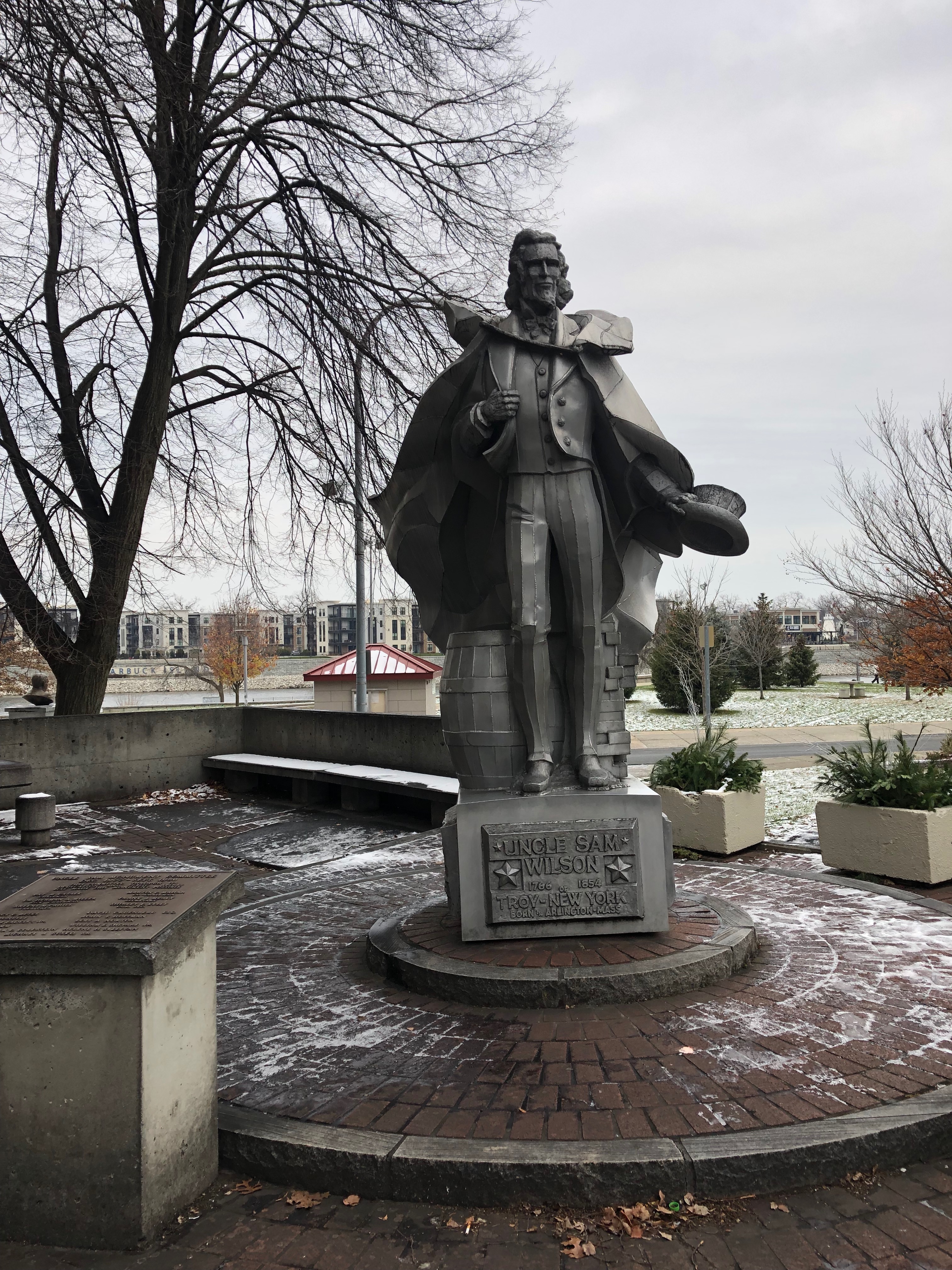
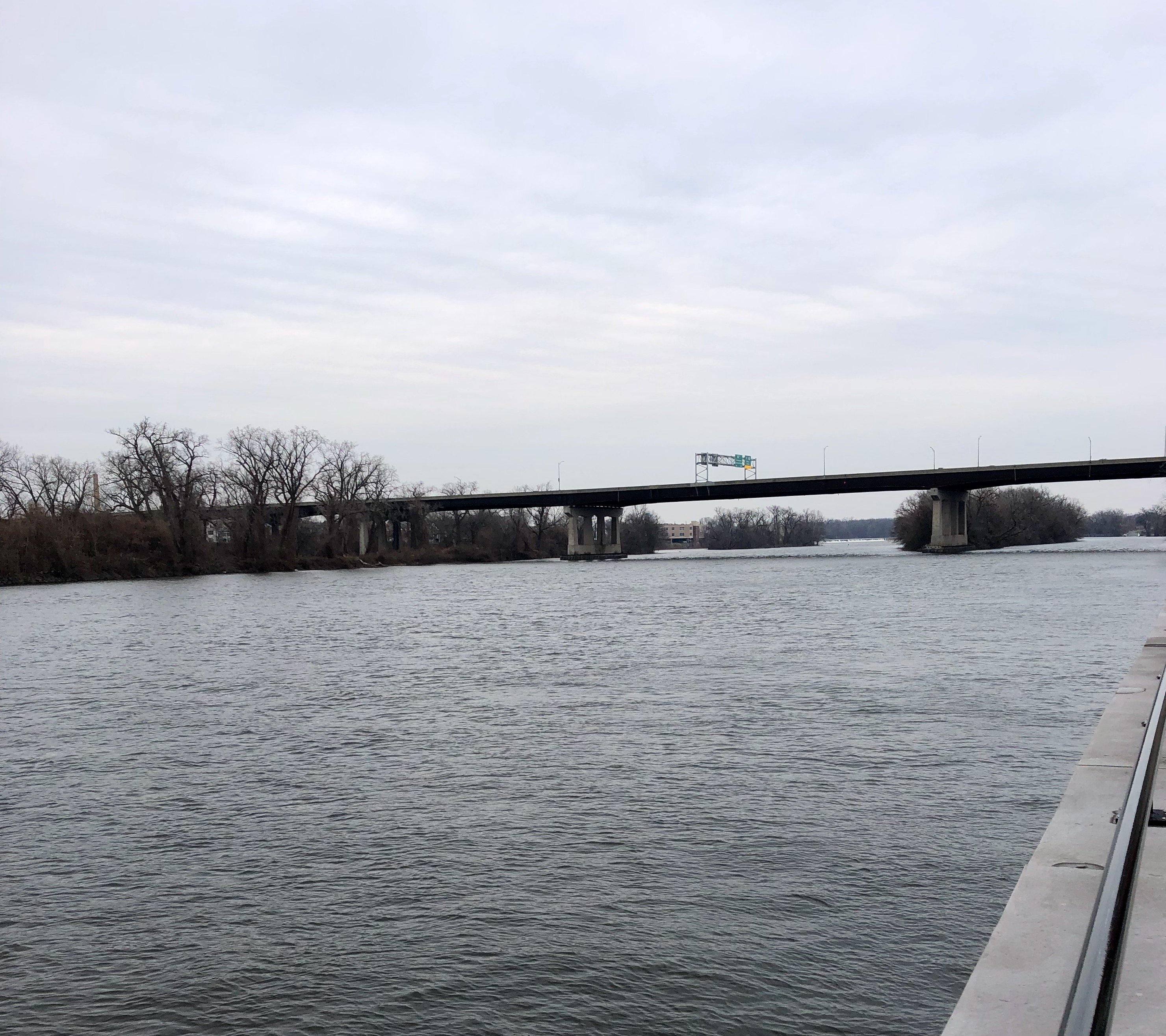
Troy turned out to be a fine location – with hotels and other amenities in close proximity to the wedding venue which meant a minimal amount of driving. As I was out and about in the unseasonably warm weather running errands and dropping things off, I took note of my surroundings (also an effort to settle my nerves). Troy, settled in 1787, has a rich history and its architecture reflects that. I took some pictures for posterity (and the blog).

Upper left: Troy is the home of Uncle Sam – a sculpture of him greets passersby

Upper right and lower right: examples of murals

Lower left: Collar City Bridge spanning the Hudson River – One of Troy’s nicknames, it was the home of a shirt-collar industry a century ago.

Left middle: a view from downtown toward RPI (Rensselaer Polytechnic Institute)

Before I knew it, the weekend was over. After all that had gone into it, our guests left town, and Gary and I began to process it all.

In trying to reconcile the fear that is part of our lives today (not just Covid, but the divisions in our country, the threats to our environment, the rolling back of the reproductive rights of women, the doubts about our future) and the desire to celebrate a joyous occasion, I thought about the challenges faced by generations that came before. I thought about my grandparents having children in the depths of the Great Depression. I thought about my in-laws telling us about a wedding performed while they struggled to survive in the Ivye ghetto during the Holocaust. I’m not suggesting that the challenges we face today are the same as those, but we are in a difficult time. I am calling upon the strength and optimism of our ancestors to see me through this. They did not allow the fear to get the better of them.

Over the last year, as we planned the wedding weekend, I wondered if we were doing the right thing. Would it be worth it if even one person got sick? We decided to move forward – to try to minimize the risk, but to not let Covid define our lives. I think, like our ancestors, we affirmed life and love. I will live with that choice (and I will keep my fingers crossed that our one guest who has Covid recovers quickly and completely and that no one else gets sick).

Widening the Lens

I feel like a voyeur, but I can’t help myself. As I continue to sift through my aunt’s things, I am captivated by letters from my grandparents (my father’s parents). I hold certain impressions of them based on childhood memories and stories I heard throughout the years. The letters confirm some of those ideas, but also shed new light and offer a different perspective.

March 7, 1975

Dearest Clair,

So how be you ketzel? Do not forget M.D. appointment and Uncle Sam. Uncle Sam is by far the best Uncle anyone ever had. We are as we were, thank the good Lord. I am now in my glory that my “friends” have gone home…..

There is so much to unpack in this brief beginning. First, the date. March of 1975, I was finishing my junior year of high school. Grandma, the writer of this letter, was 69 and would be dead 9 months later. The letter gave no hint of her failing health, she may still have been without symptoms. About four months after this, she would be diagnosed with liver cancer and things went downhill fast from there. She died December 19, 1975.

She wrote from Florida to her ‘dearest’ daughter living in New York City. Clair was the baby of the family. I doubt there were letters written to my dad that began Dearest Barry. That isn’t to say she didn’t love my dad, but I don’t think they shared the warmth revealed in these letters. Again and again, in notes from both of her parents, Clair is addressed with terms of endearment. There are many possible explanations for the absence of evidence of that affection for my dad. To the best of my knowledge, Dad didn’t save letters. Dad also had terrible handwriting, more like chicken scratching, so he may not have kept up correspondence with his parents. But, there is something more. My memory was that there wasn’t much warmth between Dad and his parents. I’ve written about their complicated relationship before. If these letters to Clair are indicative of their bond, there was a great deal of it between Clair and her parents.

Photo of Grandma and Grandpa taken by Clair around the time of this letter.

I guess it should not be surprising. Siblings can have different relationships with their parents. I can think of examples of that in our extended family. One child sees their dad as heroic while another seems him as seriously flawed. One child may feel secure in the love of a parent, another may not. Growing up I saw things through the lens of my father’s perception. Reading these letters widens the view. It doesn’t change his reality but adds to the picture I have of his family.

Which brings me to the word ‘ketzel.’ I had to smile when I read that. Dad called me that all the time when I was a child.  Ketzel means kitten in Yiddish. I didn’t know that growing up, but I recognized by the tone of his voice that it was a loving term. Ketzel is not a word I heard much if at all over the years since Dad died. Reading this letter in her Greenwich Village apartment brought my dad to me. I also didn’t know that it was a familial term – I only knew my dad used it but it makes sense that it would have been inherited along with their DNA.

Reading this letter, and the others, brought back other voices. It is nice to ‘hear’ Grandma’s voice.

Her voice comes through loud and clear. “So how be you, ketzel?” The phrasing of that is so Grandma. She was born in America, but her speech patterns had the inflections and syntax of the shtetl – at least that’s what I think it is. To me it is identifiably Jewish. Grandma was funny. She was quick with a quip, but she also had an amusing way of putting things – just like the opening of this missive.

“Do not forget M.D. appointment…” A Jewish mother reminding her daughter to take care from afar. Judging by the mounds of paper I sorted through in Aunt Clair’s apartment, she heeded her mother’s advice. She followed up on several medical conditions. Today we can access test results and other information from patient portals. Clair was ahead of her time. She kept copious records of various tests and lab reports, on paper and CDs.  

“Do not forget… Uncle Sam. Uncle Sam is the best uncle anyone ever had.” She is reminding Clair to file her taxes – which I’ll say more about momentarily. But, what a great line! Though Grandma was American born and wasn’t as close to the immigrant experience as her husband, she had a deep appreciation for her country. For whatever reason, Aunt Clair was reluctant to file her taxes. It might have been straight up procrastination, or maybe something else was at play, but Clair struggled with this her entire adult life. Taking care of details, like filing paperwork, was the bane of her existence. Filing her taxes late (or not at all some years) may have been an expression of her rebellious nature. While Clair believed in government, a subject she and I discussed many times over the years, she wanted it to be run fairly and competently. It often fell short of the mark in her estimation, and it is possible she was showing her disapproval. Her mother, in this letter, was prodding her to take care of business – but unlike the medical appointment, she didn’t listen.

Another interesting tidbit from this letter – “We are as we were, thank the good Lord.” Again, interesting syntax, not your typical ‘we’re fine.’ Grandma was thanking God that her friends had gone home. The rest of the letter goes into the details of their friends’ visit that went sour, recounted with Grandma’s trademark blunt humor. I am a bit surprised that Grandma references God, given their lack of faith, but I don’t think it represents serious reverence for a higher power, more likely just a turn of phrase.

As I read these letters I get drawn into that world, adding to the picture I already have of my dad’s family. The letters offer a glimpse into a relationship I had no access to before. It feels odd to be peeking over their shoulders, but it doesn’t feel wrong. I have an enriched understanding and by disclosing it on this blog my family can share in it too.

This effort has brought up so much rich material, there is more to explore. I hope you will find it as interesting and thought-provoking as I have.

Letters Left Behind

Note: Every so often my thoughts are best expressed in a prose-poem – I call it that because I don’t know what else to call it. As I continue going through Aunt Clair’s stuff, this is what came to me.

Aunt Clair saved letters

Who do they belong to now that

She has passed to another dimension?

The sender? The recycling bin?

Me – her devoted niece and self-appointed family historian?

Are they private?

Can I use them in my writing?

She saved them

To what end?

Buried in a stuck drawer

Wrapped in rubber bands

Encased in baggies.

Liberated, gently unfolded

Expressions of love

From her mother who died 46 years ago,

Endearments scrawled with an unsteady hand

From her father, also long dead.

Sister, nieces and nephews

offering thanks for a thoughtful gift

updating her from college or from across the world

making amends for a misunderstanding.

Love committed to paper

Yellowing, disintegrating with my touch

Voices from long ago

Briefly heard again.

A Eulogy for Aunt Clair

Note: Aunt Clair, my father’s sister, has been included in this blog many times, including a post that was dedicated to her ( this one). She was a unique person who had a major impact on my life. As my cousin Ilana so aptly put it: Every teen and young adult should be lucky enough to have an adult who cares about them and exposes them to new experiences who is not their parent. We were fortunate to have Aunt Clair. The family gathered this past Friday to celebrate and honor her. These were my remarks.

Thank you for coming – or participating via Zoom.

I’m Linda, one of Clair Brody’s nieces. Aunt Clair communicated her last wishes to me, and I hope this gathering reflects her intent.

From the time she arrived on March 5, 1935 until her death on November 2, 2021, Clair, far more than most, did things on her own terms. It is something I have long admired, though I’m not sure it always worked to her benefit.

Aunt Clair was Brooklyn born and bred. Arriving while the Great Depression still had a grip on this country, she was the beloved daughter of hard-working parents, Leo and Selma Brody. She was the younger sister, by five years, of Diane (now Gareen) and 2 ½ years younger than Barry, my father. She was so proud of her older and very accomplished siblings. Clair went to New York City public schools and graduated from Brooklyn College, with a major in photography. She was a talented photographer and some of her work is on the table here. (I am including other photos below to show her work)

Leah on her first birthday – May 1988 – Photos by Clair Brody
Leah with her Grandpa – Clair’s brother – my dad – taken that same day

Clair went on to write code for computers – for TWA (which allowed her to travel far and wide), Bendix and Avis among others –  she worked in that industry when it was in its infancy and when there were few women.

My brother Mark and I went to her apartment in Greenwich Village on Wednesday. There were a couple of reasons we went, but a major reason for me was to find some mementos of who Aunt Clair was and the legacy she leaves us. I think what we found does just that.

We were greeted by one of the long term doormen, who recognized me from my prior visits. He immediately asked, “What is happening? How is she?” Mark explained that she had passed away and his face dropped. The weight of the loss was clear. We thanked him for being so helpful to our Aunt Clair and continued on to pick up her mail and go up to the apartment.

Her mail gives another glimpse into our Aunt Clair. She has likely donated to every social justice and charitable organization in the world. The ACLU, Planned Parenthood, the Nature Conservancy, the City Mission, the Simon Weisenthal Center….the list could go on. Though she was never rich, she was generous with what she had.

We went into her apartment. First, we have to acknowledge that organization and neatness were not strengths of our beloved Auntie. Aunt Clair loved gadgets and tools and she had lots of them. She loved a good deal from Costco – so there was evidence of that, too. She enjoyed cooking and eating. – though she had a tiny galley kitchen in her Greenwich Village studio apartment – it was well-stocked with pots, pans, dishes….and gadgets.

There was a lot of dust. Aunt Clair accumulated things and saved everything. Medical reports from decades ago, instructions for exercise, letters. I found the original lease to her apartment – from July 1, 1960! She paid $80.40 a month. Think about that…she lived in the same place for 61 years. What does that say? As much as she was a free thinker, and she was as insightful and intelligent as they come, she did not embrace change.

As I looked around her apartment, I saw her love of art and music. Her taste in both could be quirky. She had lovely pieces of pottery. She also kept a plastic ring with a smiley face.

She loved biking. She had a compact stationary bike set up in that studio apartment. She had lots of tools and supplies to take care of her other bicycle, the one she kept in storage. I had great adventures with her biking.

There is much more I can say – and I will say a bit more about my personal relationship with Aunt Clair – but first I will turn to her other niece, Ilana. Then her nephew Mark will share his remembrance and I will come back.

————————————————————————

Before I share my personal memories, I want to say on behalf of my mother, that she is devastated by the loss of her sister-in-law. They may have been fractious at times (as Aunt Clair was with those near and dear to her), but they maintained a close and devoted relationship long after Dad died. Mom will miss their late-night telephone conversations and just knowing Clair was there for her.

I’d like to share some specific memories:

Aunt Clair was feisty. My father loved telling stories about her toughness, even as a little girl. One involved an unfortunate dentist who told the young Clair that the procedure he was about to perform wouldn’t hurt. Well, it did. Clair was indignant, claiming that he lied, she kicked him in a particularly sensitive spot and climbed down from the chair.

Making your way in New York City as a single woman isn’t easy. I remember Dad telling me about a mugging where Aunt Clair refused to give up her purse. She fought back and ended up bruised, angry and minus her pursue. Though Dad admired her spirit, his message to me was not to do what she did.

I learned that I had a bit of her spirit when I had an experience going into the subway. It was 1980 and Gary and I were going down the stairs to the station, Gary was ahead of me. I had a backpack on and I felt it being jostled. Without thinking, I spun and said loudly, “What the fuck are you doing?” There was a young man with his hand on my knapsack. He looked startled and he turned and ran. Gary had stopped, but the incident was already over. I surprised myself, it was an instinctive reaction. I think I was channeling my inner Aunt Clair.

Some of my fondest memories of time spent with her involved bicycling. Clair biked around Manhattan long before the city made any accommodations for riders. 

I joined her for a bike tour of Manhattan. This was no ordinary bike tour. We started in Central Park at midnight! This was in August in the late 1970s when the park was a haven for drugs and violence. Hundreds of people were gathered with their bicycles at the Bethesda Fountain. It was odd to be there. In those years, I wouldn’t have gone into Central Park by myself in broad daylight. It felt exciting and adventurous to be there amongst so many fellow cyclists.

We rode around the park, stopping periodically to hear about its history. We left the park and rode along the east and then west side of Manhattan. We rode down Broadway, passing the neon signs of the theaters, all the way to the deserted financial district. The financial district felt like a movie set, with the skyscrapers seeming like two dimensional facades. It was so quiet, it was eerie. It felt like a ghost town. We were able to ride in the canyon of Wall Street without other traffic, pedestrian or vehicular. I got up close and personal views of the architecture and sculptures in a part of the city I had only seen on a rare school trip.

Our tour concluded at sunrise at Battery Park. A hazy sun rose over the mouth of New York harbor. We rode back to the Village, got breakfast at a brasserie and ended the adventure with a nap at her apartment.

It was not my only adventure with Aunt Clair.  We took other bike rides – on Martha’s Vineyard and in Boston, too. She introduced me to walking across the Brooklyn Bridge – we bought wonton soup and ate it midway across – long before it became a ‘cool’ thing to do. I saw plays, movies and ballets with her. She introduced me to Alvin Ailey, not the man, the dance troupe. I have gone back to see them many times, and brought Gary and later my children. We ate many meals at wonderful hole-in-wall restaurants in her neighborhood. I learned so much about the city, and about being independent, from my time spent with her. Thank you, Auntie.

Finally, I want to say that I am so saddened by Aunt Clair’s final months. I wish it had gone differently. She struggled – in so many ways. She was just celebrating her 86th birthday when she found out the pancreatic cancer had returned. She fought it. She so wanted to maintain her independence, but she really couldn’t. Her body was failing her. So was our broken medical system and our country’s flawed elder care. I tried to help and so did others in the family, but we could not fix it. The inevitable was going to happen – and it did this past Tuesday.

I take comfort in several things, my memories, of course. But there is something else. When Gary and I visited her last Saturday, while she was still in the hospital, she was quite talkative. In between language that was indecipherable, she shared something important that I want to share with you. She said she had no regrets – she acknowledged that though she never had a spouse or her own children, she felt loved. She said she knew she was loved by her mother and father, and she felt like she belonged – her words. That’s more than many can say.

The last six months brought Aunt Clair a lot of anguish and discomfort, but I am heartened that she felt loved. I will miss her, as I know many of you will too, but she isn’t suffering anymore – I am grateful for that. There is a traditional phrase in Judaism, and though Aunt Clair was not religious, I think she would appreciate it: May her soul be bound up in the bond of eternal life. I hope her soul is bound with those she loved who left before her – her parents, her brother, her cousin Carol, her dearest friend Phyllis and other family and friends who were important to her.

And may she rest in peace.

Thank you.

Frankenstein

The edition I read

Apropos of Halloween, our family book club recently read and discussed Frankenstein by Mary Shelley. I had never read it before. I have seen the movie versions, the iconic one with Boris Karloff from 1931 and Mel Brooks’ version. For the record, I recommend Young Frankenstein.

Reading the book, I was surprised by how relevant the story is even though Shelley wrote it in 1818 (when she was 18 years old!). I was anticipating a difficult read. I expected the language to be dense and unfamiliar. I was pleasantly surprised to find it accessible. In parts it was quite beautiful and expressive. At other times I found it overwrought, though I suspect the author may have intended it to be. It is quite a melodramatic tale. The members of our book club differed in their judgment of the writing; some ended up skimming because they found the focus on details off-putting, while others reveled in the lush descriptions. I fell somewhere in the middle. I appreciated her ability to convey depth of emotion and paint a picture of the ‘creature’s’ experience as he entered the world, but sometimes I found it overdone and was ready to move on.

Apart from the writing itself, the story led to spirited discussion. It is so rich with themes that transcend time: the nature of man, the balance of progress (scientific discovery) and ethical obligation, the danger of unbridled passion/ambition. It was nearly impossible to contain our conversation to the scheduled one hour (we meet on Zoom). Interesting takes on the story were offered: that it was really a parable of mental illness (perhaps the ‘monster’ wasn’t real at all). Another perspective suggested that it was reflecting on the fears of that age that God had turned his back on man the way Dr. Frankenstein abandoned his creature.

We talked about the role of appearances. The creature’s appearance engendered so much disgust, fear and violence that he became the monster that the people feared. Had the public responded differently, he might never have become destructive.

In terms of the risks of progress, we agreed that the book offers a cautionary tale. We talked a bit about whether Mark Zuckerberg was a ‘Dr. Frankenstein.’ While there are differences in that Zuckerberg has not abandoned his creation (far from it), there are relevant parallels.  Progress, without due consideration of the ethics and consequences, is dangerous. Today universities have structures in place to assess the ethical impact of an experiment before it is funded. Private tech companies need to put more emphasis on ethics and consequences before steaming ahead with new applications. How to make that happen remains an open question.

In the story Victor Frankenstein, during his studies at university, becomes obsessed with breathing life into something dead. His research convinces him that he can achieve this, and he becomes single-minded in his pursuit of that goal. He sleeps little, isolates himself and slaves away in his workshop until he succeeds. Most of the story focuses on what happens after that ‘eureka’ moment, but I was interested in exploring that aspect of the narrative.

I wonder whether that level of intensity is necessary for great breakthroughs, for great scientific achievements. My daughter, who is a neuroscientist and has worked in several labs at different universities, offered that she thought meaningful scientific progress can be made by people who have lives outside the lab. She has observed researchers who have families and hobbies and still manage to produce important work. I was heartened to hear that because I am predisposed to think that it requires if not obsession, close to it.

When I raised that question at book club my cousin responded that it is a myth that big discoveries are achieved by single-minded, hardworking geniuses. He pointed out that those accomplishments are the result of collaboration or appropriation of the work of others; though individuals may claim the credit and history may celebrate that person, that isn’t the reality. We didn’t get to examine his point in depth because time had run short. I want to investigate this idea further here.

I have not read the histories of Edison, Ford and others who are credited with huge advances, but it makes sense to me that their work was built on ideas and contributions of others. I think it does us a disservice not to acknowledge that. The mythology of one man, and most often it is a man, forging the path or having the ‘aha’ moment, creates unreasonable expectations and fails to give due credit to those who provide the conditions that permit the discovery. Putting aside the cases where the idea may have been outright stolen or appropriated, wherever you look, in whatever field of endeavor, geniuses need support. These days, even in an individual sport like tennis, the winner of the tournament thanks his/her ‘team.’ Roger Federer, a genius on the tennis court, acknowledges his coach, his physio (I didn’t know what that was until recently), and his family because he recognizes that even if he was alone on the court, others contributed to his victory.

I took my cousin’s important point to heart; it still didn’t exactly answer the question I was posing. Both things can be true. Great accomplishments can require collaboration (acknowledged or not) and an obsessive devotion to the effort.  I was pleased to hear Leah’s observation; I still wonder. Though I can’t say I have seen geniuses work up close, I have worked with folks who are at the very top of their field, very respected, sought-after practitioners of medicine, law and public policy. I think it is fair to say they have bordered on obsessive. They certainly put in many, many hours of work and mental energy. They may have families and even a hobby, but it isn’t in balance. I can’t think of anyone in that esteemed position who didn’t prioritize their work (family might share equal billing, but nothing else comes close). I made a choice early in my career to seek out balance, I wasn’t that ambitious. Or maybe I was, but my ambition was to have well-adjusted children. I certainly put time and energy into them. I have come to no conclusion on this. Can a person live a balanced life and still achieve greatness? Of course, it begs the issue of defining greatness, but I’m thinking about major contributions to their field, whatever it might be.

The issue of scientific breakthroughs without due consideration of consequences and whether those engaged in that work need to be obsessed are likely connected. The obsession or unbridled ambition may lead to the inability to consider impacts beyond their own achievement. We need mechanisms in place that balance the drive for innovation with concern for the greater good. The concept of a greater good has proven difficult for folks to agree upon.

In sum, if you have not read Frankenstein, I recommend it – especially for a book club.

Note to my fellow book clubbers: If I have not done justice to the ideas shared, please add your comments. Or, if I have done justice, but you’d like to chime in, please do. If your thoughts rise to the level of a full essay, I’m happy to post it. I extend that invitation to other readers, as well.

Of A Piece

How many lives have you lived?

I was listening to a podcast the other day, as I often do when I am on a long drive in the car. Marc Maron, comedian/actor and host of WTF, during an interview, said, “That was another life, I’ve had many.” He was referring to a period of time early in his career when he was performing as a stand-up comic traveling a circuit of gigs in New England.

I thought about my life. I have had only one. I understand Maron was speaking metamorphically, but it doesn’t feel to me like I’ve had different lives. It is all of a piece. I imagine that for someone who has had very different careers or lived in different parts of the country or world, or perhaps has been divorced, it might well feel like different lives. Nothing that dramatic has happened to divide mine into definable segments.

Other than living in Pittsburgh for 3 ½ years, I have been a resident of New York my whole life – less than half of it in Brooklyn, the rest in the Capital Region. I have been with the same partner for over 40 years. I have held a variety of jobs, but all were in some aspect of public policy. These are threads that bind the tapestry of my life.

In a way, I feel jealous of those who have had more variety. Sometimes I’m restless; I want a change of scenery. I remember being on vacation in San Francisco, enjoying the natural beauty and cultural offerings, and wondering ‘why do I live in Albany?’ I’m fully aware of the downsides of the city by the bay and the upsides of New York’s capital city but I felt a sense of longing, for a different climate, new surroundings, something new. I’ve never seriously considered moving, not with all that would entail: Gary starting a new practice, uprooting the kids, being so far from our families who are almost entirely located in New York and New Jersey.

There’s a group on Facebook that I am part of called ‘View from My Window.’ Folks from all around the world post pictures from a window in their home. Many have fabulous views of mountains or oceans, but there are mundane views, too: An ordinary tree in the front yard of a suburban home or an up-close look at an apartment building exterior with fire escapes and windows. I see those pictures and imagine if it was my view. I have no complaints about the one I look at most often – the window above my kitchen sink that looks out at our backyard. The same view I have looked at for almost 30 years. As lovely as it is, I crave something different.

The view from my kitchen window this rainy, autumn morning

I’m sure others, who have moved around a lot, would envy my stability.

For some, like Maron, phases of their lives may be demarcated by periods of sobriety and addiction. That, too, is foreign to me. I can imagine that, perhaps more than any of the other changes mentioned above, living life sober would be different on a very deep level as compared to being in the throes of addiction. Perhaps one almost feels like a different person in recovery, before and after, on the wagon or off – I’m just speculating. I am happy not to have gone down that road.

Living in different places and having different careers holds appeal.  It seems so much more colorful. One of my colleagues in a writing group has lived in far-flung places in our world, not to mention different regions of our country. It sounds so much more exciting than my path.

If I am honest with myself, there is a reason my life hasn’t been that exotic. When I was younger, I was afraid of change. In college when some considered studying abroad, the idea intrigued me, but I was too insecure to do more than read through the explanatory pamphlet. I told myself I couldn’t afford it, but I don’t think that was actually the case. Looking back at it, I don’t regret it, I wasn’t ready. In some ways I wish I could go back to college now; I would be so much less tentative, more willing to take risks. Someone said youth is wasted on the young. I see the truth in that now.

The question is what will the future hold? Will Gary and I make a ‘new life’ if he ever retires? I suspect, whatever we do, it will still be of a piece with what has gone before. That’s just who we are, even with my pangs of restlessness.

Do you feel like Marc Maron does, that you have lived multiple lives? Or is your experience more like mine. I’m curious to hear if you are willing to share.

Compassion Anyone?

A flash of insight can come at the most unexpected time. I was driving to my poetry group on Saturday and I was thinking about why I was so agitated that morning.  Why was I feeling so ‘judgy’ of others? I suddenly understood something that maybe should have been obvious, but somehow wasn’t.

            Here is what I understood: If I don’t feel the emotion that the person is sharing, I am prone to judging them. If I can feel, really feel, the emotion, I am less judgmental.

            I think of myself as an empathic person. When someone shares their troubles with me, I usually feel their pain or frustration. Sometimes too much. However, there are instances where I don’t, especially these days. I was attributing that to being spread too thin and my general sense of frustration with the state of the world. It occurs to me, though, that isn’t the complete story. I have been ‘judgy’ before the pandemic.

            When a friend or relative is sharing something I can relate to, perhaps have experienced myself, I am able to recall the emotion readily. The disappointment or sadness or anger comes flooding in. When that person shares an experience or feeling foreign to me, that’s when I am predisposed to judgement. If I can’t connect their reaction to my own, I am left to intellectualize – then judgement can follow.

            I may not express it– I usually know enough to keep those thoughts to myself. But I stew in it. I’ve been stewing a lot lately. I won’t say to the person that I think they are wrong or over-reacting, but it is what I am thinking. My powers of empathy are more limited than I care to admit. Sitting in judgment doesn’t feel good, though. I don’t want to be a harsh appraiser, especially of those I love. Plus, I think it is counterproductive. Even if I don’t outwardly express it, it creates distance, or it may leak out in other destructive ways.

            Thinking about this as I was driving, the ‘aha’ moment hit me: maybe if I can’t feel what the person feels, there is another path to empathy. What if I imagine what it feels like to be that person? Not through the prism of my experience, but through theirs. So, if a person is expressing their terror of getting Covid, something I don’t feel to that degree, rather than thinking about whether they are justified and thereby trying to convince them they shouldn’t be so afraid, focus on what it feels like to be terrified. Being terrified is an awful state of mind – I can empathize with that irrespective of the cause. During the conversation, I may share some information that I hope allays their fear, but it would be delivered from a place of compassion, rather than judgment.

            Maybe the divisions among us would be helped if we tried to understand the emotion first, acknowledge and connect to it. Maybe if we named the other person’s feeling – fear, anger, hopelessness – and remembered what that emotion feels like even if it was in a different context– we could start a more fruitful conversation.

            For example, anxiety is something I have experienced, but I have had only one panic attack and that happened when I was an adolescent. Others experience panic as a regular expression of their anxiety. And, I may not be set off by the same triggers, nor have the same physical reaction, but I still know how horrible it is to feel panicky.

            My anxiety manifests in rumination, as I wrote about last week. But, even at the worst of times when I was living in my head, I was functional. Not as productive as I wanted to be, but I wasn’t paralyzed. If someone was to share their experience of ruminating, I would reflect on my own. If they were so tied up in knots that they couldn’t get out of bed, I would feel sorry for them but wonder why they couldn’t manage to get it together. While listening, it might instead be more helpful to imagine myself in my bed so overwhelmed that I can’t get up– how terrible would that feel?  – rather than thinking about whether I would react in the same way as my friend did.

            Maybe we can’t help but see things through the prism of our experience, but it is too limiting. This might be one way to be more open to others.

            I wish I could report, having had this insight, that I was free of judgment the rest of the weekend. It probably isn’t reasonable, or even desirable, to suspend all judgment. There are times when it is appropriate to criticize. Sometimes a person is so dug into their emotional state that they have lost all perspective. A compassionate loved one can offer another view. It likely won’t be well-received if it is delivered in a judgmental tone – the compassion is key. The problem is sometimes I don’t feel much compassion and that is the point of this whole essay. How do I find the compassion?

            It takes some work to locate it and I have to be willing to put in the effort. Yesterday, once again in the car, I passed two lawn signs that got me angry – a kneejerk judgment. Having had the insight the day before, I tried to test my ability to find compassion.

            The first sign read “Fuck Biden.” Great way to advertise your politics! Why would I want to have compassion for someone, why would I want to try to understand someone, who puts up a sign like that? They are entitled to their view, but in putting it out there like that, it invites anger. Should I do the work to look beyond that, to understand their rage? That is a big ask. The answer, for me, was no, no compassion. I stayed angry. My anger met theirs, metaphorically.

            The second lawn sign demanded “Unmask our children now!” My first reaction to it was to mumble ‘asshole’ to myself (actually Gary was driving and I had to explain I wasn’t calling him that). This one was easier to swallow. I could envision having a conversation. Though I am not a parent of a school-age child (I am a grandparent of a preschooler), I can imagine the frustration of dealing with the pandemic and the desire for my child to go back to ‘normalcy.’ It is unlikely that I would come to a meeting of the minds with the parent with that lawn sign, but the starting point wasn’t as hostile. As I mulled it over, my stomach muscles unclenched a bit. I would call it a semi-successful effort to find compassion.

            These two examples aren’t quite the same thing as listening to a friend or family member express something I don’t feel, but there are parallels. My goal is to walk around holding less hostility in my gut. Does my suggestion hold any water for you? If you have other ideas for how to do that, I’m all ears.

Is This the Right Time?

           I picked an interesting time to stop taking my antidepressant! About two months ago I started the process of weaning off Zoloft. Two weeks ago, I completed the process. I was on it for years – certainly more than a decade. I began to consider stopping about a year ago. I noticed that I felt ‘flat;’ I wasn’t experiencing pleasure in moments that I expected to, like being with my granddaughter or going on vacation. That isn’t to say I didn’t enjoy those things; I did but I wasn’t fully engaged. I wanted to feel more, even sadness. I understood that Zoloft was likely protecting me from real lows, but I wasn’t sure it was worth the tradeoff anymore.

            The reason I started taking medication in the first place was not because of depression, per se. I am fortunate in that I have never experienced the debilitating effects of clinical depression. My problem was that I would ruminate – I lived in my head, and I was tired of it. I remember telling my therapist that I felt stuck. I would ruminate about unsatisfying social interactions or relationship problems. Sometimes I would get stuck on fears, even silly ones. A low point was when I was on the teacup ride at Disney with Leah and instead of enjoying it – she was – I was imagining the headlines when it crashed. Anxiety was more of an issue for me than depression.

            All these years later, when it dawned on me that I was kind of numb, I thought maybe it was time to try life without Zoloft.  Even with the craziness of Covid, which has introduced another layer of challenge for our mental health, I wanted to give it a try.

            In one sense it was a good time to consider the possibility of going off the pills. When things started getting harder managing Mom and Aunt Clair’s health care about six months ago, I returned to therapy. After a few sessions I posed the question: Could the medicine be stifling my emotions? Was the dullness I felt caused by the drug? I wondered if, by virtue of being on Zoloft for so long, my brain had rewired itself. Maybe the pathways that led me continue to re-live the same conversation a hundred times had been rerouted – not to stretch the metaphor too far. She said that the flatness I was describing was a known side effect of medication and it was possible that my brain changed such that I would be less susceptible to ruminating. We discussed the process of discontinuing the medicine and what I should be on the lookout for in terms of side effects as I went forward. I also checked in with my primary care physician since my therapist is not a psychiatrist – my primary care doc actually prescribes the medicine. Having consulted with the two of them, having a plan in place, I decided to do it.

            With all that continues to go on with my mom and aunt (not to mention the relentlessly negative news from the world at large), it might not have been the wisest time to do this experiment. I think, though, it is also important for me to feel the pain of this part of the journey. Though I am only a couple of weeks into this, instinct tells me that it was the right step to take. I may change my mind – I haven’t disposed of the remainder of my pills – I reserve the right to go back on them. But, I think this feels more natural. I should feel sad that Mom is not herself. I should get angry and frustrated at the failures of our health care system. I should feel joy when my granddaughter runs at me to hug my knees, turning her bright, beautiful face up to mine, flashing a huge smile that melts my heart. I want to feel those emotions.

            It has been a dramatic welcome back to the world of emotion. People sometimes talk about oscillating between one feeling and another. My experience is more like the hour hand of a clock sweeping across an array of them – fortunately it isn’t the minute or second hand! That would be unsustainable. Anger, confusion, frustration, love, hope, despair, powerlessness, appreciation, grateful are all part of most days.

            As expected, anger is prominent. There is a lot to be angry about, and I have a shorter fuse now. I’m not sure that is a great development. Since Gary is often the one igniting the fuse, I have checked in with him to see if I’m being unreasonable. So far, we’re managing, or should I say he is. Isn’t he lucky! Seriously, though, I am working on handling my temper. It hasn’t been a problem, but I do notice a difference.

            Another expected emotion – sadness. Each time I am faced with the fact of my mom’s new limitations, I feel it. I am still not a crier. I wish sometimes I could get that release. Oddly, I find it comforting to be sad. Being numb to what is happening isn’t living. If I don’t dwell there too much of the time, I think it is healthy.

            If the last two weekends are any indication, the joy has ramped up, too. I spent time with my children and granddaughter two weekends in a row! One of those weekends was my birthday and we managed to combine all my favorite things: family, nature and art. I was more fully present. So far, so good.

My Gallery of Joy:

            I do notice some increase in anxiety. Stray thoughts about unlikely accidents (like my teacup ride) creep in, but they aren’t taking up residence. They aren’t getting in my way. At least not yet. I am hoping they won’t.

            Some may wonder why I am sharing all of this. It does feel a little weird to put this out there. But I want to ‘walk the walk’; I believe we need to destigmatize mental health issues and how can we do that if we don’t bring it out into the open? Maybe we’ll get to the point where it becomes a nonissue, then I’ll stop. We aren’t there yet. This is part of my journey, and I am choosing to share it. Hopefully it will help others who may be experiencing some of the same challenges. And, if not, maybe it illuminates what it feels like for those who have not been down this road.

Note: If any reader is considering stopping medication, please do so under the direction of a doctor and/or therapist. There can be serious side effects, especially if it is done abruptly, that need to be monitored.

First Impressions

Note: I am returning to some of my earlier blog themes by exploring the beginnings of Gary and my relationship. I continue to work on a book which will examine how generational trauma (the Holocaust)shaped our respective lives and influenced the family we created together. That book is taking forever to complete and keeps getting interrupted by life, but I keep chipping away at it.

            Gary and I were home for the break between semesters of our senior year of college when I was invited to Shabbos dinner at the Baksts. I had been raised to know enough to bring something when you go to someone’s house for dinner – wine, a box of chocolates, flowers. I wondered:  what to bring? Of course, I wanted to make a good impression. Though I had met his parents once, this would be my first extended interaction. Wine was not a big thing in my family life, and I didn’t think it was for Gary’s either, and I didn’t know anything about it, so I eliminated that as an option. I thought it would be nice if I brought a homemade dessert. Mom had a recipe for cheesecake, maybe cheese-pie is more accurate, that I loved and was always a big hit. I decided to make that.

            It was not a complicated recipe. The base of the pie was Philadelphia cream cheese – how could it go wrong? I bought a pre-made graham cracker crust. I topped the cream cheese mixture with canned strawberry filling and fresh strawberries. It looked good. I was pretty sure it would taste good, too.

            I arrived at the Bakst home in Rosedale, a neighborhood strikingly similar to my own in Canarsie. Mrs. Bakst greeted me warmly. I gave her the pie, she thanked me and asked if it should be refrigerated. We agreed that it should, and she put it on a shelf in the refrigerator. We joined the rest of the family in the living room.

            I sat down next to Gary on the couch that was encased in plastic. I took note of the furnishings, so different from my parents’ living room. Aside from the plastic coverings, the style was more formal and classic. My Mom’s taste ran to the modern (for 1979); we had a red shag carpet and black and white houndstooth drapes in our living room. We chatted for a bit, Gary’s older brother and younger sister were there, too, and then we were called to the table.

            The dining room table was set with a cream-colored tablecloth. I didn’t know if the dishes were china, but they looked fancier than everyday plates. Before we sat down, Mrs. Bakst lit the candles, reciting the prayer and then covering her eyes as I had seen my Nana do years before. Mr. Bakst made the blessings over the wine and challah.  Mrs. Bakst served the first course, chicken soup. “I cook without salt,” she explained as she set the steaming bowl down before me, “because David has high blood pressure. If you want to add it, you can.” I nodded and thanked her. “I don’t think it needs it,” David said. “It’s better without all that salt.” I didn’t add any, though my tastebuds were accustomed to lots of salt. I didn’t know if my mom or dad had high blood pressure, I did know that Mom wasn’t shy about including salt to her recipes – especially chicken soup. I was impressed that Mr. and Mrs. Bakst were so disciplined about his diet. Diet and discipline weren’t connected in my family.

            Everyone took a slice of challah. I looked around the table for butter or margarine and saw none. It was dawning on me that the Baksts kept Kosher. Gary had probably mentioned that to me, but his eating habits at college didn’t strike me as all that different from my own. I didn’t have milk with meat either (though I had been known to have a cheeseburger now and again). I didn’t yet realize that there was much more to it than that. I was about to learn quite a bit more  – much to my chagrin.

            We finished dinner. I got up to help remove the dishes.  When I stood, I was horrified to see that there were two pink smudge marks on the tablecloth where my elbows had rested. I was wearing a burgundy chenille sweater. It had not occurred to me that the color would run on to Mrs. Bakst’s pristine cloth. I think my face turned the color of my shirt.  I briefly thought about whether to say something or to try to cover it with my napkin.  “Mrs. Bakst,” I stammered, “I’m so sorry, but my sweater….look.” She looked, “Don’t worry. It will come out when I wash it.” “Are you sure?” Among the many things I knew nothing about at 20 years of age was how to get stains out. “It’s okay,” she reassured me. I made a mental note to tell Gary to let me know if it didn’t come out so I could buy a replacement. Oy. I wasn’t making the impression I hoped.

            After clearing the table, we returned to sit and continue chatting. After a bit, Mrs. Bakst offered tea and suggested serving the pie. Though, we had talked about refrigerating it earlier, we had not specifically gone over its ingredients. I realized there might be a problem. I explained to her that there was cream cheese in the mixture. Mr. and Mrs. Bakst conferred and decided that we had waited long enough after dinner to have it. According to the laws of Kashruth, I would later learn, you wait a certain number of hours before consuming dairy after meat. Not everyone observes the letter of the law. I felt badly that I had put them in that position. But, it was going to get worse.

            Mrs. Bakst removed the pie from the refrigerator, and I noticed her looking at it carefully. She was reading the label from the pre-made shell which was still affixed to the plastic cover of the pie. “is it okay?,” I asked.

“I am looking to see if the crust is kosher,” Paula explained.

I didn’t know that a crust could be unkosher. I had not yet learned that food products came with symbols to indicate whether they were rabbinically supervised and if it contained meat, dairy or was pareve (contained no ingredients that were meat or dairy and could be eaten with either). If the crust included animal fat it could indeed be unkosher. Given that there was no symbol on the label, it was likely that it wasn’t kosher.

“I’m sorry, I didn’t know. If you don’t want to have it, I understand. I can just take it home.”

Mr. and Mrs. Bakst conferred again.They decided we would have it on paper plates with plastic utensils. I felt embarrassed.

            As I drove my father’s car back to our house in Canarsie, I reflected on the evening. How many things could I get wrong? The remains of the unkosher pie sat on the passenger seat. I knew it would get eaten in my house. Though I was born Jewish, there was a lot I didn’t know. And my lack of manners was on full display! Not only were my elbows on the table, but they had stained Gary’s mother’s linen tablecloth! Hopefully the smudges would come out. I hoped Mr. and Mrs. Bakst saw some of my positive attributes – I did help clear the table….

            Writing this 43 years after the fact, I am mostly amused by my ignorance. At the time I wondered if it would be a fatal flaw in the eyes of either Gary or his parents. Obviously, it wasn’t, but I had some work to do, including understanding how Gary felt about Judaism’s rituals and practices and whether I wanted to integrate them into my life.

Gary and I survived my inauspicious debut with his parents. Five months later we were graduating from SUNY-Binghamton 1980

The Albany Book Festival to the Rescue

I thought this week’s blog post was going to be titled “The System is Broken.” The system I am referring to is elder care. It was motivated by my visit to my aunt at the Amsterdam Nursing facility. I will write that piece, but not today. Fortunately, I was rescued from that dark place by some uplifting experiences, and I decided to focus on those.

First, I will note the value of friendship. In the midst of my distress, I had a lovely dinner with my almost-life-long friend (we met when I was 14), Steven. We commiserated over our respective painful experiences of seeing our elderly parents, relatives and friends go through the indignities that aging can bring, especially when coupled with the limitations of the health care system. We found much to laugh about even as we covered those difficult subjects. We ate outside on the Upper West Side of Manhattan with a refreshing breeze washing over us. A strong cocktail improved my mood. It was a much-needed respite. Thank you, Steven.

This was followed up later in the week with a zoom call with Merle. We lamented the state of our country, but then focused on our gratitude for the good fortune we both enjoy.

The crowning event, though, in shifting away from writing that disturbing blog post, was attending the fourth annual Albany Book Festival. Last year it was limited to a virtual event due to the coronavirus. This year it was a mixture – virtual and live. I was concerned about attending an in-person, indoor event and wondered whether they would be taking appropriate precautions. I read the Covid information on the website and my worries were eased. I assured Gary that if they weren’t enforcing the rules and the environment felt unsafe, I would leave promptly.

My well-thumbed program

The morning fog had burned off, leaving a bright blue sky dotted with puffy white clouds, as I drove the short distance to the SUNY-Albany campus. I parked my car and ran into an ex-colleague from my days working at NYSSBA. This was a delightful surprise, as I had not seen her in several years. We caught up as we walked to the campus center. Purple signs, SUNY-A’s color, directed us. As we entered the building, I was relieved to see each and every person masked; not just masked but wearing them properly, fully covering their nose. There were a lot of people, but the area was not overcrowded. So far so good.

I perused the program and decided to head to the auditorium to hear Nathan Philbrick talk about his new book, Travels with George. It is a combination history, travelogue and memoir; the George in the title is George Washington. I had not read the book, nor was I familiar with Mr. Philbrick’s earlier work, but I thoroughly enjoyed the relaxed but informative conversation that was facilitated by moderator, Paul Grondahl. Mr. Philbrick, who has written multiple history books about early America, talked about Washington as a flawed but great man. Sprinkled in were amusing and interesting anecdotes about Philbrick’s own life. To conclude the session, Grondahl asked the author about his prediction for our country’s future, in this difficult and contentious time, given his knowledge of the past. Philbrick reflected on other perilous times in our history, including in the immediate aftermath of Washington’s election when the United States was first forming as a nation. He responded, “I have faith in America.” He pointed out that it may take a while, likely years, to weather the current storm. He admitted that though he is a pessimist by nature, he still trusted in our institutions. My spirits lifted. I felt better. I realize he is just one person, but he struck me as well-informed, intelligent, and knowledgeable. I bought his book.

I picked another session to attend. This one featured a conversation with the newly-named New York State poet and author, Willie Perdomo and Ayad Akhtar, respectively. Again, I was not familiar with either man’s work. I am not well read in poetry.  I am always promising myself that I will read more of it, to no avail. I left this session motivated once again. We’ll see.

Both men were well-spoken, good-humored and insightful. It is no wonder that Mr. Perdomo is a poet. He spoke lyrically, expressively and meaningfully about his life-journey. I could have listened for another hour. Mr. Akhtar didn’t project the same warmth, but he too was insightful. I bought his novel, Homeland Elegies, which according to Barack Obama is ‘a powerful and searching examination of contemporary American politics and attitudes.’ I value President Obama’s book recommendations and look forward to reading Mr. Akhtar’s work.

After that session, I wandered through the exhibit hall, taking in the offerings of other authors and publishers. I looked out the window and saw the brilliant sunshine. I decided I wanted to enjoy the beautiful weather rather than attend more sessions so I headed home.

I was invigorated by the talent, intelligence, and diversity I had witnessed at the book festival. Though I cut my stay short, I had gotten what I needed: a reminder that there are creative, smart, interesting people who are engaged with complex issues. It made me feel better about the world, about the future. Though it doesn’t change the fact that ‘the system is broken,’ I felt more hopeful and energized. Next week I can write about elder care.