Stories I Tell Myself

Linda Brody Bakst on Brooklyn, growing up, identity and more

  • I have a running joke with the guy who prepares our taxes. When I call to make the appointment he responds, “Now I know tax season is done! I am in the homestretch,” he says with delight in his voice.

    The joke is that I am almost always the last of his clients to call, usually with only a few days to spare until the deadline. This year I called on April 5th, a little early for me. Last year he was in shock when I called, and it was still March.

    We have been working with the same guy for roughly 30 years, since Gary went into private practice and our taxes became too complicated for me to do myself.

    Anyway, the point is not that I am a procrastinator, though I am that. My point is actually the conversation he and I had when we met this time. Over the years we have had many discussions, including an annual update on our respective families. I have always enjoyed our session – as much as one can when the ultimate purpose is to figure out our tax bill.

    In all those years, we both understood that we do not share the same political affiliation. He is aware of the organizations I donate to – the usual laundry list of liberal causes, though they are mainstream compared to some of the more leftwing groups out there.  I know he is more fiscally conservative, befitting a CPA.  

    Somehow during this visit our conversation strayed farther into the political realm. The Covid relief program came up and he shared his perception that it was ill-conceived, with folks who didn’t need assistance getting it. His message was, “if you saw what I saw, if you knew what I knew, you would agree with me.” I acknowledged that it is entirely possible that the program wasn’t designed appropriately – I know little about it, and I have no personal experience with it. I don’t doubt that our government is capable of mismanaging a program. The difference between our perspectives is the motives we ascribe to it and the conclusions we draw.

    I think he sees governmental ineffectiveness and believes it is proof that there is corruption at the root, that inherently it will be flawed, and we shouldn’t support those programs. I see ineffectiveness and I want us to try harder, do better, build oversight mechanisms to ensure the money goes where it is supposed to go.  

    What was interesting to me about our interaction this year was that it was more pointed but fortunately it didn’t get unpleasant. We agreed that we have different priorities. As a bottom line, I am more concerned about civil rights (including reproductive choice) than I am about our economy. He is more focused on our nation’s finances and what he perceives as a diminishing work ethic among our younger generations.

    Before we got to the point where we concluded that we would agree to disagree, we touched on a wide range of subjects in addition to Covid relief,  such as police, U.S. support of Israel, Hunter Biden, Ivanka and Jared. Don’t you talk about that stuff with your accountant? With each topic, we quickly came to a dead end. We shrugged and kind of laughed. We were not going to come to a meeting of the minds. In between we returned to the task at hand – my (and Gary’s) 2021 tax return. We ended on a reasonable note, appreciating that we could have the conversation since so many could not.

    Naturally, as I drove home, I pondered our divide.  Aside from understanding that much of it came down to differences in our respective priorities and foundational beliefs, I had another thought. We are creatures of our environment and experience. Being an accountant for all these years, watching the endless (absurd? irrational? circular? targeted?) changes to the tax code, interacting with a certain segment of the population, would shape one’s perspective. My accountant may not have seen the people for whom the Covid relief program was a lifesaver. This is true in all professions – high school teachers, doctors, police detectives, the list goes on. When you do a job for a long time, you may not even realize that your view has narrowed. You may think you’ve seen it all, but it is still a narrow slice of humanity.

    I think about Gary, who is an endocrinologist (he treats many diabetics). He has patients who are non-compliant – maybe they drink too much, eat an unhealthy diet and/or don’t exercise. There is a danger that he could become cynical about people’s ability to manage their disease – I don’t believe he has. I believe he has maintained his compassion, but it would be understandable if that faded. It would not be acceptable, and it wouldn’t be good for his relationship with his patients if he were to prejudge them, but I can imagine it happening.

    Or take another issue that all doctors face: insurance and the bureaucracy that has developed around medicine. Having negative experiences with insurance companies, where they look for loopholes to deny coverage, could color one’s perspective. It could lead to giving up more easily before getting the patient the treatment they need. The quality of care can be compromised if one isn’t vigilant.

    Both challenges can lead to burnout among practitioners.

    I think about my dad who was chair of a social studies department of a New York City public high school. He retired as soon as he was eligible at the age of 56. Not because he was tired of teaching or because of the students – he still enjoyed being in the classroom. It was all the red tape, all the obstacles, and the lack of resources that drove him to end his career. I think it is fair to say, after over 30 years in education, he was burnt out. Today we see educators leaving the field in droves, long before getting their 30 years in.

    Every profession is susceptible to it, and if not burnout per se then being so entrenched in the negative that it becomes the lens through which you see the world. I knew it was time to leave school board service when my frustration intolerance got the better of me after nine years. But that was a volunteer position – I could step back without consequence to my family’s well-being. Not everyone has the luxury that I or my father enjoyed. He had a good pension; he could move on.

    In some instances that jaded, cynical perspective can be dangerous. I’ve written before about the hazards police officers face, on many levels. Police officers see us at our worst. The consequences of approaching a new interaction with a citizen expecting the worst is problematic. I imagine, after years on the job, police officers may not have the most balanced view of humanity. I’m not blaming them, I think it comes with the job.

    The question then is: what can we do about it, if anything? How do we keep our perspective broader than our circumstances allow, whatever profession we practice? How do we guard against the creeping cynicism that may be inherent in any work we do? Self-awareness may be the first step. We need to admit to ourselves that we are susceptible to the bias in the field in which we work, and then we need to pursue professional development or other experiences that keep us fresh. It is not an easy task, but a necessary one.

    When I got home and told Gary about my visit with our accountant, he looked at me incredulously. “You had that conversation with the guy who is going to tell us how much tax we owe?” I nodded. I choose to maintain my faith in humanity.

  • When you have a group of friends, especially from college, there can be an ebb and flow to the connections. I was part of a group of four friends at SUNY-Binghamton that has remained connected for 46 years, from freshman year through graduation and the decades that followed. Wow! that is a number that is hard to fathom. Stretches of time pass without seeing each other, though social media has made it easier to keep tabs on one another, but when we gather again, we pick up where we left off. Alison, Dianne, Merle and I have all led very different lives since college but the essentials remain – our view of the world, our humor, our wish to see the best in each other are at the heart.

    Most recently we gathered in Atlanta for a four-day visit. Sadly, the reason for our reunion was the death of Dianne’s husband after a grueling battle with pancreatic cancer. Dianne has lived in the Atlanta area since 1982, the rest of us remained in New York. Though our trip was prompted by her tragic loss, our time together included as many laughs as tears. There’s a Joni Mitchell lyric, “laughter and crying, you know it’s the same release” seems particularly apt. Our visit surely did not heal Dianne, a loss of that magnitude is too hard to process if it ever can be, though she is strong and resilient. Hopefully we provided comfort that she can draw on as she figures out her path forward.

    The four of us bonded during freshmen orientation at SUNY-Binghamton. Alison and Dianne chose to room together, they were high school friends from Island Park, a working-class suburb on Long Island. Merle and I came from Canarsie (Brooklyn) and though we attended the same high school, we didn’t know each other well. Luckily, the four of us were assigned to the same dorm, Cayuga Hall. Many nights of drinking, dancing, studying, and talking – mostly talking – laughing and crying carried us through those four years.

    Sometimes in friendships like ours there can be crosscurrents of tension where one person falls out with another or the dynamic shifts. That didn’t happen so much for us, at least not that I remember. Choices we made, classes, internships and jobs, may have separated us but the bond remained. We saw each other through break-ups, disappointments and achievements in those four years. It is kind of extraordinary that it was enough to sustain us for more than 40 years after we left college.

    Some friendships are born of convenience, from work or your neighborhood, and when no longer convenient, they dissolve. Others stand the test of time. What is it that creates a stronger connection?

    Scenes from Atlanta:

  • I was in the airport and had time to kill. I had finished the book I brought with me, so I went in search of another. I scanned the display and saw one that looked interesting. It was an Oprah Book Club selection and I usually find her recommendations to be reliable – they are often the right blend of substantive, and highly readable. Aside from having her seal of approval, the descriptors on the cover were ‘propulsive,’ ‘magnificent,’ and, ‘heart-pounding.’ I was in the mood for that. Perfect reading material for my wait in the terminal and the two-hour flight.

    I dug in and was taken on a ride from the beginning to the end. I read 378 pages in basically two days. What book was it? American Dirt by Jeanine Cummins.

    Some of you may recognize the title. When I was perusing the shelf in the airport store it did not ring a bell. After I finished it and went to enter it to my list on Goodreads, I saw that it was the subject of controversy. I saw comments that labeled the book racist. When I read a little further, I remembered the storm. I don’t think I followed it closely at the time – it was published about two years ago – but I recall the dispute over whether a white woman could credibly tell the story of Mexican migrants.

    As I read the book, I did note that the author’s name did not sound Latina and I wondered if its portrayal of Mexican cartels and culture was accurate. I flipped to the back to read about the author, and I also read the acknowledgments. I thought, like with any novel, that I would give the writer the benefit of the doubt – that she likely would have done her research, that she and the editor(s) were responsible and would not knowingly put forth a false picture of that life. I was quite invested in the story, and I wanted to find out what happened to the main characters. After all, I knew I wasn’t reading a scholarly history book or anthropological analysis. I read on and I am not sorry that I did.

    It is a powerful story. I came away with a much greater awareness of the dangers, risks and challenges faced by those who make the arduous trek from Central America and Mexico to the United States. I don’t know if many face the near-death experiences that the mother and son did in this work of fiction, but their fear rang true. I was moved by their plight and by those who took the journey with them.

    On first reading the criticisms of the book, I was embarrassed that I missed that it was racist. But was it? I wanted to understand what the issue was. Did the story stereotype Latinx? I thought the characters were multidimensional, but I could be oblivious. Did it misrepresent the violence of the cartels by either romanticizing them, downplaying them or sensationalizing them? That is possible, though movies and television shows are far more extreme than this book was. I am not knowledgeable enough to assess the book’s take on that. Most of the disapproval, though, centered on the author’s lack of credentials to tell this story. Under pressure, Jeanine Cummins eventually claimed a Puerto Rican grandmother, though I believe she identifies as a white woman.  Ultimately the question seems to be: can a white woman write a novel about persons of color?

    This question applies more broadly, and I am troubled by the conversation around it. I heartily agree that historically marginalized voices need to be heard – space and time must be devoted to those who have previously been denied access. Also, if one wants to gain insight into a culture, it is probably best to read the literature of that culture rather than an outsider’s view. That said, writers should not be limited to only telling stories born of their personal experience. Male writers should be permitted to tell a story from a woman’s perspective and vice versa. Their success must be judged on the merits. I think it is a daring thing to do – I don’t write fiction, I don’t have the imagination for it. I can’t conceive of writing in another voice. But I don’t want to make that a rule for those that can. Thankfully we have many creative storytellers who reach beyond their own lives to explore the world (or create other worlds). Wally Lamb, in my opinion, did it quite successfully in She’s Come Undone, a story with a female protagonist, among others.

    This raises several related issues. One might criticize Oprah for picking the book. She has a lot of clout. One could argue that she should use her influence to bring authors forward who would not otherwise get mainstream attention. To be fair, though, I think she has done just that many times over. But, perhaps if she wanted to focus on the migrant experience she could find a book written by someone who took that journey.  On the other hand, this was a very compelling read and sparked a lot of discussion. Isn’t that a good thing?

    The publisher came in for a lot of criticism too. To some degree, the same questions that faced Oprah were directed at them. Should this manuscript have been bought and promoted? I don’t know the answer to that. I can only say that I found it to be a spellbinding story.

    The controversy over this book raises important concerns. The backlash against it and the author raises lots of questions. In our desire to bring forward previously marginalized voices, is it a zero-sum game? Can the marketplace expand, or will voices that had access before now be silenced? Did this author deserve to be vilified?

    I am not one who has worried about political correctness or cancel culture. I believe that many people do indeed need to be more sensitive in the language they use; that our collective (and individual) consciousness continues to need raising; and, that people deserve to be held accountable for their words and deeds. I am concerned, though, that if we narrow who is permitted to be heard on a given topic based on some aspect of their identity whether it be gender, race, ethnicity, or religion, we will have taken a giant step backwards. Sometimes an outsider brings needed insight and a useful perspective.

  • Note: The following essay was written by Gary Bakst, my husband. Thank you, Gary, for you thoughtful, insightful piece.

    The American dream is you work hard, and you get ahead.  Your children should have a better life than you have.  Their children should have a better life than theirs.  And, to be fair, this country has lifted millions of people into the middle class over the years, especially during the post-World War II years.  While there are all kinds of questions about how you measure this, the middle class is mostly estimated to comprise over 50% of our total population and has been over 60% at times. 

    That is the dream.  Then there is reality.  Many people are struggling to achieve that goal.  Many others are struggling to hold on to that achievement.  The share of Americans in the middle class has gradually diminished over the last 5 decades according to most estimates and the percentage living in poverty has gone up.  People have fallen out of the middle class showing us that mobility can go down as well as up. Income inequality has risen.  The wealthiest Americans have seen their share of wealth grow ever larger while most people struggle to meet their expenses for food, fuel, heat, medicine. 

    The myth of upward mobility is the real world for so many people.  Not that nobody is able to achieve a better life, a more comfortable financial situation.  Some do.  But, I am writing this because I am thinking about the people I see every day.  I see patients and I see staff working in our office.  So many make decisions about their care that would be different but for the cost of their medications. 

    So many patients tell me about their children.  Some are doing amazing things and it is so nice to hear those stories.  I think about the kids who are accomplished professionals, or well on the way to becoming that.  Children who have their own lives, homes, families and are such sources of joy and pride to their parents. 

    But it feels like many more of my patients describe children who live in a different reality.  They are dealing with unstable job situations, unstable relationships.  Some deal with addictions, depression.  Some have children but need help taking care of those children.  Many are adults living in their parents’ homes. 

    As I have thought about these people, I have tried to make associations.  What is the common denominator that explains who has done well?  Of course, there is no perfect predictor, but I do think that stability in the parents sure does help the children.  I think of some of the married couples I take care of who are just such fine people.  Maybe they are not particularly wealthy, but they are terrific role models.  It seems to me that this, along with the expectation that their children will get a college education, goes a long way. 

    But some other people are also fine people, hardworking and with wonderful values.  But life perhaps has just not gone the same way for them.  Perhaps they have had children but a relationship that did not last.  Perhaps they have had career setbacks.  It seems to me that it is so hard to recover from those setbacks in this country.  I know these people hold their children just as close to their hearts as others do.  But I wonder if their expectations for them are different. 

    I remember when I graduated from high school, there was a mother who was crying with joy saying she never imagined she would have a child who would graduate from high school.  I recall thinking how different that was from my parents’ expectations and from my own.  Perhaps the child internalizes those expectations, and their goals and decisions are likewise impacted.  My parents had little education, but they sure did believe in its power and were determined that their children would go to college.  

    It seems to me that community has an awful lot to do with these expectations.  I see people who live in small towns and may not have the same opportunities that others do.  There may not be a tradition of people going on to higher education there.  That same issue can often be true in urban areas.  While we are nearly all connected virtually, we still live in a concrete world that we see, walk on and experience.  It is a powerful message about what is possible.  

    I did not intend this essay as a dissection of American public policy, but I do think that we need policies that encourage that upward mobility and the factors that promote it.  I think we should look at what personal characteristics and family dynamics are most helpful and do more to encourage them.  And I believe we need to break down barriers that prevent people in specific localities from reaching their dreams. 

    I am not suggesting that money is everything.  There is so much more.  We should not equate money and success, money, and happiness.  And there are surely lots of paths to a happy and fulfilled life.  It does not have to be, it really cannot be, the same path for everyone. 

    But it is hard to imagine that having the means to live a healthy and comfortable life is not better than not having those means.  Money for many of my patients is a direct barrier to health.  It seems like that ought to matter to somebody.  

    It is also worth pointing out that I am not suggesting upward mobility means everyone should be richer than their parents.  For one thing, some parents are already doing quite well and there may not be that much room to go up.  How rich would a child of Bill Gates need to be if we used that definition?  For another thing, the goal is surely not endless wealth.  That seems like a bizarre set of values. We are hoping for people to be secure and happy; healthy and safe.  Money is part of that but is not an end in itself.  

    I wonder if anyone else out there has thought about this issue.  What factors do you see as positively or negatively affecting these outcomes, be it at the family, neighborhood or even at the public policy levels?  How do we make the dream attainable for more Americans?

  • Regular readers of my blog know that my relationship with Florida is fraught. I love the beach and sunshine, but I have been traveling there since I was 11 years old to visit elderly relatives. Those trips didn’t feel like vacations, they felt stressful. I connect Florida with aging, the state serves as a reminder of our mortality, not to mention its ridiculous politics, and even though I know my grandparents and parents loved their lives there, it is a negative association. Others with the same history feel positively and have warm memories of their visits. I can’t explain why I feel the way I do, but I can’t seem to shake it.

    I have also had difficult travel experiences, from an Amtrak trip that took 24 hours longer than it should have, to last year’s nightmare landing in Orlando in turbulent weather, then sitting on the tarmac for more than two hours before taking off for our final destination, Fort Lauderdale; it rarely goes smoothly.

    All of that said, we looked forward to our trip this year. We planned it as a long weekend getaway back in December. We would meet close friends near Port St. Lucie and see NY Met spring training games. We would also visit Gary’s mother and other family. I was determined to approach this year’s trip with an open mind.

    We got off to an uncertain start when, not long after I made the flight reservations, I received an email from JetBlue advising us that the departure time for the outbound trip was changed. If I wanted to reschedule, the email said, it could be done simply by clicking on the link provided. I wanted to adjust our flights, so I did just that and was directed to their website but was unable to make any changes. After repeatedly getting the same error message, I called the airline. I was told by the automated system that my wait time would be over 120 minutes! It gave me the option to communicate with them by text instead. I took that opportunity. They would text me when a person became available. I went about my business that day, keeping the phone close so I wouldn’t miss their message. Seven hours later, as I was driving on the Thruway, I heard the familiar ding of an incoming text. I briefly looked at my phone. It was indeed JetBlue. Perfect timing! I would have to try again later.

    The next day, I called and this time after the maze of menus, I chose the option of having them call me back. They said the wait time would be about an hour and I did receive a call in that time frame. Things were looking up! I explained the adjustment I wanted to make to the JetBlue representative. It seemed simple enough. After the call was completed, I received an email confirmation, but the heading of the email said, ‘Your itinerary has been cancelled.’ Uh-oh. I opened the email, the body of which provided a new confirmation code. I went online and put that code in, and it looked like we still had our reservations. Okaaaay. I was cautiously optimistic.

    I know this is a lot more detail than anyone wants to read, but there is a point to all of this. The point is that with all the efforts to automate and streamline operations and allow passengers to ‘manage’ their travel plans, my experiences suggest that it is all a clusterfuck. I don’t like to use coarse language generally, but I need to call it like I see it.

    I should have known at that point that this trip, at least the travel part of it, was destined to be aggravating. It got worse. I thought, based on finding our travel plans intact, despite the heading of that email, that we had what we needed. I was wrong. As the date of our travel neared, and I had not received anything from JetBlue, usually they bombard us with emails, I thought I better check. Good thing I did. Turns out my trip was cancelled, though Gary’s was not. How that happened, given that we had the same confirmation code, I will never know.

    This required another series of calls and call backs. Finally, I reached a human being. It took 90 minutes on the phone to re-book my flight. I had already tried to do it myself online, the system would not let me. It gave me the message that this was a duplicate reservation!  You gotta love these systems.

    Eventually, I was successful – we no longer had the same confirmation code, but Gary and I were on the same flights. Phew! Now the only disappointment was that it became increasingly clear that there would be no baseball. Oh well, we and our friends decided we would keep our plans. We were staying on the beach on Hutchinson Island, and we knew it was lovely there. After a long winter, shut in by Covid, I was especially excited to get away.

    Gary and I got to the Albany airport, bringing only carry-on bags, and boarded the plane. We learned that not only was the entertainment system not working, but the wi-fi was out as well. They offered no complementary future service and no rebate or credit. Fortunately, I had lots of reading material. Gary tried to sleep. Other than the ambient tension around mask-wearing, the poor flight attendants had to admonish passengers multiple times, it all went smoothly. I don’t understand why folks make a big deal about the mask, especially when the airlines make the rules crystal clear. And you’re allowed to take it off to eat and drink! I don’t get why it is such a hardship. Gary and I made it to Fort Lauderdale, got the rental car and were relieved to check into our hotel.

    The next four days flew by – we visited with friends and family, sat on the beach, tried pickle ball for the first time and ate good meals. Before we knew it, it was time to return home.

    On our final night at the hotel, I used the lobby computer to check in for our flight. Since we had picked up a few items to bring back to New York, we had too much to carry on, so I paid $35 to check a bag. As I went through the process of the online check-in, I found Gary had an assigned seat, I did not. I would have to take care of that when I got to the gate. I printed out the boarding passes and went back to the room. Again, this is way more detail than anyone wants, but I share it because it illustrates how complicated travel has become.

    We successfully returned the rental car and took the shuttle to the terminal. We already had our boarding passes, but we needed to check the bag. We looked for signage to tell us what to do. We went to one of the many kiosks. I tried to initiate a transaction with my passport – the system kept freezing, nothing happened. We tried another station. Eventually we had success and were able to print out a baggage claim tag. I fumbled with it, trying to figure out how to affix it – not rocket science, but not clear either. We got on a long line to check the bag. There were three JetBlue employees seemingly set up to receive luggage. One was doing something on their phone (perhaps it was work related). Another one needed assistance from the third one so no progress was being made. Only one employee seemed to know what they were doing.

    The whole process was stressful. So many steps, so many glitches…and we weren’t through security yet.

    Gary and I paid for TSA-Pre to expedite the security process. We approach the security line. The person checks our documents, we walk a little further and another stops us. “Will your bag fit?” she asks Gary.

    “Yes, I put it in the overhead compartment on the flight down.”

    “Let me measure it.”

    “I don’t think that is necessary.”

    “Yes, let me check.”

    She takes the bag, and it doesn’t fit into their compartment.

    Gary and I object. “I’ve taken this bag more times than I can count onto planes. It always fits.” “I’m sorry, we can’t allow you to go ahead. You have to check it.”

    “Who is your supervisor?”

    She points vaguely behind her.

    We make our case to the guy we think she pointed to.

    He says, “You have to go to the ticketing area.” We realize we are getting nowhere.

    Fortunately, we left enough time for this nonsense. We walk back from whence we came and looked for the correct line to get on – someone tells us we need to use the kiosk. We don’t want to do that – we want to deal with a person. We are directed to another line.

    We finally get to the counter and plead our case. Getting nowhere, we give up – we’ll check Gary’s bag. Another $35, but at least we can get through security and go to the gate. Gary watches to make sure they attach the baggage tag and put it on the conveyor belt. We leave, both of us beyond frustrated. We get through security without further incident.

    I still need to get my seat assignment. No one is staffing the gate desk. I stand there waiting. Now it is only 30 minutes until the flight. When someone finally comes, they tell me to go sit down – I point out that there are no seats in the gate area (it is crowded – Gary has gone to sit at another as yet unused gate). The employee shrugs and tells me he needs to meet a plane and will be back. I go find Gary at the other gate where there are seats. I sit for ten minutes, stewing. I fire off a few angry tweets, decrying JetBlue’s service. Then I go back to our gate where there are now three JetBlue employees behind the desk, though no one looks up to acknowledge me. I approach and explain that I need a seat assignment and am hoping they can place me near my husband. They tell me they aren’t ready yet. One says, “It will take about ten minutes for the system to boot.” I back up. There are other passengers waiting to be helped.

    I wait. Eventually another passenger approaches the podium, and they are helped. I figure now it must be my turn. The agent hands me a boarding pass. I am five rows behind Gary. Whatever, at least I have a seat.

    We board. The woman sitting next to Gary is willing to switch with me. It isn’t essential that I sit next to Gary, we have flown by ourselves and separated by the aisle or rows apart, but it is more pleasant to be next to each other. The flight proceeds, this time with working wi-fi.

    Looking back at the flights and our experience at the airport, I wonder why I got so easily riled up, why was I so frustrated? The process of changing the reservations was absurd, but the other stuff wasn’t that big of a deal. The additional fees were annoying, the extra steps irritating, but it shouldn’t have gotten me so agitated. I need to get back to meditating! There is something about air travel, and it precedes Covid, that ramps up the stress. There are so many delays, so much ‘nickel and diming’ us, the online systems are not user friendly, and the airports are woefully inadequate for the crowds of travelers, that I start to wonder if the trip is worth it. But I want to go places! I have sites to see! I don’t want to get to a point where I am dissuaded from exploring the world. Maybe I need to adjust my attitude, accept that it will feel like a giant cattle call, no more luxurious than bus travel, and allow that more often than not there will be a delay, and make peace with that. Or, is there some magic to planning air travel to improve the experience that I am unaware of? Suggestions, please!

    The beach at Hutchinson Island – worth the hassle?
  • As has often been the case recently, I got to thinking after attending a talk at the University at Albany. Anthony Ray Hinton, author of The Sun Does Shine, was the featured speaker at the annual MLK Celebration. Mr. Hinton served 30 years on death row in Alabama for a crime he did not commit. Through the efforts of the Equal Justice Initiative, and his own forbearance, he was released from prison in 2015.

    Mr. Hinton’s speech was both inspiring and heartbreaking. I find myself noticing that a lot lately – the duality of good and evil in this world. The tragedy of the injustice of Mr. Hinton’s prosecution, the racism and cruelty he endured, is countered by his faith and the steadfast effort of good people. Mr. Hinton told his story through tears. I found it painful to hear, it was uncomfortable – but we need to bear witness to the damage done when our systems fail, when people entrusted to carry out justice fail. I am no psychiatrist and won’t pretend to be one, but I have to guess that Mr. Hinton suffers from Post Traumatic Stress Disorder. How could he not? The fact that he isn’t in a constant rage, he shared his humor and compassion, not just his tears, in his speech, is a testament to his strength. To be willing to relive his trauma so that we may learn from it is a gift.

    As I sat in the audience, I thought about the courage of individuals who come forward after experiencing something so harrowing, those who are willing to expose their suffering, to live it again, and I am humbled. I don’t know what to do with all the emotion. I want to fix it – I want Mr. Hinton to be able to heal. I want to prevent another person from experiencing the injustice. It feels overwhelming. But, if I don’t come away moved to action, even if it feels inadequate to the task, then Mr. Hinton’s willingness to dredge up his pain will be for naught.

    We ask a great deal of survivors of trauma. We ask them to tell their stories so that we might learn. We ask them to not make us too uncomfortable while they tell their truth. We ask them to continue to function in this world, despite the fact that they have seen and experienced the ugliness of mankind. I think of my in-laws giving testimony as part of Spielberg’s Shoah Project. I have written many blog posts about their journey. It took a while for my father-in-law to recover from the process of giving testimony. There was a personal cost to doing it. He wanted the story known, he wanted it documented, but he paid a price in reawakening pain, depression and anxiety that had been pushed down. I believe it was worth it to him and to my mother-in-law, their experiences are now preserved for the ages, they cannot be erased from history even after their time on earth expires.

    When we hear the stories of survivors, it often includes a message of hope. People who stood up, who made survival possible. In Mr. Hinton’s case, he had the emotional support of his mother and best friend, as well as Bryan Stevenson of the Equal Justice Initiative (and the staff of that nonprofit). My in-laws were aided by their families, ‘righteous Gentiles,’ and luck. I am thankful for those forces for good, Paula and David would not have survived but for their efforts and their stories would be unbearable if not for those acts of courage and kindness.

    I watch the war in Ukraine unfold and I see the same duality. The barbarism unleashed by Putin, countered by the resolve and courage of Zelenskyy and the Ukrainian people. Gary and I attended a local prayer vigil in support of Ukraine. The Archbishop of the Albany Diocese, Edward Scharfenberger, spoke, cautioning us to not give in to despair. He said despair was a tool of the devil. While I don’t believe in God or the devil, those aren’t words or ideas that resonate for me, I do believe humanity has the potential for good and evil. I think he is right to say that if we let despair win out, then we cede ground to the worst among us.

    It is daunting and frightening to open one’s eyes to the pain and cruelty abundant in our midst. It is easier and tempting to bury our heads in the sand or focus on our own immediate needs (like worrying about the price of gasoline), but that is shortsighted. That’s how evil wins. I also come back to Mr. Roger’s seemingly simple statement to look to the helpers in times of crisis. I think that offers comfort, but it isn’t enough. I myself need to be a helper in whatever ways I can. I am not José Andrés, the remarkable chef who has made it his mission to respond to humanitarian disasters around the world. But, I can donate to his organization. I can write this blog and maybe move others to take action in whatever form available to you.

    We need to bear witness and we need to do what we can to do good in this world. I hope you will not let despair get the better of you and together we will do the work necessary to ensure, to paraphrase the words of Martin Luther King Jr, that though the moral arc of the universe is long, that it bends towards justice.

    The Ukrainian National Flower – in solidarity – picture taken in Cooperstown, NY August 2021
  • I googled ambition and this is the definition that came up: a strong desire to do or to achieve something, typically requiring determination and hard work.

  • I arrive at the corner of Bleecker and Sixth Avenue with a decision to make: continue clearing out Aunt Clair’s apartment or head home. I take a breath after running around to three banks to close out Clair’s accounts and dropping off her cable equipment. Despite the sunny skies and unseasonably mild weather, I am overtaken by sadness. It hits me: an era has come to an end. Clair’s apartment is just a block from where I stand, having made her home in Greenwich Village for 60 years. Though I know I can return any time to wander these streets, window shop, sit at a café, or see an Off-Broadway play, it won’t be the same.

    It isn’t just Aunt Clair’s passing that accounts for my unsettled feeling. Everywhere I look I see empty storefronts, signs advertising retail space for rent, shop windows papered over. Empty booths for outdoor dining line the already narrow streets. It may be mild for February, but it is still too cold to eat outside. The sidewalks are busy, though. A steady stream of people coming and going. I hear hammering, metal striking metal, and look up to see construction workers on a fire escape working on a building. Greenwich Village is in transition again.

    Memories of other visits to the Village flood in. Like many neighborhoods in New York City, the Village has gone through many incarnations. When I was a teenager in the 1970s there were multiple independent bookstores, side by side with headshops and record stores. I would come with a friend, and we would go in and out of those stores. I loved browsing the aisles of Azuma, a store featuring decorative items imported from China and Japan. SoHo wasn’t a thing yet, there was nothing but empty loft space below Houston Street. Though I enjoyed walking the neighborhood, I was wary of the strung-out junkies hanging out on the corners, the panhandlers, the odd characters who mumbled to themselves and the general seediness. That was the ‘70s and ‘80s.

    Photo captured from https://www.youtube.com/watch?v=yf206HJ55ts  – retrieved 2/13/2022

    As the decades passed, the bookstores left, New York University expanded its footprint, chain stores moved in, and the Village changed. It was strange to see the same stores (Gap, Banana Republic, American Eagle) I saw in the mall near my house in upstate New York, now just blocks away from Washington Square Park.

    Like other parts of the city, the change was a mixed bag. The neighborhood no longer felt seedy; it felt safer. Some of the charming shops remained, but pricier restaurants replaced the mom-and-pop places. SoHo became trendy featuring interesting art galleries. Rents went through the roof. Aunt Clair’s building was bought by a fancy property management company. She was fortunate to be grandfathered into the rent-control program; it was the only way she could have stayed in her place. In fact, she likely could not have afforded to live anywhere in Manhattan had she been forced out.

    One of the last times I walked through the Village with Aunt Clair, not long before the pandemic, change was already afoot. Some stores were vacant, much to her consternation. She explained to me that for large real estate companies there was some kind of tax advantage to taking a loss on these properties – there was no incentive to rent to a fledgling new business, hence the empty retail spaces. In her estimation, the neighborhood was paying the price to protect the interests of the rich and powerful – something that violated her sense of fairness. Not knowing enough to question her, we went on to other topics, but her analysis stayed with me.

    My travels this morning, to settle Aunt Clair’s affairs, also took me past the NYU-owned building where my mother sublet an apartment for several summers. After my dad died in 2005, my mom hoped to fulfill a lifelong dream of living in the Village, a prospect distinctly unappealing to Dad. Aunt Clair, Dad’s ever resourceful sister and devoted to Mom, found a list of apartments offered for sublet by NYU professors when they went on sabbatical or taught abroad for a semester. Aunt Clair got Mom on that email distribution list and found a place for her. Mom spent at least three summers seeing shows, going to museums, and meeting up with Clair and other friends and family, a dream fulfilled.

    As I stand on the corner, I think of all the experiences on these streets. I am grateful that I noticed as I ran errands that morning that three of Clair’s favorite shops – a coffee roasting/tea shop (Porto Rico Importing on Bleecker), a homemade pasta store (Raffetto’s on West Houston) and Rocco’s Bakery (also on Bleecker) are still open for business despite the pandemic and the economic turmoil that comes like waves over the decades. Some things are constant – or seem to be, until they aren’t.

    I continue standing on the corner lost in reverie. I consider my options: stay and try to accomplish more clearing out of my aunt’s apartment, the essentials are done but the task could be never-ending, or get on the road to head home with enough time to beat rush hour. I look at the time on my I-phone. It is about 2:00 in the afternoon. Rush hour can be an all-day affair in New York. Driving uptown any time after 3:00 can get hairy, with schools letting out and some trying to beat an early exit from work. I haven’t eaten lunch and I still have about an hour on my parking meter. I stand there paralyzed with indecision. Slowly I realize I have had enough. I am worn out.

    I walk to my car wondering when I might be back here and what I will find when I do. Whatever happens, it will be without Aunt Clair there to witness and offer her unvarnished, insightful  commentary.

  • I think the whole country, the entire U.S. of A., should take up meditation. I had this epiphany the other day after I finished the 20th of a 30-day class – each session is only 10 minutes –  offered through an app called Calm. I realize this is an impossibility on so many levels, but I’d like to make the case.

    Much of the divisions in our country are caused by people feeling aggrieved. Some folks believe they are unseen or unheard by our government or by the rich and powerful. Some are bitter because of sour relationships. Others are angry because they think many in this country have been swallowed by a cult causing us to drift (speedily swim?) toward authoritarianism. Whatever the source of the grievance, I think the practice of meditation can help because it requires that you become more neutral, you need to adopt a stance of equanimity to sit quietly for ten minutes. I don’t mean to simplify something that is quite complex. Both the problems that have led so many to feel alienated/angry and the practice of meditation are complicated. But, they are simple, too.

    Sitting quietly and breathing slowly and deeply for ten minutes each day is both the easiest thing in the world and the hardest. Quieting your mind, allowing emotions to flow through you but not possess you, takes practice. I am a novice, but I see the benefit of having done it for about a month (and, full disclosure, I missed some days during the month). Some people did a ‘dry January,’ I did a ‘how to meditate January.’

    I was motivated to try this because during these last couple of years during the pandemic, I have found myself easily riled. I go from zero to sixty emotionally in seconds. I felt agitated much of the time. I read a headline and feel my stomach churn. I can’t say that my meditation practice has changed all of that, but there is noticeable improvement. I still get anxious at the prospect of taking Mom to the doctor, and I still feel my blood pressure start to rise when I read about Donald Trump’s latest rally, but I feel more in control. If it can do this for me, I can imagine what it would do for all the people out there who are living on the edge.

    The practice allows you to acknowledge feelings that you might prefer to push down. Generally, I am pretty self-aware. I think for others who are not so blessed to be in touch with their emotions, it might be uncomfortable at first, but it would be a step in the right direction. When you don’t acknowledge what you are feeling it comes out in unexpected and unpleasant ways.

    Another positive is that there are no religious aspects to meditation, unless one wanted there to be. I think it is harmonious with all faith traditions.

    We are fixated with solving societal problems from the outside in – we enact new laws, fund programs, do research, require others to take action, and talk issues to death. Many of those steps, other than talking things to death, are admirable, and necessary. But, maybe, we need another approach as well. One that starts from the inside of each individual. Maybe if more people took 10 minutes a day to sit quietly and breathe deeply, there would be less hostility and better mental health. Just an idea.

    I plan to extend my practice beyond ‘learn-how-to-meditate’ January.

  • My brother Mark, who lives near me, called the other day to tell me that he and his wife were going to visit Mom. They were planning to go there and back in one day – it is a 3.5 hour drive one way. I have been wanting to go but have been waiting for omicron to die down and the weather to cooperate. It seemed like this was fortuitous timing, and it would save me from driving alone. “Mind if I join you?” I asked. “Of course,” came the quick reply.

    As I do before any visit to Mom these days, I thought about what I can bring that will make for pleasant conversation. This has gotten increasingly challenging as her circumstances have diminished. Aside from the realities of Covid which limits options, we can’t really take her out for a meal anymore. That used to be a great pleasure for her. I would be happy to manage her oxygen and walker, which make it awkward but doable, but these days she simply tires too quickly. It gets to be too much for her and the brief pleasure she derives from getting out of the apartment is surpassed by exhaustion and anxiety.

    So, we look for other ways to make it enjoyable. Bringing in a meal is special. Fortunately, the food where she lives is good – no complaints there – but there is still a sameness. Mom particularly enjoys soup so bringing in wonton or a hearty chicken noodle is welcome. Since the weather was unseasonably nice, the sun was out in a cloudless sky and the air was relatively mild (considering it is January in the northeast), we ate on her patio. Mom closed her eyes, put her face in the sun and took a deep breath. In the days when Mom was hale and hearty she would have sat without a coat, not so anymore. It was chilly, and she needed a jacket, but it still felt good for all of us to get some fresh air.

    As I have written in many previous blog posts, I have been sorting through papers and mementos from Mom’s house in Florida and Aunt Clair’s apartment. It is a bittersweet process, finding loving letters but also evidence of loss, like my dad’s death certificate. When I come across something humorous or poignant, I often take a picture of it and text it to whomever I think might be interested. Sometimes I text Mom photos, but it is hit or miss whether she will successfully find it on her phone. I scanned the items I most recently sorted and found some things I thought would be meaningful to her for our visit. I selected some letters from Zada, Mom’s father.

    After finishing our lunch on the patio, we returned to her living room. Mom settled into her recliner and the rest of us sat down around her. We took out the letters from Zada.

    Though Zada didn’t have the opportunity to finish high school, he was a self-educated, well-read man who wrote beautifully. Mark read this one aloud to Mom:

    Tuesday 7/26/67

    I am writing one letter to my dear ‘aynklach’ (note: grandchildren in Yiddish). Because whatever I have to say, I must say to all of you. I cannot single out one. But first let me tell you what your letters mean to me. Regardless of your grammatical errors and your misspelling, the words you write are full of love and wisdom. My pride knows no bounds. You are concerned that I have a good summer, that I do not work too hard. That Terry is making proper meals, and that I should not be lonesome. How can I be lonesome when I have your letters to remind me how precious you are? So I count the days when your vacation will be over, and I will be seeing you in the flesh again. To be able to watch television with Steve (especially the programs he likes), also to hear the pearls of wisdom emanating from Mark’s mouth. And to be rewarded by my little sunshine although I hear she is not so little anymore.

    Look boys, I cannot go into detail about the sporting events we are all interested in, that is why I had the Post sent to you, and when you get back (hale and hearty) we will have long discussions of all the things that have transpired while you were away.

    I am also very pleased with the progress you are making with your swimming and Steve, if I am ever to see you dive, and do it well, my pleasure will be complete. Mark, my hand does not hurt, and I have plenty of writing time, but words, once my stock in trade, are wanting to commend such a good boy as you. So I keep thinking of beautiful things to say. My heart is so full of love that mere words would blemish my feelings. Linda, stay as sweet as you are always, never lose your vivaciousness, speak up at all times so I may see the sparkle in your eyes and the loveliness of you.

    God bless my grandchildren. May you be happy always. Zada

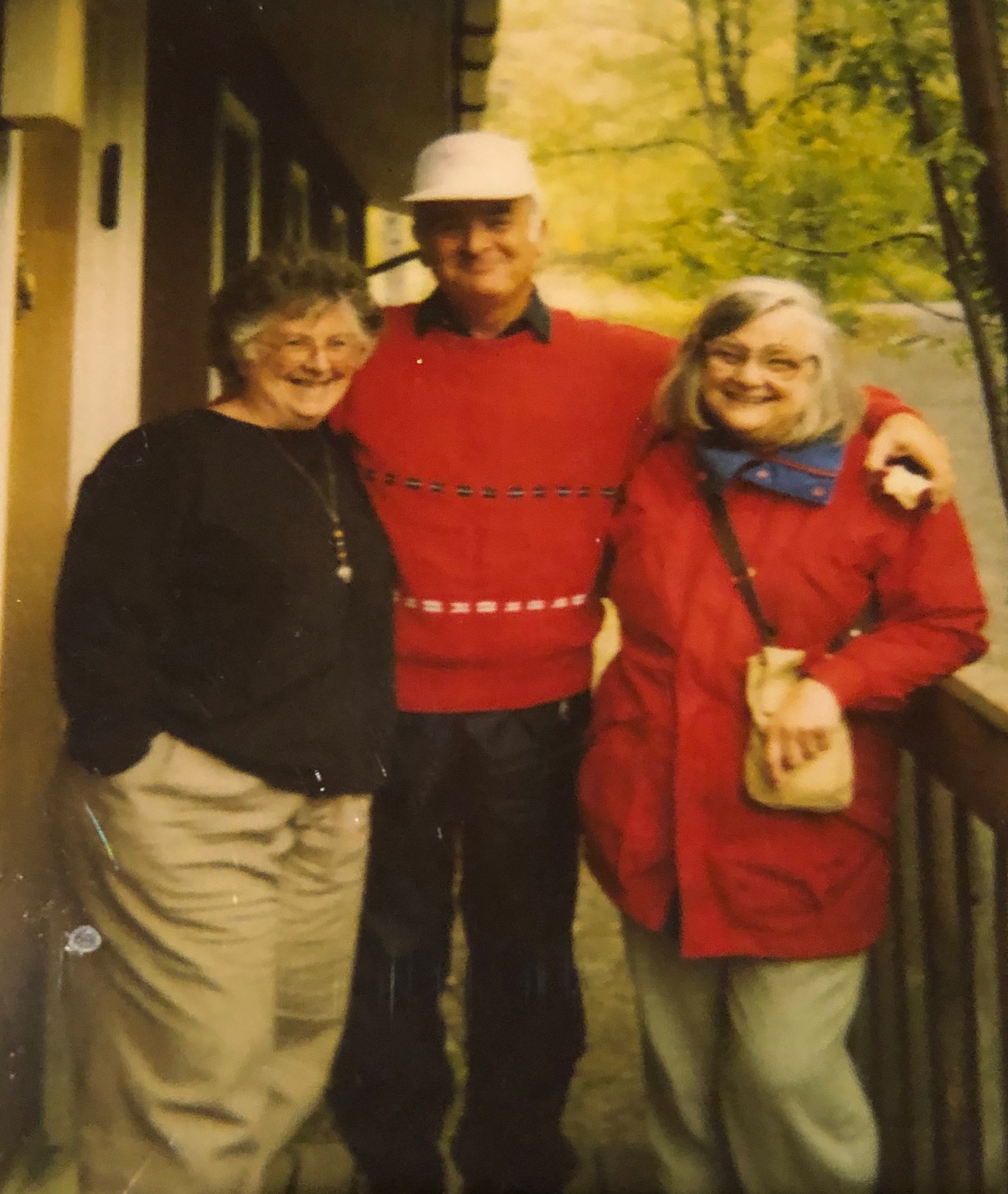
    Mom listened, a smile on her face, marveling at how well he expressed himself. We talked about the context of the letter, remembering our summers in Illinois (the first of three spent there) while Zada was home in Canarsie. We weren’t on vacation exactly; Dad was attending the University of Illinois at Champaign-Urbana to get his masters in economics. Mom remembers those days fondly. I brought a photo from that summer, which elicited Mom’s pleasure at how slim she looked in her bathing suit (see above).

    Then Mark read the next letter, dated ten years later. This letter, written on her birthday just after the wedding of his oldest grandchild, my brother Steven, begins: From the president of the Feige Brody fan club.

    It continues:

    Nov. 16, 1977

    Dear Feige,

    The purpose of this letter is to expound on the theory that it is far better to be 44 years young, than to be 44 years old.

    You proved to me without a shadow of a doubt, how you deported yourself at Cindy’s and Steven’s wedding: In my eyes and probably everyone else’s you were the fairest and youngest of all.

    Stay young Feige, your husband will adore you, your children will respect you, and I will always love you.

    Love and Best of Days,

    Dad

    As Mark read the letter to Mom, she smiled broadly and listened attentively. “That’s my father,” she said with satisfaction. I think it is fair to say that Mom did as he suggested. She stayed young, at least until her 88th year when time is finally catching up with her. Her husband, my father, certainly adored her until he took his last breath, and her children respect her. Zada was prophetic.

    As we said our good-byes, we reminded Mom that she is 88 years young.