I don’t have a sister; I have two brothers. But, I find the dynamic between sisters particularly interesting, maybe because I don’t have one. I could be romanticizing it based on Hallmark cards, but it seems that for some it can be a deep, lifelong friendship; a connection different than the relationship between a sister and a brother, at least from my observation. I did have a front row seat to my mother’s relationship with her sister, Simma, and a less intimate but still revealing view of my mother-in-law and her sister, and I saw common themes. Those relationships were quite layered and complicated. I was reminded of that recently because, as I am still in the endless process of going through my mother’s things, I came across a tribute Aunt Simma wrote for my mother that brought up questions. I am sharing portions of that essay because I think it offers insight into Mom and Simma and provides an opportunity to explore whether the relationship described is true of other sisters. This is Simma’s tribute:
Feige Brody: A Life
This is a wholly unauthorized, condensed, selective biography, one which, no doubt, will be considered by its subject to be semi-fictitious. Nevertheless, these are the author’s reminiscences and, therefore, are told from the author’s point of view.
Feige Marian Spilken was born in Brooklyn on November 16, 1933 to Ray Woltz Spilken and Charles Spilken. Her mother was 19, her father 29. She was named after her maternal grandmother who died too young in her early 40s. From the start she was a good girl, a mother’s girl, nurtured by her young mom whom she adored. Feige was everything adults could hope for in a baby. She was exceedingly pretty with dark curly hair, dimpled cheeks, and she was sufficiently chubby, a good thing in those days, to convince her paternal grandmother that Ray was not a bad mother….
The family moved to New London, Connecticut, where her sister Simma was born. Bubba Sarah Spilken was outraged that Ray should produce such a scrawny, straight haired baby who would not eat of her favorite dishes much preferring to eat bugs and dirt. Only Feige’s smiling, compliant presence and acceptance of those heavy, eastern European dishes kept Bubba from banishing Ray from the family. Feige was the good girl.
The great hurricane of 1938 forced the family to move to Jersey City, New Jersey. They lived above Charlie’s bakery and the girls loved bothering the bakers…
Across the street there was a saloon owned by the Landaus, the only other Jewish family in the neighborhood. Before it opened late in the afternoon, Mrs. Landau allowed the girls to play at the bar pretending to pull beer from the taps and serve customers. There were banquet rooms up a couple of flights of very narrow dark stairs. Everything was covered in sheets until the room had to be used. Feige loved telling Simma ghost stories as they climbed the stairs. She said the sheets were actually the ghosts’ clothing and would make appropriate noises to scare the daylights out of her impressionable sister.
Other favorite pastimes were staring out the back window at the not too distant Statue of Liberty and telling stories. Often, they would go to the front window in the late afternoon when the saloon opened. They liked to shout at one particular customer who looked worse for drink and had a fat, red nose. “Salami, Baloney, Pastrami,” they shouted since those were the most offensive words they knew. After the outcry they would duck, afraid the drunk would see them. That was exciting….
No matter where they lived, Feige was like a little mother to her sister. While Ray worked, Feige would entertain Simma and endure her fresh mouth and mischievous ways. One hot summer night all the windows were open when a terrible summer storm occurred… Simma wouldn’t listen when Feige told her to go to bed. Instead, she ran away making Feige chase after her. The rain slicked linoleum floors were so slippery Simma fell. Sliding into the metal radiator, her eye was bruised, turning black and blue, but it was Feige who suffered. She couldn’t stop blaming herself for the accident. She was a good girl.
Simma would refuse to go to sleep… Feige would induce her to come to their shared bed by telling her she would be allowed to squeeze and pull Feige’s copious ringlets. Simma can still feel their soft, springy, velvet luxuriousness. It was a fact that whether they were in Brooklyn, in the country with Bubba and Zada, or at a bungalow in Rockaway, Feige took care of her sister.
She was patient most times, but one lapse occurred in the late ‘40s. Simma was home in bed, too sick to go to school. Those were the days of Forever Amber, but there was no way the girls could obtain that “dirty” book. They got a poor imitation in Kitty. Feige allowed Simma to read the book but made her promise to read it under the covers, the way Feige read every night so their parents wouldn’t catch her.
When Feige came home from school, Simma asked her to define a word she could not find in the dictionary. “Feige,” she queried, “what is a whore?” She pronounced it “war.” “You know. It’s an armed conflict between nations,” Feige replied. Simma was frustrated and said, “I don’t mean a war, a ‘war.’” Feige responded, exasperatedly, “WHO-ER, stupid, WHO-ER.” What was this? Feige lost her cool and never did enlighten Simma as to the definition of the word…
Ray and Charlie always had people in the house. The two sides of the family gathered there as well as their many friends. Feige and Simma were allowed to stay up and mingle with them. One of Charlie’s friends, Jerry Cohen, would show them parlor tricks first fooling them and then teaching them. That was how they learned to read each other’s minds, an act they still perform for amazed spectators.
Days, though, were not always sunny. Feige finally caused her parents anxiety when she was 17. She decided she would like to move into an apartment with some friends. How could a well brought up girl live without her parents’ supervision? Ray and Charlie were distressed. But it was a great time for Simma. It was the only time Simma was told by family members that she was the good daughter, never causing her family any distress. Who were these people? Where had they been for the last 17 years?
When Feige started college her life changed, making it even better than it already was. She met Barry Brody. She was smitten and, indeed, got married to him as soon as they both were graduated from Brooklyn College. Feige is fond of quoting Charlie. Well, one of his precepts was that to have a happy marriage the couple should move away from their parents the first year of their marriage and get to know one another without interference. Feige, ever obedient, moved to Wichita Falls, Texas; Chicopee Falls, Massachusetts; and then back to Brooklyn with two boys in tow and a girl on the way.
Now, Feige was a devoted wife, mother, cook and baker. The girl who in her parents’ house had to be told that the outside of the pots and dishes had to be washed as well as the inside, was suddenly the happy homemaker. She, like Ray, loved to entertain family and friends. There was always lots of good food around which is still true whether the Brodys were home in Brooklyn or in Livingston Manor, or, now, in Boynton Beach. Their houses were and are gathering places for everyone they know, and their hospitality is boundless.
One more point of kindness, showing what a good girl and sister Feige is. A year after Simma’s husband died, Feige and Barry were afraid she would have nothing to do during the summer and suggested they all take a trip to Europe together. They planned to go to London, Paris and Amsterdam but the French changed all that. They would not allow American Air Force planes to use French airspace when they on their way to a bombing mission in Libya. The planes went the long way around. One ran out of gas and crashed killing the American crew. Feige was up in arms while putting her foot down. She would not go to France. She said there were two choices: cancel the trip or find something to replace the Paris portion. There was a replacement, a circle England tour. It was Simma’s first sight of England and Oxford, a romance that continues to this day. Thank you, Feige. By the way, Feige still has not gone nor will ever go to France. You are a good girl, Feige Marian Spilken Brody. Happy birthday with love from your sister, Simma Spilken Sulzer.

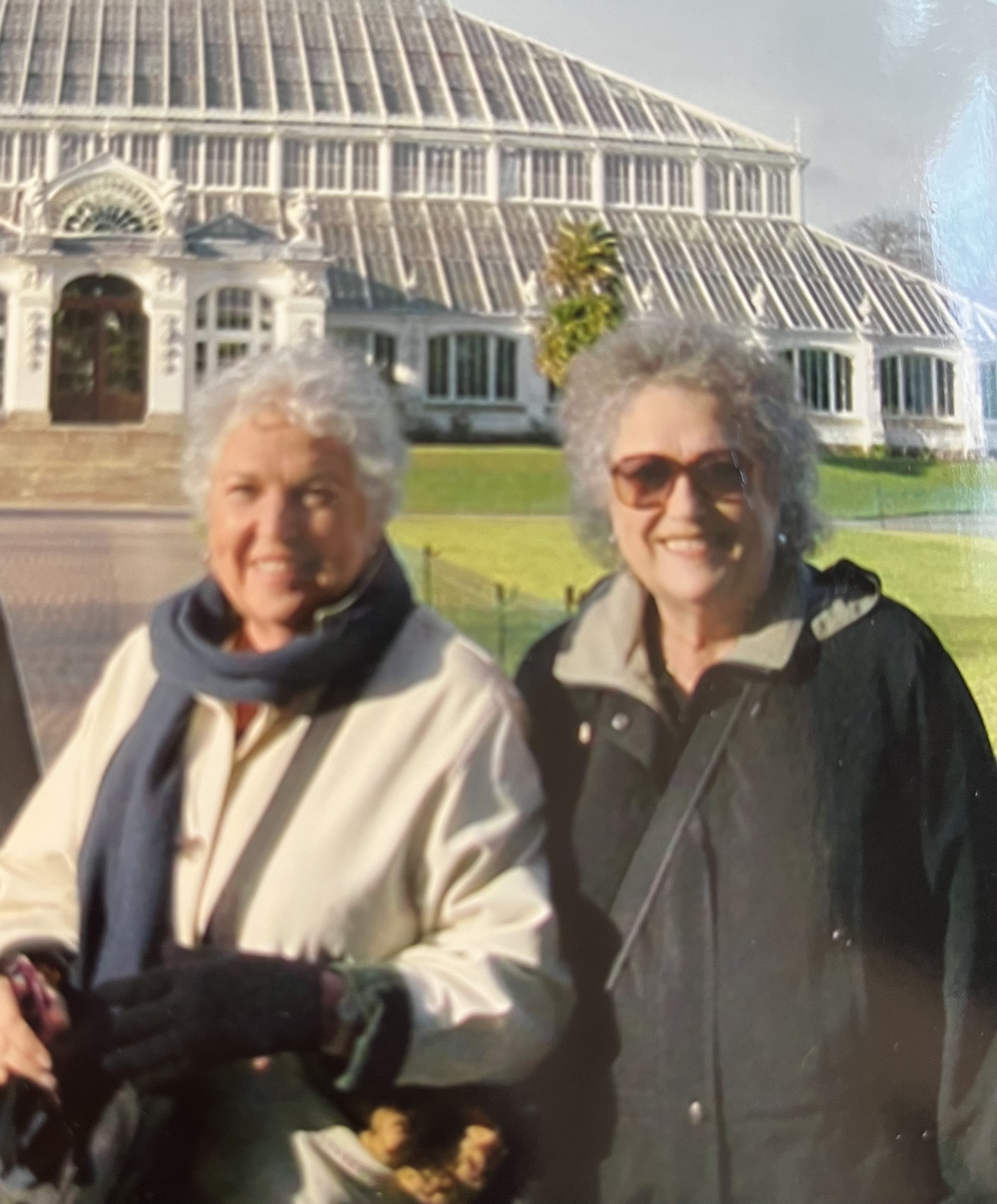
Unfortunately, both Simma and Feige have passed away so I cannot ask questions that arise from the narrative. For example, Simma notes that after the great hurricane they moved to Jersey City and lived above Charlie’s bakery (Charlie was their father). I thought the bakery was owned by Charlie’s brother. A minor point in one sense, but not so inconsequential in understanding their economic circumstances.
It’s also interesting that Simma comments in a positive way about Mom’s chubbiness as a baby – at that time, and in their culture, having a plump baby was a sign of good mothering. I think we still believe it’s okay for a baby to have round cheeks, but only up to a point, then we start to worry. The never-ending judgment of mothers continues unabated to this day.
Another recurring theme is the importance of story-telling and reading. Mom was a devoted reader. In fact, as her daughter, I would get frustrated trying to get her attention when her nose was in a book. Often, I would just give up. On the positive side, my brothers and I grew up to be readers ourselves and continue to enjoy good stories.
Simma mentions the parlor trick of reading each other’s minds. Mom and Simma performed that gag many times to the amusement and bafflement of our family. I didn’t know where they learned how to do it, now I do – Jerry Cohen! Very late in life, Mom finally revealed how it was done, though I doubt I could remember the steps well enough to do it with one of my brothers.
Simma characterizes Mom as a happy homemaker after her marriage and arrival of children. I don’t think of Mom that way. She enjoyed cooking and baking for the purpose of entertaining guests (and to a much lesser extent feeding her family), but that was the end of her homemaking enthusiasm. Keeping a close eye on her young children (!), cleaning, sewing, and ironing were not high on her priority list. I don’t think she was a happy homemaker. I don’t hold that against her, but she probably should have been a bit less laissez faire when it came to overseeing her young children.
There are so many other interesting elements to this essay, starting with Simma’s disclaimer at the beginning. She acknowledges that her perspective may be quite different than Mom’s. I don’t think she is referring to the vagaries of memory. When Mom and Aunt Simma would tell a story from their shared past, which may have involved the same people and same incident, they understood it in totally different ways. Mom seemingly came into this world as a glass half full kind of gal; Aunt Simma not so much. Often, Mom saw people through rose-colored glasses and that certainly applied to how she viewed their parents.
I find it illuminating, too, that Aunt Simma describes Mom as a good girl. Mom, by her own description, was compliant and she wanted to please her parents. Aunt Simma was more rebellious, chafing at the restrictions put on them as children. Mom credited Simma with getting them a later bedtime, even though she was the younger one. Simma was the trailblazer, according to Mom. She also spoke of Simma’s insistence on picking out her own clothes. As a young person Simma was given a budget with which to buy her own outfits – she would rather buy one stylish item, instead of several cheaper things. Mom wore whatever her mother got for her.
That brings me to the first of several common themes between Mom and her sister and my mother-in-law and hers. That dynamic, the good one vs. the rebellious one, seemed to play out in both. Paula described herself as obedient – she did whatever her mother asked her to do as a child. Sophia was less cooperative. Unlike my mom, who was the eldest, Paula was the middle child with an older brother, Bernie, and Sophia about three years younger. Years later, when I met them, Sophia commented that their dad told bedtime stories to Paula, not to her (though they shared the same bed – just like Mom and Aunt Simma). Paula claimed that he was telling the stories to both of them, but that was not Sophia’s perception. Paula recalled feeling loved by both of her parents, despite the traumatic premature death of their father (he was murdered by the Nazis). Sophia did not carry the same warm memories of paternal affection. This mirrors the differences in my mother’s and aunt’s tendency to have disparate perceptions of people (though in Mom and Simma’s case not necessarily different views of their father).


Another similarity between Mom and Paula was their choice of a spouse when compared with their younger sisters. Mom and Paula were lucky in marriage, enjoying long, supportive, loving relationships. No doubt they had their ups and downs, as all marriages do, but they had husbands who were welcomed into the family and were much loved by their in-laws. Simma and Sophia were not so blessed. I imagine that difference in marital harmony impacted their relationship as sisters, as well.
The biography that Simma wrote for my mom is full of love and warmth. Their later years were more complicated. When I visited in Florida, years after Dad died, Mom told me that she believed Simma didn’t like her anymore. I didn’t know what to say. I tried to find fault with her perception but didn’t convince her. So many things might have gone into that – the loss of their respective husbands, deteriorating health, and perhaps long buried resentments/jealousies. At one point, after Simma died and Mom was feeling guilty that she hadn’t been able to offer her sister much comfort at the end of her life, I read her this essay and other cards from Simma that expressed love and appreciation. Sadly, it didn’t seem to ease Mom’s regret.
Paula and Sophia appeared to experience a similar distancing towards the end of their lives. Again, many things contributed to that, not the least of which was physical distance with Sophia living in Tucson, Arizona while Paula split time between New York and Florida. The progression of Paula’s Alzheimer’s disease created an additional challenge.
Sibling relationships are complicated. Though DNA is shared, personalities can be dramatically different and that was certainly the case with Simma and Mom and Paula and Sophia. Many people are estranged from their siblings, and it is understandable given how fraught family life can be. The potential for deep resentment is great – add mental or physical illness, or other serious problems and the bond can break. That was not the case with my mother or mother-in-law, but the end of life challenged the connection. There is no doubt, though, in both cases, the sisterly relationship was one of the most important in their lives. Whatever their differences, they remained deeply tied to one another.
What is your experience or observation about relationships between sisters?
 Stories I Tell Myself
This was a wonderful tribute to both of my sisters. I can’t add too much about my relationship with my sisters because of our age differences. Each had very distinct personalities and I was very lucky to have both in my life. Their passing leaves a real void in my life.
LikeLike
Thanks, Uncle T. I know how much they loved you and how much their loss must continue to be felt by you – and the rest of us. One of the reasons I want to write about them and others we have lost is to keep their memories alive and hopefully the younger generation of family members will choose to read the stories.
LikeLike
This is so important to me! I love your writing Linda because it reminds me of special memories… and introduces me to so many stories I didn’t know. Thank you for continuing to honor our family members in your beautiful writings. I cried, I laughed, and resonated with your poignant sister observations xo
LikeLiked by 1 person
Thank you, Ray. It means a lot to me that you get something out these stories – that is the point. I appreciate your support over these many years that I have been doing this!
LikeLike
I find myself thinking about their marriages and whom they married versus the choices their sisters made. To my view, the men our terrific mothers married were both amazing role models, wonderful people, great providers and caretakers. They both had long and happy marriages. Your mom and dad were married 50 years before your dad passed and my parents were married 70 years before my dad died at 98 years of age.
Was it a coincidence that they both chose such good men? Why was it that they made those choices and to what extent did their lives reflect good marriages versus their marriage choices reflect good judgement? Whatever the reasons, it seems to me that their circumstances were forever impacted by that choice.
Certainly, this is just one of many aspects to who they were/are and how they affected those around them. But I find it quite instructive.
Thank you for this loving tribute.
LikeLike
Gary, I am still perplexed by the email address this has assigned you, but that aside, you raise an interesting question that we will never be able to answer. I am simply grateful to my mom and dad. They made it work and I benefitted. I think you would say the same.
LikeLike