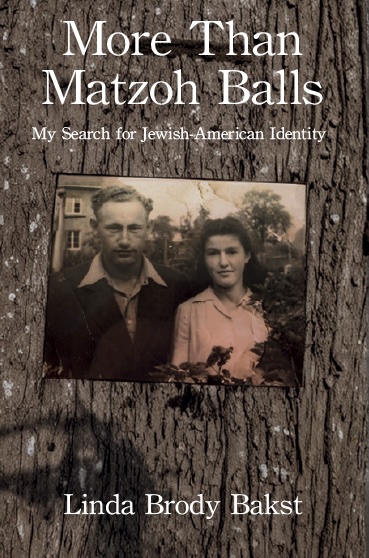
I have some exciting news to share! My book, More Than Matzoh Balls: My Search for Jewish-American Identity, is being published. It is available to preorder now on Barnes and Noble and will be available soon on Amazon (see link below). You can also request it from your local bookseller. It will be in print on February 15th.
The book is not simply a compilation of my blog posts. Faithful readers of Stories I Tell Myself may recognize some of the experiences I recount, but there is significant new material. It is not just a series of essays. It is a story, a journey of searching for identity and the challenges one faces in that process. I also weave the extraordinary Holocaust survival story of my in-laws throughout the narrative.
Though it may be particularly resonant for Jewish-Americans, I believe it addresses universal themes of faith, legacy, family relationships, generational trauma, and self-understanding. Many of us, dare I say most of us, have at least dual identities as Italian-Americans, African-Americans, Mexican-Americans; the list can go on and on. Navigating that duality is challenging in our society. Add to that different faith traditions, and you have complex strands of identity.
I hope you will order the book, read it (!), and then offer a review on Amazon, Goodreads, or whatever platform you prefer. Of course, you are welcome to reach out with comments through my blog, as well.
I believe it is a good choice for book clubs. If you are part of one, I hope you will consider recommending it. If you are interested, I am happy to participate as my schedule allows.
More Than Matzoh Balls has been a project with a very long gestation! I have been writing parts of it in my head for decades, before finally committing it to paper, starting about five years ago. I am excited and proud to see it come to fruition. I hope readers will come away with new insights and questions to ask themselves.
Thank you, dear blog readers, for giving me the encouragement I have needed over the years to continue this project. I hope you will take satisfaction in knowing you contributed to my seeing this through – and more than that, I hope you will enjoy the read!
Editor’s note: I received the following email from my brother, Mark Brody. With his permission, I thought it merited sharing.
I just read a headline, I only read the headline as that is all I can tolerate, which indicated that federal funding is being cut to the programs which provide tutoring to children. After reading that, or you can substitute any other recent news, such as how research into the cures for Alzheimer’s or cancer, etc. are being eliminated, and I decided that my sensitive, far too brilliant for her own good, sister could enjoy the following essay which, if she chooses, she might wish to post on her blog.
The Hero of Our Own Lives
“Whether I shall turn out to be the hero of my own life, or whether that station will be held by someone else, these pages must show.” (Opening sentence of David Copperfield by Charles Dickens).
Last night Pam, my wife, and I were babysitting our 5-year-old twin grandsons. After the boys had a bonus 8-minute episode of an animated, parentally approved TV show called Grizzy and the Lemmings, we all scurried up to their bedroom. I declared I would outrun them to their room and for the 156th consecutive time (we babysit frequently) both Connor and Lucas outran their ancient grandpa.
Our usual nighttime reading ritual is that Connor will select books for me to read and Lucas, exhausted from a long day, will lie in his bed and be satisfied with just hearing the story as Connor plops himself in my lap. Before the last book is concluded Lucas will be sound asleep.
Last night, however, Lucas hands me a particular book and asks me to read it.
The first problem with reading to Lucas at night is that he is usually so tired that he needs to lie in bed, and I need to place my old, creaky body on the floor next to his bed so he can see the pictures as I read the story.
The second, potentially equally vexing challenge, is that Connor whose bed is at the opposite end of the room “needs” to climb into Lucas’ bed so he can get an equally good view of the book, or perhaps more cynically, to make sure that Lucas does not get a better view of the book than he receives. This in and of itself is fine, but when reading comes to an end and Lucas is an inch away from being asleep, Connor will invariably decide he should stay in Lucas’ bed and endeavor to keep Lucas awake as there is still much playing and gabbing to be done. Extricating Connor from Lucas’ bed is often an ordeal.
Last night, however, I was delighted that Lucas decided to climb into my lap as I started to read to him. Connor then took his usual perch in my lap (the boys are still young and my lap, unfortunately or not, is quite ample). We read the story. The boys genuinely helped decipher some of the words as the lighting is dim and when the color of the word is red, and the background is black, I have difficulty making out the letters (I am color blind). The bedtime ritual was completed, and Lucas went right to sleep. I tucked in Connor and said, “Good night.”
As I left the room Connor commenced a debate with Pam. Was Grandpa’s “good night” sufficient? “Nana, when I wake up tomorrow Grandpa will not be here, don’t you think you should get Grandpa to come back and say ‘goodbye’?” Despite the debate I did not believe it wise to return to the bedroom.
First, debates with Connor (always Connor, as Lucas is not afflicted with the need/desire to question/analyze absolutely everything) can sometimes be lengthy (remember they already had an extra episode of Grizzy). I could envision much time elapsing before I would again leave the room.
Second, and much more importantly, I recall the infamous evening when I was babysitting sans Pam and her adult oversight. I recall the look of terror in Josh’s face when I showed up alone, and the parents got home to discover Grandpa in the twins’ room well after bedtime, reading/gabbing with Connor. The formerly always serene Mama demonstrated a countenance which can be generously described as something other than serene. As an aside, the Daddy of the twins, who has not yet to my knowledge been described as serene, voiced his considerable displeasure with my judgment that Connor did not need as much sleep as the parents thought necessary.
With that experience in mind and armed with the ability to learn from the past, I promptly made my exit and left Pam to handle the debate with Connor. For some reason, unbeknownst to me, Pam does not seem to test the Mama’s serenity.
Later that evening Pam explained that Connor’s thesis that Grandpa’s saying “good night” was insufficient was predicated on Connor’s observation that upon his saying “goodbye” to me, I should also say “goodbye” to him because when he wakes up in the morning I would not be there. Hence, just saying “good night” is not sufficient. Note taken.
Both grandparents, having safely bid the boys good night or goodbye as the case may be, await the parents return home which they do at a reasonable hour. Pam and I head to our own abode.
We discuss how I used to read to our boys when they were the twins’ age so many decades ago. Perhaps that is why I decided I should re-read David Copperfield. Having made a little headway in the tome, I went to bed at 6:00 a.m.
When I awoke the next afternoon, Pam and I discussed how 35 years ago I would read one chapter of the Dickens’ classic a night to Josh. If memory serves me correctly Sam – age 4 or 5- would be snuggling with Josh and me. She suggested that perhaps one chapter a night might still be a good idea for me. Another note taken, but likely ignored given my track record.
This made me think- about how long it would have taken me to complete the 64-chapter book (each chapter averaging 15-20 pages).
…..And then a memory arose which I had not thought of for many years. I now recall having been so enthralled by the elegant writing, humor and pathos of the novel, one summer afternoon, while we were on vacation in a time share in California, I simply had to read the book to myself. This decision did not end well because Joshua spotted me reading the book…without him! He was outraged and demanded that I not “go ahead of him in the book.”
Three plus decades later, I recall vividly Josh explaining how my betrayal stung him. He probably has no memory of this. My argument that I was going to read everything to him were to no avail. 7 (or 8?) year old Josh’s thesis was that this was a shared experience for the two of us (Sam’s presence was either tolerated or perhaps cynically he did not notice Sam on the other side of me as we read) and my proceeding without him was a grievous abdication of parental responsibility.
…And now a more recent memory- about 4-5 years ago, I am in Josh’s house and he is on the living room floor (he is not yet as antiquated as is his father and can sit comfortably on the floor) with one of the twins and he is reading to his son, not yet one, from one of Tolkien’s Lord of the Rings books.
…..And then another memory from two years ago- Sam reading to his then 5-year-old son (Ted) from the Hobbit.
…..And yet another memory rushes in from 60+ years ago of Mom reading to me. I struggle to recall whether it was Treasure Island or maybe The Three Musketeers– perhaps my older brother, Steven will know.
…So, to conclude my essay, my dear sister, as our great expectations (pun intended) of our government is under constant assault, perhaps there can still be a calming perspective about how rich it is when we have the opportunity to share literature (great or otherwise) with children. And perhaps by doing so we can be the heroes of our own lives.
Note from your sister: Thinking about reading stories to our children and grandchildren, or reading literature in general, is far better than absorbing the news. So thank you for sending this to me. I too have fond memories of reading to my children each night, but I was not so ambitious as you. Though I read them chapter books, I never took on Dickens.
I also think about the role books had in our shared childhood. Wherever we were, and, as you know, we spent summers in different college communities while Dad pursued his education, we took a weekly trip to the library. Mom and Dad set us up for an enriched life. As they say in one of our prayers, not that we are religious, l’dor v’dor, from generation to generation. I think we have done just that. Mark, thank you for sharing this.
I don’t have a sister; I have two brothers. But, I find the dynamic between sisters particularly interesting, maybe because I don’t have one. I could be romanticizing it based on Hallmark cards, but it seems that for some it can be a deep, lifelong friendship; a connection different than the relationship between a sister and a brother, at least from my observation. I did have a front row seat to my mother’s relationship with her sister, Simma, and a less intimate but still revealing view of my mother-in-law and her sister, and I saw common themes. Those relationships were quite layered and complicated. I was reminded of that recently because, as I am still in the endless process of going through my mother’s things, I came across a tribute Aunt Simma wrote for my mother that brought up questions. I am sharing portions of that essay because I think it offers insight into Mom and Simma and provides an opportunity to explore whether the relationship described is true of other sisters. This is Simma’s tribute:
Feige Brody: A Life
This is a wholly unauthorized, condensed, selective biography, one which, no doubt, will be considered by its subject to be semi-fictitious. Nevertheless, these are the author’s reminiscences and, therefore, are told from the author’s point of view.
Feige Marian Spilken was born in Brooklyn on November 16, 1933 to Ray Woltz Spilken and Charles Spilken. Her mother was 19, her father 29. She was named after her maternal grandmother who died too young in her early 40s. From the start she was a good girl, a mother’s girl, nurtured by her young mom whom she adored. Feige was everything adults could hope for in a baby. She was exceedingly pretty with dark curly hair, dimpled cheeks, and she was sufficiently chubby, a good thing in those days, to convince her paternal grandmother that Ray was not a bad mother….
The family moved to New London, Connecticut, where her sister Simma was born. Bubba Sarah Spilken was outraged that Ray should produce such a scrawny, straight haired baby who would not eat of her favorite dishes much preferring to eat bugs and dirt. Only Feige’s smiling, compliant presence and acceptance of those heavy, eastern European dishes kept Bubba from banishing Ray from the family. Feige was the good girl.
The great hurricane of 1938 forced the family to move to Jersey City, New Jersey. They lived above Charlie’s bakery and the girls loved bothering the bakers…
Across the street there was a saloon owned by the Landaus, the only other Jewish family in the neighborhood. Before it opened late in the afternoon, Mrs. Landau allowed the girls to play at the bar pretending to pull beer from the taps and serve customers. There were banquet rooms up a couple of flights of very narrow dark stairs. Everything was covered in sheets until the room had to be used. Feige loved telling Simma ghost stories as they climbed the stairs. She said the sheets were actually the ghosts’ clothing and would make appropriate noises to scare the daylights out of her impressionable sister.
Other favorite pastimes were staring out the back window at the not too distant Statue of Liberty and telling stories. Often, they would go to the front window in the late afternoon when the saloon opened. They liked to shout at one particular customer who looked worse for drink and had a fat, red nose. “Salami, Baloney, Pastrami,” they shouted since those were the most offensive words they knew. After the outcry they would duck, afraid the drunk would see them. That was exciting….
No matter where they lived, Feige was like a little mother to her sister. While Ray worked, Feige would entertain Simma and endure her fresh mouth and mischievous ways. One hot summer night all the windows were open when a terrible summer storm occurred… Simma wouldn’t listen when Feige told her to go to bed. Instead, she ran away making Feige chase after her. The rain slicked linoleum floors were so slippery Simma fell. Sliding into the metal radiator, her eye was bruised, turning black and blue, but it was Feige who suffered. She couldn’t stop blaming herself for the accident. She was a good girl.
Simma would refuse to go to sleep… Feige would induce her to come to their shared bed by telling her she would be allowed to squeeze and pull Feige’s copious ringlets. Simma can still feel their soft, springy, velvet luxuriousness. It was a fact that whether they were in Brooklyn, in the country with Bubba and Zada, or at a bungalow in Rockaway, Feige took care of her sister.
She was patient most times, but one lapse occurred in the late ‘40s. Simma was home in bed, too sick to go to school. Those were the days of Forever Amber, but there was no way the girls could obtain that “dirty” book. They got a poor imitation in Kitty. Feige allowed Simma to read the book but made her promise to read it under the covers, the way Feige read every night so their parents wouldn’t catch her.
When Feige came home from school, Simma asked her to define a word she could not find in the dictionary. “Feige,” she queried, “what is a whore?” She pronounced it “war.” “You know. It’s an armed conflict between nations,” Feige replied. Simma was frustrated and said, “I don’t mean a war, a ‘war.’” Feige responded, exasperatedly, “WHO-ER, stupid, WHO-ER.” What was this? Feige lost her cool and never did enlighten Simma as to the definition of the word…
Ray and Charlie always had people in the house. The two sides of the family gathered there as well as their many friends. Feige and Simma were allowed to stay up and mingle with them. One of Charlie’s friends, Jerry Cohen, would show them parlor tricks first fooling them and then teaching them. That was how they learned to read each other’s minds, an act they still perform for amazed spectators.
Days, though, were not always sunny. Feige finally caused her parents anxiety when she was 17. She decided she would like to move into an apartment with some friends. How could a well brought up girl live without her parents’ supervision? Ray and Charlie were distressed. But it was a great time for Simma. It was the only time Simma was told by family members that she was the good daughter, never causing her family any distress. Who were these people? Where had they been for the last 17 years?
When Feige started college her life changed, making it even better than it already was. She met Barry Brody. She was smitten and, indeed, got married to him as soon as they both were graduated from Brooklyn College. Feige is fond of quoting Charlie. Well, one of his precepts was that to have a happy marriage the couple should move away from their parents the first year of their marriage and get to know one another without interference. Feige, ever obedient, moved to Wichita Falls, Texas; Chicopee Falls, Massachusetts; and then back to Brooklyn with two boys in tow and a girl on the way.
Now, Feige was a devoted wife, mother, cook and baker. The girl who in her parents’ house had to be told that the outside of the pots and dishes had to be washed as well as the inside, was suddenly the happy homemaker. She, like Ray, loved to entertain family and friends. There was always lots of good food around which is still true whether the Brodys were home in Brooklyn or in Livingston Manor, or, now, in Boynton Beach. Their houses were and are gathering places for everyone they know, and their hospitality is boundless.
One more point of kindness, showing what a good girl and sister Feige is. A year after Simma’s husband died, Feige and Barry were afraid she would have nothing to do during the summer and suggested they all take a trip to Europe together. They planned to go to London, Paris and Amsterdam but the French changed all that. They would not allow American Air Force planes to use French airspace when they on their way to a bombing mission in Libya. The planes went the long way around. One ran out of gas and crashed killing the American crew. Feige was up in arms while putting her foot down. She would not go to France. She said there were two choices: cancel the trip or find something to replace the Paris portion. There was a replacement, a circle England tour. It was Simma’s first sight of England and Oxford, a romance that continues to this day. Thank you, Feige. By the way, Feige still has not gone nor will ever go to France. You are a good girl, Feige Marian Spilken Brody. Happy birthday with love from your sister, Simma Spilken Sulzer.
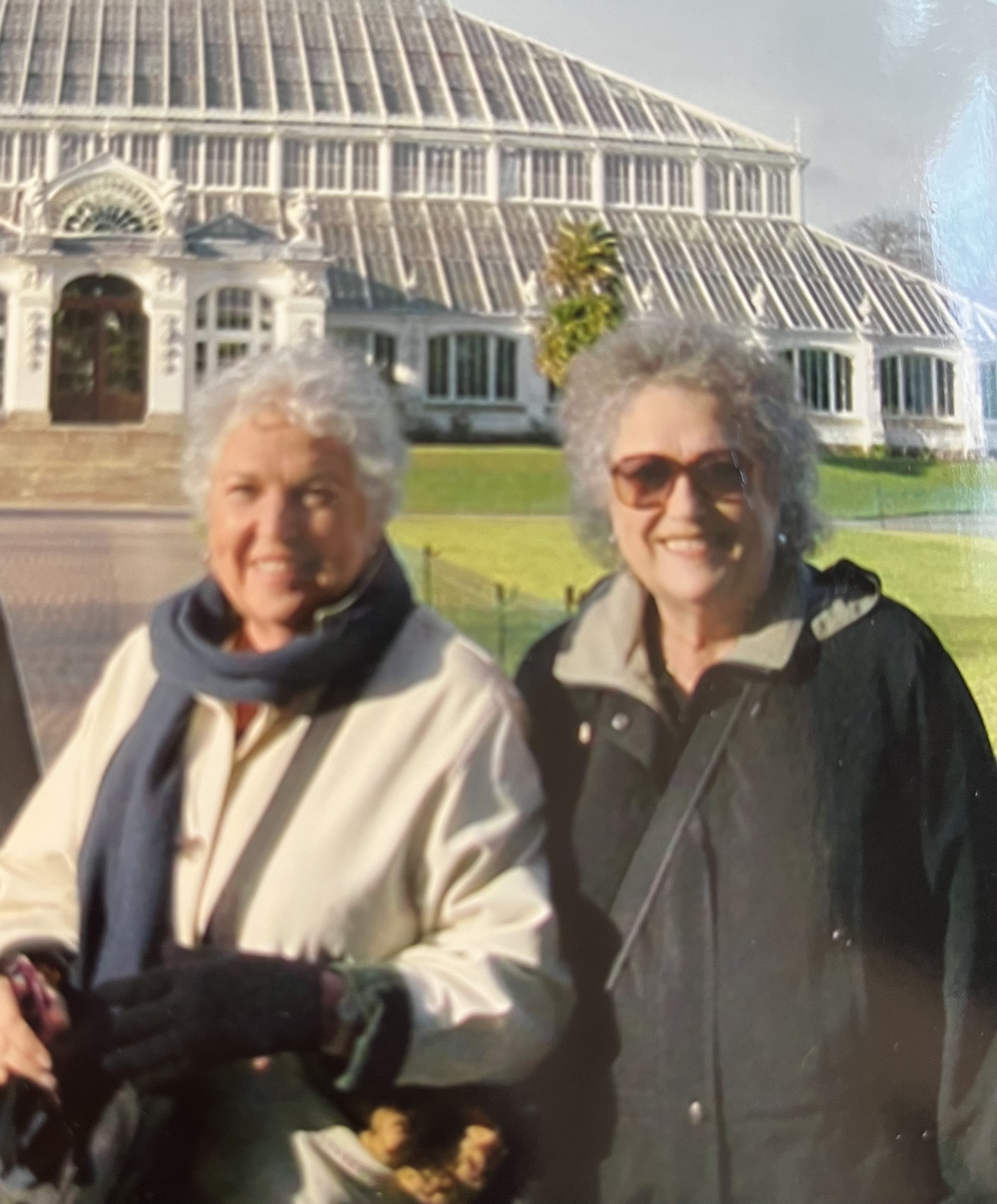
Mom (left) and Simma as teenagersMom (left) and Simma in England
Unfortunately, both Simma and Feige have passed away so I cannot ask questions that arise from the narrative. For example, Simma notes that after the great hurricane they moved to Jersey City and lived above Charlie’s bakery (Charlie was their father). I thought the bakery was owned by Charlie’s brother. A minor point in one sense, but not so inconsequential in understanding their economic circumstances.
It’s also interesting that Simma comments in a positive way about Mom’s chubbiness as a baby – at that time, and in their culture, having a plump baby was a sign of good mothering. I think we still believe it’s okay for a baby to have round cheeks, but only up to a point, then we start to worry. The never-ending judgment of mothers continues unabated to this day.
Another recurring theme is the importance of story-telling and reading. Mom was a devoted reader. In fact, as her daughter, I would get frustrated trying to get her attention when her nose was in a book. Often, I would just give up. On the positive side, my brothers and I grew up to be readers ourselves and continue to enjoy good stories.
Simma mentions the parlor trick of reading each other’s minds. Mom and Simma performed that gag many times to the amusement and bafflement of our family. I didn’t know where they learned how to do it, now I do – Jerry Cohen! Very late in life, Mom finally revealed how it was done, though I doubt I could remember the steps well enough to do it with one of my brothers.
Simma characterizes Mom as a happy homemaker after her marriage and arrival of children. I don’t think of Mom that way. She enjoyed cooking and baking for the purpose of entertaining guests (and to a much lesser extent feeding her family), but that was the end of her homemaking enthusiasm. Keeping a close eye on her young children (!), cleaning, sewing, and ironing were not high on her priority list. I don’t think she was a happy homemaker. I don’t hold that against her, but she probably should have been a bit less laissez faire when it came to overseeing her young children.
There are so many other interesting elements to this essay, starting with Simma’s disclaimer at the beginning. She acknowledges that her perspective may be quite different than Mom’s. I don’t think she is referring to the vagaries of memory. When Mom and Aunt Simma would tell a story from their shared past, which may have involved the same people and same incident, they understood it in totally different ways. Mom seemingly came into this world as a glass half full kind of gal; Aunt Simma not so much. Often, Mom saw people through rose-colored glasses and that certainly applied to how she viewed their parents.
I find it illuminating, too, that Aunt Simma describes Mom as a good girl. Mom, by her own description, was compliant and she wanted to please her parents. Aunt Simma was more rebellious, chafing at the restrictions put on them as children. Mom credited Simma with getting them a later bedtime, even though she was the younger one. Simma was the trailblazer, according to Mom. She also spoke of Simma’s insistence on picking out her own clothes. As a young person Simma was given a budget with which to buy her own outfits – she would rather buy one stylish item, instead of several cheaper things. Mom wore whatever her mother got for her.
That brings me to the first of several common themes between Mom and her sister and my mother-in-law and hers. That dynamic, the good one vs. the rebellious one, seemed to play out in both. Paula described herself as obedient – she did whatever her mother asked her to do as a child. Sophia was less cooperative. Unlike my mom, who was the eldest, Paula was the middle child with an older brother, Bernie, and Sophia about three years younger. Years later, when I met them, Sophia commented that their dad told bedtime stories to Paula, not to her (though they shared the same bed – just like Mom and Aunt Simma). Paula claimed that he was telling the stories to both of them, but that was not Sophia’s perception. Paula recalled feeling loved by both of her parents, despite the traumatic premature death of their father (he was murdered by the Nazis). Sophia did not carry the same warm memories of paternal affection. This mirrors the differences in my mother’s and aunt’s tendency to have disparate perceptions of people (though in Mom and Simma’s case not necessarily different views of their father).
Sophia (left), their mother, Lea, and PaulaSophia (left), David, my father-in-law, and Paula
Another similarity between Mom and Paula was their choice of a spouse when compared with their younger sisters. Mom and Paula were lucky in marriage, enjoying long, supportive, loving relationships. No doubt they had their ups and downs, as all marriages do, but they had husbands who were welcomed into the family and were much loved by their in-laws. Simma and Sophia were not so blessed. I imagine that difference in marital harmony impacted their relationship as sisters, as well.
The biography that Simma wrote for my mom is full of love and warmth. Their later years were more complicated. When I visited in Florida, years after Dad died, Mom told me that she believed Simma didn’t like her anymore. I didn’t know what to say. I tried to find fault with her perception but didn’t convince her. So many things might have gone into that – the loss of their respective husbands, deteriorating health, and perhaps long buried resentments/jealousies. At one point, after Simma died and Mom was feeling guilty that she hadn’t been able to offer her sister much comfort at the end of her life, I read her this essay and other cards from Simma that expressed love and appreciation. Sadly, it didn’t seem to ease Mom’s regret.
Paula and Sophia appeared to experience a similar distancing towards the end of their lives. Again, many things contributed to that, not the least of which was physical distance with Sophia living in Tucson, Arizona while Paula split time between New York and Florida. The progression of Paula’s Alzheimer’s disease created an additional challenge.
Sibling relationships are complicated. Though DNA is shared, personalities can be dramatically different and that was certainly the case with Simma and Mom and Paula and Sophia. Many people are estranged from their siblings, and it is understandable given how fraught family life can be. The potential for deep resentment is great – add mental or physical illness, or other serious problems and the bond can break. That was not the case with my mother or mother-in-law, but the end of life challenged the connection. There is no doubt, though, in both cases, the sisterly relationship was one of the most important in their lives. Whatever their differences, they remained deeply tied to one another.
What is your experience or observation about relationships between sisters?
Reading that there were chants of “Go back to Poland” at the pro-Palestinian encampments at Columbia University stopped me in my tracks. Weeks later my attempts to ignore it are not working. It is just too painful to try to pretend it didn’t happen.
The stunning ignorance and cruelty that this demonstrates is hard to swallow. Do they not understand what happened to Jews in Poland? This is personal to me. That statement could apply to American Jews, not just Israelis, after all we are hardly indigenous to the Americas. As an American Jew if I was forced to go back to Poland the only remnant of my family would be a monument to the 2500 people murdered in Halbow, Poland in 1942. My paternal grandfather’s parents and sister are buried underneath that monument in a mass grave. Luckily for my family, my grandfather went to America alone in 1921, long before World War II was on the horizon and before the thrall of Nazism. My grandfather was seeking his fortune and Jews were still permitted to immigrate. Millions of Jews in Poland were not so adventurous or prescient.
In addition to my family’s experience, we have the horrors my in-laws endured. They too lived in Poland, though today it is actually Ukraine or Belarus, which introduces another problem with their simplistic chant. Some of the Bakst family did indeed go to Israel after the war. Even if Ukraine or Belarus opened their arms to receive them today, it is not a viable alternative, or is the reason for that not obvious to those protesters?
I wrote about what happened to my father-in-law when he did go back to Iwie in 1944, while the war was still on but his town had been liberated by the Soviet army. I hope you will take the time to read my blog post about that here.
For purposes of this essay, I will summarize. David Bakst was granted leave for his heroism in a battle with the German army. At this point David was in the Soviet army who were unaware that he was Jewish. He was given leave to visit what was left of his family, his father and sister, who were in Lida, about 40 kilometers from his hometown. David pined for his home. He had warm memories of family gatherings and the love he felt among his extended family. The house was a relatively modern one, built in 1929. I think, even though it was unrealistic, he hoped in his heart to reclaim it.
They arrived at their home, which withstood bombing by Germany. A Polish family was living there. Though David was allowed to come into the house when he explained his connection to it, the reception was not warm. He was told in no uncertain terms that it wasn’t his anymore. Upon seeing the interior, with his family’s things rearranged, and seeing his parent’s bed, knowing his mother and younger sister had already been murdered, he collapsed in tears. His father and sister comforted him, they told him there was nothing in Iwie for them anymore, they needed to look to the future, and that is what they did.
David spoke fondly of that house for the rest of his life. But, whatever bitterness he may have harbored did not interfere with his making a new life in a new country.
Clearly the protesters at Columbia, at other college campuses and in the Middle East either don’t know this history or don’t care. If they don’t know it, they have a responsibility to learn it. The latter possibility is even worse. To be aware of the pain that is carried by our family and by millions of other Jewish families, and still chant “Go back to Poland,” is beyond cruel. It would be evidence of pernicious antisemitism, not of a liberation movement. It is also extraordinarily, epically ironic given that the basis of their protest is that Palestinians were forcibly evicted from their homes.
Another problem with this situation is that the media coverage of this has been quite limited. I have not seen stories that explain the problem with the suggestion that Jews go back to Poland. Those who are ignorant have not been enlightened by the coverage; they can continue to live in their deluded world. Does the media assume that people understand? If they understand, they should be called out for their inhumanity. While one might argue that the journalist’s role is not to take sides that is not what is called for here. It is a matter of giving context, explain some history and that is the role of a journalist. Giving that context doesn’t even necessarily mean folks would change their mind about the Palestinian cause, but it might help bring some nuance to the discussion. At the very least, hopefully that disgusting chant would be cast aside. I would not hope for apology, that is probably too much to ask, but it would be appropriate.
We can argue until the end of time about who the indigenous people of the Middle East are. Frankly, I don’t care beyond understanding the history of the region as best we can. We can argue who is in diaspora – aren’t both peoples? Not to mention other displaced persons who have been forced to leave their homes whether it is in Africa, Asia, or Central America because of war, gang violence, natural disasters, climate change, power struggles, genocides. Are these encampments for them too? Is there a point to arguing who is a refugee? Where does the argument get us? Yes, it is essential that we understand and acknowledge the generational trauma that Palestinians and Jews carry, but that is a two-way street. Chanting “Go back to Poland” is absurd and suggests that they are not serious about finding a solution.
I don’t know why but I think of Mom’s silverware as I stare out the window over my sink. My stomach clenches. I feel an ache; a sense of loss.
A week or so ago Mark and I brought some things, jewelry and said silverware (which upon closer inspection was silver-plated) to a place where they bought and sold gold and silver. No one in the family wanted these items – we had offered it far and wide with no takers. So, we decided we would see what we could get for them. All told the silverware came to $6.51. The woman who took it explained that they would melt it down and extract what was valuable, which wasn’t much, or we could take it back and try to sell it ourselves.
We could have cleaned it up, it was badly tarnished, and sold it on eBay or in a garage sale and perhaps gotten more, but that was more effort and time than either of us were willing to give. We decided to take the money. I think it was the right decision.
I realize I am not actually sad about the silverware; I understand why we did what we did and that if I kept it, I would not be happier. It is the loss of my mother, who valued that set, who took it as she moved from place to place, that I grieve. My mother liked pretty things. She set a lovely table. She used her ‘fine’ china – I’m not sure how fine it was – and silver when she entertained. When she served tea, she chose from one of many beautiful pots and cups she collected over the years. It gave her pleasure. I don’t tend to do that. I try to present food nicely when we have guests, but I don’t put the same effort into it, and I don’t enjoy it the way Mom did.
The silverware represents something else aside from Mom’s aesthetic sense. It was a reminder of family gatherings from long ago. Mom would have me set the Thanksgiving table – the table for the adults, we always had a kids table, too – with that silverware. I also helped when she and Dad hosted dinner parties, which they did often. They had a book club with friends that usually included Mom making dinner. I was her sous chef and assistant, vacuuming and raking our red shag living room carpet, straightening up and setting the table. My bedroom was just off the dining room. I would fall asleep still hearing their voices and laughter.
Despite the warm memories, I would not want to return to childhood. I was lonely and terribly sensitive. The societal upheaval of the late ‘60s and ‘70s weighed on me. I would not want to relive growing up with all of the insecurity it entailed, but I can get sentimental about certain things from that place and time. I thought my family was perfect. Though I didn’t appreciate that my brother Mark teased me mercilessly and my brother Steven had a scary temper, as did my dad, but it all felt comfortable and right. I knew they loved me and would protect me. I thought our extended family, my aunts and uncles and my mother’s aunts, uncles and cousins, were the best. They were part of my everyday life – coming in and out of my grandmother’s upstairs apartment regularly. I didn’t know there were tensions and complications in those relationships – not then, that awareness didn’t come until I was fully an adult. As a child my family life felt like a cocoon that shielded me from the pain of the outside world.
It has been many years since I emerged from that cocoon. The first peeling back of my comfortable nest was when Nana died, and I was 11. In some ways Mom carried on Nana’s traditions, but things changed. I left home at 16 to go to college and though I came back for some summers and a year of graduate school, I never lived with my parents again.
Mom died one month ago. Her death is perhaps the final goodbye to that world. Mom and my relationship evolved and in her final years. I was more her caretaker than she was mine, but she was still present. She was still Mom. I still wanted her blessing.
I am now part the oldest generation of the family. I am one of the elders. How strange! It’s also unnerving. I know I have matured, but I am still the same person inside. My spirit doesn’t feel old. Sometimes my body argues otherwise, but mostly it functions as it did, and I am grateful for that. But I can’t deny reality. I have one remaining uncle who I am so thankful to have, but that is all that is left of the older generation.
I suppose it is inevitable that seeing certain things, a favorite mug of Mom’s, a lovely piece of pottery that now resides in my cabinet, will remind me of her. Or a memory might be jogged when I set my table with my silverware for the seder, and I will grieve the loss again. Not just of my mother, but Dad, Nana and my aunts and uncles. Though the pang I feel in my heart is painful, it is a good thing, too. It tells me I have had rich relationships and there has been a lot of love given and received.
“There was a lot of warmth in that room,” Gary said to me as we left a celebration in honor of his uncle Sol’s 100th birthday. I readily agreed.
It was an interesting gathering. If one reaches that auspicious age, it is almost certain that you have outlived your spouse (possibly spouses), siblings and most, if not all, friends. This is true of Sol. So it can be bittersweet to plan a party. Who do you invite? Sol’s son, Ben, faced this question.
Sol is a Holocaust survivor, like Gary’s parents. I have written a great deal about Gary’s parents, David and Paula and their remarkable story. I don’t know the details of Sol’s experience. Sol married David’s sister, Batya, in America. The two couples were part of a tight knit survivor community. There were about five or six families that socialized regularly, centered in Rosedale, Queens. Their children grew up together.
Gary told me stories about those years – how the mixture of family and friends would gather at his house most weekends – the kids playing various games while the adults chatted (and maybe argued, especially about politics). How they went to the Pennsylvania Dutch country with the Majewskis, who lived down the block, and how the Majewskis had all the coolest toys – they often hung out at their house. As often happens with college and adulthood, the kids went their separate ways, maintaining only occasional contact.
I didn’t know what to expect when we arrived at the party. I wondered who would be there. Ben and Rochelle, Sol’s step-daughter, set up displays of photographs of Sol that captured his life over the many years. We studied the pictures, looking at the young faces. When we sat down at a large rectangular table that sat the 25 guests, Ben welcomed everyone and explained that when he thought about who his father would want to share this momentous milestone with, he thought of that core group of survivors. Since the original members have passed on, Ben reached out to the second generation to gather to celebrate Sol, the one who remains. They all represented the heart of Sol’s life.
Sol lives in Florida. When we go to visit Gary’s Mom, we see Sol as well. Until about a year ago, he was in remarkable shape. It is only these last months that there are signs of his age, his short-term memory is starting to fail, and his strength is waning. When Ben extended the invitation to us, after briefly discussing it, we realized it was a milestone that should be recognized so we would both attend. After all, as several observed at the party, it was an opportunity to gather for a happy occasion, not a funeral which is more often the impetus for second and third generation survivors to gather.
I do not know the details of Sol’s journey, I don’t believe he participated in Steven Spielberg’s Shoah project, so there is no testimony to watch, as I have watched my in-laws’ videos. Based on the research our niece Laura did as part of writing her book, The Shoemaker’s Son, I do know that Sol suffered horribly. One of the factors that made his situation even more challenging is that his family was poor to begin with. The Nazis did not differentiate between rich Jews and poor Jews, but having some resources to bribe or trade could buy time when one was on the run, hiding in the woods. Sol bears the scars of his painful experiences. I believe he and his brother were the sole survivors from his family. Once he got to America, he had a successful business as a glazier, but the memories of deprivation were never far from his thoughts. His tightness with money is legendary in the family.
Several of the attendees made remarks, sharing memories of Sol, honoring his tenacity, and his love of family and friends. Jokes were told. Some of the speakers managed a great imitation of Sol’s accent – an echo of their own parents’ accents of blessed memory.
Sol sat at the head of the table. He enjoyed himself. He made his own remarks: he thanked everyone for coming and expressed his love for all. He told us that this was likely his last birthday. Everyone pooh-poohed that and Ben pointed out that he has been saying that for the last 40 years, so he took that as a good sign. Of course, no one knows what tomorrow will bring for any of us.
Gary was moved to be in the presence of that group – the familiar sounds of the voices of the past, the warmth of the connections, the strength of the bond that links them – even if they haven’t kept in close touch. Not only were they honoring Sol, but they were acknowledging the legacy of the survivors who were no longer physically present – though they are kept alive in their collective memory. Despite the fact that I don’t share their history, I was happy to be part of the poignant celebration.
Sol Feder, with his remarkable head of white hair, surrounded by family and friends
Alcohol was not part of my consciousness for most of my growing up years. My Dad did not crack open a beer when he watched the Giants play football on Sunday afternoon. Wine was not part of dinner, unless it was a very unusual occasion, like the Passover Seder. I don’t recall a time when either of my parents said, in the midst of a stressful time, “I need a drink!” I didn’t see alcohol in either of my grandparents’ homes. If I did, it was a dusty bottle in a cabinet. It had almost no role in our culture. Our celebrations involved food – that was the reward, that was the comfort. Ice cream or cookies were much more of a celebratory thing than making a toast – even for the adults.
It changed after Mom and Dad took a trip to California with their friends to celebrate their 20th wedding anniversary. When they came back, I distinctly recall that wine or a cocktail might be enjoyed as part of a meal, or as part of socializing with friends. That trip was in the summer of 1974, and I was almost 15. The combination of the influence of their friends, who knew a bit more about wine and liquor, being on vacation and not having their children around, made them open to enjoying the fruits of the vine.
Given how things had been, I noticed this change. In fact, by the time I went to college, two years later, I was a bit concerned that my mother was enjoying wine a little too much. I saw that she had taken to having a glass of wine more regularly – not even on a special occasion, it could just be an ordinary dinner! Or as part of a late afternoon snack with cheese and crackers! I was still not ‘of age’ so I had not partaken, and I wasn’t particularly interested in this new ritual. I wondered whether Mom was headed for trouble.
Then I went to college. My attitude changed somewhat. I appreciated the fact that alcohol could be a good social lubricant, though in my experience, the more I drank the more withdrawn I became. Getting buzzed was good, going further than that didn’t make me feel better and could get me sick. I seemed to have a natural defense to over doing it. I also never developed a taste for beer, which was the cheapest option and the beverage most often offered at college parties. I could enjoy wines, particularly Liebfraumilch (a semi-sweet white wine – Zellerschwarzkatz was especially popular in my day) or sangria; or a cocktail (I loved white Russians – still do). Fortunately for me, though, I did not have that predisposition that some are cursed with to not be able to stop drinking once they start. A couple of glasses and I was done.
When I returned home, I wavered in my judgment of my mother. It made me a little uncomfortable that she seemed to enjoy a glass of red wine so much, or a scotch on the rocks. But, in retrospect, it was also clear that she was capable of limiting her intake on each occasion – I can’t say I ever saw her drunk. My Dad would frequently have something along with her, but he never seemed to be as taken with it. And, I never saw him drunk, or even tipsy, either.
While I was growing up, I thought this attitude toward alcohol was the norm. I had an inkling, through my friendship with Susan, that some families were more liberal in their usage. Her dad offered her a sip of his beer when I was visiting (we were probably ten years old at the time). They had wine with dinner on the weekend. They were Italian. I thought that explained it. Maybe it did, but as I have gotten older, and as my family has evolved, I realize that my experience is not the norm. I think for American Jews of a certain age (I am 63), alcohol was not routinely consumed in their childhood home (perhaps it was part of ritual or part of Shabbat dinner, but not much beyond that). As with anything, I am sure there are exceptions. But, I do believe the incidence of alcoholism was lower among American Jews. I’m not sure that is still the case.
I have had occasion to think about this any number of times over the years. I just finished reading Matthew Perry’s memoir, Friends, Lovers, and the Big Terrible Thing, which details his harrowing struggle with alcoholism and drug addiction. I feel quite fortunate to not be afflicted with the disease. I struggle with my relationship with food, but I still wouldn’t characterize it as an addiction for me.
The question, though, that I still ponder is: what is a healthy approach to alcohol, and since marijuana is now legal, weed? There is a gray area, no? There is recreational use, plain and simple; using it occasionally or even regularly but not where it interferes with anything. Then, there might be a place where one uses too much, but it still isn’t abuse. Or, by definition, is over-use abuse? I imagine there is space between drinking too much and being an alcoholic. Is it a question of reliance, or craving? Is it a matter of how much it changes your behavior? I know people who become belligerent; I also know people who love everyone once they have had more than a few. What does ‘healthy’ use look like? According to dietary guidelines put out by the U.S. government: “adults of legal drinking age can choose not to drink or to drink in moderation by limiting intake to 2 drinks or less in a day for men and 1 drink or less in a day for women, when alcohol is consumed. Drinking less is better for health than drinking more.” One drink is defined by the Mayo Clinic as 12 ounces of beer or five ounces of wine. I’m not sure what that means if you don’t drink daily. Can you drink a week’s worth on a Saturday night?
I don’t know what the answer is. I know for me, I don’t like the idea of ceding control of my behavior to any substance. I like being in command of my faculties – like I said before, a little tipsy, or buzzed is enjoyable – more than that is uncomfortable. I have come to peace with not being the life of the party (that is a joke: I have never been the life of the party, nor wanted to be), though sometimes I wonder if I am just no fun at all! On balance, I’ll take it – it is better this way.
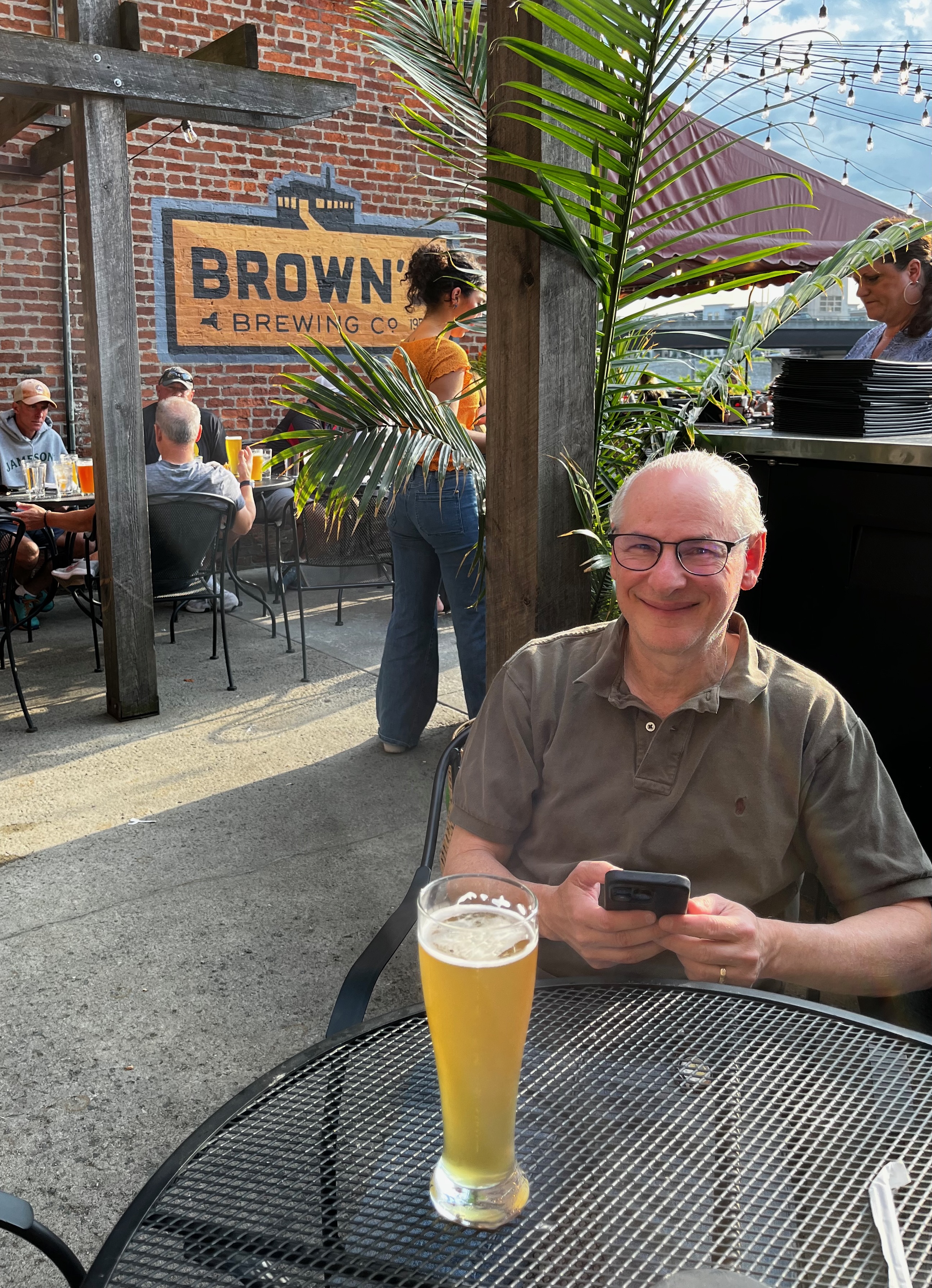
With my one libation at a family celebrationthat is way more beer than Gary usually consumes!
I’m not sure what happened exactly, but something has crystalized for me. I have been writing this blog, participating in writing groups, taking classes online and in person and spending countless hours thinking over the past 7 ½ years, but it is only in the last month that it has become clear to me that I do have a book I want to write. Actually, there are three of them (I think)! But I have chosen one theme to pursue because it feels ready. That is why my blog writing has been sporadic. I have been channeling my writing energy into the book.
Maybe it isn’t exactly accurate to call it an ‘aha moment’ because it wasn’t a single moment really – more of an accumulation of moments. It is a funny thing because I have toyed with this idea – exploring how the Holocaust has influenced Gary and myself and the family we have created – for years. I felt like there was something there, but I couldn’t get at it. I couldn’t figure out the arc of it. I was writing all around it. Finally, I see it. At least I hope I do! I hope I can sustain the vision to see me through to the end of this project.
It has been a lot of work. I would have thought, with all the blog posts I have (over 300 of them!), that it wouldn’t be that difficult to piece it together. But there is a lot missing – big chunks are needed to knit the story together. The process of filling it in has brought a lot more memories and a lot more questions.
I’ve also wondered if I should share these new pieces on the blog. There is a part of me that wants to keep it for the book. There is also the practical matter of sharing some of these stories with the people involved before I make it public. With the blog, my policy has been if another person is being written about in any significant way – other than a tribute to them – I email them the piece to get their feedback. Fortunately, everyone has been supportive – there have been essays that have benefited from another perspective and only one that I killed all together. I am not interested in writing anything that is hurtful – certainly not deliberately – and if there is some pain in the story, it has to serve a purpose and permission of any of the involved parties. Gary and Mom are the two that this has really applied to, and they have been unbelievably supportive, encouraging me to write my truth.
I have no idea whether I will be able to find a publisher for this book, or whether I will publish it myself, or whether, once I finish it, I will feel satisfied to share it with friends and family and leave it at that. We’ll see. I don’t want to get ahead of myself. There is a lot involved in that process that can be overwhelming, so right now I want to focus on the story.
One of the things that may have contributed to clarifying my purpose was visiting YIVO, the Institute for Jewish Research. I took some of the documents and photographs that had been stored in my in-laws’ house, some from their war years – to YIVO to see if they were appropriate to be archived there. I met with an archivist and he was quite receptive. He also offered insight into some of the items that brought more of it to life. Some of that may or may not find its way into the narrative I am writing, but the importance of documenting their story, but not just their story, became more evident to me. Yes, their story must be preserved and to a large extent it has been by Laura Bakst, Gary and my niece, who wrote and successfully published The Shoemaker’s Son (available on Amazon, among other places), which details Paula and David’s journey. My focus isn’t to document their story, though I will recount it in less specificity, but on what it has meant to Gary and myself in terms of our Jewish identity and what we tried to pass on to our children and their children. My family of origin was also deeply impacted by the Holocaust in a wholly different way, and I want to share that as well.
Over these years that I have been writing I struggled with the merit of our story – not Paula and David’s, there is no question that it must be preserved (and has been in several ways). After all, there is nothing extraordinary about me or my family (of course I think my children and grandchildren are extraordinary!). But, going to YIVO made me reevaluate the idea that it isn’t worthwhile.
We live in a world where antisemitism continues to thrive. We live in a world where people are traumatized – by violence, by hate, by war. Ordinary people must cope with those realities, and they pass it on to their children, sometimes in the form of fear, but also resilience, as well as a myriad of other impacts. As an ordinary Jew, the Holocaust, even though it happened before I was born and long before my children were born, has shaped us in important ways, including my relationship with faith. I am exploring that in my book. I just hope I can fulfill my vision for it.
In the meanwhile, I will try to keep up with the blog. I want to keep the conversation going and keep my connection with those of you who have been reading over these years. If you have suggestions, if you want to comment on whether I should share chapters of the book as I go, I welcome your thoughts.
I feel like a voyeur, but I can’t help myself. As I continue to sift through my aunt’s things, I am captivated by letters from my grandparents (my father’s parents). I hold certain impressions of them based on childhood memories and stories I heard throughout the years. The letters confirm some of those ideas, but also shed new light and offer a different perspective.
March 7, 1975
Dearest Clair,
So how be you ketzel? Do not forget M.D. appointment and Uncle Sam. Uncle Sam is by far the best Uncle anyone ever had. We are as we were, thank the good Lord. I am now in my glory that my “friends” have gone home…..
There is so much to unpack in this brief beginning. First, the date. March of 1975, I was finishing my junior year of high school. Grandma, the writer of this letter, was 69 and would be dead 9 months later. The letter gave no hint of her failing health, she may still have been without symptoms. About four months after this, she would be diagnosed with liver cancer and things went downhill fast from there. She died December 19, 1975.
She wrote from Florida to her ‘dearest’ daughter living in New York City. Clair was the baby of the family. I doubt there were letters written to my dad that began Dearest Barry. That isn’t to say she didn’t love my dad, but I don’t think they shared the warmth revealed in these letters. Again and again, in notes from both of her parents, Clair is addressed with terms of endearment. There are many possible explanations for the absence of evidence of that affection for my dad. To the best of my knowledge, Dad didn’t save letters. Dad also had terrible handwriting, more like chicken scratching, so he may not have kept up correspondence with his parents. But, there is something more. My memory was that there wasn’t much warmth between Dad and his parents. I’ve written about their complicated relationship before. If these letters to Clair are indicative of their bond, there was a great deal of it between Clair and her parents.
Photo of Grandma and Grandpa taken by Clair around the time of this letter.
I guess it should not be surprising. Siblings can have different relationships with their parents. I can think of examples of that in our extended family. One child sees their dad as heroic while another seems him as seriously flawed. One child may feel secure in the love of a parent, another may not. Growing up I saw things through the lens of my father’s perception. Reading these letters widens the view. It doesn’t change his reality but adds to the picture I have of his family.
Which brings me to the word ‘ketzel.’ I had to smile when I read that. Dad called me that all the time when I was a child. Ketzel means kitten in Yiddish. I didn’t know that growing up, but I recognized by the tone of his voice that it was a loving term. Ketzel is not a word I heard much if at all over the years since Dad died. Reading this letter in her Greenwich Village apartment brought my dad to me. I also didn’t know that it was a familial term – I only knew my dad used it but it makes sense that it would have been inherited along with their DNA.
Reading this letter, and the others, brought back other voices. It is nice to ‘hear’ Grandma’s voice.
Her voice comes through loud and clear. “So how be you, ketzel?” The phrasing of that is so Grandma. She was born in America, but her speech patterns had the inflections and syntax of the shtetl – at least that’s what I think it is. To me it is identifiably Jewish. Grandma was funny. She was quick with a quip, but she also had an amusing way of putting things – just like the opening of this missive.
“Do not forget M.D. appointment…”A Jewish mother reminding her daughter to take care from afar. Judging by the mounds of paper I sorted through in Aunt Clair’s apartment, she heeded her mother’s advice. She followed up on several medical conditions. Today we can access test results and other information from patient portals. Clair was ahead of her time. She kept copious records of various tests and lab reports, on paper and CDs.
“Do not forget… Uncle Sam. Uncle Sam is the best uncle anyone ever had.” She is reminding Clair to file her taxes – which I’ll say more about momentarily. But, what a great line! Though Grandma was American born and wasn’t as close to the immigrant experience as her husband, she had a deep appreciation for her country. For whatever reason, Aunt Clair was reluctant to file her taxes. It might have been straight up procrastination, or maybe something else was at play, but Clair struggled with this her entire adult life. Taking care of details, like filing paperwork, was the bane of her existence. Filing her taxes late (or not at all some years) may have been an expression of her rebellious nature. While Clair believed in government, a subject she and I discussed many times over the years, she wanted it to be run fairly and competently. It often fell short of the mark in her estimation, and it is possible she was showing her disapproval. Her mother, in this letter, was prodding her to take care of business – but unlike the medical appointment, she didn’t listen.
Another interesting tidbit from this letter – “We are as we were, thank the good Lord.” Again, interesting syntax, not your typical ‘we’re fine.’ Grandma was thanking God that her friends had gone home. The rest of the letter goes into the details of their friends’ visit that went sour, recounted with Grandma’s trademark blunt humor. I am a bit surprised that Grandma references God, given their lack of faith, but I don’t think it represents serious reverence for a higher power, more likely just a turn of phrase.
As I read these letters I get drawn into that world, adding to the picture I already have of my dad’s family. The letters offer a glimpse into a relationship I had no access to before. It feels odd to be peeking over their shoulders, but it doesn’t feel wrong. I have an enriched understanding and by disclosing it on this blog my family can share in it too.
This effort has brought up so much rich material, there is more to explore. I hope you will find it as interesting and thought-provoking as I have.
Note: Every so often my thoughts are best expressed in a prose-poem – I call it that because I don’t know what else to call it. As I continue going through Aunt Clair’s stuff, this is what came to me.
Aunt Clair saved letters
Who do they belong to now that
She has passed to another dimension?
The sender? The recycling bin?
Me – her devoted niece and self-appointed family historian?
Are they private?
Can I use them in my writing?
She saved them
To what end?
Buried in a stuck drawer
Wrapped in rubber bands
Encased in baggies.
Liberated, gently unfolded
Expressions of love
From her mother who died 46 years ago,
Endearments scrawled with an unsteady hand
From her father, also long dead.
Sister, nieces and nephews
offering thanks for a thoughtful gift
updating her from college or from across the world