What was I thinking? That was the question I was left with after a conversation with some family members. What was I thinking when I didn’t assign my kids chores when they were growing up?
A small group of us were talking about how old we were when we learned to cook, if we learned to cook. Some of us, myself included, learned quite young. I remember being in third grade when I made my first roast chicken. Mom was bedridden, either because of ongoing menstrual problems or a flare of arthritis, and she gave me instructions how to prepare it. Others in our conversation came to it early, too, most learned as they helped their mom, and some didn’t recall being taught at all.
In the context of this discussion, my son asked, “Mom, you knew how to cook. Why didn’t you teach me?”
“I don’t know. I didn’t teach your sister either, so it wasn’t a sexist thing,” I responded.
The topic moved to the broader subject of all types of household chores. One person commented that their father viewed his children as worker bees, thus they had a myriad of responsibilities that were rotated among the siblings.
In the house I grew up in, we had chores, but they were unevenly divided. Things were assigned based on sex – I did the tasks that were thought of as women’s work, my brothers took out the trash, moved the garbage pails, and swept the driveway. I set the table and did the dishes after dinner daily. I was in junior high school when I staged my rebellion. It was clearly an unfair distribution of labor. At least my parents were persuaded by my argument and things changed. My brother Mark has still not forgiven me.
I admitted to the group that Gary and I had not required our children to do chores. Before they went to college, I showed them each how to do their laundry. We were fortunate in that for most of the years they were growing up, we had a person come to clean the house either weekly or every other week so the cleaning of bathrooms, washing or vacuuming floors, changing bedding was taken care of. I did the day-to-day straightening, laundry, dishes, etc. Gary did the gardening – the kids would sometimes help him with that. If I asked my son to help me bring in the groceries from the car he did so willingly.
As I sat there, I wondered: why didn’t we give them some responsibilities? I don’t think I did them any favors by not having them know how to cook, iron, clean, etc. Of course, I wasn’t particularly good at those tasks myself. I didn’t believe in ironing, unless absolutely necessary (still don’t). I don’t know how to sew. I can sew on a button in an emergency, but Gary takes care of that for himself. Cooking was probably the only area I really could have offered them something.
As I look back, I think I wanted to spare them the drudgery. I resented the chores I did as a child, though my father had explained to me that as a family, we each needed to contribute. I understood his point and accepted it, but I didn’t like it. I must have also carried some resentment for the years that things were so unbalanced with my brothers.
Another element was that starting when my kids were in first and third grade respectively, I stopped working. I took on some freelance jobs outside the home here and there, but I was essentially a homemaker for a dozen years. Gary worked long hours, and we were well provided for thanks to his efforts. I almost felt guilty, even as I intellectually knew that I was supporting Gary’s career by doing all the housework and managing our family. Emotionally, though, it felt ‘less than,’ or not particularly valuable or admirable. I figured children only get so many years to be carefree so I’d let them be and I would take care of the chores.
It occurs to me now that I may have also been avoiding the inevitable conflict that goes along with assigning chores. It wasn’t a conscious thing at the time, but I was probably unwilling to take on the fight. This thought doesn’t make me proud but there is likely some truth in it.
Interestingly, both kids are well functioning adults. They might not have come into adulthood having a lot of the skills or knowledge necessary to take care of a home, but they are doing it, they are quite competent. They would have to say whether they feel they were ill-prepared and if it created problems for them, though they haven’t complained to me. They make good use of Google and YouTube. Somehow, they are both figuring it out with their respective partners.
I come away, after thinking about this, believing that there isn’t one right way to handle this issue as a parent. Children becoming competent adults involves a lot of things falling into place beyond how this one thing is handled.
I understand the value of giving children responsibility and having them appreciate the importance of helping as members of a family. Perhaps, my children would be better off today if I had assigned them chores, but we will never know. Each of them got the message that a work ethic was important, and more than that, they don’t exhibit a sense of entitlement. Maybe the behavior they saw modeled was the most powerful factor in shaping them into adults – that and good luck (being lucky in health and not experiencing trauma are immeasurably important).
One last thought: Gary would remind me periodically that our respective parents raised us very differently, yet we function in the world pretty well. I found that thought comforting. There is room for a range of philosophies and a range of mistakes.
Carefree days
Please feel free to share your experiences as a child with chores and/or your parenting approach. I’d love to hear!
I am a grandmother, called Nana by my granddaughters, which makes me smile.
I ask myself, how much of my life do I want to shape around theirs?
I grew up with my Nana living upstairs in the apartment above mine in a two-family semi-attached house. She was a gift to me.
I am not in the same situation. I am 2 and ½ hours from one granddaughter, three hours from the other. My children did not grow up in the situation I had either. They saw their grandparents maybe monthly in the summer, once in the winter months when we would fly down to Florida during the February break from school. They still knew their grandparents, and knew they were treasured. Most summers my kids would spend a week at my folks’ house in the Catskills. I think that was an especially bonding experience.
Is that enough for me?
These days we have FaceTime. We can see each other more frequently – in between in-person visits. What will that mean to them?
Then there is my relationship with my children. There are rare occasions when I see each of them separate from their families. It is precious time when I get to see them one-on-one. Do I shape my life to maximize the opportunity to visit them?
Or do I lead my life?…commit to volunteer work, commit to writing, commit to political activism – instead of filling in with those activities.
I don’t know how to balance it.
And then there is the mundane business of life. It is common to hear people who retire say, “I don’t know where the time goes. I’m always so busy. How did I fit in a full-time job?”
I am finding that taking care of myself as I age has become a full-time job. More frequent doctor visits, more frequent medical tests, physical therapy, exercising multiple times a week, picking up prescriptions, and all the paperwork that supports that stuff. Then there is the expansion of household tasks, some of which I crammed in or let fall by the wayside when I worked so there is catching up to do. Between taking care of the house, the car and my body, there isn’t that much extra time. Plus, my capacity or energy for all of it isn’t what it used to be.
I admit I am disappointed in a way; retirement isn’t quite a free as I thought it would be. I know I am lucky – unbelievably so in that I am not facing serious illness, just the nagging things that happen as the bones, joints and systems wear. I am even more blessed that my children are independent, capable humans who have families of their own. They live very full lives without help from me.
Some of my peers appear to be happy to center their lives around their children and grandchildren; others appear to be happy centering their lives on their own activities and maybe some have found the secret of balance. If you have, please share! Or maybe I assume folks are happy because that is the face they put on, especially on social media.
Between my own desire to remain engaged in meaningful growth, contributing to the world, and to have fun (which for me means traveling, being active, walking among trees, smelling flowers, being social, and, most importantly, deeply connected to my family), I feel like I don’t know what I am doing.
But, maybe I am doing it. This is it. I answer a call from my son who has an extra ticket to a Met game on a Monday night and I figure out how to make that work (it was a great game and we had a blast!). I schedule my various medical appointments and follow their instructions as best I can. Babysit for grandchildren and grandnephews when asked. Fit in yoga and tennis where I can. Take a walk with a friend. I write when I can, post a blog when I can. I don’t worry about getting published (easier said than done!). Let tasks in the house sit a while longer. I have lunch with a friend here and there. Plan a trip or two each year. Celebrate my granddaughters’ birthdays. Sounds pretty awesome really. So why do I feel uncentered? Perhaps it is just a matter of accepting it – the fragmented nature of it, the unpredictability of my schedule (or the absence of one) and the idea that I write mostly for myself and whatever audience reads my work. And most importantly, to believe that in being there for friends and family, I will have done something worthwhile even in the face of this very troubled world.
Looking for perspective in the woods of Central Park or maybe just admiring the birds.
My family has a movie club. It functions the same way as a book club. A member picks a movie, and we get together on Zoom to discuss it. The person who picks the film moderates the discussion. The number of participants varies from month to month, but typically there are about 19 of us. This month we discussed Field of Dreams.
I had not watched Field of Dreams in many years. I remembered enjoying it in the theater when it came out in 1989. I have caught bits and pieces of it on television since it airs frequently, but I am not someone who watches it whenever they come upon it, and I certainly had not watched it all the way through in decades.
For many this film is a touchstone. It is a perennial favorite because it speaks to universal themes: dream fulfillment, regret, father-son relationships, nostalgia for baseball, and redemption. It also features some wonderful actors, James Earl Jones, Burt Lancaster to name two and Kevin Costner qualifies as a genuine movie star (I think he is a fine actor and does a good job in this).
Somehow watching it yesterday afternoon, I was not as moved as I remember being. I wasn’t drawn into the fantasy. I liked it well enough and could appreciate aspects of it, but I found myself doubting the premise. I wasn’t buying it. When we gathered for our discussion, I was in the minority, though there were a few who were also less than impressed. I wondered if I have become too cynical to relax and give in to the sentimentality. One of the premises of the movie is that we long for a simpler, more innocent time. My problem with that idea is that I don’t believe that simpler, more innocent time exists.
I also think that the father-son dynamic, which is central to this story, didn’t resonate with me and I don’t believe that is a matter of gender. Anyone can relate to the idea of having regrets over a parental relationship that wasn’t what you wanted it to be – and having the chance to make amends would be an unbelievable gift, as happens in the movie. While I can relate to that idea and would welcome a chance to reconnect with my parents, I am lucky in that I don’t feel a lack of closure with either my mother or father. I miss them, but I don’t have much in the way of regret. I am grateful for that.
While intellectually I get the potential for how baseball can connect a father and son and how meaningful a catch could be, it still didn’t resonate. My parents were not of a generation where they played with their kids. My dad never had a catch with me – and I have no memory of him having a catch with my brothers. Maybe he did, or maybe they wanted him to. They certainly had catches with their own kids when they became fathers. I think it was a generational thing, though Gary, my husband, would toss a ball with his dad. What’s funny is that my dad was an athlete. He grew up playing ball – all kinds – baseball, basketball, stickball. He continued to be active as an adult, playing tennis and paddleball. But, he didn’t play with us. I think the mind set was different. He didn’t think it was his job to play with us. I had no expectation that he would. I can’t speak for my brothers – they may have felt a longing for that, or maybe they felt as I did that it just wasn’t something to be expected of him. Mom didn’t play with us either – not board games, not sports. We were expected to entertain ourselves.
Aside from the difference in expectation about parental roles that may explain my tepid reaction, the movie relies on nostalgia for baseball. I love baseball. It is a sport I have always enjoyed. I was a huge fan of Ron Bloomberg of the New York Yankees when I was a kid. You can probably guess why. But, I associate baseball with my brothers, my uncles and my Zada (my maternal grandfather), more than my dad. Dad followed the sport but after the Dodgers left Brooklyn before my birth, he was no longer a fan. He grew up as a die-hard Dodger fan and was angry and resentful that they left. In the years that followed he kept track of players, he read the sports page, but he didn’t root for a particular team and had no interest in going to games. If my brothers and I went to a game, it was with our uncles. I do recall a particularly memorable time my dad took us as a family, and it may explain why we went so rarely.
We went to see the Mets play the San Francisco Giants at Shea stadium. It was August of 1969, an auspicious year. Dad was no fan of New York City traffic, so he wanted to leave the game early. It was a close game, no runs had been scored, and we made our way to the exit after the 7th inning. Except when we got outside the stadium, we couldn’t find our car. We combed the aisles. This was long before we had fobs with a panic button. We had no way of flashing the headlights to help us locate the car. I don’t know why none of us had noted the section where we parked. We just kept walking up and down – every aisle looked the same, every section looked the same. Meanwhile the game went into extra innings. I believe we found our car after about an hour. The game went 14 innings before the Mets won, 1-0, so we still beat most of the crowd to our car where we listened to the last inning on the radio. It turned out to be a classic game. Gary Gentry, the Mets pitcher, held the Giants scoreless for 10 innings and was relieved by Tug McGraw who finished out the game. Juan Marichal, the opposing pitcher who went on to be a Hall-of-Famer, took the mound for 13 innings! So not only were we roaming the parking lot for a very long time, but we also missed the end of a truly great game.
It was not the happiest of experiences. Dad was not the most relaxed person under the best of circumstances. He had a temper and a short fuse. You can imagine his fury at not finding the car. Plus, with a family of five, though it was far less expensive than it is today, it was still a lot of money to buy tickets, park and feed all of us. I’m not sure we ever went to a game as a family again. It became an amusing anecdote, but not until many years passed.
[I will rely on my brothers to correct me, if I got this episode wrong.]
The point is that my affection for baseball was not nurtured by my father. So, when I watch Field of Dreams it doesn’t evoke the heartfelt emotion that it does for other folks. I know my brothers feel differently. They participated in the movie club discussion, and the film clearly struck a chord with them. I invite them to comment or write a blot post about the notes that struck home.
If you want to chime in with your feelings about Field of Dreams, please do. I will say that unlike many movies made in the 1980s, it aged well. It wasn’t offensive in any way that I perceived and, in fact, got a lot right. It just didn’t move me the way it does many others. I didn’t choke up and I shed no tears during the final scene. Did you?
I don’t have a sister; I have two brothers. But, I find the dynamic between sisters particularly interesting, maybe because I don’t have one. I could be romanticizing it based on Hallmark cards, but it seems that for some it can be a deep, lifelong friendship; a connection different than the relationship between a sister and a brother, at least from my observation. I did have a front row seat to my mother’s relationship with her sister, Simma, and a less intimate but still revealing view of my mother-in-law and her sister, and I saw common themes. Those relationships were quite layered and complicated. I was reminded of that recently because, as I am still in the endless process of going through my mother’s things, I came across a tribute Aunt Simma wrote for my mother that brought up questions. I am sharing portions of that essay because I think it offers insight into Mom and Simma and provides an opportunity to explore whether the relationship described is true of other sisters. This is Simma’s tribute:
Feige Brody: A Life
This is a wholly unauthorized, condensed, selective biography, one which, no doubt, will be considered by its subject to be semi-fictitious. Nevertheless, these are the author’s reminiscences and, therefore, are told from the author’s point of view.
Feige Marian Spilken was born in Brooklyn on November 16, 1933 to Ray Woltz Spilken and Charles Spilken. Her mother was 19, her father 29. She was named after her maternal grandmother who died too young in her early 40s. From the start she was a good girl, a mother’s girl, nurtured by her young mom whom she adored. Feige was everything adults could hope for in a baby. She was exceedingly pretty with dark curly hair, dimpled cheeks, and she was sufficiently chubby, a good thing in those days, to convince her paternal grandmother that Ray was not a bad mother….
The family moved to New London, Connecticut, where her sister Simma was born. Bubba Sarah Spilken was outraged that Ray should produce such a scrawny, straight haired baby who would not eat of her favorite dishes much preferring to eat bugs and dirt. Only Feige’s smiling, compliant presence and acceptance of those heavy, eastern European dishes kept Bubba from banishing Ray from the family. Feige was the good girl.
The great hurricane of 1938 forced the family to move to Jersey City, New Jersey. They lived above Charlie’s bakery and the girls loved bothering the bakers…
Across the street there was a saloon owned by the Landaus, the only other Jewish family in the neighborhood. Before it opened late in the afternoon, Mrs. Landau allowed the girls to play at the bar pretending to pull beer from the taps and serve customers. There were banquet rooms up a couple of flights of very narrow dark stairs. Everything was covered in sheets until the room had to be used. Feige loved telling Simma ghost stories as they climbed the stairs. She said the sheets were actually the ghosts’ clothing and would make appropriate noises to scare the daylights out of her impressionable sister.
Other favorite pastimes were staring out the back window at the not too distant Statue of Liberty and telling stories. Often, they would go to the front window in the late afternoon when the saloon opened. They liked to shout at one particular customer who looked worse for drink and had a fat, red nose. “Salami, Baloney, Pastrami,” they shouted since those were the most offensive words they knew. After the outcry they would duck, afraid the drunk would see them. That was exciting….
No matter where they lived, Feige was like a little mother to her sister. While Ray worked, Feige would entertain Simma and endure her fresh mouth and mischievous ways. One hot summer night all the windows were open when a terrible summer storm occurred… Simma wouldn’t listen when Feige told her to go to bed. Instead, she ran away making Feige chase after her. The rain slicked linoleum floors were so slippery Simma fell. Sliding into the metal radiator, her eye was bruised, turning black and blue, but it was Feige who suffered. She couldn’t stop blaming herself for the accident. She was a good girl.
Simma would refuse to go to sleep… Feige would induce her to come to their shared bed by telling her she would be allowed to squeeze and pull Feige’s copious ringlets. Simma can still feel their soft, springy, velvet luxuriousness. It was a fact that whether they were in Brooklyn, in the country with Bubba and Zada, or at a bungalow in Rockaway, Feige took care of her sister.
She was patient most times, but one lapse occurred in the late ‘40s. Simma was home in bed, too sick to go to school. Those were the days of Forever Amber, but there was no way the girls could obtain that “dirty” book. They got a poor imitation in Kitty. Feige allowed Simma to read the book but made her promise to read it under the covers, the way Feige read every night so their parents wouldn’t catch her.
When Feige came home from school, Simma asked her to define a word she could not find in the dictionary. “Feige,” she queried, “what is a whore?” She pronounced it “war.” “You know. It’s an armed conflict between nations,” Feige replied. Simma was frustrated and said, “I don’t mean a war, a ‘war.’” Feige responded, exasperatedly, “WHO-ER, stupid, WHO-ER.” What was this? Feige lost her cool and never did enlighten Simma as to the definition of the word…
Ray and Charlie always had people in the house. The two sides of the family gathered there as well as their many friends. Feige and Simma were allowed to stay up and mingle with them. One of Charlie’s friends, Jerry Cohen, would show them parlor tricks first fooling them and then teaching them. That was how they learned to read each other’s minds, an act they still perform for amazed spectators.
Days, though, were not always sunny. Feige finally caused her parents anxiety when she was 17. She decided she would like to move into an apartment with some friends. How could a well brought up girl live without her parents’ supervision? Ray and Charlie were distressed. But it was a great time for Simma. It was the only time Simma was told by family members that she was the good daughter, never causing her family any distress. Who were these people? Where had they been for the last 17 years?
When Feige started college her life changed, making it even better than it already was. She met Barry Brody. She was smitten and, indeed, got married to him as soon as they both were graduated from Brooklyn College. Feige is fond of quoting Charlie. Well, one of his precepts was that to have a happy marriage the couple should move away from their parents the first year of their marriage and get to know one another without interference. Feige, ever obedient, moved to Wichita Falls, Texas; Chicopee Falls, Massachusetts; and then back to Brooklyn with two boys in tow and a girl on the way.
Now, Feige was a devoted wife, mother, cook and baker. The girl who in her parents’ house had to be told that the outside of the pots and dishes had to be washed as well as the inside, was suddenly the happy homemaker. She, like Ray, loved to entertain family and friends. There was always lots of good food around which is still true whether the Brodys were home in Brooklyn or in Livingston Manor, or, now, in Boynton Beach. Their houses were and are gathering places for everyone they know, and their hospitality is boundless.
One more point of kindness, showing what a good girl and sister Feige is. A year after Simma’s husband died, Feige and Barry were afraid she would have nothing to do during the summer and suggested they all take a trip to Europe together. They planned to go to London, Paris and Amsterdam but the French changed all that. They would not allow American Air Force planes to use French airspace when they on their way to a bombing mission in Libya. The planes went the long way around. One ran out of gas and crashed killing the American crew. Feige was up in arms while putting her foot down. She would not go to France. She said there were two choices: cancel the trip or find something to replace the Paris portion. There was a replacement, a circle England tour. It was Simma’s first sight of England and Oxford, a romance that continues to this day. Thank you, Feige. By the way, Feige still has not gone nor will ever go to France. You are a good girl, Feige Marian Spilken Brody. Happy birthday with love from your sister, Simma Spilken Sulzer.
Mom (left) and Simma as teenagersMom (left) and Simma in England
Unfortunately, both Simma and Feige have passed away so I cannot ask questions that arise from the narrative. For example, Simma notes that after the great hurricane they moved to Jersey City and lived above Charlie’s bakery (Charlie was their father). I thought the bakery was owned by Charlie’s brother. A minor point in one sense, but not so inconsequential in understanding their economic circumstances.
It’s also interesting that Simma comments in a positive way about Mom’s chubbiness as a baby – at that time, and in their culture, having a plump baby was a sign of good mothering. I think we still believe it’s okay for a baby to have round cheeks, but only up to a point, then we start to worry. The never-ending judgment of mothers continues unabated to this day.
Another recurring theme is the importance of story-telling and reading. Mom was a devoted reader. In fact, as her daughter, I would get frustrated trying to get her attention when her nose was in a book. Often, I would just give up. On the positive side, my brothers and I grew up to be readers ourselves and continue to enjoy good stories.
Simma mentions the parlor trick of reading each other’s minds. Mom and Simma performed that gag many times to the amusement and bafflement of our family. I didn’t know where they learned how to do it, now I do – Jerry Cohen! Very late in life, Mom finally revealed how it was done, though I doubt I could remember the steps well enough to do it with one of my brothers.
Simma characterizes Mom as a happy homemaker after her marriage and arrival of children. I don’t think of Mom that way. She enjoyed cooking and baking for the purpose of entertaining guests (and to a much lesser extent feeding her family), but that was the end of her homemaking enthusiasm. Keeping a close eye on her young children (!), cleaning, sewing, and ironing were not high on her priority list. I don’t think she was a happy homemaker. I don’t hold that against her, but she probably should have been a bit less laissez faire when it came to overseeing her young children.
There are so many other interesting elements to this essay, starting with Simma’s disclaimer at the beginning. She acknowledges that her perspective may be quite different than Mom’s. I don’t think she is referring to the vagaries of memory. When Mom and Aunt Simma would tell a story from their shared past, which may have involved the same people and same incident, they understood it in totally different ways. Mom seemingly came into this world as a glass half full kind of gal; Aunt Simma not so much. Often, Mom saw people through rose-colored glasses and that certainly applied to how she viewed their parents.
I find it illuminating, too, that Aunt Simma describes Mom as a good girl. Mom, by her own description, was compliant and she wanted to please her parents. Aunt Simma was more rebellious, chafing at the restrictions put on them as children. Mom credited Simma with getting them a later bedtime, even though she was the younger one. Simma was the trailblazer, according to Mom. She also spoke of Simma’s insistence on picking out her own clothes. As a young person Simma was given a budget with which to buy her own outfits – she would rather buy one stylish item, instead of several cheaper things. Mom wore whatever her mother got for her.
That brings me to the first of several common themes between Mom and her sister and my mother-in-law and hers. That dynamic, the good one vs. the rebellious one, seemed to play out in both. Paula described herself as obedient – she did whatever her mother asked her to do as a child. Sophia was less cooperative. Unlike my mom, who was the eldest, Paula was the middle child with an older brother, Bernie, and Sophia about three years younger. Years later, when I met them, Sophia commented that their dad told bedtime stories to Paula, not to her (though they shared the same bed – just like Mom and Aunt Simma). Paula claimed that he was telling the stories to both of them, but that was not Sophia’s perception. Paula recalled feeling loved by both of her parents, despite the traumatic premature death of their father (he was murdered by the Nazis). Sophia did not carry the same warm memories of paternal affection. This mirrors the differences in my mother’s and aunt’s tendency to have disparate perceptions of people (though in Mom and Simma’s case not necessarily different views of their father).
Sophia (left), their mother, Lea, and PaulaSophia (left), David, my father-in-law, and Paula
Another similarity between Mom and Paula was their choice of a spouse when compared with their younger sisters. Mom and Paula were lucky in marriage, enjoying long, supportive, loving relationships. No doubt they had their ups and downs, as all marriages do, but they had husbands who were welcomed into the family and were much loved by their in-laws. Simma and Sophia were not so blessed. I imagine that difference in marital harmony impacted their relationship as sisters, as well.
The biography that Simma wrote for my mom is full of love and warmth. Their later years were more complicated. When I visited in Florida, years after Dad died, Mom told me that she believed Simma didn’t like her anymore. I didn’t know what to say. I tried to find fault with her perception but didn’t convince her. So many things might have gone into that – the loss of their respective husbands, deteriorating health, and perhaps long buried resentments/jealousies. At one point, after Simma died and Mom was feeling guilty that she hadn’t been able to offer her sister much comfort at the end of her life, I read her this essay and other cards from Simma that expressed love and appreciation. Sadly, it didn’t seem to ease Mom’s regret.
Paula and Sophia appeared to experience a similar distancing towards the end of their lives. Again, many things contributed to that, not the least of which was physical distance with Sophia living in Tucson, Arizona while Paula split time between New York and Florida. The progression of Paula’s Alzheimer’s disease created an additional challenge.
Sibling relationships are complicated. Though DNA is shared, personalities can be dramatically different and that was certainly the case with Simma and Mom and Paula and Sophia. Many people are estranged from their siblings, and it is understandable given how fraught family life can be. The potential for deep resentment is great – add mental or physical illness, or other serious problems and the bond can break. That was not the case with my mother or mother-in-law, but the end of life challenged the connection. There is no doubt, though, in both cases, the sisterly relationship was one of the most important in their lives. Whatever their differences, they remained deeply tied to one another.
What is your experience or observation about relationships between sisters?
This photo came up as a memory on Facebook a couple of days ago. It was bittersweet to see it. I remember that day clearly. It was only a year ago. Gary and I were in Florida for our annual pilgrimage to see the Mets during spring training. We took a short drive from our hotel to take a walk by the beach. Gary did his thing – he likes to show he can still climb a tree – and I snapped the photo to document it and sent it to our children, who, in turn, would hopefully show our granddaughters.
At the same time that we were enjoying this ordinary moment of levity, I was struggling with a difficult and painful decision. My mother, whose health had been failing, took a dramatic turn for the worse the night before. We had only just arrived in Florida. Though Mom had not been doing well, I had spoken with my brothers, the hospice nurse and her aide before leaving and we thought she was stable. We were wrong. Thus the question: Should I return and go to New Jersey, or should I stay?
Gary and I contemplated that as we walked along the beach. I had several conversations with my brothers before our walk. Both of them encouraged me to stay in Florida. Mark was heading down to Jersey from Albany with his wife, Pam, so he would be there. Steven and his wife, Cindy, lived 15 minutes away from Mom so he visited regularly. Steven was quite insistent that I stay in Florida; they would handle things. I had been very involved with Mom’s care up to that point, they didn’t want me to cut short our brief vacation. We were scheduled to be away for a total of five days, and we were on our second day when things went south.
After much contemplation, we decided to stay, believing that there wasn’t much I could add. My brothers are capable people. Mom was sleeping most of the time. Despite that, I was still torn. Did I need to see her? I decided I didn’t. I remembered how painful it was to see my father during his last days. Those images stayed with me for years, crowding out memories of him as a healthy person. It was also possible that I would get back in time to see her since our trip was so brief. Though I was deeply conflicted, I didn’t have a strong gut feeling, so we decided to stay in Florida.
I was able to enjoy the sunshine and warm air. I had the welcome distraction of the baseball games and dinners with friends. We visited Gary’s mother. In between, I talked to my brothers and thought about Mom and continued wondering whether I was doing the right thing. My brothers and sisters-in-law were handling some rough stuff – administering morphine, watching Mom to see if she was uncomfortable while she mostly slept. I felt guilty leaving this final stage to them, but I was also relieved.
Gary and I flew back north on Monday. Mom was still hanging in there. Before we left for the airport, I called my sister-in-law Pam’s cell phone, knowing she was sitting with Mom. Pam told me Mom’s eyes were closed, and she seemed comfortable. I asked her to hold the phone next to Mom’s ear. I told Mom I was coming to see her the next day but if she was ready to go, it was okay. I told her I loved her, that she was a great mother and that she earned her rest.
We arrived back in Albany late on Monday. Mom was still breathing. I got up early Tuesday morning and was packing my things to drive down to New Jersey when my phone rang. Mom’s aide, Ama, said she believed Mom had passed. She was waiting for the nurse to come to confirm it. I was surprised and I wasn’t. I thanked Ama for all she had done for Mom. I felt lost – now what should I do? After calling Gary, who was at work already, I wandered around my bedroom deciding if I still wanted to go down to New Jersey. For reasons that aren’t entirely clear to me, even now, I wanted to go. Maybe to see visual proof that Mom was gone, maybe to help Steve and Cindy with the details….
Ama was indeed correct. The next few days are a blur, planning the funeral, sorting through her things.
It was Mom’s time – I knew that. I wondered whether what I said to her on the phone made a difference. I didn’t exactly feel guilty about not being there, though I wondered if I would have offered her some additional comfort. I had been with Mom through most of her medical issues over the last years. I think I offered her comfort then. A year later I am still not sure how I feel. I am not riddled with regret, and I have been spared thinking of Mom as the sick version of herself. When I remember her, I think of her vibrant self. I am grateful for that. I still think of calling her to share good news.
I am also grateful to my brothers for protecting me – I think that is what they were doing by encouraging me to stay in Florida. I believe that they thought I had pulled my weight in caring for Mom, and they stepped up to see her through to the end, painful as it must have been.
Aside from knowing that it was Mom’s time, I know one other thing: there is no “right” answer as to how to handle the end of life. There is only doing the best you can and making decisions with love and compassion. After that, if you are a believer, you give it up to God. If you aren’t, and I am not, you give it up to the great unknown.
Note: Mom passed one year ago today – February 27, 2024. We miss her but take comfort in the long, happy life she had.
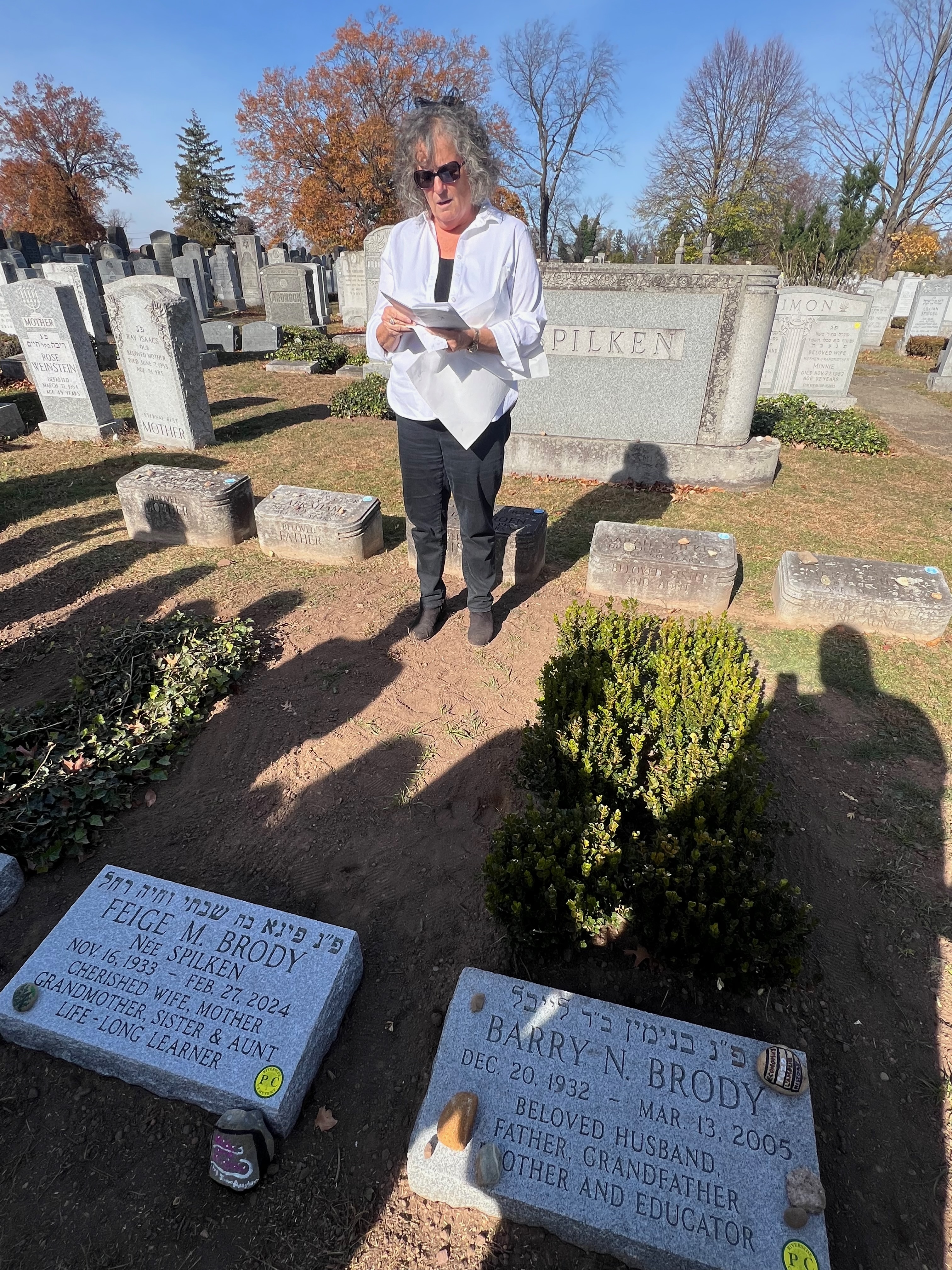
We gathered at Riverside Cemetery in Saddle Brook, New Jersey. In Jewish tradition, a year or so after a person is buried, you have an unveiling – literally the unveiling of a headstone or footstone that is the marker commemorating the individual’s life and death. Though it has been less than a year since my mother passed, my family gathered to observe this ritual for her on Sunday, November 17th, one day after what would have been Mom’s 91st birthday.
Photo by my brother, Mark Brody
19 of us stood around her grave on a brilliantly sunny day, unusually warm for mid-November in the northeast. It was appropriate weather given Mom’s sunny disposition (she was an eternal optimist, though, for better or worse, she shared her fears and complaints with me). She is buried between her mother, my Nana, and her husband, my father. The plot is part of an area that was established by the burial society founded by immigrants from Strickover, Poland where her father was born. Ironically, he is not buried here, he rests in Florida. But, other family members surround Mom, her brother, grandfather, aunts and uncles. There is something comforting to me about them all being together.
We began the ceremony by reading the portion of Ecclesiastes that tells us so eloquently that to everything there is a season – reminding us of the cycle of life. Then we uncovered the stone which reads:
Feige M. Brody
Nee Spilken
November 16, 1933 – February 27,2024
Cherished Wife, Mother, Grandmother, Sister and Aunt
Life-long Learner
Standing beside me were representatives of all those roles – her children, brother, sister-in-law, grandchildren ( a great-grandchild, too), nephew, nieces, and great-nephews.
I read these words: “On behalf of all of us, we consecrate this memorial to Feige Brody as a sign of our eternal love and devotion. May her soul be bound up in the bond of eternal life.”
The cemetery had provided a booklet with selections that could be read, and it offered the following passage which I am transcribing here because I thought it was insightful, comforting and appropriate and might be helpful to others who are grieving a loss:
“We gather here today at the final resting place of our beloved mother, sister, grandmother, aunt, Feige to unveil this grave marker dedicated to her memory and to call to mind our cherished memories of her. When Feige passed away, we assembled here to pay our respects. At that time our grief was deep, and we felt intensely the pain of loss. Now, with the passage of time, the pangs of our initial grief have softened, yet we still feel sorrow in our hearts whenever we remember her.
Jewish tradition teaches us that those memories of Feige, which each of us cherish, can provide us with a measure of comfort. Those memories also serve as a form of immortality that comes to those we love when we remember them, and when we live our lives in emulation of the virtues they taught us by example.
Our presence here today is already an indication that Feige has achieved that immortality that comes through remembrance. Our presence is also a sign of the respect and admiration in which Feige is held by us. We still feel an emptiness in our lives when think of her because she played such an important role in each of our lives as a beloved family member and friend to many. Feige was devoted to us as we were devoted to her, a relationship of love and affection that we recall today.
Throughout the months since Feige passed away, we have each had occasions to remember the impact that she had on our lives.
We are comforted by our memories of the joys she brought to people and by the contribution Feige made to the betterment of our world.
In the biblical book The Song of Songs we learn that “The bonds of love are stronger than death.” Our memories today prove the truth of that teaching.
Even though Feige is no longer present in person, the love that we shared and the way our lives were touched by her continue to be felt. The pain of loss and separation is the price we have to pay for the years of Feige’s love and devotion.
Therefore, it is with sorrow, yet at the same time with a deep sense of gratitude, that we thank God for the years during which we were privileged to have had Feige as part of our family’s life and as a member of our community. We thank God, as well, for the love that bound us together with Feige in life and that inspires our cherished memories. It is with these thoughts in mind that we now pay tribute to Feige by dedicating this grave marker to her.”
That passage provided comfort to me. I am consoled by the notion that we attain a measure of immortality by being remembered – it helps me to reconcile the loss of my mother and father, as well as other people who I have loved in my life and still think of regularly. And, it is meaningful to me to think of how, by carrying forward their values, by emulating their integrity and generosity, I am helping to preserve their legacy. Those thoughts help me to come to peace with my own mortality. Hopefully I will have touched friends and family in a way that merits remembrance.
After reading that passage, we said a concluding Hebrew prayer and Uncle Terry read a touching poem he had written in tribute. Aunt Barbara, as a self-described “out-law” welcomed into the family by Mom, offered her heart-felt perspective on Mom (and Dad’s) generosity and the importance of our family bonds. Terry noted that he had Barbara would, when the time came, rest in this same area of the cemetery, just across from where we stood. I said a silent prayer that that would not be any time soon.
Another Jewish tradition when visiting the grave of a loved one is to place a rock on the marker. This is to signify a visitor’s presence, that the person who has passed has not been forgotten. Several years ago, when we gathered at my father-in-law’s grave, my sister-in-law Doreen painted some rocks with pictures of things that she shared with her Dad or represented him. I thought that was a wonderful gesture. I decided to do that for my parents. I painted one rock to look like a bookshelf with items my dad read regularly: Economics, Puzo (he loved The Godfather and read it multiple times), L’Amour (he loved westerns) and History. I painted another stone with Pride and Prejudice by Jane Austen (my mother’s favorite of her novels, and she read Austen every summer until dementia made that impossible) and a final stone with a blueberry bush (when my parents lived in the Catskills and the grandchildren came to visit, they went blueberry picking and baked muffins). I felt good placing those rocks that embodied precious memories, knowing that they would sit there for a while at least before the elements wear them away.
No Spilken/Brody gathering would be complete without partaking of food. So, we adjourned to the diner that was just outside the cemetery. Though the service was painfully slow, and we had to wait, and the orders got mixed up (no day goes by without some aggravation), we enjoyed each other’s company before going our separate ways and returning to our lives – some in New Jersey, some in Massachusetts, some in Connecticut and the rest in Albany, New York. Hopefully our next gathering will be a happier occasion, but I am left with a feeling of warmth, believing that Mom and Dad rest easy knowing that our familial bonds are strong and that we are doing our best to live out their values.
Months go by very quickly. It seems like I just paid my cellphone bill yesterday when the next one shows up in my inbox. I don’t understand how this happens. It feels like I’m always struggling to keep up. When I go online to pay, I check to make sure that in fact it was a month since I last paid, and, lo and behold, it has been. How did that happen?
On a related note, I pay a ridiculous amount of money for phones, internet and streaming services. There has to be a better way, but that would mean taking the time to research things thoroughly to figure it out. I think I am probably paying for streaming services that include other services that I pay for separately. Does that make any sense? I am probably double paying for Hulu. But it is all so complicated, and it gives me a headache, so I throw up my hands. Someday, I promise myself, I will sort it all out. Of course, they probably have a service for that – but then you’d have to pay for it. I find it very frustrating. And these companies are probably counting on our throwing up our hands to make more money.
And then there is the confusion about which streaming service plays which program. I might only watch one program on a given service – that also makes no sense. And there is almost nothing I watch on cable, except for HGTV, SNY (the Mets baseball channel) and the tennis channel. Then there is Gary’s penchant for having some version of Law and Order playing in the background for hours each evening. Sometimes I put my foot down and say that episode was just on, please find something else. But, then there is nothing else worth watching so it is back to Law and Order. So, I guess we do use cable. But it should be more straight forward. I imagine eventually, with consolidations and such, that we will be back to the equivalent of three major broadcast networks. After all, there is only so much content we can absorb.
**************************************
I just brought my car in for service. It is a Honda Accord hybrid. Aside from needing an oil change, a light came on telling me my acoustic system wasn’t working. I drove around with that message for a while since it didn’t seem to be a critical thing to the functioning of the car. If you haven’t driven a hybrid, when it is in electric mode the engine is close to silent. To make others, especially pedestrians, aware of the car, it generates a sound – so they are alerted to its presence. My car sounded like it was singing. A regular car motor you can hear. Well, the singing stopped. The part will cost $248.00 to replace, not including labor. I am not excited about spending that amount of money, but it doesn’t seem right to be putting people at risk if I don’t get it fixed. It is always something. And it always ends up costing more than $200. Sometimes it feels like we hemorrhage money. And, I can’t complain because we have the resources to pay for it. I feel for folks, the vast majority frankly, who don’t have that luxury. We used to be in that position where we lived paycheck to paycheck – it is very stressful. No one wants to hear me complain given my privilege, but I can’t help but comment on how crazy it is.
*************************************
I’ll close this blog post by noting that we are coming up on 4 months since my mom passed away. The pangs of grief that hit me come as a surprise, though they shouldn’t. I was thinking the other day about how unusual Mom was. Dad died when Mom was only 71. At that point they were living most of the time in Florida. Mom had always wanted to live in New York City, but Dad had no interest. When he passed, thanks to Mom’s sister-in-law Clair’s ingenuity, she was able to sublet an apartment from an NYU law professor in Greenwich Village for the summer. She did this for probably four or five summers, until various things made it impractical. During those summers she went to see shows – sometimes a matinee and an evening performance on the same day. She went to museums, not just the major ones. She read the New York Times arts pages looking for interesting exhibits. She invited her grandchildren and their friends to visit and stay over. She cooked them pasta from a neighborhood shop that made it fresh. Most women I know wouldn’t be able to do that. Yes, they could cook the pasta, but not the rest of it. Many women I know wouldn’t go to NYC alone – and not necessarily out of fear of crime. They would just be afraid of taking it on – all of it, negotiating the crowds, knowing where to go, etc., etc. Granted Mom had her sister-in-law nearby and her children to help out, but in a day-to-day way she was on her own and she reveled in it. I am happy that I have inherited some of that. I think nothing of driving down to the city or elsewhere by myself. She was a terrific role model. I believe my daughter has inherited that combination of confidence and curiosity that allows us to do what might be uncomfortable for others. Hopefully it will be a gift that keeps on giving.
While my relationship with Mom could be complicated, I am lucky that I got to be her daughter.
I am gaining yet more respect for older folks. As I am aging and approaching my 65th birthday, I realize the high price we pay for getting older, and I am not referring to the physical challenges we face. So many losses are endured, it is hard to fathom.
It is expected that we will lose our parents – that is the life cycle. Some, like me, are lucky to have had them for much of my adult life. Dad died when I was 45 and Mom just passed. Others aren’t so fortunate, and it is painful no matter the age, but at least we understand that it is the natural order of things.
I think about my mom and the losses she endured as she got older. Her husband, her brother, sister, and best friend, not to mention other friends and family members. Yet she persevered, she maintained interests, she sought joy, she smiled a lot. She also didn’t back away from those who were ill – she was fully present for my dad, as well as others. I don’t think everyone is able to do that. Some might get bitter or shut down. How could you not want to insulate yourself?
Death is part of life. Maybe grieving is a constant, on some level. It is just part of the mix of emotions we experience all the time. It is the price of loving people. After all, if you protected yourself from loss, you would be depriving yourself of friendships and connections.
I imagine the reason for the death makes a difference in how one processes it. All the losses that my mom faced in her later years came about because of disease. Our family has very limited recent experience with deaths due to violence, addiction, suicide, or an accident. Those bring a special pain – the kind that can permanently change the trajectory of the survivor’s life. We carry the generational pain of the Holocaust, but that is a different kind of grief, too.
There is a sort of joke that says no one gets out of this life alive. The truth is I have not made peace with that idea. I know it intellectually, but that doesn’t mean I have accepted it. I need to. It won’t change the anguish I feel when someone I love dies or is suffering, but maybe it will help me to not waste time asking why.
I can’t accept that God is making individual choices about who lives and who dies, or how they die. It just doesn’t make sense to me to believe that a higher power is invested in that, or would knowingly be so cruel, or has that detailed a plan. I suppose even if there is a God and even if s/he were making those decisions, we wouldn’t know the rationale anyway. It isn’t like good people don’t suffer and bad people do – it doesn’t work that way. So, either way, it may be best not to torture ourselves looking for an explanation for someone’s suffering or premature death. It just is and we need to move through it as best we can, becoming more compassionate toward each other knowing how hard life can be, and seeking joy, meaning and connection where we can find it. I think my mother and father-in-law, in particular, modeled how to do it. I will try to follow in their graceful footsteps.
From Rouses Point, Lake Champlain…appreciating the beauty all around us
Life can be crazy. So many ups and downs. Times when you are too busy; times when you aren’t busy enough. Celebrations followed by funerals. Health scares. Plans ruined by weather. A fabulous vacation. Profound disappointment when an effort (a job, a project, a relationship) fails. All of these things can happen in the course of a year or even a month. It can be unmanageable.
Often the roller coaster that is life feels out of control. We don’t control the weather, disease, the behavior of others. We are left to cope – how we respond is the choice we make. That is the challenge. Sometimes I am not prepared to rise to it, but I have no alternative. I soldier on.
A few months ago, I started planning a weekend away with our family. My husband’s 65th birthday was coming up in April and he was also beginning semiretirement after more than 30 years as a very fulltime endocrinologist/internist. I thought those milestones merited a celebration. I invited our children to a lovely lodge in the Catskills and arranged a dinner that included our siblings. It promised to be a fun time.
Our kids and grandkids were due to join us late Friday afternoon at the lodge. Friday morning I got a call from our daughter, Leah, that our granddaughter, Lenny, was running a fever and they needed to adjust their plans. We hoped that she’d rally and maybe they could come for the dinner Saturday night.
The rest of us went ahead with the plan. We left Albany under cloudy skies. The weather wasn’t promising for the weekend. The route took us past Kaaterskill Creek on a scenic winding road. Unfortunately, the weather gods decided that was the moment for the skies to open up. Rain poured down in sheets. The creek looked like a raging river. It was beautiful but also a little scary as we wondered whether the road would wash out. We were glad to be traveling during the daylight and hoped that things would improve before our other guests were making the trip.
A small sample of the raging waterfall
We arrived at Scribner’s Catskill Lodge, across from Hunter Mountain, and were not disappointed with our accommodations. Even with the leaden skies and intermittent rain, the scenery was beautiful.
We explored the premises and looked for a place for dinner. We texted with Leah every so often, getting updates on our granddaughter’s condition.
As the afternoon progressed, Lenny’s fever rose. Now we weren’t so much thinking about whether they would be able to come, now we were worried about what was wrong. We know little ones can run hot, but it is scary when their temperature goes above 103 and continues to climb – especially without an evident source of infection.
It was strange to be in this lovely setting, ostensibly celebrating, but having a part of my heart and mind elsewhere. Of course this wasn’t the first time I’ve been in that situation. Just a couple of months ago, we were in Florida for Mets’ spring training when Mom’s condition took a turn for the worse.
My rational mind knew our granddaughter was not in grave danger. She was taken to urgent care, and they diagnosed a virus. All her vital signs were good, and she was breathing well. I knew that Leah and Ben were taking excellent care of her – keeping her hydrated and nourished as best they could and watching to ensure that nothing else emerged. Knowing all of that didn’t mean my imagination couldn’t get the better of me. My stomach churned.
We did manage to enjoy our company and the delicious dinner. We had a wonderful time with our son, daughter-in-law and other granddaughter. She was a delight – full of energy and enthusiasm, a tonic for my worries. But when I returned to the quiet of our hotel room, the worries returned in full force.
We said our good-byes on Sunday and headed home, still waiting for Lenny’s fever to break and debating whether I should head to Somerville to lend a hand. Since I retired my time is generally my own and I don’t have that many commitments. The week ahead was unusual in that I had several things scheduled. I kept expecting Leah to call or text with news that Lenny was on the mend, but that wasn’t happening. In fact, Sunday night they went to the emergency room when her fever went up to 104.3. Once again, they could find no source, recalibrated her dose of ibuprofen and Tylenol and sent her home. My stomach kept churning.
Last year I did a 30-day meditation course using an app on my phone. One of the main useful ideas I took from that exercise was to recognize that my thoughts were not ‘real,’ in other words thinking something didn’t make it so. Worrying about the future or what might happen was counterproductive. Not that you can stop yourself exactly, but you could recognize it and bring yourself back to the present and breathe. I was trying to remind myself of this practice when I was fretting about Lenny, but it wasn’t working very well. There was still a pit in my stomach, and it was hard to concentrate on anything else.
I didn’t want to cancel my plans. In one case I had already postponed because of bad weather, and the other was an unusual opportunity to hear someone interesting speak. But, if things didn’t improve, I thought Leah and Ben needed reinforcements. It is exhausting caring for a sick baby – sleep is interrupted, and the little one needs constant comforting. I knew they could use another set of hands, if only to take care of things around the house. They were on their fourth day of spiking fevers. I knew what my priorities were. If things didn’t get better by the next day, I would call my friends to cancel and head to Somerville.
The next morning Lenny woke up with a temp of 101.7, which was actually lower but hardly normal. She was still out of sorts. They would take her back to the doctor. I decided I needed to be there to help. My friends were very understanding (shout out to Alison and Colleen!), not surprisingly. That’s why they are my friends – they share the same priorities. They know family comes first.
I drove to Somerville and arrived to see Lenny sitting on the couch next to Leah not looking like her usual lively, happy self, but not terrible. Turned out that she had developed double ear infections. The doctor hypothesized that the virus was running its course and winding down when, possibly as a result of being in a weakened state, her ears became infected causing the fever to spike again. An anitbiotic was prescribed. Lenny already had one dose and Leah and Ben noted some improvement.
I was grateful that we had a treatment and an explanation for why the fever had come back so vigorously. I was also glad to be there – Leah and Ben both looked exhausted. Ben’s mom had been there that morning, bringing food, and allowing them to attend to work responsibilities. I would pick up the slack.
I spent the next couple of days lending a hand where I could, watching Lenny for a few hours so they could do their work. I returned home when she was ready to go back to daycare.
I am left with some thoughts. While I respect those who are able to be ‘zen’ in difficult situations, I am not one of them. I’m fine with garden variety disappointments or annoyances. I don’t know if I can overcome my nature when it comes to the health of my children and grandchildren. I cope, I function – I don’t curl up in a fetal position, but I haven’t figured out how to calm my innards.
I hold on tight to those I love, and it seems this is the price I pay. I don’t know if I can loosen my grip. I think some are able to give the worry up to God, or a higher power. That doesn’t work for me. Others, like my mom, just didn’t worry that much – that wasn’t where her mind went, especially about her own health. I’m better about my own health scares; children and grandchildren are a whole other ballgame.
I was thinking about how things must’ve been in the past when infant mortality rates were higher and life, in general, was harder. I don’t think in those days people expected happiness or ease. Just surviving required effort. The very rich always had more options but for most people leisure time was a luxury. Today we have so many conveniences and improvements in health care. Our expectations are so much higher for the quality of our lives. But I wonder if we have become unreasonable, thinking we will be happy, engaged in work we are passionate about, healthy, etc. Life is still unpredictable. It is still challenging. There is heartbreak. Knowing that hasn’t made it easier for me to roll with the punches.
Meanwhile I will remind myself to breathe.
The sun did come out for a bit on Sunday morning. I stood here, enjoying the view, and breathing
Note: I have written a great deal about my mom and posted some of her essays on this blog. She was an avid reader, supporter and contributor to this effort. After putting up a long fight for life, she passed away on Tuesday, February 27, 2024 in Freehold, New Jersey. Though we are broken hearted, we are relieved that she is no longer suffering. Here is the eulogy that I offered at her funeral service.
First, I must say thank you, Mom. I was not the easiest child to parent, more specifically to mother. I was sensitive, self-conscious and insecure. I was not blessed with the innate optimism that Mom had. Mom had her work cut out for her – something I did not fully appreciate until I became a mother myself. I would like to share two stories of her successes.
I had a truly terrible teacher in 6th grade – and in those days in NYC you had one teacher for virtually all the subjects. It made for a long, unhappy day. My best friend and I decided we had had enough and planned to play hooky. And, we did. Her apartment was empty during the day and we had a fine time. Some kids might look for trouble – we baked cupcakes, had a food fight and watched TV. Her older sister came home early and found us. I was afraid my parents would find out so I fessed up to Mom when she got home from work. She didn’t get angry, she didn’t punish me. She told me if I ever got so distressed to the point that I needed a break, to tell her and she would let me stay home. I never did take her up on that – the idea that I could was enough of a comfort. I knew she trusted and supported me.
The other story was again in the midst of a trying time in August of 1975. I had cut short working at a summer camp because I was not comfortable with the drug use and partying that surrounded me there. My parents welcomed me home. Aside from that, my grandmother, my father’s mom, was seriously ill in the hospital. One night I couldn’t sleep, my heart racing, I woke Mom. She comforted me as best she could – reminding me of the positive things in our lives and she suggested that we plan a sweet sixteen for me. Mom always believed in making the best of bad times. I was nervous at the prospect of a party– would friends come? She planned one of the all-time great parties. It was a mystery bus ride – my friends tried to guess where we were going. We went to see The Fantasticks off Broadway in Greenwich Village, we had fried chicken dinners on the bus, and returned home to make our own sundaes. I had a sign in book where my friends and family wrote kind and loving messages – I still have that book – I still read that book. It was a revelation to me – a little like Sally Field when she cried, “you like me, you really like me!” when she won the Oscar. Mom, you did good.
Mom wasn’t perfect and she knew that – she could be very hard on herself. I think I knew her in a slightly different way than my brothers – maybe being her daughter she more readily shared other parts of herself, the less optimistic side. But one of her great messages was that we should always be learning and striving to be better. That we could improve ourselves. She believed that until her dying day. That may have been the greatest gift she gave me – the belief that we can grow and evolve if we are open to it, if we work at it.
I am so grateful to Mom. Many of you know I write a blog and I share stories on it that are sometimes painful and, in some cases, may have been difficult for Mom to read. But she only encouraged me. She read what I wrote. She loved it. She appreciated my honesty. Another gift.
So, Mom, you were a wonderful human being and you raised three good human beings – is there a better legacy? I think not. We will continue to pay it forward. We love you and will miss you terribly, but you have earned your rest. I hope your spirit is reunited with all those you loved so much. Rest in peace and love, Mom.








 Stories I Tell Myself