I have some exciting news to share! My book, More Than Matzoh Balls: My Search for Jewish-American Identity, is being published. It is available to preorder now on Barnes and Noble and will be available soon on Amazon (see link below). You can also request it from your local bookseller. It will be in print on February 15th.
The book is not simply a compilation of my blog posts. Faithful readers of Stories I Tell Myself may recognize some of the experiences I recount, but there is significant new material. It is not just a series of essays. It is a story, a journey of searching for identity and the challenges one faces in that process. I also weave the extraordinary Holocaust survival story of my in-laws throughout the narrative.
Though it may be particularly resonant for Jewish-Americans, I believe it addresses universal themes of faith, legacy, family relationships, generational trauma, and self-understanding. Many of us, dare I say most of us, have at least dual identities as Italian-Americans, African-Americans, Mexican-Americans; the list can go on and on. Navigating that duality is challenging in our society. Add to that different faith traditions, and you have complex strands of identity.
I hope you will order the book, read it (!), and then offer a review on Amazon, Goodreads, or whatever platform you prefer. Of course, you are welcome to reach out with comments through my blog, as well.
I believe it is a good choice for book clubs. If you are part of one, I hope you will consider recommending it. If you are interested, I am happy to participate as my schedule allows.
More Than Matzoh Balls has been a project with a very long gestation! I have been writing parts of it in my head for decades, before finally committing it to paper, starting about five years ago. I am excited and proud to see it come to fruition. I hope readers will come away with new insights and questions to ask themselves.
Thank you, dear blog readers, for giving me the encouragement I have needed over the years to continue this project. I hope you will take satisfaction in knowing you contributed to my seeing this through – and more than that, I hope you will enjoy the read!
We are driving south on the Thruway once again. Heading to New York City for the weekend. Gary will be going to see a Met game with our son on Saturday. I will find ways to amuse myself – not a difficult assignment in the City (in my heart the one and only city :)).
I am struck by the disconnect between my life and the world at large. It is a beautiful day. The green hills of the Catskills are showing hints of color as we approach fall, they still look green and lush. The air is clear, the is sky a cloudless, azure, and the sun is beaming. If I only look at the world right in front of me, it is lovely. But, I know better. If I cast a wider look I think of the tragedies around the world (in Gaza, Israel, Ukraine, etc.), the crackdown on free speech, the unrelenting gun violence in our country, the degradation of our environment that leads to more and more natural disasters, the fear that immigrant families live with, the extraordinary corruption and lack of integrity of Donald Trump. Most of those realities don’t touch me directly. Not yet, anyway. I am fortunate. I can afford higher prices in the supermarket and at the gas pump. I already own a home. Gary and I have savings – hopefully enough to ensure a comfortable retirement. We are able to make these pleasant plans for the weekend.
I look at the cars streaming down the highway, wondering about the inhabitants. Are they like me, heading off to pleasant destinations? If they aren’t faced with serious illness or job loss/uncertainty, are they just taking things at face value, telling themselves, “It’s all good.”
I worry that people like me, who are in my economic situation more or less, can delude themselves that everything is okay. If your immediate family is okay – they are gainfully employed, aren’t married to immigrants, perhaps own homes, if their children are healthy – you can put your head down and ignore everything that is going in the wrong direction. They may not be paying attention to the larger picture. Maybe they don’t need Medicaid, maybe their employment isn’t impacted by federal budget cuts, maybe the confusion around vaccinations isn’t concerning if they aren’t immunocompromised, maybe they assume that since they have resources, their children and grandchildren will be protected.
But life is fragile, and things can change on a dime.
A mass shooting and/or random violence can strike anyone. A natural disaster can unmoor a whole family. Illness can change everything. We don’t have control over these things, for the most part, but when they happen, we hope to have support to get through it. Some things could help minimize the occurrences – gun control (or see my last essay on repealing the second amendment), more mental health services, steps to slow down climate change could help. But even if we can’t stop these things from happening, we can build supports to help us cope and knowing that support is there, can lessen the anxiety. The current attitude, though, is in the opposite direction. Our social safety net is being decimated. Cutting FEMA, loosening environmental regulations, reducing funding for mental health and pulling government resources from medical research are all disastrous policy choices.
More than that, though, the attitude that is allowing all this to happen flows from our president, his callousness, his thirst for revenge, his selfishness. We, the American people, are being led by someone who is a terrible role model, and we are worse for it. We cannot allow his character flaws to become part of our national character.
The danger is that if our lives are largely blessed, or if our vision is narrow, we can pretend all of this is not happening.
I hope your eyes are open. I hope, as we approach the midterm elections, you pick your head up and use a wide lens to look around and then vote accordingly. It’s not all good and if we continue on this road, we will no longer be the United State of America that I grew up believing in, its values established in the Declaration of Independence: We hold these truths to be self-evident, that all men* are created equal, that they are endowed by their Creator with certain unalienable Rights, that among these are Life, Liberty and the pursuit of Happiness.
*I note the archaic use of the term men and understand it to mean all humans.
Lady Liberty still stands in the harbor of New York City, as viewed from Governor’s Island on a recent visit.
What was I thinking? That was the question I was left with after a conversation with some family members. What was I thinking when I didn’t assign my kids chores when they were growing up?
A small group of us were talking about how old we were when we learned to cook, if we learned to cook. Some of us, myself included, learned quite young. I remember being in third grade when I made my first roast chicken. Mom was bedridden, either because of ongoing menstrual problems or a flare of arthritis, and she gave me instructions how to prepare it. Others in our conversation came to it early, too, most learned as they helped their mom, and some didn’t recall being taught at all.
In the context of this discussion, my son asked, “Mom, you knew how to cook. Why didn’t you teach me?”
“I don’t know. I didn’t teach your sister either, so it wasn’t a sexist thing,” I responded.
The topic moved to the broader subject of all types of household chores. One person commented that their father viewed his children as worker bees, thus they had a myriad of responsibilities that were rotated among the siblings.
In the house I grew up in, we had chores, but they were unevenly divided. Things were assigned based on sex – I did the tasks that were thought of as women’s work, my brothers took out the trash, moved the garbage pails, and swept the driveway. I set the table and did the dishes after dinner daily. I was in junior high school when I staged my rebellion. It was clearly an unfair distribution of labor. At least my parents were persuaded by my argument and things changed. My brother Mark has still not forgiven me.
I admitted to the group that Gary and I had not required our children to do chores. Before they went to college, I showed them each how to do their laundry. We were fortunate in that for most of the years they were growing up, we had a person come to clean the house either weekly or every other week so the cleaning of bathrooms, washing or vacuuming floors, changing bedding was taken care of. I did the day-to-day straightening, laundry, dishes, etc. Gary did the gardening – the kids would sometimes help him with that. If I asked my son to help me bring in the groceries from the car he did so willingly.
As I sat there, I wondered: why didn’t we give them some responsibilities? I don’t think I did them any favors by not having them know how to cook, iron, clean, etc. Of course, I wasn’t particularly good at those tasks myself. I didn’t believe in ironing, unless absolutely necessary (still don’t). I don’t know how to sew. I can sew on a button in an emergency, but Gary takes care of that for himself. Cooking was probably the only area I really could have offered them something.
As I look back, I think I wanted to spare them the drudgery. I resented the chores I did as a child, though my father had explained to me that as a family, we each needed to contribute. I understood his point and accepted it, but I didn’t like it. I must have also carried some resentment for the years that things were so unbalanced with my brothers.
Another element was that starting when my kids were in first and third grade respectively, I stopped working. I took on some freelance jobs outside the home here and there, but I was essentially a homemaker for a dozen years. Gary worked long hours, and we were well provided for thanks to his efforts. I almost felt guilty, even as I intellectually knew that I was supporting Gary’s career by doing all the housework and managing our family. Emotionally, though, it felt ‘less than,’ or not particularly valuable or admirable. I figured children only get so many years to be carefree so I’d let them be and I would take care of the chores.
It occurs to me now that I may have also been avoiding the inevitable conflict that goes along with assigning chores. It wasn’t a conscious thing at the time, but I was probably unwilling to take on the fight. This thought doesn’t make me proud but there is likely some truth in it.
Interestingly, both kids are well functioning adults. They might not have come into adulthood having a lot of the skills or knowledge necessary to take care of a home, but they are doing it, they are quite competent. They would have to say whether they feel they were ill-prepared and if it created problems for them, though they haven’t complained to me. They make good use of Google and YouTube. Somehow, they are both figuring it out with their respective partners.
I come away, after thinking about this, believing that there isn’t one right way to handle this issue as a parent. Children becoming competent adults involves a lot of things falling into place beyond how this one thing is handled.
I understand the value of giving children responsibility and having them appreciate the importance of helping as members of a family. Perhaps, my children would be better off today if I had assigned them chores, but we will never know. Each of them got the message that a work ethic was important, and more than that, they don’t exhibit a sense of entitlement. Maybe the behavior they saw modeled was the most powerful factor in shaping them into adults – that and good luck (being lucky in health and not experiencing trauma are immeasurably important).
One last thought: Gary would remind me periodically that our respective parents raised us very differently, yet we function in the world pretty well. I found that thought comforting. There is room for a range of philosophies and a range of mistakes.
Carefree days
Please feel free to share your experiences as a child with chores and/or your parenting approach. I’d love to hear!
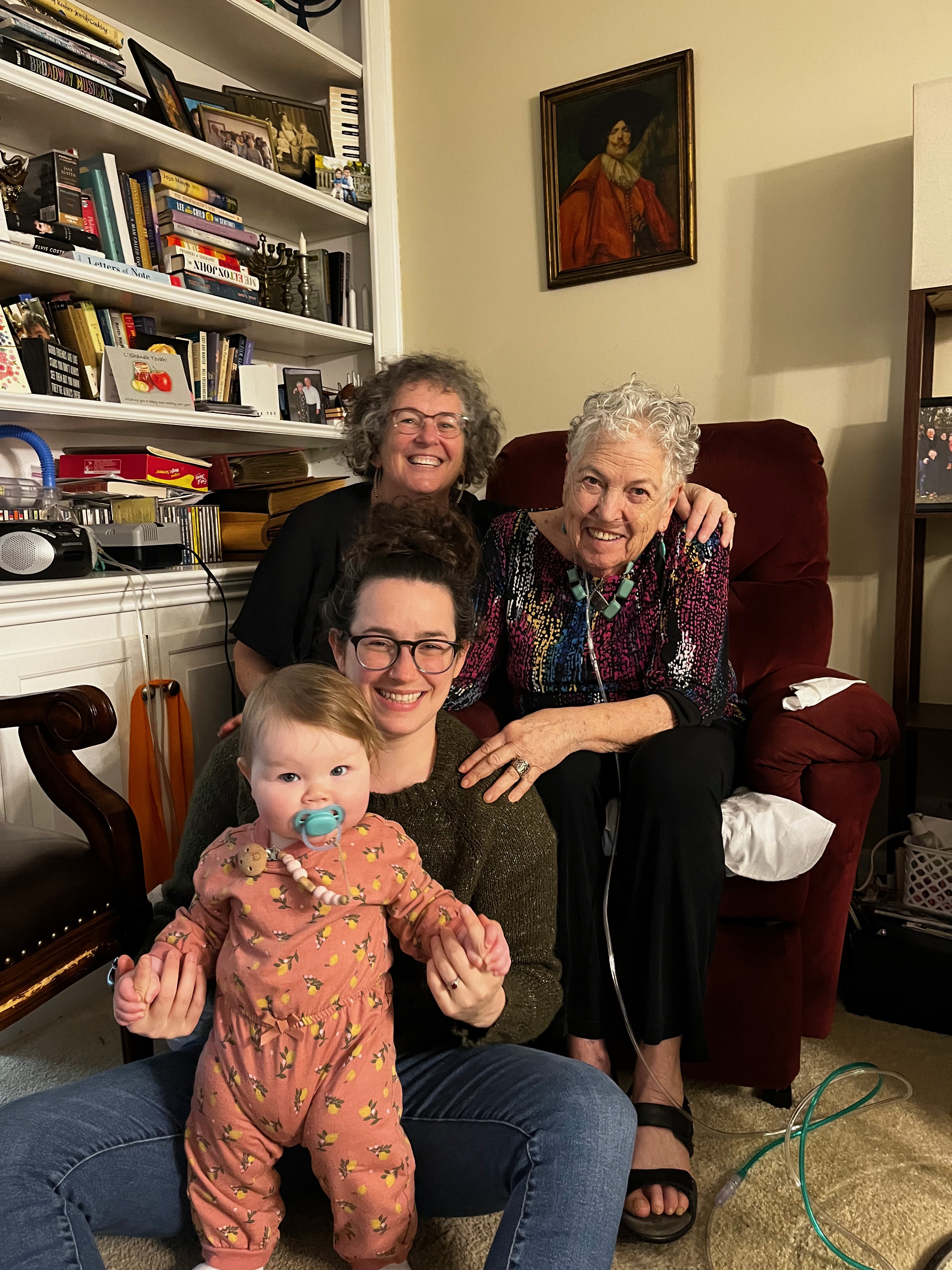
I am a grandmother, called Nana by my granddaughters, which makes me smile.
I ask myself, how much of my life do I want to shape around theirs?
I grew up with my Nana living upstairs in the apartment above mine in a two-family semi-attached house. She was a gift to me.
I am not in the same situation. I am 2 and ½ hours from one granddaughter, three hours from the other. My children did not grow up in the situation I had either. They saw their grandparents maybe monthly in the summer, once in the winter months when we would fly down to Florida during the February break from school. They still knew their grandparents, and knew they were treasured. Most summers my kids would spend a week at my folks’ house in the Catskills. I think that was an especially bonding experience.
Is that enough for me?
These days we have FaceTime. We can see each other more frequently – in between in-person visits. What will that mean to them?
Then there is my relationship with my children. There are rare occasions when I see each of them separate from their families. It is precious time when I get to see them one-on-one. Do I shape my life to maximize the opportunity to visit them?
Or do I lead my life?…commit to volunteer work, commit to writing, commit to political activism – instead of filling in with those activities.
I don’t know how to balance it.
And then there is the mundane business of life. It is common to hear people who retire say, “I don’t know where the time goes. I’m always so busy. How did I fit in a full-time job?”
I am finding that taking care of myself as I age has become a full-time job. More frequent doctor visits, more frequent medical tests, physical therapy, exercising multiple times a week, picking up prescriptions, and all the paperwork that supports that stuff. Then there is the expansion of household tasks, some of which I crammed in or let fall by the wayside when I worked so there is catching up to do. Between taking care of the house, the car and my body, there isn’t that much extra time. Plus, my capacity or energy for all of it isn’t what it used to be.
I admit I am disappointed in a way; retirement isn’t quite a free as I thought it would be. I know I am lucky – unbelievably so in that I am not facing serious illness, just the nagging things that happen as the bones, joints and systems wear. I am even more blessed that my children are independent, capable humans who have families of their own. They live very full lives without help from me.
Some of my peers appear to be happy to center their lives around their children and grandchildren; others appear to be happy centering their lives on their own activities and maybe some have found the secret of balance. If you have, please share! Or maybe I assume folks are happy because that is the face they put on, especially on social media.
Between my own desire to remain engaged in meaningful growth, contributing to the world, and to have fun (which for me means traveling, being active, walking among trees, smelling flowers, being social, and, most importantly, deeply connected to my family), I feel like I don’t know what I am doing.
But, maybe I am doing it. This is it. I answer a call from my son who has an extra ticket to a Met game on a Monday night and I figure out how to make that work (it was a great game and we had a blast!). I schedule my various medical appointments and follow their instructions as best I can. Babysit for grandchildren and grandnephews when asked. Fit in yoga and tennis where I can. Take a walk with a friend. I write when I can, post a blog when I can. I don’t worry about getting published (easier said than done!). Let tasks in the house sit a while longer. I have lunch with a friend here and there. Plan a trip or two each year. Celebrate my granddaughters’ birthdays. Sounds pretty awesome really. So why do I feel uncentered? Perhaps it is just a matter of accepting it – the fragmented nature of it, the unpredictability of my schedule (or the absence of one) and the idea that I write mostly for myself and whatever audience reads my work. And most importantly, to believe that in being there for friends and family, I will have done something worthwhile even in the face of this very troubled world.
Looking for perspective in the woods of Central Park or maybe just admiring the birds.
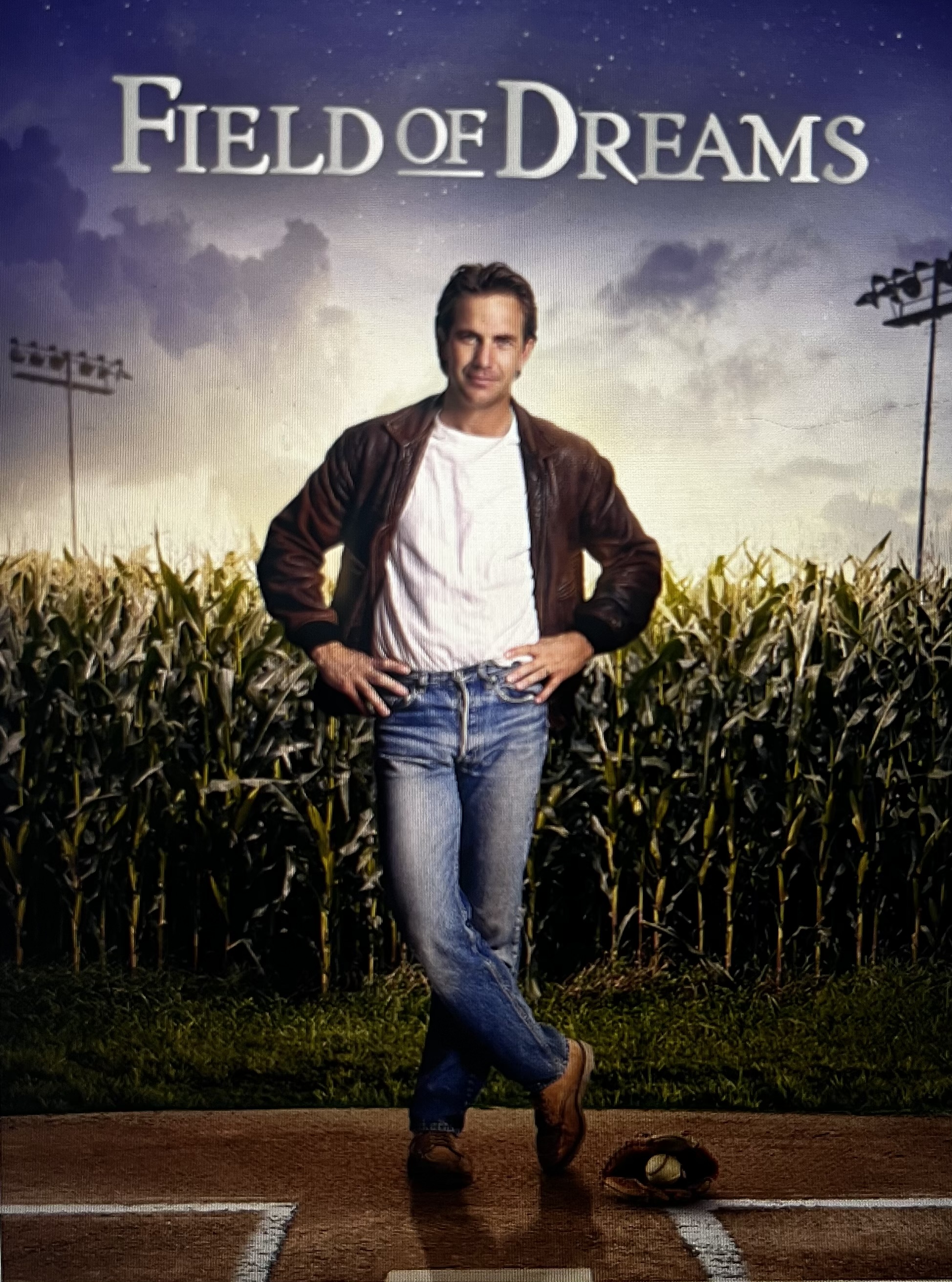
My family has a movie club. It functions the same way as a book club. A member picks a movie, and we get together on Zoom to discuss it. The person who picks the film moderates the discussion. The number of participants varies from month to month, but typically there are about 19 of us. This month we discussed Field of Dreams.
I had not watched Field of Dreams in many years. I remembered enjoying it in the theater when it came out in 1989. I have caught bits and pieces of it on television since it airs frequently, but I am not someone who watches it whenever they come upon it, and I certainly had not watched it all the way through in decades.
For many this film is a touchstone. It is a perennial favorite because it speaks to universal themes: dream fulfillment, regret, father-son relationships, nostalgia for baseball, and redemption. It also features some wonderful actors, James Earl Jones, Burt Lancaster to name two and Kevin Costner qualifies as a genuine movie star (I think he is a fine actor and does a good job in this).
Somehow watching it yesterday afternoon, I was not as moved as I remember being. I wasn’t drawn into the fantasy. I liked it well enough and could appreciate aspects of it, but I found myself doubting the premise. I wasn’t buying it. When we gathered for our discussion, I was in the minority, though there were a few who were also less than impressed. I wondered if I have become too cynical to relax and give in to the sentimentality. One of the premises of the movie is that we long for a simpler, more innocent time. My problem with that idea is that I don’t believe that simpler, more innocent time exists.
I also think that the father-son dynamic, which is central to this story, didn’t resonate with me and I don’t believe that is a matter of gender. Anyone can relate to the idea of having regrets over a parental relationship that wasn’t what you wanted it to be – and having the chance to make amends would be an unbelievable gift, as happens in the movie. While I can relate to that idea and would welcome a chance to reconnect with my parents, I am lucky in that I don’t feel a lack of closure with either my mother or father. I miss them, but I don’t have much in the way of regret. I am grateful for that.
While intellectually I get the potential for how baseball can connect a father and son and how meaningful a catch could be, it still didn’t resonate. My parents were not of a generation where they played with their kids. My dad never had a catch with me – and I have no memory of him having a catch with my brothers. Maybe he did, or maybe they wanted him to. They certainly had catches with their own kids when they became fathers. I think it was a generational thing, though Gary, my husband, would toss a ball with his dad. What’s funny is that my dad was an athlete. He grew up playing ball – all kinds – baseball, basketball, stickball. He continued to be active as an adult, playing tennis and paddleball. But, he didn’t play with us. I think the mind set was different. He didn’t think it was his job to play with us. I had no expectation that he would. I can’t speak for my brothers – they may have felt a longing for that, or maybe they felt as I did that it just wasn’t something to be expected of him. Mom didn’t play with us either – not board games, not sports. We were expected to entertain ourselves.
Aside from the difference in expectation about parental roles that may explain my tepid reaction, the movie relies on nostalgia for baseball. I love baseball. It is a sport I have always enjoyed. I was a huge fan of Ron Bloomberg of the New York Yankees when I was a kid. You can probably guess why. But, I associate baseball with my brothers, my uncles and my Zada (my maternal grandfather), more than my dad. Dad followed the sport but after the Dodgers left Brooklyn before my birth, he was no longer a fan. He grew up as a die-hard Dodger fan and was angry and resentful that they left. In the years that followed he kept track of players, he read the sports page, but he didn’t root for a particular team and had no interest in going to games. If my brothers and I went to a game, it was with our uncles. I do recall a particularly memorable time my dad took us as a family, and it may explain why we went so rarely.
We went to see the Mets play the San Francisco Giants at Shea stadium. It was August of 1969, an auspicious year. Dad was no fan of New York City traffic, so he wanted to leave the game early. It was a close game, no runs had been scored, and we made our way to the exit after the 7th inning. Except when we got outside the stadium, we couldn’t find our car. We combed the aisles. This was long before we had fobs with a panic button. We had no way of flashing the headlights to help us locate the car. I don’t know why none of us had noted the section where we parked. We just kept walking up and down – every aisle looked the same, every section looked the same. Meanwhile the game went into extra innings. I believe we found our car after about an hour. The game went 14 innings before the Mets won, 1-0, so we still beat most of the crowd to our car where we listened to the last inning on the radio. It turned out to be a classic game. Gary Gentry, the Mets pitcher, held the Giants scoreless for 10 innings and was relieved by Tug McGraw who finished out the game. Juan Marichal, the opposing pitcher who went on to be a Hall-of-Famer, took the mound for 13 innings! So not only were we roaming the parking lot for a very long time, but we also missed the end of a truly great game.
It was not the happiest of experiences. Dad was not the most relaxed person under the best of circumstances. He had a temper and a short fuse. You can imagine his fury at not finding the car. Plus, with a family of five, though it was far less expensive than it is today, it was still a lot of money to buy tickets, park and feed all of us. I’m not sure we ever went to a game as a family again. It became an amusing anecdote, but not until many years passed.
[I will rely on my brothers to correct me, if I got this episode wrong.]
The point is that my affection for baseball was not nurtured by my father. So, when I watch Field of Dreams it doesn’t evoke the heartfelt emotion that it does for other folks. I know my brothers feel differently. They participated in the movie club discussion, and the film clearly struck a chord with them. I invite them to comment or write a blot post about the notes that struck home.
If you want to chime in with your feelings about Field of Dreams, please do. I will say that unlike many movies made in the 1980s, it aged well. It wasn’t offensive in any way that I perceived and, in fact, got a lot right. It just didn’t move me the way it does many others. I didn’t choke up and I shed no tears during the final scene. Did you?
Apparently, I set goals for 2024. Who knew? I didn’t remember that I had done that until Facebook brought it to my attention as a memory. It was interesting to review! It probably helps to keep them in mind if one hopes to achieve them! That is probably the first step in successful goal management – review them periodically. Considering that I didn’t, it is interesting to find that some were met.
So, what were those goals? The first one was to read Moby Dick. Nope – didn’t happen. Totally forgot I wanted to do that. I did read 27 books and the only reason I know that is that I track it on Goodreads. Though I didn’t read Moby Dick, I did get a lot from reading Viktor Frankl’s Man’s Search for Meaning, a very different classic text. As an aside, I also particularly enjoyed Elizabeth Strout’s Abide with Me (I love her books) and The Personal Librarian. I have to admit, I don’t feel bad that I didn’t achieve that particular goal.
Another item on my list was to write almost every day. I noted that I had only written 29 blog posts in 2023. My unstated goal was to update the blog weekly which would mean 52. Well, I wrote 27 in 2024. (Same number as books I read – coincidence?) I seem to be moving in the opposite direction. In fairness, I also suggested on that list that maybe my goal should be to reassess how frequently I put up a new essay. I didn’t do that either. The truth is I can’t decide if it is good to put pressure on myself to produce pieces, or if I am comfortable taking a more freeform approach and write when I feel like it. I go back and forth – feeling kind of guilty when I don’t post for a while and then thinking that there isn’t any particular standard I need to meet. One concern is that I do want to have a readership, and it is likely to be difficult to build and sustain an audience if there isn’t a continuing conversation. I’m not sure where that leaves me. Not surprisingly, I’m continuing to have an internal dialogue on this with no conclusion. Perhaps 2025 will bring a resolution to this! Knowing me, probably not. Let’s be real.
Next on the list was to send 10 query letters to literary agents – this is how I will get my book published. I sent eight and entered one memoir writing contest. I’ll count that as a win. Unfortunately, I literally got zero responses to those inquiries, but that brings me to the next goal: Accept rejection and move onward. Fair to say I achieved that, too. I continue to work toward getting my book published. It is slow going and frustrating, but I haven’t given up. Ultimately, I can decide to self-publish, so one way or another, I will put it out there. I’m not ready to abandon my hope of having an established publishing house pick it up, there are still a lot of avenues to explore. Let’s hope 2025 brings progress on this.
My sixth goal was to stop wanting more. I included a short poem on that topic within the list (https://stories-i-tell-myself.com/2023/12/31/goals-for-2024/). This may be the thing I’ve been most successful with and oddly enough it has happened organically. It wasn’t something I had to work at consciously– something shifted. I let go of some expectations that were not serving me and that was the result of coming to peace with certain realities. Of course that doesn’t mean I wasn’t ever disappointed, but generally I felt more content. I’m glad I reviewed this list and came upon this realization.
I ended my list with two concrete things: plan a trip and sort through the clutter. I’m batting .500 on those. I planned several trips (and loved them) and am continuing to plan more of them. I enjoy both the planning and execution of travel (not the flying part – there is always such aggravation with airports, delays, crowds, etc.), but I continue to love going to new places and they don’t have to be exotic or far away. We took a long weekend to Ausable Chasm, in the northeast corner of New York State, and had a great time exploring (in fact that led to a blog post).
A view from our trip to Ausable Chasm
Sorry to say I made little to no progress sorting through the clutter. I don’t think I’ve added to it, so that is good. I’ve been conscientious about not creating new piles of paper or adding knick-knacks. Gary, with his increased time off, has been cleaning out the garage – can I get credit for that? I’ll take that as a no.
This review was a good exercise, even if it was unplanned. Maybe this should be my approach: make a list of goals for 2025, forget about them and then be surprised when Facebook reminds me. It worked relatively well in 2024.
Do you make a practice of setting goals or making New Year’s resolutions? What works for you?
Aunt Clair’s ashes were sitting in a cardboard canister in the closet of our Manhattan apartment. The third anniversary of her passing was coming up soon. Her final wishes were to have those ashes spread over her parents’ graves. For many reasons, it had not been possible to make that happen, and as her yahrzeit (Yiddish for anniversary) approached, I was distressed.
When Aunt Clair died, I made the arrangements with the funeral home. She had no spouse or children, only nieces and nephews. I was her health care proxy. I had to identify the body before cremation. It was jarring to see my aunt without her spirit, it almost didn’t look like her, but sadly it was. The representative of the funeral home was kind and explained how things worked. I wrote about her funeral and shared the eulogy on this blog previously (https://stories-i-tell-myself.com/2021/11/08/a-eulogy-for-aunt-clair/.)
The first problem with fulfilling her wishes was that when I inquired at the cemetery, I was told it wasn’t permissible to spread ashes there. We could buy a plot and bury the remains, but there wasn’t a spot near her parents, and it was expensive. After consulting with family members and my own conscience, I decided that we would at least spread some of her ashes there discreetly. I imagine that the cemetery had its reasons, but I doubt it was because it would harm anything. I also didn’t want to take the chance of calling attention to ourselves, so I didn’t want to plan to spread all of the ashes there.
One of the things I learned through this process is that the amount of ash was more than I had imagined, though I had nothing to base my idea on. The canister was heavy, and it was tall.
I thought, given her love of biking and the frequency with which she would cycle from her apartment in Greenwich Village to her sister on the Upper West Side of Manhattan, that spreading the rest of her ashes through Riverside Park would be appropriate. I looked on the city’s website and believe it or not, it is legal to spread ashes in city parks*. It is not permissible to spread them in bodies of water within a park.
So, why were her cremains still sitting in my closet three years later? Life and death happened.
I recall when I picked up the ashes from the funeral home, the representative said, “You know how common it is for people to move into an apartment in New York City and find an urn with remains buried in a closet?”
I looked at him incredulously, “No.”
“You’d be surprised. People don’t know what to do, they put them away out of sight, forget, and they sit there for someone, years later, to discover. I’m just letting you know.”
“That won’t be the case here” I reassured him, and as I walked away, I thought, “That’s crazy. Who would let that happen?”
I have a better understanding now.
I had no prior experience with cremation; it isn’t a common choice among Jews, though apparently more are opting for it according to the guy at the funeral home. Aunt Clair wanted to be cremated, but she also requested that a memorial stone be laid at the foot of her mother’s grave. She had arranged for a footstone at her father’s grave in memory of the family he lost in the Holocaust in Poland, so she thought this was possible.
After the funeral, I brought her remains back to my apartment. After a few months passed and thinking that we would have an unveiling for the footstone on the one-year anniversary (and we would spread her ashes at that time), I began the process of ordering the memorial stone. This proved to be complicated to arrange. It was not a typical request. The cemetery didn’t want it to be confusing as to who rested in the plot. After a lot of back and forth that isn’t worth detailing, we came to an agreement about what the stone could say. It wasn’t exactly what Clair wanted, but it was the best we could do. It took more than two years for the stone to come to fruition.
When the stone was finally available, other things were going on in the family. We were not able to arrange a time for the ‘unveiling’ of the memorial and we didn’t spread the ashes. In the interim Clair’s sister, Aunt Diane, passed away, as did my mother. A whole generation was disappearing. Another year passed.
As Aunt Clair’s third yahrzeit loomed, I decided I didn’t want to wait any longer to fulfill her wishes. I wrote an email to my brothers and cousin and said I would like to visit the cemetery and spread her ashes on Friday, November 15th. Jewish cemeteries are closed on Saturdays (the Sabbath) and my Mom’s unveiling was planned for Sunday, November 17th. It would be a good time to make this happen. My cousin, who lives in Massachusetts, responded that her daughter’s due date was November 20th so she would not be comfortable traveling to NYC so close to that time. Aunt Clair would certainly understand that, as did I. It turned out the timing didn’t work for anyone but me and thankfully Gary. Despite that, I decided to go ahead with the plan
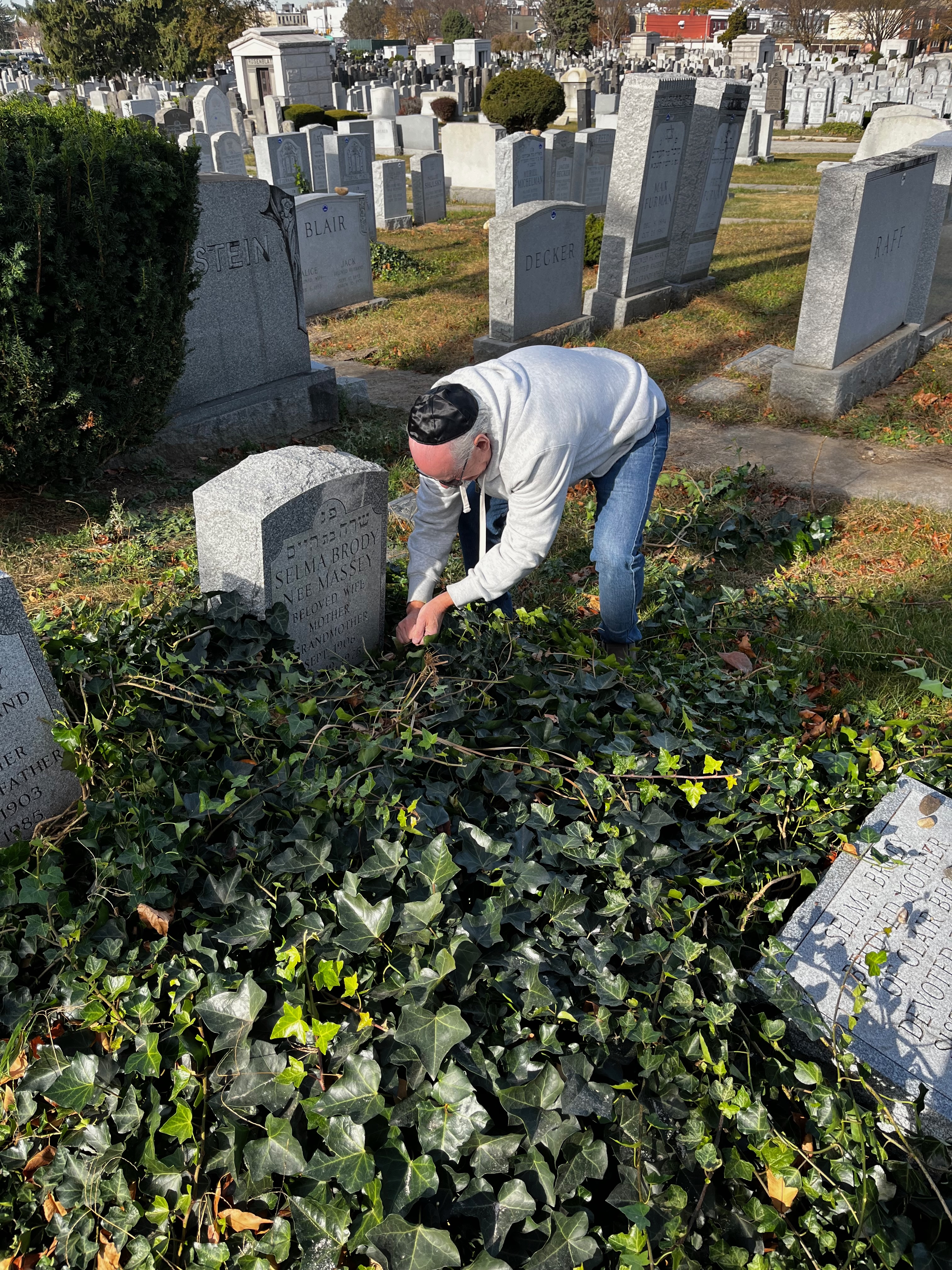
November 15th was a cool, sunny day as we drove the Jackie Robinson Parkway, a narrow, curvy roadway that connects Brooklyn and Queens and passes through a series of huge cemeteries. The trees were not yet entirely bare, the yellow and gold leaves shone in the sun. I had the location of my grandparents’ graves written down and we drove to the appropriate section of the cemetery. I thought I remembered my way to their graves. Gary and I combed the rows and couldn’t find them. I checked and rechecked my notes. Finally, I remembered I had taken a picture the last time I was there and maybe that would help. I searched my phone, those smartphones can be quite helpful and in the photograph I found a couple of landmarks that helped – a majestic tree and two large grave markers in front of my grandparents’ more modest ones with the name Feingold on them. We found the spot and now understood why we hadn’t seen them before – they were entirely blanketed in ivy.
Gary and I peeled away the ivy and exposed all the markers. Aunt Clair’s stone was there, as expected. I looked around and seeing nobody around, I took the baggie with a portion of Aunt Clair’s ashes out of my pocket and spread them over the graves. “May you rest in peace, Auntie.” I said. Gary and I paused and stood quietly for a bit. Then we got back in the car and headed back to Manhattan. Part one of my mission had been accomplished.
Gary clearing ivyAunt Clair’s memorial stone
The sun was still shining brilliantly as we made our way to Riverside Park. It was also quite breezy. I wasn’t sure how I was going to do this. I carried the canister in a canvas bag. As we walked, a plan revealed itself to me. We passed a garden, now gone to seed until the spring, and I thought this was a perfect spot to provide what perhaps could be fertilizer. I looked around and nobody was paying attention – I knew I wasn’t doing anything wrong, but I also worried it might be disturbing to onlookers. I spread a good deal of the ashes throughout the garden, and nobody seemed to notice. There was still a lot of ash left.
We continued walking through the park and came upon a memorial to the Warsaw Ghetto Uprising. The shrubs surrounding it presented itself as another opportune spot. Though Aunt Clair was not a religious Jew by any means, she was fiercely proud of being Jewish. This would be a meaningful location, as well. Gary reminded me to stand upwind as I poured the ashes over the bushes. I had not been as mindful of that the first time.
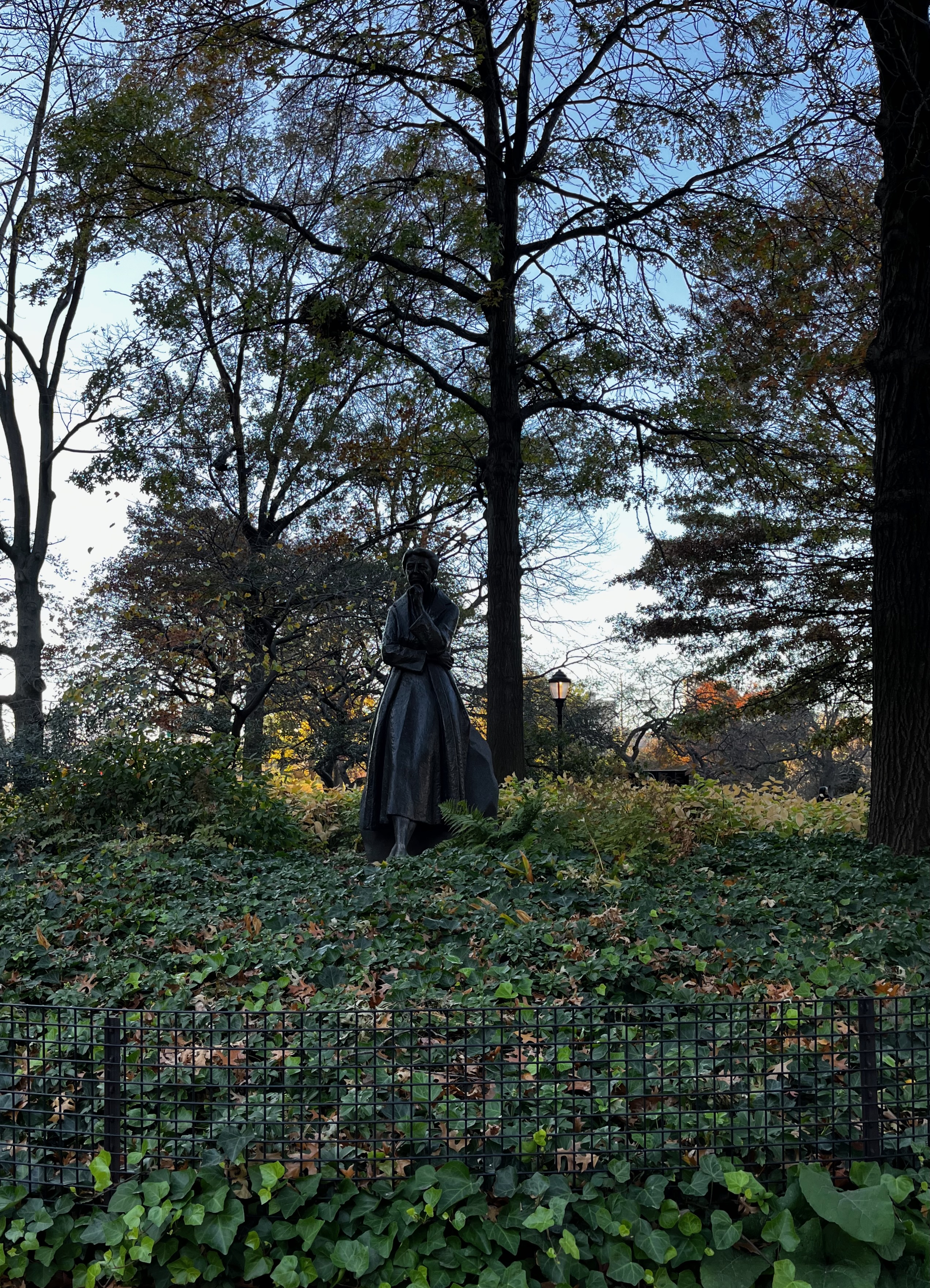
The canister was still not empty, and I knew of one more spot that I wanted to visit. Aunt Clair was an admirer of Eleanor Roosevelt and there is a statue of her at 72nd Street just inside the park. We continued our walk south to find it. I was pleased to see that there were plantings around the memorial. I spread the remaining ashes there.
Walking south in Riverside ParkStatue of Eleanor Roosevelt
Throughout our walk, aside from talking about mundane things, Gary and I shared memories of Aunt Clair. I felt good about what we were doing. I was grateful to have Gary to share it with. He knew her well and shared his own unique relationship with her. We had come darn close to fulfilling her wishes and I think we honored her spirit. Part two of our mission was now accomplished. I was glad she was no longer sitting in my closet.
We took a different route through the park back to our apartment, walking along the Hudson River. I felt peaceful. The sun lowered and its rays glistened on the water. The day was fading, and I was satisfied.
What do you do when you are sad? Do you go about your business with a heavy heart? Do you take steps to cheer yourself up? Maybe it depends on the source of your sadness…if you can even identify it.
When I’m feeling down, I often turn to writing. This explains the fact that many of my blog posts reflect that mood. I don’t want to be a complete bummer, but the inspiration to write often comes from feeling bad and needing to sort it out. Believe it or not, I have about 370 (!) posts on my blog, with probably less than 10 of those from guest writers. I wonder what percentage are about feeling depressed or disappointed? I do try to end them on a hopeful note.
But, writing and sharing helps me and I hope it helps my readers. It helps me process my thoughts, clarify my thinking and sometimes reset my mood. When I get feedback, it feels validating. I know I am not alone. Plus, it feels like a constructive thing to do, instead of wallowing. Sometimes I do need to wallow a bit, but I try to limit that. Putting pen to paper, or seeing the words on my computer screen, can help to take the sting out of the emotion. There’s a quote from Mr. Rogers (yes, Fred Rogers, he was quite wise) that says: “Anything that’s human is mentionable, and anything that is mentionable can be more manageable. When we can talk about our feelings, they become less overwhelming, less upsetting, and less scary.” Smart man, that Mr. Rogers. The stuff we hide away, mostly from ourselves, is the stuff that does the most damage.
I also find that usually when I am in a mood like this, it isn’t just one thing. There might be an incident or disappointment that pushes me over the edge, but there were likely other things that accumulated. So sorting it out, naming them, is helpful.
I have “finished” my manuscript for my memoir. I put quotes around finished because I feel like it will never really be done. I know it needs further editing, so there is that. But, also, every time I read portions of it, I tinker with the words, think of other potential scenes, wonder if it is any good. I could probably work on it forever. It reminds me of an observation Professor Weisband, one of my favorites from SUNY-Binghamton, made. I took a seminar with him that required a major research paper (it had to be 50 pages or more). Mine was on the U.S.-Soviet SALT talks. I was endlessly reading and finding new material. I asked him how you knew when your research was done. He basically said, you don’t. You decide to start writing. On the one hand, it was a very unsatisfying answer. On the other, I have found it to be largely true. You may realize that pieces are missing when you are writing and do some more digging, but at some point, and it may feel arbitrary, you have to stop and see what you have. I feel that way about my memoir.
Despite feeling like it may or may not be done, I have decided to move to the next phase which is trying to find a literary agent. I won’t go into the details of this grueling process but suffice it to say it is a little like auditioning for movies or plays. Mostly it involves rejection – or in this case, unanswered queries. No answer is the answer. I’ve only sent out 7 so far. There are hundreds, probably thousands, of agents. I will need to send out many, many more. At some point, again, perhaps an arbitrary decision, I can stop and decide to self-publish, but I want to give this a shot. It is hard not to be discouraged, especially when you feel so uncertain about whether your project is worthy. I remind myself to be proud of the fact that I am even doing this – I set a goal for 2024 to contact literary agents, and I have done that. (By the way, if anyone has contacts or suggestions, feel free to send them my way!) I need to just keep on keeping on.
Though this project weighs on me, it is not the primary source of my sadness. My memoir is something I have control over, at least to some degree. Getting it published may be as much a matter of luck as talent. The things that really make me sad are the things I can’t change: my friend’s serious illness; a relationship that isn’t what I wish it was; the precariousness of our democracy; Supreme Court decisions that defy how I understand our Constitution; and, the rise in antisemitism – to name a few.
I am old enough to have been here in this sadness before. I will distract myself with a combination of constructive things, like doing something nice for my friend, making a contribution to a candidate I believe in, and other things that are just fun – like getting out in the sunshine, watching something mindless and entertaining, talking to friends. And I will wait for the sadness to pass. Thanks to writing this – and I am sitting in my backyard as I type, listening to the birds, seeing the sun on our daisies – my mood has already begun to lift.
Months go by very quickly. It seems like I just paid my cellphone bill yesterday when the next one shows up in my inbox. I don’t understand how this happens. It feels like I’m always struggling to keep up. When I go online to pay, I check to make sure that in fact it was a month since I last paid, and, lo and behold, it has been. How did that happen?
On a related note, I pay a ridiculous amount of money for phones, internet and streaming services. There has to be a better way, but that would mean taking the time to research things thoroughly to figure it out. I think I am probably paying for streaming services that include other services that I pay for separately. Does that make any sense? I am probably double paying for Hulu. But it is all so complicated, and it gives me a headache, so I throw up my hands. Someday, I promise myself, I will sort it all out. Of course, they probably have a service for that – but then you’d have to pay for it. I find it very frustrating. And these companies are probably counting on our throwing up our hands to make more money.
And then there is the confusion about which streaming service plays which program. I might only watch one program on a given service – that also makes no sense. And there is almost nothing I watch on cable, except for HGTV, SNY (the Mets baseball channel) and the tennis channel. Then there is Gary’s penchant for having some version of Law and Order playing in the background for hours each evening. Sometimes I put my foot down and say that episode was just on, please find something else. But, then there is nothing else worth watching so it is back to Law and Order. So, I guess we do use cable. But it should be more straight forward. I imagine eventually, with consolidations and such, that we will be back to the equivalent of three major broadcast networks. After all, there is only so much content we can absorb.
**************************************
I just brought my car in for service. It is a Honda Accord hybrid. Aside from needing an oil change, a light came on telling me my acoustic system wasn’t working. I drove around with that message for a while since it didn’t seem to be a critical thing to the functioning of the car. If you haven’t driven a hybrid, when it is in electric mode the engine is close to silent. To make others, especially pedestrians, aware of the car, it generates a sound – so they are alerted to its presence. My car sounded like it was singing. A regular car motor you can hear. Well, the singing stopped. The part will cost $248.00 to replace, not including labor. I am not excited about spending that amount of money, but it doesn’t seem right to be putting people at risk if I don’t get it fixed. It is always something. And it always ends up costing more than $200. Sometimes it feels like we hemorrhage money. And, I can’t complain because we have the resources to pay for it. I feel for folks, the vast majority frankly, who don’t have that luxury. We used to be in that position where we lived paycheck to paycheck – it is very stressful. No one wants to hear me complain given my privilege, but I can’t help but comment on how crazy it is.
*************************************
I’ll close this blog post by noting that we are coming up on 4 months since my mom passed away. The pangs of grief that hit me come as a surprise, though they shouldn’t. I was thinking the other day about how unusual Mom was. Dad died when Mom was only 71. At that point they were living most of the time in Florida. Mom had always wanted to live in New York City, but Dad had no interest. When he passed, thanks to Mom’s sister-in-law Clair’s ingenuity, she was able to sublet an apartment from an NYU law professor in Greenwich Village for the summer. She did this for probably four or five summers, until various things made it impractical. During those summers she went to see shows – sometimes a matinee and an evening performance on the same day. She went to museums, not just the major ones. She read the New York Times arts pages looking for interesting exhibits. She invited her grandchildren and their friends to visit and stay over. She cooked them pasta from a neighborhood shop that made it fresh. Most women I know wouldn’t be able to do that. Yes, they could cook the pasta, but not the rest of it. Many women I know wouldn’t go to NYC alone – and not necessarily out of fear of crime. They would just be afraid of taking it on – all of it, negotiating the crowds, knowing where to go, etc., etc. Granted Mom had her sister-in-law nearby and her children to help out, but in a day-to-day way she was on her own and she reveled in it. I am happy that I have inherited some of that. I think nothing of driving down to the city or elsewhere by myself. She was a terrific role model. I believe my daughter has inherited that combination of confidence and curiosity that allows us to do what might be uncomfortable for others. Hopefully it will be a gift that keeps on giving.
While my relationship with Mom could be complicated, I am lucky that I got to be her daughter.
I often begin blog posts by referring to an interview or podcast I listened to. This one is no exception. George Packer, a journalist and novelist perhaps best known for his writings on American foreign policy, was a guest on Preet Bharara’s Stay Tuned. Most of their discussion was about the status of the United States as a world leader (lots to worry about there, but not the subject of this essay). Toward the end of the interview, they turned to a subject of particular interest to me – the use of language and whether we are increasingly limiting ourselves by removing words that have negative connotations. It is a variation of the idea that it is problematic to be ‘woke.’ As I wrote previously, I strive to be woke and see it as a good thing. However, I thought Mr. Packer had a point. He wasn’t taking aim at ‘wokeness,’ per se, he was voicing his concern that, taken to an extreme, the idea that we can’t hurt anyone’s feelings could prevent us from identifying and solving serious problems. The example he gave related to words used to describe poverty – for instance, poor, impoverished, disadvantaged, at-risk. Apparently, all of these words/phrases have been identified as loaded and therefore to be avoided.
First question: who is doing the identifying? Packer explained that many nonprofit organizations, he cited the Sierra Club as a prominent one, have come out with ‘equity guides.’ These guides provide lists of words that should not be used, and he said they provide clunky, bland alternatives (for example, instead of ‘paralyzed with fear,’ they substitute refused to take action). He characterized the people behind these guides as a small group of educated elites. He thought that though they were well-intentioned, they were doing more harm than good. Packer’s main point was that we need to be less worried about the words and more concerned about the underlying problem that the word describes. I was intrigued by his argument.
First, some context. Most news organizations and magazines have style guides – the Associated Press (AP) style guide is one that is frequently cited. If you write for those entities, they have established standards you are expected to follow. Organizations which put out frequent press releases or social media posts or are routinely called upon by the media to express positions are also likely to have one – that is why the Sierra Club has one, as does the American Cancer Society. The equity guide is an offshoot (part of) of the style guide.
Another aspect of the context relates to the Sierra Club specifically. They, like many organizations, have a complicated history in terms of their relationship to historically marginalized communities. In the past the club has mostly been thought of as the purview of white, male environmentalists. As the country has changed, and as the damage done by climate change has hit more broadly, they have needed to reach a more diverse constituency. If they are going to do that successfully, they need to understand those communities and use accessible language. They have taken positions in the past that hurt those communities. In addition, the original founder, John Muir, was known to use racist language. Thus, the organization felt it had some work to do to repair the damage. That said, equity guides are prevalent beyond this particular nonprofit and Packer believes that as it seeps into the mainstream, it will erode our ability to tell the truth.
So, is there a problem with the equity guide, as Packer argues? My conclusion: Yes and no.
The main impetus of the guide is to remind its users to put people first. I became acquainted with this notion years ago when I was cautioned not to refer to a person with diabetes as a diabetic. A person is more than any single aspect of their identity, whether it be their illness, disability, religion, occupation, etc. It may not seem like a big thing, but I believe it is meaningful and worth reminding folks.
Another main point of the pamphlet is to ask people how they would like to be identified. It reminds us not to make assumptions based on appearance, and to use the terms the individual themselves would like to use. This applies especially to race and gender. To me this is common sense advice and simple enough to follow.
They also ask writers to evaluate whether the descriptor is germane to the subject. Do we need to know the person’s age or race or gender? We are conditioned to include some of those characteristics, but it is worth asking ourselves the question. Is it relevant or does it just contribute to stereotyping? If we are trying to paint a picture of a person or a situation, maybe more specific adjectives would do a better job.
So far so good.
Where things get problematic, and where Packer has a point, is in the avoidance of words that make us uncomfortable. If we are talking about poverty, neighborhoods that are poor, we can’t use euphemisms. It is what it is. The folks who live in those communities know they are poor and/or working class. It won’t come as a surprise to them. The problem isn’t the words. The problem is, in my estimation, the assumptions that get made because of that condition. Just as we should not define an individual by a single characteristic (diabetic), we must not define a whole community by one issue (i.e., its crime rate or the percent who live below the poverty line). We often write-off those communities or try to ignore them. But, we must not ignore all the people who are trying to raise families, make a living, lead healthy, productive lives in those communities. We need to remember that in those communities lots of good things are happening – there is culture, art, humor, good food, etc., etc. No matter what words we ultimately use to describe poverty, it is the associated assumptions that are dangerous, not the words themselves.
Words have power. We need to be mindful of how we use them. Sometimes we need to vividly describe a problem to move people to action. At the same time, we shouldn’t be careless about hurting folks. On balance, I think the equity guides are a good thing. Some of its advice borders on silly (I sincerely doubt that a person in a wheelchair would be offended by using the phrase ‘paralyzed with fear,’ or that a blind person would object to the phrase ‘blind rage’ – though it would be interesting to ask a group), but users of the guide can make their own judgments. In fact, the pamphlets make a point of telling readers to do that, especially in view of regional and local standards. The guides could be problematic if a given organization implements it as if it is law, without leaving room for nuance or the wisdom of the people on the ground. But, if it is a tool to raise awareness and offer alternatives, then it isn’t the bogeyman Packer sets it up to be. As with many things, the question of whether it is a good or bad thing depends on how it is used.