Note: I wrote a blog post a while ago that asked the question ‘History,’ History In the following post, I take a different perspective.
What is history? When you visit a new city or country and take a tour, the guide often tells you about the history of the place. I love that. Perhaps my enthusiasm is based on being the daughter of a father who was a high school history teacher and a mother who was a reading teacher. So, I have been a student of history for basically my entire life. But that doesn’t answer the question of what it is. What does a tour guide include in their presentation?
I am thinking about this because we just returned from a trip that took us to some very interesting places with long, long histories. It is hard not to conclude that when we learn about history, we are often told about wars, and if not outright wars, then power struggles. Is history really a narrative of power? It appears to be so. And, when you dig into it a bit, you sometimes find that those power struggles and wars are about personal things – insults or slights.
This is a stretch, but if Hitler had been accepted to art school, could that have changed the course of history? Would his ego have been assuaged enough? Would he not have needed to go on a quest to prove himself with such horrific and destructive consequences?
The trip we took was D-Day themed, so perhaps it was inevitable that the places we saw were chosen based on the role played in that momentous event, or in World War II in general. Perhaps my perception that history is often the recounting of conflicts or wars is colored by the type of tour we chose.
We took a Viking river cruise that was organized around D-Day. We visited London, Paris, and Normandy. Each place we visited was the site of intense World War II action. Gary and I share a fascination with the topic. Our families were impacted, if not shaped, by those events. Gary has watched countless documentaries about the military battles. I have read innumerable historical novels set in that era. With that said, I learned so much on the trip, and Gary would say the same.
First, I did not understand the scope of the D-Day invasion. It covered 72 miles of France’s coastline. I thought of it as a single beach, perhaps because of the way it was portrayed in movies. In fact, even that beach, Omaha Beach alone, was six miles long. Aside from breadth of the operation, it also involved so much in the way of logistics and coordination among the allies. They built a temporary port to facilitate bringing in more troops and supplies. It was quite an undertaking.
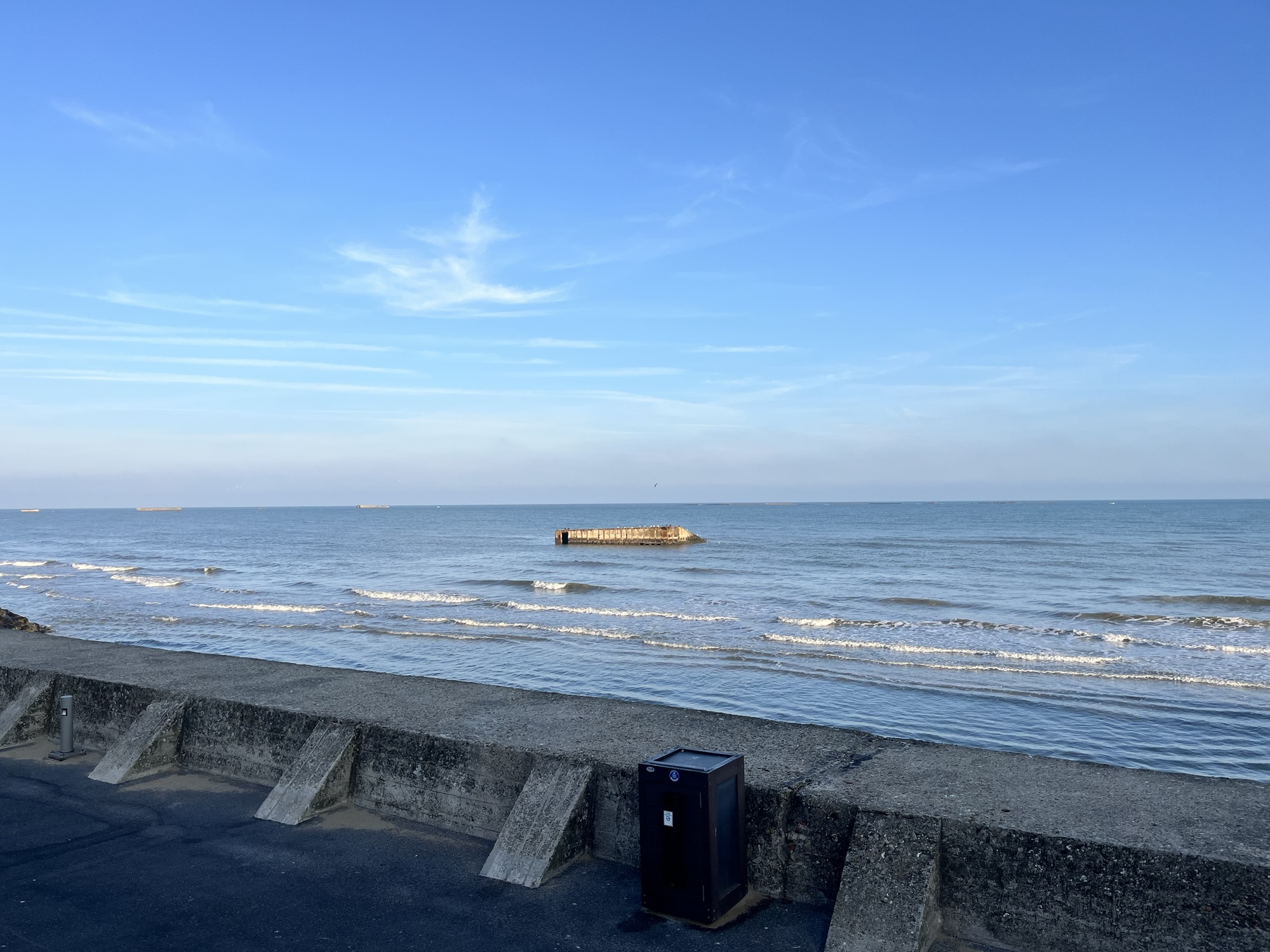
Asnelles – part of Gold BeachGold Beach with remnant of temporary harborPart of Omaha Beach
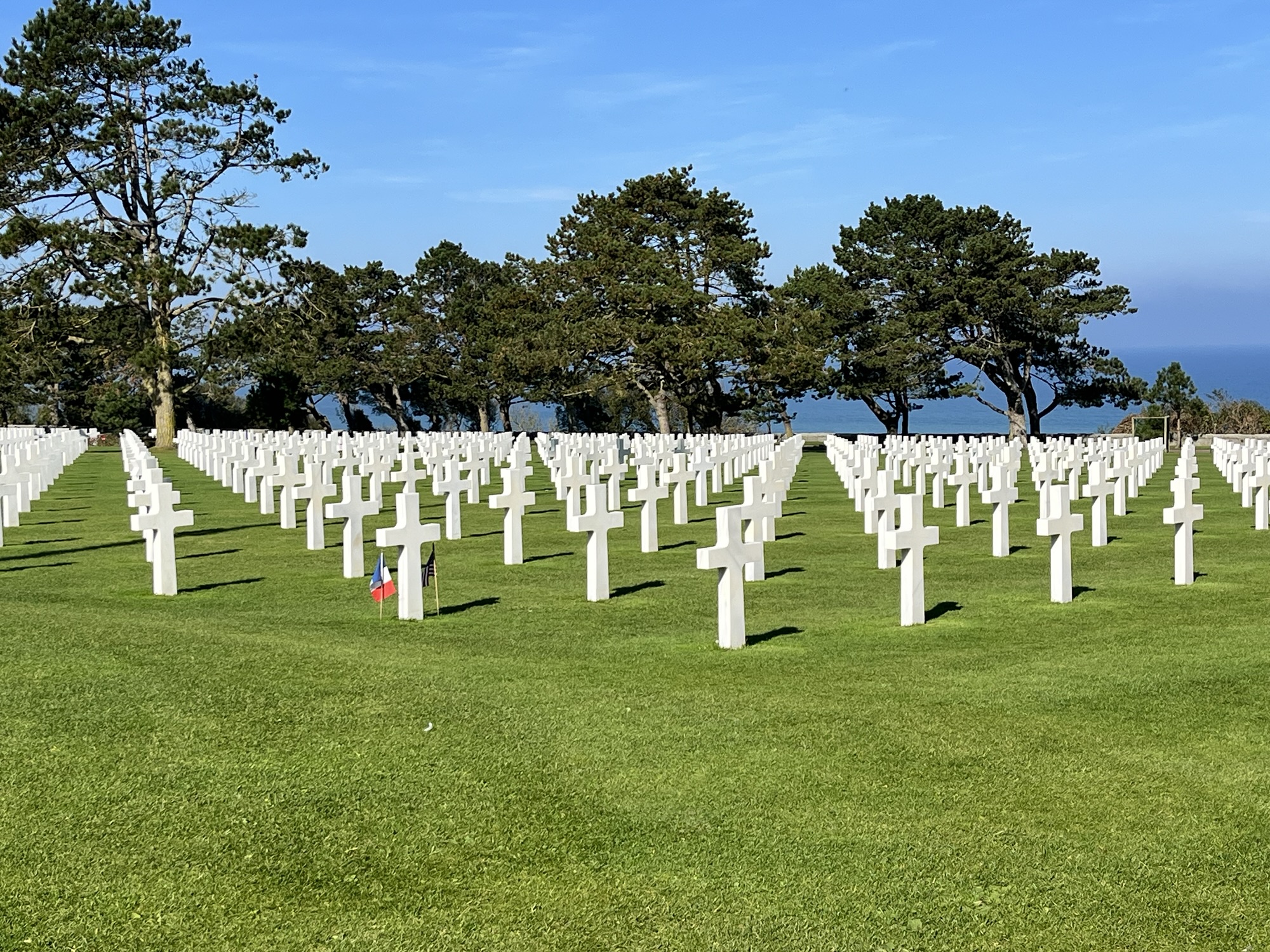
It was also clear that the difference between success and failure was very narrow. The Allies were on the brink of failure. It is scary to think about the consequences of that possibility. One can’t help but be moved by the extraordinary sacrifice made by the young soldiers who carried out that mission. Standing in the cemetery, which overlooks the English Channel, looking upon row after row of crosses and Stars of David, is overwhelming.
A small portion of the cemetery
The land in Normandy still bears the scars of the battle, too. There are craters in grassy areas, and they have left the remnants of the German battlements. The coastline is also dotted with monuments. The statues, sculptures, and museums express the gratitude of France and Europe for their liberation and tell the story of how that was achieved.
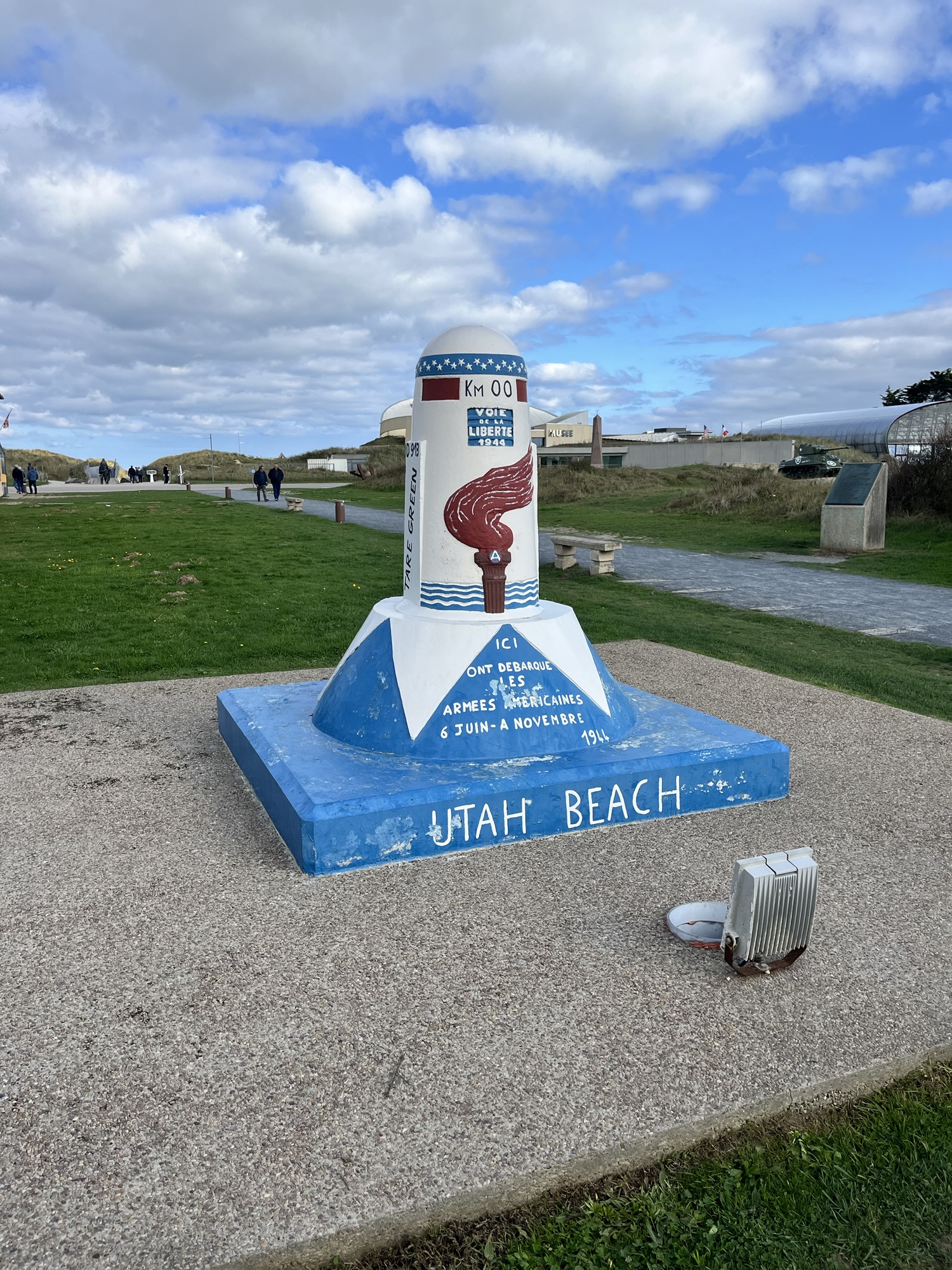
German bunkerAnother German Bunkersculpture on Omaha Beach Monument at Utah Beachsculpture near Pointe du Hoc
Perhaps the most powerful aspect of visiting this sacred space is its breathtaking beauty.
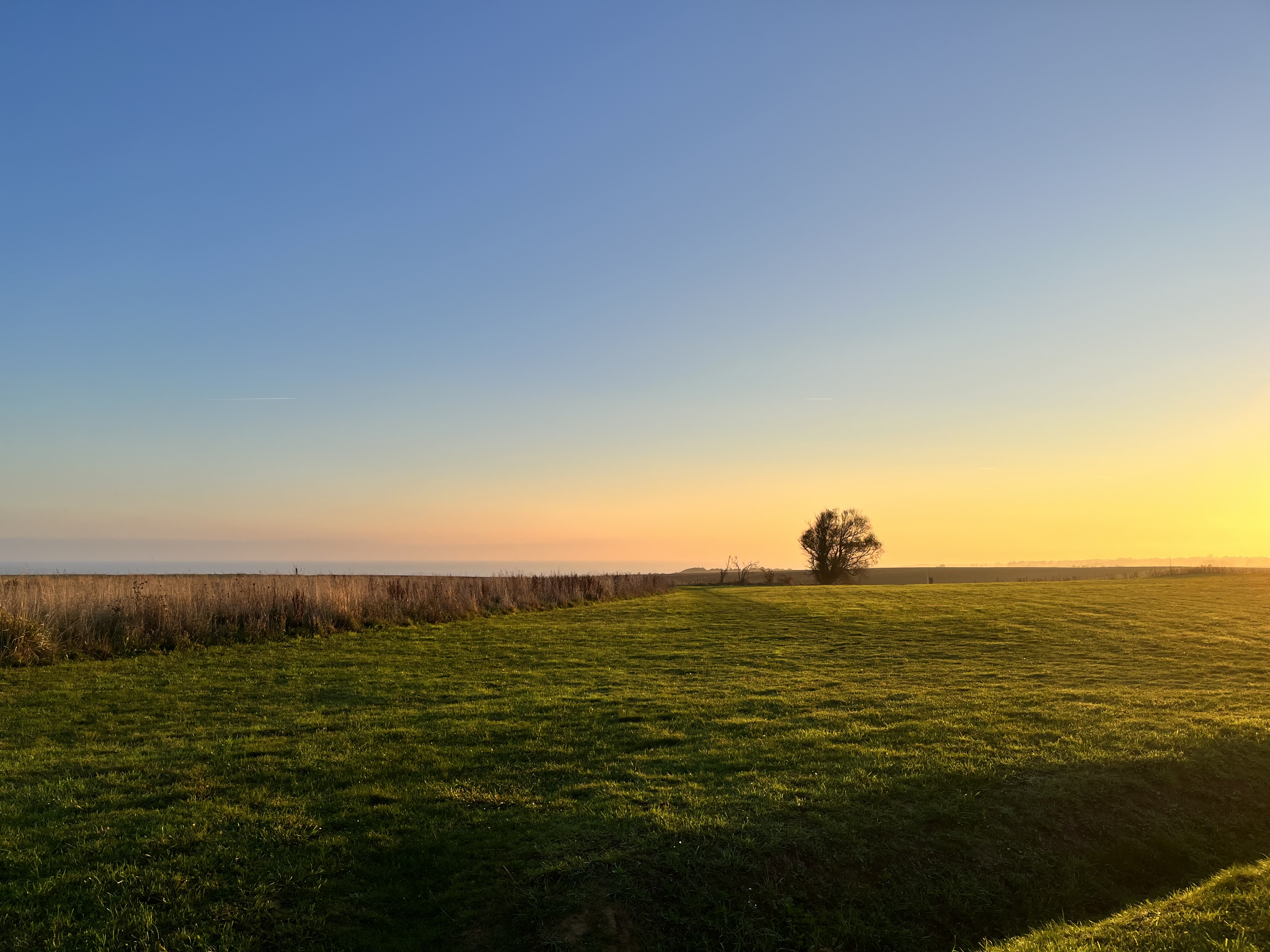
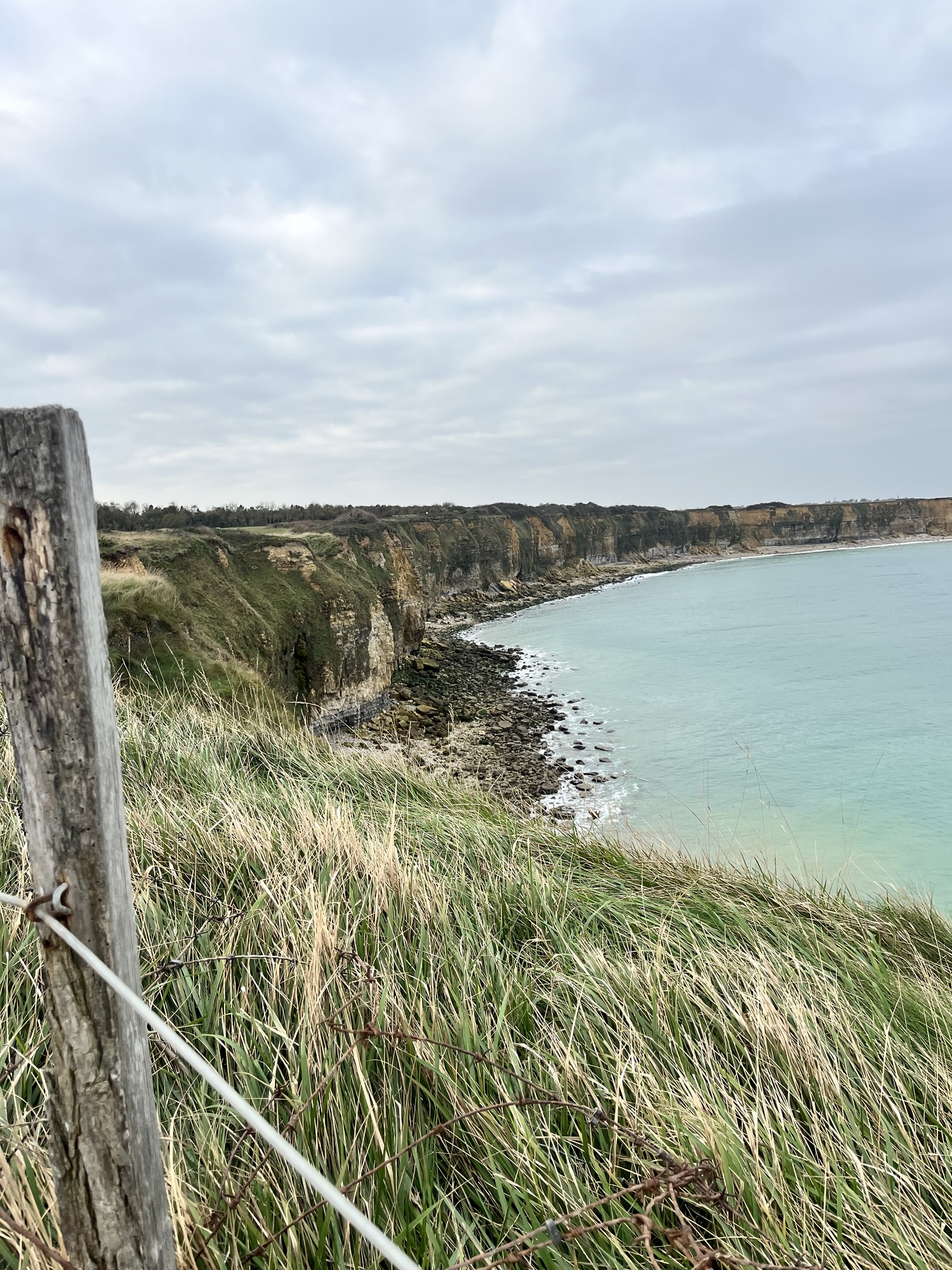
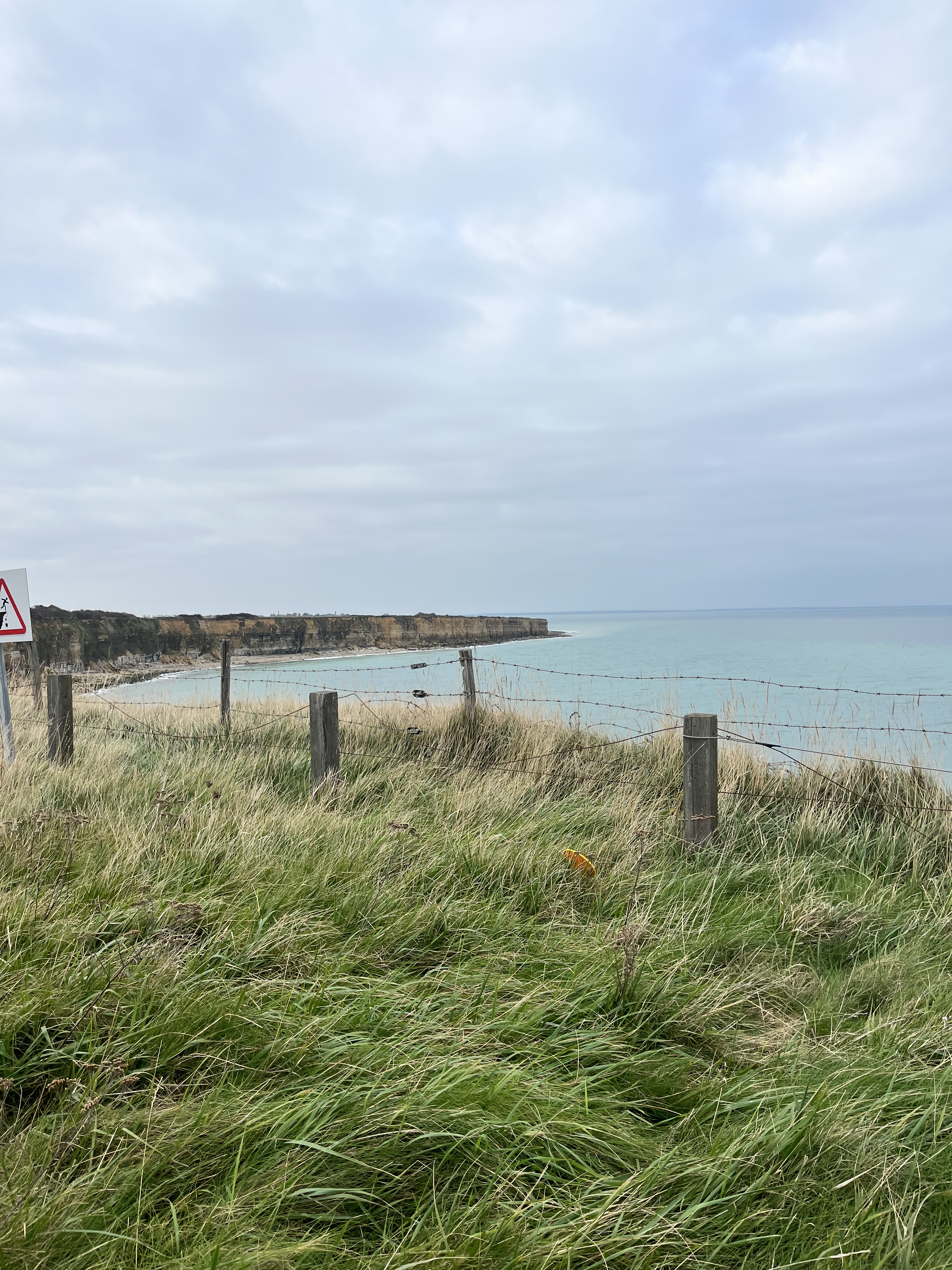
I stood on the cliffs, it was so peaceful, the only sounds were birds and the waves. The stark contrast to what it must’ve been like on June 6, 1944, with the pounding of artillery and bombs falling, is striking. When I looked at the cliffs that the soldiers had to scale, I couldn’t help but be amazed by their strength and bravery.
The cliffs at La Pointe du Hoc
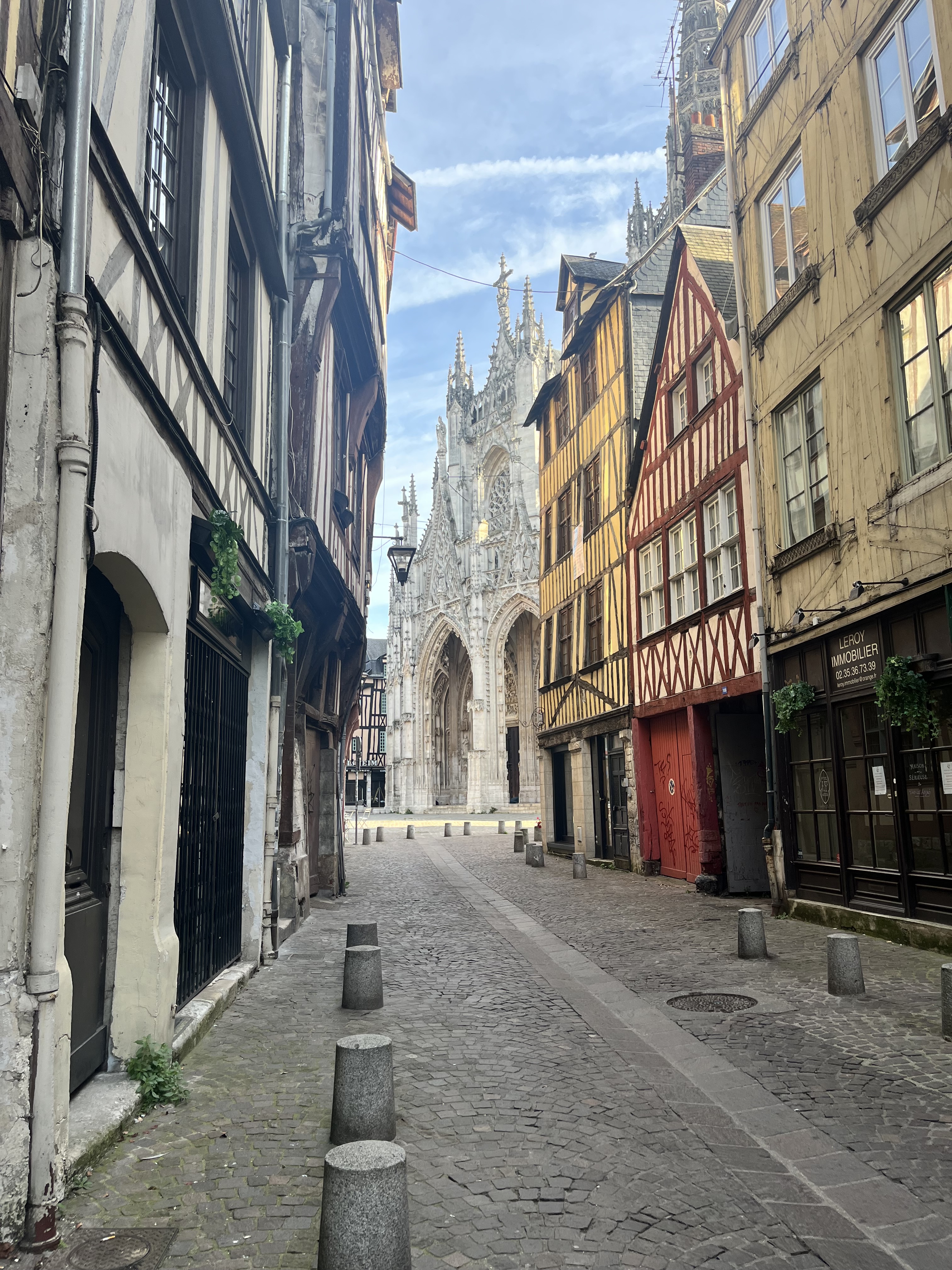
The towns, which withstood the onslaught, are charming. Some have modern elements that reflect the rebuilding effort, but many of the structures, which date back centuries, are still standing. I could have spent a great deal more time there. We visited for two full days, and it didn’t feel like enough.
These photos are from the old part of Rouen, considered the capital of Normandy.
I can’t recommend a visit strongly enough. We need to be reminded of all that went into fighting fascism and what people were willing to sacrifice for freedom. It would be tragic if we allowed our country to continue to slide into authoritarianism. I’m not sure Gary and I needed reminding, but I came away with a renewed sense of responsibility for doing what I can to prevent that from happening.
If one of the reasons we study history is to learn from it and avoid making the same mistakes, I urge everyone to revisit what World War II and the rise and fall of fascism have to teach us. War, even a just one, is brutal and exacts a steep price.
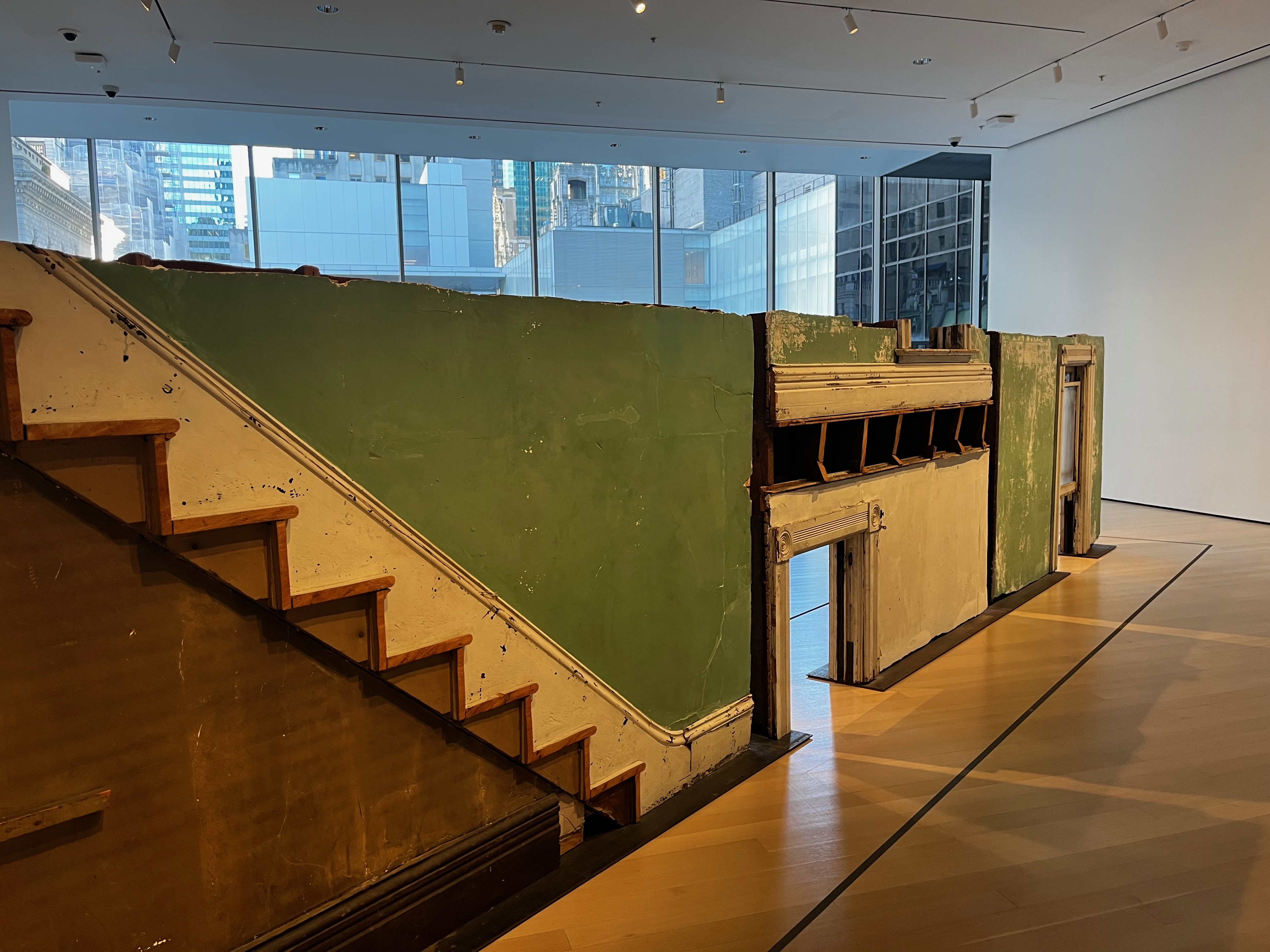
I went to the Museum of Modern Art. I hesitated before buying my ticket online because it is holiday season in New York City and that means crowds. There are always crowds at New York City’s most iconic attractions: MoMA , the Metropolitan and the Museum of Natural History are among them. But, this time of year is a whole other thing.
My strategy for any place with crowds, including Disney World, is to take the path of least resistance. I don’t have my heart set on seeing any one particular thing – I will see what I can see. Most of these places have so many choices, so much great stuff, that you can’t really go wrong. With that in mind, I decided to venture forth to MoMA.
Indeed, it was crowded, but I’ve been to exhibits where it felt like you were packed like sardines, moving slowly along a conveyor belt to see the art, which definitely detracts from the experience. This was not that – at all. In fact, I found galleries where I could sit down and look at the pieces leisurely.
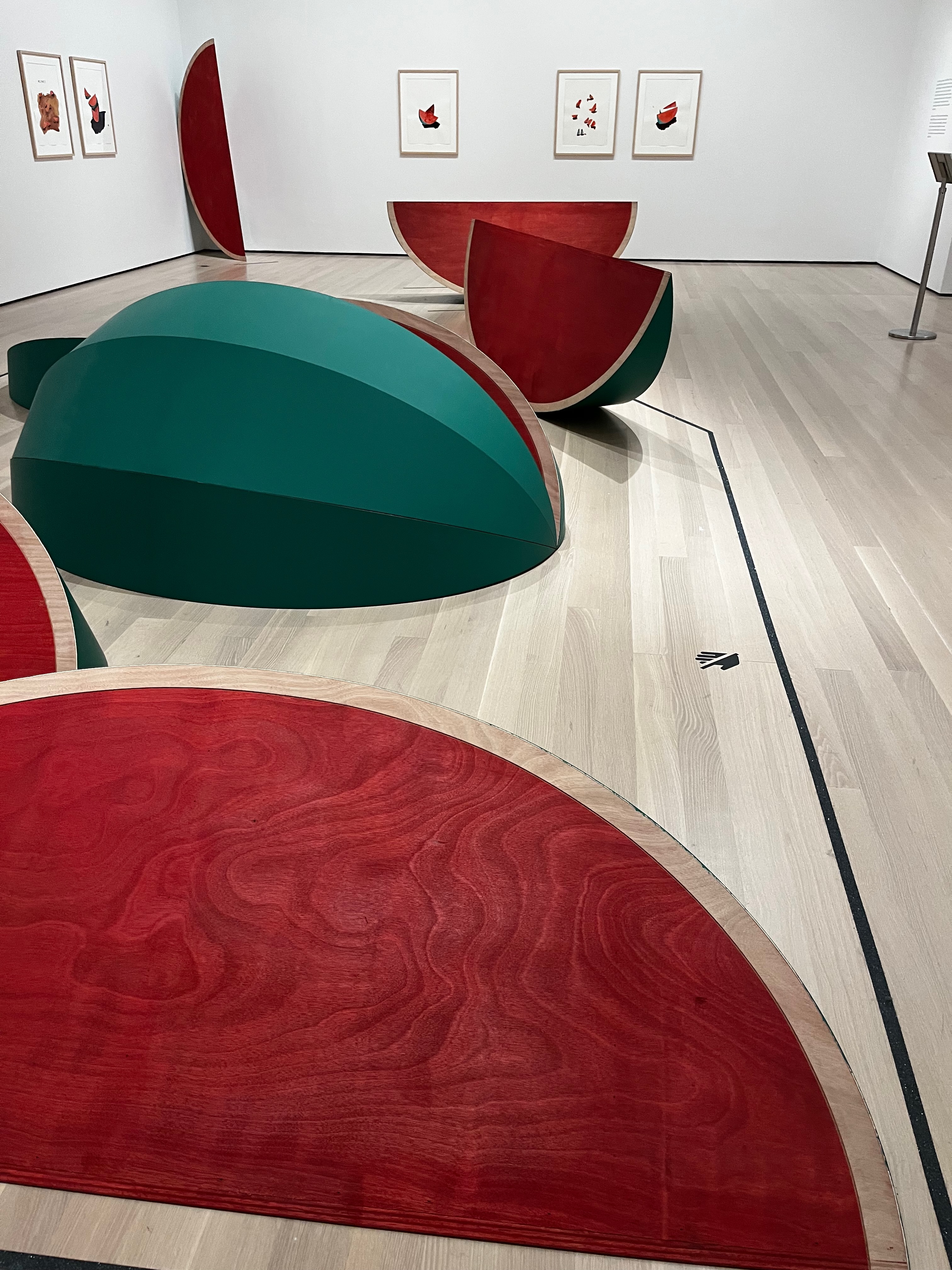
I’ve commented before on this blog about the fact that works of art, or my response to them, change over time. I find I like things that I didn’t appreciate years ago. I see other works that I loved as a young person that don’t move me as much. I love that about art. These days I gravitate to things that are whimsical – especially in sculpture. For example, this work by Thomas Schutte (an artist I had never heard of before):
The museum devoted a whole floor to an exhibit of Schutte’s work. It was incredibly varied – paintings of all sorts, sculptures of all sorts. On one card next to a display of drawings, it described a project he had undertaken that I found interesting. “Over the span of one year, Schutte drew his reflection from a round shaving mirror, recording his moods and temperaments in diaristic sketches. ‘It’s the attempt to fathom oneself,’ Schutte remarked, ‘and it failed miserably.’” I was amused and heartened by his willingness to share this. We usually only see an artist’s best work and we aren’t necessarily even aware of their failures. I can’t say I loved all that I saw of the Schutte exhibit, but it got me thinking and I appreciate that.
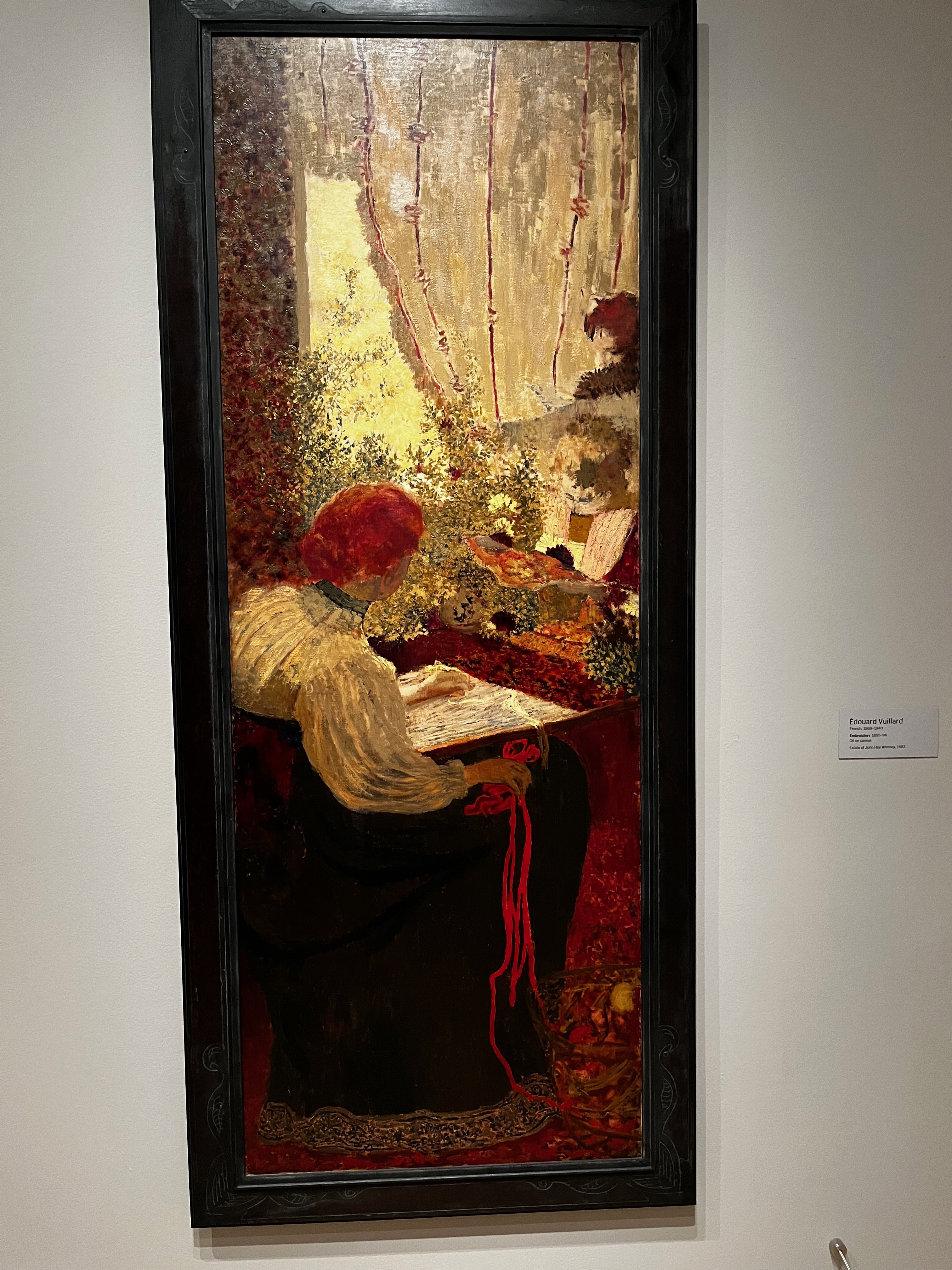
I also find now that I have more appreciation of canvases that are saturated with color, like these:
RothkoVuillard
They made me think about my mother. I remember Mom telling me that she had never appreciated Rothko until someone told her to sit down, take a few minutes, and let the color envelop her – and then she got it. She got what he was communicating. As the card next to the painting explained:
“For Rothko, art was a profound form of communication, one capable of conveying the ‘scale of human feelings, the human drama,’ as he described. Through works like these, he hoped to create the conditions for silence and contemplation.” I’m not sure I “got it,” the way my mother did, but I saw and felt more than I have in previous viewings.
It was funny to me, as I walked through the galleries, different pieces reminded me of different people. Besides my mom, who is always accompanying me when I go to an art museum, in my mind at least, I worked with a woman, Courtney, who had an appreciation for color. She told me about Pantone – the folks who catalogue colors and tell us the color of the year (for 2025, they just announced, it is mocha mousse, by the way). When I looked at the Matisse exhibit, which highlighted his paper cutouts, you could not help but be struck by his color choices. The display of Matisse’s array of colors, made me smile and think of Courtney.
Matisse: cutout that was a design for a holiday-themed stained glass, the resulting stained glass (not created by Matisse) and his color palette for his cutouts
No visit to a museum is complete without stopping in the gift shop. MoMA and the Metropolitan have stellar gift shops. I have to restrain myself. I picked up a few Hanukkah presents, but didn’t overdo it.
Here some other shots from my visit. I ended my day by walking, amidst a million of my closest friends, to Rockefeller Center to see the tree. I may not celebrate Christmas, but I can appreciate the twinkling lights that brighten our winter.
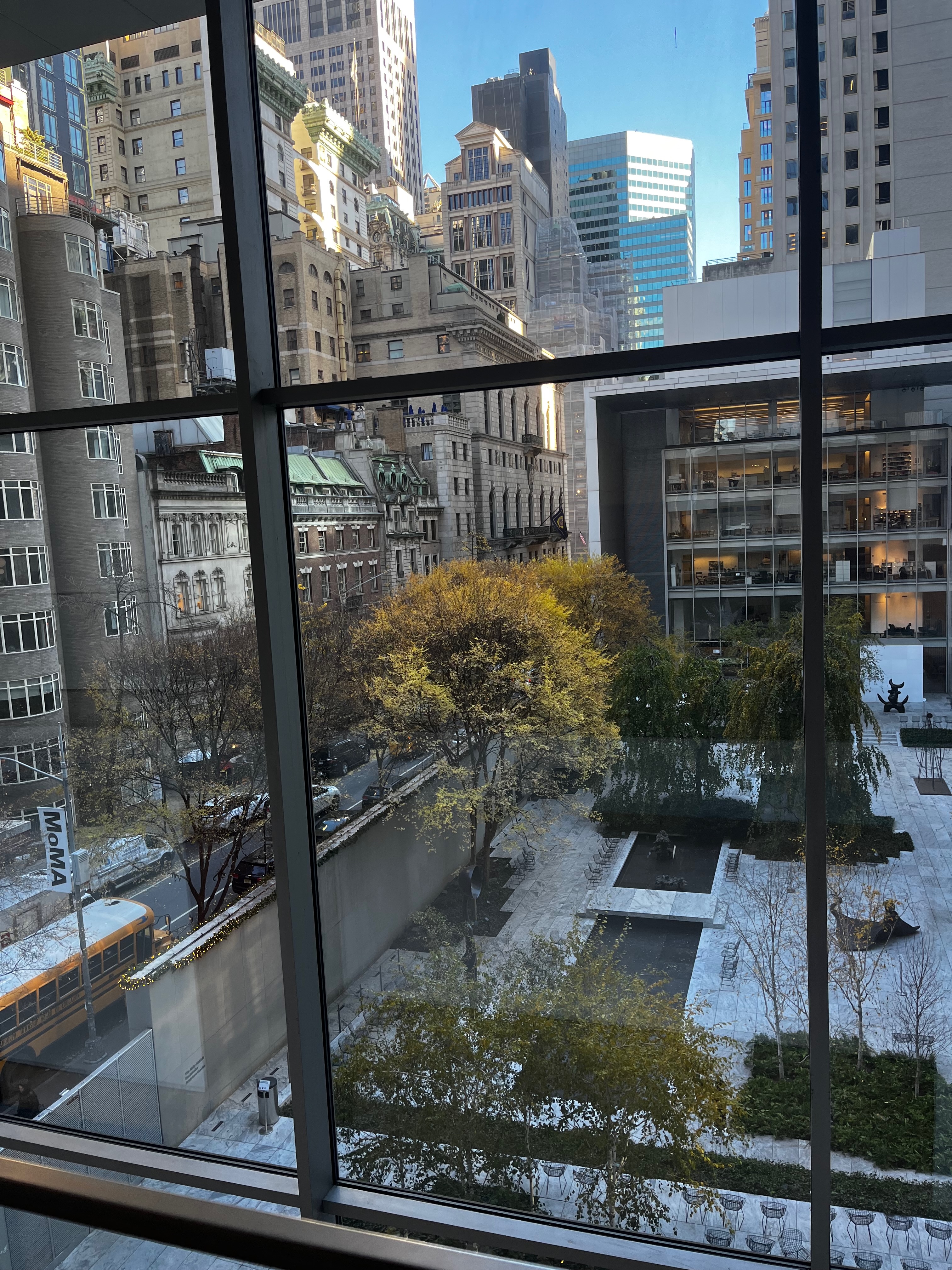
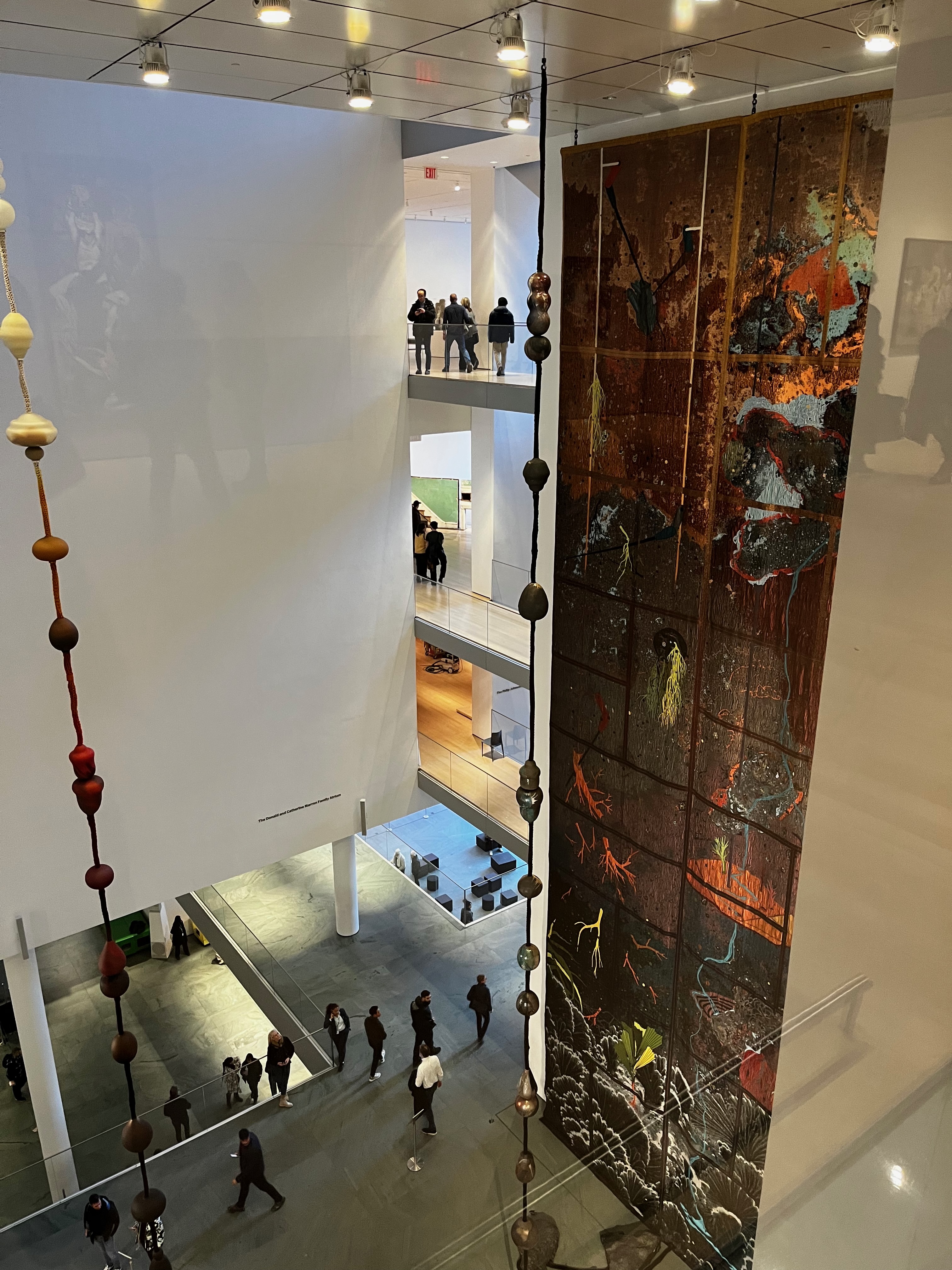
Views from inside the museum:
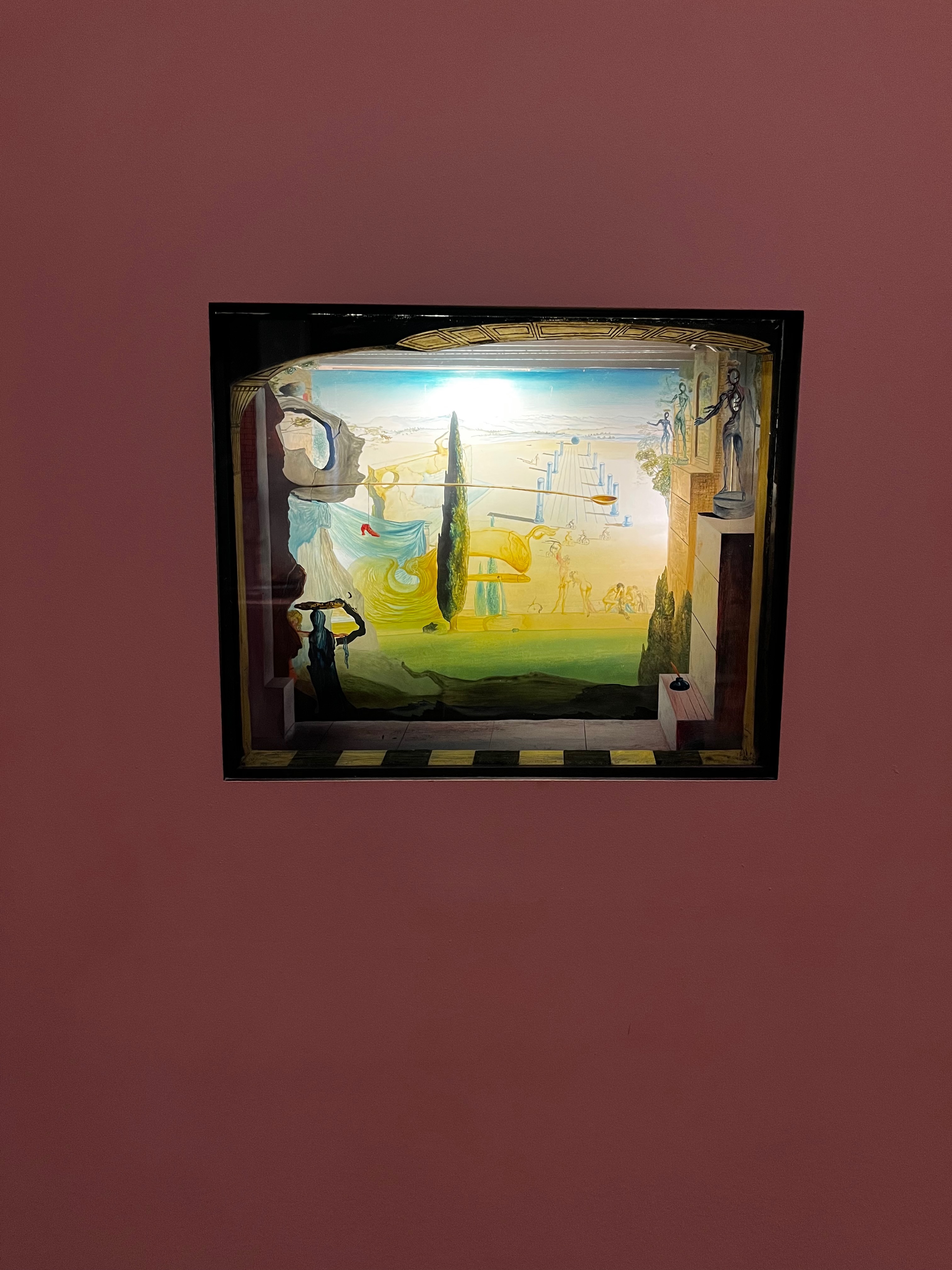
Some classics:
WarholSeuratDali
Does anyone convey loneliness or isolation more effectively than Edward Hopper?:
Two more interesting sculptures (at least to me), one on the right by Schutte (which had to do with the influx of immigrants in Germany in the 1990s):
A view of downtown from the top of Mount Washington after riding the Duquesne Incline
I could write a book about our trip to Pittsburgh. We were traveling there for a mini medical school reunion.
So many thoughts flood my mind:
The choices we make in our lives, being reminded of a turning point and what might have been. We could have settled in Pittsburgh but wanted to be closer to family. The road not taken is hard to resist imagining.
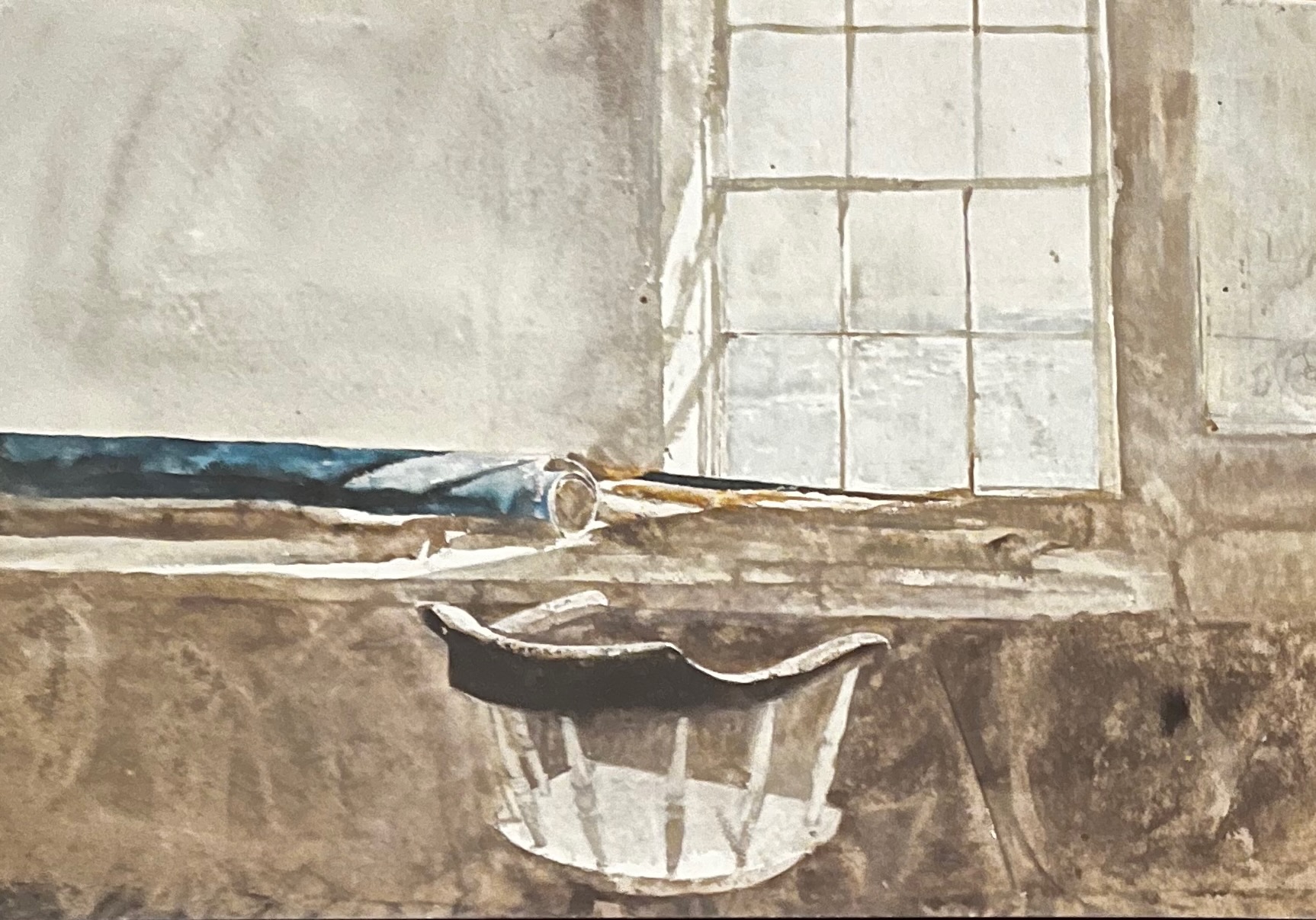
The side trip that took us at least 90 minutes out of our way, not to mention the time spent at the stop itself, a museum to see an exhibit of Andrew Wyeth’s paintings. When I suggested the detour, Gary initially didn’t want to take the time knowing what a long drive it was already from Albany to Pittsburgh. Then when we got in the car to start what should be a seven- or eight-hour trip, he said, “What the heck. We aren’t in any rush. Let’s go to the museum.” I think he took pity on me, knowing my spirits were low from the results of the election and imagining a stop to look at art might help. He was right – it worked…for a while anyway.
The juxtaposition of gleaming office buildings, the beauty of the confluence of the three rivers and the unhoused, hurting people on the streets of that same downtown area. It is painful to see folks strung out, young people panhandling, wondering what’s worse: to walk by with a shake of the head and a murmured “sorry,” or to give some money? Our society must do better taking care of its own. The wealth suggested by elaborate skyscrapers, high-end stores and fancy hotels, side-by-side with people whose possessions are held in a bunch of plastic bags begs for a more humane economy. Below is evidence of the issue in Pittsburgh.
Gathering with friends from 40 years ago, some we did see eight years ago but others we had not, in the aftermath of an election that broke my heart but likely brought joy to some of theirs, was daunting. I was worried about how it would go.
It turned out that our reunion was warm, and we avoided politics, but I did have some interesting discussions with the woman I knew best all those years ago. We sat next to each other during the Pitt-Virginia football game that neither one of us was interested in. I knew she was a Trumper, and she knows I’m a bleeding-heart liberal. We would not change each other’s minds about anything. I come away as mystified by how I feel about folks who voted for Trump as I was before. Maybe I understand a bit more about her thought process – she sees the world differently than I do. One part of our conversation I will share because I think it is revealing.
I explained that I could not forgive Trump for, among other things, his reaction to the unite the right event in Charlottesville where the marchers chanted, “Jews will not replace us” and carried tiki torches. Trump responded saying there were good people on both sides. My friend explained that Trump was referring to the people who were trying to prevent the removal of confederate monuments – that he was sympathetic to their cause – not to the chant. I said that I didn’t understand his statement that way and if that was the case he needed to make it clearer. She told me that it was obvious to her that’s what he meant. I said that even if that was what he meant, those monuments needed to come down. She disagreed. She asked me if knew anything about Abraham Lincoln. I said yes. She went on to explain that Lincoln supported monuments and naming forts after confederate generals to allow the South to save face. I responded by saying that may well be, and may have made sense in 1865, but it is now 2024, and the country needs to understand that the South lost the war. Those statutes and stories can be displayed and explained in museums and history books. Monuments in public squares should help us to remember and celebrate our better selves – the people honored don’t have to be perfect, but they do have to be on the right side of history. She just shook her head saying history should be preserved. I said, let’s change the subject and we did.
The game took almost three hours. There was a lot of conversation. Most of it was ordinary stuff about family, travel, health, but we couldn’t help but return to politics every so often, after all some of those subjects involve policy. Every time we did, we had to agree to disagree. At one point she said, amused, “You’re just too woke.” I smiled and said, “Exactly – that’s no insult to me. I work at being woke.” We both laughed.
I was proud of myself. I didn’t pretend that I didn’t disagree with her, but we didn’t get heated. I was able to hold on to the good times we shared, aware of the pain she’s had in her life, the disappointments and struggles. I assume she could do the same for me. We hugged when we said our good-byes.
Gary was sitting next to his friend and former classmate, her husband, who shares her politics. After we left, Gary and I compared notes about our experience of the game. Interestingly, they had not discussed politics at all. Not surprisingly they were more focused on the game, but they talked about other subjects too – work, memories, family, being grandpas. No politics, though. I wondered how they managed that.
I am still processing the entirety of the trip. It was only 4 days, including all that driving, but it represented so much. I am also still processing the election results. It is going to take a long time to digest it all.
The best part of the game that Pitt lost – the half time show. The band was terrific.
The Baksts took Portugal. That isn’t entirely accurate. One Johnson, our son-in-law, Ben, and one Bakst-Johnson, our granddaughter, were with us. And, we didn’t take all of Portugal. Though it is small, relative to other countries, we went to only two locations – Cascais, on the coast, and Lisbon. But, we took in a good deal of those two places!
The impetus for the trip was a phone call from our daughter. She had an opportunity to present her research at a conference on neuroeconomics (what is that?) in Cascais. She wanted to go and she wanted to extend the trip to do some sightseeing and have her husband and toddler come too. She wondered if we would be willing to go and give a hand so it would be more manageable to travel with the little one. She didn’t need to ask twice.
I knew the trip would be different from any I had taken before, and I was right.
After considering staying in the resort hotel where the conference was held, we agreed that taking an Airbnb was a better option. We thought, in general, that minimizing the moving around from place to place would be less disruptive for the little one. We reserved an apartment in Cascais that wasn’t too far from the conference site and another in Lisbon. We spent five nights in Cascais and four nights in Lisbon.
All of my other overseas travel involved staying at hotels or on cruise ships. And, all of those trips, not that there were that many, were either part of a tour or were organized by a travel agent with local tour guides. This was a departure from that. I was excited to see how that might change the experience.
Aside from the difference in accommodations, there were some other obvious distinctions. When our children were toddlers, the farthest we traveled was to visit the grandparents in Florida. We were not so brave as to undertake overseas trips with little ones. I admired Leah and Ben’s willingness to give this a try. I think in asking us to join them, there would be more hands on deck and that would hopefully make it less stressful.
In addition, Yom Kippur fell during the conference. Gary and I had some discussion about that, and we considered joining them after the holiday. It was a little surprising to us that the conference was scheduled to overlap with Yom Kippur, but then again maybe it isn’t surprising. In any event, we decided it would be interesting to observe the holiday in another country. I did some online research and found that there was a Chabad in Cascais! (Chabad is a branch of Orthodox Judaism that includes as part of its mission providing opportunities for Jews to pray and observe the rituals of the religion all around the world. For instance, there is a Chabad in Shanghai.)
Usually before Gary and I travel, I do research, especially if we have time on our own, looking for museums, points of interest, national parks, gardens, etc. This time I searched for things that would appeal to children. I learned that Lisbon has a world renown aquarium. We learned when we were there that Ben’s father’s architectural firm designed it. How cool is that!
So what were my takeaways from this trip?
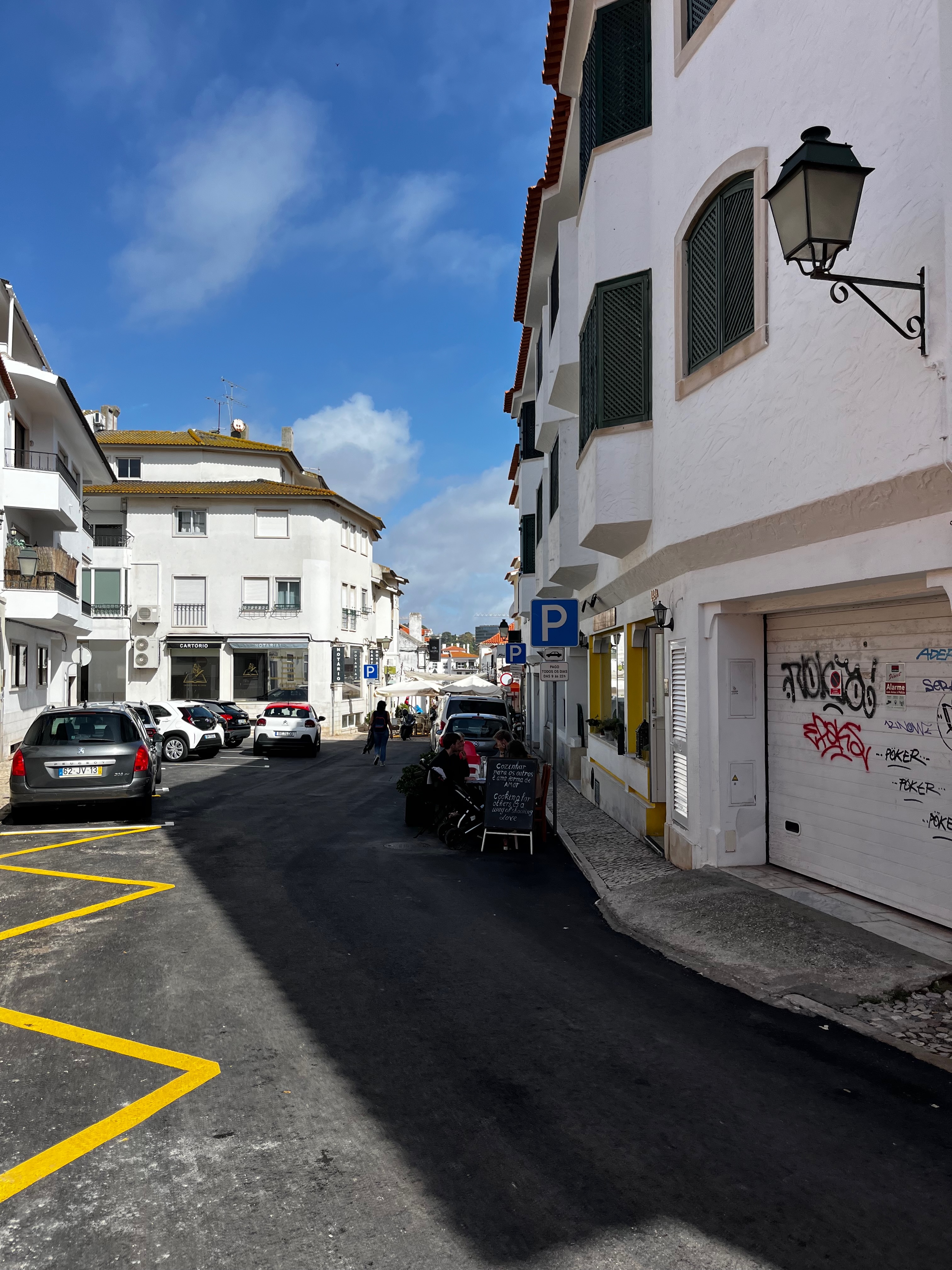
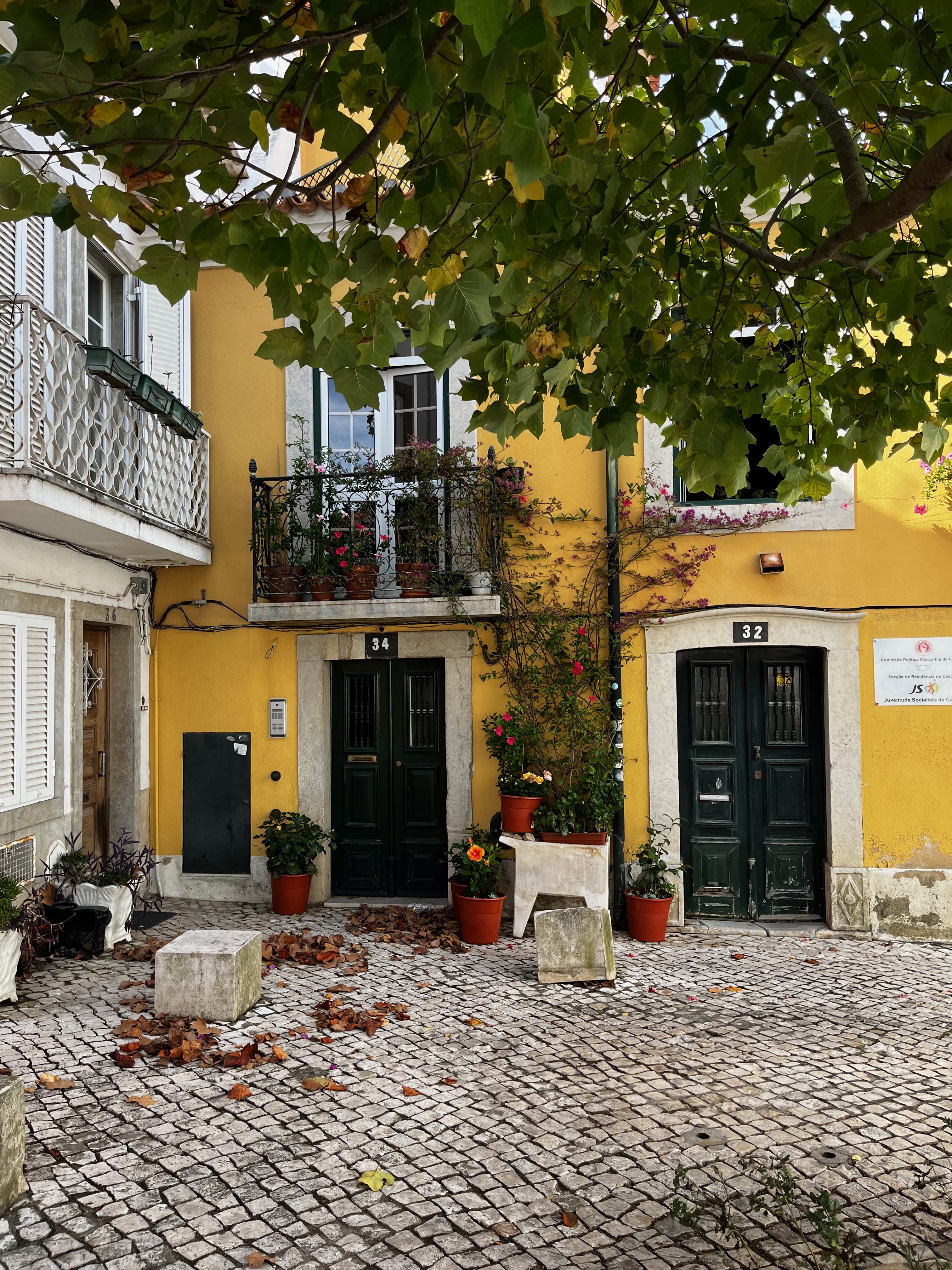
I loved staying in the apartment(s). We lived among people who were going to work, to school, living their lives. We went to the supermarket – we didn’t cook any meals, but we had breakfasts and lunches mostly at the apartment. I enjoyed walking in the neighborhood and getting to know the streets. Though the word gets overused, it felt more authentic than staying in a resort or hotel.
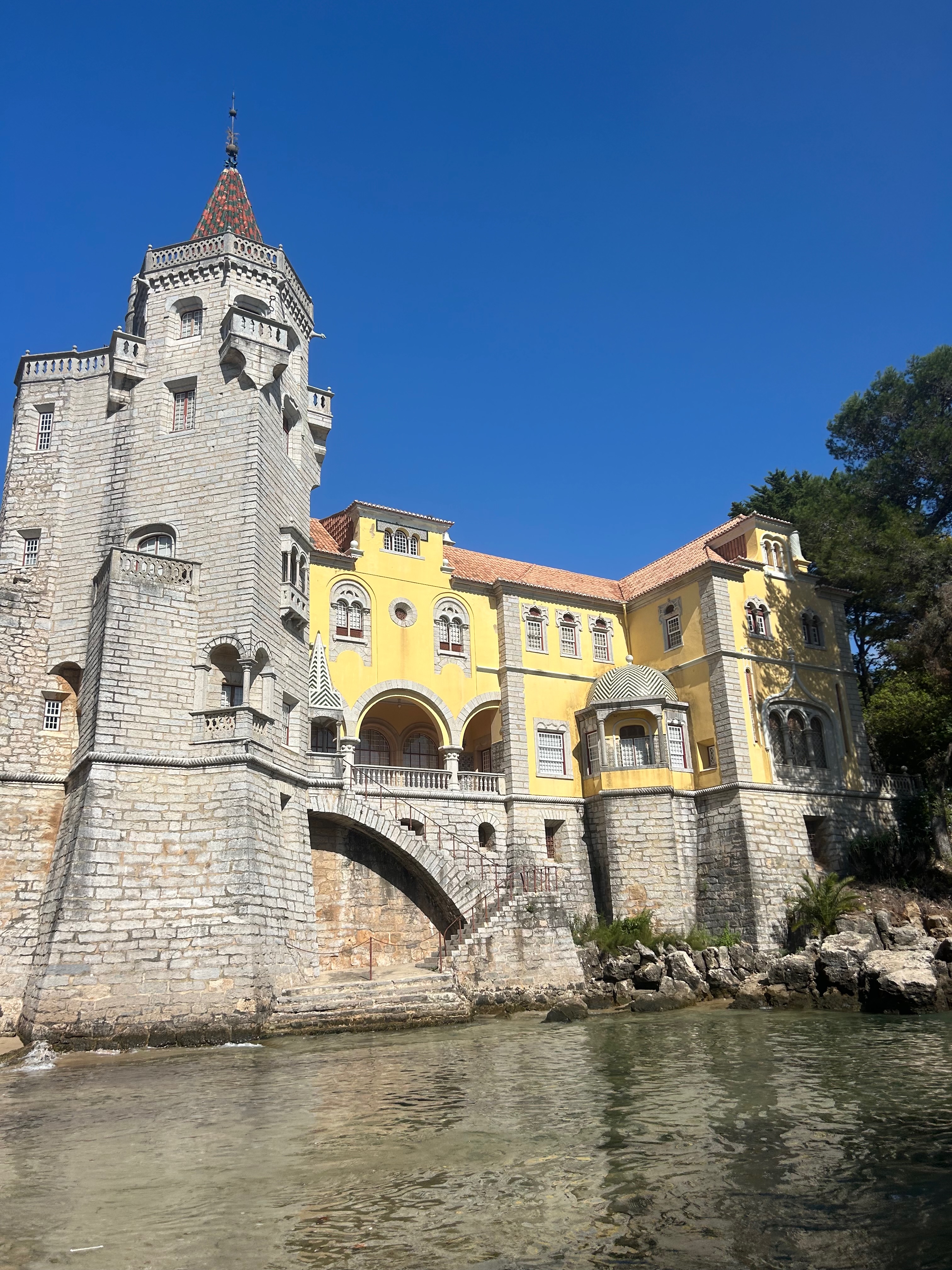
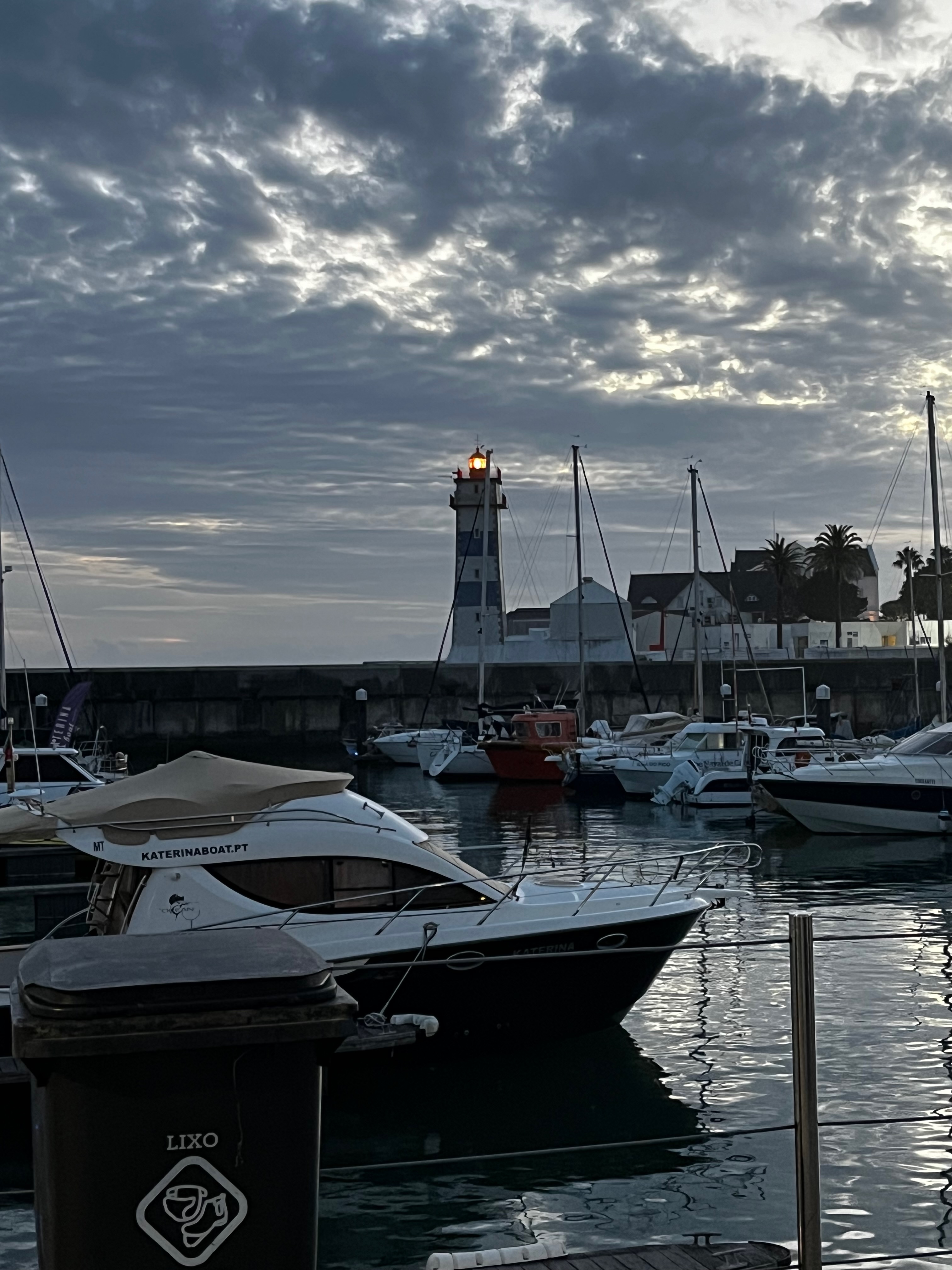
Scenes from Cascais:
Palace Condes de Castro GuimarãesThe lighthouse and marina in Cascais
Though none of us spoke Portuguese, we managed. Not everyone spoke English, but between knowing some Spanish, using Google Translate and a lot of pointing and gesturing, we communicated. Most menus offered an English version. The overlap between Spanish and Portuguese wasn’t as much as we expected, though, and the spoken language sounds more different than I realized. Sometimes Portuguese sounded almost Slavic or Germanic to my ear.
We visited so many playgrounds! Ben had an app on his phone that located playgrounds wherever we were – now that is a useful app! Our granddaughter had a great time. One playground in Cascais was in a beautiful park that had interesting sculptures and landscaped areas. It also had chickens roaming freely. We were surprised to find wild chickens commonly in parks/playgrounds, even in Lisbon!
Roosters in parks:
Park in CascaisPark in Lisbon
In general, it seemed that Portugal was more family-friendly than the United States. If you had small children, you could avoid lines. This came in especially handy when we visited Sintra – more on that in a bit. Establishments expected and accommodated strollers. The restaurants we went to had kids’ menus, too.
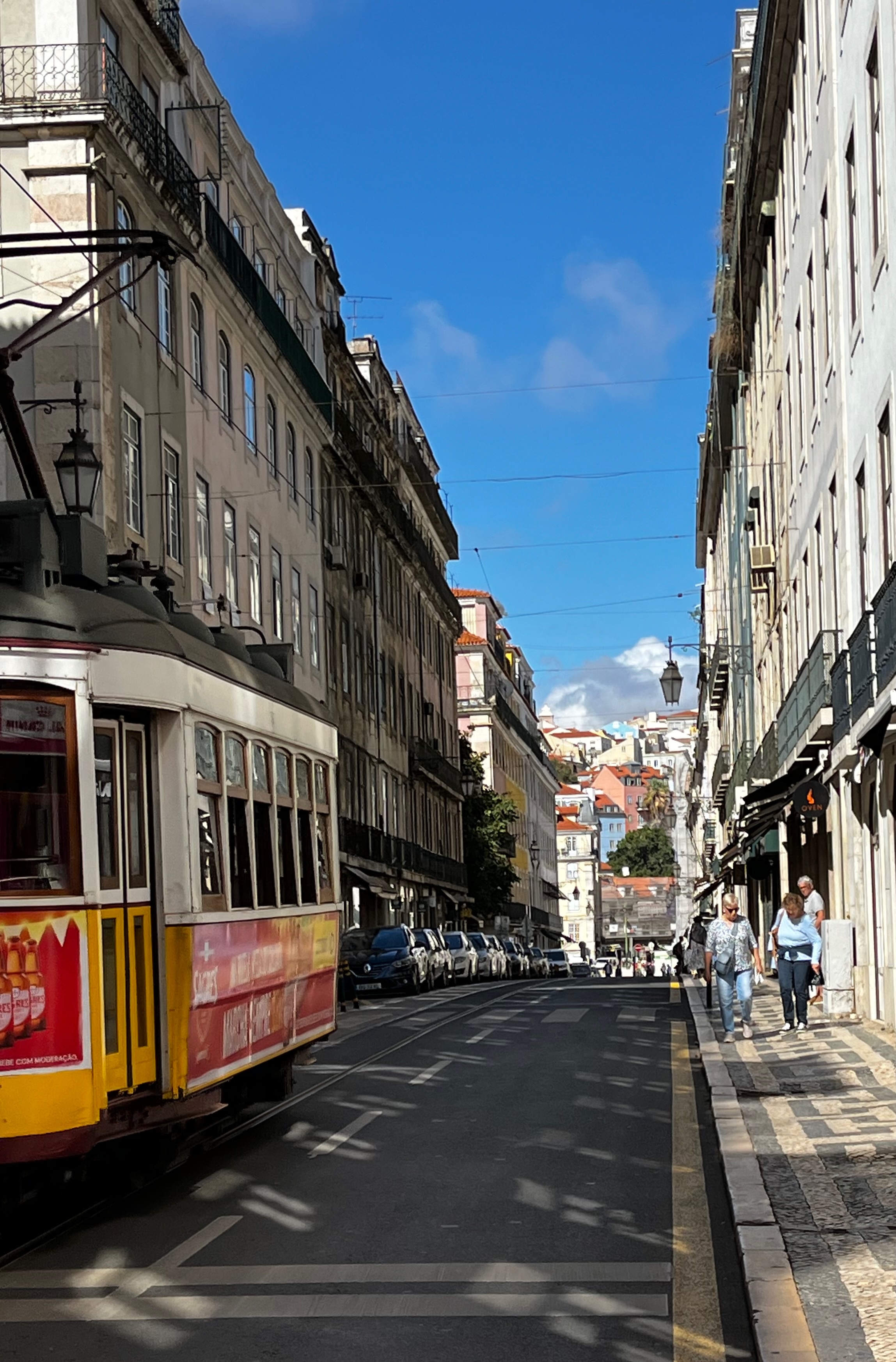
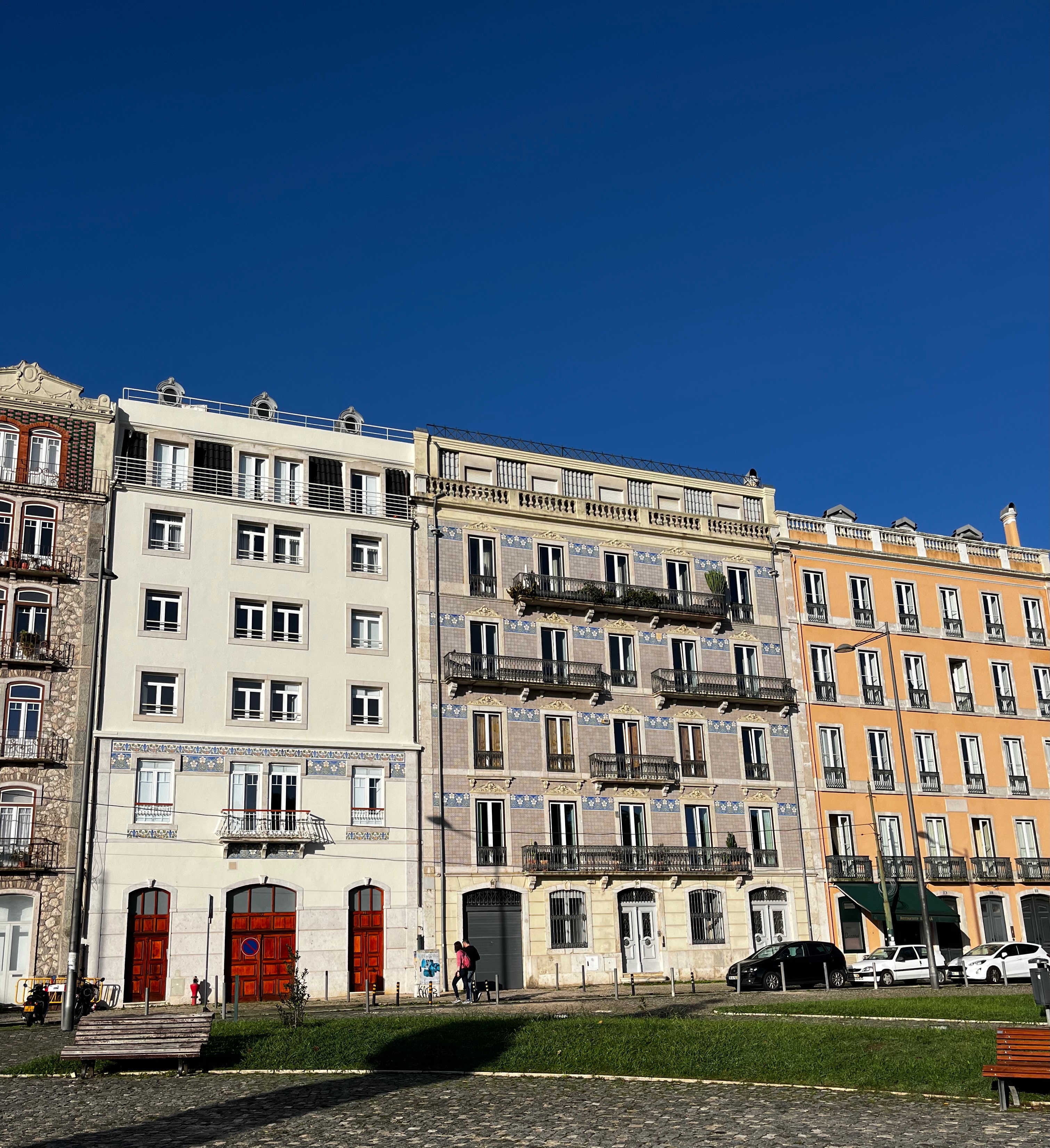
I don’t know how people who have mobility issues get around safely in these old cities – and they are centuries old. The sidewalks are narrow, and they are cobblestone! It looks charming and pretty but presents obstacles. The surfaces are uneven and the topography is hilly on top of that. It made for a good workout, but if a person was in a wheelchair or if they had balance issues, it would be very challenging. I am grateful that Gary and I do not face those difficulties.
Views of hilly Lisbon:
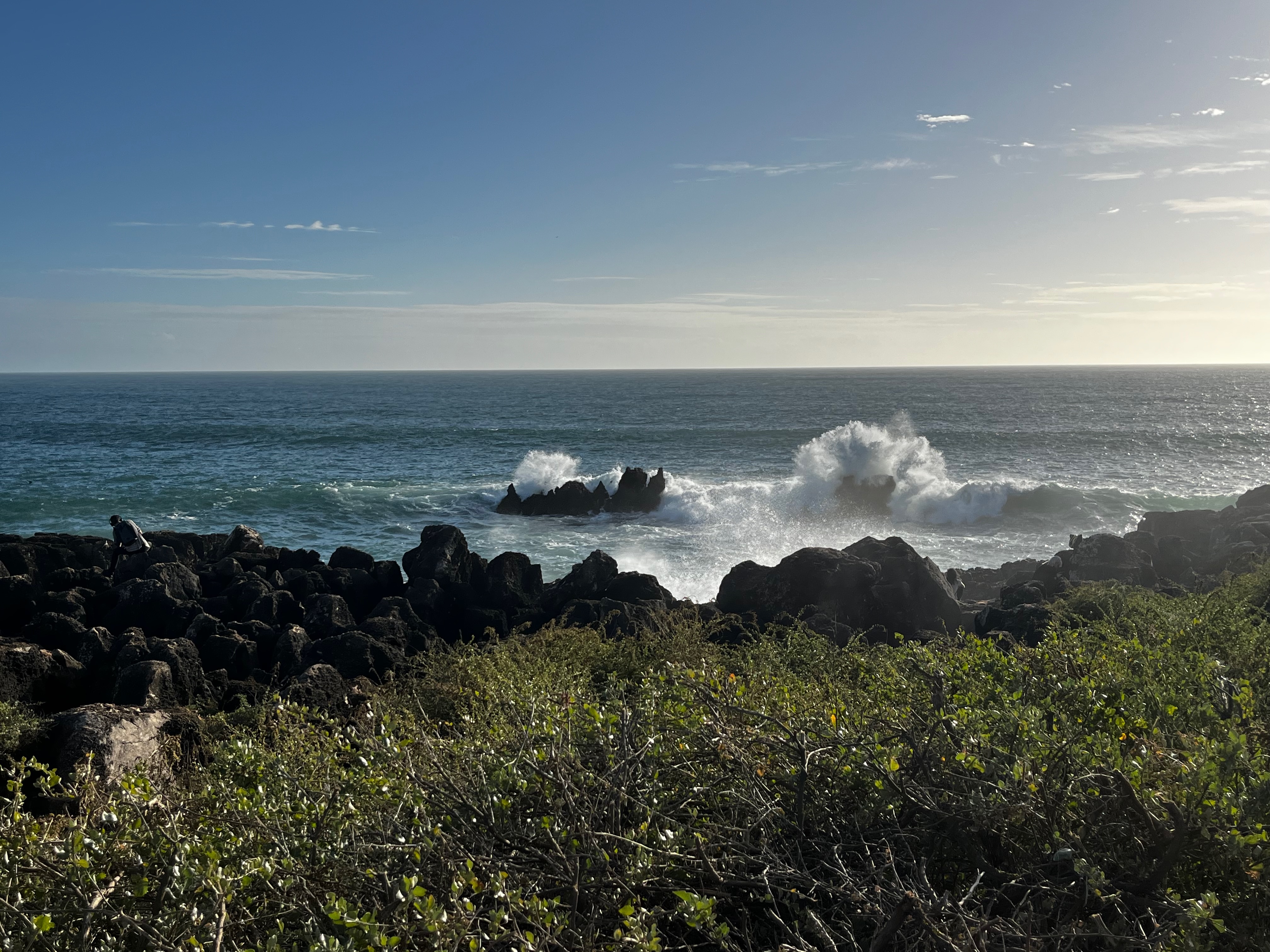
The coast of Portugal is beautiful. The ocean was wild. The currents looked strong. It wasn’t swimming weather anyway, but even if it had been, I’m not sure I would have been willing to venture in. I loved walking by it and listening to the thundering surf.
Our experience attending services at the Chabad was interesting. Security was tight – there was one entrance. Two men guarded the door and if they did not know you as a member of the congregation, they interviewed you. We were asked several questions and had to show them our passports – this was in addition to filling out an online form in advance. They were nice enough about it and we were allowed in. Not surprisingly, given that it is an orthodox synagogue, men and women sit separately. Though, I would have preferred to sit with Gary, it meant that I spent my entire time observing the women around me. They were a mix of Orthodox women (wearing modest clothes that covered their arms and legs, wearing wigs) and women in jeans and casual tops. In my experience, one doesn’t wear jeans to high holiday services. I was wearing a dress. There were a lot of children running in and out of the women’s section creating a bit of chaos. The prayers were recognizable, and melodies mostly were, too. The rabbi, who greeted us warmly when we walked in, was originally from Crown Heights in Brooklyn. His limited remarks (he didn’t give a sermon) and directions (announcing the page number, to rise or sit, etc.) were in English, he provided page numbers in Portuguese too. The prayers were in Hebrew. All in all, it felt familiar which is kind of amazing given we were in a foreign country. I didn’t get much out of the service in a spiritual sense, but that’s not unusual. I appreciated that they made the services available to us and they were welcoming.
I can’t say much about the food and drink (not meant to be a comment on our fasting for Yom Kippur, though we did fast for that one day). I enjoyed the little bit of Portuguese wine that I had. Given that most of our meals were with our granddaughter, food and drink were not a focus of our attention. Gary and I aren’t exactly foodies so this wasn’t much of a sacrifice. The food was fine. I was surprised by the number of pizza places! The pizza was good. We had good Indian and Mexican meals, too.
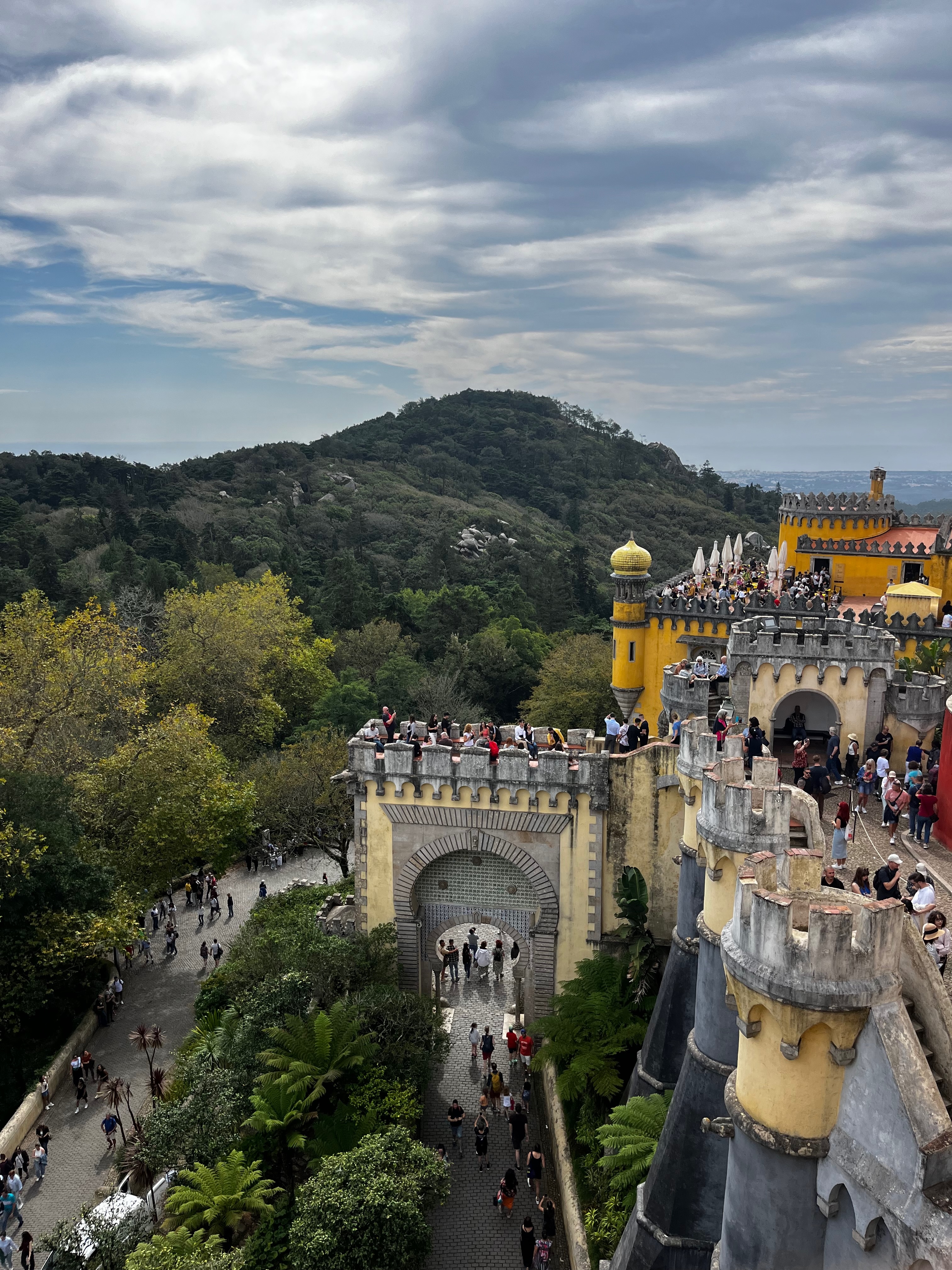
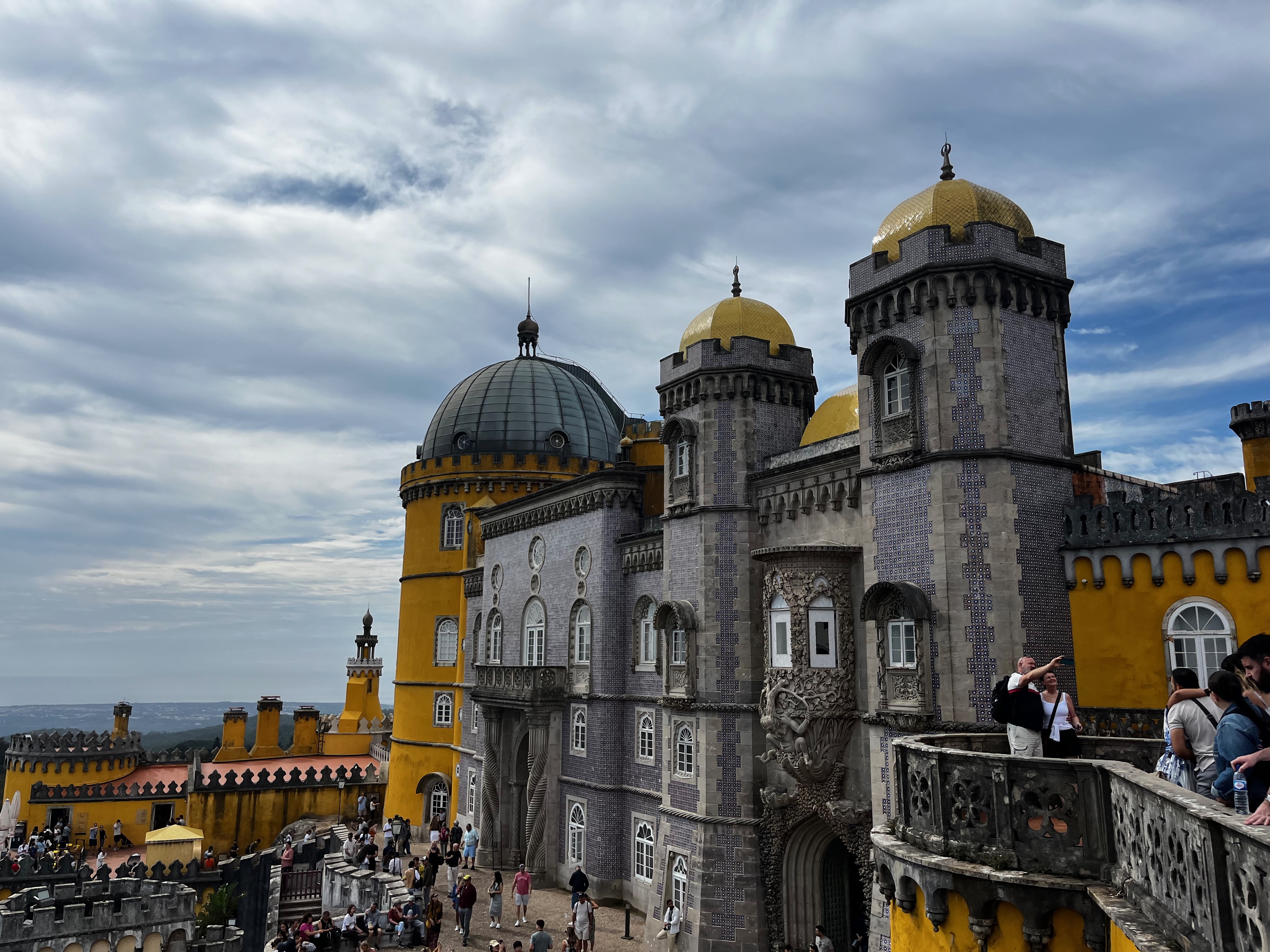
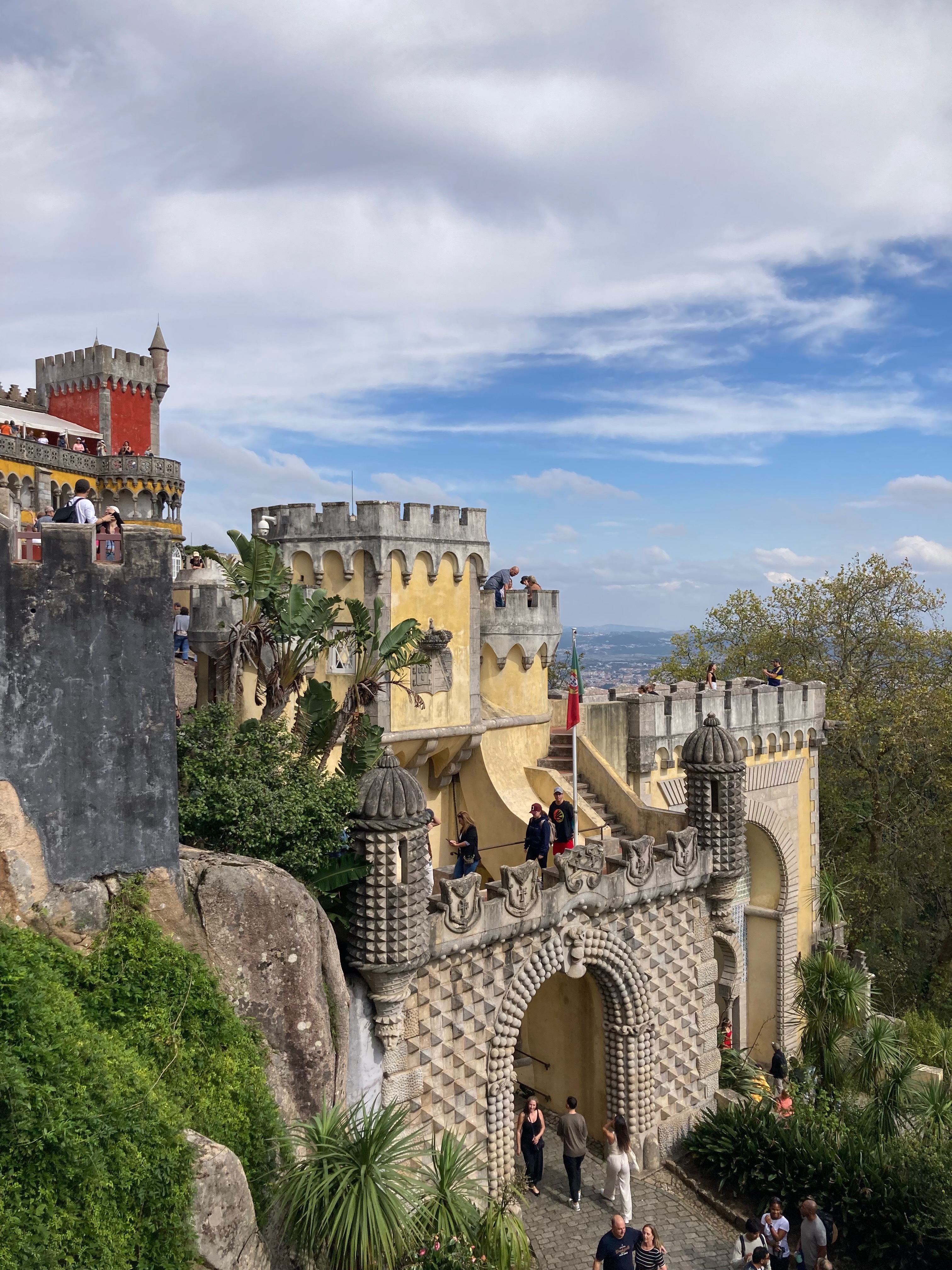
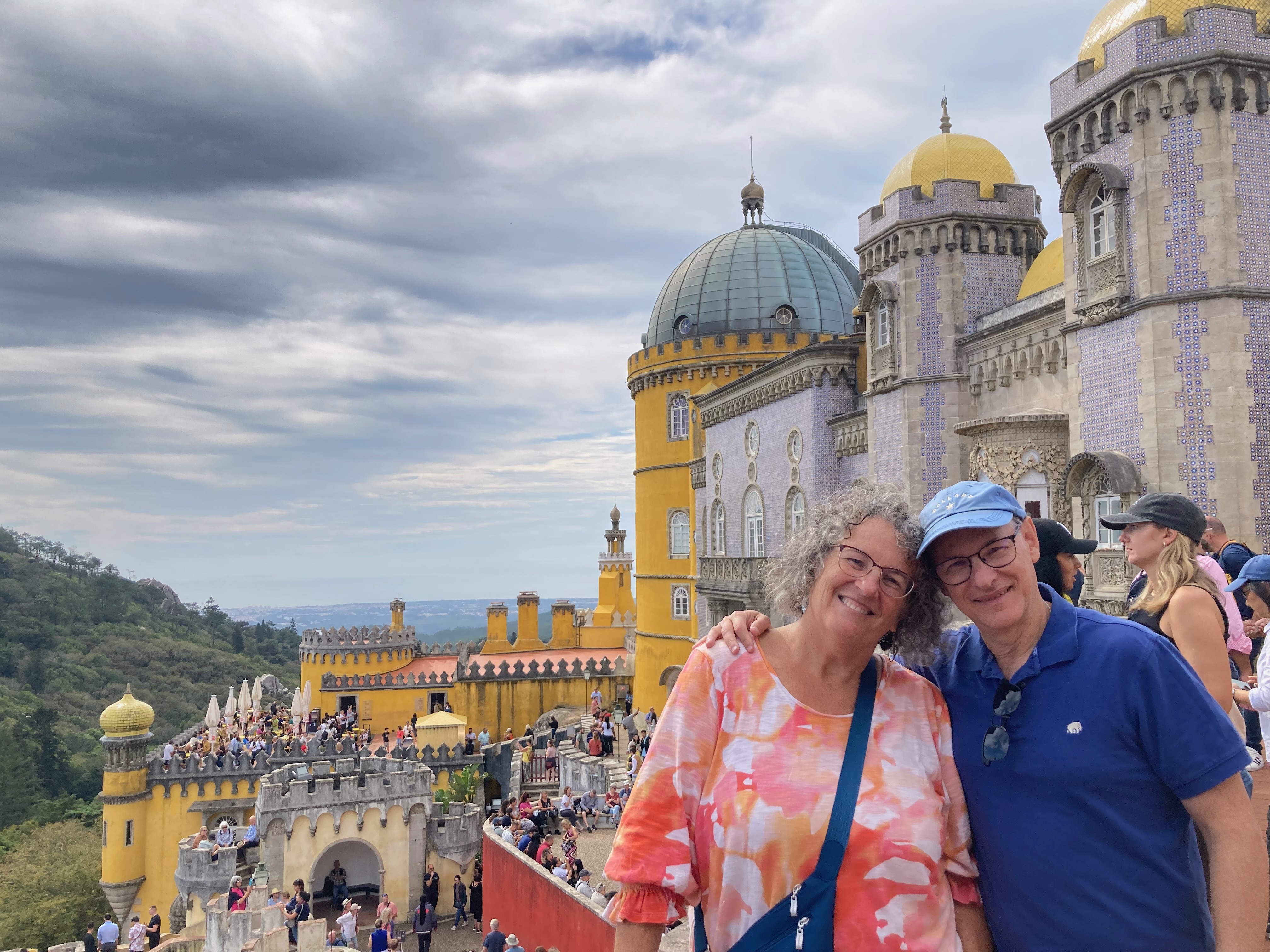
On our way to Lisbon we stopped in Sintra to see the Palais de Pena. Sintra is a charming, ancient town in the mountains. There are a number of castles there. For the duration of our stay in Portugal we rented a car because we thought that would be most convenient, and it was, except for traveling to Sintra. Should you choose to go, and I do recommend it, take public transit or a tour or some other means, do not drive. There was a prominent sign on the wall of a building that said “Sintra, a traffic jam in paradise,” or words to that effect. They weren’t lying. We were there on a Monday (not a holiday) and not during high season either, so I’m not sure when it might be less crowded. Anyway, the palace was spectacular and so were the views. And this was an occasion where having a toddler got us fast-tracked through the line!
Views of the Palais de Pena in Sintra:
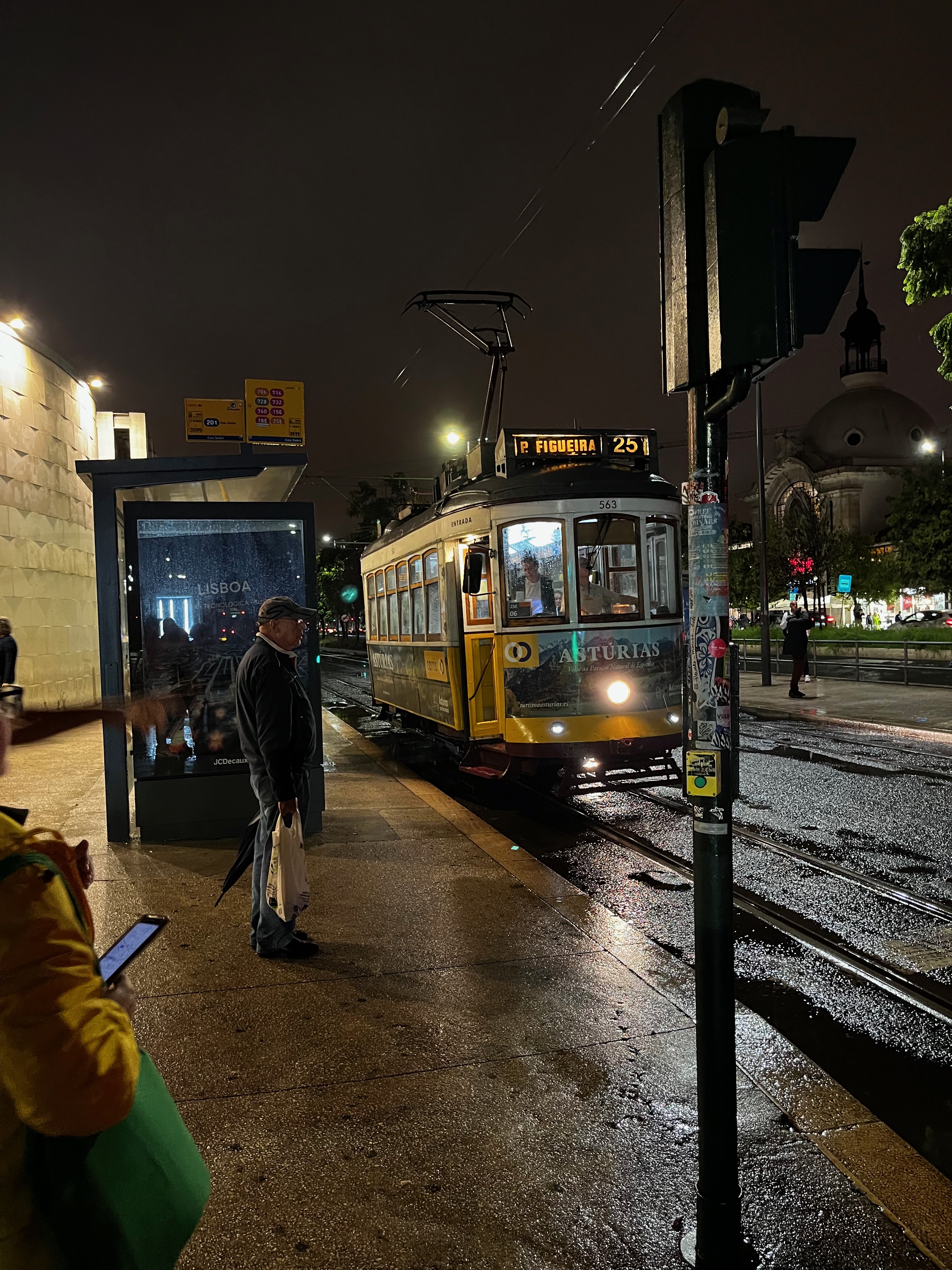
Lisbon is a great city – vibrant, with lots of restaurants and shops. It was far more multicultural than Cascais and that was reflected in the types of restaurants and stores. We took the metro to get around and that worked out very well. It wasn’t spotless but it felt comfortable.
We stayed one extra night after the kids left to go home. We took a hop on/hop off bus. The route was great and we saw a lot, but I don’t know if it was just Gray Line (the brand we used), but the buses didn’t run that frequently. Everything took longer than it should have and the buses were so crowded people were standing in the aisles. In addition, the audio that played, which gave information about the city, wasn’t synched to what we were seeing. Perhaps another bus line would have been better because in our experience it is generally a good way to get an overview of a city.
More views of Lisbon:
Belem Tower on the Tagus River in Lisbon
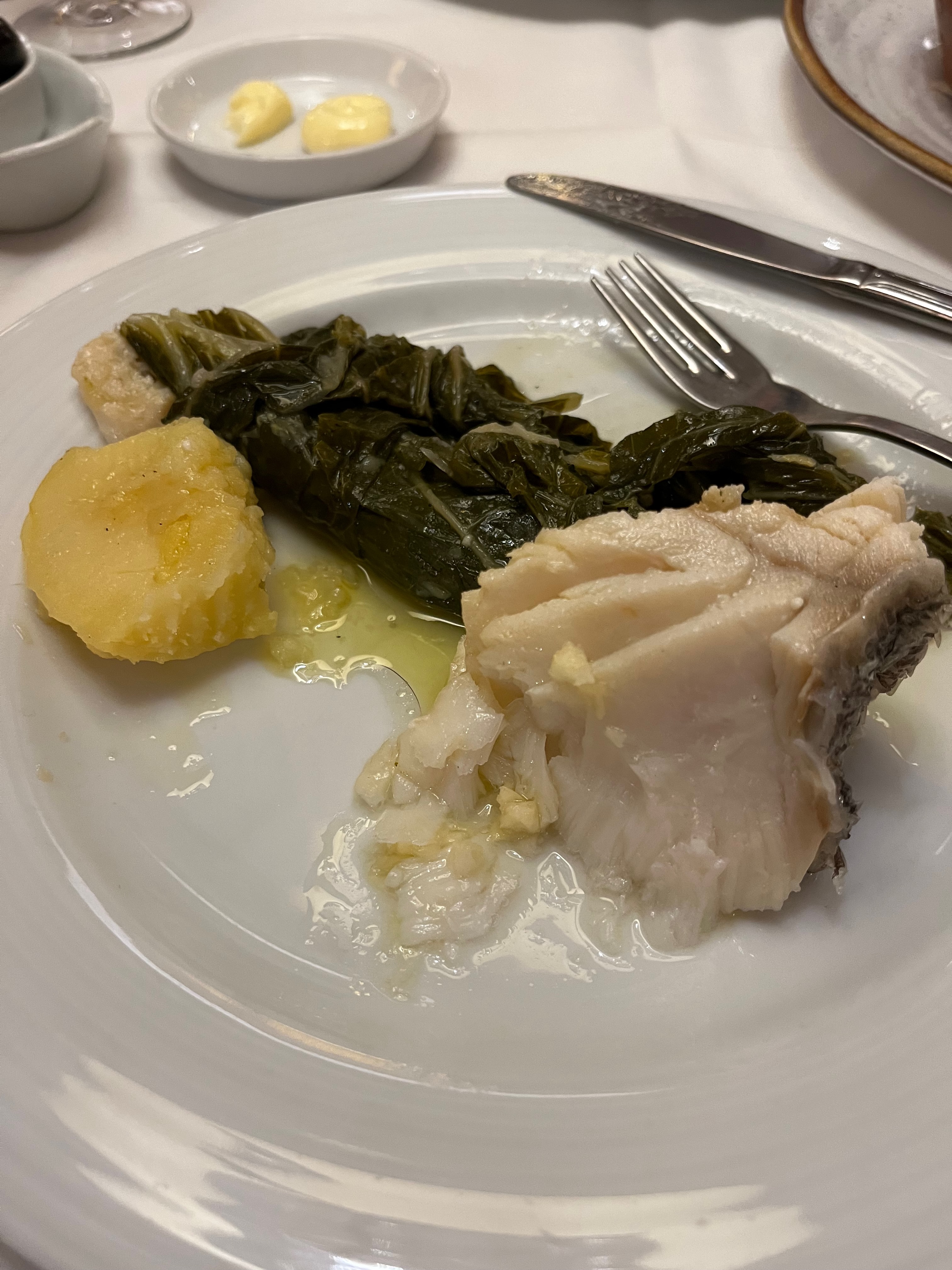
We decided we would go out for an authentic Portuguese meal for dinner. We asked for a recommendation at the hotel we stayed in for that final night – the Airbnb apartment wasn’t available for that last night. The woman at the desk offered a number of possibilities. Bacalao (cod) is a dish that is considered a national tradition, so we went to a restaurant that specialized in its preparation. I like cod, and the meal was fine, but not something I would need to have again.
The house special: cod, potato and cabbage
We were glad we had the experience – the restaurant was lovely, it was busy with folks who did not appear to be tourists, the service was good – but we didn’t love the food. Dessert, I ordered the chocolate cake with strawberry sorbet, was the best part of the meal.
Our main goal in taking the trip was to bond with our granddaughter and offer support to Leah and Ben. If we got to see some beautiful sights and learn something about Portugal that would be gravy. Given our granddaughter’s delighted reaction to seeing us each morning and her playfulness with us, I think we can say: mission accomplished. And, we did indeed see beautiful places and learned a great deal. I’ll leave it to Leah and Ben to decide if we were supportive, but I suspect we did all right on that count, too.
Note: Most of the photos were taken by me. Six of them were taken by Leah, Ben or Gary, though I am not sure which ones. Sorry for the poor attribution.
After Mom died at the end of February, I felt like I needed a reset. The last couple of years have been difficult. Though I was not the primary caregiver for either my mother or Aunt Clair, I was very involved in their medical decision-making. I accompanied them to doctors’ appointments. I visited them and tried to provide comfort. It was a painful process watching them deteriorate and being powerless to change the inevitable. Not to mention the grief I felt and feel when they were gone.
I also faced my own abdominal surgery to remove what turned out to be a benign cyst – it was actually my left adrenal gland that had hemorrhaged. While I only had a long weekend of worry before I knew it wasn’t cancer, it was still surgery under general anesthesia. The recovery was uneventful, but not without its discomforts.
All of the stress involved in these circumstances left me drained. I was not taking good care of myself. I was on the road a lot, driving over three hours each way to see Mom, and making poor food choices, stopping at Dunkin’ Donuts or McDonald’s instead of finding healthier options. There is a long tradition in my family of seeking comfort in food and I succumbed to that impulse too many times.
I thought it would be helpful if I could go someplace and gather my thoughts, get into a better rhythm. I have never gone on a retreat before, but the idea appealed to me. I wasn’t looking for spa treatments, though a massage might be nice. I was imagining some yoga, healthy food, a walk in the woods. I heard of some places like Kripalu in the Berkshires, Omega Institute in Rhinebeck in the Hudson Valley, and Canyon Ranch in several locations.
I looked them up online and read what they offered. Kripalu seemed closest to what I was looking for. I talked to Gary about it and he was fully supportive. I signed myself up for three days of retreat and renewal. They offered structured programs of varying lengths, but I wasn’t so much interested in something that formal. I wanted more flexibility. Fortunately they offered that option too.
Kripalu offers different levels of accommodations which are priced accordingly. I chose a private, dorm-style room where the bathroom would be on the hall. The idea of sharing a bathroom didn’t bother me, but I wasn’t looking for a roommate.
As I anticipated my time away, I was a bit nervous. I had not done yoga in years. There was a time, about a decade ago, where I was doing it regularly but I was never a serious student of it. I was afraid I would be in over my head. Perhaps people who went to these things were committed yoga practitioners. I called Kripalu, before I put my money down, and asked: Is this appropriate for someone of my age and level of experience (or lack thereof)? I was reassured that they offered programming that met me where I was.
I was still nervous about it, but decided I would take the risk. What’s the worst that would happen? I would try a class and if I really couldn’t manage it, I didn’t have to go again. The classes were voluntary. I could spend my time reading, relaxing and taking in the Berkshires if it came to that.
It didn’t come to that. I had a great experience.
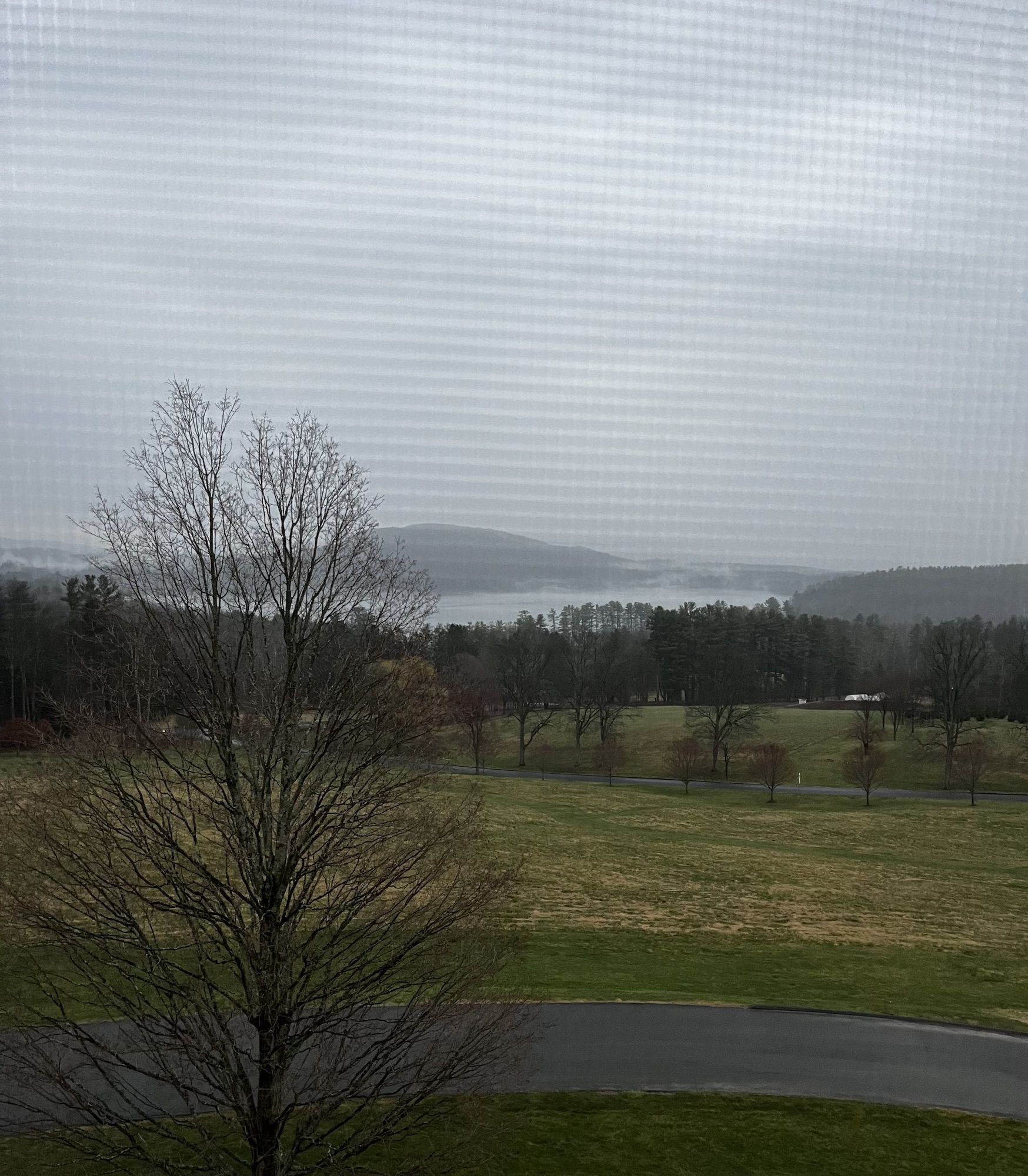
I checked in and got settled in my room. It was small, like a single dorm room. It did have a sink which I appreciated. It also had a lovely view of the lake, they call it the Stockbridge Bowl.
the view from my window – beautiful even in the rain/fog
This would be the first time since college that I would use a communal bathroom and shower. I wondered if it would bother me. It didn’t. They kept it spotless, and I think during my three days I might’ve crossed paths with another person only a couple of times.
I studied the schedule of classes/workshops and planned out my time. They told me that Gentle Yoga would be appropriate for me. They offered more vigorous classes, but I was quite challenged by the gentle version. The biggest difference from ten years ago was my balance, though my flexibility and strength weren’t what they used to be either. But I didn’t feel self-conscious about it. Everyone seemed to be focused on themselves and the teachers were encouraging. I did the best I could and felt reasonably good about it. I did a yoga class once each day. As I remembered from my previous experiences, I particularly enjoyed Savasana, the final ten minutes when you lay on your back (or choose a comfortable position) close your eyes and breathe while soft, soothing music plays…very calming.
I took two hikes. Each was guided by a staff person. I loved the approach they took. They began with a short meditation, and they suggested that during the walk out – in one case we hiked down to the side of the Stockbridge Bowl (walking through some woods and meadows in route) and the other we climbed up to a pond – that we walk in social silence. In other words, we traveled as a group, but without chatting. They wanted us to pay attention to our surroundings, listen, see and smell nature. They asked that we leave our phones in our pockets, not even to take pictures. I thought that was great – took the pressure off. When we arrived at the destination we sat quietly for a few minutes. In one case the guide read us a poem. After a time of taking it all in, the guide said if folks wanted to take photos or chat, they were welcome to; if you wanted to continue in silence, that was fine too. On each return trip I chatted with people. It was a great balance. I did notice a difference in how much I took in when we walked quietly versus when I talked with someone, but I enjoyed both experiences in different ways. Here are some views from my hikes:
the pondthe path by the lakei love light on water
Another interesting aspect of Kripalu is that they ask that breakfast be eaten silently. There are signs up around the dining hall and other spaces where you can take your meal asking that you respect the silence. (In fact some folks come to Kripalu for a silent retreat – they spend their days in silence.) The sign on the table explained that they urged you to be present while you were eating your first meal of the day – to pay more attention to the tastes and how your body felt. Again, I found it to be a great practice. This only applied to breakfast, other meals were social. For all meals, though, they ask that you not use electronic devices – they preferred that you use a physical book, but people did use e-readers. The prohibition on electronic devices extended all over the campus. There were designated areas where they were permitted and of course you could use them in your room. I loved being free of my phone. Most of the time I left it in my room, unless I knew I wanted to use the camera.
I have more to share about the workshops I took, but I will save that for another essay. It has been over a month since I returned from my retreat. While I wish I felt as energized as I did in the days immediately after my return, I can’t say that is true. I do carry the lessons I learned, the peacefulness I experienced and the spirit of it within me. I am sure I will return to do it again.