The Beauty Business

“Are you doing your eyebrows again?” Sue asked.

My college roommate opened the door to find me sitting at my desk, a magnifying mirror propped in front of me, the lamp on, poised to pluck another hair.

“Yes.”

“Do you do that every day?” she asked incredulously.

“Not EVERY day, no, but if I don’t do it regularly, they get out of control.” I replied self-consciously. I didn’t much appreciate her question. I made a mental note to try to do it more discreetly in the future, but there were limited opportunities given that I was tripled and privacy was hard to come by.

This was part of my war against a unibrow that had been ongoing since puberty. My brows were thick and dark and threatened to meet in the middle if I didn’t tame them. It was 1977, long before the popularity of Frida Kahlo made dark brows that edged toward the middle a chic choice a woman could make. In 1977 it was totally unacceptable, totally unfeminine.

I remembered that exchange during a recent phone call with my daughter. Leah called to vent about standards of beauty for women and the mental space, time, effort and money required to meet them. She objected to the fact we still labored under the onus of unreasonable expectations. “Who decides what is acceptable?,” she asked rhetorically. “And then we judge ourselves against that standard! Do men worry about that? Do men ask themselves if an outfit flatters them? Maybe there are men that do, but the average guy is probably asking themselves whether the shirt is appropriate to the occasion – are they going to work, a concert, to exercise? And that’s it. Maybe they think about the weather – should they wear long sleeves or short. They might think about whether the shirt matches their pants – maybe. We worry about so much more. I resent the whole enterprise! Ben has never asked me if a shirt he chose to wear makes him look fat!” Leah conceded that she doesn’t ask Ben that question either, but not so much because she wasn’t concerned about it, more because if the thought occurs to her, she rejects it because she recognizes that it is absurd, and she knows Ben is too smart (and kind) to answer with anything other than a positive comment about how she looks.

I agreed that it isn’t fair, women spend much more time tending to their appearance than most men. We both thought that women (and men, too) who enjoy the process and results of taking care of their skin, hair (the hair we want and the hair we don’t), nails, choosing outfits and accessories should feel good about their efforts – we would not stand in judgment. We should not think of them as shallow.  People should be free to play with their appearance and have fun with it. But those of us who don’t enjoy that, shouldn’t be burdened with the expectations of others. Right now, that is nearly impossible given the messages we have internalized about what women should look like. Sadly, at least for me, I would like the results: no stray hairs where they aren’t supposed to be, soft skin without blemishes, manicured nails, a fit, shapely body that can wear the latest fashions, feet that can wear cute shoes without pain, without putting in the time. I want to magically look put together and attractive. I think my daughter, and many women, want the same thing.

Leah railed against the mental energy being spent on all of this. “If half the mental energy and resources spent on the beauty and wellness market were spent on the world’s problems, think about where we would be,” she pointed out. “If the effort that went into that, went into problem solving how much better off would the world be? And who is profiting from this?”

I had no answer for her. It did bring to mind another conversation I had – this one with my very good friend, Merle. I shared my memory with Leah who commented, “Merle knows what’s up!”

Merle and I were in the San Francisco airport at the conclusion of our visit with her brother after our sophomore year of college. It had been an eventful, eye-opening experience being in the Bay City in 1978. We were tired and waiting for our flight, our nerves frayed when we got into a disagreement on the very topic that Leah and I were discussing 46 years later.

Merle made the case that “they” were forcing beauty products on us. “Who are ‘they’?” I asked. “Corporations – the ones selling the products, the magazines, the ad agencies, the clothing companies,” she explained. I wasn’t buying it. “But we are part of ‘they’,” I argued. After going back and forth, somehow I was taking it personally, we decided to take a break. We each took a walk in the opposite direction in the airport. We met up at the gate and didn’t discuss it further.

I had trouble accepting the idea that anyone was controlling me. I wanted to believe in my own agency – and not just in my own, everyone’s. Merle was being exposed to other ideas; she was taking Women’s Studies classes. The notion that there was a patriarchy and financial powers heavily influencing our choices resonated with her. I was not ready to believe that.

It isn’t that I haven’t thought about these issues in the intervening years. I have, and I have moved a lot closer to believing Merle’s argument. I had not, though, come as close to revisiting the topic in the same way until Leah called to vent.

So, have things changed? In some ways, they have not. Leah feels as oppressed by unrealistic standards of beauty as I did and do. It is still big business selling products and services that promise youth and attractiveness to women (now we’re supposed to use whole body deodorant!), lots of money, influence and power are associated with the industry. There have been some changes: perhaps there is more room for variation in body types – we do see chunkier women and more women of color in advertisements. Perhaps the market has broadened in that now men are targeted too, though I’m not sure that is a good thing. Women hold more positions of power today than they did in 1978. Today women hold 29% of the seats in Congress; in 1978 we held 4%. But we are 50% of the population! It remains to be seen whether a woman can be elected president, we haven’t been yet.

Given the persistent disparity in wages between the genders, the difference in the way female political candidates are treated, the continued violence against women, we have not made as much progress as I wanted. I only hope Leah will have a different conversation with her daughter when she is an adult.
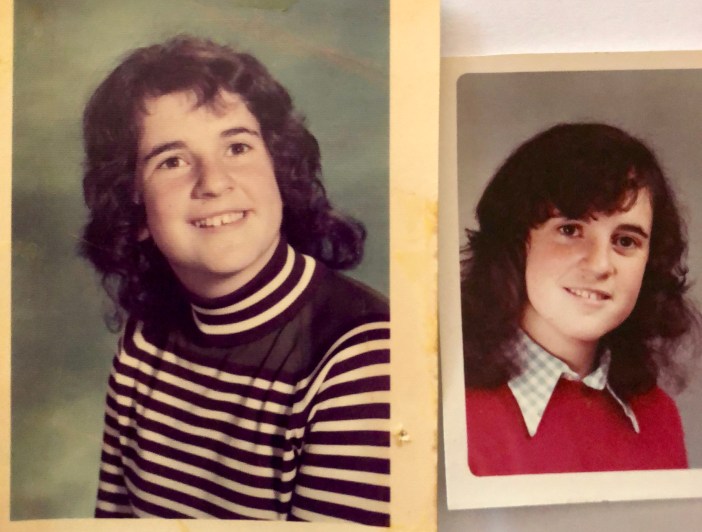
Appearances

Me in 7th and 9th grade
me more recently

I am not a conventionally attractive woman. I don’t write that to fish for compliments or to elicit sympathy. It is a fact, and it has complicated implications. I am reading a memoir, Crying in the Bathroom by Erika Sanchez and in the course of telling her story as a Mexican-American woman who has defied cultural norms, she writes of her numerous experiences being harassed, and in some cases (nearly) assaulted, by men. She writes about her problematic relationship with her appearance. I have read many similar accounts by women, especially as we processed all that was revealed from the ‘me too’ movement. I have heard first-hand stories from friends, too. I believe them and they are painful and emblematic of the reality of toxic masculinity. It has not been my experience, though, and that leads to some complicated feelings. In a bizarre way it makes me wonder what is wrong with me, and am I alone is not having those experiences?

That is not to suggest that these experiences are all attributed to the looks of the women involved, or to blame the victim for being attractive! No matter what you look like, you should not be subjected to abuse. I am well aware that 80 year old women get raped, as do ‘unattractive’ women. I also believe that systemic sexism exists. Strong women are often discriminated against in relationships and in the workplace – I have seen that with my own eyes and believe I was the victim of it. That has less to do with appearances and more to do with societal expectations about women’s behavior and/or generalized misogyny.

I also know that research shows that resumés with women’s names or names associated with African-Americans are passed over in favor of men or those with what are assumed to be white names. This has implications for job opportunities, access to loans, among other things that shape power structures in our society.

Appearances, meeting the culturally defined standards of beauty, are so important. I believe that one’s experience of the world is shaped to a more significant degree than we’d like to believe by how we look, and this is true even as an otherwise privileged white woman. From the reaction of salespeople to service received when lodging a complaint, one’s looks can help or hinder. It might be true for men too, but I doubt to the same degree.

I have been out and about with my granddaughters, both of whom are or were especially adorable babies (one is well past the baby stage). I know you are rolling your eyes and I get that – I am their nana, after all. I know I am not objective, but I am basing it on the reaction of those who walk by. Often people stop to comment or coo at them. I appreciate babies, though I almost never stop to comment or coo unless it is the child or grandchild or someone I know. I probably do smile more in recognition of a cutie pie. (Now that I am thinking about it, I will make a point of smiling at all of them. I hope I do that already, but honestly, I’m not sure.) Sometimes if a baby is odd looking, they can have a unique charm. All deserve love and attention regardless. The reality is the world doesn’t react equally. When I was a baby, I had crossed eyes. They were glued to my nose. It wasn’t successfully fixed until I was five and surgery didn’t totally correct the problem. I think people responded accordingly. I absorbed the message that I wasn’t pretty or notable. We take in those messages long before we have the language to talk about it or understand it.

Does this all mean that we shouldn’t appreciate or comment when a child or a person is especially beautiful? Would we be losing something if we decided that it was inappropriate to say, “what a cute baby!” or telling a woman she looks beautiful?  I don’t think we need to go that far. Maybe we should simply be more mindful when it comes to giving advantages to some over others based on something so superficial.

When the ‘me too’ movement started I had some interesting conversations with friends. I grew up in a time when some things were taken for granted and accepted. One friend made the comment that you were almost insulted if a guy didn’t try to ‘cop a feel.’ She talked about the kind of flirting and ‘handsy’ fooling around that went on when groups of guys and girls hung out. No one wanted to be sexually assaulted, but a level of sexual play was tolerated and perhaps expected. I understood what she was saying, though, again it wasn’t my experience.

I know many women who were fed up with or frightened by catcalls from men. Who wants to be objectified while they are walking down the street, or any time? My mother, again the product of another generation, thought it was flattering. I know if it crossed the line, where she felt threatened, it wouldn’t have been appreciated. But, she didn’t see it as that big of a deal. Though many women talk of this as ubiquitous, again, it was not so much my experience. If it happened, I probably assumed it was directed at someone else, or I was oblivious. I do recall a drunk guy once weaving past me saying, “Look at the breasts on that bitch!” I was impressed he called them breasts. Have catcalls stopped? Have we moved beyond that crude behavior? Maybe, or perhaps we have ‘progressed’ to silently leering.

I imagine it can be confusing for those blessed with beauty, too. It isn’t based on anything earned, and one might resent it or feel frustrated that their appearance gets the reaction, not other talents or intelligence. Others may be quite comfortable enjoying the benefits, though I’m sure they would be loathe to admit it. Either way, it isn’t fair.

My point in writing this is two-fold. First, though I did not experience the hostility or harassment other women talk about, it does not make it untrue. We need to listen to others and understand their experience but that is a two-way street. I was listening to an interview with an Asian comedian. He talked about growing up in Ohio. He did not feel discriminated against. He was almost apologetic about it. He knew it happened to others, but he didn’t feel like he was subjected to it. His perception helped shape his appreciation for America. He shouldn’t feel guilty telling his story. I shouldn’t feel guilty that my experience of men hasn’t been that toxic (though I will complain bitterly about feeling limited in the workplace, having my ideas coopted or shut down). We benefit from understanding the range of human experience. Similarly, just because I wasn’t subjected to disrespect or harassment based on my appearance, doesn’t mean I get to dismiss the experience of so many other women. There is room for everyone’s story, and we need to open our hearts and minds to hearing them.

My second reason for writing this is to bring attention to the outsize effect of looks. We place far too much emphasis on appearances.  Standards of beauty are very limiting, and the implications are important. Being conscious of a predisposition can help us to work to do better. This applies in many contexts. I think teachers, in particular, may be vulnerable to implicit biases based on appearances, and they are so powerful in our lives. We talk about racism (not enough, and we haven’t fixed it by any means, but a lot is written about it) and gender, but this is even more basic. Being conventionally pretty shouldn’t be that important.