A Visit to MoMA

I went to the Museum of Modern Art. I hesitated before buying my ticket online because it is holiday season in New York City and that means crowds. There are always crowds at New York City’s most iconic attractions: MoMA , the Metropolitan and the Museum of Natural History are among them. But, this time of year is a whole other thing.

My strategy for any place with crowds, including Disney World, is to take the path of least resistance. I don’t have my heart set on seeing any one particular thing – I will see what I can see. Most of these places have so many choices, so much great stuff, that you can’t really go wrong. With that in mind, I decided to venture forth to MoMA.

Indeed, it was crowded, but I’ve been to exhibits where it felt like you were packed like sardines, moving slowly along a conveyor belt to see the art, which definitely detracts from the experience. This was not that – at all. In fact, I found galleries where I could sit down and look at the pieces leisurely.

I’ve commented before on this blog about the fact that works of art, or my response to them, change over time. I find I like things that I didn’t appreciate years ago. I see other works that I loved as a young person that don’t move me as much. I love that about art. These days I gravitate to things that are whimsical – especially in sculpture. For example, this work by Thomas Schutte (an artist I had never heard of before):
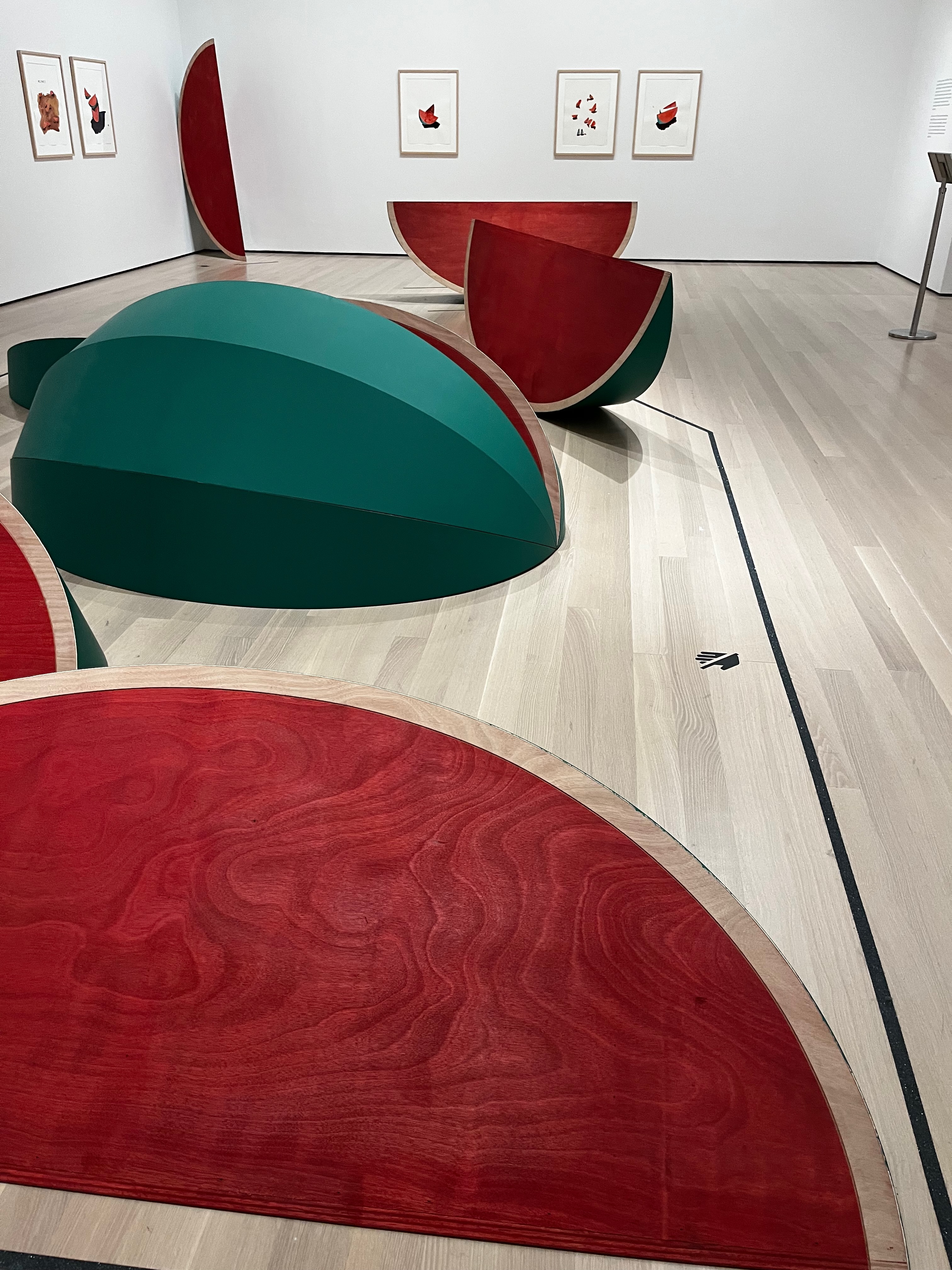
The museum devoted a whole floor to an exhibit of Schutte’s work. It was incredibly varied – paintings of all sorts, sculptures of all sorts. On one card next to a display of drawings, it described a project he had undertaken that I found interesting. “Over the span of one year, Schutte drew his reflection from a round shaving mirror, recording his moods and temperaments in diaristic sketches. ‘It’s the attempt to fathom oneself,’ Schutte remarked, ‘and it failed miserably.’” I was amused and heartened by his willingness to share this. We usually only see an artist’s best work and we aren’t necessarily even aware of their failures. I can’t say I loved all that I saw of the Schutte exhibit, but it got me thinking and I appreciate that.

I also find now that I have more appreciation of canvases that are saturated with color, like these:

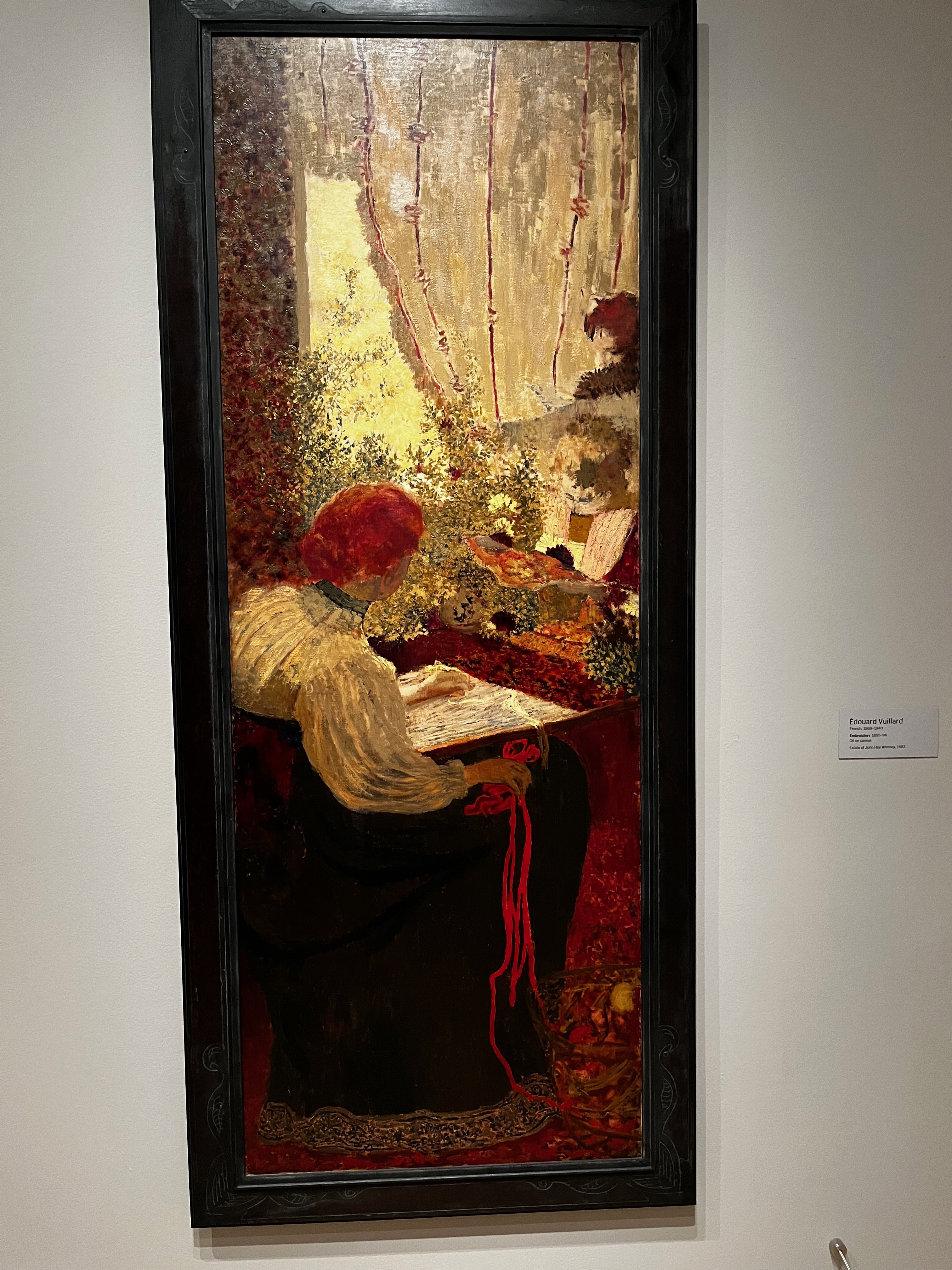
They made me think about my mother. I remember Mom telling me that she had never appreciated Rothko until someone told her to sit down, take a few minutes, and let the color envelop her – and then she got it. She got what he was communicating. As the card next to the painting explained:

“For Rothko, art was a profound form of communication, one capable of conveying the ‘scale of human feelings, the human drama,’ as he described. Through works like these, he hoped to create the conditions for silence and contemplation.” I’m not sure I “got it,” the way my mother did, but I saw and felt more than I have in previous viewings.

It was funny to me, as I walked through the galleries, different pieces reminded me of different people. Besides my mom, who is always accompanying me when I go to an art museum, in my mind at least, I worked with a woman, Courtney, who had an appreciation for color. She told me about Pantone – the folks who catalogue colors and tell us the color of the year (for 2025, they just announced, it is mocha mousse, by the way). When I looked at the Matisse exhibit, which highlighted his paper cutouts, you could not help but be struck by his color choices. The display of Matisse’s array of colors, made me smile and think of Courtney.

No visit to a museum is complete without stopping in the gift shop. MoMA and the Metropolitan have stellar gift shops. I have to restrain myself. I picked up a few Hanukkah presents, but didn’t overdo it.

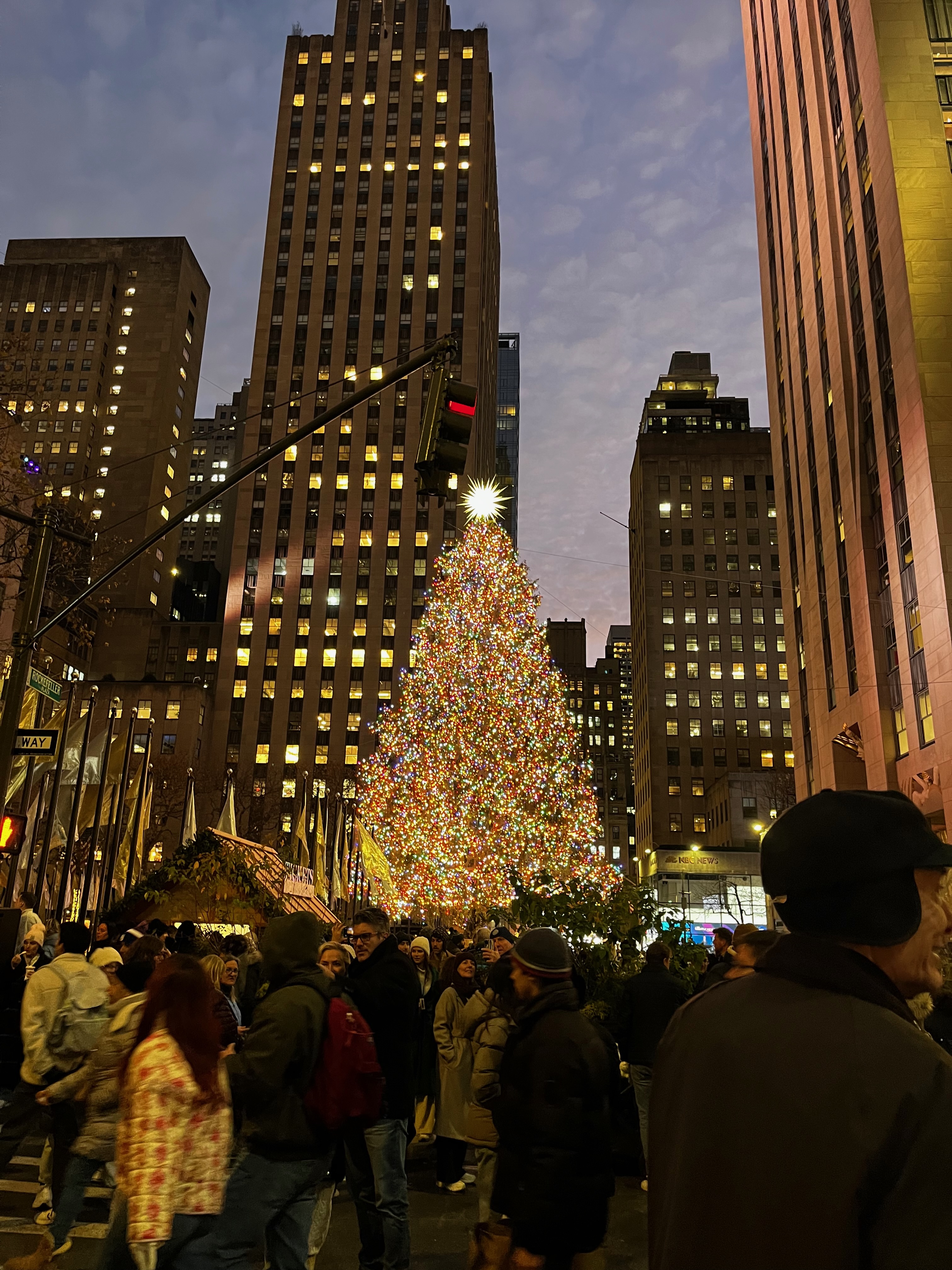
Here some other shots from my visit. I ended my day by walking, amidst a million of my closest friends, to Rockefeller Center to see the tree. I may not celebrate Christmas, but I can appreciate the twinkling lights that brighten our winter.

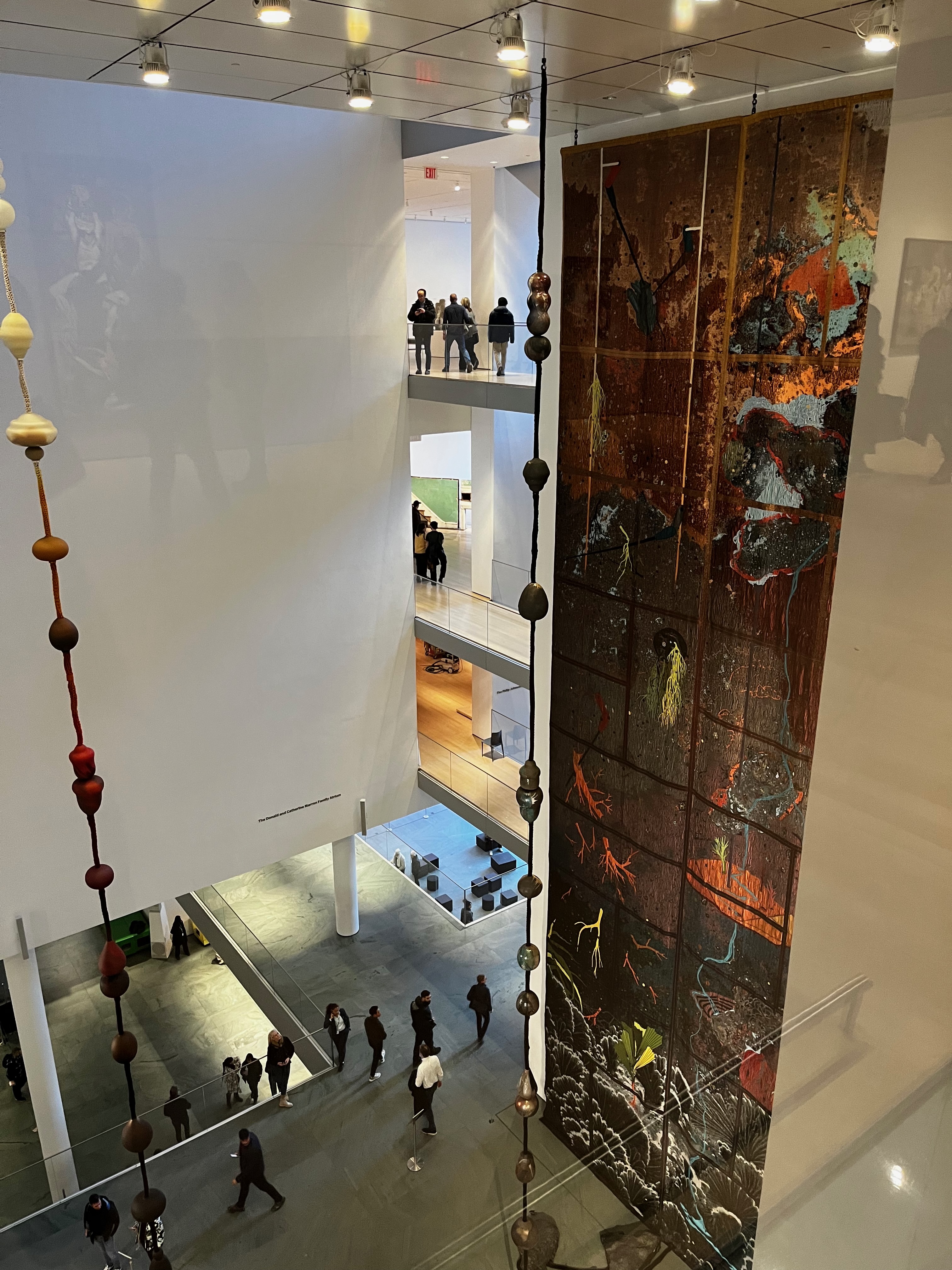
Views from inside the museum:
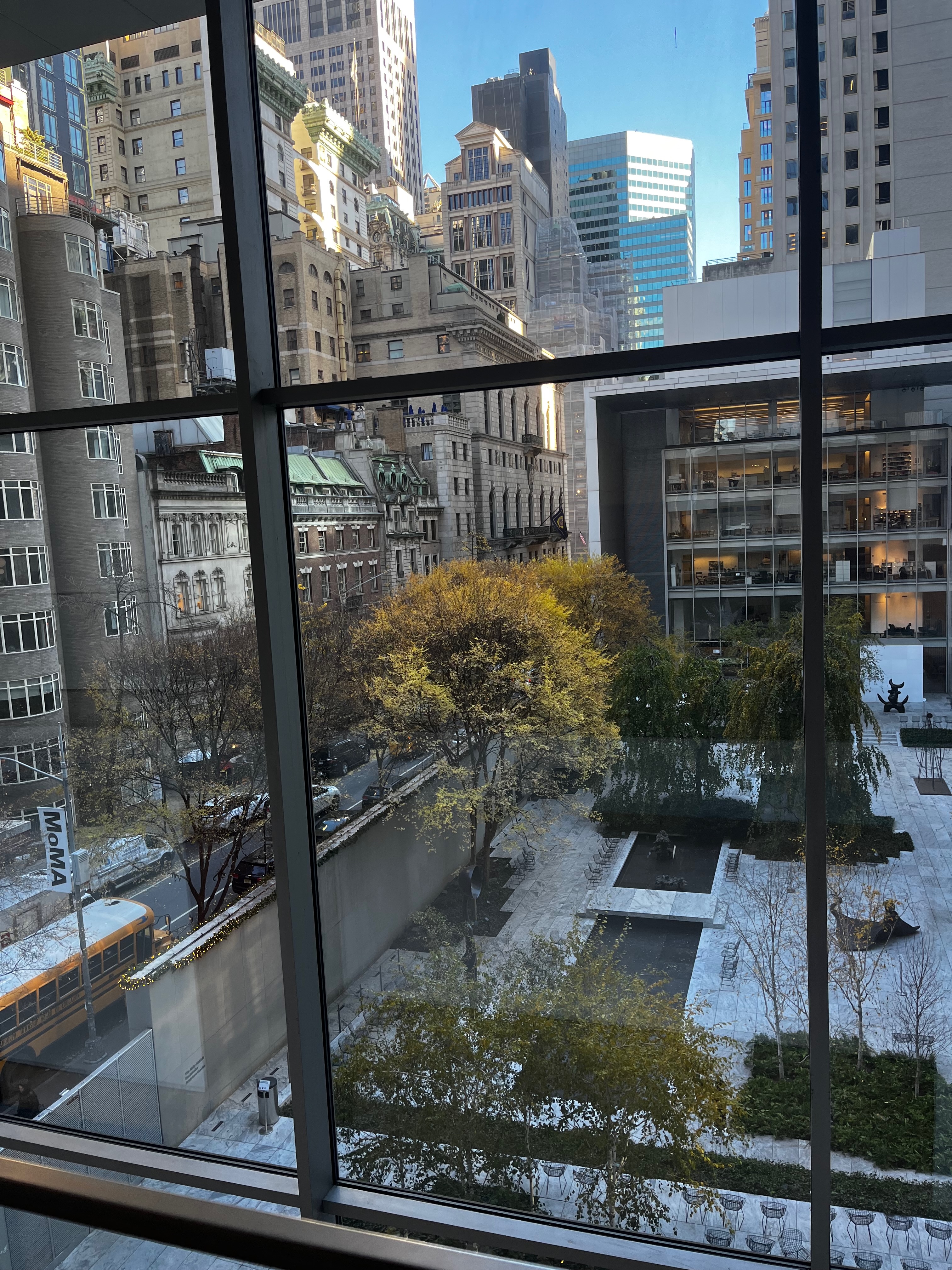
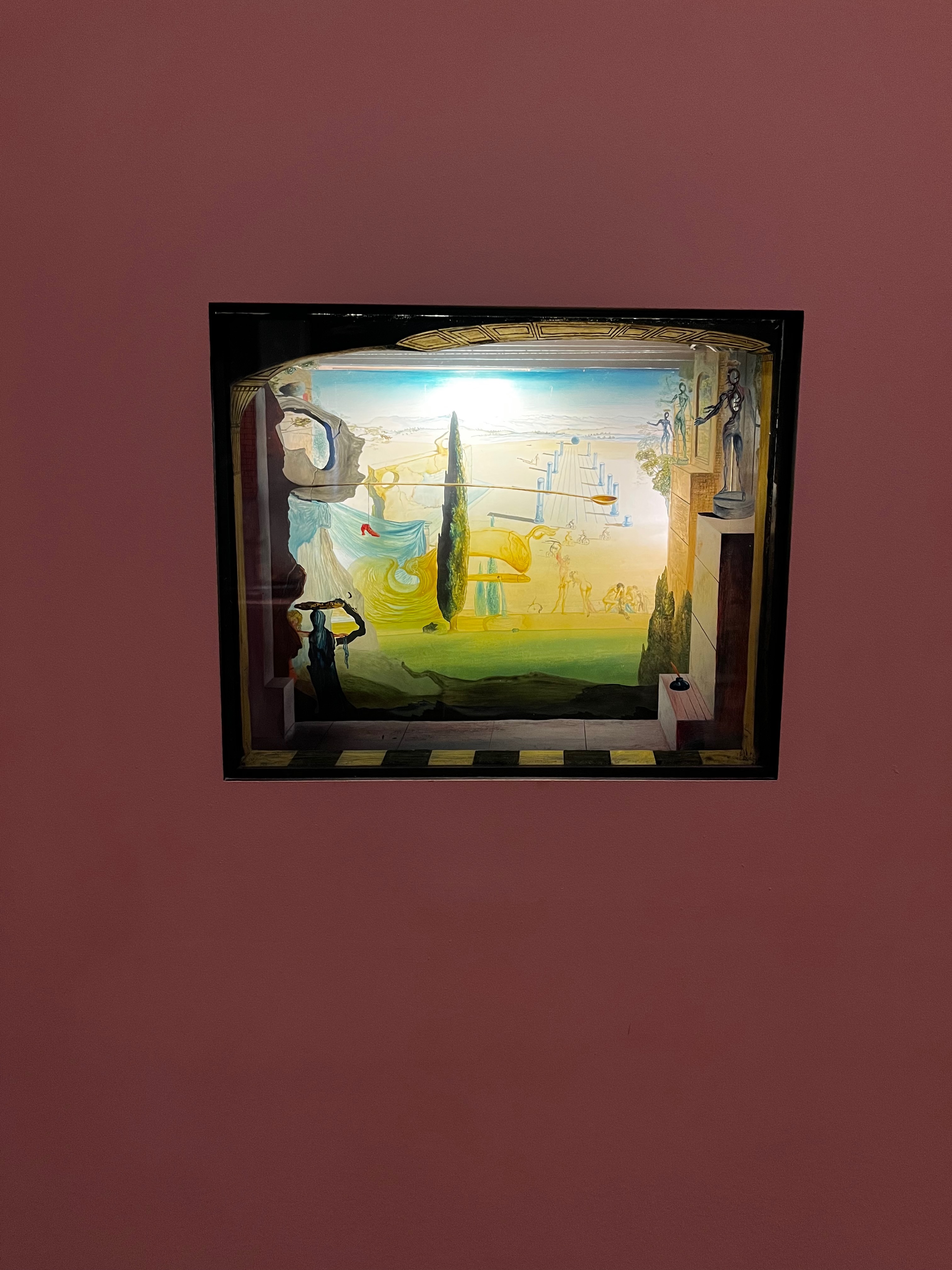
Some classics:

Does anyone convey loneliness or isolation more effectively than Edward Hopper?:

Two more interesting sculptures (at least to me), one on the right by Schutte (which had to do with the influx of immigrants in Germany in the 1990s):
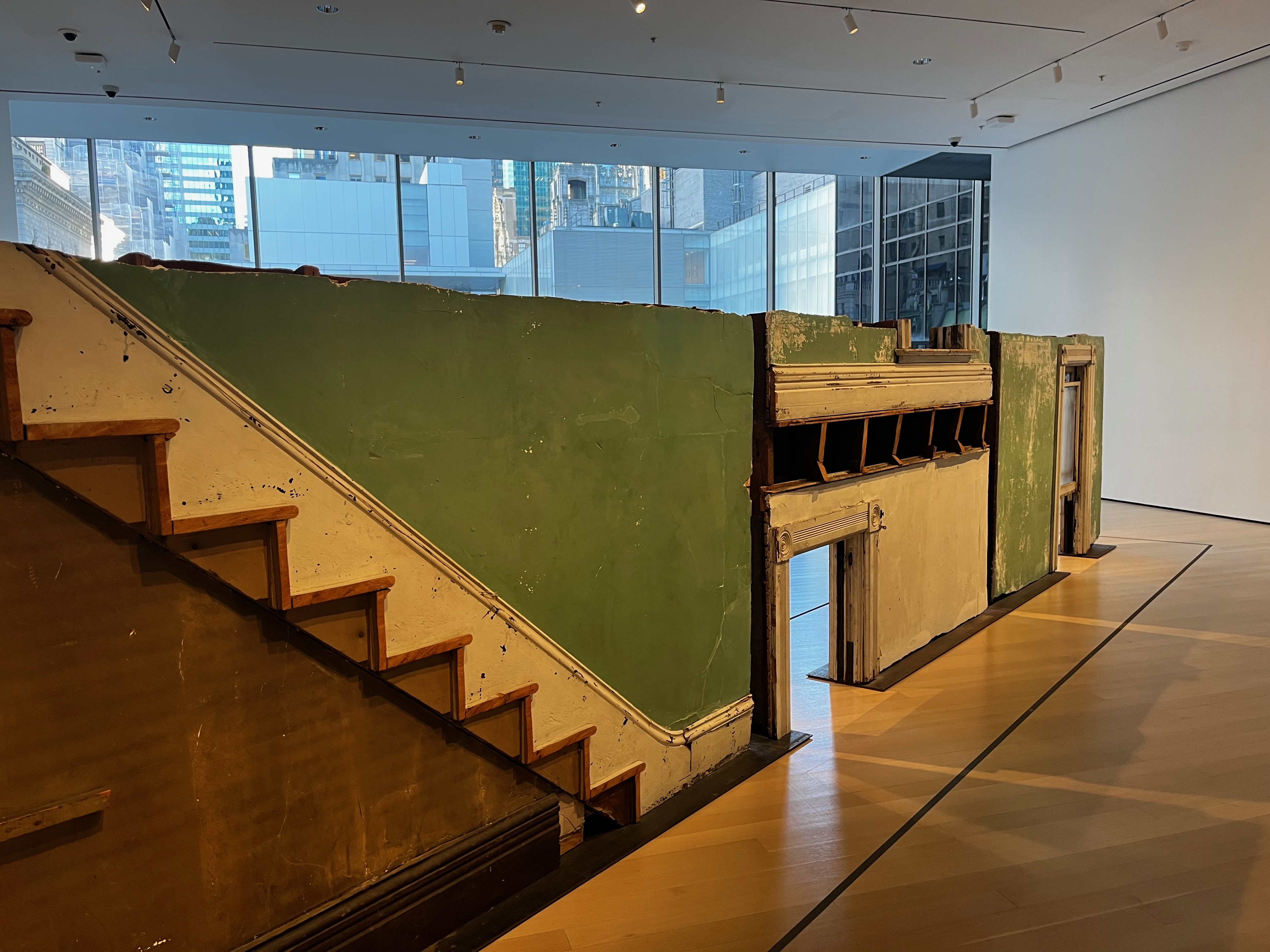
To top things off – the tree!
A Tourist in My Hometown

Last week was difficult. My mom’s health has continued to deteriorate, and it has presented challenges to get her needs met. Suffice it to say that elder care in this country is imperfect – and that is a generous assessment. We are a family with resources but even with that, it can be hard (perhaps impossible) to find services that match her needs. I feel for folks who don’t have the financial wherewithal or time or knowledge to navigate this terrain. And that doesn’t even touch on the emotional toll all of this takes and the baggage we may be bringing to our decision-making. So, Saturday night, when I could finally breathe, I realized that I had Sunday to myself before diving back in to Mom’s care. And it was supposed to be a sunny day! Not warm exactly, but warm enough. I decided I could be a tourist in my hometown – New York City.

When I was old enough to go from Brooklyn to Manhattan by myself or with a friend, I loved exploring. They used to have city buses that ran ‘culture loops.’ It was an inexpensive way to see the sights. I went to museums, I visited landmarks, I window shopped. I especially enjoyed observation decks – I went to the top of the Empire State Building and the World Trade Center multiple times – they weren’t that expensive back in the day. I loved walking the avenues and side streets, finding interesting buildings and people-watching.

I thought about how I might spend my Sunday. I had read about a new observation deck, The Summit. It is next to Grand Central at One Vanderbilt and stretches upward for 93 floors. The observation area is comprised of three floors and includes an art installation or two. Decision made. I would check this out. I bought a ticket online. It was not cheap.

Before starting my day of touring, I accompanied Gary to the Amtrak Station. Though I had taken the train from Albany several times since the new Moynihan Hall opened, I had not seen it. Somehow when I exited the train in Penn Station and made my way to the subway, I missed the new part. So, this first stop revealed a new sight – a vast improvement from the old, dingy station I was accustomed to. I said goodbye to Gary, he was heading home to go to work on Monday. I would have enjoyed having him join me on my adventure, but there are advantages to not having to worry about anyone else’s preferences.

I exited the station and started walking east and north. I was reminded again that New York City is beautiful. Yes, it can be dirty and gritty, but the parts I traversed were not. The architecture can be so interesting. You also find hidden gems, like this in front of the Polish Consulate on Madison and East 37th Street.

I am also often struck by how the sunlight makes its way through the caverns created by the buildings and casts shadows. The sun was brilliant, and the air was crisp and clear.

My ticket was for 12:00. When I arrived at One Vanderbilt there was quite a long line for the noon entry. I should have anticipated that it would be crowded – it was the weekend and it is New York! Somehow, I had forgotten about that. They had it well organized, with sufficient staff shepherding us through the process – the line snaked around kind of like it does at Disney World. We had to go through security, too. They issued booties – a good portion of the floors up top are mirrored and they don’t want them to get scuffed. You aren’t allowed to wear stilettos – not a worry for me since I’ve never worn a pair in my life! They also provided sunglasses, they warned that it was quite bright up there, but I had my own. It took a while to get through the whole process and I wondered if it was going to be worth it.

The final hallway before the elevator is darkened and there’s dramatic music playing. I guess they are trying to play up the excitement. I could imagine it being a bit scary for young ones. They also warn you if you are sensitive to flashing lights or loud noises that you should tell the staff.

Finally, I got on the elevator and we flew up to the 91st floor.

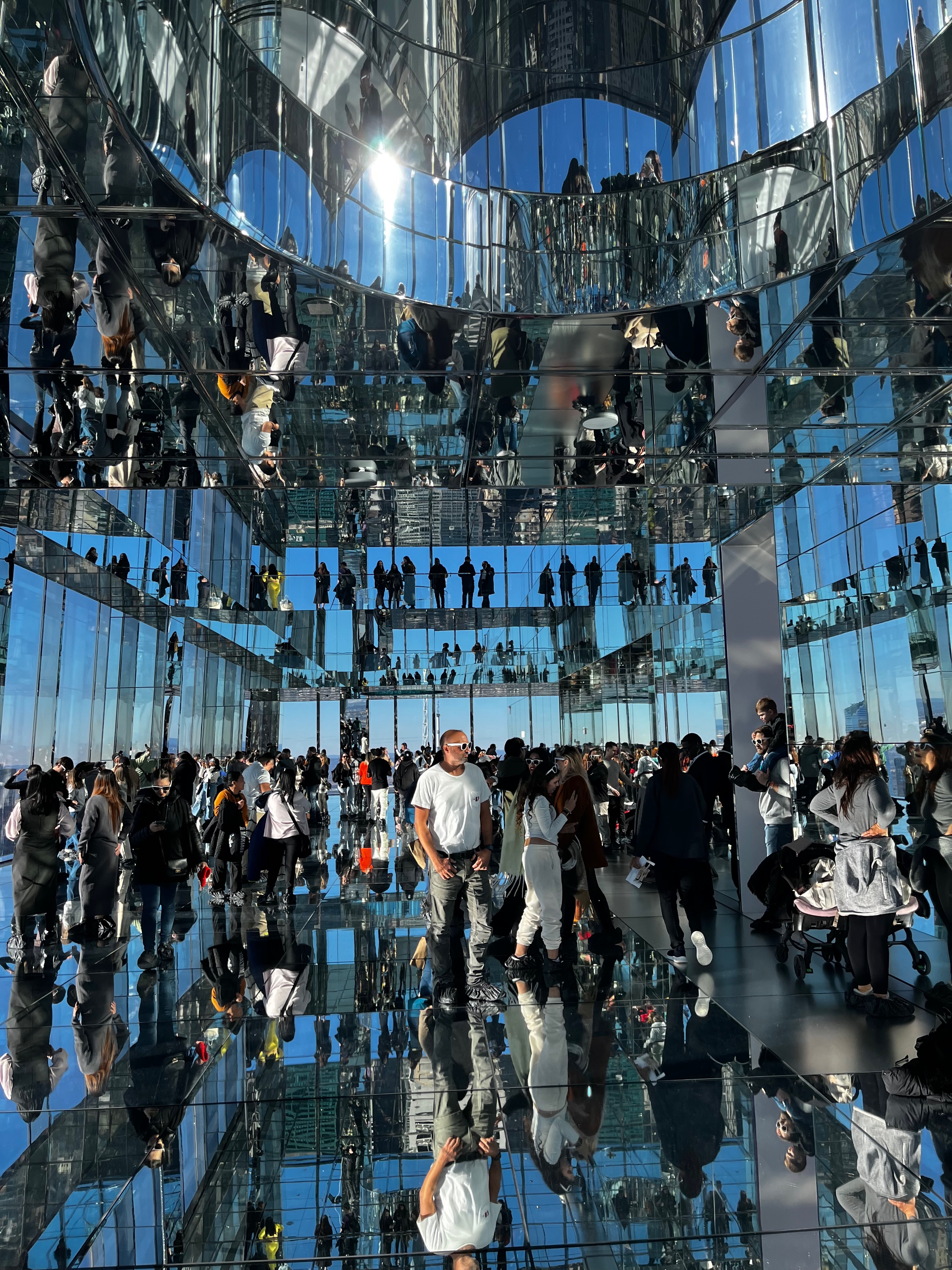
It was worth the wait. The views are stunning. The mirrored walls and floors create a wild, pixelated scene.

Though it was likely designed for the Tik Tok generation, I loved it. There were young folks making the most of it, creating what I am sure were super cool selfies or portraits of partners or friends, but I was surprised to find that it didn’t annoy me. It was interesting. I was mostly focused on taking in the vistas and people were considerate. They took their pictures but kept moving so you could get to the windows. Since the air was so clear you could see across Brooklyn, Queens, New Jersey, Westchester. You get a full appreciation for New York Harbor and the waterways that flow from it. All I can say is wow!

The art installations were cool, too. One room had mirrored balloons floating around. This was designed by Marie Kusawa and I enjoy her work – so whimsical and fun.

Naturally there were opportunities to spend more money – but you don’t have to buy anything in the gift shop or the café (there is also an open air terrace where you could bring the drink purchased at the cafe). You don’t have to buy the photos they take. But, there is no denying that it can get expensive. The base price, just to take the elevator and walk through the three floors of observation areas and installations is $42 for an adult. It was worth it to me.

There is a glass ledge you can step out on – they take a picture of you there. I bought this one. I tried to take my own photo, didn’t come out nearly as good.

It was a great day. Accomplished just what I needed it to. Now I will get back to the real world.

Side-by-Side on the LL

NOTE: I submitted this piece to the Brooklyn Nonfiction Prize and it was selected as a finalist. Yesterday was the reading and though I did not win, I am proud to have participated. It always feels a bit risky to put yourself out there, but if you don’t you can’t grow. My family has been very supportive and encouraging and I thank them for that!

  Rockaway Parkway was my subway station, where I got on the LL (today the L)  to go to The City. In Brooklyn we referred to Manhattan as The City. End to end the LL traveled from Canarsie as a mostly elevated line through Brooklyn and ended up at 8th Avenue and 14th Street, the upper reaches of Greenwich Village. I rode that line countless times growing up in the late 1960s and 70s.

            After the train left Canarsie it headed into East New York, followed by Brownsville, went underground in Bushwick, continued on to Greenpoint and Williamsburg. It traveled under the East River and emerged in Manhattan. In the 1970s it amounted to a grand tour of the most dangerous neighborhoods in Brooklyn.

            The LL sat at the open-air Rockaway Parkway station waiting for passengers, the trains arriving and leaving the station according to some mysterious, unpredictable schedule. The cars were covered inside and out with graffiti. It looked and felt like chaos.

            Aside from the physical appearance, the trains were unreliable. Countless times it would lurch into a station along the route, followed by a garbled announcement that it was going out of service. I heard the collective groan of my fellow travelers. Everyone would exit and crowd onto the platform to wait for the next one. Standing in the bitter cold or sweltering heat -it never seemed to be a moderate temperature – I tried to place myself strategically so that the doors would open in front of me. This was not a time to be timid. When the doors opened, I readied my elbows, and walked with purpose to claim my spot. This is how a New Yorker is made.

            I rode that subway line acutely aware of the danger. In the ‘70s, when it was on the brink of bankruptcy, New York City was the murder capital of the world. Muggings were common. On the subways, chain snatching, where a person would grab hold of a necklace and yank it off, fleeing as the doors slid shut, became a fad. We put our jewelry in our purses and held them close to our chests; when we arrived at our destination, we put our rings and necklaces back on.

            Since the LL traveled above ground, I could see pigeons perched on the fire escapes of the tired tenements that abutted the tracks. I watched the subway doors open and looked at the people who got on the train from those stations, almost all were brown and black, joining the white folks who had boarded in Canarsie. My neighborhood was 80% white, in fact the block where I lived was 100% white. I wondered about the lives of those who got on the train at New Lots Avenue, how was it for them to live in a neighborhood with such a bad reputation. Here we were, side-by-side, but living in different worlds. 

            I was 12 years old the first time my friend Deborah and I took the LL, just the two of us, into Greenwich Village. We emerged from the station to see a protest – people carrying signs, chanting, marching in a circle. We didn’t know what they were protesting but we thought it was the coolest thing in the world. It scared us at the same time. We looked around and quickly headed away from the hubbub, looking for bookstores, of which there were many.

            When I was 16, I got on the LL by myself to go to downtown Brooklyn to apply for my learner’s permit. There was only one Department of Motor Vehicles (DMV) office to service all of Brooklyn and the DMV was spectacularly inefficient so you had to plan to spend hours there. After I got on the train, I realized I had forgotten my birth certificate. I was too afraid to get off at any of the stops until Broadway Junction.  I wouldn’t turn around at 105th St., New Lots, Livonia, Sutter or Atlantic Avenues – five extra stops. Each time the doors opened, I looked at the platform and thought, “Should I risk it?” Each time I decided I wouldn’t. Even though it added so much time to my trip, I wouldn’t take the chance.

            In my travels from Canarsie, I frequently changed trains at Broadway Junction where the A and C lines met the LL. I descended the stairs from the elevated platform, took a deep breath and held it as I walked as quickly as possible through the underground passageway, which was damp and reeked of urine. I gulped the fresh(er) air when I got to the other side.

            One late afternoon I was riding the LL when there was an announcement over the PA. Those announcements were usually so static-y as to be indecipherable, but this one came through quite clearly. “Move away from the windows! There are reports of gunfire. Move away from the windows!” There weren’t very many of us on the train at the time. Most of the people looked incredulous, a few moved tothe windows to see. Some ignored the message entirely. I shifted down on the bench so the wall of the subway car was behind my head. Fortunately, nothing happened.

            Riding the L today reveals almost a whole new Brooklyn. Several neighborhoods have gentrified, especially Williamsburg and Greenpoint. Parts of Bushwick have become desirable real estate, as well. Brownsville and East New York are still impoverished. Compared to the 1970s, the crime rate has fallen all over Brooklyn, but the problems in those communities persist.  The neighborhood of my youth, Canarsie, has also changed. Though it is still middle and working class, the racial composition has flipped. Today it is 90% black.

            The more things change, though, the more they remain the same. People living side-by-side, riding the L, the haves and the have-nots, perhaps still leading segregated lives.