There is a route I take frequently when I run errands. I drive through a neighborhood in Albany when I go to the bank (more likely the ATM), to our favorite bagel shop or to walk at SUNY. Probably 18 months ago I noticed a house had a for sale sign. The brick house sits on a corner lot; it is possible that it is a multi-family dwelling. Anyway, I wondered how quickly it would sell. The reason I wondered, given that the market was pretty hot, maybe not as hot as some areas of the country, but healthy nonetheless, is because of the house next door. That house has a barrage of signs – including the unforgivable ‘Fuck Biden.’ I’m all for free speech, but that is over the line. The house has lots of other signs – back in the day he (and I believe it is a he because I see him mowing his lawn) had a ‘Lock her up’ sign, among others. Based on the signs he displays, he is deep into conspiracy theories about the deep state.
A photo from a New Jersey newspaper – not the house I drive past obviously, and his are a bit more discreet, but the sentiment is the same
I have driven past the ‘for sale house’ for many, many months and now its lawn is overgrown, and it has one of those orange notices affixed to its front door – I imagine that it is in foreclosure. Do you think it has anything to do with the ‘Trumpy’ neighbor? I would not want to live next door to someone who was willing to put a sign out with an expletive directed at anyone, much less our president (even if I hated him/her – in my most outraged state with Trump it would never occur to me to display such a sign). Or maybe something is actually wrong with the structure? I don’t know, but I have mixed feelings about it. Part of me feels a certain satisfaction that the house is going to seed because the Trumper takes meticulous care of his property and can’t enjoy looking at the mess next door. I don’t wish ill to whoever owned the house that isn’t selling, and it isn’t good for the neighborhood to have an abandoned property, so there is that.
That same route that I drive brings me past a house that this month is festooned with pride symbols – just around the block from the Trumper. I wonder if they know each other. I should note that there are no curse words included in their array, just rainbows and hearts. Further down that same block is a house with flags that I associate with extreme Republicans – Don’t Tread on Me, the American flag and some others that I don’t recognize (not the confederate flag, I’m pleased to report). Is it one big happy neighborhood? Somehow I doubt it.
It is interesting to me that folks choose to advertise their politics in this way – it is not election season. I have put signs on my lawn in support of candidates. In fact, my Kerry for President sign got stolen. But, I don’t choose to put symbols out that represent my politics. I admit I appreciate passing homes that fly a rainbow flag – and I like the signs that say, in one way or another, hate has no place here. I’m not sure if I think those gestures are helpful. I defend anyone’s right to put whatever they want on their lawn, though I would like to think people would exercise good judgment. ‘Fuck Biden’ isn’t good judgment. Isn’t there some ordinance against that? I would not want a six year old, who is learning to read, to see that.
It leads me to ask: will we further segregate ourselves by our politics? Cities have historically been blue, though New York City, that bastion of liberalism, has elected any number of Republican mayors. Rural areas have historically been red, though I’m sure there have been exceptions. Can that still happen? As the parties move further apart, will those anomalies continue?
I wonder what impact the divisiveness in our politics has on the real estate market, especially in suburban areas. It can’t be good for our communities. Will our neighborhoods become echo chambers like our social media? Will we instruct our realtors to find properties with like-minded neighbors?
I wish this era of hateful rhetoric was behind us.
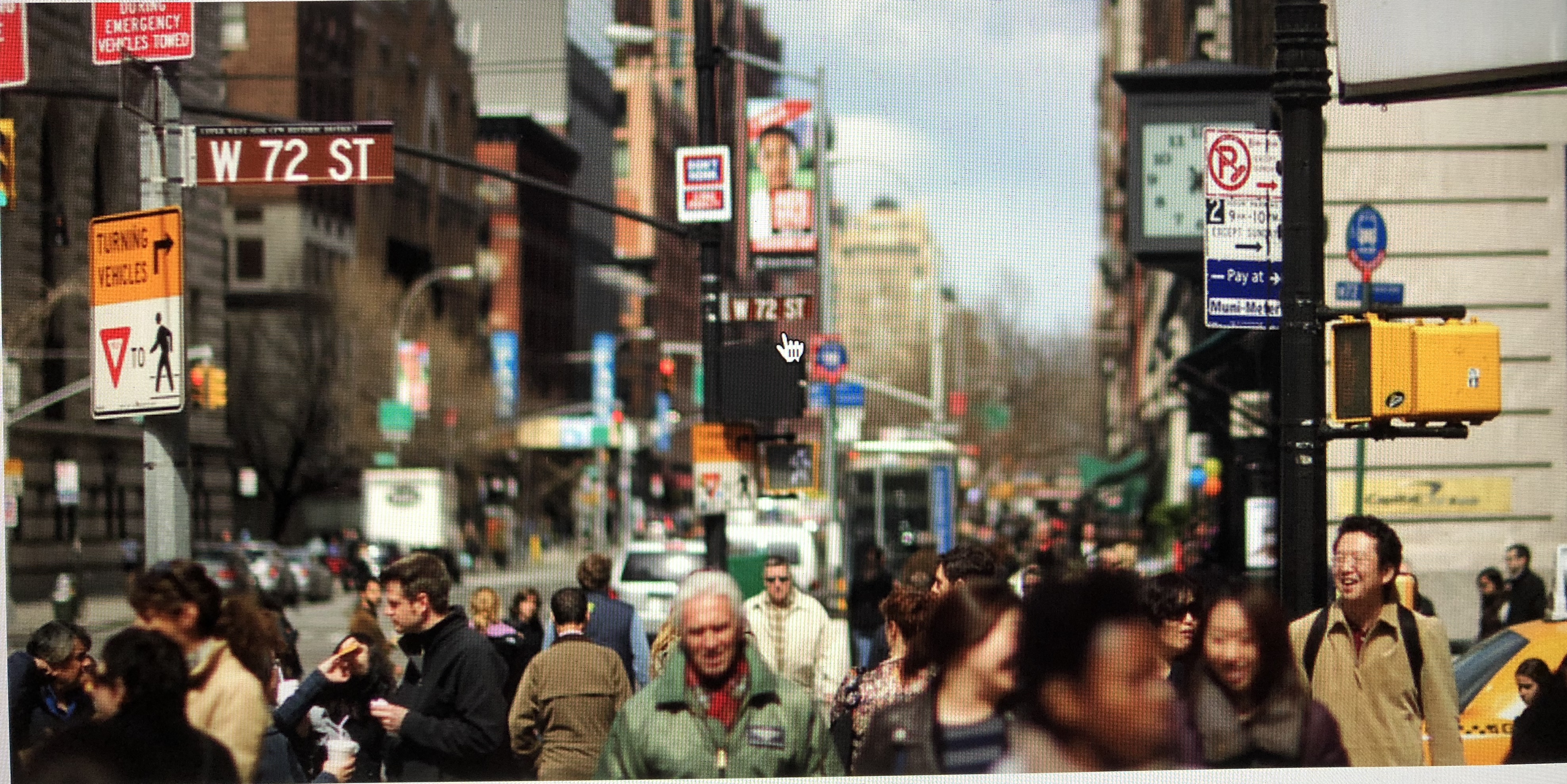
When I was in graduate school I lived on 80thand Columbus Avenue in Manhattan. It was 1980. It was my first exposure to gentrification. I hadn’t heard the term before, but it was taking place before my eyes as the block transformed brownstone by brownstone. Drug addicts, homeless and working class people were displaced by wealthier folks. Mom and Pop stores were shuttered and boutiques and trendy restaurants moved in. I wondered where the displaced people went, but I can’t say I was sad about the changes. Slowly but surely the neighborhood felt safer, I could walk comfortably on more blocks. Though the ice cream from the new Haagen Dazs shop may have been expensive, it sure was delicious.
The Upper West Side today. Photo credit: Chang W. Lee/The New York Time
Some lamented the changes, either because of the injustice to those of lesser means or because of the loss of authenticity (everything new, shiny and expensive was phony) or both. I certainly understood the former. The gap between the haves and the havenots was growing steadily, it was and is unfair. But, longing for the days when New York City was gritty and dirty, was bizarre to me. I didn’t enjoy being afraid. I was unsettled by the strung-out junkies hanging out on the stoops of those brownstones. That era, the 70s and 80s, when the city nearly went bankrupt, and the lack of support showed in crumbling buildings and overflowing garbage, is not romantic to me. (The website Gothamist ran a series of side-by-side photos of Central Park, showing the condition of the park back in the day. Take a look.)
More recently I had reason to think about the changes in the last decades in New York City when Leah and I did the Five Boro Bike Tour (which I wrote about here). We cycled through Greenpoint and Williamsburg in Brooklyn. Those two neighborhoods were off limits in the 70s and 80s, I wouldn’t have considered visiting either area, much less ride a bicycle through them. We rode past art galleries and craft beer breweries. Much like the gentrification of the Upper West Side, these areas in Brooklyn were now home to a wealthier professional class.
I thought about how change happens in neighborhoods and how complicated it all is, and whether the changes were, on balance, positive. I did a bit of research, including reading a book, The World in Brooklyn: Gentrification, Immigration and Ethnic Politics in a Global City (2012), edited by Judith DeSena and Timothy Shortell. The book is comprised of 16 scholarly essays, including one entitled, Revising Canarsie. (Note: I believe that the title was meant to be Revisiting Canarsie, not revising, because the premise of the piece was to take a look at the neighborhood and compare it to an earlier examination by Jonathan Rieder, entitled Canarsie: Jews and Italians of Brooklyn Against Liberalism(1985), a book I also read and found very insightful.)
The book, The World in Brooklyn, in general, makes the case that gentrification is a bad thing for the poor, immigrant communities. It paints a picture of an invading force that disempowers the current residents. While I believe there is truth in that picture, I think it oversimplifies things. The books presents the ‘gentry’ as one, monolithic thing – as if it is a homogenous group of rich, white people. The book doesn’t take into account that when demographics are changing, it is a two-way street. There can be hostility and an unwillingness to work with newcomers that make true integration across economic classes (not just racial differences) impossible to achieve.
I may be particularly sensitive to this issue of integrating across economic classes because of an experience I had when we moved into our suburban neighborhood, which was a new development (new, developing neighborhood). As may be the case in many suburban neighborhoods, there was a range of economic circumstances. There were those who were barely able to make ends meet to live there, and there were those for whom it was very comfortable, and, of course, families in between. Though Gary and I were in the more comfortable range, we thought of ourselves as more modest people since we had grown up in middle class families. Leah, our daughter became friends with a girl down the block and they often played at the friend’s house. We became friendly with the parents and made numerous overtures to invite them over. We were politely rebuffed. Over time, and as a result of a number of comments that were made, I came to believe that the mom made certain assumptions about us. Since Gary was (and is) a doctor, we were Jewish, we were from downstate originally, the mom, in particular, was not comfortable socializing with us. Maybe I was wrong, perhaps she just didn’t like us, but I think there was something else at work. As Gary and I became more comfortable economically, I became more aware of how that can create awkwardness, even when trying to be sensitive. It is something that is difficult to talk about. We never did get beyond neighborly friendliness and eventually they moved. The experience, and others like it, made me more aware of economic factors that can create social barriers.
My experience growing up in Canarsie offers another perspective on neighborhood relationships in the midst of change. Canarsie’s story of change is not one of gentrification, it would appear to be just the opposite. I have written before about my experience in 1972 with the boycott of schools because of the plan to bus black students from East New York into predominantly white Canarsie schools (here). There was some white flight in response, but the neighborhood remained fairly stable for a number of years (my parents left in 1989 when they retired from teaching). In 1990 Canarsie was less than 20% black; in 2000 it was 60% black (and I use ‘black’ because many of the new residents were immigrants from the Caribbean who may or may not have identified as African-American). By 2010 the neighborhood was over 80% black. Though the racial composition changed, the fact was that the economic status remained stable. The new residents weren’t poor and they weren’t uneducated.
Typical block in Canarsie – Photo Credit: Anthony Lanzilote
The Caribbean immigrants who made Canarsie their home were looking for the same things that Jews and Italians were looking for years before. According to a New York Times article:
‘A house to the Caribbean man is something very important,” Samuel E. Palmer was saying. ”He has to have a house, as opposed to an apartment. Whatever happens, the house comes first, so you can have a family and your friends can meet there. So, when I came here, the desire also was to achieve this house, this houseness.”
Canarsie had what many Caribbean immigrants wanted: single-family homes with backyards for barbecuing and growing roses or tomatoes, decent schools, affordable prices, quiet streets, proximity to family. They were loyal to Brooklyn; they had no interest in Queens or Long Island. As Mr. Palmer put it, if you move, you have to build all over again: friends, neighbors, all that.
Canarsie is teeming with new and newly revitalized civic associations these days, many of them headed by newcomers like Mr. Brazela and Mr. Duncan, lobbying and agitating for improved street lighting, road repairs, better drainage.”
THE CENSUS — A Region of Enclaves: Canarsie, Brooklyn; ‘For Sale’ Signs Greet Newcomers – NYT, June 18, 2001
The essay on Canarsie in the book that I cited above, supported this anecdotal account with research-based findings. It is sad that it wasn’t possible for the community to truly integrate. The exodus of white families accelerated in 1991 when there were three bias incidents (against black families/businesses), including the fire-bombing of a real estate agency that was court ordered to show homes in Canarsie to blacks and Hispanic buyers. The neighborhood became homogenous again – now it is over 90% black.
In reading and thinking about the issues raised by changing neighborhoods, I think there are some commonalities. Problems seem to start with assumptions made based on stereotypes or ignorance or both. And, there aren’t mechanisms to get beyond those assumptions. We have no language to talk to each other about these issues. One of the essays in the World in Brooklyn analogizes different segments of a community living together to ‘parallel playing,’ like toddlers who might play with a set of blocks at the same time, building their own structures, but not interacting. This seems like an apt description. There is some learning about each other as groups coexist, but not true integration. Of course, there are exceptions, some individuals have successfully broken down barriers, but it doesn’t seem to translate to whole communities. The question is, how do we integrate across race, economic status, religion? What have we learned from our past experiences that can help us? How can we do better?