Moments of Joy

I love yoga. I know it isn’t for everyone and that’s fine. I’m not proselytizing for it. To each their own. But for me, it is helpful. I don’t always have the experience I had this last session where I had a moment of joy, but even when I don’t it is well worth the time.

I started going regularly, two or three times a week, last November, so it has been a solid seven months. I have done yoga before, but never this consistently and for this length of time. I think the last time I did it, I had some issues with my wrist, and I stopped and never went back. Now I am more aware of how to work around the various aches and pains and am willing to accept my limitations. It feels more important for my mental and physical health to stay committed to going.

So where do the moments of joy come from? Usually it is during the last part of the class, when we take a comfortable pose and just let everything go. It is called shavasana. You’ve done the harder work of the different stretches and positions and now we rest. The leader will often give a prompt – a thought, an idea – that you can ponder (you certainly don’t have to!), but then we sit or lay in silence for a few minutes with only some soft music playing.

This last time the instructor had started the class by noting that soon we would be starting a new season, and it was a good time to consider letting go of something that no longer serves us. She pointed out that it could be as simple as a sweater that has been sitting in our closet unused for too long, or something major like a relationship. Sometimes when the instructors talk about new months or new moons, it doesn’t resonate with me. It doesn’t bother me – it can get a little woo-woo – but at this school of yoga it doesn’t go too far in that direction. I can appreciate a little spirituality, but if they go too far into the chakras and energy and planets and all of that they lose me. Anyway, in this case, her message did resonate. I do have stuff to rid myself of – and actually it does involve clothing. I have drawers stuffed with things I don’t wear and no longer need. It is a good time to purge, and I know it will feel good to do it – it feels cleansing, like I’ve lightened my burden. Things that don’t get used are clutter and when you see them every day it can feel suffocating. So, in that moment I pictured sorting through my drawer of workout clothing and t-shirts, putting the stuff in bags and either throwing them out if they are too worn or donating them. I felt better already.

But that wasn’t my moment of joy. Once I had decided on that, and I felt lighter, I thought of all that I am grateful for: that my body works well enough that I can get down on the yoga mat (and get back up!) and do many of the poses, and that feeling of gratitude led me to  thoughts of my family. Part of the reason I am motivated to be here in yoga class is to be in as good health as I can muster, being with my children and grandchildren for as long as possible. As I thought of my kids an image came to me from my granddaughter’s birthday party from last week. My son and his daughter were playing Bananagrams. Some of the older kids at the party joined in. They were just playing the game, laughing, having fun, looking healthy and happy. I was proud of my boy – he’s a good father and a good man. We were all together for a celebration. As I lay on my yoga mat with my eyes closed, I saw their faces and it brought me joy.

It isn’t that I couldn’t have that image come to me at another time. It can and it has. But, most of the time it is in the midst of other things, other tasks, other responsibilities. After doing about 50 minutes of yoga, when we wind down and relax into shavasana, my mind is clear and my body feels good – having stretched and exercised to the extent that I am able. There is more space to reflect and cherish the image. It is a gift I give myself to make the time to go to yoga. While I can’t say that when I leave, I carry that positive feeling with me for the whole day, it does help. I need moments of joy to get through the many challenges we all face.

Maybe yoga won’t do it for you, but I highly recommend finding ways to claim that moment of joy for yourself.

flowers bring me joy, too

Reset: Retreat and Renewal

After Mom died at the end of February, I felt like I needed a reset. The last couple of years have been difficult. Though I was not the primary caregiver for either my mother or Aunt Clair, I was very involved in their medical decision-making. I accompanied them to doctors’ appointments. I visited them and tried to provide comfort. It was a painful process watching them deteriorate and being powerless to change the inevitable. Not to mention the grief I felt and feel when they were gone.

I also faced my own abdominal surgery to remove what turned out to be a benign cyst – it was actually my left adrenal gland that had hemorrhaged. While I only had a long weekend of worry before I knew it wasn’t cancer, it was still surgery under general anesthesia. The recovery was uneventful, but not without its discomforts.

All of the stress involved in these circumstances left me drained. I was not taking good care of myself. I was on the road a lot, driving over three hours each way to see Mom, and making poor food choices, stopping at Dunkin’ Donuts or McDonald’s instead of finding healthier options. There is a long tradition in my family of seeking comfort in food and I succumbed to that impulse too many times.

I thought it would be helpful if I could go someplace and gather my thoughts, get into a better rhythm. I have never gone on a retreat before, but the idea appealed to me. I wasn’t looking for spa treatments, though a massage might be nice. I was imagining some yoga, healthy food, a walk in the woods. I heard of some places like Kripalu in the Berkshires, Omega Institute in Rhinebeck in the Hudson Valley, and Canyon Ranch in several locations.

I looked them up online and read what they offered. Kripalu seemed closest to what I was looking for. I talked to Gary about it and he was fully supportive. I signed myself up for three days of retreat and renewal. They offered structured programs of varying lengths, but I wasn’t so much interested in something that formal. I wanted more flexibility. Fortunately they offered that option too.

Kripalu offers different levels of accommodations which are priced accordingly. I chose a private, dorm-style room where the bathroom would be on the hall. The idea of sharing a bathroom didn’t bother me, but I wasn’t looking for a roommate.

As I anticipated my time away, I was a bit nervous. I had not done yoga in years. There was a time, about a decade ago, where I was doing it regularly but I was never a serious student of it. I was afraid I would be in over my head. Perhaps people who went to these things were committed yoga practitioners. I called Kripalu, before I put my money down, and asked: Is this appropriate for someone of my age and level of experience (or lack thereof)? I was reassured that they offered programming that met me where I was.

I was still nervous about it, but decided I would take the risk. What’s the worst that would happen? I would try a class and if I really couldn’t manage it, I didn’t have to go again. The classes were voluntary. I could spend my time reading, relaxing and taking in the Berkshires if it came to that.

It didn’t come to that. I had a great experience.

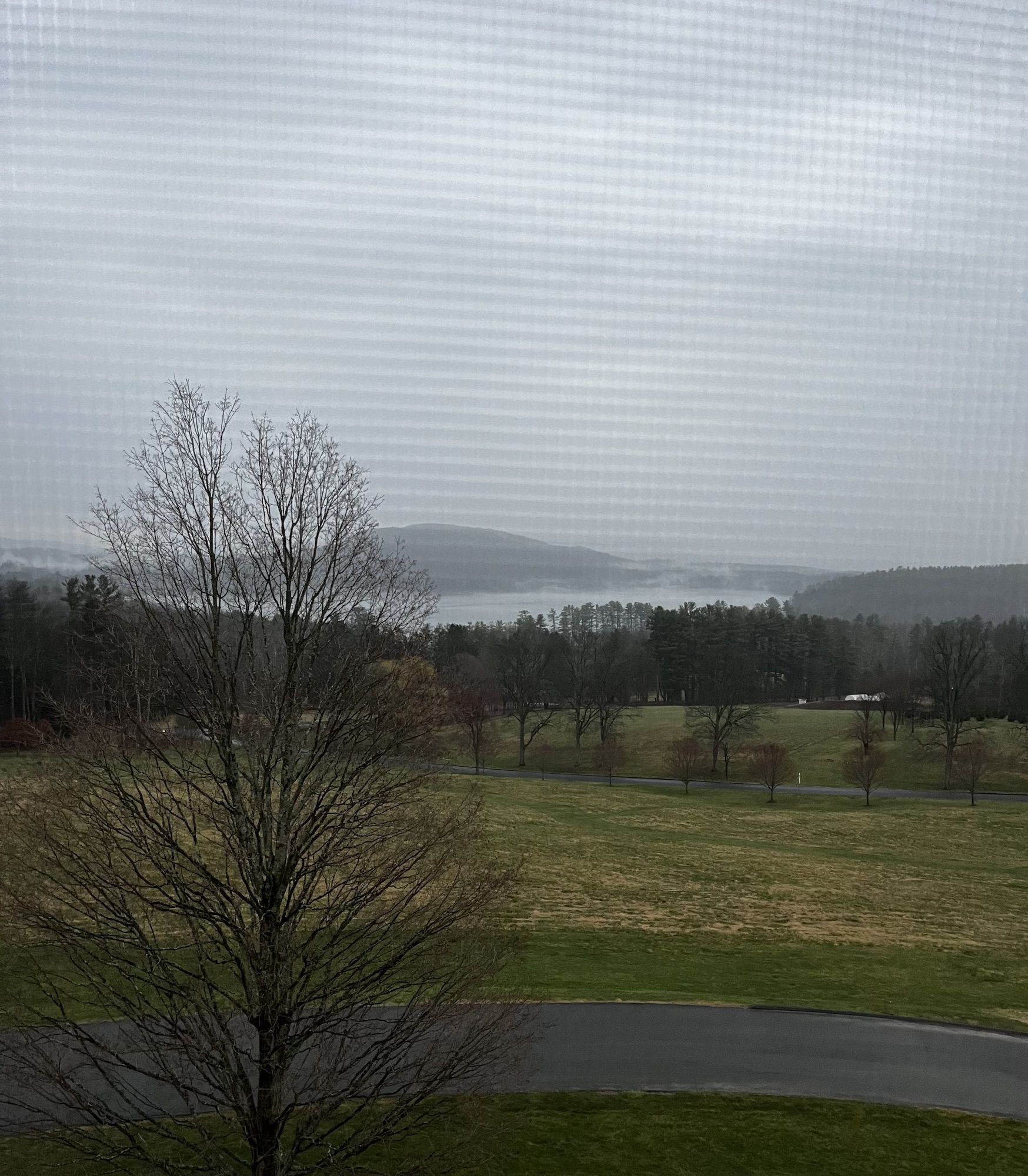
I checked in and got settled in my room. It was small, like a single dorm room. It did have a sink which I appreciated. It also had a lovely view of the lake, they call it the Stockbridge Bowl.

the view from my window – beautiful even in the rain/fog

This would be the first time since college that I would use a communal bathroom and shower. I wondered if it would bother me. It didn’t. They kept it spotless, and I think during my three days I might’ve crossed paths with another person only a couple of times.

I studied the schedule of classes/workshops and planned out my time. They told me that Gentle Yoga would be appropriate for me. They offered more vigorous classes, but I was quite challenged by the gentle version. The biggest difference from ten years ago was my balance, though my flexibility and strength weren’t what they used to be either. But I didn’t feel self-conscious about it. Everyone seemed to be focused on themselves and the teachers were encouraging. I did the best I could and felt reasonably good about it. I did a yoga class once each day. As I remembered from my previous experiences, I particularly enjoyed Savasana, the final ten minutes when you lay on your back (or choose a comfortable position) close your eyes and breathe while soft, soothing music plays…very calming.

I took two hikes. Each was guided by a staff person. I loved the approach they took. They began with a short meditation, and they suggested that during the walk out – in one case we hiked down to the side of the Stockbridge Bowl (walking through some woods and meadows in route) and the other we climbed up to a pond – that we walk in social silence. In other words, we traveled as a group, but without chatting. They wanted us to pay attention to our surroundings, listen, see and smell nature. They asked that we leave our phones in our pockets, not even to take pictures. I thought that was great – took the pressure off. When we arrived at the destination we sat quietly for a few minutes. In one case the guide read us a poem. After a time of taking it all in, the guide said if folks wanted to take photos or chat, they were welcome to; if you wanted to continue in silence, that was fine too. On each return trip I chatted with people.  It was a great balance. I did notice a difference in how much I took in when we walked quietly versus when I talked with someone, but I enjoyed both experiences in different ways. Here are some views from my hikes:

Another interesting aspect of Kripalu is that they ask that breakfast be eaten silently. There are signs up around the dining hall and other spaces where you can take your meal asking that you respect the silence. (In fact some folks come to Kripalu for a silent retreat – they spend their days in silence.) The sign on the table explained that they urged you to be present while you were eating your first meal of the day – to pay more attention to the tastes and how your body felt. Again, I found it to be a great practice. This only applied to breakfast, other meals were social. For all meals, though, they ask that you not use electronic devices – they preferred that you use a physical book, but people did use e-readers. The prohibition on electronic devices extended all over the campus. There were designated areas where they were permitted and of course you could use them in your room. I loved being free of my phone. Most of the time I left it in my room, unless I knew I wanted to use the camera.

I have more to share about the workshops I took, but I will save that for another essay. It has been over a month since I returned from my retreat. While I wish I felt as energized as I did in the days immediately after my return, I can’t say that is true. I do carry the lessons I learned, the peacefulness I experienced and the spirit of it within me. I am sure I will return to do it again.

‘Learn-how-to-meditate-January’

I think the whole country, the entire U.S. of A., should take up meditation. I had this epiphany the other day after I finished the 20th of a 30-day class – each session is only 10 minutes –  offered through an app called Calm. I realize this is an impossibility on so many levels, but I’d like to make the case.

Much of the divisions in our country are caused by people feeling aggrieved. Some folks believe they are unseen or unheard by our government or by the rich and powerful. Some are bitter because of sour relationships. Others are angry because they think many in this country have been swallowed by a cult causing us to drift (speedily swim?) toward authoritarianism. Whatever the source of the grievance, I think the practice of meditation can help because it requires that you become more neutral, you need to adopt a stance of equanimity to sit quietly for ten minutes. I don’t mean to simplify something that is quite complex. Both the problems that have led so many to feel alienated/angry and the practice of meditation are complicated. But, they are simple, too.

Sitting quietly and breathing slowly and deeply for ten minutes each day is both the easiest thing in the world and the hardest. Quieting your mind, allowing emotions to flow through you but not possess you, takes practice. I am a novice, but I see the benefit of having done it for about a month (and, full disclosure, I missed some days during the month). Some people did a ‘dry January,’ I did a ‘how to meditate January.’

I was motivated to try this because during these last couple of years during the pandemic, I have found myself easily riled. I go from zero to sixty emotionally in seconds. I felt agitated much of the time. I read a headline and feel my stomach churn. I can’t say that my meditation practice has changed all of that, but there is noticeable improvement. I still get anxious at the prospect of taking Mom to the doctor, and I still feel my blood pressure start to rise when I read about Donald Trump’s latest rally, but I feel more in control. If it can do this for me, I can imagine what it would do for all the people out there who are living on the edge.

The practice allows you to acknowledge feelings that you might prefer to push down. Generally, I am pretty self-aware. I think for others who are not so blessed to be in touch with their emotions, it might be uncomfortable at first, but it would be a step in the right direction. When you don’t acknowledge what you are feeling it comes out in unexpected and unpleasant ways.

Another positive is that there are no religious aspects to meditation, unless one wanted there to be. I think it is harmonious with all faith traditions.

We are fixated with solving societal problems from the outside in – we enact new laws, fund programs, do research, require others to take action, and talk issues to death. Many of those steps, other than talking things to death, are admirable, and necessary. But, maybe, we need another approach as well. One that starts from the inside of each individual. Maybe if more people took 10 minutes a day to sit quietly and breathe deeply, there would be less hostility and better mental health. Just an idea.

I plan to extend my practice beyond ‘learn-how-to-meditate’ January.

Words of Comfort

Once again, the Covid pandemic is on my mind. Aside from wearying of the limitations it has placed on my life, it feels like the virus is closing in on me. It feels unavoidable. It has hit close to home as family members and friends have been diagnosed in recent weeks. While omicron seems to be less deadly than prior variants and results in less serious illness, it is still no joke.  And, until we are over the peak and on the other side, we don’t really know its impact.

People continue to make different choices in how they cope with the pandemic. Some reasonable folks have concluded that, while wearing masks in public spaces, they are resuming activities and living their lives. My husband is not comfortable with that approach, perhaps as a physician who is in the office seeing patients every day, he thinks the risk is too high until we clearly pass the peak of this surge. He goes to work masked and goggled, washing and sterilizing his hands relentlessly, but then declines most social activities. He would like me to make the same choice. For the most part I have, refraining from most things except I continue to play tennis once every other week. Since I am not working and we are now in the depth of winter, my life is quite limited. It leaves too much time to think, too much time to worry.

In the midst of my angst, I read some helpful words in the form of a poem that came across my Facebook feed:

I am no longer waiting for the other shoe to drop; it already did, and I survived.

I am no longer waiting for the time to be right; the time is always now.

I am no longer waiting to do something great; being awake to carry my grain of sand is enough.

I am no longer waiting to be recognized; I know that I dance in a holy circle.

Author: Mary Anne Perrone

The above lines are part of a longer piece, but these were words I needed to read right now. I’m not so sure about that last phrase – I don’t dance in a holy circle (I’m not sure I even understand what she means by that), but the idea that I don’t need recognition to find value in what I create is a thought I need to be reminded of. The belief that I am enough is something I continue to work on.

The first lines of this piece speak to the major challenge posed by the pandemic – the fear that the other shoe will drop. What am I worried about? The health of the ones I love. I want to know that family members who have Covid or another a health scare are okay, that they will recover quickly and suffer no ill effect. Unfortunately, I can’t know that.

Worry can always be around the corner. If I allow it, it can rule my life. I find comfort in those lines above – the shoe has dropped – at times. It is true that the worst has not happened – I am still here, as are Gary and my children, thankfully – but bad things have occurred, and I have survived. I have managed.

The other day I had a long conversation with a friend who is battling colon cancer. Her husband took the diagnosis hard, understandably. It is scary, though her prognosis is good. Her husband was depressed and after a time she confronted him, saying that she needed him to stop being so down, she needed a more positive attitude. He confessed that he was terrified of losing her. She reminded him that she is here now. When something scary and unknown hangs over you it is hard to be in the present.

Though I am not faced with the same situation as my friend, I related to the challenge they faced. The meditation app I started using a few weeks ago offered helpful insight into the scenario where you might imagine the worst. During one of the exercises, the guide pointed out that thoughts are not reality – thinking something doesn’t make it so. Worrying about future health complications has little to do with the reality of the here and now. It is easy to go down the rabbit hole of ‘what if,’ but it leads nowhere and accomplishes nothing. We can’t put our head in the sand, we need to plan when we have real information about what the future holds, but we can’t live in anticipation of the worst. It is a choice we can make. I can control my thoughts. What a revolutionary idea! It doesn’t come easy to me, but it is empowering to realize that I can redirect my mental energy.

I don’t think I used to have to work so hard to quell the worry. I didn’t worry so much before. Why am I now?

Maybe being inundated with bad news – people losing their homes to fire, people dying of Covid, a friend losing her husband to pancreatic cancer – has made it harder to cope. Bad things were always happening and will always happen. I think social media heightens the sense of disaster all around us. Did they always report when a retired third string quarterback for an obscure NFL team died? My Twitter and Facebook feed is filled with those stories. When someone as famous as Betty White died in the past, of course it made the news. But now it is hard to know what to do with all this information, especially all the losses. How can we process these deaths (whether related to Covid or not)? It is hard not to be overwhelmed.

Some periods of time seem more perilous than others. This is one of those times. I want to put the people I love in a bubble. But I can’t, nor would they want to live there. I need instead to focus on the joys, the beauty and the love today.

Serenity now! View from a walk at Five Rivers – another coping-with-the-pandemic strategy