More to Come

I got derailed this week. Between two work assignments that demanded a great deal of time and the Judiciary Committee hearing this past Thursday, I had no opportunity to write. Well, that isn’t entirely true. Thursday, the day I could have spent writing, was instead spent in a rage. I am fortunate that I have not been the victim of a sexual assault, but listening to the testimony (and I didn’t listen to all of it in an effort to protect my own mental health), I was flooded with profound sadness, anger, frustration, anxiety about our country’s future and loss. I will likely need to spend some time processing and writing about this sad episode in our history.

In the meantime, I do have more to tell about the Bakst story, including a piece written by one of David and Paula’s granddaughters about a journey she took that was spurred by a photograph David shared with her. I  also plan to provide a summing up of what happened to everyone. Finally, I want to explore the threads of their story that reach through time and connect to me, my family and our collective history.

So, please stay tuned. I appreciate that so many have been taking the journey with me.

The Wedding

The Silberfarbs arrival in Cuba was greeted with a warm welcome, a furnished apartment and opportunities to work. David’s arrival in the United States, while supported by his uncle and aunt, wasn’t quite as warm. And, it started with a much more trying trip across the Atlantic, than the Silberfarb’s plane flight.

David, and 548 other displaced persons, left Bremerhaven, Germany on the Marine Flasher on January 7, 1949. The Marine Flasher was an American ship that was built to carry troops during the war in the Pacific. In 1946, it was refitted to ferry emigres across the Atlantic. It made many such trips until it went out of service in September of 1949. The American Joint Distribution Committee (AJDC), a Jewish charity which was involved in organizing and funding these trips, made efforts to comfort the traumatized passengers, many of whom were concentration camp survivors, or like David, battered by the relentless effort to endure the war. The AJDC provided kosher food to those who required it, they had novels in Yiddish available, and religious services were conducted on board. But, they could not control the weather.

David’s journey was a particularly challenging one. The North Atlantic was stormy in January and the seas were rough. In fact, the arrival of the ship was delayed by heavy gales. According to a newspaper article at the time, the Marine Flasher had to slow down to withstand the storms. David recalls that even the sailors were sick. David didn’t think he’d survive the waves crashing over the sides and his intense sea sickness. He was never so happy to set foot on land as when he disembarked on the pier of Boston Harbor on January 17th.

His cousin, Benny, Uncle Willie and Aunt Rose’s son, met him at the harbor and drove him to Brooklyn. David had never seen buildings so big or a city so densely populated as New York. In Europe, the tallest building he had seen was two stories! He moved into a room in a house in Brooklyn and he began work for his uncle at First National Pickle Products.

He put on overalls every day, took the subway to Kent Avenue and moved pickle barrels at the warehouse in Williamsburg. David didn’t feel good about dressing like a laborer and hoped for a time in the future when his work would be more professional. In the meanwhile, Uncle Willie took him to the Lower East Side to get a suit. David took pride in his appearance and looked forward to the weekends when he would don his suit to go to synagogue and socialize with fellow ‘greeners.’ Greenhorn was a term used to describe the newcomers. While it may have been meant as a pejorative when used by other Americans, when David and his community used it, they were acknowledging their shared experience.

David went to dances and sought out the company of the few survivors from his hometown. It had been customary, dating back to earlier waves of Jewish immigrants, to create organizations of ‘landsleit,’ people from the same shtetls in Eastern Europe. There was an Iwie Society that met at least annually and David became active in it.

Though David met single women during his first months in New York, his mind and heart were still with Paula. In order to ensure that Paula still had his attention, Aunt Bushe insisted that Paula send a photograph of herself to her boyfriend in New York. She took Paula to a photographer’s studio. Whether the picture did the trick or not, he continued to correspond with her, and they planned his visit.

fullsizeoutput_716
Though this isn’t the photo that was taken at the studio, it is from the same time. Paula in 1948 in Cuba.

But before David could visit, Uncle Nachum flew up to New York to talk to him. Since Paula’s father had been tragically murdered, Nachum took it upon himself to look out for his niece’s best interests. He went to the pickle factory and talked to David there. David felt self-conscious in his overalls, knowing Nachum was a successful business man. Paula’s uncle asked David about his future. David explained that he aspired to move up to management and he looked forward to the day when he could discard his overalls, but this was his job now and he worked hard for his uncle. Nachum asked, “Do you love Paula?” David, without embarrassment, replied unequivocally, “Yes.” Though Nachum may not have been impressed with David’s current station in life, he saw something in David’s resolve that gave him confidence. He gave his blessing so that David could visit Paula and then he returned to Cuba.

David flew to Cuba in November of 1949, 10 months after his arrival in Boston.

Uncle Nachum and Aunt Bushe were particularly welcoming to David when he arrived in Havana. He was invited to stay in the guest room of their home. David felt very comfortable there. Lea, Paula’s mother, also treated David warmly as they renewed their relationship which was first established in Ranshofen. It became increasingly clear to David that he wanted to make a family with Paula, and fortunately, she agreed. At the end of the three-week visit, they decided that he would come back to Cuba the following September and they would marry.

David flew back to New York and shared the good news with his aunts and uncles. He asked Uncle Willie and Aunt Rose to come to Cuba for the wedding. He continued to work hard and save his pennies.

Paula and her family planned the wedding. The date was set, September 3, 1950, at Havana’s main synagogue. At the last minute, Uncle Willie told David that they would not be going. He told him that it was too hard on Aunt Rose to travel. David was profoundly disappointed and hurt. Though he was excited about his marriage, he was deeply sad that he had no family to stand up for him, that he would walk down the aisle alone. It is traditional at Jewish weddings for both the bride and the groom to be accompanied by their respective parents when they walk down the aisle. David missed his father desperately.

When David got to Havana, he shared his disappointment with Uncle Nachum. Nachum offered to accompany him, with Bushe, to the chupah (wedding canopy), and they did. Paula was accompanied by her mother and brother. David also wanted to acknowledge his parents at the ceremony. He asked the cantor to recite El Maleh Rachamim, the Jewish prayer for the dead. The cantor objected, saying that it wasn’t appropriate to chant that prayer at a simcha (a celebration). David insisted. He explained that it would make him feel better, it would help him to feel his parents’ presence at this milestone in his life. After quite a bit of back and forth, David prevailed. The cantor sang the prayer in memory of Berl and Rochel. David felt that his parents were blessing this momentous occasion.


New Beginnings

The Silberfarbs left Ranshofen, since it was closing, in 1948. They went to another nearby DP camp. Lea, based on Bernie and Sofia’s wish to go to Israel, was trying to make arrangements, but was not yet successful. She was also corresponding with her husband’s family in Cuba. Two of Samuel’s sisters, Busha and Mary, had settled in Havana with their respective husbands, Nachum and Solomon, before World War II.

Lea wrote to Busha and Nachum, explaining her predicament. The children wanted to go to Israel but she was unable to secure passage. Nachum, in response, wrote a heartfelt letter offering to sponsor them in coming to Cuba. He reminded Lea how difficult life would be in Israel, as a widowed mother without family to help. He suggested that they try life in Cuba, if in a year they didn’t like it, he would arrange immigration to Israel. He made the point that it would likely be easier at that point to immigrate, as post-war tensions eased, and the newly created State of Israel got on its feet. The Silberfarbs were touched by Nachum’s letter and generosity, and swayed by the soundness of his argument. They agreed to go to Havana.

During the conversations about their plans, Paula kept silent. In her heart, she wanted to go to Cuba, thinking it was her chance to see David again. But, she didn’t think it was fair to try and influence the family decision based on her burgeoning romance. She was beyond delighted when things fell into place.

Meanwhile, the Silberfarbs bided their time at the DP camp. Paula was back in school. She was grateful for the opportunity. She particularly liked math. A fellow survivor, a man who was an engineer by training, taught arithmetic and geometry. He was a volunteer at the makeshift school. He may not have known much about teaching, but that didn’t trouble Paula. She loved the precision and logic of the subject and took to it naturally. In addition to the academics, Paula took sewing. An organization, ORT, set up vocational training opportunities in the DP camps. Paula took full advantage.

The Silberfarbs were slated to sail to Cuba from France. They left the DP camp only to find that the ship wasn’t there. With the assistance of another organization, HIAS, which helped with paperwork, and with additional funds from Uncle Nachum, the Silberfarbs flew from Paris to Havana. Flying was unheard of among the survivors! It was another act of generosity by Nachum.

They arrived in Havana to a warm welcome. Paula’s aunts and uncles had set up a furnished apartment for them. Paula began working, first in Uncle Solomon’s store and then in Uncle Nachum’s. She liked the responsibility of work, completing her tasks to the best of her ability, and she treated the stores as if they were her own. She felt a loyalty to her uncles who continued to be so supportive of her and her mother and siblings. They settled into life in Havana, picking up another language, Spanish, along the way.

Paula resumed her correspondence with David, now that they were both settled. David was in a rooming house in Brooklyn near his Uncle Willie and Aunt Rose, and had a job at their pickle company. They agreed he would come for a visit. He saved his money and he went to Cuba in November of 1949 to see if they might have a future together.

fullsizeoutput_707
During David’s visit to Havana in 1949: L-R Paula, David and Uncle Nachum

One More Loss

The DP camps weren’t designed to stay open indefinitely. Ranshofen was slated to close. The Silberfarbs and Baksts were making plans for the next step. Batya and Fishel left for Italy. David said his good-bye to Paula, telling her that if her family went to Cuba, he would see her again. If they went to Israel, he wasn’t so sure.  Berl and David left for another DP camp, Hofgeismar, in the American zone in Germany. From there, they hoped to go to the United States. Berl’s brother in New York offered to sponsor them.

At some point during the war, Berl developed a hernia. He was eager to get it repaired before the journey to America. He wanted to arrive in the New World strong and fit. David didn’t understand the rush, he wanted his father to wait until they got to the United States to have the surgery. Adding to David’s anxiety was the fact that he didn’t trust the German doctors. Berl could not be dissuaded. He wanted to go forward, and the surgery was scheduled to take place at the hospital in Hofgeismar.

The details of what followed are unclear. Berl made it through the surgery, but he had complications. Tragically, he died of those complications. David was devastated. After all they had both been through, they were finally on the cusp of a new life. He already lost his mother, brother and little sister. His other sister was enroute to Israel. He was alone to deal with this latest unexpected tragedy. He didn’t have Paula for comfort.  Paula and her family were still in Ranshofen, Austria. David made the funeral arrangements.

Berl was buried in a Jewish cemetery in the town of Hofgesimar. David observed shiva and mourned his loss alone.

David was at his lowest point. He didn’t know if he had the strength to go on. What was the point, he wondered? Why had he survived all that he gone through only to have this happen? He hadn’t received his visa yet and he wondered if he ever would. He wrote to Paula and shared his heartbreaking news. He waited and waited to hear back. She didn’t know what to say, how to offer comfort. She didn’t write. He never felt so alone

One night in the midst of his sorrow, he had a dream. His mother came to him. She reassured him, “You will be all right.” In the dream, she gave him a letter. It was postmarked the 8th. He awoke feeling hopeful for the first time in months. Even though it was a dream, he felt his mother’s presence. Throughout the war, during challenging and frightening times, he felt that his mother was protecting him. He felt she continued to look out for him.

On December 8th, 1948, he received a letter containing his visa. David sailed for the United States in January of 1949.

Paula’s Journey: The War Years

Note: First, today, September 3, 2018, is Paula and David’s 68th wedding anniversary. Theirs has been an extraordinary journey and I hope today’s post does justice to part of it. I wish them the happiest of days together and I thank them for all that they have given us.

One of the difficulties inherent in working from Paula’s recorded oral testimony is deciphering the names of people and places since they are either Yiddish or Polish. I have done my best to present the correct names and locations, but acknowledge that it is unlikely that I have captured all of it accurately. If any family members have information to share, please do! I don’t believe those potential inaccuracies change the meaning of the events described.

This week I pick up Paula’s narrative after a father and son came to Serniki with the terrible story of the mass murder of Jews in a town to the west.

After the two men shared their story, the atmosphere in Serniki changed, even if many didn’t believe the details. The townspeople knew the Germans were on their way. The Russians retreated, leaving a power vacuum. While some may have been hopeful that the Germans would represent an improvement over the Communists in terms of business climate, there was trepidation and uncertainty about what the future held.

Many Jews decided to hide their valuables, believing that they were vulnerable not only when the Germans invaded, but at the hands of their Gentile neighbors.  Some Gentiles took advantage of the power vacuum and appointed themselves police and meted out justice as they saw fit. Jewish homes were robbed, violence against Jews was perpetrated without consequence.

It was July of 1941 and the atmosphere in Serniki was getting more tense by the day. The Silberfarbs took their valuables to a farmer, who did business with Samuel, for safekeeping. The whole family went to the farmer and they were thinking of continuing on to leave town permanently. Before they could do that, they received word that Gershon (Paula’s paternal grandfather) had been murdered. They went back to Serniki to bury him.

A man named Danilo Polohowicz (Paula didn’t spell the name, so this was my best attempt to decipher it) was identified as the murderer. According to what the family heard, Danilo simply shot Gershon as he stood in his backyard garden in broad daylight. There were witnesses. Danilo wasn’t arrested or prosecuted for the crime.

Note: In doing research about Serniki, I found information about the trial of a war criminal in Australia. A man named Ivan Polyukhovich, who was from Serniki and was alleged to have participated in the mass murder of Jews there, had resettled after the war in Adelaide, Australia. He was tried for war crimes there in 1990. The last name seemed similar to the one Paula identified. Ivan Polyukhovich had 6 siblings. Perhaps, one of those siblings was responsible for the murder of Gershon Silberfarb, but this is conjecture on my part. Ivan was acquitted in 1990 of the war crimes because of lack of evidence and lack of eyewitness testimony.

The Silberfarbs were now back in Serniki to arrange the funeral and sit shiva for Gershon.  The Germans had still not arrived, but with the knowledge that they were on their way, and with the Gentile townspeople turning on their Jewish neighbors, it was a dangerous and tense time.

Samuel went to his father’s house to oversee the funeral arrangements and ended up staying there to rest. Lea and the children went back to their house, but instead of staying in the main house, they spent the night in the apartment next door. Lea thought, given the atmosphere in town, that the house would have been a more likely target of robbers. In fact, the house was robbed that night. The four Silberfarbs, Lea and her three children, huddled under the bed in the apartment, listening to the sounds of people breaking in next door. The next day they found the house in disarray, with the floorboards lifted. Apparently, the thieves were looking for hidden valuables.

The next day a German soldier on horseback came through the streets shouting, “Every Jew to the market!” Lea knew what that meant. She had no intention of taking her children to the market. Samuel still wasn’t home with them – as far as they knew he was still at his father’s house (or his Aunt Fanny’s house nearby), both houses were near the market, or he may have already been killed. Lea decided to try to escape with the children. She didn’t know what happened to Samuel, but she didn’t think she could do anything to help him so she turned her attention to saving her children.

They ran out their backyard through fields, across roads, towards the Stubla River. Bernie abruptly stopped, before they got to the river. Lea had initially persuaded him to come, despite his reluctance to leave without his father. Now Bernie was unwilling to go any further – he said he wouldn’t leave without Daddy. Lea couldn’t convince him. Bernie turned back and went to the market. Lea felt she had no choice but to continue. She took the girls to the farmer who hid their belongings. When they got to his house, he covered them with hay and told them to wait. He went to town to investigate.

The farmer came back and reported that the Germans kept the men to do work – to dig ditches. The streets of Sernicki flooded easily and in preparation for trucks and troops, they commanded the Jewish men of the town to dig drainage ditches. The women and children were sent home. The farmer told the Silberfarbs to go home, they would be safe. Instead of going home, though, they went to a cousin’s house. This cousin’s house was situated closer to the Stubla and offered a better route of escape (from their own house they had to go through Gentile parts of town to get to the river). By this time, it was dark out. They were relieved to see a light was on in their cousin’s house– if the house was dark, Lea was prepared to hide under the bridge by the river. They were doubly relieved to find that Bernie was also there. He had gone to the market, but since he was under 14 years of age, too young to be put to work, he was sent home. He, too, decided to go to the cousin’s house. Bernie reported that he hadn’t seen his father.

The next day, Lea went to the market alone to see if she could find Samuel. Instead she saw her nephew on a work detail. While she was near the market a Gentile townsperson gave Lea a message from her husband, “Say kaddish for me.” [Kaddish is the Jewish prayer for the dead.] Lea couldn’t allow herself to panic or be distracted. She went back to the cousin’s house and thought about what to do next.

That afternoon they heard machine gun fire. Later they heard what happened to Samuel. He was hiding in the garden of his Aunt Fanny’s house with his uncle, Avrumchik. They discussed escaping. Avrumchik agreed to run to the river first because he wasn’t married and he had no children. If there was no gunfire, Samuel would follow. There was gunfire, but unbeknownst to Samuel, Avrumchik wasn’t injured. Samuel stayed put. The German soldiers, combing the town for Jews, eventually found him in the garden and shot him.

That day 120 men, the town’s Jewish leaders, and one woman were executed. The Germans did not liquidate Serniki at that point. They created a ghetto for the remaining Jews. Families doubled up in houses located on just a few streets. The Silberfarbs lived in the ghetto with another family for a year. Uncle Avrumchik looked after them.

While living in the ghetto, Paula learned to knit and crochet (which turned out to be valuable skills). Fortunately, they had books – Paula remembered sitting by the window reading by the moonlight reflecting off the snow. Food was scarce – mother would make a soup with a few potatoes, mostly water. They were barely getting by and, in fact, Lea’s mother passed away while they were in the ghetto.

Lea knew that they would not be permitted to stay in the ghetto indefinitely. The Silberfarbs snuck out and went again to the cousin’s house closer to the river. Across the Stubla there was a small group of wealthier homes (some Jews lived there – Paula thought perhaps they were allowed to stay by paying bribes). Those homes provided an even better opportunity for escape. The Silberfarbs had a relative in one of those homes – they decided to try to get there. Though there was a guard at the bridge, they studied his routine and Bernie and an Aunt and Uncle managed to sneak across. Lea and the girls planned to go the next day. During that time, there was a call for Jews to re-register. Lea understood what this meant and told her children “We are not going! We will not go back to town.” Uncle Avrumchik did go back to investigate (they never saw him again). That night Lea couldn’t sleep. She sat in the window looking out. She saw headlights coming across the bridge– she understood that this meant that more of the German army was arriving. Lea woke everyone in the house (more than just the Silberfarbs were there) – they went out the back and fled across the river and into the woods. They dispersed in different directions, though Lea, Paula and Sofia stayed together. The next day they heard the rat-a-tat-tat of machine gun fire coming from town.

Lea thought of a man that Samuel used to do business with – they would try to make their way to him. His name was Dmitrov Lacunyetz (??).  They made it to him – he cried like a baby when he saw them and heard what happened to Samuel. Bernie, and the aunt and uncle had already arrived at Dmitrov’s farm. Dmitrov brought them to a forested area on his property to hide. He kept them there for 16 weeks, during which time the Serniki ghetto was liquidated. 850 Jews were murdered.

Dmitrov brought them food once a day. After a while, he sent his son-in-law to deliver the supplies. In order to avoid bringing suspicion upon themselves, they varied the routine. The son-in-law, now that it was getting colder, built them a little hut out of young birch trees. There were 8 of them in hiding. They had two spoons. Two people at a time would eat from the kettle that was brought to them. There would be some arguing over the food – “Don’t eat so much! Leave for the others!” It was usually a soup with millet (a grain used frequently in the region). At one point, Bernie was so hungry he couldn’t take it anymore – he went begging. He had some success and brought back and shared whatever he was given. On his rounds, he was asked “Are you Gypsy or Jew?” He said, “Gypsy.”

There was a Partisan brigade in the area that was in touch with the Russian government. Though they weren’t part of the brigade, Lea felt they were safer when they were near the Partisans. Throughout the war, she moved her family according to where Partisans were active. This particular brigade was made up of Jews, Russians and other Gentiles. Unfortunately, there was an incident involving a farmer where, in a dispute over a cow, the Partisans killed the farmer’s son. The farmer vowed to call the Germans. The area became unsafe. It was now the end of 1942. The Silberfarbs had to move on.

They met up with another group of Jewish people in the forest who knew where there were other Partisans. The group stayed hidden in the woods as they traveled. Lea would venture out and  knock on doors at night to beg for food – many gave; others didn’t. One night a dog caught her by the foot and the wound became infected. According to Paula, Lea boiled young pinecones and used the water to disinfect the wound.

People in the woods would scatter when it became unsafe. At one point, while Leah was hobbled by her foot injury, Bernie left them, he was angry at his mother’s perceived weakness, and went ahead. After a while, he came back – he couldn’t leave his mother and sisters. Eventually Lea’s wound healed.

Another farmer took them to a hut. Lea sewed for that farmer and they provided food in return. They stayed for about 6 weeks. During this period of relative stability, Paula noticed the beauty of the green forest that surrounded them. To Paula the woods came to represent safety.

At the end of the 6 weeks, the farmer told them where there was a Jewish encampment and they started in that direction. But then they heard shooting, so they changed direction. Apparently the Partisans there got overconfident, got drunk and another group came (Crimeans?) and attacked them. Jews and Partisans were killed. Fortunately, the Silberfarbs weren’t among them.

Again in the forest, a man on a horse, Natan Bobrov, who was from Serniki, found them. He told them that more Jewish Partisans were in Lasitsk, a town north and east of where they were at that point. They made their way there.

During all of this, Lea fed her children positive thoughts. “The war will finish,” she reassured them. She reminded them, “We have family in Brazil and Cuba.” She kept their spirits up as best she could. She was always thinking a step ahead, of ways to escape. “We had hope,” explained Paula. They huddled together for warmth and kept going.

They came to another house where they were allowed to stay. Paula was asked to crochet a huge scarf with scalloped edges– she didn’t actually know how to make it, but she figured it out. Paula stayed in the house, she knit or crocheted all day, making gloves and socks to support the Partisans. Lea, Bernie and Sofia stayed in the barn. The Silberfarbs helped with farm chores. The family’s son was also in the Partisans. The whole town supported the resistance. Lea and the children stayed the winter. If company came to visit the family, Paula went to the barn.

At this point, the Russians began to turn the tide of the war. The Silberfarbs were about 100 kilometers from Serniki when the area was liberated from the Germans, but the war was not yet over. They came upon the Russian army who shared canned goods and chocolates. “It was such a simcha (celebration)!” Paula exclaimed. They were in a bigger town, and though the bombing continued, they felt safer being with the army.

Sofia got typhus while they were in that town. Eventually Lea thought it was serious enough that she brought Sofia to the Russian infirmary. Sofia was cared for there. Each child, in turn, came down with typhus. Paula was admitted to the infirmary, as well. Bernie didn’t trust the doctors, and despite his illness, refused to go. He went so far as to jump out a window to avoid his mother’s efforts to get him to come with her. Lea worked in the infirmary, cleaning, emptying bedpans in return for the care of her children. After the children recovered, the army brought them to Pinsk. They sat on top of barrels of kerosene on the back of a truck for the ride.

When they got to Pinsk they shared a house with another family. Lea baked and sold bread to try and bring in some needed money, even though doing so was illegal under the Communist system. She was questioned by the NKVD, the secret police, numerous times.

One day at the market, as she was selling bread, Dmitrov Lacunyetz, the farmer who first hid the Silberfarbs, saw her. Neither of them could believe their eyes. They embraced, it was a tearful reunion. “Now I can die in peace,” he said. Throughout the war he wondered if he had really helped them. Lea shared some yeast and salt with him as a gesture of appreciation, though it was little compared to what he had done for them. He had risked his life.

Striving for normalcy, Paula started to go to school. The war finally ended in May of 1945 while the family was in Pinsk.

The Silberfarbs knew they couldn’t go back to Serniki. They wanted to go to Israel even though they had family in Brazil and Cuba. They wanted to be among Jews. Lea weighed their options. The first step was to go to a displaced persons camp, which was where transit arrangements could be made.


Next week: The Silberfarbs arrive at the DP camp and meet the Baksts and plan to emigrate.


Displaced Persons

Imagine resettling the entire population of New York City all at once. When World War II ended that was the task. Estimates of the number of displaced persons (DPs) vary wildly, probably depending on who was included in that category. Prisoners of war, concentration camp survivors, partisans, and refugees from towns caught in the cross-fire flooded Europe. At the low end, 6.5 million people were displaced, at the high end 17 million. Berl, David and Batya were among them.

For some, once the bullets stopped flying and the bombs stopped falling, they could go home and rebuild their lives. By September of 1945, three-quarters of the refugees went back to their country of origin. For others, including the Baksts, going home wasn’t an option. Out of the 4000 or so Jews that lived in Iwie, only about 50 survived. The town had been “cleansed” of Jews. The Bakst home was occupied by others.

In order to establish order and begin the process of repatriating DPs, the Allies divided Germany and Austria into zones. Great Britain, France, the United States and Soviet Union each controlled areas and all but the Soviets set up camps to house the refugees. The USSR had a policy of expecting all its DPs to reintegrate into Soviet society, irrespective of their status as a former prisoner of war or a concentration camp survivor, and therefore no DP camps were set up in their zone. The other Allied countries utilized abandoned military barracks, hospitals, apartment buildings, private homes and other assorted structures to establish DP camps. In December of 1945 the American zone had 134 camps, and by June of 1947, they had 416 sites. Great Britain had 272, while the French hosted 45.

An organization called Birchah (the Hebrew word for ‘flight’), which was a semi-clandestine Zionist network, helped Jewish survivors get to DP camps (there were some camps that only housed Jews, but most were a mixture of ethnicities).  The Baksts were assisted by Birchah and got to a camp in the American Zone. Berl had heard that concentration camp survivors were allowed expedited immigration to the United States, so he attempted to register as a camp survivor. Since neither he nor his children had a number tattooed on their arm, they were rejected. It was not uncommon for people to move among the camps since everything was in such flux. They went to another DP camp, this time in Austria, to begin the process again. It turned out to be a lucky thing that they did.

They ended up at Ranshofen. Ironically, Ranshofen was located near Brunau, Hitler’s birthplace. The DP camp was made up of brick buildings that were each two stories, with two  two-bedroom apartments on each floor.  Berl, David, Batya, who had recently married Fishel (the man she met while they were with the Partisans), were assigned one bedroom in an apartment, and another family was assigned the other bedroom. The two families shared the common spaces (living room, kitchen and bathroom).

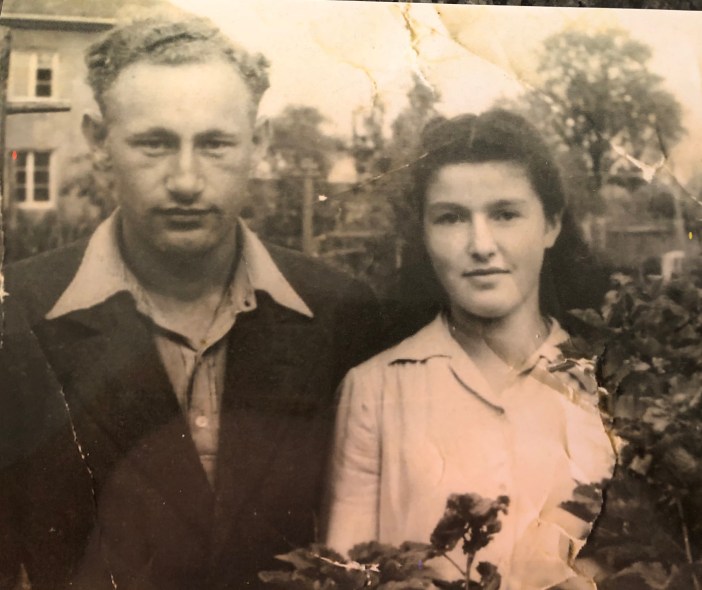
The other family assigned to the apartment included a woman, Lea Silberfarb, and her three children, from oldest to youngest, Bernard, Paula and Sophia. The families became close, sharing stories of their experiences. David was particularly taken with Paula, who despite being 9 years younger, was a good listener, sympathetic, smart, pretty and mature well beyond her years. Living as the Silberfarbs had through the war, stripped Paula of her childhood.

Paula was 10 when the Germans invaded her town, Serniki, Poland (now part of the Ukraine). She, her mom and her siblings lived, on the run, staying in forest encampments, moving from village to village, for over 4 years. (Note: I will share Paula’s story in next week’s blog post)

fullsizeoutput_686
David and Paula in Ranshofen

They were all in Ranshofen for about two years before leaving on the next step of their journey. The Silberfarbs wanted to go to Palestine, as did Batya and Fishel. Berl and David were trying to get to the United States. The paperwork to get visas and arrange travel was a bureaucratic nightmare that took patience and perseverance. In the meanwhile, Paula and David got to know each other, as well as take classes and participate in activities. David even played in a volleyball tournament against other DP camp teams, which his team won. Conditions at DP camps varied widely. Fortunately, Ranshofen offered comfortable accommodations and a range of services.

One of the factors that determined which camp a refugee went to was where they wanted to resettle. For example, the best chance to immigrate to Palestine was from a DP camp in Italy. After some time at Ranshofen, Batya and Fishel went to Italy, since that was their goal. The Silberfarbs didn’t because they were considering another option offered by family that was already settled in Cuba.

Immigrating to Palestine was very difficult and conditions in the Holy Land were challenging as the area tried to absorb survivors and build a new country in a hostile environment. In 1939 Great Britain, which exercised authority over the area, severely limited Jewish immigration. After the war, 69,000 survivors attempted illegal immigration, less than half were successful. Others were arrested and interned on Cyprus. Batya and Fishel were among those waylaid in Cyprus. In fact, their daughter, Rochelle, was born there. Once the state of Israel was established in 1948, immigration flowed more freely. Batya, Fishel and Rochelle finally made it to a Jewish homeland, and faced another war, the war for Israeli independence.

Meanwhile, Berl and David went to another DP camp in Germany, one step closer to getting to the United States. David and Paula agreed to correspond by letter. David told Paula that if she ended up going to Cuba, they would meet again. Paula held on to that thought.

(Next week: Paula’s experience during the war)


The War Finally Ends

Note: For the first time since I embarked on writing David’s story, I have no corrections to last week’s narrative! Maybe I’m finally getting the hang of this.

The Soviet army continued its march into Germany. David’s unit was trying to establish a strategic position on an island in the middle of the wide Elbe River in Magdeburg. The Germans and Russians exchanged continuous machine gun fire across the river, as the Germans tried to hold the line on the advancing troops. The Soviets, having successfully gotten some soldiers to the island in the middle, needed to establish communications with the beachhead. Many soldiers attempted to bring communication wire across to the designated spot. They each failed, many died in the attempt. Though his commanding officer was reluctant to assign David the job since he liked and valued David, he had no choice. It needed to be done.

David waited until dark. He lay down flat, on his stomach, in a small wooden row boat. He set up the spool of wire at the back of the boat so it would unroll as he paddled. He propelled the boat with his hands and kept his head down, as best he could. He looked up every so often only to make sure he was heading the right way. He heard bullets whizzing by. He kept going. He made it to the island successfully, and connected with the others. Mission accomplished!

Now he just had to make it back. He still had the cover of darkness. He got back in the boat, laying as flat as he could while still able to paddle with his arms. Machine gun fire continued to be exchanged. David prayed as he paddled. He made it back to shore and emerged from the boat.

When he got back to the trench, he took off his heavy overcoat. He looked it over and saw that there were bullet holes through the pleat in the back. His coat had a gathering of material that ran down the back. Bullets had passed through it cleanly, leaving him unharmed. David believes that God was looking out for him.

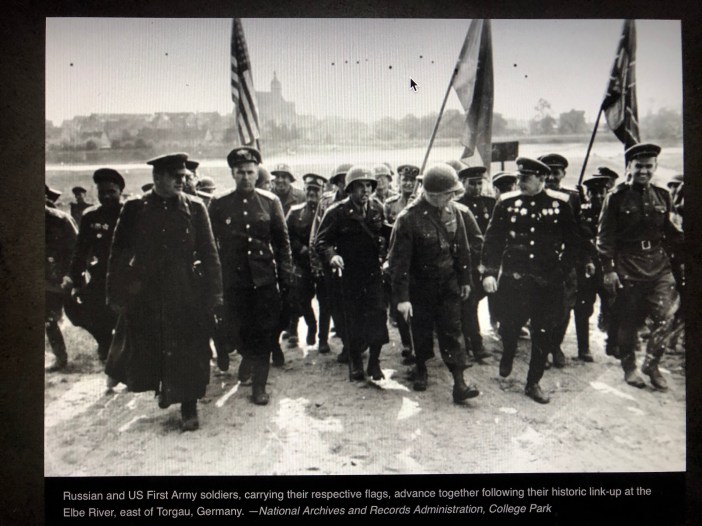
The war grinded on, with the Soviet army making slow progress. They crossed the Elbe but were still in Magdeburg when David heard the sound of artillery fire and the rumble of tanks. As a communications officer, he was about to call in an air strike. He was told, though, that it was the Americans. American troops were closing in from the other side.

David described the joy of the two armies meeting. The soldiers did not share a common language, but they communicated effectively enough. The Americans supplied the chocolate, the Russians brought the vodka and they celebrated. Chocolate never tasted so sweet. Words were not necessary. David recounts this with a broad smile on his face. The long, arduous, painful war was finally at an end.

pi1QcVqySQSw3g2LpEpHYw

Rather than wait for everything to get sorted out, David took fate in his own hands. He didn’t know what plans the Soviet army might have for him and he didn’t want to find out. Though he had managed to survive the ordeal to that point, he was well aware of the anti-Semitism that ran rampant in the Soviet army, and Soviet society as a whole. He just wanted to get back to what was left of his family. He went AWOL (absent without leave). He rode the rails back to Lodz, where Berl and Batya were now located.

uAH3JxNCTV60RIcPu8WPBg
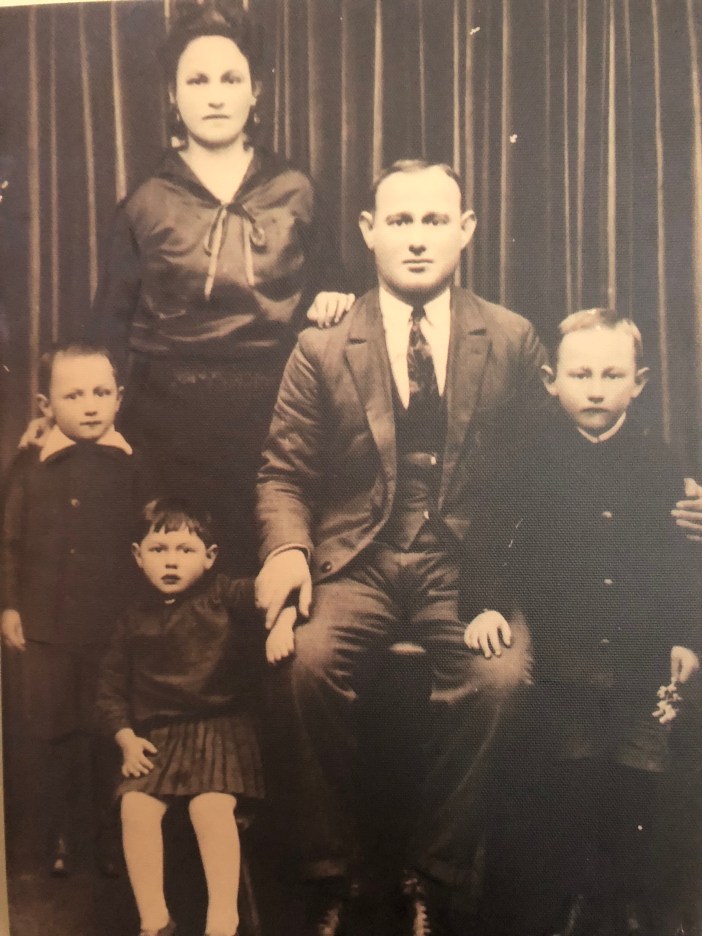
David’s family, long before the war, and before Gussie was born. R-L: David standing (with Berl’s arm around him), Berl, Rachel, Ellie and, in front (seated), Batya.

David and his father had devised a method for coding letters so they kept each other informed of their whereabouts. David knew that Berl and his sister were now in Lodz so he made his way there. Since he was AWOL, he needed to keep a low profile, and the trains were packed, so he rode on top of the train, only coming down to stand between the cars when a tunnel approached. David had an address for his family, and he found his way to them. Though they had endured many losses, the three were relieved and grateful to be reunited. Other survivors had no one.

Berl gave David a pair of pants that were too big for David’s lean waist. Fortunately, he had a belt.  Berl took David’s uniform and stashed it under the window sill in their apartment. David put on civilian garb and tried to escape notice. Today he wonders if his uniform would still be in the hiding spot.

Now they had to make plans. Where were they to go? It wasn’t an option to stay in Poland, there was nothing for them there. Berl and David wanted to go to the United States. Two of Berl’s brothers, Ike and Willie, were already established there, having left Iwie long before the war. Berl had been a successful businessman before, he looked forward to the opportunities America offered.

Batya had met a fellow partisan who she planned to marry, and they wanted to go to Palestine (in 1945 the state of Israel had not yet been created). They wanted to be part of establishing a Jewish homeland.

Of course, getting to either of those destinations, the United States and Palestine, was not a simple task. Their first stop on their respective journeys was a displaced person’s camp.

Next week: The DP camp experience and meeting Paula.

A Return to Iwie

fullsizeoutput_5ef
To give some perspective: some of the places that were part of David’s journey. Iwie (Iuje) and Lida are on the far right of the map, part of Belarus today.

As is becoming my custom, I will begin by clarifying a portion of last week’s narrative. The Germans employed a strategy of kidnapping enemy soldiers to gather intelligence. The incident in the trench began as a kidnapping attempt, not with artillery shelling, as I described previously. It was nearing daybreak when two German soldiers infiltrated the trench, attempting to forcibly take two Soviet soldiers hostage. Most of David’s regiment had been asleep. Shooting broke out when the enemy soldiers were discovered and panic ensued. With soldiers running, David was confronted by a commanding officer, as I recounted in the last blog post. The rest of the story proceeded as described. David returned to the fighting, threw his grenade, killing the two German soldiers and wounding two Soviet soldiers. He was surprised to be recognized as a hero the following day and was rewarded with a furlough to visit his remaining family.

*************************************

David traveled by train to Lida, where his father and sister were then living, a railway stop about 40 kilometers west of his hometown. Although the Soviets had regained control of the region, Berl and Batya did not go back to Iwie. Much of the town had been destroyed and everything had changed. When David arrived in Lida, he insisted that they go back to their home, he wanted to see it for himself. Berl tried to dissuade him, but David would not be deterred. Perhaps David thought he could reclaim his treasured youth, but whatever the reason, he convinced his father and sister to make the journey with him.

David recalls making their way to their beloved house and finding other people, Poles, living in it. The occupants told him it wasn’t his anymore, but David did manage to go in to look around. He saw the familiar furnishings rearranged in unfamiliar ways. When he spotted the bed that his mother and father had shared, he was overwhelmed with emotion. He ran out of the house, overcome by tears. Berl told David it was a mistake to come back. There was nothing for them in Iwie anymore.

To this day, though, David thinks nostalgically of that house. David mentioned his wish to see it again recently when we visited with him. I suggested, “Maybe the house isn’t there anymore. It was built in 1935, maybe it’s been replaced?” David thought for a minute, then shook his head. “I don’t think so. It was such a good house.” I knew better than to argue.

In an effort to satisfy David’s curiosity, I did some online research. I used Google Earth to try and locate the house. While I could find Iwie (Iuje, Belarus on Google Maps), only random photographs were available, rather than the street-level function I can ordinarily access. Belarus remains a relatively undeveloped and closed country. I did locate a hand-drawn map of Iwie from 1932, which featured Yiddish labels for street names and the legend. I printed it out. We brought it to David on our last visit. He took out a magnifying glass and studied it closely. Many minutes passed with David hunched over the map at the dining room table. After a long while, he triumphantly pointed out the location of his synagogue, his home and the shoe store. He only stopped studying it when his eyes grew too tired. I asked if he wanted to keep the map. “If you don’t mind, yes. I’m going to put it away,” he said, as he got up to bring it to the bedroom. “I don’t want Paula to misplace it.”

fullsizeoutput_5cd
The map I printed out, with my notes, based on what David said

Sadly, one of the consequences of Paula’s dementia is that she finds things and puts them away in surprising places, with, of course, no memory of having done so. Many a frustrating hour has been spent looking for misplaced things

Over the 35 years that I have been part of the family, David has mentioned the possibility of going back to Iwie many times. Before age and infirmity took their toll, I think David seriously considered it. But, Paula, who was never an enthusiastic traveler, she has always been a homebody, was resolute in her refusal to go. She had no use for Europe. I remember her asking rhetorically, “Why would I want to go back there? There’s nothing for us there.” David wouldn’t go without her. It is no longer an option.

**********************************

David, Berl and Batya returned to Lida after their painful experience at the house. It was time for David to return to duty. Berl gave him some supplies, including canned meat, for his journey.

David went back to where his regiment was stationed when he left on furlough. When he reported for service, he found that his platoon had been redeployed elsewhere, replaced by another regiment. He was viewed suspiciously by the commanding officers who were unknown to him. To add to the surprise of a single soldier showing up, the supplies his father had given him were German rations that had been left behind when they retreated. As a result, the officers, who were unfamiliar with David, suspected he might be a spy. He was interrogated for days. After a tense and unsettling week, they were finally able to authenticate his story and he was permitted to join the new regiment. He again went back to carrying communication equipment and laying wire in the new unit.

David remembers marching 40 grueling kilometers a day, marching almost the equivalent of a marathon every day. It was a brutal existence, enduring pouring rain, soaking his wool overcoat so that it weighed heavily on his shoulders.

The regiment approached the German border. They were near Danzig (now Gdansk), which sat on the coast of the Baltic Sea. His unit was taking some rest, sitting below huge, majestic trees. David and two other soldiers were leaning against the wide trunk of the tree. Their break was coming to an end, David got up to get his rifle from the other side of the tree.  Suddenly shelling began. The Germans were firing from ships in the harbor. A blast exploded right next to David’s head, knocking him out. He came to with his ears ringing and with the right side of his face paralyzed. The two soldiers who had been sitting right next to him lay dead, the shell landed exactly where he had been sitting moments before. He was stunned. David wondered how many times he could escape death.

He was examined by a doctor. He was concussed, but the doctor said he would recover. He was told to eat, drink and rest. David did as he was told. He went into a barn, found a bucket of eggs and ate every last one of them. Eventually his hearing and muscle tone returned. He attributes the slight downward curve of his lips on one side of his face to the incident, but otherwise he bears no visible scars. He returned to duty yet again.

I noted in this blog post that I have been part of the Bakst family for 35 years. Today, July 30th, is our wedding anniversary. I am so grateful to be sharing my life with Gary, and proud to be part of this enduring legacy. Happy anniversary, Gary! I hope we get to celebrate another 35!


fullsizeoutput_5ff
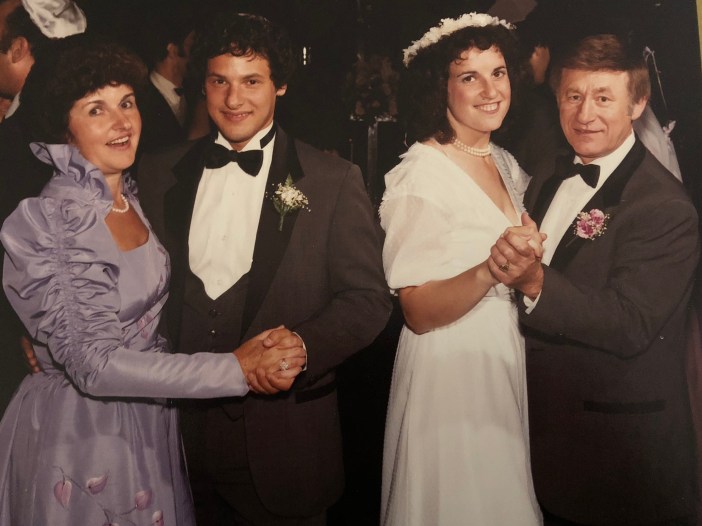
July 30, 1983 (L-R: Paula, Gary, me and David)

Next week will cover the end of the war and the immediate aftermath.

More Miracles: David in the Soviet Army

Last week’s blog post began by explaining more about the communist takeover of Iwie and then the early part of World War II when the Germans invaded David’s town. It also recounted David’s involvement with the partisans. I misplaced one element of the story. It is important  that I get this telling as accurate as possible. As I explained previously, these stories have been told in drips and drabs over the course of many years. It wasn’t told as a chronological narrative. In addition, as Gary and I continue to have conversations with David, new details emerge. It is a race against time, David is 95, to document the family history. It is a responsibility Gary and I are sharing.

For example, David recently revealed that when they lived in the ghetto, they attempted to create some kind of normalcy. They conducted Sabbath services. His aunt, his mother’s sister, got married there. Those details give a fuller picture of the experience. I want to share those pieces, even though I already covered that part of David’s story. This is a ‘living’ process, so to speak. I hope my telling it in this way, doesn’t detract from the narrative.

Now, back to the events that I misplaced in last week’s blog entry. When the Bakst family escaped to the woods, when first Berl and then David carried young Gussie through the snow drifts, I wrote that they were not able to connect with the partisans. Actually, David’s younger brother, Eliahu (they called him Ellie), joined the Bielskis at that time (I mistakenly thought he went back to the ghetto with the rest of the family and joined later when David and Berl joined Iskra).

The Bielskis were a just-forming Jewish partisan brigade. Led by two brothers, the mission of the Bielskis was to save as many Jews as possible. Their members swelled to about 1200 by the end of the war in 1945. They set up a community deep in the Naliboki forest. They carried out other missions, as well, including sabotaging German rail lines. Ellie, who was 14 when the Soviets came to Iwie, would have been 17 at the time. He participated in those activities. Ellie and another partisan were on a mission to get supplies from a farm when they were surrounded by German troops. They tried to shoot their way out. Ellie was killed on January 5, 1943 as he tried to escape. (Our son, Daniel’s Hebrew name is Eliahu in memory of David’s brother.)

The remaining Bakst family, now just Berl, David and Batya, soldiered on in spite of the mounting and unrelenting losses.

Now I will return to the thread of David’s story. He and Berl, and the recently rescued Batya, continued their activities with Iskra. Iskra was a Russian partisan brigade that was initially resistant to accepting Jewish members. Antisemitism wasn’t the sole province of the Germans, unfortunately hatred of Jews was shared by many in Eastern Europe. A fellow Iwie resident, Motke Ginsburg, had previously joined Iskra and proved to be a valuable asset. He vouched for Berl and David. Over time they were accepted.

The efforts of Iskra and other partisan units were coordinated to some extent with the Russian army. Intelligence was shared. Slowly, with the sacrifice of many Russian lives, the tide of the war turned. The German army was repelled and fell back from eastern Poland. The Soviet army came to Iwie. This time the Soviets, due to Berl and David’s partisan efforts, greeted them as heros, not undesirable capitalists.

David, now 19, was conscripted into the Soviet army. Another difficult chapter of his war time experience began. He left his remaining family and was assigned to a regiment. The Soviet army was an inhospitable place for Jews. David, with his strawberry blond hair, blue eyes, and unaccented Russian language skills, didn’t share his semitic origins. As a quick, intelligent and strong young man, David was assigned a role as a communications officer. He carried equipment and laid communication wire near the front.

On one occasion, David’s regiment was hunkered down in a foxhole when they started receiving shelling and artillery fire. The foxhole was actually a series of connected trenches. Panic erupted with soldiers running trying to escape. David was last in a line of soldiers, running away from the onslaught. He was confronted by an officer, who asked, “You, too, David?” The officer was disappointed that David was retreating along with others in his platoon. In the Russian army if you were caught retreating you risked being shot by higher ranking officers. Knowing this, David stopped and turned back. He had no weapon other than a grenade, having left his rifle in the scramble to escape. He ran back into the fray and threw the grenade, killing several German soldiers and wounding one Russian. David survived.

The skirmish ended and David’s regiment regrouped the next day. The captain of the unit called David out during roll call. David feared that he was facing punishment, he had no idea why he was being singled out. To his great surprise and relief, he was heralded as a hero. The commanding officer asked him what he would like as a reward. He asked for a furlough to visit his father. His request was granted. David journeyed back east across Poland to Lida, where his father and Batya were living.

[The story will continue next week with David’s return to Iwie and his continued service in the Soviet army.]

A Miracle: Part II of David’s Story

fullsizeoutput_58c
Berl Bakst, David’s father

When Gary and I got together a process of melding two very different Jewish-American families began. My parents were American-born (even my grandmothers had been born in this country); my Mom and Dad had master’s degrees; and, we weren’t religiously observant. Gary’s parents were European-born; formal education was abruptly stopped by the war; and, they went to synagogue every Sabbath, and kept a kosher home. It was this last piece, being observant Jews, that was initially most perplexing to me. Until I attended services with Paula and David, and until I understood the source of David’s faith, I couldn’t relate to keeping all the rules and regulations that Judaism requires. Turns out my father-in-law believes in miracles. It took a while for me to understand that.

I left off last week with the Russian invasion of Iwie. David and his family had been enjoying a peaceful and prosperous life until the Communist takeover. Not only did his father lose ownership of his home and business, but Berl was taken for questioning by the KGB repeatedly. He was subjected to interrogation nightly for weeks, with the family worried that he would be whisked off to Siberia, never to be seen again. People disappeared and rumors about being sent to the gulag pervaded the air in Iwie. Fortunately, after each interrogation Berl returned home.

As a result of being labeled ‘capitalists,’ David was shunned by friends. His fortunes, and that of his family, changed on a dime. Now they were almost destitute. Berl barely managed to provide, it was quite a fall in status. Berl’s business, which was comprised of a leather factory and shoe store, was still operating, but under Russian supervision.

Things went from bad to worse over the next few years. The Germans invaded as part of their plan to take Russia.  Jews from surrounding towns and villages were rounded up and sent to Iwie. A ghetto was created. The Bakst family lived in the ghetto, but were allowed to leave to work at the shoe factory. This gave Berl and David access to information and other townspeople. They heard rumors of ‘actions,’ actions were when the Germans would order the gathering of the Jews in the town square and either march them to the rim of a ravine and shoot them, or deport them on trains to concentration camps.

Upon hearing rumors of an impending ‘action,’ Berl, Rachel, David, Eli, Batya and Gussie (David’s sisters were born in 1927 and 1932) escaped to the woods. They tried to hook up with partisans (fighting groups that lived in the forests surrounding Iwie – and other forests in Poland). David remembered walking through thigh high snow in the bitter cold. His little sister, Gussie, was carried by Berl until the point of exhaustion when David took over. They weren’t successful in connecting with a partisan brigade. It was winter and they feared freezing to death. The Bakst family made rendezvous plans at a spot in the woods in case they got separated and had to run again in the future. They went back to the ghetto.

That first ‘action’ resulted in the killing of the leadership and intellectuals of the Jewish community in Iwie, others were spared, for the time being.

The adult Baksts continued working at the factory. Berl arranged for his wife and Gussie to be hidden in a farmer’s barn about ten miles outside of Iwie, thinking they would be safer there. They, along with about 10 other Jews, including David’s cousins, were crowded into a space under the barn floor. Food and supplies were brought to them.

At some point, perhaps because a collaborator reported them, or because the Germans saw unusual movements around that barn, they came to investigate. Normally the barn floor had hay strewn about. It was Spring and the floor was bare. A German soldier’s boot heel sunk into a hole in a floor board. A child underneath made a sound. The soldier tossed a grenade into the hole. One of David’s cousins tossed it back. Two cousins climbed out to fight and were shot immediately. The Germans continued to shoot as they set fire to the barn. The remaining people, including David’s mother and sister, were burned alive.

The farmer, who himself was now on the run, got word to Berl about the fate of his family.  No miracles saved Rachel and Gussie, but the remaining Baksts continued on. They still worked in the factory, but as the war dragged on and German fortunes were fading, their lives became more precarious. They wondered how long the leather/shoe factory would be continued. Berl would have David go across the street to the Polish shoe store to visit and try to gather information.

One day German soldiers came to the factory while David was at the store across the way. David saw the soldiers. The Polish storekeeper gave David an overcoat so that his yellow star would be covered. David put the coat on and ran out the back. Two soldiers saw him and gave chase, shooting at him. David remembers zig zagging down the alley, rolling and getting up, darting back and forth to escape. Gunshots sprayed around him, but none hit their target. He got away and went to the rendezvous spot.

Berl and Eli also escaped the factory that day. Eventually they showed up at the rendezvous spot to meet David. Batya didn’t come. Berl wanted to go back to find her. He felt he couldn’t leave his daughter behind. David argued that Berl couldn’t leave them either. In an emotional exchange that still pains David, he convinced his father to stay with them.

This time in the woods, they were able to join partisan brigades. David and Berl joined Iskra, a Russian regiment. Eli joined the Bielskis (a Jewish regiment, whose story was told in the movie Defiance).

David was a fighter in the regiment and Berl supported the group by repairing shoes and working with leather. David recalls various missions including sabotaging a German military caravan where they were able to capture weapons and ammunition.

Iskra also took measures against collaborators. When they became aware of Polish families who were cooperating with the Germans, they wanted to send a message that there would be consequences. The partisan brigade took vengeance on those villagers, and captured any food, weapons or other material that would be useful. At this point, David described himself as living like an animal –  there was no right or wrong, there was only survival and he did what he had to do.

While they were with Iskra, Berl and David got word that Batya was alive. She was in a camp outside Lida, which was about 40 kilometers away. With the assistance of the other members of the brigade, they came up with a rescue plan. Using coded messages, they managed to communicate with Batya.

Batya had a routine which involved crossing the camp to bring food to the German soldiers. This was done at the same time each day. One of the partisans, a Pole, intercepted Batya, ripped the yellow star from her clothing and covered her with his overcoat. Somehow, they walked out of the camp without being detected.

Batya joined David and Berl and became part of the Iskra brigade. To have his sister back was a miracle to David. That the rescue plan worked was unbelievable. David still gives thanks for it.

He would need more miracles to continue to survive.