The Power of History: Insights from Normandy

Note: I wrote a blog post a while ago that asked the question ‘History,’ History In the following post, I take a different perspective.

What is history? When you visit a new city or country and take a tour, the guide often tells you about the history of the place. I love that. Perhaps my enthusiasm is based on being the daughter of a father who was a high school history teacher and a mother who was a reading teacher. So, I have been a student of history for basically my entire life. But that doesn’t answer the question of what it is. What does a tour guide include in their presentation?

I am thinking about this because we just returned from a trip that took us to some very interesting places with long, long histories. It is hard not to conclude that when we learn about history, we are often told about wars, and if not outright wars, then power struggles. Is history really a narrative of power? It appears to be so. And, when you dig into it a bit, you sometimes find that those power struggles and wars are about personal things – insults or slights.

This is a stretch, but if Hitler had been accepted to art school, could that have changed the course of history? Would his ego have been assuaged enough? Would he not have needed to go on a quest to prove himself with such horrific and destructive consequences?

The trip we took was D-Day themed, so perhaps it was inevitable that the places we saw were chosen based on the role played in that momentous event, or in World War II in general. Perhaps my perception that history is often the recounting of conflicts or wars is colored by the type of tour we chose.

We took a Viking river cruise that was organized around D-Day. We visited London, Paris, and Normandy. Each place we visited was the site of intense World War II action. Gary and I share a fascination with the topic. Our families were impacted, if not shaped, by those events. Gary has watched countless documentaries about the military battles. I have read innumerable historical novels set in that era. With that said, I learned so much on the trip, and Gary would say the same.

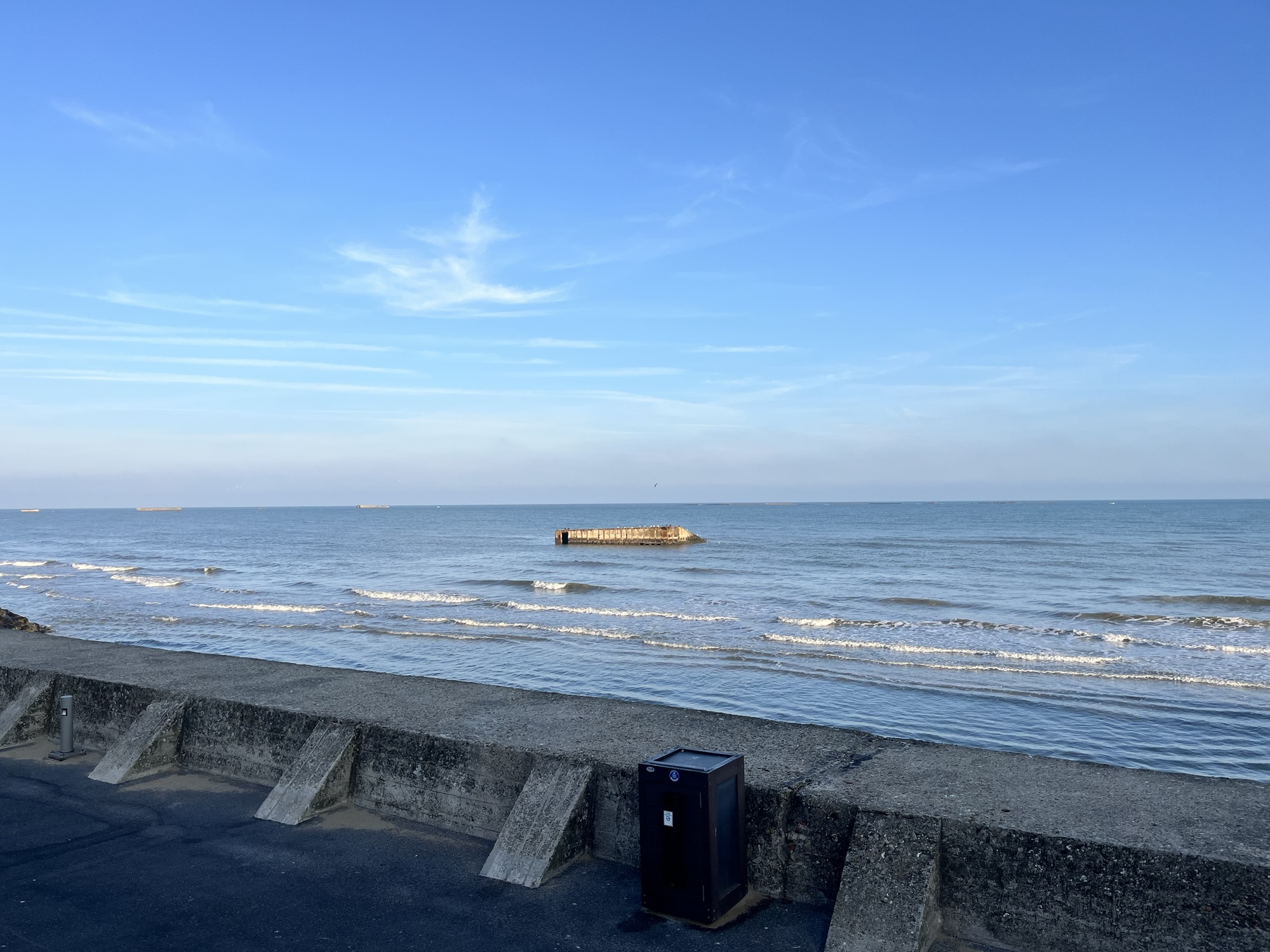
First, I did not understand the scope of the D-Day invasion. It covered 72 miles of France’s coastline. I thought of it as a single beach, perhaps because of the way it was portrayed in movies. In fact, even that beach, Omaha Beach alone, was six miles long. Aside from breadth of the operation, it also involved so much in the way of logistics and coordination among the allies. They built a temporary port to facilitate bringing in more troops and supplies. It was quite an undertaking.

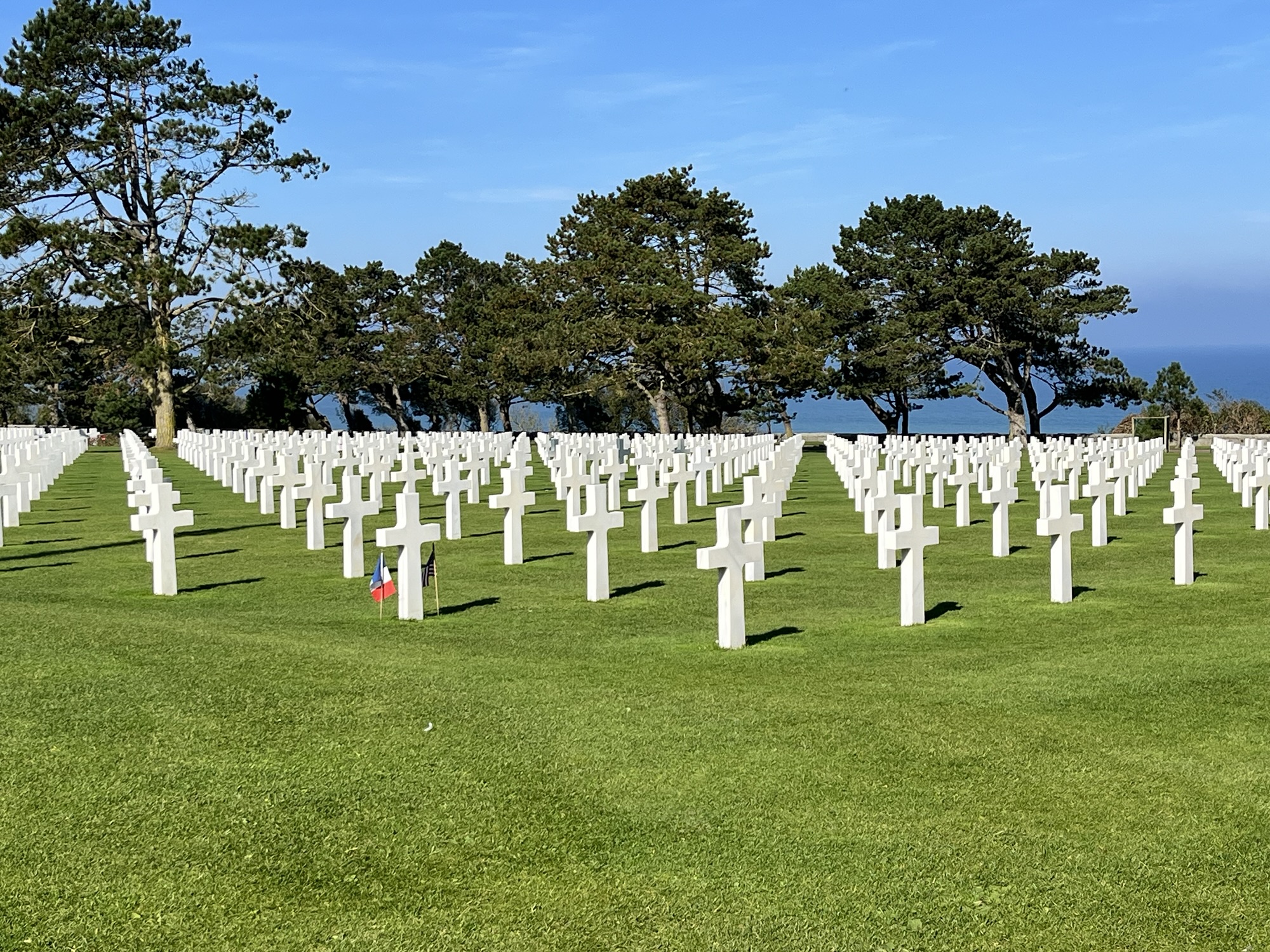
It was also clear that the difference between success and failure was very narrow. The Allies were on the brink of failure. It is scary to think about the consequences of that possibility. One can’t help but be moved by the extraordinary sacrifice made by the young soldiers who carried out that mission. Standing in the cemetery, which overlooks the English Channel, looking upon row after row of crosses and Stars of David, is overwhelming.
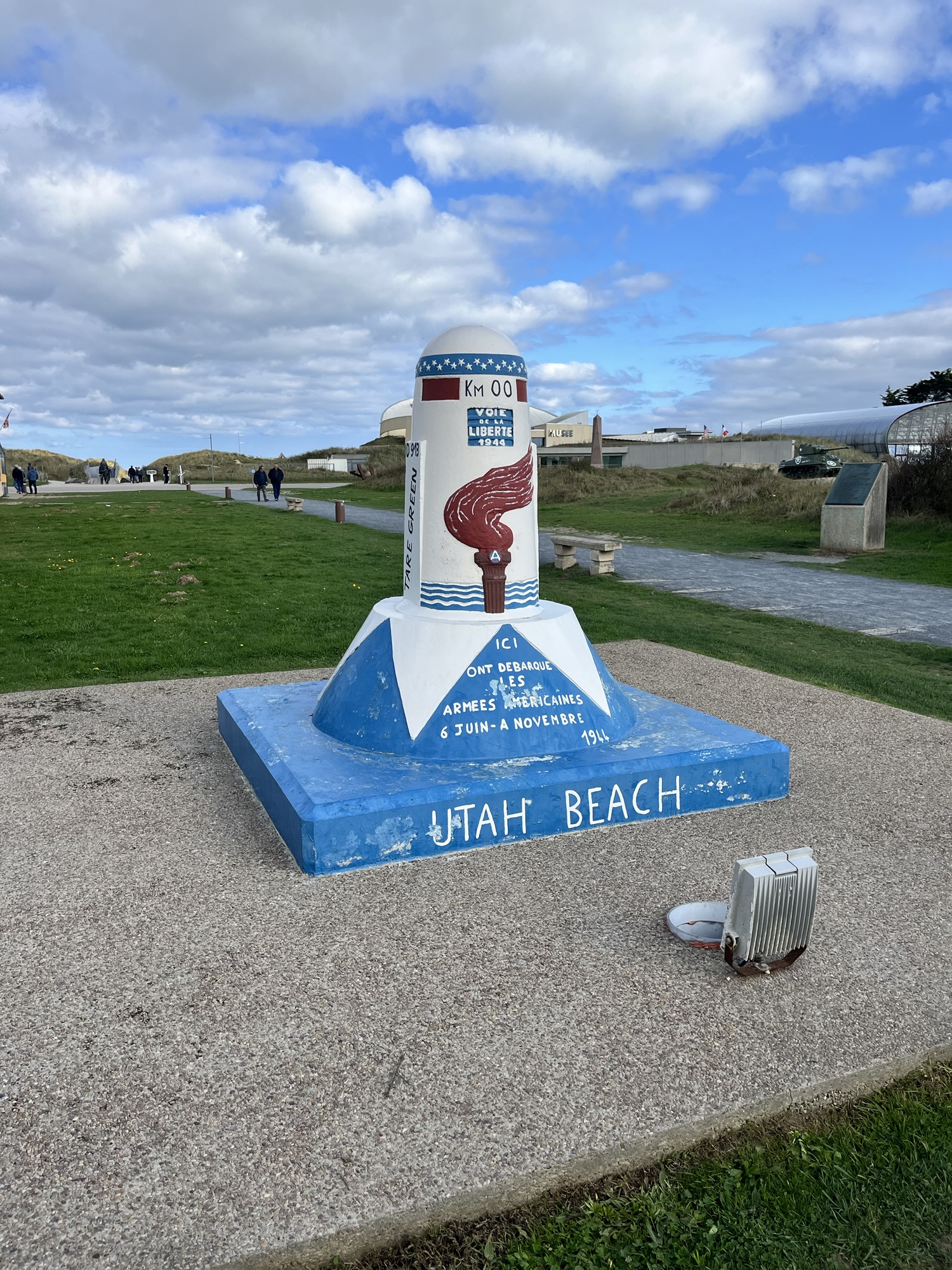
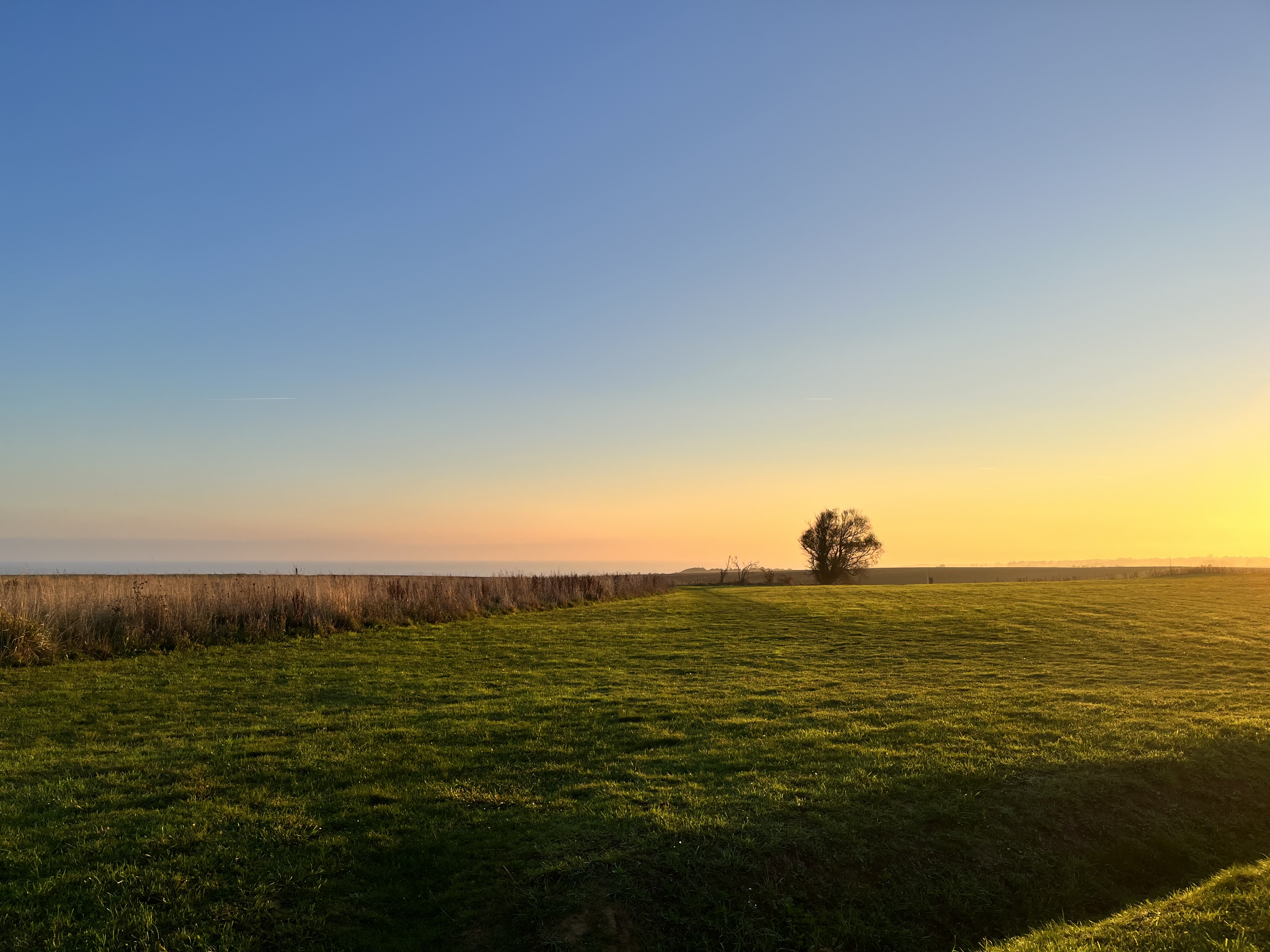
The land in Normandy still bears the scars of the battle, too. There are craters in grassy areas, and they have left the remnants of the German battlements. The coastline is also dotted with monuments. The statues, sculptures, and museums express the gratitude of France and Europe for their liberation and tell the story of how that was achieved.

Perhaps the most powerful aspect of visiting this sacred space is its breathtaking beauty.
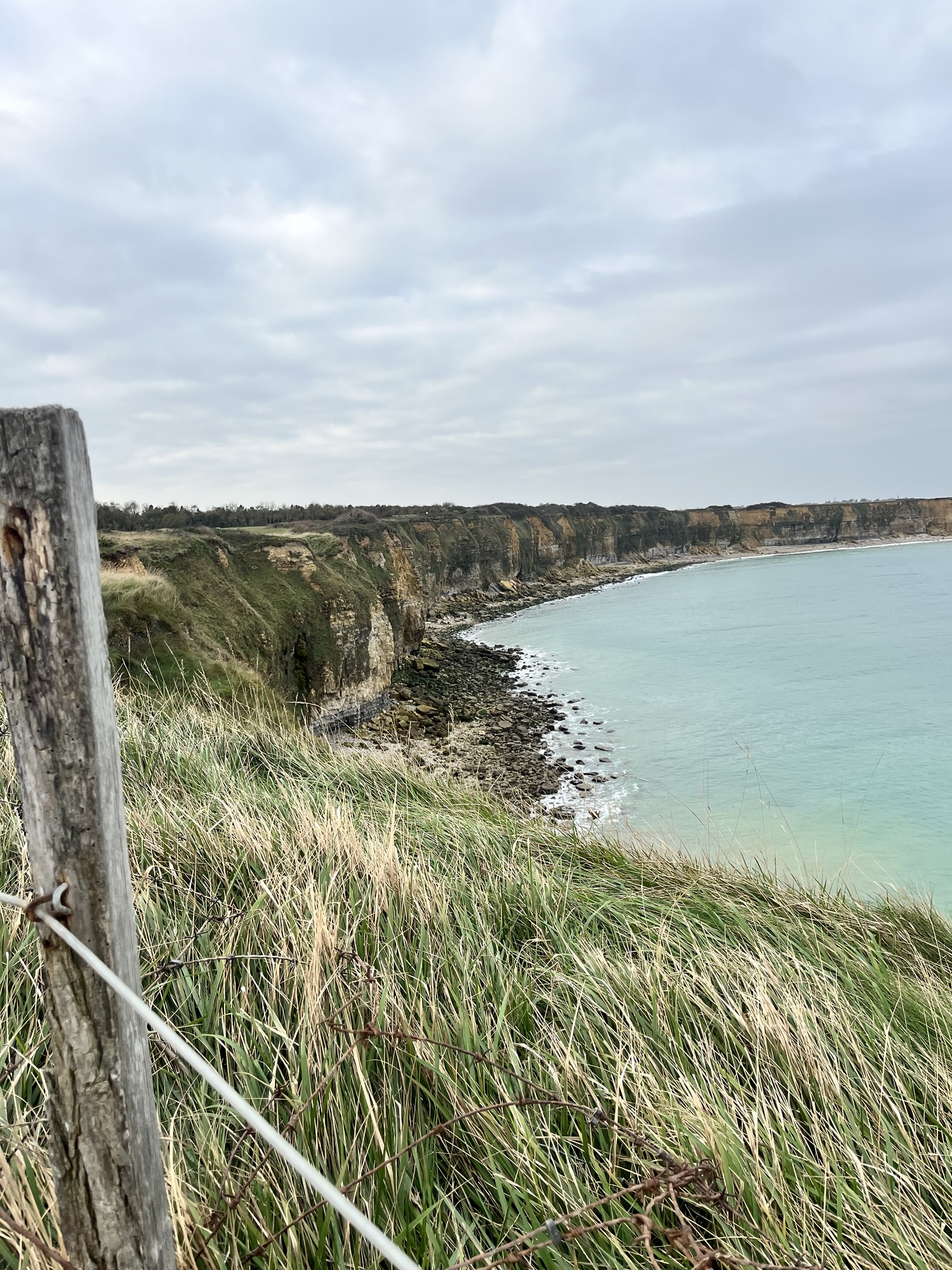
I stood on the cliffs, it was so peaceful, the only sounds were birds and the waves. The stark contrast to what it must’ve been like on June 6, 1944, with the pounding of artillery and bombs falling, is striking. When I looked at the cliffs that the soldiers had to scale, I couldn’t help but be amazed by their strength and bravery.

The towns, which withstood the onslaught, are charming. Some have modern elements that reflect the rebuilding effort, but many of the structures, which date back centuries, are still standing. I could have spent a great deal more time there. We visited for two full days, and it didn’t feel like enough.

These photos are from the old part of Rouen, considered the capital of Normandy.
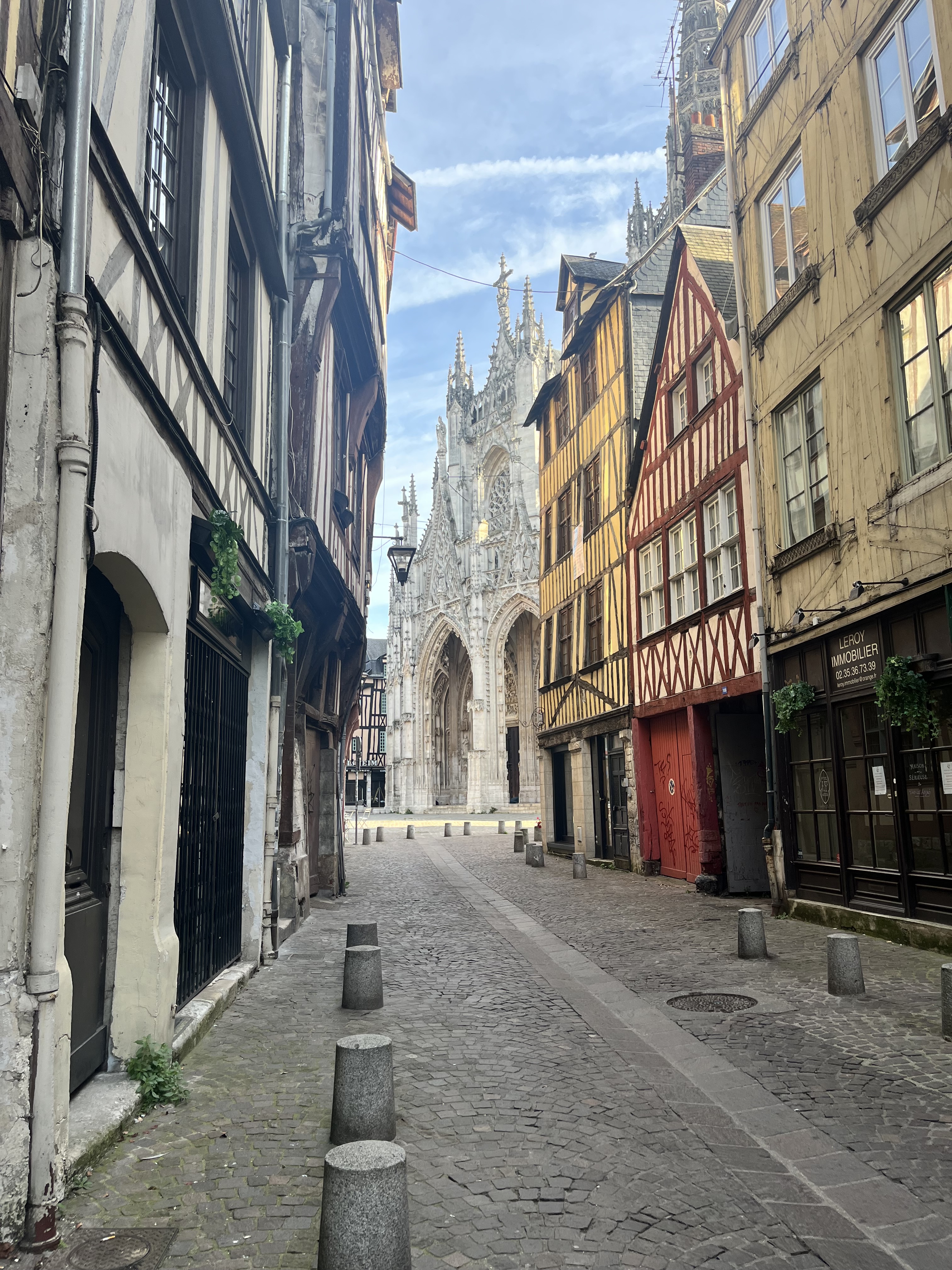
I can’t recommend a visit strongly enough. We need to be reminded of all that went into fighting fascism and what people were willing to sacrifice for freedom. It would be tragic if we allowed our country to continue to slide into authoritarianism. I’m not sure Gary and I needed reminding, but I came away with a renewed sense of responsibility for doing what I can to prevent that from happening.

If one of the reasons we study history is to learn from it and avoid making the same mistakes, I urge everyone to revisit what World War II and the rise and fall of fascism have to teach us. War, even a just one, is brutal and exacts a steep price.

Democracy Hangs in the Balance

So much to say. I hope I can express it coherently.

I want to follow up on my last blog post which explored the role of the civil service. In that essay I mentioned that we all had a general understanding of the separation of powers. Now I’m thinking maybe we don’t. Given what has transpired in the last week, I think it is important we take a deeper look at the roles of the different branches of government. I have seen it at work up close and personal throughout my career. I believe it is an essential concept, a foundational construct, of our Constitutional democracy and it is being dismantled day by day.

Elon Musk, empowered by President Trump, is upending a structure that has existed for centuries, and he is doing it without a transparent plan for what replaces it. This is a critical issue. It isn’t simply reducing the size of the federal workforce that is underway here; it is the gutting of its ability to function. Some may think that there is so much fat in government that if you cut the staff you would still have an operating agency. That might have been true if cuts were planned, surgical reductions. Across the board cuts or offering all employees a buyout without regard to who is critical, eviscerates programs. In some instances, whole programs have been shuttered. Many of the cuts target either Trump’s perceived enemies or his and his billionaire friends’ interests – not the interests of the majority of Americans.

There are two problems with how things are proceeding. First is one of process – the way thing sare being done – they demonstrate a total disregard for laws and regulations in implementing these changes. The second is one of policy – what will be the consequences of these changes for the American people? Is this what we signed up for? These processes and policies have hurt people already and we have not even begun to feel the full impact.

Our Constitution does not empower an autocrat or an oligarchy. There is an executive, but that executive does not function as a legislature or judiciary. There can be some argument about where the line between making the laws and executing the laws is drawn – and the courts mediate that – but there IS A LINE. Let’s take a look at the line.

I worked years ago for the Legislative Commission on Expenditure Review in New York State. This entity was a bipartisan committee that had staff charged with reviewing programs to see if they were complying with legislative intent. In other words, we would look at the language of the legislation that authorized a given program, for example purchasing by the Office of General Services, to see if the program was operating in accordance with the law. To understand the purpose of the program, we looked beyond the plain language of the statute. We looked at the history of the bill (the bill jacket) and then we reviewed the operations in practice. The purpose of our review was not a traditional financial audit, that was the responsibility of the Office of the State Comptroller (OSC). We audited the performance of the program. Was it effective? Was it efficient? Was it accomplishing its mission? Was it being done in compliance with the law? We made recommendations when there were areas that were falling short.

So, that is how it is supposed to work: The Legislature, with input from the Governor’s office and the public, enacts a bill; the Governor signs the bill and it becomes law. Funding, negotiated by the Governor and Legislature in the budget process, is allocated. An Executive branch agency, as directed by the Governor, creates that program. The Executive branch implements and administers it, enacting regulations through administrative procedures (which the public can comment on) to flesh things out. The Legislature periodically oversees the program by having staff review it. A separate entity, OSC, reviews the financial operation. In sum, power and accountability is shared.

This balance of powers, this separation of responsibilities, plays out at the federal level, too. The names of the entities are different, but the functions are performed by separate entities.  Power is not concentrated in any one branch. Is there potential for leakage? Are there instances where the system doesn’t work? Absolutely. Especially when Congress fails to act by not fulfilling its responsibilities.

Legislation can be vague. The Executive is left to interpret things and in that process a program can go sideways or it may overreach. Oversight can be inadequate. Oversight activities, within an agency and by the legislature can be underfunded and understaffed given the breadth and scope of the work of government. Agencies themselves have a role in preventing corruption by having internal controls and systems set up to prevent and/or detect malfeasance or other inappropriate actions. Inspector generals (IGs) and internal auditors within departments help to oversee this, in addition to the separate entities I described above. Removing those internal checks and balances threatens the integrity of the agency. We have seen the removal of IGs already. At the federal level the Government Accountability Office (GAO) performs a similar role as the state’s OSC. Congressional committees are responsible for oversight. All of this might be clumsy and time consuming, but it serves a purpose. Private sector entities can afford to be more streamlined, though they have some of the same concerns and limitations.

As is always the case there is a balance. Oversight is costly and you don’t want to create a whole other bureaucracy parallel to the one that is performing the service. But, some checks are necessary and pay for themselves by preventing or recovering losses. Finding the balance is difficult, but ridding the system of the whole process is certainly not the answer!

What happens when all of that is stripped away – both the separation of powers and the oversight – as is happening with the Trump administration? What will replace it? The judgement of one man, or a committee of men? Why should we trust them? What are their interests? What happens when Congress forfeits its authority and responsibility to oversee activities, as the Republicans appear to be doing? The system, carefully calibrated to prevent concentration of power and corruption, is rendered impotent. Is that what the American people want?

As I argued in my last blog post, we need to improve the system. We need to address the paralysis that plagues our Congress so that it can function as intended. But, we should not throw the baby out with the bathwater. The checks and balances, the division of responsibilities must be preserved. We can’t allow Trump and Musk to ransack our democracy. Please write and/or call your representatives!

Reverberations Through Time

Note: I have been absent for a month! There are many reasons for that – I will write about it at another time. I am glad to be back! I look forward to continuing our conversation about stories we tell ourselves.

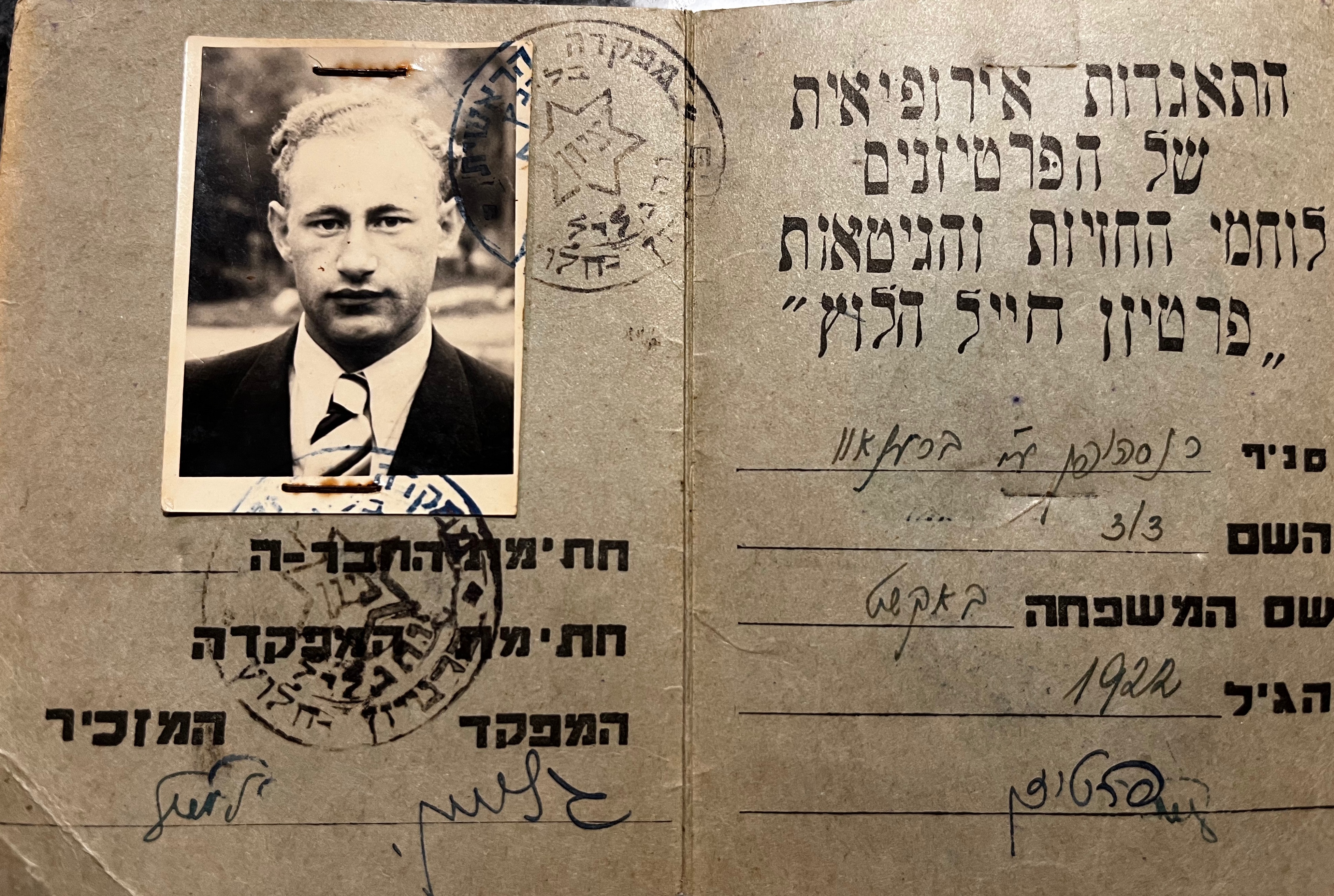
December 15, 2022 would be my father-in-law’s 100th birthday. David Bakst made it to his 98th and for that I am grateful. He passed away a week after achieving that milestone.

As I reflect on his life so many thoughts come to mind. In David’s last years, I would often accompany Gary on his Thursday afternoon visits. Gary doesn’t see patients on Thursday afternoons, so it was a good opportunity to spend time with his Dad. They, including his mom despite her advanced dementia, would go out to lunch to a diner near their apartment in Saugerties. I know Gary treasures that time and the memories they provide.

Many of those lunchtime conversations revolved around David’s memories. We would ask him about his youth and World War II experiences. We heard the same stories multiple times, new details might be offered, but even if not, we never tired of hearing them. One particular comment stayed with me, though I am not sure why. As David described his family life before the war, he said that after Shabbos services, the adults (his parents’ family and friends) would gather at his home and talk (argue) politics. David listened in, beginning a long interest in politics that remained for the rest of his days. He told us that his father was a supporter of Jabotinsky, who he described as more of a right winger. The name vaguely rang a bell, but I didn’t know anything about him or the context. I was curious. I tried to imagine what their political conversations might have been about in the late 1920s and early 1930s in David’s shtetl (village) in Poland (now Belarus).

After that conversation, I googled Jabotinsky and learned a bit but didn’t get very far and I set the subject aside, though it still intrigued me. Oddly enough the other day I came across a podcast entitled Jabotinsky and the Birth of the Israeli Right. I thought this might shed light on the topic, plus I am interested in better understanding the politics of Israel and this sounded like it could offer that.

I am very glad I listened. It accomplished exactly what I had hoped. It reaffirmed my belief that learning about our past illuminates our present; the issues that plagued us more than a century ago still percolate in the lives we live today.

The topic the Bakst family was likely discussing during their Shabbos afternoon visits was Zionism. It is appropriate that I write about this now given the intersection between anti-Zionism and antisemitism, and the appalling rise in antisemitic rhetoric and violence.

So, what is Zionism? It is the movement to create and support a Jewish homeland. Its roots go back centuries as part of Judaism, with the idea that since the destruction of the temple in Jerusalem and the diaspora, Jews prayed to return to the Holy Land. This was largely a religious tenet until the late 19th Century. It evolved into a political movement, in part in response to virulent antisemitism in Central and Eastern Europe when Jews were largely confined to living in an area called the Pale of Settlement (part of Russia and Poland). In the late 1800’s and early 1900’s, as pogroms (violent riots perpetrated against Jews in the Pale of Settlement) became more common and feared, some Jewish thought leaders concluded that the only solution to antisemitism was a Jewish homeland. They believed that there was no future for Jews in Central and Eastern Europe and that ultimately, they needed their own country in their ancestral homeland. The father of this strand of political Zionism is generally considered to be Theodor Herzl, who wrote a pamphlet that was published in 1897 entitled Der Judenstaat (The State of Jews). In it he argued that Jews were a nationality, that it was not a social or religious question, but a national one. In order to escape antisemitism, express their culture freely and practice their religion, they needed a state. This idea became quite popular and was widely discussed in Jewish circles, including David’s hometown of Iwie.

As with most political movements, there were factions. I imagine that David’s family debated the different perspectives. One of the areas of disagreement was what kind of country should it be. Some advocated for a socialist state (David Ben-Gurion emerged as the leader of this wing and in fact became the country’s first prime minister in 1948); others wanted a free market approach. I would imagine David’s father, as a successful businessman before the invasion of the Soviet Union in 1939, would have wanted a capitalist economy for the new state. Jabotinsky, the person David referenced, supported the free market, though he also believed that the citizens of the new state should determine their destiny.

Another thread of discord in Zionism is the role of Judaism, the role of the religion itself, in the creation and running of the state. One of the things that is unique about being Jewish is that it encompasses a number of elements: it is a religion, it is an ethnicity, and it is a culture. Some identify with some aspects of that identity, but not others. The Zionist movement included (and still includes) a range of belief about religion. Some are Orthodox, very observant Jews, for whom the religion and the state are inextricably tied. Others are secular Jews who may even call themselves atheists. Neither Herzl, Ben-Gurion nor Jabotinsky were particularly religious. Though I never had a conversation with David about this subject, I believe he would support maintaining the Jewish character of the state but would not support a theocracy. Defining that balance continues to be a challenge.

Jabotinsky also advocated for a strong military capability. He believed that the new state would be fought over, that the Arabs in the area would not relinquish land or power without a fight. Ben-Gurion believed that in return for economic and political considerations, the Arabs could be appeased. In furtherance of Jabotinsky’s belief in the need for military capability, he created a youth group in Poland, Betar, that would instill nationalist fervor in young people for Israel and train them to respond to attacks on Jews wherever they occurred. David Bakst was a member of Betar.

I wonder if any of the training he received, or the faith and support built as part of that group, helped him in his war experience.

There is great poignancy to these issues. Imagine if there had been a Jewish State in the mid 1930’s. Millions of lives might have been saved. Instead of ships being turned away from ports, instead of country after country rejecting Jewish refugees, people would have had a place to go. We will never know what might have been.

The controversies that plagued the founding of Israel are still playing out today. The tensions between its socialist origins and the demands of a free-market economy are still difficult to sort out. The balancing of the different attitudes regarding the role of Judaism in the state creates conflict. The fundamental disagreements between Israel and its Arab neighbors, not to mention its Arab citizens, are as troubling as ever.

And, in an even larger sense, we are still grappling with what to do about antisemitism. It is a pernicious and stubborn prejudice. It is disheartening that over a century after Herzl wrote his pamphlet, and even with the establishment of the state of Israel, lies, misconceptions and hate are still rife. After all he went through, I wonder if David would be surprised by this latest resurgence. In that one sense, I am glad he isn’t here to see it.

Moral Clarity

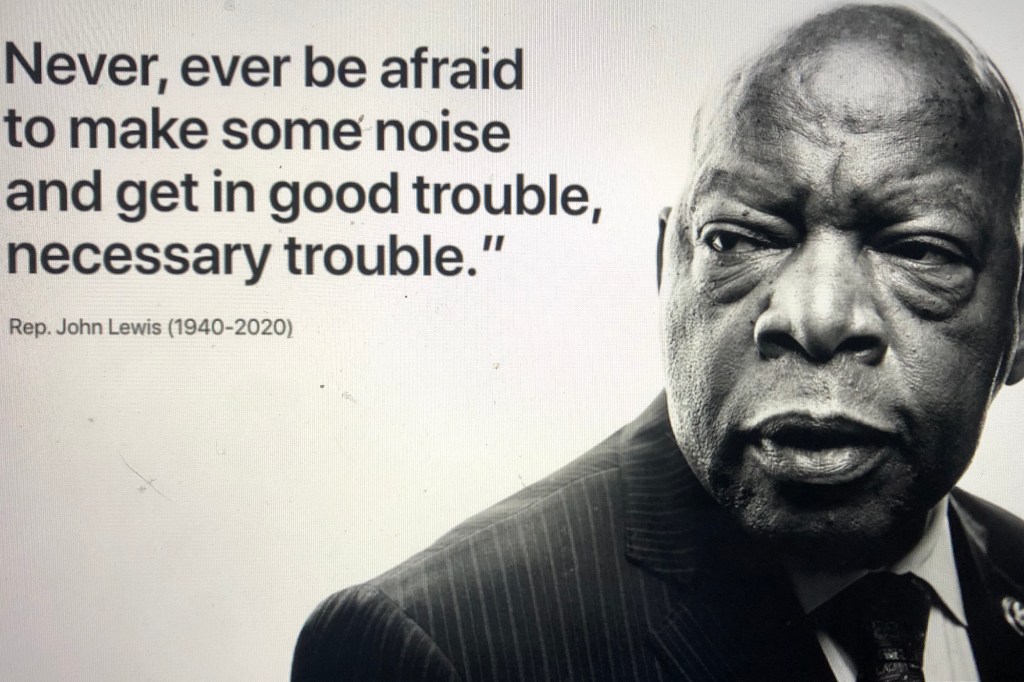
Image taken from Apple.com

Moral clarity. Those were the words that came to mind when I learned that Rep. John Lewis had died. He had a moral compass and followed it. I asked my husband, “Is that a rare quality?” Gary thought about it for a bit and said, “I don’t know.” “It sure seems like it is,” I responded.

I can’t help but compare our current president, who clearly doesn’t have a moral molecule in his heartless body, to John Lewis. There is no comparison. In fact, I can’t bring myself to type Trump’s name in the same sentence.

 After thinking for a bit, Gary looked at me, “You have moral clarity.”

“Really?”

Wow, that’s a major compliment. I thanked him but know that I am not in the same category – it is embarrassing to even write this. My family gives me more credit than I deserve for doing the right thing. I fall short often.

Thinking about John Lewis’s life I can’t help but be awed by his courage, consistency and vision. If I have moral clarity, I have not come close to living it in the way that he did. Some people live big lives. John Lewis did.  Why? What is the difference between those that lead on a national or international stage and those that don’t. I’m thinking it is a combination of having a compelling vision, a willingness to step up, a calling to shoulder responsibility, and seizing the opportunity to act.

Maybe the truth is that we all have opportunities to act, and either we don’t step up or we try and fail. Perhaps we don’t have the courage required to put ourselves on the line  – there is so much to fear, from losing a job to physical harm. Or maybe we try but don’t have the leadership qualities that inspire others, or maybe we don’t offer a message that resonates. It is amazing to think that John Lewis was 23 when he spoke at the March on Washington in 1963. So young and to already have ascended to that height! His willingness to put his body – his very life – on the line by participating in the Freedom Rides and the protests in Selma, among other activities, is awe inspiring.

I’m trying to think of times I have been in the presence of someone who had that kind of vision, determination and integrity. I can’t think of any. I can think of times I saw a speech on television that moved me. Mario Cuomo’s and Barack Obama’s convention speeches come to mind. But, again, that is different than a Black man sitting at a ‘Whites Only’ lunch counter and waiting for the painful consequences. Taking action is a different animal than soaring oratory. We need both to stir change. John Lewis did both – he used words and actions.

I think about my father who had a very strong sense of right and wrong and he communicated that in no uncertain terms to his children. The three of us benefitted from the clarity of his vision. He was a chapter chair in the teachers’ union and walked the picket line in New York City as a teacher in the 1960s, but he didn’t march on Washington or go to other protests. I wish I could talk to him about his choices. I’m not judging him – he lived an admirable life. I do wonder what he would say about leadership and courage, especially in this moment when both seem to be in such short supply.

We are living at a time where there is a paucity of leadership on the national level, certainly a lack of leadership that embraces an ethical code. We have a leader – we have a president. But he is so devoid of values, he has failed us miserably during this pandemic (and in addressing the systemic inequalities that the pandemic has made glaringly obvious).

I miss John Lewis already. Knowing his voice was out there gave me comfort. I know there are people doing good work, courageous work, trying to steer this country in a healthier direction. I hope leaders emerge who can bring us together. I am keeping an eye out for them.

History

440E6530-A285-47D2-ADD3-D911AE7B67C2_1_201_a
Image from JB Shreve and the End of History

What is history? The first time I realized that the word could be broken up as ‘his’ ‘story,’ it was a revelation. Most of what we learned in school was the story of men, of particular men, those in power. One could argue that telling the story of the powerful is appropriate – after all they made the rules, they shaped the future. At least more so than ‘ordinary’ people. If we are studying the founding of America, learning about Washington and Jefferson is imperative. But, of course, that doesn’t tell the full story. Telling the full story is complicated.

So many things go into defining history. First, who is writing or telling the story? Who chooses what is included in the curriculum? Until relatively recently, historians were mostly male and mostly white. While in theory facts are facts (although in TrumpWorld perhaps we have moved into a ‘post-factual’ period), we know that making connections and analyzing information are colored by the biases and assumptions we bring to it. Our understanding is broadened and deepened when a range of perspectives are brought to bear on a topic.

It becomes a matter of balance – history can’t solely be the domain of the privileged. But, we don’t have unlimited time, even if we take into account that we send children to school for 12 years, time is short. Choices are made. It is hard to pack in all the history we want our citizens to know and provide them with a global perspective, too. When I was in elementary school in New York City in the late ‘60s and early ‘70s, we were taught American history by highlighting the contributions of every different group that made up our country (maybe not every different group). We learned about Crispus Attucks, Haym Salomon, Baron Von Steuben,  Tadeus Kościuszko, Marquis de Lafayette – I came away proud that so many different people, representing different ethnicities and backgrounds, contributed. We learned about Washington, Jefferson, Franklin, etc., too. The message I took home was that the Revolution was a noble cause, with many contributors.

Looking back, I recognize that there were gaping holes and many things were romanticized. When the values that inspired the American Revolution were taught, the fact that women, Native Americans and Blacks were deliberately left out of the vision of life, liberty and the pursuit of happiness was not given much attention – more of a passing mention. It wasn’t until 11th grade that I learned about our treatment of indigenous people – the deliberate spreading of smallpox via blankets, for example. My children spent a great deal of time in elementary school learning about the native people of New York State – changes in curriculum were made. I don’t know if they learned about the different contributors to the Revolution, as I did. I’m not suggesting there is necessarily a trade-off, I don’t know.

In talking with friends, even friends who were in school with me, not everyone remembers learning the same stuff I recall. I was interested so I paid attention. How does that factor into all of this? Sometimes when I hear criticisms of our education because some subjects weren’t included, I think to myself, but I remember learning about that. Which brings me back to my first point – what is history and who is telling it? Perhaps we can dig up the approved curriculum for 4th grade social studies in New York City in 1968, but that may or may not be what was taught in a given classroom. And, my friend may have been absent the day we learned about Crispus Attucks.

In my limited experience doing research for this blog, I have found it challenging to settle on a ‘truth’ about events. Some are small events, like when Cutie the cat leapt out of the car window. My family agrees that it happened, but not how or why. In a more serious example, when I researched the murder of my paternal grandfather’s family in Poland by the Nazis, the specifics were hard to get a handle on. The fact of their death was indisputable, but where and how many were killed, was hard to establish. It opened my eyes to the difficulty of uncovering history and how it gets reported.

Another question is: who or what is being written about? What resources were available to reconstruct events? Could my blog constitute ‘history?’ Many of my essays are memoir, recounting experiences from 50 or more years ago, or incidents from last week. Diaries and letters are great but need context and corroboration. I don’t imagine that Donald Trump keeps a diary or writes letters, but if he did, he would hardly be a reliable source. What will history have to say about him?

You may be wondering, where am I going with this? I think these questions are central to what we are going through as a country today. We are coming to grips with a fuller picture of our history. We are raising questions about the lessons we were taught. Some feel threatened by that questioning.

We are also addressing the role of monuments and museums in the telling of that history. We are recognizing that our understanding of history evolves and then what do we do with those monuments and museums? Some might argue that our history is being rewritten and resent it because it feels like sand is shifting beneath our feet.  But it is always being rewritten – there continues to be scholarship about the fall of the Roman Empire. It is right that it is rewritten and rewritten again. No doubt it can be unsettling, but it is necessary for our growth.

This doesn’t mean that I don’t believe in history, or that we should cast aside all that we learned. But, I do think, like with most things, we need to read critically, ask questions and be open to new interpretations.

I come back to a quote from Maya Angelou, “Do the best you can until you know better. Then when you know better, do better.” I think that applies to where we are now. I think we all need to be on a quest in our lives to know better, so we can do better.

The Education of an Idealist: A Book Review

I recently read The Education of an Idealist by Samantha Power. To remind you, she was U.N. ambassador representing the United States during Obama’s second term as President. Prior to that she worked in his administration on the National Security Council. Hers is an interesting story. She was born in Ireland and lived there until her mother, unable to access a divorce in Ireland, took her two children and immigrated to America. Power’s and her mother’s journey is worth reading about. Not surprisingly, the issues raised in the book have spurred questions for me.

Some observations after reading the book:

It seems that immigrants have a clearer understanding of this country’s founding principles than many native-born Americans. Samantha Power and her family are examples of that. Fiona Hill and Alexander Vindman, NSC officials who testified in the House impeachment hearing, are two more examples.

Many of the events Power describes happened only four or five years ago, but I barely remember them. Or, more accurately, I remember the incident (for example, Assad gassing his own people in Syria or the killing of U.S. embassy staff in Benghazi) but have forgotten the specifics – if I ever knew them. It makes me wonder if it is information overload or a short attention span or not paying attention in the first place. Whatever the case, it is disturbing because how will we learn from these events if it all becomes an incomprehensible jumble swept under the rug.

As a person who has grappled with the causes and lasting impacts of the Holocaust, I was surprised to learn that Power made a name for herself by researching and writing a book about genocides in history (‘A Problem from Hell’ America in the Age of Genocide).  I will look for it next time I’m at the library. She was a reporter covering Bosnia in the 1990s and viewed her role as bringing the war crimes there to light so that the world would respond. I have always appreciated the importance of journalists educating us about events in far flung places, but this renewed my understanding of how crucial the press is. They may get things wrong or not tell a complete story but having eyes and ears on the ground is essential.

Reading about our conflicts with Russia, over its invasion of Ukraine and Assad’s actions in Syria, which Power had direct experience with at the U.N., brought into sharp relief the differences in values between our two countries. I studied Russian history (Soviet history at the time) when I was in college. I have some understanding of their single-minded concern with national security and their view of the world as an ‘us against them’ equation. They also have no legacy of democracy so when the Soviet Union crumbled it didn’t have a democratic tradition to call upon. Human rights never enter the equation for them. In the Russian scheme of things, what a country does in pursuit of its interests is not subject to any limitations – they don’t appear to apply a moral compass to the behavior of themselves or other nations. Power recounts her negotiations with Russia’s ambassador and those interactions illustrate very clearly that they are not our ally. We need to coexist with them, and we need to find opportunities to cooperate, but we cannot be confused about who they are. This reality makes Trump’s respect and affinity for Putin that much more frightening.

Another point that is driven home in the book is the power of politics. According to Power’s narrative, much of our country’s government action or inaction in foreign affairs is driven by perceptions of opinions/support of Congress, which, in turn, is driven both by their polling of their constituents and the influence of special interests. For example, Power describes Obama’s failure to act when Assad crossed the ‘red line’ in using chemical weapons, as mostly a political calculation based on lack of Congressional support for an air strike and fears of long-term engagement. After reading her analysis, in which she supported a military strike, I came away thinking that this was a failure of leadership on Obama’s part, but I have a better understanding of the factors that led to his inaction.

The notion of polling constituents or relying on phone calls/emails from constituents to gauge public opinion, raises a bunch of questions, some of which I thought quite a lot about when I was a school board member. The issues I faced were thankfully not life and death, but the fundamental question was the same: is my role as a representative to poll my constituents and vote accordingly; or is it to use my best judgment based on the information I have (which the public may not have) and apply my values to that data? Both paths are fraught. If I take the first approach, do I really know how my constituents feel? How many have I heard from and is it just the squeaky wheels? Do I poll on every issue, knowing that polling is not a perfect science?

If I choose the second approach, using my judgment, then I may be limited by the information I have and those who have provided it likely have an agenda. In the case of Congress, a lot of the information they rely on is supplied by special interests.

Whichever approach an elected official takes, representative democracy is flawed in some respects.

In my school board service, I generally went with the second approach. We didn’t do polling at that time, and I would have had some issues with it if we did. For me, it comes down to information, facts, data, analysis. If I could pull from different perspectives and look at data, I thought my decision-making would be stronger than basing it on a poll. Ultimately, the community would have their say in the most important poll – the voting booth. If they didn’t like where I came down on the issues, they would vote me out. Of course, I wasn’t terribly concerned about being voted out of a volunteer position. The challenge of taking my approach, relying on the data and applying one’s values, is that these days no one can seem to agree on a common set of facts or data. To make matters worse, there are those who benefit from exploiting the cynicism about science/data. At some point, we need to evaluate the information to assess its credibility and then trust in something!

So as not to leave you on a downer, I will share an example of the positive power of politics from the book. As Power describes the efforts to control and thwart the Ebola epidemic in West Africa a few years ago, the United States had the political will and resources to lead the way in addressing a terrifying public health emergency. This seemed to be a case where the data and science were believed, and political leaders overcame fear to do what needed to be done. One can only hope this problem-solving model can become the norm.

If you are interested in recent political history, and want to consider how values fit into public policy, I recommend reading The Education of an Idealist by Samantha Power. By the way, I am not the only one recommending the book. It appeared on President Obama’s year-end list, too.


Patriotism

All through elementary school we began our day by reciting the pledge of allegiance. I recall standing, facing the flag, hand over my heart, earnestly saying the words with my classmates.

“I pledge allegiance to the flag of the United States of America,

And to the Republic for which it stands,

One nation, under God, indivisible,

With liberty and justice for all.”

I said those words with pride. As I got older, it became a rote exercise. By the time I was in high school, in the early 1970s, it was hard to hear the words over the general din in homeroom.

The process of it losing my attention, and apparently my classmates’, too, might have been a function of our age. Or it may have reflected something else – a change in our country as a whole.

Two things made me think about this. First was the controversy over Megan Rapinoe, the women’s soccer player who got called out by President Trump for not singing the national anthem. The second thing is that the 4th of July is upon us, a good time to reflect on patriotism.

Over the years a lot of athletes have stirred controversy by their behavior during the national anthem. The first roiling I recall was when John Carlos and Tommie Smith raised their gloved fists in Black Power salutes at the 1968 Olympics in Mexico City. That touched off a firestorm. I was only 8 at the time, but I remember being upset by it. I think what disturbed me most was that it was detracting from the competition. I loved the Olympics, I loved it when Americans won an event, and I felt pride hearing our anthem played in the stadium. It reinforced that we were the good guys – and it was the Cold War, after all. I didn’t want Carlos and Smith to upset the applecart.

But, even at 8 years of age, I stopped to think about why they were doing it. They were making a statement and I felt it was important to try to understand it. They were calling attention to the fact that Black Americans were not being treated equally at home. It was hard to deny that truth. The athletes felt they had to use their platform literally and figuratively. They paid for their actions – they were kicked out of the Olympic Village and banned from the rest of the games. They also received death threats. One can only imagine what might have happened if this occurred in the age of the 24/7 news cycle and social media frenzies.

The idea that our country was falling short of its foundational values became more evident to me as the years rolled on. The Vietnam War and Watergate took their toll on my faith; they were stains on our nation’s history.

I don’t want to suggest that I didn’t feel pride in being an American – I did and do. But it is tempered by an awareness that we haven’t always met our own standards. We need people like Megan Rapinoe and Colin Kaepernick to keep us accountable. They raise legitimate issues. We can disagree with them. We can think that they are wrong. But they should be seen and heard.

I came to my own conclusion about the pledge of allegiance. When I became a school board member in 1997, I took an oath of office. It was simple and said the following:

“I do solemnly swear (or affirm) that I will support the Constitution of the United States and the Constitution of the State of New York, and that I will faithfully discharge the duties of office of school board member of the Guilderland Central School District according to the best of my ability.”

I recited and signed that statement with honor and seriousness of purpose. I thought about my responsibility to the U.S. and New York State Constitutions, and to the students and members of my school community. I kept that in the forefront of my mind during the nine years I served. But, I stopped saying the pledge of allegiance.

It was our practice, and I believe it is the custom of most school boards, to begin meetings with the pledge. I stood up out of respect for my colleagues and the audience, but I didn’t put my hand over my heart, and I didn’t repeat the words. I had two reasons. First, I felt uncomfortable pledging allegiance to the flag. The flag is a symbol. I wouldn’t desecrate it, but I didn’t want to take an oath to it. I think it is beautiful waving against a clear blue sky, but my allegiance isn’t to the flag itself. If the pledge only said, “I pledge allegiance to the United States of America,” that would be fine. I recognize the value of symbols, but we shouldn’t confuse a representation with the actual thing that we venerate. Sometimes I think the flag itself becomes more important than the values it represents.

My second objection was the phrase “under God,” which was added in 1954. I’m not an atheist exactly, I’ll call myself a doubter. Given that I grew up believing that one of the great pillars of our country was the separation of church and state, I don’t think those words belong. So, I simply stopped reciting it.

Funny thing is that for all the years that I didn’t say the pledge, no one noticed! The meetings were televised locally. We were covered by a local reporter. No one ever asked. I wasn’t interested in calling attention to myself, so I didn’t make a point of it. I made a personal choice. I wonder if it had been noticed, if it would have become a “thing.”

I wish people wouldn’t get so angry when celebrities or regular people make these kinds of gestures. Why can’t they be noted, and then people make their own determination as to whether they agree or not. If you don’t like Megan Rapinoe because of her behavior or her values, that’s fine. But we don’t need the vitriol – how did we get to death threats so quickly? We have enough real problems to deal with, we don’t need to dwell on whether someone didn’t sing or if they knelt during the national anthem.

As we celebrate the 4th of July, I hope we think about the values that are the foundation of this country as expressed in that pledge: liberty and justice for all. These are still aspirational goals that I readily embrace and work towards achieving. We can and should enjoy the symbols: our majestic flag, the fireworks, the patriotic music, the hot dogs and beer. But let’s keep our eyes on the prize.

fullsizeoutput_fe2
A house in my neighborhood – ready to celebrate the Fourth of July

Going to Extremes

It may not be readily apparent why I am spending so much time writing about the events in Ocean Hill-Brownsville. But, 50 years later, there is much to be learned, especially since we find ourselves still struggling with some of the fault lines exposed during that conflict. The strike touched on racism, anti-Semitism, and education policy (the role of community in school management, the value of multiculturalism in curriculum, student discipline and the professionalism of teachers). Each of these topics resonates with me and are actively debated today. We need to learn from our history; the strike and its aftermath are rich with lessons.

J4CisY0LT5SnkqUMjX0vYg
Photo credit unknown — reprinted in Jacobin. Police blocked entry to the school building at one point during the conflict. 

One of the tragedies of the Ocean Hill-Brownsville teachers’ strike was that it marked a serious deterioration in the relationship between African-Americans and Jewish-Americans in New York City. The two groups, through the early 1960s, were allies in the civil rights movement. The strike either created or revealed a schism.

I grew up feeling a connection to African-Americans. Because of my own people’s history, I identified with their struggle against persecution. My parents were believers in equal rights and opportunities. I never heard a racial or ethnic slur from either my mom or dad. Thinking back on it, I know they weren’t perfect, they were a product of their time and place, so I’m sure they had their prejudices, but that would have been the product of ignorance. They were life-long learners, and as they understood more, their thinking evolved. The strike and the emergence of the Black Power movement tested them.

My mother was teaching in a parochial school at the time of the strike. She was employed by the New York City Board of Education as a Title I teacher, a corrective reading specialist, but assigned to Catholic schools and yeshivas, depending on the year. Since the parochial schools were not affected by the strike, she continued to go to work, she didn’t have to cross a picket line. She remembers the time as being rife with tension, though. She taught in a neighborhood not far from Ocean-Hill Brownsville and took a subway line that travelled through there to get to work. She remembers a change in the air, she felt self-conscious on the subway as one of the few white people and previously she had not. Between the riots in cities around the country, and the friction of the strike, she felt the anxiety of the time.

My father, a social studies teacher in a NYC high school, walked the picket line. I recall him coming home and expressing anger with the leadership of Ocean Hill-Brownsville. I remember some of the names he mentioned, telling my mother of the latest inflammatory rhetoric from Sonny Carson and Rhody McCoy. Listening to the panelists at the Brooklyn Historical Society, it sounded like either the incendiary messages weren’t uttered, were overemphasized or misunderstood. It occurred to me that perhaps my father wasn’t as open-minded as I thought.

Now reading about the events, I see a fuller picture. My research revealed a number of interesting pieces.

One of the flashpoints during the strike was the assertion that the Ocean Hill-Brownsville community was anti-Semitic. As I noted in a previous post, the panelists contended that Al Shanker, the union president, was largely responsible for stoking the issue. Two of the three panelists, Ms. Edwards and Mr. Isaacs, refuted the claim that there was anti-Semitism in the community. Hearing that, I was incredulous; there is anti-Semitism in every community, just as there is racism. The degree of it, how close it is to the surface, may vary, but to deny its existence struck me as disingenuous.

Unless I misunderstood his point, Mr. Isaacs said it was the union that produced and distributed literature that included anti-Semitic language and images. I found that charge hard to believe. I could imagine that Shanker would want to consolidate his position by, as we might say today, riling up his base, but it didn’t ring true that he would go so far as to create the pamphlets.

I read news accounts, journal articles, recent scholarship and books, so much has been written about the strike. I learned that was that there was an anonymous anti-Semitic letter circulated in the junior high school in Ocean Hill-Brownsville at the time. The letter said:

‘If African-American History and Culture is to be taught to our Black Children it Must be done by African-Americans Who Identify With And Understand The Problem. It is Impossible For the Middle East Murderers of Colored People to Possibly Bring to This Important Task the Insight, The Concern, The Exposing of the Truth that is a Must If The Years of Brainwashing and Self-Hatred That Has Been Taught to Our Black Children by These Blood-sucking Exploiters and Murderers Is To Be Overcome.’

McCoy and the local Board denounced the letter. The union reprinted it, 5000 copies, as part of a leaflet which asked if this was acceptable; in effect publicizing it. Some might say Shanker exploited it.

I don’t know how strongly the African-American leadership disavowed the letter and its sentiments. I can only imagine how hurtful those thoughts would be to someone like my father. Was Mr. Isaacs suggesting that Shanker actually composed and planted the original letter, or was he criticizing the tactic of publicizing it?

It was not the only evidence of anti-Semitism. A teacher in the district read a poem by a student on WBAI, an African-American radio station in the city, called “To Albert Shanker: Anti-Seimitism.”

Hey Jew boy with that yarmulke on your head

You pale faced Jew boy I wish you were dead…

            Jew boy you took my religion and adopted it for you

            But you know that black people were the original Hebrews

            When the UN made Israel a free, independent state

            Little four and five-year-old boys threw hand grenades

            They hated the black Arab with all their might

            And you, Jew boy, said it was alright

            And then you came to America the land of the free

            Took over the school system to perpetuate white supremacy

            Cause you know, Jew boy, there’s only one reason you made it

            You had a clean white face colorless and faded.

When interviewed twenty years after the fact, the teacher had no regrets about reading the poem on the air. He said it was “raw,” but otherwise didn’t see a problem with it.

Unfortunately, there are people in the world who would write that letter and that poem today.

I come away from the panel discussion and my subsequent research believing that everyone shared responsibility for stoking racial and ethnic tensions. The Ocean Hill-Brownsville leadership was unwilling to distance itself from the extremists or troublemakers in their midst. Judging by the statements made by the panelists they still don’t acknowledge the damage done by the anti-Semitic communications. It may be true that the letter and poem didn’t represent the majority of the community. But, think of it this way:  if a single noose was to appear in a school locker, it would not be sufficient if school officials disavowed the symbolism, explained that it didn’t represent the opinion of the majority and left it at that. We would expect more, and rightly so.

It is true that the demographic of the replacement teachers was similar to those that were terminated – the majority were white and Jewish. That would support the idea that McCoy and the Board weren’t blindly anti-Semitic. But, that doesn’t address the hurt and fear engendered by the other events. The hiring of the replacements represented other problems from the union perspective (an issue I will discuss in more depth in my next blog post).

The union leadership, on the other hand, focused on those extremists to the exclusion of other legitimate concerns. There were issues with the quality of the teaching, with the atmosphere of the schools that did not welcome parental involvement and that didn’t include African-American and Puerto Rican contributions in the curriculum. And, the main point, the main issue at the heart of everything, was the problem of poor academic performance. By keeping their rhetoric focused on the hateful messages, the union didn’t appear to be willing to engage on the problems that were at the heart of the community’s anger.

There are parallels to how we engage in political discourse today. People are quick to point to the outrageous claims, or the hateful rhetoric, from the ‘other side.’ While I see the merit in bringing attention to discriminatory acts, they should not be swept under the rug, I think we go too far. The extremes get distorted and end up having more influence than they deserve. I don’t know how we reclaim some balance, but we need to give more careful thought to what we emphasize. We need to be more focused on problem-solving and substance.

A Summing Up

What is left to tell? Paula and David began their life together in Queens, New York. David continued working at the pickle factory. Paula was a homemaker and managed their finances. She was very frugal and even with David’s modest earnings, they were able to put away some money. Eventually they bought a car, and a few years after that (in 1963), they were able to buy a house in Rosedale, Queens. Rosedale bordered Nassau County, Long Island and had the look and feel of a suburban neighborhood, even though it was in the New York City limits.

QmWOeXAiThuxXtCUpOrQRA
The Bakst house in Rosedale, pictured in 2018. Photo captured from GoogleMaps. David sold the house in 1990 (give or take a year).

Their oldest child, Rochelle, arrived 18 months into their marriage. Paula’s mother and sister, Lea and Sofia, flew up from Cuba to meet the newest generation of their family. Four years after that, in 1956, Paula and David’s first son, Steven, was born. Lea and Sofia came north again, this time on permanent visas. They stayed and lived with David and Paula. It was tight quarters, six of them, in their small apartment with one bathroom, but it was nothing they couldn’t manage given all that they had been through.

Gary arrived in 1959 and was the baby of the family for 8 years, until Doreen entered the picture. Now the Bakst family was complete. David, as he envisioned when he spoke to Uncle Nachum years earlier, moved up to become the general manager of the food distribution company that the pickle business grew into.

In their early years in New York, David and Paula attended night school to learn English and, in time, they became United States citizens. They straddled two worlds. They were a product of their Eastern European shtetl childhoods, a world that had been destroyed by the Nazis, and they bore the scars of that trauma, and now they were trying to fit into the modern American society of the 1950s and 1960s. They embraced much of what America offered, but were also anxious about their ability to understand American institutions. They continued to seek out the company of family and friends that shared their shtetl experience. The generation gap, a common experience of that era, was alive and well in the Bakst household.

Not too long after her arrival, Sofia met and married Marvin Bressler, and began her own family. The Bresslers also settled in Rosedale. They had three children, a girl and two boys.

Lea continued to live with Paula and David, until her death, of a brain tumor, in 1973. She was 80 years old. She was the only grandparent the Bakst children would know.

Bernie didn’t leave Cuba until after the communist revolution in 1959. He was a businessman enjoying his life in Havana, and in the immediate aftermath of the overthrow of the Batista government, Bernie made a lot of money. With some reluctance, he, along with Nachum, Bushe, Solomon and Mary, left for Florida. The aunts and uncles, and their children, settled in North Miami Beach, a community of Cuban-Jewish exiles. Over the years, Paula and David would visit when they could. Nachum lived a long life, well into his nineties.

Bernie eventually moved further north and became a successful businessman, marrying, and starting a family in Woodmere, on Long Island (a short distance from Rosedale). He and his wife had two children.

As a result of their extended time in Cuba, Bernie and Sofia, in particular, developed an affinity for its culture and maintained a connection with it throughout their lives. As part of his business in America, Bernie owned a warehouse in Union City, New Jersey (a community with a lot of Cuban immigrants). Gary worked there a couple of summers and has vivid memories of the experience. Gary commuted from Rosedale to Jersey, with his uncle. Bernie drove like a maniac, waiting until the last minute to dart across three lanes of traffic to get to the exit of the highway. And, Bernie would play a game with the tolls at the bridges, tossing one coin at a time, hoping the wooden arm would go up before the full fare was paid. Bernie employed a number of Cuban men at the warehouse. Gary remembers the men cooking a communal lunch, pork spiced with garlic, pepper, onion and coriander, as well as the smell of strong coffee. Gary also picked up some Spanish words that weren’t taught in high school.

David’s sister, Batya, lived in Israel for 7 years, with Fishel and their daughter Rochelle. Batya left Israel and came to the United States to get a divorce (she wasn’t able to get a divorce in Israel). She lived with David and Paula while she waited for it to go through. After a year, Rochelle joined her mom in New York. Though Batya regretted leaving Israel, she felt she had no choice. In time, she remarried and had a son, Ben, and she became an educator. She and her family lived blocks away from the Baksts in Rosedale.

Batya carried her own brutal memories, one of which she shared in a speech she delivered at the Rosedale Jewish Center, where she was being honored as a woman of valor. With her children, Rochelle and Ben, in the audience, Batya recounted her time in the work camp (the one she was miraculously rescued from by the Iskra Partisan Brigade). She told of one particularly horrific experience. She was walking across the camp compound and she heard a slight thud and a small mew as a piece of balled up laundry fell to the ground nearby. Batya didn’t see who had dropped it and thought it might be a kitten so she bent down to see what was in the bunched-up fabric. She found an almost newborn baby girl, barely alive, seemingly frozen. Without thinking, Batya quickly scooped her up, held the bundle to her chest and hurried to her bunk. She tried to warm the baby. Over the next day or so, Batya smuggled water and milk and fed her as best she could. She seemed to be reviving, and Batya named her Ilana. She didn’t know what she was going to do with her, she was just going from moment to moment trying to protect the baby. At one point, much to Batya’s distress, Ilana started to cry, bringing a German soldier to investigate. The soldier grabbed the baby, and to Batya’s everlasting horror, he plunged a bayonet into her. Batya shared this memory from the bemah in the synagogue. It was the first Ben, who was about 14 at the time, had heard the story. Though he knew his mother had endured suffering during the Holocaust, he didn’t know the depth of her anguish until then. Batya died of a rare type of cancer in 1982, she was 57 years old. Her daughter, Rochelle, lovingly cared for her in her final days. When Ben became a father himself, he and his wife named one of their sons after Ilana.

Paula and David didn’t often speak of their wartime experiences with their children. For the older children, Rochelle and Steven, the impact of the trauma was more apparent. Paula was still having nightmares when Rochelle was young. Gary and Doreen were more removed from it, as Paula and David healed and as their economic circumstances improved. All four of the children, though, were acutely aware of the legacy they carried.

Out of the ashes of the destruction of Ivye and Sernicki, new generations took root in America. The Baksts and Silberfarbs had 11 children, who in turn had 15 grandchildren and, to date, two great-grandchildren.

Laura Bakst: A Granddaughter’s Journey

Note: One of the greatest sources of pride and joy for Paula and David are their four grandchildren, each accomplished in their own right. Laura, third oldest and the daughter of Gary’s brother, was kind enough to contribute this piece. 

Nearly five years ago, I made my way across rural Germany to visit my great-grandfather’s grave. While the trip itself took only a few days the process started months earlier in New York, when my Poppy (grandfather) presented me with a disintegrating photograph of his father’s tombstone and the knowledge that it was located in a Jewish cemetery near Kassel, Germany.  I could tell that at the age of ninety Poppy was still haunted by not knowing what came of the grave that he last saw over sixty years ago. I also knew that given my upcoming travels to Israel and Europe it was likely the only opportunity I’d have to locate the grave in the near future, and possibly in his lifetime.

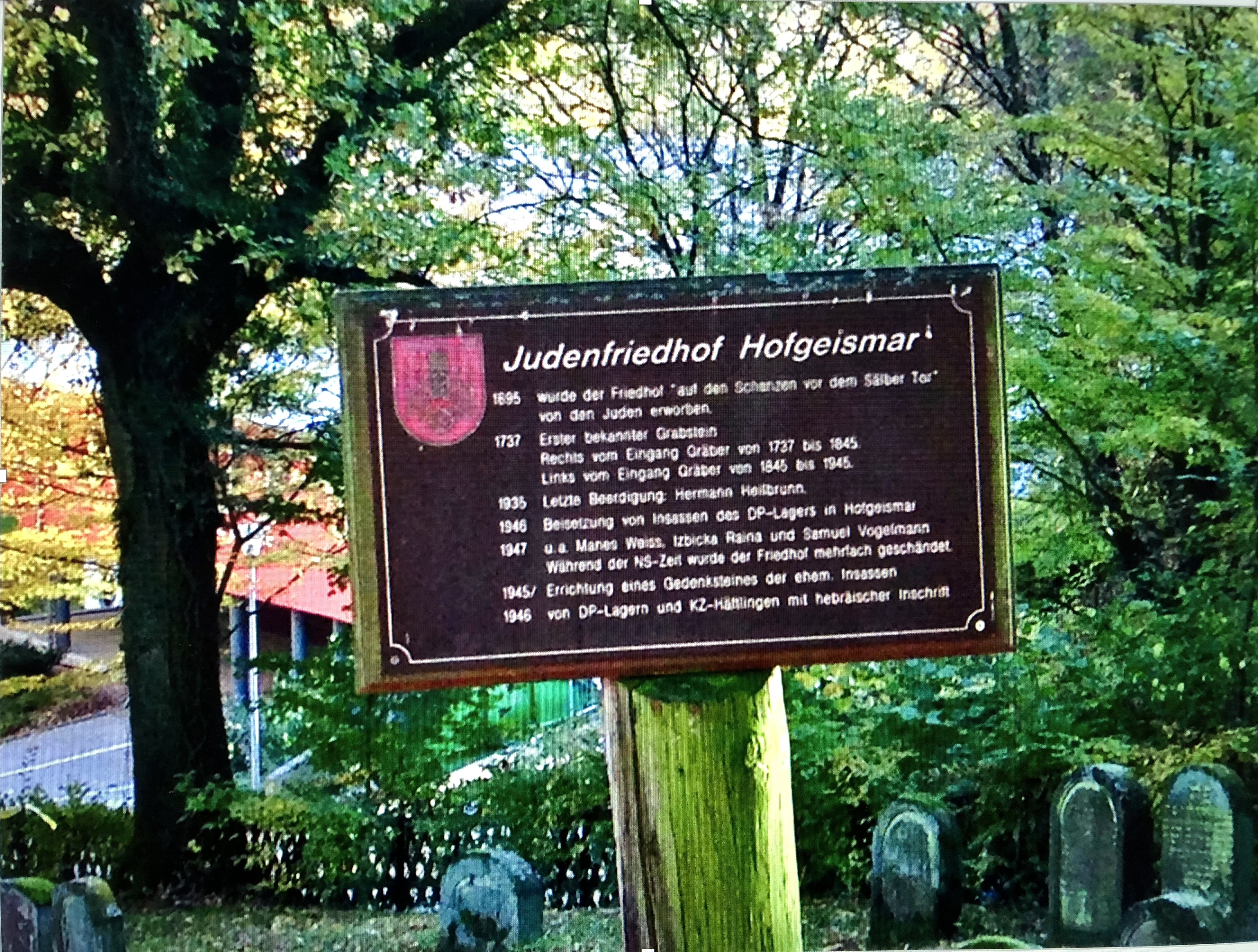
Over the next few months I sifted through archives, including multiple visits to Yad Vashem (Israel’s holocaust museum), attempting to find records on my great-grandfather.  Eventually I stumbled upon a German database of abandoned Jewish cemeteries. With the aid of Google Translate, I managed to obtain location information for a gravestone that appeared identical to the one in my grandfather’s photograph. It was in a cemetery in Hofgeismar, a small town in Northern Germany.

Fortunately, it was relatively easy to tack on a detour to Hofgeismar between trips with friends to Berlin and Amsterdam. Nevertheless, I was still nervous to be traveling across Germany on my own; I was the first in my family to return to the country since WWII, did not speak the language, and was traveling in areas not frequented by tourists. Fortunately, the kindness of others made the process a bit easier: I had made a few German friends while I was studying in Dublin who helped me book trains. Julia, a woman who volunteered at the Jewish Museum in Hofgeismar, was generous enough to not only respond to my cold-email inquiring about the cemetery, but also coordinate my entire itinerary for the day in Hofgeismar (unfortunately I was not able to meet her in person as she was traveling for a conference in Israel at the time).

Around 6:45am on a brisk October morning, I left my friends in Berlin and anxiously entered a metro station. True to Germany’s reputation, the four separate trains I took were impressively prompt. After making it to Hofgeismar, I met Mr. Burmeister, the Jewish Museum’s director, who drove me to the cemetery.

fullsizeoutput_794

I didn’t really know what to expect, but I recall being surprised by the beauty of the place. Though obviously aged by the elements, the gravestone was completely intact, with the inscription still easily readable.

fullsizeoutput_795

The small cemetery was in a lovely location, overlooking gorgeous valleys and blanketed by colorful leaves.

fullsizeoutput_798

Following the Jewish tradition, I left several stones on behalf of my family on the gravestone. Across from my great-grandfather’s grave there was a small hill, below which a number of stones from the 1800s once stood. Unfortunately, they were destroyed during WWII (the cemetery houses Jews from after the war and pre-1936), so Mr. Burmeister showed me the memorial stone erected in their memory the prior year (2012).

Mr. Burmeister gave me a tour of the small but substantial Jewish museum, in which we had an interesting conversation about the Jewish history in Hofgeismar and his interest in the subject as a non-Jew. While there are no longer any Jews in Hofgeismar, before the War it was home to one of the highest percentages of Jews in Germany (10%).

iq8%AtghSM+mXOlhooBd2w

Julia’s friend, Gabriele also showed me around Hofgeismar. We walked down to where the community temple once stood, now destroyed. We also drove through where the displaced persons camp used to be, the same camp that my grandfather stayed in after my great-grandfather died from surgical complications. The grounds are now being used for a school and police station.  The town center was exactly as I’d have pictured it, with lovely sculptures and traditional German buildings.

fullsizeoutput_799.jpeg

Gabrielle pointed out some of the homes where Jews once lived, in front of which small metal squares note their names, dates of birth and death, and what occurred to them during the war. I remembered seeing similar stones in Berlin, and Julia explained that they are becoming more common as people are more open to uncovering that their homes may have been taken from Jews.

fullsizeoutput_79a

While the entire trip was extremely meaningful, what struck me the most was how seriously modern-Germany takes addressing its history. Unlike in America, it’s illegal to deny the Holocaust, display Nazi symbols, or otherwise incite hatred based on religion or ethnicity. All schools deeply educate students about the Holocaust, leaving my German peers more knowledgeable about it than me. People like Mr. Burmeister and Julia chose to dedicate their time to preserving the Jewish history in a small, now Jew-less town. Mr. Burmeister’s parents had no familial connection to Judaism, but rather his interest in the subject was peaked as a schoolboy studying German history. A teacher from a neighboring town told me how she believed it was important to expose her students to Jewish culture early on, bringing her class of 8-10 year olds to the Hofgeismar Jewish cemetery and Museum for a three-day workshop. Through tears she explained that she educates others about Nazism because her daughter has a disability and likely would have been killed had she been living during WWII.

Note: Laura is quite correct in saying that David was haunted by never having gone back to see his father’s grave. In going through the effort of locating and visiting the site, Laura did a mitzvah (good deed) that brought her grandfather comfort. Thank you, Laura, for doing that and for sharing this story on my blog.