We didn’t see my paternal grandparents that often when I was growing up, especially compared to my maternal ones. Of course, it would be difficult to do that since we were basically living with Nana and Zada, while Grandma and Grandpa lived on the other side of Brooklyn. They didn’t drive and Canarsie was very inconvenient to get to by public transportation, so it was up to my Dad to drive us to visit. Dad had a strained relationship with them, but my mother believed that family connections needed to be nurtured. It was at her insistence that we visited them once a month.
They lived in an apartment on Prospect Park West. The huge park by the same name was right across the street from their building. We didn’t often venture into the park. On those few occasions when we did, we found the ground littered with shards of beer bottles, cracked pavement and only one working swing. Instead we amused ourselves inside, sitting next to the window counting cars by color or model, or watching TV. Grandma worried that we’d hurt ourselves on the marble coffee table in the living room so fooling around was kept to a minimum.
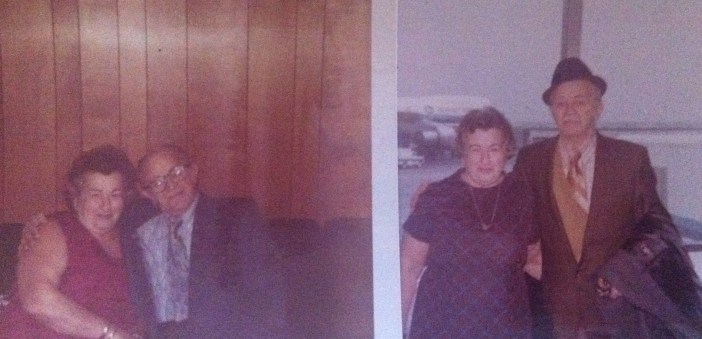
Grandpa sat in a club chair in the living room, reading the Forward (the Yiddish language daily newspaper) and smoking a cigar. He wore glasses and a hearing aid; even with that he didn’t hear very well. He didn’t initiate much conversation, but it was clear from his smile that he was delighted to see us. Grandpa was mostly bald and maintained a carefully groomed moustache, and overall appearance. Between his accent and manner, he offered a stark contrast to Zada. Zada was a storyteller and bon vivant. Zada was comfortable chatting with his grandchildren (or other visitors, for that matter) wearing only his boxer shorts and sleeveless t-shirt, sitting at the kitchen table having a meal in that state of undress. On the occasions that we slept over at Grandma and Grandpa’s, Grandpa wore pajamas and a robe. I suspect he did that every night, even when he didn’t have guests. Grandpa was buttoned up in all respects.
The apartment on Prospect Park West had two bedrooms – one for my grandparents and one that used to be shared by my aunts. Dad, I think, slept in the living room or maybe on a cot in the dining room. I noted that, like I Love Lucy and The Dick Van Dyke Show, Grandma and Grandpa had twin beds separated by a nightstand. Another contrast to Nana and Zada and my parents, each of whom shared a large single bed.
Grandma wasn’t particularly known for her cooking, but we certainly didn’t go hungry. She had some specialties notably blintzes – rolled crepes filled with cheese or berries. She particularly enjoyed watching my brother Mark eat them with great gusto.
Grandma had a sharp mind. She could add numbers quickly in her head without resorting to pencil and paper, a skill I saw put to use any time we went shopping. She also had a good sense of humor, quick with a quip and a hearty laugh. My brothers and I spent a couple of New Year’s Eves with her and Grandpa. Guy Lombardo and his orchestra were on television ringing in the new year. The highlight of the night was Grandma dancing the twist. It was so incongruous: Grandma was short and stout, she had no waist to speak of and an ample chest, but there she was doing this ‘modern’ dance. She was actually barely moving. We all dissolved in laughter. We would beg her to do it again. And she would.
How young is too young? Or put another way, what is the appropriate age for children to…..fill in the blank. As parents we were always debating these questions. To walk to a friend’s house by themselves; to ride their bike in the neighborhood alone; to cross the street; to see PG-13 movies; to wear make-up or get their ears pierced. So many decisions. There are no hard and fast rules, nor should there be.
My parents were permissive in this regard. I’ve touched on this before on my blog. I saw violent movies when I was quite young. I was allowed to read anything I wanted – I don’t recall ever being told to make a different choice when I went to the library with them or if I picked up a book that my older brother was reading. The only time my reading was limited was when I went to check out The Grapes of Wrath when I was in elementary school and the librarian told me it wasn’t appropriate. I vaguely remember arguing with her briefly before giving up.
Some of those parenting decisions are influenced by where you live and what the norms are in the area. Certainly, growing up in New York City is different than growing up in suburban Albany where my children were raised. Of course, technology has changed things, too. Our kids were in middle school before some of the social media issues started to emerge.
Generally, Gary and I were on the same page with these decisions. We agreed that our children would not have a television or computer in their bedroom (this was before laptops, i-pads or smart phones; they were in high school before that became an issue). We wouldn’t buy Eminem’s CD for Dan (he was ten when the Slim Shady LP came out), no matter how much he begged. We knew he heard the music at friends’ houses, but we wanted to be clear that we weren’t sanctioning it. It wasn’t the language we were concerned about, it was the misogyny and casual treatment of sex and violence.
We may have made some errors in judgment, but at least we made them together! One example of what may have been poor decision-making involved Daniel. Daniel was born with a certain skepticism. He never bought into fairies or magical thinking. He was on to the fact that we left money under his pillow when he lost a tooth; he never went for the idea of a tooth fairy. Though it wasn’t part of our tradition, he never believed in Santa Claus or the Easter Bunny either. Out of respect for friends, family and neighbors, we never taught our children that there wasn’t a Santa, we simply told them that we didn’t celebrate those holidays. Unfortunately, Dan came to his own conclusion before some of our friends’ children and he shared his ideas (not to be cruel, he thought they already knew). That led to some awkwardness.
Knowing that his skepticism led him to have a mature sense of humor at a young age, we let him watch a George Carlin HBO Special when he was ten or eleven. I knew the humor would appeal to him and it did. But, I think it was too much too soon. In retrospect, we should have encouraged more innocent comedy. I don’t think it helped Dan’s anxiety level to hear Carlin’s cynicism and biting observations so young, even if we all laughed and appreciated his skewering of the establishment.
Though we were almost always in agreement in our parenting decisions, there was one specific time that Gary and I were not on the same page. We had agreed that we would not pierce Leah’s ears as a baby. We wanted it to be her decision. By the time Leah was eight, she was asking to get earrings. Dan was born skeptical; Leah was born headstrong. She was quite persistent. I explained that she needed to be more mature so that she would follow the instructions for the care of her ear lobes and to be sure that it wasn’t a passing fancy. That explanation bought me some time, but by the time she was ten, she was convinced that she was ready. I thought she probably was; Gary didn’t.
One evening we were at the mall. Leah was nearing 12 at this point and I had been putting her off in terms of the earrings. Dan and Gary went to look for something while Leah and I went in another direction. We agreed to meet up at a certain time. As Leah and I were walking, we passed a kiosk that offered ear piercing. Leah stopped and asked me again. I took a deep breath and made an executive decision that she was mature enough. The woman did it quickly, with a minimum of fuss. Leah handled the pain without much reaction. She was proud of herself and excited.
We met back up with the boys. When Leah showed Gary the small gold posts in her ear lobes, he was furious. I hadn’t expected such an extreme reaction. When Gary is angry, he retreats; his silence is more penetrating than harsh words. At first, he was mad at Leah too, but he let go of that in a reasonable amount of time. Most of his fury was reserved for me. He may not be over it yet (20 years later).
Looking back at it, if that was the worst of our differences in parenting styles, that’s pretty damn good. That isn’t to say we didn’t have other arguments, but at least not about those issues.
It will be interesting to watch the next generation navigate their parenting path.
When I arrived on campus at SUNY-Binghamton in August of 1976, I was 16 and emotionally fragile. I emerged from the disaster that was junior high school and had grown more socially competent through high school, but I was still a bundle of insecurity. Plus, though I didn’t understand this about myself yet, I was prone to depression.
Thankfully, when I moved in to Cayuga Hall, I met Merle. It isn’t really correct to say that I met her because that implies that I didn’t know her before. Merle went to my high school and we were in many of the same classes. But Merle was out of my league. She had a posse of friends. She was captain of the booster squad, co-leader of Arista (the honor society), in the top ten in our class. [Editor’s note: since I posted this, Merle called to thank me and also to correct me. She was not captain of the booster squad! She was just a member of it. I stand corrected. :)] She was pretty, petite and seriously smart. I may have given myself partial credit for being smart – at least in English and Social Studies (my grades in math and science were very average), but I was none of those other things. In fact, feeling unfeminine and unattractive was my Achilles heel.
So, though I knew Merle, at the same time, I really didn’t. Imagine my surprise when we bonded over our shared struggle to acclimate to campus life during college orientation. Thus, began a beautiful friendship.
I learned there was a reason Merle had so many friends. She listened attentively, she empathized, offered great insights and gave useful suggestions. And to top it off, we laughed our asses off. We took one class together – Anthropology. One time we disrupted the class with our laughter, the professor stopped and glared at us. We tried to rein it in.
I came to college so young and inexperienced – in every sense of the word. I was wound up pretty tight, afraid to try things. Merle was a whole six months older, maybe not much in the scheme of things, but she had a much more adventurous spirit. I needed to loosen up and she helped me do that.
Much of our time, in the beginning, was spent commiserating about our roommates. Both of us were tripled; both of us were in a dorm room that wasn’t connected to a floor (the door to our rooms opened to the outside – hers on the first floor, mine in the basement). One of her roommates was quite beautiful and knew it. She lounged naked. She entertained her boyfriend at night, thinking her roommates were asleep. Merle wasn’t. It made for lots of things for us to discuss, and more to laugh about.
We signed up to be trained as counselors for High Hopes, an on campus help line that mostly gave referrals to students if they had questions or problems. Merle, I think, had already decided to be a psych major. I thought it would be interesting and believed it was an important service. The training was great. They taught us to reflect (using Carl Roger’s approach) when listening to someone’s issues because it helped the caller to clarify what they were thinking and feeling. That was one of the most valuable skills I learned in college.
We also attended a lecture about homosexuality as part of the training. It was 1977, before AIDS, before gay characters were on television, most lived in the closet – mothers were still being blamed for it. The lecture opened our eyes to something we knew very little about. A mutual friend of ours was in the process of coming out. In fact, Merle’s older brother, came out to her around that time. I went with Merle to visit him in San Francisco in June of 1978. I have great memories of that trip. I learned so much about opening my mind and heart to differences. He took us to the Castro, and though I wouldn’t have articulated it quite this way at the time, I began to understand that love is love is love….
We also went camping in Yosemite. I had seen mountains beyond the Catskills when I went with my parents to Rocky Mountain National Park years before, but Yosemite Valley and the majestic Sequoias were sights to behold. Merle’s brother and his friends brought food, but it was mostly vegetarian. While it all tasted good, Merle and I snuck off to share a ham and cheese sandwich when we were at the gift shop. We were kindred spirits even if we inhabited very different bodies.
Leaving for California
In Merle’s brother’s apartment
Merle and her brother Eric
Merle in Sausalito
I write this today because yesterday was Merle’s 60th birthday. I am happy and proud to say that we are still friends. Through the loss of parents, the birth of children, the ups and downs of marriage and career, we have shared a lot. I still rely on her empathetic ear, her insights, her suggestions and her laughter. I hope I have returned the same.
I have learned countless lessons from my friendship with Merle. Not the least of which is that you can’t judge a book by its cover. All those years ago I was intimidated by the cover. It turned out that while she is all of those things, popular, beautiful, petite, and smart, she is also warm, kind, vulnerable and funny. Here’s to continuing to celebrate life’s milestones and being there for each other during life’s challenges. Happy birthday, my friend!
Why do adults ask children that question? Are they expected to know? On the one hand, the question can prompt some introspection and perhaps a realization that they have a future which they can/should consider. On the other hand, it can be overwhelming because of all that the question implies.
I envied kids who knew what they wanted to be. Evelyn, my classmate in elementary school, wanted to be a doctor. Though I lost touch with her ages ago, I know through the wonders of the Internet that she achieved her goal.
A lot goes into achieving that goal, starting with knowing that’s what you want. Then, you have to navigate the path, and, finally, you need to have the resources and wherewithal to complete it. None of that is easy. But, for those who don’t know what they want, or for those who want a career where the path isn’t well-defined, the process can be quite fraught.
If only the path could be so well defined.
Readers of this blog may remember that I wanted to be a sportswriter when I was young. I read Marv Albert’s book, “Krazy about the Knicks,” in which he described his journey, starting with “broadcasting” games from his seat in the stands of Ebbets Field. Inspired by him, I wrote up every Knick game in a notebook (I still have that notebook).
I was worried that being a girl would hinder my prospects. I wrote to the Yankees when I was 14, and had just gotten my working papers, asking for any type of job. I wrote that I was strong enough to be a vendor in the stands, carrying Cracker Jacks or whatever (not beer, since I wasn’t of age). I got a polite rejection letter. As I’ve shared on the blog before, I continued writing sports through college when my enthusiasm for it vanished without explanation.
When I was even younger (less than ten years old), I tried my hand at writing a short story. As was often the case, I was in Nana’s kitchen while she visited with her two brothers and their wives. They were seated at the marble table, having coffee and chatting. Mostly I listened. But Uncle Morris and Uncle Jack were kind enough to engage me in conversation. They always asked about my interests. I must have mentioned that I wrote a story. They wanted to read it. I ran downstairs to retrieve my story; a couple of pages handwritten on loose-leaf paper. I presented it to them and left, too embarrassed to be present while they read it. When they finished, they called me back upstairs. They had bemused smiles on their faces. They asked where I had gotten the idea for the story. I have no recollection what it was about. I do remember feeling terribly self-conscious. They weren’t unkind, but given my level of insecurity as a baseline, I gave up writing fiction.
I still wanted to write, though. I had a good friend Cindy who shared my sensibilities. When we hung out, we would write fake newscasts (long before Weekend Update on SNL) and tape them on a small cassette recorder. We laughed so hard we cried. I don’t know if it occurred to us to share them, but we never did.
One time, Cindy and I decided to try something different. We worked on a play. I don’t recall the specifics, but I do remember Cindy making a suggestion that created major conflict between the characters, I think jealousy between siblings. I was so impressed that she could come up with that idea. At that point I knew enough about storytelling to understand the need for dramatic tension, but I had no idea how to construct it. Once again, I internalized the message that I didn’t have the talent to write.
I think I grew up looking for evidence that I didn’t have the goods to be a writer, even though another part of me felt driven to do it. I learned sportswriting didn’t satisfy the urge. An unformed notion that I needed to write still lived inside me, but I didn’t have the confidence and I didn’t see a defined path to continue pursue it. I got a job instead.
It is one of the great challenges of growing up – finding that path. Finally, at 55 years of age, four years ago, I went to look for it. Fortunately, I realize I haven’t finished growing up.
I was taking another drive to New Jersey recently. Usually I listen to music, but I have been exploring podcasts. A friend recommended Marc Maron’s WTF, saying he was a good interviewer. He’s also a comedian so I thought there could be some laughs. I enjoy a good interview and laughing so I decided to check it out. (I agree with my friend; he is a good interviewer and I enjoyed the three podcasts I listened to – it is a long ride!).
Anyway, one of the comments he made got me thinking. He was relaying a story about family vacations. He did not remember them fondly (don’t worry, Mom, I remember ours very warmly). He talked about his family of four sharing one hotel room and in that cramped space they got on each other’s nerves. He mentioned that they didn’t know each other that well. He pointed out that they were probably all too self-absorbed in their day-to-day life and didn’t actually know each other. When they were thrown together in the confines of a single hotel room, it could get unpleasant.
The idea of not really knowing your own family gave me pause. On the one hand, I would have said that we knew each other quite well. We were a close family; we spent a lot of time together. On the other, maybe not…. especially when I was younger. Most of my time with them was as a family unit, and we fell into certain roles. Dad was the disciplinarian. Mom was the one directing our activities. Mark was the instigator, looking to get a rise out of someone, mostly me. Steven was the sphinx, keeping to himself, getting along. I don’t know who I was – sometimes I know I was the whiner, “Mark touched me!” I would cry with great indignation.
I don’t mean to reduce us to one characteristic, but I think there is something to that. We still fall back into those roles.
I remember once when I was a young adult living in Albany, having already started my own family, Dad came to visit alone. He was attending a social studies conference at one of the hotels in the area. He stayed overnight at Gary and my house. It was all fine, but it felt odd. It isn’t that I never spent one-on-one time with my Dad. But that was when I was a kid. When I was 9 or 10 years old, I would go to watch him play tennis. I would ride with him to Marine Park, where he met his friends and they would play doubles. I would alternate between hitting a tennis ball against a wall and watching them play. On the way home, we’d stop for an egg cream. I remember enjoying those times, they are special memories for me.
I’m sure that was more time than some daughters get with their fathers. Yet, when he visited that time in Albany, it struck me that there was some awkwardness to it. Maybe it was because as an adult it had been years since it had just been us. Maybe we didn’t know each other as adults.
It wasn’t that he disappointed me in any way during that visit, or that it was unpleasant. I became aware, though, that our relationship was inextricably tied to our connection to my mother. I was more accustomed to spending time with them as a couple. It felt a bit weird to relate to him as an individual.
This notion was reinforced, years later, when my Dad died. I became aware that my relationship with my mother was changing. She was likely changing, after 50 years as a partner to Dad she needed to find her own path. I discovered different parts of her personality, as she may have been discovering different aspects of herself. It is hard to disentangle the varied strands – was she changing? Was I? was that who she had always been, but now I saw it?
I also think back on ideas I had about other family members. It’s funny how my understanding of our family has changed over the years. When I was young, I thought we were perfect. Then I went through a phase, not surprisingly, as a teenager, where I hated them (okay, hate is a strong word – they annoyed me profoundly). Then I got to college and realized I was so lucky to have two parents who communicated their love and care clearly, and an extended family that I was deeply connected to. As I grew into adulthood, I saw our family in more nuanced ways. I became aware of tensions that ran beneath the surface – not so much in our immediate family but with aunts and uncles. I realized that things were more complicated than they seem on the surface.
I remain deeply connected to my family. I continue to get to know them. How well do we know each other? I can’t answer that. I wonder what others experience in their families. Do you know each other?
Scaring kids straight isn’t supposed to work, but it worked on me. There is a school of thought that says that if you present adolescents with a frightening picture of what drug use looks like, it will keep kids on the straight and narrow. I haven’t looked at the data, but I’m under the impression that the strategy isn’t very effective. Maybe because adolescents think they are immortal, that they are unique, can maintain control and it won’t happen to them. Or maybe because they don’t believe the message adults are feeding them. When I was an adolescent, I believed.
When I was growing up in the early ’70s there were stories about people taking a ‘bad trip’ and trying to fly off buildings – to their death. There were other stories of tripping on LSD and wandering outside naked. I’m not sure which of those scenarios horrified me more. The idea of being out of control, or not being able to distinguish fantasy from reality, was terrifying to me. When there was a rumor that someone had laced the ketchup in Coney Island Joe’s, a neighborhood burger/hot dog place, with LSD, I stayed away for years.
When I was 12 a book came out,“Go Ask Alice.” It was released anonymously, described as the diary of a real girl who got mixed up in the drug scene. I don’t remember who got the book, my friend Deborah or me, but we were so anxious to read it that we went into her basement and read it aloud. I think we read the entire book that way – in one sitting. We were shocked and disturbed by it.
The story presented a 15 year old girl, who we could relate to as she struggled with social acceptance, whose first experience with drugs was accidental. It fed into the zeitgeist of the time (not that I knew that word then). After consuming LSD without knowing, she got deeper into the scene. She was new to her town and she became friends with a group of kids who were experimenting with drugs. It all seemed so plausible to me.
The worst part of the story was that the diary ended with her clean, starting a new path with new friends. There was a brief epilogue that reported that she died of a drug overdose a couple of weeks later. Deborah and I were devastated.
I was just starting junior high school and I never felt more alienated. As I have written before in earlier blog posts, Nana, my grandmother and closest companion, had died the year before. To make matters worse, I was zoned to go to a different junior high school from my classmates in elementary school. It was a challenging time to say the least.
Reading Alice’s story, the girl’s name is never actually revealed, we just assumed it was Alice based on the title of the book, convinced me that whatever loneliness I might have felt, befriending kids who were doing drugs was not an option. I think Deborah came away thinking the same thing.
I’m not sure what reminded me of the book or this issue, but when I did a bit of online research about it, I found some interesting things. Unbeknownst to me, a few years after it came out, there was controversy about whether the book was a real diary or if it was fabricated. The edition we read had the tag line “A Real Diary.” (see photo above) It was presented as non-fiction. Lo and behold, when information emerged about the possible author, Beatrice Sparks, it turned out she was a therapist who said it was a diary of one of her clients that the parents authorized her to use. But, apparently Sparks augmented the diary entries. Today the book is still in print, but it is categorized as fiction and includes a disclaimer. Turns out James Frey’s “A Million Little Pieces” wasn’t the first of this kind of controversy.
Perhaps those adolescents who were skeptical about messages from adults were right. Ironic, isn’t it? I think my fear of drug use served me well, though.
One challenge in writing this blog is that it is disjointed. I’ve jumped around quite a bit, while still trying to follow some threads in a coherent way. I appreciate you readers taking the journey with me. Hopefully it hasn’t been too confusing!
In preparing to write this piece, I reread a bunch of posts to remind myself what I had covered. I don’t want to repeat myself, but I also want to make sure that each essay stands on its own. Please feel free to comment or message me if you have questions or if I’ve lost you! I welcome the feedback.
I’ve written about the ‘tense conversation’ (read here) Gary and I had about his applying to medical school. With all that went into the application, and all the pressure he felt, medical school presented quite a test – to Gary, to me and to our relationship.
Gary sailed through high school with minimal effort. He needed only a bit more energy to get through college. He began medical school not knowing how smart he was and without well-developed study skills. I think to some degree he had ‘impostor syndrome,’ he didn’t know if he belonged or deserved to be there.
Plus, he had his father’s hopes and dreams (and money for tuition!) riding on his success. Not too much pressure! Fortunately, Gary rose to the challenge. He not only met it, but he excelled. He set a brutal work pace for himself to achieve it.
As I wrote previously, Gary and I drove a U-Haul from Queens to Pittsburgh in August of 1982. We parked the truck in front of Ruskin Hall in Oakland, the neighborhood which the University of Pittsburgh occupies, and got the keys and went up to the apartment.
Ruskin Hall – photo from University of Pittsburgh website
Gary and his parents had traveled to Pittsburgh earlier in the summer to select the apartment, this was my first time seeing it. I was pleasantly surprised, and a bit overwhelmed. Tears welled as I looked at the high ceilings, huge windows, hardwood floors and spacious bedroom and living room. It reminded me of an upper west side of New York City pre-war apartment and I hadn’t expected something so nice. I couldn’t believe this was going to be Gary and my first home together. I wasn’t actually moving in with him at that point, I was going to join him later, but I knew it would be ours. I wanted to get at least six months in my new job before moving on, and Gary needed to get acclimated to medical school on his own. I knew I would be joining him in the not too distant future and I had no expectation that we would have such a nice apartment.
We moved the furniture in, which wasn’t much, but he had the essentials. We went to the nearest mall and bought some other items, including a phone. One of those new-fangled portable models that we plugged in and didn’t think anything more of it. After finding a grocery store and stocking the pantry and refrigerator with things he could easily prepare, I took a cab to the airport and flew home. I was sad to say goodbye, but fortunately airfare from New York to Pittsburgh was $29, thanks to PeopleExpress and US Air. We planned that I would visit once a month. We also planned to talk on the phone every few days and set our first phone date for Tuesday evening at 8:00, two days from then.
I went back to work on that Monday and pined for Gary. I couldn’t wait to talk to him. The appointed hour couldn’t come fast enough. At 7:59 on Tuesday evening, I picked up the phone in Canarsie and dialed Gary’s new number in Pittsburgh. The phone rang and rang. I counted 20 times. I hung up and dialed again and let it ring another 20 times. I was worried (was something wrong? Was he sick?). I was angry (how could he forget that we had a phone date?) I was confused (what should I do? There was no one to call to check on him). I kept trying. Eventually, he answered and he had a story to tell.
Gary was in the apartment, waiting for my call, keeping himself busy by refinishing a wooden desk that he had brought from home. He heard a chirping sound. Perplexed, he walked around the apartment trying to locate the source. It was a persistent, annoying sound and he wanted it to stop. He determined that it was coming from the smoke detector (also a new-fangled device in those days). He took the step ladder and tried to reach it to disconnect it (the downside of those high ceilings). No luck. The sound stopped, but then resumed. He got the broom and took the stick and pummeled the smoke detector. It fell to the floor, but the sound began again. It finally dawned on him that it wasn’t the smoke detector, but rather it was the new telephone. In the two days that he had been in the apartment it hadn’t rung once, so he had no idea what it sounded like. We were all used to the sound of the classic bell that our phones at home used when they jingled. This phone sounded more like a bird tweeting in a high pitched insistent tone. Meanwhile, back in Canarsie, I was in a panic. I was ready to be furious, until I heard his story. Then we started laughing. Though he had mangled the smoke detector, he was fine and would have the sound of that phone chirping imprinted on his brain forever.
It was a minor but amusing misunderstanding. We managed to communicate more successfully through that first semester. Gary wrote me a letter every day (I guess we shouldn’t be surprised that he writes the kids an email every day). I was a faithful correspondent, too. And, we had no further problems with the telephone. That isn’t to say that we didn’t have our struggles during his four years of med school, but more on that next time.
What is left to tell? Paula and David began their life together in Queens, New York. David continued working at the pickle factory. Paula was a homemaker and managed their finances. She was very frugal and even with David’s modest earnings, they were able to put away some money. Eventually they bought a car, and a few years after that (in 1963), they were able to buy a house in Rosedale, Queens. Rosedale bordered Nassau County, Long Island and had the look and feel of a suburban neighborhood, even though it was in the New York City limits.
The Bakst house in Rosedale, pictured in 2018. Photo captured from GoogleMaps. David sold the house in 1990 (give or take a year).
Their oldest child, Rochelle, arrived 18 months into their marriage. Paula’s mother and sister, Lea and Sofia, flew up from Cuba to meet the newest generation of their family. Four years after that, in 1956, Paula and David’s first son, Steven, was born. Lea and Sofia came north again, this time on permanent visas. They stayed and lived with David and Paula. It was tight quarters, six of them, in their small apartment with one bathroom, but it was nothing they couldn’t manage given all that they had been through.
Gary arrived in 1959 and was the baby of the family for 8 years, until Doreen entered the picture. Now the Bakst family was complete. David, as he envisioned when he spoke to Uncle Nachum years earlier, moved up to become the general manager of the food distribution company that the pickle business grew into.
In their early years in New York, David and Paula attended night school to learn English and, in time, they became United States citizens. They straddled two worlds. They were a product of their Eastern European shtetl childhoods, a world that had been destroyed by the Nazis, and they bore the scars of that trauma, and now they were trying to fit into the modern American society of the 1950s and 1960s. They embraced much of what America offered, but were also anxious about their ability to understand American institutions. They continued to seek out the company of family and friends that shared their shtetl experience. The generation gap, a common experience of that era, was alive and well in the Bakst household.
Not too long after her arrival, Sofia met and married Marvin Bressler, and began her own family. The Bresslers also settled in Rosedale. They had three children, a girl and two boys.
Lea continued to live with Paula and David, until her death, of a brain tumor, in 1973. She was 80 years old. She was the only grandparent the Bakst children would know.
Bernie didn’t leave Cuba until after the communist revolution in 1959. He was a businessman enjoying his life in Havana, and in the immediate aftermath of the overthrow of the Batista government, Bernie made a lot of money. With some reluctance, he, along with Nachum, Bushe, Solomon and Mary, left for Florida. The aunts and uncles, and their children, settled in North Miami Beach, a community of Cuban-Jewish exiles. Over the years, Paula and David would visit when they could. Nachum lived a long life, well into his nineties.
Bernie eventually moved further north and became a successful businessman, marrying, and starting a family in Woodmere, on Long Island (a short distance from Rosedale). He and his wife had two children.
As a result of their extended time in Cuba, Bernie and Sofia, in particular, developed an affinity for its culture and maintained a connection with it throughout their lives. As part of his business in America, Bernie owned a warehouse in Union City, New Jersey (a community with a lot of Cuban immigrants). Gary worked there a couple of summers and has vivid memories of the experience. Gary commuted from Rosedale to Jersey, with his uncle. Bernie drove like a maniac, waiting until the last minute to dart across three lanes of traffic to get to the exit of the highway. And, Bernie would play a game with the tolls at the bridges, tossing one coin at a time, hoping the wooden arm would go up before the full fare was paid. Bernie employed a number of Cuban men at the warehouse. Gary remembers the men cooking a communal lunch, pork spiced with garlic, pepper, onion and coriander, as well as the smell of strong coffee. Gary also picked up some Spanish words that weren’t taught in high school.
David’s sister, Batya, lived in Israel for 7 years, with Fishel and their daughter Rochelle. Batya left Israel and came to the United States to get a divorce (she wasn’t able to get a divorce in Israel). She lived with David and Paula while she waited for it to go through. After a year, Rochelle joined her mom in New York. Though Batya regretted leaving Israel, she felt she had no choice. In time, she remarried and had a son, Ben, and she became an educator. She and her family lived blocks away from the Baksts in Rosedale.
Batya carried her own brutal memories, one of which she shared in a speech she delivered at the Rosedale Jewish Center, where she was being honored as a woman of valor. With her children, Rochelle and Ben, in the audience, Batya recounted her time in the work camp (the one she was miraculously rescued from by the Iskra Partisan Brigade). She told of one particularly horrific experience. She was walking across the camp compound and she heard a slight thud and a small mew as a piece of balled up laundry fell to the ground nearby. Batya didn’t see who had dropped it and thought it might be a kitten so she bent down to see what was in the bunched-up fabric. She found an almost newborn baby girl, barely alive, seemingly frozen. Without thinking, Batya quickly scooped her up, held the bundle to her chest and hurried to her bunk. She tried to warm the baby. Over the next day or so, Batya smuggled water and milk and fed her as best she could. She seemed to be reviving, and Batya named her Ilana. She didn’t know what she was going to do with her, she was just going from moment to moment trying to protect the baby. At one point, much to Batya’s distress, Ilana started to cry, bringing a German soldier to investigate. The soldier grabbed the baby, and to Batya’s everlasting horror, he plunged a bayonet into her. Batya shared this memory from the bemah in the synagogue. It was the first Ben, who was about 14 at the time, had heard the story. Though he knew his mother had endured suffering during the Holocaust, he didn’t know the depth of her anguish until then. Batya died of a rare type of cancer in 1982, she was 57 years old. Her daughter, Rochelle, lovingly cared for her in her final days. When Ben became a father himself, he and his wife named one of their sons after Ilana.
Paula and David didn’t often speak of their wartime experiences with their children. For the older children, Rochelle and Steven, the impact of the trauma was more apparent. Paula was still having nightmares when Rochelle was young. Gary and Doreen were more removed from it, as Paula and David healed and as their economic circumstances improved. All four of the children, though, were acutely aware of the legacy they carried.
Out of the ashes of the destruction of Ivye and Sernicki, new generations took root in America. The Baksts and Silberfarbs had 11 children, who in turn had 15 grandchildren and, to date, two great-grandchildren.
Note: At the end of this piece, Gary offers his perspective.
It was the beginning of our relationship. Gary and I had long conversations about our histories, comparing our families, and sharing our dreams for the future. I knew the broad outlines of his family background, that his parents were Holocaust survivors who had not been in concentration camps. But, I didn’t yet grasp the impact of that on Gary. On one particular autumn night, with a particular conversation, I touched a nerve and, thus, I began to learn.
We were in the living room of the apartment that he shared with two friends. It was late at night, as it often was in those days when we hung out and talked into the wee hours. I was sitting on the floor with my back against the chair he was sitting in, his legs framing my arms.
It started as an innocuous conversation, at least it seemed so to me, about his need to take the MCATs (the medical school entrance exams) and the timing of the test.
A little background might be helpful. Most pre-med students take the MCATs at the end of junior year so that they can apply to medical school during senior year. This sets them up to go directly from college to med school. Since med school is four years and there is additional training required beyond that, which often takes anywhere from three to ten years, many want to be as efficient with their time as possible. Unfortunately, Gary wasn’t in position to do that. His junior year had not been terribly successful. He lost motivation and stepped off the track he had been on, and didn’t take the MCATs. It was now the 1979-80 school year, our senior year, and the test wasn’t available to be taken very often. I think it was offered maybe twice a year. Gary’s next opportunity would be in the Spring, but he hadn’t filled out the application yet.
In order to take the test, Gary had to fill out some paperwork, write a check and mail it in. Paperwork wasn’t a strong suit for Gary, as I was beginning to learn. But, it turned out there was more to his procrastination than met the eye.
“So, let’s fill out the application now and you can mail it tomorrow,” I helpfully suggested.
“You don’t understand,” came the testy reply.
“What do you mean?” I asked, moving to turn around to face him.
“You don’t understand the pressure I am under,” his voice was tight. I heard anger, frustration and anxiety.
“Explain it, then.”
Explain he did. A torrent of words describing high expectations placed on him from as early as he could remember. “It’s good to be a doctor,” his father, David, told him when he was in Kindergarten. It was an idea David repeated regularly over the years. Gary was a good student, it was clear he was intelligent from the get-go. The seed was planted early and his father could be relentless. It was assumed he would go to medical school.
This story isn’t unusual among Jewish families. Many children were on the receiving end of those messages. My response, thinking I was supporting his vision for himself, was to say, “But you can do whatever you want! You don’t have to be limited! You don’t have to be a doctor.”
“You’re not hearing me!” Now he was angry. Gary didn’t, and doesn’t, get angry often. He was angry now.
“I feel like I do have to be a doctor! I will disappoint my father, let down my entire family, if I’m not!” He went on to describe how things went at family gatherings, how it was assumed he was on track to go to medical school. His parents, not aware of the particulars of college and graduate school, didn’t know where Gary was in the process. He was carrying 22 credits that semester (and would have to carry an equivalent load again the next semester), to make up for junior year and to graduate on time. He explained how so much was wrapped up, for his father in particular, in his earning a medical degree.
At first, I stuck to my thought that Gary could do what he wanted. “You’re great at explaining things. You could be a great science teacher,” I said. After all, I was thinking, both of my parents were teachers. I thought it was an admirable profession.
“You’re still not getting it!” Gary exploded.
I recoiled at the power and emotion behind his words. I retreated, “Okay. Okay.”
We agreed that it was late and we weren’t going to solve anything in that moment. I told him I wanted to understand, and we could talk again after we both got some sleep. We said good night and I went back across the hall to my apartment.
It was the beginning of my understanding the impact of his parent’s Holocaust experience on Gary and how it shaped him. No child wants to disappoint their parents, I certainly didn’t, but there was a more intense sense of responsibility and deeper obligation for Gary, knowing how much his Mom and Dad had gone through, how much they suffered. Gary had this opportunity that they never had, and he felt a duty to make the most of it regardless of his own wishes. I was beginning to appreciate the weight of that.
I think our conversation was also a step along Gary’s journey to sort out what he actually wanted for himself and what others expected of him. He began to acknowledge that it was okay to factor in what his father wanted, after going through an internal rebellion. And, over the course of the next two years, it would become clear to him that he did want to be a doctor.
Of course, there was also all the other anxiety that every pre-med student deals with: getting good grades, scoring high enough on the MCATs, getting into a program (preferably in the United States!) and succeeding in one. Under the best of circumstances, it is a fraught journey. Not nearly as fraught as the journey his parents had taken, but challenging nonetheless.
Some thoughts from Gary:
We all should pursue our own dreams. Right? That seems straight forward enough and yet that very question was at the heart of my dilemma back when Linda and I had that tense conversation. To be fair, that idea, the belief that each of us can and should do what we want to do, is something that many in the world would find laughable. It is a luxury many don’t have.
Many people are just trying to survive and it is for those who are fortunate enough to grow up in the right county and in the right circumstances to even think about such questions. How many people dream of picking up garbage or cleaning hotel rooms? Of working endless hours picking fruit on farms, or working in mines? On top of that, many people really don’t have a dream. We fall into whatever and we do our jobs and earn our paychecks and the world keeps spinning around.
But back then, I firmly believed I should pursue my dreams. And, while I had no reason why being a physician couldn’t be my dream, I had one really big problem: My father wanted it for me more than anyone. And that left me with the dilemma. Did I want it or was I doing it for my father? And how could I do it if it wasn’t for me? And how could I not do it after all he had been through and all that he seemed to have emotionally invested in my becoming a doctor?
As it turns out, medical school was four of the best years of my life and being a physician has allowed me to utilize my inclination to think scientifically and serve people in a most important and personal way. It has brought me a tremendous sense of purpose, a sense of doing something meaningful. And it has given me financial rewards beyond what I would have ever imagined reaping. As it turns out, it was the perfect decision.
But at that time, it wasn’t clear to me whose decision it was; where did my father’s will end and mine begin? Certainly, complicating all of this was the fact that my parents are Holocaust survivors. The children (and I’m sure grandchildren) of survivors have common traits. We tend to be anxious. We tend to be driven. We tend to live with the guilt that comes from the fact that we never had to endure what our parents did. They were getting shot at. I was more concerned about whether Keith Hernandez would get the lead runner out when fielding a bunt. They didn’t have food. I was annoyed when my brother changed the channel on our TV.
Even now, if you ask me whether I should feel guilty, I think the answer would be yes, I should.
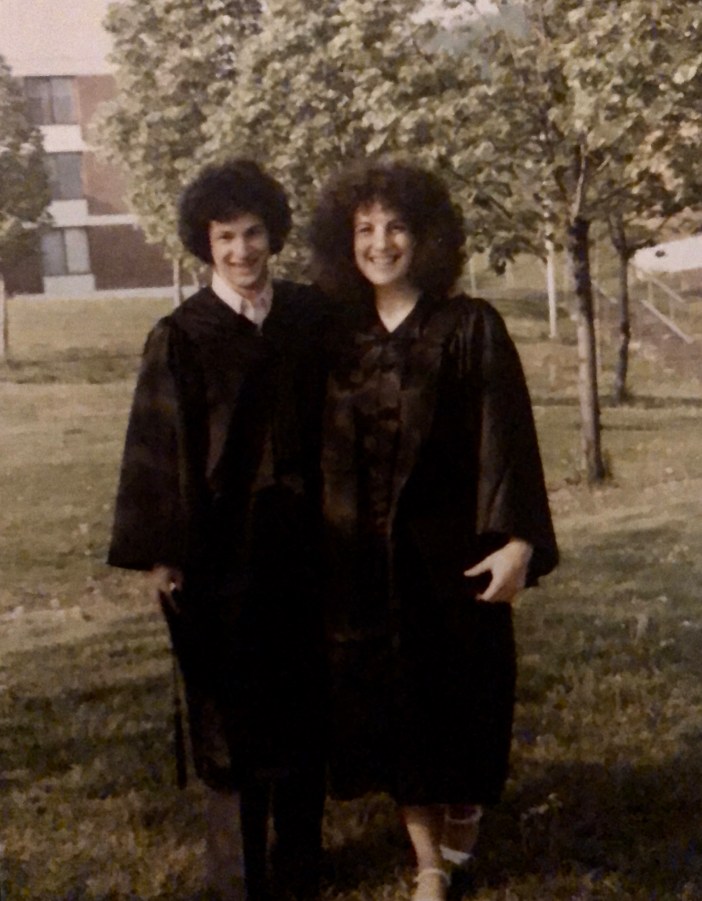
Graduation day from SUNY-Binghamton, May 1980 – we made it through to the other side of that conversation.
Note: Much of the information for this post comes from Paula Bakst’s Shoah testimony. On August 17, 1995, Paula, David, their children and grandchildren (myself included), went to the Pines Hotel in the Catskills to be interviewed and taped as part of Steven Spielberg’s project, following the making of Schindler’s List. Paula and David were interviewed separately. Although Paula’s dementia has made it impossible to ask her questions now, we are fortunate to have her story recorded.
Paula’s journey to Ranshofen was quite different than David’s, but harrowing nonetheless.
The red dot is Serniki (Sernyky), Ukraine, very close to the Belarus border. Paula’s home town was (and still is) too small to merit a label.
Paula Silberfarb was born on February 15, 1931 in Serniki, Poland, a small town in the northwest corner of what today is the Ukraine. It was a landscape of forests, meadows, marshes and rivers. The Stubla River ran along the side of the town and provided her father’s livelihood. It was a primitive town: there was no electricity or running water in their homes, no cars or trucks, the roads weren’t paved. They didn’t have a movie theater and only one family had a radio (and Paula never heard it). They lived an insulated life.
Serniki was made up of Jews and Gentiles, and though they lived peaceably before the war, they didn’t mingle, and they lived clustered on different streets. They spoke different languages: Jews spoke Yiddish, the Gentiles spoke a combination of Polish/Ukranian and Russian, though they were able to communicate with each other. They didn’t socialize, though they did have business connections. The cultural and religious separation became important in the crucible of the war.
Paula was the middle child, with an older brother, Bernie, and a younger sister, Sofia. Though middle children are often attention seeking, Paula was not. She was shy and obedient. If Mother gave her a chore, she did it. If she was told not to do something, she didn’t. She left the troublemaking and risk taking to her older and younger siblings.
Paula described herself as coming from a nice, loving home. Their house was made up of three rooms: one large bedroom, where they all slept – her parents (Samuel and Lea) in one bed, Paula and Sofia in another, and Bernie in his own; they had a separate living room and kitchen. They also had a large apartment next door – one room divided by a curtain – that they rented out. A beautiful flower garden adorned the front and side of the house; a vegetable garden in the back. Further behind the house, they had a field where they grew potatoes and wheat. They hired someone to help with that field. They brought the grain to the mill. Lea baked her own bread on a daily basis.
Paula felt cared for by her mother and father. Her mother, Lea, was the primary caregiver, she provided guidance and nourishment, in all senses, to her children. Her father, Samuel, was a boat builder. The boats were made of wood and powered by oars. Farmers used the boats to get their produce to bigger markets across the Stubla River. Samuel purchased parcels of forested land from farmers, logged it and brought the lumber to Serniki to build the boats. When a boat was completed, the children would gather to watch it launch. It was an event. The business took a great deal of Samuel’s time, he wasn’t home much. When he was home, Paula fondly recalls him sitting on the side of the bed she shared with Sofia, before they went to sleep, telling them stories. He told tales based on Jules Verne’s books. Samuel was a learned man, he had gone to university in Kiev. He was in partnership with his father, Gershon, in the boat business. (Gary is named in memory of Paula’s paternal grandfather, Gershon).
Gershon lived in his own home, bigger than Paula’s family home, near the market in town. He shared the house with one of his sisters; his wife, Paula’s grandmother, died when Paula was two. Paula described Gershon as having an aristocratic bearing, with a square little beard. She characterized her family as middle class, while her paternal grandfather may have been wealthier. Other family members, aunts, uncles, cousins, both maternal and paternal, were scattered throughout Serniki. The various locations of their homes became relevant when the Nazis invaded.
Paula’s life was made up of family and friends and observance of Jewish rituals. There was one Orthodox synagogue in town. Samuel went Friday nights, and the whole family went Saturday morning to shul. The men sat downstairs, the women upstairs, looking down at the men through small windows. Though some men in Serniki were bearded, Samuel was clean shaven. He was a modern man. After services, family and friends would come by the house, similar to the routine in David’s town. Samuel played chess while the children ran around outside.
Paula recalls playing with her friends, who were all Jewish. They played hopscotch and a game with sticks that involved tossing them to see who could throw one further. She also particularly liked walking barefoot in the mud and puddles. Paula had fond memories of one neighbor friend, Chaya. One time Paula stopped by her house and Chaya’s mother was making pancakes. She offered Paula one, and she readily accepted. Paula was served the pancake on a fine piece of china, not an everyday dish. It made her feel special and was the kind of thing Paula noticed and appreciated, even as a youngster and even 60 years after the fact.
Though she remembers being frightened of the Russians, Paula was eight when they invaded, her day-to-day life went on largely unchanged. She wasn’t very aware of how it impacted her father’s business. The one major change in her life was school. In addition to attending cheder, to learn Hebrew and Torah, Paula went to public school. The public school had been run by Poles and Paula had already completed first grade when the Russians came. Though Paula’s father had taught his children the Russian alphabet and to read, the authorities made everyone repeat their grade, so she had to begin again. Paula resented it. She completed second grade in the Russian school. It was during her third year at the school that life as she knew it completely changed.
In early summer of 1941, a father and son arrived in Serniki, on the run. They told the story of their town which was to the west; of being marched to stand at the edge of a ditch and then the Germans shot them in the back causing everyone to fall into the ditch. The father and son fell in just as the shooting started and were not wounded. They lay, feigning death, amongst the bodies until nightfall when the Germans had left. They climbed out over the corpses and ran
The Jews of Serniki didn’t believe the story. They thought it was a plea for attention, for sympathy and for help. Paula’s mother, Lea, though, believed it. Lea said, “It is too terrible for a human mind to make up. A normal human wouldn’t make up such a thing.” This was the first Paula had heard about the atrocities – she thought it was possible that the adults had heard things before, but as a child she was shielded from it.
It was a good thing Lea believed it – that belief made a difference.







 Stories I Tell Myself