Ashes to Ashes

Aunt Clair’s ashes were sitting in a cardboard canister in the closet of our Manhattan apartment. The third anniversary of her passing was coming up soon. Her final wishes were to have those ashes spread over her parents’ graves. For many reasons, it had not been possible to make that happen, and as her yahrzeit (Yiddish for anniversary) approached, I was distressed.

When Aunt Clair died, I made the arrangements with the funeral home. She had no spouse or children, only nieces and nephews. I was her health care proxy. I had to identify the body before cremation. It was jarring to see my aunt without her spirit, it almost didn’t look like her, but sadly it was. The representative of the funeral home was kind and explained how things worked.  I wrote about her funeral and shared the eulogy on this blog previously (https://stories-i-tell-myself.com/2021/11/08/a-eulogy-for-aunt-clair/.)

The first problem with fulfilling her wishes was that when I inquired at the cemetery, I was told it wasn’t permissible to spread ashes there. We could buy a plot and bury the remains, but there wasn’t a spot near her parents, and it was expensive. After consulting with family members and my own conscience, I decided that we would at least spread some of her ashes there discreetly.  I imagine that the cemetery had its reasons, but I doubt it was because it would harm anything. I also didn’t want to take the chance of calling attention to ourselves, so I didn’t want to plan to spread all of the ashes there.

One of the things I learned through this process is that the amount of ash was more than I had imagined, though I had nothing to base my idea on. The canister was heavy, and it was tall.

I thought, given her love of biking and the frequency with which she would cycle from her apartment in Greenwich Village to her sister on the Upper West Side of Manhattan, that spreading the rest of her ashes through Riverside Park would be appropriate. I looked on the city’s website and believe it or not, it is legal to spread ashes in city parks*. It is not permissible to spread them in bodies of water within a park.

So, why were her cremains still sitting in my closet three years later? Life and death happened.

I recall when I picked up the ashes from the funeral home, the representative said, “You know how common it is for people to move into an apartment in New York City and find an urn with remains buried in a closet?”

I looked at him incredulously, “No.”

“You’d be surprised. People don’t know what to do, they put them away out of sight, forget, and they sit there for someone, years later, to discover. I’m just letting you know.”

“That won’t be the case here” I reassured him, and as I walked away, I thought, “That’s crazy. Who would let that happen?”

I have a better understanding now.

I had no prior experience with cremation; it isn’t a common choice among Jews, though apparently more are opting for it according to the guy at the funeral home. Aunt Clair wanted to be cremated, but she also requested that a memorial stone be laid at the foot of her mother’s grave. She had arranged for a footstone at her father’s grave in memory of the family he lost in the Holocaust in Poland, so she thought this was possible.  

After the funeral, I brought her remains back to my apartment. After a few months passed and thinking that we would have an unveiling for the footstone on the one-year anniversary (and we would spread her ashes at that time), I began the process of ordering the memorial stone. This proved to be complicated to arrange. It was not a typical request. The cemetery didn’t want it to be confusing as to who rested in the plot. After a lot of back and forth that isn’t worth detailing, we came to an agreement about what the stone could say. It wasn’t exactly what Clair wanted, but it was the best we could do. It took more than two years for the stone to come to fruition.

When the stone was finally available, other things were going on in the family. We were not able to arrange a time for the ‘unveiling’ of the memorial and we didn’t spread the ashes. In the interim Clair’s sister, Aunt Diane, passed away, as did my mother. A whole generation was disappearing. Another year passed.

As Aunt Clair’s third yahrzeit loomed, I decided I didn’t want to wait any longer to fulfill her wishes. I wrote an email to my brothers and cousin and said I would like to visit the cemetery and spread her ashes on Friday, November 15th. Jewish cemeteries are closed on Saturdays (the Sabbath) and my Mom’s unveiling was planned for Sunday, November 17th. It would be a good time to make this happen. My cousin, who lives in Massachusetts, responded that her daughter’s due date was November 20th so she would not be comfortable traveling to NYC so close to that time. Aunt Clair would certainly understand that, as did I. It turned out the timing didn’t work for anyone but me and thankfully Gary. Despite that, I decided to go ahead with the plan

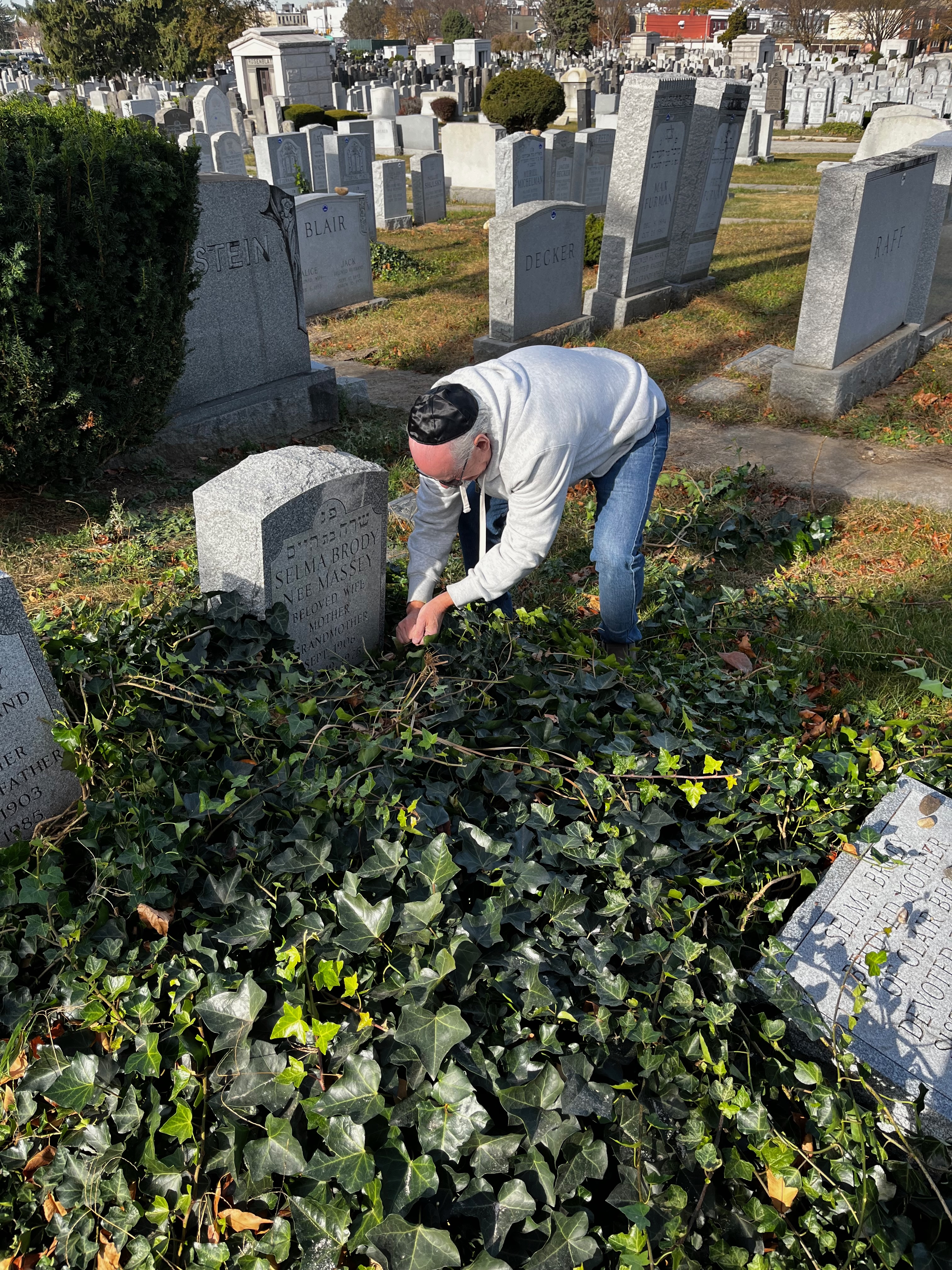
November 15th was a cool, sunny day as we drove the Jackie Robinson Parkway, a narrow, curvy roadway that connects Brooklyn and Queens and passes through a series of huge cemeteries. The trees were not yet entirely bare, the yellow and gold leaves shone in the sun. I had the location of my grandparents’ graves written down and we drove to the appropriate section of the cemetery. I thought I remembered my way to their graves. Gary and I combed the rows and couldn’t find them. I checked and rechecked my notes. Finally, I remembered I had taken a picture the last time I was there and maybe that would help. I searched my phone, those smartphones can be quite helpful and in the photograph I found a couple of landmarks that helped – a majestic tree and two large grave markers in front of my grandparents’ more modest ones with the name Feingold on them. We found the spot and now understood why we hadn’t seen them before – they were entirely blanketed in ivy.

Gary and I peeled away the ivy and exposed all the markers. Aunt Clair’s stone was there, as expected. I looked around and seeing nobody around, I took the baggie with a portion of Aunt Clair’s ashes out of my pocket and spread them over the graves. “May you rest in peace, Auntie.” I said. Gary and I paused and stood quietly for a bit. Then we got back in the car and headed back to Manhattan. Part one of my mission had been accomplished.
The sun was still shining brilliantly as we made our way to Riverside Park. It was also quite breezy. I wasn’t sure how I was going to do this. I carried the canister in a canvas bag. As we walked, a plan revealed itself to me. We passed a garden, now gone to seed until the spring, and I thought this was a perfect spot to provide what perhaps could be fertilizer. I looked around and nobody was paying attention – I knew I wasn’t doing anything wrong, but I also worried it might be disturbing to onlookers. I spread a good deal of the ashes throughout the garden, and nobody seemed to notice. There was still a lot of ash left.

We continued walking through the park and came upon a memorial to the Warsaw Ghetto Uprising. The shrubs surrounding it presented itself as another opportune spot. Though Aunt Clair was not a religious Jew by any means, she was fiercely proud of being Jewish. This would be a meaningful location, as well. Gary reminded me to stand upwind as I poured the ashes over the bushes. I had not been as mindful of that the first time.

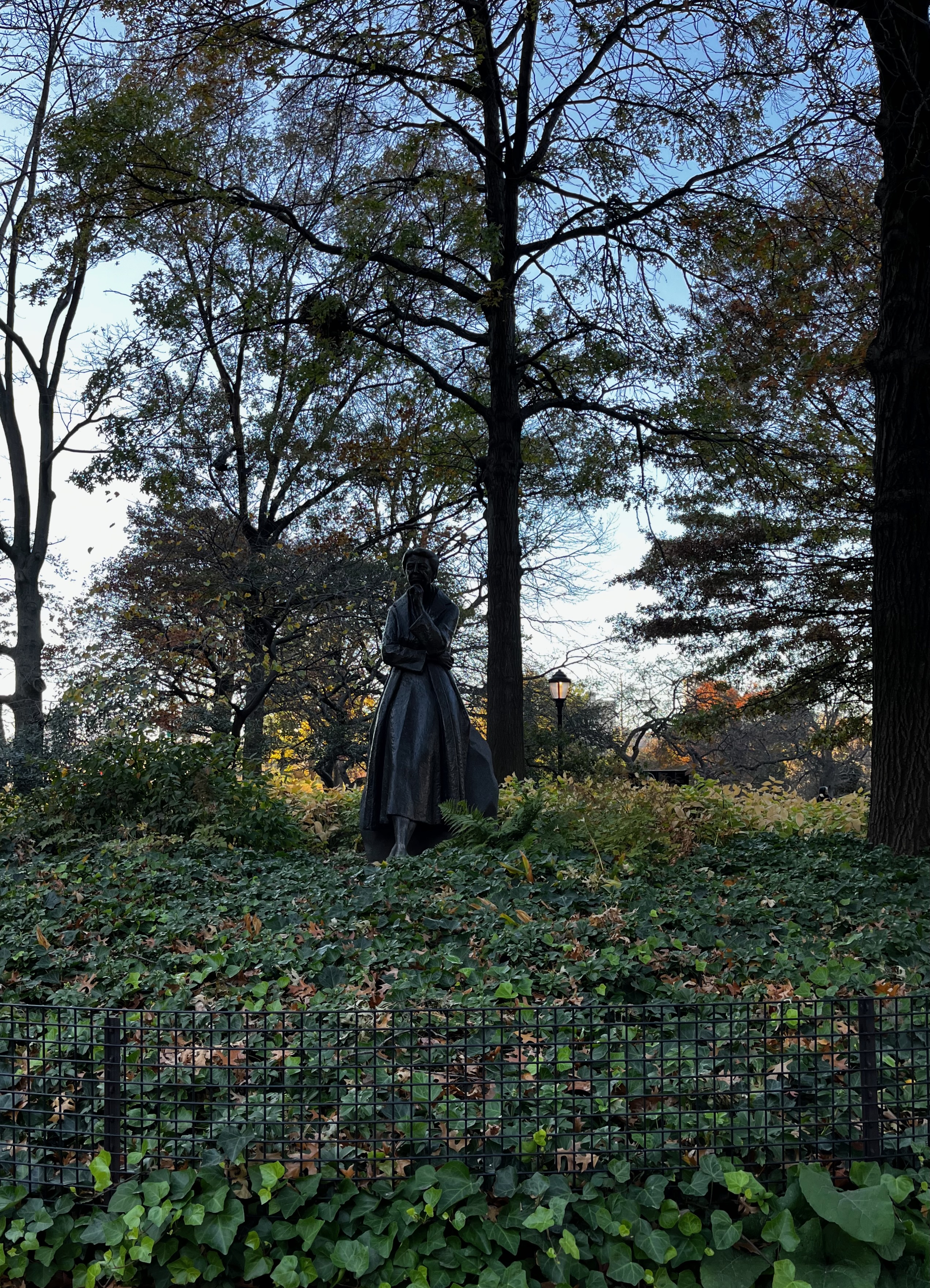
The canister was still not empty, and I knew of one more spot that I wanted to visit. Aunt Clair was an admirer of Eleanor Roosevelt and there is a statue of her at 72nd Street just inside the park. We continued our walk south to find it. I was pleased to see that there were plantings around the memorial. I spread the remaining ashes there.

Throughout our walk, aside from talking about mundane things, Gary and I shared memories of Aunt Clair. I felt good about what we were doing. I was grateful to have Gary to share it with. He knew her well and shared his own unique relationship with her. We had come darn close to fulfilling her wishes and I think we honored her spirit. Part two of our mission was now accomplished. I was glad she was no longer sitting in my closet.

We took a different route through the park back to our apartment, walking along the Hudson River. I felt peaceful. The sun lowered and its rays glistened on the water. The day was fading, and I was satisfied.

*This is where I found the information: https://portal.311.nyc.gov/article/?kanumber=KA-03480#:~:text=New%20York%20City%20Parks%2C%20including,the%20site%20of%20cremated%20remains.

Aging with Grace

I am gaining yet more respect for older folks. As I am aging and approaching my 65th birthday, I realize the high price we pay for getting older, and I am not referring to the physical challenges we face.  So many losses are endured, it is hard to fathom.

It is expected that we will lose our parents – that is the life cycle. Some, like me, are lucky to have had them for much of my adult life. Dad died when I was 45 and Mom just passed. Others aren’t so fortunate, and it is painful no matter the age, but at least we understand that it is the natural order of things.

I think about my mom and the losses she endured as she got older. Her husband, her brother, sister, and best friend, not to mention other friends and family members. Yet she persevered, she maintained interests, she sought joy, she smiled a lot. She also didn’t back away from those who were ill – she was fully present for my dad, as well as others. I don’t think everyone is able to do that. Some might get bitter or shut down. How could you not want to insulate yourself?

Death is part of life. Maybe grieving is a constant, on some level. It is just part of the mix of emotions we experience all the time. It is the price of loving people. After all, if you protected yourself from loss, you would be depriving yourself of friendships and connections.

I imagine the reason for the death makes a difference in how one processes it. All the losses that my mom faced in her later years came about because of disease. Our family has very limited recent experience with deaths due to violence, addiction, suicide, or an accident. Those bring a special pain – the kind that can permanently change the trajectory of the survivor’s life. We carry the generational pain of the Holocaust, but that is a different kind of grief, too.

There is a sort of joke that says no one gets out of this life alive. The truth is I have not made peace with that idea. I know it intellectually, but that doesn’t mean I have accepted it. I need to. It won’t change the anguish I feel when someone I love dies or is suffering, but maybe it will help me to not waste time asking why.

I can’t accept that God is making individual choices about who lives and who dies, or how they die. It just doesn’t make sense to me to believe that a higher power is invested in that, or would knowingly be so cruel, or has that detailed a plan. I suppose even if there is a God and even if s/he were making those decisions, we wouldn’t know the rationale anyway. It isn’t like good people don’t suffer and bad people do – it doesn’t work that way. So, either way, it may be best not to torture ourselves looking for an explanation for someone’s suffering or premature death. It just is and we need to move through it as best we can, becoming more compassionate toward each other knowing how hard life can be, and seeking joy, meaning and connection where we can find it. I think my mother and father-in-law, in particular, modeled how to do it. I will try to follow in their graceful footsteps.

From Rouses Point, Lake Champlain…appreciating the beauty all around us

A Visit With Mom

I walked into Mom’s room and knew immediately that it was a good morning. Despite her pale color, Mom’s eyes were open and clear, and she smiled broadly at me. “Good morning, Linda!” she greeted me with enthusiasm from her bed. She knew it was morning, knew who I was and was happy to see me. That is not the reception I always get. Thankfully she reliably knows who I am, her daughter, but more often she can barely keep her eyes open, and her speech is slurred – a product of the various illnesses, including dementia, she is living with.

The unpredictability of her condition confuses me. I wish I understood it better. I try to emotionally prepare myself for whatever the visit will bring, but it is hard. The variability also makes it difficult to decide what to do about her care. Do we continue to aggressively preserve her life, or do we begin to let her go? I believe Mom’s life at this point is largely sustained by the medications she takes – a high dose of diuretic, as well as heart and blood pressure medications. On the visits that she is foggy and lethargic, spending most of her time sleeping, I wonder if we are doing her any favors. Although she will never fully be herself, on mornings when she is alert, when she is more connected and engaged, then all the medicine and effort make sense.

On this day Mom’s lucidity is a double-edged sword. We enjoy conversation about our family. She is entertained when I read a chapter from Mel Brooks’ autobiography. She listens avidly to his experiences during World War II, which bring back her own memories. But, on the flipside, she is painfully aware of her limitations. She ruefully tells me that she can’t buy the little things she likes to have for her grandchildren and great-grandchildren when they visit because she can no longer go out to shop. She shows deep frustration when she has difficulty getting up and walking to the bathroom. The effort leaves her breathless. It is a titanic struggle to get out of bed (despite having a hospital bed): to sit up, shift weight to her legs and shuffle the few steps to the toilet takes major exertion. And that is even with the assistance of her aide. Given that she is on a diuretic, the need to go is frequent. When Mom returns to bed she is clearly dismayed by her dependence on others and her inability to be in control of her bodily functions.

As the day wears on, Mom gets more confused. The energy and alertness of the morning give way to weariness and confusion. “Maybe they will send me home tomorrow,” she says to me. “Mom, you are home.” “I am?” She thinks she is in the hospital. She is in the same apartment she has been in for the last six years.

I point to the pictures that adorn the room. I show her the table that sits in the dining area just outside the doorway to her bedroom. She nods but then goes on to tell me about how when she was in the Air Force hospital in Texas after giving birth to Steven, they were in a barracks style room. They had to line up to use the bathroom and, “what did I do?” she asks me. “I don’t know.” “I fainted.” She goes on to tell me a convoluted story about them forcing her to get up, but then they put her to bed, and she heard her Aunt Bess in the hall loudly arguing that the nurse should take better care of her. “She made sure I had a silver pitcher, it wasn’t real silver, it was probably silver-colored but that’s not the point, with cold water. Aunt Bess was something.” She was rambling a bit, I thought maybe she was conflating several different experiences. It didn’t matter – I just listened. Then she said again that maybe she would get out of the hospital soon. This time I didn’t try to correct her.

I was getting ready to end my visit. We had talked about the weather forecast, which called for a snowstorm. I told Mom that I wanted to get on the road before the weather turned. She agreed and told me if the roads were bad not to come back to visit the next day. “It isn’t worth taking the chance.” “Thanks, Ma. I’ll stay safe.”

I had no intention of coming back the next day and earlier in the day she knew that. I was going to my apartment in the city to wait out the storm and then drive the rest of the way home to Albany. Mom knows that my house in Albany is a 3.5 hour drive away from her – well, usually she knows that. Depends on the moment.

I walked out to my car reflecting on the visit.

I know what I would want for myself. I firmly and passionately believe that I would not want to live the way Mom is living. I would prefer to stop the life-sustaining medications, take morphine or whatever would allow me to be comfortable while my heart and breathing ebbed, and say my goodbyes. Let nature take its course. Mom’s doctor has said that it is a legitimate, ethical decision – to stop Mom’s diuretic and other meds, make her comfortable and let her go. Though we have made the transition to hospice care, we have not discontinued those essential medications.

Mom is DNR and that decision was made with her full knowledge and consent – she was quite capable of understanding what it meant when we did the paperwork many months ago. I am her health care proxy, but we did not discuss this current scenario. I can’t in all honesty say I know what she would want. If I did it would make this much easier. I comfort myself with the thought that she does not appear to be in pain. Her activities are severely limited, her ability to engage in conversation is variable, her energy is negligible, everything is an effort…is she taking pleasure in her existence? Sometimes, but at best it is a small portion of the day. What is the right thing to do?

So I confer with my brothers and we decide to stay the course…for now.

There are only two things I know. I don’t want this for myself. And, there is no objectively right thing to do. No matter how much I rack my brain, or gut, clarity does not emerge. I need to make peace with the path we are taking and stop ruminating. One way or another, it will resolve itself in time.

In better days: Mom two years ago on the patio of her apartment

Note: I wrote this painful post because writing it helped me process my thoughts. Instead of having a jumble of emotions and images, I understand myself better. I share it because I imagine others may have gone through, are going through or will go through this journey. I think it is important that we talk about end of life choices. Perhaps it will spur conversation in your family.