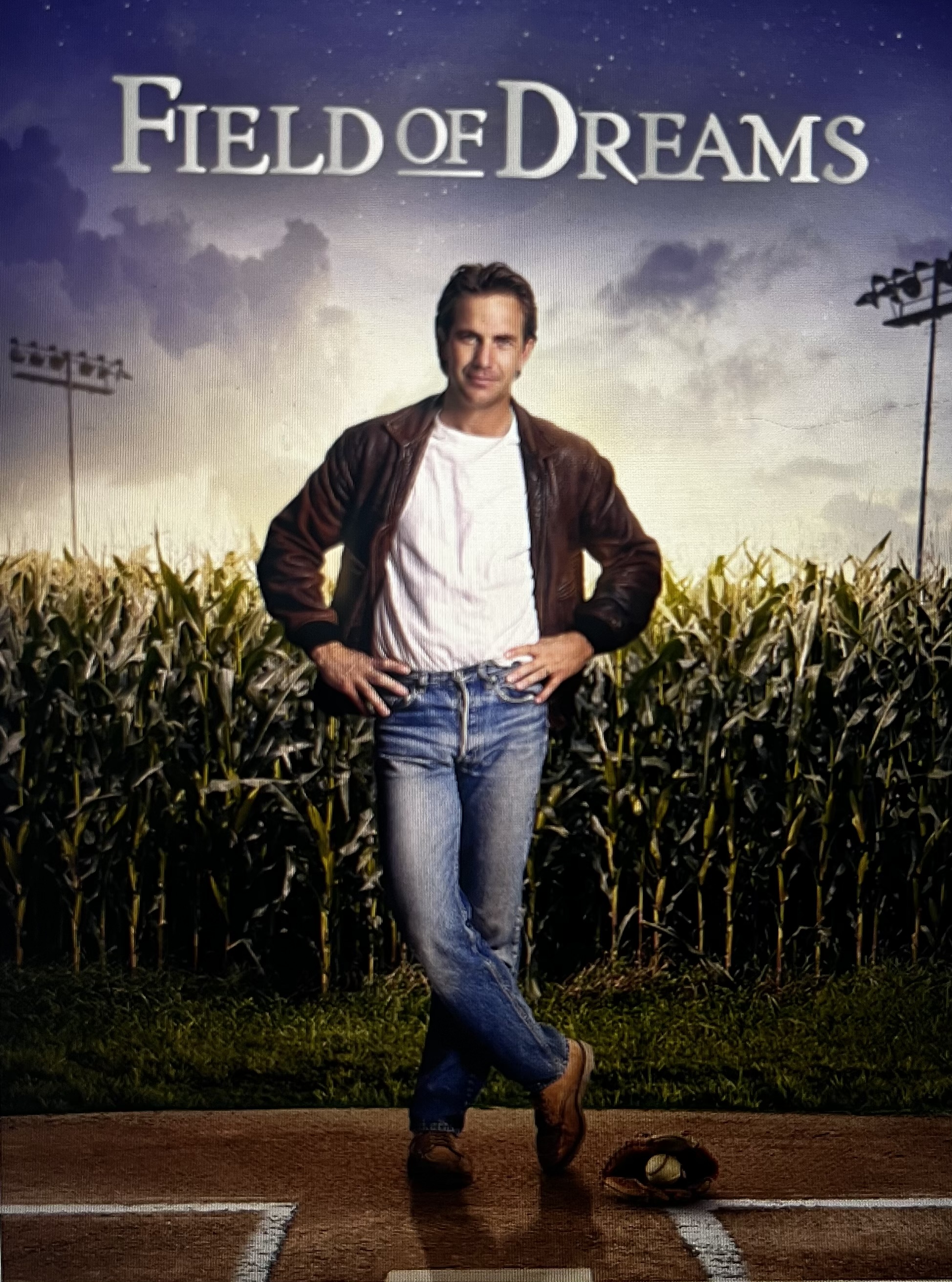
“Field of Dreams” – Some Thoughts

My family has a movie club. It functions the same way as a book club. A member picks a movie, and we get together on Zoom to discuss it. The person who picks the film moderates the discussion. The number of participants varies from month to month, but typically there are about 19 of us. This month we discussed Field of Dreams.

I had not watched Field of Dreams in many years. I remembered enjoying it in the theater when it came out in 1989. I have caught bits and pieces of it on television since it airs frequently, but I am not someone who watches it whenever they come upon it, and I certainly had not watched it all the way through in decades.

For many this film is a touchstone. It is a perennial favorite because it speaks to universal themes: dream fulfillment, regret, father-son relationships, nostalgia for baseball, and redemption. It also features some wonderful actors, James Earl Jones, Burt Lancaster to name two and Kevin Costner qualifies as a genuine movie star (I think he is a fine actor and does a good job in this).

Somehow watching it yesterday afternoon, I was not as moved as I remember being. I wasn’t drawn into the fantasy. I liked it well enough and could appreciate aspects of it, but I found myself doubting the premise. I wasn’t buying it. When we gathered for our discussion, I was in the minority, though there were a few who were also less than impressed. I wondered if I have become too cynical to relax and give in to the sentimentality. One of the premises of the movie is that we long for a simpler, more innocent time. My problem with that idea is that I don’t believe that simpler, more innocent time exists.

I also think that the father-son dynamic, which is central to this story, didn’t resonate with me and I don’t believe that is a matter of gender. Anyone can relate to the idea of having regrets over a parental relationship that wasn’t what you wanted it to be – and having the chance to make amends would be an unbelievable gift, as happens in the movie. While I can relate to that idea and would welcome a chance to reconnect with my parents, I am lucky in that I don’t feel a lack of closure with either my mother or father. I miss them, but I don’t have much in the way of regret. I am grateful for that.

While intellectually I get the potential for how baseball can connect a father and son and how meaningful a catch could be, it still didn’t resonate. My parents were not of a generation where they played with their kids. My dad never had a catch with me – and I have no memory of him having a catch with my brothers. Maybe he did, or maybe they wanted him to. They certainly had catches with their own kids when they became fathers. I think it was a generational thing, though Gary, my husband, would toss a ball with his dad. What’s funny is that my dad was an athlete. He grew up playing ball – all kinds – baseball, basketball, stickball. He continued to be active as an adult, playing tennis and paddleball. But, he didn’t play with us. I think the mind set was different. He didn’t think it was his job to play with us. I had no expectation that he would. I can’t speak for my brothers – they may have felt a longing for that, or maybe they felt as I did that it just wasn’t something to be expected of him. Mom didn’t play with us either – not board games, not sports. We were expected to entertain ourselves.

Aside from the difference in expectation about parental roles that may explain my tepid reaction, the movie relies on nostalgia for baseball. I love baseball. It is a sport I have always enjoyed. I was a huge fan of Ron Bloomberg of the New York Yankees when I was a kid. You can probably guess why. But, I associate baseball with my brothers, my uncles and my Zada (my maternal grandfather), more than my dad. Dad followed the sport but after the Dodgers left Brooklyn before my birth, he was no longer a fan. He grew up as a die-hard Dodger fan and was angry and resentful that they left. In the years that followed he kept track of players, he read the sports page, but he didn’t root for a particular team and had no interest in going to games. If my brothers and I went to a game, it was with our uncles. I do recall a particularly memorable time my dad took us as a family, and it may explain why we went so rarely.

We went to see the Mets play the San Francisco Giants at Shea stadium. It was August of 1969, an auspicious year. Dad was no fan of New York City traffic, so he wanted to leave the game early. It was a close game, no runs had been scored, and we made our way to the exit after the 7th inning. Except when we got outside the stadium, we couldn’t find our car. We combed the aisles. This was long before we had fobs with a panic button. We had no way of flashing the headlights to help us locate the car. I don’t know why none of us had noted the section where we parked. We just kept walking up and down – every aisle looked the same, every section looked the same. Meanwhile the game went into extra innings. I believe we found our car after about an hour. The game went 14 innings before the Mets won, 1-0, so we still beat most of the crowd to our car where we listened to the last inning on the radio. It turned out to be a classic game. Gary Gentry, the Mets pitcher, held the Giants scoreless for 10 innings and was relieved by Tug McGraw who finished out the game. Juan Marichal, the opposing pitcher who went on to be a Hall-of-Famer, took the mound for 13 innings! So not only were we roaming the parking lot for a very long time, but we also missed the end of a truly great game.

It was not the happiest of experiences. Dad was not the most relaxed person under the best of circumstances. He had a temper and a short fuse. You can imagine his fury at not finding the car. Plus, with a family of five, though it was far less expensive than it is today, it was still a lot of money to buy tickets, park and feed all of us. I’m not sure we ever went to a game as a family again. It became an amusing anecdote, but not until many years passed.

[I will rely on my brothers to correct me, if I got this episode wrong.]

The point is that my affection for baseball was not nurtured by my father. So, when I watch Field of Dreams it doesn’t evoke the heartfelt emotion that it does for other folks. I know my brothers feel differently. They participated in the movie club discussion, and the film clearly struck a chord with them. I invite them to comment or write a blot post about the notes that struck home.

If you want to chime in with your feelings about Field of Dreams, please do. I will say that unlike many movies made in the 1980s, it aged well. It wasn’t offensive in any way that I perceived and, in fact, got a lot right. It just didn’t move me the way it does many others. I didn’t choke up and I shed no tears during the final scene. Did you?

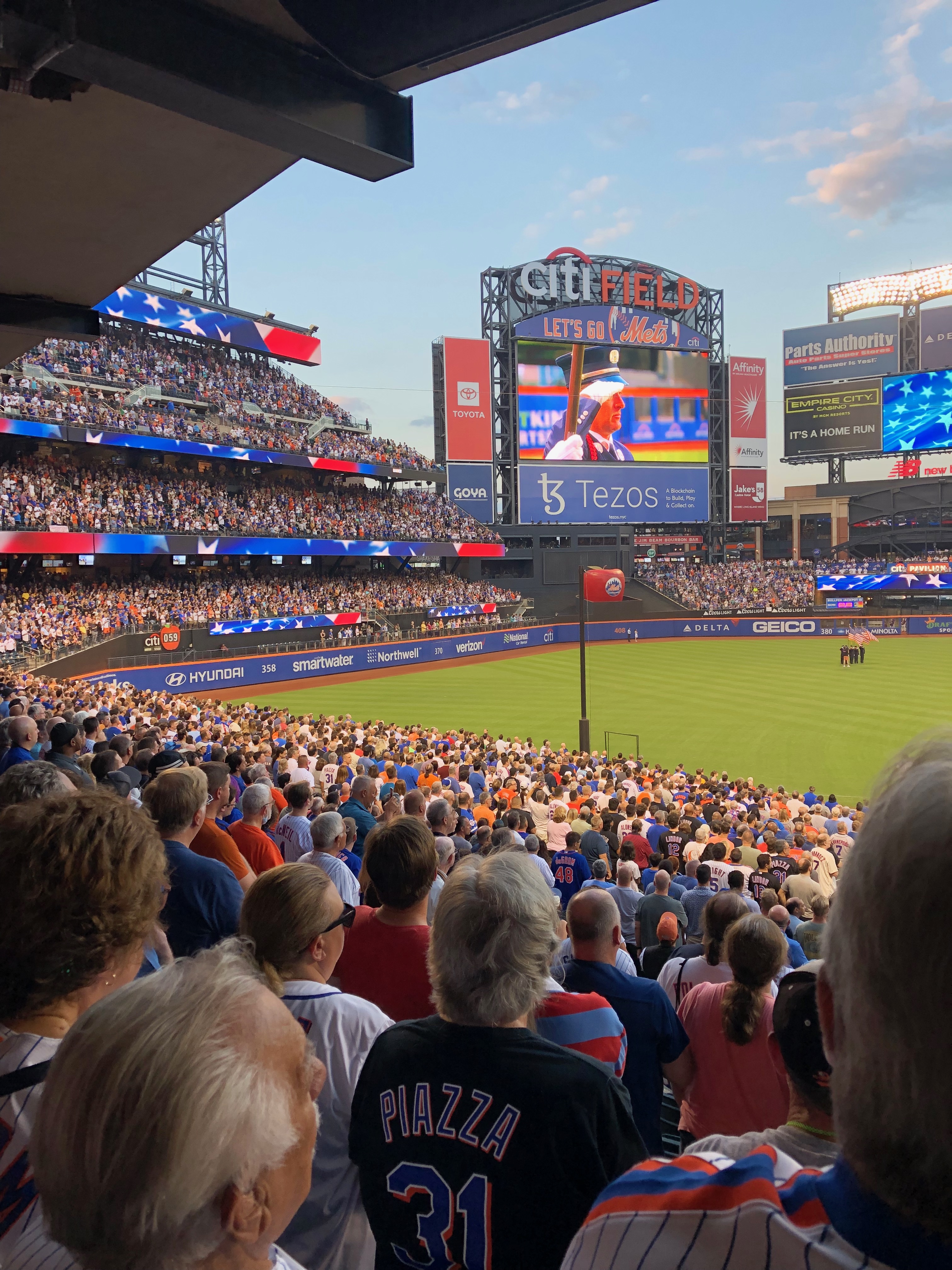
Joy in Mud(Met)ville

Note: The following was written by my husband Gary Bakst, lifelong Met fan, which means 65 years, except the Mets are actually 3 years younger than that. But you get the idea. Anyway, I hope you enjoy his prose as much as I did.

I put Gameday on my laptop as I saw my afternoon patients yesterday.  I was nervous, anxious, worried.  Dan, my son, texted to ask if I was stressed and that is exactly what I was feeling.  The Mets gave up 2 runs in the 3rd inning and another in the 6th and were down by 3-0 going into the eighth inning.  It was looking like yet another of those miserable late season games in Atlanta.  We have been here before.  We have seen this movie.  And we never liked the ending. 

Then, out of nowhere, the Mets erupted for 6 runs in the top of the eighth inning capped by Brandon Nimmo’s two run home run way deep into the right field stands.  Finally, a better ending was coming into view.  All of those demons would be erased.  The Mets were just 6 outs from the postseason.  What could possibly go wrong?

And then came the bottom of the eighth.  Maton came in to pitch it and was ineffective and they brought in Edwin Diaz to try to get a 5 out save coming off a thirty something pitch save Sunday.  Diaz failed to cover first on a ground ball to Pete Alonso and one double later, the Mets were suddenly down by 7-6 heading into the ninth inning.

Of course.  Of course the Mets couldn’t just lose by 3-0.  They couldn’t just fail in an ordinary way in front of the brainless Braves’ fans.  They had to first get our hopes up with an historic eighth inning only to give it away in the bottom of the inning.  They had to take our hearts out.  They couldn’t just let the patient die mercifully.  They had to make it painful, long and heartbreaking. 

This could not be an ordinary loss.  This had to be a Mets fan special.  I was almost sure that blood was coming out of my skin, my pores and slowly spilling onto the floor of the exam room.  The ninth inning would surely be just one, final, painful chapter in a sad, tragic story.

And then.  And then, with one out, Starling Marte got a base hit and suddenly, our guy, our MVP, back from his back, strode to the plate.  Francisco Lindor, batting from the left side, hit a ginormous home run.  Perhaps the second biggest home run in Mets vs Braves history (Piazza, of course).  The ball was well struck and carried deep into the Atlanta late afternoon gloom.  It seemingly broke open a new dimension.  It carried hope and joy and goodness and love and was itself carried by will and determination, by desire and honor and the conviction that, in the end, goodness will triumph over evil.  It was propelled by a force both divine and human and when it landed angels called from the heavens, doves flew overhead and lions lay down with lambs.

And it sailed over the right centerfield fence and suddenly, out of nowhere, the Mets were up by 8-7 and only three outs separated them from the post season, from an opportunity to celebrate right there on the turf of their most arrogant nemesis.  And it left one giant question:  Who was left to get those last three outs?  It couldn’t be Diaz.  He had thrown a ton of pitches on Sunday and a bunch more in the 8th inning.  And yet, the sad reality is that they really don’t trust any other reliever. 

And then.  And then, emerging from the dugout with the look of a man on a mission, came Edwin Diaz.  He was back and he was going to find a way to finish the job.  And somehow, despite the fact that it looked like his right arm came onto the field well after the rest of him, he got it done.  

The Mets were in the playoffs.  A great miracle happened there.  It was not the ending Mets fans have been accustomed to, not the ending we have been trained to expect.  And it was just so sweet and so amazing.  I had to look at the screen on my laptop for a while to make sure that it was real.  Wait, they’re gonna call for some kind of do over, right?  Somehow, they’ll say it can’t be over until the Mets lose.  But it was real.  And it was good. 

The Mets are in Milwaukee today for a 5:30 PM (eastern time) wild card playoff game). 

#LGM

It all started back in Spring Training and we were there.

Baseball and Life Lessons

Baseball is a thread through my family history. Zada, my maternal grandfather, was a fan and as a result my mom grew up going to games, most often at the Polo Grounds. Zada took the opportunity to impart life lessons to his young daughter. One time a player on the New York Giants pitched poorly and as he was coming off the field my mother yelled, “You’re a bum!” Zada was appalled. He told her, “You never kick a man when he’s down.” When they got home, he insisted she write a letter of apology. She did. Another time they went to a game and some ominous clouds threatened. Mom asked, “Daddy, do you think we should leave? Look at the clouds.” Zada pointed to the other part of the sky, the part that was blue and told her to focus on that. Mom took that advice to heart, always preferring to look at the bright side of things.

Baseball also played a part in my parents’ relationship, nearly sinking it. When they met in 1950 at Brooklyn College, Dad helped Mom through their required freshman physics class while they rooted for rival teams. Dad was a die-hard Dodger fan, Mom rooted for the New York Giants. They enjoyed discussing their respective teams, and Dad was tickled by Mom’s knowledge and interest. Their burgeoning romance was tested in 1951, when Bobby Thompson of the Giants hit the shot heard round the world that sunk the Dodgers playoff hopes. Mom was overjoyed, tossing her books in the air as she heard Russ Hodges jubilant call, “The Giants win the pennant! The Giants win the pennant!” Dad was crushed. Mom and Dad didn’t speak for a while. Thankfully for me and my brothers, they got past that.

Six years later both the Giants and Dodgers left for the west coast. With that move, my father lost his love of baseball. He hated Walter O’Malley, the owner of the Dodgers; he felt O’Malley betrayed the loyal Brooklyn fans. Dad now saw the sport as a business. He still followed the game but not with a genuine rooting interest. Mom didn’t hold the same animus toward the Giants. The general consensus was that the New York Giants were legitimately losing money and needed to relocate. The Dodgers were not in the same predicament.

Despite those shifts, baseball remained part of our family life, largely thanks to Zada, and his sons, my uncles, Michael and Terry.

Those who have been following this blog know that I grew up in a two-family house in Brooklyn. Me, my parents and my brothers occupied the first floor unit, while my maternal grandparents and my two teenage uncles lived upstairs. In 1962 when the Mets came into being, Uncle Mike adopted them as his team. Uncle Mike was always a fan of the underdog. Like many Met fans, he hated the Yankees.

As a child, and I do mean child, I loved the Yankees, particularly Mickey Mantle. By the time I was four years old I was enamored of the Mick – I think maybe the rhythm of his name first caught my ear. Whatever it was, I was hooked. The Yankees of my childhood were losers, though I was aware of their winning tradition. Mantle was at the end of his career by the time I was old enough to meaningfully follow the games. The Mets were the team in ascendence, much to my distress. I hated Tom Seaver, in particular. Not surprisingly, my brother, Mark, my nemesis, the thorn in my side, loved Seaver and the Mets.

So, as I recall, the rooting interests in the house lined up as follows:

Me – staunch Yankee fan; I didn’t hate the Mets, other than Seaver.

Mark – rooted for both the Mets and Yankees, but more of a Met fan.

Steven – I couldn’t tell which team he preferred; he went to Met games with my uncles, I don’t recall him joining me in my Yankee obsession.

Uncle Terry – Met fan, didn’t hate the Yankees

Uncle Mike – staunch Met fan, don’t even mention the Yankees!

Zada – rooted for both

Mom and Dad – indifferent, but wanted New York teams to win

Looking back, I think in deference to Uncle Mike, it is possible that my brothers and Uncle Terry were more vocal in their support for the Mets in the 1960s and 1970s. As the years went by, and we no longer lived in the same house, other allegiances emerged. Today Steven and Terry are avowed Yankee fans. Mark continues to root for both teams.

Today I am a Met fan. I made the switch in the interest of marital harmony. When I first met Gary, I continued to follow the Yankees. Over the years, though, for reasons I’m not sure I fully understand, though Gary has said something about obnoxious Yankee fans (not me), my husband developed an antipathy for the Bronx Bombers. The truth is my passion for sports in general has waned over the years. I enjoy watching most games – I draw the line at Australian rules football – but I am not emotionally invested in the outcome. I used to be a die-hard Knick fan, but I just can’t summon the energy anymore. It just isn’t that important in the scheme of things. So slowly but surely, my interest in the Yankees fell away. It made it easier for Gary to immerse our children in the history and culture of the Mets if I simply joined forces. Gary says being a Met fan is also a good life lesson – you learn to deal with disappointment. Like the Dodgers before them, we live with the hope that there is always next year.

So, the lessons baseball has to teach continue on to the next generation. We will see if they get passed on to our grandchildren.