Pride

Since October 7th when Hamas brutally attacked Israel, committed acts of horrific violence, and all that has followed, I have struggled with a range of emotions. I have always given a lot of thought to my identity as a Jew, but this has been a more challenging time, and it has been hard to sort out my feelings.

I have attended presentations, in person and on Zoom, to hear what others have to say. I have read books, some recently published, including one entitled “On Being Jewish Now,” edited by Zibby Owens. It is a compilation of 75 essays by authors and advocates, all written in the wake of October 7th. As I write this, I have read about ¾ of them. They offer interesting perspectives, but none, yet, have hit the mark for me. Most of the authors explain how they have been moved to assert their identity as a Jew, even if there is some fear involved. They may not have been particularly observant before but found comfort and meaning in turning to Jewish rituals. They write about the pride they feel and the importance of their alliance with Israel. My feelings are more complicated. I have been thinking about what it means to be proud of being Jewish and about pride in general.

“Think about times you’ve been proud of yourself. Jot them down. I’ll give you a couple of minutes and then let’s share.”

This was the prompt from a Weight Watchers lecturer at a meeting I attended about two decades ago. She was urging us to call upon those times when we did hard things and apply those same skills to our weight loss goals.  This exercise sticks with me because I could not think of a single thing to be proud of. Nothing came to mind – certainly not my identity as a Jew. I share this not to elicit sympathy or to fish for compliments. I am writing about this because it was then I realized that this was an issue for me, and there are implications.

I sat for those few minutes in that meeting bewildered, reviewing various experiences in my life. I was already married, had two children who were still quite young, and I was working for the state. Nothing resonated with being proud.

When others at the meeting shared their triumphs, it was enlightening. Graduating from college, completing a project, losing weight, finishing a 5K, recovering from addiction, leaving a toxic relationship….some of those things I had done, I just didn’t feel particularly proud for having done them. I realized that I have this tendency to think that the quality of what I do isn’t special or that it was expected. Everyone in my family graduated from college, in fact both my parents had master’s degrees. When I finished a 5K race, I’d look at the time and think, “Could I have gone any slower?” It isn’t a healthy perspective. This exercise made me aware of it. In the years since, I have tried to be fairer in my assessment, but it doesn’t come naturally. Today if I was asked the same question, I would be able to come up with a couple of examples of times I was proud of myself. I’m making progress. But, all of that is different than taking pride in my identity as a Jew.

One of the essayists in “On Being Jewish,” Lisa Barr, a writer of a number of best-selling novels, who I also saw speak on a panel that was addressing antisemitism in publishing, described how she was motivated to be “loud and proud” of her identity as a Jew in the aftermath of October 7th. I have been thinking about that sentiment.

I tend to consider accomplishment rather than identity when I think of sources of pride. If you are born something, does that merit feeling proud of it? I asked Gary, my husband, if he was proud to be a Jew. He thought for a moment and said yes.

“I’m not suggesting you shouldn’t be proud, but can you explain why?” I asked.

He thought for a bit, which is something I appreciate about him, he is thoughtful in the truest sense.

“I think Jews have contributed a lot to the world – in science, in medicine, in the arts…in all kinds of ways. It was the first monotheistic religion. Jews have made the world a better place… And, then there is my parents’ experience.”

As I have recounted elsewhere on this blog, Gary’s parents are Holocaust survivors. This is a source of tremendous pride (and pain) for Gary. Their Jewish identity was the cause of their suffering due to the poisonous hate of the Nazis and their collaborators but was more importantly the basis of the strength and resilience that helped them to survive and flourish.

I understood what he was saying, and though my parents were not survivors, I am part of that legacy in a larger sense.

In my heart of hearts, I wasn’t sure if that’s how I felt, especially about the first part of what he said.

“It’s funny,” I responded, “but I remember as a kid I felt that pride. When a Jewish person did something impressive – whether it was winning a Nobel Prize or Mark Spitz winning all those Olympic medals, I felt a certain satisfaction. But I’m not sure I feel that anymore. I wonder why?”

I was thinking that in a way it was like how I felt about being an American. As a child I felt proud of my country, now it is much more complicated. I have a clearer understanding of why that has changed – I have been disappointed in our country’s shortcomings often enough to wonder if we can ever realize our foundational ideals. I realize that the story of America that I absorbed as kid is far more complex and not quite as heroic. In a way, perhaps some of the same thing has happened with my Jewish identity– or maybe as one matures into adulthood it is natural to see things in a more nuanced way.

Being Jewish is complicated. It is an ethnicity and a religion. I don’t believe in the God of the religion, but I do believe in the core values of Judaism. The central theme, as I understand it, is justice – Judaism demands that we do our best to be a righteous person. This resonates with me. But, reconciling my lack of faith in God while accepting the values being espoused is tricky. Frankly, I haven’t been able to do it since I can embrace justice and fairness as a humanist, without the trappings of religion. At the same time, some of the rituals, particularly the ones we practice at home (lighting Chanukah candles as a family and singing the prayers, conducting a seder) are meaningful to me and those traditions are rooted in the religion.

The ethnicity is part of me. It is engrained in my DNA. I like the humor, the slightly skeptical worldview, the food, the propensity to question anything and everything. I bond over those qualities when I meet other Jews, especially from the New York City metropolitan area. While I take pleasure in my ethnic identity, I’m not sure I would say I’m proud of it, but maybe I should be.

Adding another layer of complexity to this question of pride is the place of Israel in Jewish identity. Zionism has become a dirty word to many with much undeserved baggage assigned to it. Zionism is simply the belief that Jews should have a homeland. Zionism does not, in and of itself, define the borders of that homeland – that is a disputed subject even among Jews. The idea that we need a homeland is hard to argue with given our long history of persecution, whether that persecution was a result of religious, ethnic or racial hate. As I have expressed in another blog post, I support the state of Israel. It is as legitimate as any other country. It is also between a rock and a hard place in terms of defending itself. There are many forces determined to wipe it off the face of the earth. How it defends itself is subject to widespread criticism, much of it unfair given the existential threat it faces.

While acknowledging that, I do have concerns about Israel that I can’t deny, even in the wake of October 7th. The first is the rightward movement of the government over the years. I do not support the Netanyahu administration, and it has gotten worse and worse in recent years. However, there are many countries, including our own, where I have not supported the government, but that doesn’t mean that the nation becomes illegitimate. Now that Trump is president-elect, our right to exist isn’t in question. While I can acknowledge that it can be hard to separate the two, Israel seems to be held to a different standard than other countries in this regard.

The other concern is more fundamental. I worry about the tension between religion and ethnicity in defining the government of Israel. Since being Jewish is both, what is the role of religion in the governance of the state? I am not suggesting it is a theocracy; it isn’t (there is no official state religion) or that it will become one. I do worry, though, that since the Rabbinate does have some official roles – in regulating marriage and divorce, for instance, there can be friction and actions that make me uncomfortable.   

Most of Israel’s founders were secular Jews, at least that is my understanding. In its initial establishment, Israel was more of a socialist state. Over the 66 years of its existence, it has become more of a capitalist economy. It is also a parliamentary democracy – so the prime minister is selected by either the majority party (if there is one) or a coalition of parties that can agree on an individual. Israel hasn’t had a clear majority party in many years. As a result, the ultra-orthodox Jewish (Haredi) parties have an outsized influence on politics and policies. They have been instrumental in allowing Netanyahu to stay in power. The Haredi, according to the most recent census data, make up only 14% of Israel’s population, but it is growing faster than other segments. Perhaps, my concern that it will drift toward more religious influence is unfounded. I hope it is.

The bottom line of all of this is that I find it hard to be as full-throated in my backing of Israel as I would be if I supported its administration. That may not be entirely fair, given what I wrote above, but it is how I feel. From what I read and hear, this is not as problematic for other Jews.

Where does that leave me in terms of being proud to be a Jew?

Minority groups that are subject to discrimination often encourage taking pride in that identity. Whether it is the LGBTQ community, or Blacks or indigenous people, movements have focused on lifting the esteem of the members of the group. Group members themselves are vulnerable to buying into the negative stereotypes and that is destructive in many ways, so it makes sense to staunch that impulse. Jews are no different. Urging Jews to take pride in their identity can be helpful in the face of the rising tide of antisemitism.

Going back to the author who said she was ‘loud and proud’ of her Jewish identity; I have no problem being loud about it. Anyone who knows me, or reads my writing, knows I am Jewish. I make no effort to hide it. The more challenging part is expressing pride – but perhaps that has less to do with the complexities of being Jewish and more my personal hesitation in feeling proud of myself. Or, perhaps, it is a perfect reflection of my Jewish identity because it is a quintessentially Jewish characteristic to struggle with different ideas.

“Go Back to Poland!” Really??!!??

Reading that there were chants of “Go back to Poland” at the pro-Palestinian encampments at Columbia University stopped me in my tracks. Weeks later my attempts to ignore it are not working. It is just too painful to try to pretend it didn’t happen.

The stunning ignorance and cruelty that this demonstrates is hard to swallow. Do they not understand what happened to Jews in Poland? This is personal to me. That statement could apply to American Jews, not just Israelis, after all we are hardly indigenous to the Americas. As an American Jew if I was forced to go back to Poland the only remnant of my family would be a monument to the 2500 people murdered in Halbow, Poland in 1942. My paternal grandfather’s parents and sister are buried underneath that monument in a mass grave. Luckily for my family, my grandfather went to America alone in 1921, long before World War II was on the horizon and before the thrall of Nazism. My grandfather was seeking his fortune and Jews were still permitted to immigrate. Millions of Jews in Poland were not so adventurous or prescient.

In addition to my family’s experience, we have the horrors my in-laws endured. They too lived in Poland, though today it is actually Ukraine or Belarus, which introduces another problem with their simplistic chant. Some of the Bakst family did indeed go to Israel after the war. Even if Ukraine or Belarus opened their arms to receive them today, it is not a viable alternative, or is the reason for that not obvious to those protesters?

I wrote about what happened to my father-in-law when he did go back to Iwie in 1944, while the war was still on but his town had been liberated by the Soviet army. I hope you will take the time to read my blog post about that here.

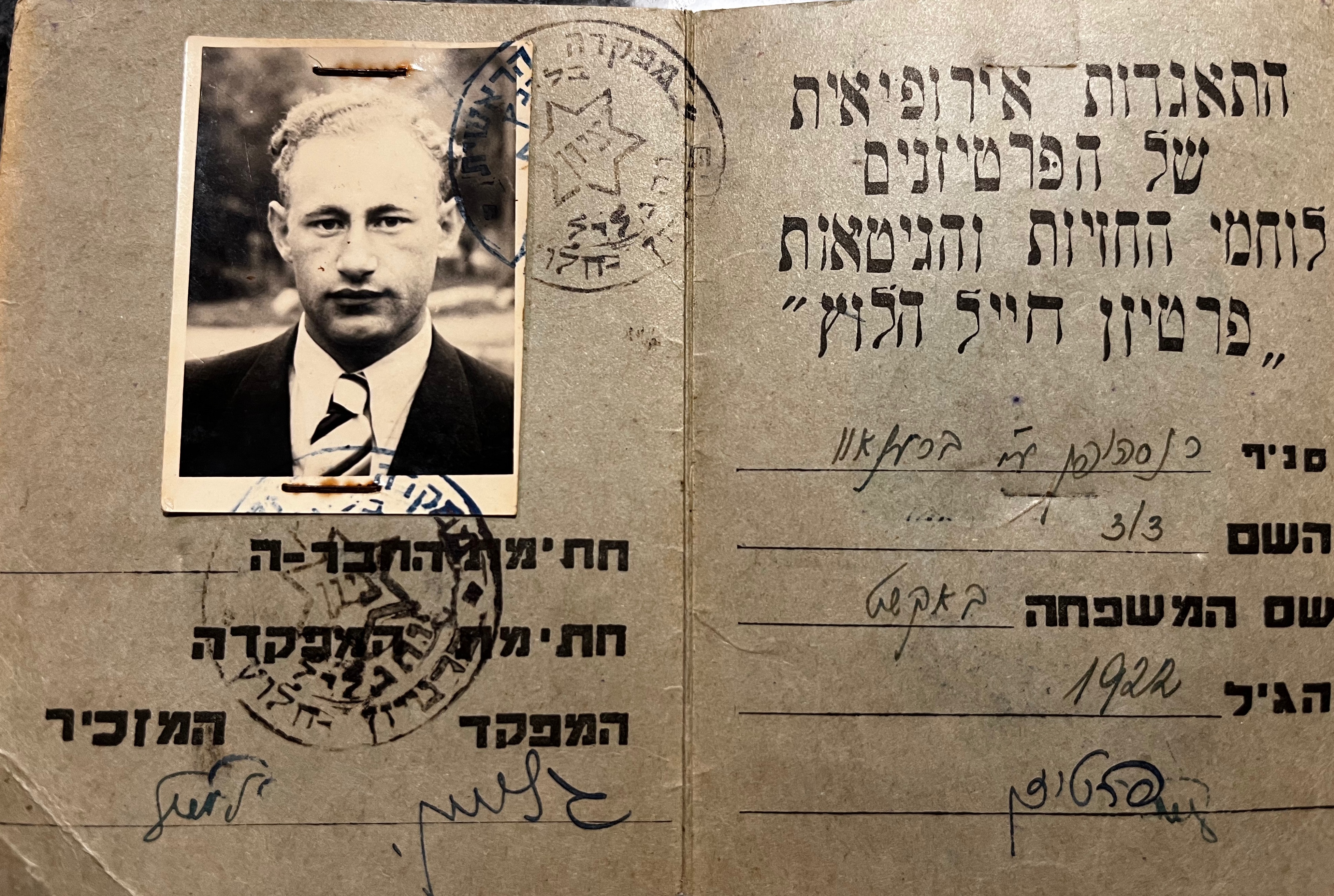
For purposes of this essay, I will summarize. David Bakst was granted leave for his heroism in a battle with the German army. At this point David was in the Soviet army who were unaware that he was Jewish. He was given leave to visit what was left of his family, his father and sister, who were in Lida, about 40 kilometers from his hometown. David pined for his home. He had warm memories of family gatherings and the love he felt among his extended family. The house was a relatively modern one, built in 1929. I think, even though it was unrealistic, he hoped in his heart to reclaim it.

They arrived at their home, which withstood bombing by Germany. A Polish family was living there. Though David was allowed to come into the house when he explained his connection to it, the reception was not warm. He was told in no uncertain terms that it wasn’t his anymore. Upon seeing the interior, with his family’s things rearranged, and seeing his parent’s bed, knowing his mother and younger sister had already been murdered, he collapsed in tears. His father and sister comforted him, they told him there was nothing in Iwie for them anymore, they needed to look to the future, and that is what they did.

David spoke fondly of that house for the rest of his life. But, whatever bitterness he may have harbored did not interfere with his making a new life in a new country.

Clearly the protesters at Columbia, at other college campuses and in the Middle East either don’t know this history or don’t care. If they don’t know it, they have a responsibility to learn it. The latter possibility is even worse. To be aware of the pain that is carried by our family and by millions of other Jewish families, and still chant “Go back to Poland,” is beyond cruel. It would be evidence of pernicious antisemitism, not of a liberation movement. It is also extraordinarily, epically ironic given that the basis of their protest is that Palestinians were forcibly evicted from their homes.

Another problem with this situation is that the media coverage of this has been quite limited. I have not seen stories that explain the problem with the suggestion that Jews go back to Poland. Those who are ignorant have not been enlightened by the coverage; they can continue to live in their deluded world. Does the media assume that people understand? If they understand, they should be called out for their inhumanity. While one might argue that the journalist’s role is not to take sides that is not what is called for here. It is a matter of giving context, explain some history and that is the role of a journalist. Giving that context doesn’t even necessarily mean folks would change their mind about the Palestinian cause, but it might help bring some nuance to the discussion. At the very least, hopefully that disgusting chant would be cast aside. I would not hope for apology, that is probably too much to ask, but it would be appropriate.

We can argue until the end of time about who the indigenous people of the Middle East are. Frankly, I don’t care beyond understanding the history of the region as best we can. We can argue who is in diaspora – aren’t both peoples? Not to mention other displaced persons who have been forced to leave their homes whether it is in Africa, Asia, or Central America because of war, gang violence, natural disasters, climate change, power struggles, genocides. Are these encampments for them too? Is there a point to arguing who is a refugee? Where does the argument get us? Yes, it is essential that we understand and acknowledge the generational trauma that Palestinians and Jews carry, but that is a two-way street. Chanting “Go back to Poland” is absurd and suggests that they are not serious about finding a solution.

Reverberations Through Time

Note: I have been absent for a month! There are many reasons for that – I will write about it at another time. I am glad to be back! I look forward to continuing our conversation about stories we tell ourselves.

December 15, 2022 would be my father-in-law’s 100th birthday. David Bakst made it to his 98th and for that I am grateful. He passed away a week after achieving that milestone.

As I reflect on his life so many thoughts come to mind. In David’s last years, I would often accompany Gary on his Thursday afternoon visits. Gary doesn’t see patients on Thursday afternoons, so it was a good opportunity to spend time with his Dad. They, including his mom despite her advanced dementia, would go out to lunch to a diner near their apartment in Saugerties. I know Gary treasures that time and the memories they provide.

Many of those lunchtime conversations revolved around David’s memories. We would ask him about his youth and World War II experiences. We heard the same stories multiple times, new details might be offered, but even if not, we never tired of hearing them. One particular comment stayed with me, though I am not sure why. As David described his family life before the war, he said that after Shabbos services, the adults (his parents’ family and friends) would gather at his home and talk (argue) politics. David listened in, beginning a long interest in politics that remained for the rest of his days. He told us that his father was a supporter of Jabotinsky, who he described as more of a right winger. The name vaguely rang a bell, but I didn’t know anything about him or the context. I was curious. I tried to imagine what their political conversations might have been about in the late 1920s and early 1930s in David’s shtetl (village) in Poland (now Belarus).

After that conversation, I googled Jabotinsky and learned a bit but didn’t get very far and I set the subject aside, though it still intrigued me. Oddly enough the other day I came across a podcast entitled Jabotinsky and the Birth of the Israeli Right. I thought this might shed light on the topic, plus I am interested in better understanding the politics of Israel and this sounded like it could offer that.

I am very glad I listened. It accomplished exactly what I had hoped. It reaffirmed my belief that learning about our past illuminates our present; the issues that plagued us more than a century ago still percolate in the lives we live today.

The topic the Bakst family was likely discussing during their Shabbos afternoon visits was Zionism. It is appropriate that I write about this now given the intersection between anti-Zionism and antisemitism, and the appalling rise in antisemitic rhetoric and violence.

So, what is Zionism? It is the movement to create and support a Jewish homeland. Its roots go back centuries as part of Judaism, with the idea that since the destruction of the temple in Jerusalem and the diaspora, Jews prayed to return to the Holy Land. This was largely a religious tenet until the late 19th Century. It evolved into a political movement, in part in response to virulent antisemitism in Central and Eastern Europe when Jews were largely confined to living in an area called the Pale of Settlement (part of Russia and Poland). In the late 1800’s and early 1900’s, as pogroms (violent riots perpetrated against Jews in the Pale of Settlement) became more common and feared, some Jewish thought leaders concluded that the only solution to antisemitism was a Jewish homeland. They believed that there was no future for Jews in Central and Eastern Europe and that ultimately, they needed their own country in their ancestral homeland. The father of this strand of political Zionism is generally considered to be Theodor Herzl, who wrote a pamphlet that was published in 1897 entitled Der Judenstaat (The State of Jews). In it he argued that Jews were a nationality, that it was not a social or religious question, but a national one. In order to escape antisemitism, express their culture freely and practice their religion, they needed a state. This idea became quite popular and was widely discussed in Jewish circles, including David’s hometown of Iwie.

As with most political movements, there were factions. I imagine that David’s family debated the different perspectives. One of the areas of disagreement was what kind of country should it be. Some advocated for a socialist state (David Ben-Gurion emerged as the leader of this wing and in fact became the country’s first prime minister in 1948); others wanted a free market approach. I would imagine David’s father, as a successful businessman before the invasion of the Soviet Union in 1939, would have wanted a capitalist economy for the new state. Jabotinsky, the person David referenced, supported the free market, though he also believed that the citizens of the new state should determine their destiny.

Another thread of discord in Zionism is the role of Judaism, the role of the religion itself, in the creation and running of the state. One of the things that is unique about being Jewish is that it encompasses a number of elements: it is a religion, it is an ethnicity, and it is a culture. Some identify with some aspects of that identity, but not others. The Zionist movement included (and still includes) a range of belief about religion. Some are Orthodox, very observant Jews, for whom the religion and the state are inextricably tied. Others are secular Jews who may even call themselves atheists. Neither Herzl, Ben-Gurion nor Jabotinsky were particularly religious. Though I never had a conversation with David about this subject, I believe he would support maintaining the Jewish character of the state but would not support a theocracy. Defining that balance continues to be a challenge.

Jabotinsky also advocated for a strong military capability. He believed that the new state would be fought over, that the Arabs in the area would not relinquish land or power without a fight. Ben-Gurion believed that in return for economic and political considerations, the Arabs could be appeased. In furtherance of Jabotinsky’s belief in the need for military capability, he created a youth group in Poland, Betar, that would instill nationalist fervor in young people for Israel and train them to respond to attacks on Jews wherever they occurred. David Bakst was a member of Betar.

I wonder if any of the training he received, or the faith and support built as part of that group, helped him in his war experience.

There is great poignancy to these issues. Imagine if there had been a Jewish State in the mid 1930’s. Millions of lives might have been saved. Instead of ships being turned away from ports, instead of country after country rejecting Jewish refugees, people would have had a place to go. We will never know what might have been.

The controversies that plagued the founding of Israel are still playing out today. The tensions between its socialist origins and the demands of a free-market economy are still difficult to sort out. The balancing of the different attitudes regarding the role of Judaism in the state creates conflict. The fundamental disagreements between Israel and its Arab neighbors, not to mention its Arab citizens, are as troubling as ever.

And, in an even larger sense, we are still grappling with what to do about antisemitism. It is a pernicious and stubborn prejudice. It is disheartening that over a century after Herzl wrote his pamphlet, and even with the establishment of the state of Israel, lies, misconceptions and hate are still rife. After all he went through, I wonder if David would be surprised by this latest resurgence. In that one sense, I am glad he isn’t here to see it.

More Miracles: David in the Soviet Army

Last week’s blog post began by explaining more about the communist takeover of Iwie and then the early part of World War II when the Germans invaded David’s town. It also recounted David’s involvement with the partisans. I misplaced one element of the story. It is important  that I get this telling as accurate as possible. As I explained previously, these stories have been told in drips and drabs over the course of many years. It wasn’t told as a chronological narrative. In addition, as Gary and I continue to have conversations with David, new details emerge. It is a race against time, David is 95, to document the family history. It is a responsibility Gary and I are sharing.

For example, David recently revealed that when they lived in the ghetto, they attempted to create some kind of normalcy. They conducted Sabbath services. His aunt, his mother’s sister, got married there. Those details give a fuller picture of the experience. I want to share those pieces, even though I already covered that part of David’s story. This is a ‘living’ process, so to speak. I hope my telling it in this way, doesn’t detract from the narrative.

Now, back to the events that I misplaced in last week’s blog entry. When the Bakst family escaped to the woods, when first Berl and then David carried young Gussie through the snow drifts, I wrote that they were not able to connect with the partisans. Actually, David’s younger brother, Eliahu (they called him Ellie), joined the Bielskis at that time (I mistakenly thought he went back to the ghetto with the rest of the family and joined later when David and Berl joined Iskra).

The Bielskis were a just-forming Jewish partisan brigade. Led by two brothers, the mission of the Bielskis was to save as many Jews as possible. Their members swelled to about 1200 by the end of the war in 1945. They set up a community deep in the Naliboki forest. They carried out other missions, as well, including sabotaging German rail lines. Ellie, who was 14 when the Soviets came to Iwie, would have been 17 at the time. He participated in those activities. Ellie and another partisan were on a mission to get supplies from a farm when they were surrounded by German troops. They tried to shoot their way out. Ellie was killed on January 5, 1943 as he tried to escape. (Our son, Daniel’s Hebrew name is Eliahu in memory of David’s brother.)

The remaining Bakst family, now just Berl, David and Batya, soldiered on in spite of the mounting and unrelenting losses.

Now I will return to the thread of David’s story. He and Berl, and the recently rescued Batya, continued their activities with Iskra. Iskra was a Russian partisan brigade that was initially resistant to accepting Jewish members. Antisemitism wasn’t the sole province of the Germans, unfortunately hatred of Jews was shared by many in Eastern Europe. A fellow Iwie resident, Motke Ginsburg, had previously joined Iskra and proved to be a valuable asset. He vouched for Berl and David. Over time they were accepted.

The efforts of Iskra and other partisan units were coordinated to some extent with the Russian army. Intelligence was shared. Slowly, with the sacrifice of many Russian lives, the tide of the war turned. The German army was repelled and fell back from eastern Poland. The Soviet army came to Iwie. This time the Soviets, due to Berl and David’s partisan efforts, greeted them as heros, not undesirable capitalists.

David, now 19, was conscripted into the Soviet army. Another difficult chapter of his war time experience began. He left his remaining family and was assigned to a regiment. The Soviet army was an inhospitable place for Jews. David, with his strawberry blond hair, blue eyes, and unaccented Russian language skills, didn’t share his semitic origins. As a quick, intelligent and strong young man, David was assigned a role as a communications officer. He carried equipment and laid communication wire near the front.

On one occasion, David’s regiment was hunkered down in a foxhole when they started receiving shelling and artillery fire. The foxhole was actually a series of connected trenches. Panic erupted with soldiers running trying to escape. David was last in a line of soldiers, running away from the onslaught. He was confronted by an officer, who asked, “You, too, David?” The officer was disappointed that David was retreating along with others in his platoon. In the Russian army if you were caught retreating you risked being shot by higher ranking officers. Knowing this, David stopped and turned back. He had no weapon other than a grenade, having left his rifle in the scramble to escape. He ran back into the fray and threw the grenade, killing several German soldiers and wounding one Russian. David survived.

The skirmish ended and David’s regiment regrouped the next day. The captain of the unit called David out during roll call. David feared that he was facing punishment, he had no idea why he was being singled out. To his great surprise and relief, he was heralded as a hero. The commanding officer asked him what he would like as a reward. He asked for a furlough to visit his father. His request was granted. David journeyed back east across Poland to Lida, where his father and Batya were living.

[The story will continue next week with David’s return to Iwie and his continued service in the Soviet army.]