Finding Balance as a Grandparent: A Personal Journey

What are my priorities?

I am a grandmother, called Nana by my granddaughters, which makes me smile.

I ask myself, how much of my life do I want to shape around theirs?

I grew up with my Nana living upstairs in the apartment above mine in a two-family semi-attached house. She was a gift to me.

I am not in the same situation. I am 2 and ½ hours from one granddaughter, three hours from the other. My children did not grow up in the situation I had either. They saw their grandparents maybe monthly in the summer, once in the winter months when we would fly down to Florida during the February break from school. They still knew their grandparents, and knew they were treasured. Most summers my kids would spend a week at my folks’ house in the Catskills. I think that was an especially bonding experience.

Is that enough for me?

These days we have FaceTime. We can see each other more frequently – in between in-person visits. What will that mean to them?

Then there is my relationship with my children. There are rare occasions when I see each of them separate from their families. It is precious time when I get to see them one-on-one. Do I shape my life to maximize the opportunity to visit them?

Or do I lead my life?…commit to volunteer work, commit to writing, commit to political activism – instead of filling in with those activities.

I don’t know how to balance it.

And then there is the mundane business of life. It is common to hear people who retire say, “I don’t know where the time goes. I’m always so busy. How did I fit in a full-time job?”

I am finding that taking care of myself as I age has become a full-time job. More frequent doctor visits, more frequent medical tests, physical therapy, exercising multiple times a week, picking up prescriptions, and all the paperwork that supports that stuff. Then there is the expansion of household tasks, some of which I crammed in or let fall by the wayside when I worked so there is catching up to do. Between taking care of the house, the car and my body, there isn’t that much extra time. Plus, my capacity or energy for all of it isn’t what it used to be.

I admit I am disappointed in a way; retirement isn’t quite a free as I thought it would be. I know I am lucky – unbelievably so in that I am not facing serious illness, just the nagging things that happen as the bones, joints and systems wear. I am even more blessed that my children are independent, capable humans who have families of their own. They live very full lives without help from me.

Some of my peers appear to be happy to center their lives around their children and grandchildren; others appear to be happy centering their lives on their own activities and maybe some have found the secret of balance. If you have, please share! Or maybe I assume folks are happy because that is the face they put on, especially on social media.

Between my own desire to remain engaged in meaningful growth, contributing to the world, and to have fun (which for me means traveling, being active, walking among trees, smelling flowers, being social, and, most importantly, deeply connected to my family), I feel like I don’t know what I am doing.

But, maybe I am doing it. This is it. I answer a call from my son who has an extra ticket to a Met game on a Monday night and I figure out how to make that work (it was a great game and we had a blast!). I schedule my various medical appointments and follow their instructions as best I can. Babysit for grandchildren and grandnephews when asked. Fit in yoga and tennis where I can. Take a walk with a friend. I write when I can, post a blog when I can. I don’t worry about getting published (easier said than done!). Let tasks in the house sit a while longer. I have lunch with a friend here and there. Plan a trip or two each year. Celebrate my granddaughters’ birthdays. Sounds pretty awesome really. So why do I feel uncentered? Perhaps it is just a matter of accepting it – the fragmented nature of it, the unpredictability of my schedule (or the absence of one) and the idea that I write mostly for myself and whatever audience reads my work. And most importantly, to believe that in being there for friends and family, I will have done something worthwhile even in the face of this very troubled world.

Looking for perspective in the woods of Central Park or maybe just admiring the birds.

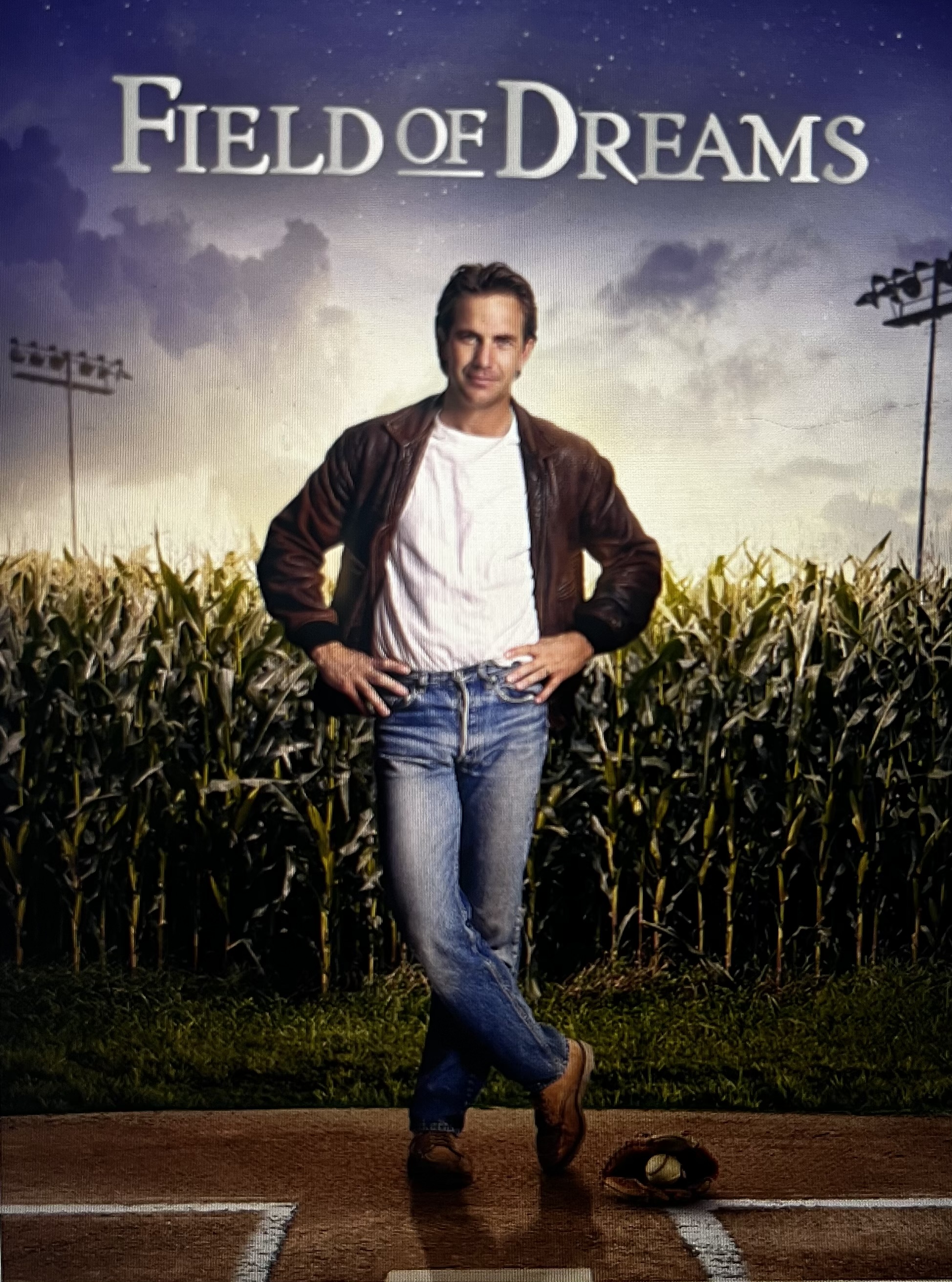
“Field of Dreams” – Some Thoughts

My family has a movie club. It functions the same way as a book club. A member picks a movie, and we get together on Zoom to discuss it. The person who picks the film moderates the discussion. The number of participants varies from month to month, but typically there are about 19 of us. This month we discussed Field of Dreams.

I had not watched Field of Dreams in many years. I remembered enjoying it in the theater when it came out in 1989. I have caught bits and pieces of it on television since it airs frequently, but I am not someone who watches it whenever they come upon it, and I certainly had not watched it all the way through in decades.

For many this film is a touchstone. It is a perennial favorite because it speaks to universal themes: dream fulfillment, regret, father-son relationships, nostalgia for baseball, and redemption. It also features some wonderful actors, James Earl Jones, Burt Lancaster to name two and Kevin Costner qualifies as a genuine movie star (I think he is a fine actor and does a good job in this).

Somehow watching it yesterday afternoon, I was not as moved as I remember being. I wasn’t drawn into the fantasy. I liked it well enough and could appreciate aspects of it, but I found myself doubting the premise. I wasn’t buying it. When we gathered for our discussion, I was in the minority, though there were a few who were also less than impressed. I wondered if I have become too cynical to relax and give in to the sentimentality. One of the premises of the movie is that we long for a simpler, more innocent time. My problem with that idea is that I don’t believe that simpler, more innocent time exists.

I also think that the father-son dynamic, which is central to this story, didn’t resonate with me and I don’t believe that is a matter of gender. Anyone can relate to the idea of having regrets over a parental relationship that wasn’t what you wanted it to be – and having the chance to make amends would be an unbelievable gift, as happens in the movie. While I can relate to that idea and would welcome a chance to reconnect with my parents, I am lucky in that I don’t feel a lack of closure with either my mother or father. I miss them, but I don’t have much in the way of regret. I am grateful for that.

While intellectually I get the potential for how baseball can connect a father and son and how meaningful a catch could be, it still didn’t resonate. My parents were not of a generation where they played with their kids. My dad never had a catch with me – and I have no memory of him having a catch with my brothers. Maybe he did, or maybe they wanted him to. They certainly had catches with their own kids when they became fathers. I think it was a generational thing, though Gary, my husband, would toss a ball with his dad. What’s funny is that my dad was an athlete. He grew up playing ball – all kinds – baseball, basketball, stickball. He continued to be active as an adult, playing tennis and paddleball. But, he didn’t play with us. I think the mind set was different. He didn’t think it was his job to play with us. I had no expectation that he would. I can’t speak for my brothers – they may have felt a longing for that, or maybe they felt as I did that it just wasn’t something to be expected of him. Mom didn’t play with us either – not board games, not sports. We were expected to entertain ourselves.

Aside from the difference in expectation about parental roles that may explain my tepid reaction, the movie relies on nostalgia for baseball. I love baseball. It is a sport I have always enjoyed. I was a huge fan of Ron Bloomberg of the New York Yankees when I was a kid. You can probably guess why. But, I associate baseball with my brothers, my uncles and my Zada (my maternal grandfather), more than my dad. Dad followed the sport but after the Dodgers left Brooklyn before my birth, he was no longer a fan. He grew up as a die-hard Dodger fan and was angry and resentful that they left. In the years that followed he kept track of players, he read the sports page, but he didn’t root for a particular team and had no interest in going to games. If my brothers and I went to a game, it was with our uncles. I do recall a particularly memorable time my dad took us as a family, and it may explain why we went so rarely.

We went to see the Mets play the San Francisco Giants at Shea stadium. It was August of 1969, an auspicious year. Dad was no fan of New York City traffic, so he wanted to leave the game early. It was a close game, no runs had been scored, and we made our way to the exit after the 7th inning. Except when we got outside the stadium, we couldn’t find our car. We combed the aisles. This was long before we had fobs with a panic button. We had no way of flashing the headlights to help us locate the car. I don’t know why none of us had noted the section where we parked. We just kept walking up and down – every aisle looked the same, every section looked the same. Meanwhile the game went into extra innings. I believe we found our car after about an hour. The game went 14 innings before the Mets won, 1-0, so we still beat most of the crowd to our car where we listened to the last inning on the radio. It turned out to be a classic game. Gary Gentry, the Mets pitcher, held the Giants scoreless for 10 innings and was relieved by Tug McGraw who finished out the game. Juan Marichal, the opposing pitcher who went on to be a Hall-of-Famer, took the mound for 13 innings! So not only were we roaming the parking lot for a very long time, but we also missed the end of a truly great game.

It was not the happiest of experiences. Dad was not the most relaxed person under the best of circumstances. He had a temper and a short fuse. You can imagine his fury at not finding the car. Plus, with a family of five, though it was far less expensive than it is today, it was still a lot of money to buy tickets, park and feed all of us. I’m not sure we ever went to a game as a family again. It became an amusing anecdote, but not until many years passed.

[I will rely on my brothers to correct me, if I got this episode wrong.]

The point is that my affection for baseball was not nurtured by my father. So, when I watch Field of Dreams it doesn’t evoke the heartfelt emotion that it does for other folks. I know my brothers feel differently. They participated in the movie club discussion, and the film clearly struck a chord with them. I invite them to comment or write a blot post about the notes that struck home.

If you want to chime in with your feelings about Field of Dreams, please do. I will say that unlike many movies made in the 1980s, it aged well. It wasn’t offensive in any way that I perceived and, in fact, got a lot right. It just didn’t move me the way it does many others. I didn’t choke up and I shed no tears during the final scene. Did you?