American Portraits

Does anyone get their portrait painted anymore, other than presidents and first ladies? I was thinking about that after going to two exhibitions, one at the Metropolitan Museum of Art, the other at the Whitney.

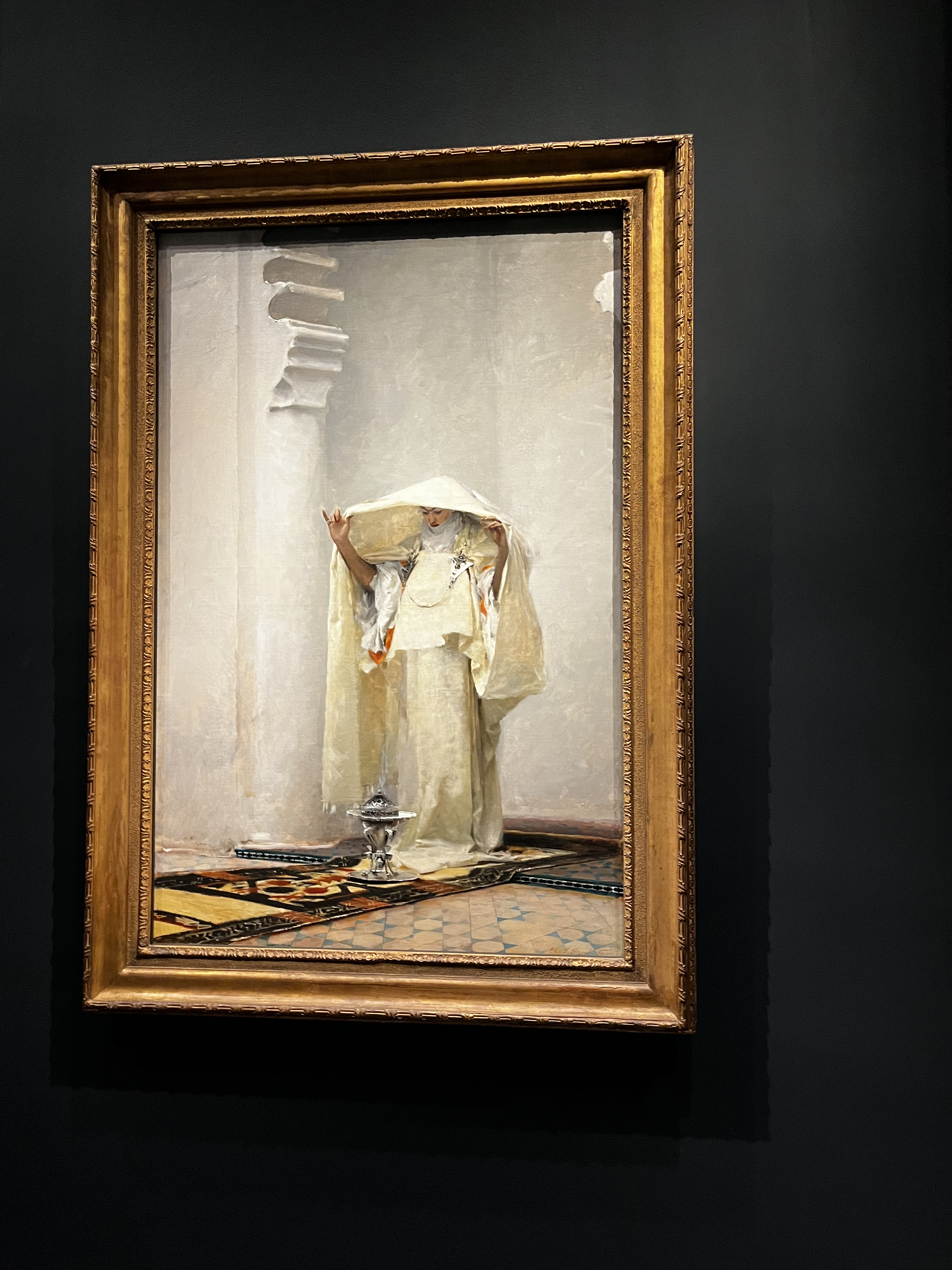
The first one was entitled Sargent in Paris, and it explored the emergence of John Singer Sargent as one of the premier portrait painters in the 1880s. He was commissioned by people in high society to paint themselves, their wives and children. I don’t travel in high society, so it is possible that old money, or the richest folks among us, still do that. If they do, I haven’t heard of the artists who do it or seen exhibits of their work. I am more familiar with hiring a photographer to do a shoot, but even that isn’t common, though some do it for an engagement or new baby. Back in the day, and I’m referring to the Guilded Age, it was apparently a sign of status to engage someone like Sargent to do a portrait.

From what I read while I walked through the galleries, Sargent was quite adept at nurturing the relationships one needed to sustain his career. There is no denying Sargent’s artistry, I love his work, but I think his ability to hobnob with the circles that could pay him enhanced his career and reputation. I wonder if he liked that part of his job. Maybe it came naturally to him. I would hate it. It is possible, like Michael Jordan who had both talent and tenacity, Sargent had both the social skills and the exceptional talent that allowed him to achieve the heights of success as a portrait artist.

Though Sargent was an American, he only visited here. His parents were ex-pats who moved around Europe. He was born in Florence, and he died in London. Despite spending a good deal of time overseas, he did leave his mark here in America, particularly in Boston where his murals decorate the ceiling and walls of the main branch of the public library. He, unlike some artists, was celebrated in his lifetime. There was a period after he died where his work was less respected because it was viewed as the work of a mere illustrator, without much creativity. Then his reputation rose again as the art world took another look at the nuance of his portraiture and skill of his brushwork.

Here are some examples of the range of his work from the exhibit:

I love Sargent’s canvases – his formal portraits and his paintings of nature. He was so versatile. He could do watercolors, and he could paint in the Impressionist style. Whatever he did, his use of color was so vibrant, you can feel the texture of the fabric of the dress his subject wore. He also makes white come alive, which is unique – not everyone can make white an interesting color. And, even though he was often simply painting a portrait of someone I never heard of nor cared about, he manages to make them compelling.

This is the one commonality I found between the Sargent exhibit and the other show I attended, Amy Sherald: American Sublime at the Whitney. You may know Amy Sherald as the artist who painted Michelle Obama’s portrait, and that canvas is included in the exhibition at the Whitney. That work got some attention, but of the pieces on display that one was the least interesting to me.

Like Sargent, Sherald paints ordinary people but makes them notable. I suppose it isn’t accurate to say Sargent portrayed “ordinary” people, since they were, with few exceptions, very rich, but they weren’t famous in the way we understand fame today. Sherald’s subjects, with the exception of Michelle Obama, aren’t rich or famous– they are regular people. Sherald is interested in presenting people of color, offering less emphasis on their skin tone and more on their everyday lives – reflecting their joy, their dignity, their pride. She also plays with our expectations of gender and race, showing people in surprising settings.

Sherald’s work is also a celebration of color, but in an entirely different way than Sargent. Her canvases are bold, and while Sargent may have been considered bold, it was in the context of the Victorian era. Sargent’s most controversial painting, Madame X, presented a woman with the strap of her evening gown off her shoulder, which he later fixed to appease the sensibilities of the time. Sherald is far more daring, pushing the boundaries of our expectations. I’m sure some viewers, I’m thinking of social conservatives, would not appreciate her perspective. I love that her work makes you stop, think and reconsider assumptions.

Here are some examples of her work:

Sherald’s canvases, with the notable exception of the Obama portrait, are not on commission. She spots people on the street that she finds interesting for one reason or another, or she has an inspiration, and she asks permission to photograph that individual and then paints from the photograph. Unlike Sargent, she was not able to make a living as an artist until later in her life. She waited tables until she was 38 years old.

Though I did not set out to see these two exhibits to compare and contrast them, it turned out to be an interesting exercise. If you are in NYC, I recommend seeing either one or both. You can expect huge crowds at the Metropolitan. I went on a member preview day and there were lines. I’m not sure if that was due to the popularity of Sargent or the popularity of the Met. It was far less crowded at the Whitney which made for a more enjoyable and relaxed experience. There are plenty of other things to see at each museum, obviously, and if you haven’t been to the Whitney since it moved downtown, the building itself is worth a visit. The Sherald exhibit runs through August 10th, while the Sargent is open through August 3rd. If you see either one, feel free to come back here and comment. I’d love to hear other perspectives.

Here are some photos I took of other exhibits that I particularly enjoyed at the Whitney:

From Generation to Generation

Editor’s note: I received the following email from my brother, Mark Brody. With his permission, I thought it merited sharing.

I just read a headline, I only read the headline as that is all I can tolerate, which indicated that federal funding is being cut to the programs which provide tutoring to children.  After reading that, or you can substitute any other recent news, such as how research into the cures for Alzheimer’s or cancer, etc. are being eliminated, and I decided that my sensitive, far too brilliant for her own good, sister could enjoy the following essay which, if she chooses, she might wish to post on her blog.

The Hero of Our Own Lives

“Whether I shall turn out to be the hero of my own life, or whether that station will be held by someone else, these pages must show.”  (Opening sentence of David Copperfield by Charles Dickens).

Last night Pam, my wife, and I were babysitting our 5-year-old twin grandsons.  After the boys had a bonus 8-minute episode of an animated, parentally approved TV show called Grizzy and the Lemmings, we all scurried up to their bedroom.  I declared I would outrun them to their room and for the 156th consecutive time (we babysit frequently) both Connor and Lucas outran their ancient grandpa.

Our usual nighttime reading ritual is that Connor will select books for me to read and Lucas, exhausted from a long day, will lie in his bed and be satisfied with just hearing the story as Connor plops himself in my lap.  Before the last book is concluded Lucas will be sound asleep.

Last night, however, Lucas hands me a particular book and asks me to read it. 

The first problem with reading to Lucas at night is that he is usually so tired that he needs to lie in bed, and I need to place my old, creaky body on the floor next to his bed so he can see the pictures as I read the story. 

The second, potentially equally vexing challenge, is that Connor whose bed is at the opposite end of the room “needs” to climb into Lucas’ bed so he can get an equally good view of the book, or perhaps more cynically, to make sure that Lucas does not get a better view of the book than he receives.  This in and of itself is fine, but when reading comes to an end and Lucas is an inch away from being asleep, Connor will invariably decide he should stay in Lucas’ bed and endeavor to keep Lucas awake as there is still much playing and gabbing to be done.  Extricating Connor from Lucas’ bed is often an ordeal.

Last night, however, I was delighted that Lucas decided to climb into my lap as I started to read to him.  Connor then took his usual perch in my lap (the boys are still young and my lap, unfortunately or not, is quite ample).  We read the story. The boys genuinely helped decipher some of the words as the lighting is dim and when the color of the word is red, and the background is black, I have difficulty making out the letters (I am color blind).   The bedtime ritual was completed, and Lucas went right to sleep.  I tucked in Connor and said, “Good night.” 

As I left the room Connor commenced a debate with Pam.  Was Grandpa’s “good night” sufficient?  “Nana, when I wake up tomorrow Grandpa will not be here, don’t you think you should get Grandpa to come back and say ‘goodbye’?”  Despite the debate I did not believe it wise to return to the bedroom. 

First, debates with Connor (always Connor, as Lucas is not afflicted with the need/desire to question/analyze absolutely everything) can sometimes be lengthy (remember they already had an extra episode of Grizzy).  I could envision much time elapsing before I would again leave the room.    

Second,  and much more importantly, I recall the infamous evening when I was babysitting sans Pam and her adult oversight. I recall the look of terror in Josh’s face when I showed up alone, and the parents got home to discover Grandpa in the twins’ room well after bedtime, reading/gabbing with Connor. The formerly always serene Mama demonstrated a countenance which can be generously described as something other than serene.  As an aside, the Daddy of the twins, who has not yet to my knowledge been described as serene, voiced his considerable displeasure with my judgment that Connor did not need as much sleep as the parents thought necessary.

 With that experience in mind and armed with the ability to learn from the past, I promptly made my exit and left Pam to handle the debate with Connor. For some reason, unbeknownst to me, Pam does not seem to test the Mama’s serenity. 

Later that evening Pam explained that Connor’s thesis that Grandpa’s saying “good night” was insufficient was predicated on Connor’s observation that upon his saying “goodbye” to me, I should also say “goodbye” to him because when he wakes up in the morning I would not be there. Hence, just saying “good night” is not sufficient. Note taken.

Both grandparents, having safely bid the boys good night or goodbye as the case may be, await the parents return home which they do at a reasonable hour.  Pam and I head to our own abode. 

We discuss how I used to read to our boys when they were the twins’ age so many decades ago.  Perhaps that is why I decided I should re-read David Copperfield.   Having made a little headway in the tome, I went to bed at 6:00 a.m.

When I awoke the next afternoon, Pam and I discussed how 35 years ago I would read one chapter of the Dickens’ classic a night to Josh. If memory serves me correctly Sam – age 4 or 5- would be snuggling with Josh and me.  She suggested that perhaps one chapter a night might still be a good idea for me. Another note taken, but likely ignored given my track record.

This made me think- about how long it would have taken me to complete the 64-chapter book (each chapter averaging 15-20 pages). 

…..And then a memory arose which I had not thought of for many years.  I now recall having been so enthralled by the elegant writing, humor and pathos of the novel, one summer afternoon, while we were on vacation in a time share in California, I simply had to read the book to myself.  This decision did not end well because Joshua spotted me reading the book…without him! He was outraged and demanded that I not “go ahead of him in the book.” 

Three plus decades later, I recall vividly Josh explaining how my betrayal stung him.  He probably has no memory of this.  My argument that I was going to read everything to him were to no avail.  7 (or 8?) year old Josh’s thesis was that this was a shared experience for the two of us (Sam’s presence was either tolerated or perhaps cynically he did not notice Sam on the other side of me as we read) and my proceeding without him was a grievous abdication of parental responsibility.

…And now a more recent memory- about 4-5 years ago, I am in Josh’s house and he is on the living room floor (he is not yet as antiquated as is his father and can sit comfortably on the floor) with one of the twins and he is reading to his son, not yet one, from one of Tolkien’s Lord of the Rings books.

…..And then another memory from two years ago- Sam reading to his then 5-year-old son (Ted) from the Hobbit.

…..And yet another memory rushes in from 60+ years ago  of Mom reading to me. I struggle to recall whether it was Treasure Island or maybe The Three Musketeers– perhaps my older brother, Steven will know.

…So, to conclude my essay, my dear sister, as our great expectations (pun intended) of our government is under constant assault, perhaps there can still be a calming perspective about how rich it is when we have the opportunity to share literature (great or otherwise) with children.  And perhaps by doing so we can be the heroes of our own lives.

Note from your sister: Thinking about reading stories to our children and grandchildren, or reading literature in general, is far better than absorbing the news. So thank you for sending this to me. I too have fond memories of reading to my children each night, but I was not so ambitious as you. Though I read them chapter books, I never took on Dickens.

I also think about the role books had in our shared childhood. Wherever we were, and, as you know, we spent summers in different college communities while Dad pursued his education, we took a weekly trip to the library. Mom and Dad set us up for an enriched life. As they say in one of our prayers, not that we are religious, l’dor v’dor, from generation to generation. I think we have done just that. Mark, thank you for sharing this.

Will It Make Difference? It Is Up to Us

I watched chunks of Senator Cory Booker’s 25-hour speech in the Senate. I did not see or listen to the whole thing. I saw enough and read enough about it to offer some observations.

First, I was impressed with his stamina. My voice isn’t strong enough to talk for an hour, much less a full day. Yes, he had some breaks where other senators spoke, under the guise of asking questions, but he stood for all of that time and spoke with passion and emotion. It was quite a feat. It is not surprising that he was an athlete in college and continues to work on his fitness. As an amusing aside, my husband was impressed with his bladder. He needed control of both to get through that ordeal.

I saw some of the comments on social media during the event. Most lauded him. Of course, I live in a Democratic echo chamber, so I didn’t see much right-wing commentary. They may have been critical or sarcastic or who knows what – perhaps they mostly ignored it. Some, even in the progressive corner, were critical – saying it was a stunt or asking what good was it doing. I think there is a legitimate point there. It was a stunt. The question is: did it do any good?

It is true that Senator Booker wasn’t fillerbustering a proposed bill or administrative appointment. But, I think there was still merit to what he did. We need people to get motivated. We need people to be informed. To Booker’s credit, he didn’t read the phonebook like some in the past who have fillerbustered. He spoke substantively. Yes, some of it may have been repetitive, but there was a logic to that. After all, who would be watching the whole thing? Plus, people need the central messages to be repeated so they grasp them. It remains to be seen whether he was able to get folks energized.

Sadly, there are limits to what the Democrats can do to stymie Trump, especially given the aggressive, outside-the-norm, methods of slashing and burning government agencies that the administration is pursing. The Dems simply don’t have the numbers in Congress to stop legislation or prevent appointments. They are taking him to court, but that is slow and, in some cases, appears to be ineffective because rulings have been ignored. Plus, in many instances the damage has already been done. If someone is fired, or an office is closed, it isn’t so simple to just put it back in place even if there is a court order. There is likely mass confusion as to what happens next when an action has been countermanded.

For folks who are angry at the Dems, I ask: what would you have them do? It is easy to criticize. I criticize when they aren’t at least raising their voices. I was profoundly disappointed in Schumer’s capitulation on the budget. Perhaps he thought it was necessary to avoid a government shut down, and that may be so, but he should have put up more of a fight first. At least make some gestures at resistance – push them a little further, see if there is even some concession.

Aside from noting Booker’s stamina, I was impressed with his intelligence and passion. Some of his colleagues in the Senate showed themselves to be articulate and knowledgeable. We make fun of politicians for many reasons, accusing them of being self-serving or corrupt. Some may be that. But Tim Kaine, Senator from Viriginia, Chris Coons, Senator from Delaware, and Chris Murphy, Senator from Connecticut, were among the speakers who displayed deep knowledge and commitment. They deserve to be recognized and respected for their efforts. Unfortunately, the realities of power in our country require that elected officials raise crazy amounts of money to run for office, which leads them to have to practically sell their souls (or be ungodly rich themselves), and that, in turn, makes us suspicious. Add to that the idea that many of our fellow citizens don’t respect academic achievement, or value people who are intellectuals and you end up with someone like Marjorie Taylor Greene being more well-known and popular, instead of well-educated, widely-read public servants like the aforementioned senators.

I know many say that all politicians and all government workers are corrupt. I am not that cynical. I look at some of the individuals who spoke yesterday, most especially Cory Booker himself, and I believe their sincerity. I believe he is a man of genuine faith – not the false piety of Trump and many of his followers. You can disagree with Booker’s philosophy of government or his approach to the economy, but he speaks from his heart. He wants government to improve the lives of Americans. I can’t say the same about our president.

Will what Cory Booker did make a difference? Time will tell. I plan to attend the protest in Albany on April 5th. I plan to continue to express my opinions, on my blog and by writing to Senators and Representatives. I will support candidates whose platforms offer a better way forward. I hope others are similarly motivated. I hope the tide can turn. I have to believe that most Americans are unhappy with the approach to budget cutting that has been taken – the cumulative impacts will take time to register, but they will be real. They are not cutting waste, fraud and abuse. For all their talk about that, they haven’t taken the time to find it! Musk wants to cut and ask questions later. Sadly, the damage is already being done, we are beginning to suffer a brain drain where researchers and academics leave to more hospitable countries/institutions, among a myriad of other negative effects.

I applaud Senator Booker. I believe history will be kind to him. I just hope we can look back and see it as a turning point – not even so much a turning point in policy, but a turning point in our national dialogue, to put the focus on substantive issues and to place value on our democratic processes instead of the politics of divisiveness. I hope the Senator is proven right when he said that the power of the people is greater than the people in power. I hope we choose to wield it, rather than ceding it to Trump, Musk and DOGE. I hope enough of us are willing to make “good trouble.”