Ashes to Ashes

Aunt Clair’s ashes were sitting in a cardboard canister in the closet of our Manhattan apartment. The third anniversary of her passing was coming up soon. Her final wishes were to have those ashes spread over her parents’ graves. For many reasons, it had not been possible to make that happen, and as her yahrzeit (Yiddish for anniversary) approached, I was distressed.

When Aunt Clair died, I made the arrangements with the funeral home. She had no spouse or children, only nieces and nephews. I was her health care proxy. I had to identify the body before cremation. It was jarring to see my aunt without her spirit, it almost didn’t look like her, but sadly it was. The representative of the funeral home was kind and explained how things worked.  I wrote about her funeral and shared the eulogy on this blog previously (https://stories-i-tell-myself.com/2021/11/08/a-eulogy-for-aunt-clair/.)

The first problem with fulfilling her wishes was that when I inquired at the cemetery, I was told it wasn’t permissible to spread ashes there. We could buy a plot and bury the remains, but there wasn’t a spot near her parents, and it was expensive. After consulting with family members and my own conscience, I decided that we would at least spread some of her ashes there discreetly.  I imagine that the cemetery had its reasons, but I doubt it was because it would harm anything. I also didn’t want to take the chance of calling attention to ourselves, so I didn’t want to plan to spread all of the ashes there.

One of the things I learned through this process is that the amount of ash was more than I had imagined, though I had nothing to base my idea on. The canister was heavy, and it was tall.

I thought, given her love of biking and the frequency with which she would cycle from her apartment in Greenwich Village to her sister on the Upper West Side of Manhattan, that spreading the rest of her ashes through Riverside Park would be appropriate. I looked on the city’s website and believe it or not, it is legal to spread ashes in city parks*. It is not permissible to spread them in bodies of water within a park.

So, why were her cremains still sitting in my closet three years later? Life and death happened.

I recall when I picked up the ashes from the funeral home, the representative said, “You know how common it is for people to move into an apartment in New York City and find an urn with remains buried in a closet?”

I looked at him incredulously, “No.”

“You’d be surprised. People don’t know what to do, they put them away out of sight, forget, and they sit there for someone, years later, to discover. I’m just letting you know.”

“That won’t be the case here” I reassured him, and as I walked away, I thought, “That’s crazy. Who would let that happen?”

I have a better understanding now.

I had no prior experience with cremation; it isn’t a common choice among Jews, though apparently more are opting for it according to the guy at the funeral home. Aunt Clair wanted to be cremated, but she also requested that a memorial stone be laid at the foot of her mother’s grave. She had arranged for a footstone at her father’s grave in memory of the family he lost in the Holocaust in Poland, so she thought this was possible.  

After the funeral, I brought her remains back to my apartment. After a few months passed and thinking that we would have an unveiling for the footstone on the one-year anniversary (and we would spread her ashes at that time), I began the process of ordering the memorial stone. This proved to be complicated to arrange. It was not a typical request. The cemetery didn’t want it to be confusing as to who rested in the plot. After a lot of back and forth that isn’t worth detailing, we came to an agreement about what the stone could say. It wasn’t exactly what Clair wanted, but it was the best we could do. It took more than two years for the stone to come to fruition.

When the stone was finally available, other things were going on in the family. We were not able to arrange a time for the ‘unveiling’ of the memorial and we didn’t spread the ashes. In the interim Clair’s sister, Aunt Diane, passed away, as did my mother. A whole generation was disappearing. Another year passed.

As Aunt Clair’s third yahrzeit loomed, I decided I didn’t want to wait any longer to fulfill her wishes. I wrote an email to my brothers and cousin and said I would like to visit the cemetery and spread her ashes on Friday, November 15th. Jewish cemeteries are closed on Saturdays (the Sabbath) and my Mom’s unveiling was planned for Sunday, November 17th. It would be a good time to make this happen. My cousin, who lives in Massachusetts, responded that her daughter’s due date was November 20th so she would not be comfortable traveling to NYC so close to that time. Aunt Clair would certainly understand that, as did I. It turned out the timing didn’t work for anyone but me and thankfully Gary. Despite that, I decided to go ahead with the plan

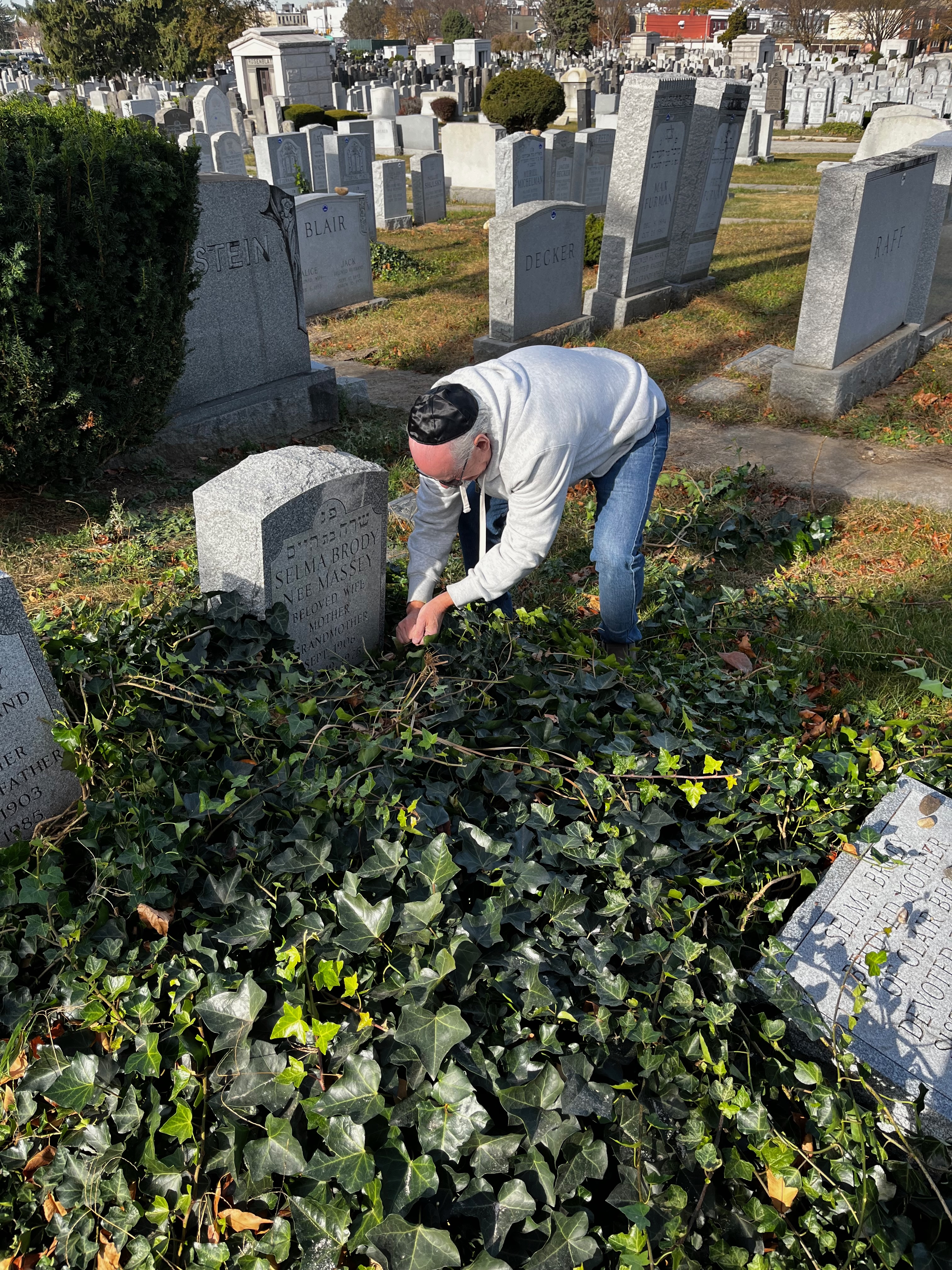
November 15th was a cool, sunny day as we drove the Jackie Robinson Parkway, a narrow, curvy roadway that connects Brooklyn and Queens and passes through a series of huge cemeteries. The trees were not yet entirely bare, the yellow and gold leaves shone in the sun. I had the location of my grandparents’ graves written down and we drove to the appropriate section of the cemetery. I thought I remembered my way to their graves. Gary and I combed the rows and couldn’t find them. I checked and rechecked my notes. Finally, I remembered I had taken a picture the last time I was there and maybe that would help. I searched my phone, those smartphones can be quite helpful and in the photograph I found a couple of landmarks that helped – a majestic tree and two large grave markers in front of my grandparents’ more modest ones with the name Feingold on them. We found the spot and now understood why we hadn’t seen them before – they were entirely blanketed in ivy.

Gary and I peeled away the ivy and exposed all the markers. Aunt Clair’s stone was there, as expected. I looked around and seeing nobody around, I took the baggie with a portion of Aunt Clair’s ashes out of my pocket and spread them over the graves. “May you rest in peace, Auntie.” I said. Gary and I paused and stood quietly for a bit. Then we got back in the car and headed back to Manhattan. Part one of my mission had been accomplished.
The sun was still shining brilliantly as we made our way to Riverside Park. It was also quite breezy. I wasn’t sure how I was going to do this. I carried the canister in a canvas bag. As we walked, a plan revealed itself to me. We passed a garden, now gone to seed until the spring, and I thought this was a perfect spot to provide what perhaps could be fertilizer. I looked around and nobody was paying attention – I knew I wasn’t doing anything wrong, but I also worried it might be disturbing to onlookers. I spread a good deal of the ashes throughout the garden, and nobody seemed to notice. There was still a lot of ash left.

We continued walking through the park and came upon a memorial to the Warsaw Ghetto Uprising. The shrubs surrounding it presented itself as another opportune spot. Though Aunt Clair was not a religious Jew by any means, she was fiercely proud of being Jewish. This would be a meaningful location, as well. Gary reminded me to stand upwind as I poured the ashes over the bushes. I had not been as mindful of that the first time.

The canister was still not empty, and I knew of one more spot that I wanted to visit. Aunt Clair was an admirer of Eleanor Roosevelt and there is a statue of her at 72nd Street just inside the park. We continued our walk south to find it. I was pleased to see that there were plantings around the memorial. I spread the remaining ashes there.

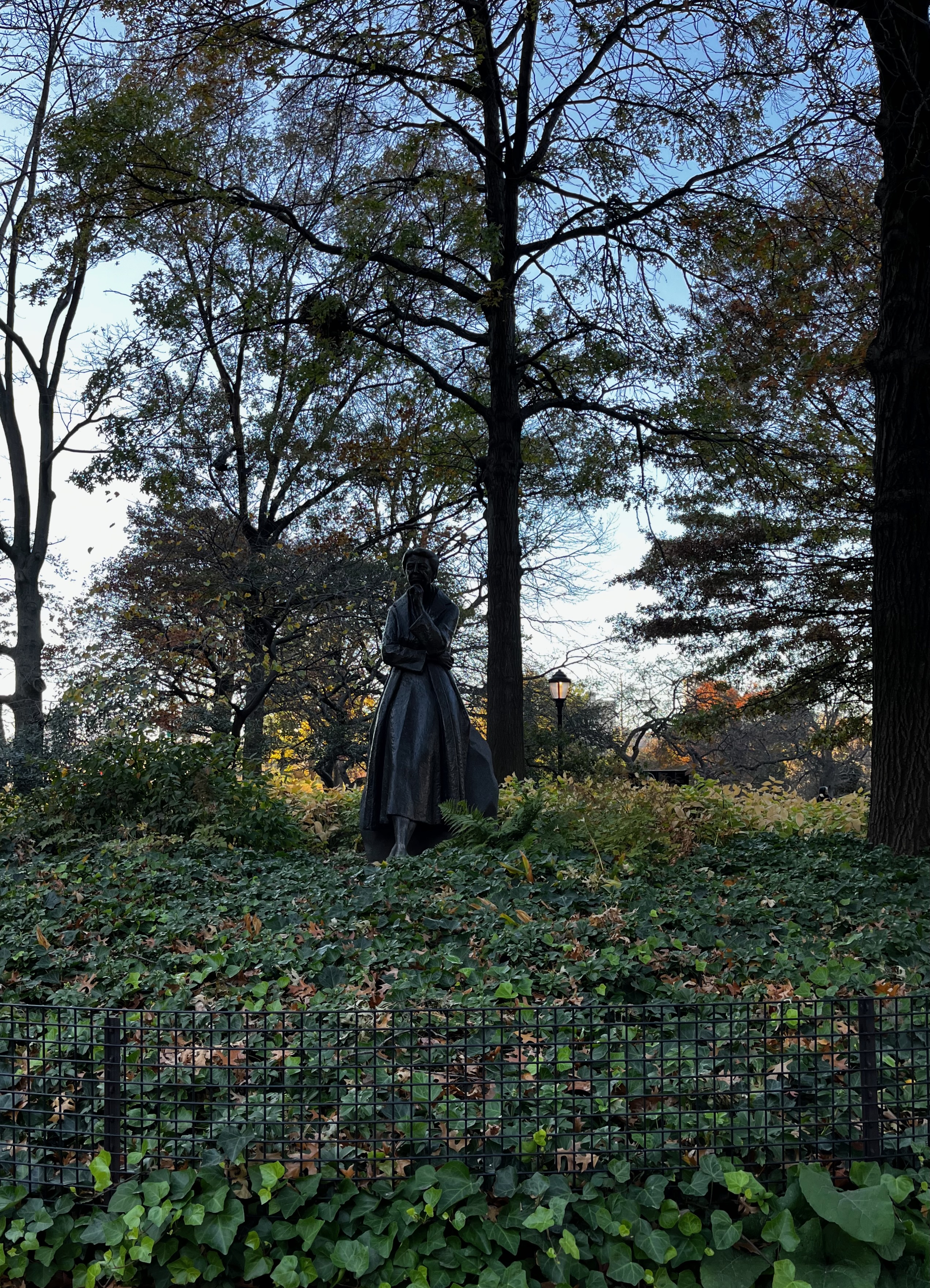
Throughout our walk, aside from talking about mundane things, Gary and I shared memories of Aunt Clair. I felt good about what we were doing. I was grateful to have Gary to share it with. He knew her well and shared his own unique relationship with her. We had come darn close to fulfilling her wishes and I think we honored her spirit. Part two of our mission was now accomplished. I was glad she was no longer sitting in my closet.

We took a different route through the park back to our apartment, walking along the Hudson River. I felt peaceful. The sun lowered and its rays glistened on the water. The day was fading, and I was satisfied.

*This is where I found the information: https://portal.311.nyc.gov/article/?kanumber=KA-03480#:~:text=New%20York%20City%20Parks%2C%20including,the%20site%20of%20cremated%20remains.
An Unveiling

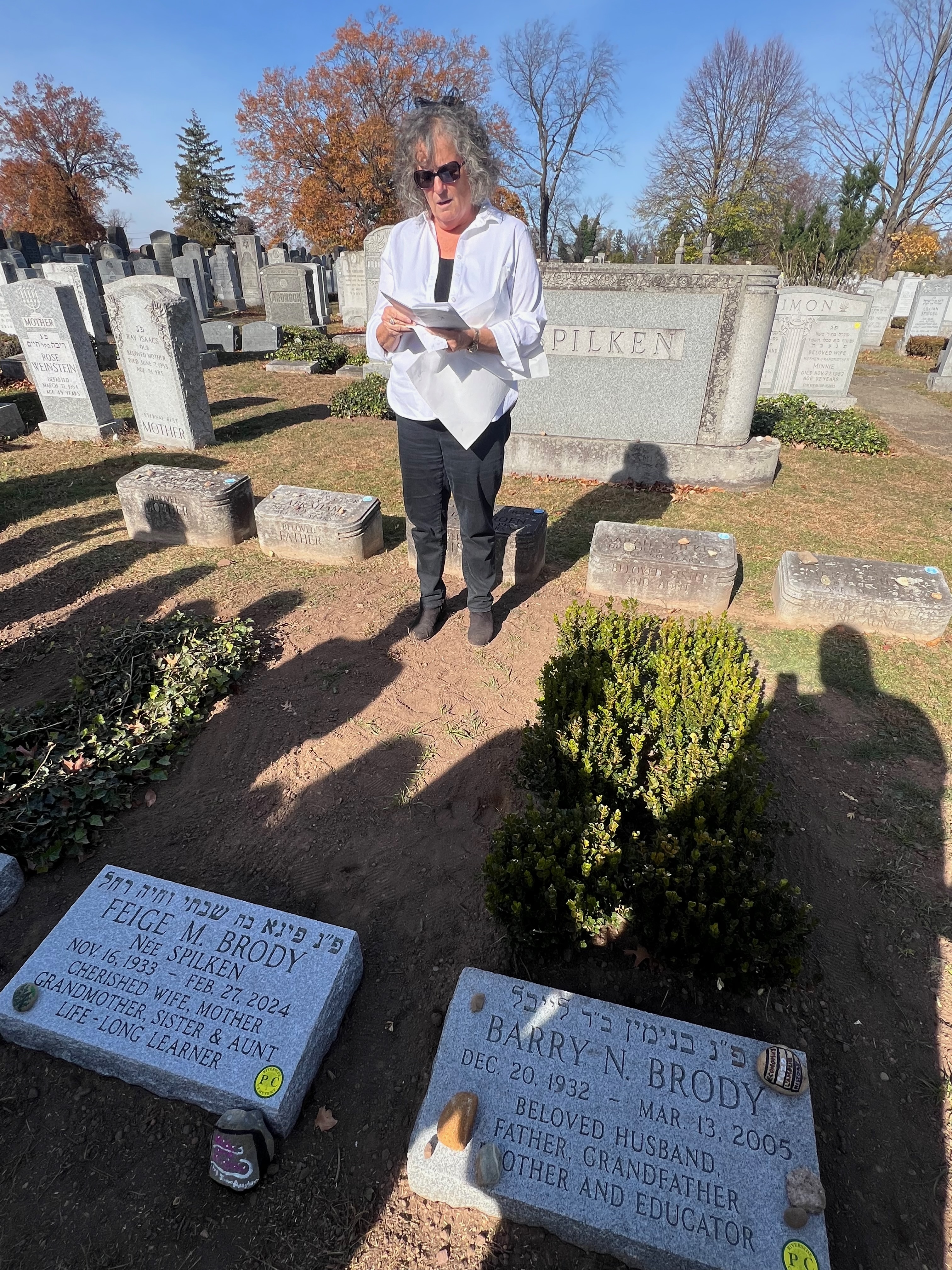
We gathered at Riverside Cemetery in Saddle Brook, New Jersey. In Jewish tradition, a year or so after a person is buried, you have an unveiling – literally the unveiling of a headstone or footstone that is the marker commemorating the individual’s life and death. Though it has been less than a year since my mother passed, my family gathered to observe this ritual for her on Sunday, November 17th, one day after what would have been Mom’s 91st birthday.

Photo by my brother, Mark Brody

19 of us stood around her grave on a brilliantly sunny day, unusually warm for mid-November in the northeast. It was appropriate weather given Mom’s sunny disposition (she was an eternal optimist, though, for better or worse, she shared her fears and complaints with me). She is buried between her mother, my Nana, and her husband, my father. The plot is part of an area that was established by the burial society founded by immigrants from Strickover, Poland where her father was born. Ironically, he is not buried here, he rests in Florida. But, other family members surround Mom, her brother, grandfather, aunts and uncles. There is something comforting to me about them all being together.

We began the ceremony by reading the portion of Ecclesiastes that tells us so eloquently that to everything there is a season – reminding us of the cycle of life. Then we uncovered the stone which reads:

Feige M. Brody

Nee Spilken

November 16, 1933 – February 27,2024

Cherished Wife, Mother, Grandmother, Sister and Aunt

Life-long Learner

Standing beside me were representatives of all those roles – her children, brother, sister-in-law, grandchildren ( a great-grandchild, too), nephew, nieces, and great-nephews.

I read these words: “On behalf of all of us, we consecrate this memorial to Feige Brody as a sign of our eternal love and devotion. May her soul be bound up in the bond of eternal life.”

The cemetery had provided a booklet with selections that could be read, and it offered the following passage which I am transcribing here because I thought it was insightful, comforting and appropriate and might be helpful to others who are grieving a loss:

“We gather here today at the final resting place of our beloved mother, sister, grandmother, aunt, Feige to unveil this grave marker dedicated to her memory and to call to mind our cherished memories of her. When Feige passed away, we assembled here to pay our respects. At that time our grief was deep, and we felt intensely the pain of loss. Now, with the passage of time, the pangs of our initial grief have softened, yet we still feel sorrow in our hearts whenever we remember her.

Jewish tradition teaches us that those memories of Feige, which each of us cherish, can provide us with a measure of comfort. Those memories also serve as a form of immortality that comes to those we love when we remember them, and when we live our lives in emulation of the virtues they taught us by example.

Our presence here today is already an indication that Feige has achieved that immortality that comes through remembrance. Our presence is also a sign of the respect and admiration in which Feige is held by us. We still feel an emptiness in our lives when think of her because she played such an important role in each of our lives as a beloved family member and friend to many. Feige was devoted to us as we were devoted to her, a relationship of love and affection that we recall today.

Throughout the months since Feige passed away, we have each had occasions to remember the impact that she had on our lives.

We are comforted by our memories of the joys she brought to people and by the contribution Feige made to the betterment of our world.

In the biblical book The Song of Songs we learn that “The bonds of love are stronger than death.” Our memories today prove the truth of that teaching.

Even though Feige is no longer present in person, the love that we shared and the way our lives were touched by her continue to be felt. The pain of loss and separation is the price we have to pay for the years of Feige’s love and devotion.

Therefore, it is with sorrow, yet at the same time with a deep sense of gratitude, that we thank God for the years during which we were privileged to have had Feige as part of our family’s life and as a member of our community. We thank God, as well, for the love that bound us together with Feige in life and that inspires our cherished memories. It is with these thoughts in mind that we now pay tribute to Feige by dedicating this grave marker to her.”

That passage provided comfort to me. I am consoled by the notion that we attain a measure of immortality by being remembered – it helps me to reconcile the loss of my mother and father, as well as other people who I have loved in my life and still think of regularly. And, it is meaningful to me to think of how, by carrying forward their values, by emulating their integrity and generosity, I am helping to preserve their legacy. Those thoughts help me to come to peace with my own mortality. Hopefully I will have touched friends and family in a way that merits remembrance.

After reading that passage, we said a concluding Hebrew prayer and Uncle Terry read a touching poem he had written in tribute. Aunt Barbara, as a self-described “out-law” welcomed into the family by Mom, offered her heart-felt perspective on Mom (and Dad’s) generosity and the importance of our family bonds. Terry noted that he had Barbara would, when the time came, rest in this same area of the cemetery, just across from where we stood. I said a silent prayer that that would not be any time soon.

Another Jewish tradition when visiting the grave of a loved one is to place a rock on the marker. This is to signify a visitor’s presence, that the person who has passed has not been forgotten. Several years ago, when we gathered at my father-in-law’s grave, my sister-in-law Doreen painted some rocks with pictures of things that she shared with her Dad or represented him. I thought that was a wonderful gesture. I decided to do that for my parents. I painted one rock to look like a bookshelf with items my dad read regularly: Economics, Puzo (he loved The Godfather and read it multiple times), L’Amour (he loved westerns) and History. I painted another stone with Pride and Prejudice by Jane Austen (my mother’s favorite of her novels, and she read Austen every summer until dementia made that impossible) and a final stone with a blueberry bush (when my parents lived in the Catskills and the grandchildren came to visit, they went blueberry picking and baked muffins). I felt good placing those rocks that embodied precious memories, knowing that they would sit there for a while at least before the elements wear them away.

No Spilken/Brody gathering would be complete without partaking of food. So, we adjourned to the diner that was just outside the cemetery. Though the service was painfully slow, and we had to wait, and the orders got mixed up (no day goes by without some aggravation), we enjoyed each other’s company before going our separate ways and returning to our lives  – some in New Jersey, some in Massachusetts, some in Connecticut and the rest in Albany, New York. Hopefully our next gathering will be a happier occasion, but I am left with a feeling of warmth, believing that Mom and Dad rest easy knowing that our familial bonds are strong and that we are doing our best to live out their values.

A Trip to Pittsburgh in the Aftermath

A view of downtown from the top of Mount Washington after riding the Duquesne Incline

I could write a book about our trip to Pittsburgh. We were traveling there for a mini medical school reunion.

So many thoughts flood my mind:

  • The choices we make in our lives, being reminded of a turning point and what might have been. We could have settled in Pittsburgh but wanted to be closer to family. The road not taken is hard to resist imagining.
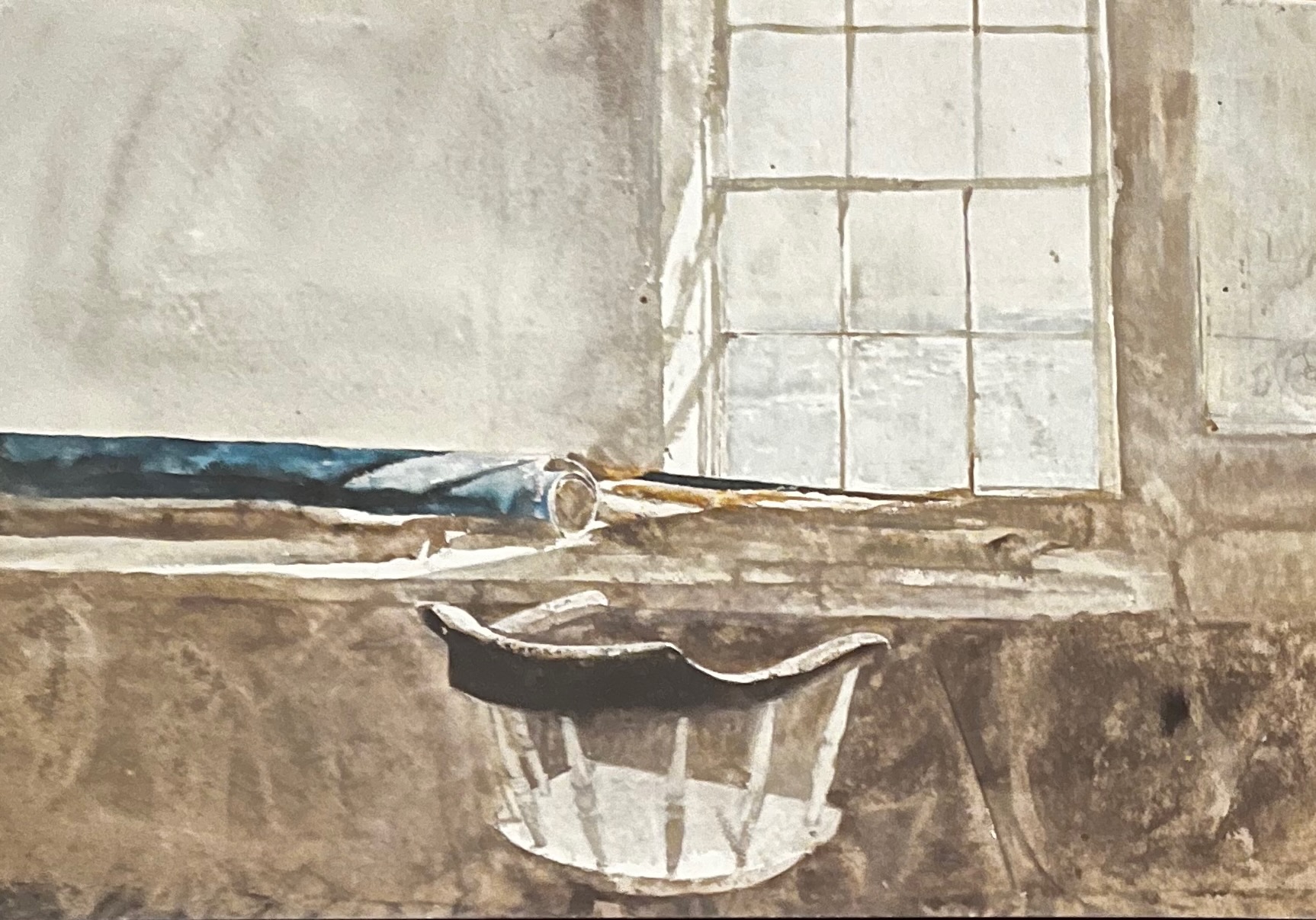
  • The side trip that took us at least 90 minutes out of our way, not to mention the time spent at the stop itself, a museum to see an exhibit of Andrew Wyeth’s paintings. When I suggested the detour, Gary initially didn’t want to take the time knowing what a long drive it was already from Albany to Pittsburgh. Then when we got in the car to start what should be a seven- or eight-hour trip, he said, “What the heck. We aren’t in any rush. Let’s go to the museum.”  I think he took pity on me, knowing my spirits were low from the results of the election and imagining a stop to look at art might help. He was right – it worked…for a while anyway.
  • The juxtaposition of gleaming office buildings, the beauty of the confluence of the three rivers and the unhoused, hurting people on the streets of that same downtown area. It is painful to see folks strung out, young people panhandling, wondering what’s worse: to walk by with a shake of the head and a murmured “sorry,” or to give some money? Our society must do better taking care of its own. The wealth suggested by elaborate skyscrapers, high-end stores and fancy hotels, side-by-side with people whose possessions are held in a bunch of plastic bags begs for a more humane economy. Below is evidence of the issue in Pittsburgh.
  • Gathering with friends from 40 years ago, some we did see eight years ago but others we had not, in the aftermath of an election that broke my heart but likely brought joy to some of theirs, was daunting. I was worried about how it would go.

It turned out that our reunion was warm, and we avoided politics, but I did have some interesting discussions with the woman I knew best all those years ago. We sat next to each other during the Pitt-Virginia football game that neither one of us was interested in. I knew she was a Trumper, and she knows I’m a bleeding-heart liberal. We would not change each other’s minds about anything. I come away as mystified by how I feel about folks who voted for Trump as I was before. Maybe I understand a bit more about her thought process – she sees the world differently than I do. One part of our conversation I will share because I think it is revealing.

I explained that I could not forgive Trump for, among other things, his reaction to the unite the right event in Charlottesville where the marchers chanted, “Jews will not replace us” and carried tiki torches. Trump responded saying there were good people on both sides. My friend explained that Trump was referring to the people who were trying to prevent the removal of confederate monuments – that he was sympathetic to their cause –  not to the chant. I said that I didn’t understand his statement that way and if that was the case he needed to make it clearer. She told me that it was obvious to her that’s what he meant. I said that even if that was what he meant, those monuments needed to come down. She disagreed. She asked me if knew anything about Abraham Lincoln. I said yes. She went on to explain that Lincoln supported monuments and naming forts after confederate generals to allow the South to save face. I responded by saying that may well be, and may have made sense in 1865, but it is now 2024, and the country needs to understand that the South lost the war. Those statutes and stories can be displayed and explained in museums and history books. Monuments in public squares should help us to remember and celebrate our better selves – the people honored don’t have to be perfect, but they do have to be on the right side of history. She just shook her head saying history should be preserved. I said, let’s change the subject and we did.

The game took almost three hours. There was a lot of conversation. Most of it was ordinary stuff about family, travel, health, but we couldn’t help but return to politics every so often, after all some of those subjects involve policy. Every time we did, we had to agree to disagree. At one point she said, amused, “You’re just too woke.” I smiled and said, “Exactly – that’s no insult to me. I work at being woke.” We both laughed.

I was proud of myself. I didn’t pretend that I didn’t disagree with her, but we didn’t get heated.  I was able to hold on to the good times we shared, aware of the pain she’s had in her life, the disappointments and struggles. I assume she could do the same for me. We hugged when we said our good-byes.

Gary was sitting next to his friend and former classmate, her husband, who shares her politics. After we left, Gary and I compared notes about our experience of the game. Interestingly, they had not discussed politics at all. Not surprisingly they were more focused on the game, but they talked about other subjects too – work, memories, family, being grandpas. No politics, though. I wondered how they managed that.

I am still processing the entirety of the trip. It was only 4 days, including all that driving, but it represented so much. I am also still processing the election results. It is going to take a long time to digest it all.

The best part of the game that Pitt lost – the half time show. The band was terrific.

My Closing Argument

I can’t wait for this election to be over. The relentless ads on tv, the frequent text and email solicitations for money, the anxiety about the country’s future are all hard to put aside. No matter what happens, it will be a relief when it’s over.

That’s not true, exactly. I will not be relieved if Trump wins and/or if there is a red wave. I will be devastated, as I was in 2016 when I didn’t want to get out of bed for days after. But, I will try to take heart in the surprising closing message of Jon Stewart at his performance at the Palace Theater in Albany, which I enjoyed very much. He pointed out that democracy is work that doesn’t end. Regardless of the result on election day, we need to soldier on, doing our part every day to work for the ideas we believe in, not just on a single election day. He reminded us how shattered we were after 9/11. We thought the world would never be ‘normal’ again, and in some ways, it was forever changed. But we couldn’t give up, we needed to continue to participate in our civic life. We can’t give up hope, hard as that might be. So, I am promising myself, if I need to mourn for a bit, I will, but then I will pick myself back up and keep trying to make this country a better place in whatever ways I can.

But, before I turn the page on this presidential campaign, I have some thoughts to share. I doubt many of my readers are Trump supporters, though there may be a few. I have always tried to be respectful. I don’t like the crude remarks or snarky takes that insult folks who view things differently than I do and I don’t plan to start now. I do need to ask a few serious questions for those who are planning to vote for him:

After Trump’s behavior these past few weeks, do you believe he is fit for office? For those who believed in him in 2016 or even in 2020, do you not see the changes? He is more impulsive and less coherent. Those are not qualities a president should have.

So many of those who served under him have abandoned him. Are they all part of some vast conspiracy? The generals? The cabinet members? His vice president? His daughter? No one is continuing to stand by him. Doesn’t that say something important about what they know about him?

For those who say ‘policy’ is the reason for voting for him, what policy? Is it about prices in the grocery store? If so, there are many factors that led to inflation (pandemic and supply chain issues to name two) that would have happened even if there had been a different president. Our rate of inflation, aside from the fact that it has been brought under control without a recession, is far less than other countries. Also, just as the health of our economy is more than the Dow Jones Industrial Average, it is more than the price of eggs.

Is it about the border? Do you really believe immigrants are ruining this country? Where is the evidence of that? How has your life deteriorated as a result of the influx of immigrants? Is crime that much worse and if it is, is it because of immigrants? I don’t believe the data supports that crime is worse, much less that the crimes that are committed are by illegal immigrants (other than sensationalized, or in some cases fabricated, stories on social media). My experience here in Albany and in NYC doesn’t back up those claims either. All of which isn’t to say that illegal immigration isn’t an issue that needs to be addressed. The demands on social services and housing, among other things, are challenging, especially to our cities. We can’t simply have open borders, but exaggerating the problem doesn’t help to solve it (neither did tanking the border bill). And blaming Kamala Harris for it is absurd.

Trump supporters like to ask if you are better off today than you were four years ago. By what measure? Four years ago, we were in the midst of the pandemic. Before vaccines, before treatments. Well over a million Americans died of Covid. Other than the divisiveness stoked by Trump, I do believe we are better off today.

Is Israel your reason for supporting Trump? Trump is an opportunist who will support whoever or whatever is in his self-interest at the time – the Saudis, Putin, possibly Netanyahu (maybe not, if he thinks Bibi doesn’t like him anymore). The incidence of antisemitism has soared since Trump came on the scene. How do you square those things? And, in order to support Israel, we need to be a functioning democracy not an oligarchy or monarchy.

Do you think children are going to school as one sex and coming home another, as Trump claims? Schools can’t apply sunscreen without parental permission. Not to mention that it takes more than a day to transition. Having worked in education policy for many years, I am well aware of the complicated questions posed by students who are trans, especially in regard to the role of parents. But, making trans students, or trans citizens in general, some kind of crisis (it can be a crisis for those individuals and families) that threatens our nation is ridiculous. I urge everyone to watch the movie Will and Harper (it’s on Netflix) to get some perspective on this. These are human beings who face challenges, not freaks who endanger our way of life.

Do you believe Kamala Harris is ‘dumb as a rock,’ to quote Trump? Really? I hear an articulate, intelligent woman. I see and hear people surrounding her who are competent and educated, not the racist, misogynist venom that spewed at the Trump rally at Madison Square Garden (and not just from that vile comedian).

Bottom line, for me, isn’t policy, though anyone who knows me, knows policy is near and dear to my heart. The bottom line is that Donald Trump is a despicable human being. He has normalized lying and cheating. I do not want my grandchildren to watch him or hear him. Our president, even if I disagree with their policies, should be someone children can watch without worrying that they will hear or see lewdness or vulgarity. And, I have granddaughters!!!! – I haven’t even mentioned reproductive rights. Or January 6th! I won’t get started on those or I will be writing another thousand words.

I will get off my soap box now. Honestly, after all of this, if you are still voting for Trump, please, please don’t tell me.