Money, Money, Money

Money can be a great thing. Not a surprising a statement. This notion was reinforced by the tour we took of Olana, home of Frederick Church, one of the significant painters of the Hudson River School. Church was born into a monied family. He may have disappointed his father when he announced his plan to be an artist as a teenager, but he had the luxury of making that choice. He was able to pursue and fulfill his dream. He wasn’t under pressure to make money; he could take his family on an 18-month trip to Europe and the Middle East without worrying about where his next dollar was coming from. He could come back inspired by all he had seen, buying knick-knacks and artwork, and full of ideas for building his own home in Hudson, New York. Olana was born at least in part from that trip and thanks to his vision we can enjoy his property today.

Olana, we learned, didn’t just refer to the building – which was the family home; it referred to the whole property including the acres of land surrounding it. Church viewed the whole thing, the land and his home, as a unified piece of art. Church would buy parcels as they came up for sale in order to preserve the views he found so inspiring. Here are two views from our walk of the property:

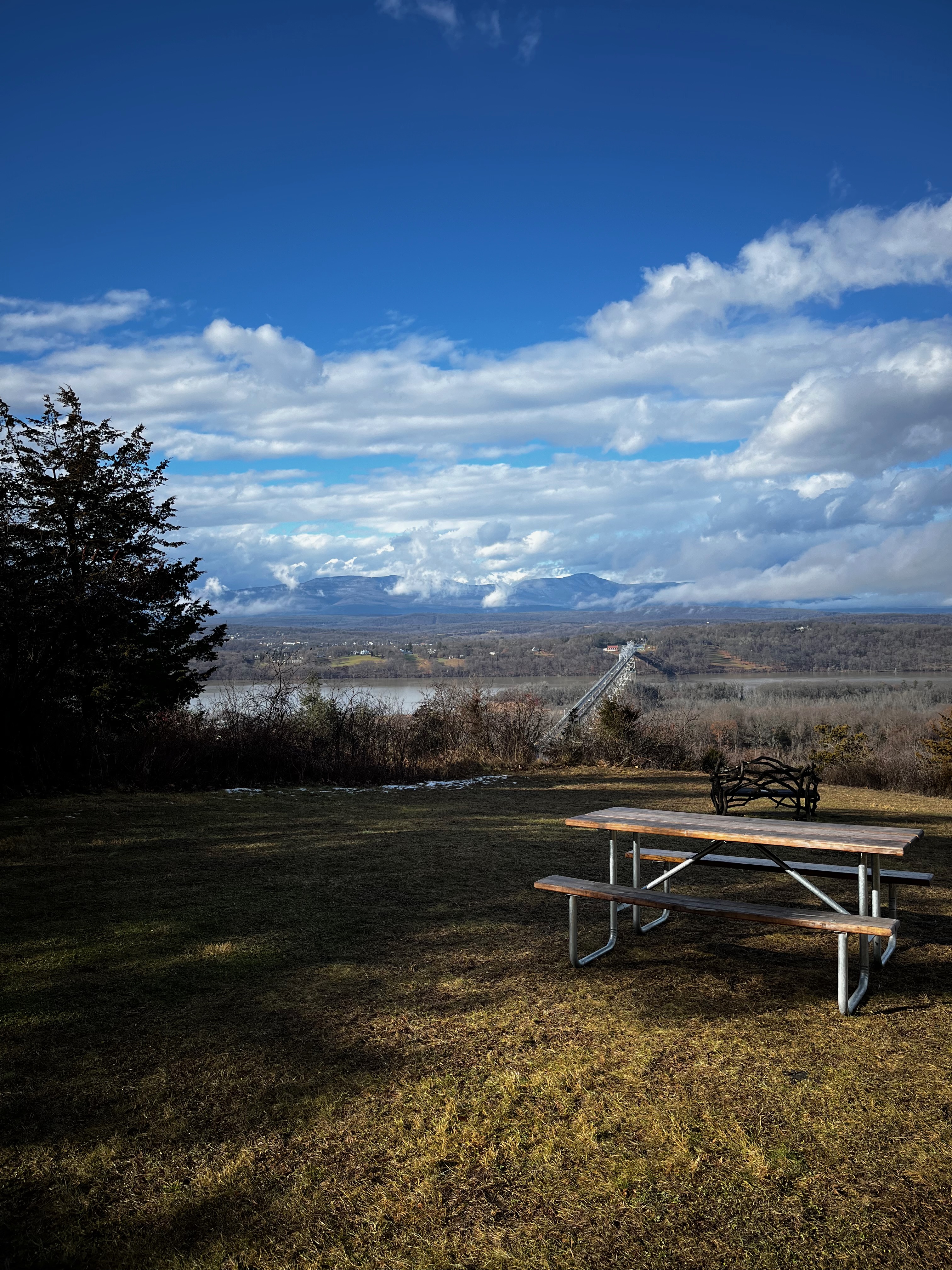
He painted many landscapes of the Catskills and Hudson River from here. When Church arrived in the area, the land had been clear cut of trees. The property was barren. He wanted to restore its natural habitat. It was the fashion of the time to plant exotic trees and plants, bringing home flora from Europe and the Middle East, but Church didn’t adopt that approach. He used native trees, and he purposely left open spaces to frame vistas. He took an artist’s approach to the project, specifying where the plantings should end so he could have a pleasing view of the mountains, rivers and farms that surrounded his property. We are fortunate that Church was a visionary. He left us a magnificent place to explore and appreciate the beauty that Is the Hudson Valley.

While we were walking the land, our guide pointed out a small cement factory that we could see in the distance. A number of years ago there had been a proposal to build another factory that would have included a 40-story smokestack. The idea was moving ahead until some in the area got wind of it and objected. Ultimately, the plan was defeated. The guide believed that if the plan had gone ahead, it would have ruined Olana. I wondered if that was the case. A view would have certainly been diminished but did that mean that Olana could no longer be a place people would want to visit and hike? Would it literally have ruined Olana? Certainly if the emissions from the smokestack were noxious, it would have. The question is moot since the State rejected the proposal.

After the last of the heirs of Church died, the land and house became a New York State Park. I am in favor of preserving wild spaces, especially for public use. But there is a balance. Economic development is also important. People need to make a living. Many towns in the Catskills have struggled and lost population. Our guide explained that Olana itself is not an insignificant employer in the region. It is a dilemma faced all over the country – the tension between development and preservation; these tensions are regularly encountered in the Adirondacks. I don’t reflexively reject development. I want to understand the implications, the costs and benefits, before coming to a conclusion. Unfortunately, it can be hard to come by good information on that. I think many of us have a knee jerk reaction to these issues. We can be predisposed to believe that any encroachment on nature is a negative thing (especially when it involves our own property or neighborhood), or we may automatically support anything that promises more jobs and tax revenue. Neither of those reactions are useful in effective policymaking.

As we finished our walk of the property, the guide asked us what we thought of the house – meaning the design of the structure. All of us on the tour liked it but saw different things in it. Some were reminded of an Italian palazzo; others saw Middle Eastern touches. It is something of a mish-mosh.
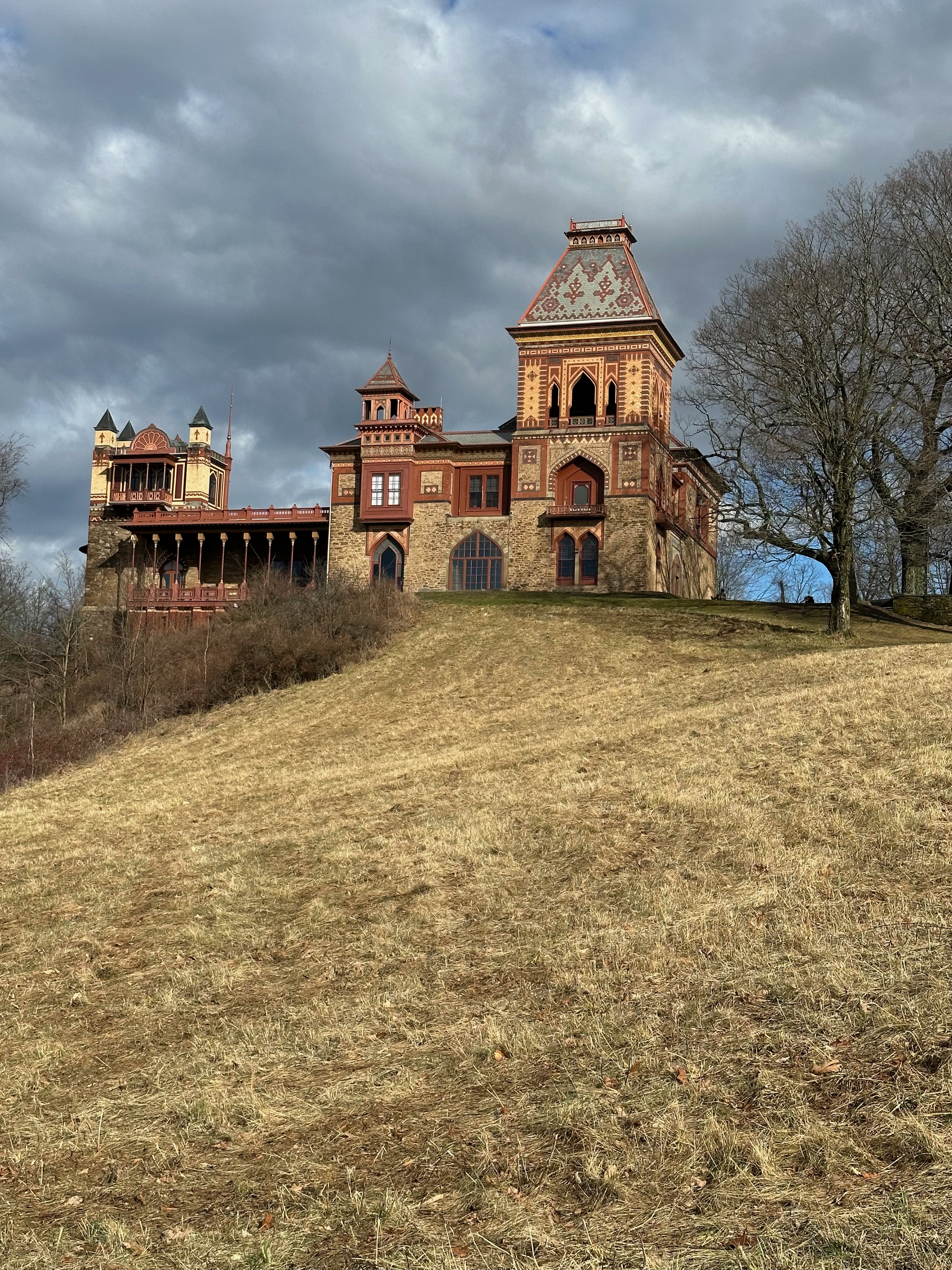
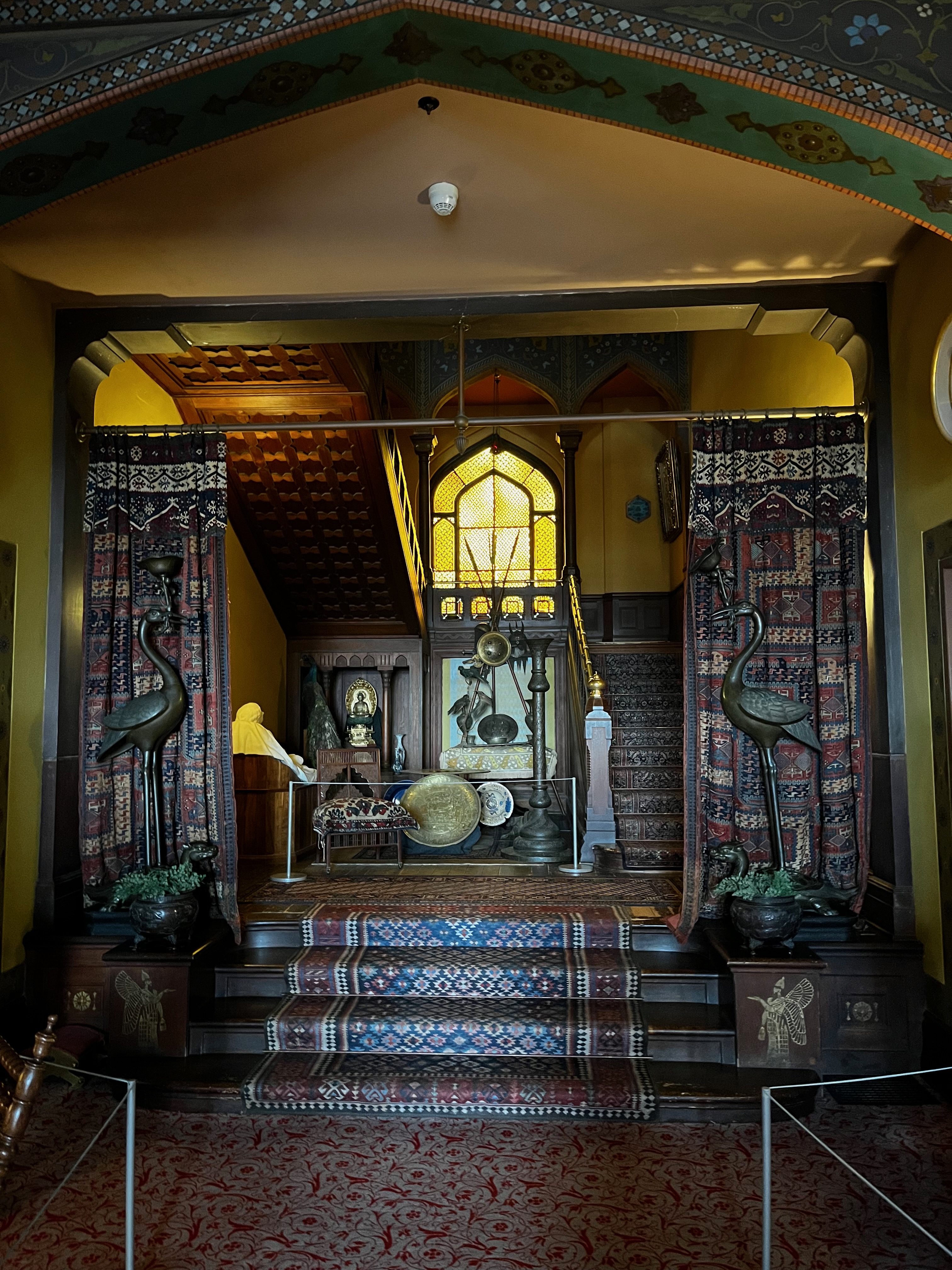
Money does give you options that most of us don’t have. Church found folks who were willing and able to fulfill his vision.

Money can also make people crazy. It can be a trap. Frederick Church enjoyed his largesse. He connected with many of the accomplished people of his day. Prominent people from New York City visited him at Olana. Other folks in that circle were not so fortunate. We learned on the tour of the Wittgenstein family of Vienna, the patriarch was a contemporary of Church, and one of the richest families in the world. Several members of that family committed suicide and the one remaining son gave all the money away. Money does not buy happiness. We can forget that when we are in the midst of challenging times. When we are barely making ends meet, or the ends aren’t meeting, it is understandable to think that having more money would solve all our problems. There is no doubt that money can help with a myriad of issues, but it doesn’t solve loneliness, or bad decision-making. Apparently, Frederick Church did not struggle with those issues and he left us a legacy we can enjoy.

A Poignant Celebration

“There was a lot of warmth in that room,” Gary said to me as we left a celebration in honor of his uncle Sol’s 100th birthday. I readily agreed.

It was an interesting gathering. If one reaches that auspicious age, it is almost certain that you have outlived your spouse (possibly spouses), siblings and most, if not all, friends. This is true of Sol. So it can be bittersweet to plan a party.  Who do you invite? Sol’s son, Ben, faced this question.

Sol is a Holocaust survivor, like Gary’s parents. I have written a great deal about Gary’s parents, David and Paula and their remarkable story. I don’t know the details of Sol’s experience. Sol married David’s sister, Batya, in America. The two couples were part of a tight knit survivor community. There were about five or six families that socialized regularly, centered in Rosedale, Queens. Their children grew up together.

Gary told me stories about those years – how the mixture of family and friends would gather at his house most weekends – the kids playing various games while the adults chatted (and maybe argued, especially about politics). How they went to the Pennsylvania Dutch country with the Majewskis, who lived down the block, and how the Majewskis had all the coolest toys – they often hung out at their house. As often happens with college and adulthood, the kids went their separate ways, maintaining only occasional contact.

I didn’t know what to expect when we arrived at the party. I wondered who would be there. Ben and Rochelle, Sol’s step-daughter, set up displays of photographs of Sol that captured his life over the many years. We studied the pictures, looking at the young faces. When we sat down at a large rectangular table that sat the 25 guests, Ben welcomed everyone and explained that when he thought about who his father would want to share this momentous milestone with, he thought of that core group of survivors. Since the original members have passed on, Ben reached out to the second generation to gather to celebrate Sol, the one who remains. They all represented the heart of Sol’s life.

Sol lives in Florida. When we go to visit Gary’s Mom, we see Sol as well. Until about a year ago, he was in remarkable shape. It is only these last months that there are signs of his age, his short-term memory is starting to fail, and his strength is waning. When Ben extended the invitation to us, after briefly discussing it, we realized it was a milestone that should be recognized so we would both attend. After all, as several observed at the party, it was an opportunity to gather for a happy occasion, not a funeral which is more often the impetus for second and third generation survivors to gather.

I do not know the details of Sol’s journey, I don’t believe he participated in Steven Spielberg’s Shoah project, so there is no testimony to watch, as I have watched my in-laws’ videos. Based on the research our niece Laura did as part of writing her book, The Shoemaker’s Son, I do know that Sol suffered horribly. One of the factors that made his situation even more challenging is that his family was poor to begin with. The Nazis did not differentiate between rich Jews and poor Jews, but having some resources to bribe or trade could buy time when one was on the run, hiding in the woods. Sol bears the scars of his painful experiences. I believe he and his brother were the sole survivors from his family. Once he got to America, he had a successful business as a glazier, but the memories of deprivation were never far from his thoughts. His tightness with money is legendary in the family.

Several of the attendees made remarks, sharing memories of Sol, honoring his tenacity, and his love of family and friends. Jokes were told. Some of the speakers managed a great imitation of Sol’s accent – an echo of their own parents’ accents of blessed memory.

Sol sat at the head of the table. He enjoyed himself. He made his own remarks: he thanked everyone for coming and expressed his love for all. He told us that this was likely his last birthday. Everyone pooh-poohed that and Ben pointed out that he has been saying that for the last 40 years, so he took that as a good sign. Of course, no one knows what tomorrow will bring for any of us.

Gary was moved to be in the presence of that group – the familiar sounds of the voices of the past, the warmth of the connections, the strength of the bond that links them – even if they haven’t kept in close touch. Not only were they honoring Sol, but they were acknowledging the legacy of the survivors who were no longer physically present – though they are kept alive in their collective memory. Despite the fact that I don’t share their history, I was happy to be part of the poignant celebration.

Sol Feder, with his remarkable head of white hair, surrounded by family and friends

Conundrums

I was listening to the local NPR station the other day. First there was a story about NYC suing bus companies which have been ferrying immigrants from Texas to the city. I wondered about the wisdom of that suit. Are the bus companies at fault? Clearly, the city is desperate to get a handle on the immigration “crisis”? Note: I am putting quotes around crisis because I am skeptical about the word in this context. It has been called a crisis for decades.

Following that story there was another report on a bill proposed by two lawmakers in New York State to appoint a commission to study the continued loss of population by the state. The latest census figures showed New York as one of the biggest losers of population in the country. This is a concern on many levels – mostly for the state’s economy and future vibrancy.

Does anyone else see an irony in airing these stories back-to-back?

Maybe immigrants could address the problem of the population loss? Maybe they could invigorate communities that are struggling?

I am not naïve. I understand that uncontrolled immigration is problematic. I believe that there are security concerns posed by folks streaming in through unregulated borders. We need to be able to have an organized process for admitting people into the country – so they are registered and authorized to work, drive, pay taxes, etc. I also understand that some of the people arriving come without resources or education and therefore have real needs. They may not be in a position to the hit the ground running, so to speak, and be immediately contributing members of our society. By the same token, we have many demands as a society: for elder care, child care, agricultural workers, etc., etc., which immigrants may be able to fill. I am not talking about taking advantage of those immigrants – I am talking about meaningful employment that allows them to establish lives and plant roots.

It seems to me that some creative problem-solving could address this challenge if we stripped away the fear-mongering and xenophobia. [And if we demanded that the ultra-rich paid their fair share of taxes.]

That’s just one of many perplexing conundrums I have been noticing.

The resignation of Claudine Gay as president of Harvard is another puzzle. Some folks believe she should have resigned after her miserable performance at the congressional hearing where she was asked about antisemitism on campus. Whether she was over-prepped by lawyers or genuinely unable to acknowledge the need to offer protection to Jewish students due to her own bias, she was certainly tone-deaf. Then the revelations about plagiarism came out. Depending on what you read, those instances are either minor oversights or significant breaches of standards of scholarship.

According to Gay’s statement, it sounds like she believes she has been subjected to a relentless racist campaign that resulted in the need for her to step down. From her perspective, resigning was about putting an end to the harassment and allowing Harvard to move forward, rather than admitting to any substantive wrongdoing.

I am frustrated by this. I want there to be clarity. Her resignation should either be an appropriate result of her academic impropriety or her inability to successfully manage the institution, or both, but not because she was unjustly run out of town. I don’t doubt she has been subjected to racist vitriol – those ugly voices are very loud. But, I want an objective assessment of her scholarship. I want to better understand how she responded to the complaints of Jewish students who felt unsafe. Is it even possible in this day and age to assess these things impartially. Whose judgement can we trust?

I believe that higher ed needs diverse representation. I believe in the goals of DEI (diversity, equity, and inclusion). How those programs are implemented is where the challenge lies. I believe there are deserving candidates – persons of color and individuals from historically marginalized communities – who are qualified to be university presidents. It feels like we are in an impossible position. Can someone who is white be appointed without everyone complaining about ‘privilege’? Can someone who is Black be appointed without arousing suspicion about their qualifications? There is no trust – and therein lies the conundrum. How do we rebuild it – if it ever existed to begin with? There are so many voices of cynicism that they can drown out the hope if we let them.

That lack of trust is the common thread between these two scenarios. We don’t trust our institutions and we don’t trust ‘others,’ people not of our tribe. That has to change.

I have written this many times before, here it is again: I will hold on to hope that we can find creative solutions to these conundrums and that we can find a way to trust our institutions (not blindly, but with proper checks and balances). We must find common ground and let go of prejudice. We have to find a way to build a foundation of trust. I will be listening for voices who can lead us in that direction.