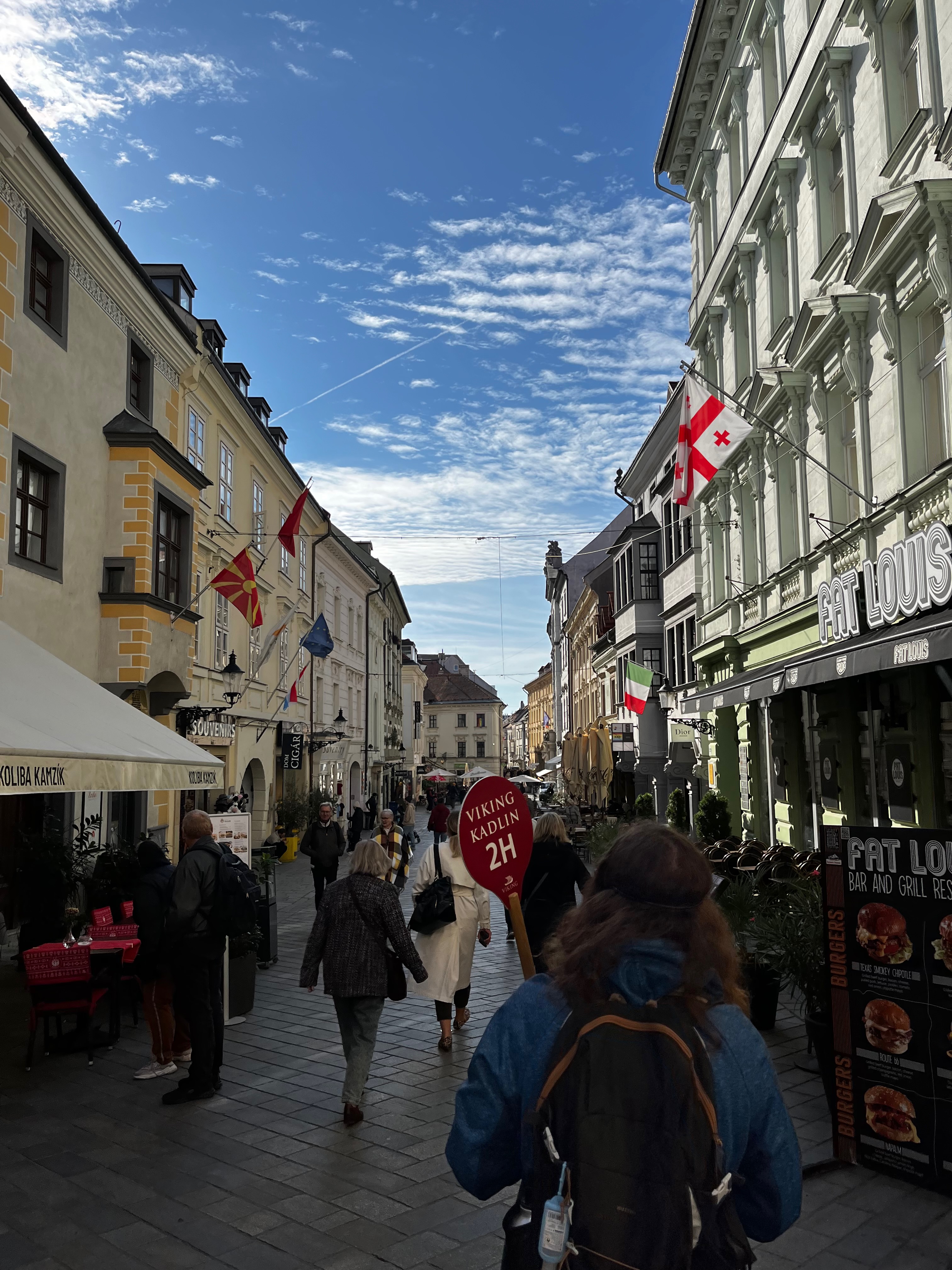
River Cruise – Not Much River

Note: I have decided to return to writing about the lighter side of life though I continue to stress about the toll of the war in Gaza, the fate of the hostages and the rise of antisemitism. Gary and I were fortunate to take an amazing trip in October and, me being me, I have lots of observations and photographs to share. Here is the first of what will likely be a couple of essays.

“How was your trip?” A straightforward question to someone who has returned from vacation. Usually the answer is straightforward, too. “Great!”  or maybe “Exhausting!” Gary and I took a river cruise in October and when people ask how it was, I find it difficult to come up a pithy response. Our trip was disappointing, awesome, educational, fascinating, painful, tiring, memorable….many adjectives apply. There isn’t one overall response.

Our river cruise was a tour of Eastern European capitals on the Danube with Viking. It was slated to start in Vienna and proceed to Bratislava (capital of Slovakia) and then Budapest, with further stops in Hungary, Bulgaria and ending in Constanta, Romania. We received an email a couple of days before we left advising us that it was possible that the beginning of the trip would not be on the boat because water levels on the river were too low. We hoped that would resolve and then didn’t think much more about it since it was totally out of our control.

When we arrived in Vienna we were told by the Viking representative that met us that indeed we could not go to the boat because the situation had not improved. They were not sure when or where we would be able to board the ship. We were taken by bus from the airport to a Hilton Hotel well-located in the middle of Vienna. Though the transfer to the hotel went smoothly, we were disappointed to find that things were quite disorganized upon our arrival. It wasn’t clear what was happening with our luggage. Rooms were not yet available, it was mid-morning. They did not communicate the status of meals for the day and no activities were scheduled. It was an inauspicious beginning.

Gary and I were traveling with his brother, Steven, and his wife, Shari. Though we were quite tired, it had been an overnight flight, we set out to explore the area on foot. It was very breezy and chilly, but we enjoyed our walk and stopped at a café. We made the best of the situation. We wandered around for a couple of hours – now it was around 1:00 and we returned to the hotel. Steve and Shari’s room was ready, ours was not. We were informed that a buffet lunch was available in the restaurant of the hotel.

We hoped that after lunch our room would be available. We went to the buffet only to find that none of the dishes were labeled – various foods were displayed without any identification. Was it fish or chicken? Pork or beef? What kind of vegetables were under that cream sauce? Those of us with allergies or food preferences were concerned and confused. The folks refilling the chafing dishes were unable to answer our questions. Oy. After much pestering of the staff, we were able to gather some information. We made it through lunch without anyone getting a rash or anaphylaxis (at least as far as I know). Dinner wasn’t much better, somewhat better labeling but not great choices. Certainly not meeting the standards expected on a Viking cruise.

I think you are getting the picture. Things were not starting out great. Especially when you consider how expensive these trips are. Despite that, though, I loved walking through Vienna, being in a new place, taking in the architecture, people-watching, seeing a city I had only read about.

As we were finishing lunch, Gary went to the registration desk to inquire about our room – it was now around 2:30. At first they said they didn’t have one available. Gary appealed to their sympathies. “We have been traveling since 6:00 yesterday evening, we didn’t sleep on the flight, we haven’t showered, can’t you do something?” Fortunately, they could. Why they couldn’t in the first place, is a mystery. But at least we had a room! We got our luggage – it was supposed to be delivered but we saw it sitting in the lobby so we just took it – and went up to our room and collapsed.

I won’t go through the whole trip giving a minute-by-minute report, but I wanted to give a sense of our frustration with how it started. Viking still didn’t have a clear itinerary for those first days or a timetable for getting on the boat. We were okay with taking it as it comes – as long as we were seeing interesting sights and as long as Viking was fulfilling its promises, even if it wasn’t on the river.

Unfortunately, I can’t say they were able to do that. The food provided at the hotel and the one restaurant they took us to in Vienna were subpar, at best. The communication was not what it should have been. On the upside, the hotel was comfortable, and the tour of the city was excellent. I loved what we saw in Vienna. Here are some photos of points of interest.

On the afternoon that we had free, Gary and I chose to go the Belvedere Museum because I am a fan of the artist Gustav Klimt. I had read that his most famous paintings were housed in that museum. I was not disappointed. The building itself was magnificent and the grounds were beautiful, as well.

Since we were not on the boat, we were given a choice: spend more time in Vienna or take an hour bus ride to Bratislava where we would take a tour. Gary and I chose to go Bratislava. During the bus ride, the tour guide provided a lot of information about both cities – Vienna and Bratislava and the two countries, Austria and Slovakia. Back in the day, Austria was not part of the Soviet bloc, but Slovakia was. The lasting impact of that was evident in their respective landscapes and the ambiance of those capital cities. As we would continue to learn throughout the trip, Russian influence was stronger and stronger as we went east. In Bratislava the tour guide told us jokes that were at the expense of the old Soviet Union. For example: a man went to the Skoda (small, Czech made car) dealership to buy a car. He was told it would be a ten year wait. The man asked if it would come in the morning or the afternoon. The salesman responded, “Why does it matter, it’s in ten years?” “Because I have the plumber scheduled to come then.” Obviously, a dig at the inefficiency of the Soviet system. The guide seemed grateful both to be able to tell the joke and that things had changed.

Bratislava’s old town was charming. It had been a walled city. Now it has lots of shops and restaurants within the remnants of the wall. Our tour guide explained that because the cost of labor is low, as are taxes, tech corporations have established offices in Bratislava. Thirty years after communism fell, there is a vibrance to the city and it is growing.

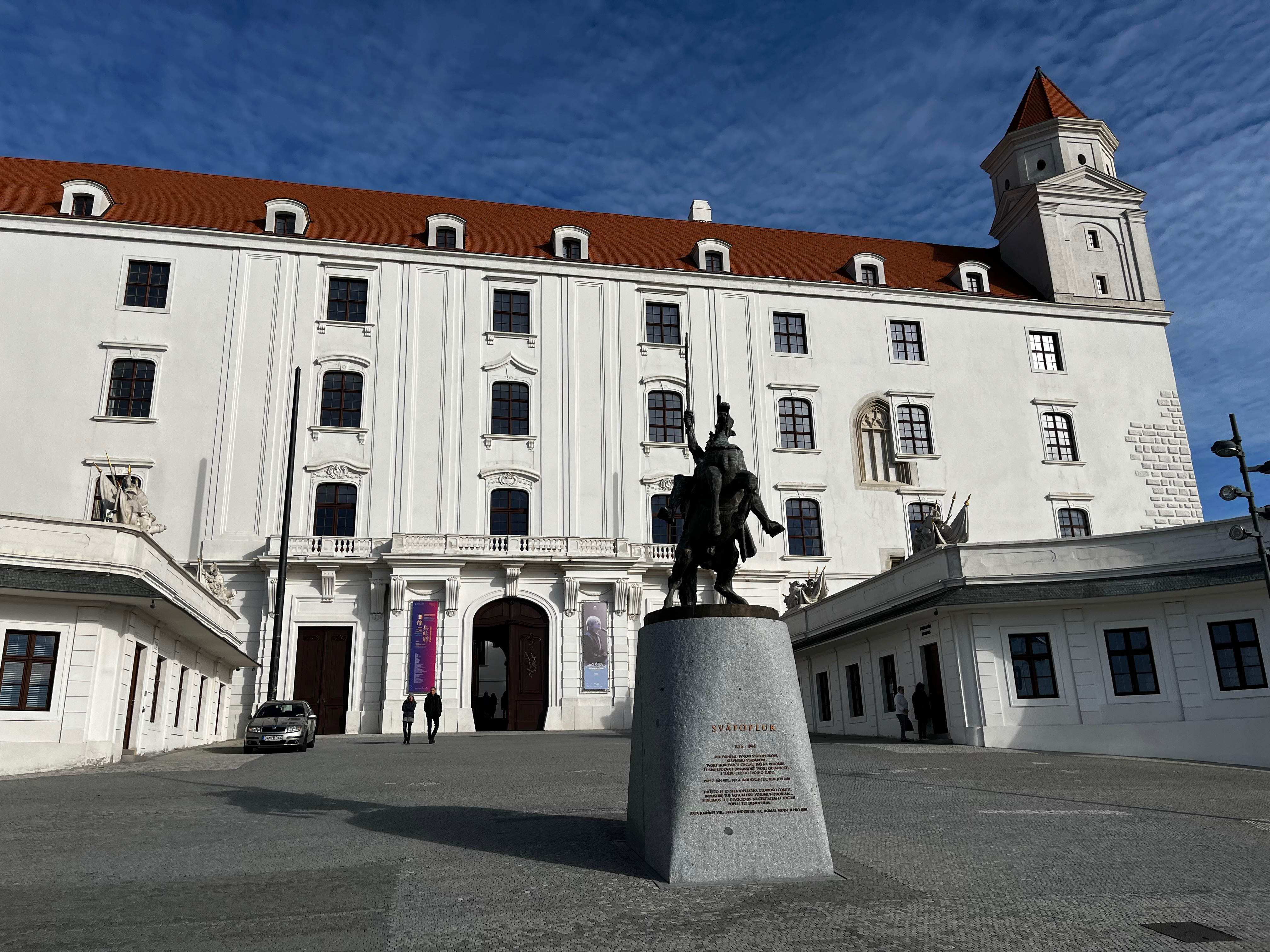
Despite the fact the cruise was not going as planned, and in fact we weren’t cruising at all, the main purpose of travel was being accomplished. We were learning about places we knew little about and expanding our horizons to include more of the world.

[more to come!]

Another Perspective

I have woken up at about 1:00 a.m. the last two nights with thoughts about the war in Gaza. As I lay in bed I argue with imaginary Palestinians – or not so imaginary since I listened to an Ezra Klein, a New York Times writer, podcast that featured Amjad Iraqi, a Palestinian citizen of Israel who is a writer and editor there. I think it is important to be as informed as possible by hearing different perspectives so, though it was uncomfortable, I listened to what he had to say.

He made some important, legitimate observations that need to be acknowledged. The way Israel came into being in 1948, with U.N. Resolution 181 and the subsequent war of independence, was traumatic for the Arabs who lived on that land. The U.N. Resolution which passed in November of 1947 defined two states, one for Israel and one for Palestinian Arabs (Jerusalem was designated as an area to be overseen by the U.N.).  The Arabs believed the resolution was inadequate and rejected it; Jews embraced it and began organizing a state for when the British left. The day after Israel declared its independence on May 14, 1948, five Arab countries (Iraq, Lebanon, Syria and Egypt – Saudi Arabia provided troops under Egyptian command) attacked the new state expecting to claim the land on behalf of the Palestinian Arabs. A war ensued during which Arabs either fled or were forcibly evicted from their homes – and in 1949 Israel won. As a result, Palestinians designated May 15th as a day of mourning – they call this sequence of events The Nakba, the catastrophe. It was violent and tragic from their perspective and that trauma, and that narrative, has been passed down generation to generation. We cannot deny that trauma, just as we cannot deny that the trauma of the Holocaust has shaped our (Jews) world view (though in a very different way). Even if we believe that the founding of Israel was a righteous and necessary thing, we can still understand that it wasn’t without consequence. There was a human cost.

With that said, the question becomes: aside from acknowledging the reality of their pain, what do we do with it? What actions or changes should be made when we recognize it?

If you ask Mr. Iraqi the only answer is to give the land back to the Palestinians. And not just any land – the precise land that became Israel. In addition, if you ask Mr. Iraqi, all Palestinians in the diaspora should have a right of return to that land. That answer is impossible to fulfill and maintain a Jewish state (certainly not a concern for Mr. Iraqi). Israel would no longer exist.

In one way, I understand his argument. Something valuable was taken, it should be given back. But that isn’t the way the world works. First and foremost, it denies Israel’s right to exist. When there is a war, the losing side, by definition, loses. At the end of a war a treaty may be signed, and agreements may be reached where some concessions are made, some property may be returned, and reparations may be offered. But, I can’t think of an instance where the people on the losing side were made whole, given all their territory back. I don’t understand why there would be an attitude of entitlement? Why would there be an assumption that they should get the land ‘from river to sea’? We can argue forever who had it first. Jews can argue their ‘entitlement’ from the time of the first temple. There isn’t a nation on this earth whose borders were somehow preordained – bloodshed has defined all of them.

It seems to me that it is more realistic and reasonable to take the position that there is a compromise to be made – a two state solution – the parameters of the respective states are difficult to hammer out (though it makes sense to start with the original U.N. Resolution) and figure out a plan for reparations. I’m not suggesting something new here – there have been negotiations for a Palestinian homeland for decades. But if the Palestinians come to the table with the perspective that Mr. Iraqi offered, there is no room for negotiation. There is no path forward. Mr. Iraqi made a vague suggestion of decentralized entities – not nations. While I am open to other models of governance, you can hardly move forward without a more concrete structure to offer that is ready to be implemented.

Putting aside for the moment his position that the only option is to give all the land back, Mr. Iraqi made the point that Palestinians had tried everything to achieve their goals – diplomacy, civil disobedience and ‘minor’ armed resistance – and that none of that worked, so Hamas launched the attack of October 7th. He didn’t exactly justify the nature of the attack – he said time would tell if Hamas leadership authorized the brutality or whether militants went rogue (Meanwhile, just recently Mahmoud Abbas, the leader of the Palestinian Authority in the West Bank said that Israel conducted the massacre at the music festival! Many pro-Palestinians will be willing to believe that). But, Mr. Iraqi was saying that their desperation left them no choice but to attack. I would argue that they didn’t try everything – it seems clear to me that there was and is another option.

What if in 1948 or at subsequent points when a Palestinian state was offered, not that it encompassed what they believed they were entitled to, but it was land and it would be under their control, they accepted the terms? And, what if, instead of keeping refugee camps, they built cities and towns with the resources they did have? And what if their thinking was, we will make this homeland as strong as possible, with a productive economy and an educated citizenry? They might have achieved their ultimate goal that way – if they shed their idea of themselves as victims and built a nation, who knows what would have happened? Why wasn’t that an option? Why isn’t it still an option?

I can imagine progressives reading this and saying that wasn’t possible – they were oppressed. I would draw an analogy to a child who grows up with abusive parents. At a certain point, if you want to be a productive adult, you need to take steps to heal yourself. It can’t be done alone – support is needed – but the recognition that you need to fix yourself, that first step, needs to be taken by the individual. I think it is no different with an oppressed people. Leadership needs to emerge that empowers people to heal their wounds and celebrate their strengths – not through terrorism, not through rage, but through education and growth. We can understand that a person who grows up with abusive parents might turn violent, but we need to offer another path forward. As a society, we cannot accept violence or murder as a viable response. No one is served by spending their life defining themselves as a victim. The fix for that is not to become a vigilante or a terrorist – that is misguided and only digs the hole deeper.

I live in the real world, so I recognize that this is not simple. We can’t flip a switch and change a national identity. Our national identity as Americans has emphasized rugged individualism and that has a toxic side (i.e., gun culture). Adjusting that, or even recognizing the negative aspects of it, is not easy. I also understand that the current state of conflict in the Middle East benefits certain actors – Iran is served by the role the Palestinians play. There are powerful interests served by the chaos in the Middle East aside from Iran. China and Russia might see opportunities they can exploit. I don’t have answers, but we have to understand the perspectives and accept the need for concessions. One point that Mr. Iraqi and I would agree on is that the status quo, even before October 7th, was unsustainable for both Israelis and Palestinians. Listening to Mr. Iraqi I was not optimistic about the future, but once again, I have to hope that each side can come to their senses and make the necessary compromises so that Israelis and Palestinians can live in dignity and peace – and the further killing of innocent people can be prevented.

Photos taken by me, Linda Bakst, in June 2011

Fighting Despair

It has been a long time since I’ve written a blog post. I wrote my last one over a month ago. It has been a struggle to motivate myself. The things I have been thinking about are not easily translated to the page. I am fighting despair.

I have written quite a lot on this blog about my identity as a Jew. In fact, my last essay was about Yom Kippur and what it meant to me. Little did I know that just days after I posted that piece a truly horrific outbreak of violence would be perpetrated on the people of Israel.

Like most sentient human beings, I was shocked by the barbarism displayed by Hamas. It was almost too much for the brain to take in. How could people inflict such cruelty on fellow human beings? The stories that emerged – of young people peacefully attending a music festival only to be slaughtered, of Jewish individuals, some of whom dedicated themselves to Palestinian rights, murdered or kidnapped, not to mention the maiming of babies – were too terrible to contemplate.

Many have written that Israel is a small country, and everyone knows someone touched by the violence. Many American Jews are connected with family and friends there. I have a more distant connection. I can’t say the attack hit me as it would if it was my own country. I read many posts from those who were crying and devastated. I didn’t have that immediate reaction, maybe I was numb.

As time has gone by, though, I find my pain deepening. The reaction of the world, the exponential rise in antisemitism, the seeming lack of understanding of the existential threat to Israel, the unwillingness to assign responsibility for this disaster to Hamas, are all beyond my comprehension. I am profoundly disappointed in humanity.

I am not blindly loyal to Israel. I, like many other American Jews and Israelis themselves, have communicated disapproval of the policies pursued by Netanyahu and his administration. Netanyahu, in my view, is as bad as Trump – but smarter. I believe he has done real damage to Israel. Though the lion’s share of the blame for the attack is on Hamas’ leadership, Netanyahu and the positions Israel’s government has taken, has contributed to the rage that Palestinian’s felt and feel. It doesn’t justify the violence, but it likely fueled it.

There is no doubt that the Palestinian people have been oppressed. Where opinions sharply differ is in identifying the oppressor. Most of those who are taking up the Palestinian cause in protests in this country and abroad assign that role to Israel (other than those who subscribe to a broader Jewish conspiracy) and to some degree the United States. I don’t buy that. There are so many examples of failures of Palestinian leadership – going back decades. Time and again compromises have been rejected. And, terrorism has been their weapon of choice for more than fifty years.

While I am not a scholar of the Middle East, I have done some reading. I have paid attention. I am not going to list the litany of times that opportunities were squandered. Similarly, I am not going to detail the errors that the I believe the Israeli government has made. Suffice it to say, I believe both parties bear responsibility for the failure to achieve peace, but in my estimation  Palestinian leadership shoulders more blame for the poverty of its people. Their corruption and their failure to use resources they do have to better the lives of their people, instead choosing to build tunnels and bombs and stockpile munitions, are evidence of their duplicity. And no matter how one parcels out fault, the violence of that attack cannot be excused.

Accusing Israel of genocide in this war is reprehensible and a lie. People throw that term around far too easily. Israel is not engaged in a campaign to exterminate a people. They are trying to destroy Hamas. We know from the tragic wars that have been fought over centuries that civilians die, collateral damage is unavoidable especially in urban combat and guerilla warfare. The United States may well have committed war crimes in Vietnam and Iraq, but we were not carrying out genocide. We may learn that Israel has committed war crimes – I don’t know if they have – but they are not engaged in genocide. Using that term is inflammatory, divisive, and singularly unhelpful in figuring out how we go forward.

Calling for a unilateral ceasefire is also disingenuous. Will Hamas cease fire? Why aren’t those voices loudly calling for a Russian ceasefire? Meanwhile Israel’s defense forces have been conducting humanitarian pauses and creating corridors to allow Gazans to move south. Other countries do far less when engaged in war. Israel is held to a different standard.

We have arrived at a place in our world where we don’t believe newspapers or television reporting. We don’t agree on a common set of facts. Palestinian supporters don’t believe babies were maimed. Maybe they don’t believe there are miles of tunnels under Gaza City – and if they do believe it, they probably don’t attribute them to nefarious purposes. Perhaps they don’t believe that schools and hospitals are being used as shields for military operations. I’m sure there is a narrative that they tell themselves that explains it all away. And, they think I am telling myself a story about terrorists and a constant barrage of rocket fire into Israel to justify my opinions. How do we bridge that divide? It is impossible to have a conversation when you believe fundamentally different things about events unfolding in the world.

I believe there is a truth. I read the Hamas charter – the one written in 1988 (https://avalon.law.yale.edu/20th_century/hamas.asp) and the newer, revised one written in 2017 (https://irp.fas.org/world/para/docs/hamas-2017.pdf). They are frightening documents. They don’t advocate for democracy or freedom for the Palestinian people (despite defining itself as a liberation movement). It states as its goal the end of Israel and the establishment of an Islamic caliphate. The words are in black and white – no one has to interpret them for you. You need not rely on someone else’s understanding. The first version actually goes so far as to advocate for the murdering of Jews (not just Israelis) by all true Muslims.

After I read those documents – and I read them because I needed to understand if Hamas was antisemitic and if its stated goal was the destruction of Israel – I didn’t want to rely on word of mouth or reporting – I became more outraged by the rhetoric we are hearing. Hamas cannot be given a pass. That charter does not provide an answer to the suffering of the Palestinian people, at least not an answer that most citizens of the world would accept.  It has reinforced my belief that Golda Meir was right when she reportedly said, and I am paraphrasing, there will be peace when they love their children more than they hate us. In her statement the ‘they’ she referred to were Arabs, not Palestinians – that term was not in use then – she was credited with saying this in 1957!

Because there is so much misinformation, disinformation, and propaganda, it can be hard to identify right from wrong. But, it can be done. It must be done. I approach all reports with a critical eye, things are rarely black and white. While there are shades of gray, and the fog of war makes it yet harder, there are facts, there is morality, there are choices to be made. There are sides to be taken. I stand with Israel. I will criticize it when I think it is wrong, just as I will the United States, but Israel is on the right side of this. I hope they prosecute the war as carefully as possible, limiting civilian casualties, but Hamas cannot be permitted to succeed. Both the Palestinian and Israeli people deserve better than current conditions and I pray that leaders from both sides will emerge who will take a more humane, reasonable path.