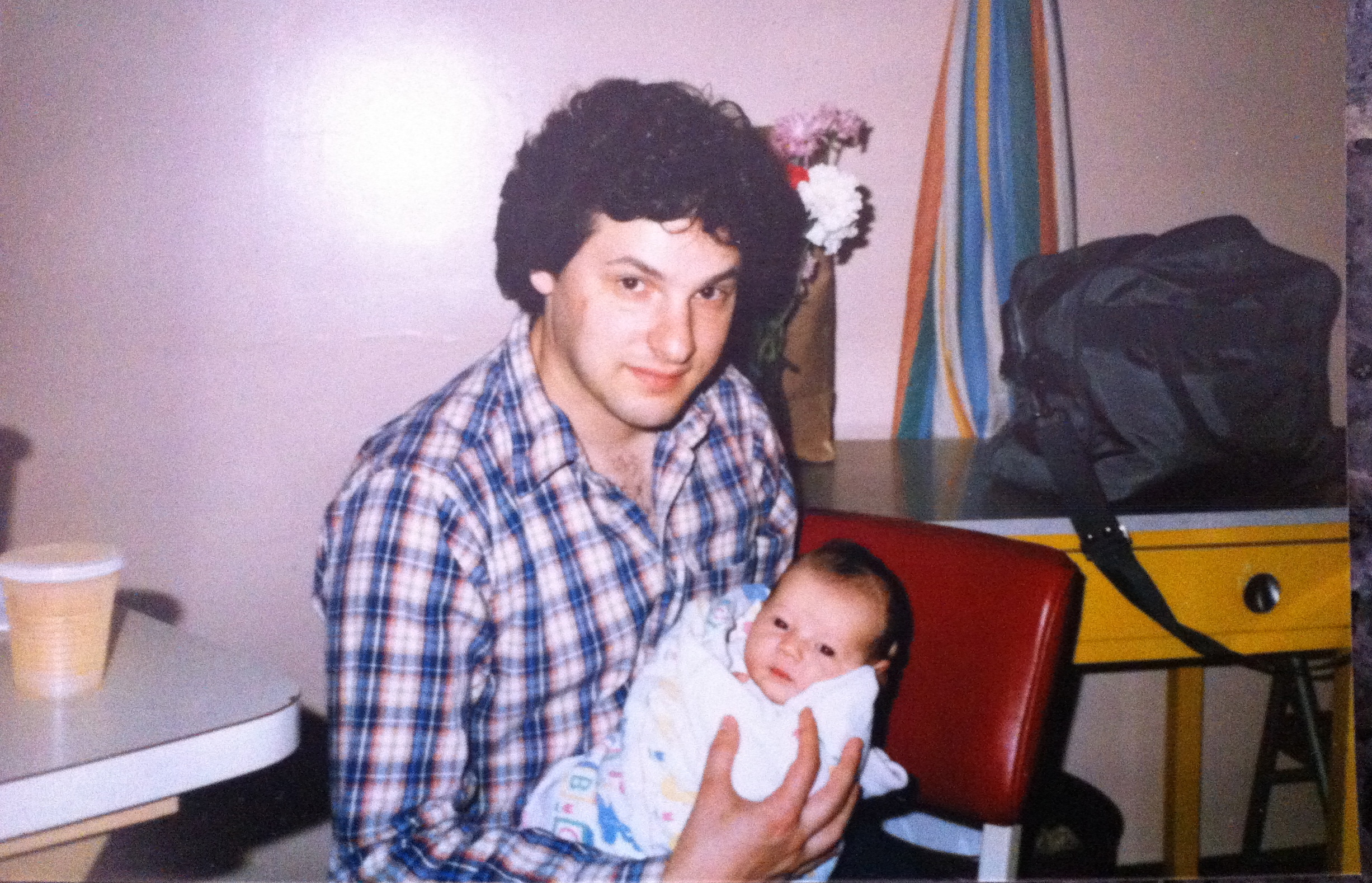
Note: Today is Daniel Aaron Bakst’s birthday. In celebration, I dedicate this blog entry to him. I love and treasure him and wish him many, many more happy and healthy birthdays.
about to lose a tooth!
about to graduate!
You could never get anything over on Daniel. He was always very observant. He noticed everything. One time we were pulling into the parking lot to pick up Leah from dance lessons, he was probably 4 at the time, and he looked up at the building and noted, “The curtains in that window are a different color than they were last week.” “Really?” I asked in wonderment. The window he was pointing to was several stories up from the main floor entrance where we went in. I’m quite sure I had never looked up, much less noted the color of the curtains.
Maybe it was related to his being so observant, or maybe it was part of his innate skepticism, but when he lost his first tooth and found money under his pillow, he wasn’t fooled. “It was you or Dad, right?” he asked, a knowing look in his eye. “You don’t think it was the tooth fairy, bud?” I asked. He looked at me, considering the possibilities.
I wasn’t quite sure what the value of the charade was, but I didn’t want to ruin the fun either. “I think you or Dad put it under my pillow,” he concluded. I countered with, “I’m not so sure.” I winked. He smiled.
Each time Dan lost a tooth, he just smiled in a satisfied kind of way as he pocketed the money the tooth fairy left; he knew what he knew.
Some of the Mom’s in my social circle saved their children’s baby teeth – I think there was even a specially made keepsake that you could store them in. The idea was creepy to me. Maybe Dan would’ve preferred that I saved them, based on what happened with his wisdom teeth.
After my experience getting wisdom teeth pulled as a mature adult, I was determined that my children wouldn’t go through that pain. If the dentist recommended their removal, we would get it done sooner rather than later.
When Dan was 18 the dentist said he should have them removed. I took him to the same oral surgeon that we used for Leah, whose procedure went uneventfully several years earlier. We finished the initial visit and scheduled a time for the surgery. As we left the office and walked across the parking lot, a car started to pull out. It almost hit me. Dan, who was walking on my right, instinctively crossed in front of me and hit the trunk of the car hard with the palm of his hand. The guy, it was a male driver, slammed on his brake and yelled an apology. Daniel was not satisfied. “Look where you’re going!” he screamed. The guy replied, “I said I was sorry for Christ’s sake!” Dan’s anger escalated. “You were being an asshole!” “Dan, Dan,” I said, quietly, soothingly, “It’s okay. Let’s just go to our car.” Dan had stopped walking and stood glaring at the guy. “What’s your problem?” the guy wanted to know. “That’s my mother walking here! You be careful!”
I took Dan’s arm and nudged him along. He took a breath and came with me. While I appreciated his protective instincts, I didn’t want him getting into a needless fight. I have to admit, though the incident happened about ten years ago, I still smile when I think of it. I knew then and still know now Dan has my back – literally and figuratively.
That wasn’t the end of our adventure with his wisdom teeth.
We returned for the surgery. I sat in the waiting room, anxious to have it done and have Dan get through it without complication. They finally called me in and told me all went well and Dan could go home. They gave me the aftercare instructions, and we started to leave. The dental assistant called after us, “Wait up a minute!” We stopped and she handed me an envelope. “He wanted his teeth,” she explained. “Really?” “Yes, it seemed important to him.” I took the envelope and put it in my purse. “Okay, thank you.”
Dan and I left. He was pleasantly loopy from the drugs but he could walk okay, which was fortunate. Dan was was over six feet tall and lanky; well beyond the point where I could carry him. We made it across the parking lot without incident this time and got home.
I tucked him in for a nap. He awoke a couple of hours later, less groggy. I checked in with him to see how he was feeling. I gave him the envelope with the teeth. “What’s this?” he asked. “Apparently you wanted your teeth,” I explained. “What?” he was genuinely perplexed. “They told me you kind of made a thing about wanting them.” “I have no recollection of that at all,” he said, laughing. “I don’t want them. Yuck.” I started laughing, too “I thought it was a little unusual, but are you sure?” I wanted to be certain before I disposed of them. “I’m quite sure,” he reassured me. The only explanation we could come up with were the drugs they gave him for the procedure. We were amused by the surprising side effects.
I took the envelope back and dropped it in the wastebasket. To my knowledge he never regretted his decision and he never asked about his baby teeth either, so I think I am in the clear. One less parenting decision to worry about.
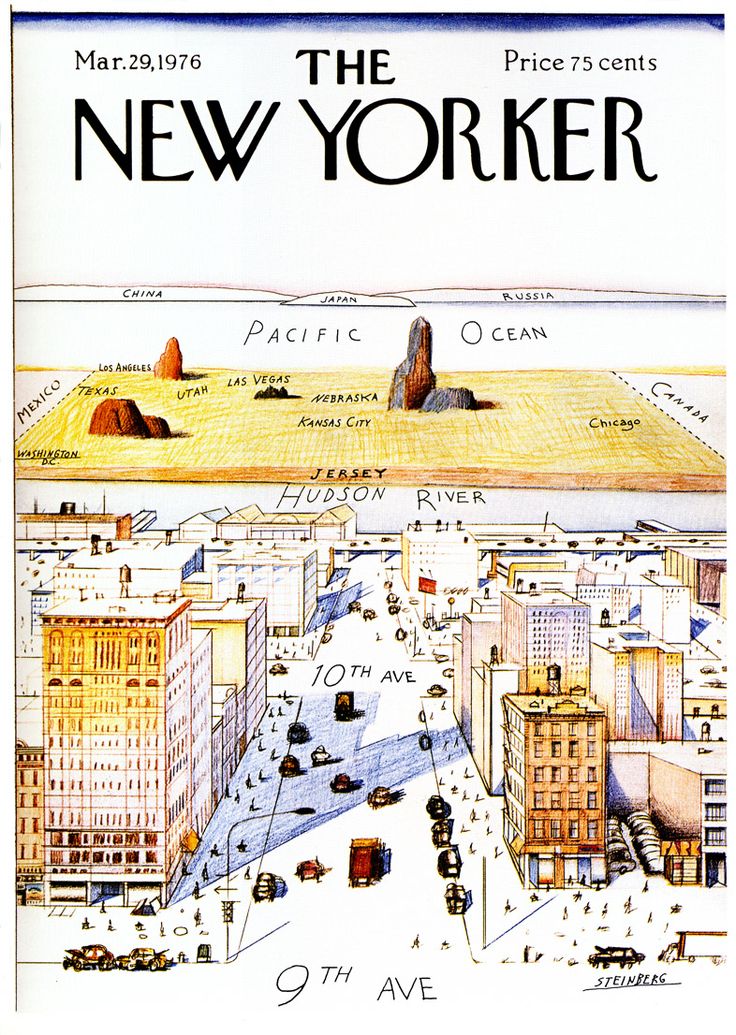
I admit it: I was a New York snob (maybe I still am). My worldview was like the famous New Yorker magazine cover (above) that shows New York City looking west from Ninth and Tenth Avenue, where the city is a bustling metropolis and then the rest of the United States is a vast empty space, devoid of anything interesting. It was with that mindset that I moved to Pittsburgh in 1982. I was 23 years old, engaged to Gary.
The late December morning dawned gray and cold. Good weather for driving. We, my parents and Gary, were standing in front of the house in Canarsie, getting ready to say our goodbyes. My Dad pulled me aside. “How bout you go to a justice of the peace when you get out there? You can still have the wedding, as planned, in July. But this way you’d be married.” Dad looked at me with his big blue/gray eyes, questioning, hopeful. I was sorry to disappoint him, but said, “Dad, we aren’t going to do that. There’s no reason to. It will be fine.” I turned to put the last few things in the back seat of my cobalt blue ’72 Toyota Celica.
He didn’t want his baby girl ‘living in sin,’ even if it was only for six months. It was six months too long for him. Fortunately, he didn’t pursue it further. We all hugged, and Gary and I got on our way.
We drove to Pittsburgh with high hopes and some anxiety. Gary had successfully completed his first semester of medical school. Now I was going to join him. I needed to find a job. I had some savings as a cushion, but I was hoping I wouldn’t have to drain it.
Pittsburgh was slowly on the rebound from the collapse of the steel industry. The landscape bore the scars of it. Buildings were soot stained. The Carnegie Library, down the block from our apartment, was gray sandstone heavily streaked with black, but the inscription, Free to the People, was still quite clearly etched over the main doors. Hulking mills, some vacant, some producing steel at reduced capacity, lined the river. The city remained the headquarters for a number of large companies that inhabited gleaming skyscrapers downtown.
Pittsburgh had the feel of the Midwest to me. I didn’t know geographically how it was characterized, but culturally it didn’t feel like an eastern city. The influence of its immigrant history, largely Polish, Germanic and Italian, was imprinted on the stores, restaurants and, most importantly, churches that dominated. Unlike New York City, which certainly had ethnic pockets but the sum of which was a hodge-podge; Pittsburgh felt more homogenous. It felt like there was a dominant culture and it was defined by the Catholic Church. While there was a Jewish community, it was quite small, and it felt small. This took some getting used to. After all, other than Israel, New York City is home to the largest Jewish population in the world.
After five months of pounding the pavement, I was about to register for secretarial work with a temp agency when a solid job opportunity came through. I had nearly exhausted my financial resources when I got a job with the city’s Finance Department.
There were some noticeable differences between the New York City’s Mayor’s Office of Operations, where I worked before I left, and the Finance Department. The first was the air quality. I worked with several men who chain-smoked through the day. Offices and conference rooms didn’t usually include windows and there was nothing I could do to disperse the fog that permeated the air. Somehow there weren’t nearly as many smokers in New York City’s Mayor’s Office.
Another difference: when we went out for a drink after work, I could not keep up with my new colleagues (not that it was a contest)! People would take turns buying rounds. I almost never got a chance to buy (and it wasn’t a strategy to avoid it). My drinks would be lined up on the bar.
Aside from air quality and drinking habits, there were actually more important differences. I worked with very few women, and there was only one at the management level. Many of the employees were only high school graduates. I was an outsider by virtue of my age, gender, education, religion and, of course, as a New Yorker. Sometimes it felt quite lonely, but there were some interesting conversations, too, especially about religion and faith.
Some of the cultural differences were more imagined than real. Gary and I invited one of his classmates, and his fiancé, to dinner at our apartment. Budgets being what they were, we didn’t eat out often and most of our socializing entailed going to each other’s apartments, eating, watching football or basketball and playing games like charades. Alcohol may have been involved.
As I recall, Ron and Ann were the first people we invited over. They were both Pittsburgh born and raised. I planned a menu after considering various possibilities. I worried that Ron and Ann would think the food I prepared was weird.
Gary and I kept kosher in our apartment (we didn’t when we ate out), so we didn’t mix meat and dairy. I was worried if I prepared a meat dish they might ask for parmesan cheese. I was worried if I made a vegetarian dish they wouldn’t be satisfied. I thought they wouldn’t know what it meant to keep kosher. I settled on making a ratatouille with ground beef (no cheese) and then worried that they wouldn’t know what it was.
Turned out Ron and Ann were more worldly than Gary and I, which in retrospect wasn’t saying much. Ron had gone to Dartmouth as an undergraduate and, if I remember correctly, majored in art history! Ann had been an English major and worked as an editor. I was pleasantly surprised to find that many of Gary’s classmates weren’t science majors as undergrads. Turned out Ron and Ann were quite comfortable eating my ratatouille. We had a great time, it was the first of many meals and laughs shared.
I realized I shouldn’t make assumptions about people based on where they came from, or any other single characteristic, for that matter. Of course I should have known better. When I stop and think about it, my Zada, who appeared on the surface to be a common laborer, was a self-taught Shakespearean scholar with the heart of a poet. Why would I buy into the stereotype implied by that New Yorker cover? But I did, and to this day, I need to check myself.
Driving home alone, I could barely concentrate on the road.
My eyes welled up.
Will I be a good mother? Can I do this?
Minutes before,
what I suspected was confirmed.
This was planned, yet I was overwhelmed.
I took a deep breath,
focused on the road and the sky, made my way home.
Into our little brick house.
I rush to the phone to call Gary.
He is still on rounds at the VA.
I have him paged.
It takes many minutes, seemingly forever.
Hello, Lin?
I’m pregnant!
Wow! This is such great news!
When do you think you’ll be home?
The usual time.
You can’t get out early?
Linda, you know I can’t.
I sighed and exhaled, resigned to this reality.
Okay, we’ll talk later.
I was left to my thoughts.
Eight months crawl by.
I was not glowing with new life.
Queasy, tired, morning, noon and night.
Ear infection, bronchitis, heartburn
I didn’t enjoy sharing my body.
So many rules:
No caffeine, no alcohol, drink milk
I don’t like milk.
Vitamins the size of Pluto.
Alcohol was no loss, caffeine another story.
I’m responsible for this new life!
I don’t want to screw it up!
The due date kept changing.
First May 2, then May 11, finally May 16
That day comes and goes.
The longest gestation in history.
I am ready! Nature has its way, though.
May 20 Gary travels to Long Island to take part 4 of his medical boards.
My parents come up from Brooklyn to keep me company.
At 5 pm they leave me with friends and
head back home, Gary is on his way.
I feel some contractions: Braxton-Hicks or the real thing?
Gary gets home by 9pm.
My water sort of breaks after midnight.
We call the doctor.
He tells us to come to the hospital.
It is before dawn on Thursday morning.
We put the garbage cans by the curb before going to Albany Med.
27 hours, the last 7 hard labor,
an apt description.
First, no progress, then Pitocin – a brutal treatment.
Finally, I push!
Such a relief! My body is almost my own again.
4:39 am, Friday, May 22, I look at my baby.
Labor was hard on me, but she is perfectly formed.
She is part of me and yet, she might well be an alien.
We are one and we are separate.
I understand her; I feel her joy, her hunger, her frustration.
But I am clueless, she is a mystery.
I fall in love over those first few weeks.
Her wondrous eyes, sparking with light.
Her pink, smooth skin.
She emerges into herself.
Curious, demanding, loving.
30 years later and
it is all still true.
[Note: Gary’s remembrance of that same time]
September 12, 1986. I was on rounds when I heard my name over the VA hospital intercom for the first (and only) time in my life. The operator put me through. Linda tells me that we are going to be parents. You could have knocked me down with a feather. I was elated and scared and excited. She asked me if I could get home early that day. But the patients cannot wait. I work as fast and furiously as I can to get out early but 10PM is the best I can do. I remember not being able to concentrate during rounds that day which is the one and only time that ever happened.
That VA rotation was in many ways horrible. Perhaps it was also an experience in growing up. The VA is an underfunded, second rate health care system and, in my mind, a poor excuse to offer people who fought for our country and now are down on their luck. And, to be sure, if you are a veteran and have other health care available to you, you are not going to the VA. So these are the guys who things have not gone well for after they came back home.
I was an intern along with two others on that rotation. Claude Scialdone was another intern with me and he was amazing. I can’t remember who the third intern was but it was not someone who did all that much. Worse than that, our resident who was supposed to guide and support us was an empty suit (perhaps an empty white coat is the better medical term?). And the attending physician came by in the morning to round, as he was supposed to do, but did nothing else. So Claude and I were basically two guys just out of med school trying to keep 40 very sick veterans alive with basically no help.
It was frightening and it was exhausting. On a normal day, when I was not on call, I would get there before 7AM and get home anywhere from 8PM to midnight. When I was on call I wouldn’t get home at all.
One particular patient still sticks in my mind. He had been there since well before I started my 6 week rotation and he was often times confused, weak and kept running fevers. I worked him up for sources of infection again and again. I ordered chest x-rays to look for pneumonia, urine cultures and blood cultures but they repeatedly came back negative. I asked my resident about the guy – I told him I was certain we were missing something. There was something going on and we were failing to identify it. The patient was treading water at best and sooner or later we were going to lose him.
My resident responded by asking me if any of the cultures had grown anything and the answer was no. He then explained that this means he’s fine. He wasn’t fine. He wasn’t close to fine and I knew that in my marrow, but I was out of ideas and had no help.
At that time, the VA closely controlled the use of the newer, broad spectrum antibiotics. If you ordered any of them, you automatically got an infectious disease consult. Normally that might not seem like a problem, but in the Albany VA at that time, it meant you got Dr. Aldonna Baltsch on your floor. Dr. Baltsch was as feared as any doctor I have ever known. She was a phenomenal, dedicated, passionate physician but she was also a perfectionist with a temper. She would come in and yell at you for all the errors she determined you were making. I think she just wanted to make us better doctors but perhaps didn’t exactly know how to go about doing it. In any case, nobody ever wanted to see Dr. Baltsch around.
For that reason, nobody ever called for an infectious disease consult. And the interns and residents became experts at using combinations of older antibiotics to avoid the newer ones that came with a dreaded visit from Dr. Baltsch. But in this moment, I realized I feared the prospect of failing and losing this patient more than I feared Dr. Baltsch.
So I ordered a new wave, broad spectrum, expensive antibiotic when my resident wasn’t looking. I did so because I knew that, while it would bring the holy wrath of Dr. Baltsch, it would also bring her expertise. She came up and was really, really angry. It was as if Mount Vesuvius was going to erupt and the lava would scorch us all. However, as it turned out, her anger was entirely directed at my resident. She never even spoke to me – which was fine with me.
And she ordered exactly the same tests I had ordered. But this time, after they yet again came back negative, she ordered an LP (spinal tap). That came back negative too but she told the lab to hold onto the spinal fluid sample longer for viral cultures and they eventually came back positive for Varicella (the virus that causes Chicken Pox). Turned out he had Varicella encephalitis, an infection of his brain caused by that virus. This is still the only case of Varicella encephalitis I have ever seen.
He was placed on antiviral antibiotics. His fevers ceased after a few days and he finally started to get better. Dr. Baltsch called for a special meeting of everyone in the entire department of medicine basically to humiliate my resident. It looked like vultures picking at a carcass as the entire faculty went after the guy. I almost felt sorry for him.
That rotation eventually gave way to others, some nearly as hard and some not quite as tough.
But fall turned to winter and winter to spring and then I took my boards exam on Long Island. Knowing Linda was past her due date and could go into labor at any minute, I rushed through the exam. It was the only time in my life that I was the first person out of the room on such an exam. That night, Linda had spontaneous rupture of membranes (her water broke). We took out the garbage and drove reasonably calmly to Albany Medical Center where she gave birth after 27 long hours of labor.
She was an amazing trooper. No anesthesia. One single dose of one pain killer. Hour after hour. I spent much of the time with her but also left to do rounds and see patients during parts of the process. At the end, on May 22nd, Leah emerged, perfect, beautiful, alert and brilliant. A miracle in our lives who has been such a great joy ever since.
Just a few hours after birth – Leah looking directly at the camera, alert and bright. Gary, on the other hand, exhausted.
Leah was a force of nature. It is hard to explain how even in those earliest days she had a spirit and a liveliness and a curiosity. I felt like she saw and understood the world around her in ways that most babies could not and her smile melted my heart. Life had taken on new meaning and I fell in love with her.
Still I was torn. I could not devote less time to my patients than what I felt I needed to. And yet I wanted to be home; to be with Leah; to help Linda who was in some ways almost a single parent. She was exhausted and I was exhausted. And I could not do all I wished I could do. I could not do all Linda needed me to do.
Having already completed all of the hardest rotations in May of 1987, my last rotation of internship was scheduled to be an easy one in a community hospital very near our house. It was going to be perfect. I would be working a short walk from our house, the hours would be reasonable. A long, hard winter was about to give way to a beautiful spring and hours with Leah and Linda. It didn’t work out that way. On the day Leah was born, an intern quit the program and the department of medicine met to determine who should cover that intern’s rotation. They decided I should cover it. I was back in the VA hospital.
Gary had a break for the Christmas holiday during his second year of medical school and I had off from work at the City of Pittsburgh Finance Department, so we planned a trip to Buffalo. Where else would one go during Christmas week?
Why Buffalo? In a remarkable turn of events, my two brothers married two sisters who were from Hamburg, a suburb of Buffalo. Consequently, though my brothers and their wives lived in New Jersey and Albany respectively, they frequently spent the holidays with their mutual in-laws. In addition, my closest friend, Merle, was getting her PhD in psychology at the University of Buffalo. So we decided to make the trip for the long weekend. It promised to be fun, especially since I would also get to see my totally adorable almost two year old nephew.
We had a car – barely. I had purchased my uncle’s 1972 Toyota Celica for $100. It had a manual transmission. It rarely started when I turned the key in the ignition. Fortunately Pittsburgh is quite hilly so we would most often push the car to the nearest hill, get it rolling and pop it into gear. Renting a car seemed much more sensible than risking the trip with the Celica, so we did.
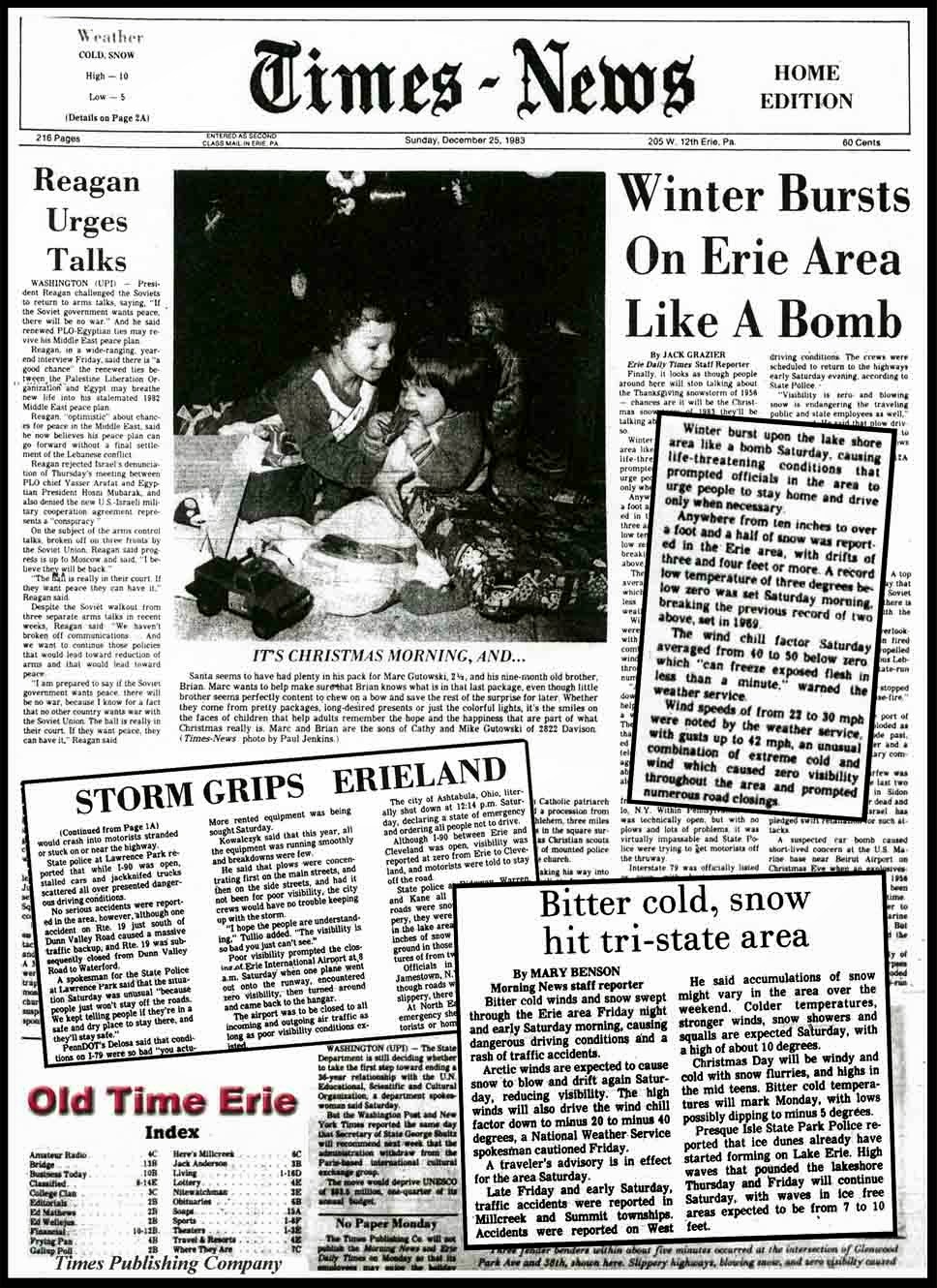
December 24 was a cold, partly sunny day in Pittsburgh in 1983. We picked up the rental and started north on route 79. We were enjoying the ride, listening to music and munching on some snacks. About 90 miles out of Pittsburgh some snow started to fall – we were approaching Meadville. We weren’t too concerned and continued on our way.
The snow grew heavier and heavier as we proceeded north. This was the definition of lake effect snow. By the time we got to the turnoff for route 90 East, just outside of Erie, we were in whiteout conditions. I opened my window and leaned my head out and tried to help Gary to stay on the road. We literally could barely see a foot in front of us.
We saw a sign for an upcoming exit and decided we had to get off the road. At the end of the ramp was a Holiday Inn, we pulled into its parking lot and debated what to do. It was still barely past noon. We listened to the weather forecast on the radio. They were reporting blizzard conditions in Erie. No kidding!!! It didn’t sound promising.
Other cars were following us off the road and into the parking lot and we realized that if we didn’t register soon, we might not get a room. Gary parked, we took our suitcases and, as it turned out, got the last room available.
We settled in, turned on the tv, read the newspaper that we brought from Pittsburgh and relaxed. We called Merle and then we called my brothers’ in-laws. While conditions weren’t quite as bad in Buffalo, the New York State Thruway was closed. We agreed that we would wait and see if we could continue the trip the next morning. Meanwhile conditions worsened outside. The wind picked up and the temperature plummeted.
We thought we would venture out for dinner, since there was a restaurant just down the road. We bundled up and left our room to find cots in the hallway and in the conference room near by. We were quite lucky that we got that room. I felt bad for the families that were celebrating their Christmas on cots in the hallway.
We made our way to the car with difficulty, the wind had caused impressive snow drifts. Looking at the accumulated snow, it was still snowing hard, the wind was howling, we realized we weren’t going anywhere. In the short time that we had been outside, my feet were nearly frozen. We hurried back into the Holiday Inn.
The staff set up tomato soup and cheese sandwiches for everyone. That was dinner and we were grateful for it.
We went back to our room and went to sleep.
The next day, Christmas day, was brilliantly sunny. We had gotten over two feet of snow, the wind was still blowing and the temperature, without windchill, was barely above zero. We went out to clear the car off and see if we could go get some breakfast. The car wouldn’t start! I called AAA. It was going to be a while until they could get to the car. We went back to the room.
The day before we had exhausted most of the resources we had with us to entertain ourselves. We got pretty creative (perhaps not the way some people would get creative). Using the chart in the newspaper, we quizzed each other on the high and low temperatures in cities across the United States and world. It was amazing how long we amused ourselves with that! Our room had sliding glass doors that had thick frost on them and we played hangman in the ice. The window would refrost fast so we were able to play multiple rounds!
Now it was Christmas day and since the car wouldn’t start, we flipped through the channels on the television. The options were quite limited. In that day and age, I don’t think the motel had cable, there were only three stations available in a place like Erie. The Yule log was on one channel. Another was off the air for the holiday. The last one featured the local middle school choir singing Christmas carols. While that was on, we saw a commercial advertising an NCAA basketball game coming up at noon. We couldn’t believe our luck, we love college basketball! At least we’d have something to watch for a couple hours.
The appointed time came and the local station announced that they were going to replay the middle school Christmas concert! Gary and I were beside ourselves. I pulled out the telephone book and found the number for the tv station. Gary called and surprisingly someone answered. Gary asked why they were replaying the concert when the network was broadcasting a basketball game. The person on the phone was none too pleased to be bothered and explained, as if Gary was an idiot, that it was Christmas and this is what people would want to watch. Gary responded, “It’s Christmas in Pittsburgh, too, but they’re getting to watch basketball! Why can’t we?!!” Not surprisingly, the guy from the station wasn’t moved by Gary’s argument. Gary slammed the phone down in frustration.
By the time the car got jumped, it was dinner time, too late to leave. We realized that it didn’t make sense to continue on to Buffalo. We decided we would stay another night in the Holiday Inn and go back to Pittsburgh the next morning. Fortunately, we were able to drive to the Ground Round for dinner! We enjoyed a cocktail and took our time eating. At least we were out of the hotel!
To our great relief, the next morning the car started. It was still brutally cold. We got back on route 79 and headed south. We were disappointed in how the weekend turned out, to say the least. Not to mention the money we spent for our trouble. Just to put a cherry on top, a bird dive bombed into the middle of the front windshield as we were driving. I don’t know why the suicidal bird picked our car, but now it was splattered across the windshield. Gary tried using the wipers, but the fluid was frozen and the wipers just smeared the bird’s remains. I had a brilliant idea. I had a cup of diet soda that I thought I could rinse the feathers and blood off. I leaned out the window and poured it on the mess. It froze instantly! Now the bird remains were coated with diet coke – at least if I had been drinking 7up it wouldn’t have looked so awful. We pulled over to clean it enough to see, and then continued on our way, shaking our heads in disbelief.
We made it back to Pittsburgh without further incident. We returned the car and said nothing to the agent about the mess on the window. As we walked away we started laughing. The whole weekend had been so preposterous. We laughed so hard there were tears rolling down our cheeks. At least we survived and had a story to tell.
I stood at the podium looking out over a banquet hall filled with my colleagues. Since I had no prepared remarks, I was trying to come up with something. What did I want to say?
The executive director of the New York State School Boards Association (NYSSBA), for whom I had worked for the last 9 years, had just introduced me by offering some left-handed compliments, noting my penchant for speaking my mind. Happily for him, the reason we were in the banquet hall was that I was retiring.
The party wasn’t only for me. A colleague, who had worked for NYSSBA for over twenty years, was also being honored. He had already been introduced and made heartfelt remarks about how much he enjoyed his career. He was genuinely moved and spoke haltingly, emotionally about his appreciation for the organization.
When my turn came to take the podium, I wasn’t at all sure what I felt. In the weeks leading up to the luncheon I couldn’t get myself to focus on writing remarks. After all, most of the reason that I was retiring at age 55 was that I was unhappy in my work. I was tired of fighting the good fight and getting nowhere. I couldn’t very well stand up and say that, despite my penchant for speaking my mind. I made innocuous remarks, thanking the people who I did enjoy working with and I wished everyone well. It was time for me to turn the page and start a new phase of my life.
It is unlikely that anyone reaches 55 years of age without starting over a few times. Whether the impetus is retirement, a relationship ending, or moving to a new city or changing jobs, it is almost impossible to avoid starting over in the course of a life. Some might actually seek out new starts, finding the prospect exciting and challenging. I am not one of those people. I like the idea of change in theory, but the reality is hard.
When district lines were redrawn when I was a child in Brooklyn and I had to attend a different junior high school than my elementary school classmates, I struggled. When my then fiancé, now husband, was accepted to medical school in Pittsburgh and I uprooted from New York City to join him, I had a tough time adjusting. When budget cuts closed the Legislative Commission on Expenditure Review, where I worked and enjoyed my job, I was angry and resented having to find a new job.
While those new starts were thrust upon me, the decision to retire as soon as I was eligible was a choice I made. After much ruminating, and discussion with Gary (husband, see above), I decided to retire, collect my minimal pension, and pursue writing. Perhaps that sounds simple. It wasn’t.
The decision was fraught on many levels. For one thing, I worried about how my retiring from paid employment would affect my marriage. Gary and I have spent a lot of time negotiating the balance of our relationship – balance in terms of finances, child care and household responsibilities, and attention to each other. Other than the first 8 years of our 33 year marriage (and counting), Gary has been the major breadwinner.
I supported Gary through medical school and continued to work when we started our family, but once he was in medical practice, he earned far more than I did. Gary never held that over my head, he wasn’t one of those husbands who begrudged me a new pair of shoes. He didn’t review the credit card statements. But, that isn’t the point. The point is that Gary works very hard, long, stressful hours. I think he felt a sense of relief, of shared burden, when I was working (for pay, that is).
Having grown up in the late ‘60s and early ‘70s, I bought the idea that women could have it all – family, marriage and career – hook, line and sinker. I wanted a career, I believed I should have a career. I felt like a failure when I finally admitted to myself that I could not balance it all. I thought it would get easier when the kids got to be school-age, but it didn’t. The running refrain in my head at the time was that I was doing a shitty job wherever I was – at home or at work.
Although I had a lot invested in my identity as a career woman, the reality was that I was working for the New York State Department of Taxation and Finance in a job that made me feel like I was living in a Kafka novel. It was not the vision I had for myself when I started the master’s program in public administration and policy at Columbia University. I thought I would help people by pursuing a career in public service, hopefully in education policy. Somehow I found myself in a job that was as far from helping people as one could get. I had to do some serious mental gymnastics to connect what I was doing to the public good.
When it became financially feasible for me to stop working and stay home with the kids, I did. I thought long and hard before doing it. I still held on to the idea that I should be doing something productive to help people and get paid for it. I considered looking for a new (more satisfying) job, but the truth was, with the demands of Gary’s career and two young children, I felt like working full time might lead me to a nervous breakdown. I was already well on my way to one. So, I stopped. I spent the next 11 years mostly staying home.
I told myself when I stopped work that I would write. Now that I was home, I thought I would try writing a fictionalized version of my childhood. I always wanted to write – I was always composing sentences in my head, describing the scenery or people I observed. At various times in my life, I wrote in a journal but I never moved beyond that. I thought I was finally ready to do it. I wasn’t. If I shared my writing I would subject myself to judgment that was too close to the bone, too close to judging my worth as a person. I couldn’t expose myself in that way, even under the guise of writing fiction.
Instead I did a bunch of other things on a freelance basis. I became an impartial hearing officer who heard disputes between parents and school districts about services for students with disabilities. I did that sporadically for about five years, until they changed the law and required hearing officers to be lawyers. I could have continued, they grandfathered the current pool in, but it didn’t seem right to me. If the belief was that a law degree was necessary, and I could see the wisdom of that, then I decided I shouldn’t continue.
I became a facilitator for the Anti-Defamation League’s World of Difference Program, a multicultural, diversity education program, and I did that on a freelance basis.
I also got involved in my kids’ school. I volunteered in their classrooms and in the library. I went to PTA meetings. After about two years of doing that I ran for the school board and was elected. I served for nine years.
When our son was in his junior year of high school and our daughter was a freshman in college, I thought it was time to go back to work full time. The pressure of two college tuitions, and my desire to get back to a career, led me to start to look for work. That turned out to be complicated. It seems that the various freelance positions I held, and serving on the school board, looked like a hole in my resume.
Finally, based on my school board service and the support of someone in the organization, I found a job with the New York State School Boards Association. I stayed for nine years. During that time, in my opinion, education reform was moving in the wrong direction. Too much emphasis on tests, misuse of the tests to evaluate teachers, charter school expansion that drained resources from public schools, Race to the Top….I could go on and on. I tried to advocate within my organization to take a stand against these policies, but I rarely made progress. After 18 years immersed in public education, and reaching age 55, I decided I had enough.
At the same time, I started to think again about writing. I had never stopped thinking about it actually. Most of my days at work were spent writing, but it wasn’t the type of writing I wanted to do. I thought maybe I was finally ready.
Lucky for me, my children knew I needed a nudge. As a retirement gift, they signed me up for a writing workshop at the Capital Region Arts Center. It was three hours each night over the course of four consecutive evenings. I was both terrified and excited.
The class started on a lovely summer evening in mid July. I was nervous about finding the Art Center and parking in Troy, so I left myself a lot of time. I am chronically early and this was no exception. The classroom was still locked, so I wandered around the Center and looked at the art exhibits. I found the vending machines. I tried to distract myself.
I went back to the classroom. I felt hopeful, but unsure of what to expect. The door was unlocked and there were a few people in the room. It turned out the workshop was led by a poet. I hadn’t written a poem in…I couldn’t remember when – probably in junior high school when we were forced to. The workshop was described as ‘generative,’ which meant that participants were able to work on whatever type of writing they wished. So, poetry wasn’t required. Phew!
There were only five other people in the class, all women, several of them looked to be about my age, the others definitely younger. The poet-leader was a young man. After brief introductions, Victorio read a poem to us, which was in the form of a letter to oneself. After he read it, he asked us to take 20 minutes and write something to ourselves. The six of us spread out in the room. I took a spot on the windowsill, looking out on the Hudson River.
I did not have difficulty finding words. I wouldn’t call it a poem, it was prose, but it wasn’t a narrative either. I wrote freely. I surprised myself.
After 20 minutes, we came back together. Victorio didn’t ask for a volunteer to read first. He simply called on me. My jaw dropped; the moment of truth. I know he saw the fear in my eyes, but he didn’t flinch and he didn’t let me off the hook. I stopped thinking, looked down and read the words I had on the page. I didn’t look up until I finished.
I honestly don’t remember the substance of the comments. What I remember is that it was okay. I survived. There was criticism, all of the constructive variety. (In that I was fortunate – none of the women turned out to be jerks, and Victorio set a great example for us.) There was encouragement. And, most important, I didn’t die of exposure or embarrassment!
Driving home that night, I was almost giddy. It felt like a burden had been lifted. Ahhh, liberation…..I could finally try to do what I had always wanted to do. In that moment I certainly didn’t know if I would ever be published (and still don’t), but it didn’t matter. I didn’t know where the process would bring me, but I knew something had changed inside. I had begun a new path.
Maybe it wasn’t really starting over at all. Maybe it was a coming home of sorts, coming home to myself.
My parents and I spent much of the summer of 1973 in Colorado. My dad had applied for and received a grant to study for his administrative certificate in education at the University of Colorado in Boulder. So we took another road trip. My brothers weren’t with us. Steven was working at Ackerman’s Hotel (which contrary to what I thought at the time was NOT in the Poconos, but was in the hills of Morristown, New Jersey) and Mark was working at a summer camp in upstate New York. I wasn’t usually in the habit of missing my brothers, but I did that trip.
The three of us left Brooklyn in our Chevy Impala, the huge backseat all to myself. I had books and a transistor radio to entertain me. For some reason my parents were not getting along. There was a lot of arguing about directions, among other things. My mom navigated using the AAA triptik while my dad drove. This was obviously long before GPS and my father was basically dyslexic when it came to directions – more on that later.
I wasn’t enjoying this road trip. I fiddled endlessly with my radio, trying to tune in to music stations that reminded me of home. Whenever Bad, Bad Leroy Brown or Kodachrome came on, it lifted my spirits. My dad, a high school social studies teacher, didn’t appreciate the latter song, something about ‘when I think back on all the crap I learned in high school, it’s a wonder I can think at all’ offended him. Other than the music, I felt kind of lonely. The bleak Midwest landscape didn’t help.
The AAA book about Nebraska and Colorado said that when we left Nebraska and entered Colorado we would soon see the Rocky Mountains in the distance. I looked hard, but all I could see was the gray sky and drab prairie. We made it all the way to Denver and we still didn’t see the mountains!
We were staying on the University of Colorado campus and I had a single room in a high rise dormitory. My parents were next door in a suite. It was a relief that we each had our own space. We arrived in the evening and got settled in.
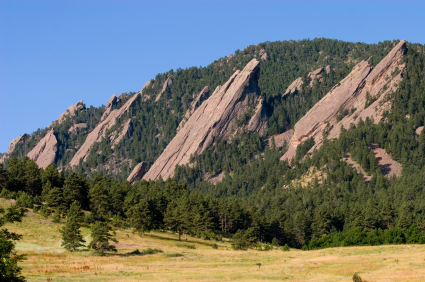
The next day miraculously the mountains appeared! They looked like a painted backdrop just like I had seen in so many John Wayne westerns. It was shocking since the day before the fog and cloud cover had been so thick that I would’ve sworn they weren’t there. I learned that they called the foothills the ‘flat irons,’ and it was an apt description. Things were starting to look up – literally. At that point I had only ever seen the Catskill Mountains, and I quickly understood that while they may have been pretty, they weren’t real mountains.
The ‘flatirons’ that moved in overnight!
I was 13 years old and my view of the world broadened immensely that summer. From appreciating nature much more, seeing the continental divide in Rocky Mountain National Park and watching a thunderstorm below us on Pike’s Peak were awesome to behold, to seeing that people lived very different kinds of lives – my eyes were opened.
While we were in Colorado, Uncle Terry and Aunt Barbara, who were also teachers like my parents and had the summer off, took their Toyota Celica and yorkie, TJ, on their own road trip. They drove from Brooklyn to Alaska! Though not exactly on their way back, they came by and visited us in Boulder. We went horseback riding, played volleyball and generally had more fun – a theme in my young life. Things were more fun with Uncle Terry and Aunt Barbara around. In addition, Uncle Terry and my parents mapped out a sightseeing trip for us before we went back to Brooklyn.
While we were in Boulder we went to a rodeo. I can thank that rodeo for opening my eyes to two other issues I was only vaguely aware of – sexism and animal cruelty. I was horrified by the rodeo on so many levels. I learned how they got the bulls to buck – strapping their testicles back or by using some kind of electric prod (that may not be how they do it today, though it still doesn’t seem like a humane activity for either the bull or rider). Not to mention finding the prospect of a cowboy being trampled by the bull sickening. Part of the entertainment involved a pretty young woman dressed up in a gingham dress who acted dumb. We were supposed to laugh – I wasn’t laughing. As far as I knew, Brooklyn had never hosted a rodeo, which to my mind made it infinitely more civilized, even if the streets were more violent. I haven’t gone to a rodeo since.
Dad successfully completed his program and we left Colorado and started the road trip that would eventually take us home. We headed to Salt Lake City, then to the Grand Tetons, Yellowstone, Mount Rushmore and last, the Badlands.
While I had heard of the Mormon Tabernacle Choir, I didn’t know anything about the religion. Another eye-opening experience. Coming from an academic family that was only culturally Jewish, the story of the Mormons struck me as other worldly. With my natural skepticism, I found it hard to believe that others put faith in the story of John Smith, all the more preposterous to me because it started in, of all places, Western New York.
As I noted before, my Dad had a terrible sense of direction. That ‘disability’ was on full display as we tried to navigate around Salt Lake City. We headed to the Great Salt Lake, only to be thwarted by confusing signs (at least to my Dad) and we kept missing the turn, heading toward Provo (the opposite direction) three times before we finally got it right. When we finally did make it to the lake, there was some kind of fly infestation there. We took one quick look and got back in the car and drove back to our motel in Salt Lake City, or at least tried to. Whenever we went out to see the sights we would have great difficulty finding our way back to the motel. I think we finally had it figured out when it was time to leave. Next stop the Grand Tetons.
We drove through long stretches of desolation in Wyoming getting to Grand Teton National Park and then again when we were leaving Yellowstone. We passed towns named Ten Sleep and Emblem where the population would be 10 or 30! I wondered if they changed the sign for each birth or death. I noticed a truck stop with a trailer next to it, and nothing else, I mean nothing else, for as far as the eye could see. It appeared that whoever ran the truck stop lived in the trailer and that was his world. I couldn’t imagine the isolation, though I tried. My father remarked, only half joking “Maybe we could bring half the population of Brooklyn here. It would be better for everybody.”
Yellowstone was another revelation. The weather was not cooperating, a persistent cold rain threatened to ruin the sightseeing. My dad, in his frustration, complained, “I didn’t come all this way to get pissed on!” I tried not to laugh from my spot in the back seat but couldn’t help it. All of us started laughing, defusing the tension. Fortunately the rain did stop and we got to see the incredible geological anomalies that dot Yellowstone while staying dry. The Mammoth Hot Springs, the geysers, paint pots, mud volcanos, there was so much to see.
Despite all the wonders or maybe because there was so much, we managed to get on each other’s nerves. This time my mother was making me crazy. As we walked through the Mammoth Hot Springs, which looked like giant, steaming wax candles, I complained to my dad, “I can’t stand Mom’s attitude. She marches through each site and commands us when it’s time to move on. It takes all the fun out of it.” Dad tried to explain that she just wanted to fit as much as we could into each day. He reminded me that I was old enough to wander the sites on my own.
Another lesson from Yellowstone: I learned how stupid people could be. Despite all kinds of warning signs about staying away from bears, naturally someone had to test the premise. We were driving along the main park road when traffic came to a stop. Looking ahead, my dad started jumping up and down in his seat, his hand thumping the steering wheel with each jump. “Feige, Feige, look!” he was so excited, like a little boy, I had to smile. There was a bear a couple of cars ahead of us. We stayed in our car, windows rolled up, watching. A person in a small camper ahead of us got out of their vehicle with a camera to get a closer picture. The bear noticed and moved toward her. She hurried back into the camper and safely got in, to my great relief, (though a small part of me was rooting for the bear). The bear, spotting a red round object at the end the camper’s radio antennae, must have thought it was food, grabbed for it. Frustrated when it wouldn’t come off, the bear pounded on the hood. We watched the vehicle rocking under the weight of the bear. Finally he ripped the antennae off, angry that it wasn’t food, threw it down and slunk off back into the forest. “How could anyone be so stupid?” I asked. My parents had no answer.
Seeing the Grand Tetons, the Grand Canyon of Yellowstone and Mount Rushmore left indelible images in my mind. I had a much better understanding of the grandeur and power of nature. I also had a much greater appreciation for John Denver’s song Rocky Mountain High, which was ubiquitous on the radio.
There came a point, after seeing Mount Rushmore, where I had had enough. I don’t remember how long we had been on that road trip, but I had spent more than a month where it was just me and my parents. Riding in the car and staying in a single motel room made for tight quarters. Enough was enough. I made my stand at the Badlands. I wouldn’t get out of the car to look. I wanted to just go home.
Now who was stupid? I didn’t really see the Badlands and I’m pretty sure I ruined it for my parents. We headed home.
Aside from my new appreciation for the beauty in nature, my broader view of life in America, I came back to Brooklyn looking forward to seeing my brothers!
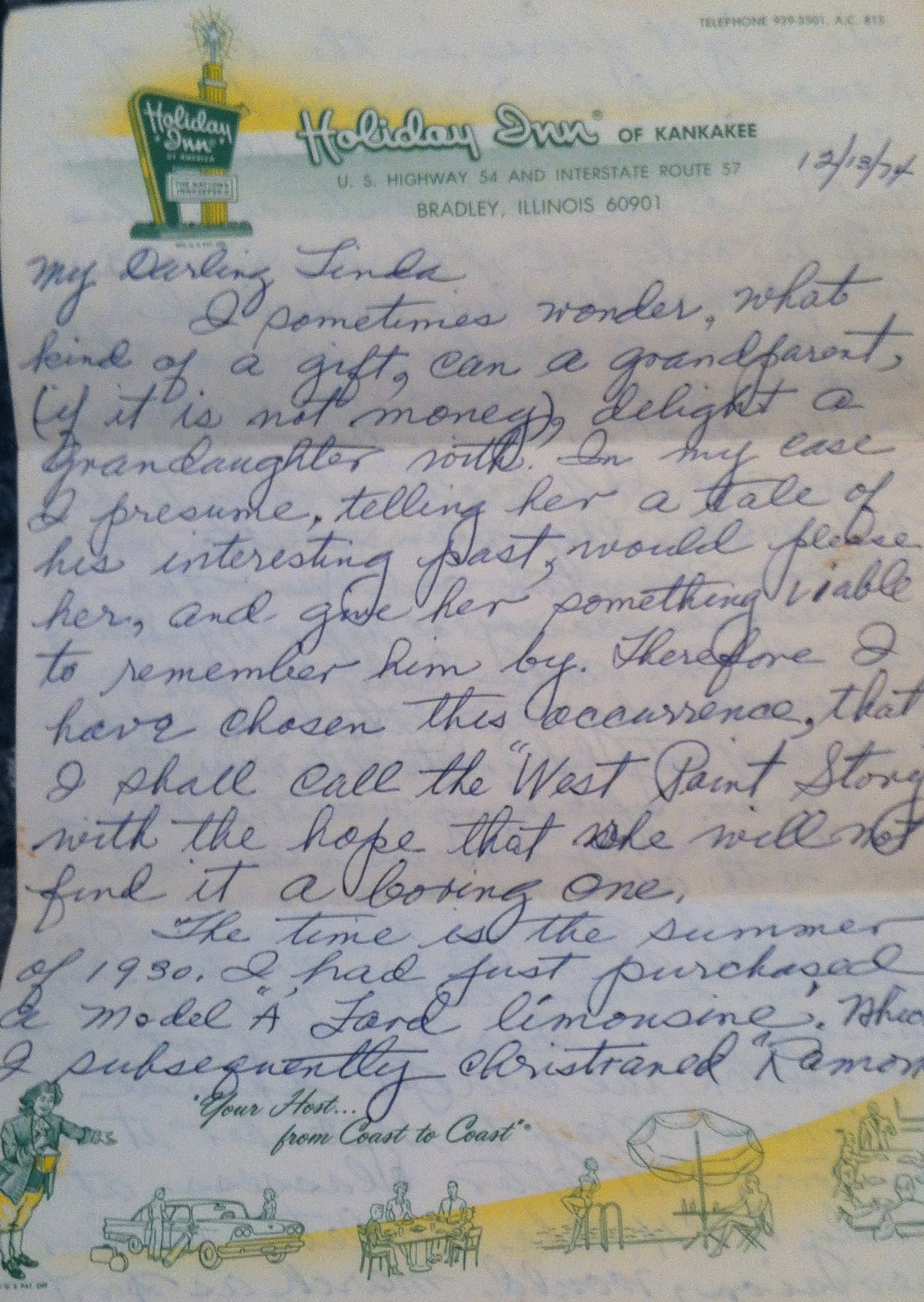
Road trips were something of a theme in my family. The following is a letter I received from Zada detailing a trip he took with two of his siblings. When he wrote this letter, it was just over a year after my trip out west and he had moved to West Palm Beach. Oddly enough the letter is written on stationary from the Holiday Inn of Kankakee (Illinois).
12/13/74
My Darling Linda,
I sometimes wonder, what kind of gift can a grandparent (if it is not money), delight a granddaughter with. In my case I presume telling her a tale of his interesting past would please her and give her something viable to remember him by. Therefore I have chosen this occurrence, that I shall call the “West Point Story” with the hope that she will not find it a boring one.
The time is the summer of 1930. I had just purchased a Model A Ford limousine, which I subsequently christened “Ramona.” The eight years in the life of Ramona (the car) were very exciting. Many a glad tale revolved about and around her existence. This tale is only one of the experiences in which she was involved.
I was a carefree soul in those days, and I decided on a picnic in the country. I invited my sister, Lily, and my brother, Sidney, to be my guests. My plan was to ride to Bear Mountain and view the picturesque scenery of Upper New York State. Remember we were city people, surrounded by tenements, and the hubbub of city life with all its noises, etc.
How refreshing was the clear air, the balmy breezes, as we rode with open windows, scanning the beautiful scenery. We arrived and had lunch at the Bear Mountain Inn, and then knowing that the West Point Academy was nearby, why not visit and watch the cadets parade?
From May to September it was the custom that after classes at precisely 4 p.m. the cadets, under supervision, would march as part of their training. We arrived in time to find a parking place, and we, in the company of about 3000 more spectators, wended our way to the parade grounds.
The parade begins, it is one of the most spectacular sights to see. The colors are born by 4 cadets followed by the Army band blaring for the “Stars and Stripes Forever.” You get goose pimply and possessed with pride that you are an “American,” and that these young men will be our protectors in times of strife. (Ask Uncle Jack and Uncle Morris and they will verbally describe to you the glow that permeates your whole being.) Have you ever heard how Albie Booth used to run through the Harvard Line, or how Bob Cousy would dribble down a basketball court, or how the Roxy Rockettes would dance in unison? Then you have a very good idea of how thrilled we were watching such symmetry in motion. The parade is over after the playing of the Star Spangled Banner. The bugles play taps and we are ready to make the trip home.
But I am not satisfied. I decide to do the whole bit. I will tour the area, show Lily and Sidney the newgym being built, the library, the auditorium, the classrooms, etc. I purposely underlined new gym because this is exactly where this unique happening took place. Now picture me driving and pointing out the various sites, not realizing that I was driving past a dead end sign. When all of sudden Ramona seems to fall, and we find ourselves, in what I thought was a ditch. But lo, no such luck. It was a square pit about 20 feet on each side, naturally it stands to reason, if it was square each side would be 20 feet. To my chagrin it was also 2 feet high. Now as good as Ramona was, her wheels were not built to climb walls. What to do? I am in a quandary. The sun is beginning to set and soon it will be dark. I tell my brother and sister to stay in the car, while I go to seek help.
I walk toward the main road and fortunately I see a squadron composed of 16 cadets, and I assume that the one in charge must be the leader. They are in formation, and probably as was their wont, marching back to their quarters. I step in front, put up my hand, like a traffic cop. On command they halt. I approach the leader, and in the most sorrowful tone, I exclaim, “Captain,” (I really did not know his rank, but I thought it would be complimentary to address him in that manner.) “I did the most stupid thing imaginable.” I explain that my sister and brother are marooned in the car, that I had foolishly driven into a hole and that I could not extricate the vehicle. He asked where the car was, and this is when it all happened.
Now he really became a squad commander, it was “squad left, squad right,” and when we arrived at the place it was “squad halt!” I forgot “squad, forward march.” Now he surveys the scene, then like a drill he orders by name 4 cadets on each side of Ramona. Then the order comes out in a stentorian voice, “Squad, heave to, and lift the car off the ground!” Then turning to me, in the same tone, “which way do you want to face the car?” I said, meekly, “Toward the main road so that I can be on my way.” Meanwhile the squadron was holding Ramona aloft. And then in the same manner, he ordered the four cadets in front of the car to take positions in the rear and then what seemed like a super human effort, his voice rang out, “Men, propel the car onto level ground!” and with all their might, they did just that.
We thanked him profusely and he answered. “It is all in a day’s work. We were glad to be of service.”
Then the orders began again “Squad, fall in formation! Squad, forward march!” They marched away like true American soldiers that had followed orders and helped people in distress.
I’ve heard so many contradictory stories about our men in the armed services, but I can never forget the sterling qualities of our West Point Cadets.
Darling Linda, like most of the things that happened to me, I end this letter with the old cliché, “You had to be there to appreciate the incident.”
As ever devotedly,
Zada
P.S. I am making a copy of this letter and sending it to Laurie. I wish for both of my lovelies to be amused. – CS
I open my eyes and orient myself to the room. I have been going back and forth so often between Albany and the city, I forget where I am. That’s right, I’m on the sleeper couch in the living room in Manhattan. Fortunately it has a good mattress.
I reach for my phone to make sure I haven’t missed any calls or messages. I briefly scroll my Facebook feed.
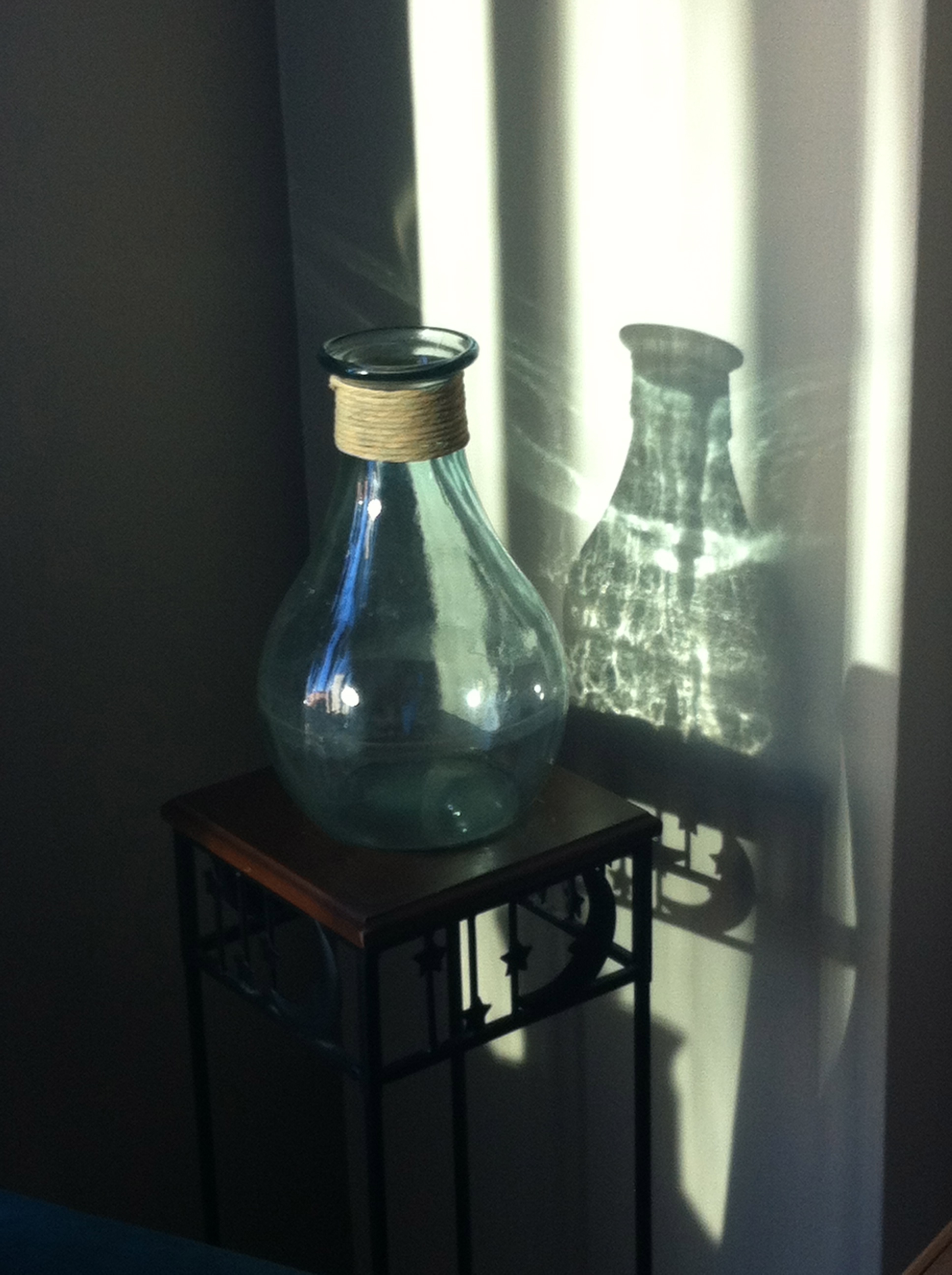
I turn to look out the large picture window. I notice in the corner that the sun is casting a perfect shadow through the lead glass vase that sits on a small table in the corner. I look closely at the shadow – the rope that wraps the top of the vase is projected in detail onto the wall. The imperfections in the surface of the glass are illuminated, as well. I imagine Andrew Wyeth could paint this and capture the beauty of the vase, the light and the shadow. I wish I could paint it, but since I can’t, I roll out of bed taking my phone. I take two pictures before the light changes. I want to share this image, this lovely moment.
I consider posting it on Facebook, but think better of that – what would be the point? Really, does the world need another pseudo-artistic photograph? Instead, I text the picture to my two kids and my husband. Leah is in Seattle, so it is just after 4 a.m. there. I know she puts her phone on silent when she sleeps so it won’t wake her. Dan and his wife are on an early morning flight to New Orleans for a long weekend so he will get the text and photo when he lands. Gary is already at work in Albany. I am in our apartment in Manhattan, looking after my 82 year old mother, asleep in the bedroom, recovering from lung surgery.
I text: I don’t know if this photo does it justice, but woke up to see this beautiful shadow on the wall. Wanted to share it.
Gary responds with: Very nice but how about a photo [if] your smiling face.
Where is autocorrect when you need it?
I text back: 🙂
I am a lucky woman. Gary often responds with sweet comments.
A while later my phone dings. Dan’s text reads: On the ground in Atlanta. Transfer in an hour or so. Very nice picture, Ma.
Two hours after that, Leah texts: Really cool shadow, Ma!
And so it goes. Many days the four of us are in conversation in this way; brief moments of sharing. Sometimes one of us doesn’t chime in, but we know that we will all have seen the exchange at some point. It helps me to feel connected to them despite the miles between us.
My parents and I were at Seniors, a restaurant in Sheepshead Bay, to celebrate my high school graduation. The ceremony was earlier in the day. I started to say, “I feel really bad…” and my dad threw down his fork. “Don’t!” he said, “We’re celebrating your graduation. You have nothing to be sad about!”
“But…” I started to explain, but the look on his face shut me down. I fought back tears and concentrated on the food on my plate.
The end of high school was a strange time for me. I was so unhappy and lonely in junior high school and came to Canarsie High School feeling like an outcast. I was terribly insecure, between my eyes, my weight and general self-consciousness, I began high school in a hole. Things did turn around, but not like in a fairy tale or Hollywood movie. The ugly duckling didn’t emerge as a swan and float off happily ever after. Painstakingly, over the course of the three years, I dug myself out.
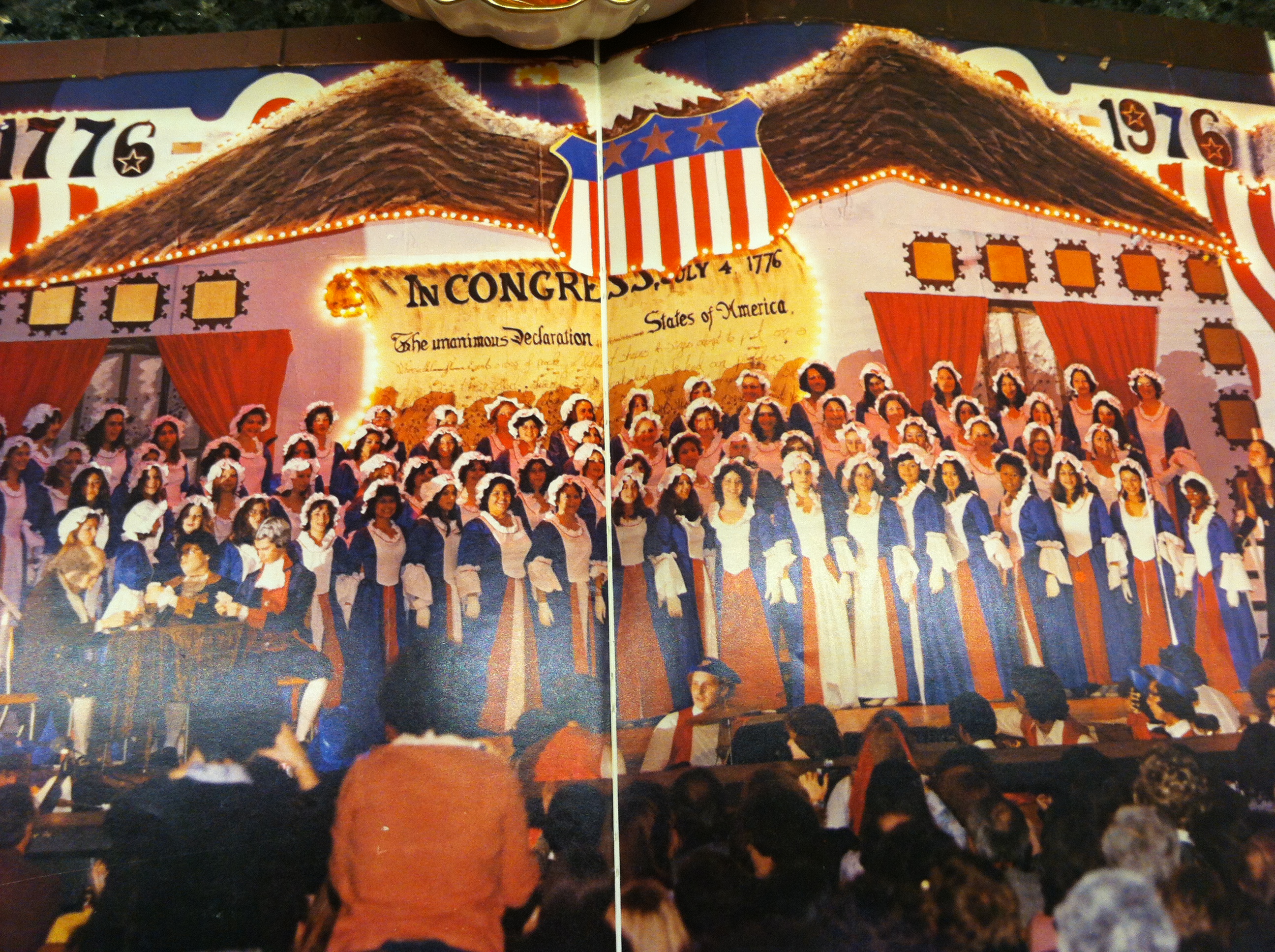
I started by joining some activities. I was in the chorus of Sing, a school show of sorts. I connected with some of the girls who stood near me in the alto section during rehearsals (some were friends from elementary school who went to a different junior high). I still had trouble knowing how to extend the friendships beyond the rehearsal, but I was making progress.
Sing senior year (1976). I am the last person in the last row on the right (picture from our yearbook).
I tried out and made the girls basketball team. We were God-awful, except for one or two players, but I loved basketball and I was happy to be part of the team.
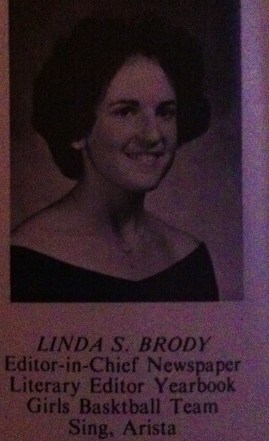
I wrote for the Canarsie Campus, the school newspaper, and by senior year I was the editor-in-chief. I started out doing okay in my classes and by the senior year, I was doing really well. The trajectory was headed in the right direction. I was voted Most Likely to Succeed by my classmates and had my picture, along with Alan Schick, in the yearbook commemorating the designation. I both enjoyed the attention and felt disconnected from it. Inside I still felt like the girl who sat in the junior high school cafeteria eating lunch alone, worried that I would be the target of teasing.
So, in June of 1976, I was in a much better place than in September 1973 when I entered high school. But, my newly formed self-esteem was still pretty fragile, and oddly enough the graduation ceremony itself delivered a major blow.
Canarsie High School held its graduation at the Loew’s Kings Theater in Flatbush, a huge old-time movie theater with some 3000 seats and ornate plaster walls. With more than 750 graduating seniors (there were more like 1100 students in the senior class, but the rest didn’t qualify to graduate) and their families, the high school auditorium couldn’t accommodate it.
I don’t remember who from my family came. My Dad drove our monster-size Chevy Impala, with my Mom and me (and perhaps others – it’s possible that Uncle Terry and Aunt Barbara were there), and dropped me off to gather with the graduates. They went to find parking.
Some students were invited to sit on the stage, those who were speaking, receiving an award or performing. I was receiving an award so I marched in and climbed up on the stage with maybe 30 other students. I was told beforehand that I would receive the Monroe Cohen Memorial Award, given in honor of Canarsie’s beloved representative to the New York City Council who unexpectedly died a year earlier. I didn’t know why I was being given the award, but I took my seat on stage and took in my surroundings.
The stage was huge; the whole theater was huge. I looked out and searched among the thousands of faces for my mother. I couldn’t spot her. My dad, who had been a dean at Canarsie High School but left to become chair of the social studies department at another city high school two years before, was invited to sit on the stage, too. He was seated on the other side with faculty and other dignitaries. I couldn’t see him either.
The ceremony proceeded in the usual way. Eventually they got to the presentation of awards. I heard our principal, Mr. Rosenman, announce the Monroe Cohen Memorial Award and I started to make my way to the front of the stage. Mr. Rosenman was saying something like, “Linda virtually single-handedly put together the school newspaper, without a faculty advisor and with very little funding.” I was standing next to him, smiling, one hand extended to receive the award and the other hand extended to shake his, when someone screamed out, “That’s not true!!” Despite the crowd, unfortunately at that moment it was pretty quiet in the theater.
I looked around, wondering, did that just happen?! Though the comment wasn’t repeated, I knew what I heard. It rang clear as a bell, echoing in my ears, “That’s not true!!” Mr. Rosenman paused briefly and then continued on as if nothing had happened. Finally I took the envelope with the award and found my way back to my seat on wobbly legs.
There may have been applause. I actually didn’t know what was happening because my head was spinning. I sank down in my seat, shaking like a leaf. I felt exposed. Everyone knew I was a fraud. I looked frantically around the theater to see if I could figure out where the comment had come from, but the words didn’t leave a vapor trail. There was no telltale sign, except in my vibrating body.
My friend Laurence, who was sitting a couple of seats down from me, reached over and patted my knee. He asked if I was all right. I nodded that I was, though I suspected that my face said otherwise. I’m sure all the color had drained from it.
I don’t remember the rest of the ceremony, but I kept breathing and made it through. I found my family afterwards. I don’t remember much about our conversation, other than my mom telling me that someone said it was a parent who yelled out. Maybe that should’ve made me feel better, but I was still in shock. My father, who was quite hard of hearing, was learning of it for the first time when we gathered after the ceremony was over. He dismissed it as sour grapes. I wished I could do the same. We got back into our Chevy and went back to our house in Canarsie.
It didn’t occur to me to be angry. I felt humiliated and it confirmed my worst fears, that I was undeserving. I hadn’t asked for the award and I didn’t write the comments Mr. Rosenman delivered.
At dinner with my parents, when I tried to bring it up, I think my Dad wanted to ignore that it happened and he didn’t want me to be hurt.
I couldn’t let go of it, but I had to pretend to.
All these years later, I remember the incident so clearly. I know that I went that night, after dinner with my parents, to celebrate at a bonfire at a nearby beach with friends. I don’t remember what my friends said. It is unlikely that I would have mentioned it because it was so embarrassing, but maybe I did. I don’t know if words of comfort were offered, but maybe they were. It is interesting, the memories we carry with us, and what we forget.
This might come up on the TV screen, interrupting programming, when there was a tornado warning. The image still makes me uneasy.
I was probably 45 years old before I stopped getting nauseous when there was a tornado watch or warning (I was well acquainted with the difference between the two – and either one caused the same reaction).
Before reaching 45, though, the atmospheric conditions present when tornadoes were possible seemed to inhabit my body. My insides were as unsettled as the air outside. The ominous clouds scuttling across the sky mirrored the feeling in my stomach.
My fear of tornadoes began in Illinois in 1968. Growing up in Canarsie (Brooklyn), I had not experienced tornado watches or warnings. If they happened, I wasn’t aware of it. My awareness of twisters was informed mostly by watching The Wizard of Oz and as long as it remained on the TV screen, I could handle it.
When we got to Illinois, where my Dad attended graduate school for three successive summers, I learned about them first hand. It seemed like there were tornado watches almost everyday. I spent a lot of time studying the sky and feeling queasy. My brothers had quite a different reaction.
One particular afternoon things got serious. Fat raindrops started to fall. First there were gusty winds and then it got very still. The sky had a yellowish-greenish tint. We had been playing outside the graduate student housing where we lived when adults, including my Mom, emerged to gather us up and shepherd us into a ground level apartment. Lawn furniture and toys were pulled inside as well.
I immediately went where I was told to go and sat huddled in a corner, away from the windows. Snacks were offered as a distraction. The idea of eating a potato chip turned my stomach. I declined the offer.
The radio was broadcasting emergency instructions repeatedly. The static-y voice kept telling us to move to an interior room and under a heavy piece of furniture. I wanted to find a desk to sit under, but there were a lot of us in the apartment so I just stayed put in my corner. My Mom sat next to me, trying to comfort me, until she realized that my brothers were nowhere to be found. Apparently they thought it would be exciting to actually see the tornado. They were 10 and 12 years old (I was 7) and they had either never come inside or they snuck out. My mother found them running up the hill behind the building trying to spot the funnel cloud. Hearing the frantic tone in her voice must have registered with them because they did come back. I think the offer of snacks may have also influenced their decision. Most of the kids’ appetites were undisturbed. Meanwhile, I concentrated on not throwing up.
Eventually the storm passed without doing damage to the immediate area. I don’t think the funnel cloud touched down near us. The fact that nothing happened, though, didn’t lessen my anxiety about the possibilities. Throughout our entire time in Illinois, I dreaded the interruption of a television show with a weather bulletin. I’d listen carefully to the locations – for a 7 year old, I was very aware of the geography around me and knew the names of the nearby towns and how close the storms were.
Many years later (around 1985 while Gary was in medical school at the University of Pittsburgh) we went on a camping trip with friends. Yes, you read that right. Those of you who know Gary well, know that camping is not his cup of tea and this trip confirmed it for him. We were coming back to Pittsburgh from our adventure along the Cheat River in West Virginia, where Gary imagined hearing lions and tigers and bears outside our pup tent. While I did not share his anxiety while we were in the woods, I had my share of worry on the trip back. I was sitting in the backseat of the car, looking at the sky and feeling uneasy. I had that familiar feeling in my stomach – the one that said “Tornado!.”
Since we had made it to the interstate highway, nearing civilization, someone flipped on the car radio. My instincts were confirmed moments later when an emergency weather bulletin was broadcast. There was a tornado warning in the area. Not knowing enough about the surrounding geography, I didn’t know how close it was to us. The others in the car barely paused in their chatter. I sat silent, my head on a swivel, scanning the sky in every direction, plotting what to do if I saw a funnel cloud, willing us to get back to our apartment in Pittsburgh safely.
Fortunately, other than spotting some ominous clouds in the distance, we didn’t encounter any difficulties. We arrived back to our sturdy brick apartment building and the roiling in my stomach subsided. Another bullet dodged.
Although we have lived in upstate New York for the last 30 years, with climate change, we have experienced tornado watches, warnings and actual twisters touching down in the area with increasing frequency. Sometime after our children were grown, I can’t pinpoint a date or event, I realized that I didn’t experience the queasy, unsettled feeling anymore. I’m not sure if it was a physical change – my body stopped functioning as a barometer – or if it was a psychic change – or both. Either way, I let go of the fear. I resigned myself to nature’s uncertainty and my inability to control it, and it happened while I wasn’t looking. While I won’t be doing what my brothers did any time soon, nor will I become a storm chaser, I have come to peace – at least with tornados.
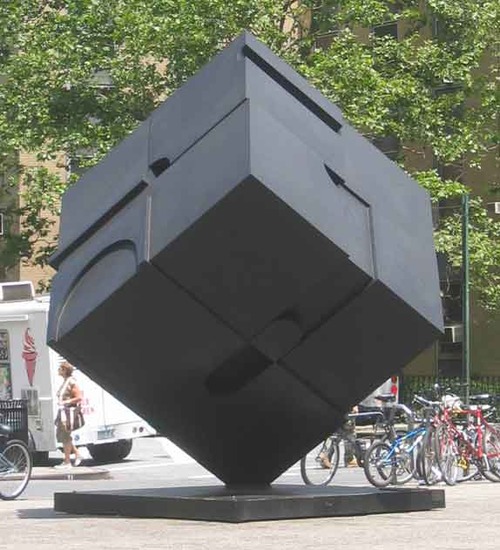
Sculpture at Astor Place. I loved and still love coming upon sculptures in public spaces in New York City. This one is near the subway station exit at Astor Place.
Growing up in Brooklyn I was always excited to go “into the city,” which meant going to Manhattan. Technically all five boroughs comprise New York City, but we knew Manhattan was really The City. Not everyone shared my excitement. There were many people in the outer boroughs who were as unfamiliar with The City and its attractions as people from say Oshkosh. My father fell into that category. He wasn’t unfamiliar with it, after all his two sisters lived there, but, somehow he failed to see the charms of the traffic, grime, and general hassle of getting around Manhattan. My Mom, on the other hand, focused on the museums, theater, and creative energy. I inherited my mother’s perspective.
Over the years I relished wandering around the different neighborhoods within Manhattan. I remember my first trip without adult supervision. My next door neighbor and friend, Deborah, and I were 12 years old when we plotted our adventure. Our plan was to explore Greenwich Village, stopping at the many bookstores that were there at the time. We studied the map of the subway system and reviewed our plan with my mom. We took the bus to the LL, the LL to Union Square and then switched trains to the 6 and got off at Astor Place. We were careful to read the signs so we got on the subway headed in the right direction. We were proud when we made it to Astor Place without any detours.
We started up the stairs to exit the subway station and we heard chanting from the street. We couldn’t make out the words, but it didn’t sound like the Hare Krishnas (a religious group – cult? – that would sometimes dance and sing on city streets). Deborah and I looked at each other and wondered what we were going to see when we got outside. When we emerged into the daylight we saw a demonstration going on across the street. People were carrying signs and marching around in a circle. In keeping with our instructions for visiting The City, we didn’t get involved – we didn’t stop long enough to really look at what the protest was about. We were delighted by it, though. Our first trip into the city unaccompanied and we arrived at a protest! In that day and age (1972) protesting was a daily occurrence. It could have been women’s lib, civil rights, the Vietnam War or a labor dispute. It didn’t matter much to us – it was exciting, but we were also a little nervous. So, we got our bearings and kept walking.
Much of what I liked best about going to the city was walking aimlessly, taking in the scenery, looking for interesting shops, and people watching. Of course some neighborhoods in the city weren’t what they are today. SoHo wasn’t filled with art galleries, trendy shops and expensive restaurants. In fact it was unlikely that we would have ventured south of Houston Street, since the Village was filled with coffee houses, head shops and other interesting stores. It wasn’t expensive to walk and window-shop, there was lots to see.
In the early 1970s the MTA (the city transit authority) ran bus routes called culture loops. It was like the ‘hop-on, hop-off’ buses that many cities offer today, but it was the cost of a single fare. I took full advantage of the service and rode the different loops many times, sometimes alone, sometimes with a friend.
When I was in college I worked summers and breaks for a perfume company that was located on 57th and 5th Avenue. I did secretarial work and some bookkeeping. I was also a messenger of sorts. The owner of the company did quite a lot of business in the Middle East and he traveled to Dubai and Kuwait pretty frequently. There was paperwork that needed to be delivered to the applicable country’s consulate, located near the United Nations, which is as far east in Manhattan as you can go. The perfume company gave me cab fare, which I would pocket and walk instead. I took a different route each time – walking as quickly as possible. I covered probably every street between the office and the different consulates – usually about 1.5 miles each way.
I still love walking in the city. My most recent visit took me on a trek from the Flat Iron district to and along the Hi Line.
The Hi Line is an elevated walkway on the site of old railway tracks that were reclaimed as public parkland. It winds its way on the west side of Manhattan from around 12th to 34th Street. I have walked the path a couple of times before, always delighted to find sculptures and other art installations throughout the walk (see pictures below from my recent walk).
Walking north on the Hi Line
A mural seen along the Hi Line
After 30th street the path of the Hi Line swings out toward the Hudson River, looping around the Hudson Yards, where trains pause or sit before entering or leaving Penn Station. A few trains rumble slowly into position, most sit silently waiting.
It was desolate on that December day. Very few people were on this part of the path. The somber clouds, the gray water, the browns and grays of the buildings created a bleak but beautiful landscape. The cold air stung my eyes. I heard the slow screech of train wheels. I heard sea gulls crying. I heard other sounds, too. Was it music?
Plaintive, elongated notes from stringed instruments wove through the ambient noise. I looked around. Was I imagining it? I finally noticed loudspeakers affixed to poles. I was not having an auditory hallucination! Notes harmonized with the trains and the gulls and the traffic of the West Side Highway. It was a powerful soundscape. Eventually I found a small plaque that identified the music (Lachrimae by Susan Philipsz) as part of an art installation. It perfectly captured the sound of loneliness amidst civilization.
You never know what you will see or hear when wandering around New York City.