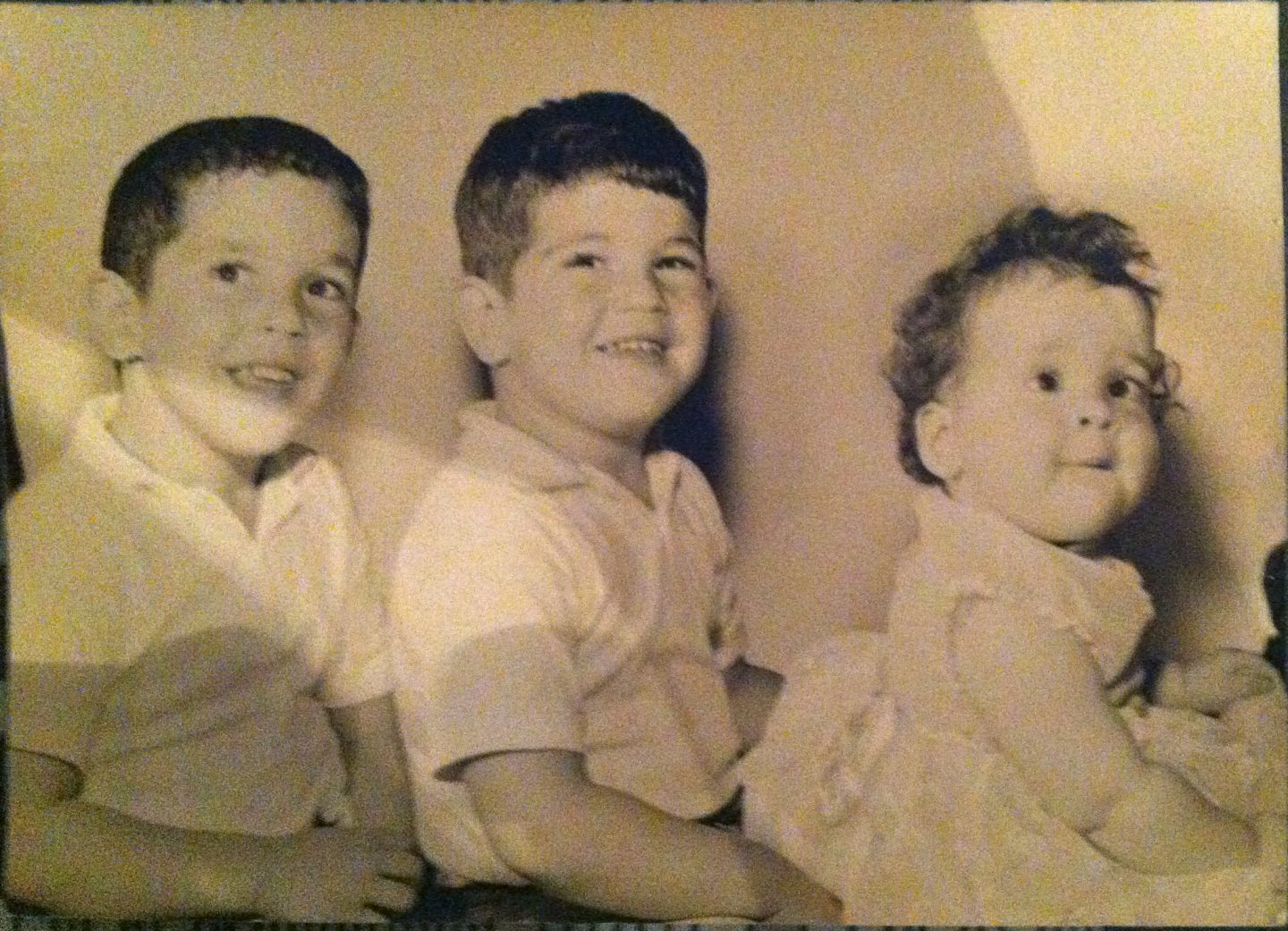
Note: Today is Leah’s birthday. It is funny how Dan, Gary and Leah all have their birthdays on the same day of the week – this year it falls on a Monday – blog day! So, as has been my custom with Daniel and Gary, I dedicate this post to Leah. It is particularly appropriate because though the rest of my family has been supportive of this endeavor, Leah has been my biggest cheerleader and frequent editor. Her comments are always incisive and helpful. More than any of that, though, she is an inspiration to me. I admire her willingness to put herself out there by sharing her songs and expressing her creativity. It only took me until I was in my fifties, but she was a trailblazer for me J. So, Leah, happy birthday! I love you hugely! I wish you love, health, peace and wonderful adventures – and everything you want for yourself, too.
Today’s blog post is my 52nd! A year goes by fast! Well, technically I skipped one week, but still, I think it is a good time to take stock.
First, some numbers. The blog has had over 6000 views and it has had 2,250 visitors. Believe it or not, there have been 50 views from Germany, 10 from Italy, even 3 from China (and some other countries, too)! WordPress provides these stats. I have no idea how to interpret them. Clearly my Mom has visited the blog many times, but not from Germany! I’m not sure how the system tallies these things. I’ve also had well over 100 comments on the blog itself, not counting what has appeared on Facebook, or what was conveyed to me personally.
Despite not knowing how to make sense of the numbers, or how to compare them to any standard or expectation, I am just pleased to have readers! I started this blog to share memories and start some conversations and I think it has been successful. Without you, dear readers, it would not have been possible.
The blog has also had some unintended consequences. One of the reasons I entitled it “Stories I Tell Myself,” was that I believed each of us has a narrative that we use to describe the events of our lives. I think we have experiences and we interpret them so that they fit into the way we understand ourselves and the world around us. For example, to simplify the idea, if a person thinks of themselves as a victim, then they might look for how a set of circumstances reinforces that belief. I think we can trap ourselves in our own narrative.
In my case, I thought of myself as an unhappy child who felt insecure. I felt like I never got the love and attention I wanted. That perception shaped my life in important ways. It has been an effort to move beyond that – an effort that fortunately became more successful the older I got.
Writing these stories, and then editing and rereading them, and receiving comments has been a revelation. In digging through my past, I found so much love and warmth. I think while I was living through it, I didn’t absorb it – I didn’t feel it. I can’t explain that. I think I was more focused on the painful or disappointing parts. But, as I wrote and as I uncovered more memories, I couldn’t help but notice the love that was the foundation.
As is often the case for me, a song lyric comes to mind. Jackson Browne (once again) wrote, in Fountain of Sorrow, “And while the future’s there for anyone to change, still you know it seems, it would be easier sometimes to change the past.” While I haven’t changed the past, and I wouldn’t describe the blogging process as easy, I think I have changed how I feel about the past.
I think the idea of ‘stories we tell ourselves’ is valid, even if, upon closer scrutiny, mine was a little off. Maybe that is the whole point. To discover whether the story is true! Not everyone would choose to examine their own stories in a public blog, but I think it has been helpful to get feedback. When people comment, for example, that the stories about my Nana and Zada make them feel warm and safe, it helps me process and amplify my own feelings.
Writing the stories was also useful. Describing the images in my head helped to clarify them. Having to choose adjectives to express an emotion, or paint a picture of Nana’s kitchen forced me to think more deeply about the memory and its meaning.
I don’t think I am done yet. I think there is more to uncover about growing up in Brooklyn in that time with my family. I think, too, there is more to explore about the beginning of my relationship with Gary, our early marriage and starting a family. I hope you will continue to share my journey and, perhaps, share some of yours. I have very much appreciated when Gary and Leah offered their own stories (and judging by the comments, readers have enjoyed their posts, too). Others are welcome to do that in the comments or in a guest blog piece.
I think it is helpful to examine our stories, our memories; expose them to the light of day. You may be surprised at what you find. I hope I continue to surprise myself.
Music is so powerful in evoking emotions. During a recent visit, my Mom and Aunt Diane were recalling times when a piece of music brought tears to their eyes. Not tears of sadness, but tears inspired by the beauty of the sound. Aunt Diane recalled a time when she was driving home from work, on the FDR Drive, when she pulled her car over to listen without distraction. They were talking about classical music, identifying particular works of Bach and Beethoven that triggered the tears.
I have had occasions, especially with a live performance, where I have gotten shivers down my spine and my scalp prickled upon hearing something that touched my soul. Most often, for me, I’ve had that happen when voices harmonize and I feel uplifted. But even when I don’t have that physical reaction, I almost always have a response to music.
As a teenager and young adult music was central to my life. I think many people share that experience during that time of their life. Perhaps there are those for whom that isn’t true – my brother Mark comes to mind, but I think, not surprisingly, he may be the exception rather than the rule.
In high school, I have vivid memories of putting an album on my turntable, in my room the size of a closet, lying on my bed, and letting the music take me away. I didn’t do anything while I listened. Occasionally I may have read or done homework, but mostly I just listened…to Simon and Garfunkel, Seals and Crofts, Carole King, James Taylor. I put on my headphones, turned up the volume so that my head was filled with their voices, their melodies, their poetry.
The combination of the music and the lyrics in songs like Fire and Rain, The Boxer, Only Living Boy in New York, America validated my own feelings of alienation, loss and sadness. Sometimes it felt good to wallow around in my loneliness – I may have overdone that a bit as a teenager. But, the music could be hopeful or soothing, too. You’ve Got a Friend, Beautiful and Bridge Over Troubled Water reminded me that I did have connections, there was another way to look at the world.
Somewhere along the line I stopped doing that – just listening. Of course, life intrudes, especially when you work and have a family. But, I waste plenty of time – there could be time to do it. Concentrating fully on music, other than when I am in the car or at a concert, is just not something I consider doing anymore.
Music was a significant part of bonding with other people, too. We took it quite seriously. I remember going to my friend Cindy’s house (not the Cindy I played hooky with in elementary school, for those of you keeping track) to hang out. We weren’t long out of high school. She put on Turnstiles (Billy Joel) – a newly released album at the time. As she was setting it up on the turntable she turned to me and said, “Let’s not talk during it, ok?” I nodded in agreement. “And, I hope you don’t mind if I sing along to some of the songs, I really love James.” Cindy had already listened to the album many times over. It was still new to me. I was fine with her singing, she had a good voice. If we wanted to discuss a song, she paused the record so we could talk – we wouldn’t think of talking over it. This was one of many times that I bonded with someone over the shared experience of listening to an album.
At college, especially freshmen year, this shared ritual was an important part of establishing friendships. Merle introduced me to Jackson Browne and Dan Fogelberg. I remember sitting on her bed in her dorm room, we weren’t roommates yet, and she handed me the album Late for the Sky. “You have to listen to this,” she said. The evocative photograph on the cover, a solitary old car parked in front of a house as a day draws to a close with a still bright blue sky with fluffy white clouds, set the stage for the intense, searching songs that followed. We sat together and listened, cementing our friendship and a shared love of Jackson Browne. The same thing happened with Fogelberg’s Home Free. I heard the first notes of To the Morning and knew it was special to me. We eagerly awaited the release of their new albums, hoping one of us had the money to buy it.
Alison introduced me to Joni Mitchell. Aside from listening to Ladies of the Canyon, Alison played the guitar and we sang the songs. Again, a bond was formed that has withstood the test of time.
Music had another role in that time and place (the mid ‘70s). It was often used as a complement to getting high. I managed to make it through high school without trying pot. At times, I felt literally alone in that status. In college, I decided to relax my rules a bit and experiment (thank you, Merle, for getting me to loosen up!). One friend, Rob, fashioned himself as a kind of pied piper for those getting high for the first time. He liked introducing people to weed and I was one of his subjects. I went to his dorm room, where he had created an appropriately mellow environment with low lighting and wall hangings. He put on the Beatles’ Magical Mystery Tour and we rolled up. I admit it was kind of pleasant and relaxing. I remember walking back to my dorm in the dark and feeling like I was watching a movie where I could see the campus scenery as frames of film. Fortunately, it didn’t freak me out, I just took it all in. Although it was a positive introduction, I never fully embraced getting high. It was fine now and again, but not something I wanted to do regularly. I wonder if my feelings about pot relate to my failure to embrace the Grateful Dead, though that may be a ‘chicken or egg’ thing. Did I not like the Dead because I didn’t love getting high? Or, was it that I didn’t love getting high and therefore didn’t love the Dead? Either way, it wasn’t my scene.
Music was also an important part of my relationship with Gary. In our first year together we spent time listening to each other’s favorite albums. I had heard Bruce Springsteen before, but I didn’t fully appreciate his artistry until I listened to it with Gary. Our taste in music overlapped quite a bit, but Gary tended to like a grittier sound. I was drawn to prettier, more melodic songs. I remember playing James Taylor’s You Can Close Your Eyes for him, expecting him to be similarly moved. Gary said something disparaging about it. I’ve blocked out what he said – but he made fun of it. I nearly broke up with him right then and there! His dismissive attitude cut me to the quick. We had a real fight (maybe our first?). We had to learn to respect each other’s taste in music – this was serious business. Clearly, we figured it out or we wouldn’t be here almost 38 years later (34 married).
There is one thing that remains different about Gary and me and our attitude toward music. Gary is happy to listen only to music from before 1980 – unless it is Springsteen or Jackson Browne. He listens to their new music. If something that sounds remotely like rap comes on the radio, he immediately changes the station or turns it off. I, on the other hand, like to hear new things, new musicians. While I’m not particularly interested in Top 40 or hip-hop, I do like trying out new artists. I listen to an alternative radio station. I’m still drawn to singer-songwriters, but I’m open to hearing new people. I listen to my old favorites, too, but I’m curious about new stuff.
As I write this and reflect on what music has meant to me, I have made a decision: I want to devote more time to listening, without distraction. Maybe I’ll borrow a page from my teenage self: Put on a CD, lay on my bed and let the music envelop me.
After I retired I took a writing workshop that was an awesome experience. I have written before about how liberating that class was for me. One of the assignments we were given was to write a poem in response to another work of art – a poem, a painting, song lyrics – whatever inspired us. I wrote a poem in response to “Down to You,” by Joni Mitchell. For those who aren’t familiar with it, or if you don’t remember the lyrics, here they are:
Everything comes and goes
Marked by lovers and styles of clothes
Things that you held high
And told yourself were true
Lost or changing as the days come down to you
Down to you
Constant stranger
You’re a kind person
You’re a cold person too
It’s down to you
You go down to the pick up station
Craving warmth and beauty
You settle for less than fascination
A few drinks later you’re not so choosy
When the closing lights strip off the shadows
On this strange new flesh you’ve found
Clutching the night to you like a fig leaf
You hurry
To the blackness
And the blankets
To lay down an impression
And your loneliness
In the morning there are lovers in the street
They look so high
You brush against a stranger
And you both apologize
Old friends seem indifferent
You must have brought that on
Old bonds have broken down
Love is gone
Ooh, love is gone
Written on your spirit this sad song
Love is gone
Everything comes and goes
Pleasure moves on too early
And trouble leaves too slow
Just when you’re thinking
You’ve finally got it made
Bad news comes knocking
At your garden gate
Knocking for you
Constant stranger
You’re a brute, you’re an angel
You can crawl, you can fly too
It’s down to you
It all comes down to you
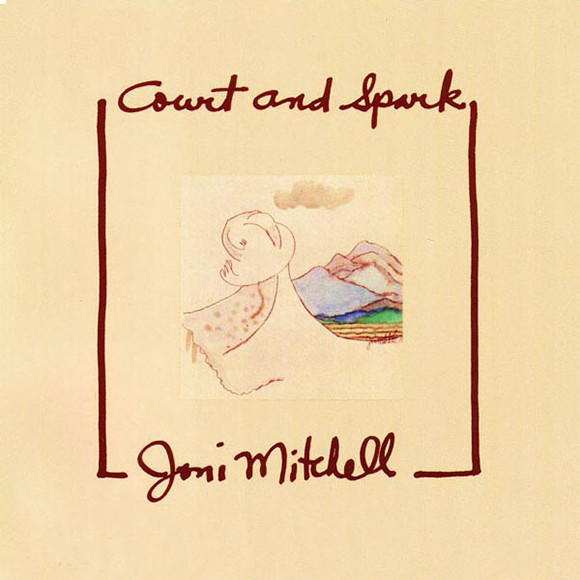
Joni Mitchell from the album Court and Spark, 1974
I must have listened to that song, among many other Joni songs, hundreds of times during my college years. She was a mainstay of the soundtrack of that time in my life. This is the poem (or prose-poem) that I wrote after reflecting on that song:
Binghamton, 1977
It is a Binghamton kind of night.
The air so cold it hurts.
The sky is clear, pinpricks of light shine against the velvet blackness.
I am in exile.
My roommate’s boyfriend is visiting.
I will spend the weekend studiously avoiding my dorm room.
I am holding my pillow pressed against my chest, my knapsack on my back.
Waiting til 8:00 pm when I will meet a friend at her dorm room
where I will crash for the next two nights.
So, I wonder, where is the ‘pick up station’ that Joni sings about?
I have never found it.
Wouldn’t know how to work it, if I did.
She counts lovers like railroad cars.
I’ve had none.
But, I would like to lay down my loneliness.
I don’t think her way will work for me, though.
Can’t imagine picking up a stranger and feeling less alone.
Joni is right about one thing, though.
Pleasure moves on too early and trouble leaves too slow.
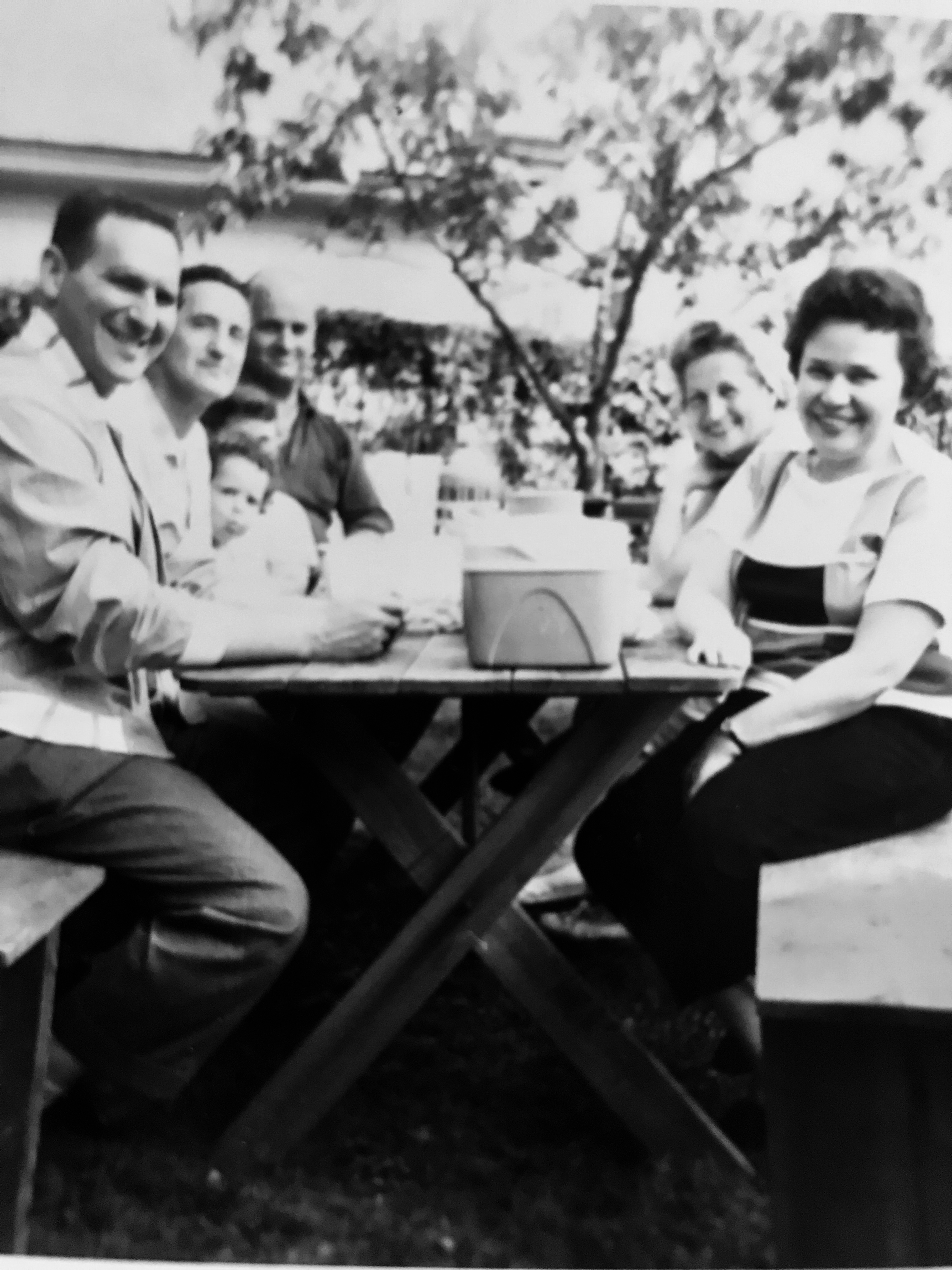
From left to right: Uncle Jackie, Uncle Morris, me, the top of my brother Mark’s head, Dad, Nana and Aunt Elsie. Jack, Morris and Nana were siblings. Aunt Sadie, their oldest sister, is not pictured. Aunt Elsie was Uncle Jack’s wife.
As a child your family is your world. At least it was for me. I didn’t question how we did things or how our family functioned. While I knew we weren’t perfect, I thought we were pretty darn close.
As the years went by, I came to understand that the people around me were in fact flawed. Even my beloved Nana. Nana was a mythic figure in our family. Her legendary status only grew after her death.
I have wanted to write about Nana for as long as I could remember. I started this blog as a way of exploring my memories of her, though I have strayed from that at times. I think I wanted to understand her better, to have a better sense of her life, from an adult perspective. I was 11 when she died, but she played such a central role in my life – from the time I was four until she died, I probably spent more time with her than my own mother. With that in mind, I wrote to her youngest brother, my Great-Uncle Jackie (Jacob, but we called him Jackie or Jack), in December of 2001, asking him to share stories about her. This was the first letter I received in response.
January 2002 Dear Linda,
Life on Rochester Ave was a most unique experience. Unlike anything else, it was a lesson in humanities, and your Nana was the ultimate professor.
The one block on Rochester Ave was a community in itself, it was a shtetl, an almost self contained mini state, which thrived for many, many years.
Nana was the leader of the pack. She could have been mayor of the block.
Her warmth and friendship was infectious.
It was not a put on. It was real. She exuded this very unusual human quality automatically – without effort, without exertion.
The block could have had a fence around it. The business establishments and owners were like a family in every sense of the word. It was a “mutual admiration society,” knowing each other, respecting each other, liking and supporting each other.
Quoting, with humility, Tevya proclaims that Anatevka (Rochester Ave) has its variety of ‘colorful characters.’
There was Max, the fruit and produce man next door to the bakery – there was Al the barber – there was Sam the butcher across the street – there was Julius the appetizing maven, Datz the pharmacist, Singer the hardware man – and two names that elude me, the luncheonette guy and the pastrami (king) on the corner.
Your Nana loved this kaleidoscope of rainbow hued people – and they loved her. This was most important!!!
It was a violation of every concept of law not to support each other, purchase from each other, or maintain a warm relationship with each other.
Bakery business is a complex business. A wholesale/retail operation is a 24 hour business.
Zada Chas., of course, was responsible for the production end.
Nana Ray was totally involved in the retail aspect of this very difficult business. Coming in contact with the immediate neighborhood customers required the patience of a saint – the wisdom of a scholar – the compassion of a person of the cloth – the wit of a comic.
Well, Linda, your Nana was all of those things and more.
She constantly transmitted a warmth and friendship to all.
Please be assured Nana was no saint – she was just a very special human being.
It was very obvious through the years that your Nana loved the business and loved the intimacy of her station behind the counter.
She was on call every minute the store was open, at a moment’s call, always in her uniform, ready to report for duty.
But – she seemed to love the thought of the sweets on display. If memory serves, she was ‘almost’ obsessed with eclairs, whip cream cake, brownies, Napoleons, etc., etc. That was bad – very bad. Your Nana was a diabetic – an out of control diabetic. She was in and out of the hospital more times than I can remember. I could almost swear that she liked the occasional stay in Unity Hospital, where she developed friendships with the medical personnel.
She was a star, a favorite Unity visitor.
Nana did not accept the fact that she could be a diabetic. She did not care for herself and, at the end, it may have contributed somewhat to her demise at such a young age.
Nana Ray was a joy to love, live with and is constantly missed.
Love, Uncle Jack
Fifteen years ago, when I received that letter, I have to admit I was a little disappointed. I had been hoping for more detail, more specific information about her life. The letter reinforced the mythology of Nana. In our family Nana was the matriarch, the center from which love flowed, even 30 years after her death. Uncle Jack noted that Nana wasn’t a saint, but he chose not to illuminate her flaws. He did address her self-destructive eating habits, and unwillingness to take care of herself. Even about that he was as gentle as possible in his wording. At the time I was hoping Uncle Jack could offer some stories that would provide more dimension, or a fuller perspective on Nana.
Today I read the letter and I see the insight in it. I appreciate the description of the community around the bakery, the community that encompassed Nana’s life. I better understand how difficult the bakery bankruptcy must have been and the defeat inherent in moving to the apartment above ours in Canarsie. It explains a lot about the sometimes testy relationship that I observed between Nana and Zada.
My mother used to tell me that she thought Nana used her hospitalizations as a kind of vacation, to take a break from her responsibilities. Uncle Jack’s letter seems to support that, though clearly it was a self-destructive way to go about it.
In some ways, the letter says more about Uncle Jack’s relationship with his older sister than it does about Nana’s life. He so loved and admired her. He was 11 years her junior. Jack had a very painful growing up. Their mother died when he was very young and his father was unable to care for him. Jack was shuttled to different relatives to live. When Nana (Ray) was married and settled, she took him in. The 1940 census, when Nana and Zada lived in Jersey City, lists their household on Essex Street as including the following: Charles – age 35, Ray – age 26, Feige – age 7, Simma – age 3 and Jack Woltz – age 15. My mother grew up with Uncle Jack as an older brother, much the way I grew up with Uncle Mike and Uncle Terry. It is strange how that pattern repeated itself.
During World War II Uncle Jack enlisted in the Marines before he was even 17, or he tried to. I believe Nana had to give permission for him to serve. In later years he spoke with great respect and pride about his time in the service, despite the fact that he was shot down in the Pacific, a harrowing experience. He had a tattoo to commemorate his time in the Marines on his bicep, quite an unusual thing for a Jewish man at the time.
While at war he wrote letters to his nieces (my mom and her sister) that included cartoons. He was a talented artist. Those letters were shared at Mom’s elementary school and posted on a bulletin board for all to see. Uncle Jack came home, after recovering from his wounds at Walter Reed, a decorated hero, a bit shell shocked, but happy to return home.
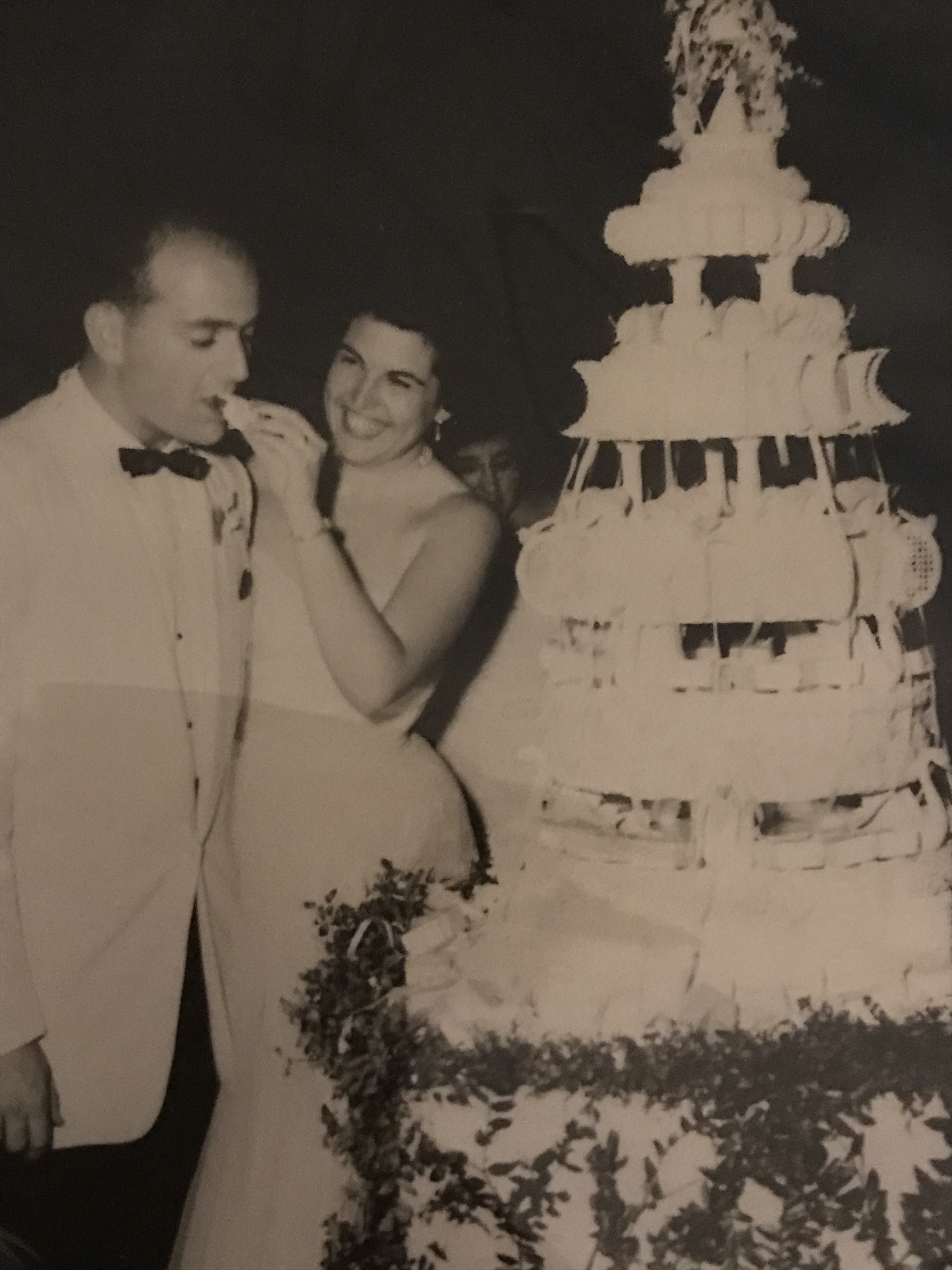
Mom and Dad’s wedding in 1954 – the cake was made by Uncle Jackie. Nana and Zada sent Uncle Jack to school for cake decorating and he was a master. This cake was just one example of his artistry.
I think it is fair to say that Nana functioned as a mother to him. Something he confirmed in a subsequent letter. As he wrote, referring to his place in Nana and Zada’s home, “As for me personally, it meant for the first time in my life I felt that I had a family, that I was a valued member of a family, a stability with shared love and responsibility. This responsibility came to pass only by the goodness of Nana Ray and Zada Chas, who were more than sister or brother-in-law – more like an interim Mother and Father, with the children more like brothers and sisters.”
I continued my correspondence with Uncle Jackie and in subsequent letters, at my prodding, he offered a fuller picture of Nana. Here is most of the next letter:
April 2002 Dear Linda,
…..Nana Ray had this thing for hosting parties. She invented the term for Webster, and they called it——obsession.
The family was always the center, the core of any party that was planned to her agenda. I’m emphatically stating that at times, it did annoy the Spilken/Woltz clans – but our rebellion was unacceptable and hopeless. Any previous plans made by the helpless had to be cancelled and rescheduled.
There were small parties, large parties, grand elaborate parties, significant and memorable parties never to be forgotten……
Listing Nana’s obsession with parties, and listing occasions would require one volume of an encyclopedia.
But briefly: birthdays, anniversaries, engagements, B’nai Mitzvot, weddings, uf rufs, going into service, coming home from service (a reunion that made Aunt Elsie your aunt), Christmas, Chanukah, New Years, and the list goes on and on and on and on….
This was your Nana. She was a class act, her most important cast members were her family. There didn’t exist an occasion too minor or too important for it to escape the opportunity for Ray to honor.
Before going further, I must inject a couple of relationship points. Ray’s relationship to her (our) sister Sadie was, at times, confrontational and argumentative. But, make no mistake, the love was strong, unbreakable and absolutely devoted. That was Nana Ray, 100% pure love. They spoke almost daily by phone. If Sadie could not come to the party, we took the party to Jersey. Restrictions on time of day or day of week never existed. Zada’s car was loaded and we did travel.
The fun was wonderful……
Aunt Say always disagreed with Ray’s way of life. Aunt Say always felt that Ray enjoyed going out too much (and as such), neglected her business. She argued that Ray’s spending on her antiques was excessive and wasteful. Say felt that vacationing was excessive, and most of all, Ray did not take care of herself (reckless food eating). Sadie was even more angry at Ray for too frequent hospital excursions.
They were both business women. Ray always felt that Sadie was more like the country bumpkin, catalogue ordering farm girl. Sadie was more home oriented, financially frugal, never concerned with fancy clothing, jewelry or home furnishings.
In spite of the silly differences, they were both hard working in their businesses, while caring for their children.
But again, our journeys to Jersey were precious and priceless. We were a family, happy to be together, enjoying the time.
Another relationship worthy of mention is the closeness shared by Nana and Aunt Elsie. This was very unusual, far beyond a sister-in-law relationship, they shared a love, respect and closeness that was out of the ordinary. They shared ideas, thoughts, and were closer than sisters.
Zada Chas and Elsie’s parents shared that same feeling of warmth, love and affection.
My love to you ——-Uncle Jack
The differences between the sisters that the letter describes and what those differences revealed about each of them, was news to me. I was not aware of any issues between the siblings. While it may be true that a child may not be privy to those particulars, my experience with my family was a bit different. I was often the proverbial fly on the wall. I liked the company of adults and I liked listening. In any event, while it is certainly possible, I don’t think the tensions were spoken about.
Therein lies a problem. In our effort to preserve a reputation, especially that of a beloved person, we may sweep a lot under the rug. I don’t think it serves us well. While I don’t think it is helpful to tear down heroes, or speak ill of the dead, I think if we ignore or whitewash their failings, we deprive ourselves of an opportunity to better understand the person, to learn about ourselves, to acknowledge human frailty and, perhaps, to be more forgiving of each other and ourselves.
These letters, more than anything, though, remind me of the lessons I took from Nana’s life: To celebrate when you can. The priority and value of family relationships, even when the people are flawed. To live in the world with kindness, generosity and love. Whatever flaws Nana had, and they may well have shortened her life, they pale in comparison to her legacy.
Note: Members of the Woltz family, please feel free to comment, correct or add to this post. If any of you would like to write a longer piece, I’d be happy to post it. That offer extends to all family members who may have something that they would like to share.
Sorry that I was not able to post my weekly essay today, but hopefully you will understand. Gary and I were in Spain this past week (!) and I had no time to write and little access to the internet. Vacations are wonderful! We took a whirlwind tour that included Barcelona, Granada, Cordoba, Ronda, Seville and Madrid – fascinating and beautiful places all.
Now if I can just figure out what day and time it is, I will be back next week with more stories. Thanks for staying with me!
Note: Today is Gary’s birthday. In this blog post I highlight one of the many times he came through for me. He remains one of my heroes. Happy Birthday, my love!
I have written before about problems with my eyes (here). That entry recalled the semi-successful attempts to correct my strabismus (crossed eyes) when I was very young. It took two surgeries to improve the alignment of my eyes, but it was not the end of the story for me and eye surgery, not by a long shot.
I graduated from SUNY-Binghamton in May of 1980, at age 20, and went straight into a master’s program in public administration and policy at Columbia University. The first day of the semester there was a meet and greet session. There were about 25 students in the program. We sat in a large circle and went round giving our names and undergraduate background. Several people introduced themselves and said, “I went to the The College.” I was baffled. I looked around for clues. I couldn’t tell if others were as perplexed. I’m not sure how it was revealed, I’m pretty sure I didn’t ask, but somehow I learned that “The College’ referred to Columbia. Okay, message received. I was intimidated.
Some public administration programs are designed to accommodate part-time students, with classes offered in the evening. Columbia’s was not. It was a full-time, two-year program that was demanding. I started experiencing a lot of migraines as that first semester unfolded and the stress mounted. To rule out a change in my eyesight as a cause of the headaches, I saw an ophthalmologist. Unrelated to the headaches, the doctor found that I had ‘lattice’ of both retinas. Lattice, it was explained, was a thinning and weakness of the retina. At that time the recommendation was to have a surgical procedure where they froze the retinas to keep them from tearing. This finding was revealed in mid November. The doctor told me I could wait until the December break for the procedure.
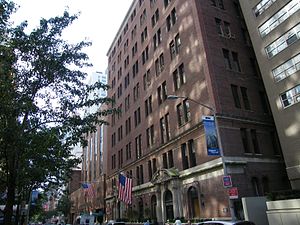
While I had some anxiety, I got through the remainder of the semester and completed my classes. The appointed day for surgery arrived and my parents took me from our house in Canarsie at the crack of dawn to Manhattan Eye and Ear Hospital on East 64th Street. I was used to coming to the upper east side for eye care, but the old red brick hospital looked menacing in the dim morning light and my memories of the nausea caused by anesthesia the last time I had eye surgery heightened my nervousness.
The hospital may not look menacing in this picture, but it was to me!
We did the necessary paperwork and I was prepped for the surgery. Next thing I knew, I awoke with my eyes bandaged. I heard voices by my bedside. I felt someone touch my foot. “Hey, it’s Steve,” I recognized my brother’s voice. “How ya doing?” he asked. “I think I’m okay.” I managed to croak out some sound, my throat was quite raw. “Just wanted to say hi and tell you to feel better,” he said.
My Mom and Aunt Clair were there, too. They explained that my Dad, after the surgery had been successfully completed, went out to get some air. He was so relieved it was done, he was overcome with emotion and needed to take a walk. My father never did well with hospitals. Ever since visiting his mom after her neck surgery when he was a young man, he would breakout in a cold sweat whenever he went to a hospital.
It was odd waking up and having both eyes covered. As I emerged from the cloud of anesthesia, a wave of intense nausea swept over me. Damn that anesthesia! The nurse gave me ice chips, which helped. Gradually I started to feel better.
A friend from graduate school, Sally, stopped by to visit later that afternoon. She had no expectation that my eyes would be bandaged. Although I could not see her, I sensed her discomfort. I tried to make small talk. We chatted for a few minutes; I made some kind of joke about getting pity points on our next test. Each visitor stayed briefly, except for my Mom and Aunt Clair who were there for the duration that first day.
I was moved to a semi-private room. There was a woman, Marcia, recovering from a detached retina, in the bed next to mine. She was a Manhattanite and quite a bit older than me. I had a lot of visitors. Marcia did not. When another uncle or aunt came to visit me, Mom and Clair would move over and visit with Marcia. They offered to share the grapes and chocolates that they brought for me.
After spending that first day completely bandaged, I was given pinhole glasses to use for mealtime. The glasses were thick black plastic with just a small dot of an opening, where the pupil of the eye would be, so I could see what was directly in front of me. Other than when I ate, both eyes remained covered. I think the idea was to minimize the movement of my eyes so the retinas could heal. I had to turn my head to see anything other than what was straight ahead of me. After I finished eating, back to the darkness.
At the time of the surgery, Gary and I had been together for just over a year. He was working at a lab at Columbia Presbyterian at 168th Street on the west side of Manhattan while I was attending graduate school. Each day after work, he came to the hospital to visit. Clair and my mother would go get some coffee or visit with Marcia when he came.
The first time he visited Gary brought me a fragrant rose that sat in a vase on the nightstand next to the bed. Although I couldn’t see the flower, I could surely smell it. There seemed to be some truth to the notion that your other senses sharpen when one of them is compromised. The second time he visited he brought two cassette tapes and a portable cassette player with headphones. He taped two of my favorite albums, Dan Fogelberg’s Homefree and Beethoven’s 6th Symphony– the Pastoral. Such great choices! Not that I had any doubts, but a person shows who they are when a challenge is faced, like my surgery, and Gary showed himself to be incredibly thoughtful.
One night after everyone had left, Marcia was angry. “You are really inconsiderate!” she rumbled. At first I didn’t realize she was speaking to me. She continued, ranting, “There isn’t a moment of peace. I’m fed up with the noise and hub bub. Your visitors are so loud!” I apologized and said we would be more thoughtful, but I hadn’t realized we were being disruptive. She railed on at me.
Lying there, in effect blind, I was frightened. I don’t remember exactly what she said, but I felt threatened. I groped for the phone on the nightstand and feeling for the buttons, I called my parents. They picked up immediately and I whispered into the phone that I was scared and explained what had happened. They said they would call the hospital to see what could be done.
I hung up and tried to relax. Marcia had quieted down by that time, but I was still anxious. A little later my phone rang and my dad explained that my room would be changed first thing in the morning. He was disappointed that it couldn’t be done right then, but they told him it just wasn’t possible. Aunt Clair, who lived in Greenwich Village, would come up to the hospital in the morning to make sure everything went as planned.
My doctor rounded very early in the morning, before 6 a.m. There’s nothing like being awoken to bandages being removed, your eyelids pried opened and a penlight flashed in your eyes. That morning the doctor and two other hospital staff members arrived at the usual early hour, along with Aunt Clair, to examine and then move me.
Aunt Clair was not an early riser; if left to her own devices she was a true night owl. She set a series of alarm clocks to get up for work, and sometimes she still slept through them. There were many times when she and my mom sat up talking late into the night in the living room of our Canarsie house and rather than go home, Aunt Clair would sleep on that same couch. In the morning I could rattle around in the kitchen and take my breakfast with no fear of waking her up. Even though she lived in Manhattan, not that far from the hospital, it was quite an imposition for her to get to the hospital before 6 in the morning. But there she was.
Aunt Clair gathered my things, including my rose and cassette player, and followed us to the new room. This one was a single. They got me settled and I went back to sleep.
I was in the hospital one final day. My eyes were no longer bandaged. The following morning Dad picked me up to take me home. I was given eye drops and instructions about symptoms to look for that would indicate a problem. Dad drove me home and I got into my parent’s bed and put on the TV. Dad went back to work. I would be home alone for at least three hours until my mom returned from work. I tried to find something mindless to watch.
I felt strange, oddly unbalanced and queasy. I didn’t know what to expect, but I didn’t realize that being in bed with my eyes covered for four days would leave me feeling weak and disoriented.
As I tried to concentrate on the TV, I had some brief flashes of light and in the corner of my field of vision things looked wavy, like seeing through a puddle. Then it went away. I wondered if I imagined it. I wasn’t sure if these were the symptoms I was supposed to be concerned about. The flashes and the visual distortion came and went very quickly. I waited a while and when it recurred a couple of times, I called the doctor’s office. I described what was happening and they told me it sounded normal, as long as the flashes and visual changes didn’t persist. I was relieved when my mom got home. Fortunately, the rest of the healing went uneventfully.
I learned some things from this surgical experience. First, and most important, when I needed help, my family and Gary could be counted on. I would always want them in my foxhole. Marcia was not so fortunate, she appeared to be alone in hers.
I also gained a greater appreciation for my eyesight. I have always loved the beauty in the world – man-made or natural – but now it was heightened. I didn’t want to miss seeing the Grand Canyon or the Alps or the great cities of Europe, or the ordinary things like the sunlight on a forsythia bush in early spring. I felt an urgency to make sure I didn’t take my vision for granted. I carry that lesson with me still.
Note: It took a little persuading, but Leah agreed to write a blog post! Here’s her take on our recent road trip. Thank you, Leah!
My mom’s is decisively the best memory for (auto)biographical details. I think I have a reasonable memory, but generally for numbers. For instance, on our recent road trip, my mom and I stayed in room 211 in Rapid City, SD, and 218 in Rochester, MN. 222 in South Bend, IN. I share that mostly to illustrate that if you want qualitative details, she’s your gal, not me. But, she’s asked me to provide some thoughts on our recent trip, and after enough reverse psychology (“I know you won’t write anything,” she said multiple times), I finally assented.
Though my mom and I technically had the same experiences during the road trip – we stopped at the same locations, ate at the same restaurants – it represented very different things. She was on a road trip, while I was closing one chapter of my life and heading into the great unknown of a new one. And in that sense, for me, the road trip began in September 2016. That was when I started looking seriously for jobs. It really got serious when I thought I was going to leave Seattle at the end of January, though I actually stayed, in limbo, until the end of March. At that point, I tetris-ed* my belongings into the car, and said my goodbyes. (*I’m using tetris as a verb here because I think using a word like “pack” would not do justice to the monumental effort it took to get everything into the car, with room for two passengers and my mom’s bags, too.)
The morning we left, it was rainy and grey. I said a last, highly emotional goodbye, and drove to pick up my mom from her hotel, trying to hold it together. Honestly, the most contentious moment of the trip probably happened within the first two minutes when my mom chirped “Bye Seattle!!” I quickly replied, “If you want me not to be sobbing while driving, then how about we not say any more goodbyes?” She agreed, and I actually pleasantly surprised myself – there was no sobbing for the rest of the trip. That alone could constitute a victory!
Our first day we made great time, stopping for a light lunch in Spokane, crossing into Montana, grabbing an iced tea at a recommended café in Missoula, and finally coming to rest in Butte. Rest was about all Butte was good for, best I could tell, and I was pleased to hightail it out of town early the next morning. That next day, Montana’s big sky greeted us as Springsteen sang us eastward. We crisscrossed mountains and valleys, relishing the meandering streams and rocky crags we passed. The burgers we had for lunch in Billings got top marks, and they literally fueled us as we headed slightly south. In Wyoming, I had never seen so much nothingness. Well, not nothingness, but no sign of humans, that’s for sure. Rolling hills with snow-capped mountains in the distance made for a pretty landscape, but it was so isolated. We were also highly amused by a weather front while in Wyoming, which is not something I ever thought I’d say. It was clearly raining a bit in front of us, but the scale of the land made us completely unable to identify where the rain was. We kept saying, “I think we’ll be in it when we crest this next hill” or “I think the rain is coming down on that ridge.” We were wrong so many times! Though we did ultimately hit the rain, it was amusingly disorienting to be so thrown off by the scale of the landscape and sky.
Ultimately, we ended that second day by winding our way through the Black Hills of South Dakota to visit Mount Rushmore. The Black Hills were unexpectedly stunning. While I was anticipating being wowed by Mount Rushmore (and I was), I did not realize that it was located in the midst of a Yosemite-eqsue landscape. Dark, granite spires with scattered evergreen trees shone in the glorious setting sunlight. It was a special time to be in the park as it was off-season and the end of the day, so we got to experience the monument with only a handful of other visitors. We spent the night in Rapid City, SD just outside the park, managing to avoid hitting the many, many deer we saw nibbling the grass on the side of the road. I attribute this successful avoidance of deer to my ongoing conversation with them: I just calmly and repeatedly told the deer, who definitely could not hear me, that I did not want to hit them and if they just stayed where they were we’d all be fine.
The next day – day 3 – we hit our first stretch of truly lousy weather. As we drove through the emptiest stretch of country I’ve ever seen, the rain, sky, land, and road spray all joined together in various shades of drab. It was like purgatory: everything was empty and sad, and you drove forever and never seemed to get anywhere. I swear when we hit the end of the rain around the time we crossed the Missouri River I couldn’t help but cheer. That day we saw the Corn Palace and the Jolly Green Giant, which were strange and welcome breaks from the driving, and ended the night with a delicious dinner and a restful night in Rochester, MN.
Day 4 I’d happily erase from my memory, aside from a delectable lunch in Madison, WI. Let’s just say that after hemming and hawing about how to best avoid traffic in the greater Chicago area, we went 70 miles out of our way to avoid said traffic, and ended up in a big ol’ traffic jam anyway. Plus rain. Plus truly boring scenery. Blerg. Getting to our hotel that night didn’t go exactly as planned, either. Instead of plugging in the address of our hotel, I managed to just plug in “South Bend.” When my GPS cheerily displayed “You have reached your destination!” we realized we were just at a random intersection at the exact center of South Bend. We had a good laugh about that. And ultimately, we were rewarded when we did get to the hotel because our room was incredibly swanky! It was entirely unexpected, but it had a gas fireplace, two bathrooms, and two king-sized beds. Needless to say, that was a highly welcome surprise after a rough day on the road.
Day 5 was a long but rewarding day. We initially planned to stay overnight in Buffalo, but we hit slightly better weather than expected, found a much better rest stop than expected, and with the Weather Master’s approval we decided to keep driving ‘til we finally made it home after a full 12 hours on the road. (To claify: I refer to my dad as the Weather Master.)
If you haven’t driven on I-90 through western New York to Albany, you might not know that the landscape changes around Utica. In truth, western New York is pretty boring to drive through, but about an hour outside of Albany you start to hit these beautiful hills and mountains. That stretch of the Thruway always reminds me of driving home from college. I never appreciated the Hudson Valley’s beauty when I lived in Albany, but that landscape always told me I was almost home.
In many ways, my road trip is still not over. I’m home, but I’m not home. In about a week, I will be headed to Boston, and two weeks after that I will start a new job. There are so many questions and possibilities for the future, and whatever comes next, I imagine that I will always be comforted and a little thrown off by coming home.
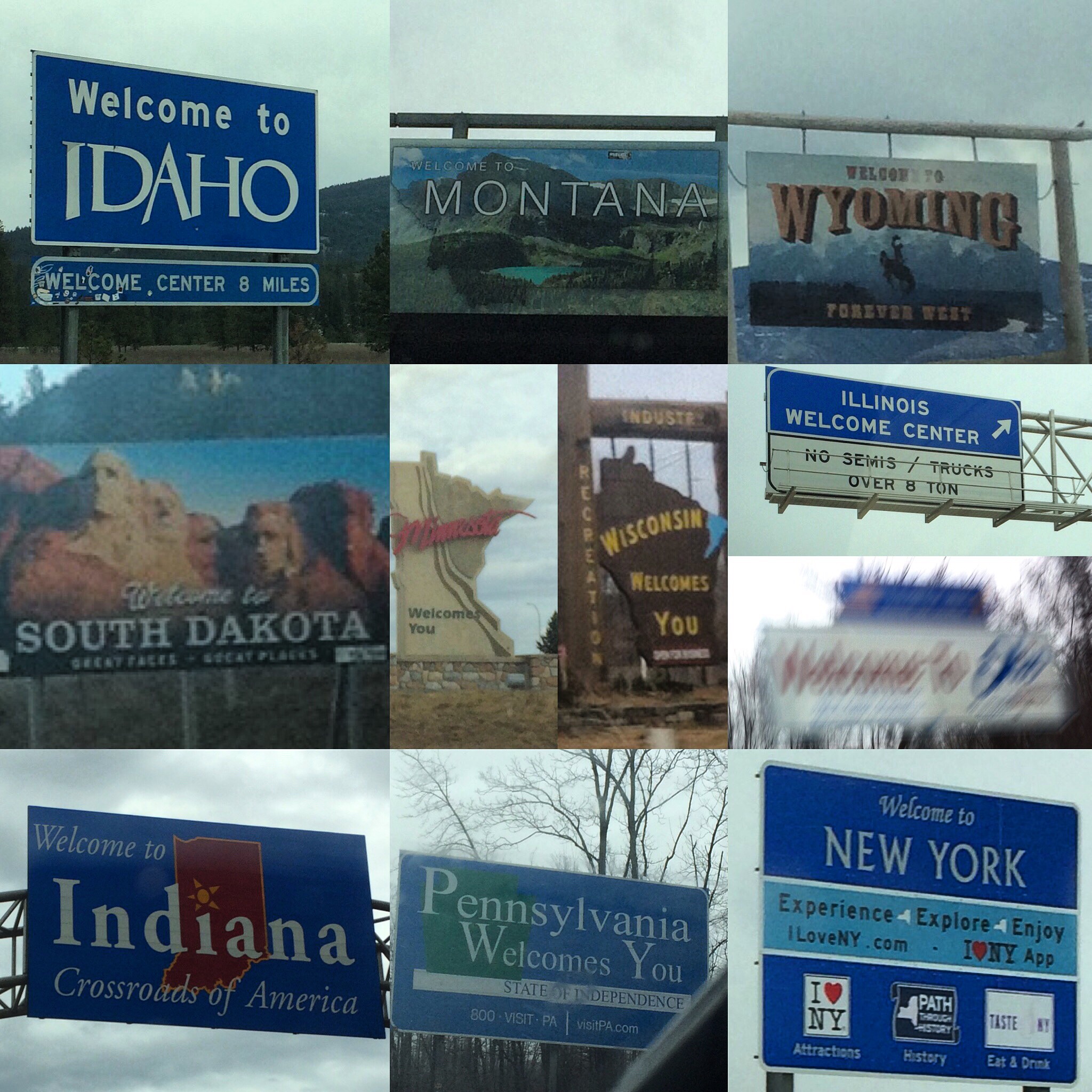
We captured the welcome signs to each state. The blurry one is of Ohio, if you couldn’t decipher it, taken by yours truly. Leah put the collage together.
Not everyone gets to drive cross-country with their daughter. I’ve gotten to do it twice! Leah went to graduate school at the University of Washington in Seattle. She began the program in September 2011. She drove the first part of that trip from Albany by herself, visiting friends along the way. I joined her in Minneapolis. The remaining journey went fine, but it was a tense time for Leah and the stress took its toll on us. While I have some fond memories, I’m not sure that either one of us would describe it as an enjoyable venture.
Now that she was done with her program and earned her PhD (I proudly think of her as Dr. Leah), we had a chance to do it again. After considering a number of options, from renting a U-Haul to hiring movers and flying, Leah decided to ship much of her stuff, sell or give away other things and pack up her Honda Civic with the rest and drive. Casting caution to the wind, I offered to share the driving and she welcomed the company. I flew out to Seattle.
I like road trips. Always have. Some people get antsy in the car. I don’t. Between music and scenery, I’m usually good. The only issue for me, as I get older, is that getting out of the car brings an unpleasant reality: after a couple of hours of sitting in a car my hips and lower back scream in protest when I climb out. But even with that, I still enjoy the trip.
I arrived in Seattle late on Saturday evening. We started out at 8:15 a.m. on Sunday in a light rain. Our arsenal for the trip included our smart phones, podcasts, audiobooks, music, a map of America, a triptik from AAA, a charger that could accommodate two USB connections (keeping phones charged was key!), patience and a sense of humor. Oh, some cash and credit cards helped, too.
Success in planning a cross-country trip depends on managing expectations and making sure your travel companion is on the same page. Leah and I agreed to take a middle ground where we would try to be efficient (cover a long distance each day) while taking a bit of time to enjoy ourselves. Not surprisingly, enjoying ourselves usually meant finding good food for lunch and dinner. We used Yelp and/or Google to find a good lunch spot in a town off the road. No McDonalds or Burger King at a rest area.
With the wonders of the World Wide Web available to us (cell service was pretty consistent), we found quirky cafes and burger joints. We had some excellent lunches. Only once did the apps fail us. The #2 rated place in Butte, Montana, for dinner, which was walking distance from our hotel, was a disappointment. The fact that it was a Mexican restaurant in a small casino should’ve been a clue, but we ignored that. Afterwards we agreed that Taco Bell probably would’ve been better.
That first night on the road in Butte, before turning in, we stopped at a Walgreens so I could pick up breathe-right strips. I don’t want to believe I snore, but Leah tells me otherwise and we were sharing a hotel room. Leah has trouble falling asleep under the best of circumstances, all we needed was for her to be kept awake by my snoring. I decided discretion was the better part of valor, swallowed my pride, and bought the strips. Why do we view snoring as a personal failing? Just wondering.
Other than the Three Amigos (yes, that was the name of the Mexican restaurant in Butte), we did quite well with our meals. If you’re ever in Billings, Montana, check out Burger Dive. It was a truly excellent, award winning burger (see picture below) and the restaurant itself was comfortable and decked out with funky, odd pieces, like a reclaimed Blockbuster video store sign. The service was friendly, too. Look at me becoming a restaurant critic! Leah and I returned to the road fortified and happy.
Yum!
Proof that it was an award winning burger
Lest you think the only places we saw were the inside of restaurants, we did make a couple of other kinds of stops. Based on a recommendation from the woman at AAA we stopped at the Corn Palace in Mitchell, South Dakota. This is one of those ‘only in America’ kinds of places (see pictures below). We also had a fine lunch at Teresa’s Café (I would never forget a meal!).
The Corn Palace features ‘mosaics’ made of corn kernels. Each year is a new theme – 2016-17 is rock-n-roll.
We stopped at another oddity (again based on a suggestion from AAA) in Blue Earth, Minnesota. Just off I-90 there is a 55-foot statue of the Jolly Green Giant. Blue Earth is the home of the brand and the humongous green statue is an homage to the partnership between the town and the company. It was good to get out and stretch our legs, take some fun photos, and hop back in the car. There is a museum, but it was closed; we were not heartbroken.
Me in a power pose with the Giant – photo by Leah
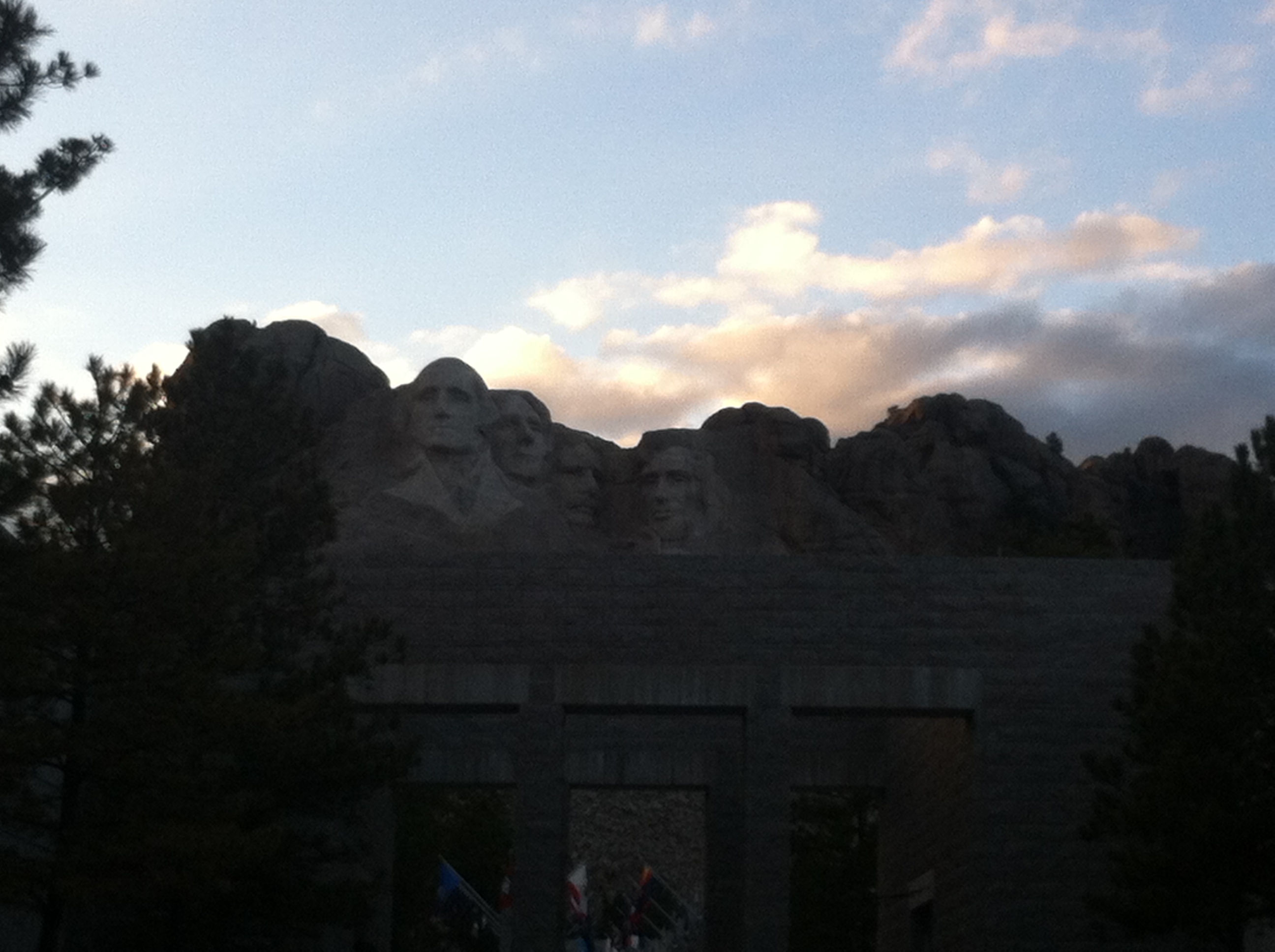
The only ‘real’ tourist destination we visited was Mount Rushmore. I had been there 44 years ago on a trip with my parents. While the huge sculpture of our presidents carved into the mountainside has not changed, the area surrounding it has. Now there is a four level parking garage, a huge plaza, a walkway lined with each state’s flag, an amphitheater, and café. We arrived just before sunset on Monday, March 27th – hardly a peak time for tourists. Almost everything was closed. The gift shop was still open – fortunately for me since I collect magnets from places I visit. Other than a few hearty souls, we had the place to ourselves. It turned out to be a beautiful time to be there. The setting sun, the tall pines and Black Hills against the baby blue sky were lovely. The faces of the presidents are illuminated at night and we saw the lights come on and then we got back in the car and headed to our hotel a few miles away in Rapid City. Exiting Mount Rushmore we drove through a faux old western town. It was a tourist attraction made of up shops and motels. Off-season, empty and shuttered, it looked like a movie set.
The western part of the United States is such a contrast to the east. The landscape in the west ranges from long stretches of amber fields of grain where the only signs of life are cattle, to other stretches that feature granite, snow-capped mountains that look like painted backdrops. Eastern Washington state and central Minnesota had vast areas of plains dotted with wind farms. Leah and I agreed that the sculptural white windmills were whimsical and graceful – they weren’t a blight on the scenery. I wondered why South Dakota and Wyoming didn’t have them, too. The common denominator in those western states was the wide-open space.
photo by Leah
Borrowing from a Jackson Browne lyric, the road and the sky collide on long segments of I-90. At one point it all became indistinguishable. In South Dakota the slate gray skies, pouring rain and copious amounts of road spray made for a bleak scene. Passing an 18-wheeler under those conditions was a white-knuckle experience. We were quite lucky that didn’t happen much during our five days on the road.
As we moved east the landscape became increasingly congested. While there was farmland in every state we drove through, we simply didn’t see the awe-inspiring views in Illinois, Indiana and Ohio. As we drove through Montana, South Dakota and Wyoming we couldn’t help but break out in song – The Sound Of Music, America the Beautiful, Home on the Range and Country Roads spontaneously burst forth. The bad weather, increased truck traffic and flat, uninteresting landscape cut down on our spontaneous singing once we arrived in the Midwest. We were left with On the Road Again each time we returned to the car.
With all those hours to pass we listened to a 7-part podcast called S-Town (or Shit Town). This was a fascinating deep dive into a Southern town with a focus on a particularly eccentric individual. The series wasn’t entirely satisfying in that it was advertised as a murder mystery, but didn’t exactly fulfill its promise. However, it was still well worth listening to as a character study.
Aside from the many hours of distraction, the podcasts provided lots of fuel for discussion for Leah and I.
Our fourth night on the road found us in South Bend, Indiana. That day had been the most stressful, with almost constant rain and Chicago-area traffic. We were so relieved to get off the road, we just ordered pizza to the room and called it a night.
We studied the maps and the weather forecasts. Our plan had been to ease up and complete the last part of the trip in two days by stopping in Buffalo the following night. We considered taking the northern route from South Bend and crossing Michigan and part of Ontario, instead of continuing on I-90. The weather forecast was bleak so we decided to stick with what we knew. Leah went to college in Ohio so the trip from Cleveland was well known to us.
The uninspiring portion of our trip.
The Ohio Turnpike gets the award for the best service areas. At this point in the trip, with the weather so miserable, we weren’t feeling adventurous. We opted for convenience and in Ohio the food choices on the turnpike were much better than what one typically finds. We had lunch at Panera’s at the Vermillion stop. We warmed up with some chicken noodle soup and then got back on the road.
We crossed the New York State line at about 3:00 in the afternoon. I was behind the wheel. “Maybe we should just go the distance and get home. We have a lot of daylight left and the weather may be worse tomorrow,” I suggested. We knew that the next day’s forecast called for a wintry mix. Leah’s eyes lit up, she liked that idea. We got a second wind. I drove through some more rain and we didn’t stop until we got to a service area outside Syracuse (our first Burger King of the trip). Leah took over the driving. I played DJ and we powered through the rest of the way listening to Springsteen and Billy Joel.
Home sweet home
At 8:30 pm, tired but happy, we greeted Gary and our two cats, Roger and Raffa. This had been a far better trip than the one we took almost six years before. Leah and I chatted easily, sang, enjoyed listening to S-Town and took in a lot of America. I will treasure my memories.
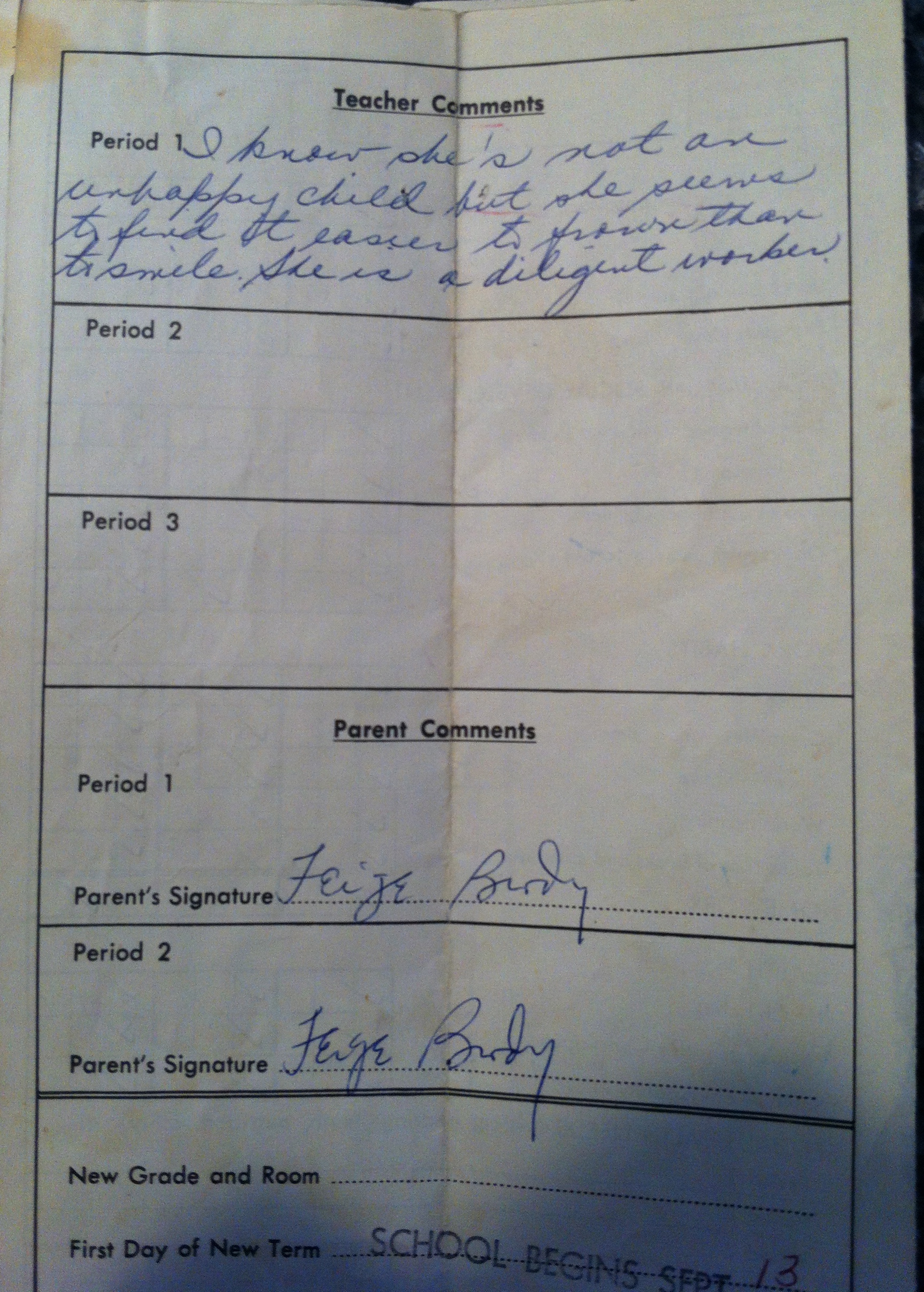
From my sixth grade report card, my teacher’s comment: Actually I was unhappy and she contributed mightily to it.
Sixth grade was a nightmare. Maybe sixth grade is a nightmare for most – especially for girls since we’re all in different stages of puberty and it wreaks havoc on our bodies and emotions. Compounding that reality was the fact that I had a truly terrible teacher that year.
Mrs. Garner was the kind of teacher who seemed to take pleasure in humiliating students. She would call a student up to the board to do a math problem when she knew the student likely couldn’t solve it. I wasn’t particularly good at math, so I was one of her victims. She would also give back test papers from lowest to highest score so everyone knew how you did. This was especially embarrassing for me since my math test scores were dismal. It took me years, and better math teachers, to get over the damage done and realize that, in fact, I wasn’t actually that bad at math.
If that was her only flaw, maybe it wouldn’t have been that bad. But as that teaching strategy revealed, she was mean. I guess in a perverse way it was a good thing because, as a result, I bonded with some of my classmates. We had a siege mentality. It became an ‘us versus her’ situation. Cindy, my best friend, and I were united in our rebellion. We plotted various schemes, and shared lots of laughs in thinking of ways to get back at her. We thought we were pretty creative when we ordered a pizza to her house. We sent an insulting letter to her home, as well. I’m embarrassed to think of it now, but we didn’t know what else to do with our hurt and anger.
For the first and only time, I played hooky that year. Cindy and I hatched a grand plot. We, and another friend, were going to meet at Cindy’s apartment. Her mother must not have been home that day. I left for school that morning, as I usually did, but took a detour to the Bayview Projects where Cindy lived, which was conveniently located right next to our school. I went to Cindy’s building and, terrified that I would be seen by another classmate, I went up the stairs instead of taking the elevator. Our other friend chickened out and went to school. Cindy and I spent the day baking (we had a food fight!), watching television and laughing.
Cindy’s older sister came home and threatened to tell. We cleaned up and vacuumed. I don’t recall if Cindy got into trouble, but since her sister knew I was afraid word would get to my parents, I fessed up before that could happen. I told my mom and she had a very unexpected reaction. She told me she should have given me a mental health day off, and that I should talk to her first if I was feeling that desperate. I never played hooky again.
Mrs. Garner did another student more harm. This past August I went to my 40 year (holy shit! I’m that old!) high school reunion and was reminded of an incident that is illustrative of her character. I went to the reunion specifically to seek out classmates who had also been in my elementary school class. As part of writing this blog, I wanted to compare notes.
Clayton was one of two African-American boys in that class. Clayton and I had been in the same class three years running. He was the smartest kid every year. He could be talkative, more talkative than the teachers appreciated, but there was no denying his smarts. In sixth grade, toward the end of the year, the class was asked to vote to have a student representative who would speak at graduation. Our class voted for Clayton. Mrs. Garner gave the honor to a white boy, telling Clayton, that he didn’t enunciate clearly enough to deliver the speech. I don’t recall the class being offered any explanation. I can say that Clayton spoke perfectly clearly (as good (sic) as any Brooklynite, if not better).
When I went to the reunion, I asked Clayton about a different incident I remembered from fourth grade. He didn’t recall it, but he shared three other experiences that reeked of racism. When he told of the election described above, parts of it came back to me. Interestingly, I didn’t remember which student had been denied the honor, I only remembered my feelings of righteous indignation that the class choice had been overridden. I wouldn’t have remembered that it was Clayton who had been wronged if he hadn’t told me. It is so interesting what we remember, what makes a mark on us.
One of the things Clayton and I discussed at the reunion was that Mrs. Garner was the wife of the District Superintendent. In addition to having tenure since she was a veteran teacher, Mrs. Garner likely had no concerns about being rebuked by the administration for her teaching methods or actions.
Hearing Clayton’s story validated the intense dislike I harbored for Mrs. Garner. She may be long gone from this earth and I may have acted out inappropriately, but my 11-year old self knew she wasn’t a righteous person.
Note: In writing this blog piece I reached out to Cindy and Clayton. Both were helpful and generously shared their memories. To further illustrate the damage done, Clayton shared the following in an email: …in addition to this slight, she then had me placed me in Class 773 in John Wilson (the lowest-ranked of the three “SP” classes in the upcoming 7th grade). Now, how you go from Valedictorian-elect to the lowest class of the SP program is beyond me, but it added to my frustration with school in general. I never again got inspired to do well in school–it just seemed not to be worth it. It wasn’t a meritorious system, it was one of politics and preferences–preferences I seemed destined to never receive. So, I have to say that in many ways, I never recovered from 6th grade.
When I was in college I remember having long conversations with my friends who were all psychology majors (I was the lone poli sci major in our group). We talked about all sorts of things, from our favorite Beatle to the meaning of life and everything in between. We discussed whether nature or nurture was more important. This was back in late ‘70s when it was still commonly thought that homosexuality was caused by overprotective mothering and autism was due to mothers who were cold and withheld affection. Fortunately we have come a long way in our understanding of those issues (at least most of us have).
We spent many a night in our dorm rooms puzzling over how we came to be who we were. I am still puzzling over that question, though, hopefully in a more informed way. At that time, I subscribed to the nurture side of the equation. I thought family life and surroundings were much more determinative of personality and the path that a person’s life took. I was preoccupied with how my parents shaped me. I saw myself as an uneasy combination of my mother and father – with less emphasis on the genetic aspect of that and more on their personalities and behaviors. Today I see them, genetics and behavior, as inextricably linked.
While we have a more nuanced view of the question of nurture vs. nature, I still think it is relevant to consider it. As a parent and as a society making policy choices, what we believe about this is important.
Data shows that if you are born into poverty, it is much more likely that you will remain there. So many factors play into that, but I certainly can’t accept that it is a genetic predisposition. Therefore, it behooves us to make public policy choices that can help change that cycle. If we look at a person’s health, nature may hold sway. After all obesity, addiction and all sorts of chronic illnesses have been shown to have a genetic component. Being born female or male also has a huge impact on the path a life takes.
Where does that leave us as parents and as a society?
Years ago when Gary and I were faced with some parenting challenges, we consulted with a child psychologist. He shared his belief that children were born with a certain temperament and that temperament could be thought of as a continuum – from easy going to extremely difficult. Children at either end of the spectrum faced challenges. Parenting strategies could help the child move a bit on the continuum, and help them cope, but we couldn’t change their temperament. I found that comforting (unlike the t-shirt pictured above!). Otherwise, it was scary to think we held so much power; better to understand that there were limits to our influence. While Gary and I provided the genetic material for Leah and Daniel, we certainly couldn’t control which ones! His view was consistent with what I was observing in my two children.
Leah and Daniel came into this world with very distinct preferences and personalities. Many of those characteristics were also consistent with general ideas about gender. Prior to having children, I thought most of what was considered ‘girlish’ or ‘boyish’ was learned. Again, it is nearly impossible to disentangle the various influences, and my children aren’t a representative sample! But, I was amazed how some of their behaviors seemed to be classic sex-linked attributes from the get-go. Of course, from the get-go babies are learning, absorbing their surroundings – the colors on the walls in their rooms, the toys we offer, the tone of voice we use – all of which likely play a part in forming gender identity.
With that said, it seemed to me that Leah and Dan arrived defined to a larger extent than I anticipated. Leah was fascinated by people; Dan by objects. He was absorbed by the mobile over his crib, leaves shaking in the wind, cars and trucks barreling down the street. Leah was much more interested in faces. She craved interaction: singing, storytelling, cuddling. Dan liked to be read to, also, but would rarely sit still for it. Early on we wondered about his hearing because he often didn’t do the typical things that let you know he was attending to what was being said. He would appear distracted or tuned out. Over time we realized that in fact he was taking it all in. There are some amusing stories about that actually. Leah, on the other hand, made eye contact, she wanted you to know she was listening. She needed the feedback – she gave it and wanted it in return.
It is possible, of course, that these behaviors weren’t hard wired. Gary and I may have taught them to behave stereotypically, but it certainly wasn’t conscious on our part.
We didn’t offer toy guns to either Leah or Dan. When one of his uncles gave Dan a large plastic tank as a birthday present, Dan took to it immediately. He knew exactly what to do. He proceeded to use it to rumble around the house and blow things up. Dan also had his beanie babies wrestling! All of these activities were accompanied by the appropriate sound effects. Vroom! POW! In contrast, Leah would take her clothes out of her drawers, take the fabrics and rub them on her face. She loved soft textures against her cheek. Leah’s Bobbe, her paternal grandmother, had a shoebox full of fabric scraps, zippers, thread and other sewing paraphernalia (no pins, needles or scissors) that was a treasure trove to Leah. Dan showed no interest in that assortment of playthings.
We tried to baby-proof the kitchen cabinets (emphasis on the word tried). Gary installed latches that required that you insert your finger to release the mechanism. Leah pulled the door as far open as the latch would allow and studied it. After a while she put her finger in and released it. Dan took a different approach. He kept pulling on the door, harder and harder, with as much force as he could muster, until it popped open. So much for relying on the latch to keep them safe!
This isn’t to say that there weren’t exceptions. Leah and Daniel didn’t conform to all of the stereotypes associated with girls and boys. Leah enjoyed roughhousing. When she played soccer or basketball she didn’t shy away from physical play. Dan, on the other hand, didn’t relish that part of sport. While he loved basketball, he didn’t enjoy mixing it up under the boards.
I have tried to figure out if there is something inherently female or male, aside from the obvious biological traits, mostly to understand myself. How do we put ourselves together harmoniously – the feminine and the masculine? Growing up I sometimes felt I was waging an internal war (as I wrote about in another blog post – here).
Is there utility to the concepts of feminine and masculine? Do we need to categorize ourselves and others in those terms?
I admit to feeling some discomfort with abandoning those ideas. Categories help us understand and make sense of things. It seems to be a human instinct to order things by defining and categorizing them. Can we do that without putting each other or ourselves in boxes? Can we leave room to embrace the exceptions?
When I meet someone I want to understand who they are. But maybe I don’t need the categories we have always fallen back on. Is it important to know if the person is male or female? Black or white? After all when we make assumptions based on what we see, it can create problems. But it’s hard not to do it. I think, too, we are searching for common ground and those categories can help find it.
When Leah and Dan were in elementary school I stopped trying to assign their characteristics to one side of the family or the other. I accepted that they were each a unique constellation of attributes. I wish I understood that about myself all those years ago. While I have moved beyond the nature vs. nurture question, understanding that the two are inextricably linked, I am still left pondering identity and how we form it.