I think the whole country, the entire U.S. of A., should take up meditation. I had this epiphany the other day after I finished the 20th of a 30-day class – each session is only 10 minutes – offered through an app called Calm. I realize this is an impossibility on so many levels, but I’d like to make the case.
Much of the divisions in our country are caused by people feeling aggrieved. Some folks believe they are unseen or unheard by our government or by the rich and powerful. Some are bitter because of sour relationships. Others are angry because they think many in this country have been swallowed by a cult causing us to drift (speedily swim?) toward authoritarianism. Whatever the source of the grievance, I think the practice of meditation can help because it requires that you become more neutral, you need to adopt a stance of equanimity to sit quietly for ten minutes. I don’t mean to simplify something that is quite complex. Both the problems that have led so many to feel alienated/angry and the practice of meditation are complicated. But, they are simple, too.
Sitting quietly and breathing slowly and deeply for ten minutes each day is both the easiest thing in the world and the hardest. Quieting your mind, allowing emotions to flow through you but not possess you, takes practice. I am a novice, but I see the benefit of having done it for about a month (and, full disclosure, I missed some days during the month). Some people did a ‘dry January,’ I did a ‘how to meditate January.’
I was motivated to try this because during these last couple of years during the pandemic, I have found myself easily riled. I go from zero to sixty emotionally in seconds. I felt agitated much of the time. I read a headline and feel my stomach churn. I can’t say that my meditation practice has changed all of that, but there is noticeable improvement. I still get anxious at the prospect of taking Mom to the doctor, and I still feel my blood pressure start to rise when I read about Donald Trump’s latest rally, but I feel more in control. If it can do this for me, I can imagine what it would do for all the people out there who are living on the edge.
The practice allows you to acknowledge feelings that you might prefer to push down. Generally, I am pretty self-aware. I think for others who are not so blessed to be in touch with their emotions, it might be uncomfortable at first, but it would be a step in the right direction. When you don’t acknowledge what you are feeling it comes out in unexpected and unpleasant ways.
Another positive is that there are no religious aspects to meditation, unless one wanted there to be. I think it is harmonious with all faith traditions.
We are fixated with solving societal problems from the outside in – we enact new laws, fund programs, do research, require others to take action, and talk issues to death. Many of those steps, other than talking things to death, are admirable, and necessary. But, maybe, we need another approach as well. One that starts from the inside of each individual. Maybe if more people took 10 minutes a day to sit quietly and breathe deeply, there would be less hostility and better mental health. Just an idea.
I plan to extend my practice beyond ‘learn-how-to-meditate’ January.
My brother Mark, who lives near me, called the other day to tell me that he and his wife were going to visit Mom. They were planning to go there and back in one day – it is a 3.5 hour drive one way. I have been wanting to go but have been waiting for omicron to die down and the weather to cooperate. It seemed like this was fortuitous timing, and it would save me from driving alone. “Mind if I join you?” I asked. “Of course,” came the quick reply.
As I do before any visit to Mom these days, I thought about what I can bring that will make for pleasant conversation. This has gotten increasingly challenging as her circumstances have diminished. Aside from the realities of Covid which limits options, we can’t really take her out for a meal anymore. That used to be a great pleasure for her. I would be happy to manage her oxygen and walker, which make it awkward but doable, but these days she simply tires too quickly. It gets to be too much for her and the brief pleasure she derives from getting out of the apartment is surpassed by exhaustion and anxiety.
So, we look for other ways to make it enjoyable. Bringing in a meal is special. Fortunately, the food where she lives is good – no complaints there – but there is still a sameness. Mom particularly enjoys soup so bringing in wonton or a hearty chicken noodle is welcome. Since the weather was unseasonably nice, the sun was out in a cloudless sky and the air was relatively mild (considering it is January in the northeast), we ate on her patio. Mom closed her eyes, put her face in the sun and took a deep breath. In the days when Mom was hale and hearty she would have sat without a coat, not so anymore. It was chilly, and she needed a jacket, but it still felt good for all of us to get some fresh air.
As I have written in many previous blog posts, I have been sorting through papers and mementos from Mom’s house in Florida and Aunt Clair’s apartment. It is a bittersweet process, finding loving letters but also evidence of loss, like my dad’s death certificate. When I come across something humorous or poignant, I often take a picture of it and text it to whomever I think might be interested. Sometimes I text Mom photos, but it is hit or miss whether she will successfully find it on her phone. I scanned the items I most recently sorted and found some things I thought would be meaningful to her for our visit. I selected some letters from Zada, Mom’s father.
After finishing our lunch on the patio, we returned to her living room. Mom settled into her recliner and the rest of us sat down around her. We took out the letters from Zada.
Though Zada didn’t have the opportunity to finish high school, he was a self-educated, well-read man who wrote beautifully. Mark read this one aloud to Mom:
Tuesday 7/26/67
I am writing one letter to my dear ‘aynklach’ (note: grandchildren in Yiddish). Because whatever I have to say, I must say to all of you. I cannot single out one. But first let me tell you what your letters mean to me. Regardless of your grammatical errors and your misspelling, the words you write are full of love and wisdom. My pride knows no bounds. You are concerned that I have a good summer, that I do not work too hard. That Terry is making proper meals, and that I should not be lonesome. How can I be lonesome when I have your letters to remind me how precious you are? So I count the days when your vacation will be over, and I will be seeing you in the flesh again. To be able to watch television with Steve (especially the programs he likes), also to hear the pearls of wisdom emanating from Mark’s mouth. And to be rewarded by my little sunshine although I hear she is not so little anymore.
Look boys, I cannot go into detail about the sporting events we are all interested in, that is why I had the Post sent to you, and when you get back (hale and hearty) we will have long discussions of all the things that have transpired while you were away.
I am also very pleased with the progress you are making with your swimming and Steve, if I am ever to see you dive, and do it well, my pleasure will be complete. Mark, my hand does not hurt, and I have plenty of writing time, but words, once my stock in trade, are wanting to commend such a good boy as you. So I keep thinking of beautiful things to say. My heart is so full of love that mere words would blemish my feelings. Linda, stay as sweet as you are always, never lose your vivaciousness, speak up at all times so I may see the sparkle in your eyes and the loveliness of you.
God bless my grandchildren. May you be happy always. Zada
Uncle Mike with arms around Zada’s grandchildren as of 1967 (L-R) Steven, Laurie, me, Mark, Ira in front Mom with good friend EileenPhotos from that summer of 1967
Mom listened, a smile on her face, marveling at how well he expressed himself. We talked about the context of the letter, remembering our summers in Illinois (the first of three spent there) while Zada was home in Canarsie. We weren’t on vacation exactly; Dad was attending the University of Illinois at Champaign-Urbana to get his masters in economics. Mom remembers those days fondly. I brought a photo from that summer, which elicited Mom’s pleasure at how slim she looked in her bathing suit (see above).
Then Mark read the next letter, dated ten years later. This letter, written on her birthday just after the wedding of his oldest grandchild, my brother Steven, begins: From the president of the Feige Brody fan club.
It continues:
Nov. 16, 1977
Dear Feige,
The purpose of this letter is to expound on the theory that it is far better to be44 years young, than to be 44 years old.
You proved to me without a shadow of a doubt, how you deported yourself at Cindy’s and Steven’s wedding: In my eyes and probably everyone else’s you were the fairest and youngest of all.
Stay young Feige, your husband will adore you, your children will respect you, and I will always love you.
Love and Best of Days,
Dad
Mom and Dad at Steven’s wedding – 1977 – Mom as the fairest of them all (not withstanding the bride)Zada at my wedding – 1983
As Mark read the letter to Mom, she smiled broadly and listened attentively. “That’s my father,” she said with satisfaction. I think it is fair to say that Mom did as he suggested. She stayed young, at least until her 88th year when time is finally catching up with her. Her husband, my father, certainly adored her until he took his last breath, and her children respect her. Zada was prophetic.
As we said our good-byes, we reminded Mom that she is 88 years young.
Once again, the Covid pandemic is on my mind. Aside from wearying of the limitations it has placed on my life, it feels like the virus is closing in on me. It feels unavoidable. It has hit close to home as family members and friends have been diagnosed in recent weeks. While omicron seems to be less deadly than prior variants and results in less serious illness, it is still no joke. And, until we are over the peak and on the other side, we don’t really know its impact.
People continue to make different choices in how they cope with the pandemic. Some reasonable folks have concluded that, while wearing masks in public spaces, they are resuming activities and living their lives. My husband is not comfortable with that approach, perhaps as a physician who is in the office seeing patients every day, he thinks the risk is too high until we clearly pass the peak of this surge. He goes to work masked and goggled, washing and sterilizing his hands relentlessly, but then declines most social activities. He would like me to make the same choice. For the most part I have, refraining from most things except I continue to play tennis once every other week. Since I am not working and we are now in the depth of winter, my life is quite limited. It leaves too much time to think, too much time to worry.
In the midst of my angst, I read some helpful words in the form of a poem that came across my Facebook feed:
I am no longer waiting for the other shoe to drop; it already did, and I survived.
I am no longer waiting for the time to be right; the time is always now.
I am no longer waiting to do something great; being awake to carry my grain of sand is enough.
I am no longer waiting to be recognized; I know that I dance in a holy circle.
Author: Mary Anne Perrone
The above lines are part of a longer piece, but these were words I needed to read right now. I’m not so sure about that last phrase – I don’t dance in a holy circle (I’m not sure I even understand what she means by that), but the idea that I don’t need recognition to find value in what I create is a thought I need to be reminded of. The belief that I am enough is something I continue to work on.
The first lines of this piece speak to the major challenge posed by the pandemic – the fear that the other shoe will drop. What am I worried about? The health of the ones I love. I want to know that family members who have Covid or another a health scare are okay, that they will recover quickly and suffer no ill effect. Unfortunately, I can’t know that.
Worry can always be around the corner. If I allow it, it can rule my life. I find comfort in those lines above – the shoe has dropped – at times. It is true that the worst has not happened – I am still here, as are Gary and my children, thankfully – but bad things have occurred, and I have survived. I have managed.
The other day I had a long conversation with a friend who is battling colon cancer. Her husband took the diagnosis hard, understandably. It is scary, though her prognosis is good. Her husband was depressed and after a time she confronted him, saying that she needed him to stop being so down, she needed a more positive attitude. He confessed that he was terrified of losing her. She reminded him that she is here now. When something scary and unknown hangs over you it is hard to be in the present.
Though I am not faced with the same situation as my friend, I related to the challenge they faced. The meditation app I started using a few weeks ago offered helpful insight into the scenario where you might imagine the worst. During one of the exercises, the guide pointed out that thoughts are not reality – thinking something doesn’t make it so. Worrying about future health complications has little to do with the reality of the here and now. It is easy to go down the rabbit hole of ‘what if,’ but it leads nowhere and accomplishes nothing. We can’t put our head in the sand, we need to plan when we have real information about what the future holds, but we can’t live in anticipation of the worst. It is a choice we can make. I can control my thoughts. What a revolutionary idea! It doesn’t come easy to me, but it is empowering to realize that I can redirect my mental energy.
I don’t think I used to have to work so hard to quell the worry. I didn’t worry so much before. Why am I now?
Maybe being inundated with bad news – people losing their homes to fire, people dying of Covid, a friend losing her husband to pancreatic cancer – has made it harder to cope. Bad things were always happening and will always happen. I think social media heightens the sense of disaster all around us. Did they always report when a retired third string quarterback for an obscure NFL team died? My Twitter and Facebook feed is filled with those stories. When someone as famous as Betty White died in the past, of course it made the news. But now it is hard to know what to do with all this information, especially all the losses. How can we process these deaths (whether related to Covid or not)? It is hard not to be overwhelmed.
Some periods of time seem more perilous than others. This is one of those times. I want to put the people I love in a bubble. But I can’t, nor would they want to live there. I need instead to focus on the joys, the beauty and the love today.
Serenity now! View from a walk at Five Rivers – another coping-with-the-pandemic strategy
As I continue to go through Aunt Clair’s collection of papers, I find interesting items. Among them a xerox copy of a letter written by Grandma to her oldest daughter, Diane (who was called Dinya by the family). I was initially puzzled that a xeroxed letter, not addressed to her, was included in Aunt Clair’s collection. After reading it I understood why Aunt Diane would have shared it and Clair kept it.
The first page of the letter, with the date, is missing so I don’t know exactly when it was written but based on the subject (and reference to their wedding anniversary) it appears to be early in my grandparents’ retirement to Florida, either the winter of 1970 or 1971:
In the almost 43 years of our marriage this is the first time Daddy went with me for clothes. He’s a panic. He wants me to buy everything I try on. Dinya, I think he is really seeing me for the first time in many years. Daddy could be walking with me, suddenly he stops and tells me I look good, is enough to drive me crazy. Daddy is completely relaxed and thank ‘God,’ he feels good. Remember the wise words from your mudder. Nothing like a love affair at 65 and 67. When we walk into a store and I try a dress on and walk over to Daddy to ask if he likes it etc etc, he tells me it is very nice, shakes his head up and down and tells me I look very good. When I walk back to the dressing room with the saleswoman, she asks if I’m ‘going with him,’ if I’m going to marry him. She thinks he’s my Romeo and I’m taking him shopping. Dinya, I fall apart. Dinya, you, Paul and children have a very Healthy Happy New Year. We miss you all very much. Heaps of love from Daddy and me.
Mom
How adorable is that? It gives me hope as a spring chicken of 62 and married for only 38 years that romance can be alive and well in the years ahead. I am quite fortunate in that, even with the natural ebb and flow of relationships, the love has never gone out of my marriage. It is nice to know that the flame can burn brightly again.
I also appreciate Grandma’s word choices. She writes, “He’s a panic.” I can hear her saying that – she used that a lot as I recall, and it shows up in any number of the letters in Aunt Clair’s collection. It meant the person, or their behavior, made her laugh. I don’t think we use the word panic that way anymore, do we? She also refers to herself as ‘your mudder,’ spelling it as she would say it. But it wasn’t that she had an accent and thought it was spelled that way, she was perfectly capable of saying and spelling mother properly, she was being humorous. The letters are filled with her amusing touches.
In another way, it feels odd to read this. These are my grandparents! And she is writing to her daughter! There is nothing off color or even too personal in it, it’s lovely, but still not what one expects in communication between a mother and daughter – especially of that generation. But, maybe I’m wrong and if I could survey letters of that era I would find intimacies shared. I wonder if I wrote something along those lines to my daughter how she would react.
More interesting to me is that it was my impression that though they cared for each other, I didn’t perceive much of a spark between Grandma and Grandpa. After all, they slept in separate twin beds like Lucy and Desi on television. Most of what I heard and saw of their interactions revolved around their respective health. Grandma regulated Grandpa’s diet rigidly and often spoke on his behalf. I thought he was the quintessential henpecked Jewish husband. Maybe he was.
Grandpa, with his gentlemanly, reserved ways, was considerate in a formal way, but I don’t recall romantic gestures. It was a different time, though. Emotions were more closely held. I certainly didn’t know them in their youth. Plus, they had been through so much.
Young adulthood, which for Grandma and Grandpa was during the early 1930s when the country was suffering, is a time of striving – to find your place, to establish yourself. Grandpa had the spirit of an entrepreneur. He came to America to seek his fortune; he was willing to take risks. He came by himself, leaving his parents, sister and extended family in Poland in 1921. He was 17. Grandma, American-born, was much more cautious by nature. The Great Depression heightened her fears. This difference caused friction. Aunt Clair told me that Grandpa felt stifled by Grandma. Then in 1945 Grandpa learned that what remained of his family had been killed by the Nazis. I can only imagine what that did to his spirit. It is a lot of strain for a marriage. Growing up in the stress, trauma, and sadness colored the childhoods of Diane, Dad and Clair and shaped their perception of their parents.
Both Grandma and Grandpa worked hard; they put in long hours at the stores they owned. Over the years they had a dry goods store, a luncheonette and then a laundromat. Some of their businesses were more successful than others. Their financial situation was a mystery, even to my father. They moved to a nicer apartment on Prospect Park West when Dad was in high school and it didn’t include a bedroom for him, though there was one for his sisters. Was that about money? Though they said they would contribute to his wedding, they gave less than they committed to, leaving Mom and Dad to use their gift money to cover the difference.
I knew Dad harbored many resentments about the way he was treated by his parents. He was determined to do it differently with his own children and he did. Recently my mother told me that when Grandma was dying, she and Dad talked it out. Tears were shed and apologies were made. I’m glad to know that, though I wish I knew it years ago when Dad was still alive.
Marriages go through phases, it seems, and children absorb the ripple effects. The beginning can be tough as the couple figures out if they are on the same page in how they approach life. Children can strengthen the bond but also create other tensions. Throw in a natural disaster (like the New England Hurricane of 1938 that upended Nana and Zada’s life) or economic calamities (like the Depression) or violence (the Holocaust) and a marriage may be stretched to the breaking point. If the marriage survives all that retirement can come as a balm, or a couple may find themselves strangers to each other.
Grandpa was able to relax and enjoy himself in his retirement. Not all men are able to do that. I know my father-in-law struggled with the transition, perhaps because retirement wasn’t on his terms. But it was likely more than that. Many men are defined by their work, their identities are wrapped up in their profession, and the loss of that can unmoor them. I imagine women can have that issue too, but I think it is less common for a woman to be so invested in their career that she can’t adjust when it is over. Having hobbies and other interests helps too.
Most of the letters Aunt Clair saved were written by Grandma when they first became snowbirds (1970-75), after their retirement. The letters reveal that the last five years of Grandma’s life were very happy ones. Though it was abruptly cut short by cancer, she took great pleasure in those final years, even more so because she enjoyed the renewed attentions of her husband. I’m glad Aunt Clair saved those letters so I could know that.
Note: The following essay explores a theme that can be a third rail: Christmas in America. My intent is not to impugn the holiday. I hope friends, family and readers who celebrated this past Christmas had a wonderful, meaningful holiday. I understand and respect its importance. I have a perspective, as an outsider, that some may not have considered. I offer my thoughts in that context. I welcome constructive criticism, other insights and reactions. Please feel free to comment.
I was watching a holiday version of House Hunters recently. The idea was that a family wanted to find their dream home in time to be settled in it for Christmas and have time to decorate for the season. The family was shown homes by a real estate agent who looked like Santa Claus (yes, really). Okay, I figured, let’s see what this is. I love these types of shows – whether it is Lakefront Bargain Hunt, or House Hunters International, I find it entertaining and mildly informational seeing a range of housing options across the globe. This variation seemed interesting enough.
Though I do not celebrate Christmas, I enjoy the light displays very much. As we begin the dark descent into winter, the lights are a bright, cheerful spot. Growing up in Canarsie (Brooklyn) we would take a ride around the neighborhood to see which houses had the best lights. The funeral home, Guarino’s, did a particularly spectacular job. I could enjoy the efforts of my neighbors but did not feel deprived that we as Jews didn’t decorate our home.
I settled in to watch and early on felt surprisingly uncomfortable. My hesitation with this episode of House Hunters: Home for the Holidays was that the family featured was Indian (from India originally) and they were Hindus. First, to be clear, I have no issue with the show featuring non-white, non-Christian families! One of the things I appreciate about the House Hunters franchise is that they present a fairly diverse group of individuals – families, couples or singletons of every color and orientation. It may not be perfectly representative, but there is a cross section of humanity on the show. I have been watching it since the Bush (Dubya) administration and they incorporated diversity early on.
The thing that troubled me – and I could have missed something that would have explained it – was the premise that this family needed to have a fabulous Christmas display, though it didn’t seem like they celebrated the holiday. The show began with an explanation of the Hindu holiday of Diwali – a festival of lights. They were going to incorporate the colors of Diwali into their Christmas decorations. Mind you, at least as best as I can tell, Diwali does not fall at the same time of the year as Christmas so I’m not sure there is a natural fit, but maybe there is. The family explained to the Santa-look-a-like realtor about their holiday, and he was delighted to learn about it. That’s great, if only they left it there. Maybe the house hunt could have centered on how well it met their needs in celebrating Diwali, or other Hindu festivals.
But, then they went on this journey to find the perfect home for their new Christmas display. It didn’t sit right, though I readily acknowledge every family’s right to celebrate whatever holidays they want in whatever way they want (assuming they aren’t hurting others in the process).
I had a friend in graduate school whose family (her parents) immigrated from China to escape Communism. Her parents were not raised with religion. When they got to this country they converted to, I think that is the right word, or maybe they simply became Catholic. They raised their children in the church accordingly. They did this of their own free will. I didn’t ask why her parents chose Catholicism, or why they chose religion at all. The beauty of our country is that they could make that choice. They celebrated Christmas. They did not shed their Chinese customs either – in food and family traditions they maintained their identity. I’m sure there were difficulties adapting to American life, but they seemed to be forging a path that integrated different elements into a whole that worked for them. So, the idea of coming to America and embracing Christianity is not what I am questioning.
I was not convinced this was the case for the family featured on House Hunters: Home for the Holidays. If this family got joy from adding Christmas to their family traditions, good for them. Something about the way it was presented didn’t come across that way. It felt like a competition to outdo others with their Christmas lights. It seemed to have nothing to do with the actual meaning of the holiday.
I would love to hear from readers who are of other faiths, or those without any faith tradition, who have navigated this. Did your family adopt Christmas? If so, how does it feel for you? I know many people who intermarried (Jews and Christians are common pairings in my family) – which is also a journey that requires compromise and negotiation. But, I am not really focused on that here. This t.v. show was not highlighting a ‘mixed’ family. There may be parallels but it is a little different.
I find Christmas in America to be very confusing – and I was born here (third generation as my grandmothers were born here) and have never lived anywhere else. On the one hand, people seem to want Christmas to be everywhere – on t.v., on the radio, in the mall, even in public schools. They want it to be an American holiday. But then they complain that Christ has been taken out of Christmas. If Christ is at the heart of it, then it should be for believers. Not everyone is a believer, though. Perhaps many in this country are happy to celebrate Christmas as a secular holiday. But then why the attachment to “Merry Christmas?” If it is secular, why is it so important that everyone observe it? You can’t have it both ways.
I can imagine that for some the holiday is about family traditions which is a powerful attachment. Putting up a tree, decorating the home, exchanging gifts, gathering with those you love are all beautiful traditions. I respect that, but it still does not explain why it should be expected of others who don’t share the faith or the family history.
I wondered if the family on this show felt pressured to adopt Christmas as a holiday. Muslims, Hindus, Jews, atheists and other non-Christian people should not have to participate in Christmas. If they choose to, for whatever reasons (though hopefully not to keep up with the Joneses), that’s their right. And, they don’t owe me an explanation for their participation. I just hope it comes from a healthy, expansive place and not from feeling looked down upon, or judged as less than by other Americans. And, Americans should not start from the assumption that everyone celebrates Christmas.
We are now two weeks out from the wedding and we still know of only one case of Covid. We dodged a bullet, and I am so grateful to our guests and vendors for helping to make it as safe as possible. We are so lucky to have memories of a joyous event largely untainted by negative consequences. I can happily reflect on those special moments of joy. Here are some photos from our celebration.
Since the newest Covid surge has reduced our socializing, Gary and I have had time to watch Netflix, or in the case of the documentary “Get Back,” Disney+. The documentary is about the lead up to the rooftop concert that marked the Beatles final public performance, something previously explored in the film and album Let it Be. The documentary is almost eight hours long, divided into 3 segments. I thought it was well worth watching. I came away with a deeper appreciation of them as a band. While I am not immersed in Beatlemania, I am a fan of their music. There was a great deal I didn’t know or had forgotten.
First, they were so young! The events depicted were from January of 1969. I was nine years old and to me the Beatles were grown-ups. Watching them now, from the perspective of a 62 year-old, is quite different.
One of the things I came away with was that music-making is both inspiration and hard work. At various times each of the Beatles come into the studio having dreamt up a new melody in their head the night before or having an idea for a song while they were driving over in their car. To then watch the piece come to fruition is amazing. Some might find it either laborious or repetitive at points, but I thought it showed how much goes into it. I also wondered why I haven’t had the experience of driving to work and having a song like ‘The Long and Winding Road’ pop into my head. I’m joking, of course, I have no skill in that area. But how cool would that be?!? The documentary showed genius at work – and I don’t believe I am overusing that term.
Also, at least based on this presentation, the women, Linda and Yoko, got a bad rap in the old narrative around the Beatles break up. It seems it is a myth that they caused the split of the band. They were there during these sessions and did not seem to be interfering or causing tension. Unless Peter Jackson, the director, selectively edited things, Linda and Yoko should not bear that burden any longer.
If the film offers insight into the disintegration of the group, it seems that the members, particularly George and John, wanted to pursue their own creative voices. They felt constrained by being in the band. Other pressures and circumstances may have exacerbated things – drug use, family/relationship demands, the relentless attention that came with being a Beatle all likely contributed – but ultimately it seems they grew apart. One can’t help but feel sad thinking about what could have been. As I watched I thought frequently about the premature death of John Lennon, which occurred 11 years later, as I appreciated anew his talent and irreverent sense of humor.
Finally, I was impressed with how playful the whole group was. Though stressors were revealed in the film, George Harrison briefly quit, the joy they got from making music together was also evident. There was a lot of laughter.
After spending nearly 8 hours watching the film, I felt like I hung out with them which is a pretty cool feeling. In recent days I find myself putting on Beatles albums and enjoying them immensely.
Another thing Gary and I did, given Covid limitations, was take a ride to Bear Mountain, listening to Let it Be as Gary drove. I haven’t been to Bear Mountain in decades. There was a thin cover of snow, so though we originally planned to hike in the woods, we decided we didn’t have the proper footwear for that. Fortunately, there were some paved paths, one that circled a lovely reflective lake, so we could still explore and take in the lovely scenery.
Hessian Lake – reflecting the surrounding mountain
I had no memory that the park included a zoo which is arranged along a nature trail. Since it was Christmas Eve day, and it was cold and gray, there weren’t many other people which made it perfect! We saw an array of birds, reptiles and fish, in addition to a bear and coyote. The trail also included a history museum which focused on events in the area during the American Revolution. Most of all, though, I enjoyed the views. That section of the Hudson River Valley is spectacular.
A view of the Hudson River looking south
As we wended our way through the park, we noted how great it would be to bring our granddaughter there – an idea I will file for an outing in the future.
After walking for a couple of hours, we went into the Bear Mountain lodge and found a restaurant that was still open despite the approach of Christmas. We ordered some food and, in an abundance of caution, ate it in our car. It was time to go home. “You don’t need to turn on the GPS, I know how to get home from here,” said Gary. Famous last words. We ended up on the wrong road, but it turned out to be a happy accident. We found our way to 9W north which was a less direct route but took us through a beautiful stretch of mountains dusted with snow.
When we got to Newburgh we turned west and took the Thruway, not nearly as scenic, but more efficient.
Though we made many adjustments on account of Covid, we are trying to make the most of this holiday season.
What a weekend! The wedding weekend is now a full week behind us, and I have been on a roller coaster of emotions. From worrying about everything coming together beforehand, to deep satisfaction watching Leah and Ben having fun with their friends, to laughing with delight at our granddaughter’s performance as flower girl, and back to worrying about the Covid surge and what it might mean for our guests – it has been quite a ride. Frankly I am ready to get off the ride already, it is exhausting. Will I ever feel like life is normal? It is hard to imagine.
The three-day extravaganza in Troy, New York – the welcome dinner on Friday night, the wedding itself Saturday late afternoon and the Sunday brunch – could not have gone better. People came ready to celebrate. It was the first time for many of us (about 120) to gather and we made the most of it. One of the highlights for me was watching Leah and Ben’s eclectic group of friends cutting up the dance floor. The DJ did a great job of keeping the beat going. The dance floor was filled with guests of every age – it is funny that the music of the ‘60s and ‘70s transcends time. Everyone was boogeying and singing along, including me.
But the true verdict on the ‘success’ of the event won’t be known for another week when we see whether any of us or our guests got Covid. That is an unfortunate caveat. So far, we know of one guest who tested positive this past week after feeling symptoms on Tuesday – it is not clear that they were exposed at the wedding. I don’t want to make the wedding about Covid, but it can’t be avoided. I find it hard to reconcile the joy of the gathering with the risk of illness, potentially serious illness.
The weekend was about love – celebrating the love of our daughter and son-in-law for each other, and the love that family and friends have for them. But the specter of Covid hangs over our heads.
We took every step we could think of to ensure that we created as safe an environment as possible. We asked all attendees to provide proof of vaccination – and they did. We asked everyone to take a PCR test within 72 hours of coming to the wedding. We believe people did that, too. We made sure staff at the venue was vaccinated and masked. And, finally, we provided rapid tests to use on the day of the celebration. Gary and I took our rapid test in the hotel room before leaving for the rehearsal dinner – both of us were relieved to be negative.
All those measures still don’t guarantee that there won’t be breakthroughs, especially with the new Omicron variant and the recent spike. We will wait another week to see what happens. As of my writing this, Leah, Ben, Gary, our son Dan, daughter-in-law Beth and I have all taken tests and we have all been negative. Gary and I took a PCR test on Saturday morning, and we learned last night (Sunday) that we were negative again. Phew….
We live in such a strange time. We started planning the wedding two years ago, before the pandemic, when Leah and Ben got engaged. At the time we thought we’d have a large party – between the bride and groom’s friends and families, there were many we wanted to include. As the reality of Covid set in, we made adjustment after adjustment. Eventually we realized that we had to postpone the party – the kids did get married on the original date (December 12, 2020) and we had a total of 12 people present – just the immediate family. I wrote about that weekend here. It was lovely, and we made the best of it, but it wasn’t what we envisioned.
As time passed and things improved, with vaccinations and treatments, Leah and Ben decided to go forward with the original party plan. We, their parents, were happy to do it. The journey since then has included many ups and downs. We reevaluated regularly and kept adding procedures to try to protect everyone. There were many phone calls and long deliberations – we kept fine-tuning the protocol. But nothing is fail-safe.
At different points the worry became nearly overwhelming. Friday night, after our successful welcome dinner at the Arts Center, I lay down exhausted in our hotel room. I couldn’t sleep. I worried, my brain flitted from one disastrous scenario to another. Worry is a useless emotion! There was nothing productive to do. I tossed and turned and eventually dawn arrived. Not surprisingly, it was pouring. Rain is a good omen, right?
Fortunately, morning brought things to do, places to go and people to see. The rain subsided. The moment of truth arrived – the official gathering began. I stopped worrying and stayed present.
The venue, Revolution Hall in Troy, New York, has a beautiful bridal suite. We stocked it with snacks and bottled water. While Leah got her hair and make-up done, friends and family stopped by to chat. I took it all in, watching everyone shower Leah with warmth and affection, sharing stories and laughing. One of the pleasures of being a parent is seeing your children’s lives unfold – the partners they choose, the friendships they cultivate. I like my kids’ friends – they are smart, thoughtful, and kind people. I probably enjoyed the time in the bridal suite as much as Leah did!
Troy turned out to be a fine location – with hotels and other amenities in close proximity to the wedding venue which meant a minimal amount of driving. As I was out and about in the unseasonably warm weather running errands and dropping things off, I took note of my surroundings (also an effort to settle my nerves). Troy, settled in 1787, has a rich history and its architecture reflects that. I took some pictures for posterity (and the blog).
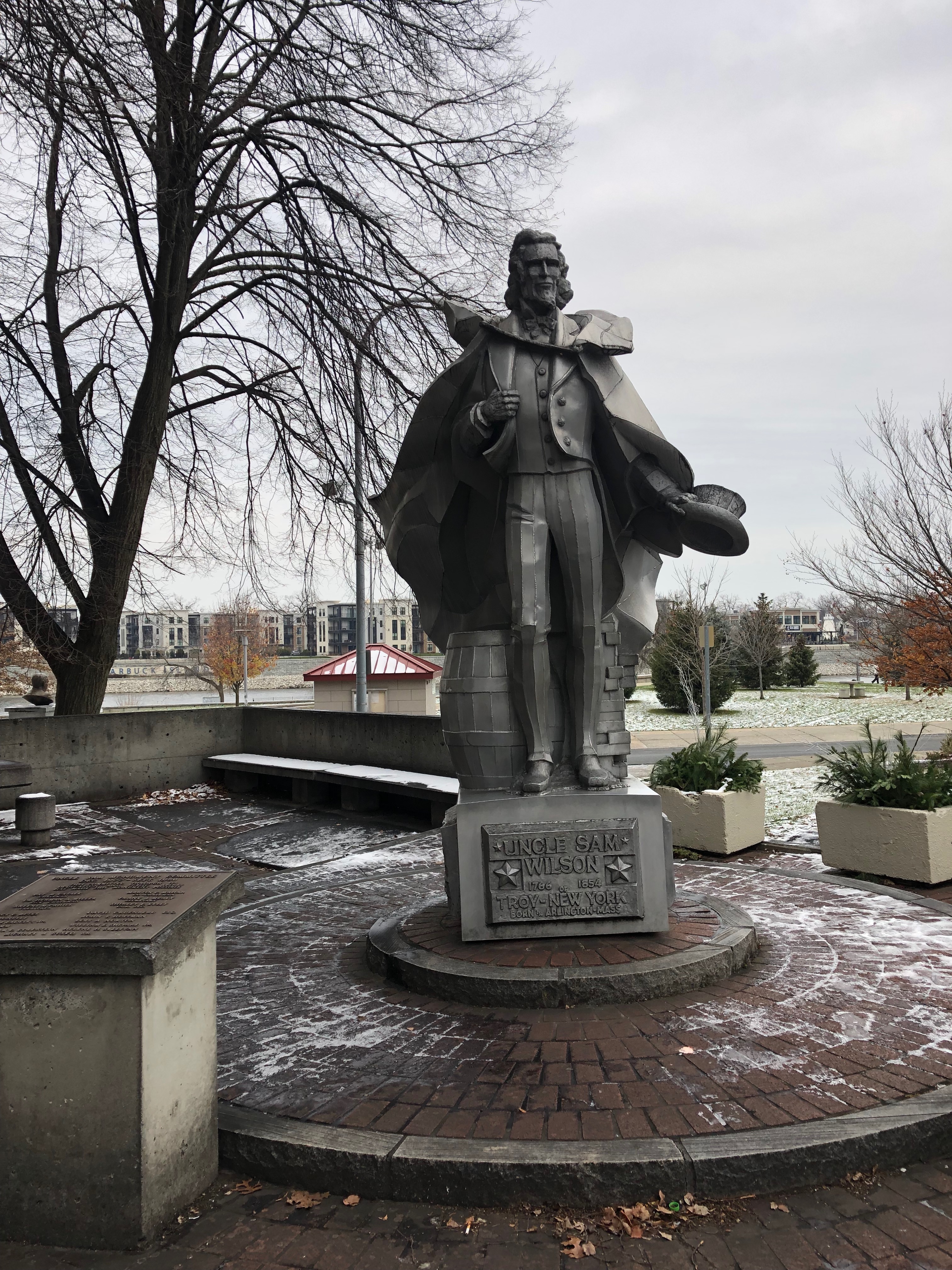
Upper left: Troy is the home of Uncle Sam – a sculpture of him greets passersby
Upper right and lower right: examples of murals
Lower left: Collar City Bridge spanning the Hudson River – One of Troy’s nicknames, it was the home of a shirt-collar industry a century ago.
Left middle: a view from downtown toward RPI (Rensselaer Polytechnic Institute)
Before I knew it, the weekend was over. After all that had gone into it, our guests left town, and Gary and I began to process it all.
In trying to reconcile the fear that is part of our lives today (not just Covid, but the divisions in our country, the threats to our environment, the rolling back of the reproductive rights of women, the doubts about our future) and the desire to celebrate a joyous occasion, I thought about the challenges faced by generations that came before. I thought about my grandparents having children in the depths of the Great Depression. I thought about my in-laws telling us about a wedding performed while they struggled to survive in the Ivye ghetto during the Holocaust. I’m not suggesting that the challenges we face today are the same as those, but we are in a difficult time. I am calling upon the strength and optimism of our ancestors to see me through this. They did not allow the fear to get the better of them.
Over the last year, as we planned the wedding weekend, I wondered if we were doing the right thing. Would it be worth it if even one person got sick? We decided to move forward – to try to minimize the risk, but to not let Covid define our lives. I think, like our ancestors, we affirmed life and love. I will live with that choice (and I will keep my fingers crossed that our one guest who has Covid recovers quickly and completely and that no one else gets sick).
I feel like a voyeur, but I can’t help myself. As I continue to sift through my aunt’s things, I am captivated by letters from my grandparents (my father’s parents). I hold certain impressions of them based on childhood memories and stories I heard throughout the years. The letters confirm some of those ideas, but also shed new light and offer a different perspective.
March 7, 1975
Dearest Clair,
So how be you ketzel? Do not forget M.D. appointment and Uncle Sam. Uncle Sam is by far the best Uncle anyone ever had. We are as we were, thank the good Lord. I am now in my glory that my “friends” have gone home…..
There is so much to unpack in this brief beginning. First, the date. March of 1975, I was finishing my junior year of high school. Grandma, the writer of this letter, was 69 and would be dead 9 months later. The letter gave no hint of her failing health, she may still have been without symptoms. About four months after this, she would be diagnosed with liver cancer and things went downhill fast from there. She died December 19, 1975.
She wrote from Florida to her ‘dearest’ daughter living in New York City. Clair was the baby of the family. I doubt there were letters written to my dad that began Dearest Barry. That isn’t to say she didn’t love my dad, but I don’t think they shared the warmth revealed in these letters. Again and again, in notes from both of her parents, Clair is addressed with terms of endearment. There are many possible explanations for the absence of evidence of that affection for my dad. To the best of my knowledge, Dad didn’t save letters. Dad also had terrible handwriting, more like chicken scratching, so he may not have kept up correspondence with his parents. But, there is something more. My memory was that there wasn’t much warmth between Dad and his parents. I’ve written about their complicated relationship before. If these letters to Clair are indicative of their bond, there was a great deal of it between Clair and her parents.
Photo of Grandma and Grandpa taken by Clair around the time of this letter.
I guess it should not be surprising. Siblings can have different relationships with their parents. I can think of examples of that in our extended family. One child sees their dad as heroic while another seems him as seriously flawed. One child may feel secure in the love of a parent, another may not. Growing up I saw things through the lens of my father’s perception. Reading these letters widens the view. It doesn’t change his reality but adds to the picture I have of his family.
Which brings me to the word ‘ketzel.’ I had to smile when I read that. Dad called me that all the time when I was a child. Ketzel means kitten in Yiddish. I didn’t know that growing up, but I recognized by the tone of his voice that it was a loving term. Ketzel is not a word I heard much if at all over the years since Dad died. Reading this letter in her Greenwich Village apartment brought my dad to me. I also didn’t know that it was a familial term – I only knew my dad used it but it makes sense that it would have been inherited along with their DNA.
Reading this letter, and the others, brought back other voices. It is nice to ‘hear’ Grandma’s voice.
Her voice comes through loud and clear. “So how be you, ketzel?” The phrasing of that is so Grandma. She was born in America, but her speech patterns had the inflections and syntax of the shtetl – at least that’s what I think it is. To me it is identifiably Jewish. Grandma was funny. She was quick with a quip, but she also had an amusing way of putting things – just like the opening of this missive.
“Do not forget M.D. appointment…”A Jewish mother reminding her daughter to take care from afar. Judging by the mounds of paper I sorted through in Aunt Clair’s apartment, she heeded her mother’s advice. She followed up on several medical conditions. Today we can access test results and other information from patient portals. Clair was ahead of her time. She kept copious records of various tests and lab reports, on paper and CDs.
“Do not forget… Uncle Sam. Uncle Sam is the best uncle anyone ever had.” She is reminding Clair to file her taxes – which I’ll say more about momentarily. But, what a great line! Though Grandma was American born and wasn’t as close to the immigrant experience as her husband, she had a deep appreciation for her country. For whatever reason, Aunt Clair was reluctant to file her taxes. It might have been straight up procrastination, or maybe something else was at play, but Clair struggled with this her entire adult life. Taking care of details, like filing paperwork, was the bane of her existence. Filing her taxes late (or not at all some years) may have been an expression of her rebellious nature. While Clair believed in government, a subject she and I discussed many times over the years, she wanted it to be run fairly and competently. It often fell short of the mark in her estimation, and it is possible she was showing her disapproval. Her mother, in this letter, was prodding her to take care of business – but unlike the medical appointment, she didn’t listen.
Another interesting tidbit from this letter – “We are as we were, thank the good Lord.” Again, interesting syntax, not your typical ‘we’re fine.’ Grandma was thanking God that her friends had gone home. The rest of the letter goes into the details of their friends’ visit that went sour, recounted with Grandma’s trademark blunt humor. I am a bit surprised that Grandma references God, given their lack of faith, but I don’t think it represents serious reverence for a higher power, more likely just a turn of phrase.
As I read these letters I get drawn into that world, adding to the picture I already have of my dad’s family. The letters offer a glimpse into a relationship I had no access to before. It feels odd to be peeking over their shoulders, but it doesn’t feel wrong. I have an enriched understanding and by disclosing it on this blog my family can share in it too.
This effort has brought up so much rich material, there is more to explore. I hope you will find it as interesting and thought-provoking as I have.
Note: Every so often my thoughts are best expressed in a prose-poem – I call it that because I don’t know what else to call it. As I continue going through Aunt Clair’s stuff, this is what came to me.
Aunt Clair saved letters
Who do they belong to now that
She has passed to another dimension?
The sender? The recycling bin?
Me – her devoted niece and self-appointed family historian?
Are they private?
Can I use them in my writing?
She saved them
To what end?
Buried in a stuck drawer
Wrapped in rubber bands
Encased in baggies.
Liberated, gently unfolded
Expressions of love
From her mother who died 46 years ago,
Endearments scrawled with an unsteady hand
From her father, also long dead.
Sister, nieces and nephews
offering thanks for a thoughtful gift
updating her from college or from across the world
Note: Aunt Clair, my father’s sister, has been included in this blog many times, including a post that was dedicated to her ( this one). She was a unique person who had a major impact on my life. As my cousin Ilana so aptly put it: Every teen and young adult should be lucky enough to have an adult who cares about them and exposes them to new experiences who is not their parent. We were fortunate to have Aunt Clair.The family gathered this past Friday to celebrate and honor her. These were my remarks.
Thank you for coming – or participating via Zoom.
I’m Linda, one of Clair Brody’s nieces. Aunt Clair communicated her last wishes to me, and I hope this gathering reflects her intent.
From the time she arrived on March 5, 1935 until her death on November 2, 2021, Clair, far more than most, did things on her own terms. It is something I have long admired, though I’m not sure it always worked to her benefit.
Aunt Clair was Brooklyn born and bred. Arriving while the Great Depression still had a grip on this country, she was the beloved daughter of hard-working parents, Leo and Selma Brody. She was the younger sister, by five years, of Diane (now Gareen) and 2 ½ years younger than Barry, my father. She was so proud of her older and very accomplished siblings. Clair went to New York City public schools and graduated from Brooklyn College, with a major in photography. She was a talented photographer and some of her work is on the table here. (I am including other photos below to show her work)
Leah on her first birthday – May 1988 – Photos by Clair Brody
Leah with her Grandpa – Clair’s brother – my dad – taken that same day
Clair went on to write code for computers – for TWA (which allowed her to travel far and wide), Bendix and Avis among others – she worked in that industry when it was in its infancy and when there were few women.
My brother Mark and I went to her apartment in Greenwich Village on Wednesday. There were a couple of reasons we went, but a major reason for me was to find some mementos of who Aunt Clair was and the legacy she leaves us. I think what we found does just that.
We were greeted by one of the long term doormen, who recognized me from my prior visits. He immediately asked, “What is happening? How is she?” Mark explained that she had passed away and his face dropped. The weight of the loss was clear. We thanked him for being so helpful to our Aunt Clair and continued on to pick up her mail and go up to the apartment.
Her mail gives another glimpse into our Aunt Clair. She has likely donated to every social justice and charitable organization in the world. The ACLU, Planned Parenthood, the Nature Conservancy, the City Mission, the Simon Weisenthal Center….the list could go on. Though she was never rich, she was generous with what she had.
We went into her apartment. First, we have to acknowledge that organization and neatness were not strengths of our beloved Auntie. Aunt Clair loved gadgets and tools and she had lots of them. She loved a good deal from Costco – so there was evidence of that, too. She enjoyed cooking and eating. – though she had a tiny galley kitchen in her Greenwich Village studio apartment – it was well-stocked with pots, pans, dishes….and gadgets.
There was a lot of dust. Aunt Clair accumulated things and saved everything. Medical reports from decades ago, instructions for exercise, letters. I found the original lease to her apartment – from July 1, 1960! She paid $80.40 a month. Think about that…she lived in the same place for 61 years. What does that say? As much as she was a free thinker, and she was as insightful and intelligent as they come, she did not embrace change.
As I looked around her apartment, I saw her love of art and music. Her taste in both could be quirky. She had lovely pieces of pottery. She also kept a plastic ring with a smiley face.
She loved biking. She had a compact stationary bike set up in that studio apartment. She had lots of tools and supplies to take care of her other bicycle, the one she kept in storage. I had great adventures with her biking.
There is much more I can say – and I will say a bit more about my personal relationship with Aunt Clair – but first I will turn to her other niece, Ilana. Then her nephew Mark will share his remembrance and I will come back.
————————————————————————
Before I share my personal memories, I want to say on behalf of my mother, that she is devastated by the loss of her sister-in-law. They may have been fractious at times (as Aunt Clair was with those near and dear to her), but they maintained a close and devoted relationship long after Dad died. Mom will miss their late-night telephone conversations and just knowing Clair was there for her.
I’d like to share some specific memories:
Aunt Clair was feisty. My father loved telling stories about her toughness, even as a little girl. One involved an unfortunate dentist who told the young Clair that the procedure he was about to perform wouldn’t hurt. Well, it did. Clair was indignant, claiming that he lied, she kicked him in a particularly sensitive spot and climbed down from the chair.
Making your way in New York City as a single woman isn’t easy. I remember Dad telling me about a mugging where Aunt Clair refused to give up her purse. She fought back and ended up bruised, angry and minus her pursue. Though Dad admired her spirit, his message to me was not to do what she did.
I learned that I had a bit of her spirit when I had an experience going into the subway. It was 1980 and Gary and I were going down the stairs to the station, Gary was ahead of me. I had a backpack on and I felt it being jostled. Without thinking, I spun and said loudly, “What the fuck are you doing?” There was a young man with his hand on my knapsack. He looked startled and he turned and ran. Gary had stopped, but the incident was already over. I surprised myself, it was an instinctive reaction. I think I was channeling my inner Aunt Clair.
Some of my fondest memories of time spent with her involved bicycling. Clair biked around Manhattan long before the city made any accommodations for riders.
I joined her for a bike tour of Manhattan. This was no ordinary bike tour. We started in Central Park at midnight! This was in August in the late 1970s when the park was a haven for drugs and violence. Hundreds of people were gathered with their bicycles at the Bethesda Fountain. It was odd to be there. In those years, I wouldn’t have gone into Central Park by myself in broad daylight. It felt exciting and adventurous to be there amongst so many fellow cyclists.
We rode around the park, stopping periodically to hear about its history. We left the park and rode along the east and then west side of Manhattan. We rode down Broadway, passing the neon signs of the theaters, all the way to the deserted financial district. The financial district felt like a movie set, with the skyscrapers seeming like two dimensional facades. It was so quiet, it was eerie. It felt like a ghost town. We were able to ride in the canyon of Wall Street without other traffic, pedestrian or vehicular. I got up close and personal views of the architecture and sculptures in a part of the city I had only seen on a rare school trip.
Our tour concluded at sunrise at Battery Park. A hazy sun rose over the mouth of New York harbor. We rode back to the Village, got breakfast at a brasserie and ended the adventure with a nap at her apartment.
It was not my only adventure with Aunt Clair. We took other bike rides – on Martha’s Vineyard and in Boston, too. She introduced me to walking across the Brooklyn Bridge – we bought wonton soup and ate it midway across – long before it became a ‘cool’ thing to do. I saw plays, movies and ballets with her. She introduced me to Alvin Ailey, not the man, the dance troupe. I have gone back to see them many times, and brought Gary and later my children. We ate many meals at wonderful hole-in-wall restaurants in her neighborhood. I learned so much about the city, and about being independent, from my time spent with her. Thank you, Auntie.
Finally, I want to say that I am so saddened by Aunt Clair’s final months. I wish it had gone differently. She struggled – in so many ways. She was just celebrating her 86th birthday when she found out the pancreatic cancer had returned. She fought it. She so wanted to maintain her independence, but she really couldn’t. Her body was failing her. So was our broken medical system and our country’s flawed elder care. I tried to help and so did others in the family, but we could not fix it. The inevitable was going to happen – and it did this past Tuesday.
I take comfort in several things, my memories, of course. But there is something else. When Gary and I visited her last Saturday, while she was still in the hospital, she was quite talkative. In between language that was indecipherable, she shared something important that I want to share with you. She said she had no regrets – she acknowledged that though she never had a spouse or her own children, she felt loved. She said she knew she was loved by her mother and father, and she felt like she belonged – her words. That’s more than many can say.
The last six months brought Aunt Clair a lot of anguish and discomfort, but I am heartened that she felt loved. I will miss her, as I know many of you will too, but she isn’t suffering anymore – I am grateful for that. There is a traditional phrase in Judaism, and though Aunt Clair was not religious, I think she would appreciate it: May her soul be bound up in the bond of eternal life. I hope her soul is bound with those she loved who left before her – her parents, her brother, her cousin Carol, her dearest friend Phyllis and other family and friends who were important to her.