Stories I Tell Myself

Linda Brody Bakst on Brooklyn, growing up, identity and more

  •  

    Note:  It seems particularly appropriate to be writing about this subject because yesterday was Gary and my 34th wedding anniversary. It has been wonderful to think back on the beginnings.

    The summer of ‘79 was a defining one, on many levels. The research experience in Corbett was enlightening, but more importantly, the summer of ’79 is when I met Gary.

    I moved off campus in my junior year (’78-79) with friends, Merle and Alison. They went home for the summer, but I stayed in our rundown apartment at 30 Haendel Street. Binghamton has a neighborhood where the streets are named after German composers and writers. The pronunciation of some of the names bore no relation to their German origins. For example, Goethe was pronounced go-e-thee!  30 Haendel was a three story walk up, with two apartments on each floor. We lived on the third floor, which was fine in the winter since warm air rises. Not so great in the summer, as I was about to learn. Forget air conditioning, I didn’t have so much as a fan.

    Our apartment sloped down about 10° from the front to the back; if you put a marble down on the floor of the living room it would have rolled down the hallway, through the kitchen and out the back door. It was a wooden structure, with sagging porches and rickety steps. The building probably should have been condemned, but we were oblivious to that at the time. It had its charms – mostly it was cheap, and it was the first apartment for all of us.

    Our friend Dianne sublet Alison’s bedroom for the summer.  Dianne, a psychology major, had a job for the summer waitressing at Sambo’s (yes, that was the name of the restaurant, as offensive as it was) and working at the autism clinic on campus, too. Dianne was an RA in College-in-the-Woods, one of the dorm complexes at SUNY-B, during the school year.

    Dianne was friendly with a couple of guys, Mark and Russ, who were also psych majors. They were also spending the summer in Binghamton. Mark lived a few blocks away from us, on Schubert Street which sat between Beethoven and Mozart (more German/Austrian composers!). Dianne and I began the summer hanging out with them and Mark’s housemates.

    Mark and his housemates talked about another guy joining them. I kept hearing that Gary Bakst was coming up soon. I had heard a bit about Gary before because Dianne was his RA (I’m sure Gary is wincing as he reads this), but I had yet to meet him.

    During the previous school year, I had several conversations with Dianne about this guy, Gary, who was a bit of a thorn in her side. Her floor was made up of females, but there were males in the two suites. Dianne took pains to cheerfully decorate the bulletin board that displayed the cafeteria menu and other announcements. Apparently, Gary and his buddies liked to kick a soccer ball around indoors with complete disregard for lighting fixtures and the bulletin board. 19-year-old ‘boy-men’ were not particularly respectful of her artistic efforts. Hearing Dianne’s frustration was my first awareness of Gary Bakst. Dianne and Gary did come to a meeting of the minds before the school year ended, but it was a bit of a bumpy road.

    I don’t remember exactly how I ended up in the car that picked him up from the bus station, but I was there when Gary arrived, and there was a lot of chatter about a problem. The house on Schubert Street was overbooked. Mark, had invited a friend, Jon, from another college, to spend the summer and offered him space in the apartment. Apparently, the other guys didn’t know anything about it, or maybe they did, it was all unclear. Gary was the last to arrive, though, and he was not okay with sleeping on the couch in the living room. It took a while to iron things out, there were some tense negotiations, but everyone ended up staying and Gary got a bedroom.

    When I wasn’t doing field work in Corbett, I went to the library on campus and ate lunch outside the student union. Some of the guys from Schubert Street who were working or taking classes on campus, along with Dianne, would show up at the student union at lunch time, too. Whoever got there first would grab a big table and slowly it would fill up.  Sometimes Gary and I got there early and we would chat. We got to know each other. I don’t remember what we talked about, but we shared a lot of interests. We were both sports fans and interested in politics, conversation flowed easily. Gary was taking physics that summer because he was pre-med, but he was a political science major, like me. I was comfortable with him and he made me laugh. I was, however, seeing his housemate, Mark.

    I don’t recall thinking at the time that I was interested in Gary ‘in that way.’ I was happy for his friendship, to be dating in general and to finally have separated myself from what had been a painful ending of a two-year relationship.

    Unfortunately, I spent much of my junior year wondering what was wrong with me because the guy I had been seeing (exclusively on my end), kept choosing to date other people! Part of the problem was that he lived in Brooklyn, going to Brooklyn College, while I was in Binghamton. But, I thought it was my failing – I wasn’t attractive enough, I wasn’t interesting enough, etc., etc. I was ruminating on that to the point that my stomach always hurt and I was pretty miserable to be around. Frankly, I think my housemates were getting tired of it. Finally, Alison left me a note and a bottle of Di-Gel, reminding me I needed to take care of myself and move on. It was the nudge I needed. I stopped wallowing – not completely, of course, but enough so that I took steps forward.

    That’s where I was at the beginning of the summer of ’79.
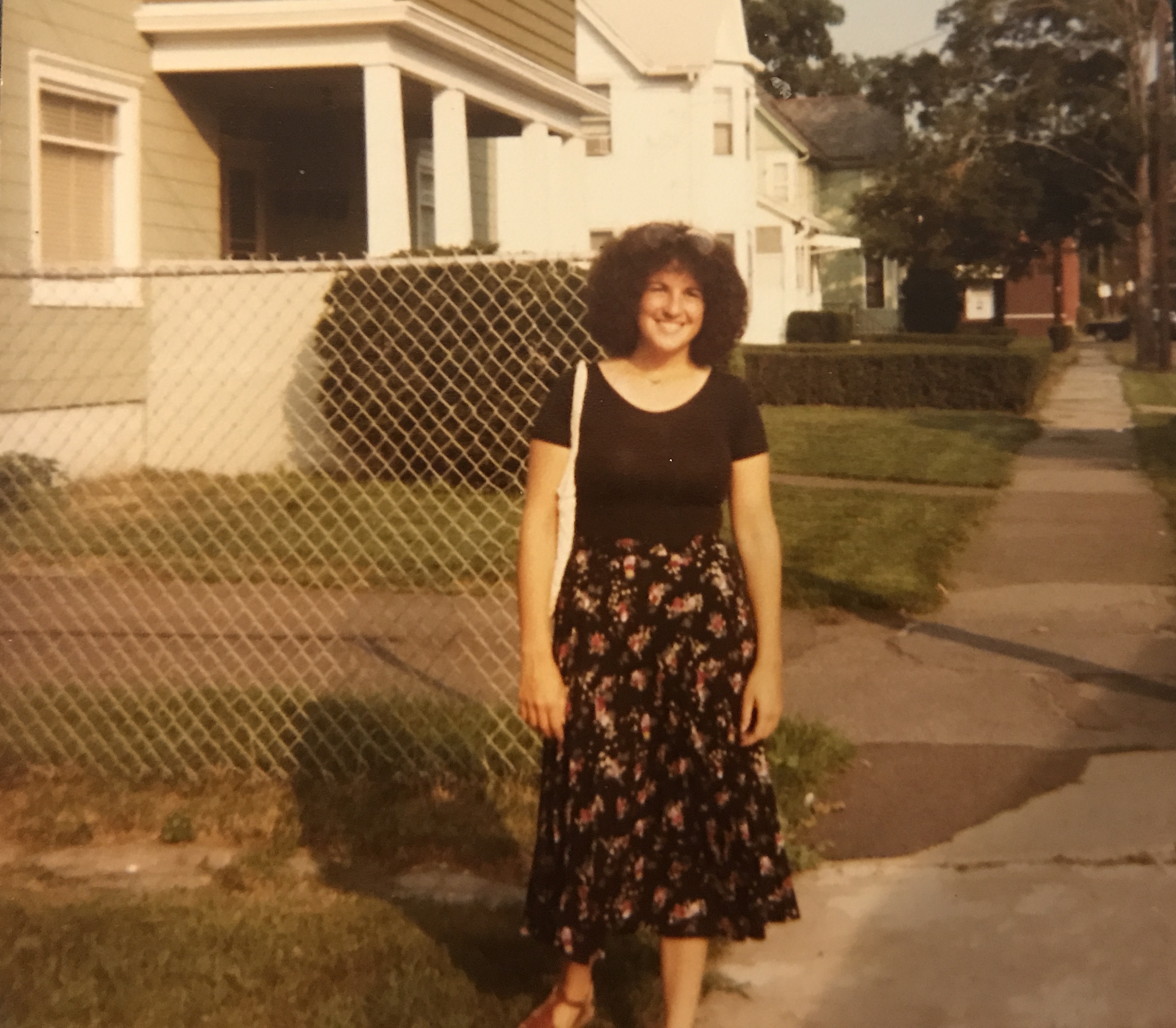
    IMG_0633
    Me, summer of ’79, attending dinner at Russ’s apartment

    Dianne and I kept busy: we hosted Mark and Russ for a barbecue. They arrived in suits! They returned the favor and invited us for dinner. The whole group of us, including Gary, went out to dance at Power and Light, a disco (it was that era). Some weekends we went to a lake to swim. I played tennis with whoever was available. It was a good summer.

     As the summer wound down, Gary mentioned that he and two of his buddies were looking for an apartment for the fall. I knew the apartment across the hall at 30 Haendel was going to be available so I told him about it and gave him our landlord’s phone number. Before I knew it, Gary had taken the place.

    One early August evening I realized I left a book in Dianne’s car, a two-door red Pontiac Le Mans. It was parked just across the street from our apartment. I quickly went down the three flights to the street.  I opened the driver’s side door and leaned in, but couldn’t quite reach the book on the floor of the passenger side. So, I sat down on the seat, one leg in the car, one hanging out the door. I stretched to reach and as I did the car door closed on my left foot. Ouch! That was one heavy door! I didn’t think that much about it, though. It was bruised, but I could walk. I finished out the last week of the summer in Binghamton, hobbled a bit, but doing what I needed to do.

    Everyone went home for a couple of weeks before coming back for the fall semester of our senior year. I was happy that Gary would be living across the hall, but I didn’t think too much more about it.

    Since I had a couple of weeks at home, I went back to work at the Perfumer’s Workshop. My foot wasn’t getting better, in fact it was getting worse. The subway ride was torturous. I felt the vibrations of the train as if electric shocks were shooting through my left leg. The pain traveled from my left foot all the way up to my thigh. After two days of commuting, I went to see Uncle Terry, who was at this point a practicing podiatrist. He x-rayed my foot and, lo and behold, I had a fracture! No wonder it was so painful!  He wrapped it and gave me a surgical boot.

    I went back up to school for the fall semester still wearing the surgical boot. Merle and Alison had not yet returned, but Gary had. Each time Gary left his apartment he checked on me to see if I needed anything. While I could walk, I was minimizing the number of times going up and down the three flights of stairs with my bulky boot. One evening he unexpectedly brought me ice cream – a sure way to a Brody’s heart. I was impressed, he was very thoughtful. I was still seeing Mark, but we weren’t that serious. Now Gary was on my radar.

    About two weeks into September, Gary asked me out on a date. We planned to go to Copperfield’s for dinner (a big step up from the usual places college students went to eat), and then to campus to see a movie. Sounded pretty mundane, but it didn’t turn out to be.

    More to come next week 🙂

     

  • Growing up in Brooklyn in a tight-knit, large Jewish family created a kind of myopia. I didn’t know there were other ways that people lived their lives. Fortunately, I had an experience in college that helped lay the groundwork for having a broader perspective.

    One might think that going away to college in and of itself, going from Brooklyn to SUNY-Binghamton in the Southern Tier, would have broadened my horizons. Given the demographics of the school, though, it really didn’t do much to expose me to diversity. Most of the students came from Long Island and the boroughs of NYC.

    I was a political science major. In my junior year in 1979, Professor Weisband, who I admired greatly, announced to our international politics class that a summer research position was available. The National Science Foundation was offering funding to support a research project and would award grants based on an application process. It sounded like an exciting opportunity, so I applied. Much to my surprise, I was awarded the grant, so I spent the summer in Binghamton working for Professor Richard Rehberg, who was engaged in a project to study a ‘company town,’ where the company left.

    Professor Rehberg was conducting community development research, in conjunction with a non-profit think tank, The Institute for Man and Science. Corbett, New York, located about 70 miles east of Binghamton, in the heart of the Catskills, was founded as a company town in 1912. The Corbett-Stuart Company established an acid factory there and the company owned the land, property and houses. They rented homes to the employees.

    The acid factory went out of business in 1934, but the company held on to the property. Residents continued to live there, paying rent, but finding work elsewhere, cobbling together a life. In 1976, there were 170 residents in Corbett. The Stuart family, which still owned the town, put it up for sale. The headline in the classified section of New York Times read:  One small town for sale, fully occupied. The description went on to say: 130 wild acres; a cluster of 30-odd white frame houses, an abandoned schoolhouse whose black iron bell still hangs in the belfry cocked at an angle as if waiting to peal out a last ring; an abandoned general store with a Canada Dry sign on the door reading, “Glad You Stopped, Come Again”; an old horse barn with a blacksmith shop right next to it; and alongside the road, traces of the old rail bed where the trains of the Delaware and Northern Railroad used to roll when Corbett was a prospering acid factory town and a good place to live.*

    Corbett was no longer a prospering town, part of the research project was looking at whether it could be a good place to live again. Although there were other interested buyers, the residents of the town teamed with the Institute of Man and Science (now known as the Rennselaerville Institute) to buy the town!

    Part of the Institute’s arrangement with the residents included permission to do research on the process of community development. To continue to survive, the town would need physical improvements (to address water and other infrastructure needs). Given the economics of the area, the residents would have to do a lot of that work themselves. This presented a unique opportunity to study the process of the residents organizing to accomplish those goals.

    In fact, the town developed a compact. The Corbett Compact included the following:

    We, the members of the Village of Corbett and The Institute on Man and Science set forth on an adventure which requires our full cooperation and commitment. Like the passengers on the ship Mayflower we herewith draft and sign this compact setting forth some articles of common faith and agreement.

    In so doing, we give our pledge to rebuild Corbett as a small community in which people help each other…in which we can get a good night’s sleep…in which our children can range safely…in which we can feel good about our town, our neighbors, and ourselves…in which we do not waste.

    At the same time we seek a community in which people live and let live, respecting the rights of others to be different. We want people to grow. Some will grow and stay. Others will grow and leave. But for all of us, Corbett may always be home.*

    All of this was incredibly foreign to me. I had never heard of a company town. The notion of a whole town being owned, not self-governing, was outside my frame of reference.  I was pleased to learn that this town was embarked on such a huge transition, and I was interested to meet the people who aspired to realize the promise of their compact.

    Another element that was alien to me was the size of the town. I couldn’t imagine living in a place made up of only 170 people. There were more than 170 people living on my block in Canarsie.

    Although my family had done some traveling in America, I described my reaction to driving through Wyoming in 1973 in another blog post, I had never come face-to-face with rural life in America. Corbett was rural America.

    My job that summer was to assist in administering surveys to the residents and to do my own research on utopian communities. I would produce a research paper on commonalities among utopian communities that contributed to their success and failure. The idea was that, perhaps, I could uncover some lessons that might be useful to the Corbett project. Though Corbett was not conceived as a utopian community, it was endeavoring to be a planned community.

    I remember my first visit to Corbett. I drove with a graduate student, Kevin, who was also working with Dr. Rehberg.  We drove country roads, up, down and around the lush, green hills. We passed reservoirs. We saw more cows than people, by far.

    27skeldingweb2-master768
    We passed many views like this as we traveled from Binghamton to Corbett.

    We turned off the two-lane blacktop onto a gravel road and found ourselves in Corbett. This was the definition of being in the middle of nowhere. It was warm and sunny, the air was clear except for the dust the car had kicked up. The only sounds were the wind in the trees and bird calls. I saw a modest, run-down home in front of us. We went up the two worn steps to the wooden porch and knocked.  Marcus, one of the town leaders, pushed open the screen door and welcomed us in. He was expecting us.

    The house was shaded by the huge trees, so it was cool inside. Marcus made himself comfortable on a large recliner. Kevin and I sat across from him. Kevin asked the questions from the survey. While I don’t remember the particulars, the questions focused on quality of life and the resident’s satisfaction. As I recall, most of the people we interviewed were quite satisfied.

    This was a revelation to me. To meet people who lived such modest lives (in my view at the time), but who were comfortable with it, came as a surprise. I thought happiness was much more complicated. One of the things I realized is that for some of the people who lived in Corbett, living closer to nature was a source of pleasure. Cutting wood, drawing water from a well, hunting and fishing, and repairing your own house brought satisfaction. Working with neighbors to revitalize their town, even if they didn’t all like each other, was rewarding. It is one thing to read about other ways of life, it was another thing to meet it, up close and personal. I was not ready to sign up for life in a small community, but I understood it better.

    I had another, more minor, revelation that summer. Dr. Rehberg invited me to a gathering at his home. I felt awkward about attending since I was the only undergraduate, but I felt like I had to. I remember sitting on his deck, everyone was drinking beer and relaxing, letting their hair down, so to speak. Even though I was a college kid, and beer was the cheapest beverage, I never developed a taste for it. I was politely sipping one, trying to be sociable. I looked around and it hit me. These ‘grown-ups’ were not that different from me and my friends. After drinking a few beers (or in my case, a mixed drink or two), they were every bit as silly as we were. Somehow, I thought adults were different. It was a relief (and maybe a disappointment) to learn that they weren’t.

    Dr. Richard Rehberg was a good guy. I would address him as Dr. Rehberg or Professor, and he would say, “You can call me Dick.” I was of a generation where Richards were called Richie, Rich or Rick. Definitely not Dick. He was perplexed by my refusal and I explained that I was raised by my parents to call adults Mr. or Mrs., which was true, but wasn’t the whole story. As much as I started to see him, and other professors, as human beings, and despite his gracious invitation, I would not call him Dick.

    The summer of ’79 was a defining one for me. I had come off a difficult junior year because of a break up that was very drawn out and painful. I grew a lot that summer. Staying in Binghamton, doing the research, having the experience in Corbett broadened my horizons.

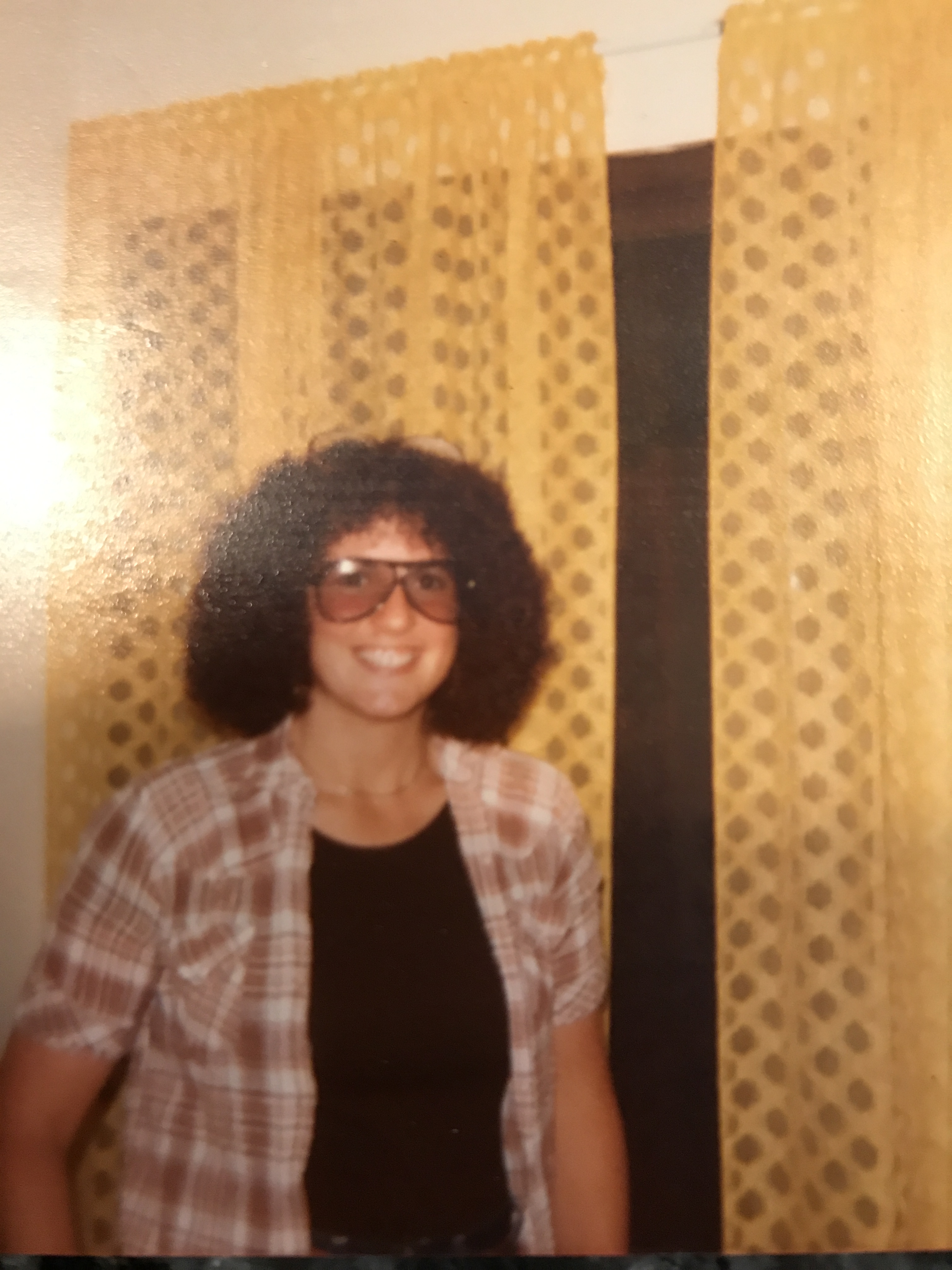
    fullsizeoutput_115
    Me, in front of the house in Binghamton, the summer of ’79. Can you find the glasses atop my head amidst all that hair?

    I also met Gary that summer. That is a story for another blog entry.


    *”The Catskills Mountains USA – Physical and Cultural Restoration,” Cultural Survival Quarterly Magazine, by Harold Williams, September 1986 (retrieved 7/22/17)

  • IMG_0125
    Wisteria in Ronda, Spain – Fortunately, I could see it quite well, but I could not smell it 😦

    Driving from Brooklyn to Champaign-Urbana, I was always the first in my family to know that a farm was nearby. I picked up the scent of cow manure miles away. Cow manure was in wide use as we drove Interstate 70 through the farmland of Ohio, Indiana and Illinois. To some, who perhaps grew up on a farm, that pungent aroma may have evoked warm feelings, reminders of Spring, the earth and beloved animals. For me, with my city sensibilities, it reminded me of the elephant enclosure at the Central Park zoo. I held my nose until I thought we passed it, or until I absolutely had to take a breath.

    When I was early in my pregnancy with Leah, it was autumn. The smell of moldering leaves followed me around, I think the odor took up residence in my olfactory system. Years later, whenever I caught a whiff of rotting leaves, it reminded me of my pregnancy – a strange, perhaps unfortunate, association.

    I enjoyed pleasant aromas, too. Freesia was a favorite flower. I loved Jovan Musk, the perfume, when I was in college. Baking chocolate chip cookies or roasting chicken were wonderful kitchen scents. Many childhood memories are infused with scents: suntan lotion at Belle Harbor Beach, mothballs in a cabin in Harriman State Park, the mountainous landfill next to my Canarsie home.

    The first time I lost my sense of smell and taste was in 1989. Dan was 7 months old and Leah was just shy of two and a half. I took a leave from my doctoral program, first to give birth to Dan, and then extended it to go back to work full-time. Gary was in the third year of his internal medicine residency with two years of an endocrine fellowship still to come. He was paid for his efforts, but it was a paltry sum – certainly not enough for our family of four to live on. I had a graduate assistantship to attend the PhD program, but it wasn’t enough to cover our expenses.

    A professor of mine, who knew I was looking for work, informed me about a job opportunity with the New York State Legislature. I applied and got the job; I started in late September of 1989. I reported for my first day of work with a heavy cold.

    I was assigned my own cubicle, which made me slightly less self-conscious about the constant nose-blowing and hacking. I had been to the doctor and was already on an antibiotic. After another week or two with no improvement in the symptoms, I went back to the doctor. She prescribed a different antibiotic.

    One afternoon I was sitting at my desk at work and I took some M&M’s as a snack. I put a couple in my mouth and realized I couldn’t taste it. I could feel them dissolving on my tongue, but I didn’t taste any sweetness or chocolately-goodness. I took a few more, just to be sure. Nothing! How disappointing! I didn’t think that much about it, though, attributing it to the severity of my congestion.

    That night, as I was reading to Leah before bed, I noticed I was a little breathless. I couldn’t read aloud as fluidly as I usually did, needing to pause every few words to catch my breath. I pointed it out to Gary, who put his stethoscope to my lungs and heard me wheezing. I had never wheezed in my life. I went back to the doctor the next morning.

    The doctor sent me for a chest x-ray and then I went back to work. A couple of hours later I got a phone call telling me I had pneumonia in both lungs. I asked the doctor if I needed to go home. The doctor said, “Yes! And, let’s schedule you to come back in tomorrow.”

    When I visited the doctor the next day, she looked at me and suggested that I go to the hospital. “You clearly can’t get the rest you need at home. And, we should try IV (intravenous) antibiotics for a day or two.” I agreed. My family rallied to help take care of Leah and Daniel.

    Between the bed rest, IV antibiotic and, an inhaler, I turned the corner. Over time, my tastebuds came back and so did my sense of smell. Both senses may have been dulled a bit, but not that noticeably.

    When the kids were young it felt like I was constantly battling ear infections, sinusitis and/or bronchitis, though I never had pneumonia again. I had another episode of losing my sense of taste, but after a course of steroids, it came back. Over the years, I don’t know if it was related to the recurrent respiratory issues or not, my sense of smell diminished. Fortunately, once Leah and Dan were done with elementary school, I stopped getting those infections, but my sense of smell got left behind.

    Today, I no longer perceive skunk! The odor must be unbelievably pungent for me to get even a whiff of it. Not a huge loss, it’s true. But, I can’t appreciate the scent of flowers either. Even sticking my nose into a rose, I only get a hint of the fragrance. It is so ironic, having been born with such a sensitive nose.

    Smell is such an important part of forming memories, such an important part of experiencing the world. It is funny how there are some things I can still smell, the sense isn’t entirely gone. I still know when the litter box needs to be changed, thankfully (or not)! The pungency of slicing an onion still brings tears to my eyes.

    Earlier this Spring, walking in the woods with Gary, I sensed the freshness in the air, but not the sweetness. “Can you smell that?” he asked, as we hiked. “These white blossoms are really sweet.” I shrugged, “Nope.” We walked on. I appreciated the rich green carpet of ferns, the sun dappled leaves, the sound of the wind in the trees, the coolness of the shade. But, it felt a bit incomplete.

    Yesterday Gary and I took a break from our car ride from New Jersey to Albany to check out the Walkway over the Hudson River. The walkway is a pedestrian bridge that links Highland and Poughkeepsie.

    It was still warm, though the sun was setting. The air had cleared after a morning of heavy, hazy humidity.  We enjoyed great views of the Hudson north and south. Heading back, with a neighborhood of Poughkeepsie beneath us, my nose registered something! “I smell barbecue! Smells good!” I said. “You can smell that?” Gary asked happily. We found the source, a family cooking out in their backyard.

    My visual and olfactory systems may be flawed, but I’ll enjoy what I have for as long as I have them. I’m sure others struggle with compromised senses. Smell isn’t often mentioned; I think it deserves some attention.

  • Note: I wrote the following essay about two weeks after the election of Donald Trump. I didn’t post it to the blog at the time, I wasn’t sure that I wanted to take the blog into the political arena since it is such a divisive subject.  But, I am continuing to experience anxiety related to Trump’s presidency – in fact, I was motivated to write a poem, which you’ll find at the end of this essay. So, I re-read what I wrote, and did some editing and decided to share it. I hope it offers food for thought.

    donald-trump-650-afp_650x400_61498283248

    I am struggling. I have moments where I imagine I have the energy to do the things I need to do – laundry, cooking, planning stuff, paying bills, writing, etc. And then when I actually need to move to do them, I feel like I am in mud. My spirit is in quicksand and sinking slowly. Has it reached bottom yet?

    I know that I need to move beyond that, but I am so profoundly disappointed. I feel drained. I’m hoping that writing this, as writing often does for me, will be a form of expurgation. Maybe I will be able to leave it on the page. So here goes….

    In the wake of Trump’s election, I have been thinking a great deal about the people who voted for him and what they might believe.

    Here are some beliefs I can accept, even if I don’t agree with them:

    • That government is not able to provide solutions to societal problems.
    • The primacy of individual responsibility, rather than “it takes a village.”
    • Big government is inefficient and incompetent.
    • American businesses and workers need more protection in global markets.
    • Religious faith, if one is a believer, should guide personal behavior and choices
    • Less regulated (or unregulated) capitalism is the best economic system.
    • Favoring national security over personal privacy.

    Here are some beliefs I cannot accept:

    • That immigration policy or immigrants are the source (or even a major source) of America’s economic and/or societal woes.
    • That building a wall will solve any of America’s problems.
    • That people of color have too much power (or that white people have too little power) in this country.
    • That by sanctioning same-sex marriage, we are on a slippery slope that will allow bestiality or polygamy.
    • That government has a role to play in regulating reproductive rights (other than its role in approving drugs and licensing doctors, etc.)
    • That one individual’s religious faith can trump another person’s beliefs.
    • That Hillary Clinton belongs in jail.
    • That registering Muslims, or preventing immigration of Muslims, will reduce the threat of terrorism.

    The above is partially in response to something my nephew wrote after the election. He wrote about how essential it is to be willing to talk with and listen to people with differing perspectives and not live in an echo chamber (not his words, mine). I see the danger in that. But, I also don’t think the ‘echo chamber’ is the root of the problem. I think that makes the problem far worse, but the divisions in our country, at their root, aren’t caused by the failure to listen to others. I think the division is about fundamental beliefs and, in some cases, willful ignorance.

    No matter how much I talk to someone who thinks Hillary belongs in jail, they are simply not going to be able to convince me (and it is highly unlikely that I will change his/her mind). My mind is closed to that notion. Unless and until evidence of a crime is presented, and despite the extraordinary effort to do just that, it hasn’t happened.

    Some beliefs may be born of ignorance, for example, climate change denial may be based on ignorance of the science. But to overcome ignorance, you must be willing to be educated and accept information (facts) that doesn’t conform to your mindset (if actual evidence of Hillary’s criminality surfaced, I would change my view).  The willingness to be educated is different than being willing to exchange ideas with someone. Yes, I can learn something by listening to another perspective, but at some point we need to agree to a body of knowledge or a set of facts about our world. I see that failure as the root of the problem.

    When we are receiving information, it seems to me, we look at it through the lens of our belief system. I don’t see things in black and white, I see many, many shades of gray (which is sometimes a pain in the ass), but it generally makes me open to considering alternative ideas. When I receive information, I ask myself a number of questions: where did the information come from? Is it observable? Is it consistent with other known facts? It’s like when I used to read journal articles in graduate school – what was the methodology? Can the findings be trusted? Do others do that when they receive information? And if they don’t, what do we do about that?

    I see most things on a continuum; values, beliefs, philosophies. Here are some of the belief continuums I see:

    People inherently good—————————————–People inherently evil

    Individualism—————————————————–Collective Responsibility

    Capitalism———————————————————State-run economy

    Isolationism——————————————————–Globalism

    Unfettered Growth———————————————–Environmental Protection

    Business Owners’ Autonomy———————————–Workers’ Rights

    National/Personal Security————————————Individual Privacy

    Closed US Borders————————————————Completely Open Borders

    Gun-Owner Rights————————————————Repeal 2nd Amendment

    Obviously within these categories there are many sub-issues.  But, I think this captures the major issues of our day. Am I missing anything?

    Here’s where I would put myself:
    X(midpoint)

    People Inherently Good———-L——————————People Inherently Evil

    Individualism————————L—————————-Collective Responsibility

    Capitalism——————————-L————————–State-run economy

    Isolationism—————————————L—————-Globalism

    Unfettered Growth———————————-L————-Environmental Protection

    Business Owners’ Autonomy————————–L———-Workers Rights

    National/Personal Security————–L———————–Individual Privacy

    Closed US Borders———————-L————————–Completely Open Borders

    Gun Rights————————————————-L———Repeal 2nd Amendment

    Can you place yourself on these scales? Where do you fall?

    Maybe this is silly, but I tend to weigh things (not myself, if I can help it).

    Can we have meaningful discussion along these lines? Would it be helpful? If we recognize our predispositions, if we are honest with ourselves, perhaps we can look at information more objectively.

    ___________________________________________________________

    Six months later, I was driving up the Northway, with a too familiar feeling in the pit of my stomach, as I listened to NPR report on the G-20 summit. Here is the poem that came to me:

    His Presidency

    What is that feeling?

    My stomach grips

    My arms are weak

    I sigh deeply


    Images and thoughts of our President flit across my mind

    His signature hand gestures

    His limited vocabulary

    His callousness

    It is unbelievable to me that he represents us on the world stage


    I have physical symptoms

    Of his presidency

    What is the cure?


  • 1843-10-tarjetas-de-hugs-and-kisses

    Another family gathering was coming to a close and I was saying my good-byes. When I was young my family used to joke about “Jewish good-byes,” referring to the fact that we needed to begin the process of saying farewell an hour before we wanted to leave.  I remember my father nudging my mother to begin. There were hugs and kisses for each aunt, uncle and cousin, and, in the midst of that, new conversations would start. The process could take quite a while.

    I was never comfortable with that ceremony. Somehow, and I can’t explain it, I was always uneasy with the hugging and kissing. I loved my family, including the extended members, loved our conversations and connections, and I wanted to express warmth – but did it have to include a kiss? Couldn’t we nod and smile at a comfortable distance?

    As a young child, the resisting of kisses became a thing. When family came to visit I either begrudgingly gave them my cheek, or I avoided them. It became a running joke with one of Nana’s cousins, who went by the nickname “Knock,” his last name was Nachimow. He would cajole me, he practically chased me around the living room. I tried not to give in. It was a strange combination of funny and upsetting to me.

    Many years ago, I remember seeing an old family movie of my brother, Mark, trying to give me a kiss on my cheek. I may have been two years old in the film, which would have made him five (I was probably 30 when I last saw it). The way I remember the film, I was trying to climb out of the backseat of the car and Mark was trying to give me a kiss before I got out. The film had no audio so I don’t know what was being said, and I don’t know who was holding the camera.  I was squirming and pushing him away. I was not surprised seeing the images on the grainy film. I knew this about myself, but it also it made me sad.

    Watching our actions, I felt sad for Mark. I don’t think he was doing anything wrong. He was expressing affection for his little sister, but I wanted no part of it. On the one hand, I was entitled to define my boundaries. I certainly felt, and still believe, that a person should have control of their body and their space. On the other hand, what was it about kisses and hugs that made me squirm?

    I was probably about 10 when Uncle Terry had a minor surgical procedure. He was recuperating in his bedroom, which was above mine in our house in Canarsie. I think I made a card for him and went up to visit. Knowing my reticence about getting kissed, he told me had a secret for me and when I bent down to listen, he planted a kiss on my cheek. I blushed deeply. “Uncle Terry!” I yelped, I was so surprised (I have always been gullible so falling for the ruse was no surprise.) “That wasn’t so bad, was it?” he asked. I had to admit it wasn’t.

    In junior high school, I had a great social studies teacher. It was toward the end of the year and the class knew his birthday was coming up. Since my grandfather worked at a bakery, I volunteered to bring in a cake. I presented the cake at the end of class, someone else brought paper plates and forks. The class sang ‘happy birthday.’ Mr. Stern was clearly touched. After the little celebration, he gave me a peck on the cheek. I could feel my face burning bright red and I retreated back to my seat. I hoped no one noticed.

    When I was in college and I saw how some of my friends interacted with their siblings, it was a revelation. They would greet each other with hugs and kisses. They might sit close together on a couch or put an arm around a shoulder while chatting. That was not how I interacted with my brothers. I’m not sure when the last time I hugged Mark or Steven. But, I don’t doubt our affection for each other. I know they would be there to help, protect or support me, as I would be for them.

    But it does strike me as a bit odd. Saying our good-byes at that recent family gathering, I felt some of my usual uneasiness. I certainly give my mom a kiss and hug. My children have no choice – I am getting my hug (unless we are ‘schvitzy’)! After that, it is all iffy. And, for me, there is still some awkwardness about it. With some relatives, the expectations are clear – we will hug, or we will give each other a peck on the cheek.  It is equally clear with my brothers, we will just wish each other well. But for some there is a bit of a dance. Perhaps we should develop signals so people will know what we’re comfortable with.

    Now that I’ve written this, I’m sure all my interactions with friends and family will be totally comfortable! No one will try to hug or kiss me ever again! I hope it doesn’t come to that. As with most aspects of human behavior, I am endlessly curious about it. Why are some naturally physically affectionate? Why do others shy away from it? Why am I still conflicted? The search for understanding continues.

  • It was the summer of 1980 and I had just graduated from college. I would start graduate school at Columbia in the fall. I planned to work at The Perfumer’s Worskhop for the summer, the same place I had worked for the past three summers. The Perfumer’s Workshop was a company that created and distributed a few different lines of perfumes and essential oils, very high-end products that were sold only at the best department stores. Prior to working there, I had not even heard of these department stores. Suffice it to say that Princess Luciana’s Tea Rose, their biggest seller, was not offered at Alexander’s, or even A&S, and A&S was a fancy store, in my estimation.

    tea_rose_range-490_h

    I got the job through a friend of my father. I learned a lot in my time at The Perfumer’s Workshop. Aside from learning the names of the high-end department stores across the country (Nieman Marcus, Bullocks, Carson, Pirie, Scott, etc.), I saw a whole different world in that office. Mr. Bauchner, the owner, was always tan and dressed in the latest men’s fashion. He frequently jetted off to Dubai and Kuwait – exotic places I had not heard of until then. I hadn’t seen ‘air kisses’ before – visitors were greeted with pecks on the cheek that seemed to deliberately miss. Mr. Molyneux, the ‘nose,’ came to the office carrying his seemingly miniature Yorkshire terrier in his arms like a baby. (Note: The person who developed the scents at a perfume company was called ‘the nose.’) He had a light green velvet suit that he favored and sometimes he wore a beret.

    It was a very small company; all the men were addressed as Mister. The office manager/controller was addressed by her first name, Eve. All the women, and there were only a few, were called by their first names. At the time, this seemed appropriate.

    They offered me a permanent job, but I could not see my future there. I knew, and I was honest with them, that I didn’t want to be a bookkeeper and I had no interest in the world of high fashion and all that entailed. They were very gracious about allowing me to continue to come back for summers and school breaks.

    In August of that summer the Democratic party was holding its convention at Madison Square Garden. My parents’ good friend, Sonya, was very involved in politics. She was, in fact, married to a congressman (Ted Weiss) who represented Manhattan’s Upper West Side. Sonya had connections and knew I was interested in politics, so she arranged for me to get an interview to work at the convention.

    On a hot, humid July day I made my way from the Perfumer’s Workshop office on 57th and 5th to the interview at the Statler Hotel across from Madison Square Garden. I anticipated a swanky Manhattan hotel; it wasn’t. It had clearly seen better days. A threadbare carpet led me to a hotel conference room where I was briefly interviewed. It was clearly a formality. They told me they would be in touch with more specifics. I can’t say that I left feeling excited because I didn’t know what the job entailed, it all seemed pretty loose. The drabness of the hotel colored my mood. I went back uptown to the Perfumer’s office thinking that I couldn’t pass up the opportunity, despite being underwhelmed by the interview process. In the meantime, I would continue working at the perfume company until the convention.

    During that summer, my brother, Steve, and his wife, Cindy, were temporarily living in London. They were there for six months and that summer was in the middle of their time there.

    Cindy and Steve allowed me to ‘apartment-sit’ at their lovely place in Jamaica Estates in Queens while they were away. Living there cut down my commute time dramatically, compared to Canarsie, and not having to move back in with my parents after college was a big plus. Unexpectedly, it also provided an opportunity for Gary to ingratiate himself with my father.

    One evening I was on the phone with Gary. He was at his parent’s house in Rosedale, another neighborhood in Queens. We were chatting happily when Gary said he needed to go (literally) and he would call me back. We hung up and I went about my business. I think about half hour or 45 minutes went by when there was a knock on the apartment door. “Who’s there?” I ask, as I looked through the peephole. I see Gary and I open the door. Not only is Gary there, but his brother, Steven, is standing to the side of the doorframe. They both have baseball bats!

    “You’re okay?” Gary asked. “Yes. What’s going on?” I opened the door wide so they could come in. “You didn’t answer the phone!” Gary exclaimed, sounding exasperated. “What do you mean? It didn’t ring,” I responded. I went over to the phone and picked it up and to my surprise there was no dial tone.

    Turned out, Gary, having answered nature’s call, tried phoning me continuously for ten or fifteen minutes, getting progressively more nervous when I failed to answer. We had been on the phone and he knew I had no plan to go out, or even get in the shower. So, in a move that sealed him in my father’s heart forever, he and his brother jumped in the car and drove (maniacally, if I know Steven) over to make sure I was all right – bringing baseball bats to mete out justice, if need be.

    We surmised that something must have happened with the phone after I hung up and I didn’t realize it had gone out of service.  They were quite relieved to find that I was safe and sound. Gary and Steven went back home satisfied that all was well.

    Steve and Cindy’s time in London provided the family with an opportunity to see England and there was discussion about visiting them. Pam, Cindy’s sister, wanted to go and we explored traveling together, but the timing didn’t work. I was betwixt and between because I needed to make money over the summer, so I didn’t want to cut short my time at Perfumer’s Workshop. I also wanted to work the convention and I would be starting graduate school early in September. But, how many opportunities would I have to go to London and have a place to stay for free? The trip would cost me only airfare and meals. But, how many opportunities would I have to attend the Democratic National Convention?

    It was a tough decision.

    After weighing the merits of each, I decided to go to London. I have vivid memories of that trip. I probably spent more time with my brother Steven during that week than I had in my life up to that point, or since. We took Brit Rail to Bath and saw Roman ruins and where Jane Austen lived. We went to museums and saw a play, Mousetrap. We also snuck into the second act of the play, Norman Conquests! I did some exploring on my own, too.

    Most memorably, though, we took a one-day trip to Paris. When I arrived in London, Mark and Pam were concluding their own visit. (As mentioned previously on this blog, my two brothers married two sisters. Mark and Pam were engaged to be married in the summer of 1980.) We overlapped for one-day, quite an auspicious day. My plane landed at Gatwick, I took a train to Victoria Station and found Steven waiting for me. We went to their apartment, met Cindy, Mark and Pam and dropped my stuff off. We left immediately to catch a bus. We took the bus to the ferry to cross the channel (the Chunnel didn’t exist yet). We arrived in Paris as the sun was coming up. We had a little over 12 hours to tour Paris on our own before we caught the bus back to London.

    I have a picture in my mind’s eye of us crisscrossing Paris, trying to see as much as possible in our limited time. My sister-in-law, Cindy, has very long legs and covers a lot of ground quickly and efficiently. Steven, with years of experience as her partner, matched her pace. I lagged behind them, but kept them in sight. Mark and Pam were quite a bit behind me. We trooped through Paris in that alignment. The Eiffel Tower, the Tuileries, the Pompidou Center, the Champs de Elysees, and the Arc de Triomphe. Mostly we just walked by the various sites. We did go into the Louvre. I couldn’t believe I was seeing so many iconic places.

    It was exhausting! We met up with the others from the bus at a restaurant where we had dinner before boarding for our return. I sunk into my seat, beyond tired, barely able to keep my eyes open. Next thing I knew, there was a bit of a commotion and some male passengers, including my brothers, were coming down the aisle of the bus. It was pitch black as I looked out the side window, but there was a huge bonfire ahead of us blocking the road. There was some shouting in French. I didn’t understand what was going on. I heard my brother Steven explaining to the bus driver that he had previously traveled back to England through Ostend (in Belgium), which wasn’t too far. We were scheduled to get to the ferry in Calais in France, but we were thwarted. Steven was giving the driver directions so we could find another way back!

    I came to understand, later, that French fisherman had created a blockade at Calais so that boats could not cross the English Channel. The bus driver was planning to ram the bus through the bonfire! Fortunately, the passengers, including my brothers, convinced him that going to Ostend was a better option. The blockade later spread to other ports. It was a dispute about fishing rights. We made it to Ostend and got on a ferry back to England. It turned out to be the last ferry for something like two weeks! We couldn’t believe it. Thank God Steven had a great sense of direction!

    We got back to London. Mark and Pam returned to the United States. I slept for a day and then went about touring London and some of the surrounding areas. I didn’t regret my choice, though I believe that 1980 convention may have been the last time there was a contest on floor. Ted Kennedy challenged President Carter for the nomination, though he gave up after the first day.

    A couple of months after I returned from my London adventure, I got this letter from Zada for my birthday. The letter included another story – his experience at the 1920 Democratic National Convention! In true Zada-fashion, it is a little off-color, but it was my 21st birthday, after all. I may have missed my chance to attend a convention, but, unbeknownst to me, Zada had attended one 60 years earlier.

    October 3, 1980

    Dear Linda,

    At one time the age of maturity was ’21.’ Now I understand it is ’18.’ I think that you have matured a lot earlier. You have proven this not only to my satisfaction, but to everybody around you. We all are proud of the net result.

    Although we will wish you the best in all succeeding birthdays, this one according to custom, is a check, that we hope you use to your advantage. I had vowed that I would send a check to grandchildren up to the age of 21. So far, I have lived up to my vow.

    I promised you that because you missed the Democratic National Convention I would write of my experiences at the 1920 Democratic Convention that was held at the old Madison Square Garden, at that time situated on 23rd and Madison Ave. I will set the scene so that in your mind you will realize that this has happened 60 years ago. The morals and mores of the times then were a lot different than they are today…But if a U.S. president can say publicly, “I will whip his ass!”, what I have to relate is mild in comparison.

    I was 16 years old, and on the street where we lived there was a young man who had worked with the Sells-Floto Circus. His boss there was in charge of the concessions at the convention. There was a need of hawkers (salesmen). So naturally he asked a few of us if we would be willing to work at the Garden in this capacity. And, as you know, I always possessed a yen for all kinds of adventure. I eagerly accepted. What I am going to relate is only one phase of all the important events I encountered. Some day, if fate decrees that we are together and if you are interested, I will recount the events that made such an impression upon me.

    The delegates are assembled in the vast auditorium, there is a mixture of lady delegates, but predominantly they are mostly of the male species. As you know they have come from all parts of our great country. There has been a deadlock between Alfred A. Smith, governor of New York State and Williams Gibbs McAdoo, Secretary of the Treasury and also a son-in-law of President Woodrow Wilson. The battle raged hot and hectically. Neither one would accede to the other. It was necessary for the boys in the ‘smoked filled rooms’ to break the deadlock so they came up with an alternate choice which I will name later. As you have seen when a candidate is announced, all in his favor will start parading around the arena shouting and singing to the blaring music, the chant, We want Smith or whatever candidate is nominated. This repeated time and again for as long as their voices hold out.

    The political ‘big wigs’ had come up with the governor of Ohio, namely James E. Cox. He was nominated and the band began to play an Ohio song (which I vaguely remember a few lines like “Round on the ends and high in the middle, that spells Ohio.). As they were told, the delegates arose with the cry, We want Cox! We want Cox! We want Cox! We want Cox! And above all the tumult, as if by prearrangement, all the male voices and the band stopped dead. All you could hear from the various locations, female voices shouting the slogan We want Cox! We want Cox! We want Cox! And with the same suddenness, realizing the double entendre of what they were saying, they ceased. And for a moment or two there was a complete hush over all of Madison Square Garden. Followed by gales of laughter emitting from the throats of 20,000 voices. You really had to be there to realize the impact of the occasion. So that is all for now. I promise that someday I will tell you little vignettes about Franklin D. Roosevelt, William Jennings Bryan, Secretary of War Newton D. Baker and Isabelle Jewett Brown of S. Carolina. All that I witnessed at the 1920 Democratic National Convention.

    Have a happy birthday and a healthy new year.

    Lots of Love

    Laura* and Zayda**

    *Laura was Zada’s second wife. He remarried when he moved to Florida. From that point on he always including her in the close.

    **We called my grandfather Zada, a Yiddish term. I believe this is the only letter I have where he spelled it with a y. Since it not an English word, and Yiddish uses a different alphabet, there is no correct English spelling. Our family most commonly used Zada, but I have seen many variations.

  • Click on this link to hear the theme song and opening sequence: That Girl

    I loved “That Girl.” I wanted to be Ann Marie, the lead character. She had great hair (I’ve written about my struggles with my hair before in Hair: Not Long, Not Beautiful). Hers was shiny and straight with a stylish flip at the bottom. Her bangs were perfect. My bangs always curled – the least bit of humidity or sweat and my bangs were history, just frizz and curls. She also had a cute figure, like a real-life Barbie doll. She had a boyfriend who was devoted to her, despite her sometimes-exasperating adventures. She was bubbly and had a great smile. She lived in Manhattan and her loving parents lived in a nice suburban house. Oh, why couldn’t I be her?!

    I was seven years old when “That Girl” first started airing. It was on for five years. No matter what I did, my hair would not look like Ann’s. No matter what I did, my body was simply too thick. I come from Eastern European peasant stock, after all. The closest person, in real life, that I knew who met that ideal was my Dad’s cousin, Carol. Somehow the peasant stock was noticeably absent in Carol. She was petite and had fabulous hair that she wore in the same style as Ann Marie. She lived on the Upper East Side of Manhattan and she was a lawyer. I was in awe.

    But, and this is big, she wasn’t married! While it is entirely possible she had a boyfriend, I was not aware of that as a child. This was a major problem, in my young mind. It confused me. According to my sophisticated world view, she should have either been married or had a steady boyfriend, since she was the epitome of what a woman should be.

    The messages I received as a girl growing up in the ‘60s and ‘70s were conflicting. I was paying close attention to the women’s movement and I bought in to the idea that women can and should have it all: career and family. That message turned out to be incomplete – maybe we could have it all, but not at one time. It was also unrealistic given the need for all of society to change – men, the world of work, families, our institutions. It was a tall order that hasn’t been fulfilled yet – 50 years later.

    Even with those ideas about changing roles for women, my notion of romantic relationships remained quite traditional. I thought a woman should marry a man, have two children and a cat. The idea of having a cat may have been revolutionary, but otherwise, I was quite traditional.

    I got the message that a woman should be attached, that something was amiss if she was without a husband. Even as a girl, I felt that pressure. I could not separate what was societal, familial or my own neuroses.

    In my family, the dating status of single female adults was not spoken of. Generally, you had to be engaged to be married for the relationship to be recognized. And, while that is understandable, in terms of welcoming someone into the family, it doesn’t explain the silence on the subject. I took the silence to mean there was something wrong with being a single woman. In our extended family, there were a few who fell into that category. Oddly enough, there was only one single male, my Uncle Mike, and it was understood that he certainly wanted to be married (which he did, eventually). We had no ‘confirmed bachelors.’ In retrospect, I wonder if the silence around the women who weren’t married was more about wanting to avoid any conversation about sex.

    All of this contributed to my great fear that I would not marry. If Carol wasn’t married, pretty as she was, how would I ever ‘catch’ someone. Why, as an adolescent, was I preoccupied by this fear?

    I remember a conversation I had with my brother when we were teenagers. For a couple of summers, Mark and I worked at the same summer camp. One time there was talk on the girl’s side about a counselor, Robin, coming back to her bunk with grass on her back and in her hair. There was some joking and teasing about who she had been with. Rumor had it that she was with my brother. That was weird for me to hear. Some brothers and sisters may talk or joke about their dating lives, but that was not the case in our family. After hearing the scuttlebutt, alone with my brother, I asked him if he thought Robin liked him. He responded that he hadn’t really thought about it.

    That was an ‘aha!’ moment for me. He hadn’t thought about it!! That is all I would have been thinking about. It was all I ever thought about when it came to guys: does he like me? Not, do I like him? I would worry about that once I knew that he liked me! Now, my brother may be unusual, actually, I know he is unusual. But I do think there was something to this. I spent endless hours with friends parsing words, body language, tone of voice to determine if the guy was interested. While I don’t doubt that guys were concerned with whether they were liked, I think their priorities were elsewhere – like: What’s for dinner? How did the Mets do? When would they next have sex? Maybe that is an overstatement, but I think there’s truth to it.

    So much of my self-worth hinged on whether there was a guy interested in me. Or at least that’s what I thought during my teenage years and well into young adulthood. The irony is I came to learn that having a boyfriend or husband didn’t fix that self-worth issue. As author Anne Lamott said in her recent TED Talk (which I highly recommend watching here), that is an ‘inside job.’ No outside validation can silence the persistent voice in your head that tears you down. You have to find a way to do that yourself.


  • anger1

    Is it socially acceptable for women to express anger? I have thought about this forever– long before Senator Kirsten Gillibrand was called to task for dropping the f-bomb in frustration the other day. My first reaction to Senator Gillibrand’s outburst was, “Way to go! You tell ‘em, sister!”

    Anger is a mysterious emotion to me.  As a girl and then as a woman, it was/is difficult to express. There is a caveat to that. I have had no problem expressing anger with my mother or my husband. Aren’t they lucky?! While they might prefer it be otherwise, I choose to think of it as a mark of how comfortable I am with them. They are the recipients of the full range of my emotions. That is the positive spin I’m putting on it and I’m sticking with it. (Perhaps I’m letting myself off too easily.)

    My children might say that I freely express anger with them, too. (Leah and Dan, you can take this opportunity to offer your first public comments on this blog, if you wish.) That may have been true when they were children, but it is much more complicated now that they are adults. The truth is, I don’t often get angry at them. More frequently I can be hurt or frustrated, emotions which are also difficult to express.

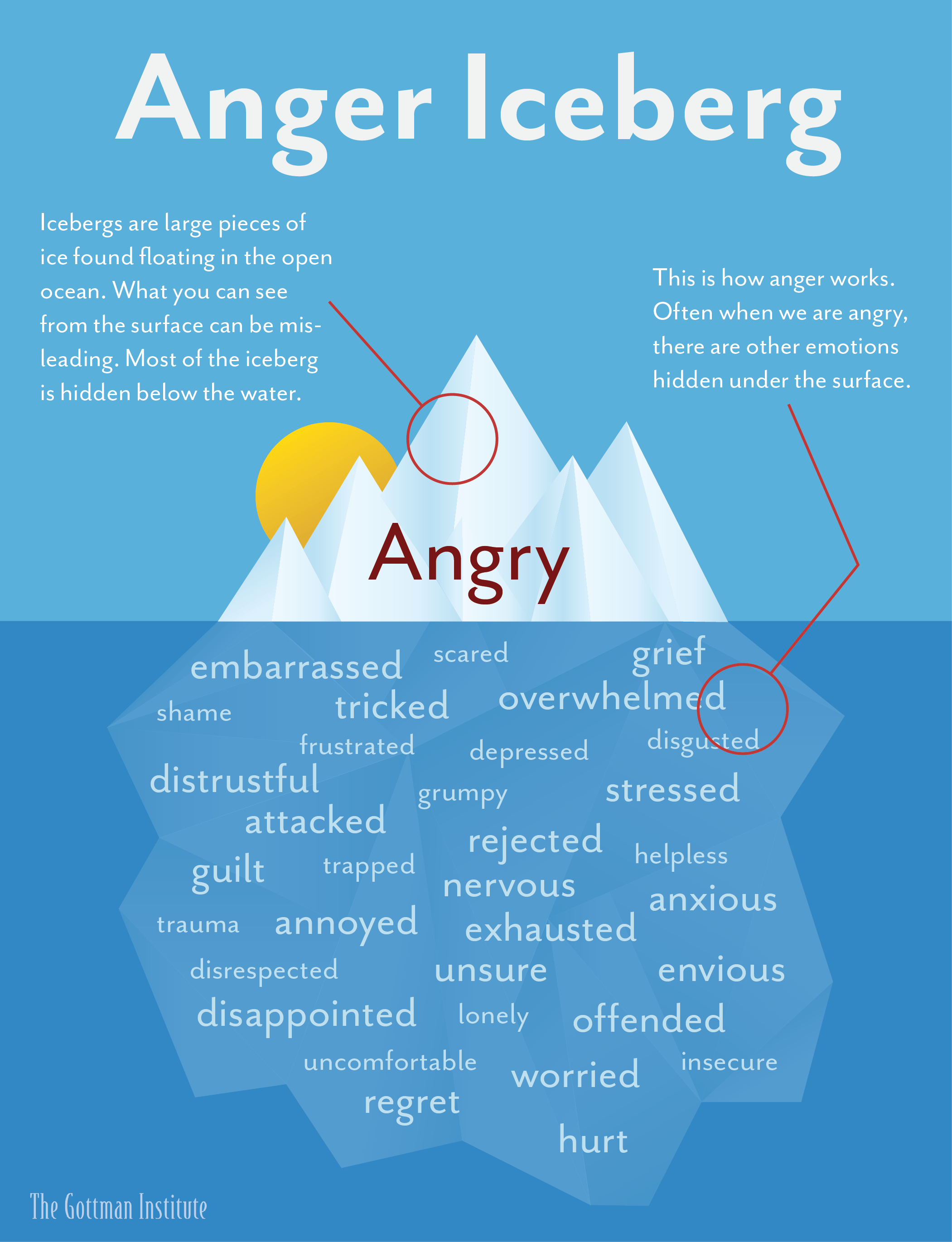
    Which brings me to the question: what is anger? Isn’t it the result of fear, frustration or hurt? Is anger actually a separate thing? Turns out these aren’t original questions, as the image below reveals.

    anger-iceberg-1

    I reflect on my Dad’s temper (which I wrote about previously here) when we were growing up.  I think 95% of the time his anger was a manifestation of frustration. Driving the car in New York City traffic, where other drivers did dumb things, where rubbernecking could cause endless delays, where the Van Wyck Expressway was under construction for my entire life, the aggravation sent him over the edge. Add Mark teasing me, telling me I was adopted or calling my shoes canoes, and me responding by hitting him or whining to my parents; it was a toxic mix. “Don’t make me pull over!” he screamed. Dad’s voice was deep and intense – in a small space like the car, the sound reverberated. We got in line quickly. Until the next provocation.

    It also seems that some people are born angry. I don’t know if that was the case with my dad, but it seemed to be the case with my son. Perhaps it was low frustration tolerance, or over-sensitivity, but Dan was angry a lot. If something didn’t taste the way he expected, or if a fabric was rough on his skin, he objected strenuously. Gary and I tried various strategies to help him manage it and find outlets for it. I wouldn’t presume to speak for Dan, but by the time he was in high school he seemed to have a much better handle on it.

    For me, anger was often expressed in tears and sometimes when I least wanted them. I couldn’t cry in grief, but I could cry in anger.

    I was working for the City of Pittsburgh’s Finance Department in 1984. Computer systems were being implemented and there was resistance from staff. One of my jobs was to train the city’s auditors on the new system. The audit department was comprised of about 15 men (zero women), who had been doing their jobs, on average, for more than 10 years. I was 24, right out of graduate school, from New York City and Jewish. And, at that time many of the Finance Department employees, even in the audit department, only had a high school diploma. I was an outsider for many reasons and my message of change was very unwelcome.

    I walked the group through the new system. I don’t remember exactly how it started to devolve, but it became a gripe session. They vented all of their anger and frustration on me. The department supervisor, a man at least 30 years my senior, stood by silently. I almost wondered if he was taking pleasure in the display, after all it was directed at me, not him. I tried to stand my ground, explaining how this was a tool to help them, explaining how I was not the decision-maker here but the messenger, how I would share their concerns with the higher ups. After a while, although I was angry, I got shakier and shakier, my voice cracking. Eventually some tears rolled down my cheeks. I wished I could have channeled my father’s rage. Finally, mercifully, the session was over.

    I went to my office to collect myself. Then I went to see my boss, the treasurer. I told him he might hear some things about the training session and I wanted him to hear it from me first. While at that point I was composed, I was still shaky. The one thing that came from that meeting was that he spoke with the audit supervisor about his failure to step up and help, given that he was a member of the management team.

    A few days later, I ran into one of the auditors on the staircase. He apologized for his behavior, explaining that I was the unfortunate recipient of their built-up frustration. I accepted his apology, but something about it made me uneasy. I felt like he was patronizing me. He was one of the most aggressive offenders at the training session –  his last name was Heckler.  Unbelievable! How appropriate.

    It wasn’t the first time and it wasn’t the last time that a workplace experience played out that way. If I felt that my integrity was in question or if criticism was unfair, it resulted in tears, rather than anger. I hated that about myself. Fortunately, the circumstances didn’t arise very often. I was in my late 40’s when I finally could stand my ground without tears.

    Actually, standing my ground in the workplace, even without the tears, didn’t work out that well either. I never did figure out how to successfully express disagreement or frustration (if success is measured by changing minds of those in power).

    As I got older and less concerned with what other people thought, I was freer in stating my opinion. This didn’t always go over very well. When I worked for the school boards association, if the organization was taking a position that I thought was not in the best interest of students or my fellow employees, I could be quite passionate in expressing my views. I wasn’t very effective in changing minds, which could reflect the weakness of my argument, or it could have related to how I delivered the message. I came to believe that it was at least partly because strong opinions expressed by a strong woman were not welcome.

    Research, at least in one study reported on in Psychology Today,*  suggests that when women show anger, they lose credibility, while men gain credibility when they do. That finding is certainly consistent with my experience.

    For both men and women anger is a tricky emotion to manage. But for women it seems to be a no-win situation. If you come across too strongly, it turns people off. If you are too meek, you get walked over or patronized. I don’t know how this will ever change, but I am hopeful that awareness is the first step.

    *Salerno, J. M., & Peter-Hagene, L. C. (2015). One Angry Woman: Anger Expression Increases Influence for Men, but Decreases Influence for Women, During Group Deliberation. Law and Human Behavior, doi:10.1037/lhb0000147)

  • IMG_1281

    Her skin smelled different as I gave her a hug. Nana was just back from a vacation to Florida. Her freckles had blended from the sun, her face and arms a burnished copper. I felt a little sad, a bit distant. I wanted her familiar scent, her familiar skin. But I was grateful that she was home at last.

    That trip to Florida must have been longer than others because I remember writing a letter to her. I remember thinking I was quite clever because I wrote, “Everyone misses you, but I miss you most of all.” A variation of the line from The Wizard of Oz, the one where Dorothy tells the Scarecrow she’ll miss him most of all. Though I don’t think I had that in mind when I wrote it.

    More commonly, we were the ones leaving – at least for the summers. My Dad, a teacher, used his summers to attend graduate school. We spent, as a family, one summer in Worcester, MA at Clark University, and three summers at the University of Illinois in Champaign-Urbana (I have written about our road trips and time in Illinois here and there).

    One summer I was especially uneasy about leaving home because I was taking care of a cat. We didn’t have pets in my family, my mother was deathly afraid of all animals. I always wanted a cat so I befriended a neighborhood stray that I named, creatively, Cutie. Mom allowed me to feed her in the garage and I could bring her in the basement to play with now and again. I considered Cutie to be my cat. I didn’t want to leave her when it was time to go to Illinois. Nana agreed to look after Cutie.

    While we were away, unbeknownst to me, Cutie was injured. I later learned that the neighborhood kids were mean to her (not all that surprising given how they treated me), throwing rocks and taunting her. Nana tried to protect her, but she wasn’t outside much. Cutie recovered, but she was left with a scar. When I came home and saw it, I was devastated. She had a patch of fur missing on her neck and there was an ugly scab there. Every time I looked at it, I felt sick to my stomach. I was so upset, I didn’t want to handle her anymore. Rather than holding and comforting her, I rejected her. My nine-year-old self couldn’t cope with the disfigurement, which made me feel worse. My Dad stepped in and explained that since I couldn’t care for Cutie anymore, it would be best if we took her to an ASPCA shelter. I reluctantly agreed.

    Dad got in the front seat of the car and I held Cutie on my lap in the back. We didn’t have a carrier. Cutie got agitated once the car started moving. I managed to hold her for a while, but eventually she wriggled out of my arms and climbed on the back of my Dad’s seat. At that moment, Dad opened his window. Cutie leapt out. I screamed. I think we were on Utica Avenue, or a similarly busy thoroughfare. I didn’t see where Cutie went, though at least I didn’t think she had been hit by another vehicle.

    “Stop the car!” I pleaded.

    “I can’t, not right here,” Dad said firmly.

    “You did that on purpose!”

    “What?”

    “You opened the window on purpose! Now what will happen to her?” I was crying.

    “Linda, I didn’t open the window on purpose, but it may be for the best.”

    “Shouldn’t we look for her?” I asked desperately.

    At this point, Dad pulled the car over. We were looking out the windows in every direction, but we didn’t get out. There were so many people crowding the street, so many cars blocking the view of the sidewalks, shops with racks of goods outside, buses coming and going; general chaos. It was hopeless. There was no way we would spot her.

    “We were bringing her to a shelter, anyway, Linda,” Dad offered. “Maybe this is better. I’m sorry. Let’s go home.” He circled around the block. I was still looking frantically, through my tears. I didn’t see her. I didn’t really believe that it was better, but I didn’t know what to do.

    It was a painful episode for everyone. I think we all felt guilty. I was mostly disappointed in myself and how I reacted to Cutie’s injury. One thing I don’t recall doing: I didn’t blame Nana. I knew that even if I had been home the same thing could have happened.

    I always wondered if my father opened the window to let her out. That will remain one of life’s mysteries. Maybe it was for the best. At the time, I didn’t understand how shelters worked. Thinking about it now, it is unlikely that she would have been adopted. She had always been a street cat. I tried to convince myself that she figured out how to survive in a new neighborhood.

    I still loved cats, but it would be quite a while before I took care of another one.

    Another one of life’s mysteries began with another trip. This one Nana took – to Portugal. That seemed like quite an exotic destination to me. People I knew didn’t travel to Europe. She went with her older sister, Sadie. I had a sense that this was a big thing – maybe a once in a lifetime opportunity that Nana felt she couldn’t pass up.

    Naturally Nana came back bearing gifts. She brought back a gold filigree bracelet. I marveled at its intricate pattern and delicacy. She also brought back an embroidered bag. It was black with bright flowers and the word ‘Portugal’ sown on. I kept my doll collection in that bag for years.

    Unfortunately, she also brought back an infection in her big toe. People with diabetes often have difficulty healing, especially in their extremities. I didn’t understand that at the time, I only knew that this toe infection became a serious medical problem that required hospitalization. Once again Nana went to Unity Hospital in Brooklyn.

    For a time, it looked like they might have to amputate her toe, or maybe even her foot. Nana, who was looking forward to dancing at Uncle Terry’s wedding in a few months’ time, flat out rejected that possibility. She was determined to keep all her toes, perhaps even at the risk of her overall health. She was released from the hospital with all her toes. She danced at Terry and Barbara’s wedding in January of 1971. Three months later, in April, she died. I don’t know if there was a relationship to the infection. I didn’t think so at the time.

    To an 11-year-old, three months is a long time. It is strange how the perception of time changes the older you get. The infection and her death seemed too far apart to be connected. Now I’m not so sure.

    Jewish tradition doesn’t generally permit an autopsy because of the belief that the body is sacred, shouldn’t be desecrated and should be buried intact. There are exceptions if the law of the land requires it or if a physician determines that new knowledge could be gained to help others. Neither exception applied, so we never fully understood Nana’s death. An embolism or an aneurysm were suspected. Perhaps the adults knew more but, if so, nothing was shared.

    These events left me with many questions. Why would anyone harm an animal? Why didn’t I have the stomach to care for Cutie after her injury? Did Dad deliberately open his window to let her escape? Did the infection hasten Nana’s death? Could things have been different for Nana if she had taken better care? Of those questions, there was only one I could do anything about. I could do better with my next pet.

    I suppose we all carry questions that we can’t answer. I look for meaning in the losses and I think I find it, even if I don’t have answers. As a child, I learned to love and cope with loss – the two are inextricably connected.

    IMG_0452
    Roger and Raffa posing in my bedroom May 2017
  • conference20graphic20horizontal

    It’s no secret that I am trying to be a writer. I am not yet ready to call myself a writer, that would be too audacious. I’m not sure when I will be ready to assume the mantle, but this past weekend I took a step in that direction. I attended a writers’ conference!

    I am a veteran of conferences – as an attendee and a presenter – but those were school board-related, where my identity was firm. I had a love-hate relationship with those conferences. I loved the learning – hearing experienced, knowledgeable professionals share insights gets my adrenaline going. I also enjoyed presenting information that I thought would educate and motivate school board members. The thing I hated about those conferences was the stress – juggling my stuff (I always seemed to have too many things!) without spilling coffee all over myself, making small talk with people I didn’t know, getting adequate sleep after exceptionally long days where I had to be ‘on’ for so many hours. The stress was a big part of the conference experience.

    I wanted to further develop my writing, and improve my odds of getting published, so months in advance I ponied up the money and committed to spending Friday and Saturday of Memorial Day weekend in Pittsburgh to attend the Creative Nonfiction Writers’ conference. I even paid extra to get a half hour one-on-one session with an agent. I thought I was ready to take the plunge.

    One would think, given that I was so invested in this conference, that I would plan my time so that I would arrive fresh and rested, ready to maximize the experience. One would be wrong. Here was my schedule, of my own design, for the week leading up to it.  I drove with my brother, Mark, from Albany to New Jersey on Wednesday night so that we could escort my Mom to Florida on Thursday. We were in Florida to attend my aunt’s unveiling (a Jewish tradition where the headstone is unveiled at the cemetery about a year after a death). We flew back on Monday, arriving in Newark at 9:00 p.m. We drove back to Albany that night, arriving at 1:30 a.m. I had Tuesday to do laundry and get organized. On Wednesday I drove to New York City to leave my car with Daniel so he and Beth could visit Leah over the holiday weekend. I took Amtrak back to Albany on Thursday. Gary met me at the station and we left for Pittsburgh. We arrived in Pittsburgh at 10:30 pm. The conference started with breakfast at 8 a.m. on Friday.

    Not surprisingly I didn’t sleep that well Thursday night. It was one of those nights where you wake up every hour and look at the clock. I finally fell into a restful sleep at about 6 a.m. When the alarm went off at 7:30, I was disoriented, to say the least.

    I stumbled around in the hotel room (the room-darkening curtains worked a little too well), trying not to disturb Gary, and managed to shower and dress without injuring myself. I got down to the lobby and saw that it was pouring so I decided to treat myself to a cab even though the conference was only a 10-minute walk away. The doorman hailed me a cab. I took a deep breath and thought, “Okay, this is good. I’m on time. I can relax.” Not so fast.

    The cab rattled and bumped down the potholed streets. The driver, in a muffled, raspy, unfriendly voice, warned me that I should buckle up or hold on. I did as I was told. In anticipation of walking to the conference I had set up the map function on my phone, so a voice was giving directions – directions which the driver wasn’t following. I said, “Oh, that’s just my phone,” thinking he’d be wondering about the disembodied voice. He said, sounding defensive and annoyed, “Oh, people do that all the time. They use their phones and say, ‘Where the hell are you going?’ Not realizing that I’ve been doing this for 30 years and might know a better route than the damn phone.” I started to explain that I wasn’t checking on him, but thought better of it. Fortunately, we arrived at my destination within minutes. I was relieved to get out of the cab.

    I found my way to the conference registration desk and breakfast. I even managed to find some very pleasant women to sit with– one from Missouri (originally from Long Island) and another from Texas – who were newcomers to the conference. It seemed like things were settling down when it was time to go to the first lecture. The three of us trooped upstairs to the ballroom for the session and settled into seats. I reached for my phone to silence it and couldn’t find it. I went through my purse, my briefcase, the conference bag, my pockets… multiple times. I went back downstairs to where we had breakfast. I retraced my steps. No luck.

    I went back up to the ballroom, where the lecture had not yet begun. My new friend from Texas offered to let me use her phone to call Gary. “Please pick up!” I repeated to myself, thinking Gary would ignore the call since he wouldn’t recognize the number. Fortunately, he answered. I explained my dilemma and said I had a feeling that the phone fell out of my pocket during that godforsaken cab ride. After consoling me, he readily agreed to try and track it down. I gave him as much information as I could (white van, cranky cab driver, etc.). We made up to meet at the hotel room after my consultation with the agent, which was scheduled from noon until 12:30.

    I still had time before the talk began to go up to the front of the room and ask the conference organizer if she would make an announcement about my lost phone. She did. Although everyone was being very nice, I couldn’t help but wonder if this was all a sign that I didn’t belong at the conference. It didn’t take much to derail my inchoate confidence.

    I tried to concentrate on the speaker. I took notes, writing down articles and books that were referenced as stellar works of creative nonfiction. Following the opening lecture, there were breakout sessions. I went to one on research and fact-checking. I barely had time to think about the meeting with the agent. It was quickly coming up on the time for that meeting. I left the breakout session early to try and gather my thoughts. What was it I was trying to accomplish with my meeting?

    Though I wouldn’t allow myself to say the words to myself, let’s be honest. In my heart of hearts, I wanted the agent to be so bowled over by me, she would ask to sign me up right there. My logical brain knew that wouldn’t happen, so I did think of some questions.

    Our conversation was cordial. I briefly described my blog and that I had two goals: growing my readership and developing a couple of themes from the blog into a book. She shared some insight into what an agent looks for. She told me that having 40,000 followers will get a blogger noticed. Okay, then. While I don’t know how to interpret the numbers WordPress provides, I know I’m nowhere near that!

    I asked a couple of more questions, she gave me a couple of suggestions. We made some small talk about the Upper West Side of Manhattan. She commiserated over the loss of my phone, and she took my card, at least I think she did. Who knows if she kept it or looked at it?

    We shook hands, she wished me luck. I gathered my things and walked back to the hotel to meet Gary. I was in a funk. I was bone tired, disappointed and worried about finding the phone.

    I opened the door to the room to some good news! Gary, after persistently calling my phone, reached the cabbie. Gary was similarly unimpressed with his personality, but at least he agreed to meet at 4:00 p.m. at the taxi stand in front of the hotel. He asked for a cash reward. We weren’t sure that he would show up, but we had hope.

    I filled Gary in on my meeting with the agent; he was philosophical about it. “You know what steps you need to take. You just need to decide whether you want to.” True. He also pointed out that I should take some time to process all that had happened. There were no decisions to be made immediately.

    Part of me wanted to get under the covers and go to sleep. That would be a decision. I didn’t, though. We had some lunch, he filled me in on the particulars of tracking down the phone. I revived a bit and went back into the fray. Gary would message me on my computer, which I had with me, to let me know the status of the phone. I returned to the conference.

    I attended the sessions, still not fully present, but better than the morning. I checked my computer at 4:15 and there was a message from Gary; he had the phone! What a relief! And, the day was almost over!

    The last session of the afternoon concluded, I met Gary. We went out for a nice dinner. I had a cocktail and regrouped. I got a better night’s sleep and went back for day two.

    I’m glad I did. I met some more interesting people, most were making a living doing something else, but wanted to write. I met a massage therapist, an airline pilot, several teachers, a nurse practitioner, a publicist, a researcher on nuclear weapons from Kazakhstan! On that second morning of the conference, I sat down to breakfast next to a young man from New Orleans. He is in the midst of an MFA program. He asked about my situation. I told him I retired two years ago to pursue writing. He smiled, “So you’re living the dream.” “I suppose I am.”

    After listening to author after author at the conference talk about their journey, I learned just how daunting this endeavor is: getting published isn’t easy and even if you are lucky enough to get published, it doesn’t necessarily get easier.

    After all is said and done, it comes down to this: do I want to tell stories? Do I want to work on the craft? Right now, the answer is yes.