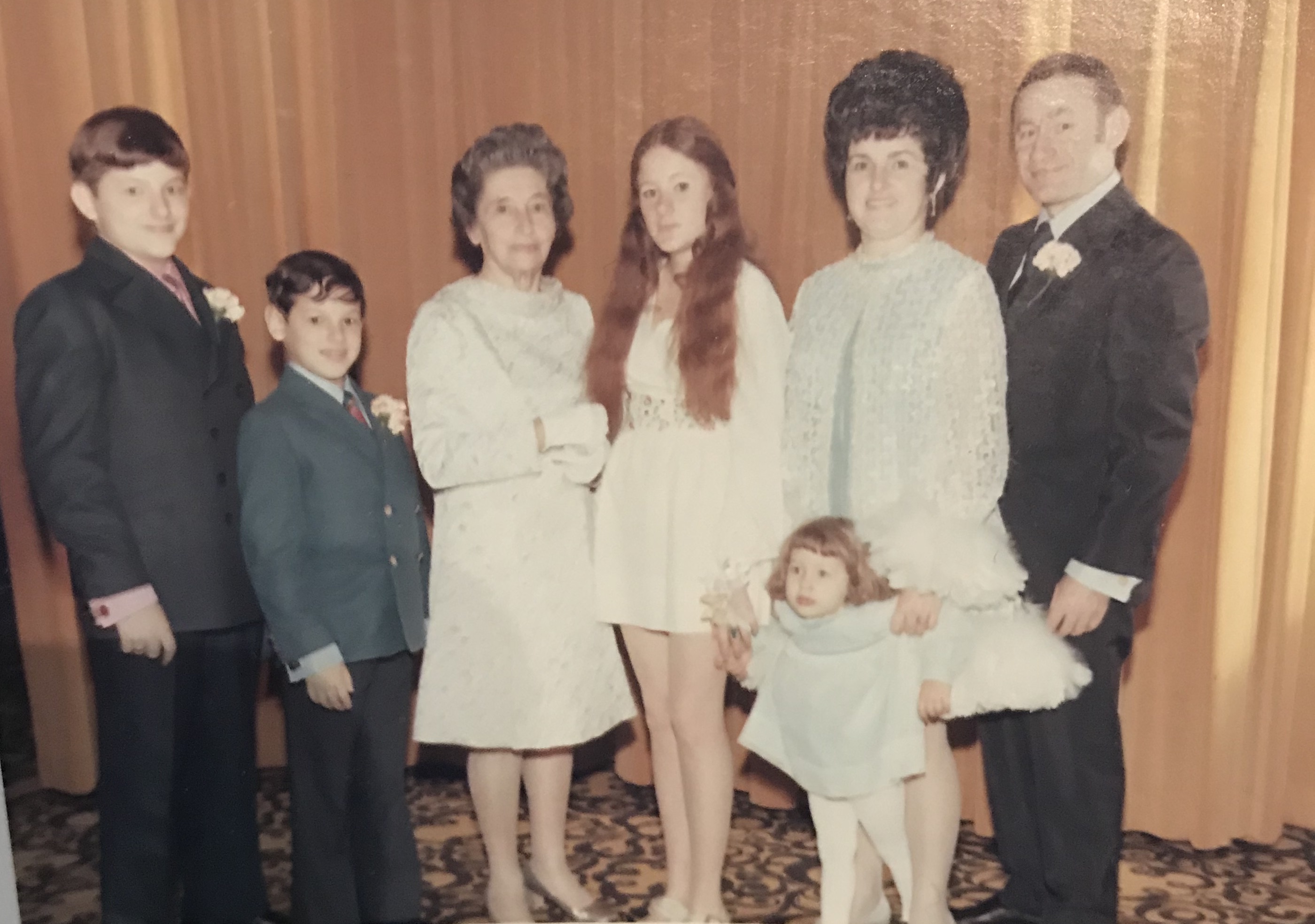
Three generations: Daniel, David and Gary (not in the picture is the fourth generation, his great-granddaughter, who David is holding)
Regular readers of this blog and family members know that David Bakst has appeared many times in my stories and essays. My father-in-law had an extraordinary life. If you haven’t read his story, you can find the beginning of it herehttps://stories-i-tell-myself.com/2018/07/09/part-of-the-story/. Most recently I recounted that he led us in the blessings over the Chanukah candles and bread via FaceTime at Leah’s wedding. It was so appropriate that he did that. He loved to sing and daven (pray), he cherished his family and his Jewish identity was a source of comfort and pride. In leading us in those rituals, he fulfilled all three.
He died yesterday. He was 98 years old. On the one hand it wasn’t shocking, he had been in failing health in the last few months, but, at the same time, he seemed indestructible. It is impossible to count the number of times he cheated death in his long life. He was a Holocaust survivor after all. He was hospitalized any number of times over the last few years but rallied each time so we expected that he would do it again. He had such a strong will; he was an inspiration to all who knew him.
Gary, my husband and one of his two sons, would say that his father was the most optimistic Holocaust survivor he ever met (and he has met many survivors). David emerged from the ordeal and trauma of his war years with a fierce determination to live, to take joy, to continue his family name. Despite a lot of evidence to the contrary since he had witnessed the worst in human nature, he liked people; he was open to them. This is particularly unusual for someone who had his life experience. He wasn’t a fool, but he didn’t shut down. He radiated warmth, enjoyed a good discussion and engaged with the world. To the very end, when diminished eyesight and compromised hearing robbed him of reading the newspapers and watching CNN, he would ask Gary to fill him in on events in the world. As a devoted Zionist, he was always particularly interested in Israel; he followed U.S. politics closely, too.
David wasn’t perfect. He was impatient and he could be demanding. He was a product of his time and place, but his essential good nature led him to evolve. He respected the women in his life. The same cannot be said of many men from his generation. His care for and devotion to his wife on her long Alzheimer’s journey was so touching, we were in awe of his tenderness.
David left his children, grandchildren and great-grandchild a wonderful legacy. He persevered in the face of difficulties I can’t fathom. He reclaimed his humanity after being subjected to unspeakable horrors. His death is a terrible loss for the family, but he leaves us essential life lessons, as well as poignant and treasured memories. May his memory be a blessing.
David and Paula in the displaced persons camp circa 1947
I am still basking in the afterglow of Leah and Ben’s wedding weekend. To be fair, some of what I feel isn’t basking. There is a tinge of sadness because the big event is behind us and we have plunged into this darkest of winters. But, when I feel that melancholy, I look at the pictures and I am brought back to the joy, light and hope that filled the weekend.
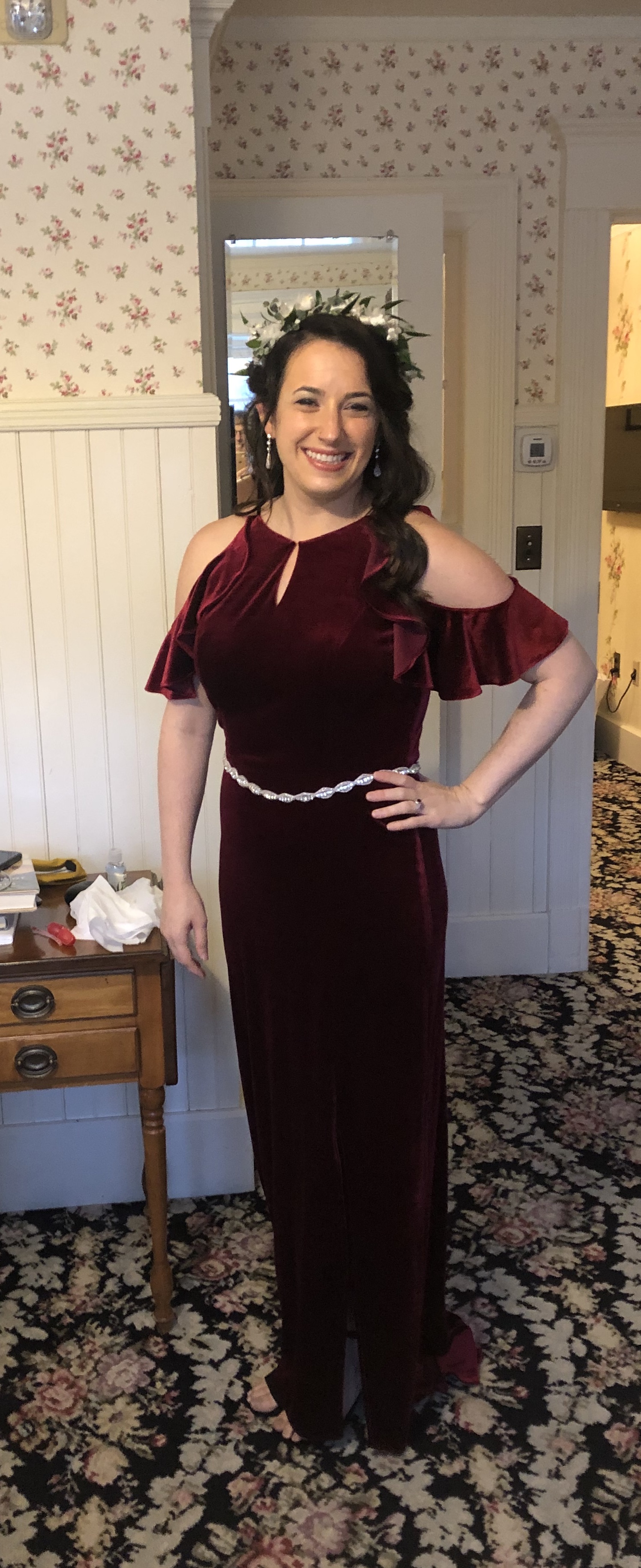
I wanted to share more reflections. I wish all parents the pleasure I felt helping Leah to get dressed. It was just the two of us in her room at the Inn. She didn’t really need my help, only with her zipper, but it was a joy watching it all come together. Though she was stressed, it was a happy excitement more than any negative energy. Being a bride can be a lot, so much expectation and preconceived ideas about what one should look like. Leah made a bold choice in going for a red velvet dress, and it was the right choice. She radiated happiness. I can’t deny that she, like all women I know, struggles with body image, it seemed that she was able to put that aside and enjoy the moment. She was (and is) beautiful and she positively beamed.
Although Leah would not ordinarily wear a fur, the one she has on in the picture above is her Bobe’s (her paternal grandmother) which was quite meaningful to Leah. Though Leah has three living grandparents, they were not able to attend. Having her Bobe’s stole wrapped around her was a reminder that they were there in spirit. In addition, the headpiece she is wearing is the same one I wore 37 years ago (brought back to life by our florist).
Though the grandparents couldn’t attend, they did participate. We FaceTimed with my mom, who dressed for the occasion as if she was attending (looking beautiful) and she toasted the couple; and with Gary’s parents. Regular readers of this blog might remember that Gary’s mom is many years into Alzheimers. She was on the FaceTime call but it is hard to know what she took from it. While on FaceTime, we lit the menorah, sang the prayers, and said the blessing over the bread. Gary’s Dad led us in those prayers, even though he was in Florida. The wonders of technology!
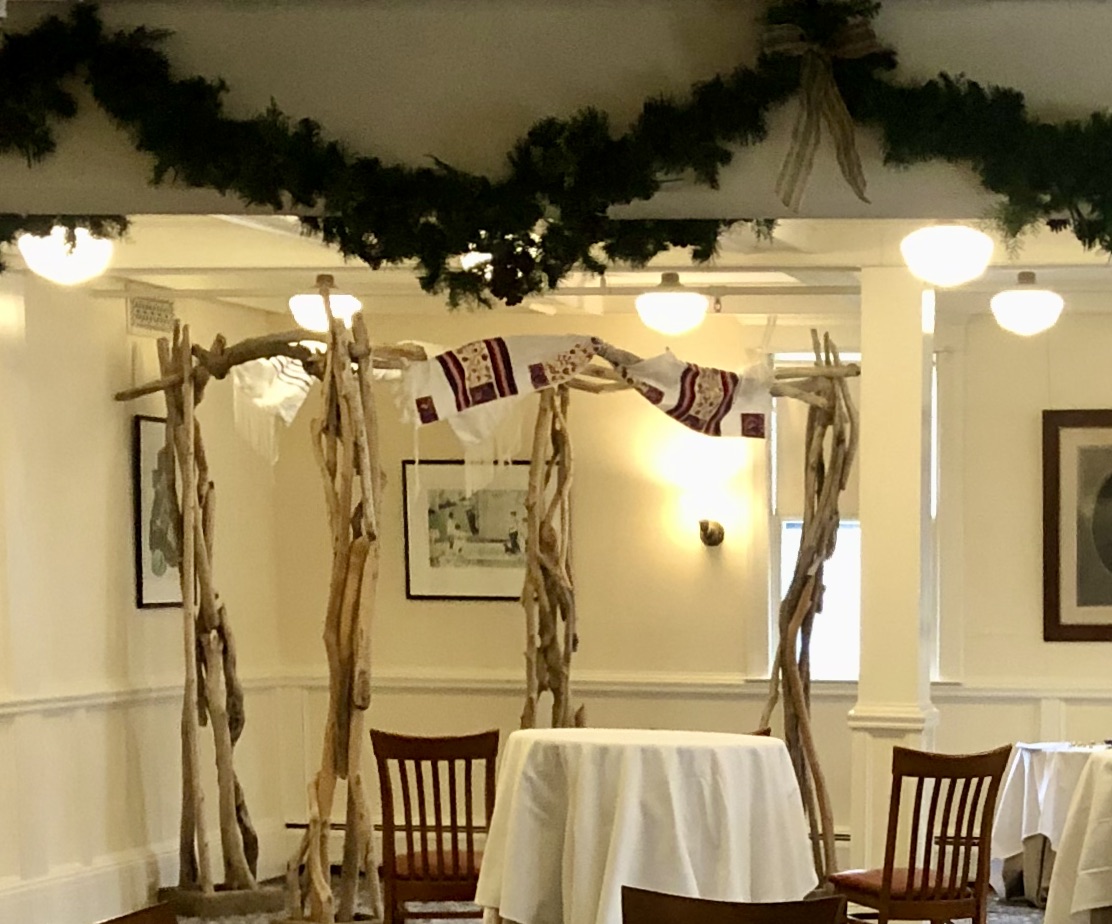
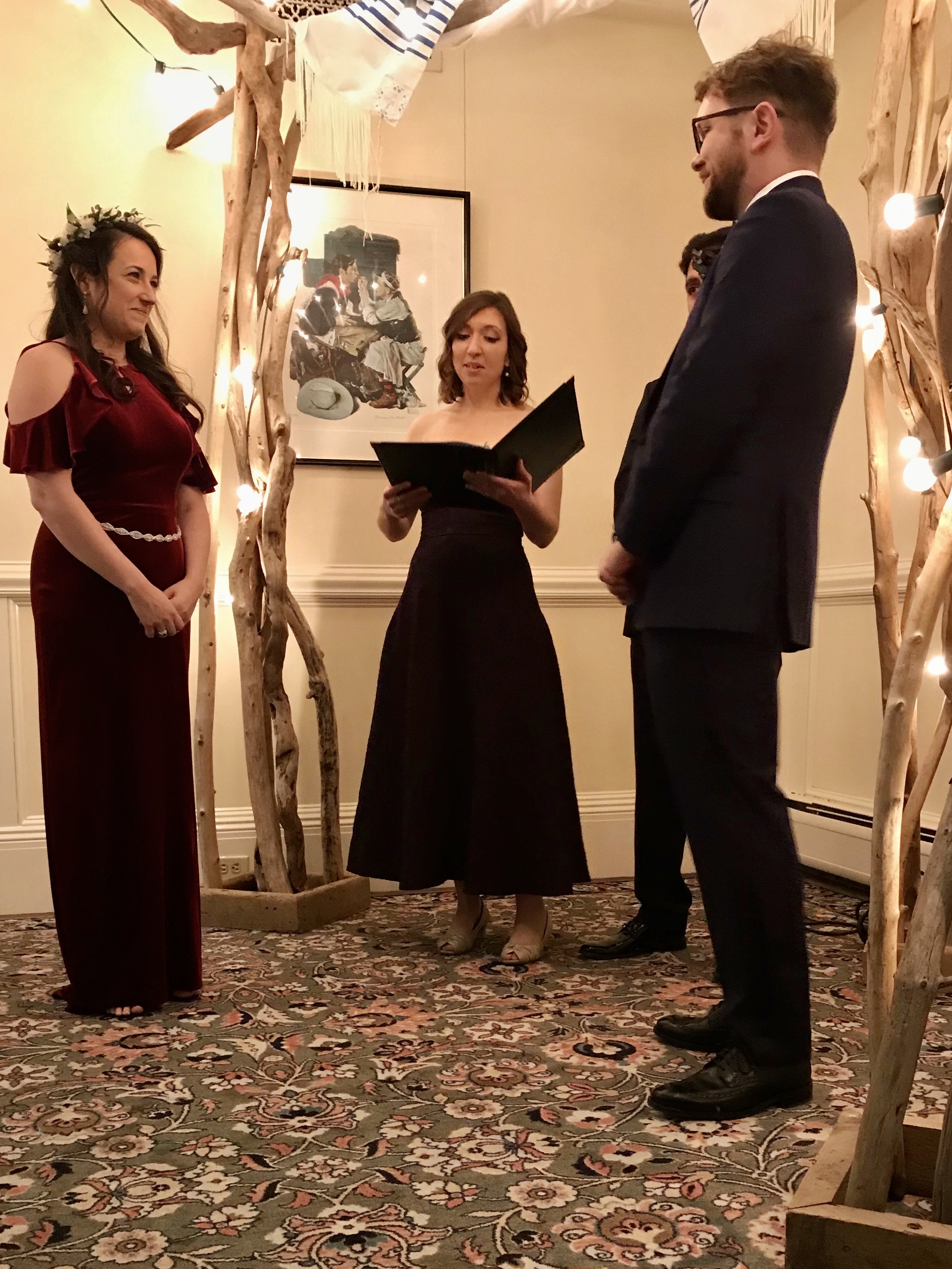
Another pleasure from the weekend was working with a small business owner, Danny from Weathered Wood in Troy, NY. As we were planning this new version of the wedding, it was coming down to the wire, and the kids decided that it would be nice to have a chuppah (wedding canopy). Though they were not having a religious ceremony, the symbolism of the chuppah (recognizing that they are making a new home as a couple) was meaningful to them. This was three weeks before the wedding date. I had gathered information about chuppahs from round one of wedding planning and I had Danny’s business card. I called and he was more than happy to accommodate us.
We agreed that he would get to the Red Lion at 9:30 a.m. to set up. At 8:45 the room phone rang. Danny was at the front desk. Some people might be annoyed at a vendor being 45 minutes early; I was elated. I was awake for hours already and was delighted to get started. We chatted as he worked, and I learned what a struggle it has been for his business to survive Covid. He explained that normally he would have 30 opportunities to rent a chuppah, this year he had 5! Chuppahs aren’t his only business, he is an artist who works in wood and he maintains a shop in downtown Troy. He is barely holding on, hoping to weather the pandemic, but it is getting desperate. While I knew this was the case for many small business owners, it was jarring to face it in person with an individual who was clearly talented, hardworking and attuned to customer service. I write this both to bring more attention to something we already know but may be tempted to ignore (the strain on small, locally-owned stores ), but also to suggest that if you have an opportunity, you should visit Weathered Wood. He has many lovely items. (I also wrote a rave review on Yelp.) That’s it for my sales pitch.
The chuppah
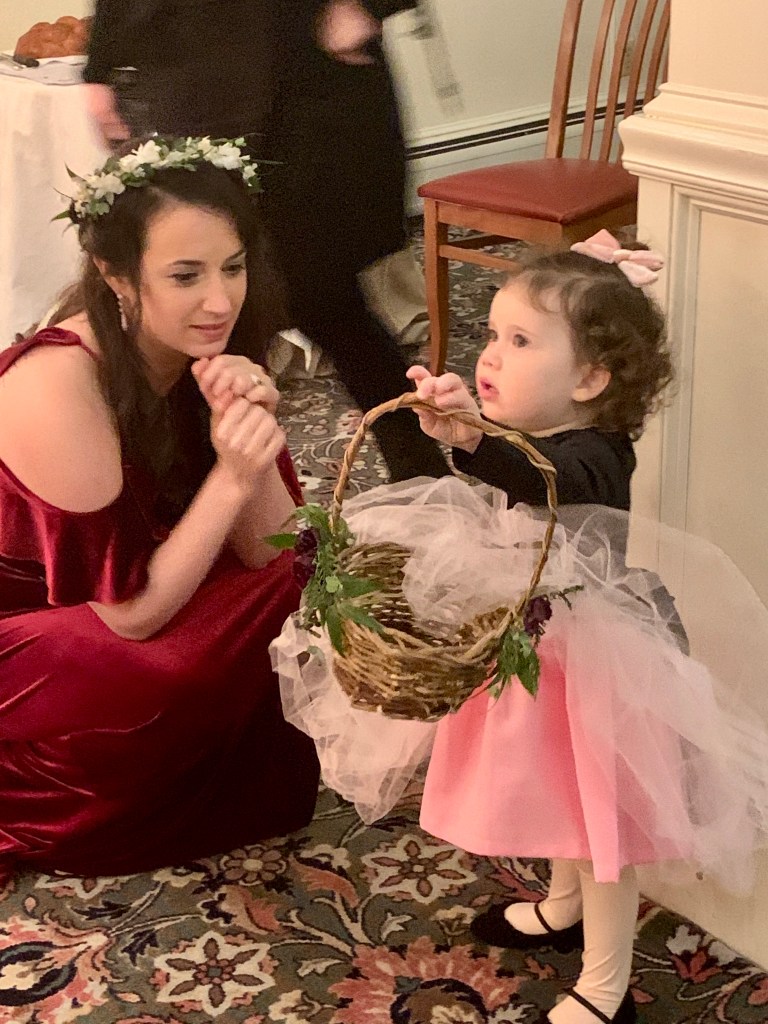
Back to the wedding….one of the other joys of the weekend was reuniting with our son, daughter-in-law and granddaughter. We had not seen them in three months! Way too long in the life of a two-year old. I was worried that our little one would be shy with us; that perhaps she would take a long time to warm up and we only had a weekend! Fortunately, while she was initially reticent, that lasted about two minutes. After that she happily climbed in Gary or my lap. We were back in our rhythm. She continued to charm everyone for the rest of weekend. She was the flower girl and she did it in her own special way. She didn’t drop the petals until after the ceremony and she ran up the aisle and back again, and it was perfect. We had the ceremony, cocktail hour, dinner and time hanging out afterwards, and through it all she was a delight. It was 10:00 p.m. when the party broke up and she had not fussed once. She played with toys, visited with us, and kept us entertained. Hanukkah gelt (chocolate covered coins) may have played a role but was used sparingly.
The next few months will be challenging. I will come back to my memories of Leah and Ben’s wedding weekend to nourish my spirits. Then I will look forward to Spring.
We made it! After planning, adjusting, worrying, fretting and more planning, the wedding weekend not only happened, it was a success. In the face of Covid, we pulled it off. We won’t fully exhale for another two weeks or so, when we see that no one in our little gathering got sick, but the important event was accomplished. Ben and Leah are husband and wife!
We started planning Leah and Ben’s wedding Pre-Covid (PC). It is hard to remember that there was a PC time, but there was. We had a big bash planned – with some 200 guests, a venue reserved, hotel rooms blocked, photographer and DJ booked, etc. After the plague struck, for a while we held out hope that time was on our side – that December was far enough off so the worst of the virus would be over. As the pandemic wore on, it became clear that the it wasn’t going to be the case and that the original plan would have to either be cancelled entirely or significantly modified.
Happily, the kids decided they wanted to keep their wedding date (12/12/2020). They scrapped the idea of a big shindig this year and agreed that they would just have their immediate family (12 of us – maybe there is something to that number for them). In October we set about looking for an inn in Massachusetts. We settled on the Red Lion in Stockbridge.
I lived in anxiety that there would be a lockdown as the coronavirus raged. I just wanted our daughter to have this and I didn’t want the plague to win. When Friday arrived and Gary and I left for Stockbridge, I finally felt some relief. Even if Massachusetts declared a shutdown, they usually give a couple of days notice so in that respect, we were in the clear. I can declare that we pulled it off and I have photographic evidence.
Friday evening we started the festivities by visiting Winterlights at Naumkeag Estate in Stockbridge.
The room where it happened, including a table with family wedding photos.
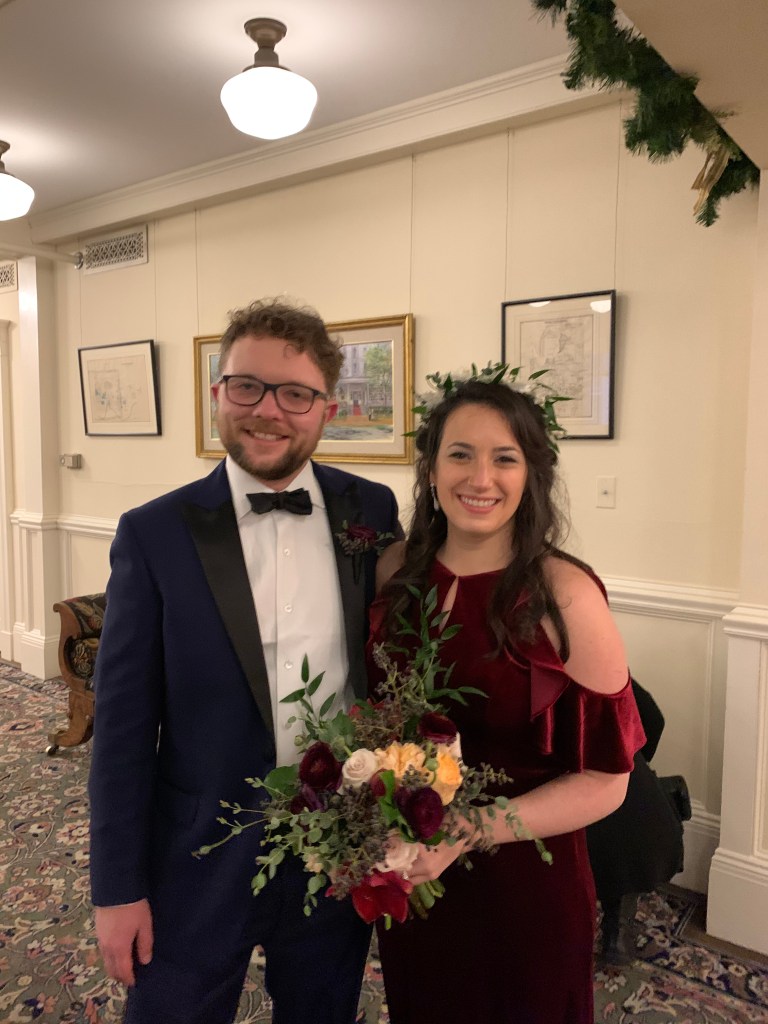
The bride and groom, and the cutest flower girl ever! Good friends, Sarah and John officiated.
I am so grateful for the riches of this past weekend. Our daughter who was so joyful. Our son-in-law who is so warm and loving. Our son, daughter-in-law and granddaughter who are fun, funny, and all-around fabulous people. Our newest family members, Ben’s parents, Kathy, and Gary and Alex (Ben’s brother) – all good-natured, generous and happy participants in all of the activities. The food and drink were great. The accommodations were more than comfortable. We made beautiful memories and hopefully got Leah and Ben off on the right track (to borrow a phrase from Leah’s grandpa David). We look forward to many more shared celebrations.
Note: Some of the photos were taken by Kathy Johnson, some by Gary Bakst and some by me. Frankly I’m not sure which were which at this point, but thank you both for sharing!
“You can’t put the genie back in the bottle,” I said.
I don’t remember what prompted my remark, but Leah, my daughter, had an interesting reaction.
“Maybe you can. What do we know about genie-world?”
I laughed.
“Well, true, but it’s an expression…”
“I know, but why is it? What are the rules of genies? Who knows?”
She had a fair point. If I Dream of Jeannie, a 1960s T.V. show that I loved when I was growing up, was any guide, genies went back into their bottles regularly. I remember the inside of Jeannie’s bottle. It was colorful and decadent with silk draped on the walls and velvet cushions. Not a bad place to hang out actually, though it seemed quite limited. Jeannie blinked, turned into purple smoke and went back in when directed by her ‘master’ or when she was angry at him and wanted to sulk. In hindsight it was a ridiculous show. I think I knew it was ridiculous at the time but couldn’t resist the romantic angle and attractive characters. But, I digress.
Sometimes when you stop and think about the expressions we use, you realize that they aren’t what they seem. In this case, the first known use of ‘letting the genie out of the bottle’ was in Tales of the Arabian Nights in 1706. We are familiar with the story of Aladdin, but there was actually another earlier one. The moral of that story, though, was the opposite of our use of the phrase today. In the original tale a quick-thinking fisherman outwitted the genie, convincing him to get back into his bottle, thus avoiding the mischief the genie might have wrought. How the message evolved to take on a different meaning, I don’t know. It is not the only example of the transformation of language or concepts over time.
The question posed by the genie and the bottle, or Pandora’s Box, is still relevant. Once an idea is out in the world, can you contain it? When I was growing up, we talked about this in the context of the threat of nuclear weapons. We wondered if the existence of nuclear weapons would inevitably lead to their use. Thankfully it hasn’t, at least not yet. They remain a threat, but steps were taken, and treaties were signed, to reduce the risk.
Today I think about it in terms of social media. Is it out of our control? Sometimes it feels like it is. Disinformation takes on a life of its own.
But social media doesn’t have to be that way. Some will find this objectionable, but regulation would help. We all know free speech isn’t unfettered, you can’t yell fire in a crowded theater, there are limits to hate speech, etc. Some of the standards that are applied in that context should be applied to the Internet. It is a matter of having the will to do it and applying the resources to the task. It needs to be a cost of doing business for Facebook and Twitter. God knows they make enough money! Newspapers and magazines have fact checkers and editors. Wikipedia has found a way to deal with the need for facts – it isn’t perfect, but it does pretty well compared to the wild west of other of social media platforms.
I know that the devil is always in the details (another expression worth examining since I’ve also heard it said that God is in the details too). I’m not suggesting it will be easy to regulate but we need to start. The fact that something is difficult doesn’t mean it can’t or shouldn’t be done. The damage to our culture of the current hands-off approach, in sowing division and inspiring violence, is a real threat to our democracy and our society.
It is indeed time to put the genie back in the bottle and I believe we can.
NOTE: This is another story written by my mother, Feige Brody, who during this pandemic has been reflecting on her childhood.
Chicago bustled and New York never slept, but Jersey City had no such energy. When my family lost everything in New London, Connecticut, with the hurricane of 1938, we moved in above Uncle Irving’s wholesale bakery in Jersey City, in a railroad flat. The best thing I could say about it was that it had running water and heat.
But we were really on the wrong side of the tracks. The railroad was on one end of the street and the other four corners had rundown bars. The men that frequented those bars were not called homeless then, they were called drunks and slept in the gutter or wherever they fell. The smell was horrific, of feces, urine and garbage, all mingling. I had to be careful where I walked never knowing what was under foot.
Simma (my sister who was not school age yet) and I were the only children on the block so there were no friends to play with. I went to school by walking to the corner where I could join kids who were coming from the right side of the tracks. After school, walking home they would turn at that corner and I would be alone. I was always terrified, with my heart pounding and my palms sweaty. I was afraid some drunk would be sleeping on the steps and I would have to climb over him to get home. Never once was I actually bothered, but the fear persisted for the entire year and a half that we lived there.
Across the street from my uncle’s bakery was a fancy saloon. The owners were very kind, and they let Simma and I play there. The floor was a high-polished wood and we would run and slide – back and forth. Sometimes we made up elaborate games with our paper dolls on that floor. We were allowed to play the piano, softly, and jumped up and down the steps that led to apartments. It may have been a saloon, but it was our playhouse. Once in a while a man would be at the bar talking to the owner, making arrangements for a party or celebration. Then Simma and I would sweep up our play floor and help set the tables to prepare.
One day, leaving the saloon in a hurry, I ran past the owner’s dog, who was gnawing on a bone. As I bolted past, he took a bite out of me! Dad rushed me to the hospital where I was surrounded by medical personnel all dressed in white. I was put in a bed with bright white lights shining down on me and once again I was terrified. I was given an injection with a huge needle into my belly to prevent rabies. Fortunately, we soon learned the owners had papers that showed the dog was not rabid, so I didn’t need more shots. Dad took me home. I never did get over my fear of dogs.
We were still in Jersey City in 1939 when Mother got sick with rheumatic fever. Fortunately, the Sisters of St. Joseph came each day to wash, feed, bring water and provide whatever relief they could. I continued to go to school and each afternoon coming up the stairs at the end of my day, one of the sisters would be standing at the top of the stairs, gesturing to remind me to tip toe and be quiet, because every noise would bring Mother more pain. The good Sisters were intimidating in their long black habits, leaving only a bit of their face showing, and looking so unfamiliar to me. I was sure they meant to be kind, but I was terrified of them. (Ironically, many years later I was a reading teacher at St. Joseph High School in Brooklyn and became friends with several nuns.)
With my mother being ill, her brother, Jackie, who had been living with us, left to stay with other aunts and cousins. Uncle Jackie was nine years older than me and was more like an older brother. He was the one who rescued Simma and I when I accidentally set fire to the curtains with a candle that I lit hoping to show Santa Claus the way to our apartment. With Jackie leaving, I was desolate.
I don’t know if there were pills that could have alleviated Mother’s pain, or maybe we couldn’t afford them, I will never know. While my parents would talk about the hurricane, they did not talk about her illness.
Since I could not stay in the apartment to play after school, I was left to my own devices. Though I knew it was forbidden, I went to the railroad tracks where older boys were playing. I would walk along, imitating those boys, balancing on the tracks, until I heard a rumble and then I hopped off and raced next to the train. I watched the train streak by, the conductor blowing the horn. It was a bit of fun in an otherwise dreary time. Once I fell and cut my knee and it bled a lot. I ran home and clomped up the stairs. I heard Mother cry out in pain. The sisters yelled at me, but one of them cleaned my knee. The skin healed over a small pebble that remained as a reminder. After many years it dissolved.
Eventually Mother recovered and in 1940, Dad having saved some money, bought a partnership in a Brooklyn bakery. We moved to the apartment above that store and Uncle Jackie was able to join us again. My third life began there. For the first time in a long while I felt safe in a friendly neighborhood, with lots of other kids. I realized the fear I carried in Jersey City was useless, there was nothing more to fear.
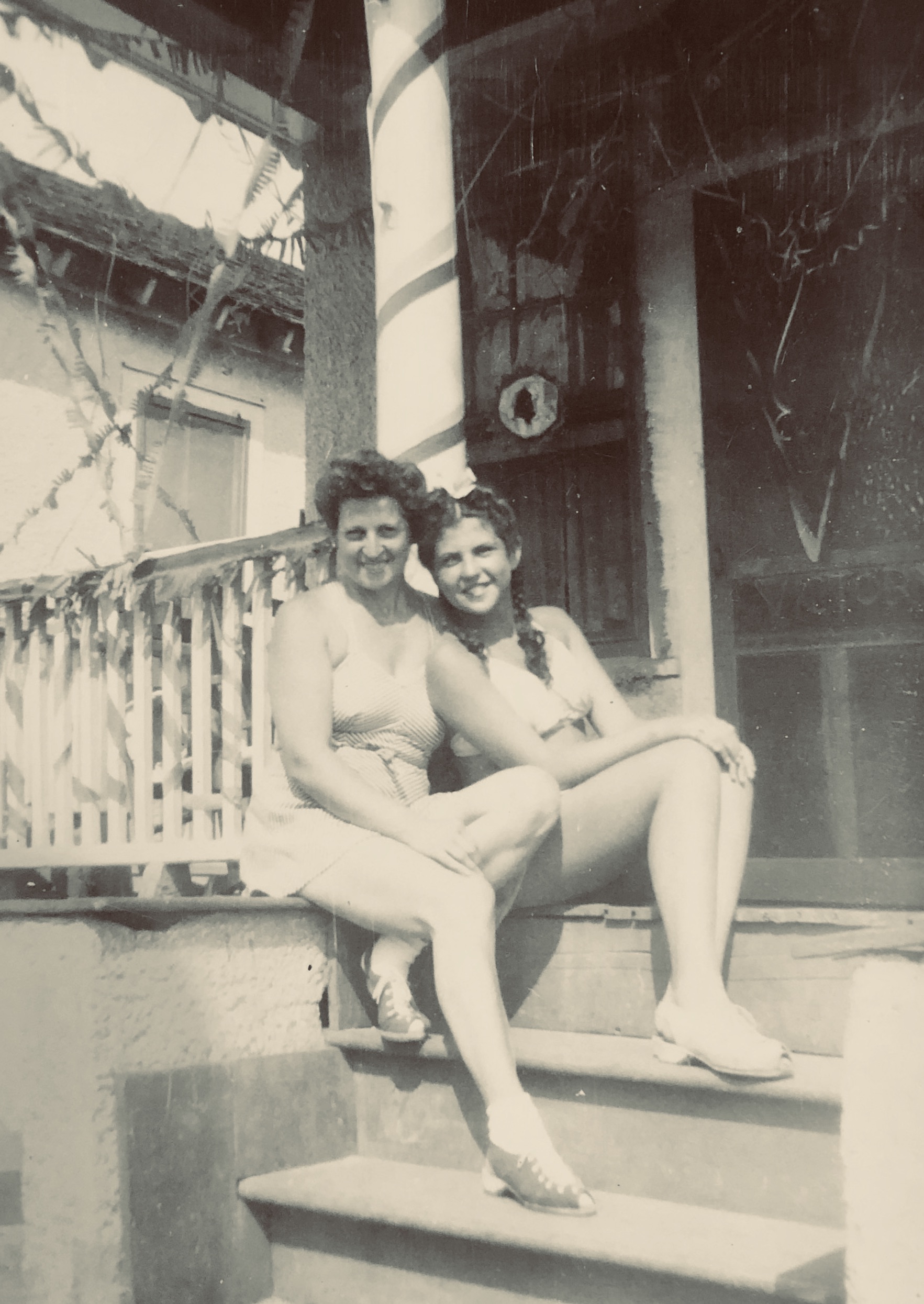
My mother (Feige) on the right, my Nana, on the left, years after Jersey City – in happier times
A daughter’s comment: I am so glad my Mom has written these stories. I know it isn’t easy for her, on several levels, but it enriches our understanding of her life. I am struck by the trauma she endured – losing everything in that devastating hurricane, moving to a cheerless place, worrying about her mother’s health, getting bitten by a dog. It was quite an eventful and painful early life. Yet, she was resilient. She did keep a fear of dogs, understandably (that was also reinforced by later scary encounters), but she was (and is) an optimist. She turned her attention to the bright blue part of the sky, as her father instructed her to do. Fortunately the third part of her life brought far more pleasure and much less fear. As the country emerged from the Great Depression, her family’s fortune turned for the better, too.
When I was growing up and my family gathered for holidays or special occasions we often played ‘the family game.’ After we finished eating, and there was always copious amounts of food, and after the table was cleared and the leftovers were stored, we adjourned to the living room. Paper and pencils were distributed to each person – all were expected to participate, young and old. We would toss out potential questions like: If you had only one book on a deserted island, what would it be? If you could have dinner with one person, living or dead, who would you choose? What is your pet peeve? Etc, etc. We would agree on the question. Each person would write down their answer, fold the paper and drop it in a bowl. A reader would be designated. That person would go through each answer and we’d speculate on who might have written it. After we had gone through all of answers once, we would go back through a second time, voting on the likely candidate.
Sometimes people answered to get a laugh, but mostly they offered sincere responses. The process resulted in lots of jokes, lots of insights and some surprises. We learned about each other. My father would play a couple of rounds and then, if we were at home or if we were all gathered at a hotel for a bar/bat mitzvah, he would call it a night and go off to sleep. After another few rounds, others would retire for the evening, myself included. That would leave the hard-core night owls to stay up until who knows when. My mom, Aunt Simma, Uncle Terry and Aunt Barbara, my cousin Laurie, and my brother Mark could be counted on to far outlast me.
I wasn’t yet a teenager when we started the family game. I don’t know who came up with the idea. (I think a version of this has been packaged as a real game recently, but we were playing it 50 years ago!) As people married into the family, they joined in. It was part of the initiation.
A couple of rounds from those years stay with me. I remember one in particular. We must’ve been getting desperate because the question was pretty convoluted. It was: What characteristic does the person on your left have that they haven’t fulfilled yet? What potential could they realize if they want to? Hmmm – that was pretty deep. I don’t remember who I had to answer for. Looking back at it now, I think it’s pretty cool that children were expected to answer that about an adult. I well remember what Aunt Simma said about me. She said I could be cheerful.
I don’t know exactly how old I was at the time – I’m going to guess I was around 14 or 15. I found it to be a very interesting observation. It meant that she recognized that I wasn’t happy. In a strange way, I found it validating. I didn’t know I was being seen or that my sadness was noticed. Other than being the object of a lot of teasing by my brother and my uncle, I didn’t feel like I received a lot of attention. Her answer suggested that I was noticed, even if it was for having the potential to be cheerful.
It also made me feel hopeful. Maybe I could be happy? If Aunt Simma saw that potential, maybe I could grow into a cheerful person.
Now, at age 61, I can’t say I fulfilled that potential, but as a general rule, I’m not sad (and there is better living through chemistry to thank too). I think I bring positive energy to my friends and family.
I remember one other round of the family game that made an impression. We were playing at Livingston Manor, the home my parents retired to in the Catskills. The question asked us to name our pet peeve. My father and I said exactly the same thing: stupid people.
Neither of us were referring to people who had actual diminished mental capacity. We shared an impatience with people who don’t pay attention to what they are doing or don’t bother thinking before they act or are just oblivious to those around them. Especially when driving or providing customer service. By the time we played that round of the family game, my father had mellowed considerably but he still was impatient. I never had his temper, but I shared his frustration. I was amused that not only had we named the same pet peeve, but we labeled it using the same terms. I knew my dad and I shared a way of looking at the world and this confirmed it.
Along those lines, once when Gary and I were visiting Aunt Simma in Florida many years ago, she asked me an interesting question – this was not part of the family game.
This picture is from the time we visited Aunt Simma in Florida that I write about below. Leah is about 7 months old.
She observed that my father stated things as if they were a given, when others might have a different view and she wondered if I didn’t find that difficult to deal with as a child growing up? I thought for a moment and said, “Honestly, no. Probably because 99% of the time I agreed with him.” Her eyebrows shot up in surprise, “Interesting,” she said. I smiled. And it was true. My life would have been much more difficult if I clashed with my dad, he was intense, opinionated and smart. When on rare occasion I did disagree with him,- it wasn’t pretty. Fortunately, though, I mostly saw things as he did. I will always be my father’s daughter.
I am grateful for memories of our family game. Maybe once Covid isn’t the danger it is now we can gather and play it.
I would be delighted to hear others’ memories of the game – the good, the bad, the ugly (if there was any of that). Feel free to chime in.
It’s funny how things come full circle. I find myself returning to the beginning with this blog. I named it “Stories I Tell Myself,” because I wanted to explore the narrative of my life. I began writing almost five years ago with the belief that we all tell a story about ourselves; we curate or shape our memories to fit that tale. We look for recurrent themes – incidents that reinforce our preconceived ideas that we are lucky (or unlucky), or lazy or hard-headed or mischievous. Those identities were likely assigned to us when we were very young. Much of it communicated by stories our parents told us about what kind of baby/child we were.
I wanted to look at the stories I’ve been telling myself, in part to see if I could break free of them. I wanted to change the narrative; I wanted to change the running commentary in my head. When I thought about my childhood, I felt sad. Not dramatically sad the way it is for some who have endured unspeakable trauma. Rather mine is tinged with melancholy: I was a little girl with her face pressed against the window imagining everyone she saw was happier, more carefree, more popular.
Over these five years, the exploration has led to some tangents. I spent time examining how Gary and I melded our distinct Jewish-American histories into our own family. After writing many blog posts on that topic, I worked on a book to weave that story together. I have mostly put that aside but will likely come back to it. I explored my experience with race relations, which is another thread of my life experience. I posted a number of essays around that theme. I continue to delve into this because I think there is something to share about race and ethnicity based on growing up in Canarsie (Brooklyn) in that time (the late ‘60s-early ‘70s), but then I was diverted by the coronavirus (not literally, I have been fortunate to avoid falling ill). But I felt overwhelmed by the stress of the pandemic and needed to write about my experience of it and this political moment. In sum, in the last four and a half years I have been all over the place.
And now, I think I have returned to the beginning. After examining these different threads, I realize that some of the story I told myself is true, but some of it isn’t. I think that is a positive discovery on two levels: the process of examination has been healthy and rewarding; and understanding that my interpretation of events was just that – my interpretation – is liberating.
I didn’t have any earth-shaking revelations. I didn’t uncover some long-buried family lie, or some truth I hid from myself. I found small variations in how things happened, different perspectives on behaviors and that resulted in a shift. I come away with more compassion for myself.
An important aspect of the process has been sharing the stories and getting feedback. I’ve shared pieces I’ve written in different settings – on the blog, of course, but also in workshops and several writing groups. The feedback has shed new light on these stories.
One comment that I heard more than once when I shared pieces that recounted experiences with my Nana and Zada (my maternal grandparents) was how warm and loving my family was, how lucky I was to have that. I thought, when I wrote those stories, that the overriding theme was my loneliness and anxiety. That was there, too, but objective readers picked up on something else. Something that was there, but I had not given enough weight. Getting that feedback has shifted how those memories sit in my gut. I have not changed the past, but I have begun to change how I feel about it. I think that will be the story of my book.
Healing is on my mind. I thought Joe Biden struck the right tone in his speech Saturday night. He appealed to Americans to stop looking at each other as the enemy if we belong to a different political party. Easier said than done, though.
Is healing a bridge too far?
I am fortunate in that I don’t have a lot of experience in needing to heal relationships. I have never been estranged from my parents or brothers, or aunts, uncles or cousins. At least not that I am aware. I’m not suggesting that there hasn’t been ebbs and flows, or hurt feelings here and there, but never a breach in the relationship. The one significant friendship that was broken happened when I was in elementary school. I learned a lot from that experience. I think about it today because though it was a personal relationship, I think it bears on the challenge that faces our country.
I wrote about this incident previously on this blog (here). I was playing with my good friend in the alley between our houses when other kids from the block showed up and started taunting her. Rather than defend her or take her into my house to escape, I joined in. I’m still horrified by having done that, but I can’t deny it. I felt terrible and after some time passed, I apologized to her. She accepted my apology and we went back to being friends and remain so to do this day – more than 50 years later. I can’t speak from her perspective, but I have thought about why we were able to overcome my betrayal.
I did offer a genuine apology. I knew I was wrong, and I think I owned that. Whether she truly accepted my apology immediately, or whether she decided to give me second chance to see if she could trust me, I can’t say. Either way, her willingness to do that was huge. Many people would not be able to move on from that hurt. I don’t know if over the years I have disappointed her, but I do know that she has remained in my heart even when we don’t see each other for long periods of time (she lives on Long Island, while I am in upstate New York). When we do speak or get together, we pick up right where we left off.
What does this have to do with our country? I’m doubtful that the conditions that allowed us to repair our relationship are in place, despite Joe Biden’s appeal to our better angels. Will anyone take responsibility for the wrongs they have done? I’m not painting myself as a hero, but there is risk in apologizing. I needed to accept that I had done wrong, and I needed to take the chance that she would reject me and we both had to give each other time to rebuild the trust. Is either political party up to the task?
Democrats have participated in gerrymandering and their rhetoric has been extreme at times. Democratic candidates have been guilty of putting the desire for power over good policy choices. I think the Clintons, in particular, were guilty of that. Will they own it? Will any prominent Democrat acknowledge their responsibility?
From where I sit, though, I believe the Republicans have more to apologize for. In allowing Trump to behave as he has, in turning a blind eye to his (and his family’s) corruption, in not rejecting his hate speech, they have a lot to answer for. And, actually, going back to Newt Gingrich, who ushered in (I believe) this culture of scorched earth politics, is any Republican willing to disavow that approach. Will anyone apologize to Merrick Garland, or more importantly, the American people?
It seems to me that Biden was suggesting that we put all of this behind us and start anew – rather than reckoning with the damage. For healing to happen, though, I don’t believe you can just sweep it all under the rug. Maybe, in truth, he isn’t suggesting that we heal, but rather just move on.
I think healing would be far healthier, if we can do it. We have never faced our divisions or confronted the wrongs – we still haven’t reckoned with the Civil War for crying out loud. It is a huge undertaking but if we don’t do it, will we inevitably face another one?
The path forward requires that those who have done wrong to publicly acknowledge it. And by wrong, I am not talking about policy mistakes. We can debate immigration or economic policy (though putting children in cages is more than just a policy mistake). I am referring to processes – the systematic hoarding of power, the disrespect shown to adversaries, the corrupting influence of money and the spreading of lies. The fact that these things have been done has to be admitted.
If Democrats and Republicans take that first step of taking responsibility, then they will have to take another difficult step. They will have to give each other another chance.
I’m not sure anyone is ready to take either of those steps. It won’t be enough if it is only Joe Biden who does. We need more Democrats and we need a lot of Republicans to step up. With Trump at the helm, and still denying defeat, it seems unlikely. I have no expectation that Trump himself is capable of taking responsibility, but if those Republicans who remain in leadership positions don’t do it, I don’t know how we make progress.
While I am very relieved that Biden and Harris won, and I want to be hopeful, the challenge before us is daunting.
First, ultimately the truth comes out; maybe not immediately, but in time it would emerge, and you would be embarrassed or ashamed to be caught in that lie.
Second, your lie could hurt someone, and we didn’t want to hurt other people if we could avoid it. [They did offer this caveat: If it was a white lie, intended to protect someone from harm, it might be okay.]
Third, it can be hard to keep track of lies and you might contradict yourself later (“What a tangled web we weave when first we practice to deceive” – I remember that adage from that font of all wisdom, Sargent O’Rourke on F-Troop.)
Fourth, if you make a practice of lying, you won’t be trusted, and when you need to be believed, you will be out of luck (see the fable ‘The Boy Who Cried Wolf’).
Finally, and possibly most important, when you lay your head down on your pillow at night you want to have a clear conscience so you can sleep peacefully.
I was convinced. I am not perfect – I can’t say I’ve never lied, but I am really bad at it. Ask my family.
It appears that our president didn’t learn this lesson, or he has conveniently forgotten it. It is hard to believe that we need to review the reasons to value honesty. Let’s take a closer look at how Trump fails:
The first argument assumes a person can be embarrassed. Trump has no shame. When he is caught in a lie, he doubles down on it.
The second argument assumes that we value not hurting people. Trump is unconcerned about people’s feelings – he puts this on display every time he mocks someone for their disability and, more generally, how he treats people in his life.
Trump could not care less about keeping track of his lies, he makes no attempt to do so. When a reporter brings up statements Trump has made in the past which were incorrect or contradictory, he pretends it never happened or shrugs his shoulders.
Trump doesn’t value relationships and doesn’t want to acknowledge dependence on anyone, so he moves through the world without worrying about whether his word means anything. He has been sued repeatedly for not fulfilling commitments. His lack of credibility has done damage to our relationships with allies across the world.
Considering that he is known for tweeting at all hours of the night or early morning, sleep appears to elude him.
Trump’s enablers and followers apparently didn’t learn that lying is wrong either. It frightens me for our future – lying has become normalized. What will it mean for our country if our culture no longer values personal integrity and if we believe the ends justify the means?
Trump’s lying may in fact be criminal when you consider his handling of the coronavirus. I believe he has blood on his hands.
I understand the temptation to lie when it is expedient. If a lie gets you what you want in the short term, it can be quite tempting. Sometimes we lie to avoid conflict or unpleasant conversations. Whatever the motivation, it is short-sighted. If you lie to avoid conflict, it puts off the inevitable and possibly makes it worse when you finally do have to confront it. If you lie to achieve a short-term goal, it may jeopardize more important long-range accomplishments. We need to take a longer view, in our personal relationships and in our professional lives. I think any number of societal issues we face would be improved if we did that.
I was thinking about this because of a Facebook exchange I had with a neighbor. She is a Trump supporter and she posted a comment that she wasn’t voting for Trump’s personality, but for his principles(!). What principles? I was stunned. She made this remark in response to someone that criticized Trump for lying. Incessant lying is incontrovertible evidence of a lack of principles and/or mental illness. In either case, it is not a quality that someone who is entrusted with the presidency of our country should possess. This neighbor’s world is upside down. But, that’s what happens when you depend on Fox News and talk radio for your information.
Yesterday that same neighbor criticized Biden on Facebook for being boring. I long for boring. I am exhausted after four years of outrageous statements. I can’t wait for us to turn the corner and heal from this divisive and painful time – not to mention finally getting a handle on the pandemic with thoughtful, scientific federal guidance.
Tomorrow is election day. I pray that Americans send a resounding message by rejecting the Lying Liar and those that have enabled him in the House and Senate. While I also hope that Trump is held accountable for his crimes after he is out of office, I think I will be satisfied if he and his family fade away and are no longer part of our national conversation. It is an interesting question: what is best for our country? Pursuing investigations and possible prosecution or focusing on the future and turning the page on Trump. But, I am getting ahead of myself. We can debate that question after he is sent packing.
I am practically holding my breath with anxiety – I need to remind myself, and you, to breathe until we get through this, hopefully in 48 hours.