The thing you most need to do when feeling lonely or depressed is the one thing that is hardest to do: call someone, reach out to another person. Taking that step requires more energy than I can muster in those moments.
*****************
Money makes money; the more money you have, the more you can accumulate. The system is unfair and conspires against those who don’t have it. I was struck by this, in a small way, when I went to the bank to get certified checks (bank checks?) for our closing the other day. As a perk of being a ‘privileged’ customer, I didn’t have to pay for the checks. There was a woman being served by the teller next to me who didn’t have a checking account and needed to get a bank check. She was charged – I think it was $5.00 per check. There’s an irony there. The person who could afford it wasn’t charged, the person who could least afford it was. I know why the bank does that, from a business perspective it makes sense. From an ethical perspective, perhaps another model would be better for society. What if bank customers with the financial wherewithal paid more for their services so that people with less resources paid less? Is that blasphemy in our capitalist economy?
Another example – a person with great credit and solid savings gets a low rate on a loan to buy a house. That person pays less for their house and can continue to save and build their financial resources. Another person, with a less strong credit history and less savings, gets a higher interest rate on their loan. They pay more and are likely to continue to struggle to make ends meet. What would happen if the system was reversed?
I can’t imagine the system changing given the vested interests in keeping it the way it is. And some might think it is fair the way it is – they may believe that the rich have earned their perks. I’m not so sure.
******************
I think she was just trying to be helpful, but she wasn’t. A woman was explaining to me how she manages her diet. She limits her carb intake, loads up on fruits and vegetables, virtually eliminates fats and makes sure she gets her 10,000 steps daily. I was nodding along. She is rail thin, I am not. When new information comes out about diet and exercise, she incorporates it into her routine. I think she was sharing her approach in hopes that I would see the light. As if I didn’t know all of that stuff.
For some of us, eating is mostly about fueling our bodies. Gary is able to approach it that way. That’s not what eating is about for me. Hunger has little to do with it. It is about comfort, boredom, frustration, grief, and joy, too.
Maybe I’m being unfair in assuming that it is easy for the rail thin woman. Maybe she is working hard – actually, I’m sure she is. But, the discipline of regulating her eating comes more naturally. Perhaps it is another of life’s little ironies – those of us who most need to separate emotions from eating, have the hardest time doing it.
*******************
I came across a post on Facebook, from Julian Lennon, though I don’t think he wrote it himself:
Life is so ironic, it takes sadness to know what happiness is
Noise to appreciate silence and
Absence to value presence.
It seemed to fit with the way I’ve been looking at things lately.
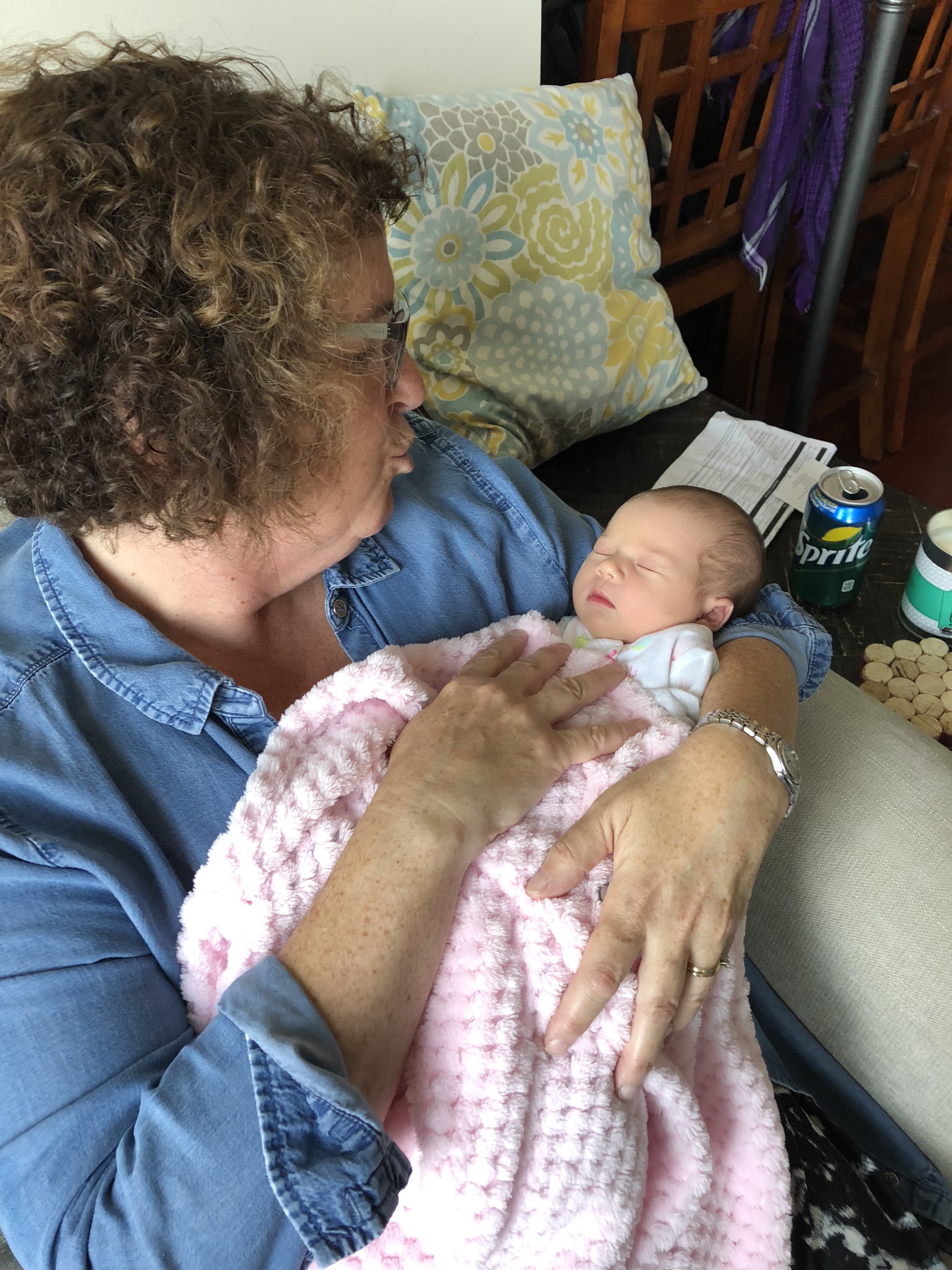
As we drove up to Temple Emanuel in Kingston, NY, I wondered how the day might go. Linda and I were about to bring my mother and my father to see their brand new great granddaughter Evelyn (Evey, for short). Our wonderful son Daniel and his wonderful wife Beth became parents on May 31stand we had already been down to the city to see the baby (and them) twice. The first time, it was just Linda and I, and the following weekend we brought Linda’s mom, Feige, to see Evey. Those visits had gone quite well.
This visit presented some significant challenges, challenges we spent considerable time fretting over. The biggest issue was my mom’s Alzheimer’s disease. She has been living with it, meaning we as a family have also been living with it–my father most of all–for more than a decade. The disease has done what it does. It has gotten inexorably worse as her memory, and so much of what made her a brave, kind, thoughtful, bright person, have been stolen from her. The ability to manage money, to cook and clean and participate in meaningful discussion gradually disintegrated.
And it left someone behind who is at once my mother and, at the same time, certainly not her. Anyone who has a relative with this cruel disease understands what I just wrote better than my poor ability to communicate it. In her case, my mother will become incredibly fixated on things that worry her. This is perhaps a consequence of her underlying psychological makeup and, of course, her experiences during the Holocaust, in addition to the disease.
But she will ask, “where are we going?” “where are we?” “who are you?” “where is my mother?” and similar questions relentlessly. You cannot answer the question enough times; it just keeps getting repeated. She cannot retain what is said to her. I find it fascinating that she has no trouble remembering what she is worried about. Something works deep inside there, but not the ability to remember what was just said to her. Never.
Taking care of her and my father has been a team effort among my siblings, but like all teams, this one is not made up of equal players. I have done my part in terms of managing the medical side of their care. But that is, frankly the easiest part. My sisters and brother have done much more than I have in terms of managing their lives overall. My two sisters in particular, Ro and Dor, have been beyond wonderful and selfless in all they have done.
Before we left Albany to pick my parents up, Linda and I made signs to put on the back of the seat, in front of my mom, reminding her where we were going, who we were going to see, who was in the car. While it didn’t work perfectly, it actually worked quite well on the way down to the city. Given her other deficits, it is interesting that she can still read English and Hebrew.
Linda picked up sandwiches which we brought in the car and gave them to eat on the way down to the city. They were both dressed up for Saturday morning services, something they attend weekly. In Florida, they attend synagogue three days each week since the daily minyan is no longer available. While in Saugerties, the pickings are slimmer and they just go Saturday mornings, but they both still enjoy services. In Florida, my dad serves as gabbai (the person who calls people up to the Torah) and often davens (sings/chants) the prayer service, something he is quite good at. Up here in New York, they are just congregants and that seems to be plenty good by them too.
As we drove down, there was pleasant conversation with my father and my mom seemed reasonably satisfied, responding well to cues to read the information on the seat in front of her as needed. We were particularly concerned about the effects of being away from her familiar environment but she really did quite well on that ride. The weather was glorious and there was no traffic to speak of.
Eventually we made it to New York City and to Dan and Beth’s apartment in Harlem. Their building is lovely and their one bedroom apartment is as spacious as a NYC one bedroom apartment gets. They have room for Evey’s crib and a chair to hold and feed her in the bedroom. And their cat, Hamilton–a three legged cat–seems to have behaved reasonably well with the presence of a new lifeforce in his space.
In the apartment, Great Grandpa was in his glory. He was holding Evey and speaking to her and explaining that she knows that he is her friend and she seemed quite pleased as well. This was the reason for all of the effort. For David, getting to see a generation three removed from his own, his own progeny, getting to hold and speak to and be with that great granddaughter, was nothing less than a miracle, the fulfillment of some sort of cosmic justice.
The fact is, he never should have been alive to witness this amazing moment. He was supposed to have been killed long ago in northeastern Poland. The nazis had more than enough resources devoted to making sure he died. There were ss everywhere, there was a ghetto and plenty of anti-Semitic Poles ready to turn Jews in to the Germans. The statistics are startling. 80% of Jews in Poland before World War II did not survive to the end of the war. 98% of Jewish children were killed. The nazis did not want anyone young enough to reproduce to survive and special attention was paid to youth.
David, my dad, lost his mother, his sister and his brother. His father died shortly after the war, while in a displaced persons camp, just before they were scheduled to leave to America. All of the cousins and friends and neighbors he knew were in the same boat. Of the approximately 4,500 Jews in and around Ewier (his hometown in Poland) in 1939, between 50 and 100 lived to see 1945. David had done amazing things and overcome incredible odds to reach America and build a new life.
Although, she is no longer aware of much of her own history, Paula, my mom, went through similar difficulties. I am less certain of the numbers in Sarnik, but there have been mass graves uncovered there and the numbers are similarly grim. Her mother, Lea Silberfarb, was beyond bright and brave and I am so proud that my daughter wears that name so well. Lea rescued her three children against all odds, unable to even get word to her husband who was killed by the Germans.
So now, 73 years after the end of World War II, having overcome all of that and having built a new life in a new land, learning a new language, having experienced all of the illnesses he has accumulated, here was my dad, 95 years old, holding the next generation. Those who came with an army to kill him are gone. He remains. And his legacy lives on in a new baby’s bright eyes.
He was glorying in her, loving her and loving the experience. We have had our challenging moments and Linda has been kind enough to provide this forum for me to discuss them before.
This was a very different moment. This was the reason to endure all of those other moments. He understood that. Linda understood that. Dan and Beth understood that. And all wanted him to have that moment. It was a form of pure joy that is hard to put into words.
After that visit, Dan showed Bobe and Grandpa the view from the patio of his building and we said our farewells. We stopped at our apartment and they got to see it and to use the facilities before we headed back upstate. We were to meet my brother Steve along with his family for dinner, his wife Shari and their amazing children, Laura and Jordan. The prior evening, we had seen them at Shari’s retirement party and I was so impressed with her, Steve and their children as they each spoke so eloquently about Shari’s remarkable career managing a large part of OPWDD, the state office tasked with caring for people with developmental disabilities.
We did not have as easy a time driving up. My mom was tired and did not respond as well to the sign on the seat. She was not as easily comforted and the relentless questions were rapid fire. Linda worked hard to keep her engaged, comforted and oriented, but it wasn’t easy.
We arrived at the Harriman exit and made it to the restaurant where we were meeting my brother’s family. They came out to the car as we pulled up and grabbed my parents, giving Linda and I a breather.
We had a nice meal, I had a cold beer, Linda enjoyed two glasses of sangria. After dinner, we drove the remainder of the way to Saugerties where we dropped off the parents to the care of their aide. With all of the things that could have gone wrong, there were no unfortunate events.
We had a successful visit and my dad has subsequently spoken joyfully of that day.
It is not every day that you can give your parent that kind of gift. Of course, Dan and Beth were quite essential to that. They are incredible people, kind and loyal and already clearly outstanding parents.
It was a wonderful Father’s Day gift and a rewarding day. The following day, actual Father’s Day, Linda and I didn’t go anywhere. I did some yard work, also known as my therapy, we grilled and relaxed.
We know the old saying, ‘you can’t judge a book by its cover.’ We know this applies to people, yet we do it anyway; we judge. Looked at another way, is the idea that you never know what is going on with another person, unless they share it with you. I am going to share, with the hope that it helps others.
I take Zoloft and I have for many years. Some may read that and think, ‘Big frickin’ deal! Doesn’t everyone?’ Others may be surprised since my life is so charmed (and it is). And some may wonder why I would share something so private.
It is that last one that motivates me to write this post. Struggling with depression and anxiety is no different than other illnesses. I think there are some who view having cancer or diabetes or high cholesterol as a private matter – but not out of shame.
I hesitate to label myself as mentally ill. I have never been clinically depressed, as I understand that term. I have suffered only one panic attack that I recognized as such, and that was when I was a teenager. But, I have struggled my whole life with persistent melancholia. Whether that qualifies as a mental illness according to the DSM, I will leave for a doctor to decide. The label doesn’t matter, I was struggling through my life. It took a few things to get me to finally seek help.
One significant trigger was my son. When he was an adolescent, he asked me why I was always so unhappy. That opened my eyes to the impact my moods were having on my children, and that maybe it was getting worse. I also realized that I was fed up with ruminating. When things would go wrong, let’s say a family member said something that hurt my feelings or an interaction at work was frustrating, I would replay the incident in my head for months, imagining what I should have said in response, or how I would talk to them about it, only to do nothing. I would get stuck in that place and time, I couldn’t get out of my own way. One more factor led me to reach out and that was my daughter was approaching college age and she would be leaving home. I wanted to prepare myself and I wanted to handle the stress of that process better.
I asked my internist for a referral to a psychologist. I wasn’t thinking that I needed medication. I thought talk therapy would be sufficient. The referral worked out well – the therapist was a terrific match for me. She took a cognitive approach and we agreed that we would look at adding medication down the road, if we thought it would help.
After a number of months of weekly visits that were useful, I still wasn’t progressing the way I hoped, we revisited the medication question. We decided that I would try Zoloft (my internist actually did the prescribing). It was the right decision. It hasn’t been a miracle drug. The big difference I noticed was that I wasn’t in my head all the time. I could move past the aggravations and hurts that are a normal part of life, but previously I was not able to let go of. It didn’t suddenly fix my self-image problems, or remove all anxiety or regret, but it made it less of a struggle.
After a while, having learned some strategies and having better insight into myself, I thought I would try stopping the drug – I discussed it with both my therapist and my internist. I weaned off of it. After about a year, I realized it wasn’t a good move. The aftermath of my father’s death was a particularly challenging time for me. I also came to the realization that whatever it was about my brain that led me to ruminate was still there – it wasn’t going away. While I may have been able to manage it behaviorally, it took so much mental energy to do it that it was exhausting. I needed to come to peace with taking the medicine for the foreseeable future.
I write this because during all the years that this was playing out, I had numerous occasions where people commented on how lucky I am, or how happy, assertive, or comfortable (insert positive characteristic here) I seem to be. I am those things, some of the time, and not without considerable effort. If only they knew, better living through chemistry! Now they know!
So, there are three points in my sharing this. First, don’t make assumptions based on what you see. There is an internet meme that says you never know the battle someone else is fighting. Every time I see it, it resonates. Start with compassion. Second, it shouldn’t be a thing for someone to share that they take an anti-depressant, anti-anxiety or any other medication that helps to regulate mood. We shouldn’t sit in judgment. We may be moving in that direction, but we aren’t there yet. Lastly, I hope it is helpful to someone to know my story.
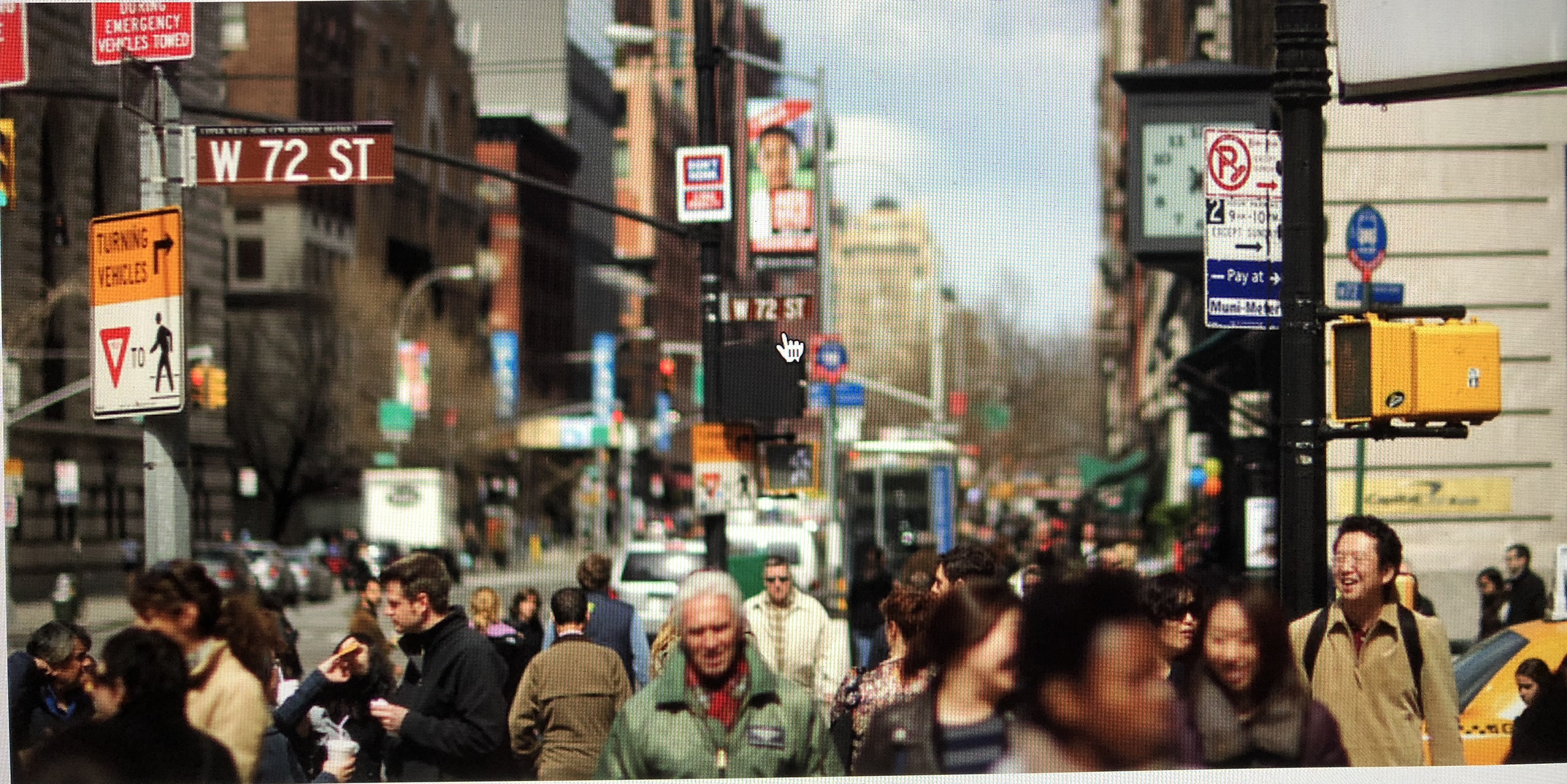
When I was in graduate school I lived on 80thand Columbus Avenue in Manhattan. It was 1980. It was my first exposure to gentrification. I hadn’t heard the term before, but it was taking place before my eyes as the block transformed brownstone by brownstone. Drug addicts, homeless and working class people were displaced by wealthier folks. Mom and Pop stores were shuttered and boutiques and trendy restaurants moved in. I wondered where the displaced people went, but I can’t say I was sad about the changes. Slowly but surely the neighborhood felt safer, I could walk comfortably on more blocks. Though the ice cream from the new Haagen Dazs shop may have been expensive, it sure was delicious.
The Upper West Side today. Photo credit: Chang W. Lee/The New York Time
Some lamented the changes, either because of the injustice to those of lesser means or because of the loss of authenticity (everything new, shiny and expensive was phony) or both. I certainly understood the former. The gap between the haves and the havenots was growing steadily, it was and is unfair. But, longing for the days when New York City was gritty and dirty, was bizarre to me. I didn’t enjoy being afraid. I was unsettled by the strung-out junkies hanging out on the stoops of those brownstones. That era, the 70s and 80s, when the city nearly went bankrupt, and the lack of support showed in crumbling buildings and overflowing garbage, is not romantic to me. (The website Gothamist ran a series of side-by-side photos of Central Park, showing the condition of the park back in the day. Take a look.)
More recently I had reason to think about the changes in the last decades in New York City when Leah and I did the Five Boro Bike Tour (which I wrote about here). We cycled through Greenpoint and Williamsburg in Brooklyn. Those two neighborhoods were off limits in the 70s and 80s, I wouldn’t have considered visiting either area, much less ride a bicycle through them. We rode past art galleries and craft beer breweries. Much like the gentrification of the Upper West Side, these areas in Brooklyn were now home to a wealthier professional class.
I thought about how change happens in neighborhoods and how complicated it all is, and whether the changes were, on balance, positive. I did a bit of research, including reading a book, The World in Brooklyn: Gentrification, Immigration and Ethnic Politics in a Global City (2012), edited by Judith DeSena and Timothy Shortell. The book is comprised of 16 scholarly essays, including one entitled, Revising Canarsie. (Note: I believe that the title was meant to be Revisiting Canarsie, not revising, because the premise of the piece was to take a look at the neighborhood and compare it to an earlier examination by Jonathan Rieder, entitled Canarsie: Jews and Italians of Brooklyn Against Liberalism(1985), a book I also read and found very insightful.)
The book, The World in Brooklyn, in general, makes the case that gentrification is a bad thing for the poor, immigrant communities. It paints a picture of an invading force that disempowers the current residents. While I believe there is truth in that picture, I think it oversimplifies things. The books presents the ‘gentry’ as one, monolithic thing – as if it is a homogenous group of rich, white people. The book doesn’t take into account that when demographics are changing, it is a two-way street. There can be hostility and an unwillingness to work with newcomers that make true integration across economic classes (not just racial differences) impossible to achieve.
I may be particularly sensitive to this issue of integrating across economic classes because of an experience I had when we moved into our suburban neighborhood, which was a new development (new, developing neighborhood). As may be the case in many suburban neighborhoods, there was a range of economic circumstances. There were those who were barely able to make ends meet to live there, and there were those for whom it was very comfortable, and, of course, families in between. Though Gary and I were in the more comfortable range, we thought of ourselves as more modest people since we had grown up in middle class families. Leah, our daughter became friends with a girl down the block and they often played at the friend’s house. We became friendly with the parents and made numerous overtures to invite them over. We were politely rebuffed. Over time, and as a result of a number of comments that were made, I came to believe that the mom made certain assumptions about us. Since Gary was (and is) a doctor, we were Jewish, we were from downstate originally, the mom, in particular, was not comfortable socializing with us. Maybe I was wrong, perhaps she just didn’t like us, but I think there was something else at work. As Gary and I became more comfortable economically, I became more aware of how that can create awkwardness, even when trying to be sensitive. It is something that is difficult to talk about. We never did get beyond neighborly friendliness and eventually they moved. The experience, and others like it, made me more aware of economic factors that can create social barriers.
My experience growing up in Canarsie offers another perspective on neighborhood relationships in the midst of change. Canarsie’s story of change is not one of gentrification, it would appear to be just the opposite. I have written before about my experience in 1972 with the boycott of schools because of the plan to bus black students from East New York into predominantly white Canarsie schools (here). There was some white flight in response, but the neighborhood remained fairly stable for a number of years (my parents left in 1989 when they retired from teaching). In 1990 Canarsie was less than 20% black; in 2000 it was 60% black (and I use ‘black’ because many of the new residents were immigrants from the Caribbean who may or may not have identified as African-American). By 2010 the neighborhood was over 80% black. Though the racial composition changed, the fact was that the economic status remained stable. The new residents weren’t poor and they weren’t uneducated.
Typical block in Canarsie – Photo Credit: Anthony Lanzilote
The Caribbean immigrants who made Canarsie their home were looking for the same things that Jews and Italians were looking for years before. According to a New York Times article:
‘A house to the Caribbean man is something very important,” Samuel E. Palmer was saying. ”He has to have a house, as opposed to an apartment. Whatever happens, the house comes first, so you can have a family and your friends can meet there. So, when I came here, the desire also was to achieve this house, this houseness.”
Canarsie had what many Caribbean immigrants wanted: single-family homes with backyards for barbecuing and growing roses or tomatoes, decent schools, affordable prices, quiet streets, proximity to family. They were loyal to Brooklyn; they had no interest in Queens or Long Island. As Mr. Palmer put it, if you move, you have to build all over again: friends, neighbors, all that.
Canarsie is teeming with new and newly revitalized civic associations these days, many of them headed by newcomers like Mr. Brazela and Mr. Duncan, lobbying and agitating for improved street lighting, road repairs, better drainage.”
THE CENSUS — A Region of Enclaves: Canarsie, Brooklyn; ‘For Sale’ Signs Greet Newcomers – NYT, June 18, 2001
The essay on Canarsie in the book that I cited above, supported this anecdotal account with research-based findings. It is sad that it wasn’t possible for the community to truly integrate. The exodus of white families accelerated in 1991 when there were three bias incidents (against black families/businesses), including the fire-bombing of a real estate agency that was court ordered to show homes in Canarsie to blacks and Hispanic buyers. The neighborhood became homogenous again – now it is over 90% black.
In reading and thinking about the issues raised by changing neighborhoods, I think there are some commonalities. Problems seem to start with assumptions made based on stereotypes or ignorance or both. And, there aren’t mechanisms to get beyond those assumptions. We have no language to talk to each other about these issues. One of the essays in the World in Brooklyn analogizes different segments of a community living together to ‘parallel playing,’ like toddlers who might play with a set of blocks at the same time, building their own structures, but not interacting. This seems like an apt description. There is some learning about each other as groups coexist, but not true integration. Of course, there are exceptions, some individuals have successfully broken down barriers, but it doesn’t seem to translate to whole communities. The question is, how do we integrate across race, economic status, religion? What have we learned from our past experiences that can help us? How can we do better?
Note: I wrote a post previously that included portions of this story (here). I wanted to write about it in a different way, explore it further.
In front of my house in 1966
I met Mindy before we even moved to Canarsie. I was a month shy of my fifth birthday. In the twilight of a warm August evening in 1964, we drove across Brooklyn to see our new home. After we got out of the car, my mom took my hand and led me up the stairs of the next door neighbor’s house, and rang the doorbell. A woman answered. “Hi, let me get Mindy,” she greeted us in a husky voice. “Mindy!” she yelled, “Come down and meet our new neighbors!” Apparently, Mom had, on a previous trip, introduced herself and our visit was expected.
I stood on my tiptoes to see over the solid part of the screen door. In the dim light, I could make out the shape of a girl, who looked to be about my age and size, coming down the stairs. We waved at each other. The screen door opened and our moms talked while we looked at each other.
Mindy was olive-complected and skinny. Her almond-shaped brown eyes didn’t line up exactly right – neither did mine. In the coming years, we would share the experience of wearing an eye patch to correct muscle weakness. We bonded over being neighborhood outcasts. We also enjoyed pretending, making up elaborate games involving playing school or imagining we were pirates.
Since only a narrow alley separated our houses, we would talk from our respective windows. We had a lot in common – we each had a brother named Mark (her’s spelled it Marc) who we complained about. Our mothers were teachers. We each shared our houses with extended family. Her aunt, uncle and two cousins lived in the downstairs apartment of their house, while my grandparents and two uncles lived upstairs from us. We were both sports fans. As we got older we talked incessantly about our beloved Knicks. We obsessed about our crushes on particular players (me on Dave DeBusschere, her on Henry Bibby).
There were some important differences. Her mother was a screamer. I could hear her yelling at Mindy, even calling her names, from inside my house. Though my dad was the one with the temper in our family, he never resorted to name-calling.
Her mother would come home from work and lay down to rest, insisting on quiet in the house, before she made dinner. Mindy and I would do anything to avoid disturbing her. Mrs. Schiff’s anger was a thing to behold. If we couldn’t play outside because of the weather, we used my bedroom or basement. I was rarely invited to her house.
Mindy was my best friend. That is until my friendship with Susan blossomed at the end of third grade. Susan and I were in the same class; Mindy was never in ours. Things got complicated because Susan and Mindy weren’t friends.
One day, Mindy and I were deep into pretending that the narrow strip of dirt and grass between our two houses was a ship. I was the captain; she was the first mate. We were busy battling pirates when Marguerite, Johnny, Susan and Mike showed up. “You stupid, skinny idiot,” they taunted. I was relieved – they weren’t jeering me. I stood silent.
Not only was I silent while the taunts rained down on Mindy – after a while I joined in. I knew it was wrong, even in the moment. But, it was too tempting; it was exhilarating to be part of the powerful.
Mindy and I didn’t speak for months. I would lay in my bed staring out my window, looking at her house only a few feet away, feeling guilty and ashamed. I couldn’t stand it. I went to my mother and told her what happened and asked what I should do. She said there was only one thing to do, apologize.
“But what if she doesn’t accept my apology?”
“She may not, but you have to do it. You’ll feel better, even if she doesn’t.”
I couldn’t bring myself to do it immediately, but I knew she was right. After a few days, I got my courage up.
I spotted her in front of her house, getting ready to get on her bicycle. I called to her, “Mindy! I’m sorry,” I blurted it out. She turned to look at me, warily. I came down my steps and approached her, continuing, “Can we be friends again? I promise never to do anything like that again.” She gave me a small smile and said, “It’s okay with me, but we need to talk to my mother.” “Okay, whatever you want,” I said, relieved, though the thought of facing Mrs. Schiff made my stomach turn over.
At a pre-arranged time, I rang her doorbell and Mindy answered. She ushered me up the stairs. Their apartment was the mirror image of my grandparent’s place next door. Her mother was seated at the kitchen table, taking a break from making dinner. I told her I apologized and it would never happen again. She told me, in her sand-papery smoker’s voice, in no uncertain terms that I couldn’t bully Mindy and I couldn’t treat her like a second fiddle, or else I’d be in trouble. “You can’t play with Mindy only when no one else is available,” she warned. She nodded toward the pot of boiling water on the stove.
Maybe I imagined that she gestured to the boiling water – but I believe she actually did. In my memory she said, “I will boil YOU in that pot if you mistreat her!” Whether she uttered those words or not, I clearly got the message. Almost 50 years later Mindy and I are still friends. I learned my lesson.
I have always prided myself as someone in touch with their feelings. I can usually pinpoint the source of my emotions. Frustration with a relationship, disappointment in an outcome, anxiety about a challenge, excitement about an upcoming new experience – I can usually identify what is going on. Lately that ability seems muddled – I’ve had more free-floating anxiety than usual.
I was driving south on the Thruway the other day, heading to New York City for something like the 5thtime in a month (I’m usually excited by the prospect of time in the city). This time I just felt nervous, my brain flitting from one thing to another, I was having a hard time concentrating. Thankfully I was able to focus on the road – it would truly have been a really bad sign if I got lost. I can make the trip on autopilot at this point. I tried to think through what has been going on, why this unease? Why have I been feeling more overwhelmed than circumstances seem to warrant? Since I was alone in the car, I took the opportunity to try and sort it out.
I am well aware that I am very fortunate, my life is an embarrassment of riches. I try to keep gratitude in the forefront, but, oddly, I find that the more I have, the more I fear losing it. I’m not referring to things (though I do have a confusing relationship with things, I like them more than I should), but to people. Readers of this blog know that our daughter-in-law is expecting a baby any day now. I think humming along in the background of my brain has been an awareness of the risks involved for everyone. I am also well aware of the fact that I have no control over how things will go. If only I could wrap up my loved ones in a cocoon to protect them! Obviously, not an option. So, maybe one contributor to my heightened level of anxiety is anticipation of this big event.
It’s funny in some ways because we spend so much time wishing for things (both tangible things and situations/events) and then when they happen, you realize it isn’t quite what you thought. There are strings attached.
You hope that your child finds a partner in life. But when they do, it changes your relationship (in all sorts of ways, many positive, some unanticipated). You look forward to being a grandparent, but that brings new worries. You look forward to a trip, but then you deal with the aggravation of delayed flights or turbulent weather. You want the luxury of a swimming pool in your backyard, but then you have to deal with the maintenance (a seemingly never-ending source of aggravation in our case). These may seem like wildly different ‘things,’ but there is a theme. There is a cost that comes with the things we want. Perhaps that is obvious, but it makes me stop and think. There is virtue in simplicity. Maybe I should consider Buddhism! The way I understand one of its central tenets is that you shouldn’t become attached to things or ideas – you need to let go of expectations. I don’t know if I can do that.
Or maybe I need to figure out how to not let these things get to me; figure out a way to acknowledge the worry, but then set it aside, especially when there isn’t something to be done.
But, it is so easy to lose perspective. Over the last couple of months, we have been enmeshed in the process of buying a condo in NYC. That’s the reason for so many trips to the city. Filling out the paperwork for a mortgage and shepherding it through the process felt like a full-time job. How blessed am I that making this purchase is even an option? But it is also a source of anxiety. It is a huge investment, the numbers are scary. But then I would remind myself that if it fell through, there was no real loss. And, if we successfully closed on it, and it turned out to be too big a financial commitment, we could sell it. So why did it feel so stressful?
In part, I blame Trump. You may ask, what is the connection? As I was driving down the Thruway, mulling things over, I realized that another large piece of my anxiety came from worries about our country’s future. I happened to be reading a novel, Ready Player One, set in a dystopic future that was all too imaginable to me. I have no faith in Trump, he has appalling judgment and is intent on sowing seeds of hate and fear, and Congress isn’t willing to take him on. The threats of climate change, of civil unrest rooted in the growing divide in this country, of America losing its footing, are all too real. Not to mention the tragedy of gun violence. Making such a huge investment in a time like this feels like a leap of faith, but my faith is shaken.
This unsettled feeling about our future was reinforced by an experience I had on that trip. On the day I was driving, a video went viral of a white guy going on a rant in a New York deli because the employees were speaking Spanish. It is the type of thing that seems to be happening a lot more in this age of Trump and ubiquitous cellphones. One of the reasons I was making the trip was to be at the new apartment for the guy to install cable and wifi. The guy arrived, at the appointed time, and, as is often the case, it took quite a bit longer than expected for him to successfully get things running. He was there for a couple of hours. At one point, while we were waiting for technical support people (he was on hold with his office) to try and fix things on their end, his personal phone rang and he asked me if I minded if he answered it. “If I do, I will be speaking Spanish,” he explained. “Of course you can answer your phone,” I responded. He shrugged sheepishly, as he answered. I moved toward the kitchen to give him space.
As I reflect on this interaction, I realize that I would feel differently if he had been in the middle of explaining something to me, then it would be rude to take a personal call, regardless of the language he spoke. But at that point we were just waiting awkwardly. I had no problem with him taking his call. I thought it was a sad commentary that he felt the need to explain that he would be speaking Spanish. It was a personal call, it wasn’t my business to understand his end of the conversation anyway. When he got off the phone I said we had come to a sad place if he needed to ask if it was okay to speak Spanish. He gave a small smile and another shrug.
During my 2 ½ hour drive and as I continue to think about my state of mind, I have come to a better understanding of what’s been going on. Not surprisingly, most of the issues are out of my control. I decided I need to focus on what I can do to manage it.
These are the strategies I came up with:
Avoid reading dystopic novels (at least for a while).
Reduce the number of times I allow myself to look at Twitter and Facebook to two times per day. Look at blocking some of the more vitriolic sources from my Facebook feed.
Find an organization or campaign that I can volunteer for that is in concert with my values. (Or, alternatively, assuming Dan and Beth will allow/need, help with the baby!)
Devote more time to productive activities, whether it is clearing clutter in my home, doing research for my memoir or talking to friends, spend more time doing constructive things so I don’t dwell in worry.
I hope that isn’t too ambitious. It doesn’t seem like it should be. If you have suggestions, please share. I’ll report back.
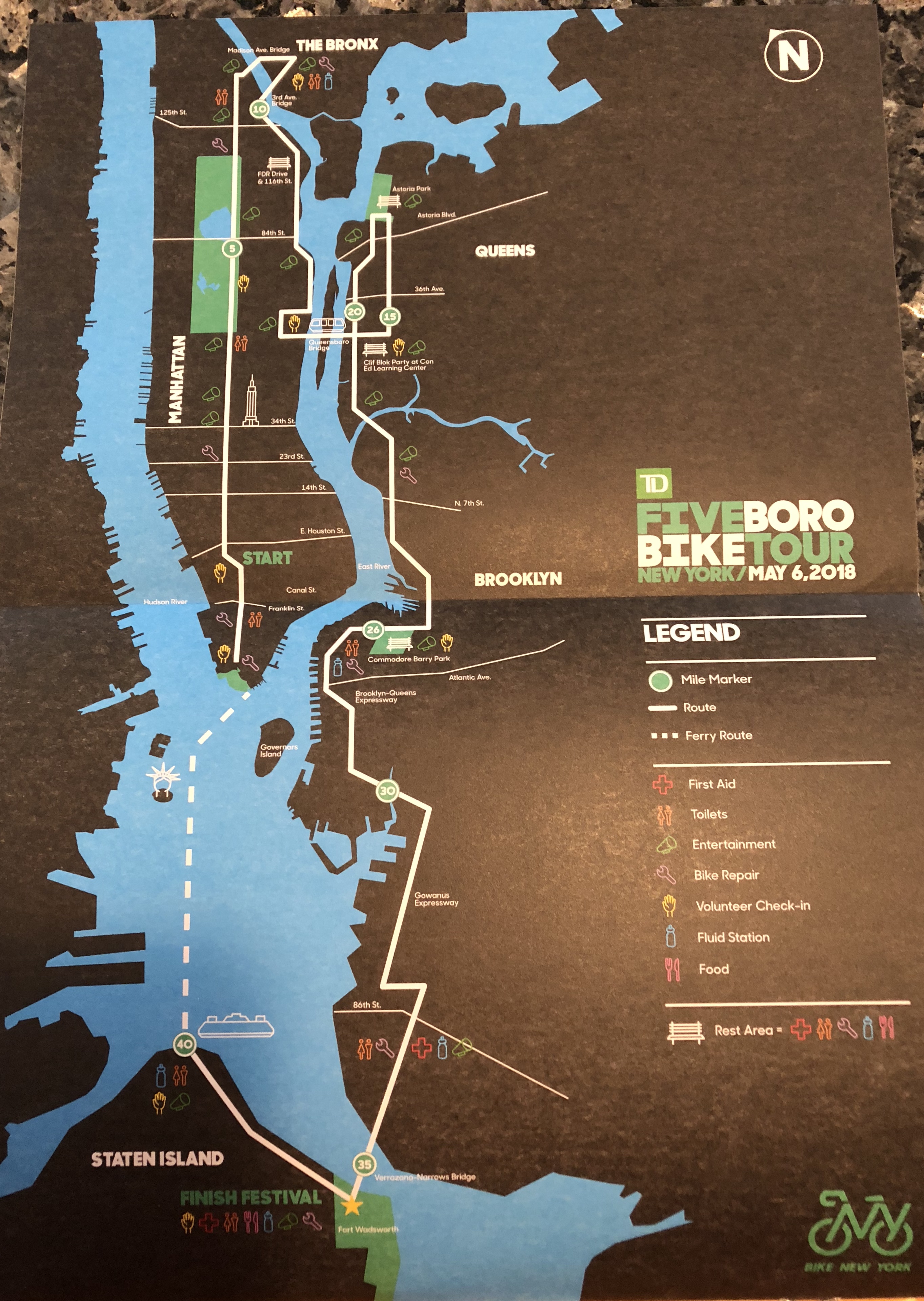
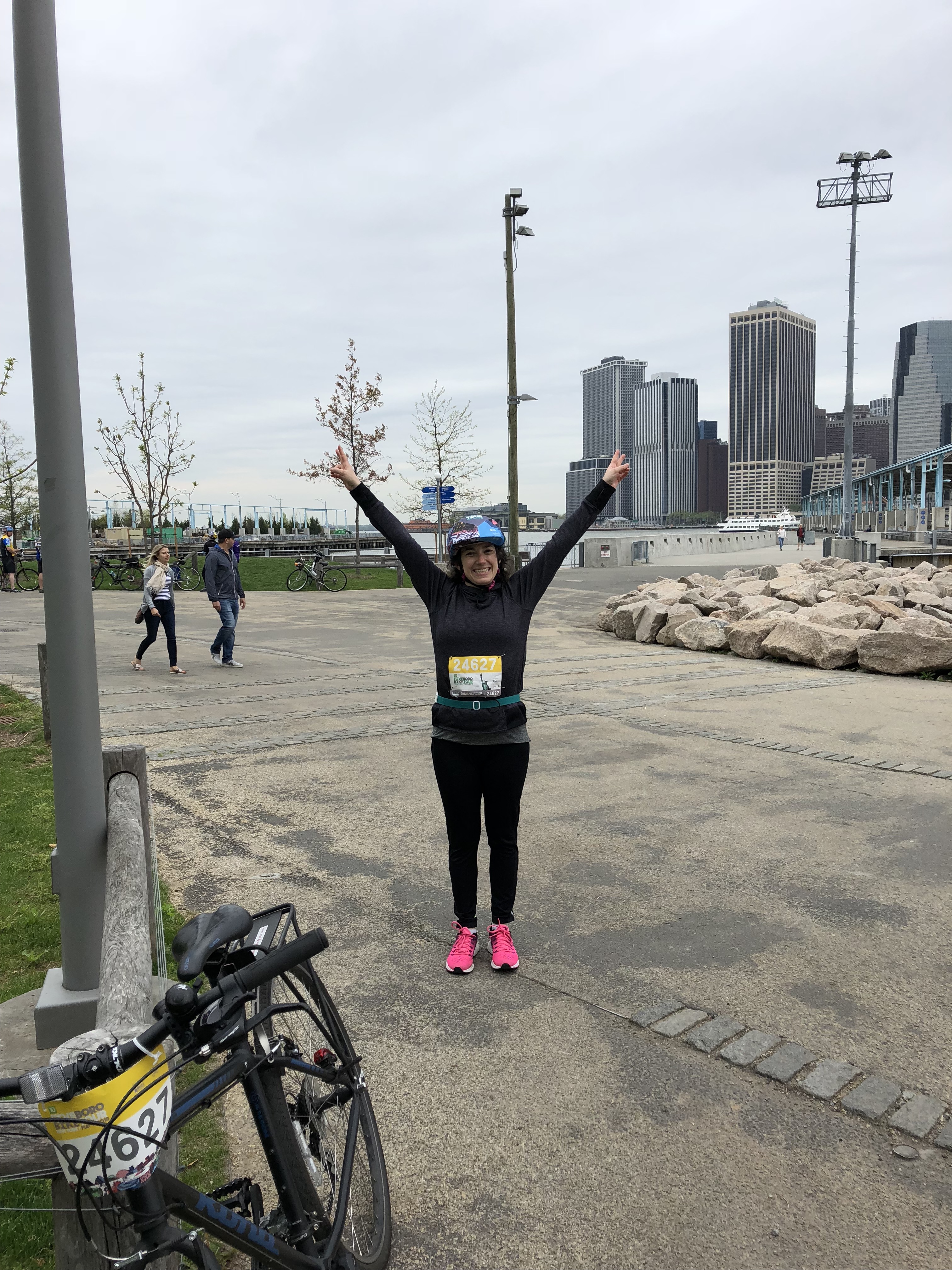
When Leah called me back in January and asked if I wanted to do the 5 Boro Bike Tour, my answer was a definitive and excited yes. For those of you not familiar with it, this is a 40 mile bike ride through all five boroughs of New York City. I thought it was a great idea. I love biking – it is an awesome way to sightsee and get exercise. I would plan it and get to experience it with my daughter, we would build memories together. It was a full four months off so I could train for it and get in shape. All of which turned out to be true, except for that last one about the training.
Spring came very late to Albany, in fact we had a number of Spring snows, which made biking outside very difficult, if not impossible. I admit that I am a fair-weather bicyclist. I did up my walking/jogging routine. And when the weather finally permitted, I cleaned up my pretty red bike, Gary put air in the tires, and I took to the road. The longest ride I managed, though, was 14 miles. A paltry amount compared to the 40 the tour would require. But, I was determined and that would count for something.
As the date of the tour approached (it is not a race! all the promotional materials make a point of this, I think mostly for safety reasons), I found myself increasingly nervous. I had butterflies. Aside from the inadequate preparation, I was worried about a few things, in no particular order:
potholes – New York City streets and highways, especially in the Spring, are a disaster. I worried, with so many bikers, would I be able to avoid them?
the weather – Rain was forecast. While I don’t mind the rain generally, the idea of slick roads and obscured potholes (see above), was frightening.
bike malfunction – The tour materials suggest bringing a spare tube because flats are common (again, see the first bullet), and I didn’t get one. Also, I didn’t get my bike tuned up, which was also recommended. So, I was concerned that something would go wrong and I didn’t know how that would work out.
my 58 year-old body – I do exercise regularly, but I still manage to be quite overweight. In addition to the lack of preparation, I worried about how my various parts would handle such a long ride.
logistics – I read and re-read the online information about the tour, but I still worried about all the logistics, like getting to the start on time, getting back to the apartment, getting separated from Leah, etc.
disappointing Leah – I wanted this to be a fun experience for both of us, I didn’t want to fail or be a drag on her.
I think that about covers the sources of my anxiety. I was surprised by how nervous I was. Looking at the list of my concerns written out, I shouldn’t have been surprised.
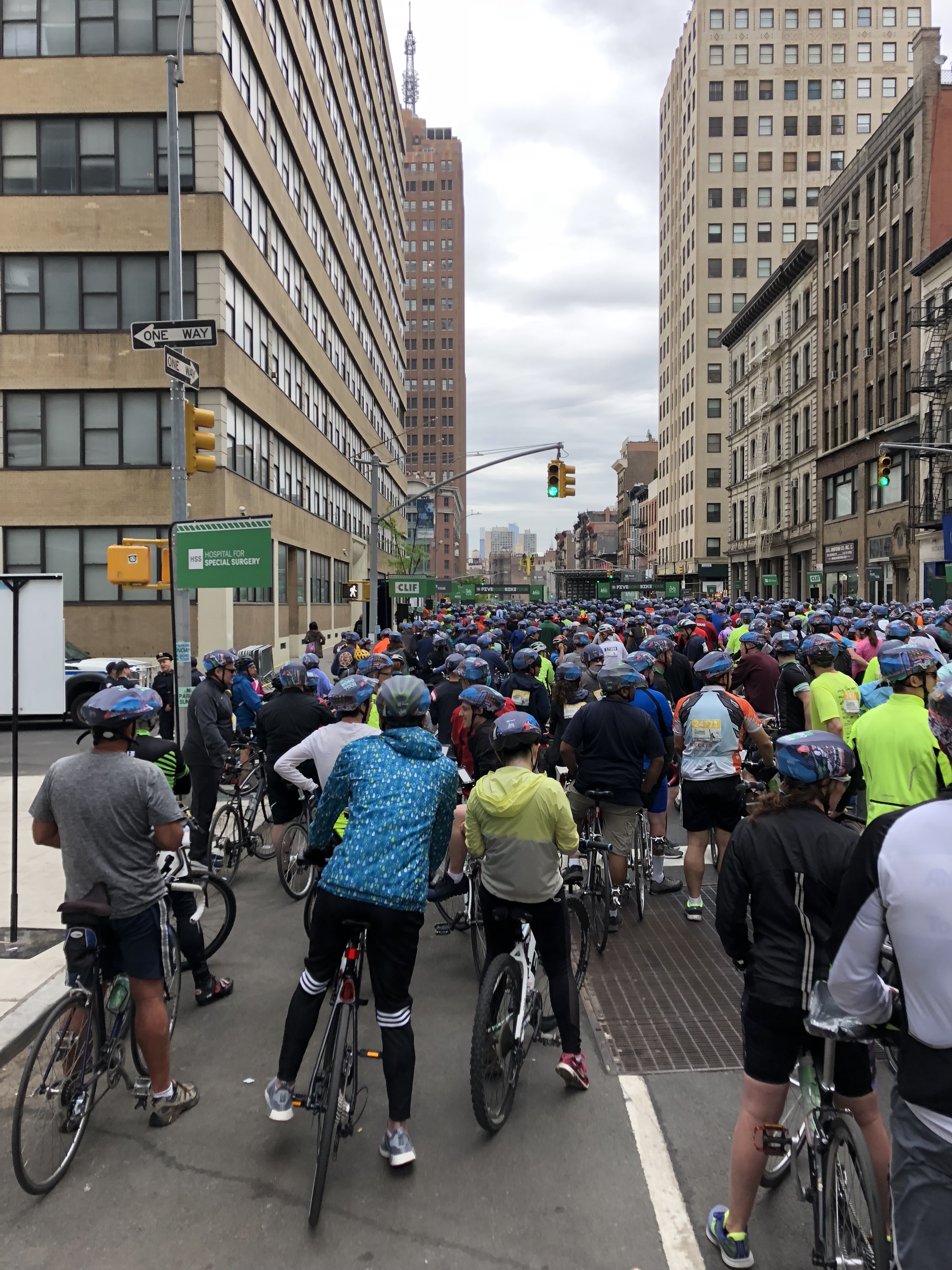
The route map. Blue is water, the black is land (kind of hard to decipher at first)The start – they stagger the start in waves. We were in the third wave at 8:45a.m.
Anyway, I plowed ahead and did it anyway, and I am so glad I did. Here are my thoughts and observations on taking a 40 mile bike ride through potholed streets and highways with my daughter:
Leah is the best teammate ever! She is fun, encouraging, fierce and strong (in every sense). I could rely on her. She remained in good humor (with one brief exception I will get to later – which wasn’t directed at me, but at circumstances beyond our control). She took pleasure in the sights. She believed in me. Yay, Leah!
The weather was perfect. Cloudy and a little cool, it was awesome for biking. Maybe some sunshine would have made some of the dingier parts of the city look better, but cloud cover was wonderful. We learned later from Gary that there was rain in every direction, but the city was spared. We were in our own dry bubble.
The ride up Sixth Avenue from the the financial district to Central Park, and then into the park (in full bloom), was exhilarating. With no automobile or truck traffic, we had the wide avenue to ourselves (and thousands of fellow bicyclists). We passed through different neighborhoods and could appreciate the architecture, sculpture and people as we passed. Central Park was in all its glory with flowering trees and clumps of tulips and green grass.
Seeing Gary waving us on as we exited Central Park at 110th Street was a great surprise. Seeing Dan and Beth, in her ninth month (!), at the side of the FDR at 120th Street was encouraging and so very cool. It’s funny because Leah and I were passing 106th Street a few minutes later when I said, “You know we passed Beth’s school (where she teaches), but I didn’t note it or mention it. Oh well.” I was making a point of mentioning landmarks or places related to our family history. Beth told us later they were standing in front of her school! Obviously I so excited to see them, I didn’t notice anything else.
We heard only one lewd comment. We were riding up Adam Clayton Powell Boulevard when a man on the sidewalk yelled out, “Oh, I wish my face was a bicycle seat!” Leah and I laughed about that for a couple of blocks, and periodically throughout the rest of the race.
Water is essential! Somehow we had neglected to bring a water bottle. Since this event was ‘eco-friendly’ the water stations offered no cups or containers. We used our hands the first time. When we got to Queens, I suggested we pull over and I ran into a bodega and bought a large bottle of water. The guy in the store took one look at me, and pointed down an aisle, “The water is over there.” What a relief! We refilled it as necessary.
The experience of riding with so many people was almost entirely positive. Some riders had blue tooth speakers set up with music blaring. That created camaraderie and gave us a boost. Plus there were real musicians along the way – we heard every type of music. Gospel, bluegrass, rock, jazz. There were also cheerleaders – we had no idea what team they represented, if any. It isn’t like the NYC Marathon where spectators line the route, but that was fine. At times there were bottlenecks, a particularly bad one exiting the FDR and approaching the Queensboro Bridge, where we had to dismount and walk for a while. Most people were courteous. We did see some accidents, but thankfully nothing too serious. The organizers of the tour did a good job – there was lots of support and people giving directions.
Riding on the FDR and BQE was an eerie experience. The BQE, in particular, was strange because there isn’t much in the way of scenery to appreciate, it is hard to gauge progress and the road is textured so it created a lot of vibration. My body, from head to toe, did not enjoy that. It also seemed to feature a lot of gradual uphills. Nothing dramatic, just enough to feel really shitty when you’ve already gone 28 miles. This was the most challenging part of the day for me. My legs were not happy and my spirit was sagging and I knew we had a demanding uphill to come (the Verrazano Bridge). We pulled over, I drank some water, took some bites of a power bar, and Leah gave me a pep talk. We resumed the trek.
I told Leah that I might have to walk some of the way on the Verrazano, my legs just may not carry me. I knew I would finish, but I didn’t know if I could ride all of that. Leah wanted to ride it – she was fresh as a daisy (she may not say that exactly, but she was in good shape). We made a plan to meet at the finish and agreed that she should do her thing. Later when we compared notes, I was so impressed with her. The climb up the bridge was tough. I was pleased with myself because I stayed on my bike. I thought I had reached the point where the downhill would begin, but alas, it wasn’t! There another stretch of uphill (at a slightly lesser grade, so it appeared from a distance that you had already crested the hill). What a disappointment! I got off my bike and walked the last part of the uphill. Leah had the same experience of expecting the end of the climb, but fierce woman that she is, she just pedaled harder.
We started at 8:45 a.m. and ended around 1:30 p.m.- a bit slower than we hoped, but we had no complaints.
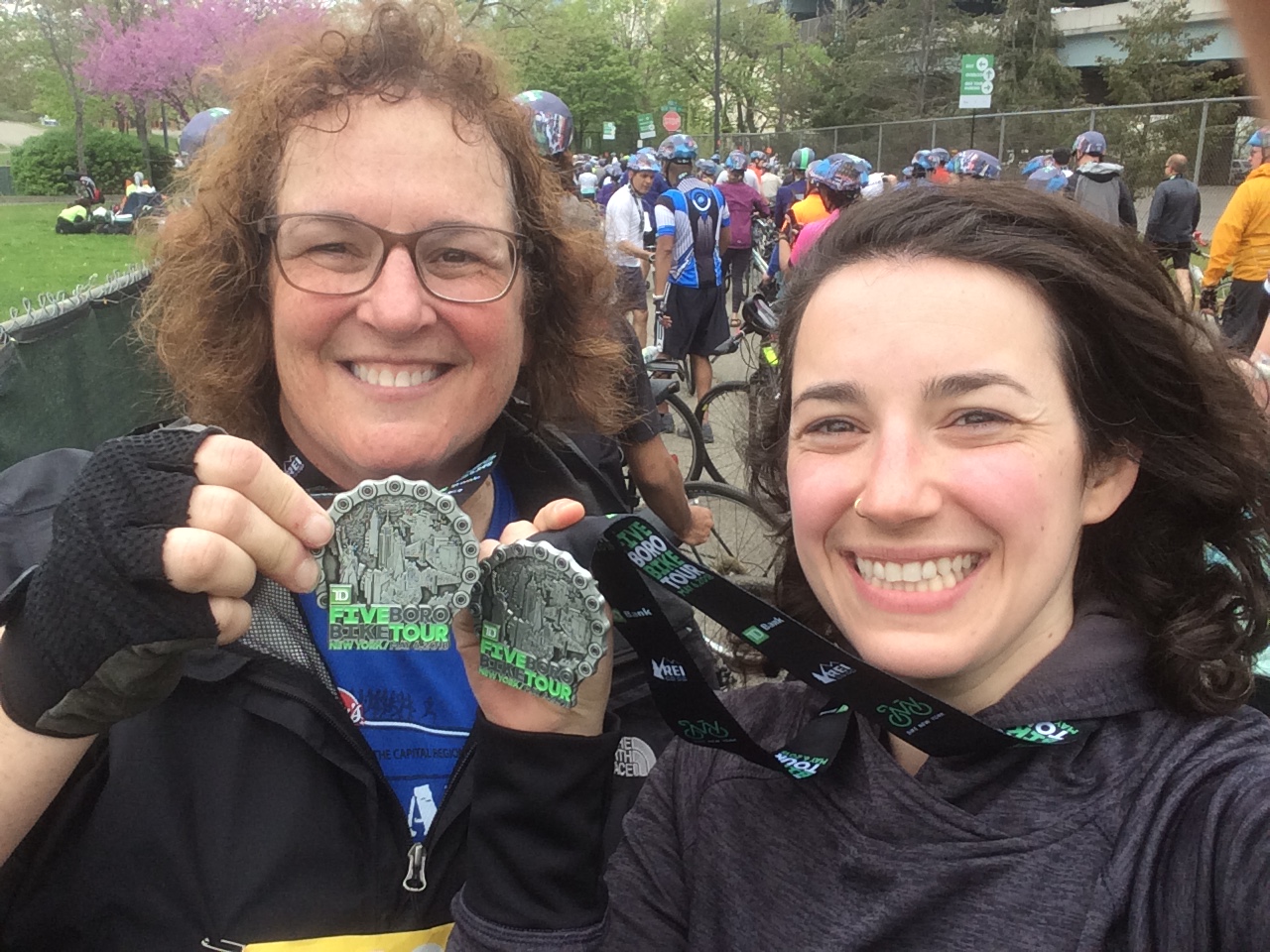
We met after we got our medals at the finish line and walked our bikes through the festival area where there was music and concessions. For probably the first time in my life, a cold beer sounded very appealing. We wanted to get back so we didn’t partake, just followed the hordes of people to the exit. We re-mounted our bikes and rode to the Staten Island Ferry. The ride started out pleasant enough. But then it kept going and going. I got angrier and angrier. Where was that fucking ferry!?! I was muttering and cursing. I was not mentally prepared for the four mile ride to the ferry! This was truly the worst part, for me. For Leah, the next part was the worst. Waiting on line to get on the ferry. She was facing a four hour drive back to Boston and was eager to get back to the apartment, get changed, eat and get on the road. She handled her frustration well. It was probably close to an hour of waiting on line before we got on the ferry. I was never so happy to sit down!
Gary was waiting a short distance from the ferry landing with the car. We walked less than two blocks with our bikes. He was parked right next to a hot dog vendor, so clutch! I bought a soft pretzel and a Diet Coke and climbed into the back seat. Delicious! Leah and Gary secured the bikes to the car and, other than hitting some traffic in lower Manhattan, we got back to the apartment in reasonable time.
Taking a break in Brooklyn
What a day! I was pleasantly surprised that I could still walk. My 58 year old body didn’t fail me. I took a hot shower. Leah and I debriefed a bit with Dan, Beth and Gary. I shared a long hug with Leah before she got on the road.
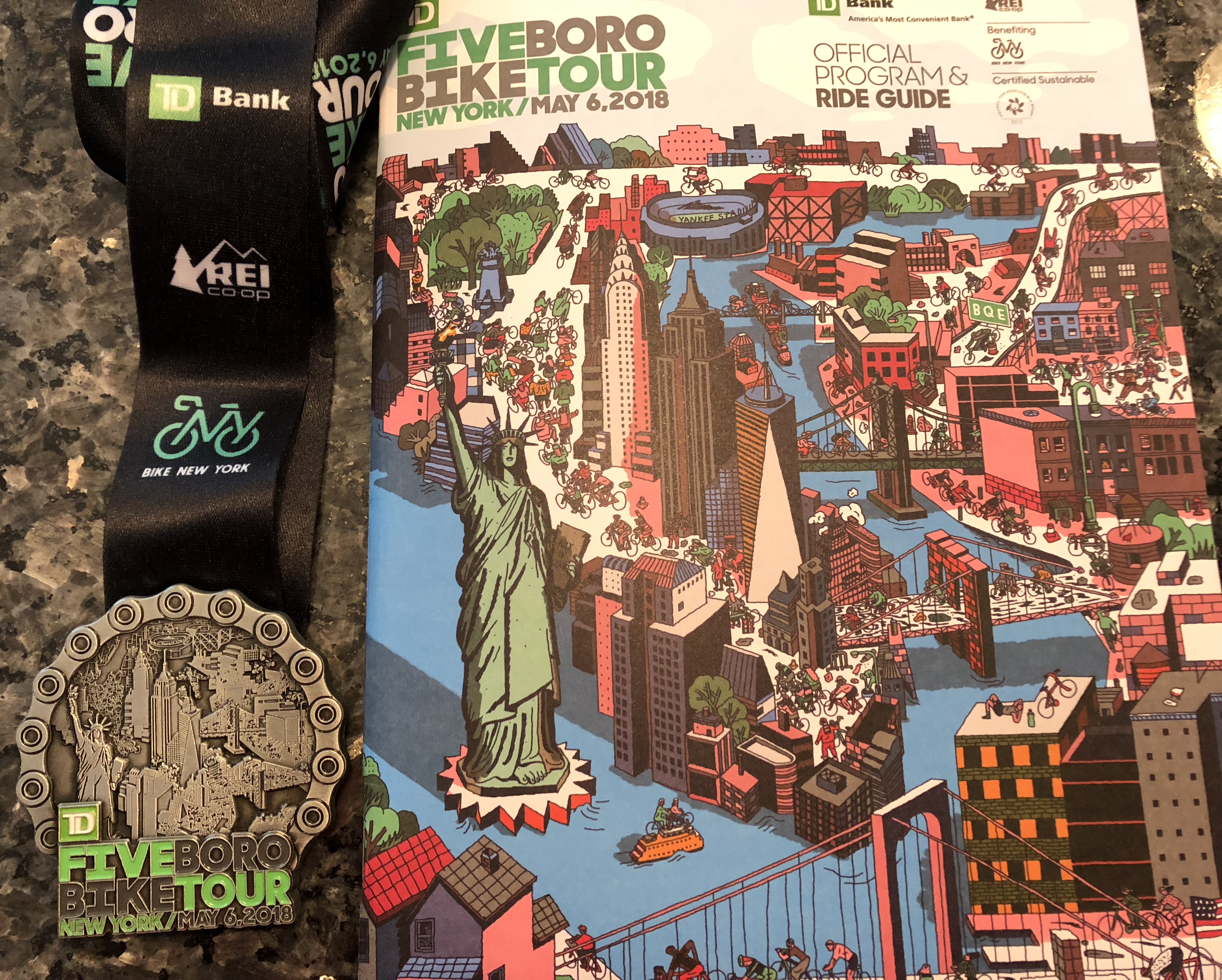
medal and tour booklet (which I studied!)
As I sit here writing this, I am not in agony – everything is a bit a sore, but certainly tolerable. I will carry great memories, and, as always, great appreciation for my family. Their encouragement and pride are a constant source of strength and joy.
Writing this memoir blog has been revelatory in a few different ways. For one, I have gained a deeper appreciation for the mystery that is memory. Some of the readers of the blog have expressed wonder at the quantity and specificity of my memories. Some say they have no memories of their own childhoods. I find that hard to imagine given that my idea of myself is shaped so much by my memories.
My father maintained that he had no memories of his childhood, though there were a few stories (mostly about the presence of the mob in his neighborhood) that he liked to tell. I was left with the impression that he felt sad about his growing up years, that he felt neglected and unappreciated by his parents, and therefore, I assumed that he had repressed it. Even without access to specific memories, he carried a narrative about his childhood that certainly shaped his adult persona. I wonder if it would have been helpful or hurtful to uncover specific memories, if he could.
My brother Mark is another person who professes to have little to no memory of his growing up years. But, based on his comments on the blog, I think he has more than he gives himself credit for. Perhaps my recounting of events awakened memories for him. I wonder if that has been a positive or negative thing for him. Sometimes his take on an incident (for example, when my cat, Cutie, jumped out the car window, which I wrote about here) is quite different than my own. In that case, I had no memory of Mark being in the car with us when Cutie took her fateful leap. He says he remembers it clear as day. So much for not having any memories of his childhood! And, so much for me being THE family historian.
As is often the case, I’m not sure how my oldest brother, Steven, would characterize his memory. He has shared some in response to the blog, but he tends to keep things close to the vest in many areas of his life, so I don’t know if that is the tip of the iceberg, if he doesn’t remember much, or something in between.
I knew before embarking on this memoir blog that memory was illusive, but as I write about childhood experiences and receive feedback, I understand that calling the blog “Stories I Tell Myself” was prescient. I’ve always suspected that we each have a narrative for our lives, one made up of selective memories and interpretations of those memories. That suspicion has been strengthened by my experience of writing this.
I have also come to realize that some of my memories are incomplete and/or unreliable (see the above referenced experience with Cutie the cat). In another example, I would have sworn that when I was in high school (I would have been 14 or 15 years old), as a stringer for a local newspaper, I wrote a story about a blind athlete who came from Yugoslavia. Turns out I wrote two different stories. One about a blind athlete and the other about a soccer player who had immigrated from Yugoslavia. Upon further reflection, the conflated memory made no sense because it was highly unlikely that the blind athlete, who I knew was named Andre Rodriquez, would have come from Yugoslavia! Somehow, in my mind the two became one, and that inconsistency was overlooked. When I realized the disconnect, I made up an explanation – perhaps his father was in the US armed forces stationed there. It wasn’t until I looked at my portfolio of clippings, and saw it in black and white, that I understood my error.
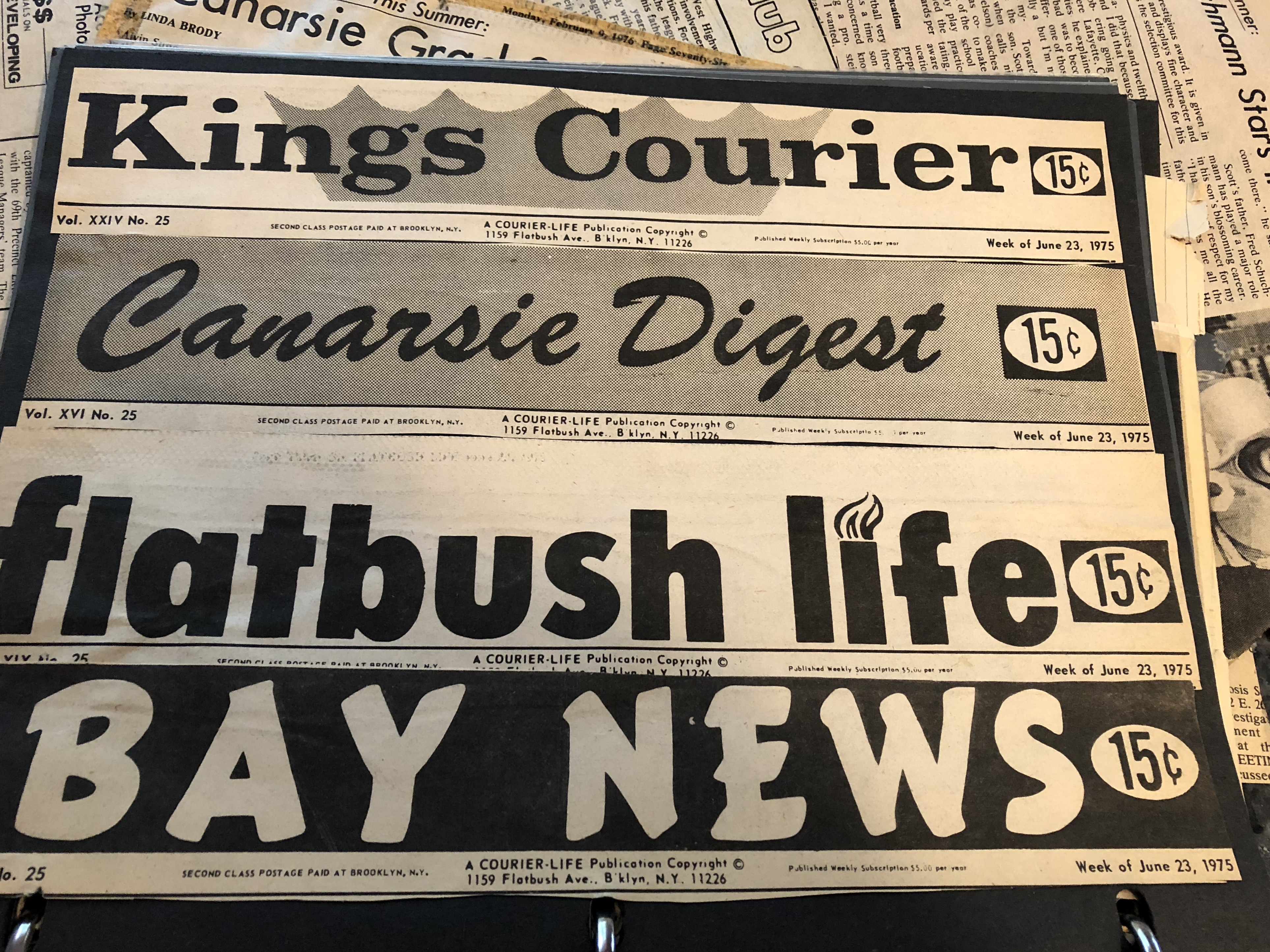
The banners of the four Brooklyn neighborhood newspapers that I wrote for in high school – in my portfolio of clippings.
I don’t think this is cause to question all of my memories because the particulars aren’t necessarily that relevant to the meaning of it. But what is the meaning of the memory?
The editor of the local syndicated newspaper had asked me to interview Andre, who was going to participate in a Marine Corp track and field competition, despite his blindness. Andre was a student at Erasmus Hall High School in Brooklyn. I set up an appointment with Andre through his coach. I went to the gym at the prearranged time, which was during practice. I located the coach among the various people running, stretching, lifting weights, who brought me over to Andre. I introduced myself, we shook hands. I have a picture in my mind’s eye of Andre: café au lait skin, long brown hair, slight frame, wearing a blue track suit. We went to sit on the bleachers so I could interview him. He was accompanied by a student who acted as his guide when they ran. The guide, I don’t recall his name, sat next to Andre during the interview. Within a couple of minutes, it became clear that the two were friends also. After a few preliminary questions, Andre leaned slightly toward his buddy and asked, as if I couldn’t hear, “Is she pretty?” I giggled, as I waited for the response. He smiled at me and said yes, which was very kind of him (of course, what could he say?). Andre responded, “I thought so.” I was confused. “What would make you think that?” I asked. “I could just tell.” I could feel my cheeks burning, they were probably hot pink. I was grateful he couldn’t see that. I quickly changed the subject back to the interview.
It probably isn’t surprising that I stored that memory. Other than Nana referring to me as ‘shana madela’ (pretty girl in Yiddish), I was rarely complimented on my looks. Rarer still from someone not related to me. It was ironic that it took a blind person to see it.
So, did it actually happen that way? I have no way to know. It doesn’t merit tracking down Andre to check (nor do I imagine he would remember it). But, it fits with the way I understand myself.
It calls to mind something that happened when Leah was about six years old. Gary and I were a little late to realize that if we intended to raise our children to be Jewish we would need to enroll them in Hebrew school. Consequently, Leah missed the equivalent of Kindergarten. We did manage to sign her up for first grade. Fortunately, she was a quick study. She came home after a Sunday school class with an important question. Having heard the story of Adam and Eve and the Garden of Eden, she asked, “Is it true? Did it really happen?” After thinking for a bit, I told her that I didn’t know if it was real, some people believed it was literally true, others didn’t. The important thing was what we learn from the story, that this was a story told for centuries and had value because of what it taught people through the ages. I suggested that when they read these stories in class, she should think about the lessons learned, rather than whether it was historically true. Lucky for me, she seemed satisfied.
Maybe our memories are like that, too: worth examining for what they reveal about ourselves, rather than the history they may reveal.
Are you afraid I’m going to steal your lunch?” he asked.
I was hunched over the table in the cafeteria of my junior high school when some guy, who I didn’t know, asked me that question. My left arm encircled a Tupperware containing a small chef’s salad, while I shoveled a forkful of lettuce in my mouth with my right hand.
“No,” I mumbled.
I could see how it would look like I was afraid of that, given my posture. But, actually, I was trying to hide what I was eating. I was trying to keep to the Weight Watcher program I had begun six months earlier. Most kids didn’t bring salad to school. I wished I was eating one of those moon pies – a chocolate marshmallow confection of gooey goodness that they sold at school – but none of that for me.
I was humiliated by his question, though I didn’t think he meant to be cruel. He sounded more curious and bemused as he asked it. Still I was relieved that he moved on and left me alone. I continued eating, but tried to look less protective of my salad.
Junior high school was a challenging time. I was still recovering from the death of Nana a year and a half before. I was trying to find my way in my second year at a new school where I knew very few of the other students. The vast majority of my elementary school classmates were zoned for a different junior high. I made it through 7thgrade and now it was the beginning of 9th(I skipped 8thgrade as part of a New York City program that compressed junior high into two years instead of three) and while I was beginning to make some friends, it still wasn’t easy. (I wrote about one aspect of my junior high school experience, the boycott of schools caused by the busing plan in this blog post)
Making matters worse was the fact that I had matured early. I was fully developed which made me self-conscious. I also had menstrual problems. My period was very irregular and when I got it, after missing it for several months, it was terrible. It would last for two weeks, with cramps, and I bled profusely. My situation wasn’t as bad as my mom’s in that when she was that age she would pass out when she got her period. She told me that she had a friend assigned to keep an eye on her when she was in junior high school. Though she shared that story, I didn’t feel like I could talk to her about my concerns. I wasn’t passing out, and the thought of someone being assigned to me was completely unacceptable. My goal was to fly as far under the radar as possible. At 13, if I could have blended into the woodwork at school, I would have been happier.
It was 1972 and they didn’t have the feminine products available today – sanitary napkins were bulky and didn’t come with a wrapper in which to dispose of it (you had to wrap it in toilet paper). If memory serves correctly, the girls’ bathrooms in school didn’t have waste receptacles in the stalls either, just a garbage pail by the sinks. All of which meant that it was nearly impossible to be discreet about having my period. I needed to carry a purse (something I didn’t ordinarily do), and I would have to take that purse with me to the bathroom. Even on an ordinary day, the idea of using the bathroom was an anathema to me, I tried to avoid it. I didn’t want to be marked, I didn’t want anyone to know about my bodily functions. I don’t know why I felt ashamed, but I did. I thought other girls, if they even got their period, didn’t have the issues I had, and I didn’t have the nerve to broach the subject with anyone. So, I suffered in silence and muddled my way through, hoping not to embarrass myself by staining my clothes (which sadly did happen on more than one occasion).
Eventually, I had an episode of cramps that were so bad, I had to tell my mom. She made an appointment for me to see her gynecologist. I remember Dr. Holland asking me a series of questions before examining me. Mom was not in the room with me for that part. He asked me if I had had intercourse. Surprised by the question, I answered no (I was still only 13!). He asked me if I was sexually active. I didn’t understand the difference between the first and second question, so I told him no, again. A nurse stayed in the room for the physical exam, which wasn’t that traumatic. Fortunately, he found nothing wrong. He made some suggestions to treat the cramps if they were painful in the future and that was that.
Though I continued to struggle with my menstrual cycle, not everything was bleak during my junior high school years. Eventually I connected with a few girls. Toward the end of 9thgrade, a couple of us made a plan to leave school for lunch, a daring idea. Geri and Lisa came up with the notion of sneaking out – everyone had to eat in the cafeteria, no one was allowed to leave for lunch (maybe they were afraid we wouldn’t come back!). We decided we would go to Lisa’s house, where no one was home, since it was only a couple of blocks from school. We would make sure to get back in time for our next class.
The big day arrived and we successfully escaped. We were feeling triumphant and excited as we hurried to Lisa’s house. As we were walking down Avenue K, we heard a car horn and some hooting and hollering. We all turned to look. At first, I didn’t know what I was seeing. I saw flesh pressed up against the rear window. They were butt cheeks! We started shrieking and running. We were afraid the car would follow us. We got to Lisa’s house – we were laughing and terrified at the same time. One of the girls knew that it was called being ‘mooned.’ I had never heard of that. We took it as some kind of sign that we shouldn’t have snuck out. I didn’t leave school for lunch for the remainder of the year. I don’t think any of us did.
I ended my junior high school career on a high note. I was given an award – the Ben Ramer Memorial Award – for outstanding female athlete. When they told me about it, that I would receive it at the graduation ceremony, I was incredulous. The thing was there were no opportunities for girls to participate in sports, other than gym. There were no teams. We did the Presidential Fitness Program and we had physical education, but that was the extent of it. I couldn’t imagine how they determined I should get the award. I felt undeserving, but proud, nonetheless.
Mom and I went shopping for a graduation dress and found one that I felt pretty good wearing, which was saying a lot for me. Graduation day was humid with intermittent showers, which perfect for my hair! It curled just the way I wanted it to, the humidity calmed the frizz. I wore white platform heels and managed to walk across the stage without stumbling. After all of the Sturm und Drang of my junior high school years, things were looking up. I looked forward to a new beginning in high school.
7th Grade on the left, 9th grade on the right – things had improved