Stories I Tell Myself

Linda Brody Bakst on Brooklyn, growing up, identity and more

  • So, this happened: Gary and I were attending morning services at synagogue last Tuesday, the second day of Rosh Hashanah (the Jewish New Year), when a man ran down the aisle naked from the waist down. The rabbi blocked his path as he was attempting to go up to the bimah (in our shul it is a raised stage where the rabbi and cantor lead services and where the Torah is housed). The rabbi yelled, “Get out! You can’t do this!” Four male congregants ran to assist the rabbi, escorting the man back up the aisle and out of the sanctuary. The naked man was yelling ‘Happy New Year!’ He did not resist the rabbi’s effort to block him or the men who led him out. The whole incident took only a minute or two. When the rabbi resumed services, he began by saying that though it is understandable that we react in anger to this disturbance, we must also remember to have compassion. There are broken people in our community, and we should have compassion for those who are.

    I felt terribly sad. Gary and I stayed for the remainder of the service. I thought the rabbi handled the incident well. I thought his message was on point.

    While riding home in the car, I learned Gary’s reaction was similar to mine. We were both aware that it could have been so much worse – from the man being aggressive or belligerent, to congregants overreacting and assaulting him, to totally disrupting the service. Gary told me he didn’t move to help because he thought the men who were closest had it under control – at a certain point if more people went over it would make matters worse. I agreed with his judgment. We were both unnerved that someone would do such a thing – we wondered what was going on in his mind.

    When I got home, I looked at my phone (I had not brought it to temple) and saw that I missed a call from a friend who is also a congregant at our synagogue. Her voicemail asked me to call her back. I did. Our conversation shed a different light on the events I described above.

    She had been at services and was in the lobby getting ready to leave because her husband was feeling uncomfortable about the man’s behavior. Let me give some context.

    Probably a half hour to 45 minutes before galloping down the aisle with only a red Coca-Cola t-shirt on, the man was meandering through the pews wishing each congregant a happy new year. He stopped and shook each man’s hand and greeted each woman – Gary and I included. This is not the custom in synagogue. He was somewhat underdressed for the holiday wearing a plaid button-down shirt and beige corduroy pants (most men wear suits and ties). He was not wearing a tallit (prayer shawl which men typically wear on Rosh Hashana), but he did have a yarmulke on. I thought he seemed odd and I looked at him closely. I noted that he had a small hard cover book in his front pants pocket. I did not see anything that seemed menacing. Though his demeanor seemed off, I was not frightened.

    After greeting each congregant, he climbed up the stairs to the bimah to see the rabbi – this was during silent prayer. The rabbi waved him off gruffly and the man turned around and climbed back down the stairs. Not long after, as he was standing in the aisle, a congregant, who I thought I recognized as a member of the temple board, approached him and invited him to sit next to him. He went willingly. They were seated a few rows ahead of Gary and me. I was very appreciative that someone reached out to connect with him. The two men appeared to engage in some conversation, and he stayed seated there for a while. Eventually he meandered away, but I didn’t see where he went.

    The next time I saw him, he was loping down the aisle sans pants shouting happy new year, as I described above.

    My friend’s experience was totally different. Her husband, put off by the man’s odd behavior, decided they should leave. He was uncomfortable and felt unsafe. They left the sanctuary and were in the lobby chatting with someone when they saw the man come back into the temple from a door that is normally locked. He was carrying a Husky tool bag (a small duffel bag). Alarmed, they quickly went down the stairs to the parking lot in front of the synagogue where a policeman was sitting in his cruiser keeping an eye on things. They told the policeman what they observed and urged him to go inside and make sure everything was all right. The policeman was reluctant to do so because he wasn’t supposed to intrude unless there was a call from inside the building. My friend and her husband were insistent. The policeman agreed and was walking toward the synagogue when another congregant came running toward them saying they needed help inside. Then the policeman ran in.

    After the policeman ran in, my friend called 911 because she was concerned that a single policeman would be overmatched if the man had a weapon or weapons. The dispatcher assured her they were on it. She and her husband got in their car and went home.

    As we discussed the incident, it was clear that my friend was very distressed. I understood that seeing the man come in with a duffle bag was very disturbing and I had not witnessed that part. If I had, I believe I would have done the same as she did in alerting the police. I also shared her concern about the door being unlocked.

    Security at the temple has been a source of anxiety for years, not just as a result of the tragedy at the Tree of Life synagogue in Pittsburgh. Anti-Semitic acts and rhetoric have flared up again and again over the years necessitating more elaborate security plans. There are volunteer ushers who greet congregants at the front doors (which are not locked) and stationed throughout the building. Their responsibility, as I understand it, is to greet members, help anyone who needs assistance, and keep an eye out (along the lines of ‘see something, say something.’) All other doors, other than the main entrance, are supposed to be locked. On ordinary days, when large numbers of people are not expected for services, even the front doors are locked, and you are either buzzed in or you have the code to punch in to gain entry. During holidays one or two police cruisers are stationed in the parking lot (last Tuesday there was only one).

    While I agreed with my friend on some points, we had differences. She thought his behavior in the first instance, wandering about the sanctuary greeting everyone, merited more attention and perhaps a request that he leave. I wasn’t willing to go that far since at that point he hadn’t done anything wrong. My friend’s take was that a mentally ill person may be harmless, until they aren’t. My thought was that all people may be harmless, until they aren’t. How can we know?

    The incident left me with so many questions:

    What can the usher do? If I were ushering and a person came in with a duffel bag, would I ask them to leave it in their car? Would I ask them to explain why they needed it? Maybe I wouldn’t ask anything. Do we need metal detectors at the entrances of our houses of worship?

    I can say with certainty that I do not believe that the answer is to arm the ushers!

    If a person is acting oddly, is that enough of a reason to ask them to leave? What is odd behavior? I know it makes me uncomfortable if a person speaks too loudly for the circumstances, or exhibits vocal tics, or is seemingly disconnected, or highly emotional (without context).  That discomfort may correspond to an instinct that something is wrong or off, but that may not mean that the person is a danger to anyone. If we can’t know, do we err on the side of preserving our comfort (security) or the rights of that individual who may have a mental or physical disability? It is a painful choice to make. People struggling with these conditions are certainly deserving of compassion. As a society we don’t offer enough support in terms of treatment, prescription coverage or residential options.

    Gary and I have processed this incident a few times since it happened. Yesterday we were discussing whether, if somehow we knew that the guy was going to get naked and run down the aisle, would we want him escorted out earlier. Gary said that he would – that he wouldn’t want us all subjected to that during Rosh Hashana services. I could see his point. On the other hand, if we could know that he wasn’t dangerous, was it really all that bad? Nobody got hurt. We both recognized, of course, that no one is clairvoyant and human behavior is unpredictable, so it was pointless to conjecture.

    After my conversation with my friend, I wonder, if there was a congregation-wide conversation where these issues were discussed, would we be able to come to a meeting of the minds about the lessons learned from this incident? Would we agree on an approach for the future? Can we overcome our differences which stem from our respective values and fears? The frequency of mass shootings has frayed nerves and that makes it even more difficult to navigate these issues.

    Please feel free to share your perspective by leaving a comment. Thank you.

    roshhashanahimagecropped
    symbols of Rosh Hashanah
  • I was listening to a podcast the other day. The interviewer and the guest are both recovering addicts. The guest was talking about her recent relapse and how it all started with being bored. As a performer, she often has odd hours free. For her being at loose ends can be an invitation to drink. She will say to herself, what the hell, I can just have a nip.

    Though I am not a drinker, this resonated with me. For me, faced with unstructured time and no particular task at hand leads to food. A well-worn pathway in my brain is triggered. One of my first thoughts is: what can I eat? I imagine for some that is a completely alien thought – as thinking about drinking is for me. But maybe it leads to some other self-destructive behavior – online shopping anyone? It got me thinking about boredom and its perils.

    When I was a child if I went to my Dad and said I was bored, he had a singularly unhelpful suggestion, “Bang your head against the wall.” It was a quick way of dismissing me. It reflected his belief that being a parent didn’t include being an entertainer. We were expected to solve our own problems and make our own fun. I’m not endorsing that approach. I never used it on my children. But there is a legitimate point: there were always books to read or tv to watch. Sometimes that wasn’t appealing.

    So, what is boredom? There are always things to do. Especially as an adult. Household chores await. Projects need starting. Paperwork is piled up. A closet can be cleaned out. Or, I can take a walk or call family or friends. Boredom must be a state of mind then.

    Are there people who are never bored? My husband may fall into that category. His work life is so busy and all-consuming, in both time and mental energy, that the little free time he does have is critical for decompressing – exercise, gardening, communicating with our children and his parents. Not much is left over.

    But some people who live busy lives can still be bored. Sometimes when I was at work, and my schedule was quite full, I knew I was going through the motions. I wasn’t really engaged.

    Maybe that is the key – engagement. Finding activities, people, places, work that engage your brain so it can’t wander off into trouble.

    One challenge to that is when you’re between tasks or appointments. Let’s say you have plans at 2:00 in the afternoon and now it’s noon. Do you start a project? Do you kill the time doing crossword puzzles? Do you continue eating lunch well past the portion you need for nourishment? This can even happen at work. There were countless times that I finished preparing for a meeting only to have it postponed an hour. Then what? A trip to the vending machine?

    fullsizeoutput_123f
    Hmmm – what do I do next? A manicure perhaps?

    This might not seem like a serious problem. There are real challenges in this world – many people are burdened with worries about money, safety, health, shelter, etc. But I’m thinking that being bored, being unfulfilled or not engaged, can lead to some of those problems. Just look at what started this whole train of thought – two recovering addicts talking about boredom as a trigger to use their drug of choice.

    I know from my years of Weight Watchers that there are ways to disrupt that well-worn pathway to food. There are many other possibilities instead of snacks. The challenge is to stop long enough to change direction. I’ll keep working at it. As with many of life’s trials, I need to adjust my thinking.

  • I participate in a few writing groups. One of the groups is specifically for memoir. Last Thursday I shared a piece with that group which may be the introduction to my book. I say ‘may be’ because the project is still so raw, I can imagine that it might change. That aside, the essay I brought explored my identity as a secular Jew – a person who identifies with the culture (the values, humor, food and history) but not the faith in God. I was gratified to receive positive feedback from the group. One person in particular commented that I got it exactly right – it resonated with his own experience. It was encouraging.

    Friday night I went to Sabbath services at a local reform synagogue because a friend was celebrating her bat mitzvah. It is quite an undertaking to achieve one’s bat mitzvah, especially as an adult, since it involves learning to read Hebrew and chanting in front of the congregation. My friend had been studying for a solid year. I was very pleased for her and know it was quite meaningful for her and her family.

    Over the years I have flirted with the idea of studying for my bat mitzvah. When I was growing up it was not common for girls to go through the process. The first time I seriously considered it was when my children were getting further along in their Hebrew School education and I wanted to be supportive. I was the only one of the four of us who didn’t read Hebrew. We were going to services regularly at that point and I thought I would get more out of it if I studied. So, I took some classes with our rabbi. The classes had an unfortunate effect of reinforcing my lack of belief. Though I appreciated learning to read Hebrew (which I didn’t keep up so I no longer can), the discussions we had focused on the meaning of rituals and how they related to God. It left me cold. After trying a few different classes, I stopped.

    I would not go so far as to claim that I am an atheist. I am in doubt as to the existence of a higher power. I am not in doubt, though, about the emptiness I feel when saying the prayers that are part of the liturgy of synagogue services. The God of those prayers, the God described in the Torah, doesn’t make sense to me. I can’t worship that God. But I like the feeling of gathering in community for common purpose.

    Sitting in the sanctuary Friday night, I thought once again about becoming a bat mitzvah. And, once again, I rejected it. I keep running into the same wall – how can I go through the motions of professing a faith I simply don’t have. I do have faith, but it isn’t in that God. My faith is in the potential of humanity. (I can write about how that belief is currently being tested, but that is a subject for another time.)

    I feel a kinship with other Jews – we often share a sensibility, as well as all the things I mentioned above that are part of our culture. I would like to nurture that connection.

    While sitting through the service on Friday night, on the heels of my experience at Thursday night’s memoir group, I had an idea. Could there be a place for secular Jews? I started imagining a center of study (of our history), a place to explore and develop our shared values, to share food and humor. I could imagine celebrating holidays there, but without all the praying to God.

    We are coming up on the Jewish New Year and Day of Atonement. This period of time doesn’t need God to be meaningful to me. I have always appreciated it as a time of reflection, an opportunity for growth and to make amends with people who I have wronged. I would welcome the opportunity to gather with people to observe the holiday, to discuss the challenges that introspection brings. We could still blow the shofar as the symbolic reawakening that it is intended to be.

    Does such a thing exist? One could argue that the Jewish Community Center (JCC) plays some of that role. But, it doesn’t really. Maybe it could, but so much of the emphasis there is on recreation and servicing specific populations (children and seniors) – as it should. Other programming is offered, but not what I am imagining.

    The great fear of Jewish organizations is that the religion will die. After surviving centuries of persecution, it may die of neglect. The only areas of growth are among the Hasidic and Modern Orthodox. Conservative and Reform Judaism are shrinking and struggling. My future, as a Jew, will not be with Hasidism or Orthodoxy. I’m pretty sure my children won’t go that route either. Is there a viable alternative? Is it possible to create a movement of secular Jews?


  • Yesterday was the first time I went to a playground in many years. My children are well into adulthood. Now that we have a grandchild, I had reason to pay a visit. I saw so much, and probably through different eyes than the last time I spent any time there.

    We were lucky enough to have our granddaughter, who I’ll call Lucy, was with us for a sleepover. [Her parents do not want her portrayed on social media and I respect their judgment, so I am not using her real name.] She is just over 15-months old, walking steadily, beginning to climb and enjoying the wonders of the outdoors. She liked picking up leaves and presenting them to us proudly. She also loves dogs – or “Doggies!” as she blurted out with glee every time she saw one. What better place to take her than Central Park, which as luck (or planning) would have it is down the block from our apartment.

    dqrXfpGlTQS5wVBbBx89Ug
    Plenty of leaves and acorns to pick up!

    We took a few essentials, a hat, a sippy cup with water, put her in her stroller and off we went. The sun was struggling to break through the layer of clouds. The air was cool. Perfect weather for a visit to the playground. Lucy was alert to the sights and sounds – pointing and commenting with almost-words.

    At the entrance to Central Park at 100th Street there is an extensive playground. I had walked past it many times before without paying much attention, and now I was about to get a whole new perspective.

    It was ten o’clock on Sunday morning. I hadn’t given a thought to the fact that I was missing CBS Sunday Morning, until now as I write this, though I watch that show religiously. Grandchildren have a way of reprioritizing things.

    The playground was busy, but not crowded. There were children of different shapes and sizes. We took Lucy out of the stroller and she started walking toward the sprinklers. I hadn’t realized there were sprinklers, so we weren’t prepared for her to get wet. Fortunately, she didn’t charge in – she was content to watch the water shooting up into the air. One boy, I’ll guess he was about 5, was wearing only his underwear, stood directly over the jet of water and seemed to enjoy pretending he was peeing. I wasn’t sure what I would have done if he was my child. That was the first of many similar questions I’d be asking myself over the course of the next hour.

    What the child was doing was harmless and he was having fun. On the other hand, I would also want my son/grandson to learn “appropriate” public behavior. The mom appeared to be nearby. I didn’t hear or see her address him, but later when I looked over, they were gone. She may well have spoken to him privately or quietly or both. I wasn’t sitting in judgment; I wasn’t sure what “the right thing to do” was.

    After watching the sprinklers for a while, we walked over to the area where there was a cement and brick climbing structure and slides once you got to the top. These were big slides! I imagined that from the top it would look like a mountain for a small child. Lucy was content to play with the sand at the bottom and explore the stones that made up the ladder. Several little boys were climbing. One was being watched by his older sister. She moved confidently up and down the structure, stopping to offer her little brother help. “You can do it, Milo,” she urged him. He followed her a couple of steps up, using his hands and feet. Then he seemed to get stuck in place. He started to whimper. His sister tried again to encourage him. “Follow me.” He couldn’t or wouldn’t. After a few more moments, she called “Dad! Milo needs help.” The Dad responded pretty quickly, climbing up, putting a hand on his son and encouraging him to continue going. Milo wasn’t having it. The Dad picked him up and carried him down. I didn’t hear what the Dad said to him.

    Maybe I’m making too much of it, but parenting involves so many decisions, moment by moment. Was the big sister old enough to be watching him? Should the Dad have been closer by? Do you push your child to overcome their fear? If so, how hard? Again, I wasn’t judging the dad. I was reminded how hard it is to be a parent. And, for someone like me, where questions run amok, it could be torturous. I’m so glad I got through that stage! I will leave it to my children to judge whether I got it more right than wrong. With adult children, there are still parenting choices to make, but not every day! And they aren’t so vulnerable, they are more fully formed and can better withstand our mistakes.

    Later when we were walking home, Gary observed that he wouldn’t have been sitting on the bench chatting with other parents if his son was Milo (who was quite a bit bigger than Lucy, and may have been two or three, but he was still in diapers). I said I wasn’t so sure what I would have done.

    Being a grandparent is simpler. Our job was to keep Lucy safe. It was one morning of many for her. If we were more protective than her parents, she would recover. Better that way than the alternative.


  • Gary and I are creatures of habit. Maybe most people are, I suppose, but we have our routines and we don’t often move outside our comfort zone. This extends to travel. Typically, when we are going to be away from home, I search the Marriott website for the nearest, least expensive property and book it. We like the reliability and predictability of it. We have only used airbnb (actually it was a different site, but the same idea) once and that was because we were traveling with friends and they found the property. It worked out fine, but we still didn’t feel comfortable planning our travel using it.

    With this trip to the Canadian Maritimes (which refers to the provinces on the east coast – Nova Scotia, New Brunswick, Prince Edward Island, Newfoundland and Labrador), we took a step away from our usual tactic. It may have been possible to travel using only Marriott or Hilton brand hotels, but the places we were interested in didn’t seem to offer them. I still didn’t take the home-sharing approach, instead I booked bed and breakfasts that I found through Google and TripAdvisor. This may not sound that adventurous, but it was for us!

    I researched various websites to plan where we would go and mapped out a route. We knew we would drive. Albany, New York (where we live) has a nice, small airport, but you can’t fly direct to many places. To fly to Halifax (the capital of Nova Scotia) would have us going first to Philadelphia or Newark. It would end up taking as much time as driving. Besides, Gary and I like road trips. Once that was established, I looked for accommodations. Bed and breakfasts abound in the places we were going. I looked at reviews and amenities (Gary MUST have wi-fi!) and made reservations. While I like the idea of B&Bs and have stayed in them a few times over the years, I did have some trepidation.

    Regular readers of this blog know that I am not the most social person. I have written before about different approaches to travel (and not just travel, it could be waiting in line in a store). I am not inclined to initiate conversation. I’m not unfriendly, at least I don’t think I come off that way, but I’m just as happy reading my book or keeping to myself. Some of it comes from social anxiety, but some of it is just comfort with being quiet – at least in that setting.

    Anyway, I thought staying in a B&B would force me to push myself…and it did.

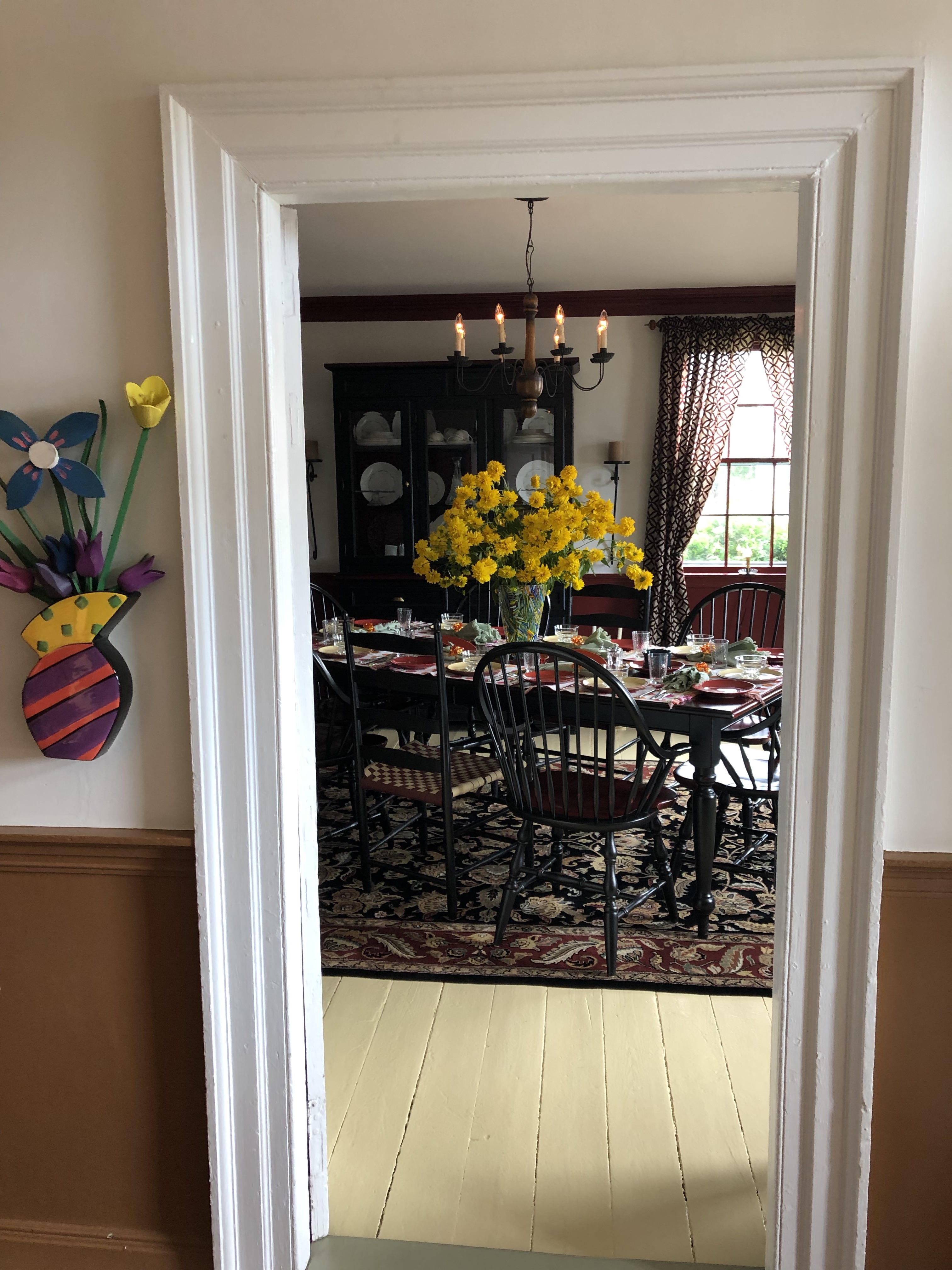
    The first place we stayed, Bailey House in Annapolis Royal, was an historic building, dating from around 1770.  The current proprietor decorated it with funky, brightly-colored art. Our room was lovely. There was one problem – the bed creaked. It was otherwise comfortable, but every time one of us turned over, we were reminded that the place was even older than us! The other parts of our stay more than made up for it. We were there for two nights and enjoyed a sumptuous breakfast with our fellow guests. Conversation flowed easily – some were American (from Sarasota and Atlanta), some from England and another couple from Halifax.

    hd+AgQV3Tx2kZJsfeKWK0w
    The table set for breakfast at Bailey House

    Some observations from our breakfast table:

    • We got great recommendations on where to eat and places to see both in Annapolis and our next stop, Lunenberg.
    • I learned that Booking.com, the website I used to make my reservations, takes an exorbitant percentage (15%) of the cut from the B&B owner. I could, once I found a place I wanted to stay, call it directly and make my own arrangement (one of the guests at the table had done just that). That thought had not occurred to me. While the website is entitled to make money, the size of the hit surprised me.
    • I found out that Nova Scotia was way bigger than I thought. Though I pride myself in knowing some geography, I was pretty ignorant about this. One thing about traveling, and talking to local people, you get a much better and more accurate perspective. If you had asked me before we went there, I would have said Nova Scotia was probably somewhat bigger than Rhode Island. I was way off. It is only a bit smaller than Ireland, or three times the size of Massachusetts!
    • This may be seem like a non-sequitur, but:  we learned that Sarasota has a vibrant arts community – including great live music. Next time we go to Florida, maybe we’ll stop in and get a different view of Florida (as I’ve written about before, I have a number of negative associations with the Sunshine State).
    • The world is small – a woman at the breakfast table, who now lives in Atlanta, was born and raised in Albany, New York and attended the synagogue down the block from our house)! We played some Jewish geography, mentioning names and places to see if we could find some commonality. We were successful. (Do other ethnic groups play a similar game?)
    • We had great conversations with all of the guests and did not touch on politics at all! Hallelujah!
    • The smell of coffee and freshly baked pastry is a wonderful start to the day.

    None of the above would have been possible if we stayed at a Courtyard.

    Each of the B&Bs we stayed in offered something different. In Lunenberg, the Sail Inn was also an old, historic building that was well located close to the waterfront and near shops and restaurants, and the bed didn’t creak! An Asian couple ran it, they spoke heavily accented English, and they had a young son who was very inquisitive. He noticed that Gary had engaged the emergency brake when we parked our car, and he wondered why. Gary explained. The boy followed up with a number of other questions. It was nice to spend time with a family.

    0XArIZQtTx2u0rc76UqIPA
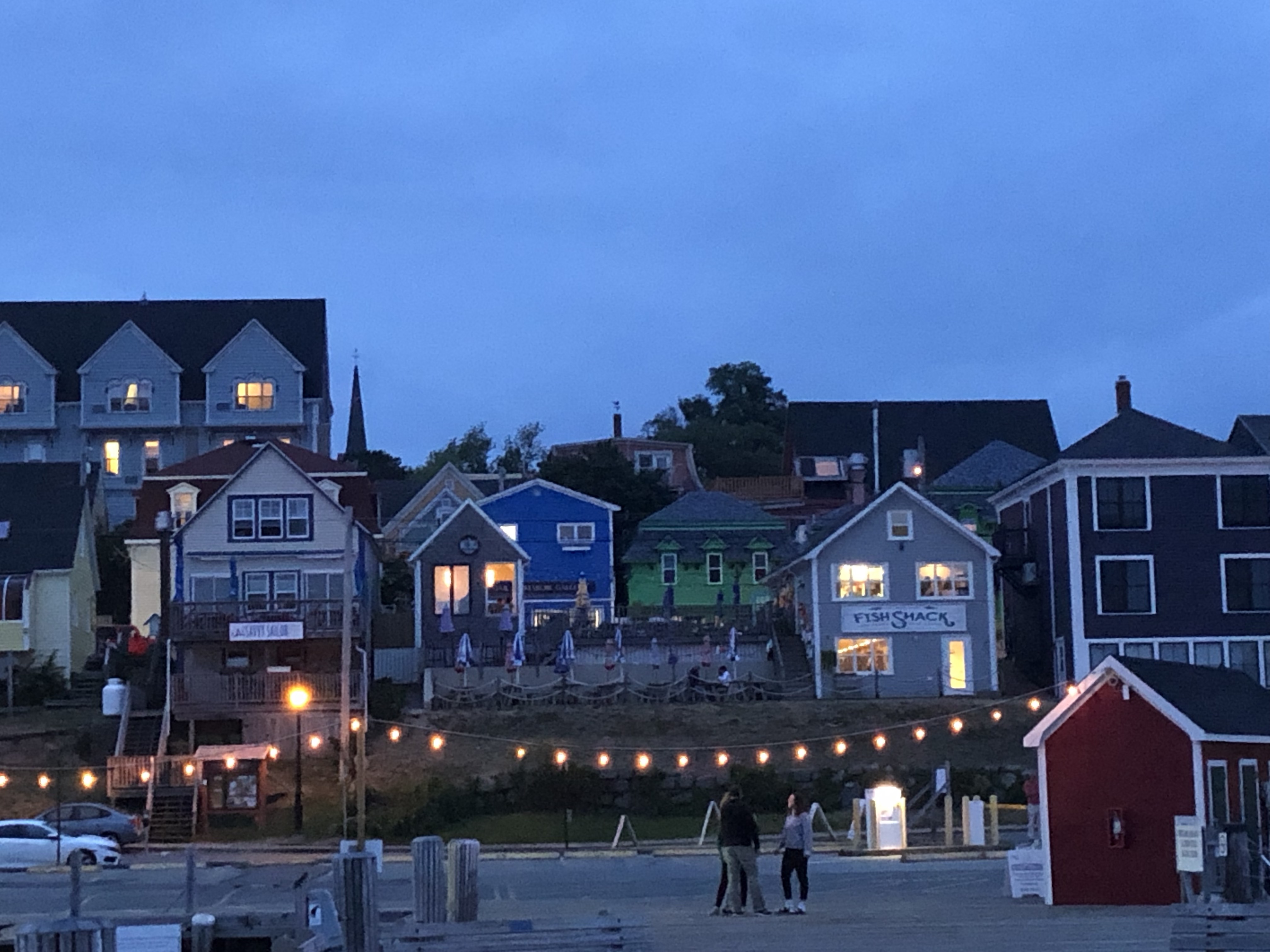
    The view from the Lunenberg waterfront – a stone’s throw from our B&B

    We had breakfast that morning with a retired German couple who were finishing up their trip. We chatted about similarities and differences in our countries. They explained that when Germany reunited, some West Germans wouldn’t travel to what had been East Germany, thinking that there was nothing worth seeing. The couple thought that was foolish and shared what they had seen, recommending Dresden, should we ever visit.

    The next B&B was located in a suburb of Halifax and was a modern home. The couple who hosted, Norma and Bill, were retired teachers. The room we stayed in reminded me of my parent’s bedroom in the house where I grew up. It had furniture that looked exactly like the Ethan Allen colonial style that Mom and Dad had, with the same drawer pulls. Norma and Bill’s bookcase was also crammed with history books, many familiar titles that sat on my Dad’s shelf, like Will and Ariel Durant’s The Lessons of History. I felt at home immediately. The hosts also took great pride in their garden, which was clearly lovingly tended. Unfortunately, we didn’t have enough time to truly enjoy it, but it added to the charm as we came and went.

    Norma also offered helpful tips. When we mentioned that we were planning to go back to downtown Halifax to get dinner and listen to some live music, she suggested taking the ferry, rather than driving. The ferry made things much simpler and added to our experience. The weather was lovely for the ride across Halifax Harbour and we got to see the city from another angle.


    The view from the ferry as we approached Halifax

    The next two places we stayed weren’t B&Bs, but were inns, the main difference being that they didn’t include breakfast. We stayed in Cheticamp on Cape Breton Island, just outside the national park (a breathtakingly beautiful place). The hosts at Cheticamp Outback Inn were also welcoming. They gave us a great orientation to the town, including a rundown of places to eat (there were only four or five options since it is a very small town!). Since they didn’t provide breakfast at the inn, we were pleasantly surprised when, on our first morning, there was a knock on our door and one of the hosts delivered two slices of homemade lemon loaf to tide us over until we went into town. Yum!

    adzHarAlQFWTe8KCVor3Rg
    One of many spectacular views from Cape Breton Highlands National Park. Our B&B was just outside the park entrance

    Our final stop was the Chipman Inn (Pratt House) in St. John, New Brunswick. It was located in the heart of downtown and did not have an onsite host. The building reminded me of a Brooklyn brownstone. The room was spacious and charming. We were two blocks from the waterfront, the sounds of live music and the cries of sea gulls added to the character of the place. Gary and I took a walk and found many restaurants and shops. I had not expected to find such a vibrant, hip neighborhood.


    Two of the numerous painted salmon we found around St. John

    Our trip to the Canadian maritime is now done, committed to memory. The scenery, the food, the history, the accommodations all exceeded our expectations. It also turns out that making conversation with strangers over breakfast can be fun, informative and enriching. We may have to reconsider our travel routine for our next trip. Bed and breakfasts may become the norm.

    One preconception was confirmed: Canadians are very friendly.

  • I turned to Gary, “I’m in my happy place.” I felt giddy. We were walking through the Historical Gardens in Annapolis Royal, Nova Scotia. I love gardens. I don’t know when this started for me but everywhere we go, if there is a botanical garden or other type of public green space (arboretum, outdoor sculpture garden, etc.) I am drawn to it. I want to visit – it is more appealing to me than most other tourist destinations. I am not a gardener myself, so I am not sure how to explain this, but I love them.

    Whether it is the conservatory in Central Park in New York City, the Rose Garden in Portland, Oregon, the Chihuly exhibit in the New York Botanical Gardens, I feel a deep satisfaction looking at the meeting of nature and man. People have planted and tended these gardens and then nature puts on an awesome display.

    I love the walking, the scent (even my compromised nose could smell the fragrance today), the colors, the breeze (if there is one and somehow there usually is). Yesterday was a perfect day for our tour in Annapolis Royal. The sun was brilliant, no humidity, a strong breeze to keep us cool, but not too cool. The idea behind this garden was to take us through the history of the area using gardens to show the changes in the region. Our tour guide was excellent, quite knowledgeable. We learned of the competing cultures – originally there was a First Nation tribe, then French settlers (who lived harmoniously with the indigenous people), then the British (who deported the French and were at odds with the local tribe), then the French attempted to reclaim the area. Some things never change – war, deportations, immigrants struggling to make a life. All of this told through the gardens. With the splendor around us, I didn’t get bogged down in the negative, though. Everywhere I looked I saw something gorgeous. Here is a small sampling, though my photography skills don’t do it justice.


    I can’t think of a better way to spend the day. On the walk back to our bed and breakfast, we stopped in several art galleries. I bought a few things – a magnet to remember the trip, some postcards to send the kids, a couple of gifts for those who are watching our cats. The kind of shopping I enjoy!

    As we walked, Gary commented that San Diego would be jealous of the weather. He was exactly right. There aren’t too many times or places where that can be said. Then to top it off we watched a lovely sunset, chatting with a likeable couple from Florida who were staying at our B&B.

    6ejaChJYSM6d%MfwY4r1FA
    sunset on the Annapolis River

    Whatever the rest of our vacation week brings, this was a day to be treasured.

  • “I would do it again. I’m just being honest.” This was the statement made by a participant in the workshop I was facilitating. It was disappointing (to put it mildly) to hear, three hours into a workshop that was designed to, in large part, change his perspective.

    Although I am retired, I consult every so often for the New York State School Boards Association (NYSSBA), working with school district governance teams. The idea of the workshop, generally, is to strengthen the team and make sure they are on the same page. I have been doing this for more than ten years, with varying degrees of success.

    Typically, a board will have one of these retreats when they are experiencing trouble. The specifics of the problem differ each time, but it usually boils down to lack of trust between the board and administration or among the board members themselves. Sometimes the breach is not too serious, and a healthy discussion and review of roles and responsibilities can get them back on the right track. Sometimes the divisiveness is deep and seemingly intractable. That was the case at this most recent session.

    This Board had recently gone through a contentious process hiring an assistant superintendent. The Board, particularly the Board President, had been very involved in the selection. Best practice, as defined by NYSSBA, is a more circumscribed role for the Board, leaving more of the responsibility to the Superintendent. Without getting into the gory details, the relationship between some of the Board (it is a seven-member board) and the Superintendent had broken down. Two board members were uncomfortable with how things had gone and thought the team would benefit from some training. The full board agreed.

    I was invited to help the team by putting together a program that would review their roles and responsibilities and walk through a hiring scenario so that we could discuss the issues. The goal was to have them, including the Superintendent, agree to a protocol moving forward. When the Board President made that comment that he would do it all again, it was crystal clear that he was not buying what I was selling (which was not a specific solution, but rather a definition of roles). We continued the discussions, going over other topics, but this was a case of mission NOT accomplished. Maybe I had spent too much time going over the details of what had happened; or maybe we hadn’t spent enough time and needed to dig in even deeper.

    It got me thinking about conflicts in general. I know a great deal has been written about conflict resolution and I have read only a tiny fraction of the literature. Perhaps I should read more!! I’m wondering: how much should we hash out our conflicts? Do we go over all of the minutia? Or is it better to talk more generally and focus on moving forward? These questions apply to personal relationships, too.

    Most people don’t like conflict, though I have come across a few who seem to crave it and are purposefully provocative. Fortunately, they are the exception. Other people are so steadfast in their desire to avoid it that too much gets swept under the rug resulting in a mountain of resentment. I guess the challenge is to find the sweet spot – to balance processing/understanding the differences with the need to move forward and not belabor the point. It isn’t easy to find – especially when emotions run high.

    Plus, all parties have to be invested in finding resolution, not a given in many situations. In the case of the workshop I was facilitating, the Board President was intransigent, convinced of his rightness. Ultimately, we had to agree to disagree. I had the luxury of leaving it at that. In personal relationships you can’t necessarily do that.

    I am thankful that in my marriage I can say with confidence that we are both able to see the big picture. We both want resolution and we want the other to be happy. We have some fundamental differences that pop up now and again, but we have been able to manage them.

    I’m thinking, looking at our world rife with conflict, that more situations are like the one with that school board than my marriage. I’m thankful for what I have and wish it for others.

    qSrHcDPYSpGgQC++SHObbg
    Sometimes we need a bit of peace


  • I am not going to write at length about gun violence in this country. But I do want to comment on what I see as an irony after the two most recent mass shootings. As the majority of Americans get more and more fed up with and anxious about the frequency of mass murders, suicides and “regular” homicides (in sum the staggering rate of gun violence in this country), the more possible the great fear of the gun rights activists could be realized. If things get bad enough, maybe we will come for your guns, instead of common sense gun control legislation. The staunch unwillingness of the NRA to negotiate reasonable standards (background checks, allowing databases to talk to each other, outlawing high-powered automatic weapons) may create an untenable situation where the majority of Americans are willing to put even more limits on gun ownership. I certainly am.

    I know most of my readers don’t enjoy my political writing much (judging by the number of views those essays get), so I will leave it at that and move on to other topics.

    **************

    As I work on my book, I asked my mother a few questions to fill in some gaps in my understanding of our family history. First, I want to note how fortunate I am to still have my mother to ask those questions! Her memory may not be what it once was, but she still has so much to offer. Since beginning this blog and undertaking my memoir, I’ve had many conversations with her that have enriched my understanding of events and of our family.

    Recently I asked her questions about Zada (regular readers know Zada was my maternal grandfather, Mom’s father). Zada was the patriarch of the Spilken family. He was a lover of life and an optimist. Two of his children, my mother and her brother, Terry, were able to adopt that approach. His other two children…not so much.

    Zada’s life was hard in many respects. I didn’t fully appreciate some of the challenges until Mom reminded me of some tragedies that I may have known about before but had forgotten or not thought about for decades.

    Zada came to this country when he was three. His father was ten years younger than his mother! She already had three children by her first husband. Zada was the oldest of five more children. All eight were raised together in a tenement on the lower East Side. It was a hard life – everyone worked as soon as they were able. I recall Zada describing sleeping in shifts because their apartment was so small, and they had to take on a boarder to help pay the rent.

    What I didn’t remember is that one of Zada’s sisters, Ruth, who was seven or eight at the time, was playing with friends on the roof of the tenement when she fell off. She was found dead on the sidewalk. I can’t imagine the horror. But family life went on – I’m not suggesting that lives weren’t changed by the tragedy, but Zada was able to maintain his spirit. Maybe Zada was unique, but my sense of things is that in those days (this would have been early in the 20th century), people expected tragedy. Accidents and fatal illness were more common and as a result the death of a child was not so unusual.

    I am glad standards have improved so that our expectations for our children are higher. But I do wonder if we could use some of the fortitude that our ancestors had. I can think of numerous examples of difficult times Zada endured. He lost everything in the hurricane of 1938 (fortunately none of his family died, but they lost their business and their home with most of their possessions). His sister, Lily, died as a young woman of tuberculosis. He went bankrupt when he was 60 years old and had to go to work in a commercial bakery at that late stage of his life. His wife, my Nana, died prematurely at the age of 56. So much loss to endure, but his spirit remained upbeat. He continued to be engaged with the world, even after macular degeneration took his vision.

    img_1285
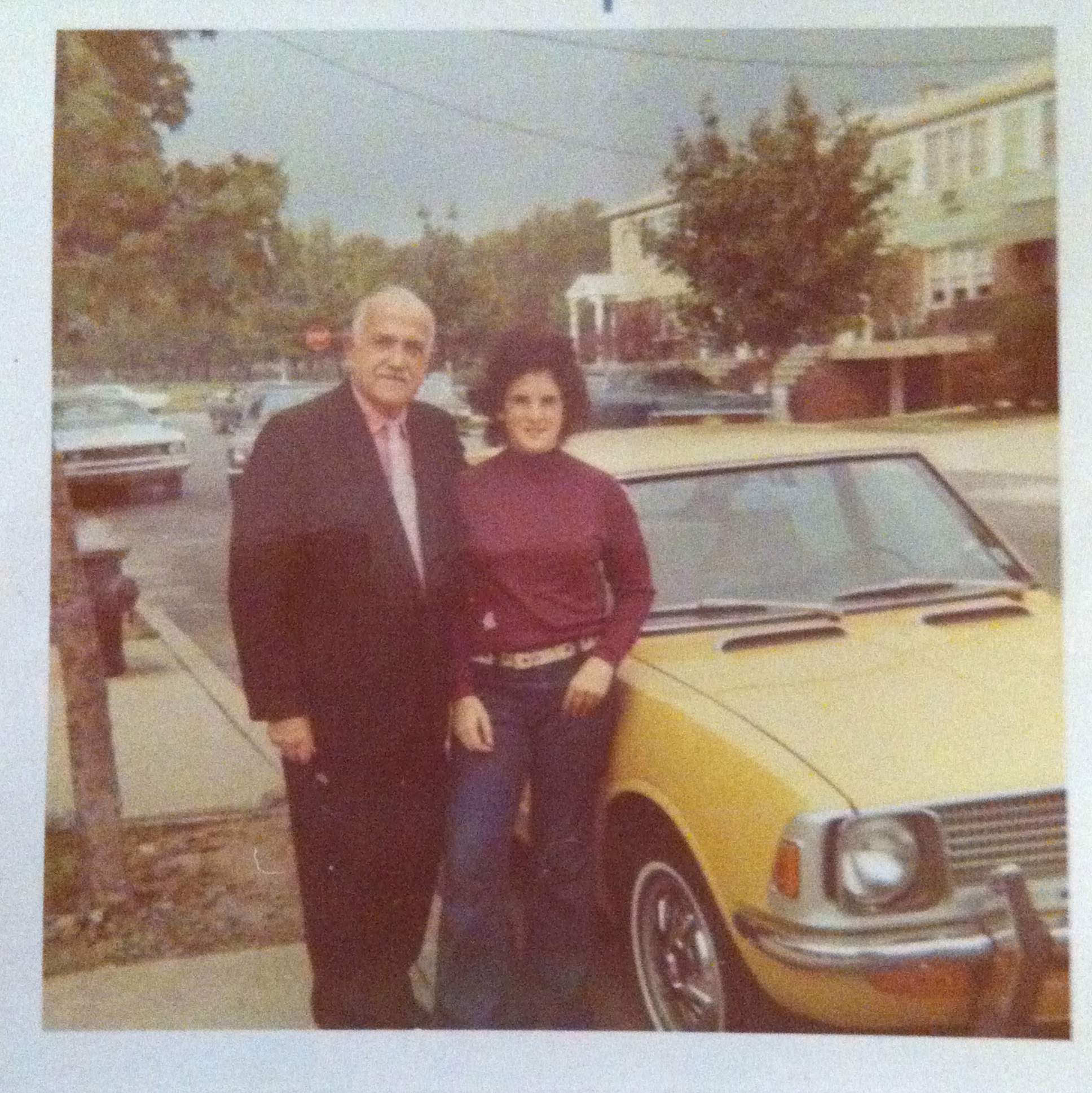
    Zada and me next to his Toyota Corolla in Canarsie (1973)

    I was thinking about this after our book club read The Sun Does Shine: How I Found Life and Freedom on Death Row by Anthony Ray Hinton. Hinton was convicted of crimes he didn’t commit in Alabama in the 1980s. He was on death row for 30 years until he was finally exonerated. The book follows his journey. It is a very powerful story. He makes a choice, while on death row, to reclaim his humanity instead of giving in to anger and bitterness. He chooses to establish relationships with fellow inmates and guards, he starts a book club, he escapes to his imagination. He has the love and support of his mother and one friend throughout. There is much more to the story, but I will leave you to read it.

    During our book club we discussed whether we would have the strength to make the choice Hinton made. Some of us were pretty certain we wouldn’t have the wherewithal, others of us thought we would try. Of course, you never know unless you are tested. I hope to never be tested in the ways that Hinton or my Zada were. While my life so far has brought challenges, they have not been on that scale. I hope I will rise to whatever my future holds with the fortitude of my ancestors, especially Mom and Zada.

  • If you want to find every bit of schmutz (translation: dust bunnies and other crumbs) in your house, have a 14-month old visit.

    If you want to be reminded of the wonder of electricity, watch the face of a 14-month old when you flip a light switch on and off.

    If you want to discover muscles you forgot you had, play with a 14-month old for two full days.

    If you want to see the beauty of the wind in the trees, look out the window with a 14-month old.

    If you want your heart to melt, get a hug around the legs from a toddler who nuzzles you when she is ready for a nap.

    If you want to experience your heart in your mouth, watch that toddler walk like a drunken sailor past a glass and wood coffee table.

    If you want to experience the full range of human emotion, spend 15 minutes with a 14-month old who goes from joy to frustration to laughter to curiosity to tears in that space of time.

    If you want a smile, give a 14-month old a bite of a sugar cookie. Yum.


    I had the pleasure of all of this, and more, over the past four days. It is also why my blog post is so late. I admit to being tired, physically, mentally and emotionally. I am also reminded that there is a reason we have children when we are young. But, it is all worth it. To be a grandparent is a privilege and I am keenly aware of that. I will treasure memories of these days.

    IMG_2107
    On a brutally hot day, she had the right idea! My precious one.


  • img_1565

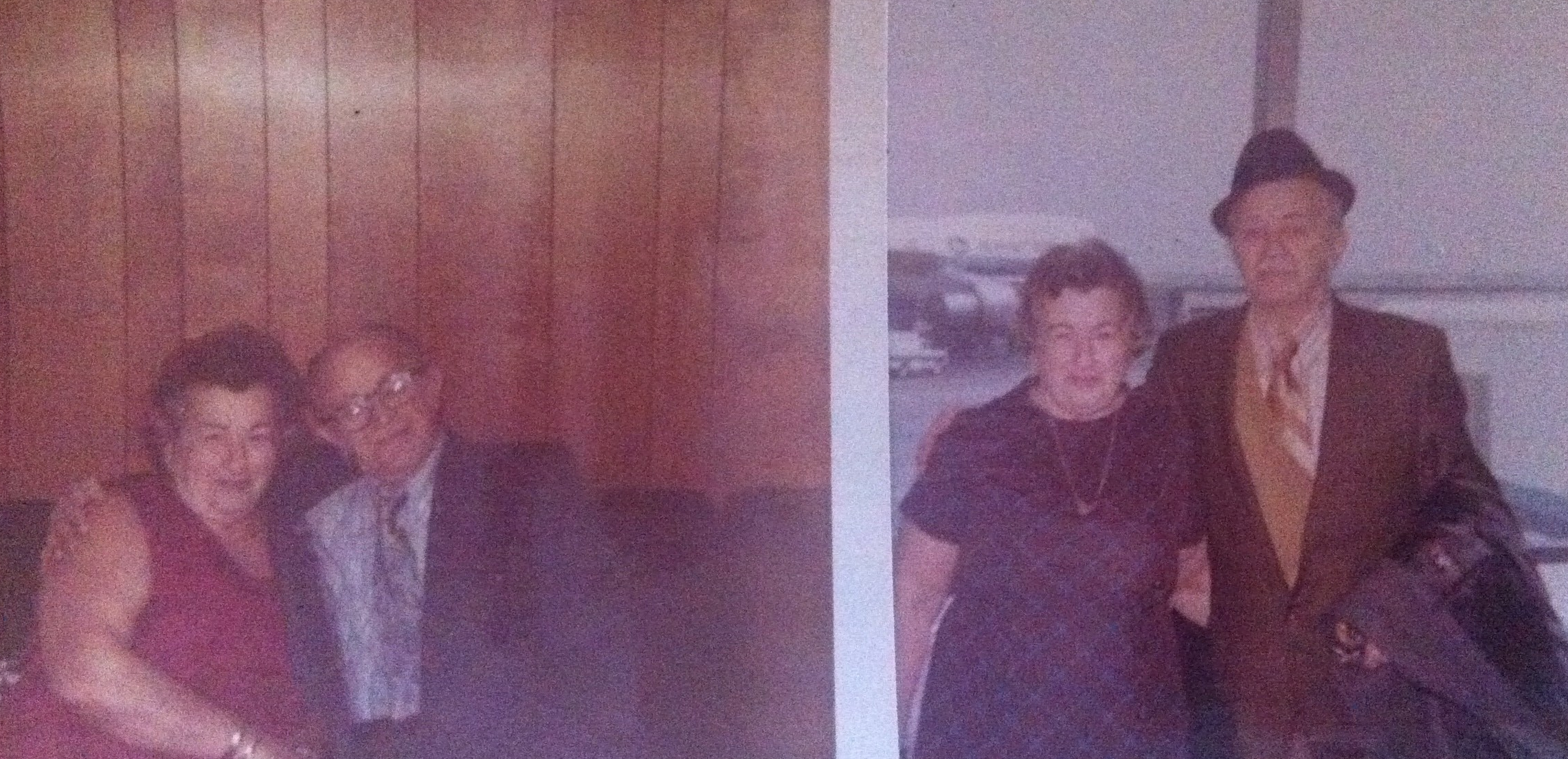
    We didn’t see my paternal grandparents that often when I was growing up, especially compared to my maternal ones. Of course, it would be difficult to do that since we were basically living with Nana and Zada, while Grandma and Grandpa lived on the other side of Brooklyn. They didn’t drive and Canarsie was very inconvenient to get to by public transportation, so it was up to my Dad to drive us to visit. Dad had a strained relationship with them, but my mother believed that family connections needed to be nurtured. It was at her insistence that we visited them once a month.

    They lived in an apartment on Prospect Park West. The huge park by the same name was right across the street from their building. We didn’t often venture into the park. On those few occasions when we did, we found the ground littered with shards of beer bottles, cracked pavement and only one working swing. Instead we amused ourselves inside, sitting next to the window counting cars by color or model, or watching TV. Grandma worried that we’d hurt ourselves on the marble coffee table in the living room so fooling around was kept to a minimum.

    Grandpa sat in a club chair in the living room, reading the Forward (the Yiddish language daily newspaper) and smoking a cigar. He wore glasses and a hearing aid; even with that he didn’t hear very well. He didn’t initiate much conversation, but it was clear from his smile that he was delighted to see us. Grandpa was mostly bald and maintained a carefully groomed moustache, and overall appearance. Between his accent and manner, he offered a stark contrast to Zada. Zada was a storyteller and bon vivant. Zada was comfortable chatting with his grandchildren (or other visitors, for that matter) wearing only his boxer shorts and sleeveless t-shirt, sitting at the kitchen table having a meal in that state of undress. On the occasions that we slept over at Grandma and Grandpa’s, Grandpa wore pajamas and a robe. I suspect he did that every night, even when he didn’t have guests. Grandpa was buttoned up in all respects.

    The apartment on Prospect Park West had two bedrooms – one for my grandparents and one that used to be shared by my aunts. Dad, I think, slept in the living room or maybe on a cot in the dining room. I noted that, like I Love Lucy and The Dick Van Dyke Show, Grandma and Grandpa had twin beds separated by a nightstand. Another contrast to Nana and Zada and my parents, each of whom shared a large single bed.

    Grandma wasn’t particularly known for her cooking, but we certainly didn’t go hungry. She had some specialties notably blintzes – rolled crepes filled with cheese or berries. She particularly enjoyed watching my brother Mark eat them with great gusto.

    Grandma had a sharp mind. She could add numbers quickly in her head without resorting to pencil and paper, a skill I saw put to use any time we went shopping. She also had a good sense of humor, quick with a quip and a hearty laugh. My brothers and I spent a couple of New Year’s Eves with her and Grandpa. Guy Lombardo and his orchestra were on television ringing in the new year. The highlight of the night was Grandma dancing the twist. It was so incongruous: Grandma was short and stout, she had no waist to speak of and an ample chest, but there she was doing this ‘modern’ dance. She was actually barely moving. We all dissolved in laughter. We would beg her to do it again. And she would.