Note: It is only appropriate that today I share another of my Mom’s pieces. I am off to visit her and accompany her to the doctor. Unfortunately, Mom has had a serious health issue come up that is made more difficult to manage because of COVID. Any positive vibes, karma, or prayer is appreciated. Meanwhile, here is another slice of her life. We hope you enjoy!
A stoop is not a porch. A porch has rocking chairs or other seating where folks sip iced tea and relax. A stoop is a wide staircase that leads to a multifamily home, usually in a city. I had a stoop. It was in front of the house where I grew up, on Rochester Avenue in Brooklyn.
The stoop was our playground, like a town center for all the kids on the block. We sat on the steps of the stoop and played jacks or all kinds of card games. The boys would trade baseball cards or play knocks (don’t ask).
We sat on the steps and took turns playing jump rope or double dutch (if you were brave) on the sidewalk. We played hit the penny. We’d put a penny on the crack in the pavement, you and your partner stood on either side, trying to hit the penny with a pink ball called a pensy-pinky. One point if you hit it; two points if it turned over. 11 points to win. The boys also played punch ball and of course stoop ball, which took some imagination. We sat on the steps putting on or taking off our roller skates with a key on a string attached to our neck.
After school or in the evening we would sit on the steps talking about our teachers. Were they fair? Did they have favorites? We talked about who we liked or disliked. We sometimes did our homework and if we were in the same class, we might compare answers.
A group of us would meet on the stoop and then go to the movies. Afterwards we’d come back to the stoop and the boys would act out sword fights (from the movie Robin Hood). The girls would be the damsel in distress – I might be her best friend. They would play cops and robbers; or, they would be the US and its allies fighting the Nazis or the Japanese. We would see news reels at the movies which gave us reports on the progress of World War II.
We would sit on the steps singing war time songs like The White Cliffs of Dover. We would watch the night sky and follow the search lights until the warden came to tell us to go home for dinner or bed. The blackout had to be obeyed and we’d go home to pull down the shades and leave the street in total darkness.
It was the 40’s and some of us had relatives in the armed services so we knew of the Second World War and the stories of concentration camps. But, in general, we did not talk about it. So it was a time of innocence and change. If we knew of the horrors or the turmoil in the world, we did not talk about it then.
Our conversations did become different in the 1950’s. We got older; we got married and moved away; we got jobs and had children. Then different people sat on the stoop, playing the games of their youth.
NOTE: I wanted to include additional (better) photographs to this post, but the platform wasn’t accepting the format of some. It is a mystery to me. I tried editing them in different ways, accessing them in different ways….I gave up. Oh well. Hopefully you will get my intention.
We are six months into the pandemic. It simultaneously feels like it has been a lifetime and hard to believe that it has been that long. I was looking through photos on my phone and thinking about the journey.
The experience has been both isolating and connecting. I have spent long hours alone. I have also spent hours talking to friends and family.
It is filled with contradictions – an opportunity to commune with nature, but also to feel powerless in the face of nature’s mysteries.
For me it began with my last foray out to dinner with friends in Beacon, New York, on March 7th. We went to Dia that day and took in the abstract art and pondered its meaning (which I wrote about here).
The pandemic has continued through today, August 20th, when I took a car ride up the Northway and explored Round Lake, partly driving, partly walking. I was hoping to hike through the nature preserve there but didn’t find a trail. I did find a dock where you could put in a kayak. Unfortunately, I don’t have one. I did find lovely views, brightened by purple loosestrife.
Too bad I didn’t have a kayak
I got back in my car and found a promising bike path. Next time I will have to hook up the carrier to the trunk and bring my bike. I also found a charming shop named Leah’s Cakery. How could I not stop in given that it was apparently named after my daughter? I was rewarded with wonderful iced coffee and a delicious blueberry muffin.
In these six months I have travelled around the Capital Region visiting previously unseen nature preserves and found many lovely spots, but I have also gone only as far as my backyard for respite.
Some examples of enjoying our back yard:
We’ve made a number of fires and made s’mores
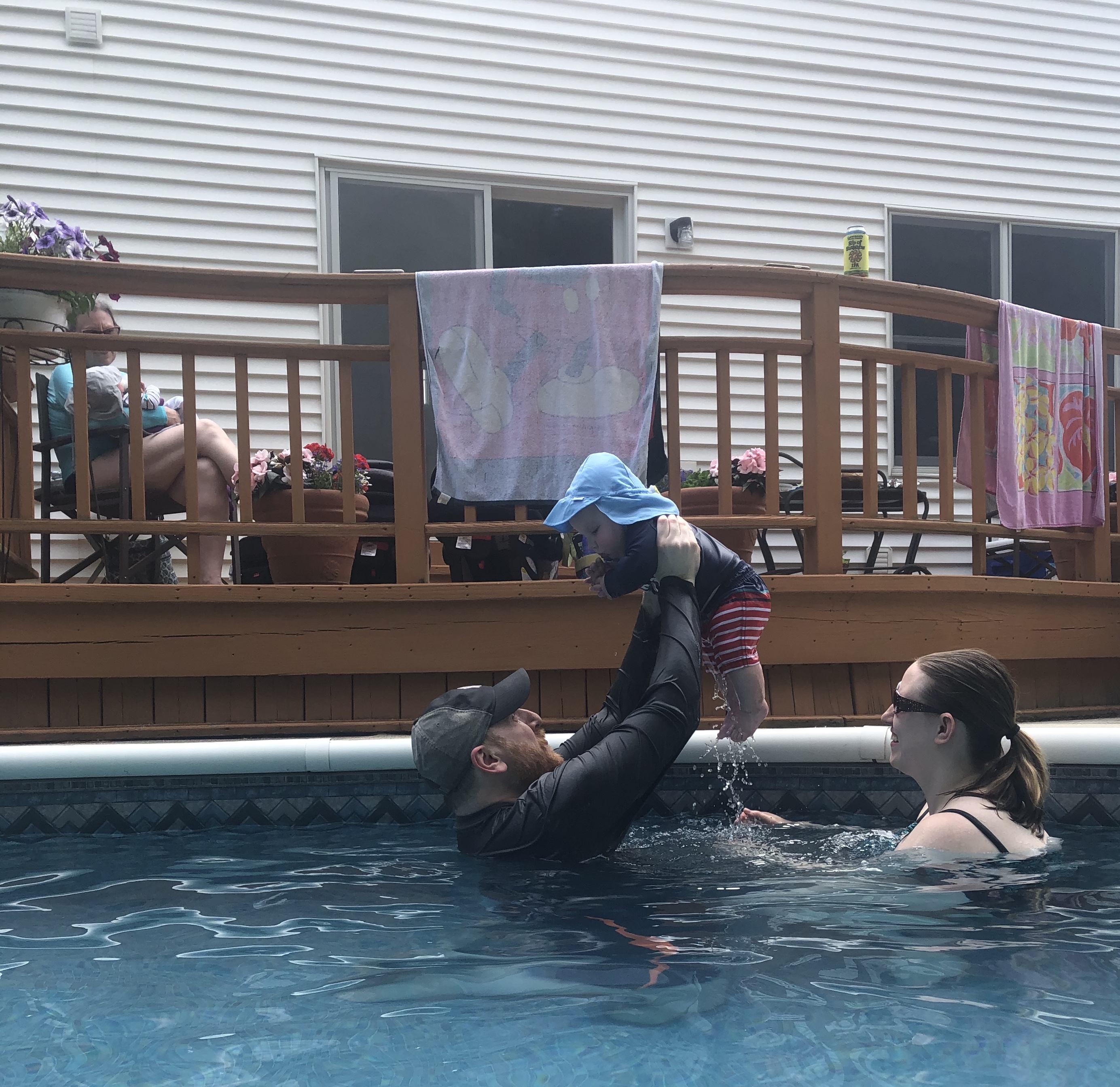
Had family come by to swim, while keeping social distance – not easy when delicious babies are involved!
Evidence of some of my hikes throughout the region:
a moment to appreciate the delicate white flowers
surprised to find a sculpture on a tree – Montgomery, NY
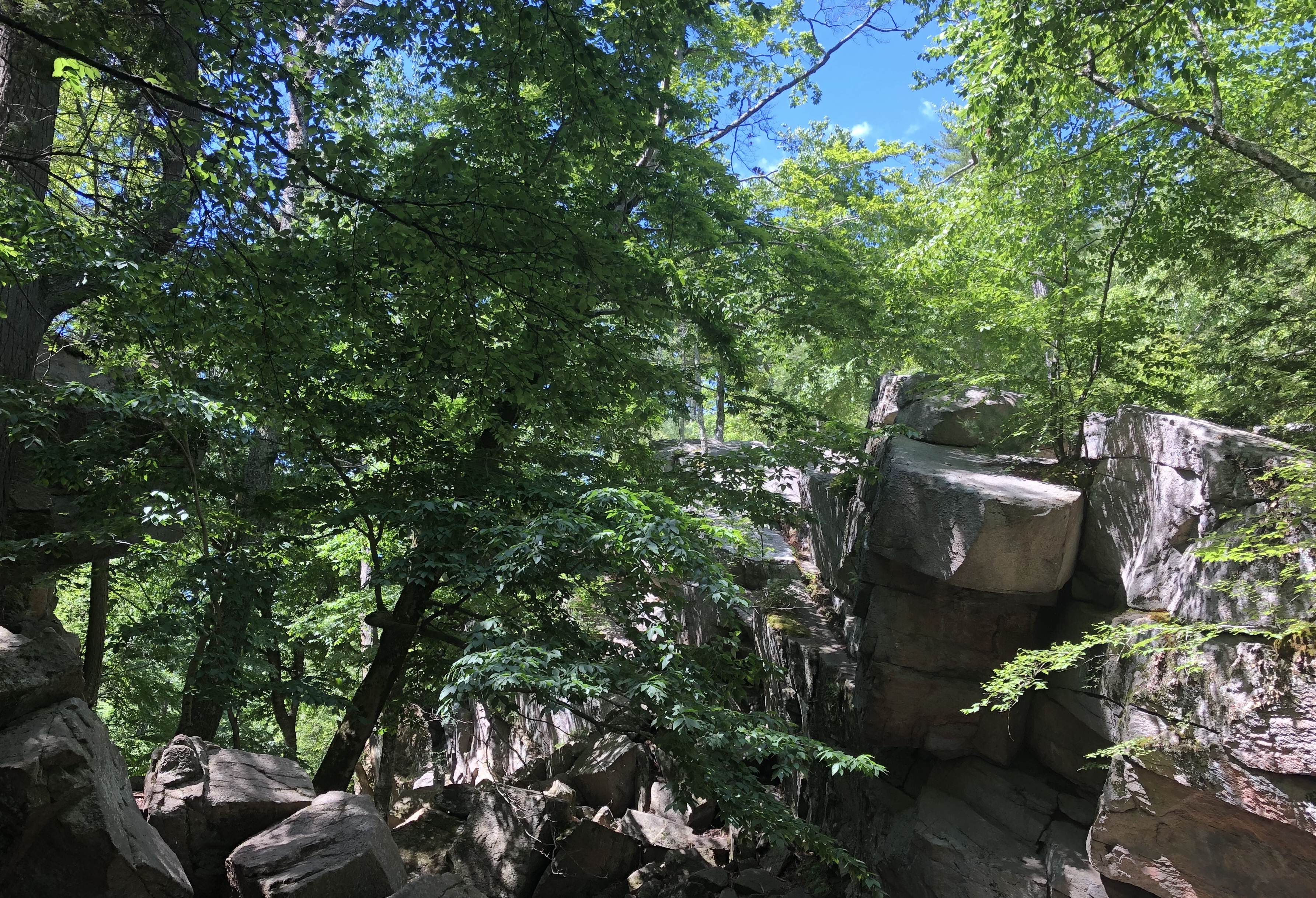
Scrambling over rocks in Massachusetts
Walk through Five Rivers – photo by Barb Bradley
I have observed the arc of the seasons: from the gray skies and barren trees of the end of winter to the deep azure and lush green of middle of summer.
I am probably tanner than I have ever been, though that isn’t saying much. The sun and I have a complicated relationship. I love it; it doesn’t love me. When I was young, the summer sun would cause a rash. Now with careful use of sunscreen with an spf over 30, I can handle the northern sun (a tropical sun is another story), mostly I freckle, at least I don’t burn. Each time I head out to walk, hike, jog or bike, I slather it on.
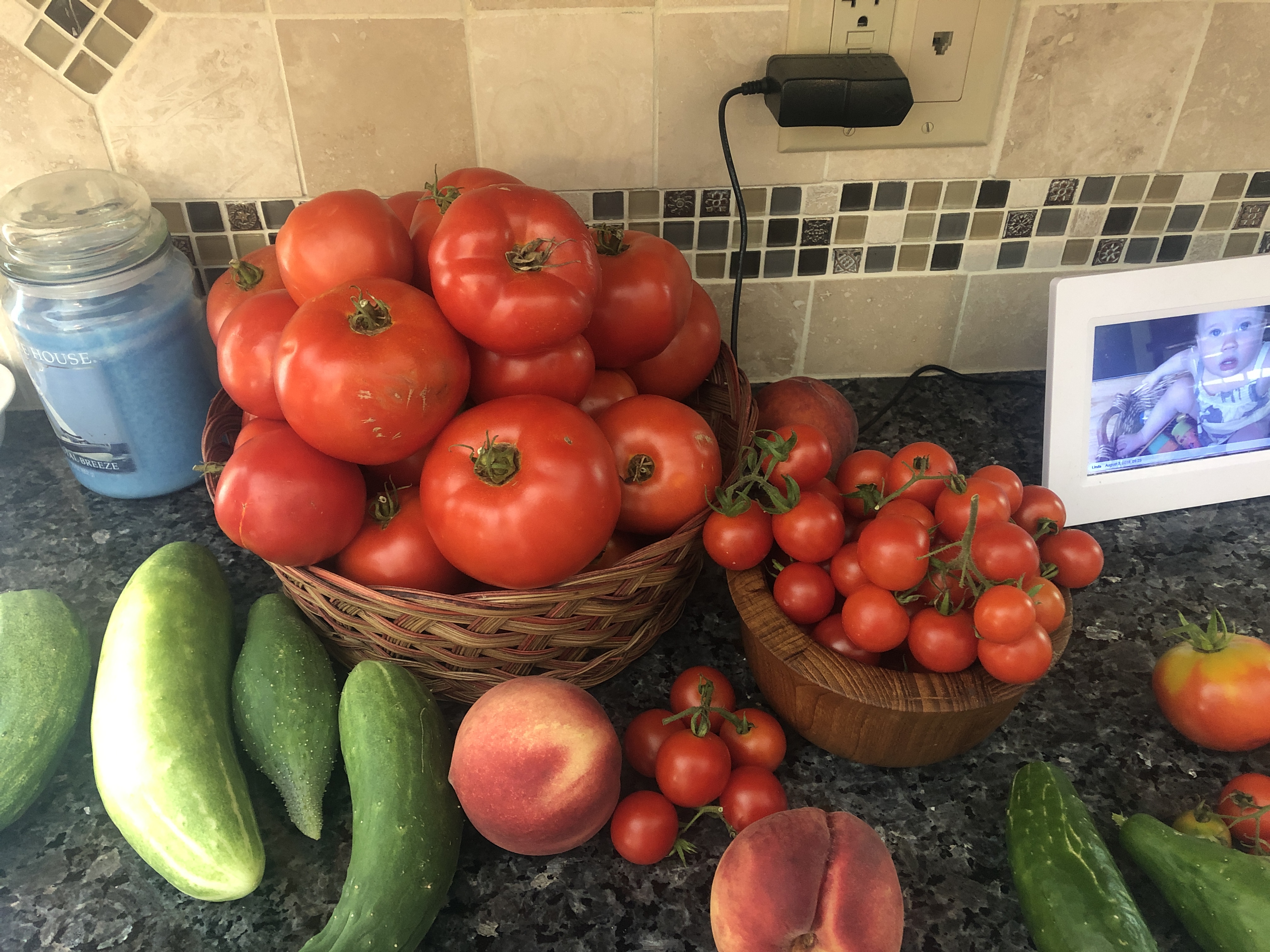
In that time, Gary planted a garden and reaped its harvest. He fought off critters that threatened to eat everything, but he won the war. He had a record-breaking tomato crop that we have been happy to share.
Just some of the bounty from the garden – except the peaches, they came from the supermarket
We had a lot of zucchini, too. I made it every which way, from bread to soup. Luckily Gary and I like both (and they go quite well together, too).
Fortunately, I had stopped coloring my hair long before the pandemic, but I didn’t get it cut until yesterday. It had gotten out of control – frizzy and wild. Over the six months, it has also gotten a good deal grayer, with silver sprinkled in, and white around my face. I don’t mind. I kind of like it, but each time I catch a glimpse of myself in the rearview mirror I’m startled by what I see. Hmmm, is that me? After taking a beat, I nod and decide again that I’m good with it. It is a badge of honor – I’ve lived 60 years and it’s okay that people know that.
On some of my hikes I have been accompanied by Gary or a friend, but at least as often I am alone. I am not comfortable going too far afield by myself, but I will walk a well-traveled path. Mostly I go to the U of Albany campus and walk around the pond there. I watched a family of Canadian geese grow from furry goslings to almost full-size. I learned from my daughter-in-law that the black bird I photographed perched on a branch hovering over that pond is a cormorant. I have also learned that I like being able to put a name to a bird, tree or flower that I see.
For a number of months part of the ring road of the SUNY campus was closed off because they had set up COVID drive-thru testing. Just recently, they reorganized the test site and the full loop is open again. Now that it is late August, I look for signs of students. I have noticed more cars and more people using the tennis courts, but not much evidence of students. The gate to the basketball court is still chained shut. Tennis has been deemed safe to play, basketball is not. The judgments about what is safe and what isn’t keep evolving. Early on the tennis courts were off limits, too.
I am trying to make the best of the situation, trying to internalize that I am blessed. My husband and children are gainfully employed. My mother and in-laws have had health issues made more difficult to address because of COVID, but they have been managing; they have survived thus far. I even got to visit Mom once.
Despite the cooperation of the weather which has allowed us to get outside (though sometimes it has been beastly hot and humid), I feel sad. Hard to shake it, the melancholy that comes from knowing how many have died, how many have and continue to suffer and, while I have faith that a vaccine and treatment will be found, we don’t know how long this will go on.
I work at being positive, each day, finding humor, breathing deeply, looking at pictures of my kids and granddaughter, making my plan to vote and donating funds to candidates I support. But, truth be told, the sadness remains.
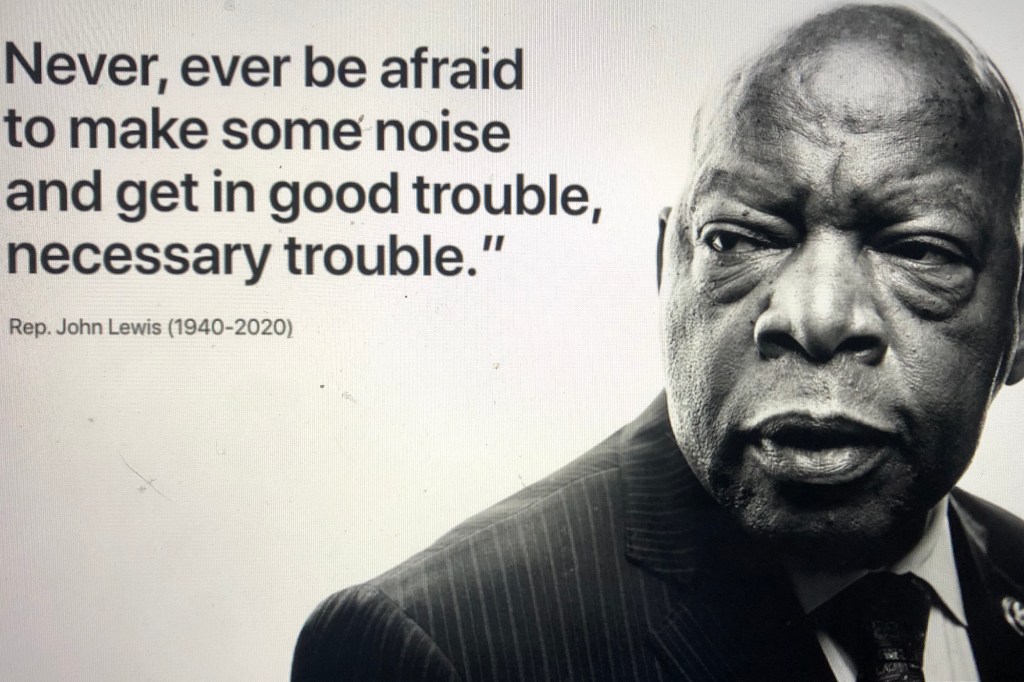
Moral clarity. Those were the words that came to mind when I learned that Rep. John Lewis had died. He had a moral compass and followed it. I asked my husband, “Is that a rare quality?” Gary thought about it for a bit and said, “I don’t know.” “It sure seems like it is,” I responded.
I can’t help but compare our current president, who clearly doesn’t have a moral molecule in his heartless body, to John Lewis. There is no comparison. In fact, I can’t bring myself to type Trump’s name in the same sentence.
After thinking for a bit, Gary looked at me, “You have moral clarity.”
“Really?”
Wow, that’s a major compliment. I thanked him but know that I am not in the same category – it is embarrassing to even write this. My family gives me more credit than I deserve for doing the right thing. I fall short often.
Thinking about John Lewis’s life I can’t help but be awed by his courage, consistency and vision. If I have moral clarity, I have not come close to living it in the way that he did. Some people live big lives. John Lewis did. Why? What is the difference between those that lead on a national or international stage and those that don’t. I’m thinking it is a combination of having a compelling vision, a willingness to step up, a calling to shoulder responsibility, and seizing the opportunity to act.
Maybe the truth is that we all have opportunities to act, and either we don’t step up or we try and fail. Perhaps we don’t have the courage required to put ourselves on the line – there is so much to fear, from losing a job to physical harm. Or maybe we try but don’t have the leadership qualities that inspire others, or maybe we don’t offer a message that resonates. It is amazing to think that John Lewis was 23 when he spoke at the March on Washington in 1963. So young and to already have ascended to that height! His willingness to put his body – his very life – on the line by participating in the Freedom Rides and the protests in Selma, among other activities, is awe inspiring.
I’m trying to think of times I have been in the presence of someone who had that kind of vision, determination and integrity. I can’t think of any. I can think of times I saw a speech on television that moved me. Mario Cuomo’s and Barack Obama’s convention speeches come to mind. But, again, that is different than a Black man sitting at a ‘Whites Only’ lunch counter and waiting for the painful consequences. Taking action is a different animal than soaring oratory. We need both to stir change. John Lewis did both – he used words and actions.
I think about my father who had a very strong sense of right and wrong and he communicated that in no uncertain terms to his children. The three of us benefitted from the clarity of his vision. He was a chapter chair in the teachers’ union and walked the picket line in New York City as a teacher in the 1960s, but he didn’t march on Washington or go to other protests. I wish I could talk to him about his choices. I’m not judging him – he lived an admirable life. I do wonder what he would say about leadership and courage, especially in this moment when both seem to be in such short supply.
We are living at a time where there is a paucity of leadership on the national level, certainly a lack of leadership that embraces an ethical code. We have a leader – we have a president. But he is so devoid of values, he has failed us miserably during this pandemic (and in addressing the systemic inequalities that the pandemic has made glaringly obvious).
I miss John Lewis already. Knowing his voice was out there gave me comfort. I know there are people doing good work, courageous work, trying to steer this country in a healthier direction. I hope leaders emerge who can bring us together. I am keeping an eye out for them.
Note: My mother has continued to write stories of her youth. This one was shared previously on my brother’s Facebook page. I wanted to share it, too, since it is such an important part of our family story. In fact, I had written about it before here. After my Mom’s essay, there is a postscript with some facts and figures about the storm and then a portion of my previous post. My Mom’s description adds details to my understanding of how that momentous, traumatic experience, the New England Hurricane of 1938, felt to her and the lesson she took from it.
Change by Feige Brody
There is always change, whether it is the change of seasons, change of jobs or change of homes. The first momentous change in my life, which I can recall, was in September 1938 when I was not yet 5 years old. We lived on the second floor of a two- story building in New London, CT. I was playing outside when a black cloud covered the sun and changed my day to night.
When the winds and rain began no one knew that it would be unlike any other storm, but would be the most powerful and destructive hurricane in New England’s recorded history. As my mother called me up the stairs, I recall her attempting to remove things from the clothesline when it snapped, and all the white sheets went flapping into the black sky.
Mother and I hurried inside where my two -year old baby sister, Simma, was crying in her crib. Mother closed all the windows and I played with Simma singing “Rain Rain go away.” Suddenly a burst of wind shattered our windows. Glass and rain poured into our apartment. Mother plopped us onto the center of my parents’ bed. She had to keep us off the floor while she attempted to clean the debris.
To our immense relief our soaking father soon arrived and the first thing he said was “Christopher Columbus saved my life.”
Dad then proceeded to tell us that he had been delivering breads and cakes when the storm intensified. His car was stuck in a flooded street and the car started to fill with water so he scrambled out. Holding onto the walls of the buildings he started making his way home. A gust of wind however sent him air borne and blew him into the statute of Christopher Columbus which was right in the middle of the road. Dad held on for dear life; eventually, he and Christopher Columbus parted, and Dad resumed his precarious journey back to us.
Our apartment was illuminated only by the outside flames of a burning New London. We could hear fire engines and sirens. The water in our apartment began to rise; Mother knew we were going to have to abandon our home and she started packing diapers and a few other items.
Fortunately, a coast guard boat soon arrived, in what used to be our back yard, and we climbed through the broken window in the kitchen and into the boat. I remember putting my hand in the swirling water and splashing. It was fun and exciting for an almost five- year old girl. But the fun subsided soon. When we were deposited on relatively dry land there was utter darkness. Electric wires were whipping in the wind and we were drenched and walking on wet ground. I had to jump to avoid the live wires which were sparkling and sizzling all around us. I was frightened for the first time. No one was able to hold my hand because Mom was carrying Simma and Dad was carrying our few belongings.
I learned that life could turn around in a second. We lost everything in that hurricane. Our life was changed in every way.
My father, a voracious reader, quoted Voltaire, and told me “All is for the best in the best of all possible worlds.” 80 plus years later, I do not believe “all is for the best,” but, I do believe that this is the best and only world we have, so we should make the best of it. And this has been my philosophy of life through changes in jobs, changes in homes, and changes in the seasons of our lives.
Post Script: Some facts pertaining to the hurricane on the 21st of September 1938:
1. There was no warning system- in 1938 forecasting in US lagged behind Europe
2. No insurance
3. This was prior to the naming of hurricanes
4. 682 people died
5. In 1938 dollars: 306 million in losses (which is 4.7 billion dollars in 2017)
6. It was a Category 5 Hurricane with wind 160 mph
7. 2 billion trees destroyed
8. 20,000 electrical poles toppled
9. 26,000 automobiles destroyed
10. Damaged or destroyed 570 homes including mine
Here is a link to footage from the National Weather Service that shows the fury and aftermath of that epic storm: link
——————————————————————————————————————————
This is an excerpt from the blog post I wrote, which is a profile of mom’s Dad, who I called Zada. He was the essence of resilience.
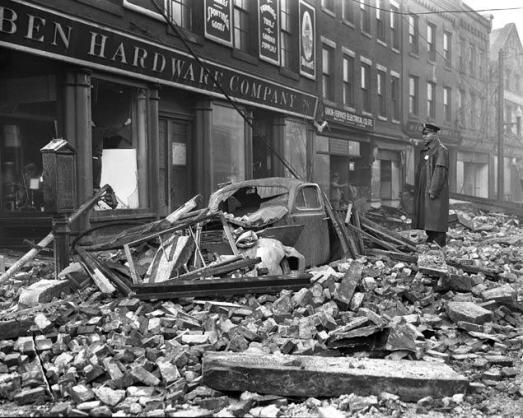
An essential part of family lore involved the hurricane of 1938. Nana and Zada, as well as my mother and her sister (almost five and two years old respectively), were living in New London, Connecticut. Zada was working at his father’s bakery when a fierce hurricane of historic proportion came ashore without warning. Nana and the two girls had to be rescued by a Coast Guard boat that plucked them from their second floor apartment, saving them from the floodwaters that had already engulfed the first floor.
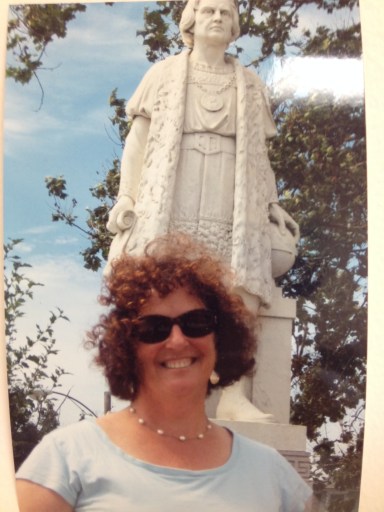
Zada, 34 years old at the time, left work and tried to make his way home during the storm. The wind was whipping at over 100 miles per hour and the rain was relentless. The Thames River had overflowed with a record tidal surge (a record that stands to this day) and was streaming through the streets. Zada clung to a statue of Christopher Columbus to avoid being swept away. Zada maintained that the statue saved his life.
Eventually he was reunited with his family, but they had lost everything to the storm. The bakery was destroyed, as was their home.
A view of the destruction in New London (NY Daily News)
There were a number of family legacies of that historic storm. Zada started celebrating his birthday along with Christopher Columbus on October 12th . As a child I thought it was his actual birthday. Since Zada came to this country from Russia as a baby, his birth records were in dispute. While Christopher Columbus may be in disgrace today, we are still grateful for the monument to him in New London. In fact over the years I have gone to visit it several times.
I missed my self-imposed Monday morning deadline by several days, but hopefully you will forgive me. After five months of pandemic limitations, we arranged a visit with our son’s family. We got to spend time with our beloved granddaughter! To add to the joy, our daughter and son-in-law-to-be came too! We were all extra-careful in the weeks leading up to the visit, no one had any symptoms (though every day I imagined every symptom in the book!) and we decided to take the risk. They came for six days (Leah and Ben were here for four)! We picked blueberries (granddaughter ate every single one she picked, none made it to the bucket), we swam in our pool for hours, we watched 101 Dalmations and Onward many times over, we ate great meals and generally reveled in their company. I put aside my writing. I took many photographs to help remember the wonders of a two year old. On Monday Leah and Ben returned to their work life and yesterday, in the midst of the downpour that was the remnants of Isaias, Dan and his family packed up and drove home. It was a bittersweet goodbye, but we were left with a treasure trove of memories.
Today I have root canal to look forward to – I’m not joking. I probably could have timed that better. The good news is that we already have another visit planned so it will not be so long until we see each other – just a few weeks, not an endless five months (assuming no spike in Covid or other disaster).
One other exciting thing since I last posted, the essay I wrote that was accepted to an online journal has gone live! (I wrote bout that in Victory! ) I am honored and excited to be included in this edition of Trolley, the literary journal of the New York State Writers Institute. The theme for the magazine was our experience during the pandemic – poets, essayists and visual artists contributed. I hope you’ll explore it. Here is the link to my story. Happy reading!
Night and day (Photo on left: AP/Alex Brandon; Photo on right: AP/Seth Wenig)
I watch with horror the violence and destruction that seems to accompany peaceful protest. I admire the protesters, the ‘wall of moms,’ and believe they are acting in good faith. Who is to blame for the fact that it devolves into riot? Is it because the response by the police and ‘troopers,’ (from whatever Federal agency they may come – which is another troubling issue) are so aggressive? Is it troublemakers who seize an opportunity? Is it both? Who is benefitting from the chaos? And, is it really chaos? How much violence and destruction is there really? These days, when where you get your information makes such a difference in your reality, it is hard to know what to believe.
I have attended a number of protests in my life. Gary and I went to Washington D.C. for the Women’s March. I’ve gone to several Planned Parenthood demonstrations. I went to show support for our local Jewish Community Center after it had been targeted with anti-Semitic bomb threats. All of them were peaceful. None of them were held at night. Something seems to change at night. Why?
I continue to reflect on the role that law enforcement plays in our society. I wrote about it previously here. I have been thinking about my own experiences. I am my father’s daughter and that means that I have an instinctive negative reaction to authority figures – at least those who are heavy-handed. Dad left the Air Force as soon as he could; the culture of taking orders without question wasn’t a good fit.
Fortunately, I have had minimal interactions with police officers, other than a few speeding tickets. The blaring siren, the lights flashing in your rearview mirror and the realization that it is directed at me gets the adrenaline flowing full force, even though I know that I haven’t done anything seriously wrong. I have been envious of friends who have been able to sweet talk their way out the ticket. I don’t have that skill set. On those rare occasions when I have been stopped, I try to curb that instinctive resentment (sometimes not that successfully), minimize the interaction, obey their direction, and move on.
Once back in the late ‘80s, Gary and I were pulled over in Brooklyn. We were heading to a friend for Sunday brunch and wanted to pick up a cake or pie, so we were looking for a bakery or grocery store in an unfamiliar neighborhood. As a result, Gary was driving a little erratically – stopping and starting, pulling over to the side to see if shops were open. Next thing we know, we hear the siren from a patrol car and look back to see we were being flagged down. After the police officer explained why he stopped us, we understood his concern, but the officer was more than a little rude and condescending in questioning us. Gary was very respectful (more than I would have been capable of being), explaining what we were looking for, producing his driver’s license and registration. When the interaction was over, we breathed a sigh of relief. We agreed that the cop seemed to take pleasure in his power trip, he enjoyed seeing us quaking in our boots.
On the other hand, we had a positive experience with a state trooper in Pennsylvania. Our car broke down and we managed to pull over on the shoulder of the highway. It was cold and damp out. Within minutes a patrol car arrived. The trooper radioed for assistance and let us sit in his warm, dry car until the AAA tow truck came. We took the trooper’s name and Gary wrote a letter to the state police to thank him for his service.
In both of those instances, we did not fear for our lives. The two interactions were very different, but even in the case of the unpleasant police officer, we weren’t concerned that we would be arrested, abused or killed. I would not have labeled it as ‘white privilege’ at the time, but we both recognize it as such now.
My feelings about the police includes quite a range of emotion, including fear, respect, resentment and appreciation. I guess it depends on the circumstances.
Many years ago, when we lived in the city of Albany, we heard screaming coming from our neighbor’s house. Our house was set on higher ground so we could see into the apartment, the curtains were not drawn. Upon hearing the sounds of distress, I looked out our bedroom window and saw a woman being chased by a man from one room to another. I waited a minute or two to see if things calmed down. They didn’t – I thought she was in danger. I didn’t know the couple despite the fact that they lived next door. I called 911. Fortunately, they responded quickly, and it appeared that they successfully deescalated the situation. I was grateful to be able to call upon them. The incident was never repeated.
As far as I know, that was a success story. I know it doesn’t always go that way. The couple, by the way, were Black. That scenario raises a lot of questions. Is that the role of the police? Who would I have called if the police were no longer assigned that responsibility? I suppose there could be another service, but what would that look like? There are so many unknowns in a situation like that. The man or woman could have had a gun; mental illness or drugs/alcohol could have had a role. Whoever responded to the call wouldn’t know what they were walking into.
I guess that is one of the problems at the root of this. We don’t know what we are dealing with and the situation can evolve. A peaceful protest may be proceeding without incident until it isn’t. A loud argument between people can turn violent. I attended a training for school resource officers several years ago where one of the presenters explained that police are taught to gain control of the situation – their mindset is to shut things down and get the upper hand. While that strategy makes sense in one way, in another it may be counterproductive, especially when someone is angry or desperate and wants to be heard.
It is clear to me that law enforcement needs to improve its ability to deescalate rather than inflame. In the meanwhile, as protest continues and may even be spreading, I pray it can happen without destruction, injuries or deaths.
As I understand the directive in New York State, you are supposed to be masked (nose and mouth covered) if you are in public when you can’t keep the appropriate physical distance (six feet). Seems simple, but it isn’t.
Some of the complexity I understand – I am confused by what it means in some circumstances (more on that in a bit). Most situations are crystal clear so when people aren’t masked inside stores then they are being defiant or selfish or both. I’m happy to report that the vast majority of folks I see when I go to the Price Chopper are doing it right.
I must confess that I don’t like wearing a mask. I am someone who, under ordinary circumstances, sweats a lot. If I walk around the block, I will be perspiring pretty much regardless of the weather. It is just a fact of my life. My forehead and face get damp easily. Wearing a mask makes it worse. I also wear glasses – contact lenses are not an option for a variety of reasons. The combination of these factors means that I am often looking at the world through fogged up lenses. I need a defroster. Someone should invent glasses that have that feature. Maybe windshield wipers?
Despite this inconvenience, I wear the mask. It isn’t comfortable, it isn’t pleasant, but I wear it. I don’t want to put others or myself at risk.
Now to the grey areas and questions I have…
Sometimes I see people driving in their car with their masks on. I wonder why. If they have passengers that would explain it. But many times, they are alone. I don’t wear my mask if I am alone in my car or if I am riding with my husband. Am I missing something?
The other day I stopped to put gas in my car. There were four other people getting gas at the other pumps. No one had their mask on. I did. Though we were outside, I didn’t think we were distant enough to go without. Again, am I missing something? Why weren’t others wearing their masks?
I wonder about the etiquette of mask wearing when outside in public. I don’t live in a densely populated area. When I go out to walk in the neighborhood, I am able to keep an appropriate distance even if I see someone else. Should I still be wearing my mask under those circumstances? Given that it makes me even warmer and that my glasses fog up, I prefer not to, but I also want to do the right thing. For all I know, my neighbors are grumbling, “why isn’t she masked?” Though, generally, when I see other walkers or bike riders on my street they aren’t masked either. Maybe I can stop fretting about this one.
If I walk in a more heavily trafficked area, I will have my mask on or at the ready so that I can mask up if I approach other people. I will give others a wide berth on the sidewalk and appreciate when others do that for me. Here is my question in this scenario: if all parties are wearing masks, do you need to still to be six feet apart? Can you just walk by each other without taking a detour into the street or onto the grass?
I got an estimate for some work to be done on our deck. The guy came to the house, he rang the doorbell and he backed away to keep an appropriate distance. I opened the door and asked him to go around back so we could talk by the deck. He was wearing a mask when he rang the bell, but it only covered his mouth. I wore my mask when I went outside to meet him in the backyard. I saw him adjust his to cover his nose and it stayed that way for about two minutes before it slid down. He didn’t fix it. I was wondering if I should say something to him. This is another etiquette question. I don’t feel comfortable correcting people on their mask usage. In this case, we were outside, and I could back away when his mask slipped, so I let it go.
To be honest, though, I have never asked someone to adjust their mask, even when I have been in a store. It is all so fraught. I don’t want to be in a viral video where someone goes nuts in response to being called out for not abiding by the rules. I don’t envy store employees who have to enforce the policy. What a thankless, and possibly dangerous, job. It is hard to believe we have come to a point where someone would actually pull a gun (this happened in a Walmart, of course) when admonished to put on a mask. It’s craziness!
I find it very stressful thinking about it all the time and trying to figure out the right way to handle each situation. As I said before, sometimes it is totally clear – other than when I am in my own house, if I am indoors, I am masked. But there are all these other situations where I do this dance. I worry whether I am doing it right and then I worry whether others are. I don’t want to think about it anymore! Maybe it would be simpler to just wear it all the time.
Note: My mom has been trying her hand at writing, too. During this shut down, where she has been almost entirely confined to her one-bedroom apartment, she has been reflecting on her life. She wrote this piece and I thought I would share it. I think it gives some insight into her and some lessons she taught me. Plus, I think it is great that she is putting pen to paper (and in her case it is with pen and paper) and I want to encourage her to continue.
I’ve often heard women complain that their husbands were busy playing cards while they were left alone. I didn’t mind.
This is what I did. I walked the Avenue, Fifth Avenue.
On Thursdays my husband, Barry, and his friends would get together after work, have dinner and then play cards. They always played at our house because it was a central meeting spot.
In the meanwhile, I would finish my workday at school in Brooklyn and take the subway to the city. There is only one city, Manhattan.
I would walk up the avenue, but not like Fred Astaire and Judy Garland (Easter Parade, 1948), more like Bill Cunningham (NY Times Photographer). I‘d go to the corner of 5th Avenue and 57th Street to watch the world go by. The languages I heard, the clothing I observed and the ages of those walking the Avenue were as varied as the cultures they represented.
Since the hour and day was not conducive to seeing a Broadway matinee, I varied my excursions. Sometimes I would go to St. Patrick’s Cathedral. The outside was surrounded by the ever-present sounds of construction and general din of the City, but inside was quiet with magnificent stained glass windows.
Most fun would be visiting the luxurious bathrooms of the very expensive department stores such as Saks 5th Avenue. The restrooms were decorated with silk or satin wall coverings and gold-plated faucets. I got a kick out of my brief moment of feeling rich and pampered.
Other excursions would be to the jewelry stores, Cartiers and of course the crown jewel, Tiffany’s. Tiffany’s had a special room where they displayed replicas of the trophies made for championship teams and marvelous tiaras and necklaces commissioned by famous people. The real jewelry would be in locked cases. Obviously, I never bought anything; but it didn’t hurt to look.
Other times I would go browse in Barnes & Noble – no coffee bar then—and also the Hallmark store which had all kinds of knick-knacks in addition to the wide array of cards and wrapping paper. I strolled past the other famous shops as well.
Getting into the City always excited me, with its energy and hustle bustle.
I would head home, plug in the coffee pot and bring out either the brownies or pie that I had made the night before for Barry and his fellow poker players. After the refreshments the guys would head home. We all had work the next day.
My take: Mom loved the City and she passed that on to me. While I have not ventured into the fancy stores on Fifth Avenue, or tried their restrooms, I have people-watched along that iconic avenue and I have spent hours in its bookstores and that same Hallmark shop.
I also learned that husbands and wives don’t need to be joined at the hip. Mom and Dad had unique interests and that was a good thing – they gave each other space to pursue them. This was a valuable thing to understand and was an important building block for my own marriage.
I well-remember poker nights because the smell of the cigars wafted up from the basement. I was sometimes asked to help clean up the next day and the air was still hazy from the lingering smoke. My dad didn’t partake, but his friends sure did. I always hoped there was leftover brownie as a reward for my efforts.
Also, Mom loved coffee – I believe she must have built an extraordinary tolerance to caffeine because she consumed potfuls (of regular!) in the course of the day when I was growing up. At some point it did catch up with her so that now she has to limit her intake, but she still loves her two cups in the morning, black (no sugar, no milk).
Mom – not with coffee since it was the afternoon. Diet ginger ale will have to do 🙂
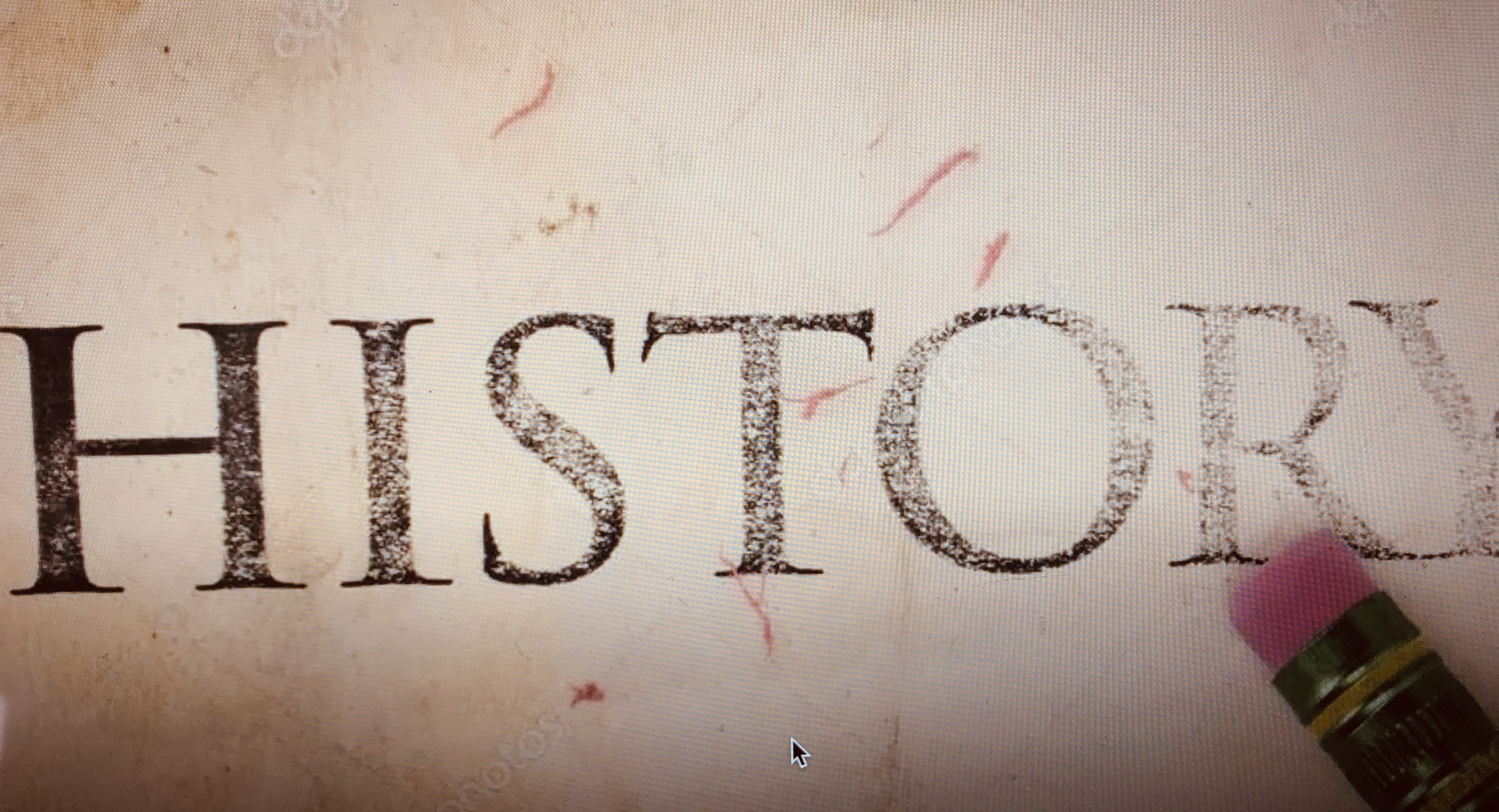
What is history? The first time I realized that the word could be broken up as ‘his’ ‘story,’ it was a revelation. Most of what we learned in school was the story of men, of particular men, those in power. One could argue that telling the story of the powerful is appropriate – after all they made the rules, they shaped the future. At least more so than ‘ordinary’ people. If we are studying the founding of America, learning about Washington and Jefferson is imperative. But, of course, that doesn’t tell the full story. Telling the full story is complicated.
So many things go into defining history. First, who is writing or telling the story? Who chooses what is included in the curriculum? Until relatively recently, historians were mostly male and mostly white. While in theory facts are facts (although in TrumpWorld perhaps we have moved into a ‘post-factual’ period), we know that making connections and analyzing information are colored by the biases and assumptions we bring to it. Our understanding is broadened and deepened when a range of perspectives are brought to bear on a topic.
It becomes a matter of balance – history can’t solely be the domain of the privileged. But, we don’t have unlimited time, even if we take into account that we send children to school for 12 years, time is short. Choices are made. It is hard to pack in all the history we want our citizens to know and provide them with a global perspective, too. When I was in elementary school in New York City in the late ‘60s and early ‘70s, we were taught American history by highlighting the contributions of every different group that made up our country (maybe not every different group). We learned about Crispus Attucks, Haym Salomon, Baron Von Steuben, Tadeus Kościuszko, Marquis de Lafayette – I came away proud that so many different people, representing different ethnicities and backgrounds, contributed. We learned about Washington, Jefferson, Franklin, etc., too. The message I took home was that the Revolution was a noble cause, with many contributors.
Looking back, I recognize that there were gaping holes and many things were romanticized. When the values that inspired the American Revolution were taught, the fact that women, Native Americans and Blacks were deliberately left out of the vision of life, liberty and the pursuit of happiness was not given much attention – more of a passing mention. It wasn’t until 11th grade that I learned about our treatment of indigenous people – the deliberate spreading of smallpox via blankets, for example. My children spent a great deal of time in elementary school learning about the native people of New York State – changes in curriculum were made. I don’t know if they learned about the different contributors to the Revolution, as I did. I’m not suggesting there is necessarily a trade-off, I don’t know.
In talking with friends, even friends who were in school with me, not everyone remembers learning the same stuff I recall. I was interested so I paid attention. How does that factor into all of this? Sometimes when I hear criticisms of our education because some subjects weren’t included, I think to myself, but I remember learning about that. Which brings me back to my first point – what is history and who is telling it? Perhaps we can dig up the approved curriculum for 4th grade social studies in New York City in 1968, but that may or may not be what was taught in a given classroom. And, my friend may have been absent the day we learned about Crispus Attucks.
In my limited experience doing research for this blog, I have found it challenging to settle on a ‘truth’ about events. Some are small events, like when Cutie the cat leapt out of the car window. My family agrees that it happened, but not how or why. In a more serious example, when I researched the murder of my paternal grandfather’s family in Poland by the Nazis, the specifics were hard to get a handle on. The fact of their death was indisputable, but where and how many were killed, was hard to establish. It opened my eyes to the difficulty of uncovering history and how it gets reported.
Another question is: who or what is being written about? What resources were available to reconstruct events? Could my blog constitute ‘history?’ Many of my essays are memoir, recounting experiences from 50 or more years ago, or incidents from last week. Diaries and letters are great but need context and corroboration. I don’t imagine that Donald Trump keeps a diary or writes letters, but if he did, he would hardly be a reliable source. What will history have to say about him?
You may be wondering, where am I going with this? I think these questions are central to what we are going through as a country today. We are coming to grips with a fuller picture of our history. We are raising questions about the lessons we were taught. Some feel threatened by that questioning.
We are also addressing the role of monuments and museums in the telling of that history. We are recognizing that our understanding of history evolves and then what do we do with those monuments and museums? Some might argue that our history is being rewritten and resent it because it feels like sand is shifting beneath our feet. But it is always being rewritten – there continues to be scholarship about the fall of the Roman Empire. It is right that it is rewritten and rewritten again. No doubt it can be unsettling, but it is necessary for our growth.
This doesn’t mean that I don’t believe in history, or that we should cast aside all that we learned. But, I do think, like with most things, we need to read critically, ask questions and be open to new interpretations.
I come back to a quote from Maya Angelou, “Do the best you can until you know better. Then when you know better, do better.” I think that applies to where we are now. I think we all need to be on a quest in our lives to know better, so we can do better.
I woke up and grabbed my phone, as I usually do, from the nightstand. I quickly flipped through various apps, just checking to see if anything momentous happened overnight. Nothing of note, just the usual craziness inherent in living in TrumpWorld. Then, the last thing I do before I get out of bed is look at my email. It is formatted so that I can read the first line or two of the body. Imagine my surprise when I saw this:
Hello Linda,
Your submission “Life in the age of coronavirus” has been accepted for publication
Holy smokes! I couldn’t click on it fast enough. Those of you who have been reading this blog for a while know it has been a journey to get published (here is one example). I have wondered whether it would ever happen. I thought about why it was important to me, whether I could or should let go of that idea. Just recently I had recommitted to trying to make it happen ( wrote about that in Another Monday in Quarantine).
On my daughter’s birthday, May 22, I submitted a piece to Trolley, the online journal of the New York State Writers Institute. They were soliciting submissions of poetry, fiction and nonfiction for an issue that would have coronavirus as its theme – they wanted to hear what writers were experiencing during the pandemic. That sounded like a promising topic. I have been posting essays to this blog on just that subject. I chose a recent one and did a bit of editing. When I hit the send button, I remember thinking maybe the date would be an auspicious one. Good things happen on May 22nd. The streak continues!
I forwarded the congratulatory email to my husband and children. I knew they would be pleased for me. It was still quite early, before 7:30 a.m. I would wait to call my mom until a more reasonable hour.
I fought my instinct to downplay the news. I have this way of devaluing things I do – saying to myself it isn’t a big deal; anyone could do it – doesn’t matter what it is. If it is something I accomplished, it can’t mean much. If I lost 20 pounds, I would focus on the fact that I had another 20 to go. If I got excellent evaluations for a presentation, I would think only about the one negative comment. When I finished a 5K or the Five Boro Bike Tour, I would talk about how slow I was. I started down that path this time, too. If a publication accepted my work, it must reflect poorly on them or they took everyone’s submission. For what might be the first time in my life, I shut that down. Instead, I thought, ‘Enjoy this, Linda, just enjoy it.’
I looked again at previous editions of Trolley. It made me smile to think of my essay appearing there. It may not be the New Yorker, but it doesn’t have to be.
Mom was excited, as I predicted, when I shared the news with her. Gary came home after work bearing roses. Shortly thereafter the doorbell rang. Two bottles of red wine were delivered, courtesy of Leah, Dan and Beth. Who knew wine could be ordered online and delivered to our door?!? I opened one bottle and poured myself a generous glass. I savored the full, sweet taste and all the moments of the day.
Now, to keep writing and submitting…perhaps I’ll try submitting on the birthdays of Dan and Gary. Maybe they’ll bring me good luck. But, even if more publications don’t follow, at least this happened.