I was fighting a war on several fronts when I was growing up. I wanted to be a classically feminine girl and I wanted to behave like a boy at the same time. I had strong opinions about things, but I wanted to please people, too. I wanted to look pretty but I really wanted to be comfortable.
Wanting to look pretty created issues because I wasn’t interested in clothes or make-up. I had neither the patience nor the desire to read fashion magazines or talk to other girls about that stuff. It was likely rooted in insecurity – I don’t think I believed I could be pretty and it was far easier to dismiss it as uninteresting than to try and fail or be laughed at for the unsuccessful effort.
At the same time I wanted to be strong, physically and mentally. But I was afraid of seeming too masculine. I thought I already appeared masculine – I perceived myself as being built like a linebacker. Not to mention the unsightly facial hair that I could never figure out how to handle.
I absorbed the message that girls were supposed to have Barbie-like figures and mine didn’t look like that. I didn’t have a tiny waist, I didn’t have long, thin legs and I didn’t have a small, shapely butt. And then there was my hair and my eyes. Even when I grew up enough to know that the Barbie standard was ridiculous, I wasn’t able to make peace with my body.
It didn’t help that I had several experiences of being mistaken for a boy. One time was particularly awkward. I was probably 11 or 12 and I was in Star Value City, the five and dime in the shopping center near my house. I had been sent by my mom to buy sanitary napkins. I hated being sent on that particular errand. In those days, boxes of sanitary napkins were at least the size of a large microwave oven. There was no way to disguise the package – they didn’t make a bag big enough to cover it. It was so embarrassing – I thought everyone would see the monster box of Kotex and think they were for me.
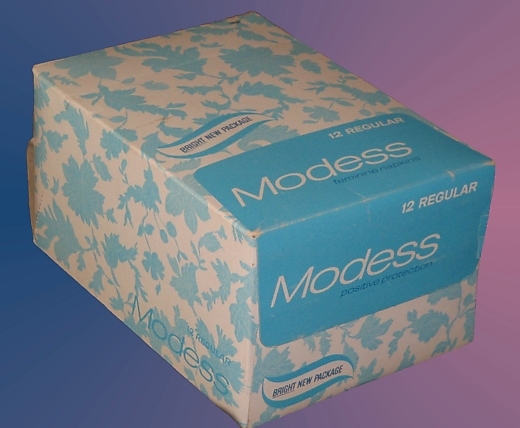
So, I was wandering the aisles, gathering up the courage to go the feminine products section, when a girl who looked a little older than me approached me and smiled. She said, “You’re cute,” in a flirty way. I was attired in my usual uniform: jeans, sneakers and an oversize sweatshirt. I was totally taken aback. I didn’t know how to respond. I couldn’t bring myself to say, “You know, I’m a girl.” Or anything else for that matter. I was speechless. I just tried to move on. She was persistent and followed me, commenting on my curls and freckles. I was dying. Eventually she got the idea that I wasn’t going to speak and she left me alone. And, then I had to go buy the sanitary napkins and walk home with them!
I imagine that other girls got mistaken for boys and vice versa, but I couldn’t handle it. For me it played into my worst feelings about myself. I couldn’t talk to anyone about it either, it was just too embarrassing.
This was the source of another deep ambivalence. On the one hand I have always understood that the substance of a person is far more important than their looks. I value humor, insight, sensitivity, generosity, compassion and curiosity in friends. Yet, I weigh my looks so heavily when I take stock of myself.
I used to take inventory – I got these qualities from my mom (for instance, my smile and my large rib cage) and other qualities from my dad (short legs and strong opinions) – both physical characteristics and personality traits. My mom and dad were so different from each other. My Dad was a manly man – decisive, logical, authoritative, short-tempered, athletic, and strong. I thought I was a lot like my dad. My mom wasn’t exactly a girly-girl, but she certainly put on make-up everyday when she was getting ready for work. Mom was intuitive; she didn’t think in logical steps (at least not a logic that I recognized). She was also preoccupied with physical appearances and commented on that all the time– my eyebrows were a regular source of concern. I internalized that preoccupation.
I think the mix of personalities worked for them in their marriage, they complemented each other, but those characteristics didn’t coexist so easily in me. I found myself wanting to be decisive and passive at the same time! I simultaneously cared deeply about how I looked and thought it was a shallow conceit. Trying to integrate the competing aspects of myself made for a very confusing and sometimes painful growing up. Making peace has been a life long project, one still in progress.


Leave a reply to Feige Brody Cancel reply