There is a route I take frequently when I run errands. I drive through a neighborhood in Albany when I go to the bank (more likely the ATM), to our favorite bagel shop or to walk at SUNY. Probably 18 months ago I noticed a house had a for sale sign. The brick house sits on a corner lot; it is possible that it is a multi-family dwelling. Anyway, I wondered how quickly it would sell. The reason I wondered, given that the market was pretty hot, maybe not as hot as some areas of the country, but healthy nonetheless, is because of the house next door. That house has a barrage of signs – including the unforgivable ‘Fuck Biden.’ I’m all for free speech, but that is over the line. The house has lots of other signs – back in the day he (and I believe it is a he because I see him mowing his lawn) had a ‘Lock her up’ sign, among others. Based on the signs he displays, he is deep into conspiracy theories about the deep state.
A photo from a New Jersey newspaper – not the house I drive past obviously, and his are a bit more discreet, but the sentiment is the same
I have driven past the ‘for sale house’ for many, many months and now its lawn is overgrown, and it has one of those orange notices affixed to its front door – I imagine that it is in foreclosure. Do you think it has anything to do with the ‘Trumpy’ neighbor? I would not want to live next door to someone who was willing to put a sign out with an expletive directed at anyone, much less our president (even if I hated him/her – in my most outraged state with Trump it would never occur to me to display such a sign). Or maybe something is actually wrong with the structure? I don’t know, but I have mixed feelings about it. Part of me feels a certain satisfaction that the house is going to seed because the Trumper takes meticulous care of his property and can’t enjoy looking at the mess next door. I don’t wish ill to whoever owned the house that isn’t selling, and it isn’t good for the neighborhood to have an abandoned property, so there is that.
That same route that I drive brings me past a house that this month is festooned with pride symbols – just around the block from the Trumper. I wonder if they know each other. I should note that there are no curse words included in their array, just rainbows and hearts. Further down that same block is a house with flags that I associate with extreme Republicans – Don’t Tread on Me, the American flag and some others that I don’t recognize (not the confederate flag, I’m pleased to report). Is it one big happy neighborhood? Somehow I doubt it.
It is interesting to me that folks choose to advertise their politics in this way – it is not election season. I have put signs on my lawn in support of candidates. In fact, my Kerry for President sign got stolen. But, I don’t choose to put symbols out that represent my politics. I admit I appreciate passing homes that fly a rainbow flag – and I like the signs that say, in one way or another, hate has no place here. I’m not sure if I think those gestures are helpful. I defend anyone’s right to put whatever they want on their lawn, though I would like to think people would exercise good judgment. ‘Fuck Biden’ isn’t good judgment. Isn’t there some ordinance against that? I would not want a six year old, who is learning to read, to see that.
It leads me to ask: will we further segregate ourselves by our politics? Cities have historically been blue, though New York City, that bastion of liberalism, has elected any number of Republican mayors. Rural areas have historically been red, though I’m sure there have been exceptions. Can that still happen? As the parties move further apart, will those anomalies continue?
I wonder what impact the divisiveness in our politics has on the real estate market, especially in suburban areas. It can’t be good for our communities. Will our neighborhoods become echo chambers like our social media? Will we instruct our realtors to find properties with like-minded neighbors?
I wish this era of hateful rhetoric was behind us.
When I told my mother that Gary and I were going to Croatia for vacation she looked at me puzzled and asked, “Why?” I explained that Croatia’s coast, which sits on the Adriatic Sea, is reputed to be beautiful and has become a tourist destination. “But, where is it?” I started by saying that the Adriatic is the sea that borders Venice, Italy and if you go across from there, you get to Croatia. She was still having trouble picturing it. Then I told her it was part of the former Yugoslavia. “Oh, now, I understand where it is.” Interesting, for a woman of her age that reference clarified things.
Croatia was indeed part of communist Yugoslavia until 1991 when it fought a war for its independence. Yugoslavia was never part of the USSR, but it was under its sphere of influence. When the Soviet Union fell apart in the late 1980s and early 1990s, Yugoslavia broke up into six separate countries as well. If our experience there is any indication, it appears that Croatia has embraced the West.
The Croatians we met, and it is true that they were mostly involved in the tourism industry and may not be representative of the whole country, were quite enthusiastic about the United States. We perceived no resentment or negative vibes. In fact, several of them commented on how much they admired America. Everywhere we went there were tourists from all over – Italy, France, Germany, Asia and the U.S. Clearly tourism is a critical part of their economy. They also expressed pride in their country and way of life. Several told us that Croatians take their time – if they want to have coffee they will take 2 hours to sit, relax and enjoy.
We started our adventure in Split. We learned that it was the birthplace of the Roman Emperor, Diocletian, who ruled from 284 to 305 A.D. He built a ‘retirement home’– palace is more accurate – in Split. He is the only Roman Emperor to step aside willingly – he planned for his succession. Most were overthrown or murdered. Anyway, his palace still stands. Today it is home to a church, monastery, apartments, restaurants and shops. We took a tour, and it was fascinating to see how it has evolved. Different eras are demarcated by the different materials used – blocks of limestone, bricks, stones show how things originated and were then repaired centuries later.
Our tour guide for Diocletian’s palace, Yakob, was very knowledgeable. He is a native of Split, expressed pride in his city and country, and shared a great deal about the history and current politics of his nation. He explained that all students in Split learn English. He told us he grew up watching U.S. television shows. His favorite was Seinfeld! We were shocked. I wouldn’t have thought that humor would translate to another culture. He loved it and could reference specific episodes and funny tidbits. I wasn’t sure how I felt about Jerry, Elaine, George and Kramer representing us. They aren’t the most admirable folks. Apparently, though, it entertained Yakob and honed his English skills.
It was so interesting to travel around and see and hear the mix of cultures. American music, Croatian radio stations, Muslim influences.
Gary and I made the trip with our friends Merle and Dale. Merle had done the vast majority of the research and gathered recommendations about historical sites, hotels and restaurants. We took tours in some places, but we were not part of a tour group going from place to place. There can be pluses and minuses to that approach, but it worked for us. In a country where so many speak English, it was totally manageable.
We traveled from one location to another by ferry. There are many islands off Croatia’s Dalmatian coast and ferries offer the most efficient means of getting from one to another. After Split, we visited Hvar. It has a busy, crowded port that looked like what one might expect of a Mediterranean resort, filled with restaurants, bars, souvenir shops and churches. We didn’t spend much time in that section of Hvar – we chose a hotel in a quieter, smaller town.
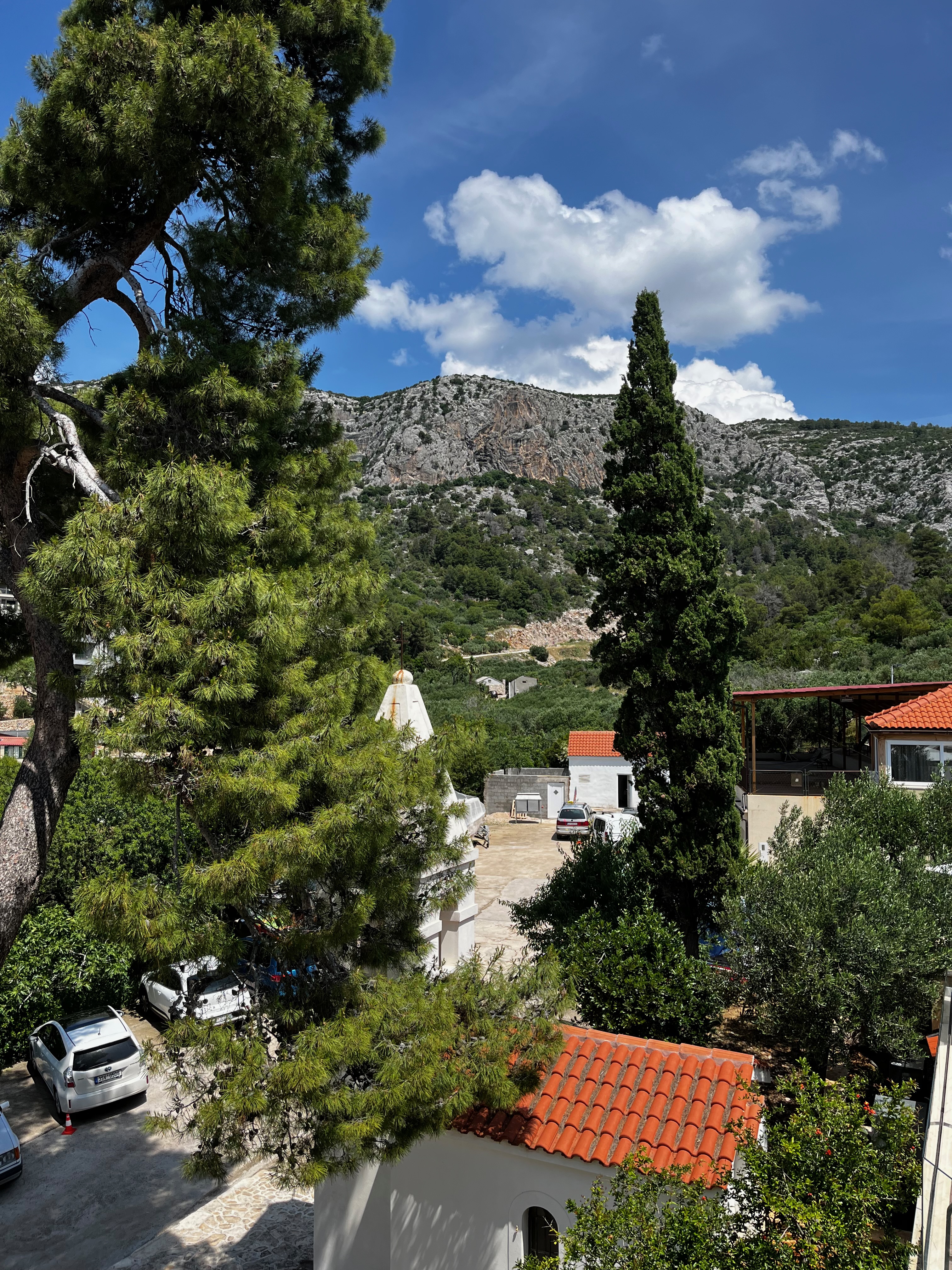
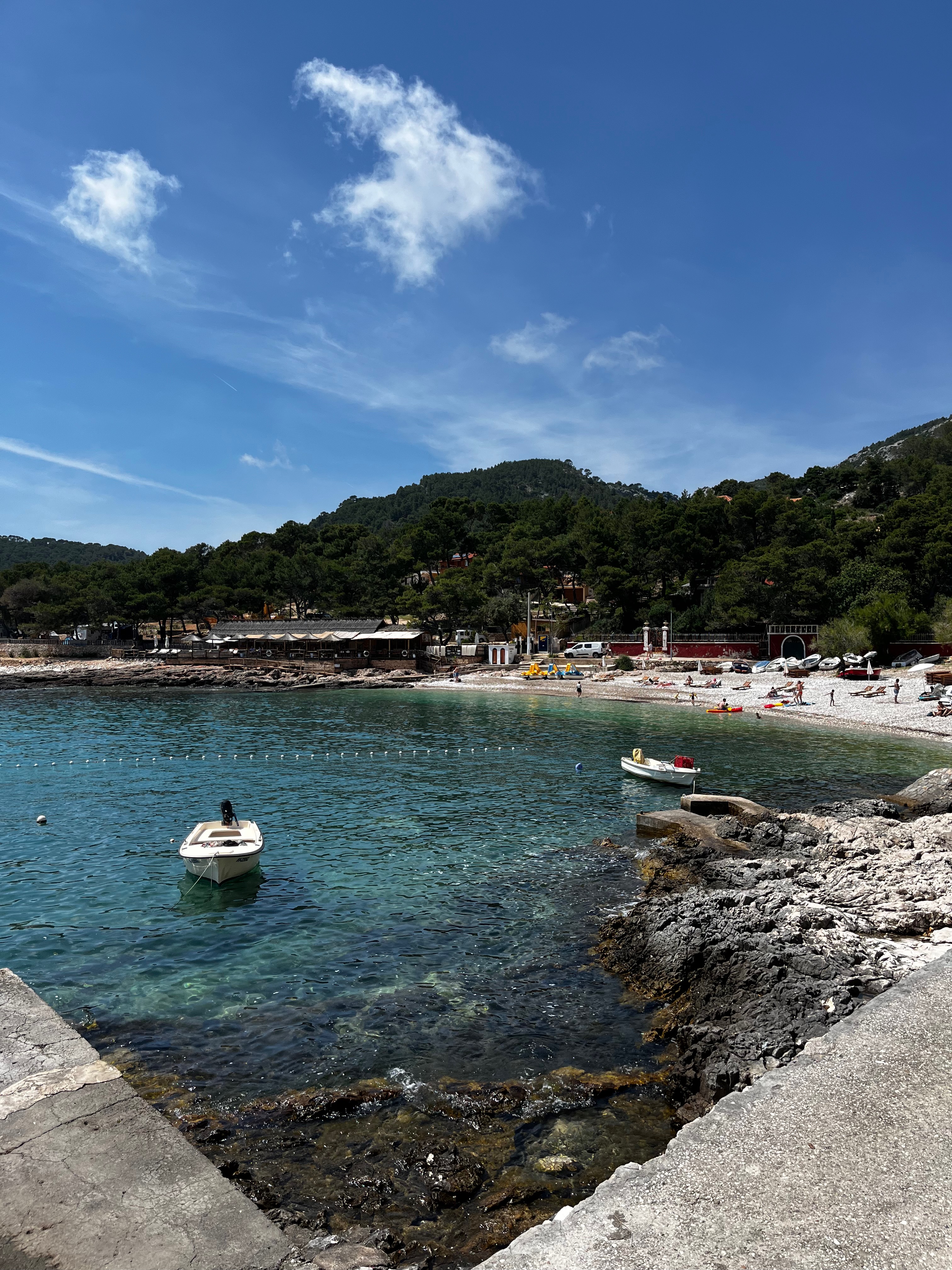
Everywhere we traveled we noted the orange ceramic tile roofs and beige stone buildings. It made for beautiful views of waterfronts and hillsides – perhaps a cross between Italy and Greece. Here are some views of Milna, Hvar (the small town where we stayed instead of the main port area):
The weather this time of year is supposed to be optimal with sunshine and temperatures in the 70s. When I checked the weather in the week to two weeks before the trip, it consistently showed thunderstorms. We started looking for indoor activities in case our other plans derailed and we packed accordingly. It turned out to be unnecessary. When we arrived we were told that weather forecasts for the Croatian coast are meaningless, the forecasters are always getting it wrong. We were glad they did!
We did face one morning of rain and it was during our tour of a national park – Plitvice Lakes National Park was about 3 hours inland (north and east) of Split. It was sunny in Split and remained that way for the first two hours of our bus ride to the park. We emerged from a tunnel through a mountain to cloud cover and by the time we got to the park it was raining. It poured for a few hours. It did not dampen our spirits or ruin the views and fortunately we had packed ponchos for just this situation. We took a 9 kilometer walk that wound around lakes and waterfalls. I can’t remember being anywhere more lush. It was spectacular. They had gotten substantial rain in the days leading up to our visit and the waterfalls were full and powerful. It was breathtaking. The rain stopped in time for our boat ride and the sun came out when we stopped for lunch. Someone was looking out for us! When we resumed hiking after lunch, it was dry. Here are some views of our visit to Plitvice:
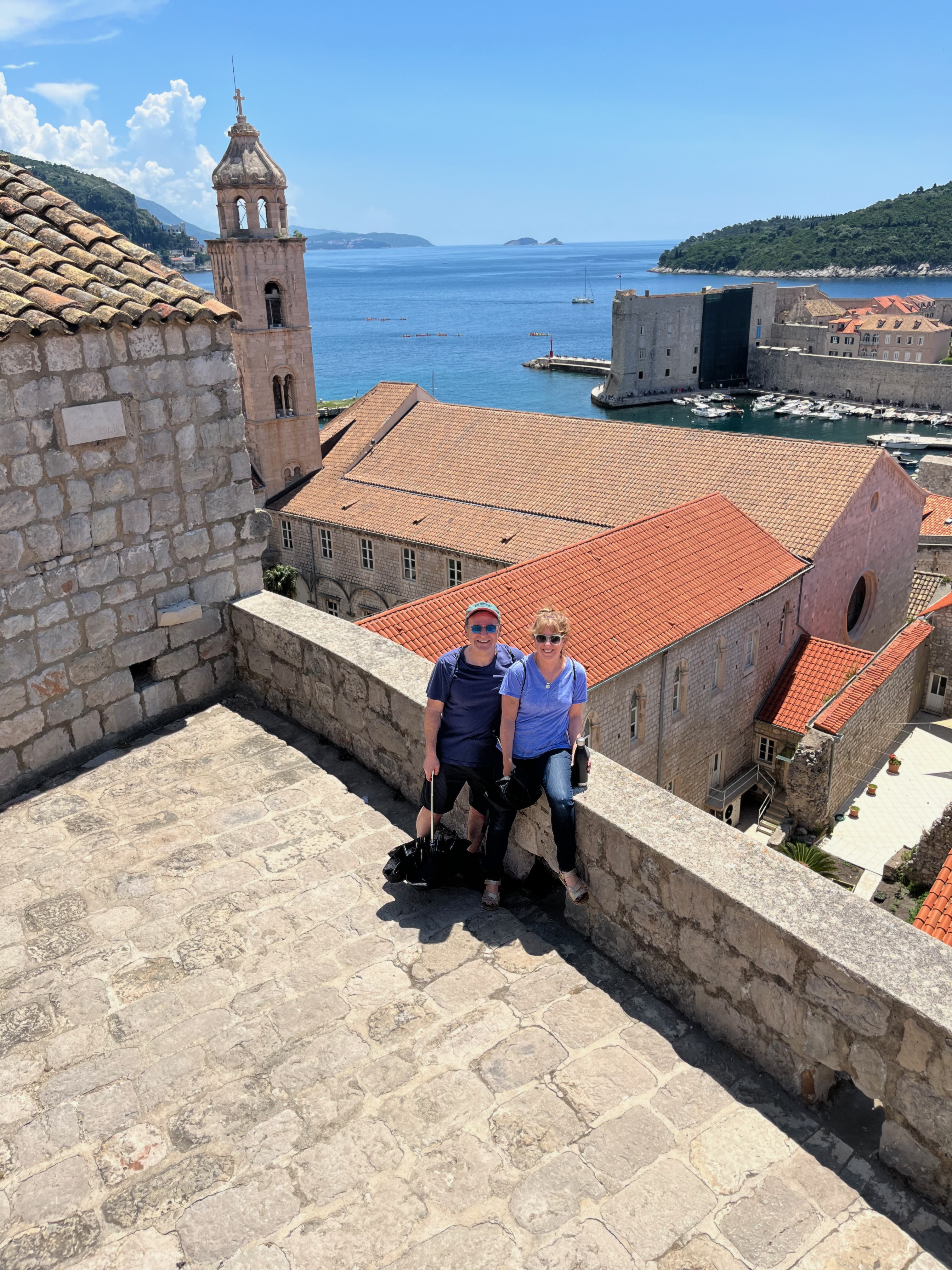
We also visited Dubrovnik, an ancient city at the south end of the country. We took a cable car ride up to the top of a mountain that overlooks the old part of the city. The view was like something out of a tour book. The walled old town could have been the setting for a fairy tale – it was the setting for parts of Game of Thrones (so was Diocletian’s Palace). The water of the Adriatic is clear and varies from blue to green. The orange tile roofs pop next to it. We timed our ride on the cable car to be up there as the sun set. It was magnificent.
Here are some shots from there and from atop the walls of the old city:
We had some excellent meals. The national dish of Croatia is ‘peka.’ Merle had gotten a recommendation for a restaurant that specializes in that dish and it was a one mile walk from where the cable car left us. That walk was so special – the sun was low in the sky, the light was soft and yellow. The countryside was dotted with purple, yellow and white flowers (see the second photo above). The road wound down the hillside and opened up to vistas of Dubrovnik and the Adriatic on one side and mountains on the other.
The restaurant did not disappoint. Peka is made with either beef or lamb and I am not a fan of either, so I didn’t have it – you had to pre-order because it takes so much time to cook. It was interesting for Merle, Dale and Gary because peka reminded them of comfort food they grew up with in the best possible way. The restaurant slow cooked the meat under an iron bell and it is served with roast potatoes. The seasonings tasted familiar to them. We hypothesized that since Croatia traces its roots to the Slavic people of Eastern Europe, as we do as Ashkenazi Jews, that perhaps the cooking style was shared. It was quite a moment for them, Merle in particular, to have such a strong sense memory, to be so many miles from home and so many years since last tasting it, but be taken back to her grandmother’s cooking.
Sadly, all good things come to an end. It was time for Gary and I to return home. Our trip back was long and tiring, only to be greeted by a line that snaked up and down a cavernous hall at JFK to get through customs. That line alone took an hour – just to show our passports and be admitted back into the United States. People on the line were remarkably well behaved, though. It took 18 hours of travel time from our hotel in Trogir, a charming, old town near the airport in Split, to get to our apartment on the upper west side of Manhattan. On the one hand, it is kind of miraculous to be able to travel almost 4,400 miles that quickly. But, on the other, in this modern era of jets, it shouldn’t take that long – especially when you consider the amount of time spent waiting on lines to get through security and passport control at various airports. If Gary and I plan to travel more overseas, I will definitely look into the expedited programs they have for international flights.
Now it’s back to the grind, especially for Gary. I will look back at my pictures and treasure our memories of the beautiful places we saw, the people we met, the shared laughs and the experiences we had. We are lucky to have taken many wonderful trips and hope to continue to do so as long as we are healthy enough and have the resources to do it.
I keep telling myself I want to read more poetry. But I don’t do it. Why? I think in part it is because for me it is hit or miss. I love it or I don’t get it. And when I don’t get it, I feel less than. It feels unsatisfying. With a book, it is different. I may like the story or the writing, or I may not, but I don’t often feel a sense of failure. With modern art, or even classical paintings, if I don’t appreciate something, I just move on without judgment – not of the artist and not of myself. Why does poetry that goes over my head, or if it doesn’t move me, make me feel like it is a personal failure? I think I need to adopt the attitude I have about other art forms – enjoy what resonates and let the rest go. Maybe then I would make it more of a priority. After all, poetry lends itself to our lifestyles these days – they can be quick reads (maybe not quickly understood and processed, but it doesn’t require a huge time investment) so it would seem to be a good fit.
I am pleased to report, though, that a book of poetry I just read, prompted by my family book club (thank you, Nicolette), did not fall into the category of going over my head. I found it accessible and meaningful. Amanda Gorman’s Call Us What We Carry was insightful, moving, intelligent and creative. My niece, who picked it as this month’s read, called it a ‘time capsule,’ and I think that is very apt. Gorman wrote it during the pandemic, it was published in 2021. The poems remind me what the early days of Covid felt like – the isolation, the fear, the uncertainty. The poems cover that year, 2020, and all the upheaval that went with it. While some might not want to be reminded, it is important because though we think we have moved beyond it, in our quest for normalcy, there are residual effects that we need to reckon with.
It Is amazing to me that Amanda Gorman is so young – as of today she is 25. When she recited her poem, “The Hill We Climb” at Biden’s inaugural (that uplifting poem is included in this collection), she was 21! She is clearly well-read and well-educated – how much is formal education (she earned her B.A. from Harvard so there had to be some of that), or her own reading and research, I don’t know, and it doesn’t matter. She brings a sense of history and culture to her poems that is so impressive. There are references to the pandemic of 1918, the Great Migration (the movement of African Americans from the south to the north during the first half of the 20th century), the Civil War and her own life. She includes footnotes and endnotes. All of it is called upon in service of enlightening our present moment.
It isn’t common for our book club members to all agree on something we have read. Usually there are differences of opinion, and we bring a variety of perspectives and preferences to the piece – which is what is beautiful about it– and we read a wide range of genres. Everyone was impressed with Call Us What We Carry. Each of us picked up on different themes, some things resonated more than others, but we all valued the experience. I should note that we do not all share the same politics – though I would not characterize any of us as extremists, we are mostly center-right, center-left, and maybe a bit further left. I point this out because one might be tempted to assume that Gorman’s poetry would be heavy-handed. We did not find it so – she writes substantively, with evidence and passion – not propaganda.
Several of our members perceived that some of the poems communicated anger. I can’t say I felt that as I read. I didn’t pick up on that in her tone. If it was there, it wouldn’t be without cause – there is plenty to be angry about. It didn’t hit me that way, though.
I think this collection of poems offers an important contribution to our time. I recommend reading and or listening to it. Our book club had a discussion about how best to engage with it – some had listened, some read and one of us read and listened at the same time. I think, if one can, that last method would probably be best. Reading it allows you to appreciate some of the artistic choices made in how it is presented (the poem in the shape of the U.S. Capitol, the use of white space, the color of the paper, etc.). Listening likely offers more of an appreciation of the rhythm and the playfulness of the language.
I will leave you with two parts of poems that made a meaningful impression on me. The first comes from “The Shallows,” which describes a time challenging to the human spirit, she concludes the poem with these lines:
Shall this leave us bitter?
Or better?
Grieve.
Then choose.
The other piece is entitled Pre-Memory:
“Marianne Hirsch posits that the children of Holocaust survivors grow up with memories of their parents’ trauma: that is to say, they can remember ordeals that they did not experience personally. Hirsch calls this postmemory. Seo-Young Chu discusses what she calls postmemory han, han being a Korean conception of collective grief. Postmemory han, then, is the han passed on to Korean Americans from previous generations. As Chu writes: Postmemory han is a paradox: the experience being remembered is at once virtual and real, secondhand and familiar, long ago and present.” The whiplike echo of Jim Crow, too, passes through Black bodies even before birth.”
The piece then goes on to explore this idea. The notion that we inherit trauma, if it is true, has major implications – and would explain a lot about why people behave the way they do and why it is so difficult to move on.
Amanda Gorman is wrestling with provocative and interesting ideas. I think it is worth the time to explore them. I look forward to seeing what she will offer us as she grows.
I am sometimes critical of Albany, New York. I have lived here for 37 years but in some ways, it has never felt like home. Maybe there is something about not being born in a place, not having spent your childhood there making memories, not associating your family of birth with it, that means you never quite feel connected. Of course, the place where I grew up, Canarsie of the 1960s and ‘70s, doesn’t exist anymore. The people I knew, the stores, even the landscape has changed. That may be why they say you can never go home again. What is home after all? That may be a topic for another blog post.
Anyway, my point is that for all that I might joke about ‘smAll-bany,’ there are a number of wonderful things about it. Saturday was one of those days that reminded me what is charming. Mother’s Day weekend is when the Tulip Festival is held each year. It is a chance for Washington Park to show off – the city gardner(s) do a wonderful job of planning a vibrant display of tulips of every variety and color. Below is just a sample:
There are also booths of crafts and food. There is music. All of it is free – well not the items sold at the booths obviously, but there is no entrance fee. The festival lasts two days. This year I noticed that one of the bands performing was Guster. We, as a family, enjoyed Guster back when the kids were teenagers. They play melodic tunes with fun beats and lovely harmonies, and we listened to them frequently when we were on one of our many long car rides. We saw them as a family at the Saratoga Performing Arts Center back in the early 2000s. I told Gary they were playing as part of Tulip Festival, and we agreed we’d try to go. They were going on at 4:30 on the mainstage at the park on Saturday according to the schedule printed in the newspaper.
Saturday afternoon Gary was weeding the garden, I was immersed in a book. At 3:45 Gary came in to get changed. We got in the car at 4:00 to head toward the park thinking we might not make it to the performance, but we had nothing to lose. It usually takes 10-12 minutes to get to the park. We hit traffic and had trouble finding a spot, but we found one on the street. It was a bit of a walk to the site. With all of that we arrived on the lawn at 4:35, just as the emcee said, “Please welcome to the stage…Guster!” There was a large crowd, but there was space – especially where we happened to come in – off to the side.
Ryan Miller of Guster saying hello to Albany
Where else can you do that? Leave your house a half hour before a performance at a large public festival and get there on time. In what city or small city is that possible? As we took our spot amid the crowd, Gary and I smiled at each other. “Isn’t Albany great?” I asked. Gary nodded emphatically.
The sun was shining brilliantly, the air was warm and there was a refreshing breeze. It looked like confetti was falling from the sky in celebration – it was some kind of small leafy substance coming from the trees. Though the ground rules said no marijuana, concert-goers paid no heed. Smoke wafted through the air and the police who were on duty on the periphery seemed unperturbed. Everyone appeared to be in a good mood – especially the guy in an orange t-shirt dancing dreamily with a broad smile on his face. Guster was great – they were in fine voice. The music brought back terrific, happy memories. The crowd enjoyed it. They played for just under 90 minutes. When it was over, we walked back to our car and drove home.
Earlier in the day we met my niece and her family at a local farmer’s market for breakfast. There too things were easy. We parked. We got a table. There were plenty of people, especially young ones, but it wasn’t packed. There were few if any lines at the booths. A group of musicians were playing what I might call American roots music – I’m not sure if that’s the right label, but it was all delightful. In the New York metropolitan area, attending a farmer’s market like this would never be that stress-free.
I imagine for folks who grew up in more rural areas my day might have felt different. They might not have been willing to venture out to the festival in the first place! Perhaps looking for street parking in the city of Albany and seeing the crowds of people in the park might have created anxiety. To be fair, the street we parked on has seen better days – the surrounding buildings were rundown. Gary and I were okay with it. It is all a matter of perspective, I suppose.
Anyone who knows me knows that I still love New York City. I look forward to spending more time there. It’s good, though, to stop and smell the roses (or tulips) where I am. There is a lot to like about living and raising a family in the Capital District.
Hooray! I moved back into my bedroom this morning. My period of isolation is over! Ten days is a long time – at least in some contexts. After three years of avoiding it, Covid caught up with me.
I went to Boston to give my daughter a hand as she was dealing with a sick husband and child. We thought, based on the diagnosis at the hospital, that her daughter had croup, and that Ben was just under the weather. I figured I would mask while I was there, hoping to avoid getting whatever bug they had. What’s that saying? Something like, ‘woman plans, god laughs.’
I arrived at their apartment, said hello, and picked up a prescription that needed to be filled for the baby, and their insurance card. I went to a pharmacy and then got sandwiches for lunch. When I returned, I helped fold laundry. I removed my mask to eat lunch but sat distant from Leah. We opened a window to increase the airflow. Leah was relieved to have me there. So far so good.
About two hours into my visit, Leah’s phone rang. It was the Somerville Health Department telling her that someone in the household had tested positive for Covid. The baby had been to the hospital the night before. As part of the examination of the baby, they swabbed her for Covid. Given that she was diagnosed with croup, Leah and Ben hadn’t given it a thought. The news came as a shock.
Leah and Ben did a home test and, lo and behold, they were both positive. They called the pediatrician to share the information and find out if it changed anything in terms of the care of the baby. Turned out, it didn’t, which was a relief in some ways. We discussed what I should do.
I decided I would stay at a hotel for that night – I certainly wasn’t going to stay at the apartment. I told them I would bring them dinner and other supplies that evening. I left. Ben, who was feeling pretty miserable at this point (totally exhausted), was going to call his doctor to see if they recommended treatment.
I double masked everywhere I went. I decided I would go home the next morning. If I got sick, I didn’t want to be in a hotel in Boston and I didn’t want to feel too poorly to drive the three hours home. I stayed at the hotel that night after picking up Paxlovid for Ben and dinner for them. I felt fine.
I brought them breakfast in the morning. I was double-masked. Said my good-byes. I felt terrible leaving them, everyone sick. At this point, Leah was having symptoms, too. Great – a cranky baby and two parents who felt like shit. Plus the anxiety of not really knowing how serious Covid would be for the baby. But, what choice did I have?
I still felt fine as I drove home. I tested when I got home – negative. Maybe I would escape. I tested the next morning – still negative. But, now I’m starting to feel poorly. Headache, sore throat, tired.
Covid is a strange virus. It behaves differently in everybody. Plus, you can test negative and still have it. You can test positive and have no symptoms. You can continue to test positive long past the infectious stage. It so hard to know what to do. You hear horror stories about people having long-haul covid.
I went for a PCR test that morning (Saturday) and got a positive result within 24 hours. During the height of the pandemic, it could take 3 days or longer to get a result (which made the test almost useless) – so at least that is better. By the time I got the result, it was clear I was sick. My body hurt all over. I felt exhausted. I started coughing. I called my doctor. They recommended Paxlovid. I have several risk factors for serious illness, so though I am always a bit anxious about taking a new medication because it isn’t uncommon for me to have strange reactions to things (rash, anyone?), I decided it was worth it.
Meanwhile, it is now Sunday, the day I am supposed to read for the Brooklyn Nonfiction Prize. I didn’t want to miss it. I had a strategy. Though I was coughing, it wasn’t that bad (yet). I decided I would take cough medicine in advance. I had throat lozenges at the ready. I took Tylenol, too. I napped for an hour beforehand. The adrenaline kicked in. I was next to the last to read – of 15 people! I did not win. Nothing to be ashamed of – the other essays were good. I was still disappointed. I have to admit, I kind of crashed afterward. I was exhausted. It didn’t help that I was facing 7 more days of isolation.
I moved into Daniel’s old bedroom for the duration. I used what had been the kids’ bathroom. We are lucky to have so much room. Gary is serious about this isolation and masking stuff. He has masked at work from the beginning of pandemic and continues to do so now (he just recently stopped using goggles). We ate separately. We would watch t.v. in the same room, but distant and masked and, as long as it wasn’t too cold, we had a window open. It appears that he has not gotten it. When he had it last Fall, he still blames Las Vegas (we will likely never go back there!), I didn’t get it from him after we followed much the same isolation protocol.
I’m glad I took the Paxlovid. I did have a very unpleasant taste in my mouth for the five days I took it, and my digestive system did not enjoy it, but I recovered pretty quickly. The fever, severe headache and body aches were gone within 24 hours. The fatigue lasted a bit longer and the cough lingered. As of today, ten days into this, the cough is almost entirely gone. That is always the last symptom to go when I have a respiratory illness.
Though I was clearly recovering, I woke up each morning feeling sad. Another day isolated. I felt okay, but not so good that I had the energy to be productive. In theory, there are always things to do in the house – junk drawers to sort, stuff to organize. I didn’t feel up to it. Instead, I binge watched Top Chef. Thank god for that!
Fortunately, the baby, Leah and Ben have recovered well, too. I could hear them cheering all the way from Somerville when the baby could go back to daycare. Ten days cooped up in a relatively small apartment with an 11-month old who is healthy enough to be active, but fussier than usual, with no reinforcements, and little sleep, is an ordeal. They rose to the occasion, as they always do.
One piece of good news: we should all be immune for the next few months! Gary and I have a trip planned at the end of May. I should be able to travel without worrying about Covid. Leah and her family should be able to go out and about the rest of this Spring and early Summer without thinking about Covid, too. And we appear to have weathered the illness without lasting effect. It is always a matter of perspective – and finding the stuff for which to be grateful. It doesn’t come naturally to me to do that, but eventually I figure it out.
The view out my kitchen window. I looked at that a lot over the last ten days. I’m lucky to have such a lovely view
NOTE: I submitted this piece to the Brooklyn Nonfiction Prize and it was selected as a finalist. Yesterday was the reading and though I did not win, I am proud to have participated. It always feels a bit risky to put yourself out there, but if you don’t you can’t grow. My family has been very supportive and encouraging and I thank them for that!
Rockaway Parkway was my subway station, where I got on the LL (today the L) to go to The City. In Brooklyn we referred to Manhattan as The City. End to end the LL traveled from Canarsie as a mostly elevated line through Brooklyn and ended up at 8th Avenue and 14th Street, the upper reaches of Greenwich Village. I rode that line countless times growing up in the late 1960s and 70s.
After the train left Canarsie it headed into East New York, followed by Brownsville, went underground in Bushwick, continued on to Greenpoint and Williamsburg. It traveled under the East River and emerged in Manhattan. In the 1970s it amounted to a grand tour of the most dangerous neighborhoods in Brooklyn.
The LL sat at the open-air Rockaway Parkway station waiting for passengers, the trains arriving and leaving the station according to some mysterious, unpredictable schedule. The cars were covered inside and out with graffiti. It looked and felt like chaos.
Aside from the physical appearance, the trains were unreliable. Countless times it would lurch into a station along the route, followed by a garbled announcement that it was going out of service. I heard the collective groan of my fellow travelers. Everyone would exit and crowd onto the platform to wait for the next one. Standing in the bitter cold or sweltering heat -it never seemed to be a moderate temperature – I tried to place myself strategically so that the doors would open in front of me. This was not a time to be timid. When the doors opened, I readied my elbows, and walked with purpose to claim my spot. This is how a New Yorker is made.
I rode that subway line acutely aware of the danger. In the ‘70s, when it was on the brink of bankruptcy, New York City was the murder capital of the world. Muggings were common. On the subways, chain snatching, where a person would grab hold of a necklace and yank it off, fleeing as the doors slid shut, became a fad. We put our jewelry in our purses and held them close to our chests; when we arrived at our destination, we put our rings and necklaces back on.
Since the LL traveled above ground, I could see pigeons perched on the fire escapes of the tired tenements that abutted the tracks. I watched the subway doors open and looked at the people who got on the train from those stations, almost all were brown and black, joining the white folks who had boarded in Canarsie. My neighborhood was 80% white, in fact the block where I lived was 100% white. I wondered about the lives of those who got on the train at New Lots Avenue, how was it for them to live in a neighborhood with such a bad reputation. Here we were, side-by-side, but living in different worlds.
I was 12 years old the first time my friend Deborah and I took the LL, just the two of us, into Greenwich Village. We emerged from the station to see a protest – people carrying signs, chanting, marching in a circle. We didn’t know what they were protesting but we thought it was the coolest thing in the world. It scared us at the same time. We looked around and quickly headed away from the hubbub, looking for bookstores, of which there were many.
When I was 16, I got on the LL by myself to go to downtown Brooklyn to apply for my learner’s permit. There was only one Department of Motor Vehicles (DMV) office to service all of Brooklyn and the DMV was spectacularly inefficient so you had to plan to spend hours there. After I got on the train, I realized I had forgotten my birth certificate. I was too afraid to get off at any of the stops until Broadway Junction. I wouldn’t turn around at 105th St., New Lots, Livonia, Sutter or Atlantic Avenues – five extra stops. Each time the doors opened, I looked at the platform and thought, “Should I risk it?” Each time I decided I wouldn’t. Even though it added so much time to my trip, I wouldn’t take the chance.
In my travels from Canarsie, I frequently changed trains at Broadway Junction where the A and C lines met the LL. I descended the stairs from the elevated platform, took a deep breath and held it as I walked as quickly as possible through the underground passageway, which was damp and reeked of urine. I gulped the fresh(er) air when I got to the other side.
One late afternoon I was riding the LL when there was an announcement over the PA. Those announcements were usually so static-y as to be indecipherable, but this one came through quite clearly. “Move away from the windows! There are reports of gunfire. Move away from the windows!” There weren’t very many of us on the train at the time. Most of the people looked incredulous, a few moved tothe windows to see. Some ignored the message entirely. I shifted down on the bench so the wall of the subway car was behind my head. Fortunately, nothing happened.
Riding the L today reveals almost a whole new Brooklyn. Several neighborhoods have gentrified, especially Williamsburg and Greenpoint. Parts of Bushwick have become desirable real estate, as well. Brownsville and East New York are still impoverished. Compared to the 1970s, the crime rate has fallen all over Brooklyn, but the problems in those communities persist. The neighborhood of my youth, Canarsie, has also changed. Though it is still middle and working class, the racial composition has flipped. Today it is 90% black.
The more things change, though, the more they remain the same. People living side-by-side, riding the L, the haves and the have-nots, perhaps still leading segregated lives.
I often begin blog posts by referring to an interview or podcast I listened to. This one is no exception. George Packer, a journalist and novelist perhaps best known for his writings on American foreign policy, was a guest on Preet Bharara’s Stay Tuned. Most of their discussion was about the status of the United States as a world leader (lots to worry about there, but not the subject of this essay). Toward the end of the interview, they turned to a subject of particular interest to me – the use of language and whether we are increasingly limiting ourselves by removing words that have negative connotations. It is a variation of the idea that it is problematic to be ‘woke.’ As I wrote previously, I strive to be woke and see it as a good thing. However, I thought Mr. Packer had a point. He wasn’t taking aim at ‘wokeness,’ per se, he was voicing his concern that, taken to an extreme, the idea that we can’t hurt anyone’s feelings could prevent us from identifying and solving serious problems. The example he gave related to words used to describe poverty – for instance, poor, impoverished, disadvantaged, at-risk. Apparently, all of these words/phrases have been identified as loaded and therefore to be avoided.
First question: who is doing the identifying? Packer explained that many nonprofit organizations, he cited the Sierra Club as a prominent one, have come out with ‘equity guides.’ These guides provide lists of words that should not be used, and he said they provide clunky, bland alternatives (for example, instead of ‘paralyzed with fear,’ they substitute refused to take action). He characterized the people behind these guides as a small group of educated elites. He thought that though they were well-intentioned, they were doing more harm than good. Packer’s main point was that we need to be less worried about the words and more concerned about the underlying problem that the word describes. I was intrigued by his argument.
First, some context. Most news organizations and magazines have style guides – the Associated Press (AP) style guide is one that is frequently cited. If you write for those entities, they have established standards you are expected to follow. Organizations which put out frequent press releases or social media posts or are routinely called upon by the media to express positions are also likely to have one – that is why the Sierra Club has one, as does the American Cancer Society. The equity guide is an offshoot (part of) of the style guide.
Another aspect of the context relates to the Sierra Club specifically. They, like many organizations, have a complicated history in terms of their relationship to historically marginalized communities. In the past the club has mostly been thought of as the purview of white, male environmentalists. As the country has changed, and as the damage done by climate change has hit more broadly, they have needed to reach a more diverse constituency. If they are going to do that successfully, they need to understand those communities and use accessible language. They have taken positions in the past that hurt those communities. In addition, the original founder, John Muir, was known to use racist language. Thus, the organization felt it had some work to do to repair the damage. That said, equity guides are prevalent beyond this particular nonprofit and Packer believes that as it seeps into the mainstream, it will erode our ability to tell the truth.
So, is there a problem with the equity guide, as Packer argues? My conclusion: Yes and no.
The main impetus of the guide is to remind its users to put people first. I became acquainted with this notion years ago when I was cautioned not to refer to a person with diabetes as a diabetic. A person is more than any single aspect of their identity, whether it be their illness, disability, religion, occupation, etc. It may not seem like a big thing, but I believe it is meaningful and worth reminding folks.
Another main point of the pamphlet is to ask people how they would like to be identified. It reminds us not to make assumptions based on appearance, and to use the terms the individual themselves would like to use. This applies especially to race and gender. To me this is common sense advice and simple enough to follow.
They also ask writers to evaluate whether the descriptor is germane to the subject. Do we need to know the person’s age or race or gender? We are conditioned to include some of those characteristics, but it is worth asking ourselves the question. Is it relevant or does it just contribute to stereotyping? If we are trying to paint a picture of a person or a situation, maybe more specific adjectives would do a better job.
So far so good.
Where things get problematic, and where Packer has a point, is in the avoidance of words that make us uncomfortable. If we are talking about poverty, neighborhoods that are poor, we can’t use euphemisms. It is what it is. The folks who live in those communities know they are poor and/or working class. It won’t come as a surprise to them. The problem isn’t the words. The problem is, in my estimation, the assumptions that get made because of that condition. Just as we should not define an individual by a single characteristic (diabetic), we must not define a whole community by one issue (i.e., its crime rate or the percent who live below the poverty line). We often write-off those communities or try to ignore them. But, we must not ignore all the people who are trying to raise families, make a living, lead healthy, productive lives in those communities. We need to remember that in those communities lots of good things are happening – there is culture, art, humor, good food, etc., etc. No matter what words we ultimately use to describe poverty, it is the associated assumptions that are dangerous, not the words themselves.
Words have power. We need to be mindful of how we use them. Sometimes we need to vividly describe a problem to move people to action. At the same time, we shouldn’t be careless about hurting folks. On balance, I think the equity guides are a good thing. Some of its advice borders on silly (I sincerely doubt that a person in a wheelchair would be offended by using the phrase ‘paralyzed with fear,’ or that a blind person would object to the phrase ‘blind rage’ – though it would be interesting to ask a group), but users of the guide can make their own judgments. In fact, the pamphlets make a point of telling readers to do that, especially in view of regional and local standards. The guides could be problematic if a given organization implements it as if it is law, without leaving room for nuance or the wisdom of the people on the ground. But, if it is a tool to raise awareness and offer alternatives, then it isn’t the bogeyman Packer sets it up to be. As with many things, the question of whether it is a good or bad thing depends on how it is used.
NOTE: Another view from the frontlines written by my husband, Gary Bakst.
I saw a patient for a physical exam and there was a lump found on that exam. It was not one of those lumps that make you immediately think the worst. But it also wasn’t a lump that felt obviously innocent. It would require investigation. I was concerned but in my gut I thought this is probably going to turn out to be benign. I also knew that what I needed to do was fairly straightforward. The work up should be easy. However, what should be easy is hardly ever easy these days.
I knew he needed a CT of the pelvis with and without contrast to better understand what we were looking at. However, when I searched our electronic medical record system, there was no option for a CT pelvis with and without contrast. There was CT abdomen with and without. There was CT abdomen and pelvis with and without. There was CT pelvis without any specification as to whether or not it included contrast and there was CT pelvis with contrast. I have no idea why they made the choices so weird. Ultimately I decided they must have intended that the CT pelvis (without specifying) was without contrast. So I ordered CT pelvis with contrast and CT pelvis.
This electronic medical record system was imposed upon our office. We did not ask for it and we surely did not want it. We had an electronic medical record system that was working very well but the larger organization that we are now part of felt it was important to get everyone in the organization on the same platform. They switched us over a bit more than a year ago knowing they were going to again switch systems for the entire organization in early 2024. We explained to them that our office is particularly busy and they did not have enough support staff to make this cumbersome system work in the setting of such a busy practice. They weren’t impressed with that argument.
When the switchover came, they sent in people to help us with the transition and they were great but the underlying issues were too much to overcome. Our office became less productive, we were less able to accommodate our patients and new referrals. The larger organization lost money when they thought they would save money. Some of our doctors and PA’s became frustrated. Two have left and one went from full time clinical to half time clinical practice. We have been able to hire a PA and a nurse practitioner and we hopefully have another physician joining us soon. Still our productivity is well below where we were before the change. Belatedly the higher ups came to understand that the transition was a failure and allowed us more staff to deal with it. Unfortunately, that happened just as the economy got weird and you couldn’t hire anyone. However, as time went by, we have been able to increase our staffing and it has gotten better.
We submitted the plan for the CT pelvis to the patient’s insurance company and they rejected it. We appealed and they again rejected it and said I needed to speak to one of their reviewers. Ultimately, they finally approved the CT. Thankfully, it showed nothing terrible. I had also ordered some lab work for this patient. Previously, we drew the blood in the office and we also had a very efficient office lab that processed the blood work. It was accurate and very fast. The overwhelming majority of lab work was available to me on the day that the blood was drawn. I would go home from the office and be able to review all of that lab work, call the people who had a problem and create letters to those who had good results so they could know they were fine. Each evening, that day’s blood work was essentially all dealt with.
However, the larger organization closed our lab. We still draw the blood but the plan was to send it to their lab to save money. We explained that it would lead to delays and be less efficient and not allow us to do as well in dealing with issues that come up with lab work. However, they felt very strongly that it would be a major savings in lab costs. To be fair, the higher ups listened to our objections and we were able to speak with them at length about it. But the decision was made and was not going to be undone.
On the same day that they changed our electronic medical record system, they also closed our lab. Specimens were to be sent to the hospital but at the same time, the pandemic related supply chain issues got us. There was a shortage of vacutainer tubes needed for blood draws so we had to send all of our labs to Lab Corp except for those patients who have Blue Shield which does not accept Lab Corp. Lab Corp did pretty well getting us timely results. They took one day longer than our lab but they were not too bad. We lost much of our ability to have the lab add on tests as needed or re-run results that were questionable. Still, it was a moderate, not severe, drop in our function. For the Blue Shield patients, they had to go to either St. Peter’s labs or Quest labs, both of which were quite slow. Sometimes we just never got any results and we had to call for them. Sometimes patients would tell me their results off their portals for those labs and that is how I found out how they were doing.
Finally, in November, the shortage of vacutainer tubes was over and our hospital lab said they were ready to accept our labs rather than sending them to Lab Corp. But they were not ready. We saw labs taking 4 or 5 days to come back. In quite a few cases, by the time they got to our specimens, they had timed out and it was too late to run them. For reasons I cannot fathom, they denoted this as “lab accident” and that showed up on patient’s portals. Patients were naturally concerned about the lab accidents involving their results. I started sending them to Lab Corp again until the hospital was able to get enough staffing to actually process the labs properly. They are finally doing better but not great.
In my patient’s case, there were lab abnormalities that required follow up. I asked them to add the follow up labs from the blood that we had already collected but they could not do so. Previously that would have been easily accomplished. The patient came in for repeat blood work and they did much of what I asked for but somehow left out the most important follow up test. I am capable of making mistakes but I had correctly ordered it-they just didn’t do the test. Fortunately, in this case, they were able to run it and it also turned out to be good news.
I have spent a fair amount of time criticizing the larger organization that owns our practice but I want to make the important point that they are actually pretty good as larger organizations go. The problem with them is that they are a larger organization. Speak to doctors anywhere in the country and you will hear similar stories. Mostly you will hear worse stories. These guys are really only guilty of being a bit too smart to realize that sometimes when something works, you should let it keep working rather than fix it. Other organizations do far worse and have more concerning priorities. The main point is that we now live in a landscape of practices owned by large organizations in which the decision makers are removed from the people taking care of the patients. They have their own data and jargon and don’t answer to us. Another part of this is the insurance companies which are increasingly difficult to deal with. Then there are the ridiculous costs of pharmaceuticals and the shortages of all kinds of common products from blood pressure medications to amoxicillin liquid.
Ultimately, this patient is well and that is the most important piece of news. And in the end, we were able to get done what we needed to get done. But, comparing what it took to make it happen to what that would have involved just a few years ago, the difference is quite stark. People talk about the problems in health care these days. You are not imagining them. This was a fairly straightforward case. Nobody was hospitalized; nobody had surgery. It was just a CT and a couple of labs. But it shouldn’t be this hard.
I am not a conventionally attractive woman. I don’t write that to fish for compliments or to elicit sympathy. It is a fact, and it has complicated implications. I am reading a memoir, Crying in the Bathroom by Erika Sanchez and in the course of telling her story as a Mexican-American woman who has defied cultural norms, she writes of her numerous experiences being harassed, and in some cases (nearly) assaulted, by men. She writes about her problematic relationship with her appearance. I have read many similar accounts by women, especially as we processed all that was revealed from the ‘me too’ movement. I have heard first-hand stories from friends, too. I believe them and they are painful and emblematic of the reality of toxic masculinity. It has not been my experience, though, and that leads to some complicated feelings. In a bizarre way it makes me wonder what is wrong with me, and am I alone is not having those experiences?
That is not to suggest that these experiences are all attributed to the looks of the women involved, or to blame the victim for being attractive! No matter what you look like, you should not be subjected to abuse. I am well aware that 80 year old women get raped, as do ‘unattractive’ women. I also believe that systemic sexism exists. Strong women are often discriminated against in relationships and in the workplace – I have seen that with my own eyes and believe I was the victim of it. That has less to do with appearances and more to do with societal expectations about women’s behavior and/or generalized misogyny.
I also know that research shows that resumés with women’s names or names associated with African-Americans are passed over in favor of men or those with what are assumed to be white names. This has implications for job opportunities, access to loans, among other things that shape power structures in our society.
Appearances, meeting the culturally defined standards of beauty, are so important. I believe that one’s experience of the world is shaped to a more significant degree than we’d like to believe by how we look, and this is true even as an otherwise privileged white woman. From the reaction of salespeople to service received when lodging a complaint, one’s looks can help or hinder. It might be true for men too, but I doubt to the same degree.
I have been out and about with my granddaughters, both of whom are or were especially adorable babies (one is well past the baby stage). I know you are rolling your eyes and I get that – I am their nana, after all. I know I am not objective, but I am basing it on the reaction of those who walk by. Often people stop to comment or coo at them. I appreciate babies, though I almost never stop to comment or coo unless it is the child or grandchild or someone I know. I probably do smile more in recognition of a cutie pie. (Now that I am thinking about it, I will make a point of smiling at all of them. I hope I do that already, but honestly, I’m not sure.) Sometimes if a baby is odd looking, they can have a unique charm. All deserve love and attention regardless. The reality is the world doesn’t react equally. When I was a baby, I had crossed eyes. They were glued to my nose. It wasn’t successfully fixed until I was five and surgery didn’t totally correct the problem. I think people responded accordingly. I absorbed the message that I wasn’t pretty or notable. We take in those messages long before we have the language to talk about it or understand it.
Does this all mean that we shouldn’t appreciate or comment when a child or a person is especially beautiful? Would we be losing something if we decided that it was inappropriate to say, “what a cute baby!” or telling a woman she looks beautiful? I don’t think we need to go that far. Maybe we should simply be more mindful when it comes to giving advantages to some over others based on something so superficial.
When the ‘me too’ movement started I had some interesting conversations with friends. I grew up in a time when some things were taken for granted and accepted. One friend made the comment that you were almost insulted if a guy didn’t try to ‘cop a feel.’ She talked about the kind of flirting and ‘handsy’ fooling around that went on when groups of guys and girls hung out. No one wanted to be sexually assaulted, but a level of sexual play was tolerated and perhaps expected. I understood what she was saying, though, again it wasn’t my experience.
I know many women who were fed up with or frightened by catcalls from men. Who wants to be objectified while they are walking down the street, or any time? My mother, again the product of another generation, thought it was flattering. I know if it crossed the line, where she felt threatened, it wouldn’t have been appreciated. But, she didn’t see it as that big of a deal. Though many women talk of this as ubiquitous, again, it was not so much my experience. If it happened, I probably assumed it was directed at someone else, or I was oblivious. I do recall a drunk guy once weaving past me saying, “Look at the breasts on that bitch!” I was impressed he called them breasts. Have catcalls stopped? Have we moved beyond that crude behavior? Maybe, or perhaps we have ‘progressed’ to silently leering.
I imagine it can be confusing for those blessed with beauty, too. It isn’t based on anything earned, and one might resent it or feel frustrated that their appearance gets the reaction, not other talents or intelligence. Others may be quite comfortable enjoying the benefits, though I’m sure they would be loathe to admit it. Either way, it isn’t fair.
My point in writing this is two-fold. First, though I did not experience the hostility or harassment other women talk about, it does not make it untrue. We need to listen to others and understand their experience but that is a two-way street. I was listening to an interview with an Asian comedian. He talked about growing up in Ohio. He did not feel discriminated against. He was almost apologetic about it. He knew it happened to others, but he didn’t feel like he was subjected to it. His perception helped shape his appreciation for America. He shouldn’t feel guilty telling his story. I shouldn’t feel guilty that my experience of men hasn’t been that toxic (though I will complain bitterly about feeling limited in the workplace, having my ideas coopted or shut down). We benefit from understanding the range of human experience. Similarly, just because I wasn’t subjected to disrespect or harassment based on my appearance, doesn’t mean I get to dismiss the experience of so many other women. There is room for everyone’s story, and we need to open our hearts and minds to hearing them.
My second reason for writing this is to bring attention to the outsize effect of looks. We place far too much emphasis on appearances. Standards of beauty are very limiting, and the implications are important. Being conscious of a predisposition can help us to work to do better. This applies in many contexts. I think teachers, in particular, may be vulnerable to implicit biases based on appearances, and they are so powerful in our lives. We talk about racism (not enough, and we haven’t fixed it by any means, but a lot is written about it) and gender, but this is even more basic. Being conventionally pretty shouldn’t be that important.
Do you find yourself asking friends or family that question? It has come up in a few different contexts. The other day I was visiting with a friend. She, like me, is involved in the care of her elderly mother who has faced a myriad of health issues. She was telling me about her mother’s frustration with her television set – sometimes it works, sometimes it doesn’t, sometimes she can get the channels she wants, sometimes she can’t. I know from experience with my mom it can be hard to sort out the source of the problem – is it the equipment? is it the technology? Which part of the technology? Is it our mother? I am not terrible when it comes to troubleshooting cable, the internet, and equipment, but I am no tech geek either. I can manage, but how is an 89-year-old or a 92-year-old supposed to navigate it? I have an idea! Senior living centers should have staff specifically devoted to tech support (separate from maintenance) – someone residents can call when their remote no longer changes the channel or their iPad freezes. It would save so many frustrating calls to family members who aren’t nearby or can’t just drop in and fix it. I imagine many people would be willing to pay something extra for the service.
In an effort to make things better, my friend went to Best Buy and bought a new t.v. and arranged for delivery. While I was visiting with her, the t.v. was supposed to be delivered and installed. Everything that could go wrong went wrong. There must have been six phone calls before it was finally determined that the person showing up to do the installation was not the same person who was delivering the set. The installation guy arrived before the t.v., and they had no record of the delivery being scheduled!
In between being beyond annoyed, we had to laugh. The whole thing was preposterous. My friend was sure she had been clear about the delivery address (at first the person on the phone was heading to her house, which is not where her mother lives). Nothing got accomplished – leaving my friend with another series of telephone calls to straighten it out.
Was it always so complicated? Were deliveries routinely screwed up? These days I am so relieved when anything goes as planned. But, maybe I’m just older and more impatient. Maybe I’m focusing on the errors and not all the times things happen the way they should.
I have raised the question before – does all the technology we use make our lives easier? Or, does it introduce more opportunities for things to get screwed up – and make it more difficult for us to get to the bottom of the problem to fix it.
I am responsible for overseeing my mother’s medical care. It makes sense that I play that role since my husband is a doctor and neither my brothers nor their spouses have that expertise. The one problem with this is that I live about 3.5 hours away from Mom. Generally speaking, I am able to work things out to accompany her to appointments. The thing that has been more challenging has been keeping her medicines and medical supplies in stock. I can’t tell you how many times there have been problems. Sometimes the issue is one of supply – the pharmacy to which the prescription was sent (electronically) is out of stock of the particular drug. Do they call me? No, apparently they communicate with the doctor (or maybe, depending on who you believe, they communicate with no one). I have explained to everyone and anyone involved in Mom’s care that they should call, email or text me – in fact in many cases my number is the only one they have. And, yet, I still don’t get notified.
And, when did supplies get to be an issue? I had a conversation with my daughter the other day while she was in search of eye drops, amoxicillin and children’s Tylenol for her baby who had conjunctivitis and an ear infection. She spent hours on the phone calling pharmacies. Finally, after a whole lot of back and forth with pharmacists and the doctor’s office, she called me triumphant. She scored the needed drugs!
Going back to my travails with keeping my mother’s supply of medications.: another issue is, not surprisingly, insurance coverage. I am told that her sensor (Mom has diabetes and finger sticks are just not practical anymore) is not covered by Medicare. Then when the drugstore receives the prescription for it, perhaps reasonably, doesn’t fill it (figuring the patient will likely want an alternative that is covered) and sends an email to the doctor letting her know. Eventually I get informed, and I tell them, just fill it. This happens every month. I believe that the sensor probably could be covered but I would need to appeal the decision and go through the hoops and loops. And they’d probably make me do it every time! I think they are counting on wearing me out – and they have been successful. I don’t want to go down that rabbit hole; I just pay for it. Fortunately, it isn’t crazy expensive.
There are so many layers to this. Sometimes I think systems are deliberately set up to not serve us. Or perhaps, as drugstores and doctors’ offices are bought up by corporate entities, the systems are designed, and the decisions are made too far away from where the service is delivered. Something is lost. When entities were smaller, they could be more responsive. Maybe that accounts for some of the loss in customer service.
Or maybe things aren’t actually that different. As I consider this, I wonder if I’m just an old fogey. People are people, after all. What do you think?