Stories

A Tourist in My Hometown

Last week was difficult. My mom’s health has continued to deteriorate, and it has presented challenges to get her needs met. Suffice it to say that elder care in this country is imperfect – and that is a generous assessment. We are a family with resources but even with that, it can be hard (perhaps impossible) to find services that match her needs. I feel for folks who don’t have the financial wherewithal or time or knowledge to navigate this terrain. And that doesn’t even touch on the emotional toll all of this takes and the baggage we may be bringing to our decision-making. So, Saturday night, when I could finally breathe, I realized that I had Sunday to myself before diving back in to Mom’s care. And it was supposed to be a sunny day! Not warm exactly, but warm enough. I decided I could be a tourist in my hometown – New York City.

When I was old enough to go from Brooklyn to Manhattan by myself or with a friend, I loved exploring. They used to have city buses that ran ‘culture loops.’ It was an inexpensive way to see the sights. I went to museums, I visited landmarks, I window shopped. I especially enjoyed observation decks – I went to the top of the Empire State Building and the World Trade Center multiple times – they weren’t that expensive back in the day. I loved walking the avenues and side streets, finding interesting buildings and people-watching.

I thought about how I might spend my Sunday. I had read about a new observation deck, The Summit. It is next to Grand Central at One Vanderbilt and stretches upward for 93 floors. The observation area is comprised of three floors and includes an art installation or two. Decision made. I would check this out. I bought a ticket online. It was not cheap.

Before starting my day of touring, I accompanied Gary to the Amtrak Station. Though I had taken the train from Albany several times since the new Moynihan Hall opened, I had not seen it. Somehow when I exited the train in Penn Station and made my way to the subway, I missed the new part. So, this first stop revealed a new sight – a vast improvement from the old, dingy station I was accustomed to. I said goodbye to Gary, he was heading home to go to work on Monday. I would have enjoyed having him join me on my adventure, but there are advantages to not having to worry about anyone else’s preferences.

I exited the station and started walking east and north. I was reminded again that New York City is beautiful. Yes, it can be dirty and gritty, but the parts I traversed were not. The architecture can be so interesting. You also find hidden gems, like this in front of the Polish Consulate on Madison and East 37th Street.

I am also often struck by how the sunlight makes its way through the caverns created by the buildings and casts shadows. The sun was brilliant, and the air was crisp and clear.

My ticket was for 12:00. When I arrived at One Vanderbilt there was quite a long line for the noon entry. I should have anticipated that it would be crowded – it was the weekend and it is New York! Somehow, I had forgotten about that. They had it well organized, with sufficient staff shepherding us through the process – the line snaked around kind of like it does at Disney World. We had to go through security, too. They issued booties – a good portion of the floors up top are mirrored and they don’t want them to get scuffed. You aren’t allowed to wear stilettos – not a worry for me since I’ve never worn a pair in my life! They also provided sunglasses, they warned that it was quite bright up there, but I had my own. It took a while to get through the whole process and I wondered if it was going to be worth it.

The final hallway before the elevator is darkened and there’s dramatic music playing. I guess they are trying to play up the excitement. I could imagine it being a bit scary for young ones. They also warn you if you are sensitive to flashing lights or loud noises that you should tell the staff.

Finally, I got on the elevator and we flew up to the 91st floor.

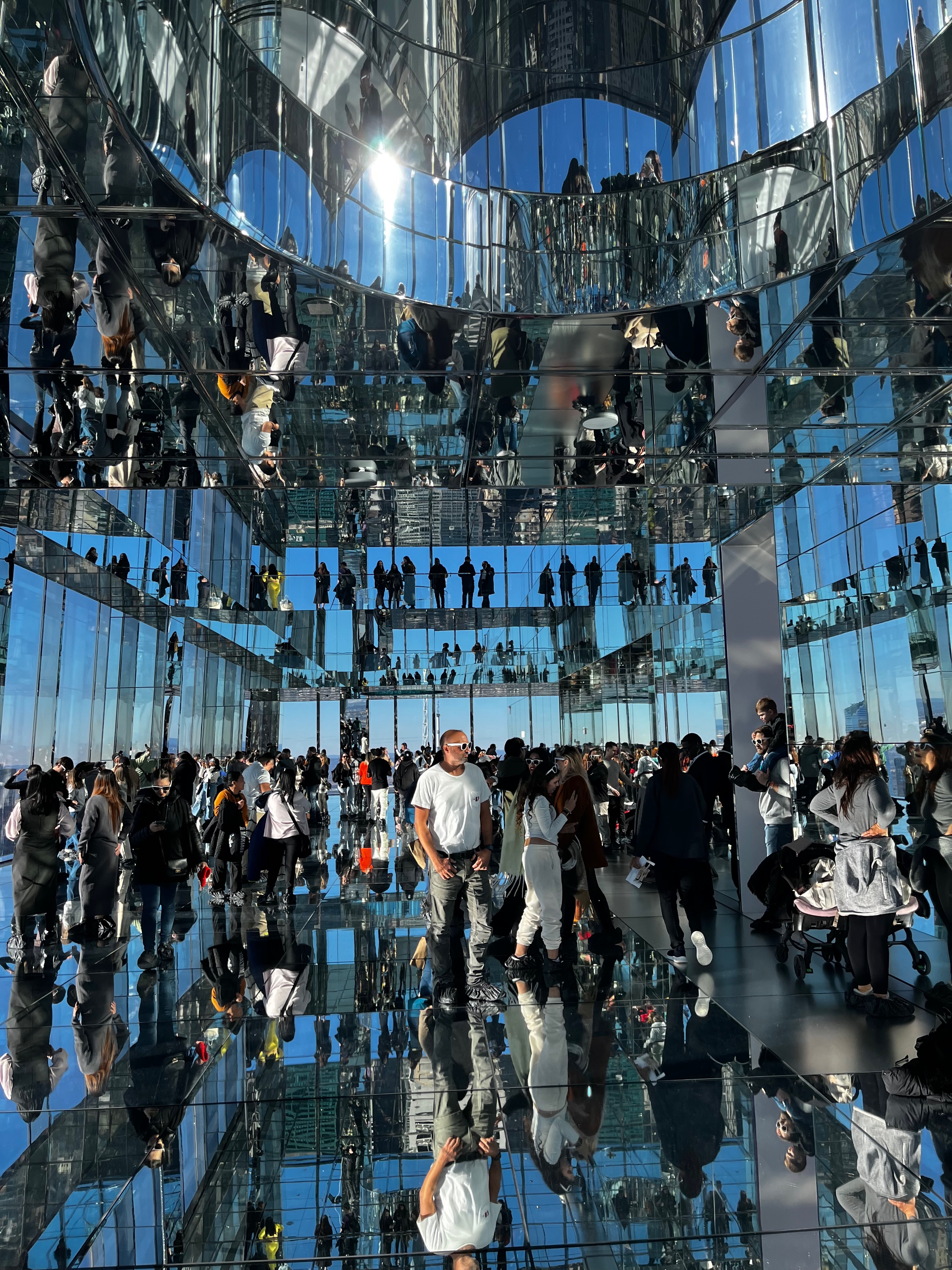
It was worth the wait. The views are stunning. The mirrored walls and floors create a wild, pixelated scene.

Though it was likely designed for the Tik Tok generation, I loved it. There were young folks making the most of it, creating what I am sure were super cool selfies or portraits of partners or friends, but I was surprised to find that it didn’t annoy me. It was interesting. I was mostly focused on taking in the vistas and people were considerate. They took their pictures but kept moving so you could get to the windows. Since the air was so clear you could see across Brooklyn, Queens, New Jersey, Westchester. You get a full appreciation for New York Harbor and the waterways that flow from it. All I can say is wow!

The art installations were cool, too. One room had mirrored balloons floating around. This was designed by Marie Kusawa and I enjoy her work – so whimsical and fun.

Naturally there were opportunities to spend more money – but you don’t have to buy anything in the gift shop or the café (there is also an open air terrace where you could bring the drink purchased at the cafe). You don’t have to buy the photos they take. But, there is no denying that it can get expensive. The base price, just to take the elevator and walk through the three floors of observation areas and installations is $42 for an adult. It was worth it to me.

There is a glass ledge you can step out on – they take a picture of you there. I bought this one. I tried to take my own photo, didn’t come out nearly as good.

It was a great day. Accomplished just what I needed it to. Now I will get back to the real world.

Money, Money, Money

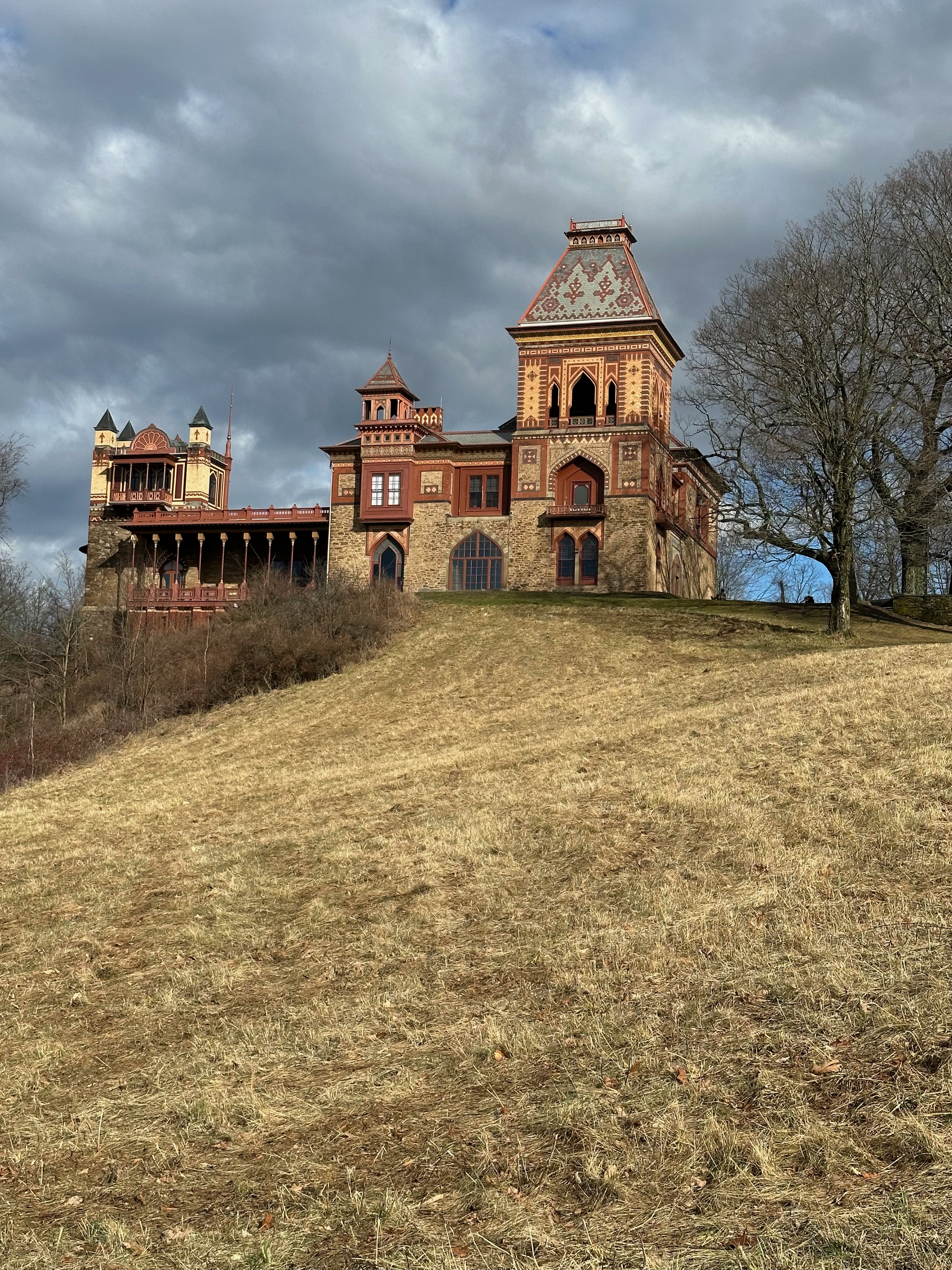
Money can be a great thing. Not a surprising a statement. This notion was reinforced by the tour we took of Olana, home of Frederick Church, one of the significant painters of the Hudson River School. Church was born into a monied family. He may have disappointed his father when he announced his plan to be an artist as a teenager, but he had the luxury of making that choice. He was able to pursue and fulfill his dream. He wasn’t under pressure to make money; he could take his family on an 18-month trip to Europe and the Middle East without worrying about where his next dollar was coming from. He could come back inspired by all he had seen, buying knick-knacks and artwork, and full of ideas for building his own home in Hudson, New York. Olana was born at least in part from that trip and thanks to his vision we can enjoy his property today.

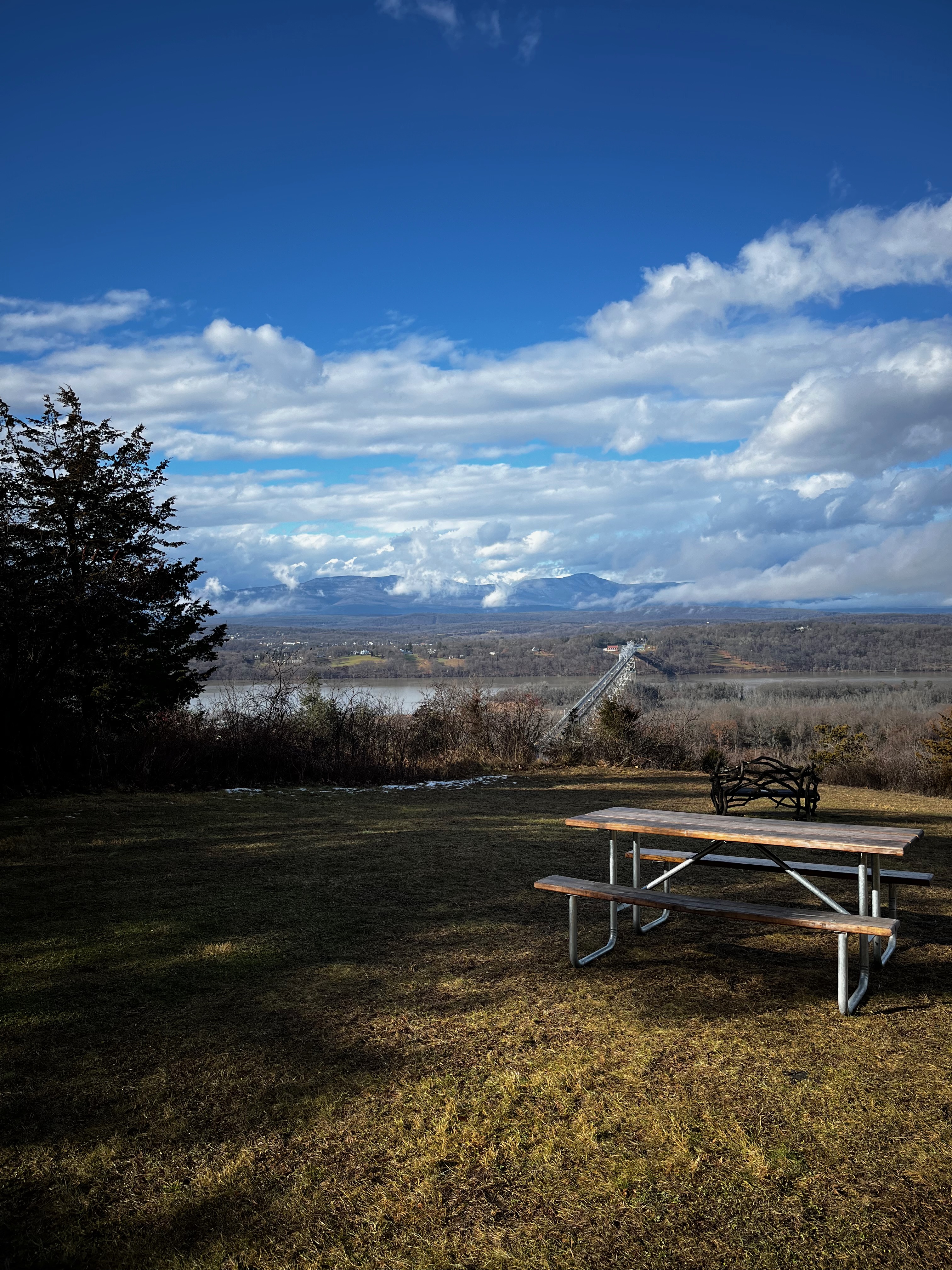
Olana, we learned, didn’t just refer to the building – which was the family home; it referred to the whole property including the acres of land surrounding it. Church viewed the whole thing, the land and his home, as a unified piece of art. Church would buy parcels as they came up for sale in order to preserve the views he found so inspiring. Here are two views from our walk of the property:

He painted many landscapes of the Catskills and Hudson River from here. When Church arrived in the area, the land had been clear cut of trees. The property was barren. He wanted to restore its natural habitat. It was the fashion of the time to plant exotic trees and plants, bringing home flora from Europe and the Middle East, but Church didn’t adopt that approach. He used native trees, and he purposely left open spaces to frame vistas. He took an artist’s approach to the project, specifying where the plantings should end so he could have a pleasing view of the mountains, rivers and farms that surrounded his property. We are fortunate that Church was a visionary. He left us a magnificent place to explore and appreciate the beauty that Is the Hudson Valley.

While we were walking the land, our guide pointed out a small cement factory that we could see in the distance. A number of years ago there had been a proposal to build another factory that would have included a 40-story smokestack. The idea was moving ahead until some in the area got wind of it and objected. Ultimately, the plan was defeated. The guide believed that if the plan had gone ahead, it would have ruined Olana. I wondered if that was the case. A view would have certainly been diminished but did that mean that Olana could no longer be a place people would want to visit and hike? Would it literally have ruined Olana? Certainly if the emissions from the smokestack were noxious, it would have. The question is moot since the State rejected the proposal.

After the last of the heirs of Church died, the land and house became a New York State Park. I am in favor of preserving wild spaces, especially for public use. But there is a balance. Economic development is also important. People need to make a living. Many towns in the Catskills have struggled and lost population. Our guide explained that Olana itself is not an insignificant employer in the region. It is a dilemma faced all over the country – the tension between development and preservation; these tensions are regularly encountered in the Adirondacks. I don’t reflexively reject development. I want to understand the implications, the costs and benefits, before coming to a conclusion. Unfortunately, it can be hard to come by good information on that. I think many of us have a knee jerk reaction to these issues. We can be predisposed to believe that any encroachment on nature is a negative thing (especially when it involves our own property or neighborhood), or we may automatically support anything that promises more jobs and tax revenue. Neither of those reactions are useful in effective policymaking.

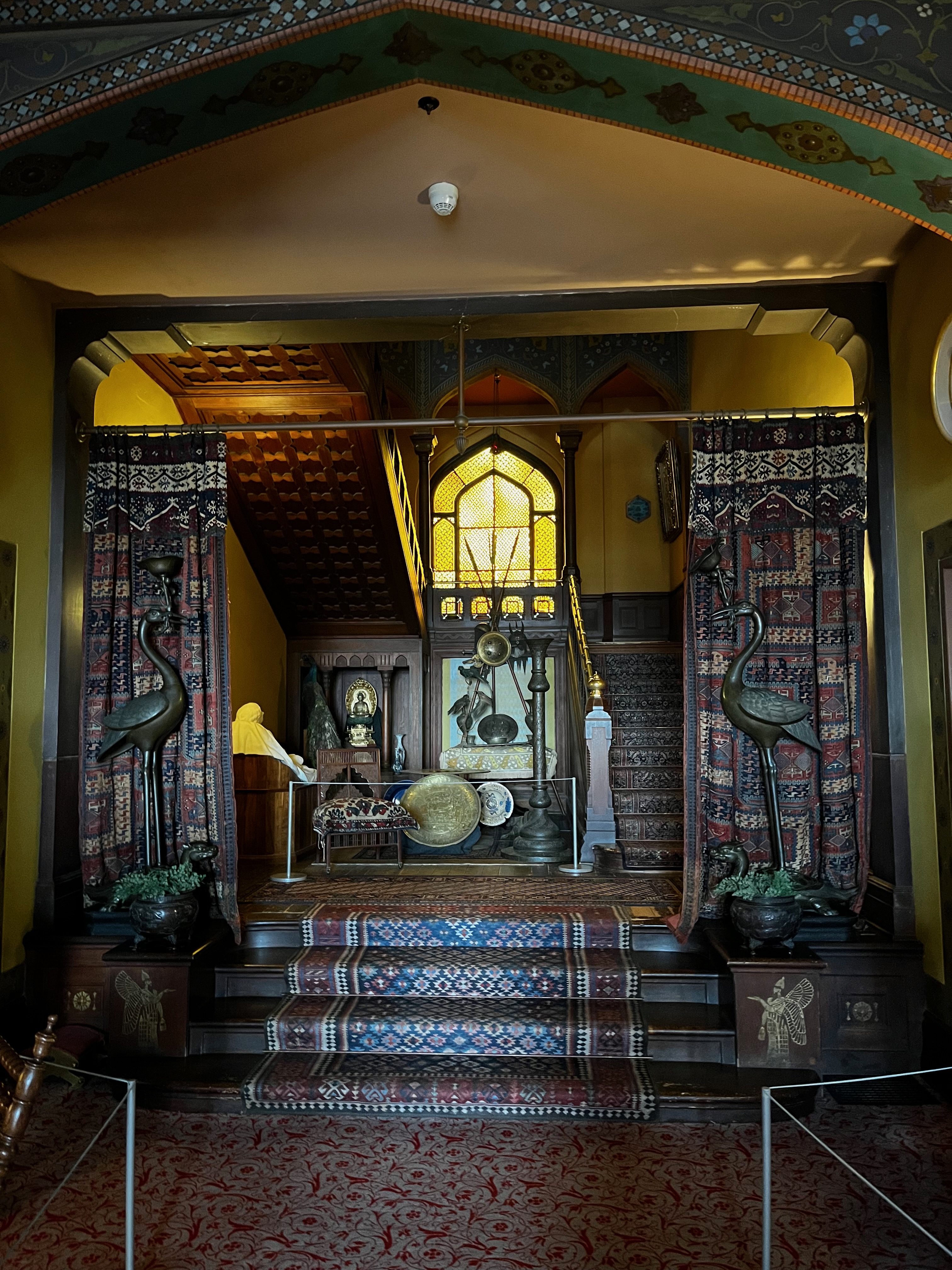
As we finished our walk of the property, the guide asked us what we thought of the house – meaning the design of the structure. All of us on the tour liked it but saw different things in it. Some were reminded of an Italian palazzo; others saw Middle Eastern touches. It is something of a mish-mosh.

Money does give you options that most of us don’t have. Church found folks who were willing and able to fulfill his vision.

Money can also make people crazy. It can be a trap. Frederick Church enjoyed his largesse. He connected with many of the accomplished people of his day. Prominent people from New York City visited him at Olana. Other folks in that circle were not so fortunate. We learned on the tour of the Wittgenstein family of Vienna, the patriarch was a contemporary of Church, and one of the richest families in the world. Several members of that family committed suicide and the one remaining son gave all the money away. Money does not buy happiness. We can forget that when we are in the midst of challenging times. When we are barely making ends meet, or the ends aren’t meeting, it is understandable to think that having more money would solve all our problems. There is no doubt that money can help with a myriad of issues, but it doesn’t solve loneliness, or bad decision-making. Apparently, Frederick Church did not struggle with those issues and he left us a legacy we can enjoy.

A Poignant Celebration

“There was a lot of warmth in that room,” Gary said to me as we left a celebration in honor of his uncle Sol’s 100th birthday. I readily agreed.

It was an interesting gathering. If one reaches that auspicious age, it is almost certain that you have outlived your spouse (possibly spouses), siblings and most, if not all, friends. This is true of Sol. So it can be bittersweet to plan a party.  Who do you invite? Sol’s son, Ben, faced this question.

Sol is a Holocaust survivor, like Gary’s parents. I have written a great deal about Gary’s parents, David and Paula and their remarkable story. I don’t know the details of Sol’s experience. Sol married David’s sister, Batya, in America. The two couples were part of a tight knit survivor community. There were about five or six families that socialized regularly, centered in Rosedale, Queens. Their children grew up together.

Gary told me stories about those years – how the mixture of family and friends would gather at his house most weekends – the kids playing various games while the adults chatted (and maybe argued, especially about politics). How they went to the Pennsylvania Dutch country with the Majewskis, who lived down the block, and how the Majewskis had all the coolest toys – they often hung out at their house. As often happens with college and adulthood, the kids went their separate ways, maintaining only occasional contact.

I didn’t know what to expect when we arrived at the party. I wondered who would be there. Ben and Rochelle, Sol’s step-daughter, set up displays of photographs of Sol that captured his life over the many years. We studied the pictures, looking at the young faces. When we sat down at a large rectangular table that sat the 25 guests, Ben welcomed everyone and explained that when he thought about who his father would want to share this momentous milestone with, he thought of that core group of survivors. Since the original members have passed on, Ben reached out to the second generation to gather to celebrate Sol, the one who remains. They all represented the heart of Sol’s life.

Sol lives in Florida. When we go to visit Gary’s Mom, we see Sol as well. Until about a year ago, he was in remarkable shape. It is only these last months that there are signs of his age, his short-term memory is starting to fail, and his strength is waning. When Ben extended the invitation to us, after briefly discussing it, we realized it was a milestone that should be recognized so we would both attend. After all, as several observed at the party, it was an opportunity to gather for a happy occasion, not a funeral which is more often the impetus for second and third generation survivors to gather.

I do not know the details of Sol’s journey, I don’t believe he participated in Steven Spielberg’s Shoah project, so there is no testimony to watch, as I have watched my in-laws’ videos. Based on the research our niece Laura did as part of writing her book, The Shoemaker’s Son, I do know that Sol suffered horribly. One of the factors that made his situation even more challenging is that his family was poor to begin with. The Nazis did not differentiate between rich Jews and poor Jews, but having some resources to bribe or trade could buy time when one was on the run, hiding in the woods. Sol bears the scars of his painful experiences. I believe he and his brother were the sole survivors from his family. Once he got to America, he had a successful business as a glazier, but the memories of deprivation were never far from his thoughts. His tightness with money is legendary in the family.

Several of the attendees made remarks, sharing memories of Sol, honoring his tenacity, and his love of family and friends. Jokes were told. Some of the speakers managed a great imitation of Sol’s accent – an echo of their own parents’ accents of blessed memory.

Sol sat at the head of the table. He enjoyed himself. He made his own remarks: he thanked everyone for coming and expressed his love for all. He told us that this was likely his last birthday. Everyone pooh-poohed that and Ben pointed out that he has been saying that for the last 40 years, so he took that as a good sign. Of course, no one knows what tomorrow will bring for any of us.

Gary was moved to be in the presence of that group – the familiar sounds of the voices of the past, the warmth of the connections, the strength of the bond that links them – even if they haven’t kept in close touch. Not only were they honoring Sol, but they were acknowledging the legacy of the survivors who were no longer physically present – though they are kept alive in their collective memory. Despite the fact that I don’t share their history, I was happy to be part of the poignant celebration.

Sol Feder, with his remarkable head of white hair, surrounded by family and friends

Conundrums

I was listening to the local NPR station the other day. First there was a story about NYC suing bus companies which have been ferrying immigrants from Texas to the city. I wondered about the wisdom of that suit. Are the bus companies at fault? Clearly, the city is desperate to get a handle on the immigration “crisis”? Note: I am putting quotes around crisis because I am skeptical about the word in this context. It has been called a crisis for decades.

Following that story there was another report on a bill proposed by two lawmakers in New York State to appoint a commission to study the continued loss of population by the state. The latest census figures showed New York as one of the biggest losers of population in the country. This is a concern on many levels – mostly for the state’s economy and future vibrancy.

Does anyone else see an irony in airing these stories back-to-back?

Maybe immigrants could address the problem of the population loss? Maybe they could invigorate communities that are struggling?

I am not naïve. I understand that uncontrolled immigration is problematic. I believe that there are security concerns posed by folks streaming in through unregulated borders. We need to be able to have an organized process for admitting people into the country – so they are registered and authorized to work, drive, pay taxes, etc. I also understand that some of the people arriving come without resources or education and therefore have real needs. They may not be in a position to the hit the ground running, so to speak, and be immediately contributing members of our society. By the same token, we have many demands as a society: for elder care, child care, agricultural workers, etc., etc., which immigrants may be able to fill. I am not talking about taking advantage of those immigrants – I am talking about meaningful employment that allows them to establish lives and plant roots.

It seems to me that some creative problem-solving could address this challenge if we stripped away the fear-mongering and xenophobia. [And if we demanded that the ultra-rich paid their fair share of taxes.]

That’s just one of many perplexing conundrums I have been noticing.

The resignation of Claudine Gay as president of Harvard is another puzzle. Some folks believe she should have resigned after her miserable performance at the congressional hearing where she was asked about antisemitism on campus. Whether she was over-prepped by lawyers or genuinely unable to acknowledge the need to offer protection to Jewish students due to her own bias, she was certainly tone-deaf. Then the revelations about plagiarism came out. Depending on what you read, those instances are either minor oversights or significant breaches of standards of scholarship.

According to Gay’s statement, it sounds like she believes she has been subjected to a relentless racist campaign that resulted in the need for her to step down. From her perspective, resigning was about putting an end to the harassment and allowing Harvard to move forward, rather than admitting to any substantive wrongdoing.

I am frustrated by this. I want there to be clarity. Her resignation should either be an appropriate result of her academic impropriety or her inability to successfully manage the institution, or both, but not because she was unjustly run out of town. I don’t doubt she has been subjected to racist vitriol – those ugly voices are very loud. But, I want an objective assessment of her scholarship. I want to better understand how she responded to the complaints of Jewish students who felt unsafe. Is it even possible in this day and age to assess these things impartially. Whose judgement can we trust?

I believe that higher ed needs diverse representation. I believe in the goals of DEI (diversity, equity, and inclusion). How those programs are implemented is where the challenge lies. I believe there are deserving candidates – persons of color and individuals from historically marginalized communities – who are qualified to be university presidents. It feels like we are in an impossible position. Can someone who is white be appointed without everyone complaining about ‘privilege’? Can someone who is Black be appointed without arousing suspicion about their qualifications? There is no trust – and therein lies the conundrum. How do we rebuild it – if it ever existed to begin with? There are so many voices of cynicism that they can drown out the hope if we let them.

That lack of trust is the common thread between these two scenarios. We don’t trust our institutions and we don’t trust ‘others,’ people not of our tribe. That has to change.

I have written this many times before, here it is again: I will hold on to hope that we can find creative solutions to these conundrums and that we can find a way to trust our institutions (not blindly, but with proper checks and balances). We must find common ground and let go of prejudice. We have to find a way to build a foundation of trust. I will be listening for voices who can lead us in that direction.

Goals for 2024

Sargent portrait – seen at the exhibit at Boston’s Museum of Fine Arts

Historically I am not one to set goals or make resolutions. I think that reluctance stems from the recognition that we mostly fall short and then have to deal with the failure. The other day I was watching, of all things, House Hunters and this guy in the couple made a point of needing to be able to post his annual goals on his bathroom mirror. This was something his wife didn’t especially want to see every day, so they wanted their new home to have separate vanities in the bathroom. I thought the guy was way over the top, but it got me thinking. While goal setting presents risks, it offers real opportunities: to prioritize how I use my time, to remind myself of what is important to me, to feel accomplished when something is achieved. Of course, I don’t need to share them publicly since that adds pressure, but what the heck. What is my blog for if not to take some risks, so here goes:

Read Moby Dick.

            [No other story is referenced as often in other books.

             It appears on lists of the best American novel.

            And yet, somehow, I never read it.

            I think it is time.]

Write everyday – or realistically almost every day.

            [I only posted 29 essays on my blog in 2023.

             My goal has been weekly.

             Perhaps it is time to reconsider my goal.

             Okay, my goal for 2024 is to reassess how often I want to add to my blog.]

Send out 10 query letters to literary agents.

            [probably more]

Accept rejection and continue onward.

Stop wanting more!

            [I have enough.

            Be more Zen,

            Let go of expectations.

            Exhale the want.

            Inhale the beauty,

            Appreciate the gifts,

            Even on cold, damp, gray days.

            Hear the music: bird calls, the wind in the trees, voices harmonizing.

            See the splendor: light, color, richness rendered on a Sargent canvas.

            Receive what is given,

            Feel the love expressed in a glance, in a gesture.

            Let it fill me.

            Trust the love.

            Trust the relationships.

            The child in me still wants…]

Plan a trip.

Sort through the clutter.

            [Simplify]

Gary, my husband, upon reading the above, said, “Good luck with that. I thought reading Moby Dick was enough.” Maybe it is ambitious, but I’m going to try. Let’s check back in a few months, meanwhile, Happy New Year! Wishing you all a peaceful, joyful, and healthy year ahead whether or not you set goals or make resolutions.

“You Don’t Have to be Jewish to Love….”

There was a ubiquitous advertising campaign when I was growing up – “You don’t have to be Jewish to love Levy’s Rye.” I can see the poster in my mind’s eye plastered on buses and the walls of subway stations. A picture of a cute Chinese boy with a sandwich.

This ad came to mind as I was thinking about one aspect of our trip to the Eastern European capitals. We took tours of the Jewish Quarters of Budapest (Hungary) and Bucharest (Romania). The tour guides were not Jewish, but they showed a deep appreciation and knowledge of Judaism and the culture associated with it. As tour guides, one would expect a certain familiarity with the topic, but not necessarily warmth or affection. In the current environment, given the heightened tensions and increasing boldness of antisemites, I had not expected their sincerity or openness. But, the truth is, as with all groups, you shouldn’t have to be a member to appreciate what that group brings to the table (literally or figuratively).

I was moved by the attitudes of our guides. They came to their interest through their own personal journeys. In one case because of a romantic relationship that led her to live in Israel for 7 years, and when that relationship ended, she maintained her connection, though she had not converted. In the other case academic study of history led to curiosity and more research into Judaism. As part of that process, she became acquainted with the production manager of the Yiddish Theater in Bucharest and arranged for us to meet him – more about that in a bit.

In Budapest the area we explored is still called the ‘Jewish Quarter’ and there are some Jewish residents, but not many. The name is a relic of a time long ago. We walked the narrow streets, learning that it is an area that is now popular among young people because of the restaurants, bars and shops. It is also home to the largest synagogue in Europe – the Dohany Street Synagogue.

Before we toured the synagogue, we stopped at the shoe memorial that lines the Danube River, a display that commemorates the murder of Budapest’s Jews by shooting them into the river which occurred between December of 1944 and early January of 1945. Our guide didn’t sugarcoat things – she acknowledged that Hungary fought on the side of the Nazis and that their fascist party, the Black Arrow, orchestrated the round up and murder of the remaining Jews. I wasn’t expecting that unvarnished acknowledgement but was grateful for it. The memorial was created in 2005, marking the 60th anniversary of those horrific events. The shoes are a poignant and painful symbol of the human beings lost. Men, women and children swept into the current leaving only their shoes as tangible evidence of their existence. Hungary today has a Jewish population of about 47,500 in total, with many living in and around Budapest. Before World War II Budapest alone had a Jewish population of 200,000, with an estimated 825,000 in the country as a whole.

Our next stop was the synagogue. Since we were traveling after the attack by Hamas on October 7, security was heightened. Entries were timed and by appointment only. We went through metal detectors and our bags were checked. The synagogue is so impressive – and reminded me, in its grandeur, of many churches we had visited throughout Europe. I believe the sanctuary could hold 3000.

Neither my family nor Gary’s had roots in Hungary, so we were not tracing our family tree. Oddly enough, one of the names on the headstones we saw in the cemetery next to the shul for Jews killed in the Budapest ghetto during the war years was Sandor Bruder – Bruder was my paternal grandfather’s original last name, he changed it to Brody when he arrived in America. It was chilling to see the name on a grave, but I have no knowledge of an actual connection.

Another note of significance is that the Dohany Street Synagogue was where Theodore Herzl, widely considered the father of modern Zionism, was born and raised. Mount Herzl, the home of Israel’s national cemetery in Jerusalem, is named after him.

Memorial to the victims of the Holocaust in the courtyard of the Dohany Street Synagogue

The tour of the Jewish Quarter was arranged through our cruise company, Viking. There were about 15 of us and I don’t think most of the others, aside from my brother-in-law and his wife were Jewish. I found it interesting that they chose this tour – there were other options. Again, it was heartening to think that folks who didn’t share our heritage were interested enough to make this choice.

Our tour of the Jewish Quarter in Bucharest, Romania was arranged privately so it was just the four of us. The guide, Alina, asked us if we would want to meet the production manager of the Yiddish Theater if he was available. We were shocked to learn that there was a Yiddish theater, neither the city nor the country has a Yiddish speaking population that would seem to support it. We had no idea what to expect but were happy to see the theater and hear what the manager had to say. After walking through the area and viewing the outside of three synagogues – they were each locked because of security concerns in view of the war in Gaza (two were museums, one continued to host religious observances) – and learning about the history and current status of the Jewish community in Bucharest, we headed to the theater.

The production manager, George-Marcel, limped into the lobby to greet us, he was having some knee problems, but that didn’t get in the way of his showing us his pride and joy – the theater. He shared his own history, in English, telling us that decades ago he was at a low point in his life, working a job that brought him no satisfaction, when he heard about a position at the theater as a cleaner. He explained that as soon as he walked into the building, he felt he was at home. The people were accepting. The spirit of the place touched him. Though he was not Jewish, he identified with the stories that were being told. “Their story is our story,” he said, “their history is our history.” He didn’t see the history of the Jewish people as separate from that of the Romanian people. This resonated with me – the world would be a better place if we all believed that. Rather than confining our focus to our own traditions or limiting our understanding to our own tribe, if we embraced learning about each other and thus discovering our common humanity, there would be a much greater chance of peace in this world.

Images of the Yiddish Theater

Over the many years George-Marcel worked there, he took on more and more responsibility, eventually becoming the production manager. In the process he learned more Yiddish and Hebrew than I’ll ever know. He also built relationships with the artists who came through, as well as the small regular staff. The theater receives some government funding, not enough to keep it solvent but something to build on. They stay afloat with additional donations. It was interesting to us that the government, I don’t recall if it was the city or national government, values their work enough to continue funding it. The theater does put on other productions and collaborates on different projects but continues to offer Yiddish plays and musicals. Like with opera, a translation is projected above the stage so the audience can follow along.

After the tour, we went to George-Marcel’s small office, filled with knick-knacks, where a large Israeli flag hung against the wall next to his desk. One of the things common to the countries we visited, particularly Hungary, Serbia and Romania, was the popularity of home brewed brandy – which was called different names in each place. George-Marcel took an unmarked clear bottle from his bottom desk drawer, distributed paper cups and poured a bit in each and we toasted. ‘L’Chaim!’ His homemade brew was made from apples, but my palette didn’t detect anything other than alcohol. The warmth I felt as the liquid made its way down my throat matched the warmth in the room. George-Marcel asked us to sign his guest book which we did, expressing our thanks for his welcoming us and for sharing his knowledge. We wished each other well.

In the lobby of the theater – our tour guide, Alina, in front, George-Marcel between us

It was the last day of our trip, and it was a wonderful note to end on. Though we were thousands of miles from home in a country so different from our own, we made a connection that we will remember for a long time to come.

In honor of the fifth night of Hanukkah, here is a display of menorahs in the museum of the Dohany Street Synagogue.

Note: If you are in Bucharest, Alina offers other tours of the city as well – we would heartily recommend her – alina@wheninbucharest,.com

River Cruise – Not Much River

Note: I have decided to return to writing about the lighter side of life though I continue to stress about the toll of the war in Gaza, the fate of the hostages and the rise of antisemitism. Gary and I were fortunate to take an amazing trip in October and, me being me, I have lots of observations and photographs to share. Here is the first of what will likely be a couple of essays.

“How was your trip?” A straightforward question to someone who has returned from vacation. Usually the answer is straightforward, too. “Great!”  or maybe “Exhausting!” Gary and I took a river cruise in October and when people ask how it was, I find it difficult to come up a pithy response. Our trip was disappointing, awesome, educational, fascinating, painful, tiring, memorable….many adjectives apply. There isn’t one overall response.

Our river cruise was a tour of Eastern European capitals on the Danube with Viking. It was slated to start in Vienna and proceed to Bratislava (capital of Slovakia) and then Budapest, with further stops in Hungary, Bulgaria and ending in Constanta, Romania. We received an email a couple of days before we left advising us that it was possible that the beginning of the trip would not be on the boat because water levels on the river were too low. We hoped that would resolve and then didn’t think much more about it since it was totally out of our control.

When we arrived in Vienna we were told by the Viking representative that met us that indeed we could not go to the boat because the situation had not improved. They were not sure when or where we would be able to board the ship. We were taken by bus from the airport to a Hilton Hotel well-located in the middle of Vienna. Though the transfer to the hotel went smoothly, we were disappointed to find that things were quite disorganized upon our arrival. It wasn’t clear what was happening with our luggage. Rooms were not yet available, it was mid-morning. They did not communicate the status of meals for the day and no activities were scheduled. It was an inauspicious beginning.

Gary and I were traveling with his brother, Steven, and his wife, Shari. Though we were quite tired, it had been an overnight flight, we set out to explore the area on foot. It was very breezy and chilly, but we enjoyed our walk and stopped at a café. We made the best of the situation. We wandered around for a couple of hours – now it was around 1:00 and we returned to the hotel. Steve and Shari’s room was ready, ours was not. We were informed that a buffet lunch was available in the restaurant of the hotel.

We hoped that after lunch our room would be available. We went to the buffet only to find that none of the dishes were labeled – various foods were displayed without any identification. Was it fish or chicken? Pork or beef? What kind of vegetables were under that cream sauce? Those of us with allergies or food preferences were concerned and confused. The folks refilling the chafing dishes were unable to answer our questions. Oy. After much pestering of the staff, we were able to gather some information. We made it through lunch without anyone getting a rash or anaphylaxis (at least as far as I know). Dinner wasn’t much better, somewhat better labeling but not great choices. Certainly not meeting the standards expected on a Viking cruise.

I think you are getting the picture. Things were not starting out great. Especially when you consider how expensive these trips are. Despite that, though, I loved walking through Vienna, being in a new place, taking in the architecture, people-watching, seeing a city I had only read about.

As we were finishing lunch, Gary went to the registration desk to inquire about our room – it was now around 2:30. At first they said they didn’t have one available. Gary appealed to their sympathies. “We have been traveling since 6:00 yesterday evening, we didn’t sleep on the flight, we haven’t showered, can’t you do something?” Fortunately, they could. Why they couldn’t in the first place, is a mystery. But at least we had a room! We got our luggage – it was supposed to be delivered but we saw it sitting in the lobby so we just took it – and went up to our room and collapsed.

I won’t go through the whole trip giving a minute-by-minute report, but I wanted to give a sense of our frustration with how it started. Viking still didn’t have a clear itinerary for those first days or a timetable for getting on the boat. We were okay with taking it as it comes – as long as we were seeing interesting sights and as long as Viking was fulfilling its promises, even if it wasn’t on the river.

Unfortunately, I can’t say they were able to do that. The food provided at the hotel and the one restaurant they took us to in Vienna were subpar, at best. The communication was not what it should have been. On the upside, the hotel was comfortable, and the tour of the city was excellent. I loved what we saw in Vienna. Here are some photos of points of interest.

On the afternoon that we had free, Gary and I chose to go the Belvedere Museum because I am a fan of the artist Gustav Klimt. I had read that his most famous paintings were housed in that museum. I was not disappointed. The building itself was magnificent and the grounds were beautiful, as well.

Since we were not on the boat, we were given a choice: spend more time in Vienna or take an hour bus ride to Bratislava where we would take a tour. Gary and I chose to go Bratislava. During the bus ride, the tour guide provided a lot of information about both cities – Vienna and Bratislava and the two countries, Austria and Slovakia. Back in the day, Austria was not part of the Soviet bloc, but Slovakia was. The lasting impact of that was evident in their respective landscapes and the ambiance of those capital cities. As we would continue to learn throughout the trip, Russian influence was stronger and stronger as we went east. In Bratislava the tour guide told us jokes that were at the expense of the old Soviet Union. For example: a man went to the Skoda (small, Czech made car) dealership to buy a car. He was told it would be a ten year wait. The man asked if it would come in the morning or the afternoon. The salesman responded, “Why does it matter, it’s in ten years?” “Because I have the plumber scheduled to come then.” Obviously, a dig at the inefficiency of the Soviet system. The guide seemed grateful both to be able to tell the joke and that things had changed.

Bratislava’s old town was charming. It had been a walled city. Now it has lots of shops and restaurants within the remnants of the wall. Our tour guide explained that because the cost of labor is low, as are taxes, tech corporations have established offices in Bratislava. Thirty years after communism fell, there is a vibrance to the city and it is growing.

Despite the fact the cruise was not going as planned, and in fact we weren’t cruising at all, the main purpose of travel was being accomplished. We were learning about places we knew little about and expanding our horizons to include more of the world.

[more to come!]

Another Perspective

I have woken up at about 1:00 a.m. the last two nights with thoughts about the war in Gaza. As I lay in bed I argue with imaginary Palestinians – or not so imaginary since I listened to an Ezra Klein, a New York Times writer, podcast that featured Amjad Iraqi, a Palestinian citizen of Israel who is a writer and editor there. I think it is important to be as informed as possible by hearing different perspectives so, though it was uncomfortable, I listened to what he had to say.

He made some important, legitimate observations that need to be acknowledged. The way Israel came into being in 1948, with U.N. Resolution 181 and the subsequent war of independence, was traumatic for the Arabs who lived on that land. The U.N. Resolution which passed in November of 1947 defined two states, one for Israel and one for Palestinian Arabs (Jerusalem was designated as an area to be overseen by the U.N.).  The Arabs believed the resolution was inadequate and rejected it; Jews embraced it and began organizing a state for when the British left. The day after Israel declared its independence on May 14, 1948, five Arab countries (Iraq, Lebanon, Syria and Egypt – Saudi Arabia provided troops under Egyptian command) attacked the new state expecting to claim the land on behalf of the Palestinian Arabs. A war ensued during which Arabs either fled or were forcibly evicted from their homes – and in 1949 Israel won. As a result, Palestinians designated May 15th as a day of mourning – they call this sequence of events The Nakba, the catastrophe. It was violent and tragic from their perspective and that trauma, and that narrative, has been passed down generation to generation. We cannot deny that trauma, just as we cannot deny that the trauma of the Holocaust has shaped our (Jews) world view (though in a very different way). Even if we believe that the founding of Israel was a righteous and necessary thing, we can still understand that it wasn’t without consequence. There was a human cost.

With that said, the question becomes: aside from acknowledging the reality of their pain, what do we do with it? What actions or changes should be made when we recognize it?

If you ask Mr. Iraqi the only answer is to give the land back to the Palestinians. And not just any land – the precise land that became Israel. In addition, if you ask Mr. Iraqi, all Palestinians in the diaspora should have a right of return to that land. That answer is impossible to fulfill and maintain a Jewish state (certainly not a concern for Mr. Iraqi). Israel would no longer exist.

In one way, I understand his argument. Something valuable was taken, it should be given back. But that isn’t the way the world works. First and foremost, it denies Israel’s right to exist. When there is a war, the losing side, by definition, loses. At the end of a war a treaty may be signed, and agreements may be reached where some concessions are made, some property may be returned, and reparations may be offered. But, I can’t think of an instance where the people on the losing side were made whole, given all their territory back. I don’t understand why there would be an attitude of entitlement? Why would there be an assumption that they should get the land ‘from river to sea’? We can argue forever who had it first. Jews can argue their ‘entitlement’ from the time of the first temple. There isn’t a nation on this earth whose borders were somehow preordained – bloodshed has defined all of them.

It seems to me that it is more realistic and reasonable to take the position that there is a compromise to be made – a two state solution – the parameters of the respective states are difficult to hammer out (though it makes sense to start with the original U.N. Resolution) and figure out a plan for reparations. I’m not suggesting something new here – there have been negotiations for a Palestinian homeland for decades. But if the Palestinians come to the table with the perspective that Mr. Iraqi offered, there is no room for negotiation. There is no path forward. Mr. Iraqi made a vague suggestion of decentralized entities – not nations. While I am open to other models of governance, you can hardly move forward without a more concrete structure to offer that is ready to be implemented.

Putting aside for the moment his position that the only option is to give all the land back, Mr. Iraqi made the point that Palestinians had tried everything to achieve their goals – diplomacy, civil disobedience and ‘minor’ armed resistance – and that none of that worked, so Hamas launched the attack of October 7th. He didn’t exactly justify the nature of the attack – he said time would tell if Hamas leadership authorized the brutality or whether militants went rogue (Meanwhile, just recently Mahmoud Abbas, the leader of the Palestinian Authority in the West Bank said that Israel conducted the massacre at the music festival! Many pro-Palestinians will be willing to believe that). But, Mr. Iraqi was saying that their desperation left them no choice but to attack. I would argue that they didn’t try everything – it seems clear to me that there was and is another option.

What if in 1948 or at subsequent points when a Palestinian state was offered, not that it encompassed what they believed they were entitled to, but it was land and it would be under their control, they accepted the terms? And, what if, instead of keeping refugee camps, they built cities and towns with the resources they did have? And what if their thinking was, we will make this homeland as strong as possible, with a productive economy and an educated citizenry? They might have achieved their ultimate goal that way – if they shed their idea of themselves as victims and built a nation, who knows what would have happened? Why wasn’t that an option? Why isn’t it still an option?

I can imagine progressives reading this and saying that wasn’t possible – they were oppressed. I would draw an analogy to a child who grows up with abusive parents. At a certain point, if you want to be a productive adult, you need to take steps to heal yourself. It can’t be done alone – support is needed – but the recognition that you need to fix yourself, that first step, needs to be taken by the individual. I think it is no different with an oppressed people. Leadership needs to emerge that empowers people to heal their wounds and celebrate their strengths – not through terrorism, not through rage, but through education and growth. We can understand that a person who grows up with abusive parents might turn violent, but we need to offer another path forward. As a society, we cannot accept violence or murder as a viable response. No one is served by spending their life defining themselves as a victim. The fix for that is not to become a vigilante or a terrorist – that is misguided and only digs the hole deeper.

I live in the real world, so I recognize that this is not simple. We can’t flip a switch and change a national identity. Our national identity as Americans has emphasized rugged individualism and that has a toxic side (i.e., gun culture). Adjusting that, or even recognizing the negative aspects of it, is not easy. I also understand that the current state of conflict in the Middle East benefits certain actors – Iran is served by the role the Palestinians play. There are powerful interests served by the chaos in the Middle East aside from Iran. China and Russia might see opportunities they can exploit. I don’t have answers, but we have to understand the perspectives and accept the need for concessions. One point that Mr. Iraqi and I would agree on is that the status quo, even before October 7th, was unsustainable for both Israelis and Palestinians. Listening to Mr. Iraqi I was not optimistic about the future, but once again, I have to hope that each side can come to their senses and make the necessary compromises so that Israelis and Palestinians can live in dignity and peace – and the further killing of innocent people can be prevented.

Photos taken by me, Linda Bakst, in June 2011

Fighting Despair

It has been a long time since I’ve written a blog post. I wrote my last one over a month ago. It has been a struggle to motivate myself. The things I have been thinking about are not easily translated to the page. I am fighting despair.

I have written quite a lot on this blog about my identity as a Jew. In fact, my last essay was about Yom Kippur and what it meant to me. Little did I know that just days after I posted that piece a truly horrific outbreak of violence would be perpetrated on the people of Israel.

Like most sentient human beings, I was shocked by the barbarism displayed by Hamas. It was almost too much for the brain to take in. How could people inflict such cruelty on fellow human beings? The stories that emerged – of young people peacefully attending a music festival only to be slaughtered, of Jewish individuals, some of whom dedicated themselves to Palestinian rights, murdered or kidnapped, not to mention the maiming of babies – were too terrible to contemplate.

Many have written that Israel is a small country, and everyone knows someone touched by the violence. Many American Jews are connected with family and friends there. I have a more distant connection. I can’t say the attack hit me as it would if it was my own country. I read many posts from those who were crying and devastated. I didn’t have that immediate reaction, maybe I was numb.

As time has gone by, though, I find my pain deepening. The reaction of the world, the exponential rise in antisemitism, the seeming lack of understanding of the existential threat to Israel, the unwillingness to assign responsibility for this disaster to Hamas, are all beyond my comprehension. I am profoundly disappointed in humanity.

I am not blindly loyal to Israel. I, like many other American Jews and Israelis themselves, have communicated disapproval of the policies pursued by Netanyahu and his administration. Netanyahu, in my view, is as bad as Trump – but smarter. I believe he has done real damage to Israel. Though the lion’s share of the blame for the attack is on Hamas’ leadership, Netanyahu and the positions Israel’s government has taken, has contributed to the rage that Palestinian’s felt and feel. It doesn’t justify the violence, but it likely fueled it.

There is no doubt that the Palestinian people have been oppressed. Where opinions sharply differ is in identifying the oppressor. Most of those who are taking up the Palestinian cause in protests in this country and abroad assign that role to Israel (other than those who subscribe to a broader Jewish conspiracy) and to some degree the United States. I don’t buy that. There are so many examples of failures of Palestinian leadership – going back decades. Time and again compromises have been rejected. And, terrorism has been their weapon of choice for more than fifty years.

While I am not a scholar of the Middle East, I have done some reading. I have paid attention. I am not going to list the litany of times that opportunities were squandered. Similarly, I am not going to detail the errors that the I believe the Israeli government has made. Suffice it to say, I believe both parties bear responsibility for the failure to achieve peace, but in my estimation  Palestinian leadership shoulders more blame for the poverty of its people. Their corruption and their failure to use resources they do have to better the lives of their people, instead choosing to build tunnels and bombs and stockpile munitions, are evidence of their duplicity. And no matter how one parcels out fault, the violence of that attack cannot be excused.

Accusing Israel of genocide in this war is reprehensible and a lie. People throw that term around far too easily. Israel is not engaged in a campaign to exterminate a people. They are trying to destroy Hamas. We know from the tragic wars that have been fought over centuries that civilians die, collateral damage is unavoidable especially in urban combat and guerilla warfare. The United States may well have committed war crimes in Vietnam and Iraq, but we were not carrying out genocide. We may learn that Israel has committed war crimes – I don’t know if they have – but they are not engaged in genocide. Using that term is inflammatory, divisive, and singularly unhelpful in figuring out how we go forward.

Calling for a unilateral ceasefire is also disingenuous. Will Hamas cease fire? Why aren’t those voices loudly calling for a Russian ceasefire? Meanwhile Israel’s defense forces have been conducting humanitarian pauses and creating corridors to allow Gazans to move south. Other countries do far less when engaged in war. Israel is held to a different standard.

We have arrived at a place in our world where we don’t believe newspapers or television reporting. We don’t agree on a common set of facts. Palestinian supporters don’t believe babies were maimed. Maybe they don’t believe there are miles of tunnels under Gaza City – and if they do believe it, they probably don’t attribute them to nefarious purposes. Perhaps they don’t believe that schools and hospitals are being used as shields for military operations. I’m sure there is a narrative that they tell themselves that explains it all away. And, they think I am telling myself a story about terrorists and a constant barrage of rocket fire into Israel to justify my opinions. How do we bridge that divide? It is impossible to have a conversation when you believe fundamentally different things about events unfolding in the world.

I believe there is a truth. I read the Hamas charter – the one written in 1988 (https://avalon.law.yale.edu/20th_century/hamas.asp) and the newer, revised one written in 2017 (https://irp.fas.org/world/para/docs/hamas-2017.pdf). They are frightening documents. They don’t advocate for democracy or freedom for the Palestinian people (despite defining itself as a liberation movement). It states as its goal the end of Israel and the establishment of an Islamic caliphate. The words are in black and white – no one has to interpret them for you. You need not rely on someone else’s understanding. The first version actually goes so far as to advocate for the murdering of Jews (not just Israelis) by all true Muslims.

After I read those documents – and I read them because I needed to understand if Hamas was antisemitic and if its stated goal was the destruction of Israel – I didn’t want to rely on word of mouth or reporting – I became more outraged by the rhetoric we are hearing. Hamas cannot be given a pass. That charter does not provide an answer to the suffering of the Palestinian people, at least not an answer that most citizens of the world would accept.  It has reinforced my belief that Golda Meir was right when she reportedly said, and I am paraphrasing, there will be peace when they love their children more than they hate us. In her statement the ‘they’ she referred to were Arabs, not Palestinians – that term was not in use then – she was credited with saying this in 1957!

Because there is so much misinformation, disinformation, and propaganda, it can be hard to identify right from wrong. But, it can be done. It must be done. I approach all reports with a critical eye, things are rarely black and white. While there are shades of gray, and the fog of war makes it yet harder, there are facts, there is morality, there are choices to be made. There are sides to be taken. I stand with Israel. I will criticize it when I think it is wrong, just as I will the United States, but Israel is on the right side of this. I hope they prosecute the war as carefully as possible, limiting civilian casualties, but Hamas cannot be permitted to succeed. Both the Palestinian and Israeli people deserve better than current conditions and I pray that leaders from both sides will emerge who will take a more humane, reasonable path.

“Why Am I Here?”

Yom Kippur, the Jewish day of atonement, is behind me. It was an intense day for many reasons – it usually is. Especially compared to an ordinary day. After all, if one observes, you fast and spend many hours in quiet reflection. A combination of things came together to make it especially emotional for me this year.

Though I have not written about it directly, I may have alluded to it in other blog posts, I have been facing a bit of a health challenge. Back in June, as part of a CAT scan to determine my calcium score, there was an incidental finding of a cyst in my abdomen. At first my doctor didn’t recommend follow-up, but on closer inspection of the scan, it was determined that it needed further investigation. Over the course of the summer, step by step, we tried to figure out what this thing was. There was a three-to-four-day period in early August where it was thought to be a pancreatic cyst that might not be innocent. During that stretch of uncertainty, I wondered if this was the beginning of the end. My aunt passed away from pancreatic cancer two years ago. I wondered if I was embarking on that journey.

Fortunately, another test result revealed that possibility to be extremely unlikely – they were able to take a fluid sample and the outcome was very encouraging. However, the question of where this cyst originated (it is large – about the size of a baseball, but not the shape of one) is still not clear and it makes a difference in terms of the course of treatment or whether just watching it is sufficient.

As I write this today, after much consideration, Gary and I, along with my doctors, have decided that we will get this thing removed, but it is not an emergency. Gary and I had planned a river cruise ten months ago that is scheduled to depart on October 15th. We have been assured that there is little to no risk in keeping our travel plan. It has been a confusing time and, with all of the back and forth, I am comfortable with our decision.

I am not going into all the details of this medical odyssey– no need to go into the nitty gritty of it. I am sharing it because it contributed to my state of mind going into the High Holy days this year. There had been uncertainty and a good deal of soul searching even before Yom Kippur began.

I am a Jew who is not religious; I am doubtful about the existence of God. Despite this I have taken the ritual of Yom Kippur to heart. Starting with Rosh Hashana, we are asked to reflect upon our behavior over the course of the prior year and admit to our flaws and failings. We ask for forgiveness from those we have injured or disappointed and we make promises to do better in the year ahead. For many, this process might involve asking God for forgiveness and beseeching him or her to allow us to be ‘sealed’ in the book of life for another year, but that isn’t what resonates with me. The practice of, on an annual basis, taking stock, holding yourself accountable and quite literally making amends is powerful – or it can be if taken seriously. It can also be an exercise in going through the motions. If I am honest, there were years that I have done that. Not this year.

Perhaps because of my heightened awareness of the precarious nature of health, I was more open to the message of the holiday. I listened to the sermon of the rabbi from B’nai Jeshrun, a synagogue in New York City that we live streamed, as we came to the close of Yom Kippur and I found his message very profound and more than a little unsettling.

Rabbi Rolando Matalon, who speaks eloquently with the Argentinian accent of the country of his birth, implored the congregants to ask themselves: ‘why am I here?’ ‘what is my particular mission?’ He offered a story from the bible of an unnamed person who asks Joseph, who is wandering in a field, what he is looking for and when Joseph replies that he is looking for his brothers, the man shares what he overheard the brothers say. This sets Joseph on a path to Egypt, a path he would not have otherwise taken, but we know how consequential that was. The rabbi offered a number of interpretations of this interaction, but ultimately the point he made was that every individual has an impact, whether they know it or not. In this bible story, a man only called ‘Ish’ (somebody) plays a critical role in setting events in motion. Rabbi Matalon continued by explaining that each individual is a messenger, each individual has to fulfill their particular mission – we have to do the work of figuring out what we are doing in this world. He noted that it was hard work that takes time and commitment. Whether I felt that the parable he shared was a perfect illustration of that idea or not, I believe his point is correct. That is the work of our time on earth: to discover what I can contribute to repairing the brokenness we see all around us and within ourselves.

In those days of deep uncertainty in August, when I wondered if I was facing a truly life-threatening illness, I asked myself that question. I realized I didn’t know how to answer and that was very troubling. As I listened to the rabbi, I visited the question again.

As a child and young adult, I thought about these things. I was always very introspective. I thought I would find a career that would lead me to fulfillment. I was growing up at a time when girls were encouraged to have careers, to consider alternatives to the traditional role of wife and mother. I believed that it wasn’t enough to be a homemaker. I wanted to make more of a contribution to the world. When I was in college, I remember conversations with friends, particularly with one friend whose mom was very devoted. We talked about how it was important to have a well-rounded life, to not be solely defined by being a mother. At that point, I didn’t even know if I wanted to have children, I didn’t imagine that I would ever define myself that way.

As I went to school, through college and graduate school, and through my first professional jobs, the question of what I was meant to do nagged at me. I had not figured it out. Sometimes I would really struggle – I would not go so far as to describe it as depression, but persistent sadness over my inability to find purpose. Imagine my surprise when I found that the questions stopped after I became a mother. I had no expectation that it would answer that very fundamental issue. While I still grappled with defining myself, a substantial part of me felt settled. I understood what I needed to do. In a day-to-day way my purpose was clear. I thought to myself, ‘I guess the joke is on me because mothering appears to be what I am meant to do.’

My children have been adults for a long time now. My relationship with them has evolved and continues to evolve. Since they left home about 15 years ago I worked at a job that provided some satisfaction. Then I retired to take up writing with very little success, if one defines success as mainstream publications or earning money or fame or large readership. I would not say the question of my purpose has plagued me as it did in my youth, but all is not quiet inside either. There I was all those years ago, smugly talking in my dorm room, about how I wouldn’t be like the women raised in the 1950s, and yet here I am struggling with finding meaning now that the years of active mothering are behind me. The irony is not lost on me. The role that felt the most fulfilling is essentially done – not that I don’t have a meaningful relationship with my children and grandchildren. But it doesn’t feel the same – my soul (whatever that is) is not as well nourished.

I think the rabbi’s question, and the intensity of all the emotion leading up to the moment, led to a bit of a crisis of meaning and confidence. In the week that has passed since then my innards have settled. I am finding comfort in reflecting on meaningful conversations, friendships and experiences.

All of this introspection is not only prompted by the High Holy days. It is also the season of my birthday. The lyrics of that Beatle song “When I’m 64” have come home to roost. That number kind of freaks me out even though I am still a year away from Medicare eligibility. Apropos the lyric of the song, I am confident that Gary still needs me. One of the thoughts that has given me solace over this past week is the idea that I have helped him to make a significant contribution to the quality of his patients’ lives – and that ain’t nothing.

I will leave you with one other important lesson learned from this Yom Kippur. In the spirit of the holy day, I hoped to ease the tension (make amends) in a relationship by calling and discussing the issue. It may be obvious to many that it wasn’t wise to have that kind of heartfelt conversation on a day of fasting – it wasn’t obvious to me. It is now. Perhaps I should have taken a clue from Jewish law which prohibits making phone calls on the holiday – something I have always ignored. It might have gone better in the days leading up to or days following Yom Kippur because the odds of success are greatly enhanced when all parties to the conversation are fed, hydrated and caffeinated. Sorting out fraught emotions while headachy, hungry and tired is not a winning strategy. Tensions have subsequently been eased but we may have arrived there with less agita if I had placed the call on any other day.

Live and learn – something I hope to continue to do every day that I inhabit this earthly realm. And, I believe that is also in keeping with the rabbi’s sermon.

Foggy morning on the Mass Turnpike