Stories I Tell Myself

Linda Brody Bakst on Brooklyn, growing up, identity and more

  • If a politician runs on a platform that ridicules government, what can we expect of them if they are elected and take office? The first time I thought about that question, I was a state worker and George Pataki was running for governor of New York. His rhetoric at the time went beyond a belief in small government. I understood the notion that some thought that ‘government that governs least, governs best.’ I may not have agreed with the sentiment, but I understood it. And, as I saw it, that philosophy grew out of the streak in America’s history that idealized ‘rugged individualism,’ a belief in the primacy of individual effort and achievement. Pataki’s argument, though, struck me as qualitatively different. The statements he made demeaned state employees and made it sound like government was inevitably incompetent, that by its nature it was bad.

    I felt personally insulted. While there were state employees who were lazy and inefficient, most that I knew were in it to do good things for people. I wondered what the impact of the rhetoric would be on people seeking to work for the state. Who wants to work for a CEO who seemingly doesn’t believe in the mission, or doesn’t have confidence in the workforce? It was demoralizing.

    Pataki ran for governor for the first time in 1994 and he won. Since that time that rhetoric has become much more common, it has become ubiquitous and it has been amplified by social media. We elected a president who espouses those beliefs in the extreme. Trump has appointed personnel who are systematically dismantling their agencies. This raises a fundamental question: do Americans believe in government by the people, for the people? Or do Americans believe and trust in corporations?

    I know what I believe. I don’t think either government or corporations are inherently good or inherently bad – both are made of people and people are people. There needs to be a healthy balance of public and private enterprise.

    It used to be that we could argue about the size of government or the scope of the government’s role in regulating different areas of our lives (for example, health, housing, the environment); but not the basic premise that government could and should provide some services and oversee our safety. The differences between Democrats and Republicans, when I was growing up, centered on how active the government should be in regulating markets and in providing a social safety net. The pendulum swung back and forth a bit depending on who was in power.

    Some elements of the culture wars of today were present then, too. There were differences in attitudes about reproductive rights and views of law enforcement, but it didn’t reach to the point of invalidating a role for government. Sometimes it feels to me as if the legitimacy of our government is at stake.

    The incivility of the rhetoric is also markedly different. Personally, I am less concerned about that than I am about the beliefs that may underlie the incivility. Given the 24/7 news cycle and social media, people may need to be more outrageous to be heard. What is more concerning is this: do people really believe the things that they are saying/tweeting/posting?

    Gary, my husband, has been talking about the damage Fox news has done to our country – he’s been pointing to that as a problem for years now. Former President Obama recently commented on the danger of living in different realities based on the media we listen to. It isn’t clear to me whether this is the source of the problem or a symptom of the problem. Are we listening to different sources of information because they conform to our ideas, or do those sources create our ideas? Either way, how do we change it?

    Also, who will be willing to work for a government so disrespected, so disempowered? Who is going to get a degree in public administration if things continue in this vein? I believe we need professional, educated people to work for our government.

    I have to believe that the tide will turn. I have to believe that Americans will not be willing to continue to cede power to Donald Trump, Steve Bannon and those who think like them. We can continue to debate the proper balance of public and private, of regulation and unfettered markets. We can argue about social issues, too. Those debates are healthy. I hope 2018 proves to be a turning point. I intend to do my best to make it one. We must move away from the rhetoric that is undermining the very foundation of our union.

    gettysburganniv_v1


  • Imagine my surprise when I opened my email a week and a half ago and found out I was a semifinalist for the Brooklyn Nonfiction Prize! I couldn’t believe it. I submitted a piece, Nana’s Table, which you can read here, to a contest sponsored by the Brooklyn Film Arts Festival.

    It was Friday night, December 15th, and I was sitting at the island in my kitchen, with Gary, Daniel and Beth. Daniel and Beth had just driven up from New York City to spend the weekend with us. We would be celebrating Hanukkah the next day with more of the family coming to our house. We were chatting easily, I was mindlessly playing Text Twist on my computer, when a new email popped up. I saw the subject line ‘Brooklyn Nonfiction Prize.’ I swallowed hard and opened it immediately. When I saw that it said that I was a semifinalist for the prize, I held up my hand and said, “Sorry to interrupt, but you’re not going to believe this!” I proceeded to read the email to them. They were as excited, or more so, than I was.

    The email explained that semifinalists were invited to read a portion of their story at an event scheduled for the following Wednesday evening (December 20th), which coincidentally was my father’s birthday. He would have been 85. Maybe it was a sign.

    The reading would be held at St. Francis College, in Brooklyn Heights. I did a quick check of my calendar and saw that I had a hair appointment, but that could easily be changed. There was nothing to keep me from going. Dan and Beth said they would come, too. The email asked for an RSVP, so I sent a quick response saying I would attend. With more than 20 people coming for our Hanukkah party the next day, I didn’t have time to give it more thought. I had salads to prepare, potatoes to peel and presents to wrap.

    Saturday passed in a blur, busy from the moment I woke up until I went to bed that night. My brother Mark had driven down to New Jersey to pick up my mother so she could attend the party. My in-laws were able to come too – in fact we planned to celebrate my father-in-law’s 95th birthday. Cousins, in-laws, nieces and nephews mingled and ate potato latkes. I misjudged the amount of food – usually I have too much. Not this time. After the bowls of tuna and egg salad and the platter of lox were ravaged, I made more, and sent Mark out on an emergency lox run. In my family we don’t need a beer run, we need more lox.

    Lying in bed after the party, exhausted, I started to think about the logistics of the next few days. I decided since Mark had schlepped to Jersey and back to get our mother, it was only fair that I should drive her home. In an unfortunate bit of timing, we had promised the use of our New York City apartment to a colleague of Gary’s whose daughter was having surgery in a city hospital on Monday. So, I couldn’t just drive Mom back and stay in the city for the week.

    After leaving my mom at her place in Freehold, I had time alone in the car – my first private time since Friday night. I could finally think about the upcoming reading and what it meant to me.  I was surprised at how validating it felt. I guess I shouldn’t have been surprised. I think sometimes, in an effort to protect myself from future disappointment, I don’t allow myself to take pleasure in accomplishments. The refrain in my head usually includes messages that devalue whatever it is I did.  In this case, between feeling proud of myself (there I said it!), I thought things like: Probably nobody good entered the contest. Or, I have no chance. And, I hope I don’t embarrass myself. My brain ping-ponged back and forth.

    The reading at the college was free and open to the public. I went back and forth in my mind about inviting people to it. Should I post something on Facebook? I looked to see if the Brooklyn Film Festival had it listed as an event that I could share. Finding nothing, I decided I didn’t feel comfortable creating something. I felt like I would be imposing on people. Or maybe I just didn’t want to be disappointed if no one came.

    I drove back to Albany. I did my usual things, every so often getting hit with nerves at the thought of appearing in front of a bunch of strangers and sharing my story. Though I presented programs and trained small and large groups during my previous professional life, this was different. This was sharing a piece of myself.

    In order to simplify things, Gary and I decided I would stay at a hotel Wednesday night. We didn’t want to ask his colleague to leave our apartment, he was already dealing with a stressful situation with his daughter. I was able to get a good rate at the Marriott near the Brooklyn Bridge and we decided I should think of it as a treat. The hotel was only a few blocks from St. Francis College on Remsen Street, it would be convenient, too.

    I took Amtrak down to the city on Wednesday and arrived early in the afternoon. I hopped the A train and found my way to the hotel. Fortunately, they had a room available even though it was before check-in. I made myself comfortable, took a shower and practiced my reading. Although I didn’t put anything on Facebook, I did email Merle and another long-time friend who lived in Manhattan, Steven, to invite them – making it clear that I knew it was short notice and I would understand if they couldn’t make it.

    Steven responded that he would be happy to come and he would meet me there. Merle wrote that she would come, as long as she had recovered from the bug she was battling. Happily, she did and she came to the hotel at about 4:00.

    I got a text from Aunt Clair that she would come, too. I had a small but mighty rooting section: Dan, Beth, Aunt Clair, Merle and Steven. I knew my mother, Leah and Gary would be sending positive thoughts even though they couldn’t physically be there. I felt very lucky to have so much support.

    Merle and I left the hotel and met Aunt Clair at the Burger King down the block. We walked together to St. Francis College. As we were about to go in, Dan and Beth joined us. We found our way to the Maroney Theater on the 7th floor. There were a few people in the theater setting up the podium and microphone. It was a small theater with a performance space at the front and rows of seats upward from there.

    We took seats in the middle, not too close to the front, but not too far back either.

    More people started to trickle in, including Steven. We all chatted and joked, and I tried to relax while taking it all in.

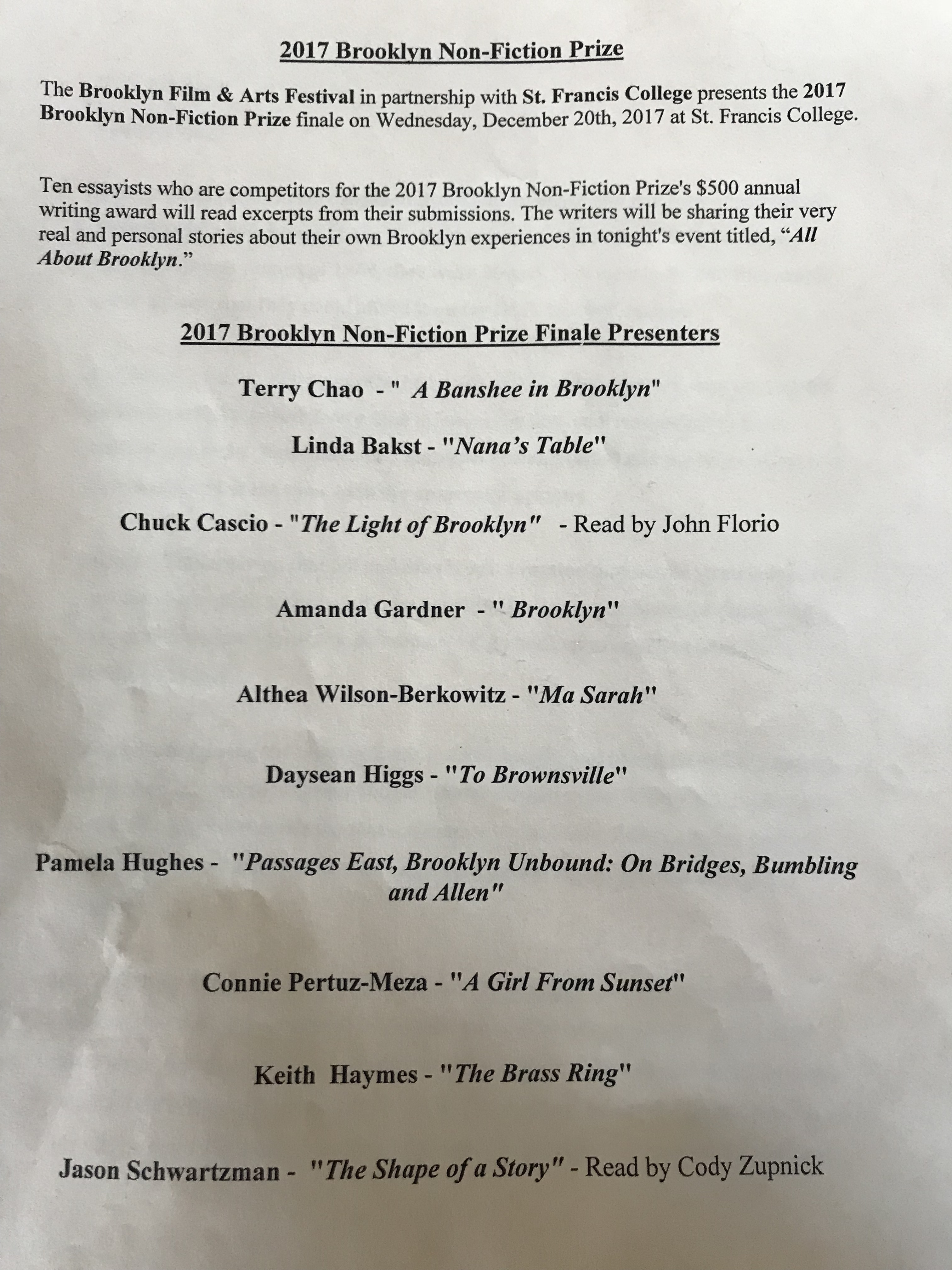
    A young man distributed a sheet of paper that turned out to be the program.

    OM9PsGAORzmc7n99EBb6yA

    I was slated to be the second reader of ten. I studied the other nine names and titles of their stories. I looked around the room – there was a wide array of ages, races and sexes. I wondered who the writers were.

    The program was supposed to begin at 7, but we had arrived early. About five minutes before 7 the same young man who passed out the program asked for our attention. He wanted to take attendance to see if the readers were present. Several were still missing. We went back to chatting and waiting, more people arrived. The theater was getting pretty full.

    At 7:10, it was decided that the program should begin regardless. The young man stepped up to the podium and tapped on the microphone. It was working. I was relieved because my voice does not project well and I have difficulty sustaining any volume. He introduced the first piece, but the woman wasn’t there. That meant I was going first.

    I took a deep breath and went down the aisle stairs and took my place at the podium. I read Nana’s Table, fumbling only once or twice over words. I couldn’t see the audience very well with the white spotlight on me, but I looked up every so often trying to make contact with my family and friends. The room was very quiet, as I read. It felt like people were listening intently. Toward the end of my reading someone’s cell phone went off, but they silenced it pretty quickly. I didn’t let it distract me.

    There was applause when I finished and I returned to my seat. And just like that, it was done. The young man introduced the next writer. Different stories of Brooklyn unfolded. A range of experiences were recounted. A young African-American man described growing up in the projects where gangs dominated, but he found community there, too. A Latina wrote movingly about her mother’s and sister’s struggles in Sunset Park, sadly known as ‘Gunset’ Park at the time. Another shared her story of taking a class at Brooklyn College with Allen Ginsburg, the beat poet.  A retired police officer, who like me started writing when he retired at age 55, told his story of deep regret at not helping a childhood friend who grew up with him in Coney Island. Two other stories, like mine, focused on relationships with grandparents. A picture of a borough filled with people of different ethnicities, but similar pains and struggles, was painted.

    After all the stories were read, all the authors were invited to the front. We received a nice round of applause and then the emcee announced the winner. The retired cop won the Brooklyn Nonfiction Prize for 2017. I can’t lie, I was a little disappointed. But, the whole thing had been an enriching experience. Dan told me several times how proud he was of me. Leah sent texts with the same message. I knew Gary and my mother were eagerly awaiting hearing the result. Their collective pride in my effort was very meaningful to me.

    Hearing the other stories, sharing mine, confirmed that I was on the right track, to borrow a phrase from my father-in-law. I was doing what I should be doing.

    Everyone with me had enjoyed the evening immensely. Steven said, “Sign me up for your next reading.” I smiled and thought, “I hope there is a next reading.”

    It was late by the time it concluded. Dan and Beth, who had work the next morning, gave me hugs and went back to Manhattan, as did Aunt Clair. Steven, Merle and I went out to dinner at an old-style Italian restaurant on Court Street. After enjoying several glasses of chianti, warm Italian bread and a variation on eggplant parmigiana, we parted ways. I went back to the hotel.

    I woke early the next morning and took a walk. I hadn’t been in Brooklyn Heights for many years. I found my way to Brooklyn Bridge Park, which didn’t exist the last time I was in the neighborhood. It was a sunny, brisk morning. I marveled at how beautiful it all was. I counted my blessings as I walked.


  • Who was batting for the Mets on July 13, 1977 when the lights went out in New York City?*

    13blackout1-articlelarge
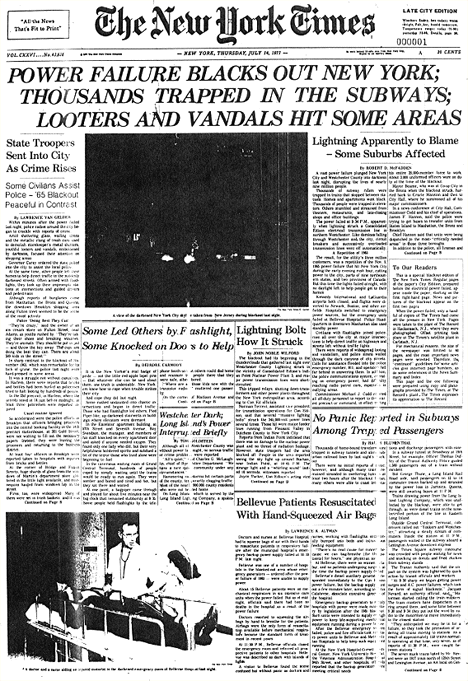
    Photo from the New York Times

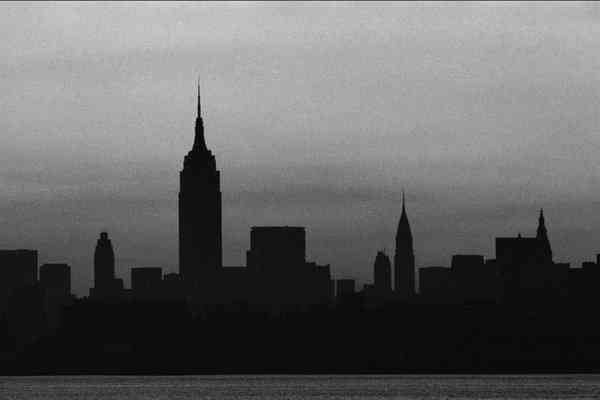
    I can’t say I remembered the answer to this trivia question, but I do have some vivid memories of that evening. I was in the shower in my house in Canarsie. Home from college for the summer, working temp jobs in the city during the day, that particular evening, I was home alone. My parents were visiting my grandparents in Florida. I have no idea where my brothers were – but I know they weren’t around. Uncle Terry and Aunt Barbara were living in the upstairs apartment in Canarsie, and they were keeping an eye on me while my parents were away (I was 17 years old). That particular evening they were visiting friends in Rockland County and weren’t home yet.

    It was unnerving to have the lights to go out while I was in the shower. I shook off visions of Psycho and climbed out of the tub, slowly, carefully. Once I opened the bathroom door, there was enough ambient light to find my way to my bedroom just across the hall. It was about 9:30 pm, but not fully dark since it was still early in the summer. I got dressed quickly so I could check outside to see if my neighbors had power.

    I went out on the front porch and saw that all the houses and street lights were dark. I went back inside and found some flashlights. The phone rang. It was Aunt Barbara telling me that they were on their way home. I was grateful for that. I was also relieved that the phone was working. I felt a bit less isolated. I think I spent much of the next hour on the phone, talking to the guy I was starting to see, waiting for Uncle Terry and Barbara to get back. Eventually they made it. Things were quiet on our block. The same could not be said for other parts of the city, though I didn’t know that at the time. It was probably a blessing that I couldn’t find a transistor radio or turn on the television.

    After my aunt and uncle got back, the three of us sat on the porch for a while, trying to capture the scant breeze. Eventually we gave up, went in and tried to get some sleep. New York City was suffering through a brutal heat wave, the demand for power and some unfortunate lightning strikes caused the blackout.

    When I woke in the morning, the power still wasn’t on. That meant I couldn’t go to work! I was able to make a plan to go to the beach with the guy who I was on the phone with the night before. I had my parent’s car, since they had flown down to Florida. It was a 1972 Impala, a behemoth, it was like driving an ocean liner. The car was so big I had a difficult time maneuvering it. A couple of weeks earlier I went on an outing in the Impala with my friend, Merle. I drove first to Kings Plaza, a huge mall in Brooklyn, where Merle got out of the car to help me negotiate the parking garage ramps which seemed entirely too small for the mammoth car. Then we went to Island Park to visit our college friends. We were like Lucy and Ethel on that trip, Merle trying to give me directions from the handwritten notes I had taken over the phone from Dianne, while I tried to stay calm in the traffic on the Belt and Sunrise Highway. Growing up in Brooklyn in a one-car family, I didn’t drive often. Merle and I made it to Island Park and back – I only bumped a garbage can while making a u-turn – we were otherwise unscathed. But, we were exhausted from laughing so hard.

    Despite my driving deficiencies, my guy and I made it to the beach in the Rockaways. It was late morning and the heat was already oppressive. There was a lot of traffic on the Belt Parkway for a Thursday after rush hour. We weren’t the only ones with the idea of getting an extra beach day in during the workweek. It was one of those summer days that wasn’t sunny, but we had to squint because of the glare.

    Listening to the car radio, we heard about the looting and violence of the night before. People took advantage of the power outage to smash windows and break into stores and generally commit mayhem, especially in downtown Brooklyn. The city, which still had not recovered from being on the brink of bankruptcy, had a reduced and demoralized police department. It was also the ‘Summer of Sam.’ It wasn’t just the heat and humidity that hung in the air and left us feeling unsettled. The threat of a serial killer was another ingredient in an already roiling pot.

    0713_big

    It was an odd time for me, a time of transition. Although objectively the atmosphere in Canarsie was more fraught than in my years as a child and adolescent, I was not as anxious. I had more friends and was embarking on my first romantic relationship. I had a long way to go to quell my insecurities, work still in progress, but I had made a turn for the better. The blackout of 1977 didn’t derail me.

    *Lenny Randle. If anyone knew this, you win a prize 🙂

  • I thought I would have a blog post ready for today, but I don’t. I was writing a more political post – though those don’t seem to be my most popular essays. But once I arrived on the ‘happy island’ (Aruba), I lost my motivation. I will just have to keep enjoying my time here (see below). I will be back next week. Have a great week!

  • %h2yl8MAQ3CX+oAsNaIO0g
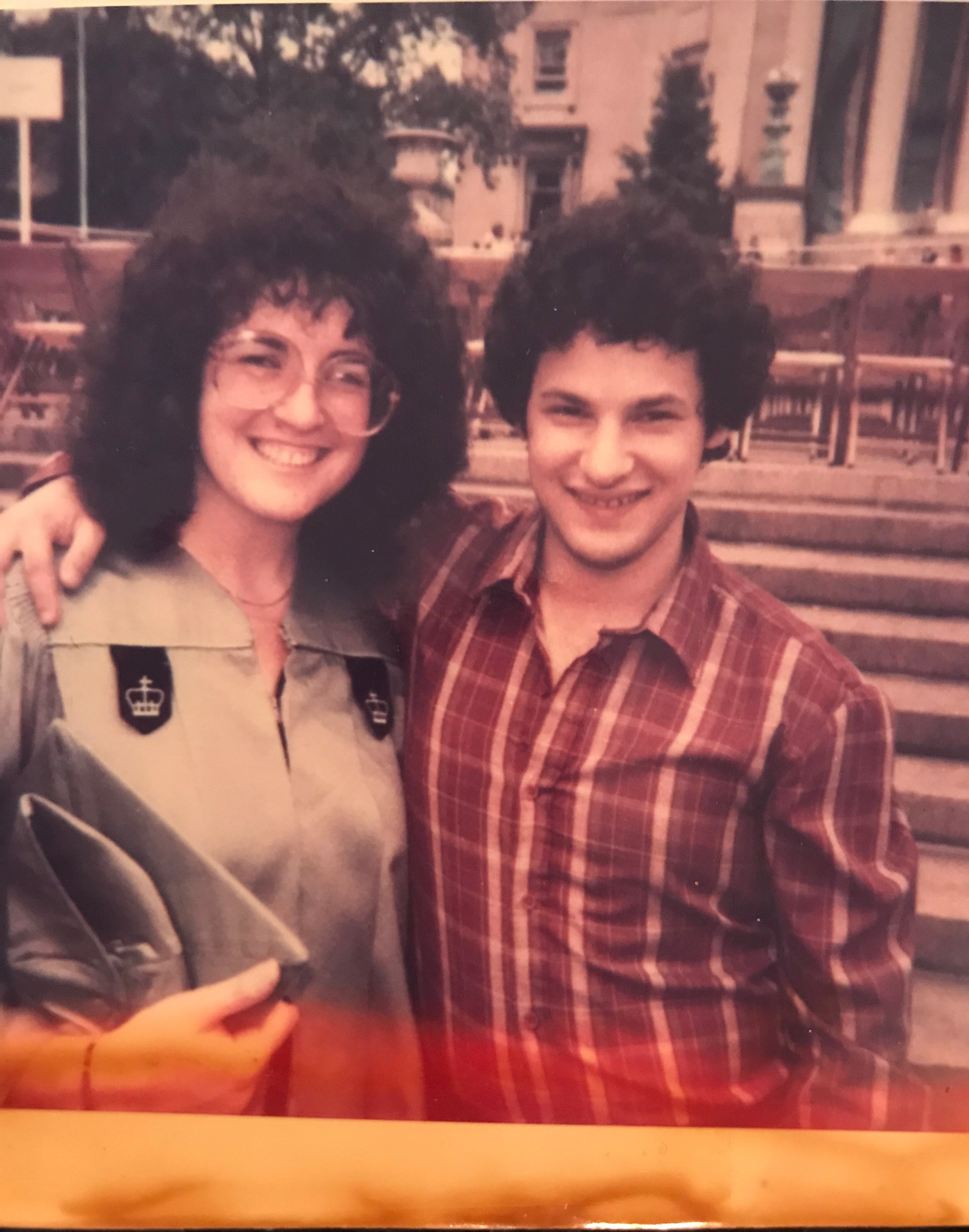
    Gary and me at my graduation from Columbia – May 1982

    I always loved Manhattan. I loved the excitement of it, the different neighborhoods, and the energy. While I was in college, at SUNY-Binghamton where I felt exiled in a gray, isolated city that barely deserved that designation, I dreamed of coming to Manhattan to live and work. I got my chance to live the dream when I went to graduate school at Columbia University.

    I finished the first of a two year Master’s program at Columbia in May of 1981. I lived in a Columbia-owned apartment building on 80th and Columbus Avenue and I had an internship in New York City’s Mayor’s Office (Ed Koch was the mayor at the time) for the summer.

    Each day that summer I descended into the subway station at 79th and Central Park West. The same panhandler that I saw on a daily basis was at the bottom of the stairs. I knew him by his tattered denim jacket and black knit cap. His long legs extended, back propped against the wall, his hand outstretched, jiggling a dirty Styrofoam cup, begging for spare change. Judging by the sound of it, the cup wasn’t very full. I made my way around him. I looked at him briefly, didn’t make eye contact, and continued through the turnstile.

    I stood on the platform waiting for the C train. The stagnant, humid air was already warm, despite the early hour. Perspiration started to roll down my back. I hated starting my day with my clothes already damp. I had a desk in a small office that I shared with a full-time staff person and I didn’t want to come in smelling of sweat and the subway. The one window in the office, which contained an air conditioner, looked out at a brick wall inches away. It wasn’t optimal for fresh air, but at least it was cool.

    Work was interesting. I was in the Community Assistance Unit (CAU). New York City was divided into community boards. Those boards met with representatives of city agencies (Police, Fire, Sanitation, etc.) to discuss local issues. CAU was the liaison between those boards and the mayor’s office. Staff from CAU attended those meetings and filled out a report. They had files filled with these reports, but nothing had been done with them. That’s where my internship came in. I was to review the reports and look for commonalities or systemic problems and present what I found to the director of the unit.

    After finishing my day, if I didn’t have plans after work, I got back on the subway to go uptown. Again, I’d wait for the train to roll into the station. It was always a bad sign if a subway car was empty – that meant one of two things: either the air conditioning wasn’t working or a homeless person was living there and the smell was too overpowering (or both). Sometimes I stepped on to the empty car anyway.

    One particular day that summer I got back to my apartment and started dinner. I put a pot of water up to boil. When it came time to add the pasta, I opened the box of spaghetti and a roach fell into the pot along with the dry noodles. I shrieked. I was done. I already had an exterminator on retainer. The building, and many around it, were in the midst of being rehabbed. It didn’t matter how many times the exterminator came, more roaches infiltrated. I lost the war and retreated.

    My dream of Manhattan was over. I called my parents and said I was coming home to Canarsie. I knew the commute to Columbia would be a bear, but I would save a lot of money and I just couldn’t deal anymore with life in Manhattan. Between the homeless, the drug addicts, the need for constant vigilance about my personal safety and, finally, the roaches, I gave up. The reality in 1980-81 was a rude awakening.

    All these years later, it might surprise you to know that Gary and I agreed that our plan would be to retire to Manhattan. Despite that awful year, I still loved going to the city for shows, ballets, museums and restaurants. Over time, as the 1980s progressed and the city recovered from the fiscal crisis of the late ‘70s, things changed. By the time my children were old enough to take to the city, in the 1990s, I felt comfortable there. I still had to be watchful, keeping my purse wedged between my arm and my body, and be aware of my surroundings, but I felt free to show my children all the city had to offer. My dream of Manhattan reawakened.

  • IMG_1288

    I’m not sure what people from Canarsie call themselves – Canarsiens? Canarsie-ites? Either way, I’m asking for your input.

    I started this blog with the hope of painting a picture of my life in Canarsie, Brooklyn in the mid 1960s through early ‘70s. It was a time not unlike today, in some ways. It felt fraught, dangerous even. So much was changing and violence, in the form of urban riots and crime, was lurking. I grew up acutely aware of those crosscurrents.

    Others growing up in Canarsie at the same time had different perceptions. I deduce this from conversations I have had with friends and from comments posted on the Internet. This isn’t surprising, of course, one would expect different experiences. But some have described an idyllic childhood in which neighbors looked out for each other and children played together in harmony (mostly). Which made me wonder: was my experience the exception?

    I want to explore that question. If you (and please feel free to pass this request on) grew up in Canarsie and graduated from either Canarsie High School or South Shore from about 1973-1977 and would like to share your memories, I would like to interview you. Please send me an email at LBakst.Canarsie@gmail.com and I will follow up.

    The three major topics I am interested in exploring are: family life, ethnicity/race relations, and perceptions of safety. I am particularly interested in memories of the boycott of schools in response to the busing plan in Canarsie in 1972-73.

    This is not going to be a scientific study by any means, but interviews can yield important perspectives. I am hopeful that I will gain more insight into a broader range of experience and then I can share those insights on my blog, either as part of my stories or separately. I will keep the information anonymous, unless you are willing to speak for attribution.

    Aside from satisfying my personal curiosity, I’m hoping it will help paint a more detailed picture of that time and place, which in turn should lead to a better understanding of who we are now. I hope the conversation will be interesting to you, too! I hope to hear from you.

  • Note: The following is a longer post than usual. For readers who have been following me from the beginning, some of the stories may be familiar. I have pieced together previous blog posts, along with new material, to create a more complete narrative of my relationship with Nana (my maternal grandmother). I am experimenting with different forms and approaches. Thanks, Leah, for your edits and suggestions. And, thanks Dan for your suggestion for the title. I look forward to feedback from any and all readers!
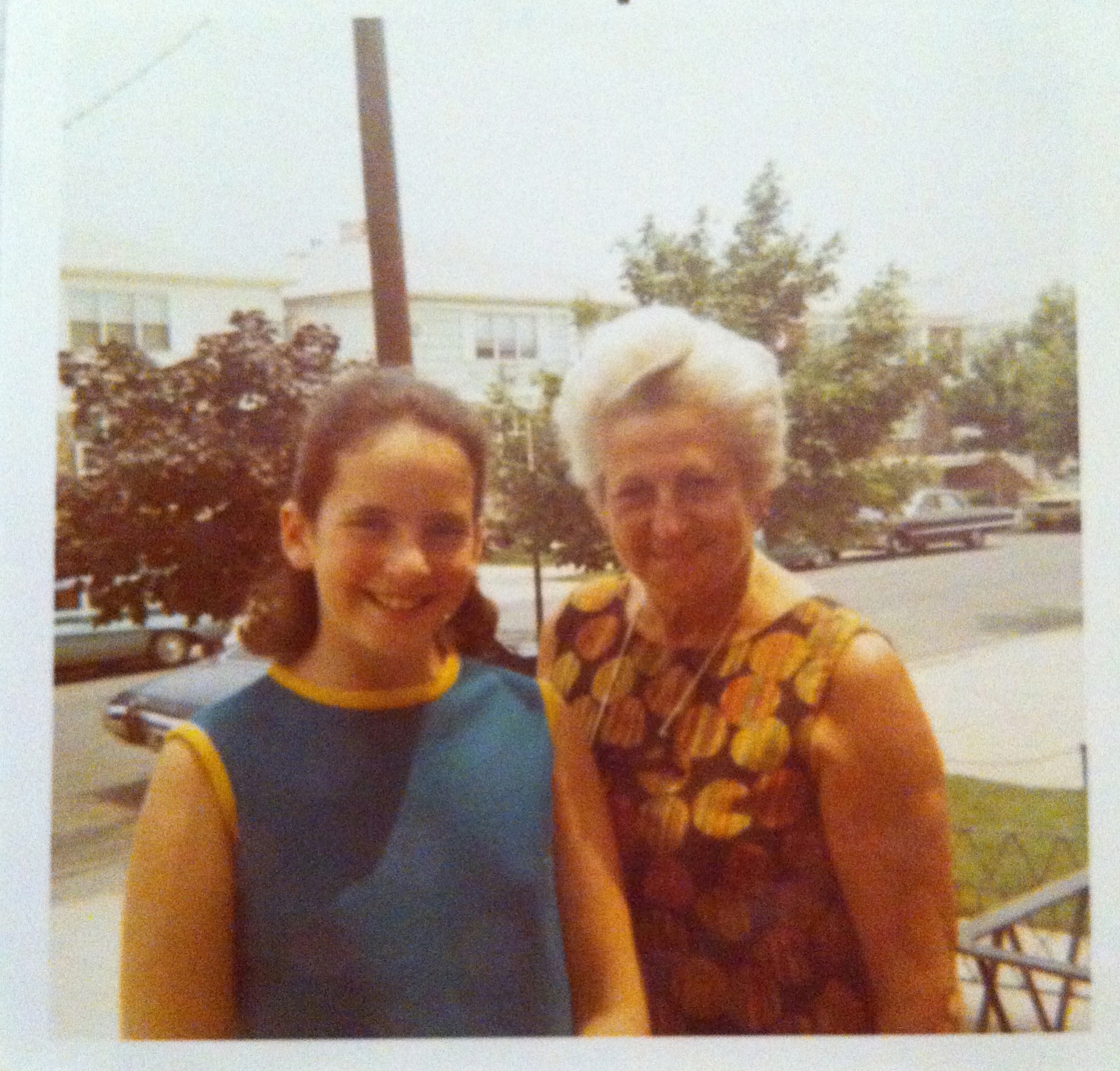
    IMG_1281

    After renting various apartments in Brooklyn, my mom and dad took a leap of faith. They bought a new house in a new neighborhood, built on landfill, in Canarsie, Brooklyn. It was August of 1964, they were 30 and 31 respectively, and they were not at all sure that they could afford it on my Dad’s teacher’s salary.

    The house, a two-family semi-attached brick and shingle structure, was on a street that had yet to be paved. Every time it rained the dirt road was awash in mud, puddles and rocks. Nana, Zada (my maternal grandparents) and my two uncles, who were teenagers at the time, took the apartment upstairs.

    I started Kindergarten that fall and thus began a routine that would stretch over the next six years: go to school, visit upstairs with Nana, go back down for dinner with my parents and two brothers, do homework, go back up to watch tv with Nana, and, finally, go to bed.

    Long before moving to Canarsie, Zada, in 1941 bought and managed Miller’s Bakery on Rochester Avenue in Crown Heights. Nana worked in the bakery alongside Zada and the family lived above the store. A master bread baker, Zada’s challah and rye bread were outstanding, in fact he had trucks delivering his product across the borough.

    By 1962 the neighborhood in which Miller’s once thrived was changing. Zada thought that the new immigrants, mostly from the Caribbean, would buy his high-quality rye, pumpernickel and challah. But, they didn’t. He didn’t change his product and he didn’t follow his customers to Long Island either. So, for the second time in his life, he lost everything – he went bankrupt.  At the age of 61 he went to work for a commercial bakery in Greenpoint, and moved his wife and two teenage sons to the upstairs apartment in our Canarsie home.

    The door to Nana and Zada’s apartment was always unlocked. Each day when I came home from school, I dropped my stuff off in my bedroom, climbed the stairs, and let myself in. Though it was a two-family house, with separate apartments, I lived in it as if it was one.

    Nana sat at a small, round marble table. The gold threads in the marble caught and reflected the light from the amber glass fixture suspended above it. The marble table top sat on a black cast iron pedestal. Both were unforgiving on misplaced elbows and knees.

    “Hello, Sunshine,” her daily greeting to me as I opened the door. Nana’s arthritic hands were wrapped around a large teacup with steam rising. She lifted herself from her chair and shuffled across the yellow linoleum floor toward the refrigerator.  I settled into a chair next to hers.

    “Zada brought home a chocolate crème pie.  Do you want a piece?” She was already removing the pie from the refrigerator shelf – she knew my answer. Zada often brought home surplus goods from the bakery – large black and white cookies, corn muffins or assorted pies, and I was always ready to indulge in a treat. As the refrigerator door swung closed, I saw Nana’s supply of insulin bottles lined up on the bottom shelf.

    A small black and white television set sat on the table, tuned to the Dinah Shore show. The Mike Douglas Show came on shortly after. I ate my pie.

    “Tell me about your day, Sunshine,” Nana asked.

    “The usual. But, we have an assembly on Thursday and my class is putting on a little play. Maybe you could come?”

    Nana sighed, “You know I’d love to, but my feet are hurting so much, there’s no way I could get there.”

    My elementary school was not near the house, it was even a long walk to the bus.

    “It’s okay, Nana. Maybe next time your feet will be better.”

    We turned our attention back to the Mike Douglas show where the Rockettes were dancing. I adjusted the rabbit ear antenna so we’d get better reception.

    “Lindale, bring me my aspirin,” Zada bellowed from the back bedroom. Another part of my daily ritual.  Zada worked an early morning shift and was resting in bed while I visited with Nana.

    “Coming!” I would get a glass of water, go into the bathroom and pour three aspirin from a huge bottle and bring it to him. Zada was propped up in bed, his long legs crossed at the ankles, wearing his sleeveless t-shirt, boxer shorts and horn-rimmed glasses, reading the Daily News. He took all three pills at once and washed them down with a gulp of water.

    “Did you have the chocolate crème pie?” Zada asked.

    “I did, it was delicious.”

    “Good.” I took the glass back and returned to the kitchen, my job done.

    The four o’clock sun streamed through the slats of the shutters in the window. I sat in my cocoon with Nana until my mom called me down for dinner.

    On any given day, my visit with Nana might have included one of her friends from the old neighborhood. Like Nana and my mother, they relied on public transportation or car service because they didn’t drive. The nearest bus to our house left them with a long, windy walk across Seaview Park.

    Alex, the tailor, who had one leg shorter than the other and wore a clunky orthopedic shoe, trudged across the park. Alex repaired the holes in my winter coat pockets by replacing them with a colorful, satin smooth fabric. I loved the orange and yellow cloth so much I wished I could wear the pockets on the outside.

    Dora, Yetta and both Goldies made the trek to Canarsie, too.  They climbed the stairs to Nana’s second floor home and settled in at the marble table, like I did.

    Invariably they would bring a small trinket for me, a large chocolate coin wrapped in shiny foil, or a miniature stuffed animal. Nana smiled as they gave me my small treasure. After asking me what grade I was in and if I liked school, they went on to speak to each other as if I wasn’t there. I listened. Nana served tea and cake.

    It seemed that Nana was a collector of lost souls. Some had physical problems, some would be considered spinsters, but no matter, they had a place at her table.

    One day I took my usual place at the table and Nana shared an idea. Since my hair was a constant source of difficulty, she wanted me to try something different. A mixture of curls, waves and wiry frizz, my hair was entirely unmanageable.  This was before the advent of the myriad of gels, creams, sprays and treatments that fill an aisle of CVS today. In the late ‘60s and early ‘70s, fashion required girls to wear their hair long and stick straight. I was in a state of war with mine – and my unruly hair was winning.

    Combing my hair after washing it was a nightmare for both me and my mother, and anyone who was within earshot. My hair was such a jumble of knots that it was nearly impossible to endure the process. I would avoid the whole thing for as long as my mother would allow.

    Nana came back from a session at the beauty parlor with her silver hair teased high, each hair sprayed into submission.  Fortunately, that wasn’t what she had in mind for me, though that still might have been an improvement.

    She explained that she spoke to another hairdresser at her salon about me. A new style had come into fashion, a shag, and they thought it could work. If I was interested, Nana would make me an appointment. I readily agreed.

    After getting Mom’s consent, Zada drove Nana and me across Brooklyn to her beauty parlor. Nana was greeted with warm embraces and enthusiastic hellos. The smell of hairspray hung in the air. Most of the other patrons were Nana’s age.

    A shag was a layered cut that allowed for curls. I watched as my hair was trimmed and styled. When it was done and I looked in the mirror, I breathed a sigh of relief and smiled. For the first time, my hair looked good! The other people in the beauty parlor even complimented me.

    Zada picked us up and drove us back home. We were excited to show everyone. Nana walked in with me to see Mom’s reaction. Mom looked at me puzzled for a long minute, brow furrowed, and said, “I have to get used to it.” Her face said she didn’t like it. I burst into tears and ran to my bedroom. As I left I heard Nana say loudly, “Feige, you don’t know your ass from your elbow!”

    I had never heard Nana use a curse word – ever. And, I never heard her say a cross word to my mother. I also had never heard that expression – it conjured up an image that shocked my eleven-year-old self. I didn’t know if I should laugh or cry – so I did both.

    After a minute or two, Mom knocked on my bedroom door. “Nana’s right, Linda,” she said as she sat down next to me on my bed, gently stroking my back. “The cut looks great. I’m sorry for reacting that way. I was just surprised.”

    “Ok,” I sniffled, “but I can’t believe Nana said that!”

    “Well, she was upset with me. Don’t worry about it. Just enjoy the haircut.”

    “You really think my hair looks okay?”

    “I do. Go upstairs and let Nana know you’re feeling better.”

    I did.


    A few months later I climbed those same stairs to my grandparents’ apartment, knowing Nana was no longer there. I opened the door and found Zada sitting at the huge mahogany dining room table in his suit and tie. I crossed the room and went to sit with him to wait for everyone else to be ready to leave.

    I was wearing the same dress, brown with white polka dots, cinched at the waist, that I wore a month earlier to my grandparents’ 40th wedding anniversary party.  That party, with its frivolity and craziness (there had been a belly dancer, of all things!) seemed ages ago.

    Zada looked at me and said, “Nana would be so happy to see you looking so pretty,” and his voice broke; he made a strangled sound. His shoulders heaved as he sobbed.  I didn’t know what to do. I had never seen a grown man cry. I stood up and ran back down the stairs to my bedroom with the sounds of his grief following me. I didn’t know how to comfort him or myself.

    Two days before, I awoke to the sound of Uncle Mike calling to my mom. “Feige, it’s mommy.  She’s sick.” I heard his panicked voice in the hall outside my bedroom.  Then I heard rustling sounds as my mom got out of bed, “I’m coming!” the slap of her slippers on the linoleum as she followed him upstairs. I pulled the covers over my head, trying to block out any more sounds.

    I couldn’t help but hear the voices calling back and forth, the frantic phone calls being made.

    Despite my growing fear, I got out of bed and slowly climbed the stairs to see what was going on. I stepped into Nana’s kitchen and my Dad stopped me.

    “Nana would not want you to see her like this,” he said.

    “Can I make her some tea?”

    “Okay, why don’t you do that.”

    I did and when it was ready, I wanted to bring it to her, but an ambulance was just arriving. I put the cup down on the marble kitchen table and retreated to our apartment. When I heard movement on the steps, I went back out into the hallway to try and see Nana. I couldn’t see her face, just her wavy white hair as they carried her to the ambulance.

    All the adults piled into cars and followed the ambulance, siren wailing. It got very quiet in the house. Mark, my 14-year-old brother, an unbelievably heavy sleeper, had finally awoken in the tumult. I explained to him what was going on. Steven, my oldest brother, was away working at a resort hotel in New Jersey for the Easter/Passover holiday break from school.

    Mark and I didn’t know what to do with ourselves. Mom and Dad had returned the night before from their first ever vacation without us. They went to Florida, while Nana and Zada watched us, and came back happy and tan. That happiness lasted only a few hours.

    They also brought back souvenirs. With nothing to occupy us but our worry, Mark and I took our new alligator-shaped water guns and chased each other around outside – down the alley next to our house, into the backyard and back to the front. Squirting each other, we laughed to relieve the stress. Eventually we tired ourselves out, went back into the house and just waited.

    After what seemed an interminable amount of time, though it was still afternoon, we heard people at the door. As the front door was being unlocked, I could see my Aunt Simma through the sidelight, tears streaming down her face. My Dad opened the door and came into the kitchen.

    “Come, sit with me,” Dad said. He ushered Mark and me to the couch in the living room.

    He took a deep breath. “Nana died,” he said quietly.

    “What happened?” I asked, “How??”

    “We don’t really know – maybe a burst blood vessel or blood clot.”

    Mark immediately burst into tears. How did he do that? How did he understand it so quickly? I was numb. Dad patted Mark’s shoulder and put his hand on mine. “It’s okay to cry.”

    I don’t know if he said that for Mark’s benefit or mine. I’m sure he offered words of comfort but I don’t remember what they were.

    I learned a lot over the course of the next week. I learned about sitting shiva –  the Jewish ritual surrounding death. I watched the mirrors in the house get covered with sheets; Mom, my aunt and two uncles and Zada each wore a black pin and ribbon to signify their loss; mourners used small hard stools instead of regular chairs. Each morning my uncles walked across the park to the nearest synagogue to say kadish. The house was filled with people, day and night; sometimes it felt like a party. Nana loved a party. It was strange – the happy chatter mixed with grief.

    I learned that grown men do cry. Uncle Jack, Nana’s youngest brother, was sitting quietly one moment and then was overcome the next. I didn’t shed a tear, not then, not since. Nana was my comfort and heart, I felt a deep sadness, but tears would not come.

    At the time, I thought Nana was old. She was 56. I am 58 as I write this.
  • I went to see an exhibit, Andrew Wyeth at 100: A Family Remembrance, at the Fenimore Museum in Cooperstown earlier this fall. I am a huge fan of Wyeth’s work. I find myself mesmerized by Wyeth’s ability to evoke so much beauty in the most mundane scenes (see below).

    I came away from the exhibit with some thoughts about writing. As with many artist exhibitions, studies were included along with the final canvas. There were sketches and paintings that led up to the final work. He also painted the same people and places many times over, capturing small changes in light and shadow. So, I wonder: Can the same apply to writing? Can I write the same experience several times over – picking up different details, emphasizing a different theme? Do we have only one crack at the story? I know there are books and movies where a story is told from different characters’ perspectives, but I am getting at something else. For example, I think I could write my memories of the day of Nana’s death again (maybe more than a few times) and write it differently. But, would it be interesting to readers? Would it just be an exercise for myself?

    Obviously, writers return to their muse, or may be inspired to create multiple pieces based on a single experience of heartbreak. But, I’m thinking of trying something different – a more literal translation of what a painter does – what Monet did with his haystacks.

    This is a half-baked thought, I will continue to turn it over to see if there is something there for me, to spark some creativity.

    There were other exhibits at the Fenimore that I enjoyed. One artist, whose name I did not write down, evoked the interiors of religious shrines by using shards of color that looked like glass. The holy sites became abstractions of color, famous pagodas, mosques and churches were rendered in this way. I wondered if the artist was getting at some essential commonality – at least that it was I took from it.

    Another thing I like about going to the Fenimore is that whenever I have visited, there have been different paintings by local artists of local scenery. It is easy to see why folks would be moved to paint the scenery. It is idyllic. Each time I have visited the museum I have walked down the path that leads from the building to Otsego Lake, called ‘glimmerglass’ for a reason. The water reflects the blue sky and lush hills perfectly.  (No, I have not been paid by the museum to write this!).

    I left the Fenimore that afternoon struck by how much talent there is in this world – so much creativity – it boggles the mind. It is both intimidating and inspiring.

  • Note:  As a reminder before picking up my story where I left off, Santa Claus had come to the daycare center. I attended and gave Leah and Dan gifts instead of allowing Santa to deliver them and the daycare center agreed to form a committee of parents and staff to look at the holiday celebration for the future.

    december-dilemma-460
    Photo from the ADL

    As Amy promised, a committee was formed. The committee decided that a survey of parents would be helpful in determining what steps to take.  Since I had a master’s degree in public administration and was on leave from a doctoral program in public policy, I had taken several classes on social science research methods, so I volunteered to help with the survey design and collate the results.

    It’s funny but I remember very little about the survey itself – I don’t recall what questions we asked. I do remember, quite clearly, that several parents used the open-ended question to explain that this was a Christian country and if others didn’t like it, they could go back where they came from. For Gary and I that would mean going back to Queens and Brooklyn, respectively – which were (and are) still part of this country, though some might like to deny it.

    I was shocked and hurt. While it was only a small number who expressed their view in such an extreme way, I hadn’t expected it. I was especially distressed that this represented views of people employed by the medical center, a group that I thought would be more enlightened.

    Despite my dismay, I collated the results and prepared a summary. Frankly, I don’t recall what the survey said in terms of Santa Claus visiting, but I think it must have been inconclusive. The purpose of the meeting was to discuss the information the survey did provide and give the daycare center administrators feedback on what to do for the coming year.

    Once again, I left work and got on the bus to go to the center. A stop after mine another woman got on the bus and I recognized her as a parent from the center. I believe all parents were invited to attend the meeting, even if they had not participated in the committee. We smiled at each other and she sat down near me.

    “Are you going to the meeting?” I asked. She nodded and we introduced ourselves and started chatting. I explained how Santa’s visit the year before had affected my family and that I was hoping that the center would consider changing how they celebrated Christmas. She nodded sympathetically. “I can see how that would be difficult,” she said.

    We continued chatting as we got off the bus and found our way to the conference room. The meeting had quite a turnout – all the seats were taken. Extra chairs were brought in, not everyone could fit at the table.

    The room felt tense to me. I don’t recall why I felt that way, but I know, even before a word was spoken, that I felt defensive. I told myself to breathe and relax.

    The director and assistant director led the discussion. I reported the results of the survey, including sharing some of the disagreeable (to me) comments. Perhaps not surprisingly, the conversation devolved. I made my case: Santa Claus may be considered an American symbol to many, but not to non-Christians. Also, Santa can be seen at malls, community centers, churches, on television, etc., so if a parent wanted their child to experience a visit with Santa Claus, it wasn’t difficult to arrange.

    The assistant director was outraged by my comments. If looks could kill, I would be dead. “Why should the children be deprived of Santa’s visit?” she asked, leaning across the table, accusation in her eyes. This was clearly a very personal thing to her, as it was to me.

    “I was there when Santa came,” I reminded her, “and several kids were crying and others didn’t seem to care.” I was thinking that this should actually be the central point.

    “I saw children having fun!” she retorted.

    This wasn’t going well. I was getting angrier and angrier. At that point, I stopped participating.

    The meeting continued for a bit longer. The director, to sum things up, said that they (the staff) would make a final decision about Santa and inform parents within a week. I left thinking they were going to keep things as they were, given that the staff seemed so invested in it and there weren’t very many parents objecting.

    As I walked out of the meeting and headed back to the bus stop to go back to work, the woman I came in with stopped me. “It would’ve been much better if you could have explained it the way you did to me on the bus. You were too strident.”

    I didn’t know how to respond. I wanted to cry. I told her I would’ve like to have done that, too. I kept walking.

    I sat on the bus thinking about what she said. Was it me? Did I present my case poorly? I know I was wound up, and I probably did come across too strong. But, I couldn’t help myself. I felt under attack.

    The daycare center kept its policy of having Santa visit. We went through the same process as the year before.

    One day, as we approached Christmas, one of Dan’s teachers, who had been Leah’s the year before, asked us if we had gotten our Christmas tree yet. I said no and left it at that. What was the point of explaining it yet again? Was it willful ignorance?

    Leah was to start Kindergarten the following fall. She would be attending School 16, the public elementary school a few blocks from our house. The Albany Jewish Community Center (JCC) offered an aftercare program with transportation from School 16. We looked at whether it made sense to move Dan at that point, too, so that they would continue to be in the same place.

    The JCC daycare program was more expensive (Dan was three when we were considering this) – plus the medical center took the cost of day out of the Gary’s pre-tax salary. We had to considered whether we could afford to make the move.

    It wasn’t much of a decision to make. We moved to Dan and Leah to the JCC that summer so they would be settled in before Leah began Kindergarten in the fall. In many ways, it was a relief. While Gary and I weren’t interested in putting our children in a Jewish setting for their education or care, it did make things easier for the time being.

    It wasn’t the end of our battles over Christmas celebrations, we had a few in the public schools, but none so painful and fruitless as that first one.

  • fullsizeoutput_17d
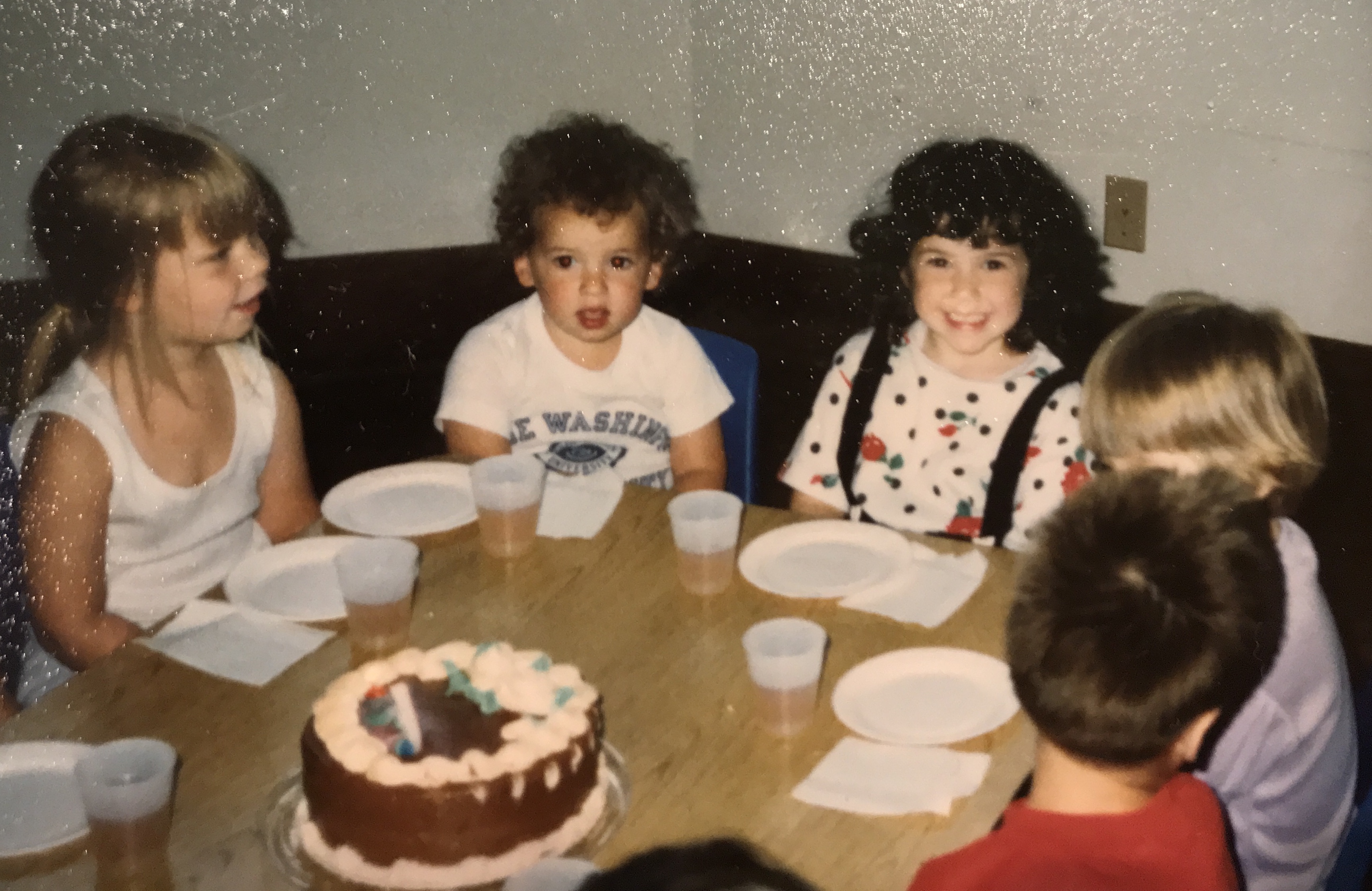
    Celebrating Leah’s birthday at Kidskeller (daycare center). Dan is to her right.

    It was late fall of 1990. I went through the revolving door of my office building to leave for the day, as I did five days a week. By the time I emerged on the sidewalk, every thought about work evaporated. It was like crossing into another world, one totally focused on Leah and Daniel (my children, aged 3 years and 18 months). If I offered to bring something from home to a colleague at work, let’s say a book, by the time I got to the street, the thought was gone. No chance I’d remember to bring it. The next day I’d arrive back at the office, realize I had forgotten and apologize to my colleague. It was hopeless. My brain was on overload.

    In the fall of 1990 Gary was in his second year of his endocrine fellowship, his fifth year of post-medical school training. I was working full time for the New York State Legislative Commission on Expenditure Review. Leah and Daniel attended a daycare center, Kidskeller, that was part of Albany Medical Center, where Gary was in training.

    Each day I’d leave work, take a bus to VA hospital where our car was parked. I would take the car to the daycare center and pick up the kids and drive home. Sometime later in the evening, Gary would call and I would put the kids in the car and pick him up. Honestly, I don’t know how our marriage survived those years– at times we were hanging on by our fingernails.

    On one particular day, I got to Kidskeller and was getting stuff from Leah’s cubby. As was often the case, there was a note from the head of the program with information about upcoming events. I quickly read it and saw that Santa Claus would be visiting the center in a few weeks. I took a deep breath, folded the note and put it in the bag with Leah’s other stuff. The same note was in Dan’s cubby. I would read it more carefully later that night.

    After Gary got home and had dinner, I showed him the note, which asked parents to bring a small wrapped gift for their child so that Santa could distribute it when he visited.  We were not happy. I resented being required, in effect, to get gifts when money was so crazy tight. I also resented having Santa Claus imposed on us – he was ubiquitous already! While some Jews may partake of Christmas rituals, we didn’t. I enjoyed the lights and decorations that brighten the season, but we didn’t exchange gifts or acknowledge Santa Claus and we didn’t want that for our children.

    We were surprised that a daycare associated with a medical center would approach the holiday without recognizing the awkward position in which it would put non-Christian parents and children. After discussing it, Gary and I decided that it was likely too late to ask them to change the plan, but we would talk to the director so that maybe other plans could be considered in the years to follow. In the meantime, I would come to the center at the appointed hour with a gift for Leah and Dan and give it to them myself.

    The next day I stopped by the day care director’s office and asked if I could schedule a time to meet with her. I told her it was about the center’s plans for Christmas. She readily agreed and we set aside some time the following week.

    I arrived at the meeting as relaxed as possible. I knew there was nothing to be gained by going in loaded for bear.

    “Amy, I wanted to explain how the plan to have Santa Claus come to the center, and give gifts to the kids, put Gary and I in a difficult position,” I began.

    I went on to explain that we didn’t view Santa Claus as a secular figure and that we didn’t observe Christmas. She listened. I think it came as a surprise to her that we were troubled by Santa Claus, as she didn’t see him as a religious symbol at all.

    We agreed that there wouldn’t be any change to that year’s plan. She understood that I would come with my own gifts for Leah and Daniel. We also agreed that the center would form a committee of parents and staff to discuss holiday observances and make recommendations for the future. I was pleased that she was willing to do that.

    The day of Santa’s visit arrived. I left work, taking my lunch hour, to go over to the center. Santa was scheduled to visit Dan’s room first. The children, who were between 18 months and two years old, were sitting on the floor in a circle. Their care givers and a couple of other parents were spread throughout the room. Dan climbed into my lap. Santa was led in by the assistant director. Santa sat in a chair and read off each child’s name, inviting each to come up and get their present. After some cajoling by an adult, most of the kids toddled up to Santa. Only one or two cried. The adults were smiling and laughing. I gave Dan his small gift. Santa left and moved on to the next age group.

    I left Dan and went to Leah’s room. She was with the 3-4 year olds. While some of the kids were still reticent, more of them shared the excitement of the adults. I gave Leah her present. She seemed a bit perplexed, but was always excited to get a gift.

    I went back to work, struck by the feeling that Santa’s visit meant more to the adults than the children.

    When I went back to pick up Leah and Dan at the end of the day, one of Leah’s teachers asked Leah if she would hang the ornament they had made on her Christmas tree. Leah turned to look at me, not sure how to answer. I smiled and said, ”We don’t have a Christmas tree, but we’ll give it to someone who does.”  Cathy said, “Oh, you don’t? Hmmm.” I took Leah’s hand and we went to get Dan.

    Driving home, Leah asked, “Why don’t we have a Christmas tree?” I explained that we aren’t Christian and we don’t celebrate the holiday. We celebrate other holidays. “I wish we celebrated Christmas,” Leah said wistfully. “I understand, Leah. We can still enjoy the lights and stuff. We just won’t be observing it in our house.” I changed the subject, “What should we have for dinner?”

    I hadn’t expected to confront this so soon. She was three and a half.

    That wasn’t close to the end of it.

    (My next blog post will relate what happened with the day care center committee and the following year’s holiday season.)