Stories I Tell Myself

Linda Brody Bakst on Brooklyn, growing up, identity and more

  • Towards the end of Gary’s third year of medical school, we were thinking about next steps. Though graduating from medical school is a significant milestone, it isn’t close to the end of the journey. Internship, residency and, likely, fellowship remained to be completed. And, before he could begin, he had to go through a process called ‘the match.’

    Medical students choose a specialty and then apply for programs in that specialty. Gary chose internal medicine. The way it works is that he fills out an application, which includes his transcript, the scores on the different medical boards that are taken along the way, and references. I don’t recall all the specifics, but after the initial application, you would be invited for an interview if the program was interested in you. During the 4th year of med school, about four weeks were set aside so that the student could travel around for those interviews. Then, the student ranked his/her preferences from top choice to places they would accept. At the same time, the programs ranked their choice of students. The two sets of rankings were fed into a computer and voila! – a match was made.

    So much went into this process; so many decisions along the way – from choosing the specialty to deciding what part of the country we wanted to consider. Although we enjoyed our time in Pittsburgh, we wanted to be closer to family so Gary focused his attention on programs in the Northeast – mainly New York (upstate and the metropolitan area) and Philadelphia. He scheduled the interviews and we created an itinerary. The Toyota Celica we had when I first came to Pittsburgh had died, we got tired of pushing it downhill to pop it into gear and donated it to a local vocational school, and we were without a car for a while. We were fortunate that Gary’s brother Steven bought a new car at that time and generously gave us his old one – a car way too cool for us, a Pontiac Firebird with a t-top. We gratefully accepted his gift, it would make the interview process so much easier and less expensive.

    Gary left Pittsburgh early afternoon on the first Sunday in November to make a grand tour of Pennsylvania and New York, with his first stop in Syracuse. I would meet him at the end in Brooklyn for Thanksgiving. We said our good-byes, I wished him luck and he went on his way.

    He was driving on the Pennsylvania Turnpike, not that far out of Pittsburgh (but far enough), when the engine light came on. Neither Gary nor I were knowledgeable about cars. He drove for a bit, thinking he’d get off the next exit. But, exits on turnpikes aren’t that close together. To make a long story short, he had to pull over onto the shoulder when he saw smoke wafting from the engine. A state trooper luckily came upon him quickly. The car got towed to the nearest service station.

    At that point, I got a collect call from Gary, explaining that he was in Breezewood, Pennsylvania and was being told that the engine had seized. The car would be out of commission for quite a while, even if they were able to find a replacement engine. Gary was in something of a panic, his interview was scheduled the next day at 8:00 am in Syracuse. I went into problem-solving mode. We decided I would deal with the car. We got off the phone so he could look into transportation back to Pittsburgh and I would figure out how to get him to Syracuse.

    A number of things fell into place: he was able to get a bus to Pittsburgh very quickly, then he grabbed a cab to the airport. I found and booked him a flight to Syracuse and arranged for a rental car. It looked like we would be able to pull this off in time to make his interview. It also meant that we spent hundreds of dollars we couldn’t afford, but that’s what credit cards (and parents, if you are lucky) are for.

    The rest of his travels went well. When he finished all the interviews, we had some decisions to make. I put my policy analysis skills (I knew I’d find some use for them) into action to help sort things out. The task of figuring out how to rank the programs was overwhelming. Without going into the gory details, we made a matrix – yes, a matrix! The elements that were relevant to the decision were listed on one side (quality of the program, quality of life for us, closeness to family, affordability, etc.). I think we had something like 7 factors. We gave a weight to each factor (quality of program got the most weight, and quality of life was second). Then we ranked each program according to each factor and came up with a score. Much discussion went into this, as well as many hours of thought. While the matrix was helpful, it wasn’t an exact science. Ultimately, Gary ranked Columbia (in New York City) first, Albany Med second, I think one of the Philly programs was next and I don’t remember after that (maybe Gary does). I know he ranked ten programs

    One of the considerations in this equation was what each program offered in the way of experiences. The sad reality was that this was in the midst of the AIDS crisis, before any viable treatment options were available. When Gary visited NYU (located in Manhattan) and Downstate (located in Brooklyn), the combination of the huge number of AIDS patients, their suffering and not being able to offer much to relieve their symptoms, was devastating. All hospitals were challenged by this crisis, but the internal medicine programs in those two locations were simply overwhelmed. I don’t recall if Gary included either of those programs on his list, or if maybe he ranked them at the bottom.

    All the paperwork and interviews were done, now it was up to the invisible, giant (in my imagination anyway) all-powerful computer to do its magic. Match day was March 19, 1986.

    All the students gathered in a large common room in the medical school at the appointed hour – I think it was noon. I took off from work to be there to get the news hot off the press with Gary. Each student’s name was called and they were given an envelope. Inside was a computer-generated letter that indicated the program.

    Our hearts were thumping. I believe names were called alphabetically – it was good to be a Bakst. Gary went up and got the envelope and quickly made his way back to me so we could open it together. He ripped it open, our eyes scanned the paper and found…Albany. I looked at Gary to see his reaction – after all this was his second choice. I did not read disappointment. I felt a small let down and maybe a bit of surprise. Of course, I had no idea what would happen, and had no reason to assume he would get Columbia. We compared results with our friends – it seemed that everyone was happy with their placement.

    We knew our families were waiting to hear where we would be going. We went over to the pay phones to call them. As we made the calls, and processed the outcome, we got more excited. Then we joined friends and went out to celebrate.

    We would have a few more months in Pittsburgh, and then start the next phase of our lives together…in Albany, New York.
  • Sometimes I slip and say, “when we went to medical school.” Of course, I know that I didn’t go. In fact, when I would meet Gary on campus, we would take a short cut that went through the anatomy lab. I kept my eyes tightly closed, held my breath and he guided me through as quickly as possible. I wasn’t cut out for blood, guts or formaldehyde. But, I still feel like I went through it. Maybe because it was so intense. Maybe because our lives were totally consumed and structured by the demands of Gary’s schedule. Whatever the reason, now and again the phrase still slips out.

    When I joined Gary in Pittsburgh, one of the things I was struck by, and people will be pleased to know this, was how seriously Gary and his fellow students took their learning. I don’t know if it is like this in other medical schools, but at Pitt, with a few exceptions, students were committed to learning all of the material. There was concern about grades, too, but the focus was actually on learning. They took their responsibility very seriously. Not only were they studying for a given test, they were trying to retain the knowledge beyond that test. Certainly, this was true for Gary and his circle of friends.

    This was a contrast from my experience in graduate school, where my fellow students at Columbia were present and worked hard, but didn’t display that level of commitment, not even close. The med school students saw a connection between what they were learning and the quality of care they would later provide patients. I found it very reassuring.

    fullsizeoutput_ab7
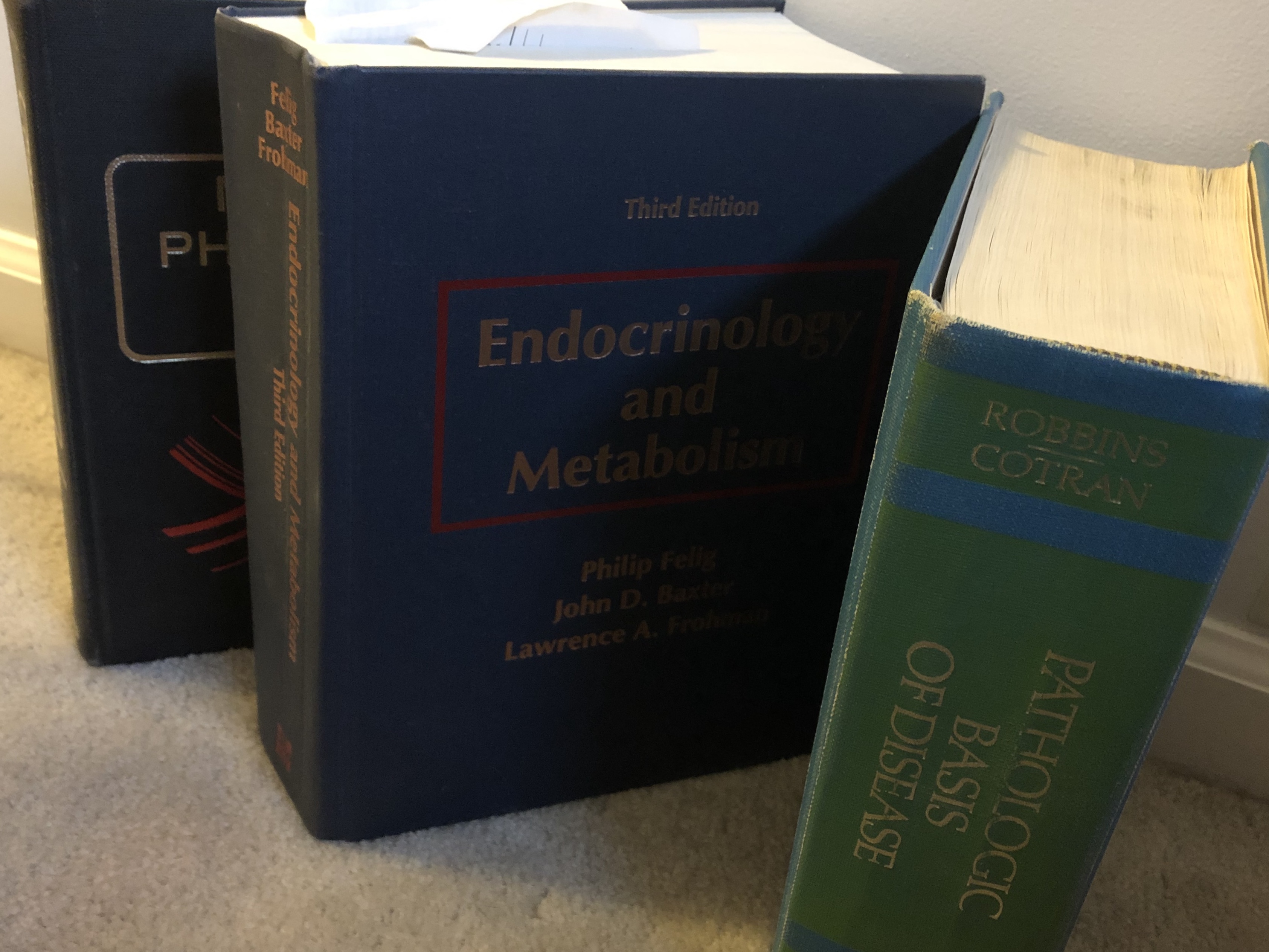
    These were some of the thick books Gary lugged around.

    The first two years of medical school were comprised of traditional classes. Gary lugged huge, thick texts on biochemistry and anatomy and physiology to and from the apartment – sometimes to one of the libraries on campus, more often downstairs to a room in our building. Ruskin Hall, where we lived, had a lounge on the first floor that was good for studying. There was a long wooden table with sturdy chairs and some more comfortable chairs against the walls. It was never terribly crowded, but there were always some people studying there. When he wasn’t in class or lab, that’s where I’d find Gary. It became a routine: every evening around 8:00 I’d bring him a cup of Maxwell House International Suisse Mocha (the instant mix). We’d touch base for a minute or two and then I’d go back up to the apartment, watch t.v. or read and go to sleep. I didn’t know what time Gary came up.

    It could be lonely for me. Other than Gary, I didn’t know a soul in Pittsburgh. It took a few months for me to find a job, but even after finding one, it was hard to make friends. I was an outsider at work, being so young, a New Yorker and Jewish (I wrote about that here and here). My colleagues were married, with children and in a different place in their lives. Though it was fine for work, for the most part, I couldn’t make a connection that went beyond a celebratory drink during the holidays.

    We did have a circle of friends from Gary’s class, which included some women. I did become friends with one who was in a similar situation, she worked while her husband went to med school. She was a copy editor at a publishing company. But her life took a major turn when she got pregnant and had a baby during the second year of medical school. We remained friendly, and we socialized as couples, but she, understandably, was preoccupied.

    I tried some different things to network and branch out. I joined a group called Women in Community Development and edited their newsletter. I enrolled to get my PhD in Public Administration at the University of Pittsburgh and took a few classes, while working full time. I joined a gym near work. None of those efforts led to the kind of connection I wanted. Looking back, I think my loneliness and sadness were more about my general melancholia, not yet treated with medication.

    I muddled through, trying to be as supportive of Gary as possible, while simultaneously leaning on him to fulfill all of my emotional needs (perhaps a contradiction in terms). The third year of medical school brought new and different challenges. Gary began rotations in the hospitals, each one exposing him to another specialty. Most med students, early on, made a choice: medicine or surgery. There were many specialties within each of those two branches, but the two areas called upon different skill sets. Surgeons tended to be action-oriented, take-charge, fix-it kind of people. Internal medicine drew problem-solvers, relationship-focused, detail-oriented folks. There was some trash talk between the two groups, with those choosing medicine disparagingly referred to as ‘fleas.’ I don’t recall a pejorative assigned to surgeons, but the general idea was that they wanted to operate first, ask questions later.

    Gary chose medicine, not surprisingly. As a result, the medicine rotation loomed large for him. He was determined to ace it. It was the longest rotation, lasting almost three months, taking him to different hospitals with a long stint at the VA. The hours were brutal. Gary would leave the apartment at 6:00 am and get home around 9:00 pm, if not later, and then he would read/study. I don’t recall him having weekends off, and if he did, they were spent studying. There was just so much to learn.

    One night, tired of eating dinner alone and feeling resentful, I asked Gary if he had to keep these hours. “Can’t you cut back a bit? Does everyone do what you’re doing?” Gary carefully explained to me that this was time-limited, the rotation would end. He felt he needed to go all out because it would be important for future choices. If he wanted to get a residency placement of his choosing, the better he did in this rotation, the more options he would have. I didn’t know it then, but this argument would become a recurring theme in the first ten years of our marriage: me questioning whether Gary’s long hours were necessary. This time I told him I understood, and tried to suck it up.

    I don’t know how he did it, I barely made it through the ordeal. I have this unfortunate tendency when in a dark period to feel like it will never end. I find it a challenge to see light at the end of the tunnel. Fortunately, that isn’t a quality Gary shares – he certainly wasn’t seeing much light, literally or figuratively. It was the fall, he left in the dark and came home in the dark and spent most of his time in the dim fluorescent light of hospital wards.

    Finally, the rotation came to an end. I arrived home from work and found Gary already in the apartment. This was a major step forward, he was never home before me. I hung up my coat, went to the bathroom and came out to greet him. He was standing by the kitchen sink, taking a glass of water, but looking quizzically at me.

    “What?” I asked, feeling like I must’ve missed something. Turned out I had.

    “Did you go into the bathroom?”

    “Yes, why?”

    “Go in there again.”

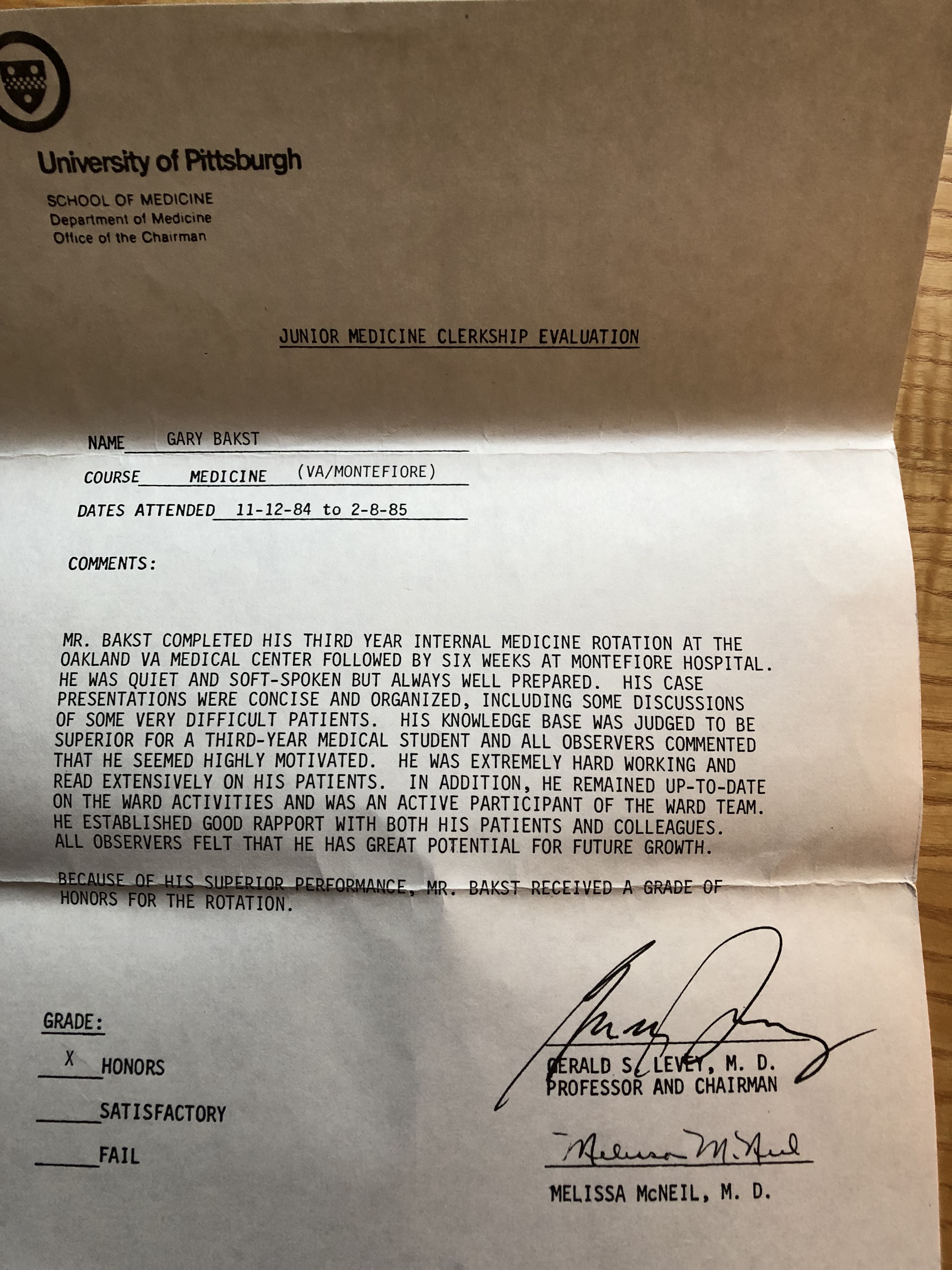
    I was perplexed but I did as he asked. I looked up and taped to the mirror was a piece of paper. I don’t know how I missed it the first time, though I do try to avoid mirrors. I recognized the format – it was the end of rotation evaluation. Gary got honors in Medicine! I screeched and jumped up and down. I threw my arms around him. We danced around the apartment. I later learned that Gary was one of only four students (out of 140) to achieve that distinction. Gary was well on his way to leaving his ‘imposter syndrome’ behind, and hopefully getting a choice residency when he graduated.

    MUFlJNoXRWeVzOualO7FBw
    The form that was taped to the mirror.
  • I am working on a piece that continues the medical school thread, but it isn’t ready yet. In the meanwhile, I wanted to share more thoughts on and images of Central Park. I’ve written about my love for the park before here.  On Black Friday, rather than shopping, we went for a walk in Central Park. Under the best of circumstances I don’t like shopping. To borrow a line memorably delivered by Jack Nicholson in Terms of Endearment, “I’d rather stick needles in my eyes…” than go to the mall on Black Friday. Gary and I find that line to be quite useful and it applies in this case.

    Though the weather wasn’t perfect, it was gray and cold, the park still offered a lovely respite from all the holiday stresses and strains. Plus I could tell myself I was walking off some of the stuffing and sweet potato casserole I consumed the day before.

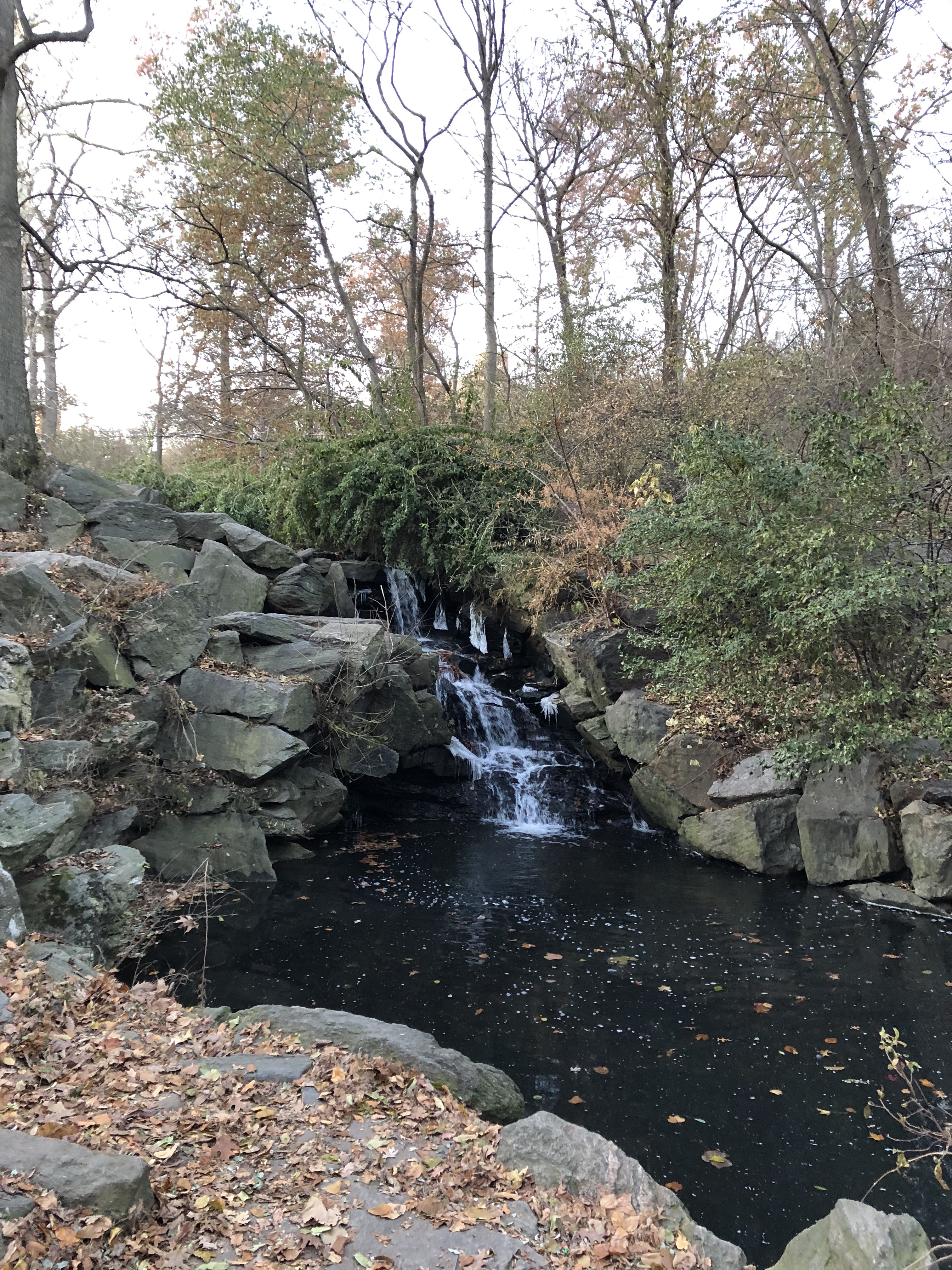
    It continues to amaze me that in the midst of New York City chaos, I can find a wooded landscape. Here are some images from our foray into the park.

    HMoLu7BTRBiCLOZHyH5NFg%Cz2SEMkQRWd1HLBQHlqJw

    To add to my joy, our daughter joined us.

    SYDHBGv7TpenGNwTEXxkfA

    It was a wonderful Thanksgiving. My father-in-law, rapidly approaching his 96th birthday, my mother-in-law, on her long Alzheimer’s journey, my grandchild and children, as well as Gary’s siblings, were able to join us. 13 of us squished around a dining room table in a New York City apartment. Traffic cooperated. Parking spots were found. The food was plentiful. The stars aligned. I knew my brothers and mom were happily celebrating Thanksgiving with family in Buffalo and New Jersey respectively. All was well in Linda’s universe.

    And we took a walk in the park. What could be better? I am so very grateful.

  • One challenge in writing this blog is that it is disjointed. I’ve jumped around quite a bit, while still trying to follow some threads in a coherent way. I appreciate you readers taking the journey with me. Hopefully it hasn’t been too confusing!

    In preparing to write this piece, I reread a bunch of posts to remind myself what I had covered. I don’t want to repeat myself, but I also want to make sure that each essay stands on its own. Please feel free to comment or message me if you have questions or if I’ve lost you! I welcome the feedback.

    I’ve written about the ‘tense conversation’ (read here) Gary and I had about his applying to medical school. With all that went into the application, and all the pressure he felt, medical school presented quite a test – to Gary, to me and to our relationship.

    Gary sailed through high school with minimal effort. He needed only a bit more energy to get through college. He began medical school not knowing how smart he was and without well-developed study skills. I think to some degree he had ‘impostor syndrome,’ he didn’t know if he belonged or deserved to be there.

    Plus, he had his father’s hopes and dreams (and money for tuition!) riding on his success. Not too much pressure! Fortunately, Gary rose to the challenge. He not only met it, but he excelled. He set a brutal work pace for himself to achieve it.

    As I wrote previously, Gary and I drove a U-Haul from Queens to Pittsburgh in August of 1982. We parked the truck in front of Ruskin Hall in Oakland, the neighborhood which the University of Pittsburgh occupies, and got the keys and went up to the apartment.

    IZVw8UWASsyLJG8vQhdLrA
    Ruskin Hall – photo from University of Pittsburgh website

    Gary and his parents had traveled to Pittsburgh earlier in the summer to select the apartment, this was my first time seeing it. I was pleasantly surprised, and a bit overwhelmed. Tears welled as I looked at the high ceilings, huge windows, hardwood floors and spacious bedroom and living room. It reminded me of an upper west side of New York City pre-war apartment and I hadn’t expected something so nice. I couldn’t believe this was going to be Gary and my first home together. I wasn’t actually moving in with him at that point, I was going to join him later, but I knew it would be ours. I wanted to get at least six months in my new job before moving on, and Gary needed to get acclimated to medical school on his own. I knew I would be joining him in the not too distant future and I had no expectation that we would have such a nice apartment.

    We moved the furniture in, which wasn’t much, but he had the essentials. We went to the nearest mall and bought some other items, including a phone. One of those new-fangled portable models that we plugged in and didn’t think anything more of it. After finding a grocery store and stocking the pantry and refrigerator with things he could easily prepare, I took a cab to the airport and flew home. I was sad to say goodbye, but fortunately airfare from New York to Pittsburgh was $29, thanks to PeopleExpress and US Air. We planned that I would visit once a month. We also planned to talk on the phone every few days and set our first phone date for  Tuesday evening at 8:00, two days from then.

    I went back to work on that Monday and pined for Gary. I couldn’t wait to talk to him. The appointed hour couldn’t come fast enough. At 7:59 on Tuesday evening, I picked up the phone in Canarsie and dialed Gary’s new number in Pittsburgh. The phone rang and rang. I counted 20 times. I hung up and dialed again and let it ring another 20 times. I was worried (was something wrong? Was he sick?). I was angry (how could he forget that we had a phone date?) I was confused (what should I do? There was no one to call to check on him). I kept trying. Eventually, he answered and he had a story to tell.

    Gary was in the apartment, waiting for my call, keeping himself busy by refinishing a wooden desk that he had brought from home. He heard a chirping sound. Perplexed, he walked around the apartment trying to locate the source. It was a persistent, annoying sound and he wanted it to stop. He determined that it was coming from the smoke detector (also a new-fangled device in those days). He took the step ladder and tried to reach it to disconnect it (the downside of those high ceilings). No luck. The sound stopped, but then resumed. He got the broom and took the stick and pummeled the smoke detector. It fell to the floor, but the sound began again. It finally dawned on him that it wasn’t the smoke detector, but rather it was the new telephone. In the two days that he had been in the apartment it hadn’t rung once, so he had no idea what it sounded like. We were all used to the sound of the classic bell that our phones at home used when they jingled. This phone sounded more like a bird tweeting in a high pitched insistent tone. Meanwhile, back in Canarsie, I was in a panic. I was ready to be furious, until I heard his story. Then we started laughing. Though he had mangled the smoke detector, he was fine and would have the sound of that phone chirping imprinted on his brain forever.

    It was a minor but amusing misunderstanding. We managed to communicate more successfully through that first semester. Gary wrote me a letter every day (I guess we shouldn’t be surprised that he writes the kids an email every day). I was a faithful correspondent, too. And, we had no further problems with the telephone. That isn’t to say that we didn’t have our struggles during his four years of med school, but more on that next time.

  • I have just returned from an epic trip, as you likely know if you are a regular reader of this blog. I love seeing new places and it doesn’t have to be some exotic port of call. I get a lot out of seeing small towns in upstate New York. I still do some consulting for the New York State School Boards Association and that often requires driving 3-4 hours in various directions around the state. Anytime I can see a new town, I am interested. My most recent engagement took me to Warsaw, New York. The route to and from that town went through the Finger Lakes. On the trip out I took the most direct route, the New York State Thruway, which is not the most fascinating ride – partly because I have traveled the length of the Thruway many, many times over. On the way back, though, I took Route 20 part of the way so that I would drive past some of the lakes. I also made a stop in Seneca Falls to pay my respects to the courageous and visionary suffragettes.

    I walked the Main Street of Seneca Falls looking at the shops and cafes. I went into the little museum and I walked along the river. I am always drawn to sculpture gardens and the local map indicated that there was a sculpture trail along the river. Who knew? I followed the trail and found some lovely spots.

    I find the display of both natural beauty and human creativity very satisfying – it celebrates the best things in life. I had lunch in a small cafe and then got back on the road. I drove briefly on a rural route to get back to the Thruway and made my way home.

    Travel is always a balancing act. The desire to see things and the desire to get where I’m going. Most often there are time constraints – appointments to attend, chores to be done, cats to be fed, responsibilities to meet. But sometimes it is the stress of knowing all that stuff awaits, rather than actually having a deadline. I feel the weight of a deadline, but there really isn’t one. I wonder if I can take more time to smell the roses, so to speak; make more stops along the road to see the unique and interesting places off the beaten path.

    There are other things to balance when traveling. Gary and I took a tour of Spain a while ago, and again on this most recent Mediterranean cruise, where we spent a day in each city (not even a full day). There were quick hits. On the cruise we saw: Barcelona, Valencia (actually I missed Valencia because I was sick, but Gary saw it), Benidorm, Gibraltar, Malaga, Marseille, Villafranche, Nice, Pisa, Florence, Rome, Naples and the Amalfi Coast!! In less than two weeks!!! There are pluses and minuses to that type of trip. We saw so much. We got a taste of so many places. But there wasn’t much time in any spot – there is so much more to see in Florence, Rome, Malaga and Barcelona, in particular. We went to one museum – to see David by Michelangelo. In theory, in getting the quick hit, we can decide to go back to explore more, but given limited time and resources, is that realistic? Is it better to go one place and spend a week? Given how little vacation time most people have, what is the best way to go – see a breadth of places or have a more in-depth experience? Of course, there is no right answer, just a matter of personal preference, I suppose. And, I am well aware that it is a luxury to even be able to ask the question.

    When we were walking along the seaside in Benidorm (which is on the Costa del Sol of Spain), my brother-in-law mentioned that he didn’t find resort towns very interesting. I could see his point. There is a beach, hotels, condos, shops and restaurants – not all that much different one from another. And resort towns aren’t really examples of how people in a particular country live, it is how they vacation. On the other hand, the flavor of each place is different. The landscape varies and is often beautiful (which is why people vacation there!). Some scenes of the Costa del Sol, the French Riviera and the Amalfi Coast:

    How do you feel about that? Is it interesting to you, or would you rather skip those places (unless you are going to a resort for a beach vacation)?

    There were other differences in approach to travel between myself and my brother-in-law. He would often make conversation with others in our tour group or with waitstaff. It isn’t my impulse to do that. I see lots of positives in chatting with other people, but I am not that comfortable doing it. I don’t think I’m unfriendly, but it isn’t my instinct to initiate a chat. This characteristic isn’t about travel per se, but it is more on display in that context. In my day-to-day existence, if I am waiting on line or when I was in that cafe in Seneca Falls, I don’t try to make conversation with people I come across. I guess I’m wondering if I would enjoy it if I made more of an effort, or if I am comfortable this way. I don’t believe there is a right a right or wrong, just pondering (as I often do).

    I can’t wait for my next trip – wherever it takes me!


  • I am still on a break from writing. But, I am taking in the sights, sounds, smells and experiences of traveling – so I will have more to write about in the future! In the meantime, here are some images from the trip so far.

    9dFpWWf%SQaC11RwLO8j5A
    Benidorm, Spain

    tdPAXcUSTKSK+IVZF7xrFg.jpg
    Market in Malaga, Spain

    1VamfgenRjmHm75MPfMM7g.jpg
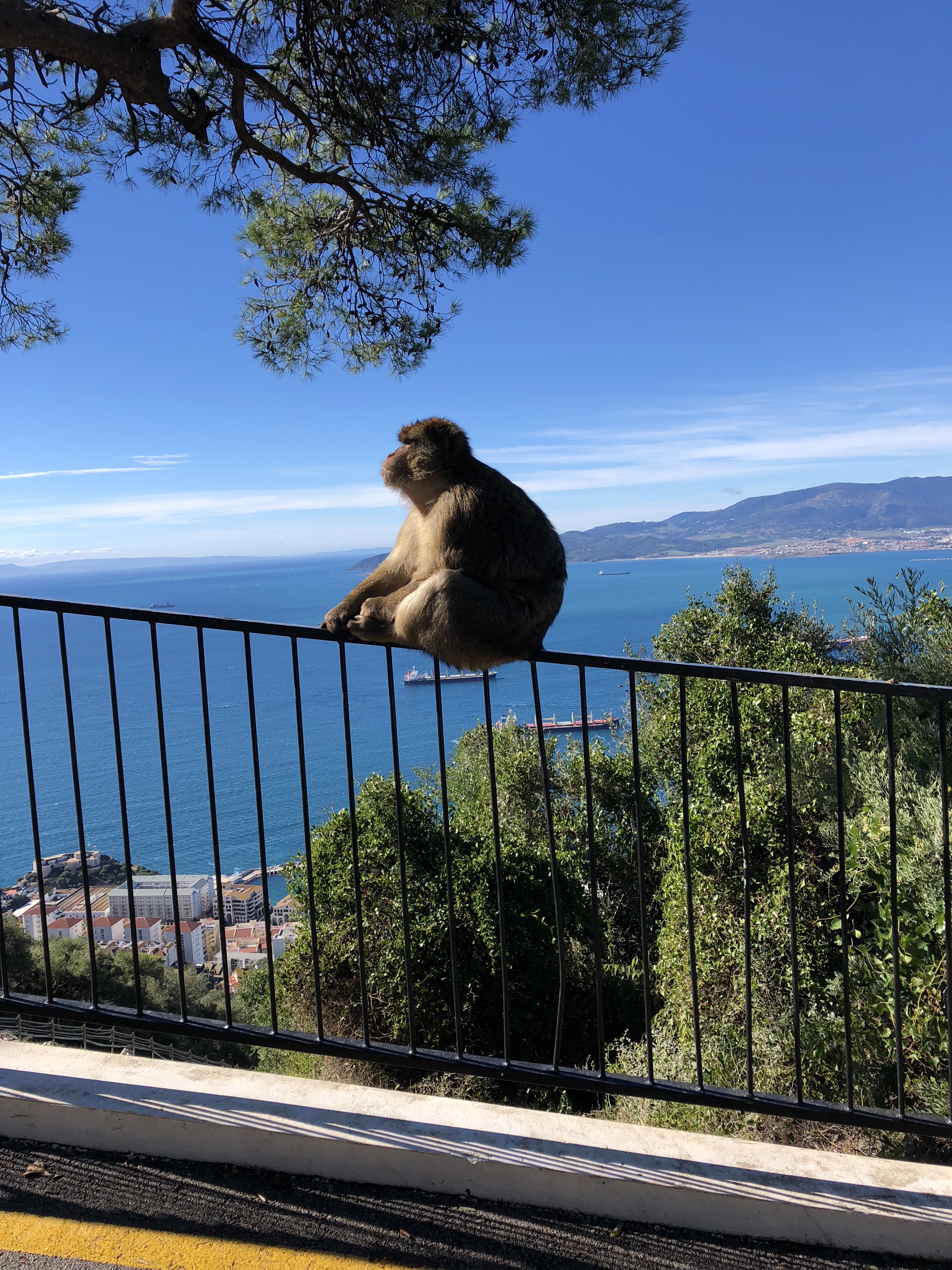
    Barbary ape (actually a monkey), Gibraltar

    rNk%KjDNQU2XfPpLm9W3lQ.jpg
    Mediterranean skies from the ship

    I’ll be back next week.

    One final reminder, please vote tomorrow!!!!


  • Somehow, after recounting the drama and trauma of my in-laws journey through an anti-Semitic landscape, the events of this past weekend are crushing to me. It is a terrible reminder of our need to be vigilant in the face of hate and violence. I can only hope that we, as a country, will turn the tide. I hope the coming election sends a clear message. Please vote – and please vote for change.

    Although I have covered the broad strokes of the Bakst family’s story, I do have a few more essays to write on that topic. I have learned a lot in the process of researching and listening to David’s stories, and I have thought quite a bit about the meaning of his and Paula’s experience that I would like to share.

    But, first, I am taking a short break. In fact, I write this from Barcelona, the first stop on a Mediterranean trip. Lucky me! Don’t worry, though, I voted by absentee ballot and so did Gary!

    Some views of Barcelona:

  • What is left to tell? Paula and David began their life together in Queens, New York. David continued working at the pickle factory. Paula was a homemaker and managed their finances. She was very frugal and even with David’s modest earnings, they were able to put away some money. Eventually they bought a car, and a few years after that (in 1963), they were able to buy a house in Rosedale, Queens. Rosedale bordered Nassau County, Long Island and had the look and feel of a suburban neighborhood, even though it was in the New York City limits.

    QmWOeXAiThuxXtCUpOrQRA
    The Bakst house in Rosedale, pictured in 2018. Photo captured from GoogleMaps. David sold the house in 1990 (give or take a year).

    Their oldest child, Rochelle, arrived 18 months into their marriage. Paula’s mother and sister, Lea and Sofia, flew up from Cuba to meet the newest generation of their family. Four years after that, in 1956, Paula and David’s first son, Steven, was born. Lea and Sofia came north again, this time on permanent visas. They stayed and lived with David and Paula. It was tight quarters, six of them, in their small apartment with one bathroom, but it was nothing they couldn’t manage given all that they had been through.

    Gary arrived in 1959 and was the baby of the family for 8 years, until Doreen entered the picture. Now the Bakst family was complete. David, as he envisioned when he spoke to Uncle Nachum years earlier, moved up to become the general manager of the food distribution company that the pickle business grew into.

    In their early years in New York, David and Paula attended night school to learn English and, in time, they became United States citizens. They straddled two worlds. They were a product of their Eastern European shtetl childhoods, a world that had been destroyed by the Nazis, and they bore the scars of that trauma, and now they were trying to fit into the modern American society of the 1950s and 1960s. They embraced much of what America offered, but were also anxious about their ability to understand American institutions. They continued to seek out the company of family and friends that shared their shtetl experience. The generation gap, a common experience of that era, was alive and well in the Bakst household.

    Not too long after her arrival, Sofia met and married Marvin Bressler, and began her own family. The Bresslers also settled in Rosedale. They had three children, a girl and two boys.

    Lea continued to live with Paula and David, until her death, of a brain tumor, in 1973. She was 80 years old. She was the only grandparent the Bakst children would know.

    Bernie didn’t leave Cuba until after the communist revolution in 1959. He was a businessman enjoying his life in Havana, and in the immediate aftermath of the overthrow of the Batista government, Bernie made a lot of money. With some reluctance, he, along with Nachum, Bushe, Solomon and Mary, left for Florida. The aunts and uncles, and their children, settled in North Miami Beach, a community of Cuban-Jewish exiles. Over the years, Paula and David would visit when they could. Nachum lived a long life, well into his nineties.

    Bernie eventually moved further north and became a successful businessman, marrying, and starting a family in Woodmere, on Long Island (a short distance from Rosedale). He and his wife had two children.

    As a result of their extended time in Cuba, Bernie and Sofia, in particular, developed an affinity for its culture and maintained a connection with it throughout their lives. As part of his business in America, Bernie owned a warehouse in Union City, New Jersey (a community with a lot of Cuban immigrants). Gary worked there a couple of summers and has vivid memories of the experience. Gary commuted from Rosedale to Jersey, with his uncle. Bernie drove like a maniac, waiting until the last minute to dart across three lanes of traffic to get to the exit of the highway. And, Bernie would play a game with the tolls at the bridges, tossing one coin at a time, hoping the wooden arm would go up before the full fare was paid. Bernie employed a number of Cuban men at the warehouse. Gary remembers the men cooking a communal lunch, pork spiced with garlic, pepper, onion and coriander, as well as the smell of strong coffee. Gary also picked up some Spanish words that weren’t taught in high school.

    David’s sister, Batya, lived in Israel for 7 years, with Fishel and their daughter Rochelle. Batya left Israel and came to the United States to get a divorce (she wasn’t able to get a divorce in Israel). She lived with David and Paula while she waited for it to go through. After a year, Rochelle joined her mom in New York. Though Batya regretted leaving Israel, she felt she had no choice. In time, she remarried and had a son, Ben, and she became an educator. She and her family lived blocks away from the Baksts in Rosedale.

    Batya carried her own brutal memories, one of which she shared in a speech she delivered at the Rosedale Jewish Center, where she was being honored as a woman of valor. With her children, Rochelle and Ben, in the audience, Batya recounted her time in the work camp (the one she was miraculously rescued from by the Iskra Partisan Brigade). She told of one particularly horrific experience. She was walking across the camp compound and she heard a slight thud and a small mew as a piece of balled up laundry fell to the ground nearby. Batya didn’t see who had dropped it and thought it might be a kitten so she bent down to see what was in the bunched-up fabric. She found an almost newborn baby girl, barely alive, seemingly frozen. Without thinking, Batya quickly scooped her up, held the bundle to her chest and hurried to her bunk. She tried to warm the baby. Over the next day or so, Batya smuggled water and milk and fed her as best she could. She seemed to be reviving, and Batya named her Ilana. She didn’t know what she was going to do with her, she was just going from moment to moment trying to protect the baby. At one point, much to Batya’s distress, Ilana started to cry, bringing a German soldier to investigate. The soldier grabbed the baby, and to Batya’s everlasting horror, he plunged a bayonet into her. Batya shared this memory from the bemah in the synagogue. It was the first Ben, who was about 14 at the time, had heard the story. Though he knew his mother had endured suffering during the Holocaust, he didn’t know the depth of her anguish until then. Batya died of a rare type of cancer in 1982, she was 57 years old. Her daughter, Rochelle, lovingly cared for her in her final days. When Ben became a father himself, he and his wife named one of their sons after Ilana.

    Paula and David didn’t often speak of their wartime experiences with their children. For the older children, Rochelle and Steven, the impact of the trauma was more apparent. Paula was still having nightmares when Rochelle was young. Gary and Doreen were more removed from it, as Paula and David healed and as their economic circumstances improved. All four of the children, though, were acutely aware of the legacy they carried.

    Out of the ashes of the destruction of Ivye and Sernicki, new generations took root in America. The Baksts and Silberfarbs had 11 children, who in turn had 15 grandchildren and, to date, two great-grandchildren.

  • Note: One of the greatest sources of pride and joy for Paula and David are their four grandchildren, each accomplished in their own right. Laura, third oldest and the daughter of Gary’s brother, was kind enough to contribute this piece. 

    Nearly five years ago, I made my way across rural Germany to visit my great-grandfather’s grave. While the trip itself took only a few days the process started months earlier in New York, when my Poppy (grandfather) presented me with a disintegrating photograph of his father’s tombstone and the knowledge that it was located in a Jewish cemetery near Kassel, Germany.  I could tell that at the age of ninety Poppy was still haunted by not knowing what came of the grave that he last saw over sixty years ago. I also knew that given my upcoming travels to Israel and Europe it was likely the only opportunity I’d have to locate the grave in the near future, and possibly in his lifetime.

    Over the next few months I sifted through archives, including multiple visits to Yad Vashem (Israel’s holocaust museum), attempting to find records on my great-grandfather.  Eventually I stumbled upon a German database of abandoned Jewish cemeteries. With the aid of Google Translate, I managed to obtain location information for a gravestone that appeared identical to the one in my grandfather’s photograph. It was in a cemetery in Hofgeismar, a small town in Northern Germany.

    Fortunately, it was relatively easy to tack on a detour to Hofgeismar between trips with friends to Berlin and Amsterdam. Nevertheless, I was still nervous to be traveling across Germany on my own; I was the first in my family to return to the country since WWII, did not speak the language, and was traveling in areas not frequented by tourists. Fortunately, the kindness of others made the process a bit easier: I had made a few German friends while I was studying in Dublin who helped me book trains. Julia, a woman who volunteered at the Jewish Museum in Hofgeismar, was generous enough to not only respond to my cold-email inquiring about the cemetery, but also coordinate my entire itinerary for the day in Hofgeismar (unfortunately I was not able to meet her in person as she was traveling for a conference in Israel at the time).

    Around 6:45am on a brisk October morning, I left my friends in Berlin and anxiously entered a metro station. True to Germany’s reputation, the four separate trains I took were impressively prompt. After making it to Hofgeismar, I met Mr. Burmeister, the Jewish Museum’s director, who drove me to the cemetery.

    fullsizeoutput_794

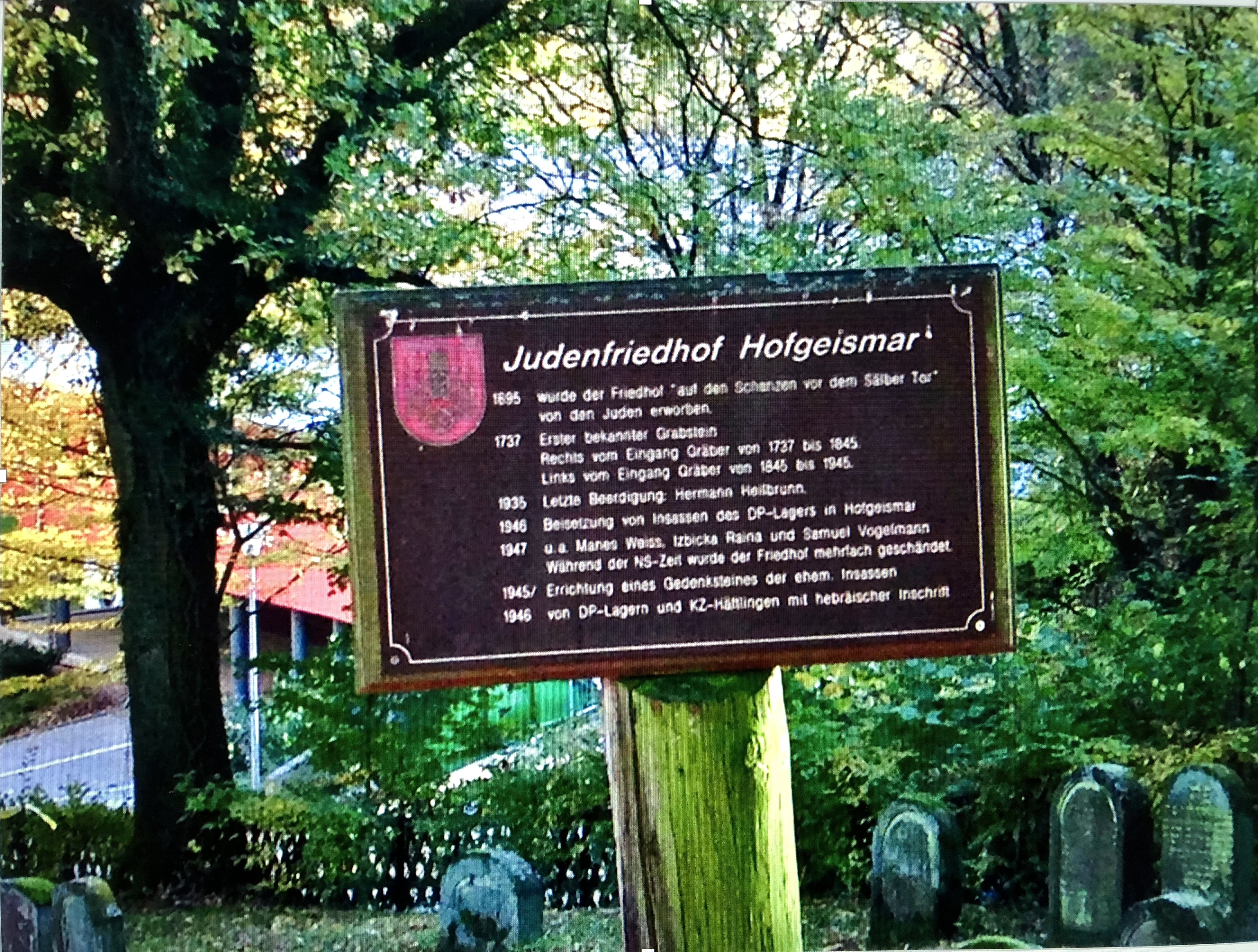
    I didn’t really know what to expect, but I recall being surprised by the beauty of the place. Though obviously aged by the elements, the gravestone was completely intact, with the inscription still easily readable.

    fullsizeoutput_795

    The small cemetery was in a lovely location, overlooking gorgeous valleys and blanketed by colorful leaves.

    fullsizeoutput_798

    Following the Jewish tradition, I left several stones on behalf of my family on the gravestone. Across from my great-grandfather’s grave there was a small hill, below which a number of stones from the 1800s once stood. Unfortunately, they were destroyed during WWII (the cemetery houses Jews from after the war and pre-1936), so Mr. Burmeister showed me the memorial stone erected in their memory the prior year (2012).

    Mr. Burmeister gave me a tour of the small but substantial Jewish museum, in which we had an interesting conversation about the Jewish history in Hofgeismar and his interest in the subject as a non-Jew. While there are no longer any Jews in Hofgeismar, before the War it was home to one of the highest percentages of Jews in Germany (10%).

    iq8%AtghSM+mXOlhooBd2w

    Julia’s friend, Gabriele also showed me around Hofgeismar. We walked down to where the community temple once stood, now destroyed. We also drove through where the displaced persons camp used to be, the same camp that my grandfather stayed in after my great-grandfather died from surgical complications. The grounds are now being used for a school and police station.  The town center was exactly as I’d have pictured it, with lovely sculptures and traditional German buildings.

    fullsizeoutput_799.jpeg

    Gabrielle pointed out some of the homes where Jews once lived, in front of which small metal squares note their names, dates of birth and death, and what occurred to them during the war. I remembered seeing similar stones in Berlin, and Julia explained that they are becoming more common as people are more open to uncovering that their homes may have been taken from Jews.

    fullsizeoutput_79a

    While the entire trip was extremely meaningful, what struck me the most was how seriously modern-Germany takes addressing its history. Unlike in America, it’s illegal to deny the Holocaust, display Nazi symbols, or otherwise incite hatred based on religion or ethnicity. All schools deeply educate students about the Holocaust, leaving my German peers more knowledgeable about it than me. People like Mr. Burmeister and Julia chose to dedicate their time to preserving the Jewish history in a small, now Jew-less town. Mr. Burmeister’s parents had no familial connection to Judaism, but rather his interest in the subject was peaked as a schoolboy studying German history. A teacher from a neighboring town told me how she believed it was important to expose her students to Jewish culture early on, bringing her class of 8-10 year olds to the Hofgeismar Jewish cemetery and Museum for a three-day workshop. Through tears she explained that she educates others about Nazism because her daughter has a disability and likely would have been killed had she been living during WWII.

    Note: Laura is quite correct in saying that David was haunted by never having gone back to see his father’s grave. In going through the effort of locating and visiting the site, Laura did a mitzvah (good deed) that brought her grandfather comfort. Thank you, Laura, for doing that and for sharing this story on my blog.

  • Note: At the end of this piece, Gary offers his perspective.

    It was the beginning of our relationship. Gary and I had long conversations about our histories, comparing our families, and sharing our dreams for the future. I knew the broad outlines of his family background, that his parents were Holocaust survivors who had not been in concentration camps. But, I didn’t yet grasp the impact of that on Gary. On one particular autumn night, with a particular conversation, I touched a nerve and, thus, I began to learn.

    We were in the living room of the apartment that he shared with two friends. It was late at night, as it often was in those days when we hung out and talked into the wee hours. I was sitting on the floor with my back against the chair he was sitting in, his legs framing my arms.

    It started as an innocuous conversation, at least it seemed so to me, about his need to take the MCATs (the medical school entrance exams) and the timing of the test.

    A little background might be helpful. Most pre-med students take the MCATs at the end of junior year so that they can apply to medical school during senior year. This sets them up to go directly from college to med school. Since med school is four years and there is additional training required beyond that, which often takes anywhere from three to ten years, many want to be as efficient with their time as possible. Unfortunately, Gary wasn’t in position to do that. His junior year had not been terribly successful. He lost motivation and stepped off the track he had been on, and didn’t take the MCATs. It was now the 1979-80 school year, our senior year, and the test wasn’t available to be taken very often. I think it was offered maybe twice a year. Gary’s next opportunity would be in the Spring, but he hadn’t filled out the application yet.

    In order to take the test, Gary had to fill out some paperwork, write a check and mail it in. Paperwork wasn’t a strong suit for Gary, as I was beginning to learn. But, it turned out there was more to his procrastination than met the eye.

    “So, let’s fill out the application now and you can mail it tomorrow,” I helpfully suggested.

    “You don’t understand,” came the testy reply.

    “What do you mean?” I asked, moving to turn around to face him.

    “You don’t understand the pressure I am under,” his voice was tight. I heard anger, frustration and anxiety.

    “Explain it, then.”

    Explain he did. A torrent of words describing high expectations placed on him from as early as he could remember. “It’s good to be a doctor,” his father, David, told him when he was in Kindergarten. It was an idea David repeated regularly over the years. Gary was a good student, it was clear he was intelligent from the get-go. The seed was planted early and his father could be relentless. It was assumed he would go to medical school.

    This story isn’t unusual among Jewish families. Many children were on the receiving end of those messages. My response, thinking I was supporting his vision for himself, was to say, “But you can do whatever you want! You don’t have to be limited! You don’t have to be a doctor.”

    “You’re not hearing me!” Now he was angry. Gary didn’t, and doesn’t, get angry often. He was angry now.

    “I feel like I do have to be a doctor! I will disappoint my father, let down my entire family, if I’m not!” He went on to describe how things went at family gatherings, how it was assumed he was on track to go to medical school. His parents, not aware of the particulars of college and graduate school, didn’t know where Gary was in the process. He was carrying 22 credits that semester (and would have to carry an equivalent load again the next semester), to make up for junior year and to graduate on time. He explained how so much was wrapped up, for his father in particular, in his earning a medical degree.

    At first, I stuck to my thought that Gary could do what he wanted. “You’re great at explaining things. You could be a great science teacher,” I said. After all, I was thinking, both of my parents were teachers. I thought it was an admirable profession.

    “You’re still not getting it!” Gary exploded.

    I recoiled at the power and emotion behind his words. I retreated, “Okay. Okay.”

    We agreed that it was late and we weren’t going to solve anything in that moment. I told him I wanted to understand, and we could talk again after we both got some sleep. We said good night and I went back across the hall to my apartment.

    It was the beginning of my understanding the impact of his parent’s Holocaust experience on Gary and how it shaped him. No child wants to disappoint their parents, I certainly didn’t, but there was a more intense sense of responsibility and deeper obligation for Gary, knowing how much his Mom and Dad had gone through, how much they suffered. Gary had this opportunity that they never had, and he felt a duty to make the most of it regardless of his own wishes. I was beginning to appreciate the weight of that.

    I think our conversation was also a step along Gary’s journey to sort out what he actually wanted for himself and what others expected of him. He began to acknowledge that it was okay to factor in what his father wanted, after going through an internal rebellion. And, over the course of the next two years, it would become clear to him that he did want to be a doctor.

    Of course, there was also all the other anxiety that every pre-med student deals with: getting good grades, scoring high enough on the MCATs, getting into a program (preferably in the United States!) and succeeding in one. Under the best of circumstances, it is a fraught journey. Not nearly as fraught as the journey his parents had taken, but challenging nonetheless.

    Some thoughts from Gary:

    We all should pursue our own dreams.  Right?  That seems straight forward enough and yet that very question was at the heart of my dilemma back when Linda and I had that tense conversation.  To be fair, that idea, the belief that each of us can and should do what we want to do, is something that many in the world would find laughable. It is a luxury many don’t have.

    Many people are just trying to survive and it is for those who are fortunate enough to grow up in the right county and in the right circumstances to even think about such questions.  How many people dream of picking up garbage or cleaning hotel rooms?  Of working endless hours picking fruit on farms, or working in mines?  On top of that, many people really don’t have a dream.  We fall into whatever and we do our jobs and earn our paychecks and the world keeps spinning around.

    But back then, I firmly believed I should pursue my dreams.  And, while I had no reason why being a physician couldn’t be my dream, I had one really big problem:  My father wanted it for me more than anyone.  And that left me with the dilemma.  Did I want it or was I doing it for my father?  And how could I do it if it wasn’t for me?  And how could I not do it after all he had been through and all that he seemed to have emotionally invested in my becoming a doctor?

    As it turns out, medical school was four of the best years of my life and being a physician has allowed me to utilize my inclination to think scientifically and serve people in a most important and personal way.  It has brought me a tremendous sense of purpose, a sense of doing something meaningful.  And it has given me financial rewards beyond what I would have ever imagined reaping.  As it turns out, it was the perfect decision.

    But at that time, it wasn’t clear to me whose decision it was; where did my father’s will end and mine begin?  Certainly, complicating all of this was the fact that my parents are Holocaust survivors.  The children (and I’m sure grandchildren) of survivors have common traits.  We tend to be anxious.  We tend to be driven.  We tend to live with the guilt that comes from the fact that we never had to endure what our parents did.  They were getting shot at.  I was more concerned about whether Keith Hernandez would get the lead runner out when fielding a bunt.  They didn’t have food.  I was annoyed when my brother changed the channel on our TV.

    Even now, if you ask me whether I should feel guilty, I think the answer would be yes, I should.

    fullsizeoutput_772
    Graduation day from SUNY-Binghamton, May 1980 – we made it through to the other side of that conversation.