Stories I Tell Myself

Linda Brody Bakst on Brooklyn, growing up, identity and more

  • NOTE: I have changed the names out of respect for the privacy of those involved.

    April 20th marked twenty years since the tragedy at Columbine High School. It was a watershed moment for many reasons. It is one of those times where I remember exactly where I was as the horror unfolded on live television. We were in the living room of our friends’ home on the Outer Banks of North Carolina. Memories come flooding back…bittersweet memories.

    Memories:  Of flying kites on the beach, where we could count on a stiff wind to make it easy to get the kite to lift off, almost taking our children with it!
    1538818_374972795981893_1564844352_n
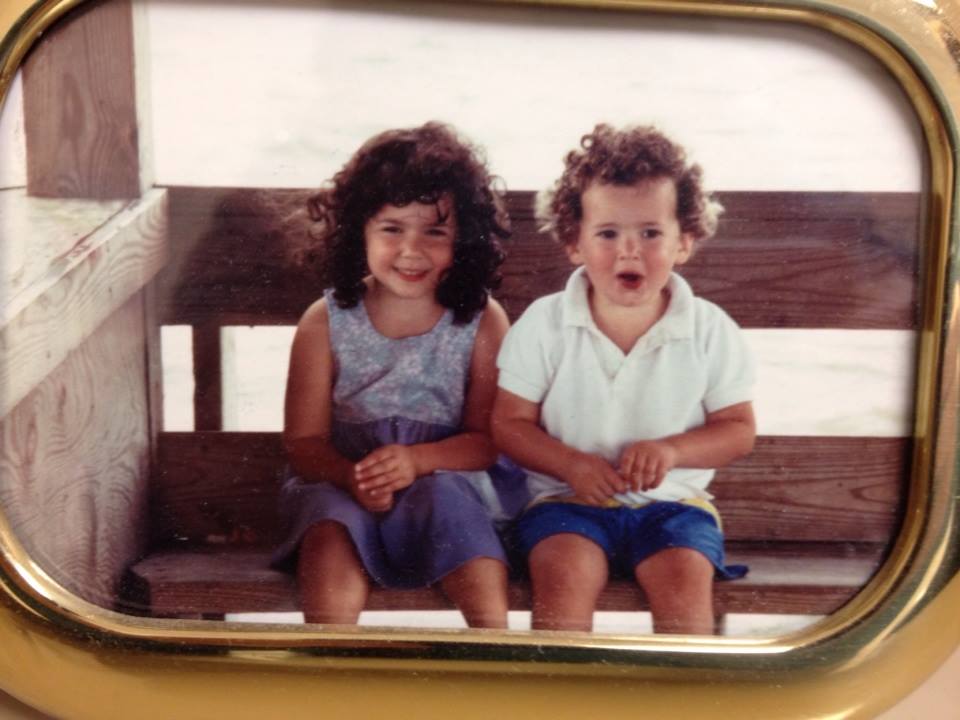
    Leah and Daniel on one of our early trips to the Outer Banks circa 1992

    Of Daniel assuming the pose of a martial arts master to slay the waves. He also had a penchant for chasing sand pipers. I was so relieved when they flew away beyond the grasp of his small hand.

    Of taking Leah and Christine, our friends’ daughter, to the pool – as older girls (four and six) they could swim. They amused themselves in the water for hours.

    Of sunny early mornings, before anyone else was awake, sitting on the deck facing the ocean and reading whatever novel I had brought with me. Our time on the Outer Banks was often my only chance to read a book for pleasure and I relished it.

    Of walking with some combination of our kids the couple of blocks to the shopping area where there was a donut shop. Breakfast was often coffee and a donut.

    Of retreating from the midday sun to the cool of the air-conditioned house for an afternoon nap.

    Of Gary, legs coated in sunscreen and sand, building elaborate sand castles with the kids.

    Of quickly packing up everything and evacuating ahead of hurricane Hugo – which actually missed the Outer Banks and made landfall in Charleston, South Carolina, but we couldn’t take chances with our children. We drove inland through the night and went to the Martins’ home in Maryland.

    When we first went to the Outer Banks in 1989, we rented a house near Duck, we loved the name of the town. Wild horses could still be seen by the roadside. We drove down from Albany, an arduous trip, in our Camry station wagon. It was the first car Gary and I ever bought and we didn’t get air conditioning, thinking we didn’t need it living in upstate New York. Plus, we would save a lot of money, which was still very tight. That was a serious mistake and we paid for it in a myriad of ways, including on those trips. Neither Leah nor Dan appreciated hot air blasting through the open windows as we made our way south on the Jersey Turnpike.

    I vividly recall arriving at the rental house that first time. It was a beautiful home – weatherworn shingles, with multiple decks and, of course, the smell of the ocean coupled with the unique scent of the Carolina lowlands. We went inside and I nearly burst into tears. There was a long staircase to get to the main living area. There were glass coffee and end tables. We had a 7 month old (Dan) and Leah was two and a half. A week of keeping Leah and the other kids safe from falling down those stairs, or banging into the glass tables flashed before my eyes. Gary and Evan, his buddy from medical school, ushered me outside while they quickly moved the tables and did as much baby-proofing as possible. I practiced taking deep breaths.

    It turned out to be a great week and the beginning of something we would do for more than ten years.

    On Tuesday, April 20, 1999 we were a few days into our spring break from school and our friends had, years earlier, bought a house in Whalehead (a newly developed area on the northern edge of Outer Banks). We were fortunate enough to be invited to continue our tradition of vacationing with them.

    That afternoon, having spent the morning riding bicycles and playing mini-golf, we were hanging out in the great room on the top floor.  We happened to have the television on, tuned to CNN. We watched as events unfolded in Littleton, Colorado. After leaving it on long enough to understand that it was a school shooting, we turned it off and went about our activities. We didn’t want our children to be distracted or troubled by the images.

    I remember being angry – at the gunmen of course, but also at the media coverage. They didn’t know what was happening. They were broadcasting live coverage from a helicopter – but the reporters didn’t understand what they were seeing, so they could only speculate. Like a car wreck, it was hard to look away, fortunately we did, eventually. I remember thinking that the speculation of the reporters seemed reckless.

    That tragedy was a watershed moment in many ways. It was my first real understanding of the power and problems caused by the 24/7 news cycle. Since I was a school board member at the time, it represented a major change in the way we thought about school security. And, though it was entirely coincidental, our times going to the Outer Banks were also coming to a close.

    Our children were growing up, beginning activities that would take time and commitment. The Martin children were doing the same. We would need to make difficult choices about how to spend our limited vacation time. There were always some stresses and strains between the kids, and in our friends’ marriage, that sometimes interfered with the fun. Those rough patches were outweighed by the laughter and adventures.  But then tragedy truly struck and things were permanently altered.

    In April of 2003 the Martin’s oldest son, at age 15, was diagnosed with brain cancer. Gary and I visited them in early August and found them shattered by the devastating prognosis. I came back and spent a week at the end of October, to help with their two youngest children (their oldest daughter had started college), so Evan and Amy could tend to their son. It was beyond painful. He died in January of 2004, just shy of his 16th birthday.

    Not only had they lost their son, but their family was irretrievably broken.

    While April of 1999 was not our last time vacationing together, we had one or two more trips, it felt like the beginning of the end of something. Somehow the terrible events of that day and the subsequent tragedy for the Martin family are forever linked in my mind.

     

  • When Leah was born, my first child, I was overwhelmed. Not surprising, most first time moms are. Each time she cried, which seemed often, I would go through the possibilities: hungry? wet diaper? too cold/ too hot? needing to be cuddled? In an effort to bring some order to chaos, I kept a pad where I wrote down how long she slept, how long she nursed, and her diaper production (a nice way of saying her pooping and peeing). Writing it down seemed to help. With time it became more routine, and I relaxed as I learned about my baby.

    I noticed that when Dan and Beth had their beautiful baby girl they more or less did the same thing, but they had an app for that! She is now approaching 11 months, they stopped using the app quite a while ago, as they too eased into parenthood.

    Both my mother and my father-in-law, 85 and 96 respectively, have faced serious health challenges over recent weeks. My mom had an operation to have a cancerous tumor removed from her left lung (the second time she faced this, 3 years ago she had a cancerous tumor removed from her right lung). My father-in-law had pneumonia. He was hospitalized, fortunately briefly, and seems to be slowly recovering. Pretty miraculous – I don’t think many 96 year olds survive pneumonia. They are both progressing in fits and starts.

    My anxiety about their recoveries reminds me of how I felt when Leah was born. A fear of doing the wrong thing, of not knowing what might be helpful, of understanding whether a symptom is serious or not, of not being attentive enough or maybe too focused. You can make yourself crazy.

    So, we have come full circle – concerned about those basic bodily functions. Here’s hoping that they continue to work, and that my anxiety lessens as they do.

    It is times like these that I wish I was a person of faith, but I don’t feel it. When my dad was seriously ill, and it turned out was approaching the end of his life, I had these same anxieties. Though I don’t believe in God (that’s an essay for another time), I found myself offering up a prayer to the universe: give me strength, give me the wisdom to know what to do and have mercy on my father. I silently repeated those words regularly over the course of the weeks. I don’t know if it helped. I did get through it. I offer that same prayer now. I will see this through, too.

    L1sxqGs3SzKyxBhbRdJEvQ
    While Mom was in surgery, I looked out the hospital lounge window and saw this. I appreciated the bit of whimsy in that moment.
  • Scaring kids straight isn’t supposed to work, but it worked on me. There is a school of thought that says that if you present adolescents with a frightening picture of what drug use looks like, it will keep kids on the straight and narrow. I haven’t looked at the data, but I’m under the impression that the strategy isn’t very effective. Maybe because adolescents think they are immortal, that they are unique, can maintain control and it won’t happen to them. Or maybe because they don’t believe the message adults are feeding them. When I was an adolescent, I believed.

    When I was growing up in the early ’70s there were stories about people taking a ‘bad trip’ and trying to fly off buildings – to their death. There were other stories of tripping on LSD and wandering outside naked. I’m not sure which of those scenarios horrified me more. The idea of being out of control, or not being able to distinguish fantasy from reality, was terrifying to me. When there was a rumor that someone had laced the ketchup in Coney Island Joe’s, a neighborhood burger/hot dog place, with LSD, I stayed away for years.

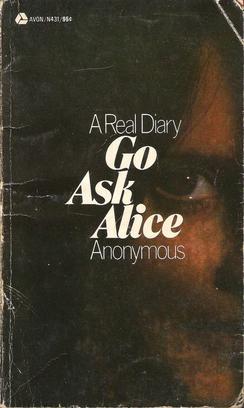
    When I was 12 a book came out,“Go Ask Alice.” It was released anonymously, described as the diary of a real girl who got mixed up in the drug scene. I don’t remember who got the book, my friend Deborah or me, but we were so anxious to read it that we went into her basement and read it aloud. I think we read the entire book that way – in one sitting. We were shocked and disturbed by it.

    Go_Ask_Alice_-_Avon_Books_paperback_edition_cover_art

    The story presented a 15 year old girl, who we could relate to as she struggled with social acceptance, whose first experience with drugs was accidental. It fed into the zeitgeist of the time (not that I knew that word then). After consuming LSD without knowing, she got deeper into the scene. She was new to her town and she became friends with a group of kids who were experimenting with drugs.  It all seemed so plausible to me.

    The worst part of the story was that the diary ended with her clean, starting a new path with new friends. There was a brief epilogue that reported that she died of a drug overdose a couple of weeks later. Deborah and I were devastated.

    I was just starting junior high school and I never felt more alienated. As I have written before in earlier blog posts, Nana, my grandmother and closest companion, had died the year before. To make matters worse,  I was zoned to go to a different junior high school from my classmates in elementary school.  It was a challenging time to say the least.

    Reading Alice’s story, the girl’s name is never actually revealed, we just assumed it was Alice based on the title of the book, convinced me that whatever loneliness I might have felt, befriending kids who were doing drugs was not an option. I think Deborah came away thinking the same thing.

    I’m not sure what reminded me of the book or this issue, but when I did a bit of online research about it, I found some interesting things. Unbeknownst to me, a few years after it came out, there was controversy about whether the book was a real diary or if it was fabricated.  The edition we read had the tag line “A Real Diary.”  (see photo above) It was presented as non-fiction. Lo and behold, when information emerged about the possible author, Beatrice Sparks, it turned out she was a therapist who said it was a diary of one of her clients that the parents authorized her to use. But, apparently Sparks augmented the diary entries. Today the book is still in print, but it is categorized as fiction and includes a disclaimer. Turns out James Frey’s “A Million Little Pieces” wasn’t the first of this kind of controversy.

    Perhaps those adolescents who were skeptical about messages from adults were right. Ironic, isn’t it? I think my fear of drug use served me well, though.

  • fullsizeoutput_d1cI just finished reading She’s Come Undone by Wally Lamb, for the second time. Since I don’t remember much about books I read, it may as well have been for the first time. Anyway, it is a coming-of-age story of a girl, Dolores, which begins when she is about 4 years old. Her first vivid memory is of that age because a television was being delivered to her house, a momentous and exciting event. Her family hadn’t owned one before.
    The television comes to play a significant role in her troubled life as she uses it as an escape. Dolores retreats to game shows and soap operas when her own life became too painful. The book isn’t about the role of television in our lives, but it got me thinking. While I don’t relate to her behavior exactly, I do know that House Hunter’s International and Jon Stewart’s The Daily Show got me through the Bush Administration, Dubya’s that is.

    I have established a rule for myself in this new retired life I lead. I won’t turn on the tv until after 5:00 p.m. I think it is a good rule. I’m still not always productive, after all now social media can be a tremendous time waster, but knowing that I can’t turn to television makes the odds better that I spend my time constructively.  It is too bad I didn’t think of that rule when my kids were little (and there was no social media). Sometimes when I felt drained and unmotivated, I sat and watched talk shows, watching a whole day slip away. And, after watching, I felt yet more drained and unmotivated.

    Thinking about television brought up another issue: the messages we are fed. My view of myself as a woman was certainly affected by the images presented. I have written about this before (here). I certainly couldn’t measure up to the standards of Mary Tyler Moore and Marlo Thomas – though I don’t blame them personally. We were inundated with unrealistic views of women (and men, too, I suppose) in programs and advertisements. I don’t know how much that has changed, though I think there has been some movement to offer more diversity.

    But there is something else in the images that television offers that troubles me. We have read a lot about violence on tv and in video games and how that may desensitize people. But, we haven’t read, or at least I haven’t, about the portrait of the criminal justice system – particularly the police.

    Gary and I, especially Gary, are fans of police procedurals – like the original Law and Order. We watched Hill Street Blues back in the day and NYPD Blue.  These days Friday nights are spent watching Hawaii Five-O (actually I just keep Gary company for that one, I do crossword puzzles) and Blue Bloods. I know that these shows, all of them, are not depictions of real life, though the better episodes can make me feel real emotion. I have been thinking lately about whether they do damage in how they manipulate you to feel that it is okay to rough up a suspect. They are counting on you to root for the cop, even as he (and it is most often a he) physically and/or mentally abuses a suspected perp (I picked up on the lingo over these many years).

    I know we aren’t watching documentaries. But how much license are they taking? I realize that the writers are putting together a 60 minute episode (far fewer minutes with all the commercials) where everything has to be resolved. Actual cases take years to move through the system. That license, to compress events, is less troubling to me.

    I don’t know which is worse. If the way interrogations are portrayed is realistic, then we have major problems with police abusing their power. If the picture painted is fabricated, then what is the impact on people’s beliefs about the police? I think the ideas we have about our world are shaped to some degree by the entertainment we consume. Attention, though not enough, has been given to stereotypes of women, African-Americans, and other minorities. Studies have been done on the impact of violent content. But, I’m not aware of discussion of this – is the depiction of the way the police do their work done responsibly on television and in movies? And, if it isn’t, what is the cost of that misrepresentation?

    By the way, She’s Come Undone, where I started this blog post, doesn’t get into this question at all. But like all good books, it spurred lots of thought.

  • Has a week gone by already? Geez, hard to believe. It must be apparent that I don’t have a blog post ready – I’m winging it this morning. I have had lots of ideas for posts, but haven’t had the time to develop any of them. My time has been taken up, as is often the case, with the drudgery of life, with some added work commitments, my mom’s health issues and associated planning added in to the mix.

    I do want to mention one thing, before asking you to bear with me and tune in again next week. Gary and I went to see Lewis Black at the Troy Music Hall Saturday night. If you aren’t familiar with his humor, he is known for his rants. He did a bit about how we are living in a time where people believe that if they think something that is enough to make it true. He took it to an absurd extreme – it involved him feeding kittens with his own breast milk –  I laughed so hard I nearly peed myself (thankfully I didn’t). It was cleansing to laugh at the craziness of the world we live in. Especially since the crazy is reaching epic levels. But, I won’t go there on this sunny Monday morning. Plus I have too much to get done – aforementioned work assignment, get my car’s oil changed, finish laundry, pack for some travel, pay bills…..you get the idea. Hard to know what to do first!

    I hope during the coming week I will have time to get some real writing done. It may be a challenge, but I am hopeful. Please stay tuned.

    Wishing us all a reprieve from the crazy…..

  • My friend Merle, who knows about these things and knows me as well as anyone, suggested I keep a gratitude journal. Not that I am not grateful for the blessings in my life already, but if I wrote, even briefly, each day about positive, joyful moments it might help move the needle from my tendency to dwell in negative spaces. So, with that in mind, and in acknowledgment of International Women’s Day, I want to share this:

    I am so grateful for my granddaughter’s soft cheeks, wide blue/gray eyes, and sweet disposition. Gary and I got to spend time with her this past weekend and seeing her discovering the world for the first time, her pleasure in eating, her little legs kicking in the high chair in anticipation of the next spoonful of yogurt, learning to wave and say hi, provides me with sustenance and treasured memories. Hearing her say ‘Nana’ – it is possible it was just babble – but I will choose to think she was addressing me, makes me smile just thinking about it!

    I am so grateful for my daughter-in-law who knows how to throw a party like nobody’s business. She made a 30th birthday party for Dan that was thoughtful in every detail, from the activities (ping-pong) to the beverages (favorite beers) to the food (BBQ) and decorations (his likeness on blue cups). Not to mention her gifting us with said granddaughter! She has added to our son’s happiness immeasurably and they are making a life together that is a source of pride, joy and hope.

    I am beyond grateful for my daughter! When she enters the room I’m sure I’m smiling ear-to-ear. Her bright eyes, inquisitive and incisive mind, her playfulness and curiosity are infectious. I look forward to every visit, and our chats in between sustain me. She is fierce, determined and is in pursuit of social justice – all things I admire deeply. It doesn’t hurt that she may be my biggest cheerleader.

    Finally, I am grateful for my mother. Her spirit is indomitable, even in the face of yet another health challenge. She shows us all how to embrace life, enjoy the beauty that surrounds us in nature, music, books, dance, films, and ideas. Even at 85, she shows no sign of losing that spark. I am thankful to have her as a role model to me, and our family. She may not be perfect, and she can be very hard on herself, but she is always striving to be better, to learn and grow. What more can you ask of a human being?

    It is Monday morning and I am facing some challenging times ahead, but I am glad I took Merle’s advice and began the day with a moment of gratitude.


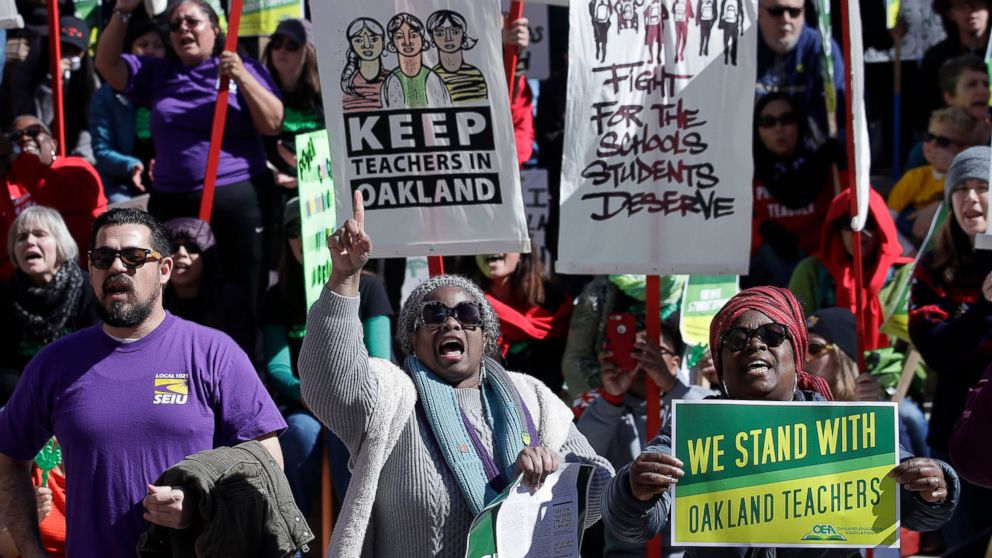
  • It might seem that I have exhausted the topic of the teacher’s strike. But, alas, I have not! There is one more central issue to the strike that was not addressed that night at the Brooklyn Historical Society and that was: Do we value teachers? This question is still resonant today. Just look at Oakland where teachers walked out two weeks ago (they settled a couple of days ago) and shortly before that, the teachers’ strike in Los Angeles as examples.

    WireAP_d82c7f1407384fee8fd0a4feb7467a96_16x9_992
    Associated Press photo – February 21, 2019 – Community members supporting Oakland teachers’ strike

    Those two labor actions were, in large part, about pay – teachers need second jobs to make ends meet. The 1968 dispute in New York City didn’t hinge on salary, but that isn’t the only measure of whether we value the profession.

    One aspect of treating teachers professionally is to provide due process before reassignment or termination. The attempt by the Ocean Hill Brownsville school board to fire people who had tenure without a hearing was offensive to my father. He would not want to protect teachers who were lazy or incompetent, but they were entitled to be heard first.

    There is a reason that the teaching profession includes tenure. Tenure existed long before there were teachers’ unions (tenure came into practice in the early in the 1900s; though there were attempts to organize earlier, the UFT wasn’t formed until 1960). The reason was to protect teachers from political influence or corruption. People understood there was a danger that a new principal could come in, fire the staff and hire their relatives or give jobs to the highest bidders. There has long been recognition that the education of our children held a special status that needed to be protected.

    As with all things, though, there is a need for balance and there is a perception that things have gotten out of whack with it becoming a long and expensive process to terminate a terrible teacher. In 1968 my Dad had no tolerance for those who were taking advantage of the system, skating by, making no effort. He had his own scornful word for them, “deadwood.” I don’t know if he invented that term, but I heard it often enough when Dad expressed his frustration with a colleague. It is an effective metaphor:  decaying branches clogging up a stream. But, he didn’t believe the majority of the teaching force was “deadwood” or racist. Finding the balance between due process and ridding the system of deadwood continues to be a struggle. Remember the headlines on the front page of the New York Post not long ago? – with pictures of ‘rubber rooms’ for teachers that can’t be trusted in the classroom but can’t be terminated either. We need to find the right balance, but that still doesn’t answer the central question of how much do we value teachers.

    Our attitude toward teachers in America is a funny thing. We have a kind of schizophrenia about them. One the one hand, we think anyone can teach, everyone thinks they know how things should be done in the classroom. After all, we’ve all gone to school. And then there’s the old saying, “He who can does; he who cannot, teaches.” Hardly a statement of praise. As noted above, teachers are underpaid and that continues to be a sticking point. It’s also been considered ‘women’s work’ dating back to the nation’s westward expansion when the ‘schoolmarm’ taught in one room schoolhouses. Women’s work has never been given its due.

    On the other hand, we expect so much of teachers. When poor achievement scores are reported, teachers are blamed. In New York State we require that they earn a master’s degree within five years of their appointment. There are demanding continuing education requirements – I believe 75 hours every five years.

    We simultaneously believe that kids right out of college can step into a classroom to teach (as in Teach for America and exemplified by Rhody McCoy hiring strike replacements who were fresh out of college subject to a single interview) and yet we complain that inexperienced, uncertified teachers are disproportionately assigned to poor, underserved schools, and offer that as emblematic of the inequity of the system.

    A number of years ago I had an interesting conversation with a gentleman who grew up in Finland. If you read about successful school systems, Finland is often cited as exemplary. He explained that students who went into teaching were the best and the brightest; teachers there were expected to have the equivalent of a PhD, were as revered as medical doctors, and were paid accordingly. Not exactly a description of our situation.

    So, what’s the deal, America? Can anyone teach? Or, is it a profession? And, if it is a profession, is it an esteemed one that we are willing to pay for? We can’t have it both ways.

  • After listening to the panelists, I couldn’t help but wonder if there was any substance to the union’s side of the conflict. The story that was told that night at the Brooklyn Historical Society was eye-opening, but, there was a glaring omission. No one mentioned the issue of teacher professionalism as a source of conflict.

    For my father, and others like him, this was probably the single strongest motivating factor in supporting the strike. The attitude and actions taken in Ocean Hill-Brownsville exhibited a blatant disregard for the professionalism of teachers, in three ways: by having the community dictate curriculum, by hiring uncertified, inexperienced replacements, and by dismissing teachers without due process. All of that would have felt like a personal insult to someone like my dad.

    Dad, Barry Brody, got his B.A. from Brooklyn College, then did two years in the Air Force. He went into teaching, earning his master’s in education from Columbia Teacher’s College. He went on to get a master’s in economics from the University of Illinois at Champaign-Urbana (coincidentally Al Shanker’s alma mater). He spent most summers furthering his education. He would apply for grants to study. He spent a summer at Wharton, another at Weslyean, then Clark University in Worcester, MA, three summers in Illinois and one at the University of Colorado. Our family joined him, this was how we vacationed (which is another story). He was always a voracious reader. If there was a new biography of Lincoln or Jefferson, he would read it – and critique it. He read widely, though history was his passion.

    He took pride in his scholarship and his teaching. If there was one overriding lesson he imparted to his three children, though there were many, it was to do your job to the best of your ability, no matter what it was. If you were a busboy or a secretary, take pride in your work. You show up on time, put your nose to the grindstone, without excuses. He modeled that behavior. There was dignity and pride in a job well done. My brothers and I took that lesson to heart and it served us well.

    I believe the issues raised by the decentralization experiment in Ocean Hill-Brownsville struck at the heart of my dad’s sense of himself as a teacher and his pride as a professional. The fact that the changes being wrought were accompanied by so much anger, and in some quarters, hate, made it impossible to bridge the divide. Both sides were convinced of their righteousness.

    The idea that parents would dictate curriculum, and I think Dad’s perception was that the plan gave parents that authority, would be an anathema to him. The notion that laypersons would make decisions about what material to include in global studies or American history likely struck him as absurd.

    Today we are much more aware of the importance of incorporating the contributions of people of color and women so that a more complete and accurate picture of American and world history is provided (I’m not suggesting that the work is done). Some of that change came about precisely because of the pressure brought to bear by communities of color. Some of it has come about as more women and people of color become historians themselves.

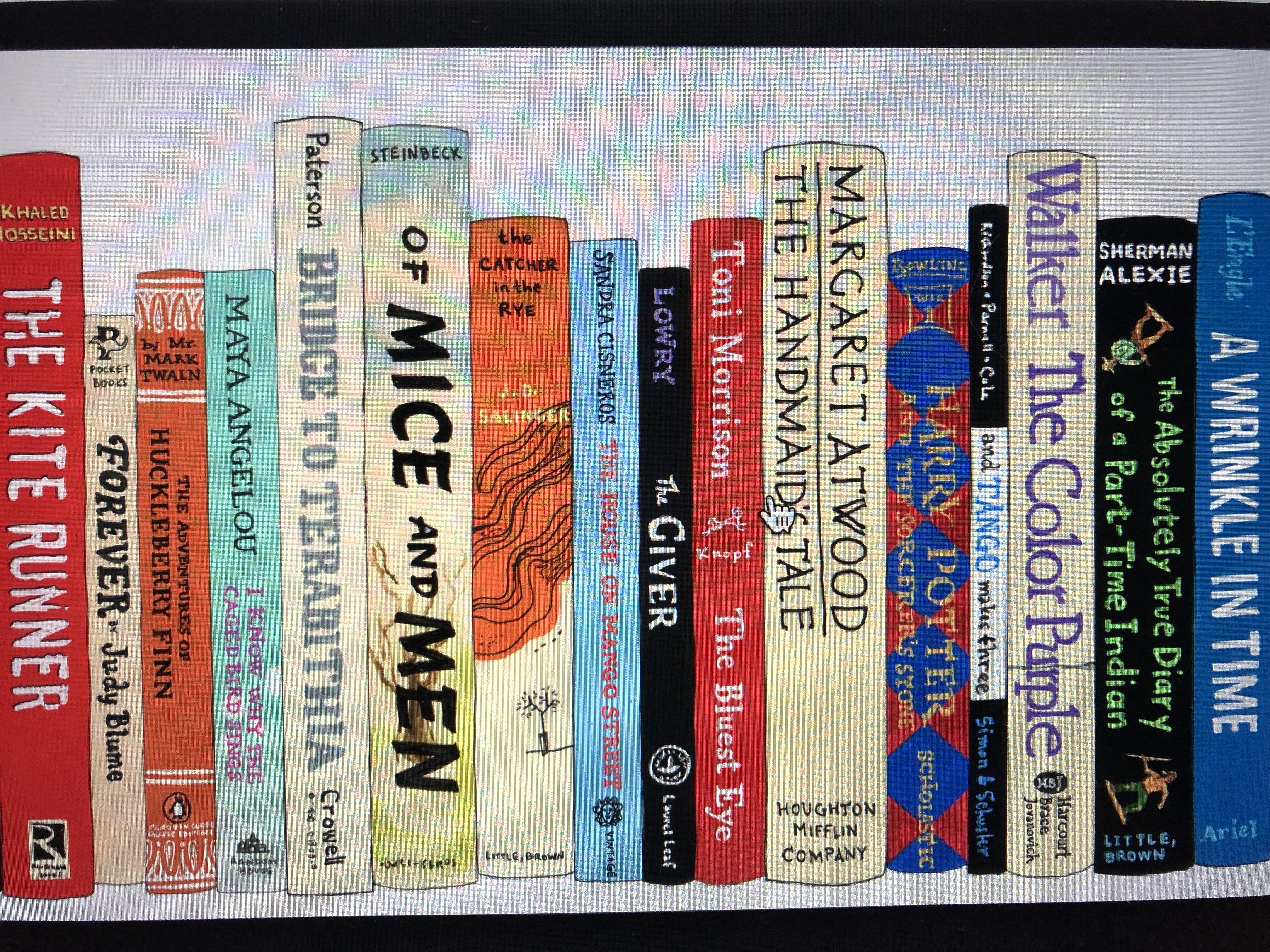
    But, today community input is still fraught. What about when a community objects to teaching evolution? Or sex education? Or, inclusion of LGBTQ literature? The list can, and does, go on and on, and I think it always will. The process of incorporating public opinion needs to be robust enough to withstand pressure from extremes, but flexible enough to evolve as new knowledge is gained. But what does that look like?

    lJLqTNEwQUibEEflQIeYJg
    Banned books – illustration by Jane Mount

    One of the reasons I believe so strongly in public education is that a cross-section of children, representing different parts of society, learn together. And, hopefully, across communities there is a common body of knowledge imparted. It doesn’t have to be exactly the same, but if you grow up in Harlem or a rural town in central New York, I believe you should share a common understanding of science, history, math, etc. There can and should be differences that reflect the needs of the children, but a great deal of the fundamentals should be shared.

    I think the panel discussion at the Brooklyn Historical Society lost an opportunity to engage in a more balanced way. To discuss community control without acknowledging the legitimate concerns of teachers took away from the credibility of the program.

    I am still left with the question: What should the role of the community be in curriculum? If folks reading this have opinions about it, please comment! I’d love to hear.

  • It may not be readily apparent why I am spending so much time writing about the events in Ocean Hill-Brownsville. But, 50 years later, there is much to be learned, especially since we find ourselves still struggling with some of the fault lines exposed during that conflict. The strike touched on racism, anti-Semitism, and education policy (the role of community in school management, the value of multiculturalism in curriculum, student discipline and the professionalism of teachers). Each of these topics resonates with me and are actively debated today. We need to learn from our history; the strike and its aftermath are rich with lessons.

    J4CisY0LT5SnkqUMjX0vYg
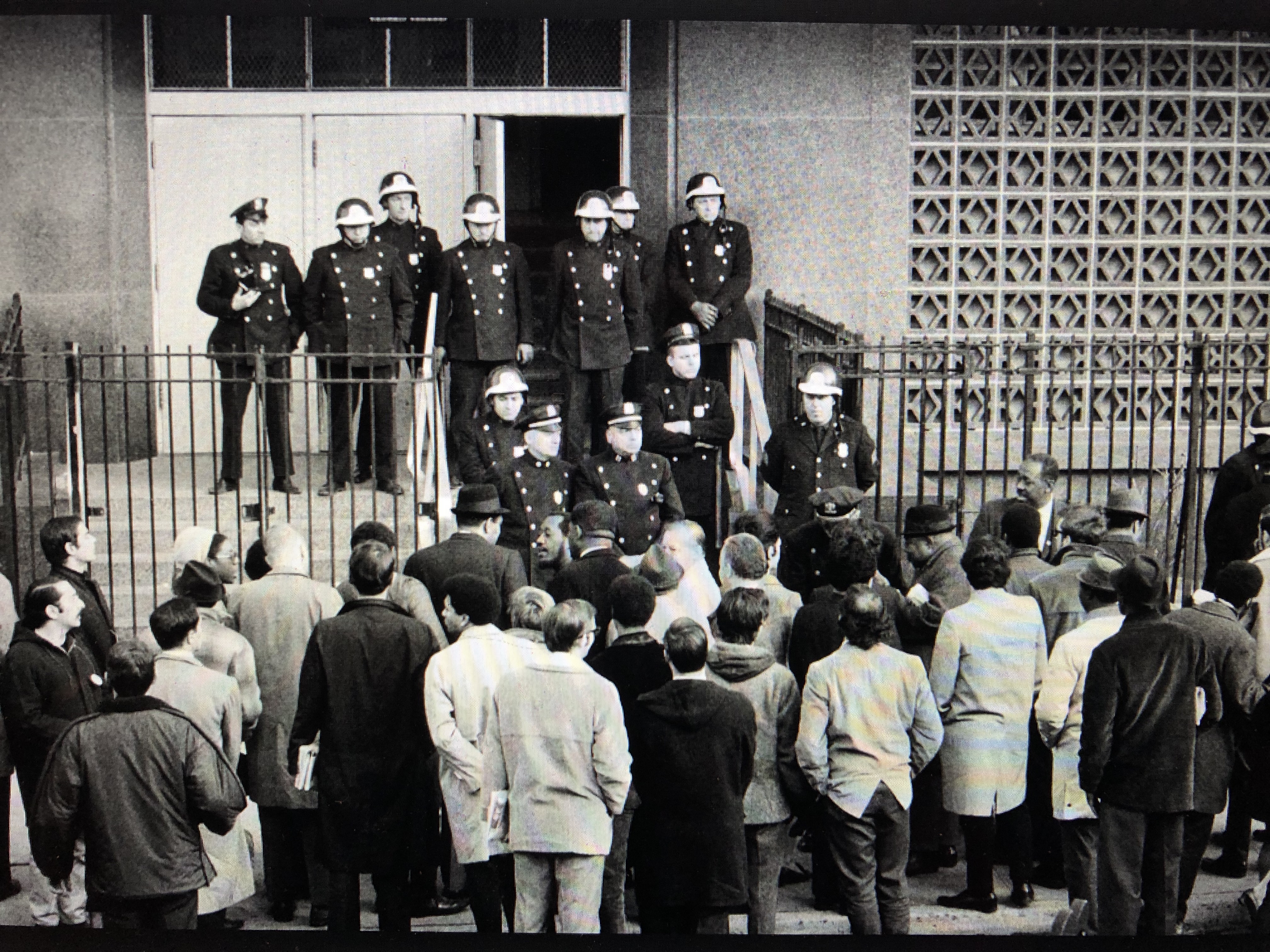
    Photo credit unknown — reprinted in Jacobin. Police blocked entry to the school building at one point during the conflict. 

    One of the tragedies of the Ocean Hill-Brownsville teachers’ strike was that it marked a serious deterioration in the relationship between African-Americans and Jewish-Americans in New York City. The two groups, through the early 1960s, were allies in the civil rights movement. The strike either created or revealed a schism.

    I grew up feeling a connection to African-Americans. Because of my own people’s history, I identified with their struggle against persecution. My parents were believers in equal rights and opportunities. I never heard a racial or ethnic slur from either my mom or dad. Thinking back on it, I know they weren’t perfect, they were a product of their time and place, so I’m sure they had their prejudices, but that would have been the product of ignorance. They were life-long learners, and as they understood more, their thinking evolved. The strike and the emergence of the Black Power movement tested them.

    My mother was teaching in a parochial school at the time of the strike. She was employed by the New York City Board of Education as a Title I teacher, a corrective reading specialist, but assigned to Catholic schools and yeshivas, depending on the year. Since the parochial schools were not affected by the strike, she continued to go to work, she didn’t have to cross a picket line. She remembers the time as being rife with tension, though. She taught in a neighborhood not far from Ocean-Hill Brownsville and took a subway line that travelled through there to get to work. She remembers a change in the air, she felt self-conscious on the subway as one of the few white people and previously she had not. Between the riots in cities around the country, and the friction of the strike, she felt the anxiety of the time.

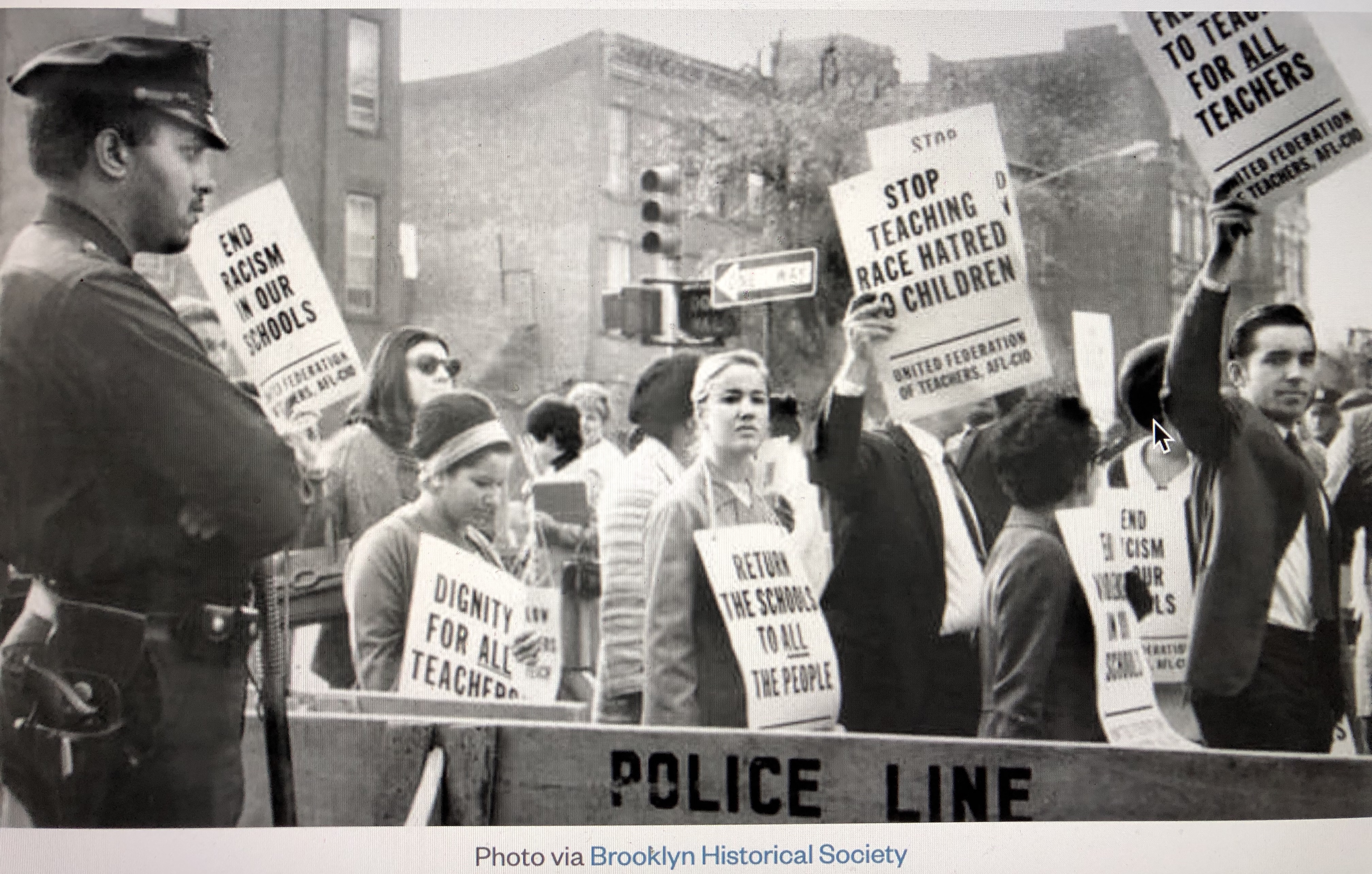
    My father, a social studies teacher in a NYC high school, walked the picket line. I recall him coming home and expressing anger with the leadership of Ocean Hill-Brownsville. I remember some of the names he mentioned, telling my mother of the latest inflammatory rhetoric from Sonny Carson and Rhody McCoy. Listening to the panelists at the Brooklyn Historical Society, it sounded like either the incendiary messages weren’t uttered, were overemphasized or misunderstood. It occurred to me that perhaps my father wasn’t as open-minded as I thought.

    Now reading about the events, I see a fuller picture. My research revealed a number of interesting pieces.

    One of the flashpoints during the strike was the assertion that the Ocean Hill-Brownsville community was anti-Semitic. As I noted in a previous post, the panelists contended that Al Shanker, the union president, was largely responsible for stoking the issue. Two of the three panelists, Ms. Edwards and Mr. Isaacs, refuted the claim that there was anti-Semitism in the community. Hearing that, I was incredulous; there is anti-Semitism in every community, just as there is racism. The degree of it, how close it is to the surface, may vary, but to deny its existence struck me as disingenuous.

    Unless I misunderstood his point, Mr. Isaacs said it was the union that produced and distributed literature that included anti-Semitic language and images. I found that charge hard to believe. I could imagine that Shanker would want to consolidate his position by, as we might say today, riling up his base, but it didn’t ring true that he would go so far as to create the pamphlets.

    I read news accounts, journal articles, recent scholarship and books, so much has been written about the strike. I learned that was that there was an anonymous anti-Semitic letter circulated in the junior high school in Ocean Hill-Brownsville at the time. The letter said:

    ‘If African-American History and Culture is to be taught to our Black Children it Must be done by African-Americans Who Identify With And Understand The Problem. It is Impossible For the Middle East Murderers of Colored People to Possibly Bring to This Important Task the Insight, The Concern, The Exposing of the Truth that is a Must If The Years of Brainwashing and Self-Hatred That Has Been Taught to Our Black Children by These Blood-sucking Exploiters and Murderers Is To Be Overcome.’

    McCoy and the local Board denounced the letter. The union reprinted it, 5000 copies, as part of a leaflet which asked if this was acceptable; in effect publicizing it. Some might say Shanker exploited it.

    I don’t know how strongly the African-American leadership disavowed the letter and its sentiments. I can only imagine how hurtful those thoughts would be to someone like my father. Was Mr. Isaacs suggesting that Shanker actually composed and planted the original letter, or was he criticizing the tactic of publicizing it?

    It was not the only evidence of anti-Semitism. A teacher in the district read a poem by a student on WBAI, an African-American radio station in the city, called “To Albert Shanker: Anti-Seimitism.”

    Hey Jew boy with that yarmulke on your head

    You pale faced Jew boy I wish you were dead…

                Jew boy you took my religion and adopted it for you

                But you know that black people were the original Hebrews

                When the UN made Israel a free, independent state

                Little four and five-year-old boys threw hand grenades

                They hated the black Arab with all their might

                And you, Jew boy, said it was alright

                And then you came to America the land of the free

                Took over the school system to perpetuate white supremacy

                Cause you know, Jew boy, there’s only one reason you made it

                You had a clean white face colorless and faded.

    When interviewed twenty years after the fact, the teacher had no regrets about reading the poem on the air. He said it was “raw,” but otherwise didn’t see a problem with it.

    Unfortunately, there are people in the world who would write that letter and that poem today.

    I come away from the panel discussion and my subsequent research believing that everyone shared responsibility for stoking racial and ethnic tensions. The Ocean Hill-Brownsville leadership was unwilling to distance itself from the extremists or troublemakers in their midst. Judging by the statements made by the panelists they still don’t acknowledge the damage done by the anti-Semitic communications. It may be true that the letter and poem didn’t represent the majority of the community. But, think of it this way:  if a single noose was to appear in a school locker, it would not be sufficient if school officials disavowed the symbolism, explained that it didn’t represent the opinion of the majority and left it at that. We would expect more, and rightly so.

    It is true that the demographic of the replacement teachers was similar to those that were terminated – the majority were white and Jewish. That would support the idea that McCoy and the Board weren’t blindly anti-Semitic. But, that doesn’t address the hurt and fear engendered by the other events. The hiring of the replacements represented other problems from the union perspective (an issue I will discuss in more depth in my next blog post).

    The union leadership, on the other hand, focused on those extremists to the exclusion of other legitimate concerns. There were issues with the quality of the teaching, with the atmosphere of the schools that did not welcome parental involvement and that didn’t include African-American and Puerto Rican contributions in the curriculum. And, the main point, the main issue at the heart of everything, was the problem of poor academic performance. By keeping their rhetoric focused on the hateful messages, the union didn’t appear to be willing to engage on the problems that were at the heart of the community’s anger.

    There are parallels to how we engage in political discourse today. People are quick to point to the outrageous claims, or the hateful rhetoric, from the ‘other side.’ While I see the merit in bringing attention to discriminatory acts, they should not be swept under the rug, I think we go too far. The extremes get distorted and end up having more influence than they deserve. I don’t know how we reclaim some balance, but we need to give more careful thought to what we emphasize. We need to be more focused on problem-solving and substance.

  • The panel discussion sparked so many questions and reflections. After some preliminary remarks by the moderator, Monifa Edwards, the valedictorian from the Ocean Hill-Brownsville Junior High School, began the session by talking about her journey. Ms. Edwards, who is in her 60s now, held herself like a dancer, lean and elegant. She spoke with assurance. She gave some background, noting that her family, originally from the Caribbean, valued education. Her parents were distressed that the neighborhood schools had such a poor reputation. As a result, they enrolled her in a public elementary school in Sheepshead Bay, across the borough, an opportunity offered by New York City to desegregate the schools.

    She described a harrowing experience on one particular trip. The bus was surrounded by angry white parents. The driver and bus monitor vanished, and the parents started rocking the bus and yelling epithets. Monifa recounted that she could still see, in her mind’s eye, the face of one of the mothers – her hair in curlers, her face twisted in hate. Monifa was terrified and traumatized by the experience. She came home and told her parents that she was going to go to a neighborhood school next year, no matter what, even if the education offered was inferior.

    I heard Monifa’s story and it broke my heart. I could imagine her fear as the bus threatened to tip over.  Monifa continued, explaining how based on this, and other painful experiences, she was ‘primed to be radicalized’ (her phrase). Radicalized meant adopting the beliefs of the Black Panthers. When she asked adults around her, how could that white mother hate her so much and want to do her harm, she was told that white people were the devil. This made sense to her young self. It explained what she had experienced.  In the context of the time, I could understand how a child would receive and accept that message. She joined the Black Panthers, who became involved in the controversy over the schools in Ocean Hill-Brownsville.

    Hearing the idea that white people were the devil reminded me of another time I heard that sentiment. As I have written before, I facilitate workshops for school boards across New York State. The goal of the sessions is to educate board members about their roles and responsibilities and to do team building. I had worked for the Anti-Defamation League before coming to NYSSBA and been trained to facilitate workshops on multiculturalism. So, when a school board was experiencing conflict due to charges of racism, I was asked to conduct a retreat to help them through it.

    The nine-member Board had only one person of color, an African-American woman. As the session progressed, after opening exercises and a discussion of identity, we got to the heart of the matter: the racism allegation. In the course of the dialogue, the African-American woman expressed her frustration that she was not being heard by her fellow board members. She explained that she grew up in a southern state and shared that her grandmother told her white people were the devil – it was a message she heard repeatedly. She wanted us to understand how hard she worked to let go of that thought; she wanted her colleagues to understand how difficult it was for her to trust them.

    It took courage and self-awareness for her to admit that. The other board members at the table had not acknowledged any racist impulses or messages that they had grown up with (or may have still held).

    As the discussion at that workshop continued, it emerged that all of the first-and second -year Board members (there were three of them, all of them women), shared the feeling of not being heard. It was possible that the source of the problem was in not effectively orienting new members and not explaining how to get items on the agenda, or it could have been sexism (the Board president was male), rather than racism directed at one member.

    I left that Board retreat somewhat optimistic that we had made some progress. Maybe they had a better understanding of each other. Perhaps the Board President, having heard the frustration of three of the female new members, would be more inclusive. I was disappointed that the white board members hadn’t acknowledged any stereotypes or preconceived notions they had about African-Americans, but I was hopeful that they had food for thought. Perhaps as they had time to process the session, in the privacy of their own thoughts, they would examine their beliefs.

    Sitting in the audience listening to the panel discussion at the Brooklyn Historical Society, I was reminded that the messages we receive as children are powerful. It takes work and awareness to overcome them. Many people are not introspective, some may not want to make the effort, and others may not be willing to be honest with themselves. But if we are ever going to progress, we need to do the work.

    Ms. Edwards said she had long since moved beyond her radical phase, she was able to overcome the hateful message.  Unfortunately, time was limited and there were other issues to discuss so we didn’t learn how that process occurred or how long it took. I wanted to understand more (I plan to return to this subject in my next blog post).

    I also wonder how many people in the world, who are currently traumatized by violence and/or abuse, are ‘primed to be radicalized.’

    fullsizeoutput_c72
    The largely white teachers’ union thought they were the target of racists. It was a complicated story, with layers of hate and mistrust.


    Next week: More on the teachers’ strike and the charges of anti-Semitism.