Stories I Tell Myself

Linda Brody Bakst on Brooklyn, growing up, identity and more

  • Mom felt woefully unprepared for her own puberty. When she found blood in her underwear, she thought she was dying. Her mother, my Nana, had said nothing to her about the changes she could expect as she matured into womanhood. Determined not to make the same mistake, Mom was on a mission to provide me with the necessary information. She may have overcompensated.

    Mom sat my brothers and me down to tell us the facts of life…at the same time. I assume this explanation was prompted by questions from my oldest brother. The problem was that I was four and a half years younger than him. I think I was five at the time. I wasn’t ready for the birds and the bees yet, at least not at the level that my almost ten-year-old brother needed. I was confused by the information and what I did understand sounded disgusting. Mom meant well, but it was a perplexing start to my girlhood.

    Over those early years, I was all too aware of my mother’s menstrual problems. Mom and Dad referred to it as being ‘unwell.’ Dad would say to me, “Mom is unwell, you need to let her rest and…..” fill in the blank with a household chore or errand. As a result, I learned to prepare roast chicken and other meals as a youngster. Mom could be debilitated by heavy bleeding. She had several medical procedures to address it, culminating in a total hysterectomy when she was 42 (I was 16 at the time). She refers to that surgery as the happiest day of her life, exaggerating only a little. I now understand she had fibroids and endometriosis. As a young girl observing this, and for lots of other reasons, I wished I was a boy. But that was not to be – the inexorable maturation process did its thing. And, not only that, it did it on a much earlier timetable than my peers.

    I asked Mom about getting a bra at the end of third grade. She seemed taken aback. I don’t think she noticed what seemed obvious to me and was making me very self-conscious. She took me to a store in our local shopping center and I was fitted for a bra. At the beginning of fourth grade, at the age of nine, I was beyond a training bra!

    Since I was already afflicted with self-consciousness, being fully developed by fifth grade didn’t help. Even in seventh grade many of my classmates still looked like young girls. I would have given anything to have a flat chest! And, like my mother, I had menstrual problems. My period was very irregular and when I got it, after missing it for several months, it was terrible. It would last for two weeks, with cramps, and I bled profusely. I didn’t feel like I could talk to Mom about it, immersed as she was in her grief since Nana had only recently died.

    It was 1972 and they didn’t have the feminine products available today – sanitary napkins were bulky and didn’t come with a wrapper in which to dispose of it (you had to wrap it in toilet paper). The girls’ bathrooms in school didn’t have waste receptacles in the stalls either, just a garbage pail by the sinks. All of which meant that it was nearly impossible to be discreet about having my period. I needed to carry a purse (something I didn’t ordinarily do), and I would have to take that purse with me to the bathroom. Even on an ordinary day, the idea of using the bathroom was an anathema to me, I tried to avoid it. I didn’t want anyone to know about my bodily functions. I don’t know why I felt ashamed, but I did. I thought other girls, if they even got their period, didn’t have these issues, and I didn’t have the nerve to broach the subject with anyone. So, I muddled my way through, hoping not to embarrass myself by staining my clothes (which sadly did happen on more than one occasion).

    Eventually, I had an episode of cramps that were so bad, I had to tell my mom. She made an appointment for me to see her gynecologist. Dr. Holland asked a series of questions before examining me. Mom was not in the room. He asked if I had had intercourse. Surprised by the question, I answered no; thinking to myself I’m 13! It made me wonder if girls my age were having sex.  Apparently, some did, or he wouldn’t have asked the question! Then he asked if I was sexually active. I didn’t understand the difference between the first and second question. I almost asked him to explain but was too embarrassed. I just said no, again.  A nurse stayed in the room for the physical exam, which was weird and uncomfortable but not traumatic. Fortunately, he found nothing wrong. He made some suggestions to treat the cramps if they were painful in the future and that was that.

    Not everything was bleak during my junior high school years.  In 9th grade I connected with a few girls. We made a plan to leave school for lunch, a daring idea. Gerri and Lisa came up with the notion of sneaking out – everyone was supposed to eat in the cafeteria (maybe they were afraid we wouldn’t come back!). We decided we would go to Lisa’s house, where no one was home, since it was only a couple of blocks away. We would make sure to get back in time for our next class.

    The big day arrived, and we successfully escaped. We were feeling triumphant as we hurried to Lisa’s house. We were walking down Avenue K when we heard a car horn and some hooting and hollering. We all turned to look. At first, I didn’t know what I was seeing. Then I realized it was flesh pressed up against the rear window. They were butt cheeks! We shrieked and ran. We were afraid the car would follow us. We got to Lisa’s house –  laughing and terrified at the same time. One of the girls knew that it was called being ‘mooned.’ I had never heard of that. Some kids may have been exhilarated by the adventure, but I took it as a sign that we shouldn’t have snuck out. I didn’t leave school for lunch for the remainder of the year.
    IMG_1281
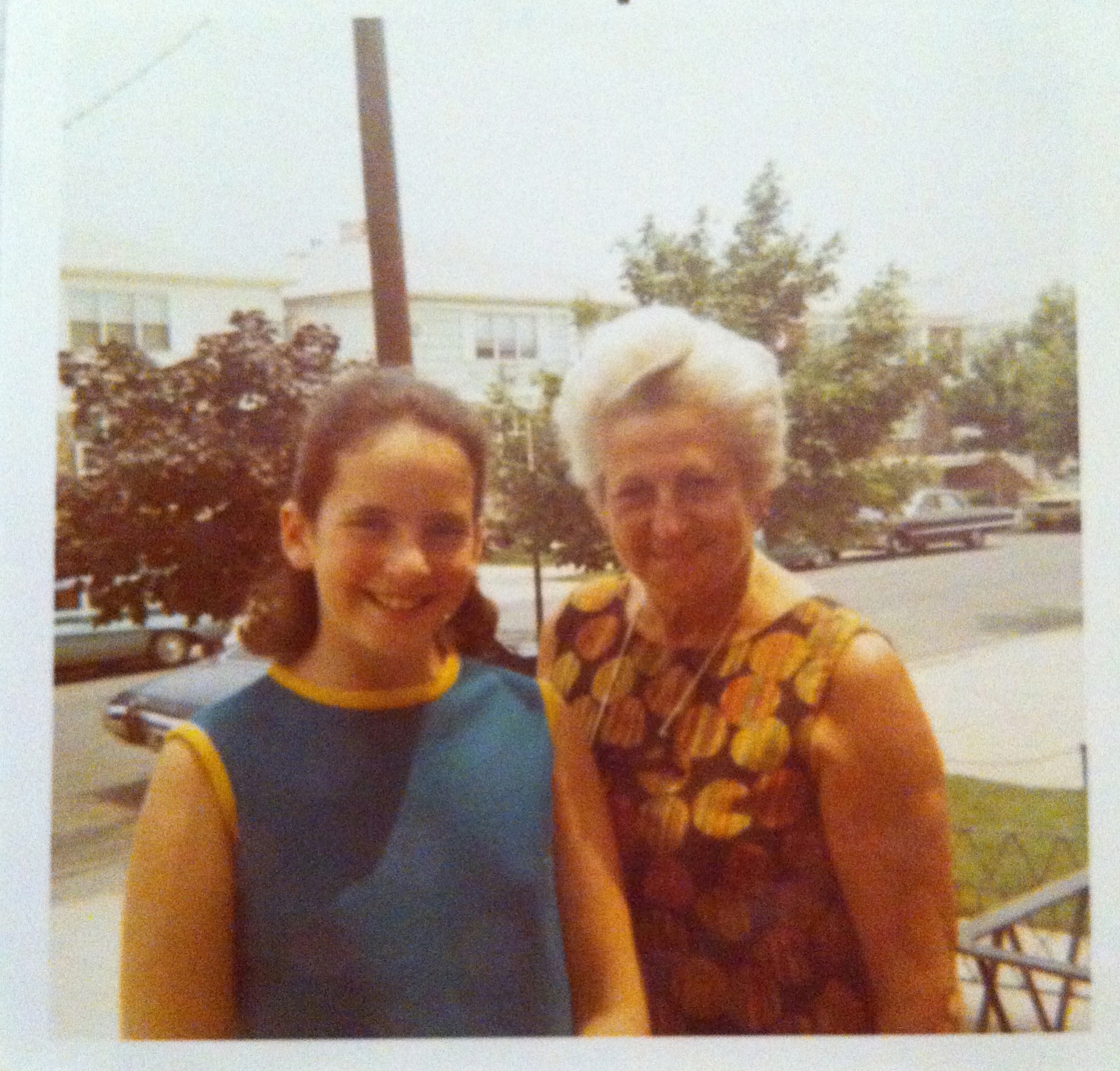
    Nana and me. At the beginning of my journey to womanhood, maybe a year before Nana died.
  • Last week the New York Times headline read: Trump Targets Anti-Semitism and Israeli Boycotts on College Campuses. It caused quite a stir in the Jewish community.

    The first paragraph reported that the President planned to sign an Executive Order that would permit the federal government to withhold funding to colleges that fail to combat discrimination. That didn’t sound like a bad thing, but then I read the second paragraph (I added the bold):

    “The order will effectively interpret Judaism as a race or nationality, not just a religion, to prompt a federal law penalizing colleges and universities deemed to be shirking their responsibility to foster an open climate for minority students. In recent years, the Boycott, Divestment and Sanctions — or B.D.S. — movement against Israel has roiled some campuses, leaving some Jewish students feeling unwelcome or attacked.”

    Reading that the Executive Order would define Judaism as a nation and/or race made the hair on my neck stand up. As I surfed the Internet looking at reaction to this, I found a number of comments picking up on Judaism as nationality as problematic. I was more disturbed by the use of the term race.  That idea, of Jews as a separate race, struck terror in my heart. After all, that was one of the essential pieces of Hitler’s plan to exterminate us. Identifying us as a race, as ‘the other,’ as subhuman, made the Holocaust possible. I came to understand this when I took a class in college called The Making of Modern Germany. That class was the single most important one I have ever taken.

    Professor George Stein taught every Tuesday and Thursday for ninety minutes during the fall semester of my sophomore year at SUNY-Binghamton. He stood at the podium, wearing a dark suit and tie, his black hair meticulously combed, and lectured to us. It might sound boring, but it was anything but. It was a history class, but he drew from music, art, folklore, science and philosophy to tell the story of a nation. In the telling he gave context and insight into bigger themes – What is a nation? What is modernity? It was fascinating. It wasn’t interactive. Professor Stein may have left a bit of time for questions, but essentially it was entirely lecture and I wouldn’t have had it any other way. You could hear a pin drop in the hall. I took notes furiously; I wanted to commit to memory all he was offering because it was so compelling and comprehensive. I never considered skipping class. I wish I could take it again. I held on to some of my notebooks from college and graduate school. Unfortunately, I have not been able to find that one. Over the years I have wanted to refresh my memory any number of times.

    My mind went to that class when I read about the Executive Order. I remember clearly Professor Stein explaining the importance of Hitler’s manipulation of antisemitism. It was already entrenched in Eastern Europe based on the belief that the Jews killed Christ and the widely circulated lie that Jews used the blood of Christian children as part of the Passover ritual. Professor Stein traced how those seeds were exploited to take hatred to the next level. Judaism became more than a religion – Jews became a race with unique characteristics (a whole science was devoted to elucidating the differences). This was a critical step in building the case for genocide.

    This is why reading that Trump was urging the United States government to begin defining Judaism as a race was alarming and terrifying, even as it was being offered to ostensibly combat harassment of Jews on college campuses. I could easily imagine it being turned on its head, as so many things are these days, for nefarious purposes.

    When I saw that the Anti-Defamation League supported the Executive Order, I thought there’s no way they would if it was as explained in the New York Times article. I read as much as I could on the Internet. That first day I found a lot written about the Executive Order, but not the order itself – which was frustrating.

    As I was reading, I was thinking, wasn’t antisemitism already covered by our nation’s laws? Why was this necessary? I went back to look at the Civil Rights Act and found that Title VI, which covers any entity that receives federal funds, prohibits discrimination based on race, color or national origin. Title VII of the same act prohibits employment discrimination on the basis of sex, race, national origin or religion. Obviously the two lists are not the same.

    Why aren’t they the same? I didn’t do deep research into this, but since educational institutions are permitted to be connected to a religion (e.g., Jesuit colleges, parochial schools) or same sex and still receive federal funds, I think they couldn’t include those categories in Title VI. Whether we should provide public funds to institutions affiliated with a religious denomination is a discussion for another day.

    In my work with NYSSBA, though, I knew that this issue of schools addressing antisemitism has been litigated many times. So, the question remained, under what authority, could schools (colleges or public schools) act against antisemitism? The Civil Rights Act is enforced largely through the Department of Justice and the Department of Education. Those agencies are responsible for interpreting the law and have offices within them that receive complaints of discrimination and/or harassment (harassment can be a form of discrimination). Over the years, dating back to the Bush II administration, they issued guidance documents (the DOE calls them ‘Dear Colleague’ letters) which interpreted Title VI as covering religion. In the aftermath of September 11th, when Muslim students were especially vulnerable, the government explained that when students were targeted for being perceived as a different race the school district had an obligation to protect those being harassed. So, using the same logic, Jewish students and Sikh students (or any student whose religious practice or nation of origin may make them appear to be of a different race) are covered by Title VI.

    Then the question becomes, what does this Executive Order offer that is different? After looking into this, I have no answer.  I came to the conclusion that it remains to be seen whether this is a positive thing, or a dangerous step, or not really a change at all (and just political pandering) – as with many things, it depends on how it is interpreted and implemented.

    [By the way, it is worth noting that states also have laws that offer protections, too. New York State’s anti-discrimination laws are much more expansive than federal law and includes LGBT and disabled citizens, among others.]

    The Executive Order was finally posted by the White House the next day – needless to say, I read it. I will point out that the Executive Order, and the source document it is based upon (a definition of antisemitism adopted by the International Holocaust Recognition Alliance) does not say that Judaism is a race or a nation. It also does not say that being anti-Israel is equivalent to being anti-Semitic, despite what Jared Kushner opines; though that is where the waters get muddy. The IHRA document specifically says “….criticism of Israel similar to that leveled against any other country cannot be regarded as anti-Semitic.”

    As we know, on college campuses Israel gets a lot of criticism. Where it crosses over into antisemitism is complicated and often in the eye of the beholder. Can a person be anti-Zionist and not be anti-Semitic? If anti-Zionism means you oppose the existence of the State of Israel, it is hard not to get a whiff or more of antisemitism (other than Jews who believe that God – the messiah – is the only one that can create a Jewish homeland).

    The founding of the State of Israel was, in my opinion, as legitimate as any nation. After the Holocaust, it was clear that Jews needed a homeland. As a result, the U.N. defined and authorized its creation. Every country I can think of has disputed boundaries and conquests in its history that contributed to their current configuration. The United States, Russia, China, Great Britain all come to mind. I’m not aware of any country that wasn’t built on the blood of a people in some way or another. Israel is no different.

    I have lots of criticisms of Israel and how it conducts itself, especially under Netanyahu. But to suggest that it deserves to be isolated in the same way as North Korea or Iran, or to question its right to exist, is a bridge way too far. Students should be able to study in Israel. Academic exchanges should be welcomed. Individuals can choose not to buy its products if they don’t like their policies, as I don’t shop Walmart. But, I am not seeking to have Walmart driven into the sea, or cutting it off from civilized society. I would like Walmart to change – to treat its employees fairly and to operate as a good corporate citizen. Maybe it isn’t a perfect analogy, but I think it makes the point.

    If this Executive Order is used to stifle protest of Israel’s actions, then it will be a misuse of governmental authority. If it bolsters the federal government’s authority to investigate harassment of Jews, that would be a positive outcome given the frightening increase in anti-Semitic hate crimes. If it gives authorities more cover, and suggests more political will to confront it, then maybe it can be helpful.

    In sum, my two takeaways from this are: (1) the New York Times did a poor job of reporting on this and contributed mightily to the controversy by mischaracterizing the Executive Order. Some might not be surprised at that, I am disappointed.

    And, (2) as with all things with the Trump administration, we will have to be vigilant to make sure power isn’t abused or turned on its head.

  • Note: This is a guest post by my husband, Gary Bakst, M.D. While I may question whether the jokes are funny (Gary didn’t write them!), I don’t question the seriousness of the subject he addresses. Thank you, Gary.

    Jewish Humor – here are some jokes that have been around longer than I have:

    1. Why don’t Jews drink? It interferes with their suffering.
    2. My wife will buy anything that’s marked down. Yesterday she brought home two dresses and an escalator.
    3. A man can’t find a lawyer. He picks up the Yellow Pages and picks out a law firm-Schwartz, Schwartz, Schwartz and Schwartz. He calls up and says, “Is Mr. Schwartz there?  A guy says, “No, he’s out playing golf.” The man says, “All right, then let me speak to Mr. Schwartz.”  “He’s not with the firm anymore.”“Then let me talk to Mr. Schwartz.”  “He’s away in Detroit.  He won’t be back for a month.”“Ok, then let me talk to Mr. Schwartz.”  “Speaking.”
    4. I’d like to help you out. Which way did you come in?
    5. In New York’s Garment District, a little, old man is hit by a car. While he is waiting for an ambulance, a police officer tucks a blanket under his chin and asks him, “Are you comfortable?”  The man responds, “I make a living.”

    It is that final joke that I am thinking about as I write this essay.  I grew up in a middle-class family and in a middle-class neighborhood. I remember when Linda and I struggled to make ends meet.  I realize that we are more comfortable today, but I still like to think that I am connected to the struggle of the average person/average family.  The reality is, every so often a patient says something that reminds me that I am not as connected as I’d like to believe.

    They will tell me about the cost of an item – perhaps $10 – that is a big deal in their lives.  They are living on fixed incomes or small paychecks.  They have worked their whole lives but cannot afford things that I would take for granted.  While every expense is important, the one that we are most often speaking about is the cost of their medication.

    This is a problem that has been mentioned often in the media.  But I don’t think that the real impact on so many people has been adequately discussed.  The stories I see in the news are about the most extraordinary examples.  They don’t convey the reality that I see people face numerous times every day.  The reality is, especially in the world of diabetes care, that we are in a time when there are great medications that can change people’s lives.  They can safely lower their glucose levels, protect their hearts and their kidneys, prolong their lives.

    On the other hand, I have never seen a time in which so many people just couldn’t afford their medications.  It was not that long ago that medications were prescribed by doctors and filled at pharmacies and patients picked them up for no copay or small ($5-10) copays.  Now, the doctor writes the prescription and it goes to maybe a pharmacy, maybe a gigantic mail order facility.  The insurance company rejects the charge but doesn’t tell either the doctor or the patient why the med was rejected or what alternative would be covered.

    Our staff spends enormous, frustrating hours, expensive hours, working on getting medications approved.  When a medication is approved – not necessarily the medication we had ordered but some theoretically similar drug – the patient is still left with frequently gigantic out of pocket expenses.

    Some of this is related to the fact that medications are so much more expensive than they used to be.  The pharmaceutical industry is entitled to make their profits and needs substantial income in order to invest in the next generation of medications.  But too much of that profit comes from the US (as compared to overseas markets) and it seems like the average American is carrying a financial burden that is breaking their back.

    On top of this, the insurance companies routinely reject claims, use intentionally opaque methods to keep us and our patients in the dark about what they need in order to approve those claims and even when they cover the medications, they leave too much of the charge on the shoulders of the patient.

    Insurance companies typically use ever increasing premiums to herd patients into high deductible plans.  This means that you pay your premiums, but the insurance company may never spend anything on your care.  The situation is similar for those who receive their insurance through the Affordable Care Act (Obamacare).  While it is great that there is insurance that people can access, the insurance is often expensive and comes with high deductibles.  And, for those who get their insurance through Medicare, the development of prescription drug coverage (during the George W. Bush administration) is a great step forward but the coverage comes with that so called “donut hole” which means that you have to pay thousands of dollars out of pocket and then you can get back to where the coverage helps you out.

    In the end, we are at a time of crisis in health care affordability and especially medication affordability.  Recognizing that I have no expertise in this topic beyond what I see every day in my office, I would make several suggestions that I do not hear from our politicians of either party.

    1. I would end the policy of not allowing Medicare to negotiate with pharmaceutical companies regarding the price of medications. Medicare needs that tool.
    2. Congress needs to pass a law limiting how much more any medication can cost in the US as opposed to the rest of the developed world. Perhaps up to 20% more but not the 300% more that we often see.
    3. I would outlaw deductibles over $1000
    4. I would limit how terrible any insurance policy can be and still be legal to sell in the US. If you are marketing your policy as insurance, it has to be helpful to people when they get sick or injured.
    5. I would require insurance policies to offer adequate reimbursements to hospitals such that they can hire enough nurses to truly take care of patients. Patient to nurse ratios are becoming dangerous and patients will be harmed.
    6. I would increase reimbursement to doctors and other health care providers for primary care services. This would continue the trend of reduced reimbursement for procedures and presumably make more doctors consider careers in primary care – not enough doctors are going into primary care.
    7. I would require insurance companies to make public how much money they spend on items other than patient care and to make public their procedures for approval of tests such as PET scans and for medications and expensive treatments. It is time to remove the curtain and give doctors and patients a fighting chance to get patients the care they deserve.
    8. Medicare is more efficient in translating money into care and I would require private insurance companies to make strides towards that benchmark in order to operate in the US.

    There it is. That is my little manifesto.  The rantings of a comfortable doctor on behalf of his uncomfortable patients.  Now one last Jewish joke:  A Jewish grandfather takes his grandson to the beach when, suddenly, a gigantic wave sweeps the boy away.  Panicked, the grandfather looks up and prays to God, “Oh God, please bring him back.  Let him live.”  Just then, an even larger wave deposits the boy back on the beach unharmed.  The grandfather looks up and says, “He had a hat.”

  • This past Saturday I was in the elevator of my son and daughter-in-law’s apartment building when I pulled out my phone. I saw that I missed a phone call and a FaceTime call from my daughter. I had been picking up sandwiches at the Fairway and, as is often the case for me, I didn’t hear or feel my phone ring. Since I had just spoken to Leah earlier in the morning, I was surprised to see that she had called so soon – especially a FaceTime call. We don’t often bother with that.

    I figured I’d call back when I got settled back in the apartment. Gary and I were watching our granddaughter while her parents were working at their new house, readying it to move in the following day. I came in to find Gary on FaceTime with Leah. This was really odd.

    “Here she is,” I hear Gary say to Leah.

    “Come over,” he says, as he waves me in before I even take my coat off. I sense some impatience.

    I put the packages down and come over.

    “Hi, what’s up” I say to the screen.

    Leah’s smiling face looks back at me. Ben, her partner, is by her side.

    “We have some news!” Leah said, as she held up her left hand.

    There was a ring on it!

    “We’re engaged!”

    Gary and I cheered for them and expressed our excitement. We told them we loved them and couldn’t wait to celebrate. Leah looked radiant and emotional. Ben was smiling broadly and proudly. It was one of those precious life moments.

    While this wasn’t unexpected, we didn’t know for sure when it would happen. And, until it actually does, it is best not to make any assumptions.

    Naturally, the emotions and the excitement brought lots of reflections – especially on symbols and traditions. These days there can be so much hype around an engagement – almost like it’s a competition. It can seem staged for social media. I knew that would not be what Leah would want. Thankfully Ben knew that, too. Theirs was low key and simple. Ben didn’t call Gary to ask permission nor did he get down on one knee. Those are traditions that wouldn’t be meaningful to our daughter and we are fine with that. If they wanted to observe those rituals, that would be fine too, but we didn’t have any stake in that. Leah is 32 years old, she is an adult who has been independent for a very long time (and independent minded since birth).

    It can be tricky navigating these milestones, though. There are so many messages that children receive about what is expected of men and women. As much as we may have made progress in opening the gender boxes so that there is more room for individuality, there are still boxes. And there are still powerful images of what it means to be a bride and groom. It can be hard to separate what is actually meaningful from what is expected. We may not even be aware of the limitations that we have placed on ourselves. I know I had a hard time with that when I got engaged and that was a time when we weren’t inundated with images from social media.

    I also recalled being surprised at how much I loved my engagement ring. I was not, and I still am not, someone who was very interested in jewelry. I didn’t pay particular attention to what other people had or what they wore. I didn’t know anything about quality. I did want a ring; I did want a symbol of his commitment to me. Even though, at the same time, I knew that the object had little to do with his actual commitment. But when he gave it to me and I put it on, I found that I couldn’t stop looking at it. One day I was in the elevator at work and the light happened to reflect off the stone in such a way that I held my hand up to admire it. A person congratulated me. I had not noticed that there was someone else in the elevator with me! I was embarrassed, but I thanked them and laughed at myself.

    Who knew it could be so much fun to have something so sparkly on your finger? I realized there was a reason people liked diamonds. Plus, when I looked at it, I was reminded of Gary and my love for each other. It was a more powerful symbol than I previously understood.

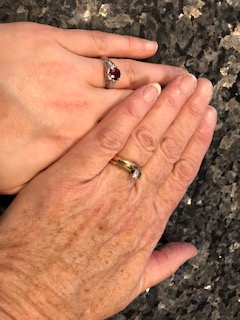
    Leah’s ring is a ruby. Ben knew that she would prefer that to a diamond. Leah doesn’t like to do things just because everyone else does. But I think Leah is similarly surprised by the power of the symbol. She is already enjoying wearing it much more than she ever expected.

    IMG_2625
    mother and daughter

    Leah has never worn a ring – I think it was a combination of not enjoying the feeling of her fingers being encumbered and not caring one way or another about jewelry in general. There’s only one exception I can think of – she does like earrings – especially those that have a sense of humor about them. She favors a pair that are yellow and shaped like a banana.

    I suspect planning a wedding will bring lots of opportunities for us to think about traditions that are meaningful and those that can be set aside. I have already been warned – she will not be wearing a white or off-white wedding gown. I am not surprised.

  • There’s something I need to get off my chest. A thought has been percolating for well over a month and I need to put it out there. I was with a group of people and unfortunately discussion turned to politics. After some comments about the weaknesses of President Trump, a couple of people asked: But who can you vote for among the Democrats? Now, anyone who knows me knows that I am more than willing to vote for any of the Democratic candidates, except Bernie Sanders. I like a lot of the people running, actually. If Bernie were to somehow emerge as the nominee, I would either write someone else in or choose the Green candidate. Otherwise, I am prepared to vote for any of them. But that isn’t the point.

    As I thought about that question I realized that I was angry about it. I don’t think that is the question at all. It is an easy out. The people asking were Republicans. They aren’t likely to support any Democrat no matter what. The question they should be asking is: Can’t our party (the GOP) offer a better candidate? Do we have to accept Trump as our candidate in 2020?

    I recognize that we differ on policy matters. I’ve addressed this before on this blog (here). There is room for differences in ideas and beliefs about tax policy, immigration, environmental regulation, etc. But, it is impossible for me to believe that there are intelligent Republicans out there who don’t see Trump for the corrupt, dangerous person that he is. He is enriching himself and his family by virtue of his office. He has no ethics. He is a bully. Even if you like his policies, you have to acknowledge the harm he is doing – both domestically and internationally. His unwillingness to confront Russia about interfering in our elections is about his personal interests and his affinity for autocrats. The same can be said about Turkey’s President Erdogan.That should not be the basis of U.S. foreign policy. His willingness to enlist foreign actors to uncover dirt on his opponents is not politics as usual; he wants us to believe that everyone does the things he does. He appears to be counting on Americans’ cynicism or fatigue to get away with it. We can’t let that become the norm.

    I don’t understand how the majority of Republicans aren’t demanding a change. I know that some, his base, like his style, like his bluster. They may even like his racism and misogyny. But I can’t believe that is the majority. Why are they, by and large, silent? I am aware that there are a few Republican columnists (Bill Kristol, David Frum) sounding the alarm about the harm Trump is doing. But I never hear from any elected Republican officials. And, more to the point, what about regular citizens who are members of the Republican party? Why aren’t they demanding either a change in his behavior or a different candidate for 2020? Where is the groundswell of anger that their party leader behaves so badly? People need to stand up to him – and that responsibility doesn’t fall to the Democrats. Republicans need to step up.

    It is dangerous to accept that the ends justify the means. Even if you believe the US economy is doing well, can’t that be achieved with different Republican leadership? Mitch McConnell is willing to go to any lengths to put pro-life judges on the federal bench. Lindsay Graham is willing to sell his soul and whatever integrity he might have once had to be “in the room” of the powerful. I’m hopeful that karma (or their constituents) will deal with them. But what about everyone else? There must be someone who can champion the Republican agenda in 2020  – why does it have to be Trump?

    I implore all Republicans with a conscience: demand an alternative to Trump! This isn’t about the Democrats at all. It is about the future of our country.

  • Note: I shared this three years ago. I think it merits reposting, especially for those who missed the early essays. I hope you enjoy!

    For years I wanted to write about my family. When I started writing in a serious way a year and a half ago, I thought I would be focusing on my relationship with my grandmother, Nana. I have written about her, and I will continue to explore those memories and how they shaped me. I have been surprised, though, by how prominent my memories of Zada have been. Perhaps I shouldn’t be.

    Zada was a storyteller. I remember running to the basketball courts in the park across the street from our house to retrieve my brothers, Mark and Steven. Zada was going to tell stories! Extended family was visiting our house in Canarsie and Zada was going to regale us with his tales of growing up on the Lower East Side and of his first car. Hearing that Zada was going to be sharing those tales, Mark and Steven set aside their game and came home immediately. Now that is testimony to how entertaining Zada was!

    Fortunately, Zada wrote some of his stories to me in letters. I don’t have all of his stories, not by a longshot, but I have carefully stored the ones that I do have. The one I have shared below gives a number of insights into our family, including: (1) why the Spilkens speak so loudly 🙂 ; (2) why we prize our family so much; (3) where the emphasis on critical thinking began; and (4) how much education was valued. Perhaps you will find other insights.

    img_1560
    This is the letter that I have reprinted here. He alluded to stories ‘for another telling’ throughout this letter. Unfortunately I do not have many of them. I’m not sure if he actually wrote those other stories down. If other family members have them, please share!

    Here in Zada’s own words:

    June 1973

    Dear Linda,

    In a few days you will be graduating Junior High School. The first step in achieving a world of knowledge. It brings back to me thoughts of my own graduation and the indelible impression it made on my life.

    I measure the fortunate circumstances in my life in milestones. The first milestone is becoming aware that you can read the printed word, and being able to imbibe and digest all the beautiful things that have been written. This also gives you the extreme pleasure in being able to formulate your own ideas and opinions.

    All the other milestones are experiences that leave a lasting impression. With me it would be from the time I met my beloved, the thrill of seeing my firstborn and the satisfaction I had from the ones that followed. The sublime devotion they have accorded me. Becoming a grandparent and knowing the family will be perpetuated eternally. A boy growing up on the East Side of New York, and seeing Palm Beach for the first time (that is a story for telling later).

    So now, dear Linda, I will try to tell you why my graduation affected me so that I carry the memory with me forever. My parents came to this country about 1905. For various reasons my father was forced to leave Poland (also for telling later). He left behind my brother Jack, Irving, and sister Lillian and myself, also most important of all, Mother. My father worked hard, long hours in order to make enough money to pay for our passage to America. Within two years he sent for us. We arrived at Ellis Island and were taken to our new home on Orchard Street, between Stanton and Rivington. This neighborhood was known as the lower East Side.

    My father’s salary was meager, in order to supplement his earnings and allow us to exist, Lily and Irving went to work. My mother took in four boarders. In those days for $5 a week a boarder would get food and lodging. Now picture a four-room railroad flat, toilets in the hall, man and wife, three children (Jack came to America later) all in one flat. The fortunate thing was that my father and two of the boarders worked nights so that they were able to sleep days. In other words, it was quite a quiet household. That is why when I grew older instead of talking moderately, I shouted in order to make sure that everybody heard me.

    Eventually things got better. Unions came into existence, more money was expended for salaries, my father’s wages were tripled. We were able to live in better quarters. We said goodbye to our boarders and moved to East New York, Brooklyn.

    In the year 1915 East New York was the equivalent to what city people today think of as the mountains (the Catskills, that is). I must not forget to tell you that in the interim Bess, Ruth, Harry and Sidney became additions to the family. (We lost Ruth in our first year in East New York).

    So now I am the oldest of the children going to school. In the year of June 1917 I am to be graduated from Public School 109, located at Powell and Dumont Streets. Finally the day arrives I am to be graduated and the only one of the family that will be present is my brother, Irving. Extenuating circumstances made it impossible for any others to attend.

    Now let me set the picture of Public School 109. We did not have an auditorium, but an assembly room that at the most would have held about 150 people. There were about 60 students, and the like number of adults (the graduation exercises were held on a weekday morning accounting for such a small attendance).

    Our principal was Oswald D. Shalakow. A real administrator and fine gentleman. There was no valedictorian, so our principal gave the graduating address. This is the problem he posed for us, and he expected answers:

    A teacher leaves her classroom and forgets her wallet, it is open and money is in the purse. Two students enter the room individually. The first one sees the money and is tempted to take it, but he fights with himself, and finally he overcomes, leaves the room but does not take anything. The second boy enters the room, sees the money, leaves without giving a thought about taking the money.

    The consensus of the graduating class was that the first boy deserves all the credit, because he had to battle his conscience and he had won.

    But our principal explains to us that the second boy should get all the credit, because, his reasoning was that the first boy may someday succumb to temptation, and would not be able to resist taking the money. But the second boy is inherently honest. It never enters his mind to take anything that does not belong to him. It may be different today, morals being what they are. So form your own opinion as to who was right.

    Now the diplomas are to be handed out, so the principal makes this request. Please refrain from applauding the individual, but when the last graduate is called, he would welcome a large round of applause for all of the graduates. Names would be called alphabetically and if people would applaud at the start they would get tired when it would come to the “Jays,” and it would not be fair to the boys that would follow.

    The assembly room is quiet, the names are called, each boy as his name is called approaches the principal, receives his diploma, and returns to his seat. Now he comes to the “Esses.” He calls Charles Spilken. I rise, on my way to the principal. I hear a deafening clamor, take two pieces of marble and clap them together, that was what my brother Irving was doing with his hands. Understand that Irving had two very strong hands (more in a later telling). If the floor had opened up, and I fell thru, I would have welcomed that kind of calamity, I was so embarrassed. But years later when I looked back at that incident, I realized that all the emotion, all that happiness seeing his first graduation, especially that of his little brother, who was now on his way to becoming a somebody, because in those days to be educated was to reach the pinnacle of success. That he could not suppress the feelings within his heart, that he forgot everything, but to give vent to that pride.

    That is really how my love of family originated. To love one another. To revel in each other’s successes, to be steadfast in each other’s adversity(ies). To have a ‘swelling pride,’ that cannot be subjugated by petty annoyances.

    Then will I consider myself blessed, especially Dearest Linda if you can realize how proud you make your Zada, for being able to be present at the maturing of Linda Brody.

    I’ll leave for West Palm Beach knowing that I am endowed with the best family a man can ever possess. May that feeling within me age, but never grow less.

    Zada

  • Halloween has come and gone. Since we were out of town, I didn’t have to buy candy, so I dodged a bullet. Leftover candy is irresistible. Even if I bought things I didn’t like… wait, who am I kidding? There isn’t much candy I don’t like. I did miss getting to see the little ones dressed up as mice or rabbits or bumble bees or whatever adorable costume they and their parents devised. But, it isn’t the same without little ones of my own.

    So many memories of Halloweens past….

    When our children were growing up, we decorated (to be more precise, Gary decorated). Gary usually picked a theme and he would create elaborate scenes. One year he got dry ice and set up a witch’s cauldron. He made a giant spider using black Hefty bags and wire hangers, painted tennis balls red for the eyes, and set it up on the lawn. The next year he made a giant spider web. That spider and web were re-used year after year until they fell apart. His decorations were clearly homemade, and there was a charm in that. Without our kids to amuse with his creations, Gary doesn’t bother anymore. I don’t blame him. I loved that he did it for all those years. The only decorating we still do is carving pumpkins – and this year we didn’t even do that.

    In the past, we stocked up on candy for the many, many, many trick-or-treaters who rang our doorbell in our suburban subdivision that was perfect for scoring a huge haul. Every year I would buy at least 10 bags of candy and then Gary would pick up more on his way home from work – God forbid we should run out!

    Gary, Leah, Dan and I each carved a pumpkin; we lit them with votive candles and put them on the front porch. Gary would roast the seeds and enjoy them during the week that followed. Leah and Dan had homemade costumes, too – again courtesy of Gary who could do wonders with a box. I think Dan’s favorite was his ATM machine with the bag for the candy attached inside from the slot where you could make a deposit. That box still sits in his bedroom closet. Leah’s favorite was dressing as a chewable grape Tylenol. Gary turned to his trusty cardboard boxes to make the pill and I supplied a Halloween-themed turtleneck. That one is likely in landfill somewhere.


    Unfortunately, due to recurrent ear infections both kids were quite familiar with those little purple (but tasty) pills. Lucky for them, though, they were never sidelined for Halloween – I believe each was able to trick-or-treat every year until they decided they were too old for it. That was not the case for me.


    Halloween was a totally different experience for me growing up in Canarsie in the late 1960s. My children waited until it was getting dark to go out. We had to be finished by the time it was dark. We rushed home from school, changed into costumes and out we went. It was not safe to be out after dark – not just on Halloween, but any day of the year.

    I don’t recall ever carving a pumpkin. We may have had some decorations – perhaps paper cut-outs of witches or ghosts that hung on the front door.

    My Canarsie neighborhood was good for trick-or-treating. The blocks were short, the houses were close together. Each time you climbed the front stairs, there were two doorbells to ring. None of that mattered, though, if I was sick. Somehow October was a cursed month for me, and it remained so well into adulthood. Invariably I had an ear infection and fever. Okay, not every year, I did get to go trick or treating sometimes, but it happened often enough that it became a thing.

    On those occasions when I wasn’t able to go, I would dress up in my costume (most often as a princess), sit on the steps of our foyer and wait for the doorbell to ring. Since my grandfather worked in a bakery, he brought home giant cookies for us to give, but those were for friends and children we knew. Everyone else got a small candy bar.  One time an older boy who I didn’t know saw the array of cookies and he stepped into the hallway and grabbed a couple as I yelled, “Those aren’t for you!” He made off with them, there was nothing I could do. I was so upset I went in and told my mom I didn’t want to hand out the candy any more. I don’t know why that rattled me so much – some combination of feeling powerless and disappointment in humanity. That was just who I was, even as a seven-year old.

    On the years when I had to sit out trick-or-treating, my brother Mark would carry a second bag for me. I’m sure that roused suspicions and may have earned him some unwelcome comments, but he did it anyway. I had a paradoxical relationship with Mark. On the one hand, I spent almost my entire childhood dreading his teasing, his caustic jabbing at me. “Your shoes look like canoes!” (a comment about my big feet) “You were adopted!” A barrage of remarks that would get under my skin immediately.

    Mom or Dad would have to separate us multiple times a day.

    “Don’t even look at him!”

    “Go to your room and close the door!”

    Mom still wonders how we all survived it.

    On the other hand, though, he went trick or treating for me. Mark was often my protector. It was fine for him to harass me, but not for other kids in the neighborhood. If I tripped and fell over a cracked sidewalk, he would stamp on the offending slab as if to punish it for hurting me. And, for all the teasing, we would do stuff together. Our older brother Steven couldn’t stand our squabbling and preferred solitary activities or being outside with friends. That left Mark and I to watch wrestling or baseball or F Troop on TV, that is when we weren’t banished to our separate rooms.

    Another Halloween has come and gone. On to the next holiday, stirring up more memories.

  • This past weekend was very special. We celebrated my 60th birthday as a family. It was made special by the people who showered me with love. I am grateful and inspired by your words and deeds. The main planner of the lovely weekend in the Berkshires – with all of my favorite things – was Gary, with able assists from Leah, Daniel, Beth and our granddaughter.

    Let me pay tribute to my favorite things – ‘things’ encompasses people, places and objects.

    First and foremost, I love my family. Not just my immediate family, though they are the best. Many people would not choose to celebrate a milestone birthday with their mother, siblings, in-laws, nieces and nephews (and some other assorted relations). I would. So, Gary arranged to gather them.

    I love the Berkshires. The wooded mountains, with enough autumn color to contrast with the bright blue sky, are lovely. Saturday provided us with crisp, cool air and bathed us in sunshine.

    I love a walk in the woods, so we took a hike up Monument Mountain. Dan, Beth and our 17-month old granddaughter started out with us, but when it started to approach her nap time, they went back to the Inn. Gary, Leah, Ben and I continued to the peak.

    It was the perfect hike in that some of it was easy, some of it was uphill which demanded more of us, and some of it was a little scary. When we got close to the top it got rocky, with some sheer drops. It required care and concentration – especially for this 60-year old. But the payoff was worth it – the views and the sense of accomplishment were satisfying. Leah led us through the tricky parts and kept an eye on me to make sure I was okay. Ben found me a great walking stick. We all got back to the car safe and sound.

    I love a good sandwich with chips. As we made our way down the mountain, I pulled out my handy-dandy smart phone and pulled up Yelp and found a highly rated deli nearby. The wonders of modern technology! We picked up sandwiches and brought them back to the Inn. Our granddaughter was still napping so we sat in the common area and ate.

    While I don’t generally love games, there are certain kinds of games that I do enjoy. Beth, our daughter-in-law, introduced us to one where you pick a letter (in this case m) and each person takes a turn naming a movie title that begins with that letter. We played as teams. Gary was my partner. He is not a movie maven, but he has a great imagination. He made up some great titles (The Mufti, Grand was a particularly humous one) and we laughed. That is one of my favorite things to do – laugh. He also surprised us with some legitimate answers.

    Our room at the inn had a huge claw-foot tub. After lunch I soaked my weary legs and back in a wonderful hot bath. Yet another indulgence in a pretty great day. But there was more to come.

    Next was the dinner party. I love food! This was a sumptuous meal. I had a cocktail. I had some wine with dinner. I visited with my favorite people. There were so many nice touches. Gary borrowed someone’s Polaroid camera (who knew they made them anymore?) and Leah took pictures and put together an album during the festivities (I can look at it and think back on this lovely time). Our granddaughter was a joy and made it through the main course.

    Gary composed and read a poem for me. It really isn’t fair that he has so many talents. Others offered kind, loving words, too.

    Daniel presented me with custom socks. I have a tradition of gifting socks. I also have a tradition of sending my children postcards from wherever my travels take me – including work which brought me to exotics cities like Buffalo and Rochester. I sent a postcard anyway. Dan has saved those postcards. Beth photographed them and had it printed on socks and made up two pair. One for Dan, which he was wearing that night, and one for me. How cool is that? It makes me smile to look at them, remembering the various trips. But, more than that, I get to reflect on my connection to my son (and daughter).

    I love chocolate. The birthday cake was a celebration of chocolate. They plated it with a scoop of black currant sorbet. So delicious! What a way to end the meal!

    Sunday morning dawned cold and rainy – not my favorite thing. But the kids, Gary and I gathered for one more meal. Hot coffee, a warm scone, berries, yogurt and granola hit the spot. One last snuggle with our granddaughter and hugs for our children. The weekend was over, and it was time to go home. I will keep the memories of my favorite things: my family, the beauty of nature, physical activity that pushes me just enough, laughter, delicious meals and decadent chocolate to top it off.

    Thank you to all who made it possible, especially Gary, Leah and Daniel. I love you hugely!

    IMG_2530
    A view from Monument Mountain
  • This past week I was participating in my family movie club (which works essentially the same way as our family book club which I have written about here). While we were on the call waiting for everyone to join, my aunt said she had a question for me about my last blog entry. Some of it seemed familiar to her, like she already read it. Yes, I acknowledged, some of it had appeared in previous blog posts but there was new material, too. She agreed and we left it at that.

    I had a few reactions to her comment. First, I was very impressed with her memory! Clearly, she reads the blog, which delights me. I also felt a little guilty – like I wasn’t living up to my end of the bargain. At the same time, I am aware that not all readers have been with me from the beginning and, therefore, need more context. And not all readers commit the stories to memory!

    But, this highlights a conundrum I face: how to keep a memoir blog fresh? Bearing in mind that I do have new(er) readers, and since I am working on a book that covers a lot of the same territory.

    The truth is, I don’t know if I can. There are more stories to tell, but it is hard to balance my time. If I take the time to develop other memories, ones that don’t fit in the narrative of the book, then I’m not putting the time into the book. And then there’s that pesky life that interferes. So, I find myself struggling.

    Plus, there’s one other thing – a much bigger consideration. When I started this process, I read a lot about writing memoir. One of the issues that needs to be confronted is deciding what to share – many things enter into this. Is it my story to tell? An event from childhood can have a profound effect but I may have been an observer of it, not the protagonist. Should I write about that? If I do, should I share it with that person first (assuming they are alive)? Do I need their permission?

    There are other questions I need to ask myself: What is my point in telling the story? Is it simply an amusing anecdote? What are the consequences of the telling?

    I told myself when I started this that I was writing toward understanding, not revenge. Frankly, I don’t have anything I need to get revenge for. I’m lucky that way. But, in telling certain stories it still may reflect poorly on someone. Some of my posts didn’t make Gary look so good – I believe more of them show him to be the caring, accomplished, loving person that he is – and he is a strong enough person to take it. He has only encouraged me. It is more complicated with other people.

    I have no terrible tales to tell, but if I write about hurts and things that scarred me, inevitably flaws are revealed. If it is mine, I am free to choose to write about it. But you never know how someone will receive something I’ve written. In some instances, I have shared the piece before it was posted. Not so much for permission, though my children do have veto power, but rather to get corrections and to give a heads up.

    When it is someone else’s flaw, it is hard. I have been writing this blog for over three years now. I’ve gotten this far without causing an estrangement. If I hurt someone, I have not heard about it (but maybe I wouldn’t). I’m getting awfully close to the bone. I want to take care of my relationships – they are more important than the blog. But I do think there is value in writing these stories. The feedback I get suggests that is the case.

    All of this is my way of explaining why I may not have a fresh post each week. I need time – to process my thoughts, to, in some cases, give people a heads up, to consider the consequences, to do research (I want to get the facts right when there are facts), to talk to friends and family about their memories. And to work on the book and live a life!

    Thank you for your patience, support and encouragement.

  • I came to college carrying a lot of baggage. I was 16 when I arrived at orientation at the State University of New York at Binghamton (SUNY-B) in 1976. I brought my insecurities and inchoate self to campus with hopes of emerging confident, connected (to friends, a boyfriend would be good, too) and on my way to a successful career. An ambitious undertaking to say the least!

    In the weeks before leaving, I went shopping with Mom for supplies. I got a real winter coat – winters were longer and colder than in Brooklyn (though I had no idea how much worse it would be!). I picked out towels and linens that had mountain scenes on them. I loved my new things. We packed up the car and left Brooklyn early in the morning in the middle of August. Orientation preceded the beginning of the semester, so when we drove out of Canarsie, I didn’t think I was coming back until Thanksgiving. I was excited and anxious.

    My parents and I got to campus and were directed to my room, which was difficult to find. I was assigned to College-in-the-Woods, the newest of the dorm complexes on campus and supposedly the most desireable. The buildings were brick-red cinderblock structures with a quirky layout that included large rooms, intended to be triples, where the door to the room was outside the building. Those rooms weren’t part of the rest of the floor. Not only was the room set apart, but in my case, it was located in back of the building. When I opened my door, I saw a small driveway, garbage dumpsters and then the woods.  There was also a door to the rest of the dorm across a short walkway. The room was part of the all-male basement floor, called “the Pits,” of Cayuga.

    Dad saw the set up that first day and was furious. He thought it wasn’t safe. We sought out the resident director to see if anything could be done to change it. Dad made his case that it was isolated and appeared to be poorly lit. The director assured him that it would be fine.

    My Dad, who in my eyes was the strongest person in the world, single-handedly carried my full steamer trunk into the room. Mom helped me unpack and made my bed. Then, they got back in the car and headed home to Canarsie. I had to fight the urge to climb in and go with them.

    My two roommates and I represented a microcosm of the campus. Sue was Jewish from Long Island. Sharon was Jewish from a suburb of Rochester. I was Jewish from Brooklyn. Jews were heavily overrepresented on campus, as was downstate. There weren’t many students from the local area, the Southern Tier, or from other parts of upstate New York. Despite the fact that I had traveled four hours from the New York metropolitan area, I was still surrounded by its people.

    I hit it off better with Sue that first day. There were a lot of kids from her high school who lived in our dorm complex and she invited me to go meet them. I followed her to another dorm and was introduced to a well-built guy wearing a powder blue jumpsuit, platform shoes, his feathered blond hair styled like a male version of Farrah Fawcett, with impossibly white teeth. He was ready to hit the disco. I was wearing overalls, sneakers and was still fighting with my curly, out-of-control hair. I couldn’t think of a less appealing place to go than the disco. I was so intimidated I don’t think I made sensible conversation. After observing the scene for a while, I made some excuse and retreated to my room. This was going to be even harder than I thought.

    Fortunately, there was a dorm-wide meeting where I spotted someone from my high school. Merle was a familiar face and though I didn’t know her well, our circle of friends from Canarsie overlapped. She was in a similar situation – tripled in a room that was outside the dorm. We bonded over our shared sense of feeling lost in our new surroundings; we found a lot to laugh about, too.

    At that gathering we connected with two other girls, Alison and Dianne, from Island Park, which was on Long Island, a working-class suburb, more similar to our Brooklyn experience. The four of us became fast friends and spent a lot of time hanging out, listening to music and laughing.

    Merle and I came up with a theory. The happier you were at home, the unhappier you were at college. If you came to Binghamton to escape a bad home situation or feeling like you outgrew high school, then college felt great. I made a lot of progress in high school, emerging from the pain of junior high, but I wasn’t close to outgrowing it. Merle’s experience was different in that she had a huge network of friends in Canarsie, some were going to Brooklyn College, some to other schools. Her boyfriend was at Brockport, hours away by car. She wasn’t accustomed to needing to make new friends. For both of us Binghamton proved to be a difficult place to do that. The combination of intense academic competition (so many students were pre-med or pre-law) and a pervasive sense of entitlement (born of their upper middle-class suburban upbringing) made it an unreceptive environment.

    I found the campus atmosphere stifling. It felt unreal to me, not only was my room isolated, but the whole campus felt like an island. I couldn’t walk to a store. There was a commercial strip outside of campus, but it wasn’t very accessible on foot (there were no sidewalks) and there weren’t many shops like I had in Brooklyn (not that I had any money to spend anyway). I was used to reading three New York City newspapers every day. I was accustomed to watching the news on television every night. The only television available was in the common lounge and there was no cable, we didn’t get NYC channels. The local Binghamton newscast seemed quaint by comparison. I felt disconnected from the world.

    My roommate situation didn’t help. Though I got along fine with Sue, we never moved much beyond that first day. Her social circle was not one I was going to join. Sharon, on the other hand, came to college not knowing how a woman got pregnant. She was naïve beyond belief. Sue offered her her copy of Our Bodies, Ourselves. Though I was totally inexperienced in that regard (I had a lot to learn from Our Bodies, Ourselves, too), I at least knew the facts of life. Sharon was a very odd duck. One of the things that was unique was that she could burp louder than anyone I had ever known. Each time she did, I couldn’t help myself, I would go, “Woah!?!,” a mixture of awe and surprise. I was taught to keep all bodily functions as quiet and private as possible, so Sharon was a revelation. Beyond that habit, we also didn’t have much in common, and she seemed a bit troubled. During midterms, she scratched her own face in a fit of anxiety.

    I had my own struggles that first semester. My writing, which was a source of pride in high school, was criticized by my Lit & Comp teaching assistant and my Intro to Poli Sci professor. In fact, I received C’s on the first two papers I submitted. I was reeling.

    Perhaps because they knew I was struggling, or maybe because they thought nothing of a four-hour jaunt in the car, Uncle Mike, Uncle Terry and Aunt Barbara came for a visit. I took them on a tour of campus and then we went to get ice cream. One of the major positives of coming to the Southern Tier was discovering Pat Mitchell’s ice cream. It was a major draw if an on-campus event advertised Pat Mitchell’s – a far more appealing attraction to me than free beer. The store was located in Endicott, a solid 15-minute drive from campus, so it was a rare treat. Their chocolate chip ice cream was heavenly. It should have been called chocolate chunk – large milk chocolate hunks were surrounded by creamy, smooth vanilla creating the perfect spoonful. In a flash of inspiration, we asked them to pack up a quart in dry ice. I hopped in the backseat and we all headed back to Brooklyn to surprise my mother.

    With my departure to college, my parents were empty-nesters. I wasn’t the only one enduring a difficult adjustment.

    We all trooped into my parent’s house, me bringing up the rear. Mom was so shocked to see me, her jaw dropped. Then she sneezed. She didn’t stop sneezing for the 12 hours that I was home. The sneezing, runny nose and itchy eyes actually continued after I left. It was the weirdest thing. We didn’t understand what happened, but Mom developed some kind of allergy that she never had before, and it returned each September for the next several years. We joked that it was somehow connected to the trauma of me, her baby, leaving for college. Or maybe it was that surprise visit that shook up her immune system.

    After that little escapade, I returned to campus and went back to work adjusting to my surroundings.

    ycU0tnCmSpy0L8mWQWcxRA
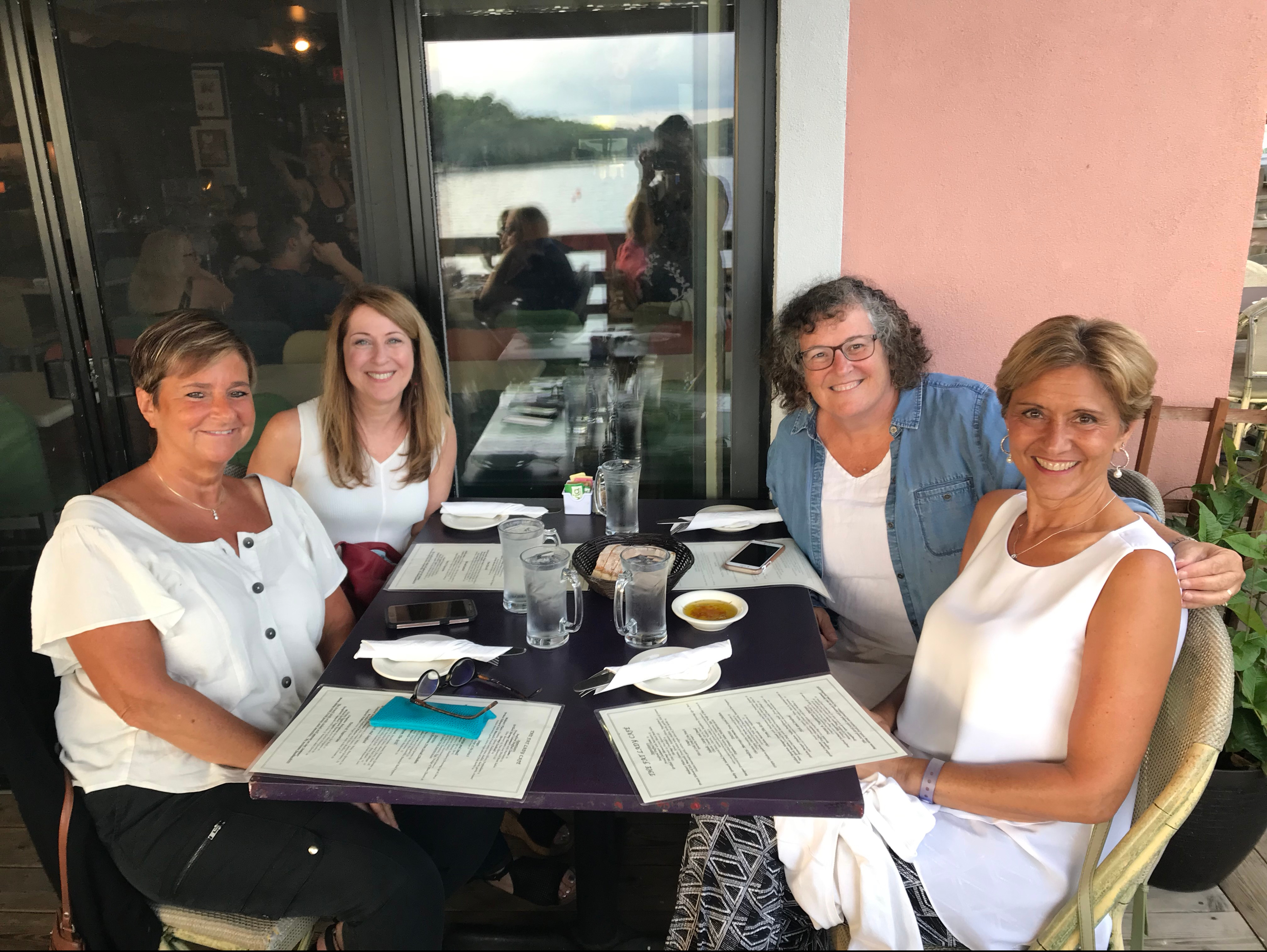
    Four friends, forty years later