Stories

A Visit to Saratoga

 Have you ever taken a visual field test? It is part of the evaluation I get when I visit the opthamologist. I take them pretty frequently because I am suspicious for glaucoma and have had other vision issues. The exam involves looking through a lens at a white surface, focusing on an orange light in the center, and pressing a button each time you see a flashing white light anywhere in your field of vision – hence the name of the test. It isn’t painful. It isn’t invasive. But it deeply annoying, especially for me who as a routine matter has floaters and flashes of light. It isn’t easy to distinguish the little white dots from what I usually see and leaves me wondering whether to hit the button.

My vision, on an ordinary day, is like looking through a dirty windshield where there are certain spots that have schmutz (a technical term). Unlike a windshield, though, the spots move. This has been the case most of my adult life and I am used to it. I do worry that it will get worse. I am grateful that I can see, and I don’t take it for granted. Though I have had this issue, among other eye problems, for many years, I have not been diagnosed with anything that suggests that I have  progressive eye disease. I do see two different opthamologists at least yearly to keep tabs on it.

I took one of those tests the other day and in the middle of it, everything went black. Fortunately it wasn’t my eyes. The power went out. Emergency lights came on briefly and then everything else buzzed back to life. A technician scurried into the room and told me I would have to start the visual field test again. Oh well. Not a big deal though I didn’t relish the idea of spending yet more time trying to figure out if what I was seeing was real or my usual visual stuff.

I finished and eventually was taken to the doctor’s office for the actual eye exam. But it turned out that their Wi-Fi was down as a result of that brief outage earlier. I was told I could wait and see if it came back up or I could reschedule my appointment. Apparently, the eye doctor didn’t feel he could see patients without access to the computer system. Really? He couldn’t look at my eyes and take notes? I can’t say I understood, but I didn’t argue. Our reliance on technology can be the topic of another essay.

I decided to reschedule. I was frustrated, but thought ‘how could I make the best of the situation?’

My eye doctor is located in Saratoga County, about a half hour drive from home. I knew the Saratoga Battlefield was nearby. I have lived in this area for over 35 years and never went. It was a crisp, late summer morning. I decided it was time to venture forth. I plugged Saratoga National Historical Park into my GPS and took a lovely 15 minute ride to the grounds. Entry is free!

It turned out to be an auspicious day to go. The first battle of Saratoga, also known as the Battle of Freeman’s Farm, was fought on September 19, 1777. I showed up on the anniversary of that fight – the 246th anniversary to be exact. They were having an educational program to commemorate the date.

I learned a few things. I probably learned some of this before but had no memory of it. I didn’t recall that there were in fact two battles – the first the British won. The second battle was the decisive victory for the Americans that turned the tide of the war. That one occurred a couple of weeks later, October 7, 1777. Benedict Arnold was one of the heroes of the battle, before he switched sides. It is said that if he died there, and he was injured, he would be remembered as a hero of the Revolution.

There is something about battlefields, not that I have visited that many, that is eerie. I had a similar feeling at Gettysburg  – of standing on hallowed ground. The sense that something of import had happened there.  A stiff wind was blowing across the fields and there weren’t very many people around so there was a desolation to it. I can’t explain it, but I felt the weight of history, of the souls that fought there. Maybe it was just my imagination, but it moved me. I’m glad the site has been preserved.

I also learned that the British weren’t only at war with America. They were in conflict all over the globe – with France, Spain and the Netherlands, to name a few. I also learned that the Revolutionary War led to a split in the Iroquois Nation, with most of the tribes siding with the British. The Oneida fought on the side of the Americans. It was also interesting to note that the army of the colonies was integrated. Enslaved people (forced to fight instead of their ‘owners’), freemen (Black), Native Americans and colonists fought side by side. It was later in America’s development that the army became segregated.

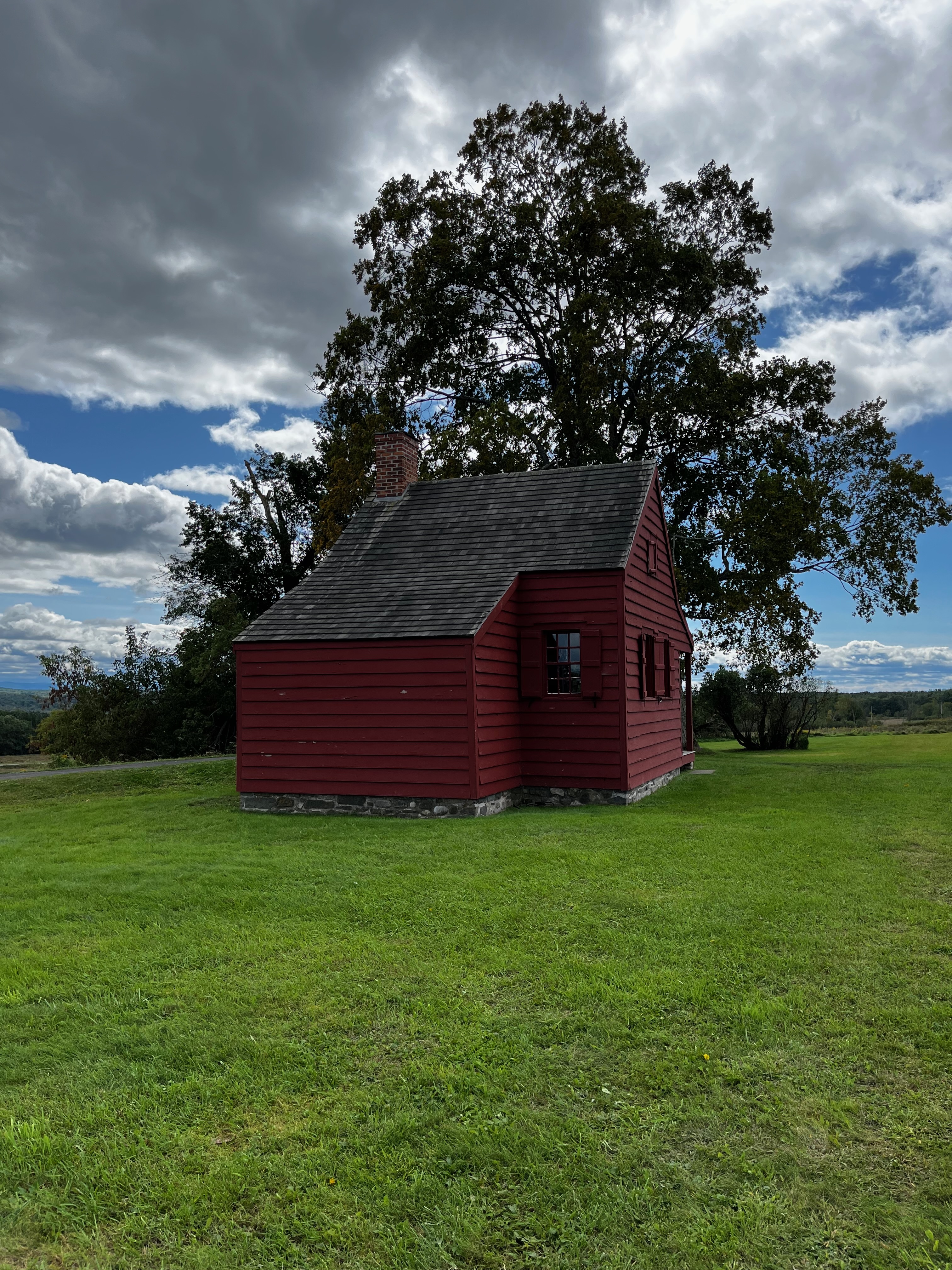
Not all Americans supported the cause which led to conflict among the families that lived in the area. One farm couple, the Neilsons, left their home to get out of harm’s way and their farm was commandeered by Benedict Arnold. The main house has been restored and I walked in to take a look. The general had a canopy bed, but there were four other cots sharing the modest space. It was interesting to hear that the couple came back after hostilities ended and raised 8 children there. Here is a picture of the home.

Hard to imagine a family of ten living there! These days we Americans have very different expectations about space requirements.

The landscape is beautiful. The area is a great place to hike or bike. The Hudson River runs along the east edge of the park.

The British, who were advancing from Canada, were trying to get to Albany to get food and supplies. The battles in Saratoga were crucial in preventing them from regaining strength.

Though I did not get to fulfill the purpose of my appointment in Saratoga, my time was well spent. I look forward to visiting again.

Walking or Hiking?

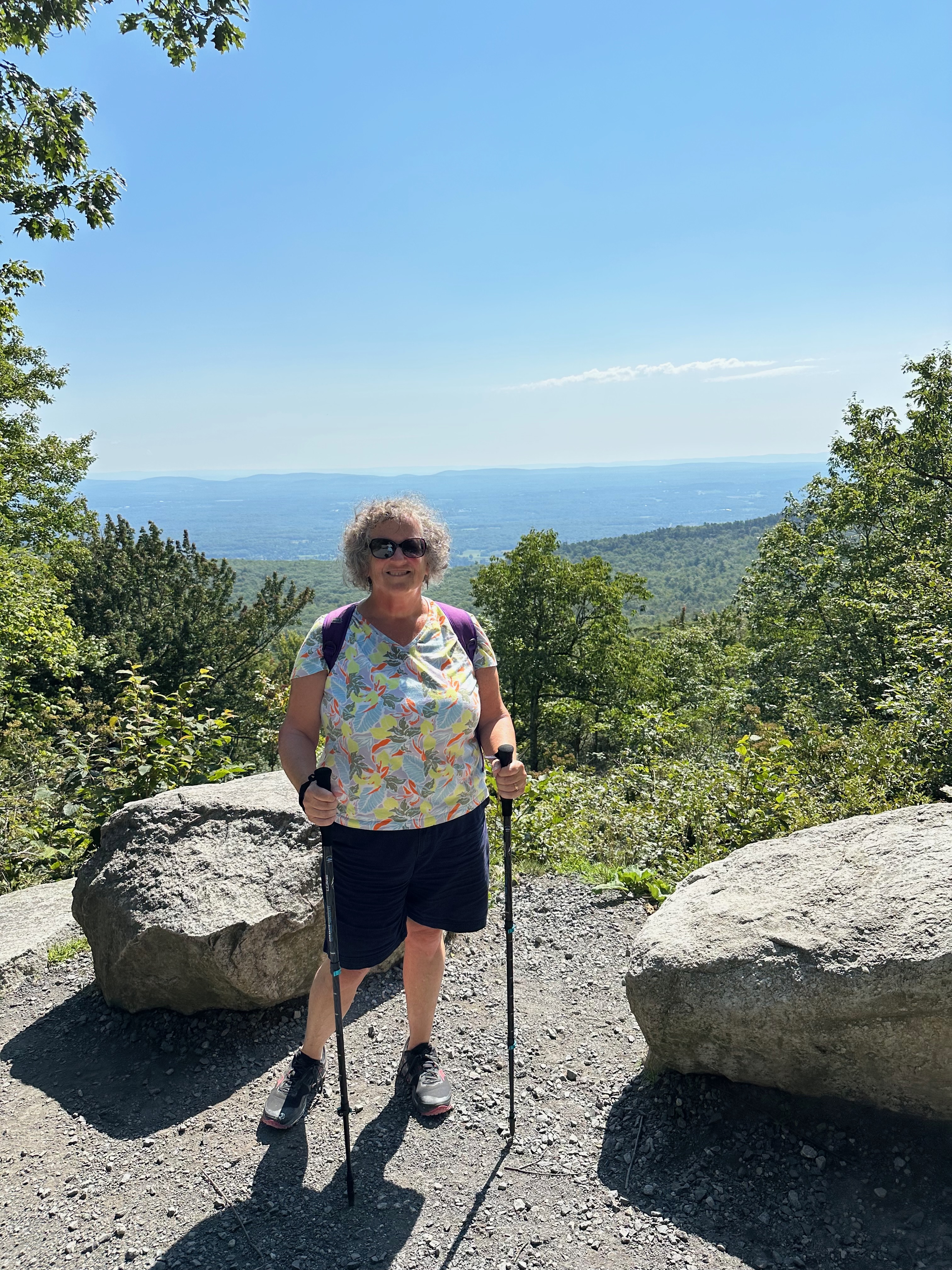
I don’t consider myself a hiker – more of a ‘walker-in-the-woods.’ I frequently take walks on trails in my area (the Capital Region of New York State). Those trails can involve some ups and downs, but not climbing. Because I am always looking for new places to walk, I follow a group on Facebook ‘Hiking the Hudson Valley.’ Folks frequently post about Minnewaska State Park which is not exactly in the Capital Region, it is in the Catskills, but looked beautiful and is less than a 90 minute drive. It was on my list of places to check out. This holiday weekend provided the perfect opportunity.  My main conclusion: my unwillingness to call myself a hiker is well founded.

That isn’t entirely fair. Gary and I did hike, and I did complete the loop, but it was a close call. Here are my lessons learned:

  1. Hydrate even before starting out. I only had coffee and it was a hot day.
  2. Bring more water. I had four 8 ounce bottles of water – in other words 32 ounces for the two of us. Gary was my hero, knowing I was having difficulty he let me drink about 30 of those ounces! I don’t know how he was able to manage given the heat, but fortunately his body functions very differently from mine and he is far more fit. I sweat beyond all reason under most circumstances, never mind when it is hot and we are exercising. My shirt was so wet before we even began our ascent that it looked like I had jumped into Lake Minnewaska. I wish I had. Which brings me to number 3…
  3. Bring a change of shirts – maybe that only applies to a Brody, which I am by birth. We sweat copiously. Dad always brought a fresh shirt when he played tennis. It wasn’t that comfortable driving back home in a still soaking wet shirt.
  4. Research the trail so you understand what you are getting into. We read the description on the sign, but it didn’t ‘grade’ it as easy, moderate or difficult. Of course those ratings, even when I have read them beforehand, don’t necessarily correspond to your personal experience. I have found some trails easier than the rating or far more challenging.
  5. If you are prone to allergies, take your medication before you hike! Fluid was pouring from every orifice (not that one, I am happy to say). My nose was running like a faucet. My eyes were tearing – between sunscreen and sweat I could barely keep my eyes open. Halfway through the hike I realized I had tissues, nasal spray and Claritin in my knapsack! Don’t know why I forgot about that, but at least I found it. The second half of the hike improved, but I had already used my shirt multiple times – yuck. I saved Gary’s dry shirt for wiping my eyes – once again he was my hero!
  6. If in doubt, bring your hiking sticks. This I got right. I would have been in trouble on the trail without them.
  7. Get in better condition! I am quite capable of walking long distances on gentle or flat terrain – when walking in New York City doing five miles is not that challenging. Hiking, even a modest mountain, is another thing all together. It tests balance and leg strength in ways that strolling along a path in Central Park simply doesn’t.

Sounds like we had a great time, doesn’t it? Actually, we did. Despite the pain, it was beautiful. The scenery was gorgeous.

Once we reached the top of Millbrook Mountain, I was able to recover. The way Minnewaska’s trails are organized there are sometimes multiple routes to the same place – a footpath and a carriage road. The carriage road is a gravel, wide trail that doesn’t involve climbing (it isn’t flat, but you aren’t negotiating rocks to go up). In this case the footpath was about half the distance (the sign said 1.2 miles, it felt like 10!) and was the route we took up and involved a good deal of climbing (not scrambling, but lots of leg work) and crossing a stream. We took the carriage road back. It was 2.5 miles and much easier. We covered the 2.5 miles much more quickly – less time than it took us to go the 1.2. At times we felt like we were going uphill both ways, but the carriage path was very manageable. We only stopped once for a break.

All in all, we walked about 5.5 miles. I am proud of myself for completing it. I am also grateful to Gary for being such an encouraging and supportive partner. He also led the way on the footpath so I didn’t have to concern myself with finding the trail markers. I think he was worried about me for a bit there and I felt bad about that, but I rallied. I will be better prepared next time. I do think there will be a next time.

Lions, Tigers and…Octopi?

As is often the case, this post is inspired by a book and the discussion we had about it at our family book club. We read Remarkably Bright Creatures by Shelby Van Pelt. The story uses an interesting device in that one of the narrators is an octopus named Marcellus. Marcellus is intelligent and insightful. One either buys into the conceit, or one doesn’t. The success of the book for the reader will likely turn on that.

Based on the reactions of the members of our book club, and from what I see on Goodreads, most people had no problem with it and, in fact, were charmed by Marcellus’ voice in the novel. I, on the other hand, had some trouble with it. I think suspension of disbelief only takes me so far. I don’t love fantasy as a genre, though this book wasn’t that, anthropomorphizing (if that is a word) an octopus veered into fantasy, but the author did not create a different world. In reality it was more of a family saga in which lost souls become connected with the help of the octopus. I liked the family part but could have done without Marcellus.

I wonder how much of my issue comes from the fact that I am not that much of an animal person. I have compassion for animals and have loved my cats, but I would not call myself an animal lover. I am not taken by every dog I pass as I walk in my neighborhood. I am not confused about my priorities – humans rank higher for me in the animal kingdom than other species.

We had this discussion with friends just this past weekend. Sadly, they had to put down their dog a few months ago, a beloved pet of many years. The woman of the couple was still grieving the loss and was keeping mementos of him around the house. The guy mostly felt bad for his wife and daughter. “He was a dog to me,” he explained almost sheepishly. He was saddened by the dog’s suffering and wished it hadn’t gone that way, but there was a limit to his grief. I understood what he was saying. For some a pet is equal to a family member. Others may have a range of emotion:  from not wanting anything to do with dogs or cats, to loving them but not the same way as another human, to treating their pet with the same love and attention as they would a child. I would put myself in that middle category. I wrote about my relationship with Raffa, the cat we had to put down months ago, previously on this blog. I couldn’t bear to see her suffer, but it wasn’t anything close to how I feel about family or friends.

Aside from how we view pets, there are other issues we discussed at book club in the context of exploring Remarkably Bright Creatures. Marcellus lived in an aquarium – in a contained habitat. We debated the ethics of zoos and aquariums. When I was growing up little thought was given to how zoo animals were housed. The cage for a tiger might be just large enough for him or her to pace back and forth. It was sad and it was clear the animal was miserable. We have progressed from there. Most modern zoos create large areas for the animals to roam with some configuration of water features and barriers to allow visitors to view them. Even with that, though, the animals are clearly not in their natural habitats. Lions wouldn’t live in the Bronx if not for the zoo, but at least they are not confined to a cage – they get fresh air and they are surrounded by grasses and trees. Some in our group were not comfortable with even this improved arrangement, they felt that animals should be free. At the same time, a couple of points in support of zoos were made.

In allowing people, especially children, to see exotic animals in person it can spur interest and provide an educational opportunity. In doing so, people may be motivated to be protective of the animals – heightening awareness of imperiled species and their environments.

In addition, zoos do research and partner with other entities that enhance our understanding of the animals. Sometimes zoos take in animals that can no longer survive in the wild.

I also wonder if we are romanticizing life in the wild. For example, how long is life expectancy for lions that live freely compared to those in captivity? If the animal has the company of its own species, is well-fed, receives medical care and lives in a comfortable physical environment, maybe they aren’t unhappy at all. Maybe a zoo isn’t so bad. Of course, if the animal is mistreated or neglected, then the calculus changes.

I think we all agreed that we were uncomfortable with animals performing tricks – like whales at a seaquarium. It is one thing to schedule feedings so that an audience can watch, it is another to make the whale, dolphin or seal leap, catch or clap for our amusement and a reward. I remember once going to the Catskill Game Farm years ago where chimps were dressed up in motorcycle garb and rode bikes. I found it very disturbing. I’m happy to say that act no longer exists, and the game farm no longer houses animals. It has been transformed into a campground. Given what we saw there that is a better use of the space.

Like many things it comes down to human behavior and judgment. Zoos and seaquariums can be great resources if the people running them are ethical and compassionate. If humans fail to meet that standard, then the animals suffer and there need to be consequences for that failure. Those individuals need to be held accountable. I don’t think the basic concept of a zoo or aquarium is problematic.

What do you think? If you read Remarkably Bright Creatures, did you enjoy it?

My granddaughter at our local aquarium

Fruit of the Vine

Alcohol was not part of my consciousness for most of my growing up years. My Dad did not crack open a beer when he watched the Giants play football on Sunday afternoon. Wine was not part of dinner, unless it was a very unusual occasion, like the Passover Seder. I don’t recall a time when either of my parents said, in the midst of a stressful time, “I need a drink!” I didn’t see alcohol in either of my grandparents’ homes. If I did, it was a dusty bottle in a cabinet. It had almost no role in our culture. Our celebrations involved food – that was the reward, that was the comfort. Ice cream or cookies were much more of a celebratory thing than making a toast – even for the adults.

It changed after Mom and Dad took a trip to California with their friends to celebrate their 20th wedding anniversary. When they came back, I distinctly recall that wine or a cocktail might be enjoyed as part of a meal, or as part of socializing with friends. That trip was in the summer of 1974, and I was almost 15. The combination of the influence of their friends, who knew a bit more about wine and liquor, being on vacation and not having their children around, made them open to enjoying the fruits of the vine.

Given how things had been, I noticed this change. In fact, by the time I went to college, two years later, I was a bit concerned that my mother was enjoying wine a little too much. I saw that she had taken to having a glass of wine more regularly – not even on a special occasion, it could just be an ordinary dinner! Or as part of a late afternoon snack with cheese and crackers! I was still not ‘of age’ so I had not partaken, and I wasn’t particularly interested in this new ritual. I wondered whether Mom was headed for trouble.

Then I went to college. My attitude changed somewhat. I appreciated the fact that alcohol could be a good social lubricant, though in my experience, the more I drank the more withdrawn I became. Getting buzzed was good, going further than that didn’t make me feel better and could get me sick. I seemed to have a natural defense to over doing it. I also never developed a taste for beer, which was the cheapest option and the beverage most often offered at college parties. I could enjoy wines, particularly Liebfraumilch (a semi-sweet white wine – Zellerschwarzkatz was especially popular in my day) or sangria; or a cocktail (I loved white Russians – still do). Fortunately for me, though, I did not have that predisposition that some are cursed with to not be able to stop drinking once they start. A couple of glasses and I was done.

When I returned home, I wavered in my judgment of my mother. It made me a little uncomfortable that she seemed to enjoy a glass of red wine so much, or a scotch on the rocks. But, in retrospect, it was also clear that she was capable of limiting her intake on each occasion – I can’t say I ever saw her drunk. My Dad would frequently have something along with her, but he never seemed to be as taken with it. And, I never saw him drunk, or even tipsy, either.

While I was growing up, I thought this attitude toward alcohol was the norm. I had an inkling, through my friendship with Susan, that some families were more liberal in their usage. Her dad offered her a sip of his beer when I was visiting (we were probably ten years old at the time). They had wine with dinner on the weekend. They were Italian. I thought that explained it. Maybe it did, but as I have gotten older, and as my family has evolved, I realize that my experience is not the norm. I think for American Jews of a certain age (I am 63), alcohol was not routinely consumed in their childhood home (perhaps it was part of ritual or part of Shabbat dinner, but not much beyond that). As with anything, I am sure there are exceptions. But, I do believe the incidence of alcoholism was lower among American Jews. I’m not sure that is still the case.

I have had occasion to think about this any number of times over the years. I just finished reading Matthew Perry’s memoir, Friends, Lovers, and the Big Terrible Thing, which details his harrowing struggle with alcoholism and drug addiction. I feel quite fortunate to not be afflicted with the disease. I struggle with my relationship with food, but I still wouldn’t characterize it as an addiction for me.

The question, though, that I still ponder is: what is a healthy approach to alcohol, and since marijuana is now legal, weed? There is a gray area, no? There is recreational use, plain and simple; using it occasionally or even regularly but not where it interferes with anything. Then, there might be a place where one uses too much, but it still isn’t abuse. Or, by definition, is over-use abuse? I imagine there is space between drinking too much and being an alcoholic. Is it a question of reliance, or craving? Is it a matter of how much it changes your behavior? I know people who become belligerent; I also know people who love everyone once they have had more than a few. What does ‘healthy’ use look like? According to dietary guidelines put out by the U.S. government:  “adults of legal drinking age can choose not to drink or to drink in moderation by limiting intake to 2 drinks or less in a day for men and 1 drink or less in a day for women, when alcohol is consumed. Drinking less is better for health than drinking more.” One drink is defined by the Mayo Clinic as 12 ounces of beer or five ounces of wine. I’m not sure what that means if you don’t drink daily. Can you drink a week’s worth on a Saturday night?

I don’t know what the answer is. I know for me, I don’t like the idea of ceding control of my behavior to any substance. I like being in command of my faculties – like I said before, a little tipsy, or buzzed is enjoyable – more than that is uncomfortable. I have come to peace with not being the life of the party (that is a joke: I have never been the life of the party, nor wanted to be), though sometimes I wonder if I am just no fun at all! On balance, I’ll take it –  it is better this way.

Reflections on Our 40th

Sunday, July 30th, 2023 will mark Gary and my 40th wedding anniversary. So many thoughts and emotions run through my mind. We have been together for more than four decades! Wow! I have written an open letter that I am sharing here. This letter is open in more than one sense: it is public for you to read (obviously), and it is honest.

Dearest Gary,

I am oh so grateful. I am grateful to have a partner in this difficult world. I never would have made it through the Reagan, Bush (Dub-ya) and Trump years without you! I know you are there for me, come what may. If I face a health or emotional challenge, I know I can count on you. You haven’t always been perfect, but who is? Sometimes you have surprised me by understanding me better than I understand myself.

I am proud of us. It hasn’t always been easy. The rough times were when we were each stretched to our limit – where there was little to no margin in time or energy and there was anger and/or resentment as a result. But, even when those times occurred, we stayed committed – to each other, to our family. The foundation of respect remained. Fortunately, more often when one of us was stressed to the max, the other had something left to give and gave. I don’t know if other couples give up too soon. The truth is we never really know what goes on behind closed doors, in the privacy of a home. I only know our life together. I think our effort has been well worth it. The good times have far outweighed the bad (and I can say that as someone who has a tendency, when things are bleak, to not see the light – luckily this is not a quality you share).

I have so many memories – we have shared so much. You know my oldest and newest friends– it is worth noting that even my newest friends have been around for decades. You know my family and I know yours, including those who have left this earth but remain in our hearts. There is so much we don’t have to explain to each other.

When we started this journey, I had no idea we would be so lucky. When I was a kid, I could not imagine having such a rich life. We have shared our children’s bat and bar mitzvahs, their weddings, the birth of grandchildren. We have traveled across this country and abroad (with more yet to come!). We have shared professional success. You have had an especially admirable career, making a difference in many lives. I take pride in your many accomplishments.

We’ve gone to concerts, movies, plays, ballets, museums, and all kinds of performances. We have had meaningful discussions about all of it. Once you retire, I look forward to adding books to our conversations (no pressure – well, maybe a little pressure)!

We’ve looked at magnificent scenery, searched for rainbows, laughed our asses off (just this morning I laughed till I cried at a parody you wrote of one of those drug commercials) and eaten more meals together than we can possibly count. (And, let’s not forget that I have cooked more meals for you than you can possibly count!)

We have also maintained our own interests and identities. We have given each other space for that, too.

It is amazing to me that our love has continued to evolve and ever deepen. In the beginning of a relationship, when you first fall in love, it is an intoxicating thing. I remember my friend in graduate school, after spending time with us, told me she wanted what we have – she said she wanted to have someone look at her the way we looked at each other. I think the romance is hard to sustain. As our lives have gone on, through the drudgery, the ups and downs, the losses, I don’t know if we have always looked at each other that way, but I know sometimes we still do. When those moments occur, they are even more precious, more meaningful since they have been hard-earned.

40 years feels like a milestone worth celebrating. I don’t know what the future will bring. I hope we will get to keep loving, talking, laughing, exploring, comforting and learning for as long as our health will allow. I am grateful, proud, and fortunate that we have come this far. Thank you for all you have given me.

Happy anniversary, my love.

Your Linny

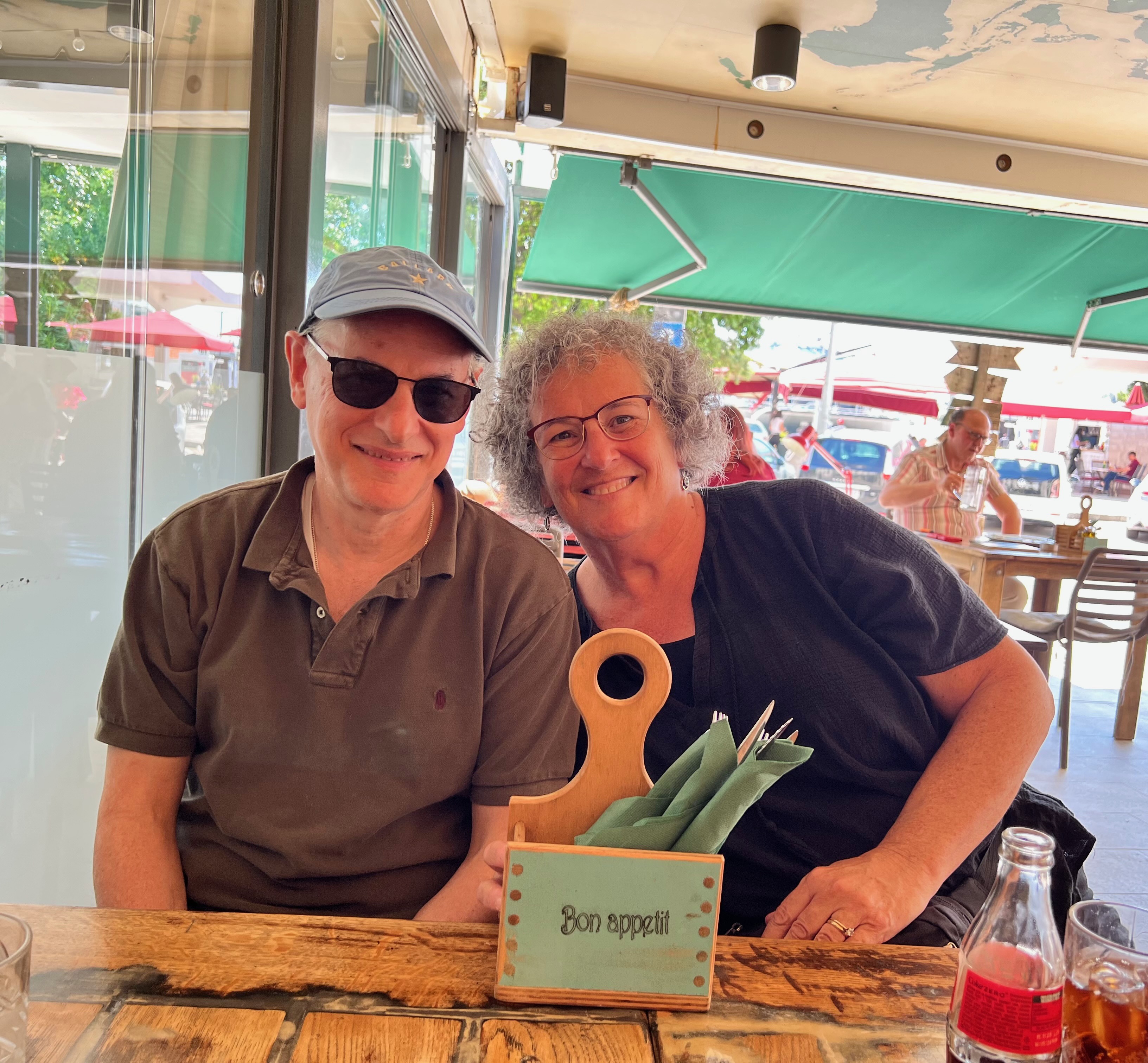
June 2023 in Croatia

Planes, Boats, Buses and Automobiles

Travel can be fraught under any circumstance. No matter the mode of transportation there can be curveballs. Traffic, due to construction or an accident, can stymie progress. Weather can create havoc. Air travel has its own set of challenges. This past weekend our family faced all of that. The good news: we survived! The bad news: nerves were frayed and I’m pretty sure I can speak for all of us when I say we are exhausted. But, if that is the worst of it, we can count ourselves fortunate.

We were invited by our daughter and son-in-law to join them on a family vacation to a cabin on Georgian Bay (on Lake Huron in Canada). The plan was for them to fly from Boston to Toronto with their 13-month-old baby. We would pick them up at the airport in Toronto and drive the rest of the way – about 2.5 hours to a remote marina north of Toronto where we would be met by our son-in-law’s father in a boat. He would ferry us the rest of the way – to a place called the Iron City Fishing Club (more about that later). Unbelievably, that travel went smoothly for all of us.

The kids’ flight was on time. We found the little city airport (Billy Bishop Airport  – named after a World War I Canadian flying ace) which sits on a small island in Lake Ontario just off the shoreline of Toronto).

That’s Gary – we walked along the lake, the airport is just across the waterway, while we waited for the kids’ flight to arrive

We loaded up the car and didn’t get lost finding the marina just outside of MacTier, Ontario. The last 15 minutes of the ride involved a curvy, narrow road that Gary had to take very slowly and naturally that was the one time our granddaughter got fussy. But, it was brief, and we arrived at the marina in good spirits to find Ben’s mom and dad waiting for us with the Iron City boat. We loaded our stuff – we were all remarkably efficient in packing, so we didn’t have that much baggage, but it did involve supplies for four adults and one baby so it wasn’t light either. We had a delightful boat ride in the late afternoon sun over calm waters of Lake Huron. The smoke from the Canadian wildfires, the fires themselves were not near our location, had cleared earlier in the day.

We thanked our lucky stars that everything had gone so well. We enjoyed our five full days at Iron City. I will write another blog post about that experience another day.

We began the return trip on Friday at noon. It was the kind of day that made us reluctant to leave. The air was crystalline, very low humidity (finally!), with a strong breeze. The clarity of the air showed off the blue of the lake and sky, and the rocky shore.

Despite our reluctance, we got on Ben’s father’s boat and once again enjoyed a delightful, refreshing ride back to the marina.

It took Gary a bit to find the car, but he did and again we loaded up. We settled in for the 2.5 hour journey. Leah asked Ben how he felt about the vacation – how did he feel about the experience since it was the first time he was making it with his own child. Ben has been coming to Iron City for his whole life, the place has been part of their family for generations. He had been there with Leah in the year before Covid (summer of 2019), but not since. Ben replied, “The trip isn’t over yet. We still have to get home.” I don’t know if Ben had a premonition, but truer words were never spoken.

All went well on the first leg. Our granddaughter slept for almost two hours and woke up in a fine mood. We dropped them at the airport after hugs and good-byes. It is always painful to leave a grandchild, but we had had a wonderful week with her.

Gary and I got back in the car and continued our drive back to Albany. We weren’t sure if we would stop overnight and decided to play it by ear. It was about 3:30 in the afternoon when we left the kids.

The first hint of trouble came with word that their flight was delayed. It didn’t sound too bad…at first. We continued our drive uneventfully, crossing back into the United States at Lewiston without too much of a line. I have a history of having some difficulties when crossing back into the United States – once when the border agent questioned if the two children traveling in our car were ours and I got annoyed and another time when I didn’t understand the instructions we were given about where to stand at customs at JFK. Gary requested that I not say a word and let him handle this interaction with the border agents. I handed him the passports, he was driving, and I kept my mouth shut. We had no problem.

The real problems started when the kids’ flight was cancelled, which they learned some time after 6:00 pm. We felt terrible for them – and at this point it made no sense for us to go back. It is their story to tell about the different permutations they tried, but they were distressed because their dog, oddly named Douglas (a formal name for a very small dog), was at home in the care of a friend, who had a flight herself and was due to leave Friday afternoon. Leah and Ben expected to be back Friday night. They were scrambling for coverage for their dog and an alternative way to get home. The airline offered them their next flight – on Tuesday! Obviously, that was not going to work.

We were texting with them and had decided we were tired; it was now almost 7:00 pm and we had been up early and began the trip with the boat ride at noon. We decided to take a hotel room outside of Rochester.

After many frantic calls and texts, another friend was able to go over to their apartment to take care of Douglas over night. They explored many options: other flights, renting a car and taking a train, all of which presented insurmountable problems, they decided to take a bus to Rochester. It was due to arrive at 1:10 a.m. Their 13-month-old was holding up remarkably well, but they had not taken supplies for this long of a delay. We went to the market and bought milk and formula. We booked another hotel room.

Gary and I went out to dinner and then relaxed in the hotel room. Gary was suffering with heavy congestion so we decided that I would be the one to go to the bus station. He went to bed. At least one of us would be rested for the drive tomorrow. Leah texted around ten o’clock that they were crawling in traffic and that she would text when they got to the station before Rochester, Batavia, so I could go to sleep. I tried to and did close my eyes for a bit. At 2:30 a.m. I got the text that they were in Batavia, about 35 minutes away from Rochester.

Thank goodness for GPS. I plugged it in and drove the desolate streets to the bus station. I was thinking about the spate of violence that hit Rochester years ago when it was down on its luck. The last time I was there for work, which was probably a decade ago, it looked depressed and unsafe. I was anxious but focused. From the little I could see in the dark, with my eyes glued to the route, it did look better, though totally deserted. But that is probably a good thing at 3:00 in the morning. I pulled into the parking lot, kept the car doors locked, and was comforted to see other people waiting, too. There were no further delays and the Trailways bus pulled into the station as expected (a mere two hours late). Later Leah explained that there was construction on a bridge in Canada that created a crazy traffic jam. They traveled two miles in two hours!

After a few minutes of the bus pulling in, Leah climbed down the steps with the baby in her arms. She wasn’t asleep, but she was calm (both of them were). Ben came down a few minutes later carrying the car seat and backpacks. What a day for them! Once again, we loaded their baggage in the car.

Due to their dog, they decided that Ben would take an early flight (5:15 a.m.) to Boston and that we would drop him at the airport. It would make no sense for him to go to the hotel for an hour. Leah thought that taking that early morning flight would be a disaster for her and the baby so she would come to the hotel, get some rest and ride with us back to Albany. We would figure out how to get them to Boston, but they wouldn’t have to worry about Douglas, so they wouldn’t be as stressed.

We got to the hotel and made up a few bottles. They settled into their room, and I went to bed in mine. Ben was left to try to make himself comfortable in the airport. It was now close to 4 a.m.

We woke later in the morning to learn that Ben’s flight was delayed. They debated whether he should just come with us and bag the flight. They decided he would stay with it because, assuming it wasn’t cancelled, and the airline was assuring him that it was going to go by noon, he would still get back before we could possibly drive there, especially taking account of the baby’s needs.

We left Rochester (Henrietta actually) at about 10:00 am after a successful breakfast. We arrived in Albany just before Ben’s flight took off! He had been in the airport for 10 hours, instead of the 90 minutes we expected. What a misery! Our drive was uneventful. Once again, the baby was awesome. She chatted adorably for the first half hour and then fell asleep for the next two. She needed to be entertained for the last half hour. We stopped at our house in Albany, let the baby play, wander around and had lunch. Then we got back in the car.

Ben had successfully arrived home. He got to shower and walk Douglas. Then he and Douglas drove to meet us outside Worcester to save us about two hours of driving if we took them all the way home. We met at a Dunkin’ Donuts in Grafton, MA. Iced coffee is helpful in these situations. The baby lit up when she saw her daddy. They were happy and relieved to be reunited. Douglas was especially happy, his tail wagging, nuzzling Leah’s legs.

It had been an ordeal. A trip, difficult to make under normal circumstances – involving boat, plane and car –  that should have taken 9 hours door-to-door took about 31! Only Ben can answer the question Leah posed Friday afternoon, but I might wait a while before asking again. For my part, though it was a lot of time in the car, we had an awesome vacation. I’m glad Gary had Sunday to recover before heading back to work.

Though I love seeing other places, I have more understanding for those who find the process of traveling overwhelming and choose to stay local. So much can go wrong! Add a baby and pets to the mix and it can be nerve-wracking. You need a very Zen attitude – which can be hard to maintain in the face of unexplained delays and seemingly unhelpful staff. It’s still worth it to me, but as I get older that calculus could change.

A view I wouldn’t get unless I was willing to travel. That’s Leah kneeling to take a picture from the Iron City dock.

Sunshine

I don’t normally post on Friday, but my schedule has gotten all out of whack! I’ve been working on my book and a first draft is complete, but it has taken energy and time away from the blog. We’ve also been traveling – more on that soon. Thank you for bearing with me.

Does everyone who is lucky enough to have a grandchild see rays of sunshine when they look at them? Do they see sparks of light in the child’s eyes? An aura of yellow joy surrounding their head?

Grandchildren don’t always behave perfectly, I will acknowledge that, but they are sources of delight. Even when they are crying, they are adorable (it is much easier for a grandmother to say that!).

I see and feel my granddaughters’ radiance when I look at them. They are full of energy and curiosity. They emanate light and are full of life.

It is interesting because it seems to be a cycle – there is a feedback loop at play. A newborn baby arrives, you look at him or her with wonder. They in turn do the same. As a Mom or Dad it may take some time to fall in love with the little being – though for some the feeling is instantaneous; an almost chemical reaction upon first seeing the baby. For me it took time. I felt protective immediately, responsible for this vulnerable life, but I can’t say I felt the bond of love as soon as they emerged. That happened over time and grew in intensity. As your love grows, and you shine it on the baby, it seems to be reflected back in full measure. Unfortunately, this may not happen for everyone – if it did in every instance, the world would be a better place. It was my experience, though, and it seems to be happening for my children.

As a grandparent, in some ways, it is simpler. We don’t bear the awesome responsibility. We can simply bask in the wonder and love. Our grandchildren may prefer to be held by their mom or dad, but we get to build a bond, too. The feedback loop of love develops. I think babies know when someone is looking at them with deep love, enjoying, valuing their very existence.

I can appreciate the charm and adorableness of other babies and toddlers. I love my great-nephews tremendously. And I am delighted by my friends’ grands.  I have to be honest, though, the phenomenon of light beaming from their eyes and smiles is reserved for my granddaughters. I imagine that is true for other grandparents – they see it in their own but not so intensely when they look at others.

I was thinking about this the other day after one of my granddaughters left after a weekend visit. She spent the weekend charming everyone who came in her orbit – especially me and Gary. One of my daughter’s friends stopped by with her perfectly adorable little one, but I was struck by how I was only seeing that halo of light around my granddaughter. I was thinking about this phenomenon when I had an ‘aha’ moment.

When I was growing up my maternal grandparents lived upstairs from us. I’ve written about my relationship with Nana in many blog posts. I recounted how each day I came home from school, put my stuff in my room, and went up to visit. I was greeted, on a daily basis, by “Hello, Sunshine.” Nana called me Sunshine with such regularity that I thought it was my middle name. My parents named me Linda S. Brody, they didn’t give me a middle name, just the initial (apparently they couldn’t agree on a suitable ‘S’  name; I was named after my father’s grandmother, Lifsha Surah – in Yiddish). For the longest time I thought the ‘S’ was for Sunshine.

I didn’t think of myself as a source of light growing up – I felt I was kind of a sad kid. I think I was dismissive of Nana’s term of endearment. I liked that she called me that, but I didn’t internalize it. It occurs to me now that perhaps my view was distorted. Nana saw something. Now I think I understand it. It gratifies me to reflect on that; to believe that she felt what I feel. I wish I understood this sooner, there is something validating in the realization. But, I guess you know when you know and certainly better late than never.

My granddaughters are my sunshine.

Nana and me – on our front porch in Canarsie – sometime between 1969-71

Lawn Signs

There is a route I take frequently when I run errands. I drive through a neighborhood in Albany when I go to the bank (more likely the ATM), to our favorite bagel shop or to walk at SUNY. Probably 18 months ago I noticed a house had a for sale sign. The brick house sits on a corner lot; it is possible that it is a multi-family dwelling. Anyway, I wondered how quickly it would sell. The reason I wondered, given that the market was pretty hot, maybe not as hot as some areas of the country, but healthy nonetheless, is because of the house next door. That house has a barrage of signs – including the unforgivable ‘Fuck Biden.’ I’m all for free speech, but that is over the line. The house has lots of other signs – back in the day he (and I believe it is a he because I see him mowing his lawn) had a ‘Lock her up’ sign, among others. Based on the signs he displays, he is deep into conspiracy theories about the deep state.

A photo from a New Jersey newspaper – not the house I drive past obviously, and his are a bit more discreet, but the sentiment is the same

I have driven past the ‘for sale house’ for many, many months and now its lawn is overgrown, and it has one of those orange notices affixed to its front door – I imagine that it is in foreclosure. Do you think it has anything to do with the ‘Trumpy’ neighbor? I would not want to live next door to someone who was willing to put a sign out with an expletive directed at anyone, much less our president (even if I hated him/her – in my most outraged state with Trump it would never occur to me to display such a sign). Or maybe something is actually wrong with the structure? I don’t know, but I have mixed feelings about it. Part of me feels a certain satisfaction that the house is going to seed because the Trumper takes meticulous care of his property and can’t enjoy looking at the mess next door. I don’t wish ill to whoever owned the house that isn’t selling, and it isn’t good for the neighborhood to have an abandoned property, so there is that.

That same route that I drive brings me past a house that this month is festooned with pride symbols – just around the block from the Trumper. I wonder if they know each other. I should note that there are no curse words included in their array, just rainbows and hearts. Further down that same block is a house with flags that I associate with extreme Republicans – Don’t Tread on Me, the American flag and some others that I don’t recognize (not the confederate flag, I’m pleased to report). Is it one big happy neighborhood? Somehow I doubt it.

It is interesting to me that folks choose to advertise their politics in this way – it is not election season. I have put signs on my lawn in support of candidates. In fact, my Kerry for President sign got stolen. But, I don’t choose to put symbols out that represent my politics. I admit I appreciate passing homes that fly a rainbow flag – and I like the signs that say, in one way or another, hate has no place here. I’m not sure if I think those gestures are helpful. I defend anyone’s right to put whatever they want on their lawn, though I would like to think people would exercise good judgment. ‘Fuck Biden’ isn’t good judgment. Isn’t there some ordinance against that? I would not want a six year old, who is learning to read, to see that.

It leads me to ask: will we further segregate ourselves by our politics? Cities have historically been blue, though New York City, that bastion of liberalism, has elected any number of Republican mayors. Rural areas have historically been red, though I’m sure there have been exceptions. Can that still happen? As the parties move further apart, will those anomalies continue?

I wonder what impact the divisiveness in our politics has on the real estate market, especially in suburban areas. It can’t be good for our communities. Will our neighborhoods become echo chambers like our social media? Will we instruct our realtors to find properties with like-minded neighbors?

I wish this era of hateful rhetoric was behind us.

Travel: Why Croatia?

When I told my mother that Gary and I were going to Croatia for vacation she looked at me puzzled and asked, “Why?” I explained that Croatia’s coast, which sits on the Adriatic Sea, is reputed to be beautiful and has become a tourist destination. “But, where is it?” I started by saying that the Adriatic is the sea that borders Venice, Italy and if you go across from there, you get to Croatia. She was still having trouble picturing it. Then I told her it was part of the former Yugoslavia. “Oh, now, I understand where it is.” Interesting, for a woman of her age that reference clarified things.

Croatia was indeed part of communist Yugoslavia until 1991 when it fought a war for its independence. Yugoslavia was never part of the USSR, but it was under its sphere of influence. When the Soviet Union fell apart in the late 1980s and early 1990s, Yugoslavia broke up into six separate countries as well. If our experience there is any indication, it appears that Croatia has embraced the West.

The Croatians we met, and it is true that they were mostly involved in the tourism industry and may not be representative of the whole country, were quite enthusiastic about the United States. We perceived no resentment or negative vibes. In fact, several of them commented on how much they admired America. Everywhere we went there were tourists from all over – Italy, France, Germany, Asia and the U.S. Clearly tourism is a critical part of their economy. They also expressed pride in their country and way of life. Several told us that Croatians take their time – if they want to have coffee they will take 2 hours to sit, relax and enjoy.

We started our adventure in Split. We learned that it was the birthplace of the Roman Emperor, Diocletian, who ruled from 284 to 305 A.D. He built a ‘retirement home’– palace is more accurate – in Split. He is the only Roman Emperor to step aside willingly – he planned for his succession. Most were overthrown or murdered. Anyway, his palace still stands. Today it is home to a church, monastery, apartments, restaurants and shops. We took a tour, and it was fascinating to see how it has evolved. Different eras are demarcated by the different materials used – blocks of limestone, bricks, stones show how things originated and were then repaired centuries later.

Our tour guide for Diocletian’s palace, Yakob, was very knowledgeable. He is a native of Split, expressed pride in his city and country, and shared a great deal about the history and current politics of his nation. He explained that all students in Split learn English. He told us he grew up watching U.S. television shows. His favorite was Seinfeld! We were shocked. I wouldn’t have thought that humor would translate to another culture. He loved it and could reference specific episodes and funny tidbits. I wasn’t sure how I felt about Jerry, Elaine, George and Kramer representing us. They aren’t the most admirable folks. Apparently, though, it entertained Yakob and honed his English skills.

It was so interesting to travel around and see and hear the mix of cultures. American music, Croatian radio stations, Muslim influences.

Gary and I made the trip with our friends Merle and Dale. Merle had done the vast majority of the research and gathered recommendations about historical sites, hotels and restaurants.  We took tours in some places, but we were not part of a tour group going from place to place. There can be pluses and minuses to that approach, but it worked for us. In a country where so many speak English, it was totally manageable.

We traveled from one location to another by ferry. There are many islands off Croatia’s Dalmatian coast and ferries offer the most efficient means of getting from one to another. After Split, we visited Hvar. It has a busy, crowded port that looked like what one might expect of a Mediterranean resort, filled with restaurants, bars, souvenir shops and churches. We didn’t spend much time in that section of Hvar – we chose a hotel in a quieter, smaller town.

Everywhere we traveled we noted the orange ceramic tile roofs and beige stone buildings. It made for beautiful views of waterfronts and hillsides – perhaps a cross between Italy and Greece. Here are some views of Milna, Hvar (the small town where we stayed instead of the main port area):

The weather this time of year is supposed to be optimal with sunshine and temperatures in the 70s. When I checked the weather in the week to two weeks before the trip, it consistently showed thunderstorms. We started looking for indoor activities in case our other plans derailed and we packed accordingly. It turned out to be unnecessary. When we arrived we were told that weather forecasts for the Croatian coast are meaningless, the forecasters are always getting it wrong. We were glad they did!

We did face one morning of rain and it was during our tour of a national park – Plitvice Lakes National Park was about 3 hours inland (north and east) of Split. It was sunny in Split and remained that way for the first two hours of our bus ride to the park. We emerged from a tunnel through a mountain to cloud cover and by the time we got to the park it was raining. It poured for a few hours. It did not dampen our spirits or ruin the views and fortunately we had packed ponchos for just this situation. We took a 9 kilometer walk that wound around lakes and waterfalls. I can’t remember being anywhere more lush. It was spectacular. They had gotten substantial rain in the days leading up to our visit and the waterfalls were full and powerful. It was breathtaking. The rain stopped in time for our boat ride and the sun came out when we stopped for lunch. Someone was looking out for us! When we resumed hiking after lunch, it was dry.  Here are some views of our visit to Plitvice:

We also visited Dubrovnik, an ancient city at the south end of the country. We took a cable car ride up to the top of a mountain that overlooks the old part of the city. The view was like something out of a tour book. The walled old town could have been the setting for a fairy tale – it was the setting for parts of Game of Thrones (so was Diocletian’s Palace). The water of the Adriatic is clear and varies from blue to green. The orange tile roofs pop next to it. We timed our ride on the cable car to be up there as the sun set. It was magnificent.

Here are some shots from there and from atop the walls of the old city:

We had some excellent meals. The national dish of Croatia is ‘peka.’ Merle had gotten a recommendation for a restaurant that specializes in that dish and it was a one mile walk from where the cable car left us. That walk was so special – the sun was low in the sky, the light was soft and yellow. The countryside was dotted with purple, yellow and white flowers (see the second photo above). The road wound down the hillside and opened up to vistas of Dubrovnik and the Adriatic on one side and mountains on the other.

The restaurant did not disappoint. Peka is made with either beef or lamb and I am not a fan of either, so I didn’t have it – you had to pre-order because it takes so much time to cook. It was interesting for Merle, Dale and Gary because  peka reminded them of comfort food they grew up with in the best possible way. The restaurant slow cooked the meat under an iron bell and it is served with roast potatoes. The seasonings tasted familiar to them. We hypothesized that since Croatia traces its roots to the Slavic people of Eastern Europe, as we do as Ashkenazi Jews, that perhaps the cooking style was shared. It was quite a moment for them, Merle in particular, to have such a strong sense memory, to be so many miles from home and so many years since last tasting it, but be taken back to her grandmother’s cooking.

Sadly, all good things come to an end. It was time for Gary and I to return home. Our trip back was long and tiring, only to be greeted by a line that snaked up and down a cavernous hall at JFK to get through customs. That line alone took an hour – just to show our passports and be admitted back into the United States. People on the line were remarkably well behaved, though. It took 18 hours of travel time from our hotel in Trogir, a charming, old town near the airport in Split, to get to our apartment on the upper west side of Manhattan. On the one hand, it is kind of miraculous to be able to travel almost 4,400 miles that quickly. But, on the other, in this modern era of jets, it shouldn’t take that long – especially when you consider the amount of time spent waiting on lines to get through security and passport control at various airports. If Gary and I plan to travel more overseas, I will definitely look into the expedited programs they have for international flights.

Now it’s back to the grind, especially for Gary. I will look back at my pictures and treasure our memories of the beautiful places we saw, the people we met, the shared laughs and the experiences we had. We are lucky to have taken many wonderful trips and hope to continue to do so as long as we are healthy enough and have the resources to do it.

Sunset on the ferry back to Split

Call Us What We Carry

I keep telling myself I want to read more poetry. But I don’t do it. Why? I think in part it is because for me it is hit or miss. I love it or I don’t get it. And when I don’t get it, I feel less than. It feels unsatisfying. With a book, it is different. I may like the story or the writing, or I may not, but I don’t often feel a sense of failure. With modern art, or even classical paintings, if I don’t appreciate something, I just move on without judgment – not of the artist and not of myself. Why does poetry that goes over my head, or if it doesn’t move me, make me feel like it is a personal failure? I think I need to adopt the attitude I have about other art forms – enjoy what resonates and let the rest go. Maybe then I would make it more of a priority. After all, poetry lends itself to our lifestyles these days – they can be quick reads (maybe not quickly understood and processed, but it doesn’t require a huge time investment) so it would seem to be a good fit.

I am pleased to report, though, that a book of poetry I just read, prompted by my family book club (thank you, Nicolette), did not fall into the category of going over my head. I found it accessible and meaningful. Amanda Gorman’s Call Us What We Carry was insightful, moving, intelligent and creative. My niece, who picked it as this month’s read, called it a ‘time capsule,’ and I think that is very apt. Gorman wrote it during the pandemic, it was published in 2021. The poems remind me what the early days of Covid felt like – the isolation, the fear, the uncertainty. The poems cover that year, 2020, and all the upheaval that went with it. While some might not want to be reminded, it is important because though we think we have moved beyond it, in our quest for normalcy, there are residual effects that we need to reckon with.

It Is amazing to me that Amanda Gorman is so young – as of today she is 25. When she recited her poem, “The Hill We Climb” at Biden’s inaugural (that uplifting poem is included in this collection), she was 21! She is clearly well-read and well-educated – how much is formal education (she earned her B.A. from Harvard so there had to be some of that), or her own reading and research, I don’t know, and it doesn’t matter. She brings a sense of history and culture to her poems that is so impressive. There are references to the pandemic of 1918, the Great Migration (the movement of African Americans from the south to the north during the first half of the 20th century), the Civil War and her own life. She includes footnotes and endnotes. All of it is called upon in service of enlightening our present moment.

It isn’t common for our book club members to all agree on something we have read. Usually there are differences of opinion, and we bring a variety of perspectives and preferences to the piece  – which is what is beautiful about it– and we read a wide range of genres. Everyone was impressed with Call Us What We Carry. Each of us picked up on different themes, some things resonated more than others, but we all valued the experience. I should note that we do not all share the same politics – though I would not characterize any of us as extremists, we are mostly center-right, center-left, and maybe a bit further left. I point this out because one might be tempted to assume that Gorman’s poetry would be heavy-handed. We did not find it so – she writes substantively, with evidence and passion – not propaganda.

Several of our members perceived that some of the poems communicated anger. I can’t say I felt that as I read. I didn’t pick up on that in her tone. If it was there, it wouldn’t be without cause – there is plenty to be angry about. It didn’t hit me that way, though.

I think this collection of poems offers an important contribution to our time. I recommend reading and or listening to it. Our book club had a discussion about how best to engage with it – some had listened, some read and one of us read and listened at the same time. I think, if one can, that last method would probably be best. Reading it allows you to appreciate some of the artistic choices made in how it is presented (the poem in the shape of the U.S. Capitol, the use of white space, the color of the paper, etc.). Listening likely offers more of an appreciation of the rhythm and the playfulness of the language.

I will leave you with two parts of poems that made a meaningful impression on me. The first comes from “The Shallows,” which describes a time challenging to the human spirit, she concludes the poem with these lines:

Shall this leave us bitter?

                Or better?

Grieve.

Then choose.

The other piece is entitled Pre-Memory:

“Marianne Hirsch posits that the children of Holocaust survivors grow up with memories of their parents’ trauma: that is to say, they can remember ordeals that they did not experience personally. Hirsch calls this postmemory. Seo-Young Chu discusses what she calls postmemory han, han being a Korean conception of collective grief. Postmemory han, then, is the han passed on to Korean Americans from previous generations. As Chu writes: Postmemory han is a paradox: the experience being remembered is at once virtual and real, secondhand and familiar, long ago and present.” The whiplike echo of Jim Crow, too, passes through Black bodies even before birth.”

The piece then goes on to explore this idea. The notion that we inherit trauma, if it is true, has major implications – and would explain a lot about why people behave the way they do and why it is so difficult to move on.

Amanda Gorman is wrestling with provocative and interesting ideas. I think it is worth the time to explore them. I look forward to seeing what she will offer us as she grows.