On July 8, 2024 I posted a blog asking Joe Biden and Donald Trump to step aside. One of them did. On July 21st, President Biden stopped his campaign and endorsed Kamala Harris. Before I published that blog, I sent an email to the White House thanking President Biden for his excellent service but suggesting that it was time to end his candidacy in favor of a younger person. Do you think I can take credit for his decision? Have I become an influencer? I’d like to take credit. I’m kidding, of course, I am not delusional. Without taking undue responsibility, I will admit to being relieved and energized by the turn of events.
Now if only the Republicans would take heed of the Democrats’ success and dump Trump and offer America a good alternative, then we could have a real, substantive contest. We have a close race now, but for many of us the possibility of another Trump presidency is horrifying. He is not a serious person, he is a cartoon character who doesn’t have values or policies; and, more than that, he is dangerous because he is impulsive and ill-informed. It would be better for our country if we could choose between two respectable, intelligent people who simply represent different visions of how the country can achieve success.
I did not watch a lot of the Democratic Convention. I saw snippets and caught up with some of the speeches after the fact. The most meaningful scene that I did watch live was Tim Walz’s speech when his son leapt up in enthusiasm and love and shouted, “That’s my Dad!” How could you not get chills and/or cry seeing that? This moved me on many levels. First, I am thrilled that the Walz family and the campaign saw no need to hide Gus (I don’t know what went on behind the scenes, hopefully campaign advisors had either no say in how this was handled or were supportive of his visibility). Not that long ago, I can imagine that a candidate might make a different choice. Gus may have an observable disability, but that should not be a bar to participating in his family’s moment of pride. He should be there to celebrate and express himself (as long as it was a healthy, positive choice for him). It is important for us as a society to see the full range of humanity.
Then there is the freedom with which Gus showed his emotion. Good for him! Many of us, including women, are much more constrained. We can all learn from that and get comfortable with tears of joy and sorrow. Though it may be more socially acceptable for women to cry, at least in some contexts, it can still be judged negatively. I find it ironic that Trump’s histrionics are ignored, and even celebrated, but Gus’ s tears have been mocked on right wing social media. For folks who make those kinds of comments, the world is upside down. Cruelty is celebrated, signs of strength are seen as signs of weakness, wrong is right…that is Trump World.
It was also heartening to see such a raw, genuine expression of love for his father. It says something important about Tim Walz and his character. After his selection as the nominee, I did some reading about him. Before I knew next to nothing beyond that he is governor of Minnesota and I might not have even known that! The articles I read revealed that he was an exemplary teacher (in my view, excellent teachers share many of the qualities of wonderful parents). Former students have said glowing things about him. If you haven’t read this article, which recounts how his class predicted the Rwandan genocide, I urge you to. It is an example of what fine teachers can do: provide students with an opportunity to think, to analyze and to understand. They participated in an exercise that went beyond learning important dates and names and gave them skills and ideas that will make them better citizens of the world. Here is the link to that article: https://www.nytimes.com/2008/04/23/education/23education.html
This type of teaching makes me think of my dad, who was also a high school social studies teacher who wrote curriculum on the Holocaust, and that is a high compliment. Dad was a great teacher and father.
The more I read, the more I see of them, the more impressed I am with the Harris/Walz team. Maybe, just maybe, we are beginning to turn the corner. I am hopeful that the fever has broken and Trump’s hold on the Republican party and a good portion of America is breaking. There is plenty of room in America for different views of policy without the vitriol, without the ugly threats and negativity, without the fear of devolving into violence. Let’s do our part to turn the page.
My college roommate opened the door to find me sitting at my desk, a magnifying mirror propped in front of me, the lamp on, poised to pluck another hair.
“Yes.”
“Do you do that every day?” she asked incredulously.
“Not EVERY day, no, but if I don’t do it regularly, they get out of control.” I replied self-consciously. I didn’t much appreciate her question. I made a mental note to try to do it more discreetly in the future, but there were limited opportunities given that I was tripled and privacy was hard to come by.
This was part of my war against a unibrow that had been ongoing since puberty. My brows were thick and dark and threatened to meet in the middle if I didn’t tame them. It was 1977, long before the popularity of Frida Kahlo made dark brows that edged toward the middle a chic choice a woman could make. In 1977 it was totally unacceptable, totally unfeminine.
I remembered that exchange during a recent phone call with my daughter. Leah called to vent about standards of beauty for women and the mental space, time, effort and money required to meet them. She objected to the fact we still labored under the onus of unreasonable expectations. “Who decides what is acceptable?,” she asked rhetorically. “And then we judge ourselves against that standard! Do men worry about that? Do men ask themselves if an outfit flatters them? Maybe there are men that do, but the average guy is probably asking themselves whether the shirt is appropriate to the occasion – are they going to work, a concert, to exercise? And that’s it. Maybe they think about the weather – should they wear long sleeves or short. They might think about whether the shirt matches their pants – maybe. We worry about so much more. I resent the whole enterprise! Ben has never asked me if a shirt he chose to wear makes him look fat!” Leah conceded that she doesn’t ask Ben that question either, but not so much because she wasn’t concerned about it, more because if the thought occurs to her, she rejects it because she recognizes that it is absurd, and she knows Ben is too smart (and kind) to answer with anything other than a positive comment about how she looks.
I agreed that it isn’t fair, women spend much more time tending to their appearance than most men. We both thought that women (and men, too) who enjoy the process and results of taking care of their skin, hair (the hair we want and the hair we don’t), nails, choosing outfits and accessories should feel good about their efforts – we would not stand in judgment. We should not think of them as shallow. People should be free to play with their appearance and have fun with it. But those of us who don’t enjoy that, shouldn’t be burdened with the expectations of others. Right now, that is nearly impossible given the messages we have internalized about what women should look like. Sadly, at least for me, I would like the results: no stray hairs where they aren’t supposed to be, soft skin without blemishes, manicured nails, a fit, shapely body that can wear the latest fashions, feet that can wear cute shoes without pain, without putting in the time. I want to magically look put together and attractive. I think my daughter, and many women, want the same thing.
Leah railed against the mental energy being spent on all of this. “If half the mental energy and resources spent on the beauty and wellness market were spent on the world’s problems, think about where we would be,” she pointed out. “If the effort that went into that, went into problem solving how much better off would the world be? And who is profiting from this?”
I had no answer for her. It did bring to mind another conversation I had – this one with my very good friend, Merle. I shared my memory with Leah who commented, “Merle knows what’s up!”
Merle and I were in the San Francisco airport at the conclusion of our visit with her brother after our sophomore year of college. It had been an eventful, eye-opening experience being in the Bay City in 1978. We were tired and waiting for our flight, our nerves frayed when we got into a disagreement on the very topic that Leah and I were discussing 46 years later.
Merle made the case that “they” were forcing beauty products on us. “Who are ‘they’?” I asked. “Corporations – the ones selling the products, the magazines, the ad agencies, the clothing companies,” she explained. I wasn’t buying it. “But we are part of ‘they’,” I argued. After going back and forth, somehow I was taking it personally, we decided to take a break. We each took a walk in the opposite direction in the airport. We met up at the gate and didn’t discuss it further.
I had trouble accepting the idea that anyone was controlling me. I wanted to believe in my own agency – and not just in my own, everyone’s. Merle was being exposed to other ideas; she was taking Women’s Studies classes. The notion that there was a patriarchy and financial powers heavily influencing our choices resonated with her. I was not ready to believe that.
It isn’t that I haven’t thought about these issues in the intervening years. I have, and I have moved a lot closer to believing Merle’s argument. I had not, though, come as close to revisiting the topic in the same way until Leah called to vent.
So, have things changed? In some ways, they have not. Leah feels as oppressed by unrealistic standards of beauty as I did and do. It is still big business selling products and services that promise youth and attractiveness to women (now we’re supposed to use whole body deodorant!), lots of money, influence and power are associated with the industry. There have been some changes: perhaps there is more room for variation in body types – we do see chunkier women and more women of color in advertisements. Perhaps the market has broadened in that now men are targeted too, though I’m not sure that is a good thing. Women hold more positions of power today than they did in 1978. Today women hold 29% of the seats in Congress; in 1978 we held 4%. But we are 50% of the population! It remains to be seen whether a woman can be elected president, we haven’t been yet.
Given the persistent disparity in wages between the genders, the difference in the way female political candidates are treated, the continued violence against women, we have not made as much progress as I wanted. I only hope Leah will have a different conversation with her daughter when she is an adult.
When I was a child, my family didn’t take many vacations. My parents were teachers and money was tight. The travel we did do was associated with my dad’s continuing education. There was one exception. We took a tour of upstate New York. We lived in Brooklyn, so this was an economical, practical choice. As I recall, Dad consulted with Uncle Jack to set the itinerary. We went to Niagara Falls, Corning and Cooperstown. Uncle Jack also suggested Ausable Chasm, but that wasn’t included since it is in the northeast corner of the state; it was too far afield from the other places and would add too many miles and too much time. For some reason, the idea of going to Ausable Chasm stuck in my mind as a place I wanted see. All these years later, Gary and I made the trip this past weekend. I’m glad we did.
When Gary cut back his schedule to three days a week back on April 1st, I had visions of taking many weekend jaunts. I have a list of places that are reasonable drives that I want to go, including Ausable Chasm. Somehow, we haven’t taken any of those jaunts. Life gets in the way and Gary’s work responsibilities have not been reduced as much as I might have hoped. But, finally this past weekend presented an opportunity, so off we went.
I looked for a bed and breakfast or inn in the area (the closest city is Plattsburgh) but I didn’t have much luck finding something for all three nights. I found one place that we could stay for one night, but they had a wedding that would take up the inn for the remainder of the weekend. I decided to book that and then find another place for the other two nights.
We arrived at the Valcour Inn and Boathouse which sits on a beautiful property that faces Lake Champlain. It was an interesting place, very comfortable and lovely, but everything was handled online – there was no person to greet us. We received instructions for checking in via email. We entered the necessary codes, and we went to our room. We had access to a wide porch that ran the length of the building that looked out on the lake.
The view from the porch
There were Adirondack chairs available – perfect to sit, read and enjoy the view. Though it felt odd not to talk to a human being, or be able to ask questions directly, the accommodations were quite comfortable. They also posted a list of recommended restaurants in the area and we chose one for lunch.
We went to Rove’s Café and Kitchen in Peru (yes, there is a Peru, New York. As a side note, it is interesting that our state has towns named Athens, Cairo, Mexico, among other famous world locations.) The café was a small, unassuming looking place. Appearances aren’t everything – our meals were terrific. We went back for breakfast on Sunday morning and again were not disappointed. It’s great to find a small, local place that serves excellent food instead of going to the ubiquitous chains.
Keeping with the theme of taking advantage of local amenities, we went to Peru High School to play tennis. It was sunny but windy which made hitting the ball a bit of an adventure, but we had fun. The tennis courts had lines for pickleball and, in fact, two different sets of people showed up to play pickleball on the court next to ours but gave up because of the wind. Score one advantage to tennis which uses a heavier ball.
After perusing Google, I found an Italian restaurant in Plattsburgh for dinner, about 10 miles north of where we were staying. Nonnalisa turned out to be excellent. Again, it didn’t have much in the way of ambiance, but the woman who waited on us, who may have been the owner, was friendly and accommodating. The food was fresh and very tasty. The shopping center where the eatery was located didn’t look too lively, it was kind of desolate actually, but the restaurant was busy. Guests at two of the other tables were speaking French, a reminder that we were close to the Canadian border.
We read that it was good to arrive at Ausable Chasm early if you want to avoid waiting on a long line to get entry tickets. The park opened at 9:00 a.m. and given Gary and my sleep patterns, getting there at that hour would not be an issue. It was good advice. The Inn provided a ‘take-away’ breakfast – a pre-packaged box with yogurt, nuts, cheese and a pastry, plus coffee and juice were offered. It proved to be quite adequate and efficient. So, we got to the park just after it opened and there was no issue parking and there were only a couple of people ahead of us to buy tickets. When we returned to the Welcome Center just before noon, the line was quite long.
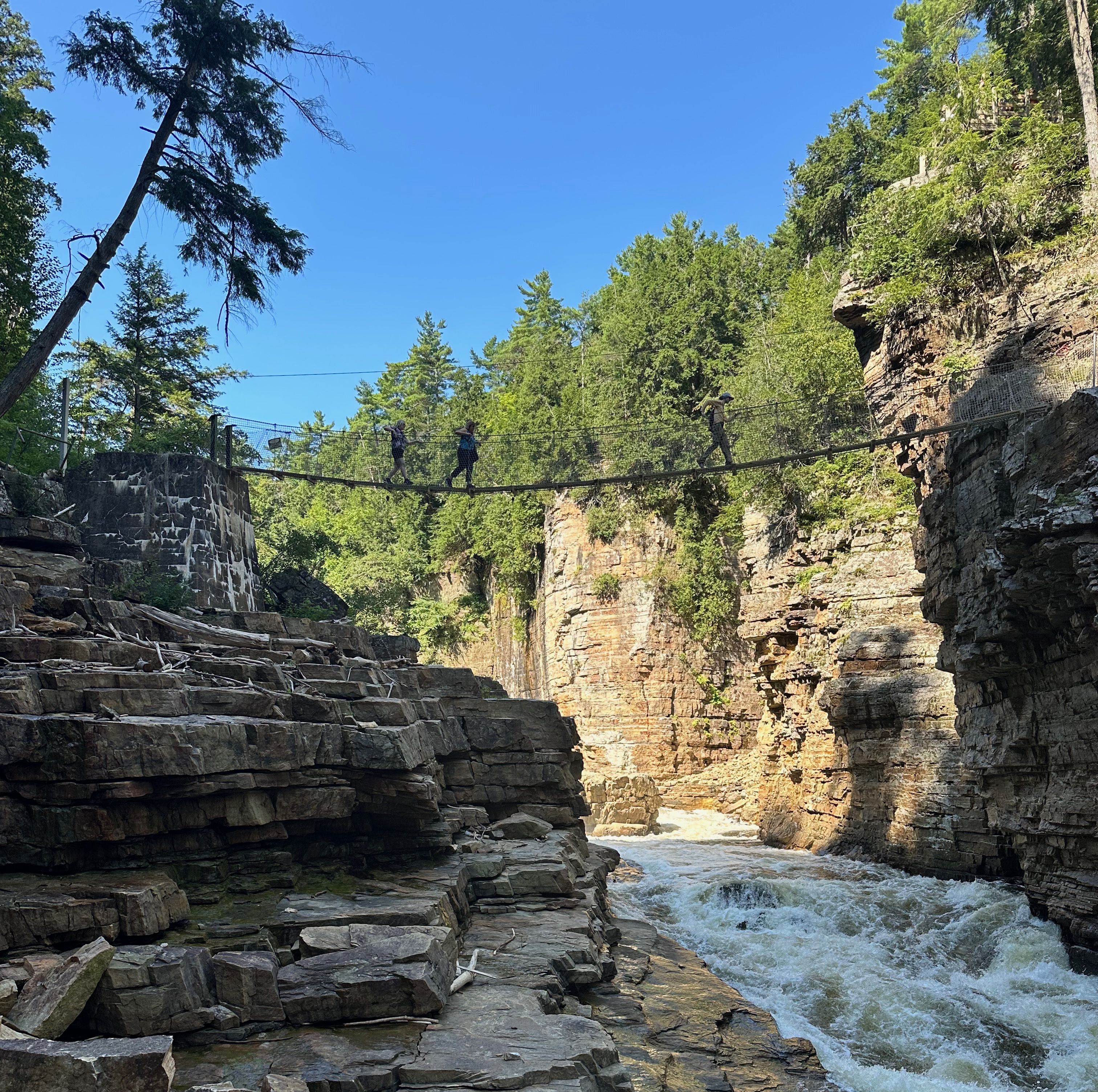
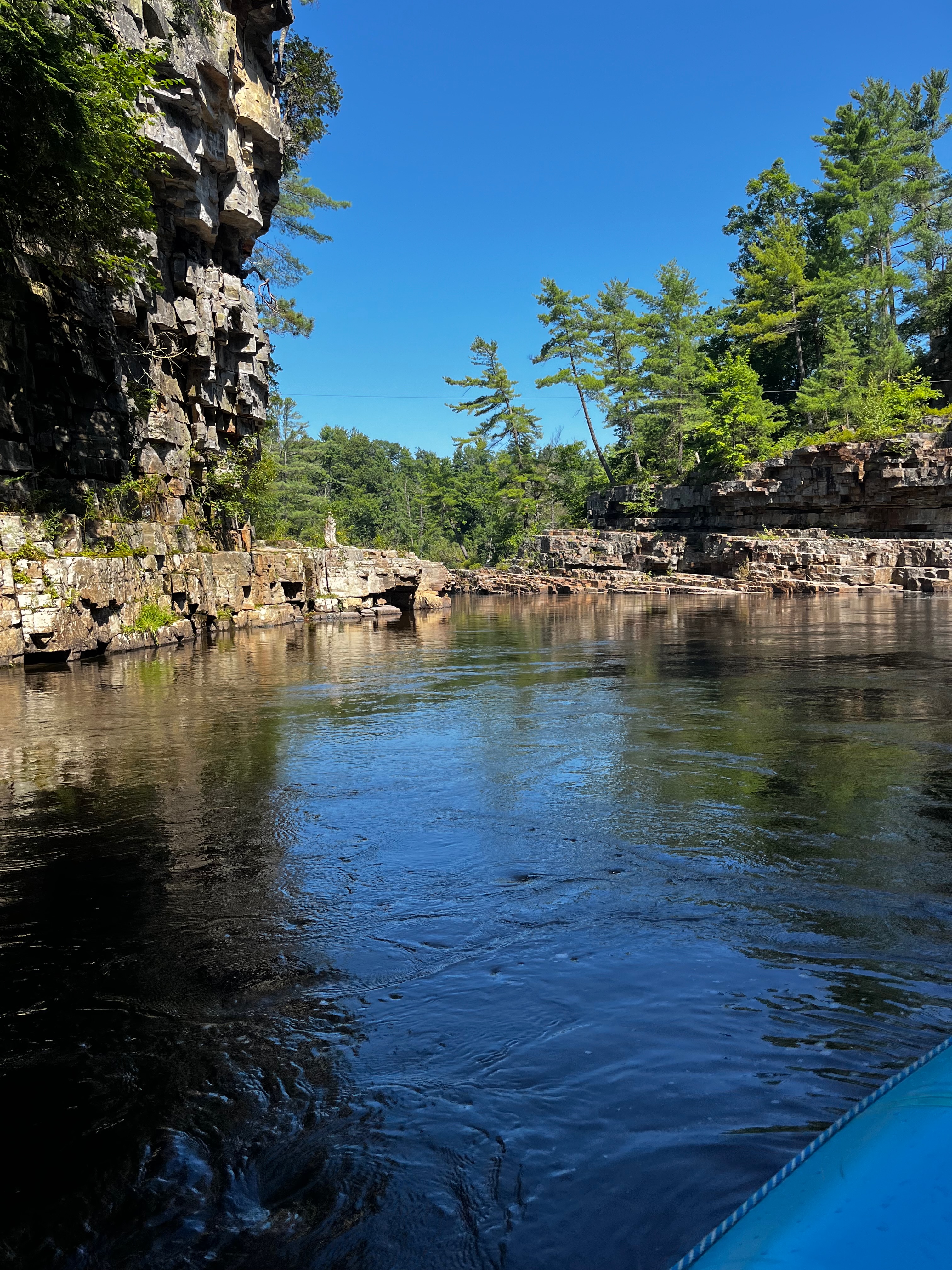
Ausable Chasm offers different kinds of experiences depending on the desired level of adventure. We opted for the package that included access to the hiking trails, the walk along the river and the raft excursion (there was another level up that included rock climbing, etc.). It was just the right challenge for us. The walk along the river in the chasm involved crossing suspension bridges – the kind that bounce and sway as people walk on them. It was unnerving to know that the water was rushing over rocks about fifty feet below us, but I did it without hesitating. Yay me!
One of the two suspension bridges we crossed.
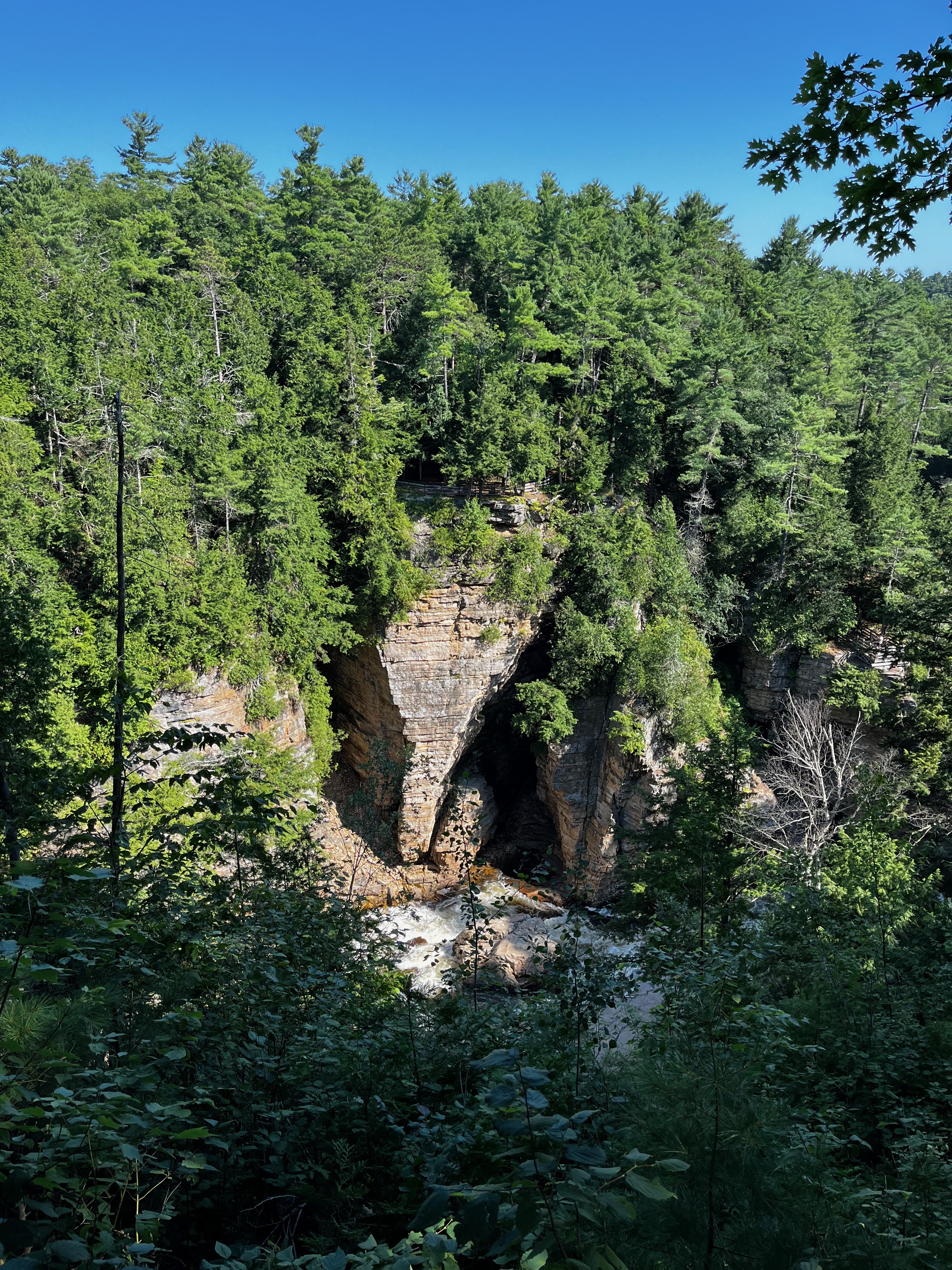
The chasm offers many beautiful views from the rim and from the bottom. It is quite a geological phenomenon. And we learned that it isn’t called a canyon because of how narrow it is. You learn something new every day!
View from the rimView of Elephant Ear from the rimview from the floor of the chasmanother view from the bottom
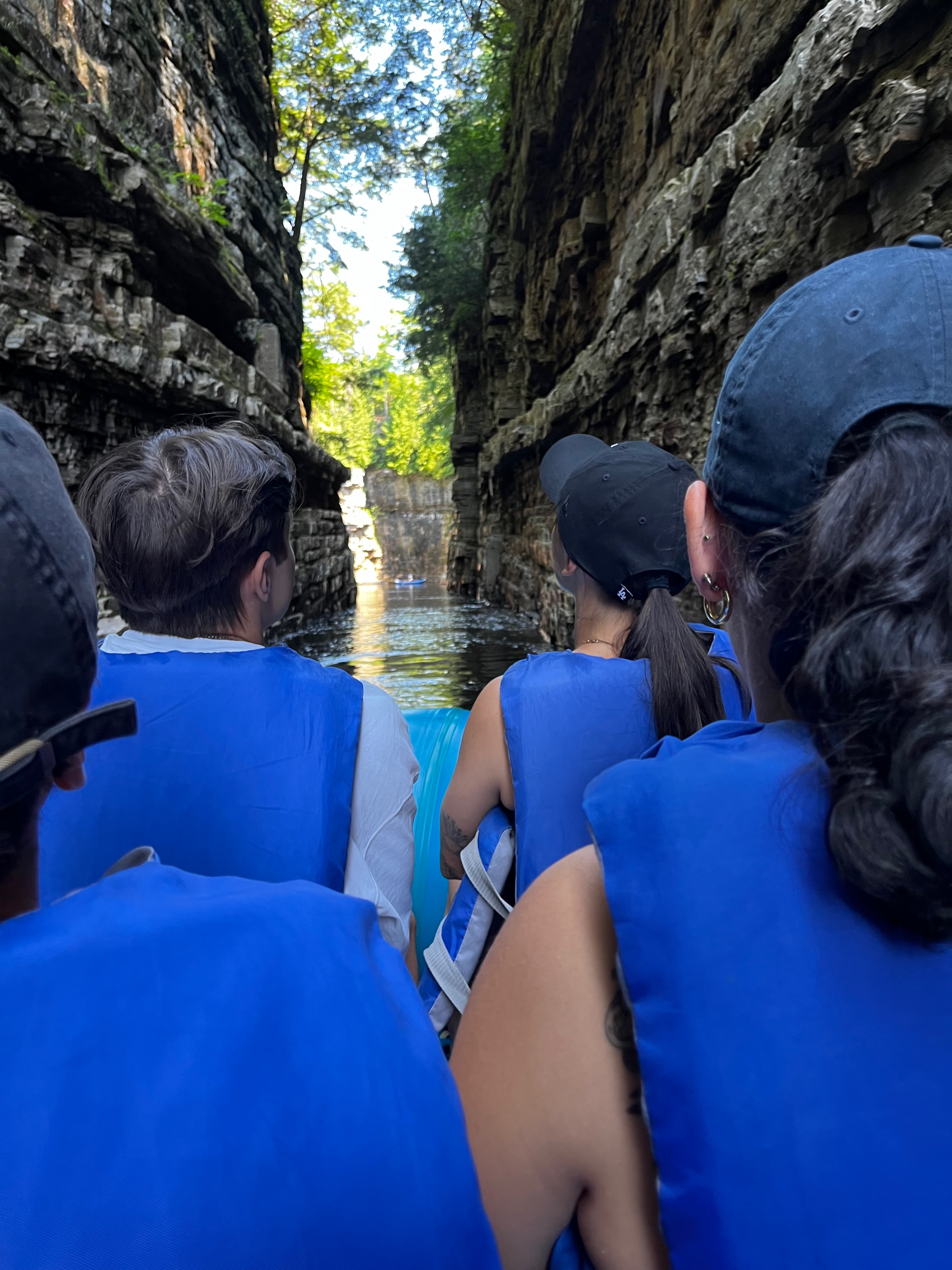
The walk at the bottom is led by a tour guide. After completing the path, we were left where the raft loaded. We put on life preservers and boarded the raft. The current was mild, though there were two areas of rapids, but even those were pretty tame. It was just the right amount of excitement for me. Having gone white water rafting in Quebec and getting ejected from the raft and being rescued by my son, I was pleased that this was less exhilarating.
Once we completed the water portion of our adventure, we had a choice. We could hike back to the gatehouse or take a shuttle bus. We were ready for more hiking and we took the more challenging route. We made our way through a dry chasm – which involved climbing through and around large rocks that at one time was a river bed before time and nature did its thing and rerouted the river. It wasn’t too hard, and it was very beautiful. The light filtering through the trees and our verdant surroundings were magnificent.
hiking through the dry chasmclimbing out of the chasm
We got back to the Welcome Center feeling like we had a good workout. I needed to get postcards to send to the kids and find a souvenir magnet to add to my wall back home and then we could check into our next accommodations – The Shamrock Inn which was just down the road. A shower was definitely in order – all that hiking in the heat, and I had soaked through my shirt. Not to mention that my hiking shoes and socks were sopping wet from the raft ride.
The Shamrock Inn provided a lovely room, clean and comfortable, though it was a bit small. The friendly owner, who checked us in and lived on the premises, recommended a place for lunch back up the road in Keeseville, a small café that was known for its great grilled cheese sandwiches. After cleaning up, off we went. We were not mislead. Those were killer grilled cheese sandwiches – and I got a frozen strawberry lemonade which was perfect after our morning’s efforts.
One of my favorite things about traveling is seeing different towns – how do other people live? What does a town offer that is charming or unusual? Does the town look to be thriving or is it struggling? Just driving the roads in and around the area was interesting. Fortunately, Gary shares my enthusiasm for that. Keeseville looked like it was trying to comeback from difficult times. Peru looked like a settled community with both established businesses and places that were struggling. In between we saw a mixture of beautiful lakefront homes and trailer parks. We like to look up the towns on Wikipedia, see if there’s some interesting history, what the population is…
In that vein, we went to the Museum of the Underground Railroad which is right next to Ausable Chasm. This area of the north country of New York State had a role in helping escaped enslaved people make it to freedom in Canada. We learned quite a bit about the journey and about some specific people who successfully made it and some local people who helped. We also learned how different views split church congregations in the area. It is a small museum, but worth the visit.
We had one more day in the area and we decided to go across Lake Champlain to Burlington, Vermont, which involved taking a short ferry ride. We rented bicycles and rode along the Burlington Greenway Bike Path which skirts the lake and traverses a causeway that connects the mainland of Vermont to Grand Isle. It was a beautiful ride that took us through forested areas, we passed public beaches, and then to the causeway. We rode 9 miles out and then turned around.
the causeway part of the bike path
We didn’t go all the way across to Grand Isle. 18 miles was sufficient for us, given that we had not biked at all in quite some time. My legs were aching, and Gary’s butt was complaining, but it was well worth it. We rewarded ourselves with cocktails and lunch after returning the bikes. There was a restaurant on the water right across from the rental place. It was wonderful to sit in the shade, drink some water and sip a pina colada.
Me after 18 miles in 85 degree heat – I did it!
All good things must end. It was time to go home – back to the grind of work for Gary and back to my routines. Three days went by quickly, but it did feel like a mini vacation. We did all that I hoped to – satisfied my curiosity about a place I had heard of as a child, took in the beauty that is the north country of New York State, spent quality time together, learned some history, got a good deal of exercise and enjoyed good food. I look forward to our next three-day jaunt whenever and wherever that might be.
First, let me state that I will vote for whoever the Democratic candidate is for President. If it is Joe Biden, I will vote for him. If it is a sack of potatoes, I will vote for it. In my mind, Trump is not an option; he is dangerous.
Second, the media should subject Donald Trump’s mental health to the same scrutiny given to Joe Biden’s condition. Op-ed pieces in major newspapers should be calling for Trump to step down (as the Philadelphia Inquirer did) for a myriad of reasons, not the least of which is that he is a convicted felon, found guilty by a jury of his peers.
With those two stipulations, I believe the right thing for Joe Biden to do is to step aside. This judgment is not offered because I think it enhances the Democrats chances in the election or consigns us to lose. It is simply the right thing for him to do.
Despite all the pundits’ insights and poll results, we don’t know how it would play out. Biden, as he currently presents, is not a strong candidate. As my brother pointed out to me, those voters who are willing to entertain voting for Trump are not being given a reason to choose Biden. So those who say that changing candidates now is a recipe for disaster, may not be clear eyed about what we are facing if he remains on the ballot.
I believe Joe Biden has been an excellent president. He has navigated unbelievably challenging times, and the country has benefitted from his administration’s policies in many ways. I have admired him throughout his career and believe him to be a good man with a kind heart, but I believe he is in denial about his cognitive abilities. This is not unusual. Unfortunately, in my family we have observed many people go down the path of dementia. Having good days and bad, covering for themselves (and family members covering for them), and not wanting to recognize what is happening are common reactions. Biden’s unwillingness to submit to a cognitive exam is troubling to say the least. Cognition doesn’t get better; they don’t recover. It just gets worse. Explaining his debate performance by saying he was tired, or it was just 90 minutes of him not at his best, does a disservice to him and the country.
When he walked stiffly, I was not alarmed. When he stuttered, I empathized. When he fumferred for words, I made little of it: who over the age of 50 doesn’t struggle to retrieve words? All of that can be understood, some of it has been true his entire public life. The incoherence at the debate, his inability to recall if he had watched the debate in the interview with Stephanopolous, are something else. He looks vacant some of the time. That is a change. This is not a matter of getting enough sleep, though I don’t doubt that is a factor. Being tired takes a toll. Unfortunately, being President of the United States is pretty much a 24/7 job. He can’t afford to have an off 90 minutes at the NATO summit today.
I believe when he made the decision to seek reelection months ago, he was in better condition cognitively. At least better enough so that it seemed reasonable to continue. Something has changed and now it is public. The patriotic thing to do is to step aside. If he doesn’t have the confidence in Kamala Harris to ‘anoint’ her, there are other options. Pundits are dwelling on the lack of an obvious choice as the reason Biden should stay in the race. I think that is short-sighted for so many reasons.
I know how important the question of who takes his place is. And, almost equally important is the question of through what process. These are essential issues, but they are separate from whether Joe Biden should continue. We need to have confidence in our president. As much as I admire the work he has done, and believe that he has surrounded himself with competent, good people, that is not enough to lead us forward over the next four years. He no longer inspires confidence. We don’t elect a team; we elect one person. Dr. Jill, or any other person in his inner circle, should not be the de facto president.
Democrats have a convention coming up. It offers an opportunity. No, it isn’t the same as having primaries, but there is wide representation at the convention – all 50 states, different wings of the party, many of whom are elected officials in their own right. One could argue that the drawn-out candidate selection process we usually use hasn’t worked well anyway – generally speaking the extremes of the party (this is true for Republicans too) are overrepresented in the primary process. The convention may be messy, and it may be difficult, but it wouldn’t be undemocratic to let it play out that way.
As many know, my husband is a doctor. If he were to show signs of mental impairment (more than just slowing down) such that his judgment was no longer sound, and he was in denial about it, I would feel an obligation to step in. The consequences of his making mistakes are too high, people’s lives are at stake, I would need to discuss it with his colleagues, and of course urge him to retire. It would be painful. I would hate to be in that position, but in good conscience I could not delude myself or him. I would not want him humiliated by not being able to meet the extraordinarily high standards he has met his entire career. I would want to preserve his dignity in the process, but I could not let him put patients at risk. Joe Biden has far more responsibility for far more people. Those around him owe it to the country and owe it to Joe Biden to be honest about what is happening. It doesn’t sound like they are doing that. They may think they are protecting him or the country, but they aren’t.
Finally, for those who look back at history to try to predict how this will go, there are important differences between now and any previous time. Everything goes so much faster now thanks to (or we can blame) the internet and social media. People’s attention spans are shorter. One might argue that having a shorter period of time to campaign in a concentrated way could be more effective. The candidate might not be losing much, if anything at all, by being out front only from August to November. I don’t believe we have faced an analogous situation in our history.
By the way, though this is truly yelling into the void, the Republicans need to cast aside Trump and choose another candidate, too.
What do you do when you are sad? Do you go about your business with a heavy heart? Do you take steps to cheer yourself up? Maybe it depends on the source of your sadness…if you can even identify it.
When I’m feeling down, I often turn to writing. This explains the fact that many of my blog posts reflect that mood. I don’t want to be a complete bummer, but the inspiration to write often comes from feeling bad and needing to sort it out. Believe it or not, I have about 370 (!) posts on my blog, with probably less than 10 of those from guest writers. I wonder what percentage are about feeling depressed or disappointed? I do try to end them on a hopeful note.
But, writing and sharing helps me and I hope it helps my readers. It helps me process my thoughts, clarify my thinking and sometimes reset my mood. When I get feedback, it feels validating. I know I am not alone. Plus, it feels like a constructive thing to do, instead of wallowing. Sometimes I do need to wallow a bit, but I try to limit that. Putting pen to paper, or seeing the words on my computer screen, can help to take the sting out of the emotion. There’s a quote from Mr. Rogers (yes, Fred Rogers, he was quite wise) that says: “Anything that’s human is mentionable, and anything that is mentionable can be more manageable. When we can talk about our feelings, they become less overwhelming, less upsetting, and less scary.” Smart man, that Mr. Rogers. The stuff we hide away, mostly from ourselves, is the stuff that does the most damage.
I also find that usually when I am in a mood like this, it isn’t just one thing. There might be an incident or disappointment that pushes me over the edge, but there were likely other things that accumulated. So sorting it out, naming them, is helpful.
I have “finished” my manuscript for my memoir. I put quotes around finished because I feel like it will never really be done. I know it needs further editing, so there is that. But, also, every time I read portions of it, I tinker with the words, think of other potential scenes, wonder if it is any good. I could probably work on it forever. It reminds me of an observation Professor Weisband, one of my favorites from SUNY-Binghamton, made. I took a seminar with him that required a major research paper (it had to be 50 pages or more). Mine was on the U.S.-Soviet SALT talks. I was endlessly reading and finding new material. I asked him how you knew when your research was done. He basically said, you don’t. You decide to start writing. On the one hand, it was a very unsatisfying answer. On the other, I have found it to be largely true. You may realize that pieces are missing when you are writing and do some more digging, but at some point, and it may feel arbitrary, you have to stop and see what you have. I feel that way about my memoir.
Despite feeling like it may or may not be done, I have decided to move to the next phase which is trying to find a literary agent. I won’t go into the details of this grueling process but suffice it to say it is a little like auditioning for movies or plays. Mostly it involves rejection – or in this case, unanswered queries. No answer is the answer. I’ve only sent out 7 so far. There are hundreds, probably thousands, of agents. I will need to send out many, many more. At some point, again, perhaps an arbitrary decision, I can stop and decide to self-publish, but I want to give this a shot. It is hard not to be discouraged, especially when you feel so uncertain about whether your project is worthy. I remind myself to be proud of the fact that I am even doing this – I set a goal for 2024 to contact literary agents, and I have done that. (By the way, if anyone has contacts or suggestions, feel free to send them my way!) I need to just keep on keeping on.
Though this project weighs on me, it is not the primary source of my sadness. My memoir is something I have control over, at least to some degree. Getting it published may be as much a matter of luck as talent. The things that really make me sad are the things I can’t change: my friend’s serious illness; a relationship that isn’t what I wish it was; the precariousness of our democracy; Supreme Court decisions that defy how I understand our Constitution; and, the rise in antisemitism – to name a few.
I am old enough to have been here in this sadness before. I will distract myself with a combination of constructive things, like doing something nice for my friend, making a contribution to a candidate I believe in, and other things that are just fun – like getting out in the sunshine, watching something mindless and entertaining, talking to friends. And I will wait for the sadness to pass. Thanks to writing this – and I am sitting in my backyard as I type, listening to the birds, seeing the sun on our daisies – my mood has already begun to lift.
Months go by very quickly. It seems like I just paid my cellphone bill yesterday when the next one shows up in my inbox. I don’t understand how this happens. It feels like I’m always struggling to keep up. When I go online to pay, I check to make sure that in fact it was a month since I last paid, and, lo and behold, it has been. How did that happen?
On a related note, I pay a ridiculous amount of money for phones, internet and streaming services. There has to be a better way, but that would mean taking the time to research things thoroughly to figure it out. I think I am probably paying for streaming services that include other services that I pay for separately. Does that make any sense? I am probably double paying for Hulu. But it is all so complicated, and it gives me a headache, so I throw up my hands. Someday, I promise myself, I will sort it all out. Of course, they probably have a service for that – but then you’d have to pay for it. I find it very frustrating. And these companies are probably counting on our throwing up our hands to make more money.
And then there is the confusion about which streaming service plays which program. I might only watch one program on a given service – that also makes no sense. And there is almost nothing I watch on cable, except for HGTV, SNY (the Mets baseball channel) and the tennis channel. Then there is Gary’s penchant for having some version of Law and Order playing in the background for hours each evening. Sometimes I put my foot down and say that episode was just on, please find something else. But, then there is nothing else worth watching so it is back to Law and Order. So, I guess we do use cable. But it should be more straight forward. I imagine eventually, with consolidations and such, that we will be back to the equivalent of three major broadcast networks. After all, there is only so much content we can absorb.
**************************************
I just brought my car in for service. It is a Honda Accord hybrid. Aside from needing an oil change, a light came on telling me my acoustic system wasn’t working. I drove around with that message for a while since it didn’t seem to be a critical thing to the functioning of the car. If you haven’t driven a hybrid, when it is in electric mode the engine is close to silent. To make others, especially pedestrians, aware of the car, it generates a sound – so they are alerted to its presence. My car sounded like it was singing. A regular car motor you can hear. Well, the singing stopped. The part will cost $248.00 to replace, not including labor. I am not excited about spending that amount of money, but it doesn’t seem right to be putting people at risk if I don’t get it fixed. It is always something. And it always ends up costing more than $200. Sometimes it feels like we hemorrhage money. And, I can’t complain because we have the resources to pay for it. I feel for folks, the vast majority frankly, who don’t have that luxury. We used to be in that position where we lived paycheck to paycheck – it is very stressful. No one wants to hear me complain given my privilege, but I can’t help but comment on how crazy it is.
*************************************
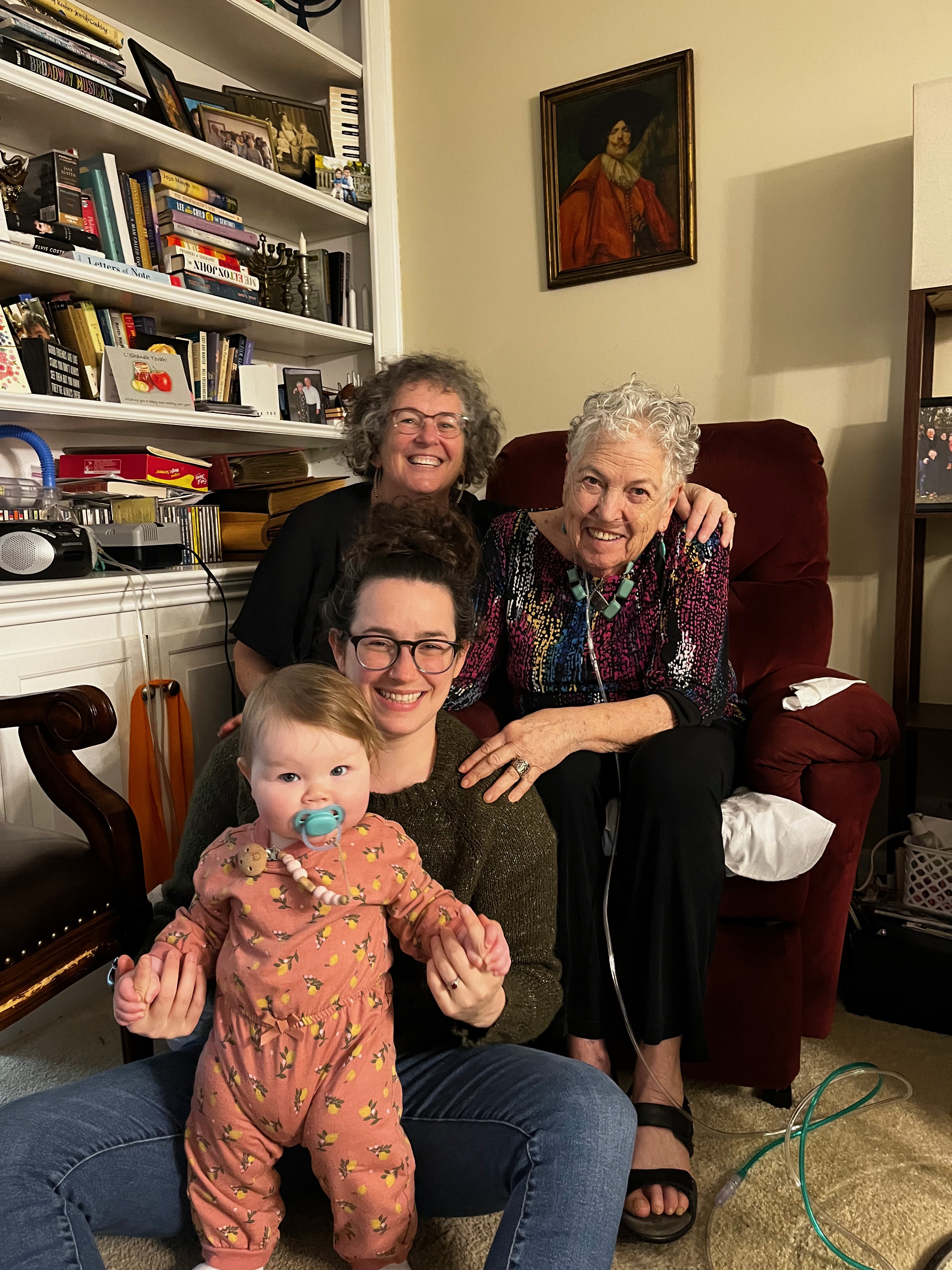
I’ll close this blog post by noting that we are coming up on 4 months since my mom passed away. The pangs of grief that hit me come as a surprise, though they shouldn’t. I was thinking the other day about how unusual Mom was. Dad died when Mom was only 71. At that point they were living most of the time in Florida. Mom had always wanted to live in New York City, but Dad had no interest. When he passed, thanks to Mom’s sister-in-law Clair’s ingenuity, she was able to sublet an apartment from an NYU law professor in Greenwich Village for the summer. She did this for probably four or five summers, until various things made it impractical. During those summers she went to see shows – sometimes a matinee and an evening performance on the same day. She went to museums, not just the major ones. She read the New York Times arts pages looking for interesting exhibits. She invited her grandchildren and their friends to visit and stay over. She cooked them pasta from a neighborhood shop that made it fresh. Most women I know wouldn’t be able to do that. Yes, they could cook the pasta, but not the rest of it. Many women I know wouldn’t go to NYC alone – and not necessarily out of fear of crime. They would just be afraid of taking it on – all of it, negotiating the crowds, knowing where to go, etc., etc. Granted Mom had her sister-in-law nearby and her children to help out, but in a day-to-day way she was on her own and she reveled in it. I am happy that I have inherited some of that. I think nothing of driving down to the city or elsewhere by myself. She was a terrific role model. I believe my daughter has inherited that combination of confidence and curiosity that allows us to do what might be uncomfortable for others. Hopefully it will be a gift that keeps on giving.
While my relationship with Mom could be complicated, I am lucky that I got to be her daughter.
I am gaining yet more respect for older folks. As I am aging and approaching my 65th birthday, I realize the high price we pay for getting older, and I am not referring to the physical challenges we face. So many losses are endured, it is hard to fathom.
It is expected that we will lose our parents – that is the life cycle. Some, like me, are lucky to have had them for much of my adult life. Dad died when I was 45 and Mom just passed. Others aren’t so fortunate, and it is painful no matter the age, but at least we understand that it is the natural order of things.
I think about my mom and the losses she endured as she got older. Her husband, her brother, sister, and best friend, not to mention other friends and family members. Yet she persevered, she maintained interests, she sought joy, she smiled a lot. She also didn’t back away from those who were ill – she was fully present for my dad, as well as others. I don’t think everyone is able to do that. Some might get bitter or shut down. How could you not want to insulate yourself?
Death is part of life. Maybe grieving is a constant, on some level. It is just part of the mix of emotions we experience all the time. It is the price of loving people. After all, if you protected yourself from loss, you would be depriving yourself of friendships and connections.
I imagine the reason for the death makes a difference in how one processes it. All the losses that my mom faced in her later years came about because of disease. Our family has very limited recent experience with deaths due to violence, addiction, suicide, or an accident. Those bring a special pain – the kind that can permanently change the trajectory of the survivor’s life. We carry the generational pain of the Holocaust, but that is a different kind of grief, too.
There is a sort of joke that says no one gets out of this life alive. The truth is I have not made peace with that idea. I know it intellectually, but that doesn’t mean I have accepted it. I need to. It won’t change the anguish I feel when someone I love dies or is suffering, but maybe it will help me to not waste time asking why.
I can’t accept that God is making individual choices about who lives and who dies, or how they die. It just doesn’t make sense to me to believe that a higher power is invested in that, or would knowingly be so cruel, or has that detailed a plan. I suppose even if there is a God and even if s/he were making those decisions, we wouldn’t know the rationale anyway. It isn’t like good people don’t suffer and bad people do – it doesn’t work that way. So, either way, it may be best not to torture ourselves looking for an explanation for someone’s suffering or premature death. It just is and we need to move through it as best we can, becoming more compassionate toward each other knowing how hard life can be, and seeking joy, meaning and connection where we can find it. I think my mother and father-in-law, in particular, modeled how to do it. I will try to follow in their graceful footsteps.
From Rouses Point, Lake Champlain…appreciating the beauty all around us
Reading that there were chants of “Go back to Poland” at the pro-Palestinian encampments at Columbia University stopped me in my tracks. Weeks later my attempts to ignore it are not working. It is just too painful to try to pretend it didn’t happen.
The stunning ignorance and cruelty that this demonstrates is hard to swallow. Do they not understand what happened to Jews in Poland? This is personal to me. That statement could apply to American Jews, not just Israelis, after all we are hardly indigenous to the Americas. As an American Jew if I was forced to go back to Poland the only remnant of my family would be a monument to the 2500 people murdered in Halbow, Poland in 1942. My paternal grandfather’s parents and sister are buried underneath that monument in a mass grave. Luckily for my family, my grandfather went to America alone in 1921, long before World War II was on the horizon and before the thrall of Nazism. My grandfather was seeking his fortune and Jews were still permitted to immigrate. Millions of Jews in Poland were not so adventurous or prescient.
In addition to my family’s experience, we have the horrors my in-laws endured. They too lived in Poland, though today it is actually Ukraine or Belarus, which introduces another problem with their simplistic chant. Some of the Bakst family did indeed go to Israel after the war. Even if Ukraine or Belarus opened their arms to receive them today, it is not a viable alternative, or is the reason for that not obvious to those protesters?
I wrote about what happened to my father-in-law when he did go back to Iwie in 1944, while the war was still on but his town had been liberated by the Soviet army. I hope you will take the time to read my blog post about that here.
For purposes of this essay, I will summarize. David Bakst was granted leave for his heroism in a battle with the German army. At this point David was in the Soviet army who were unaware that he was Jewish. He was given leave to visit what was left of his family, his father and sister, who were in Lida, about 40 kilometers from his hometown. David pined for his home. He had warm memories of family gatherings and the love he felt among his extended family. The house was a relatively modern one, built in 1929. I think, even though it was unrealistic, he hoped in his heart to reclaim it.
They arrived at their home, which withstood bombing by Germany. A Polish family was living there. Though David was allowed to come into the house when he explained his connection to it, the reception was not warm. He was told in no uncertain terms that it wasn’t his anymore. Upon seeing the interior, with his family’s things rearranged, and seeing his parent’s bed, knowing his mother and younger sister had already been murdered, he collapsed in tears. His father and sister comforted him, they told him there was nothing in Iwie for them anymore, they needed to look to the future, and that is what they did.
David spoke fondly of that house for the rest of his life. But, whatever bitterness he may have harbored did not interfere with his making a new life in a new country.
Clearly the protesters at Columbia, at other college campuses and in the Middle East either don’t know this history or don’t care. If they don’t know it, they have a responsibility to learn it. The latter possibility is even worse. To be aware of the pain that is carried by our family and by millions of other Jewish families, and still chant “Go back to Poland,” is beyond cruel. It would be evidence of pernicious antisemitism, not of a liberation movement. It is also extraordinarily, epically ironic given that the basis of their protest is that Palestinians were forcibly evicted from their homes.
Another problem with this situation is that the media coverage of this has been quite limited. I have not seen stories that explain the problem with the suggestion that Jews go back to Poland. Those who are ignorant have not been enlightened by the coverage; they can continue to live in their deluded world. Does the media assume that people understand? If they understand, they should be called out for their inhumanity. While one might argue that the journalist’s role is not to take sides that is not what is called for here. It is a matter of giving context, explain some history and that is the role of a journalist. Giving that context doesn’t even necessarily mean folks would change their mind about the Palestinian cause, but it might help bring some nuance to the discussion. At the very least, hopefully that disgusting chant would be cast aside. I would not hope for apology, that is probably too much to ask, but it would be appropriate.
We can argue until the end of time about who the indigenous people of the Middle East are. Frankly, I don’t care beyond understanding the history of the region as best we can. We can argue who is in diaspora – aren’t both peoples? Not to mention other displaced persons who have been forced to leave their homes whether it is in Africa, Asia, or Central America because of war, gang violence, natural disasters, climate change, power struggles, genocides. Are these encampments for them too? Is there a point to arguing who is a refugee? Where does the argument get us? Yes, it is essential that we understand and acknowledge the generational trauma that Palestinians and Jews carry, but that is a two-way street. Chanting “Go back to Poland” is absurd and suggests that they are not serious about finding a solution.
After Mom died at the end of February, I felt like I needed a reset. The last couple of years have been difficult. Though I was not the primary caregiver for either my mother or Aunt Clair, I was very involved in their medical decision-making. I accompanied them to doctors’ appointments. I visited them and tried to provide comfort. It was a painful process watching them deteriorate and being powerless to change the inevitable. Not to mention the grief I felt and feel when they were gone.
I also faced my own abdominal surgery to remove what turned out to be a benign cyst – it was actually my left adrenal gland that had hemorrhaged. While I only had a long weekend of worry before I knew it wasn’t cancer, it was still surgery under general anesthesia. The recovery was uneventful, but not without its discomforts.
All of the stress involved in these circumstances left me drained. I was not taking good care of myself. I was on the road a lot, driving over three hours each way to see Mom, and making poor food choices, stopping at Dunkin’ Donuts or McDonald’s instead of finding healthier options. There is a long tradition in my family of seeking comfort in food and I succumbed to that impulse too many times.
I thought it would be helpful if I could go someplace and gather my thoughts, get into a better rhythm. I have never gone on a retreat before, but the idea appealed to me. I wasn’t looking for spa treatments, though a massage might be nice. I was imagining some yoga, healthy food, a walk in the woods. I heard of some places like Kripalu in the Berkshires, Omega Institute in Rhinebeck in the Hudson Valley, and Canyon Ranch in several locations.
I looked them up online and read what they offered. Kripalu seemed closest to what I was looking for. I talked to Gary about it and he was fully supportive. I signed myself up for three days of retreat and renewal. They offered structured programs of varying lengths, but I wasn’t so much interested in something that formal. I wanted more flexibility. Fortunately they offered that option too.
Kripalu offers different levels of accommodations which are priced accordingly. I chose a private, dorm-style room where the bathroom would be on the hall. The idea of sharing a bathroom didn’t bother me, but I wasn’t looking for a roommate.
As I anticipated my time away, I was a bit nervous. I had not done yoga in years. There was a time, about a decade ago, where I was doing it regularly but I was never a serious student of it. I was afraid I would be in over my head. Perhaps people who went to these things were committed yoga practitioners. I called Kripalu, before I put my money down, and asked: Is this appropriate for someone of my age and level of experience (or lack thereof)? I was reassured that they offered programming that met me where I was.
I was still nervous about it, but decided I would take the risk. What’s the worst that would happen? I would try a class and if I really couldn’t manage it, I didn’t have to go again. The classes were voluntary. I could spend my time reading, relaxing and taking in the Berkshires if it came to that.
It didn’t come to that. I had a great experience.
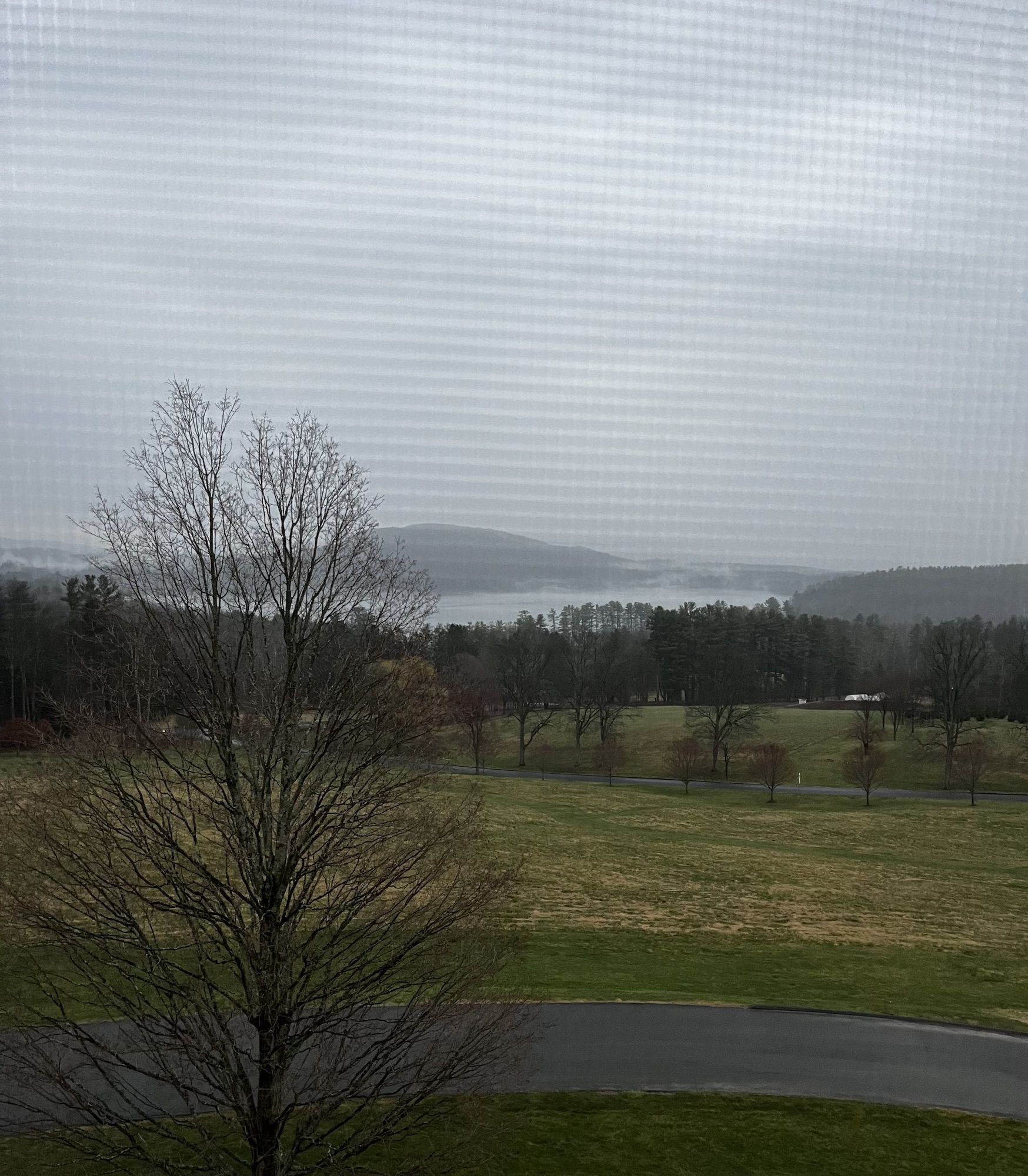
I checked in and got settled in my room. It was small, like a single dorm room. It did have a sink which I appreciated. It also had a lovely view of the lake, they call it the Stockbridge Bowl.
the view from my window – beautiful even in the rain/fog
This would be the first time since college that I would use a communal bathroom and shower. I wondered if it would bother me. It didn’t. They kept it spotless, and I think during my three days I might’ve crossed paths with another person only a couple of times.
I studied the schedule of classes/workshops and planned out my time. They told me that Gentle Yoga would be appropriate for me. They offered more vigorous classes, but I was quite challenged by the gentle version. The biggest difference from ten years ago was my balance, though my flexibility and strength weren’t what they used to be either. But I didn’t feel self-conscious about it. Everyone seemed to be focused on themselves and the teachers were encouraging. I did the best I could and felt reasonably good about it. I did a yoga class once each day. As I remembered from my previous experiences, I particularly enjoyed Savasana, the final ten minutes when you lay on your back (or choose a comfortable position) close your eyes and breathe while soft, soothing music plays…very calming.
I took two hikes. Each was guided by a staff person. I loved the approach they took. They began with a short meditation, and they suggested that during the walk out – in one case we hiked down to the side of the Stockbridge Bowl (walking through some woods and meadows in route) and the other we climbed up to a pond – that we walk in social silence. In other words, we traveled as a group, but without chatting. They wanted us to pay attention to our surroundings, listen, see and smell nature. They asked that we leave our phones in our pockets, not even to take pictures. I thought that was great – took the pressure off. When we arrived at the destination we sat quietly for a few minutes. In one case the guide read us a poem. After a time of taking it all in, the guide said if folks wanted to take photos or chat, they were welcome to; if you wanted to continue in silence, that was fine too. On each return trip I chatted with people. It was a great balance. I did notice a difference in how much I took in when we walked quietly versus when I talked with someone, but I enjoyed both experiences in different ways. Here are some views from my hikes:
the pondthe path by the lakei love light on water
Another interesting aspect of Kripalu is that they ask that breakfast be eaten silently. There are signs up around the dining hall and other spaces where you can take your meal asking that you respect the silence. (In fact some folks come to Kripalu for a silent retreat – they spend their days in silence.) The sign on the table explained that they urged you to be present while you were eating your first meal of the day – to pay more attention to the tastes and how your body felt. Again, I found it to be a great practice. This only applied to breakfast, other meals were social. For all meals, though, they ask that you not use electronic devices – they preferred that you use a physical book, but people did use e-readers. The prohibition on electronic devices extended all over the campus. There were designated areas where they were permitted and of course you could use them in your room. I loved being free of my phone. Most of the time I left it in my room, unless I knew I wanted to use the camera.
I have more to share about the workshops I took, but I will save that for another essay. It has been over a month since I returned from my retreat. While I wish I felt as energized as I did in the days immediately after my return, I can’t say that is true. I do carry the lessons I learned, the peacefulness I experienced and the spirit of it within me. I am sure I will return to do it again.
Maybe it’s just me, but the political narrative that gets presented in the media makes no sense. I’m listening to a podcast where New York Times columnists are talking about the relatively healthy economy and why people are still not optimistic or confident in it. They are hypothesizing about Covid lag, lingering inflation, negative feelings about Joe Biden. Those things may be relevant, but I don’t think that is what is at play in the poll numbers.
I think the reason the polls show negativity is because, though the survey questions may target the economy, people are pessimistic because the world is going to shit. Everywhere you look, it is scary. I think this view applies to Democrats, Republicans and Independents. Personally, I find the divisiveness in our country, whether it is around Trump’s trials, the war in Gaza, global warming or the issues the panelists were talking about (lingering effects of Covid and inflation), call into question whether we will be able to come together to address the problems. I don’t think I am alone in being pessimistic. We are a country famous, maybe even envied, for our optimism. I’m not sure that still applies.
In fact, just the other day I was at a gathering at my daughter’s house. A friend of hers was talking about his lack of hope generally, that it was hard to find things that inspired confidence in the future. He made the point that one of the few bright spots, something he was grateful for, was the young children of his friends. When he looked at them, their innocence and promise, it made him feel better. The man who was expressing this thought is in his mid-thirties.
Ever since that march in Charlottesville in August of 2017, the Unite the Right Rally where folks were marching with tiki torches, and our President couldn’t condemn it, I have been uneasy. I imagine for some that might not have been as seminal a moment as it was for me, but there have been so many things that have happened since then that make me question whether we live in the same reality. That event hit me hard. I thought I was watching something that happened fifty years ago, not a protest in an enlightened college town. And things have only gotten worse. The chasm has widened.
There is the possibility that we have always been this divided, but we just didn’t know it. People’s ugliest thoughts weren’t broadcast on social media. If someone stood on a soap box in a town square, even Union Square in New York City, and proclaimed that (insert your favorite scapegoats) were the devil, it was likely to fall on deaf ears. Now that person gets support from people across the globe who share a similar warped world view and the idea gets momentum. It also gets overrepresented in the social media narrative because it generates clicks – controversy or outrageousness always does. It is hard to get a handle on how many believers there really are when you have bots and trolls and foreign and domestic agents who benefit from the chaos.
If you ask me that classic question, “Are you better off today than four years ago?” I don’t know how to answer that. My economic situation is about the same, maybe better, but the precariousness of the health of the world, in every sense, affects my response. My feeling has little to do with Joe Biden or his policies. To me it feels like he is working to hold back a tsunami of terrible things – trying to preserve women’s reproductive rights, slowing climate change, bolstering the economy, minimizing inflation, reducing tensions in the Middle East, addressing crime, the list can go on. Some would include the southern border as a crisis. In some ways it is, but in other ways it is a manufactured panic. There are real problems with our immigration system, but some politicians are invested in keeping it a problem rather than making it better. I think Biden is doing a reasonable job against staggering obstacles. He has not created these problems.
No matter how good a job he does, though, it pales in comparison to the challenges. And it is done in the setting of unprecedented division.
I see footage of what is going on at Columbia University and other college campuses where backers of Palestinians have set up encampments to protest United States support of Israel and the universities’ investment in Israel and/or our defense industry that aids Israel. Separate and apart from the rightness or wrongness of the protesters’ positions (a topic for another essay), there is a way to get your message across effectively. If the idea is to win people over to your side, persuade them of the righteousness of your position, it isn’t by shutting down traffic on the Golden Gate Bridge or harassing Jewish students or impeding folks from getting to their calculus class. In most cities, (perhaps all cities – I am not a lawyer) you need a permit to stage a protest or march. There is good reason for this. It goes back to the balancing of different legitimate interests: the protesters and other citizens going about their lives. It is fine to disrupt the routine, to a degree. But you can’t purposely jeopardize public safety. I’ve attended any number of rallies for causes. I believe in showing up to voice my opinion on public policy, but there is a way to do it. Chanting hateful slogans doesn’t help either.
We live in confusing times. I think the polls reflect people’s general uneasiness, not a judgment of the economy. I wish Biden was more effective at communicating his vision for the future of our country. I do fault him for not showing clarity of purpose and leadership, but I don’t hold him responsible for the sorry state of our union. I believe we are suffering the effects of the cynicism, greed and fear that has become the stock and trade of the Republican party, along with the poisonous influence of social media over the last decade. Add in natural disasters which are increasingly frequent with climate change, seemingly endless wars across the globe and it feels overwhelming. I don’t know what the solution is, but we need to understand and acknowledge what we are dealing with before we can find answers. Polls are not shedding light on the issue. We need to be asking different questions.