Stories I Tell Myself

Linda Brody Bakst on Brooklyn, growing up, identity and more

  • Unfortunately I do not have a new blog post ready. It has been a busy week. I took a NYSSBA assignment that brought me to Attica (not the prison), the school district. And, I have two more assignments coming up in short order. I have also been working on a piece to submit to a writing contest that is Brooklyn-themed.

    So, it was Monday before I knew it!

    If any of you have thoughts about which of my Brooklyn-based blog posts really resonated or you thought was a particularly strong piece, please let me know! I am planning to use some of the prior blog posts as the basis for the piece (which can be 2500 words).

    Oh, and one more thing, I did find out that the submission that I wrote about previously was rejected by a literary magazine. I’m oh-for-three. Discouraged, but not defeated.

    I’ll be back next week with a new story.

  • Views of Central Park in mid-October (photos by me!)

    Oh, how do I love thee?


    I love the juxtaposition

    Nature and civilization

    Bird calls and sirens

    Steel and glass skyscrapers and majestic ancient trees


    Ducks and turtles paddling the reservoir

    Birds swoop

    Stately pre-war apartment buildings stand guard to the west

    Museum mile beckons to the east

    Commerce to the south

    Harlem to the north


    Flora, fauna and culture abound

    Beauty in all its forms

    For the taking


    People of every age and size

    Of every skin color

    Of every socio-economic level


    Running, walking

    Laying in the grass

    Cycling, rowing

    Reclining on a park bench


    Riding in a pedi-cab

    Or a horse-drawn carriage

    Planking on a pedestrian bridge

    Graceful moves of tai chi on the meadow


    Children’s laughter

    So many languages

    The wind in the trees

    Honking horns

    The rotors of a helicopter slicing the air


    Let me count the ways.


  • Aunt Clair, my father’s younger sister by two and a half years, may be short in stature, but she more than makes up for it with an outsize personality. One of my earliest memories was a weekend where she watched me and my two brothers while my parents were away. As I recall, we named her car ‘Bumpity Morgan.’ I don’t know if that name was a result of its poor suspension or New York’s potholed streets (or both).

    I could be mixing different times together, but I recall Aunt Clair driving us in ‘Bumpity’ to the beach in the Rockaways. We were enjoying jumping the waves and collecting shells when the sky grew ominous. Aunt Clair poo-poohed it for a while and we continued to enjoy playing in the water and sand. Eventually it became clear that a storm was rolling in. We gathered up our things as quickly as we could and made a run for it. We got to ‘Bumpity’ just in time to avoid the lightening and fat raindrops. Wet and sandy, we climbed into the car and went back home, having squeezed out the last possible moments of fun. This was a very different approach from my parents. Mom and Dad would have packed up sooner, cleaned the sand off our feet and gotten back to the car with time to spare.

    Aunt Clair, 81 years old now, lives in the same rent-controlled studio apartment in Greenwich Village that she has occupied for almost my entire life. When you think of a person who spent over 50 years, living on their own, in the Village, you might imagine someone with idiosyncrasies – you might imagine my Aunt Clair.

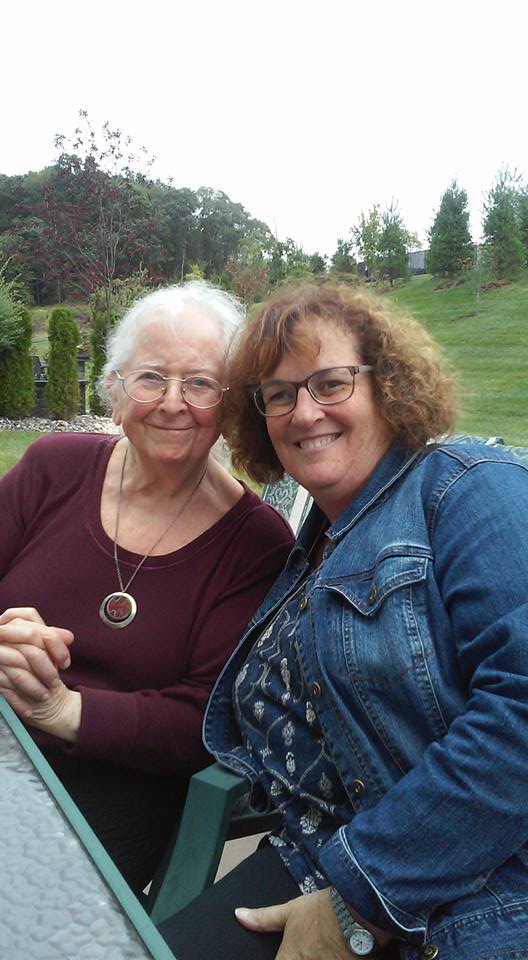
    14457289_10211171777516732_2778092040984534968_n
    Aunt Clair and me, June 2017 Photo credit: Mary Sulzer

    She stands maybe 5’2” with curly white hair, there may be remnants of light brown strands from her younger years. Even 40 years ago, whenever I would walk with her, she would remind me that she had to take twice as many steps to keep up – she considered me to be tall! I didn’t think I had a particularly long stride, unless I was next to her.

    Like her siblings, she has large, lively blue eyes. Like her siblings, she is razor sharp smart and insightful. She has a hearty laugh – my kids tell me we sound alike when we laugh.

    Aunt Clair is feisty. My father loved telling stories about her toughness, even as a little girl. One involved an unfortunate dentist who told the young Clair that the procedure he was about to perform wouldn’t hurt. Well, it did. Clair was indignant, claiming that he lied, so she kicked him in a particularly sensitive spot and climbed down from the chair.

    Making your way in New York City as a single woman wasn’t easy. I remember hearing about a mugging where Aunt Clair refused to give up her purse. I’m not sure how that ended up, I think she ended up bruised, angry and minus her pursue. Though my Dad admired her spirit, his message to me was not to do what she did in that case. He advised, if in a similar situation, to not fight back and risk serious injury. Aunt Clair didn’t (and still doesn’t) find it easy to back down.

    I learned that I had a bit of her spirit when I had an experience going into the subway. It was 1980 and Gary and I were going down the stairs to the station, Gary was ahead of me. I had a backpack on and I felt it being jostled. Without thinking, I spun and said loudly, “What the fuck are you doing?” There was a young man with his hand on my knapsack. He looked startled and he turned and ran. Gary had stopped, but the incident was already over. I surprised myself, it was an instinctive reaction. I guess I was channeling my inner Aunt Clair.

    Some of my fondest memories of time spent with Aunt Clair involved bicycling. Clair biked around Manhattan long before the city made any accommodations for riders.  She continued to bike, even to chemotherapy appointments when she was in her late 70s!

    When I was college-aged and home for the summer, I joined Aunt Clair for a bike tour of Manhattan. This was no ordinary bike tour. We started in Central Park at midnight! Earlier that evening I went with my parents to see an off-Broadway play. We drove into the city from Brooklyn with my bike was strapped to their car. Aunt Clair met us at the theater when the show was over. We retrieved my bike and went to her apartment to drop my stuff off and then headed uptown.

    img_23781
    Photo credit: Snapshot for Sore Eyes – Central Park at Night

    Hundreds of people were gathered with their bicycles at the Bethesda Fountain which is located mid-park at around 72nd Street. Central Park begins at 59th Street and stretches to 110th, south to north. East to west, it encompasses two avenues across (Fifth to Central Park West). It was odd to be in a place that most people thought of as dangerous at that hour. In those years, I wouldn’t have gone into Central Park by myself in broad daylight. It felt exciting and adventurous to be there amongst so many fellow cyclists.

    We rode around the park, stopping periodically to hear about its history. We left the park and rode along the east and then west side of Manhattan. We rode through the theater district all the way down to the deserted financial district. The financial district felt like a movie set, with the skyscrapers seeming like two dimensional facades. It was so quiet, it was eerie. At that time, there were no residential buildings in the area, so there weren’t restaurants (other than those that catered to the lunch crowd) or clubs or theaters. It was a ghost town during off hours. We were able to ride in the canyon of Wall Street without other traffic, pedestrian or vehicular. I got up close and personal views of the architecture and sculptures in a part of the city I had only seen on a rare school trip.

    Our tour concluded at sunrise at Battery Park. A hazy sun rose over the mouth of New York harbor. We rode back to the Village, got breakfast at a brasserie and ended the adventure with a nap at her apartment. Midafternoon she drove me and my bike back to Canarsie.

    It was not my only adventure with Aunt Clair.  We took other bike rides together – on Martha’s Vineyard and in Boston, too. She introduced me to walking across the Brooklyn Bridge – we bought wonton soup and ate it midway across – long before it became a ‘cool’ thing to do. I’ve seen plays, movies and ballets with her. We’ve eaten many meals at wonderful hole-in-wall restaurants in her neighborhood. I learned so much about the city, and about being independent, from my time spent with her.

    I was fortunate to grow up in an unusual family – made up of interesting, quirky and intelligent people. Aunt Clair’s feistiness, strong opinions and independent streak could sometimes create friction with other family members, especially my Dad (who shared some of those same qualities). But, I have been lucky to have her.


  • Tomorrow is my birthday. I have ambivalent feelings about birthdays. A legacy of my Nana and Zada is my belief that one should celebrate whenever possible, since there is plenty of heartache in this world. I also believe that even though showing appreciation for the people you love should be a regular thing, and not dictated by the calendar, birthdays, holidays and Mother’s Day, etc., are good reminders. I don’t think there are that many of us walking around feeling over-appreciated.

    On the other hand, in my family we didn’t make a big deal out of birthdays – only milestones, like 13 for my brothers and 16 for me. There is an amusing anecdote about my brother Mark’s 11th birthday. As noted in previous posts, my grandfather was a baker and he would bring home surplus goods from the commercial bakery where he worked. One year there was a birthday cake that hadn’t been picked up and it was fortuitous because it was also Mark’s birthday.  Zada brought home the large, day old cake with white icing. So what if it said, in pastel blue letters, ‘Happy Birthday Manny’ on it?  And, so what if it was a little stale?  It would have been a shame to let the cake go to waste. We lit the candles and sung a very off key version of the birthday song and had a good laugh about it.

    There was a small part of me that wished we observed birthdays like other kids’ families. Some even stayed home from school for the day! That was out of the question in our family.

    My birthday often falls on or near the Jewish high holy days. The story I heard was that my mother thought she was having indigestion from Rosh Hoshana dinner, when in fact, she was in labor. Apparently, her labor with me was fast and furious and I arrived before they had a chance to administer the anesthesia. In those days, they knocked women out when delivering babies. I emerged, all 9 pounds 15 ounces of me (!), without the benefit of her being unconscious. Poor Mom!

    For the most part, I like the fact that my birthday falls during the Jewish New Year celebration – as long as it doesn’t fall on the actual day of Yom Kippur (our day of fasting). The high holy days ask us to reflect on the year we finished, make amends for our sins and consider how we will do better in the year to come.  As someone who is introspective to begin with, it is a good fit with my birthday.

    The problem, though, with birthdays and the high holy days, is the other reminder they provide: time marches on and, as we get older, it seems to march faster and faster. Sometimes I get overwhelmed by our total inability to control it. The number 58 doesn’t mean anything really, I am the same person. On the other hand, I’m freakin’ old!

    I look at my mom, who is still young at heart. There are real issues, limitations, imposed by aging, but if we are lucky enough to have a sound mind (or relatively sound :)), there is no reason we can’t be engaged and interested in the world. There is always more to learn. My parents were/are great role models in their continuous quest for knowledge and insight.

    Having observed Yom Kippur this past weekend, I approach my birthday with gratitude. We were fortunate to have Leah, Daniel and Beth with us for the holiday – the first time in many years that we have been able to be together. Unfortunately, I also had an ear and sinus infection, but I reveled in our time together. As residue of the holiday, tomorrow I will still be thinking about how I can make myself a better person, a better family member, friend and citizen of this troubled world. And hopefully take a moment to celebrate, too.

    roshhashanahimagecropped

    Shana tova.

  • Note: Names and details have been changed in the essay below to ensure the anonymity of the participants.

    meeting-clipart-632x474

    One of my roles, when I worked for the New York State School Boards Association (NYSSBA), was to facilitate board retreats. These sessions were designed to build trust and improve communication between board members and the superintendent, and to review their roles and responsibilities. Although I have retired from NYSSBA, I continue to take assignments to facilitate these workshops. I like to think that I can be helpful to boards that may be experiencing some dysfunction or just helping them improve their performance as a team, and a little extra cash doesn’t hurt either.

    I’ve had some interesting experiences in doing this work. We usually begin with an icebreaker activity where we go around the room sharing some information about ourselves. We start with some straightforward stuff, where they grew up, how many siblings they have. And, lastly, they are asked to share their biggest challenge growing up. I often share the difficulty I had growing up with crossed eyes (which I have written about in this blog).

    I had done this exercise many times. Participants usually respond in a range of ways, from offering very little by saying something innocuous, to making themselves vulnerable by sharing a private pain. In a recent workshop, an older gentleman, who was the first of the group of 12 to share, responded in a way that I had not heard before.

    He began, “I’m not quite sure how to put this.” I got a little nervous, not knowing what kind of experience he was going to recount.

    He went on, “I was an excellent ballet dancer.”

    In the words of my mother-in-law, this I was not expecting.

    My first impression of him would not have led me to associate ballet dancing with the short, 50ish year old man sitting before me. Without casting aspersions, he presented as squat and not noticeably graceful. He didn’t hold himself in that elegant, regal way that dancers typically do.

    I also didn’t know where he was going with this. Being excellent at something isn’t usually a challenge, but then again, perhaps his experience related to gender stereotyping, or people like me making assumptions based on appearances.

    All these thoughts were bouncing around in my head as I listened to his story. Hopefully I maintained a neutral facial expression, as all professional facilitators should.

    He went on, “I recognized I was better than most and I needed to learn to hide that knowledge.”

    Wait, what exactly was his challenge? To learn humility?

    “I’ll give you an example….” He went on to explain that in high school he had a run-in with some members of the football team, who were teasing him about his ballet dancing.

    Now the anecdote started to make sense, though, he certainly started the telling in an unusual way.

    “There were three or four players, including the quarterback, in the room before class started,” he explained. “hassling me about being a ballet dancer. I said, ‘I don’t know what you’re talking about. I get to hold an attractive girl, whose costume leaves little to the imagination. You, on the other hand, put your hands behind the butt of another guy! Who’s the gay one?’ That shut them up.”

    There were 12 of us in the room, sitting around a rectangular conference table. Everyone was silent. I think we were all nonplussed. I’m not sure if he was expecting a response, but after a brief pause, he continued.

    “Later, when the school day ended, I was heading to my locker. I saw the guys from the football team at the end of the hallway. We made eye contact. I left my stuff in my locker and turned to leave school and head home. The football players saw me turn and they took off, chasing me. I ran.

    It was a distance to home and there were some hills. One by one the football players gave up, until only the quarterback was left chasing me. I was just outside my house when I stopped and faced him. We looked at each other. I said, ‘Let’s make a deal – you don’t do anything to me, you leave me alone, and I won’t tell anybody at school that I, a ballet dancer, outran the football team!’ After all, that would have embarrassed them. And, I would have done it, too. He agreed and that was the end of it. They never bothered me again.”

    As he finished his story, he had a self-satisfied smile on his face.

    I wasn’t sure how to respond. Was the story true? Was this a story he told himself? I looked quickly around the room to see if anyone wanted to say anything. After a bit of an awkward silence, I smiled and said, “Joe, thank you for sharing, sounds like a challenge you handled. Jill, how about you go next.”

    I felt a mix of emotions. I was a bit incredulous, it all seemed too neat, almost scripted. But, it certainly wasn’t appropriate to question him. I was also offended by the casual sexism and homophobia in the way he relayed the story. Though this was an experience from many years ago, and talking that way was understandable and would’ve been acceptable then, there was nothing in his telling that showed any insight gained over the years. He was quite pleased with himself.

    I also felt sad. I should have sympathized with him – it must’ve been difficult to be a male ballet dancer all those years ago. It likely still is. But, in how he framed his story and in his telling, he buried the pain of it. And that made it difficult for me to respond with genuine empathy.

    Interestingly, as we went around the table and others shared, it was as if they, in response to his approach, revealed their childhood challenges without masking their pain. It was quite remarkable actually – in that small group, three had been abandoned by their mothers and one had a parent who died when he was in high school. Two revealed that they had a parent who was an alcoholic. I was reminded, again, how much private pain there is in this world.

    The point of the exercise is to build trust among the team. I wondered if it had the desired effect.

  • Young plant

    I submitted a piece of my writing for publication. I sent an essay to a literary magazine that was soliciting work on the theme of ‘starting over.’ It was a topic that resonated with me, so, months ago, I sent it in. I haven’t been rejected….yet.

    Over the last two years and three months (but who’s counting?) that I have been writing, I have summoned the courage to submit three times. Once to a different literary magazine, once for entry to a writing class, and this most recent time.  The other two times, I was rejected.

    One of the lessons I took from my first writing workshop, in July of 2015 (which I wrote about here), was that not all rejections are equal. Our workshop leader said that a rejection that came with a personal comment, beyond the usual form letter, shouldn’t be counted as a rejection. Yes, ultimately it was a rejection, but, it shouldn’t be viewed as a failure. He also explained that if you were published one out of every ten times you submitted something, consider yourself successful. That helped put things in perspective – and I took his words to heart.

    The first piece I submitted, I got an email rejection that said this (I ‘bolded’ the key sentence):

    Although we do not have a place for your work in the special issue on Race, Racism, and Racialization, we wanted you to know that our readers read your essay closely. 

    We received several hundred excellent submissions, from which we are only able to select a handful. We are grateful to everyone who took the time to think, and write, about issues of race, racism, and rationalization and had to reject many very good pieces. We encourage you to consider submitting this piece to other journals. This is not a conversation that should be confined to special issues. 

    Thank you for sending us your work

    I wasn’t sure how to categorize this. Was this a partial victory? I was tempted to reach out to our workshop leader and ask him to rate it since I had nothing to compare it to.  I didn’t know if everyone got the same encouragement either.  Alas, I didn’t reach out to him. I didn’t submit it elsewhere, at least not yet.

    One of the interesting things that I am learning is that to be a published writer, there is another skill set, in addition to writing, that one needs. You need to have the energy and wherewithal to research magazines, editors and publishers. You need to have the energy and wherewithal to network and promote yourself and, in the jargon of the business, ‘build your platform’. I think it is fair to say that I am deficient in this – in fact, I think the same deficiency stunted my career in education policy.

    This may sound like one of those flaws that isn’t really meant as a flaw (like saying ‘I’m too modest’). But, it truly is a flaw. I find it very difficult to sustain the enthusiasm and confidence it takes to promote myself. What I want to do is write. But, I do want to be in conversation with others – which means wider exposure. My blog allows me to do that to some extent. So, the question is, do I have the will and the desire to pursue this? Do I have the energy to do the things that might expand the readership of my blog?

    This process, of writing, blogging and submitting pieces, has opened my eyes. When I was a child, I harbored so many hopes and dreams. They ranged from aspiring to be an Olympic figure skater (I loved Peggy Fleming!) to curing cancer or finding a way to eliminate air pollution. Early on I realized I didn’t have an affinity for science and my flat feet made skating painful. I moved on to other dreams. I wanted to be Barbara Walters. The idea of being a journalist, someone who interviewed famous people, wasn’t as far-fetched. At some point, though, I stopped thinking about those things. I moved on to an adult life – busy with graduate school or work, children, family, friends, the quotidian chores of life. My ambition was gone. I barely noticed when it left.

    When I started writing, something happened. A sense of possibility was reawakened.

    In a couple of different instances, I think at a Weight Watcher meeting years ago and then maybe watching an Oprah episode, the question was asked: what are you hoping for? What is a dream you have for yourself? I couldn’t think of anything and it wasn’t because my life was so perfect that I couldn’t imagine more. It was that I had stopped thinking about possibilities. Other than wanting to travel more, which wasn’t really the kind of thing they were getting at, I didn’t have hopes for myself. At the time, I didn’t know what to do about that, or if I was, in fact, missing out. I was just managing my life day-to-day.

    Waiting to hear if a piece I submitted is accepted is nerve wracking, but exciting too. I am awake to the possibilities. It seems there is always that tradeoff in life. If you love, you risk loss. If you try, you risk failure. If you hope, you risk disappointment.

    For many years I thought that the absence of my ambition didn’t have downside. It hadn’t been a conscious decision to give up on accomplishing more. The need, the desire, was just gone. I’m not sure that it is back, but I’m considering the possibilities.

  • I stood at the foot of the hospital bed, playing solitaire on the tray table.  With each turn of a card, I looked up to see my father’s large blue-gray eyes staring at me.  Memorizing my face?  Asking for something?

    He was beyond speech; four years into his illness.  Chronic lymphocytic leukemia was supposed to be relatively benign.  “You can live with this for twenty years and likely die of something else,” said the doctor at the time.   Four years later, aged 72, he was diapered and speechless in a hospice bed. I didn’t understand how he had gotten to this point. Even though I saw the disease rob my father of himself, bit by bit, it was still a shock.

    When I was growing up, he was often mistaken for a wrestler or football player.  Such was my father’s presence.  A deep, resonant voice, broad shoulders, with a bald head and prominent nose – he was the perfect dean of a New York City high school.

    He was also the perfect social studies teacher.  A voracious reader; he consumed biographies of Jefferson, Lincoln, Russian histories, westerns by Louis L’Amour, and any and all novels about the mob.  All with equal gusto.

    I continued playing solitaire.  The slap of the cards on the laminate was a familiar sound to him.  I would hear that sound as I came down the stairs in my own house, when my parents visited, and see him at my kitchen table, playing solitaire while waiting for the rest of us to be ready to go – wherever it was we were going, Dad was always ready early.

    I kept looking up at his eyes.

    My flight was 5:45 a.m. the next day, Sunday, March 13, 2005.  That flight would get me home in time to see Leah’s final dance recital (she was a senior in high school and would be going on to college in the fall) and to celebrate Daniel’s 16th birthday.  I took my leave, giving him a kiss on the cheek and a squeeze of his diminished arm. My mom and my brother Mark were with him and that comforted me.

    He died that next day, on my son’s birthday, during my daughter’s dance recital.

    I still see his eyes looking at me.

    fullsizeoutput_155

  •  

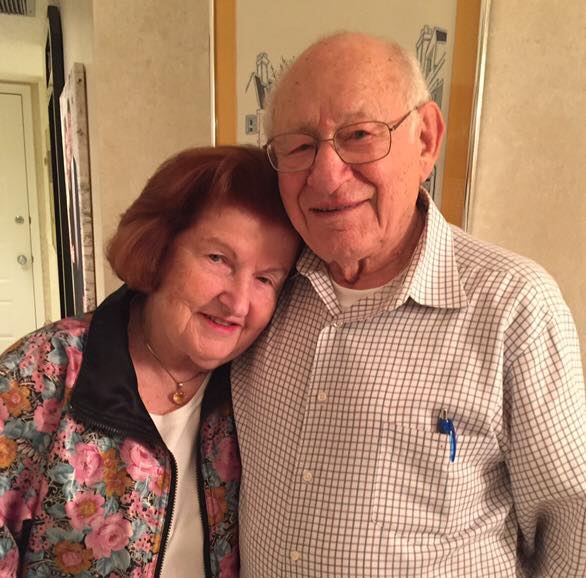
    21271050_10213938747246026_598520306118937214_n

    His skin is mottled,

    He is 94.

    He stands erect,

    He walks with assurance.

    He says, I feel the same as I always feel.


    Right now, I think.

    He can’t imagine feeling different,

    He doesn’t remember.


    Months before, winter of 2016, hospitalized 5 times or more in Florida,

    Weakened by persistent diarrhea and congestive heart failure.

    We see his mortality as he lay in a hospital bed,

    Grateful to have his ‘son the doctor’ by his side.

    He felt his vulnerability – then, not now.


    Summer of 2017, Saugerties, NY.

    They have a full-time aide,

    Living ten minutes from their daughters.

    Close to their sons.

    In an apartment, furnished with familiar things,

    In a new community, in an unfamiliar place.


    I arrive to take him to his doctor’s appointment,

    We leave his wife, many years into Alzheimer’s, with the aide.

    We step outside into the light so bright, he shields his eyes til they adjust.

    He walks with purpose to the car.

    Fall is in the air, he says.

    Almost time to go back to Florida, he tells me


    I start the car and drive,

    I don’t respond to his comment about Florida.

    What to say?


    When was the last time he drove?

    He would not be able to navigate the roads to the doctor’s office,

    Or the paperwork,

    Or explain his complex medical history.


    He might understand the doctor’s instructions,

    He is a compliant patient.

    He has an iron will,

    Which may explain his 94 years.


    His long life brought him from the woods in Poland

    Where he fought with the partisans against the Nazis,

    To fight in the Russian army,

    To survive by any means necessary.

    To a displaced persons’ camp,

    To immigrate to the United States,

    To build a life.

    To outlive friends and family, still bound to Paula, his children and his faith.


    Should he and Paula go to Florida?

    What is the right balance between their quality of life and their safety?

    What is the right balance between David’s wishes and the peace of mind of his children?

    Who decides?

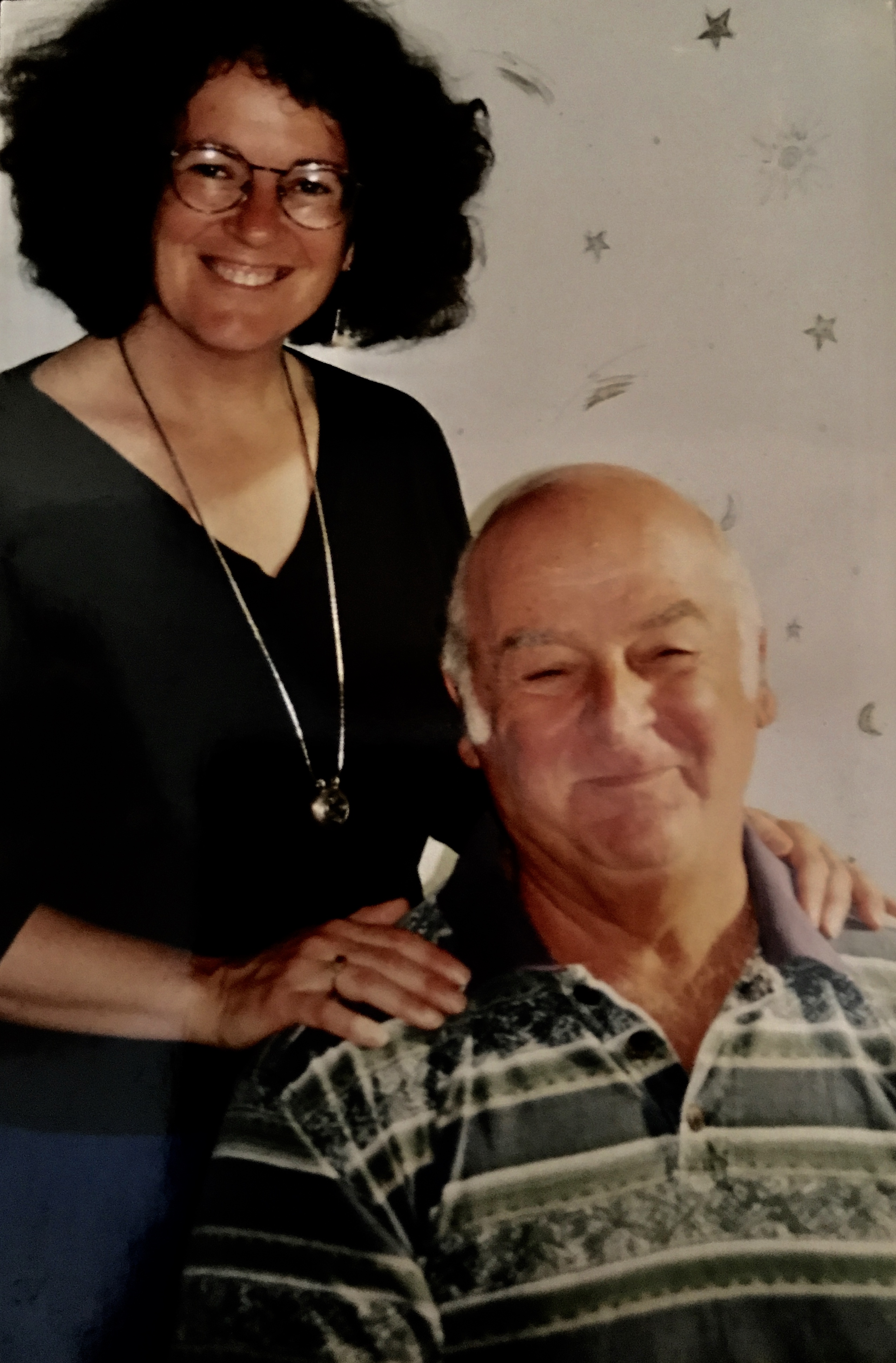
  • fullsizeoutput_146
    One of my favorite pictures of me and my Dad – from the late 1990s

    I was very lucky. I grew up with a father who made me feel safe and supported. Although I did not fully understand my good fortune until I was a young adult, I did know it long before he died. I appreciated him in his lifetime and I am grateful for that.

    Dad had an imposing presence. He was a bit shy of 6 foot, which in my mother’s estimation wasn’t tall enough (she was over 5’7” before osteoporosis and age did its damage), but he was a good healthy height by the standards of most Jewish people of his generation. It might be different today, with hybrid vigor and all, but notwithstanding my mother’s family, my grandparents’ and parents’ generation tended to be short. More than his height, though, Dad had broad shoulders, both literally and metaphorically.

    I came to a greater appreciation of my father’s broad shoulders when I was a freshman in college.

    I remember the trip up to Binghamton to drop me off quite clearly. We were listening to the radio as we drove through the Delaware Water Gap in the early morning, which was scenic with its green mountains and shimmering waterways. The sun was shining – a good omen, I thought. Coincidentally, the radio was tuned to a station that was playing music around the theme of saying good-bye. That may not have been the best choice for listening under the circumstances.

    I already had mixed feelings about leaving home to go to college. I knew it was the right thing to do. It had been drummed into me that it was an important growth experience. My parents lived at home when they went to Brooklyn College and wanted their children to have the opportunity to go away. But, I was only 16 and had never been one to embrace change easily, so it presented a challenge. While I made progress during high school, gaining confidence and more self-esteem, I still had a long way to go.

    For my oldest brother, college away was a great fit. As my parents liked to tell it, Steven arrived at the SUNY-Brockport campus, unloaded his bicycle, hopped on and rode away without looking back. They didn’t know if he would return to say good-bye.

    For my brother Mark, I think it was a bit different. I don’t think he felt particularly ready to leave home, but he seemed to adjust to life at Oneonta. He was two years ahead of me and was quite settled by the time it was my turn to go to Binghamton.

    In late August of 1976, as we drove through the Delaware Water Gap, with the sad songs playing, I felt a mix of melancholy and hopefulness. It was a new chapter and I had no idea what to expect.

    We arrived on campus and were directed to my room, which was difficult to find. I was assigned to the College-in-the-Woods dorm complex, the newest of the dorms on campus and supposedly the most desireable. The buildings were a modern design, with a quirky layout that included large rooms, intended to be triples, where the door to the room was outside the building. Those rooms weren’t really part of the rest of the floor. Not only was the room set apart, but in my case, it was located in back of the building, so it was isolated. When I opened my room door, I saw a small driveway, garbage dumpsters and then the woods.  There was also a door to the rest of the dorm across a short walkway. The room was allegedly part of the basement floor, called “the Pits,” of Cayuga Hall. My new home.

    Dad was not happy with my room. In fact, he was angry. We went to find someone in authority. Dad vigorously made the case that he thought it wasn’t safe for young women. In his opinion, the room should have been assigned to boys. There were no options for changing anything, though. They assured us that it was safe, there was adequate lighting and the RA (resident assistant) on the floor would be attentive. Reluctantly, Dad gave in, but not before putting everyone on notice about his concerns.

    My Dad, who I thought was the strongest person in the world, single-handedly carried my very full, heavy steamer trunk into the room. We all made several trips from the car to the room. They helped me unpack and my mom made up my bed. Then, they left and headed back to Canarsie. I had to fight the urge to climb in the backseat.

    Orientation week began. I had major ups and downs. On the upside, I bonded with Merle (who was tripled in a similar type of room one floor above me on the other side of the same dorm), Alison and Dianne immediately. On the downside, I didn’t bond with my roommates and I found the campus atmosphere stifling. It felt unreal to me, not only was my room isolated, but the whole campus felt like an island. I was used to reading three New York City newspapers every day. I was used to watching the news on television every night. The only television available was in the common lounge and there was no cable in those days, we didn’t get the NYC channels. The local Binghamton newscast seemed quaint by comparison. I felt disconnected…and I was.

    I called my parents regularly, often in tears, often feeling lonely. I would be apologetic, “I’m sorry I’m calling you so unhappy.” My Dad was reassuring, “You have nothing to apologize for. We want you to call us if there is something bothering you. You are not a burden.” Although he couldn’t fix things, he and my mom did make me feel better. He wrote me encouraging letters. He tried to help me navigate things with my two roommates.

    The three of us were an interesting combination. Me, from Brooklyn, Sue from Long Island and Sharon from Rochester, NY. Sue and I got along fine, but we were from different worlds. There was a large contingent of freshmen from her high school and she socialized with them. They reminded me of the kids from the camp where I worked – and not in a good way. They were concerned with hair, make-up and designer clothes – and partying. They came across as entitled and monied. So, while as an individual Sue was fine, I didn’t enjoy her group and I didn’t hang out with her.

    Sharon was from a suburb of Rochester and she was a completely different story. She came to college not knowing how a woman got pregnant. She was naïve beyond belief. Sue offered her her copy of Our Bodies, Ourselves. Though I was totally inexperienced in that regard (I had a lot to learn from Our Bodies, Ourselves, too), I at least knew the facts of life. Sharon was a very odd duck. One of the things that was unique was that she could burp louder than anyone I had ever known. Each time she did, I couldn’t help myself, I would go, “Woah!?!,” a mixture of awe and surprise. I was taught to keep all bodily functions as quiet and private as possible, so Sharon was a revelation. Beyond that quirk, we also didn’t have much in common, and she seemed a bit troubled. During midterms, she scratched her own face in a fit of anxiety.

    I had my own struggles that first semester. My writing, which was a source of pride in high school, was criticized by both my Lit & Comp TA (teaching assistant) and my Intro to Poli Sci professor. I was reeling. The weather in Binghamton in the fall and winter of 1976/77 was biblically bad – it literally precipitated for 40 days and 40 nights. There was snow on the ground from my birthday (October 3) through April – and we had snow flurries during finals in May. I had to steel myself, I hunched my shoulders and tightened my muscles each time I opened the dorm door to the bitter cold. Previously I didn’t know nose hairs could freeze, but they did when I walked to the classroom wing! Gray clouds were a constant. For someone prone to melancholia under the best of circumstances, this was a bad recipe.

    In the middle of that fall semester, weird stuff started disappearing from our room – some money (mostly loose change), a robe, a pair of pajamas. Not major theft, but it was noticeable. I mentioned it to my Dad. He told me to report it to the RA. I did.

    They did an investigation that included being interrogated in the RA’s room by the Resident Director, with a single lamp shining on my face, while I sat on the RA’s desk chair. After a few days, I received a letter (I think all three of us received the same letter, but my memory fails me on this) that said they knew who was doing this and that person was expected to go to Psych Services (the counseling center). I shared this with my Dad, who was incensed. I was totally perplexed. Who was doing this? It was more of an annoyance than frightening to me. He wrote a letter to the President of the University saying that the matter was being mishandled and that the letter I had received had better not be included in my official record and should be destroyed. Dad received a letter in return that agreed with him and assured us that the letter was torn up and was not part of my official record.

    Shortly thereafter items stopped disappearing. It was all very strange. That incident certainly didn’t help my relationship with my roommates or connect me to my RA and the other residents of “The Pits.” It solidified the need for me to change rooms and roommates.

    At another point in that semester I received a bill indicating that tuition had not been fully paid. I think it may have related to not getting credit for my Regent’s Scholarship. Once again, I called home. Dad told me he would take care of it, and he did. I didn’t receive another bill.

    As painful as freshman year was, I learned a great deal. Aside from reading The Iliad and other classics, I made life-long friends. And, I came to understand how lucky I was to have parents who were there for me. Dad especially offered unconditional love and would help me sort out whatever issues came my way. Many of my friends were left to their own devices when bills came or were only able to rely on their Moms for emotional support. Recognizing my good fortune was more important than any academic lesson.


  • Note:  I know I said I was taking the week off, but then I felt like I needed to write this and share it. So, it’s Tuesday. It is my blog and I make the rules 🙂

    Newport, Rhode Island encapsulates much that is great about our country and, at the very same time, much that isn’t. The duality that defines our history plays out there.

    Today: Newport is beautiful. The views of the ocean, with ships of every size and shape dotting the water, are spectacular. Families enjoy themselves at the beach or strolling the streets, looking at the over-abundance of charming shops and restaurants. Old and young amble the cobblestone streets. A surprising number of folks speaking languages other than English. Though predominantly white, there were many people of color.

    Today: As we walked by, a homeless man was sweeping the sidewalk that he claimed as his own. He had his meager things set up against the low decorative wall that separated the park from the street. It is hard to miss the income inequality so evident in Newport. The huge mansions, the extraordinary wealth of some – how much is enough? The conspicuous consumption, in contrast to those sleeping on a bench.

    We took a trolley tour of Newport. The tour guide did not ignore the fact that the original wealth of Newport was built, at least in part, on the slave trade. She also acknowledged the role of Native Americans in assisting the colonists. It is a complicated history, filled with the duality that is our country’s history. Rhode Island was also the colony founded on religious freedom, but it profited from the slave trade and from piracy. These contradictory strands are not easy to reconcile.

    We took a tour of the Touro Synagogue, the oldest temple in the United States (though I would’ve sworn that they said the same of the synagogue in Savannah). The synagogue’s founders were descendants of those who had escaped the Inquisition. I had not remembered a pretty significant event associated with the Touro Synagogue (Gary recalled learning about it, though I’m not sure if it was in Hebrew school or in American History), but learning of it made quite an impression on me, so I would like to recount it here (the photos below are of the exterior and interior of the synagogue).


    After Rhode Island ratified the Constitution in 1790, George Washington came to visit. He stopped in Newport before heading on to Providence and was greeted very enthusiastically. The leader of the synagogue, Moses Seixas, presented him with a letter. Here is the letter (I know it is written in a style that is difficult, but I think it is worth the effort):

    Sir:

    Permit the children of the Stock of Abraham to approach you with the most cordial affection and esteem for your person and merits – and to join with our fellow citizens in welcoming you to NewPort.

    With pleasure we reflect on those days – those days of difficulty, and danger when the God of Israel who delivered David from the peril of the sword, – shielded Your head in the day of battle: – and we rejoice to think that the same Spirit, who rested in the Bosom of the greatly beloved Daniel enabling him to preside over the Provinces of the Babylonish Empire, rests and ever will rest upon you, enabling you to discharge the arduous duties of Chief Magistrate of these States.

    Deprived as we heretofore have been of the invaluable rights of free Citizens, we now with a deep sense of gratitude to the Almighty disposer of all events behold a Government, erected by the Majesty of the People – a Government, which to bigotry gives no sanction, to persecution no assistance – but generously affording to All liberty of conscience, and immunities of Citizenship: – deeming every one, of which Nation, tongue, or language equal parts of the great governmental machine: – This so ample and extensive Federal Union whose basis is Philanthropy, Mutual confidence and Public Virtue, we cannot but acknowledge to be the work of the Great God, who ruleth in the Armies of Heaven, and among the Inhabitants of the Earth, doing whatever seemeth him good. 

    For all these Blessings of civil and religious liberty which we enjoy under and equal and benign administration, we desire to send up our thanks to the Ancient of Days, the great preserver of Men – beseeching him, that the Angel who conducted our forefathers through the wilderness into the promised land, may graciously conduct you through all the difficulties and dangers of this mortal life: – And, when like Joshua full of days, and full of honour, you are gathered to your Fathers, may you be admitted into the Heavenly Paradise to partake of the water of life, and the tree of immortality.

    Done and signed by order of the Hebrew Congregation in NewPort Rhode Island August 17th 1790.

    Moses Seixas, Warden

    We visited the synagogue just two days after the 227th anniversary of the letter. George Washington was quite moved by this expression of support and wrote a letter in response:

    Gentlemen:

    While I receive with much satisfaction your address replete with expressions of affection and esteem, I rejoice in the opportunity of assuring you that I shall always retain a grateful remembrance of the cordial welcome I experienced on my visit to Newport from all classes of citizens.

    The reflection on the days of difficulty and danger which are past is rendered the more sweet, from a consciousness that they are succeeded by days of uncommon prosperity and security. If we have wisdom to make the best use of the advantages with which we are now favored, we cannot fail, under the just administration of a good government, to become a great and happy people.

    The citizens of the United States have a right to applaud themselves for having given to mankind examples of an enlarged and liberal policy: a policy worthy of imitation. All possess alike liberty of conscience and immunities of citizenship. It is now no more that toleration is spoken of, as if it was the indulgence of one class of people that another enjoyed the exercise of their inherent natural rights. For happily the Government of the United States, which gives to bigotry no sanction, to persecution no assistance, requires only that they who live under its protection, should demean themselves as good citizens, in giving it on all occasions their effectual support.

    It would be inconsistent with the frankness of my character not to avow that I am pleased with your favorable opinion of my administration, and fervent wishes for my felicity. May the children of the Stock of Abraham who dwell in this land, continue to merit and enjoy the good will of the other inhabitants; while every one shall sit in safety under his own vine and fig tree, and there shall be none to make him afraid. May the father of all mercies scatter light and not darkness upon our paths, and make us all in our several vocations useful here, and in his own due time and way everlastingly happy.

    George Washington

    I think that the two letters are pretty damn impressive.  In Newport, they read Washington’s letter publicly every year on its anniversary. Though we did not attend, it was read on Sunday, August 20th outside on the grounds of the synagogue.

    I recognize that Washington may not have been including women, African-Americans or Native Americans when he used the term ‘people;’ he was, after all, a man of his time. I am also not a believer in God as credited in these letters. But the ideas, of moving beyond tolerance and allowing all citizens the freedom of their conscience are still revolutionary and the letters remind me of that. These ideas are still relevant and timely in 2017.

    When I was a child we learned American history in public school. I remember learning how different groups contributed to the founding of our country. A prominent person from each group (Crispus Attucks – African-Americans, Haym Solomon – Jewish-American, Baron Von Steuben – Prussian-American, Lafayette – French-American, Tadeusz Kosciuszko – Polish-American) was studied to show that the success of the Revolution was based on the contributions of many different groups. I felt proud of that history. I believed in the ideals of the Revolution – life, liberty and the pursuit of happiness for all. My understanding of ‘all’ was more inclusive than our forefathers (and my understanding continued to expand as I became more educated), but I loved the idea of America. I felt pride when the national anthem was played, especially during the Olympic Games!

    Something changed as I grew older. The pride I felt was tempered by the realization that we were not fulfilling our ideals, we were falling short of our promise. I have been especially discouraged since the election of Trump. Reading these letters, though, even in the context of their time and understanding the limitations, reminded me of our potential. They remind me of the ideals at the heart of our country. This is something to be proud of and to aspire to fulfill.

    While I don’t subscribe to American exceptionalism (because it implies superiority), I do believe in our potential. Perhaps there is a parallel between Jews being the ‘chosen people’ and American exceptionalism. I was always uncomfortable with being labeled chosen, that idea could be translated as arrogance or supremacy. Instead, maybe being ‘chosen’ or ‘exceptional’ can be thought of as a responsibility to fulfill, not as a birthright; an ideal to work towards, not an entitlement.

    I come back from Newport reminded of the roots of our country, both good and bad. I hope we all can agree on the merit and meaning of the values that were at the heart of our founding. I hope we find our way forward with a shared understanding of the potential of this country.