I love yoga. I know it isn’t for everyone and that’s fine. I’m not proselytizing for it. To each their own. But for me, it is helpful. I don’t always have the experience I had this last session where I had a moment of joy, but even when I don’t it is well worth the time.
I started going regularly, two or three times a week, last November, so it has been a solid seven months. I have done yoga before, but never this consistently and for this length of time. I think the last time I did it, I had some issues with my wrist, and I stopped and never went back. Now I am more aware of how to work around the various aches and pains and am willing to accept my limitations. It feels more important for my mental and physical health to stay committed to going.
So where do the moments of joy come from? Usually it is during the last part of the class, when we take a comfortable pose and just let everything go. It is called shavasana. You’ve done the harder work of the different stretches and positions and now we rest. The leader will often give a prompt – a thought, an idea – that you can ponder (you certainly don’t have to!), but then we sit or lay in silence for a few minutes with only some soft music playing.
This last time the instructor had started the class by noting that soon we would be starting a new season, and it was a good time to consider letting go of something that no longer serves us. She pointed out that it could be as simple as a sweater that has been sitting in our closet unused for too long, or something major like a relationship. Sometimes when the instructors talk about new months or new moons, it doesn’t resonate with me. It doesn’t bother me – it can get a little woo-woo – but at this school of yoga it doesn’t go too far in that direction. I can appreciate a little spirituality, but if they go too far into the chakras and energy and planets and all of that they lose me. Anyway, in this case, her message did resonate. I do have stuff to rid myself of – and actually it does involve clothing. I have drawers stuffed with things I don’t wear and no longer need. It is a good time to purge, and I know it will feel good to do it – it feels cleansing, like I’ve lightened my burden. Things that don’t get used are clutter and when you see them every day it can feel suffocating. So, in that moment I pictured sorting through my drawer of workout clothing and t-shirts, putting the stuff in bags and either throwing them out if they are too worn or donating them. I felt better already.
But that wasn’t my moment of joy. Once I had decided on that, and I felt lighter, I thought of all that I am grateful for: that my body works well enough that I can get down on the yoga mat (and get back up!) and do many of the poses, and that feeling of gratitude led me to thoughts of my family. Part of the reason I am motivated to be here in yoga class is to be in as good health as I can muster, being with my children and grandchildren for as long as possible. As I thought of my kids an image came to me from my granddaughter’s birthday party from last week. My son and his daughter were playing Bananagrams. Some of the older kids at the party joined in. They were just playing the game, laughing, having fun, looking healthy and happy. I was proud of my boy – he’s a good father and a good man. We were all together for a celebration. As I lay on my yoga mat with my eyes closed, I saw their faces and it brought me joy.
It isn’t that I couldn’t have that image come to me at another time. It can and it has. But, most of the time it is in the midst of other things, other tasks, other responsibilities. After doing about 50 minutes of yoga, when we wind down and relax into shavasana, my mind is clear and my body feels good – having stretched and exercised to the extent that I am able. There is more space to reflect and cherish the image. It is a gift I give myself to make the time to go to yoga. While I can’t say that when I leave, I carry that positive feeling with me for the whole day, it does help. I need moments of joy to get through the many challenges we all face.
Maybe yoga won’t do it for you, but I highly recommend finding ways to claim that moment of joy for yourself.
I am a grandmother, called Nana by my granddaughters, which makes me smile.
I ask myself, how much of my life do I want to shape around theirs?
I grew up with my Nana living upstairs in the apartment above mine in a two-family semi-attached house. She was a gift to me.
I am not in the same situation. I am 2 and ½ hours from one granddaughter, three hours from the other. My children did not grow up in the situation I had either. They saw their grandparents maybe monthly in the summer, once in the winter months when we would fly down to Florida during the February break from school. They still knew their grandparents, and knew they were treasured. Most summers my kids would spend a week at my folks’ house in the Catskills. I think that was an especially bonding experience.
Is that enough for me?
These days we have FaceTime. We can see each other more frequently – in between in-person visits. What will that mean to them?
Then there is my relationship with my children. There are rare occasions when I see each of them separate from their families. It is precious time when I get to see them one-on-one. Do I shape my life to maximize the opportunity to visit them?
Or do I lead my life?…commit to volunteer work, commit to writing, commit to political activism – instead of filling in with those activities.
I don’t know how to balance it.
And then there is the mundane business of life. It is common to hear people who retire say, “I don’t know where the time goes. I’m always so busy. How did I fit in a full-time job?”
I am finding that taking care of myself as I age has become a full-time job. More frequent doctor visits, more frequent medical tests, physical therapy, exercising multiple times a week, picking up prescriptions, and all the paperwork that supports that stuff. Then there is the expansion of household tasks, some of which I crammed in or let fall by the wayside when I worked so there is catching up to do. Between taking care of the house, the car and my body, there isn’t that much extra time. Plus, my capacity or energy for all of it isn’t what it used to be.
I admit I am disappointed in a way; retirement isn’t quite a free as I thought it would be. I know I am lucky – unbelievably so in that I am not facing serious illness, just the nagging things that happen as the bones, joints and systems wear. I am even more blessed that my children are independent, capable humans who have families of their own. They live very full lives without help from me.
Some of my peers appear to be happy to center their lives around their children and grandchildren; others appear to be happy centering their lives on their own activities and maybe some have found the secret of balance. If you have, please share! Or maybe I assume folks are happy because that is the face they put on, especially on social media.
Between my own desire to remain engaged in meaningful growth, contributing to the world, and to have fun (which for me means traveling, being active, walking among trees, smelling flowers, being social, and, most importantly, deeply connected to my family), I feel like I don’t know what I am doing.
But, maybe I am doing it. This is it. I answer a call from my son who has an extra ticket to a Met game on a Monday night and I figure out how to make that work (it was a great game and we had a blast!). I schedule my various medical appointments and follow their instructions as best I can. Babysit for grandchildren and grandnephews when asked. Fit in yoga and tennis where I can. Take a walk with a friend. I write when I can, post a blog when I can. I don’t worry about getting published (easier said than done!). Let tasks in the house sit a while longer. I have lunch with a friend here and there. Plan a trip or two each year. Celebrate my granddaughters’ birthdays. Sounds pretty awesome really. So why do I feel uncentered? Perhaps it is just a matter of accepting it – the fragmented nature of it, the unpredictability of my schedule (or the absence of one) and the idea that I write mostly for myself and whatever audience reads my work. And most importantly, to believe that in being there for friends and family, I will have done something worthwhile even in the face of this very troubled world.
Looking for perspective in the woods of Central Park or maybe just admiring the birds.
My family has a movie club. It functions the same way as a book club. A member picks a movie, and we get together on Zoom to discuss it. The person who picks the film moderates the discussion. The number of participants varies from month to month, but typically there are about 19 of us. This month we discussed Field of Dreams.
I had not watched Field of Dreams in many years. I remembered enjoying it in the theater when it came out in 1989. I have caught bits and pieces of it on television since it airs frequently, but I am not someone who watches it whenever they come upon it, and I certainly had not watched it all the way through in decades.
For many this film is a touchstone. It is a perennial favorite because it speaks to universal themes: dream fulfillment, regret, father-son relationships, nostalgia for baseball, and redemption. It also features some wonderful actors, James Earl Jones, Burt Lancaster to name two and Kevin Costner qualifies as a genuine movie star (I think he is a fine actor and does a good job in this).
Somehow watching it yesterday afternoon, I was not as moved as I remember being. I wasn’t drawn into the fantasy. I liked it well enough and could appreciate aspects of it, but I found myself doubting the premise. I wasn’t buying it. When we gathered for our discussion, I was in the minority, though there were a few who were also less than impressed. I wondered if I have become too cynical to relax and give in to the sentimentality. One of the premises of the movie is that we long for a simpler, more innocent time. My problem with that idea is that I don’t believe that simpler, more innocent time exists.
I also think that the father-son dynamic, which is central to this story, didn’t resonate with me and I don’t believe that is a matter of gender. Anyone can relate to the idea of having regrets over a parental relationship that wasn’t what you wanted it to be – and having the chance to make amends would be an unbelievable gift, as happens in the movie. While I can relate to that idea and would welcome a chance to reconnect with my parents, I am lucky in that I don’t feel a lack of closure with either my mother or father. I miss them, but I don’t have much in the way of regret. I am grateful for that.
While intellectually I get the potential for how baseball can connect a father and son and how meaningful a catch could be, it still didn’t resonate. My parents were not of a generation where they played with their kids. My dad never had a catch with me – and I have no memory of him having a catch with my brothers. Maybe he did, or maybe they wanted him to. They certainly had catches with their own kids when they became fathers. I think it was a generational thing, though Gary, my husband, would toss a ball with his dad. What’s funny is that my dad was an athlete. He grew up playing ball – all kinds – baseball, basketball, stickball. He continued to be active as an adult, playing tennis and paddleball. But, he didn’t play with us. I think the mind set was different. He didn’t think it was his job to play with us. I had no expectation that he would. I can’t speak for my brothers – they may have felt a longing for that, or maybe they felt as I did that it just wasn’t something to be expected of him. Mom didn’t play with us either – not board games, not sports. We were expected to entertain ourselves.
Aside from the difference in expectation about parental roles that may explain my tepid reaction, the movie relies on nostalgia for baseball. I love baseball. It is a sport I have always enjoyed. I was a huge fan of Ron Bloomberg of the New York Yankees when I was a kid. You can probably guess why. But, I associate baseball with my brothers, my uncles and my Zada (my maternal grandfather), more than my dad. Dad followed the sport but after the Dodgers left Brooklyn before my birth, he was no longer a fan. He grew up as a die-hard Dodger fan and was angry and resentful that they left. In the years that followed he kept track of players, he read the sports page, but he didn’t root for a particular team and had no interest in going to games. If my brothers and I went to a game, it was with our uncles. I do recall a particularly memorable time my dad took us as a family, and it may explain why we went so rarely.
We went to see the Mets play the San Francisco Giants at Shea stadium. It was August of 1969, an auspicious year. Dad was no fan of New York City traffic, so he wanted to leave the game early. It was a close game, no runs had been scored, and we made our way to the exit after the 7th inning. Except when we got outside the stadium, we couldn’t find our car. We combed the aisles. This was long before we had fobs with a panic button. We had no way of flashing the headlights to help us locate the car. I don’t know why none of us had noted the section where we parked. We just kept walking up and down – every aisle looked the same, every section looked the same. Meanwhile the game went into extra innings. I believe we found our car after about an hour. The game went 14 innings before the Mets won, 1-0, so we still beat most of the crowd to our car where we listened to the last inning on the radio. It turned out to be a classic game. Gary Gentry, the Mets pitcher, held the Giants scoreless for 10 innings and was relieved by Tug McGraw who finished out the game. Juan Marichal, the opposing pitcher who went on to be a Hall-of-Famer, took the mound for 13 innings! So not only were we roaming the parking lot for a very long time, but we also missed the end of a truly great game.
It was not the happiest of experiences. Dad was not the most relaxed person under the best of circumstances. He had a temper and a short fuse. You can imagine his fury at not finding the car. Plus, with a family of five, though it was far less expensive than it is today, it was still a lot of money to buy tickets, park and feed all of us. I’m not sure we ever went to a game as a family again. It became an amusing anecdote, but not until many years passed.
[I will rely on my brothers to correct me, if I got this episode wrong.]
The point is that my affection for baseball was not nurtured by my father. So, when I watch Field of Dreams it doesn’t evoke the heartfelt emotion that it does for other folks. I know my brothers feel differently. They participated in the movie club discussion, and the film clearly struck a chord with them. I invite them to comment or write a blot post about the notes that struck home.
If you want to chime in with your feelings about Field of Dreams, please do. I will say that unlike many movies made in the 1980s, it aged well. It wasn’t offensive in any way that I perceived and, in fact, got a lot right. It just didn’t move me the way it does many others. I didn’t choke up and I shed no tears during the final scene. Did you?
Does anyone get their portrait painted anymore, other than presidents and first ladies? I was thinking about that after going to two exhibitions, one at the Metropolitan Museum of Art, the other at the Whitney.
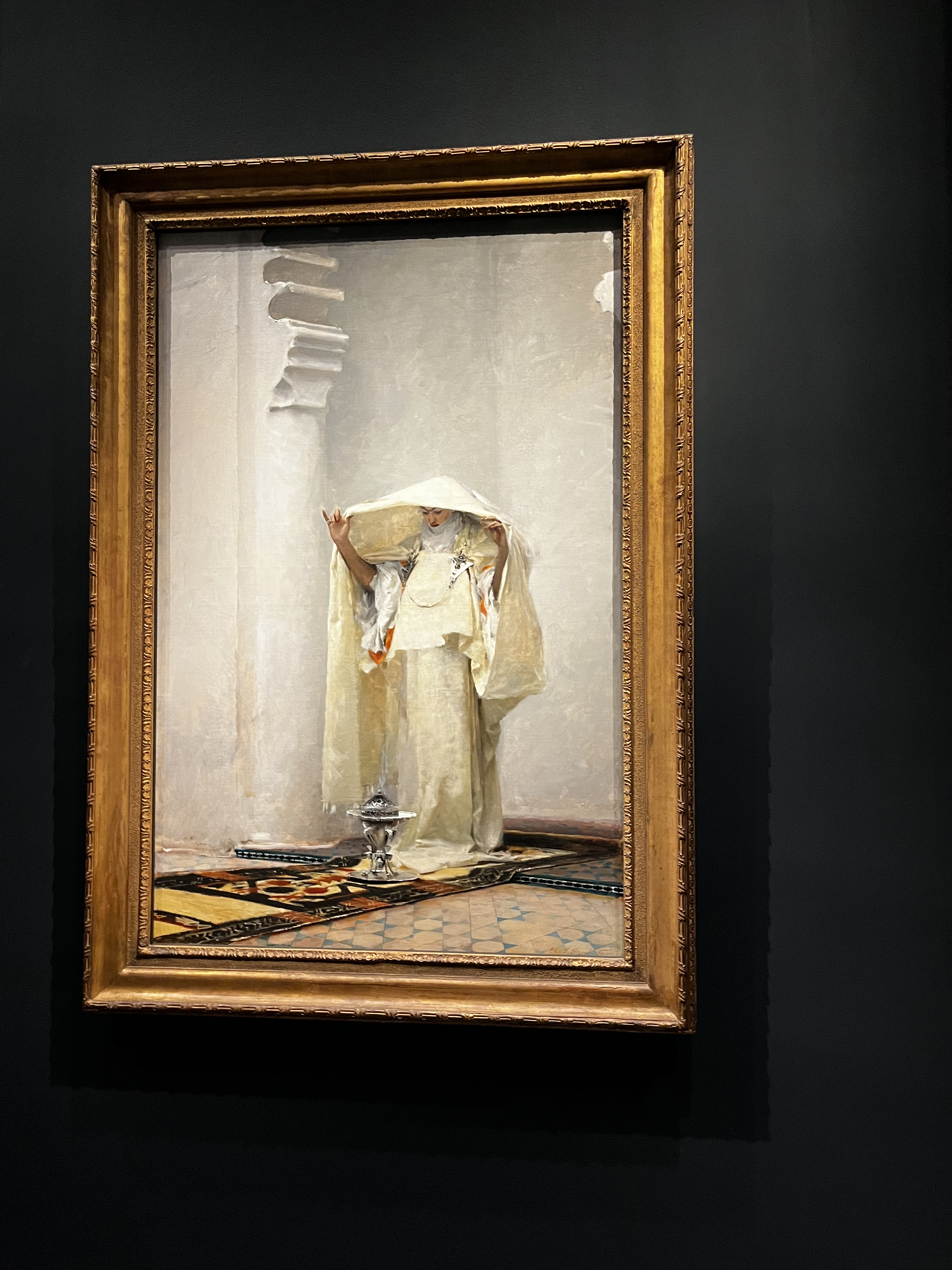
The first one was entitled Sargent in Paris, and it explored the emergence of John Singer Sargent as one of the premier portrait painters in the 1880s. He was commissioned by people in high society to paint themselves, their wives and children. I don’t travel in high society, so it is possible that old money, or the richest folks among us, still do that. If they do, I haven’t heard of the artists who do it or seen exhibits of their work. I am more familiar with hiring a photographer to do a shoot, but even that isn’t common, though some do it for an engagement or new baby. Back in the day, and I’m referring to the Guilded Age, it was apparently a sign of status to engage someone like Sargent to do a portrait.
From what I read while I walked through the galleries, Sargent was quite adept at nurturing the relationships one needed to sustain his career. There is no denying Sargent’s artistry, I love his work, but I think his ability to hobnob with the circles that could pay him enhanced his career and reputation. I wonder if he liked that part of his job. Maybe it came naturally to him. I would hate it. It is possible, like Michael Jordan who had both talent and tenacity, Sargent had both the social skills and the exceptional talent that allowed him to achieve the heights of success as a portrait artist.
Though Sargent was an American, he only visited here. His parents were ex-pats who moved around Europe. He was born in Florence, and he died in London. Despite spending a good deal of time overseas, he did leave his mark here in America, particularly in Boston where his murals decorate the ceiling and walls of the main branch of the public library. He, unlike some artists, was celebrated in his lifetime. There was a period after he died where his work was less respected because it was viewed as the work of a mere illustrator, without much creativity. Then his reputation rose again as the art world took another look at the nuance of his portraiture and skill of his brushwork.
Here are some examples of the range of his work from the exhibit:
an unusual approach to portrait paintingan example of making the color white interestingA view of the Alhambra in Spain
I love Sargent’s canvases – his formal portraits and his paintings of nature. He was so versatile. He could do watercolors, and he could paint in the Impressionist style. Whatever he did, his use of color was so vibrant, you can feel the texture of the fabric of the dress his subject wore. He also makes white come alive, which is unique – not everyone can make white an interesting color. And, even though he was often simply painting a portrait of someone I never heard of nor cared about, he manages to make them compelling.
This is the one commonality I found between the Sargent exhibit and the other show I attended, Amy Sherald: American Sublime at the Whitney. You may know Amy Sherald as the artist who painted Michelle Obama’s portrait, and that canvas is included in the exhibition at the Whitney. That work got some attention, but of the pieces on display that one was the least interesting to me.
Like Sargent, Sherald paints ordinary people but makes them notable. I suppose it isn’t accurate to say Sargent portrayed “ordinary” people, since they were, with few exceptions, very rich, but they weren’t famous in the way we understand fame today. Sherald’s subjects, with the exception of Michelle Obama, aren’t rich or famous– they are regular people. Sherald is interested in presenting people of color, offering less emphasis on their skin tone and more on their everyday lives – reflecting their joy, their dignity, their pride. She also plays with our expectations of gender and race, showing people in surprising settings.
Sherald’s work is also a celebration of color, but in an entirely different way than Sargent. Her canvases are bold, and while Sargent may have been considered bold, it was in the context of the Victorian era. Sargent’s most controversial painting, Madame X, presented a woman with the strap of her evening gown off her shoulder, which he later fixed to appease the sensibilities of the time. Sherald is far more daring, pushing the boundaries of our expectations. I’m sure some viewers, I’m thinking of social conservatives, would not appreciate her perspective. I love that her work makes you stop, think and reconsider assumptions.
Here are some examples of her work:
Sherald’s canvases, with the notable exception of the Obama portrait, are not on commission. She spots people on the street that she finds interesting for one reason or another, or she has an inspiration, and she asks permission to photograph that individual and then paints from the photograph. Unlike Sargent, she was not able to make a living as an artist until later in her life. She waited tables until she was 38 years old.
Though I did not set out to see these two exhibits to compare and contrast them, it turned out to be an interesting exercise. If you are in NYC, I recommend seeing either one or both. You can expect huge crowds at the Metropolitan. I went on a member preview day and there were lines. I’m not sure if that was due to the popularity of Sargent or the popularity of the Met. It was far less crowded at the Whitney which made for a more enjoyable and relaxed experience. There are plenty of other things to see at each museum, obviously, and if you haven’t been to the Whitney since it moved downtown, the building itself is worth a visit. The Sherald exhibit runs through August 10th, while the Sargent is open through August 3rd. If you see either one, feel free to come back here and comment. I’d love to hear other perspectives.
Here are some photos I took of other exhibits that I particularly enjoyed at the Whitney:
Editor’s note: I received the following email from my brother, Mark Brody. With his permission, I thought it merited sharing.
I just read a headline, I only read the headline as that is all I can tolerate, which indicated that federal funding is being cut to the programs which provide tutoring to children. After reading that, or you can substitute any other recent news, such as how research into the cures for Alzheimer’s or cancer, etc. are being eliminated, and I decided that my sensitive, far too brilliant for her own good, sister could enjoy the following essay which, if she chooses, she might wish to post on her blog.
The Hero of Our Own Lives
“Whether I shall turn out to be the hero of my own life, or whether that station will be held by someone else, these pages must show.” (Opening sentence of David Copperfield by Charles Dickens).
Last night Pam, my wife, and I were babysitting our 5-year-old twin grandsons. After the boys had a bonus 8-minute episode of an animated, parentally approved TV show called Grizzy and the Lemmings, we all scurried up to their bedroom. I declared I would outrun them to their room and for the 156th consecutive time (we babysit frequently) both Connor and Lucas outran their ancient grandpa.
Our usual nighttime reading ritual is that Connor will select books for me to read and Lucas, exhausted from a long day, will lie in his bed and be satisfied with just hearing the story as Connor plops himself in my lap. Before the last book is concluded Lucas will be sound asleep.
Last night, however, Lucas hands me a particular book and asks me to read it.
The first problem with reading to Lucas at night is that he is usually so tired that he needs to lie in bed, and I need to place my old, creaky body on the floor next to his bed so he can see the pictures as I read the story.
The second, potentially equally vexing challenge, is that Connor whose bed is at the opposite end of the room “needs” to climb into Lucas’ bed so he can get an equally good view of the book, or perhaps more cynically, to make sure that Lucas does not get a better view of the book than he receives. This in and of itself is fine, but when reading comes to an end and Lucas is an inch away from being asleep, Connor will invariably decide he should stay in Lucas’ bed and endeavor to keep Lucas awake as there is still much playing and gabbing to be done. Extricating Connor from Lucas’ bed is often an ordeal.
Last night, however, I was delighted that Lucas decided to climb into my lap as I started to read to him. Connor then took his usual perch in my lap (the boys are still young and my lap, unfortunately or not, is quite ample). We read the story. The boys genuinely helped decipher some of the words as the lighting is dim and when the color of the word is red, and the background is black, I have difficulty making out the letters (I am color blind). The bedtime ritual was completed, and Lucas went right to sleep. I tucked in Connor and said, “Good night.”
As I left the room Connor commenced a debate with Pam. Was Grandpa’s “good night” sufficient? “Nana, when I wake up tomorrow Grandpa will not be here, don’t you think you should get Grandpa to come back and say ‘goodbye’?” Despite the debate I did not believe it wise to return to the bedroom.
First, debates with Connor (always Connor, as Lucas is not afflicted with the need/desire to question/analyze absolutely everything) can sometimes be lengthy (remember they already had an extra episode of Grizzy). I could envision much time elapsing before I would again leave the room.
Second, and much more importantly, I recall the infamous evening when I was babysitting sans Pam and her adult oversight. I recall the look of terror in Josh’s face when I showed up alone, and the parents got home to discover Grandpa in the twins’ room well after bedtime, reading/gabbing with Connor. The formerly always serene Mama demonstrated a countenance which can be generously described as something other than serene. As an aside, the Daddy of the twins, who has not yet to my knowledge been described as serene, voiced his considerable displeasure with my judgment that Connor did not need as much sleep as the parents thought necessary.
With that experience in mind and armed with the ability to learn from the past, I promptly made my exit and left Pam to handle the debate with Connor. For some reason, unbeknownst to me, Pam does not seem to test the Mama’s serenity.
Later that evening Pam explained that Connor’s thesis that Grandpa’s saying “good night” was insufficient was predicated on Connor’s observation that upon his saying “goodbye” to me, I should also say “goodbye” to him because when he wakes up in the morning I would not be there. Hence, just saying “good night” is not sufficient. Note taken.
Both grandparents, having safely bid the boys good night or goodbye as the case may be, await the parents return home which they do at a reasonable hour. Pam and I head to our own abode.
We discuss how I used to read to our boys when they were the twins’ age so many decades ago. Perhaps that is why I decided I should re-read David Copperfield. Having made a little headway in the tome, I went to bed at 6:00 a.m.
When I awoke the next afternoon, Pam and I discussed how 35 years ago I would read one chapter of the Dickens’ classic a night to Josh. If memory serves me correctly Sam – age 4 or 5- would be snuggling with Josh and me. She suggested that perhaps one chapter a night might still be a good idea for me. Another note taken, but likely ignored given my track record.
This made me think- about how long it would have taken me to complete the 64-chapter book (each chapter averaging 15-20 pages).
…..And then a memory arose which I had not thought of for many years. I now recall having been so enthralled by the elegant writing, humor and pathos of the novel, one summer afternoon, while we were on vacation in a time share in California, I simply had to read the book to myself. This decision did not end well because Joshua spotted me reading the book…without him! He was outraged and demanded that I not “go ahead of him in the book.”
Three plus decades later, I recall vividly Josh explaining how my betrayal stung him. He probably has no memory of this. My argument that I was going to read everything to him were to no avail. 7 (or 8?) year old Josh’s thesis was that this was a shared experience for the two of us (Sam’s presence was either tolerated or perhaps cynically he did not notice Sam on the other side of me as we read) and my proceeding without him was a grievous abdication of parental responsibility.
…And now a more recent memory- about 4-5 years ago, I am in Josh’s house and he is on the living room floor (he is not yet as antiquated as is his father and can sit comfortably on the floor) with one of the twins and he is reading to his son, not yet one, from one of Tolkien’s Lord of the Rings books.
…..And then another memory from two years ago- Sam reading to his then 5-year-old son (Ted) from the Hobbit.
…..And yet another memory rushes in from 60+ years ago of Mom reading to me. I struggle to recall whether it was Treasure Island or maybe The Three Musketeers– perhaps my older brother, Steven will know.
…So, to conclude my essay, my dear sister, as our great expectations (pun intended) of our government is under constant assault, perhaps there can still be a calming perspective about how rich it is when we have the opportunity to share literature (great or otherwise) with children. And perhaps by doing so we can be the heroes of our own lives.
Note from your sister: Thinking about reading stories to our children and grandchildren, or reading literature in general, is far better than absorbing the news. So thank you for sending this to me. I too have fond memories of reading to my children each night, but I was not so ambitious as you. Though I read them chapter books, I never took on Dickens.
I also think about the role books had in our shared childhood. Wherever we were, and, as you know, we spent summers in different college communities while Dad pursued his education, we took a weekly trip to the library. Mom and Dad set us up for an enriched life. As they say in one of our prayers, not that we are religious, l’dor v’dor, from generation to generation. I think we have done just that. Mark, thank you for sharing this.
I watched chunks of Senator Cory Booker’s 25-hour speech in the Senate. I did not see or listen to the whole thing. I saw enough and read enough about it to offer some observations.
First, I was impressed with his stamina. My voice isn’t strong enough to talk for an hour, much less a full day. Yes, he had some breaks where other senators spoke, under the guise of asking questions, but he stood for all of that time and spoke with passion and emotion. It was quite a feat. It is not surprising that he was an athlete in college and continues to work on his fitness. As an amusing aside, my husband was impressed with his bladder. He needed control of both to get through that ordeal.
I saw some of the comments on social media during the event. Most lauded him. Of course, I live in a Democratic echo chamber, so I didn’t see much right-wing commentary. They may have been critical or sarcastic or who knows what – perhaps they mostly ignored it. Some, even in the progressive corner, were critical – saying it was a stunt or asking what good was it doing. I think there is a legitimate point there. It was a stunt. The question is: did it do any good?
It is true that Senator Booker wasn’t fillerbustering a proposed bill or administrative appointment. But, I think there was still merit to what he did. We need people to get motivated. We need people to be informed. To Booker’s credit, he didn’t read the phonebook like some in the past who have fillerbustered. He spoke substantively. Yes, some of it may have been repetitive, but there was a logic to that. After all, who would be watching the whole thing? Plus, people need the central messages to be repeated so they grasp them. It remains to be seen whether he was able to get folks energized.
Sadly, there are limits to what the Democrats can do to stymie Trump, especially given the aggressive, outside-the-norm, methods of slashing and burning government agencies that the administration is pursuing. The Dems simply don’t have the numbers in Congress to stop legislation or prevent appointments. They are taking him to court, but that is slow and, in some cases, appears to be ineffective because rulings have been ignored. Plus, in many instances the damage has already been done. If someone is fired, or an office is closed, it isn’t so simple to just put it back in place even if there is a court order. There is likely mass confusion as to what happens next when an action has been countermanded.
For folks who are angry at the Dems, I ask: what would you have them do? It is easy to criticize. I criticize when they aren’t at least raising their voices. I was profoundly disappointed in Schumer’s capitulation on the budget. Perhaps he thought it was necessary to avoid a government shut down, and that may be so, but he should have put up more of a fight first. At least make some gestures at resistance – push them a little further, see if there is even some concession.
Aside from noting Booker’s stamina, I was impressed with his intelligence and passion. Some of his colleagues in the Senate showed themselves to be articulate and knowledgeable. We make fun of politicians for many reasons, accusing them of being self-serving or corrupt. Some may be that. But Tim Kaine, Senator from Viriginia, Chris Coons, Senator from Delaware, and Chris Murphy, Senator from Connecticut, were among the speakers who displayed deep knowledge and commitment. They deserve to be recognized and respected for their efforts. Unfortunately, the realities of power in our country require that elected officials raise crazy amounts of money to run for office, which leads them to have to practically sell their souls (or be ungodly rich themselves), and that, in turn, makes us suspicious. Add to that the idea that many of our fellow citizens don’t respect academic achievement, or value people who are intellectuals and you end up with someone like Marjorie Taylor Greene being more well-known and popular, instead of well-educated, widely-read public servants like the aforementioned senators.
I know many say that all politicians and all government workers are corrupt. I am not that cynical. I look at some of the individuals who spoke yesterday, most especially Cory Booker himself, and I believe their sincerity. I believe he is a man of genuine faith – not the false piety of Trump and many of his followers. You can disagree with Booker’s philosophy of government or his approach to the economy, but he speaks from his heart. He wants government to improve the lives of Americans. I can’t say the same about our president.
Will what Cory Booker did make a difference? Time will tell. I plan to attend the protest in Albany on April 5th. I plan to continue to express my opinions, on my blog and by writing to Senators and Representatives. I will support candidates whose platforms offer a better way forward. I hope others are similarly motivated. I hope the tide can turn. I have to believe that most Americans are unhappy with the approach to budget cutting that has been taken – the cumulative impacts will take time to register, but they will be real. They are not cutting waste, fraud and abuse. For all their talk about that, they haven’t taken the time to find it! Musk wants to cut and ask questions later. Sadly, the damage is already being done, we are beginning to suffer a brain drain where researchers and academics leave to more hospitable countries/institutions, among a myriad of other negative effects.
I applaud Senator Booker. I believe history will be kind to him. I just hope we can look back and see it as a turning point – not even so much a turning point in policy, but a turning point in our national dialogue, to put the focus on substantive issues and to place value on our democratic processes instead of the politics of divisiveness. I hope the Senator is proven right when he said that the power of the people is greater than the people in power. I hope we choose to wield it, rather than ceding it to Trump, Musk and DOGE. I hope enough of us are willing to make “good trouble.”
I don’t have a sister; I have two brothers. But, I find the dynamic between sisters particularly interesting, maybe because I don’t have one. I could be romanticizing it based on Hallmark cards, but it seems that for some it can be a deep, lifelong friendship; a connection different than the relationship between a sister and a brother, at least from my observation. I did have a front row seat to my mother’s relationship with her sister, Simma, and a less intimate but still revealing view of my mother-in-law and her sister, and I saw common themes. Those relationships were quite layered and complicated. I was reminded of that recently because, as I am still in the endless process of going through my mother’s things, I came across a tribute Aunt Simma wrote for my mother that brought up questions. I am sharing portions of that essay because I think it offers insight into Mom and Simma and provides an opportunity to explore whether the relationship described is true of other sisters. This is Simma’s tribute:
Feige Brody: A Life
This is a wholly unauthorized, condensed, selective biography, one which, no doubt, will be considered by its subject to be semi-fictitious. Nevertheless, these are the author’s reminiscences and, therefore, are told from the author’s point of view.
Feige Marian Spilken was born in Brooklyn on November 16, 1933 to Ray Woltz Spilken and Charles Spilken. Her mother was 19, her father 29. She was named after her maternal grandmother who died too young in her early 40s. From the start she was a good girl, a mother’s girl, nurtured by her young mom whom she adored. Feige was everything adults could hope for in a baby. She was exceedingly pretty with dark curly hair, dimpled cheeks, and she was sufficiently chubby, a good thing in those days, to convince her paternal grandmother that Ray was not a bad mother….
The family moved to New London, Connecticut, where her sister Simma was born. Bubba Sarah Spilken was outraged that Ray should produce such a scrawny, straight haired baby who would not eat of her favorite dishes much preferring to eat bugs and dirt. Only Feige’s smiling, compliant presence and acceptance of those heavy, eastern European dishes kept Bubba from banishing Ray from the family. Feige was the good girl.
The great hurricane of 1938 forced the family to move to Jersey City, New Jersey. They lived above Charlie’s bakery and the girls loved bothering the bakers…
Across the street there was a saloon owned by the Landaus, the only other Jewish family in the neighborhood. Before it opened late in the afternoon, Mrs. Landau allowed the girls to play at the bar pretending to pull beer from the taps and serve customers. There were banquet rooms up a couple of flights of very narrow dark stairs. Everything was covered in sheets until the room had to be used. Feige loved telling Simma ghost stories as they climbed the stairs. She said the sheets were actually the ghosts’ clothing and would make appropriate noises to scare the daylights out of her impressionable sister.
Other favorite pastimes were staring out the back window at the not too distant Statue of Liberty and telling stories. Often, they would go to the front window in the late afternoon when the saloon opened. They liked to shout at one particular customer who looked worse for drink and had a fat, red nose. “Salami, Baloney, Pastrami,” they shouted since those were the most offensive words they knew. After the outcry they would duck, afraid the drunk would see them. That was exciting….
No matter where they lived, Feige was like a little mother to her sister. While Ray worked, Feige would entertain Simma and endure her fresh mouth and mischievous ways. One hot summer night all the windows were open when a terrible summer storm occurred… Simma wouldn’t listen when Feige told her to go to bed. Instead, she ran away making Feige chase after her. The rain slicked linoleum floors were so slippery Simma fell. Sliding into the metal radiator, her eye was bruised, turning black and blue, but it was Feige who suffered. She couldn’t stop blaming herself for the accident. She was a good girl.
Simma would refuse to go to sleep… Feige would induce her to come to their shared bed by telling her she would be allowed to squeeze and pull Feige’s copious ringlets. Simma can still feel their soft, springy, velvet luxuriousness. It was a fact that whether they were in Brooklyn, in the country with Bubba and Zada, or at a bungalow in Rockaway, Feige took care of her sister.
She was patient most times, but one lapse occurred in the late ‘40s. Simma was home in bed, too sick to go to school. Those were the days of Forever Amber, but there was no way the girls could obtain that “dirty” book. They got a poor imitation in Kitty. Feige allowed Simma to read the book but made her promise to read it under the covers, the way Feige read every night so their parents wouldn’t catch her.
When Feige came home from school, Simma asked her to define a word she could not find in the dictionary. “Feige,” she queried, “what is a whore?” She pronounced it “war.” “You know. It’s an armed conflict between nations,” Feige replied. Simma was frustrated and said, “I don’t mean a war, a ‘war.’” Feige responded, exasperatedly, “WHO-ER, stupid, WHO-ER.” What was this? Feige lost her cool and never did enlighten Simma as to the definition of the word…
Ray and Charlie always had people in the house. The two sides of the family gathered there as well as their many friends. Feige and Simma were allowed to stay up and mingle with them. One of Charlie’s friends, Jerry Cohen, would show them parlor tricks first fooling them and then teaching them. That was how they learned to read each other’s minds, an act they still perform for amazed spectators.
Days, though, were not always sunny. Feige finally caused her parents anxiety when she was 17. She decided she would like to move into an apartment with some friends. How could a well brought up girl live without her parents’ supervision? Ray and Charlie were distressed. But it was a great time for Simma. It was the only time Simma was told by family members that she was the good daughter, never causing her family any distress. Who were these people? Where had they been for the last 17 years?
When Feige started college her life changed, making it even better than it already was. She met Barry Brody. She was smitten and, indeed, got married to him as soon as they both were graduated from Brooklyn College. Feige is fond of quoting Charlie. Well, one of his precepts was that to have a happy marriage the couple should move away from their parents the first year of their marriage and get to know one another without interference. Feige, ever obedient, moved to Wichita Falls, Texas; Chicopee Falls, Massachusetts; and then back to Brooklyn with two boys in tow and a girl on the way.
Now, Feige was a devoted wife, mother, cook and baker. The girl who in her parents’ house had to be told that the outside of the pots and dishes had to be washed as well as the inside, was suddenly the happy homemaker. She, like Ray, loved to entertain family and friends. There was always lots of good food around which is still true whether the Brodys were home in Brooklyn or in Livingston Manor, or, now, in Boynton Beach. Their houses were and are gathering places for everyone they know, and their hospitality is boundless.
One more point of kindness, showing what a good girl and sister Feige is. A year after Simma’s husband died, Feige and Barry were afraid she would have nothing to do during the summer and suggested they all take a trip to Europe together. They planned to go to London, Paris and Amsterdam but the French changed all that. They would not allow American Air Force planes to use French airspace when they on their way to a bombing mission in Libya. The planes went the long way around. One ran out of gas and crashed killing the American crew. Feige was up in arms while putting her foot down. She would not go to France. She said there were two choices: cancel the trip or find something to replace the Paris portion. There was a replacement, a circle England tour. It was Simma’s first sight of England and Oxford, a romance that continues to this day. Thank you, Feige. By the way, Feige still has not gone nor will ever go to France. You are a good girl, Feige Marian Spilken Brody. Happy birthday with love from your sister, Simma Spilken Sulzer.
Mom (left) and Simma as teenagersMom (left) and Simma in England
Unfortunately, both Simma and Feige have passed away so I cannot ask questions that arise from the narrative. For example, Simma notes that after the great hurricane they moved to Jersey City and lived above Charlie’s bakery (Charlie was their father). I thought the bakery was owned by Charlie’s brother. A minor point in one sense, but not so inconsequential in understanding their economic circumstances.
It’s also interesting that Simma comments in a positive way about Mom’s chubbiness as a baby – at that time, and in their culture, having a plump baby was a sign of good mothering. I think we still believe it’s okay for a baby to have round cheeks, but only up to a point, then we start to worry. The never-ending judgment of mothers continues unabated to this day.
Another recurring theme is the importance of story-telling and reading. Mom was a devoted reader. In fact, as her daughter, I would get frustrated trying to get her attention when her nose was in a book. Often, I would just give up. On the positive side, my brothers and I grew up to be readers ourselves and continue to enjoy good stories.
Simma mentions the parlor trick of reading each other’s minds. Mom and Simma performed that gag many times to the amusement and bafflement of our family. I didn’t know where they learned how to do it, now I do – Jerry Cohen! Very late in life, Mom finally revealed how it was done, though I doubt I could remember the steps well enough to do it with one of my brothers.
Simma characterizes Mom as a happy homemaker after her marriage and arrival of children. I don’t think of Mom that way. She enjoyed cooking and baking for the purpose of entertaining guests (and to a much lesser extent feeding her family), but that was the end of her homemaking enthusiasm. Keeping a close eye on her young children (!), cleaning, sewing, and ironing were not high on her priority list. I don’t think she was a happy homemaker. I don’t hold that against her, but she probably should have been a bit less laissez faire when it came to overseeing her young children.
There are so many other interesting elements to this essay, starting with Simma’s disclaimer at the beginning. She acknowledges that her perspective may be quite different than Mom’s. I don’t think she is referring to the vagaries of memory. When Mom and Aunt Simma would tell a story from their shared past, which may have involved the same people and same incident, they understood it in totally different ways. Mom seemingly came into this world as a glass half full kind of gal; Aunt Simma not so much. Often, Mom saw people through rose-colored glasses and that certainly applied to how she viewed their parents.
I find it illuminating, too, that Aunt Simma describes Mom as a good girl. Mom, by her own description, was compliant and she wanted to please her parents. Aunt Simma was more rebellious, chafing at the restrictions put on them as children. Mom credited Simma with getting them a later bedtime, even though she was the younger one. Simma was the trailblazer, according to Mom. She also spoke of Simma’s insistence on picking out her own clothes. As a young person Simma was given a budget with which to buy her own outfits – she would rather buy one stylish item, instead of several cheaper things. Mom wore whatever her mother got for her.
That brings me to the first of several common themes between Mom and her sister and my mother-in-law and hers. That dynamic, the good one vs. the rebellious one, seemed to play out in both. Paula described herself as obedient – she did whatever her mother asked her to do as a child. Sophia was less cooperative. Unlike my mom, who was the eldest, Paula was the middle child with an older brother, Bernie, and Sophia about three years younger. Years later, when I met them, Sophia commented that their dad told bedtime stories to Paula, not to her (though they shared the same bed – just like Mom and Aunt Simma). Paula claimed that he was telling the stories to both of them, but that was not Sophia’s perception. Paula recalled feeling loved by both of her parents, despite the traumatic premature death of their father (he was murdered by the Nazis). Sophia did not carry the same warm memories of paternal affection. This mirrors the differences in my mother’s and aunt’s tendency to have disparate perceptions of people (though in Mom and Simma’s case not necessarily different views of their father).
Sophia (left), their mother, Lea, and PaulaSophia (left), David, my father-in-law, and Paula
Another similarity between Mom and Paula was their choice of a spouse when compared with their younger sisters. Mom and Paula were lucky in marriage, enjoying long, supportive, loving relationships. No doubt they had their ups and downs, as all marriages do, but they had husbands who were welcomed into the family and were much loved by their in-laws. Simma and Sophia were not so blessed. I imagine that difference in marital harmony impacted their relationship as sisters, as well.
The biography that Simma wrote for my mom is full of love and warmth. Their later years were more complicated. When I visited in Florida, years after Dad died, Mom told me that she believed Simma didn’t like her anymore. I didn’t know what to say. I tried to find fault with her perception but didn’t convince her. So many things might have gone into that – the loss of their respective husbands, deteriorating health, and perhaps long buried resentments/jealousies. At one point, after Simma died and Mom was feeling guilty that she hadn’t been able to offer her sister much comfort at the end of her life, I read her this essay and other cards from Simma that expressed love and appreciation. Sadly, it didn’t seem to ease Mom’s regret.
Paula and Sophia appeared to experience a similar distancing towards the end of their lives. Again, many things contributed to that, not the least of which was physical distance with Sophia living in Tucson, Arizona while Paula split time between New York and Florida. The progression of Paula’s Alzheimer’s disease created an additional challenge.
Sibling relationships are complicated. Though DNA is shared, personalities can be dramatically different and that was certainly the case with Simma and Mom and Paula and Sophia. Many people are estranged from their siblings, and it is understandable given how fraught family life can be. The potential for deep resentment is great – add mental or physical illness, or other serious problems and the bond can break. That was not the case with my mother or mother-in-law, but the end of life challenged the connection. There is no doubt, though, in both cases, the sisterly relationship was one of the most important in their lives. Whatever their differences, they remained deeply tied to one another.
What is your experience or observation about relationships between sisters?
This photo came up as a memory on Facebook a couple of days ago. It was bittersweet to see it. I remember that day clearly. It was only a year ago. Gary and I were in Florida for our annual pilgrimage to see the Mets during spring training. We took a short drive from our hotel to take a walk by the beach. Gary did his thing – he likes to show he can still climb a tree – and I snapped the photo to document it and sent it to our children, who, in turn, would hopefully show our granddaughters.
At the same time that we were enjoying this ordinary moment of levity, I was struggling with a difficult and painful decision. My mother, whose health had been failing, took a dramatic turn for the worse the night before. We had only just arrived in Florida. Though Mom had not been doing well, I had spoken with my brothers, the hospice nurse and her aide before leaving and we thought she was stable. We were wrong. Thus the question: Should I return and go to New Jersey, or should I stay?
Gary and I contemplated that as we walked along the beach. I had several conversations with my brothers before our walk. Both of them encouraged me to stay in Florida. Mark was heading down to Jersey from Albany with his wife, Pam, so he would be there. Steven and his wife, Cindy, lived 15 minutes away from Mom so he visited regularly. Steven was quite insistent that I stay in Florida; they would handle things. I had been very involved with Mom’s care up to that point, they didn’t want me to cut short our brief vacation. We were scheduled to be away for a total of five days, and we were on our second day when things went south.
After much contemplation, we decided to stay, believing that there wasn’t much I could add. My brothers are capable people. Mom was sleeping most of the time. Despite that, I was still torn. Did I need to see her? I decided I didn’t. I remembered how painful it was to see my father during his last days. Those images stayed with me for years, crowding out memories of him as a healthy person. It was also possible that I would get back in time to see her since our trip was so brief. Though I was deeply conflicted, I didn’t have a strong gut feeling, so we decided to stay in Florida.
I was able to enjoy the sunshine and warm air. I had the welcome distraction of the baseball games and dinners with friends. We visited Gary’s mother. In between, I talked to my brothers and thought about Mom and continued wondering whether I was doing the right thing. My brothers and sisters-in-law were handling some rough stuff – administering morphine, watching Mom to see if she was uncomfortable while she mostly slept. I felt guilty leaving this final stage to them, but I was also relieved.
Gary and I flew back north on Monday. Mom was still hanging in there. Before we left for the airport, I called my sister-in-law Pam’s cell phone, knowing she was sitting with Mom. Pam told me Mom’s eyes were closed, and she seemed comfortable. I asked her to hold the phone next to Mom’s ear. I told Mom I was coming to see her the next day but if she was ready to go, it was okay. I told her I loved her, that she was a great mother and that she earned her rest.
We arrived back in Albany late on Monday. Mom was still breathing. I got up early Tuesday morning and was packing my things to drive down to New Jersey when my phone rang. Mom’s aide, Ama, said she believed Mom had passed. She was waiting for the nurse to come to confirm it. I was surprised and I wasn’t. I thanked Ama for all she had done for Mom. I felt lost – now what should I do? After calling Gary, who was at work already, I wandered around my bedroom deciding if I still wanted to go down to New Jersey. For reasons that aren’t entirely clear to me, even now, I wanted to go. Maybe to see visual proof that Mom was gone, maybe to help Steve and Cindy with the details….
Ama was indeed correct. The next few days are a blur, planning the funeral, sorting through her things.
It was Mom’s time – I knew that. I wondered whether what I said to her on the phone made a difference. I didn’t exactly feel guilty about not being there, though I wondered if I would have offered her some additional comfort. I had been with Mom through most of her medical issues over the last years. I think I offered her comfort then. A year later I am still not sure how I feel. I am not riddled with regret, and I have been spared thinking of Mom as the sick version of herself. When I remember her, I think of her vibrant self. I am grateful for that. I still think of calling her to share good news.
I am also grateful to my brothers for protecting me – I think that is what they were doing by encouraging me to stay in Florida. I believe that they thought I had pulled my weight in caring for Mom, and they stepped up to see her through to the end, painful as it must have been.
Aside from knowing that it was Mom’s time, I know one other thing: there is no “right” answer as to how to handle the end of life. There is only doing the best you can and making decisions with love and compassion. After that, if you are a believer, you give it up to God. If you aren’t, and I am not, you give it up to the great unknown.
Note: Mom passed one year ago today – February 27, 2024. We miss her but take comfort in the long, happy life she had.
So much to say. I hope I can express it coherently.
I want to follow up on my last blog post which explored the role of the civil service. In that essay I mentioned that we all had a general understanding of the separation of powers. Now I’m thinking maybe we don’t. Given what has transpired in the last week, I think it is important we take a deeper look at the roles of the different branches of government. I have seen it at work up close and personal throughout my career. I believe it is an essential concept, a foundational construct, of our Constitutional democracy and it is being dismantled day by day.
Elon Musk, empowered by President Trump, is upending a structure that has existed for centuries, and he is doing it without a transparent plan for what replaces it. This is a critical issue. It isn’t simply reducing the size of the federal workforce that is underway here; it is the gutting of its ability to function. Some may think that there is so much fat in government that if you cut the staff you would still have an operating agency. That might have been true if cuts were planned, surgical reductions. Across the board cuts or offering all employees a buyout without regard to who is critical, eviscerates programs. In some instances, whole programs have been shuttered. Many of the cuts target either Trump’s perceived enemies or his and his billionaire friends’ interests – not the interests of the majority of Americans.
There are two problems with how things are proceeding. First is one of process – the way thing sare being done – they demonstrate a total disregard for laws and regulations in implementing these changes. The second is one of policy – what will be the consequences of these changes for the American people? Is this what we signed up for? These processes and policies have hurt people already and we have not even begun to feel the full impact.
Our Constitution does not empower an autocrat or an oligarchy. There is an executive, but that executive does not function as a legislature or judiciary. There can be some argument about where the line between making the laws and executing the laws is drawn – and the courts mediate that – but there IS A LINE. Let’s take a look at the line.
I worked years ago for the Legislative Commission on Expenditure Review in New York State. This entity was a bipartisan committee that had staff charged with reviewing programs to see if they were complying with legislative intent. In other words, we would look at the language of the legislation that authorized a given program, for example purchasing by the Office of General Services, to see if the program was operating in accordance with the law. To understand the purpose of the program, we looked beyond the plain language of the statute. We looked at the history of the bill (the bill jacket) and then we reviewed the operations in practice. The purpose of our review was not a traditional financial audit, that was the responsibility of the Office of the State Comptroller (OSC). We audited the performance of the program. Was it effective? Was it efficient? Was it accomplishing its mission? Was it being done in compliance with the law? We made recommendations when there were areas that were falling short.
So, that is how it is supposed to work: The Legislature, with input from the Governor’s office and the public, enacts a bill; the Governor signs the bill and it becomes law. Funding, negotiated by the Governor and Legislature in the budget process, is allocated. An Executive branch agency, as directed by the Governor, creates that program. The Executive branch implements and administers it, enacting regulations through administrative procedures (which the public can comment on) to flesh things out. The Legislature periodically oversees the program by having staff review it. A separate entity, OSC, reviews the financial operation. In sum, power and accountability is shared.
This balance of powers, this separation of responsibilities, plays out at the federal level, too. The names of the entities are different, but the functions are performed by separate entities. Power is not concentrated in any one branch. Is there potential for leakage? Are there instances where the system doesn’t work? Absolutely. Especially when Congress fails to act by not fulfilling its responsibilities.
Legislation can be vague. The Executive is left to interpret things and in that process a program can go sideways or it may overreach. Oversight can be inadequate. Oversight activities, within an agency and by the legislature can be underfunded and understaffed given the breadth and scope of the work of government. Agencies themselves have a role in preventing corruption by having internal controls and systems set up to prevent and/or detect malfeasance or other inappropriate actions. Inspector generals (IGs) and internal auditors within departments help to oversee this, in addition to the separate entities I described above. Removing those internal checks and balances threatens the integrity of the agency. We have seen the removal of IGs already. At the federal level the Government Accountability Office (GAO) performs a similar role as the state’s OSC. Congressional committees are responsible for oversight. All of this might be clumsy and time consuming, but it serves a purpose. Private sector entities can afford to be more streamlined, though they have some of the same concerns and limitations.
As is always the case there is a balance. Oversight is costly and you don’t want to create a whole other bureaucracy parallel to the one that is performing the service. But, some checks are necessary and pay for themselves by preventing or recovering losses. Finding the balance is difficult, but ridding the system of the whole process is certainly not the answer!
What happens when all of that is stripped away – both the separation of powers and the oversight – as is happening with the Trump administration? What will replace it? The judgement of one man, or a committee of men? Why should we trust them? What are their interests? What happens when Congress forfeits its authority and responsibility to oversee activities, as the Republicans appear to be doing? The system, carefully calibrated to prevent concentration of power and corruption, is rendered impotent. Is that what the American people want?
As I argued in my last blog post, we need to improve the system. We need to address the paralysis that plagues our Congress so that it can function as intended. But, we should not throw the baby out with the bathwater. The checks and balances, the division of responsibilities must be preserved. We can’t allow Trump and Musk to ransack our democracy. Please write and/or call your representatives!
For a while, after the election, I put my head firmly in the sand. I could not follow the news. It was all too overwhelming. But, there was only so long I could maintain that approach. I have looked up and I am frightened by what I see of the actions taken by the Trump administration. I cannot be silent.
I started this essay about a week ago and I keep having to change it, add to it, amend it. I can’t keep up with the transgressions. It is also hard to prioritize which of his moves are the scariest. Right now, I am leaning toward Elon Musk hooking up private servers to the Office of Personnel Management to communicate with all federal employees (and have access to all of their information). No one elected Elon Musk, and that is just the first problem with this scenario.
Perhaps in second place is the attack on DEI, especially blaming it for the tragic collision between the jet and the army helicopter resulting in the loss of 67 lives. Again, there are so many things wrong with the Trump Administration’s reaction to that calamity that it is hard to know where to start. One can assume that whenever things go wrong the playbook will call for blaming previous administrations and DEI.
It seems like the Trump administration strategy as they start their new term is the equivalent of a military blitz. Send everything in all at once so we are caught off guard and don’t know what to respond to first. Before you know it, the whole system will be upended. Some may have voted for him for that, but I don’t think the majority did. In fact, when you look at the numbers, Trump didn’t even win a clear majority of the vote. He has no mandate. Upending the system will have many unintended consequences (or if they were intended, they will be damaging in ways most Americans did not sign up for).
I have a master’s degree in public administration and policy from Columbia University. I completed my comprehensive exam to earn a PhD in public administration and policy at the University at Albany, but I did not write a dissertation – that means that I took all the coursework for that advanced degree but didn’t do the final piece. I share this because I have some background, some credentials, with which to evaluate what the Trump administration is doing. Most people do not want to get bogged down in the weeds of policy or administration. I understand that, and I am not going to go that far in this essay, but we do need to take look behind the rhetoric.
Most of us learned, at some point, about the separation of powers which characterize our government structure. You don’t need to go to graduate school to understand that. At a fundamental level, Trump was violating that by trying to freeze federal funds already approved by Congress. He offered no rationale or plan for going forward. Fortunately, his power grab was stopped, but it will not be the last attempt. We will face similar challenges in the future and these questions will need to be faced: Should federal agencies even comply with those orders? Are they constitutional? If they are unconstitutional, can they be disobeyed? Do they have to be obeyed until the courts decide? Meanwhile, how much damage will be done? Which brings us to a subject that is not sexy but may be increasingly important in this current environment: the role of the civil servant.
One of the first things you learn when you go to graduate school in public administration is the history of the civil service. I will not bore you with the details. It is important, though, to know why, in a general sense, we have that system. It was installed as a response to rampant corruption and a belief that the government was not being responsive to the people who fund it. Before the civil service existed, government hiring was through the spoils system – where family members and loyalists were rewarded by elected officials with positions in government without regard to their competence. It was called the spoils system from President Andrew Jackson’s quote ‘to the victor goes the spoils.’
This led to two major problems – ineffective policy and a culture of bribery. The needs of the people were not a priority. This was how things were run from 1828 (before 1828 it was also a system of patronage, but positions were awarded to elites; Andrew Jackson broadened it to include the ‘common man’ in 1828) until 1893 when the Pendleton Act was passed and created the federal civil service. Most states followed suit and created their own versions. It is important to note that the civil service does not cover the highest positions in federal or state agencies. It was understood that it was appropriate that the leadership reflect the will of the President. Secretaries/commissioners of departments and layers below that are political appointees. There was also recognition that under those policy-making positions it was important to have a class of employee who was not beholden to politics or parties, who could maintain stability and provide service when administrations changed – thus the creation of the civil service.
An essential element of the civil service was to provide a pathway to jobs with the government that was open to all, as opposed to through connections or bribery, and that would test for competency. Over the years the system has evolved with more specialized testing especially as government work required more expertise (lawyers, doctors, engineers, etc.). There have also been measures to make the workforce more reflective of the demographics of the country, ensuring that barriers to women and minorities were removed.
The civil service system has its flaws. For one thing, tests are never perfect. There is also no question that it is too difficult to fire employees who are lazy or inept or worse. But that does not mean we should throw the baby out with the bath water. We need to improve the system. President Trump appears to be trying to circumvent the whole structure. It suits his agenda to have everyone beholden to him and the MAGA universe. This would be a case of history repeating itself if we don’t learn from what happened before.
There is another aspect of this changing perspective on civil servants that deserves attention. Starting in about 1980, with the candidacy and election of Ronald Reagan, there has been a steady stream of insults hurled at government employees. Some of that may be a result of those flaws in the civil service system mentioned above. I think of the negative experiences many had with the Department of Motor Vehicles back in the 1970s when a trip to apply for or renew a driver’s license was an all-day affair in Brooklyn. The public facing clerks could be surly and seemingly inefficient. But, that was not an indictment of government as a whole. It was a failure of management and some aspects of the system, but it does not follow that we don’t need a Department of Motor Vehicles or the civil service. In fact, today, I believe, the DMV functions pretty effectively. We renew our licenses (for the most part) and registration online. When we go to the office, it is set up to process customers efficiently. Vehicles do need to be registered, and they need to be inspected. We need commercial trucks to be regulated for the safety of everyone on the roads.
We can argue about how much government is necessary; how much regulation is needed when balanced with the red tape created. That is fair game, and we can agree to disagree. But, disparaging the public workforce is counterproductive. Who wants to go into public service when it is so disrespected? So devalued? Government needs the best and brightest. I will never understand politicians who degrade the folks who implement their policies.
I went into public service because I wanted to help people. I wanted to make a difference in the quality of life of my community, to contribute what I could to improving services. Sometimes I felt frustrated because the work I did was far removed from that goal, so I looked for other opportunities. But even when I was buried in the bureaucracy of the department of tax and finance, I still believed I was doing something worthy. Collecting taxes in a fair and efficient manner is necessary. No one likes paying taxes, but without them essential services can’t be delivered.
The take-aways I offer are four-fold:
Know our history – let’s not repeat the errors we have made in the past.
Don’t throw the baby out with the bath water. Change structures, improve efficiency, but we should not dismantle whole systems impulsively and without planning for what replaces it and understanding why it was established in the first place.
Stop demeaning public service. Even if you are a libertarian, you need to value the essential work of the government and the people who do it. Insulting people is unhelpful to say the least.
Recognize that public and private management are different in important ways. The model of private business, where profit is the motive, is often not appropriate for the provision of public goods. Sometimes it may fit, and it may make sense to move certain functions to the private sector or adopt their systems, but many services don’t lend themselves to that approach.
We can’t sit back and allow the dismantling of our government without proper checks and balances. We need to make sure Congress hears us. We need to support organizations that are bringing lawsuits that raise legitimate questions about whether constitutional lines are being crossed. Please pay attention. Though it is tempting to put my head back in the sand, none of us can afford to do that.