Reflections on Life in America: A Call to Action

We are driving south on the Thruway once again. Heading to New York City for the weekend. Gary will be going to see a Met game with our son on Saturday. I will find ways to amuse myself – not a difficult assignment in the City (in my heart the one and only city :)).

I am struck by the disconnect between my life and the world at large. It is a beautiful day. The green hills of the Catskills are showing hints of color as we approach fall, they still look green and lush. The air is clear, the is sky a cloudless, azure, and the sun is beaming. If I only look at the world right in front of me, it is lovely. But, I know better. If I cast a wider look I think of the tragedies around the world  (in Gaza, Israel, Ukraine, etc.), the crackdown on free speech, the unrelenting gun violence in our country, the degradation of our environment that leads to more and more natural disasters, the fear that immigrant families live with, the extraordinary corruption and lack of integrity of Donald Trump. Most of those realities don’t touch me directly. Not yet, anyway. I am fortunate. I can afford higher prices in the supermarket and at the gas pump. I already own a home. Gary and I have savings – hopefully enough to ensure a comfortable retirement. We are able to make these pleasant plans for the weekend.

I look at the cars streaming down the highway, wondering about the inhabitants. Are they like me, heading off to pleasant destinations? If they aren’t faced with serious illness or job loss/uncertainty, are they just taking things at face value, telling themselves, “It’s all good.”

I worry that people like me, who are in my economic situation more or less, can delude themselves that everything is okay. If your immediate family is okay – they are gainfully employed, aren’t married to immigrants, perhaps own homes, if their children are healthy – you can put your head down and ignore everything that is going in the wrong direction. They may not be paying attention to the larger picture. Maybe they don’t need Medicaid, maybe their employment isn’t impacted by federal budget cuts, maybe the confusion around vaccinations isn’t concerning if they aren’t immunocompromised, maybe they assume that since they have resources, their children and grandchildren will be protected.

But life is fragile, and things can change on a dime.

A mass shooting and/or random violence can strike anyone. A natural disaster can unmoor a whole family. Illness can change everything. We don’t have control over these things, for the most part, but when they happen, we hope to have support to get through it. Some things could help minimize the occurrences – gun control (or see my last essay on repealing the second amendment), more mental health services, steps to slow down climate change could help. But even if we can’t stop these things from happening, we can build supports to help us cope and knowing that support is there, can lessen the anxiety. The current attitude, though, is in the opposite direction. Our social safety net is being decimated. Cutting FEMA, loosening environmental regulations, reducing funding for mental health and pulling government resources from medical research are all disastrous policy choices.

More than that, though, the attitude that is allowing all this to happen flows from our president, his callousness, his thirst for revenge, his selfishness. We, the American people, are being led by someone who is a terrible role model, and we are worse for it. We cannot allow his character flaws to become part of our national character.

The danger is that if our lives are largely blessed, or if our vision is narrow, we can pretend all of this is not happening.

I hope your eyes are open. I hope, as we approach the midterm elections, you pick your head up and use a wide lens to look around and then vote accordingly. It’s not all good and if we continue on this road, we will no longer be the United State of America that I grew up believing in, its values established in the Declaration of Independence: We hold these truths to be self-evident, that all men* are created equal, that they are endowed by their Creator with certain unalienable Rights, that among these are Life, Liberty and the pursuit of Happiness.

*I note the archaic use of the term men and understand it to mean all humans.

Lady Liberty still stands in the harbor of New York City, as viewed from Governor’s Island on a recent visit.

Parenting Philosophies: What Was I Thinking?

What was I thinking? That was the question I was left with after a conversation with some family members. What was I thinking when I didn’t assign my kids chores when they were growing up?

A small group of us were talking about how old we were when we learned to cook, if we learned to cook. Some of us, myself included, learned quite young. I remember being in third grade when I made my first roast chicken. Mom was bedridden, either because of ongoing menstrual problems or a flare of arthritis, and she gave me instructions how to prepare it. Others in our conversation came to it early, too, most learned as they helped their mom, and some didn’t recall being taught at all.

In the context of this discussion, my son asked, “Mom, you knew how to cook. Why didn’t you teach me?”

“I don’t know. I didn’t teach your sister either, so it wasn’t a sexist thing,” I responded.

The topic moved to the broader subject of all types of household chores. One person commented that their father viewed his children as worker bees, thus they had a myriad of responsibilities that were rotated among the siblings.

In the house I grew up in, we had chores, but they were unevenly divided. Things were assigned based on sex – I did the tasks that were thought of as women’s work, my brothers took out the trash, moved the garbage pails, and swept the driveway. I set the table and did the dishes after dinner daily. I was in junior high school when I staged my rebellion. It was clearly an unfair distribution of labor. At least my parents were persuaded by my argument and things changed. My brother Mark has still not forgiven me.

I admitted to the group that Gary and I had not required our children to do chores. Before they went to college, I showed them each how to do their laundry. We were fortunate in that for most of the years they were growing up, we had a person come to clean the house either weekly or every other week so the cleaning of bathrooms, washing or vacuuming floors, changing bedding was taken care of. I did the day-to-day straightening, laundry, dishes, etc. Gary did the gardening – the kids would sometimes help him with that. If I asked my son to help me bring in the groceries from the car he did so willingly.

As I sat there, I wondered: why didn’t we give them some responsibilities? I don’t think I did them any favors by not having them know how to cook, iron, clean, etc. Of course, I wasn’t particularly good at those tasks myself. I didn’t believe in ironing, unless absolutely necessary (still don’t). I don’t know how to sew. I can sew on a button in an emergency, but Gary takes care of that for himself. Cooking was probably the only area I really could have offered them something.

As I look back, I think I wanted to spare them the drudgery. I resented the chores I did as a child, though my father had explained to me that as a family, we each needed to contribute. I understood his point and accepted it, but I didn’t like it. I must have also carried some resentment for the years that things were so unbalanced with my brothers.

Another element was that starting when my kids were in first and third grade respectively, I stopped working. I took on some freelance jobs outside the home here and there, but I was essentially a homemaker for a dozen years. Gary worked long hours, and we were well provided for thanks to his efforts. I almost felt guilty, even as I intellectually knew that I was supporting Gary’s career by doing all the housework and managing our family. Emotionally, though, it felt ‘less than,’ or not particularly valuable or admirable. I figured children only get so many years to be carefree so I’d let them be and I would take care of the chores.

It occurs to me now that I may have also been avoiding the inevitable conflict that goes along with assigning chores. It wasn’t a conscious thing at the time, but I was probably unwilling to take on the fight. This thought doesn’t make me proud but there is likely some truth in it.

Interestingly, both kids are well functioning adults. They might not have come into adulthood having a lot of the skills or knowledge necessary to take care of a home, but they are doing it, they are quite competent. They would have to say whether they feel they were ill-prepared and if it created problems for them, though they haven’t complained to me. They make good use of Google and YouTube. Somehow, they are both figuring it out with their respective partners.

I come away, after thinking about this, believing that there isn’t one right way to handle this issue as a parent. Children becoming competent adults involves a lot of things falling into place beyond how this one thing is handled.

I understand the value of giving children responsibility and having them appreciate the importance of helping as members of a family. Perhaps, my children would be better off today if I had assigned them chores, but we will never know. Each of them got the message that a work ethic was important, and more than that, they don’t exhibit a sense of entitlement. Maybe the behavior they saw modeled was the most powerful factor in shaping them into adults – that and good luck (being lucky in health and not experiencing trauma are immeasurably important).

One last thought: Gary would remind me periodically that our respective parents raised us very differently, yet we function in the world pretty well. I found that thought comforting. There is room for a range of philosophies and a range of mistakes.

Carefree days

Please feel free to share your experiences as a child with chores and/or your parenting approach. I’d love to hear!

Will It Make Difference? It Is Up to Us

I watched chunks of Senator Cory Booker’s 25-hour speech in the Senate. I did not see or listen to the whole thing. I saw enough and read enough about it to offer some observations.

First, I was impressed with his stamina. My voice isn’t strong enough to talk for an hour, much less a full day. Yes, he had some breaks where other senators spoke, under the guise of asking questions, but he stood for all of that time and spoke with passion and emotion. It was quite a feat. It is not surprising that he was an athlete in college and continues to work on his fitness. As an amusing aside, my husband was impressed with his bladder. He needed control of both to get through that ordeal.

I saw some of the comments on social media during the event. Most lauded him. Of course, I live in a Democratic echo chamber, so I didn’t see much right-wing commentary. They may have been critical or sarcastic or who knows what – perhaps they mostly ignored it. Some, even in the progressive corner, were critical – saying it was a stunt or asking what good was it doing. I think there is a legitimate point there. It was a stunt. The question is: did it do any good?

It is true that Senator Booker wasn’t fillerbustering a proposed bill or administrative appointment. But, I think there was still merit to what he did. We need people to get motivated. We need people to be informed. To Booker’s credit, he didn’t read the phonebook like some in the past who have fillerbustered. He spoke substantively. Yes, some of it may have been repetitive, but there was a logic to that. After all, who would be watching the whole thing? Plus, people need the central messages to be repeated so they grasp them. It remains to be seen whether he was able to get folks energized.

Sadly, there are limits to what the Democrats can do to stymie Trump, especially given the aggressive, outside-the-norm, methods of slashing and burning government agencies that the administration is pursing. The Dems simply don’t have the numbers in Congress to stop legislation or prevent appointments. They are taking him to court, but that is slow and, in some cases, appears to be ineffective because rulings have been ignored. Plus, in many instances the damage has already been done. If someone is fired, or an office is closed, it isn’t so simple to just put it back in place even if there is a court order. There is likely mass confusion as to what happens next when an action has been countermanded.

For folks who are angry at the Dems, I ask: what would you have them do? It is easy to criticize. I criticize when they aren’t at least raising their voices. I was profoundly disappointed in Schumer’s capitulation on the budget. Perhaps he thought it was necessary to avoid a government shut down, and that may be so, but he should have put up more of a fight first. At least make some gestures at resistance – push them a little further, see if there is even some concession.

Aside from noting Booker’s stamina, I was impressed with his intelligence and passion. Some of his colleagues in the Senate showed themselves to be articulate and knowledgeable. We make fun of politicians for many reasons, accusing them of being self-serving or corrupt. Some may be that. But Tim Kaine, Senator from Viriginia, Chris Coons, Senator from Delaware, and Chris Murphy, Senator from Connecticut, were among the speakers who displayed deep knowledge and commitment. They deserve to be recognized and respected for their efforts. Unfortunately, the realities of power in our country require that elected officials raise crazy amounts of money to run for office, which leads them to have to practically sell their souls (or be ungodly rich themselves), and that, in turn, makes us suspicious. Add to that the idea that many of our fellow citizens don’t respect academic achievement, or value people who are intellectuals and you end up with someone like Marjorie Taylor Greene being more well-known and popular, instead of well-educated, widely-read public servants like the aforementioned senators.

I know many say that all politicians and all government workers are corrupt. I am not that cynical. I look at some of the individuals who spoke yesterday, most especially Cory Booker himself, and I believe their sincerity. I believe he is a man of genuine faith – not the false piety of Trump and many of his followers. You can disagree with Booker’s philosophy of government or his approach to the economy, but he speaks from his heart. He wants government to improve the lives of Americans. I can’t say the same about our president.

Will what Cory Booker did make a difference? Time will tell. I plan to attend the protest in Albany on April 5th. I plan to continue to express my opinions, on my blog and by writing to Senators and Representatives. I will support candidates whose platforms offer a better way forward. I hope others are similarly motivated. I hope the tide can turn. I have to believe that most Americans are unhappy with the approach to budget cutting that has been taken – the cumulative impacts will take time to register, but they will be real. They are not cutting waste, fraud and abuse. For all their talk about that, they haven’t taken the time to find it! Musk wants to cut and ask questions later. Sadly, the damage is already being done, we are beginning to suffer a brain drain where researchers and academics leave to more hospitable countries/institutions, among a myriad of other negative effects.

I applaud Senator Booker. I believe history will be kind to him. I just hope we can look back and see it as a turning point – not even so much a turning point in policy, but a turning point in our national dialogue, to put the focus on substantive issues and to place value on our democratic processes instead of the politics of divisiveness. I hope the Senator is proven right when he said that the power of the people is greater than the people in power. I hope we choose to wield it, rather than ceding it to Trump, Musk and DOGE. I hope enough of us are willing to make “good trouble.”

In Defense of American Government

For a while, after the election, I put my head firmly in the sand. I could not follow the news. It was all too overwhelming. But, there was only so long I could maintain that approach. I have looked up and I am frightened by what I see of the actions taken by the Trump administration. I cannot be silent.

I started this essay about a week ago and I keep having to change it, add to it, amend it. I can’t keep up with the transgressions. It is also hard to prioritize which of his moves are the scariest. Right now, I am leaning toward Elon Musk hooking up private servers to the Office of Personnel Management to communicate with all federal employees (and have access to all of their information). No one elected Elon Musk, and that is just the first problem with this scenario.

Perhaps in second place is the attack on DEI, especially blaming it for the tragic collision between the jet and the army helicopter resulting in the loss of 67 lives. Again, there are so many things wrong with the Trump Administration’s reaction to that calamity that it is hard to know where to start. One can assume that whenever things go wrong the playbook will call for blaming previous administrations and DEI.

It seems like the Trump administration strategy as they start their new term is the equivalent of a military blitz. Send everything in all at once so we are caught off guard and don’t know what to respond to first. Before you know it, the whole system will be upended. Some may have voted for him for that, but I don’t think the majority did. In fact, when you look at the numbers, Trump didn’t even win a clear majority of the vote. He has no mandate. Upending the system will have many unintended consequences (or if they were intended, they will be damaging in ways most Americans did not sign up for).

I have a master’s degree in public administration and policy from Columbia University. I completed my comprehensive exam to earn a PhD in public administration and policy at the University at Albany, but I did not write a dissertation – that means that I took all the coursework for that advanced degree but didn’t do the final piece. I share this because I have some background, some credentials, with which to evaluate what the Trump administration is doing. Most people do not want to get bogged down in the weeds of policy or administration. I understand that, and I am not going to go that far in this essay, but we do need to take look behind the rhetoric.

Most of us learned, at some point, about the separation of powers which characterize our government structure. You don’t need to go to graduate school to understand that. At a fundamental level, Trump was violating that by trying to freeze federal funds already approved by Congress. He offered no rationale or plan for going forward. Fortunately, his power grab was stopped, but it will not be the last attempt. We will face similar challenges in the future and these questions will need to be faced:  Should federal agencies even comply with those orders? Are they constitutional? If they are unconstitutional, can they be disobeyed? Do they have to be obeyed until the courts decide? Meanwhile, how much damage will be done? Which brings us to a subject that is not sexy but may be increasingly important in this current environment: the role of the civil servant.

One of the first things you learn when you go to graduate school in public administration is the history of the civil service. I will not bore you with the details. It is important, though, to know why, in a general sense, we have that system. It was installed as a response to rampant corruption and a belief that the government was not being responsive to the people who fund it. Before the civil service existed, government hiring was through the spoils system – where family members and loyalists were rewarded by elected officials with positions in government without regard to their competence. It was called the spoils system from President Andrew Jackson’s quote ‘to the victor goes the spoils.’

This led to two major problems – ineffective policy and a culture of bribery. The needs of the people were not a priority. This was how things were run from 1828 (before 1828 it was also a system of patronage, but positions were awarded to elites; Andrew Jackson broadened it to include the ‘common man’ in 1828) until 1893 when the Pendleton Act was passed and created the federal civil service. Most states followed suit and created their own versions. It is important to note that the civil service does not cover the highest positions in federal or state agencies. It was understood that it was appropriate that the leadership reflect the will of the President. Secretaries/commissioners of departments and layers below that are political appointees. There was also recognition that under those policy-making positions it was important to have a class of employee who was not beholden to politics or parties, who could maintain stability and provide service when administrations changed – thus the creation of the civil service.

An essential element of the civil service was to provide a pathway to jobs with the government that was open to all, as opposed to through connections or bribery, and that would test for competency. Over the years the system has evolved with more specialized testing especially as government work required more expertise (lawyers, doctors, engineers, etc.).  There have also been measures to make the workforce more reflective of the demographics of the country, ensuring that barriers to women and minorities were removed.

The civil service system has its flaws. For one thing, tests are never perfect. There is also no question that it is too difficult to fire employees who are lazy or inept or worse. But that does not mean we should throw the baby out with the bath water. We need to improve the system. President Trump appears to be trying to circumvent the whole structure. It suits his agenda to have everyone beholden to him and the MAGA universe. This would be a case of history repeating itself if we don’t learn from what happened before.

There is another aspect of this changing perspective on civil servants that deserves attention. Starting in about 1980, with the candidacy and election of Ronald Reagan, there has been a steady stream of insults hurled at government employees. Some of that may be a result of those flaws in the civil service system mentioned above. I think of the negative experiences many had with the Department of Motor Vehicles back in the 1970s when a trip to apply for or renew a driver’s license was an all-day affair in Brooklyn. The public facing clerks could be surly and seemingly inefficient. But, that was not an indictment of government as a whole. It was a failure of management and some aspects of the system, but it does not follow that we don’t need a Department of Motor Vehicles or the civil service. In fact, today, I believe, the DMV functions pretty effectively. We renew our licenses (for the most part) and registration online. When we go to the office, it is set up to process customers efficiently. Vehicles do need to be registered, and they need to be inspected. We need commercial trucks to be regulated for the safety of everyone on the roads.

We can argue about how much government is necessary; how much regulation is needed when balanced with the red tape created. That is fair game, and we can agree to disagree. But, disparaging the public workforce is counterproductive. Who wants to go into public service when it is so disrespected? So devalued? Government needs the best and brightest. I will never understand politicians who degrade the folks who implement their policies.

I went into public service because I wanted to help people. I wanted to make a difference in the quality of life of my community, to contribute what I could to improving services. Sometimes I felt frustrated because the work I did was far removed from that goal, so I looked for other opportunities. But even when I was buried in the bureaucracy of the department of tax and finance, I still believed I was doing something worthy. Collecting taxes in a fair and efficient manner is necessary. No one likes paying taxes, but without them essential services can’t be delivered.

The take-aways I offer are four-fold:

  1. Know our history – let’s not repeat the errors we have made in the past.
  2. Don’t throw the baby out with the bath water. Change structures, improve efficiency, but we should not dismantle whole systems impulsively and without planning for what replaces it and understanding why it was established in the first place.
  3. Stop demeaning public service. Even if you are a libertarian, you need to value the essential work of the government and the people who do it. Insulting people is unhelpful to say the least.
  4. Recognize that public and private management are different in important ways. The model of private business, where profit is the motive, is often not appropriate for the provision of public goods. Sometimes it may fit, and it may make sense to move certain functions to the private sector or adopt their systems, but many services don’t lend themselves to that approach.

We can’t sit back and allow the dismantling of our government without proper checks and balances. We need to make sure Congress hears us. We need to support organizations that are bringing lawsuits that raise legitimate questions about whether constitutional lines are being crossed. Please pay attention. Though it is tempting to put my head back in the sand, none of us can afford to do that.

a few of the books in my library

Pride

Since October 7th when Hamas brutally attacked Israel, committed acts of horrific violence, and all that has followed, I have struggled with a range of emotions. I have always given a lot of thought to my identity as a Jew, but this has been a more challenging time, and it has been hard to sort out my feelings.

I have attended presentations, in person and on Zoom, to hear what others have to say. I have read books, some recently published, including one entitled “On Being Jewish Now,” edited by Zibby Owens. It is a compilation of 75 essays by authors and advocates, all written in the wake of October 7th. As I write this, I have read about ¾ of them. They offer interesting perspectives, but none, yet, have hit the mark for me. Most of the authors explain how they have been moved to assert their identity as a Jew, even if there is some fear involved. They may not have been particularly observant before but found comfort and meaning in turning to Jewish rituals. They write about the pride they feel and the importance of their alliance with Israel. My feelings are more complicated. I have been thinking about what it means to be proud of being Jewish and about pride in general.

“Think about times you’ve been proud of yourself. Jot them down. I’ll give you a couple of minutes and then let’s share.”

This was the prompt from a Weight Watchers lecturer at a meeting I attended about two decades ago. She was urging us to call upon those times when we did hard things and apply those same skills to our weight loss goals.  This exercise sticks with me because I could not think of a single thing to be proud of. Nothing came to mind – certainly not my identity as a Jew. I share this not to elicit sympathy or to fish for compliments. I am writing about this because it was then I realized that this was an issue for me, and there are implications.

I sat for those few minutes in that meeting bewildered, reviewing various experiences in my life. I was already married, had two children who were still quite young, and I was working for the state. Nothing resonated with being proud.

When others at the meeting shared their triumphs, it was enlightening. Graduating from college, completing a project, losing weight, finishing a 5K, recovering from addiction, leaving a toxic relationship….some of those things I had done, I just didn’t feel particularly proud for having done them. I realized that I have this tendency to think that the quality of what I do isn’t special or that it was expected. Everyone in my family graduated from college, in fact both my parents had master’s degrees. When I finished a 5K race, I’d look at the time and think, “Could I have gone any slower?” It isn’t a healthy perspective. This exercise made me aware of it. In the years since, I have tried to be fairer in my assessment, but it doesn’t come naturally. Today if I was asked the same question, I would be able to come up with a couple of examples of times I was proud of myself. I’m making progress. But, all of that is different than taking pride in my identity as a Jew.

One of the essayists in “On Being Jewish,” Lisa Barr, a writer of a number of best-selling novels, who I also saw speak on a panel that was addressing antisemitism in publishing, described how she was motivated to be “loud and proud” of her identity as a Jew in the aftermath of October 7th. I have been thinking about that sentiment.

I tend to consider accomplishment rather than identity when I think of sources of pride. If you are born something, does that merit feeling proud of it? I asked Gary, my husband, if he was proud to be a Jew. He thought for a moment and said yes.

“I’m not suggesting you shouldn’t be proud, but can you explain why?” I asked.

He thought for a bit, which is something I appreciate about him, he is thoughtful in the truest sense.

“I think Jews have contributed a lot to the world – in science, in medicine, in the arts…in all kinds of ways. It was the first monotheistic religion. Jews have made the world a better place… And, then there is my parents’ experience.”

As I have recounted elsewhere on this blog, Gary’s parents are Holocaust survivors. This is a source of tremendous pride (and pain) for Gary. Their Jewish identity was the cause of their suffering due to the poisonous hate of the Nazis and their collaborators but was more importantly the basis of the strength and resilience that helped them to survive and flourish.

I understood what he was saying, and though my parents were not survivors, I am part of that legacy in a larger sense.

In my heart of hearts, I wasn’t sure if that’s how I felt, especially about the first part of what he said.

“It’s funny,” I responded, “but I remember as a kid I felt that pride. When a Jewish person did something impressive – whether it was winning a Nobel Prize or Mark Spitz winning all those Olympic medals, I felt a certain satisfaction. But I’m not sure I feel that anymore. I wonder why?”

I was thinking that in a way it was like how I felt about being an American. As a child I felt proud of my country, now it is much more complicated. I have a clearer understanding of why that has changed – I have been disappointed in our country’s shortcomings often enough to wonder if we can ever realize our foundational ideals. I realize that the story of America that I absorbed as kid is far more complex and not quite as heroic. In a way, perhaps some of the same thing has happened with my Jewish identity– or maybe as one matures into adulthood it is natural to see things in a more nuanced way.

Being Jewish is complicated. It is an ethnicity and a religion. I don’t believe in the God of the religion, but I do believe in the core values of Judaism. The central theme, as I understand it, is justice – Judaism demands that we do our best to be a righteous person. This resonates with me. But, reconciling my lack of faith in God while accepting the values being espoused is tricky. Frankly, I haven’t been able to do it since I can embrace justice and fairness as a humanist, without the trappings of religion. At the same time, some of the rituals, particularly the ones we practice at home (lighting Chanukah candles as a family and singing the prayers, conducting a seder) are meaningful to me and those traditions are rooted in the religion.

The ethnicity is part of me. It is engrained in my DNA. I like the humor, the slightly skeptical worldview, the food, the propensity to question anything and everything. I bond over those qualities when I meet other Jews, especially from the New York City metropolitan area. While I take pleasure in my ethnic identity, I’m not sure I would say I’m proud of it, but maybe I should be.

Adding another layer of complexity to this question of pride is the place of Israel in Jewish identity. Zionism has become a dirty word to many with much undeserved baggage assigned to it. Zionism is simply the belief that Jews should have a homeland. Zionism does not, in and of itself, define the borders of that homeland – that is a disputed subject even among Jews. The idea that we need a homeland is hard to argue with given our long history of persecution, whether that persecution was a result of religious, ethnic or racial hate. As I have expressed in another blog post, I support the state of Israel. It is as legitimate as any other country. It is also between a rock and a hard place in terms of defending itself. There are many forces determined to wipe it off the face of the earth. How it defends itself is subject to widespread criticism, much of it unfair given the existential threat it faces.

While acknowledging that, I do have concerns about Israel that I can’t deny, even in the wake of October 7th. The first is the rightward movement of the government over the years. I do not support the Netanyahu administration, and it has gotten worse and worse in recent years. However, there are many countries, including our own, where I have not supported the government, but that doesn’t mean that the nation becomes illegitimate. Now that Trump is president-elect, our right to exist isn’t in question. While I can acknowledge that it can be hard to separate the two, Israel seems to be held to a different standard than other countries in this regard.

The other concern is more fundamental. I worry about the tension between religion and ethnicity in defining the government of Israel. Since being Jewish is both, what is the role of religion in the governance of the state? I am not suggesting it is a theocracy; it isn’t (there is no official state religion) or that it will become one. I do worry, though, that since the Rabbinate does have some official roles – in regulating marriage and divorce, for instance, there can be friction and actions that make me uncomfortable.   

Most of Israel’s founders were secular Jews, at least that is my understanding. In its initial establishment, Israel was more of a socialist state. Over the 66 years of its existence, it has become more of a capitalist economy. It is also a parliamentary democracy – so the prime minister is selected by either the majority party (if there is one) or a coalition of parties that can agree on an individual. Israel hasn’t had a clear majority party in many years. As a result, the ultra-orthodox Jewish (Haredi) parties have an outsized influence on politics and policies. They have been instrumental in allowing Netanyahu to stay in power. The Haredi, according to the most recent census data, make up only 14% of Israel’s population, but it is growing faster than other segments. Perhaps, my concern that it will drift toward more religious influence is unfounded. I hope it is.

The bottom line of all of this is that I find it hard to be as full-throated in my backing of Israel as I would be if I supported its administration. That may not be entirely fair, given what I wrote above, but it is how I feel. From what I read and hear, this is not as problematic for other Jews.

Where does that leave me in terms of being proud to be a Jew?

Minority groups that are subject to discrimination often encourage taking pride in that identity. Whether it is the LGBTQ community, or Blacks or indigenous people, movements have focused on lifting the esteem of the members of the group. Group members themselves are vulnerable to buying into the negative stereotypes and that is destructive in many ways, so it makes sense to staunch that impulse. Jews are no different. Urging Jews to take pride in their identity can be helpful in the face of the rising tide of antisemitism.

Going back to the author who said she was ‘loud and proud’ of her Jewish identity; I have no problem being loud about it. Anyone who knows me, or reads my writing, knows I am Jewish. I make no effort to hide it. The more challenging part is expressing pride – but perhaps that has less to do with the complexities of being Jewish and more my personal hesitation in feeling proud of myself. Or, perhaps, it is a perfect reflection of my Jewish identity because it is a quintessentially Jewish characteristic to struggle with different ideas.

My Closing Argument

I can’t wait for this election to be over. The relentless ads on tv, the frequent text and email solicitations for money, the anxiety about the country’s future are all hard to put aside. No matter what happens, it will be a relief when it’s over.

That’s not true, exactly. I will not be relieved if Trump wins and/or if there is a red wave. I will be devastated, as I was in 2016 when I didn’t want to get out of bed for days after. But, I will try to take heart in the surprising closing message of Jon Stewart at his performance at the Palace Theater in Albany, which I enjoyed very much. He pointed out that democracy is work that doesn’t end. Regardless of the result on election day, we need to soldier on, doing our part every day to work for the ideas we believe in, not just on a single election day. He reminded us how shattered we were after 9/11. We thought the world would never be ‘normal’ again, and in some ways, it was forever changed. But we couldn’t give up, we needed to continue to participate in our civic life. We can’t give up hope, hard as that might be. So, I am promising myself, if I need to mourn for a bit, I will, but then I will pick myself back up and keep trying to make this country a better place in whatever ways I can.

But, before I turn the page on this presidential campaign, I have some thoughts to share. I doubt many of my readers are Trump supporters, though there may be a few. I have always tried to be respectful. I don’t like the crude remarks or snarky takes that insult folks who view things differently than I do and I don’t plan to start now. I do need to ask a few serious questions for those who are planning to vote for him:

After Trump’s behavior these past few weeks, do you believe he is fit for office? For those who believed in him in 2016 or even in 2020, do you not see the changes? He is more impulsive and less coherent. Those are not qualities a president should have.

So many of those who served under him have abandoned him. Are they all part of some vast conspiracy? The generals? The cabinet members? His vice president? His daughter? No one is continuing to stand by him. Doesn’t that say something important about what they know about him?

For those who say ‘policy’ is the reason for voting for him, what policy? Is it about prices in the grocery store? If so, there are many factors that led to inflation (pandemic and supply chain issues to name two) that would have happened even if there had been a different president. Our rate of inflation, aside from the fact that it has been brought under control without a recession, is far less than other countries. Also, just as the health of our economy is more than the Dow Jones Industrial Average, it is more than the price of eggs.

Is it about the border? Do you really believe immigrants are ruining this country? Where is the evidence of that? How has your life deteriorated as a result of the influx of immigrants? Is crime that much worse and if it is, is it because of immigrants? I don’t believe the data supports that crime is worse, much less that the crimes that are committed are by illegal immigrants (other than sensationalized, or in some cases fabricated, stories on social media). My experience here in Albany and in NYC doesn’t back up those claims either. All of which isn’t to say that illegal immigration isn’t an issue that needs to be addressed. The demands on social services and housing, among other things, are challenging, especially to our cities. We can’t simply have open borders, but exaggerating the problem doesn’t help to solve it (neither did tanking the border bill). And blaming Kamala Harris for it is absurd.

Trump supporters like to ask if you are better off today than you were four years ago. By what measure? Four years ago, we were in the midst of the pandemic. Before vaccines, before treatments. Well over a million Americans died of Covid. Other than the divisiveness stoked by Trump, I do believe we are better off today.

Is Israel your reason for supporting Trump? Trump is an opportunist who will support whoever or whatever is in his self-interest at the time – the Saudis, Putin, possibly Netanyahu (maybe not, if he thinks Bibi doesn’t like him anymore). The incidence of antisemitism has soared since Trump came on the scene. How do you square those things? And, in order to support Israel, we need to be a functioning democracy not an oligarchy or monarchy.

Do you think children are going to school as one sex and coming home another, as Trump claims? Schools can’t apply sunscreen without parental permission. Not to mention that it takes more than a day to transition. Having worked in education policy for many years, I am well aware of the complicated questions posed by students who are trans, especially in regard to the role of parents. But, making trans students, or trans citizens in general, some kind of crisis (it can be a crisis for those individuals and families) that threatens our nation is ridiculous. I urge everyone to watch the movie Will and Harper (it’s on Netflix) to get some perspective on this. These are human beings who face challenges, not freaks who endanger our way of life.

Do you believe Kamala Harris is ‘dumb as a rock,’ to quote Trump? Really? I hear an articulate, intelligent woman. I see and hear people surrounding her who are competent and educated, not the racist, misogynist venom that spewed at the Trump rally at Madison Square Garden (and not just from that vile comedian).

Bottom line, for me, isn’t policy, though anyone who knows me, knows policy is near and dear to my heart. The bottom line is that Donald Trump is a despicable human being. He has normalized lying and cheating. I do not want my grandchildren to watch him or hear him. Our president, even if I disagree with their policies, should be someone children can watch without worrying that they will hear or see lewdness or vulgarity. And, I have granddaughters!!!! – I haven’t even mentioned reproductive rights. Or January 6th! I won’t get started on those or I will be writing another thousand words.

I will get off my soap box now. Honestly, after all of this, if you are still voting for Trump, please, please don’t tell me.

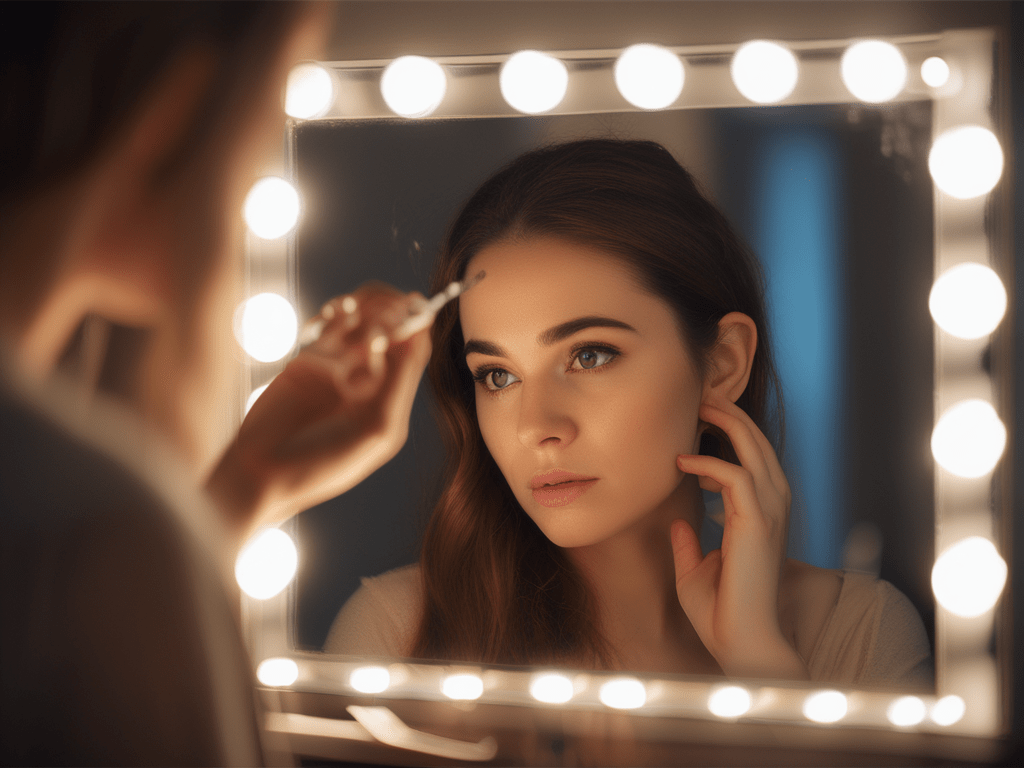
The Beauty Business

“Are you doing your eyebrows again?” Sue asked.

My college roommate opened the door to find me sitting at my desk, a magnifying mirror propped in front of me, the lamp on, poised to pluck another hair.

“Yes.”

“Do you do that every day?” she asked incredulously.

“Not EVERY day, no, but if I don’t do it regularly, they get out of control.” I replied self-consciously. I didn’t much appreciate her question. I made a mental note to try to do it more discreetly in the future, but there were limited opportunities given that I was tripled and privacy was hard to come by.

This was part of my war against a unibrow that had been ongoing since puberty. My brows were thick and dark and threatened to meet in the middle if I didn’t tame them. It was 1977, long before the popularity of Frida Kahlo made dark brows that edged toward the middle a chic choice a woman could make. In 1977 it was totally unacceptable, totally unfeminine.

I remembered that exchange during a recent phone call with my daughter. Leah called to vent about standards of beauty for women and the mental space, time, effort and money required to meet them. She objected to the fact we still labored under the onus of unreasonable expectations. “Who decides what is acceptable?,” she asked rhetorically. “And then we judge ourselves against that standard! Do men worry about that? Do men ask themselves if an outfit flatters them? Maybe there are men that do, but the average guy is probably asking themselves whether the shirt is appropriate to the occasion – are they going to work, a concert, to exercise? And that’s it. Maybe they think about the weather – should they wear long sleeves or short. They might think about whether the shirt matches their pants – maybe. We worry about so much more. I resent the whole enterprise! Ben has never asked me if a shirt he chose to wear makes him look fat!” Leah conceded that she doesn’t ask Ben that question either, but not so much because she wasn’t concerned about it, more because if the thought occurs to her, she rejects it because she recognizes that it is absurd, and she knows Ben is too smart (and kind) to answer with anything other than a positive comment about how she looks.

I agreed that it isn’t fair, women spend much more time tending to their appearance than most men. We both thought that women (and men, too) who enjoy the process and results of taking care of their skin, hair (the hair we want and the hair we don’t), nails, choosing outfits and accessories should feel good about their efforts – we would not stand in judgment. We should not think of them as shallow.  People should be free to play with their appearance and have fun with it. But those of us who don’t enjoy that, shouldn’t be burdened with the expectations of others. Right now, that is nearly impossible given the messages we have internalized about what women should look like. Sadly, at least for me, I would like the results: no stray hairs where they aren’t supposed to be, soft skin without blemishes, manicured nails, a fit, shapely body that can wear the latest fashions, feet that can wear cute shoes without pain, without putting in the time. I want to magically look put together and attractive. I think my daughter, and many women, want the same thing.

Leah railed against the mental energy being spent on all of this. “If half the mental energy and resources spent on the beauty and wellness market were spent on the world’s problems, think about where we would be,” she pointed out. “If the effort that went into that, went into problem solving how much better off would the world be? And who is profiting from this?”

I had no answer for her. It did bring to mind another conversation I had – this one with my very good friend, Merle. I shared my memory with Leah who commented, “Merle knows what’s up!”

Merle and I were in the San Francisco airport at the conclusion of our visit with her brother after our sophomore year of college. It had been an eventful, eye-opening experience being in the Bay City in 1978. We were tired and waiting for our flight, our nerves frayed when we got into a disagreement on the very topic that Leah and I were discussing 46 years later.

Merle made the case that “they” were forcing beauty products on us. “Who are ‘they’?” I asked. “Corporations – the ones selling the products, the magazines, the ad agencies, the clothing companies,” she explained. I wasn’t buying it. “But we are part of ‘they’,” I argued. After going back and forth, somehow I was taking it personally, we decided to take a break. We each took a walk in the opposite direction in the airport. We met up at the gate and didn’t discuss it further.

I had trouble accepting the idea that anyone was controlling me. I wanted to believe in my own agency – and not just in my own, everyone’s. Merle was being exposed to other ideas; she was taking Women’s Studies classes. The notion that there was a patriarchy and financial powers heavily influencing our choices resonated with her. I was not ready to believe that.

It isn’t that I haven’t thought about these issues in the intervening years. I have, and I have moved a lot closer to believing Merle’s argument. I had not, though, come as close to revisiting the topic in the same way until Leah called to vent.

So, have things changed? In some ways, they have not. Leah feels as oppressed by unrealistic standards of beauty as I did and do. It is still big business selling products and services that promise youth and attractiveness to women (now we’re supposed to use whole body deodorant!), lots of money, influence and power are associated with the industry. There have been some changes: perhaps there is more room for variation in body types – we do see chunkier women and more women of color in advertisements. Perhaps the market has broadened in that now men are targeted too, though I’m not sure that is a good thing. Women hold more positions of power today than they did in 1978. Today women hold 29% of the seats in Congress; in 1978 we held 4%. But we are 50% of the population! It remains to be seen whether a woman can be elected president, we haven’t been yet.

Given the persistent disparity in wages between the genders, the difference in the way female political candidates are treated, the continued violence against women, we have not made as much progress as I wanted. I only hope Leah will have a different conversation with her daughter when she is an adult.

It’s NOT the Economy, Stupid

Maybe it’s just me, but the political narrative that gets presented in the media makes no sense. I’m listening to a podcast where New York Times columnists are talking about the relatively healthy economy and why people are still not optimistic or confident in it. They are hypothesizing about Covid lag, lingering inflation, negative feelings about Joe Biden. Those things may be relevant, but I don’t think that is what is at play in the poll numbers.

I think the reason the polls show negativity is because, though the survey questions may target the economy, people are pessimistic because the world is going to shit. Everywhere you look, it is scary. I think this view applies to Democrats, Republicans and Independents. Personally, I find the divisiveness in our country, whether it is around Trump’s trials, the war in Gaza, global warming or the issues the panelists were talking about (lingering effects of Covid and inflation), call into question whether we will be able to come together to address the problems. I don’t think I am alone in being pessimistic. We are a country famous, maybe even envied, for our optimism. I’m not sure that still applies.

In fact, just the other day I was at a gathering at my daughter’s house. A friend of hers was talking about his lack of hope generally, that it was hard to find things that inspired confidence in the future. He made the point that one of the few bright spots, something he was grateful for, was the young children of his friends. When he looked at them, their innocence and promise, it made him feel better. The man who was expressing this thought is in his mid-thirties.

Ever since that march in Charlottesville in August of 2017, the Unite the Right Rally where folks were marching with tiki torches, and our President couldn’t condemn it, I have been uneasy. I imagine for some that might not have been as seminal a moment as it was for me, but there have been so many things that have happened since then that make me question whether we live in the same reality. That event hit me hard. I thought I was watching something that happened fifty years ago, not a protest in an enlightened college town. And things have only gotten worse. The chasm has widened.

There is the possibility that we have always been this divided, but we just didn’t know it. People’s ugliest thoughts weren’t broadcast on social media. If someone stood on a soap box in a town square, even Union Square in New York City, and proclaimed that (insert your favorite scapegoats) were the devil, it was likely to fall on deaf ears. Now that person gets support from people across the globe who share a similar warped world view and the idea gets momentum. It also gets overrepresented in the social media narrative because it generates clicks – controversy or outrageousness always does. It is hard to get a handle on how many believers there really are when you have bots and trolls and foreign and domestic agents who benefit from the chaos.

If you ask me that classic question, “Are you better off today than four years ago?” I don’t know how to answer that. My economic situation is about the same, maybe better, but the precariousness of the health of the world, in every sense, affects my response. My feeling has little to do with Joe Biden or his policies. To me it feels like he is working to hold back a tsunami of terrible things – trying to preserve women’s reproductive rights, slowing climate change, bolstering the economy, minimizing inflation, reducing tensions in the Middle East, addressing crime, the list can go on. Some would include the southern border as a crisis. In some ways it is, but in other ways it is a manufactured panic. There are real problems with our immigration system, but some politicians are invested in keeping it a problem rather than making it better. I think Biden is doing a reasonable job against staggering obstacles. He has not created these problems.

No matter how good a job he does, though, it pales in comparison to the challenges. And it is done in the setting of unprecedented division.

I see footage of what is going on at Columbia University and other college campuses where backers of Palestinians have set up encampments to protest United States support of Israel and the universities’ investment in Israel and/or our defense industry that aids Israel. Separate and apart from the rightness or wrongness of the protesters’ positions (a topic for another essay), there is a way to get your message across effectively. If the idea is to win people over to your side, persuade them of the righteousness of your position, it isn’t by shutting down traffic on the Golden Gate Bridge or harassing Jewish students or impeding folks from getting to their calculus class. In most cities, (perhaps all cities – I am not a lawyer) you need a permit to stage a protest or march. There is good reason for this. It goes back to the balancing of different legitimate interests: the protesters and other citizens going about their lives. It is fine to disrupt the routine, to a degree. But you can’t purposely jeopardize public safety. I’ve attended any number of rallies for causes. I believe in showing up to voice my opinion on public policy, but there is a way to do it. Chanting hateful slogans doesn’t help either.

We live in confusing times. I think the polls reflect people’s general uneasiness, not a judgment of the economy. I wish Biden was more effective at communicating his vision for the future of our country. I do fault him for not showing clarity of purpose and leadership, but I don’t hold him responsible for the sorry state of our union. I believe we are suffering the effects of the cynicism, greed and fear that has become the stock and trade of the Republican party, along with the poisonous influence of social media over the last decade. Add in natural disasters which are increasingly frequent with climate change, seemingly endless wars across the globe and it feels overwhelming. I don’t know what the solution is, but we need to understand and acknowledge what we are dealing with before we can find answers. Polls are not shedding light on the issue. We need to be asking different questions.

Goals for 2024

Sargent portrait – seen at the exhibit at Boston’s Museum of Fine Arts

Historically I am not one to set goals or make resolutions. I think that reluctance stems from the recognition that we mostly fall short and then have to deal with the failure. The other day I was watching, of all things, House Hunters and this guy in the couple made a point of needing to be able to post his annual goals on his bathroom mirror. This was something his wife didn’t especially want to see every day, so they wanted their new home to have separate vanities in the bathroom. I thought the guy was way over the top, but it got me thinking. While goal setting presents risks, it offers real opportunities: to prioritize how I use my time, to remind myself of what is important to me, to feel accomplished when something is achieved. Of course, I don’t need to share them publicly since that adds pressure, but what the heck. What is my blog for if not to take some risks, so here goes:

Read Moby Dick.

            [No other story is referenced as often in other books.

             It appears on lists of the best American novel.

            And yet, somehow, I never read it.

            I think it is time.]

Write everyday – or realistically almost every day.

            [I only posted 29 essays on my blog in 2023.

             My goal has been weekly.

             Perhaps it is time to reconsider my goal.

             Okay, my goal for 2024 is to reassess how often I want to add to my blog.]

Send out 10 query letters to literary agents.

            [probably more]

Accept rejection and continue onward.

Stop wanting more!

            [I have enough.

            Be more Zen,

            Let go of expectations.

            Exhale the want.

            Inhale the beauty,

            Appreciate the gifts,

            Even on cold, damp, gray days.

            Hear the music: bird calls, the wind in the trees, voices harmonizing.

            See the splendor: light, color, richness rendered on a Sargent canvas.

            Receive what is given,

            Feel the love expressed in a glance, in a gesture.

            Let it fill me.

            Trust the love.

            Trust the relationships.

            The child in me still wants…]

Plan a trip.

Sort through the clutter.

            [Simplify]

Gary, my husband, upon reading the above, said, “Good luck with that. I thought reading Moby Dick was enough.” Maybe it is ambitious, but I’m going to try. Let’s check back in a few months, meanwhile, Happy New Year! Wishing you all a peaceful, joyful, and healthy year ahead whether or not you set goals or make resolutions.

“You Don’t Have to be Jewish to Love….”

There was a ubiquitous advertising campaign when I was growing up – “You don’t have to be Jewish to love Levy’s Rye.” I can see the poster in my mind’s eye plastered on buses and the walls of subway stations. A picture of a cute Chinese boy with a sandwich.

This ad came to mind as I was thinking about one aspect of our trip to the Eastern European capitals. We took tours of the Jewish Quarters of Budapest (Hungary) and Bucharest (Romania). The tour guides were not Jewish, but they showed a deep appreciation and knowledge of Judaism and the culture associated with it. As tour guides, one would expect a certain familiarity with the topic, but not necessarily warmth or affection. In the current environment, given the heightened tensions and increasing boldness of antisemites, I had not expected their sincerity or openness. But, the truth is, as with all groups, you shouldn’t have to be a member to appreciate what that group brings to the table (literally or figuratively).

I was moved by the attitudes of our guides. They came to their interest through their own personal journeys. In one case because of a romantic relationship that led her to live in Israel for 7 years, and when that relationship ended, she maintained her connection, though she had not converted. In the other case academic study of history led to curiosity and more research into Judaism. As part of that process, she became acquainted with the production manager of the Yiddish Theater in Bucharest and arranged for us to meet him – more about that in a bit.

In Budapest the area we explored is still called the ‘Jewish Quarter’ and there are some Jewish residents, but not many. The name is a relic of a time long ago. We walked the narrow streets, learning that it is an area that is now popular among young people because of the restaurants, bars and shops. It is also home to the largest synagogue in Europe – the Dohany Street Synagogue.

Before we toured the synagogue, we stopped at the shoe memorial that lines the Danube River, a display that commemorates the murder of Budapest’s Jews by shooting them into the river which occurred between December of 1944 and early January of 1945. Our guide didn’t sugarcoat things – she acknowledged that Hungary fought on the side of the Nazis and that their fascist party, the Black Arrow, orchestrated the round up and murder of the remaining Jews. I wasn’t expecting that unvarnished acknowledgement but was grateful for it. The memorial was created in 2005, marking the 60th anniversary of those horrific events. The shoes are a poignant and painful symbol of the human beings lost. Men, women and children swept into the current leaving only their shoes as tangible evidence of their existence. Hungary today has a Jewish population of about 47,500 in total, with many living in and around Budapest. Before World War II Budapest alone had a Jewish population of 200,000, with an estimated 825,000 in the country as a whole.

Our next stop was the synagogue. Since we were traveling after the attack by Hamas on October 7, security was heightened. Entries were timed and by appointment only. We went through metal detectors and our bags were checked. The synagogue is so impressive – and reminded me, in its grandeur, of many churches we had visited throughout Europe. I believe the sanctuary could hold 3000.

Neither my family nor Gary’s had roots in Hungary, so we were not tracing our family tree. Oddly enough, one of the names on the headstones we saw in the cemetery next to the shul for Jews killed in the Budapest ghetto during the war years was Sandor Bruder – Bruder was my paternal grandfather’s original last name, he changed it to Brody when he arrived in America. It was chilling to see the name on a grave, but I have no knowledge of an actual connection.

Another note of significance is that the Dohany Street Synagogue was where Theodore Herzl, widely considered the father of modern Zionism, was born and raised. Mount Herzl, the home of Israel’s national cemetery in Jerusalem, is named after him.

Memorial to the victims of the Holocaust in the courtyard of the Dohany Street Synagogue

The tour of the Jewish Quarter was arranged through our cruise company, Viking. There were about 15 of us and I don’t think most of the others, aside from my brother-in-law and his wife were Jewish. I found it interesting that they chose this tour – there were other options. Again, it was heartening to think that folks who didn’t share our heritage were interested enough to make this choice.

Our tour of the Jewish Quarter in Bucharest, Romania was arranged privately so it was just the four of us. The guide, Alina, asked us if we would want to meet the production manager of the Yiddish Theater if he was available. We were shocked to learn that there was a Yiddish theater, neither the city nor the country has a Yiddish speaking population that would seem to support it. We had no idea what to expect but were happy to see the theater and hear what the manager had to say. After walking through the area and viewing the outside of three synagogues – they were each locked because of security concerns in view of the war in Gaza (two were museums, one continued to host religious observances) – and learning about the history and current status of the Jewish community in Bucharest, we headed to the theater.

The production manager, George-Marcel, limped into the lobby to greet us, he was having some knee problems, but that didn’t get in the way of his showing us his pride and joy – the theater. He shared his own history, in English, telling us that decades ago he was at a low point in his life, working a job that brought him no satisfaction, when he heard about a position at the theater as a cleaner. He explained that as soon as he walked into the building, he felt he was at home. The people were accepting. The spirit of the place touched him. Though he was not Jewish, he identified with the stories that were being told. “Their story is our story,” he said, “their history is our history.” He didn’t see the history of the Jewish people as separate from that of the Romanian people. This resonated with me – the world would be a better place if we all believed that. Rather than confining our focus to our own traditions or limiting our understanding to our own tribe, if we embraced learning about each other and thus discovering our common humanity, there would be a much greater chance of peace in this world.

Images of the Yiddish Theater

Over the many years George-Marcel worked there, he took on more and more responsibility, eventually becoming the production manager. In the process he learned more Yiddish and Hebrew than I’ll ever know. He also built relationships with the artists who came through, as well as the small regular staff. The theater receives some government funding, not enough to keep it solvent but something to build on. They stay afloat with additional donations. It was interesting to us that the government, I don’t recall if it was the city or national government, values their work enough to continue funding it. The theater does put on other productions and collaborates on different projects but continues to offer Yiddish plays and musicals. Like with opera, a translation is projected above the stage so the audience can follow along.

After the tour, we went to George-Marcel’s small office, filled with knick-knacks, where a large Israeli flag hung against the wall next to his desk. One of the things common to the countries we visited, particularly Hungary, Serbia and Romania, was the popularity of home brewed brandy – which was called different names in each place. George-Marcel took an unmarked clear bottle from his bottom desk drawer, distributed paper cups and poured a bit in each and we toasted. ‘L’Chaim!’ His homemade brew was made from apples, but my palette didn’t detect anything other than alcohol. The warmth I felt as the liquid made its way down my throat matched the warmth in the room. George-Marcel asked us to sign his guest book which we did, expressing our thanks for his welcoming us and for sharing his knowledge. We wished each other well.

In the lobby of the theater – our tour guide, Alina, in front, George-Marcel between us

It was the last day of our trip, and it was a wonderful note to end on. Though we were thousands of miles from home in a country so different from our own, we made a connection that we will remember for a long time to come.

In honor of the fifth night of Hanukkah, here is a display of menorahs in the museum of the Dohany Street Synagogue.

Note: If you are in Bucharest, Alina offers other tours of the city as well – we would heartily recommend her – alina@wheninbucharest,.com