Note: Since I have been traveling over the last several weeks, I have not been able to devote as much time to this blog post as I would like. Please consider it a work in progress. (the whole blog is actually a work in progress!) I want to continue exploring Brody family history and its implications but my life gets in the way. Bear with me as I continue the journey.
After reading the letter from the priest, I felt a need to see if the events described had been recorded; to see if history had taken note of the massacre. I did some research, mostly on the Internet. I also looked at a couple of books, including Jewish Roots in Poland by Miriam Weiner.
I also wanted to find the towns listed in the letter. In addition to looking at maps online, I poured over a world atlas.
I did find most of the towns, though it was challenging. The translation of town names, and my total ignorance of Polish, made finding these locations difficult. Several still exist and can be seen on a current map of Poland (Jaslo, Dukla, Nowy Zmigrod), all in the southeast corner of the country. By the way, Stary in a town’s name means ‘old,’ while Nowy in a town’s name means ‘new.’ Oddly, to me anyway, Zmigrod (without Nowy or Stary attached) appears to be miles away to the west and slightly north of the towns mentioned in the letter.
In looking for mention of the massacre in Halbow, I found another massacre exactly one month earlier, June 7, 1942, in the same area. At first I wondered if it was the same incident, perhaps the month was mistakenly recorded. After further exploration, it appears that there were actually two separate incidents (or “actions” in the language of the war) exactly a month apart. On one level it is hard to believe that there could be two (intellectually I know there were many “actions”), but the scope and horror of the Holocaust is still hard to comprehend, even all these years later.
I did find the July 7th genocide noted in several places and it appears that there is a monument erected to memorialize the lives lost in Halbow.
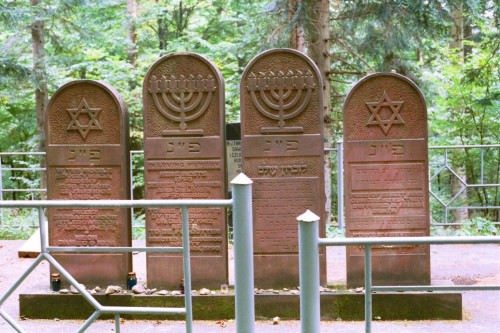
In the 1990s many children of Holocaust survivors visited Eastern Europe searching for their parent’s hometowns and gravesites of family members. Some of those travelers documented their findings. As a result, I was able to find a picture of the monument (see above). The monument was funded by Zmigrod survivors’ families in America. I was relieved to find that at least there is a monument, but another issue emerged from my research.
The priest’s letter indicates that 1434 people were buried in the mass grave in Halbow. The sources I found on the Internet reported 1250 .(archiver.rootsweb.ancestry.com/th/read/Galicia/2009-07/123905001; www.jewishgen.org/yizkor/nowy.zmigrod1/now065.html; kehilalinks.jewishgen.org/zmigrod/zmigrodholo.htm).
I am disturbed by the discrepancy and wonder what it represents. As mentioned above, in doing the research I found two separate incidents, each with 1250 victims recorded. But it seems odd that the number would be exactly 1250 in both cases. Were they estimates? How were the numbers documented? Could the 1250 represent only the Jewish victims? Or, could the priest’s information be incorrect? It raises so many questions about how history is documented.
Which led me to another question: Does the number matter? My gut reaction was, of course it does – we are talking about 184 souls not ‘officially’ counted.
But, then, I don’t want to obsess about the actual number. The number, whether it is 1250 or 1434, is too many to accept. Either way it is roughly the size of the suburban high school in my community. It is almost half the population of the town I live in. The number is important, but it isn’t the central point – the central point is that humanity was lost in every sense; in the lives cut short and in those who perpetrated the crime. Those who were responsible for the crime discarded their humanity.
We struggle today to identify and agree to facts. Sometimes when the numbers are in dispute people take the opportunity to dismiss the larger issue. Especially for those with an agenda. That these atrocities were committed is a fact that cannot be denied. My family bore the weight of it, in the loss of life, in the loss of faith and the silence that followed.
I wish I had an answer, though, for reconciling discrepancies in records (data) that sometimes lead us to lose the forest for the trees.


Leave a comment